The state company wants to sow 20,000 hectares nationwide, of which 14,623 -70%- will be in Pinar del Río.
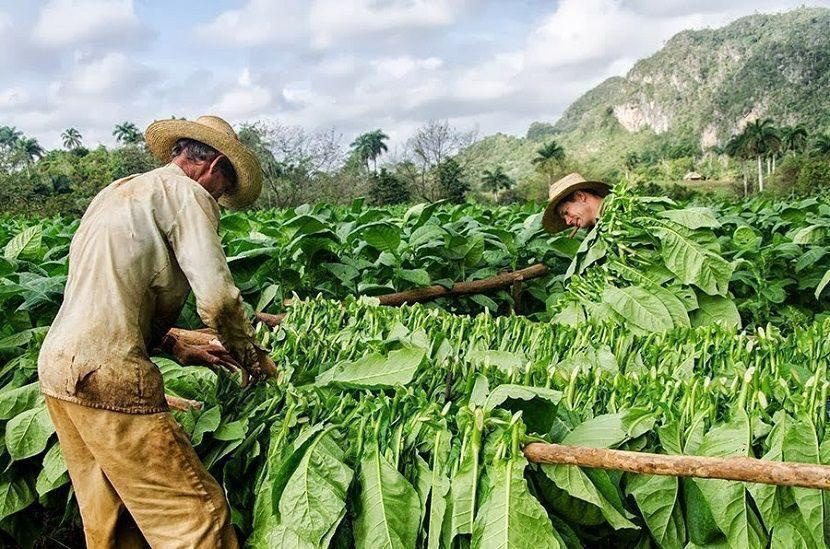
 14ymedio, Havana, August 23, 2025 — Desperate to boost a sector that is not doing as well as they hoped, the authorities of Tabacuba told the official press this Friday that for the new 2025-2026 campaign, they have planned incentives for the vegueros (tobacco growers) to produce more. Not only will they increase the freely convertible currency (MLC) payment to producers by 3.6 per cent, but “inputs in MLC will not be charged.” The catch, however, is that they will continue to be paid for part of the harvest in this currency, which is increasingly devalued and on the way to disappearing.
In the informal market, the MLC, which was created in 2019 as equivalent to the dollar, was quoted on Sunday at 195 Cuban pesos, while the dollar continues to rise and exceeds 400 Cuban pesos. Its purchasing power in the State’s own shops has weakened, and with it the confidence of citizens and producers themselves, who continue to receive part of their payments in that virtual currency.
What Tabacuba offers is not so much an incentive as an unequal treatment in which the farmers accumulate devalued MLC, which they can’t spend.
The incentives are also not for everyone but for tobacco companies that are dedicated to the cultivation of second-growth tobacco (lower quality leaves, used for the filler of cigars) and the so-called sun-on-stick tobacco, and it includes a 30 percent increase in the collection payment for those who incorporate themselves into this system before May 31. New producers or those moving from shaded tobacco to sun-on-stick will not be charged for MLC inputs or materials in that currency to build drying barns.
In short, what Tabacuba offers is not so much an incentive as an unequal treatment in which the farmers accumulate devalued MLC, which they can’t spend, since the shops that sell in this virtual currency are increasingly undersupplied.
The news comes at a time when Cuban tobacco is not exactly experiencing a golden age. The previous campaign, 2024-2025, which is in its final stretch, left rather modest figures: 10,459 hectares were planted in Pinar del Río -fewer than those planned for the next campaign- of which about 15 million cujes (sticks of tobacco) were harvested. For the time being, with some companies having already closed their plan and others about to do so, 90.7 percent of the planned 10,536 tons has been collected.
Production increased last July by 357 tons of tobacco compared to July 2024.
After a 2023-2024 campaign that did not meet expectations for the sector, which is one of those that supplies the most foreign exchange deliveries to the State, the authorities tightened their belts and decided, as of now, to motivate the farmers by creating an “exceptional stimulation system.” It consists of selling food products monthly to those who work on tobacco selection and destalking.
With the new system, production increased last July “by 357 tons of tobacco compared to July 2024, and by 180 tons more than the previous month,” applauded the tobacco authorities. That putting food on the table of workers would increase the profit so much is an eloquent statement about the needs of Cuban workers, even in a sector as lucrative–at least compared to others–as tobacco.
For this campaign the hope is more ambitious: sowing 20,000 hectares nationwide, of which 14,623, 70%, will be in Pinar del Río. The irrigation of seedlings will officially begin on September 6, although companies such as Viñales, La Palma and Consolación have already started the process, said Granma. Some 120,000 plots out of a total of 269,400 are expected to be irrigated during the month. Sowing will be divided between October (10%), November (55%), December (30%) and the first days of January (5%).
Tabacuba will also install 40 new irrigation tunnels in Vueltabajo.
Not willing to lose more ground, perhaps under pressure from its foreign partners, Tabacuba will also install 40 new irrigation tunnels in Vueltabajo to ensure that the covered (shaded) tobacco receives water.
However, 7,876 drying barns are needed to cover the more than 14,000 hectares in Pinar del Río. Most of them, 6,175, have already been built, but the missing ones are stalled due to lack of wood. “Here is the fundamental problem of the increase in planting in the province, because despite the links with agroforestry companies, we still do not reach the daily average of 5,000 pieces” of wood to support the planned hectares of tobacco, said Tabacuba.
There are more than 3,000 tons of fertilizer available.
For once, said the company’s managers, there will be no problems with fertilizers, a resource that has disappeared in the furrows: there are more than 3,000 tons available for seedlings, and those intended for planting must arrive between the end of August and the beginning of September.
At the beginning of August, 14ymedio reported on the difficulties faced by the vegueros in Pinar del Río due to the fall in value of the MLC. The currency functioned as a kind of backup against the increase in the price of materials to construct tobacco plantations and the accumulation of debts. Until recently, one of the producers confessed, it was “the only incentive for farmers, so we built the economy on the informal value of MLC. Today, it has fallen dramatically due to the latest changes in the country by the partial dollarization of the economy.”
Translated by Regina Anavy
____________
COLLABORATE WITH OUR WORK: The 14ymedio team is committed to practicing serious journalism that reflects Cuba’s reality in all its depth. Thank you for joining us on this long journey. We invite you to continue supporting us by becoming a member of 14ymedio now. Together we can continue transforming journalism in Cuba.