If it doesn’t rain, Water Resources authorities warned, the situation will be serious at the end of the month.
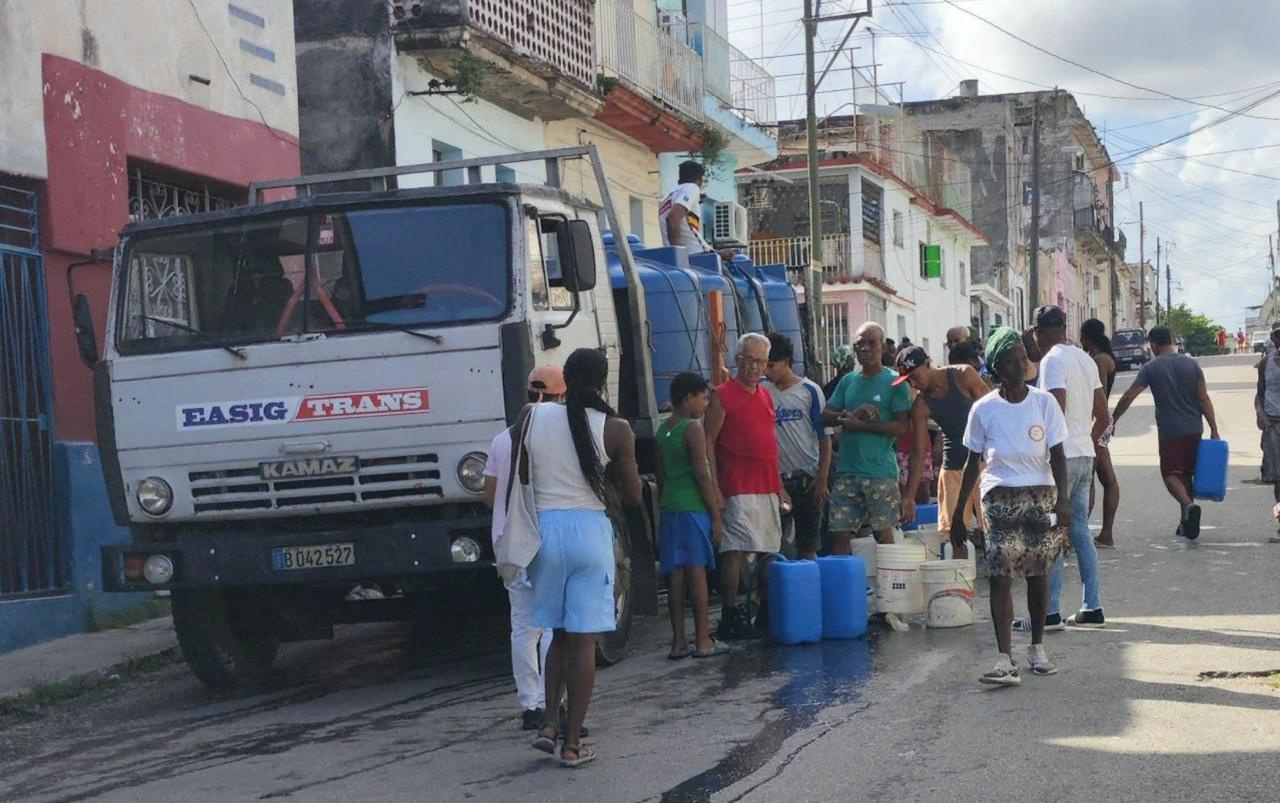
 14ymedio, Havana, August 22, 2025 — Many Cubans had hoped that Hurricane Erin’s passage through the Caribbean would bring some relief to the country’s reservoirs. But it barely rained on the island, and far from improving, the water situation has become more critical. This Thursday, on Cuban Television news, the Water Resources authorities reported that 2.9 million people have been affected, totally or partially, by the low supply of water, mainly due to the drought.
Other causes mentioned were equipment failures and electricity shortages, which severely limited the operation of conductors and pumping stations. The authorities acknowledged that the current scenario is “critical” and warned that if there are no significant rains by the end of August, the situation at the end of the month will be similar to that experienced in 2004 and 2005, when the drought hit hard.
The president of the National Institute of Hydraulic Resources (INRH) also confirmed in the news that only four territories are currently free of drought impacts: Pinar del Río, Artemisa, Isla de la Juventud and Matanzas. Even in Havana, which was also on that list, the use of wells has already begun to be regulated.
Other provinces, such as Santiago de Cuba, Holguín, Las Tunas and Ciego de Ávila, currently face the worst scenario.
In Sancti Spíritus province, the Aqueduct and Sewage Company reported on Thursday that 111,590 inhabitants have service interruptions. The causes are broken pumps (18,557 people affected), partial drought (35,686) and energy deficit that prevents pumping (56,851). According to Roberto Nápoles Darias, director of the company, several key pumping stations are also paralyzed due to lack of spare parts.
In many areas the supply depends exclusively on tanker trucks, but those available are barely sufficient to supply in cycles of 15 and 18 days.
The volume of water in rivers and reservoirs has also dropped dramatically. The San Juan de Letrán springs, which supplies 42% of Trinidad, went from 80 to 90 liters per second to only 15 to 20. And in La Yaya, which serves almost half the city of Sancti Spíritus, water can only be pumped between 5:00 and 11:00 in the morning. As warned by Nápoles, in many areas the supply depends exclusively on tanker trucks, but those available are barely sufficient to supply in cycles of 15 and 18 days.
Two weeks ago, a report from Escambray exposed the quality of the water that the residents were receiving: dirty, with mosquito larvae and a bad smell. Faced with the situation, the authorities admitted that the problem was out of their hands. Until it rains, they will continue to pump what little water remains at the bottom of the reservoirs.
In Las Tunas, Periódico 26 confirmed that more than 90,000 people in the capital city are suffering from the drought. According to David Legrá Hernández, local director of Aqueduct and Sewage, pumping from sources such as Piedra Hueca or the Cayojo reservoirs is slow and constantly interrupted by blackouts. Electrical failures are frequent, and sometimes the pumping stations spend the whole night without power. This delays distribution cycles and leaves much of the city without water for hours.
Legrá explained that, although critical areas are prioritized, there are places like the La Cana basin, where it has rained “very little, almost nothing,” and precautions are useless against the lack of water. He also regretted that the supply mechanisms have become obsolete in the face of a “city that has grown, in which its sources of supply and distribution mechanisms now fall short.”
The lack of drinking water in homes has even triggered protests, such as the one last Tuesday in Centro Habana.
The drought, which had been causing alarm for months, has taken a critical turn in recent weeks. The lack of drinking water in homes has even triggered protests, such as the one last Tuesday in Centro Habana, where a group of people with buckets cut off Reina Street in protest after going more than seven days without water.
Earlier this month, another popular protest took place in Cajimaya, a village in the municipality of Mayarí, in Holguín. According to reports on social networks, where videos and images were also shared, several people were arrested by the police.
While families are desperate to find a neighbor with a well or a relative who is still getting water through the pipes, the authorities do not seem to have a coherent plan. On the one hand, they acknowledge the alarming water shortage, and on the other they persecute those who complain in the streets that their wells have been dry for weeks.
Translated by Regina Anavy
____________
COLLABORATE WITH OUR WORK: The 14ymedio team is committed to practicing serious journalism that reflects Cuba’s reality in all its depth. Thank you for joining us on this long journey. We invite you to continue supporting us by becoming a member of 14ymedio now. Together we can continue transforming journalism in Cuba.