Cuban Exile in Miami Urges a Declaration of ‘Void’ for the Constitutional Referendum in Cuba

Rosa María Payá criticizes the referendum, saying that the “constitutional text directly violates the most basic rules of democracy.” (@RosaMariaPaya)

14ymedio biggerEFE, via 14ymedio, Miami, February 25, 2019 — Opposition and Cuban exile organizations called on the international community today to declare the process of constitutional reform in Cuba invalid and to ignore the official results of the “fraudulent” referendum of Sunday.

Rosa María Payá, the leader of the Cuba Decides movement, told EFE that the process has been “flawed since the beginning,” and she denounced the increase in repression and intimidation of civil society during the voting held this Sunday on the island.

She said that at least “nine people are missing and a hundred detained,” and dozens of opponents were beaten during a day that also lacked “national and international observation.” continue reading

The activist considers the process in which more than 7,000,000 Cubans went to the polls this Sunday to decide on a new constitution “illegitimate” and said that it doesn’t modify the Communist political system.

Cuba Decides and other exile groups in Miami, among them the Movimiento Democracia, denounced the constitutional referendum as an “imposition” of the ex-President and leader of the governing Communist Party of Cuba (the only legal party), Raúl Castro.

In this sense, they urge the international community, including the democratic governments of the region and the European Union to follow the Organization of American States (OAS) in disavowing “whatever result” the constitutional process produces.

The Secretary-General of the OAS, Luis Almagro, said today that it “does not recognize the acts and institutions” created by the new constitution in Cuba.

Opponents and exiles say that the referendum originates from a commission formed by the Communist Party and members of the National Assembly, “none of whom were chosen in free, just and plural elections.”

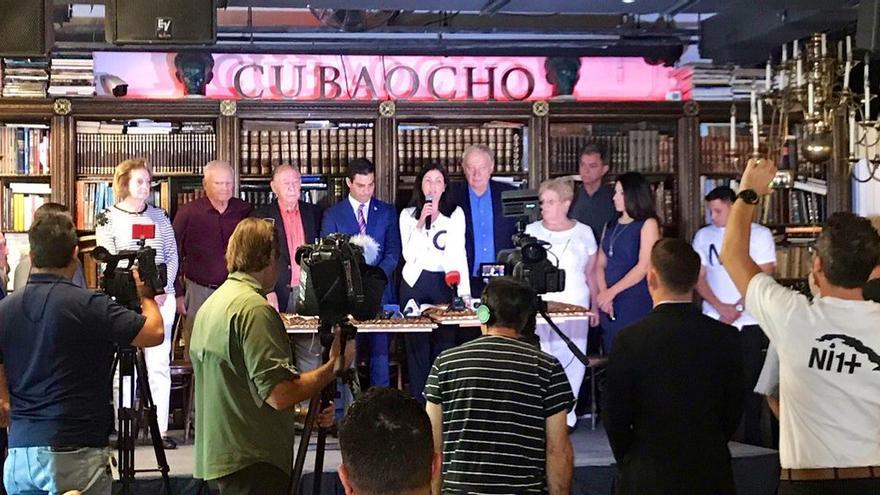
During a news conference, attended by Miami Mayor, Francis Suárez, the Cuban exile groups complained that the “constitutional text is designed to guarantee the perpetuity in power” of the Cuban Communist Party.

Payá also stated that the “constitutional text directly violates the most basic rules of democracy” and threatens with the “use of arms” Cubans who “want to change the system it defines.”

The activist said that on the island there is also a sense of nervousness over the crisis of political legitimacy in Venezuela facing president Nicolas Maduros and that it contributed to the repression this Sunday.

The day was marked by “the lack of transparency and verbal and physical violence against members of civil society and the opposition by repressive forces and, in many cases, the electoral authorities,” said Cuba Decides.

In addition, Payá condemned the raids on homes, the absence of conditions for a secret vote and propaganda in favor of the official option in polling places, among other irregularities.

According to official Cuban data, of the more than 8 million voters registered, more than 7.5 million (81.5%) had already voted one hour before the polls closed on Sunday.

Translated by Regina Anavy

__________________________________

The 14ymedio team is committed to serious journalism that reflects the reality of deep Cuba. Thank you for joining us on this long road. We invite you to continue supporting us, but this time by becoming a member of 14ymedio. Together we can continue to transform journalism in Cuba.

Observers Criticize Delay in Announcement of Referendum Results

The OCDH had 170 observers, deployed in 12 of the 16 provinces of the country. (14ymedio)

14ymedio bigger14ymedio, Havana, February 25, 2019 — After election day Cuba returned to its routine this Monday and the majority of the population shows no signs of interest in the “preliminary” results of the referendum on the Constitution that will be announced starting at 3:00pm by the National Electoral Commission (CEN).

The improvements in transportation that characterized the days leading up to the referendum ended as quickly as they had arrived. The signs for Yes to the new Constitution remain, omnipresent, in stores, state offices, buses, and billboards.

“I only hope that now the propaganda on television lessens a little, because we’ve had a few days in which it’s been impossible to sit and watch a program without something coming out about the referendum,” sighs Rebeca, a Havana resident of 36 who says she didn’t vote in the process. “I preferred to go to the beach because the day was really nice.” continue reading

In Santiago de Cuba, the leader of the Patriotic Union of Cuba (Unpacu), José Daniel Ferrer, denounced the police cordon around the opposition organization’s headquarters and the arrest of several of its members. The ex-political prisoner reported on social media about the violent detention of opposition figures, some of whom were left by police on the highway*, far from voting centers.

The Cuban Observatory of Human Rights (OCDH), headquartered in Madrid, has denounced the delay of the CEN in publishing the preliminary results of the process. “More than 16 hours after the closing of the polling places, the official data of participation and the results are still not known,” the organization laments in a press release.

The OCDH believes that it is “the same line of lack of transparency that has predominated in the performance of the Cuban government throughout the entire process.” The independent organization lists irregularities during the voting such as “the manipulation of the electoral register, the use of pencils” in place of pens to mark the ballots, and the absence of international observers, among others.

“It makes us even more suspicious of what the Government will have done in the darkness of the early morning,” adds the press release. “According to the data received so far, the sum of the rejections (votes for No, blank ballots, null votes, and abstentions) would surpass 30% of the electoral register, with an upward trend,” it assures.

the information is based “on acts of vote counting facilitated by electoral observers, OCDH collaborators, and reliable citizens, who in the midst of a climate of vigilance and repression were able to exercise protection of the vote,” specifies the text.

On Sunday’s events, the OCDH pointed out low voter turnout, especially in Holguín, Camagüey, Sancti Spíritus, Villa Clara, Havana, and Pinar del Río, contrary to the assertions of the CEN, which announced that 74.09% had cast their votes as of 2:00 pm.

The raid on activist centers, arrests, and lack of privacy to cast a vote also weighed down the process. “In Artemisa, it’s reported that members of polling stations visit old people in their homes and pressure them to vote for Yes,” pointed out the organization in one of its reports published the day of the vote.

The OCDH had 170 observers, deployed in 12 of the 16 provinces of the country. The observers have carried out a systematic monitoring of the different phases of the election day and their work “seeks to corroborate that the process fulfills national electoral norms (Law Number 37) and with the minimum international standards.”

Several 14ymedio reporters also participated in the ballot counting. Among the voting centers visited was that on Lombillo street, between Factor and Estancia, a 12-story building in the Plaza of the Revolution municipality. In this building of district 72 live mainly workers from the Ministry of Transport and of the Provincial Court.

The electoral register of this polling place varied throughout the day until arriving at 498, because 112 new voters were added, the majority national guests of the nearby hotel Tulipán. Of the total voters 429 (86.14%) voted, abstentions reached 13.86%. No was marked on 25 ballots (5.83%) and there were 4 blank ballots (0.93%). Yes was marked 400 times and obtained 93.24% of the valid votes but only 80.32% of the electoral register of this polling place.

“This is a community highly integrated into the Revolution and we have many Communist Party activists,” explained María de los Ángeles, a retiree who lives in the building. “Since they built this building we have been like a family and now we have come to give complete support to that Constitution because it guarantees the existence of the homeland.”

A few blocks from this place, in the Nuevo Vedado area near 26th Street, where the residents enjoy a greater purchasing power, Yes got a less inflated majority, with barely 70.14% of the electoral register.

The big houses where some of the relatives of the accused in 1989’s Cause Number 1 live. Cause Number 1 was a case in which several generals and high-ranking military officers were executed or condemned to long sentences for their supposed link with narcotrafficking, had their doors and windows closed this Sunday, as this newspaper verified.

“Here people are really unhappy with the economic situation,” commented a resident under condition of anonymity. “In this neighborhood, five years ago we had at least ten private restaurants, and now there are only three left because they have suffocated them with the taxes,” he laments.

In the two polling places for District 82 in La Timba, a low-income neighborhood near the Plaza of the Revolution, Yes obtained 71.6% of the electoral register, a similar support to the district of Nuevo Vedado, but abstentions were even greater with 19.1%.

*Translator’s note: It is a common police practice, in Cuba, to pick up dissidents and instead of taking them to a police station and formally detaining them, to simply drive them far from their homes and leave them on a deserted country road.

Translated by: Sheilagh Carey

______________________________________

The 14ymedio team is committed to serious journalism that reflects the reality of deep Cuba. Thank you for joining us on this long road. We invite you to continue supporting us, but this time by becoming a member of 14ymedio. Together we can continue to transform journalism in Cuba.

Apathy in the Streets and Unease in the Cuban Government

Antonio, a habanero who lives on the street, says that he has “nothing to lose. I’m going to vote No.” (14ymedio)

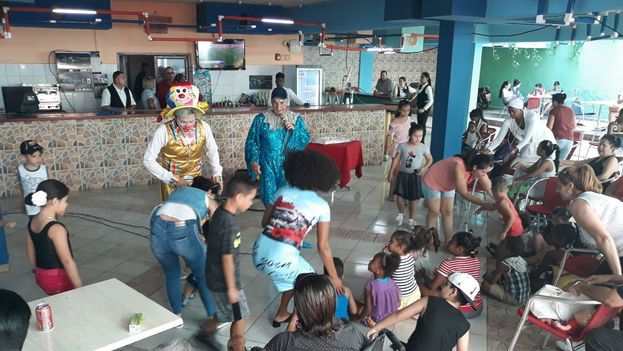
14ymedio bigger14ymedio, Havana / Camagüey | 23 February 2019 — Clown performances promoting a Yes vote on the referendum, long lines to buy food and a general apathy about voting on the new constitution shape the scene on Saturday in Cuba, a few hours before the polling places open, where government officials have more at stake than a new charter.

From early in the morning families have been lining up at the Coppelia ice cream parlor and people are crowding into the agricultural markets. The cinemas and theaters are running their usual programs, but the countdown for the vote this Sunday has increased police patrols in the streets, with uniformed troops and members of State Security.

In the cafeteria of the Hotel Tulipán, in Nuevo Vedado, a clown encourages the toddlers with statements about the Constitution. “Raise your hands, children, if you’re going to wake up early tomorrow,” says the blue clown, played by the actor, Noel Torriente, in a show called Children also vote for the fatherland. continue reading

In the Hotel Tulipán, the blue clown puts on a show called Children also vote for the fatherland. (14ymedio)

A man of 36 years who offers guide services to tourists on the outskirts of the Plaza de la Revolución doesn’t seem very enthusiastic and adds that the new constitution won’t do much to put “beans on my table”. He is one among many who believe that the referendum has nothing to do with their own interests.

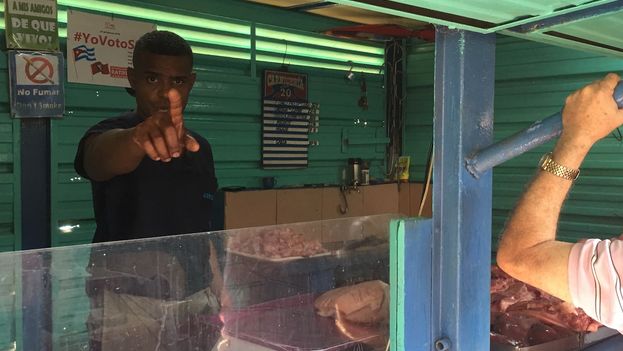
In the Market at 17th and K, in Vedado, there are carrots and beets, but the longest line is for pork, even though the price per pound is more than a worker earns in a day. The seller screams “No photographs!” when he sees a reporter approach; his kiosk is papered with posters for a Yes vote.

The pork seller screams “No photographs!” when he sees a reporter approach. (14ymedio)

Nearby, in the doorway of the bus terminal, Miguel sells newspapers and believes that the correct thing to do is to go and vote, because he considers it “important for the country. In the assemblies everyone expresses their opinion and now you have to go and ratify,” the old man of 80 years adds.

Esperanza, a school employee, doesn’t share his opinion. “Everyone should vote No, to see the Government’s reaction.” She has already decided to reject the constitutional text but hasn’t told her colleagues and friends because she “doesn’t want to lose my job” or be marked as a “counterrevolutionary”.

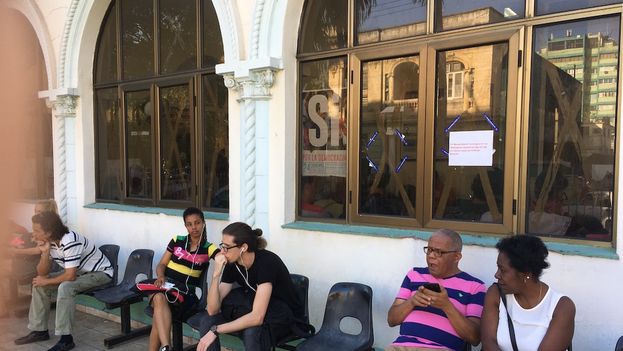
Outside the Immigration and Naturalization office on calle 17 in Vedado, people barely interact to avoid any critical opinion aborting their trip abroad. The Yes propaganda is everywhere, and one joke assures that “after February 24, passports will be cheaper,” which they all pretend not to hear.

Outside the Immigration and Naturalization office on calle 17 in Vedado, people barely interact to avoid any critical opinion aborting their trip abroad. (14ymedio)

Outside Coppelia, Antonio takes in the sun. Homeless, missing a shoe and with years of living on the street, he says that he is registered to vote in Playa. “I have nothing to lose. I’m going to vote No.” He says this categorically while the passersby move away.

In Camagüey, the authorities have increased the presence of civil police, especially around the long food lines. (14ymedio)

Hundreds of kilometers from the capital, in the streets of Camagüey, the residents are more interested in the shortage of food than in the constitutional referendum. This Saturday, there are also a larger number of police and members of State Security, dressed in civilian clothing but identifiable by their Suzuki motorcycles, traditionally used by the political police.

“Every day more products disappear,” comments Ariel Almansa, a young entrepreneur who waits in line at DiTú on 12 Plantas del Avenida Finlay, to buy two packages of chicken, a product that has been absent in previous days. Among the merchandise that has disappeared, he enumerates “oil, eggs, deodorant and condoms.”

The shortage has increased the popular malaise, a discontent that could be reflected in the ballot boxes in a rejection of the new Constitution. “I’m going to vote No because this has become unsustainable,” another client who waits in the food line tells 14ymedio. “It’s not that I reject the Constitution; it’s that this can’t continue,” she adds.

In Camagüey, the authorities have increased the presence of civil police, especially around the long food lines. “They say they’re here to avoid fighting and that now the cooking oil has been delivered,” explains Damaris Marín outside a market in the Montecarlos area.

The reappearance of the product hasn’t passed unnoticed, and many think it’s an electoral maneuver for the referendum on Sunday. “Now a little chicken and oil appear in some shops because they want us to vote Yes tomorrow,” says a woman at the bus stop on Route 19.

In these last weeks, officials have used all the resources at their disposal to promote ratification of the constitutional text. The residents in Camagüey were surprised these last days when groups of kids, with school uniforms and during school hours, ran through the streets leaving propaganda in favor of a Yes vote under doors.

Translated by Regina Anavy

_________________

The 14ymedio team is committed to serious journalism that reflects the reality of deep Cuba. Thank you for joining us on this long road. We invite you to continue supporting us, but this time by becoming a member of 14ymedio. Together we can continue to transform journalism in Cuba.

Cuban Surrealism / Ivan Garcia

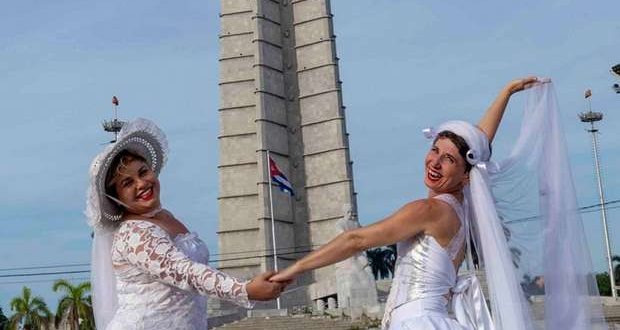
Symbolic wedding in Havana’s Plaza of the Revolution in defense of homosexual marriage, eliminated in the text of the new Constitution, which has unleashed controversy in the Cuban LGBTI community and also in different religious denominations settled in Cuba. Taken from Cubaencuentro.

Iván García, 22 February 2019 — While the television news announces an imminent landing of the Yankee marines in Venezuela for the weekend, and resuscitates phrases from old  speeches by Fidel Castro, Orestes, a Havanan who, among other things, sells liters of bleach at 25 pesos, prepares a sofrito of black beans while the volume of his portable speaker rises with the music of the reggaeton singer Jacob Forever.

“Today I ended up late for dinner. I had to walk almost twenty kilometers selling bleach all over the city,” he says as he starts making the tomato, cabbage and cucumber salad which he will accompany with white rice, beans and a single-egg omelet,” because there are also almost no eggs to be had.”

In addition to bleach, Orestes sells what falls off the truck: flavorings, floor mops or clothes brought in from Panama by the ‘mules’. He lives in a ramshackle room in a collective shelter south of the capital. His topics of conversation are sports, women and the harsh living conditions implemented by neo-Castroism. continue reading

“Cuba has become a jungle. Everyone is trying to survive. And the government continues with its theater. It is rumored that after the referendum on February 24, Canelo (Díaz-Canel) will legalize la bolita (the now-illegal lottery). If that happens, then it will be the government that is going to make the money,” he says, adding:

“I’m going to vote Yes. I have no other choice. Otherwise, the sector chief (police) comes down on you and makes your life impossible. Vote NO and what does it solve? And if the Americans get their hands on Venezuela, they say they’re going to send Cubans to fight there. I would not go, I don’t need anything in that country. Why do I have to fight for Maduro? I would look for a medical certificate where it says I’m crazy. My thing is selling bleach and getting it on with my little girlfriend. There isn’t anything else.”

A few hours after the beginning of the electoral farce that would ratify the future Constitution, I asked all sorts of people in Havana if they had read the text of the Constitution. “One day in my workplace, from up above, they scheduled a debate. I didn’t understand anything. These legal issues are written in a language that only lawyers understand,” says Mara, a clerk in a state cafeteria.

Yadira, a pre-university student, responds: “No, I didn’t read it, I’m not for that.” And how do you plan to vote?, I ask. “I will vote Yes. At my school, in a debate we had, they told us that it was the only way to maintain the gains of the Revolution. We know it’s crap, but nobody wants to look for problems,” confesses the young woman, who on Sunday, February 24, will vote for the first time in her life.

Luis Manuel, a taxi driver, says he read the constitutional text “and that’s why I will mark NO. You have to be very forgetful to vote Yes after living so many years with a foot up your ass. Buddy, it is irresponsible to support a system that does not work and grant it the grace to govern us the rest of our lives.”

Ismary, a bank employee, does not intend to vote. “And if the polling place comes to my house with the ballot, maybe I’ll put Yes, so as not to stand out. But if I wake up on the wrong side of the bed, I’m going to vote No. In any event, if I vote Yes or No, annul the ballot, leave it blank, not go vote, nothing is going to change, everything will remain the same or worse. Diaz-Canel said it already, on Sunday the Yes will win. I do not know why they have elections in Cuba, if they do not want people to vote NO.”

Andres, a biologist, resident of the Capdevila neighborhood, twenty minutes by car from downtown Havana, says that in his neighborhood they prepared a debate “with stooges from the government, to encourage them to vote Yes. But you can’t live on rhetoric or the past, this revolution has already gone to hell. I intend to vote NO because the rulers have not been able to meet the demands of the people. They’ve been living off their story for 60 years, false promises and lies. And everything in life has a limit. It’s been a while since I hung up the gloves. I do not believe in any of them.”

Along with the referendum, the critical situation in Venezuela is a topic of conversation in the streets of Havana. If we give credit to the neo-Castro autocracy, it is only a matter of time before the United States invades Venezuela. And in schools, companies and institutions throughout the island, Cubans are being called to sign a book condemning the hypothetical invasion.

The official story they offer about Venezuela is very simple: Trump has blockaded it because it is a sovereign and independent nation and the United States and the Venezuelan opposition are to blame for all the evils.

The propaganda apparatus of the regime has designed a version of the events that excludes the disastrous administration of Nicolás Maduro, corruption, repression and torture of political prisoners as well as the parliamentary coup of the PSUV of the National Assembly which — after the opposition won a majority in 2015 — took away all its powers.

This strategy works with uninformed people, such as Cubans who drink coffee without milk (because there isn’t any) or with those who, due to the high cost of the internet, only use it to communicate with their relatives abroad and not to learn about what is really happening in Venezuela and in the rest of the world, except for a few exceptions.

“A military aggression by the United States against Venezuela would be a gift to Maduro, because it would justify the disaster by selling him as a victim. Trump is capable of anything. But there is a reality: the hyperinflation in Venezuela, the hunger and poverty have two culprits: Madurismo and the Cuban government, which with its crazy advice has caused the collapse of that nation,” says Sergio, a retired university professor.

Someday, those who have governed Cuba for six decades will have to offer a public apology. In the name of the worst socialism, they have impoverished Venezuela and polarized the country. For twenty years, the Cuban special services and their military advisers have designed defense strategies. The blatant interference of Castroism in Venezuela was proven in an audio, released in 2013, of a conversation between Mario Silva, a Chavista journalist, and Aramís Palacios, a senior Cuban intelligence official.

Caracas is a matter of national security for the Havana regime. They will fight with all the means at their disposal in order to keep Maduro in power. The defense at all costs of Hugo Chavez’s substitute has unleashed all kinds of rumors. In the streets people are saying that Cuba could send troops. “My son is doing his military service and I told him not to sign any paper that would commit him to fight in Venezuela. We are not living in the times of Angola, when many like me were naive enough to fight,” says Armando, self-employed.

Local analysts believe that unless they send elite troops, “Cuba is not in a position to deploy a vast operation like the one in Angola 44 years ago. It would be impossible, with outdated weapons and a precarious preparation. The doctrine of a war ‘of the whole people’ is the case for the military occupation of the country.

But if military events take place in Venezuela, modern warfare strategies should be used, such as air strikes to specific sites with smart missiles. The United States will not disembark troops in Venezuela. It would be a clumsy move that would reverse all the Latin American and global support that Washington has achieved,” predicts a former officer of the armed forces.

According to the prestigious Cuban-American economist Carmelo Mesa-Lage, the loss of the Venezuelan subsidy would impact between 10 and 15 percent of Cuba’s GDP. In an economy in recession, where Raúl Castro’s reforms do not encourage agricultural, productive or industrial growth, losing access to subsidized oil from Caracas could cause a dangerous setback.

Cubans are tired of shortages and false promises. A new Special Period could explode through the air the inoperative barracks economy and the lack of political liberties. And Fidel Castro is no longer there to help get through the disaster.

Ortega’s Paramilitaries Are More Lethal Than Those of Venezuela

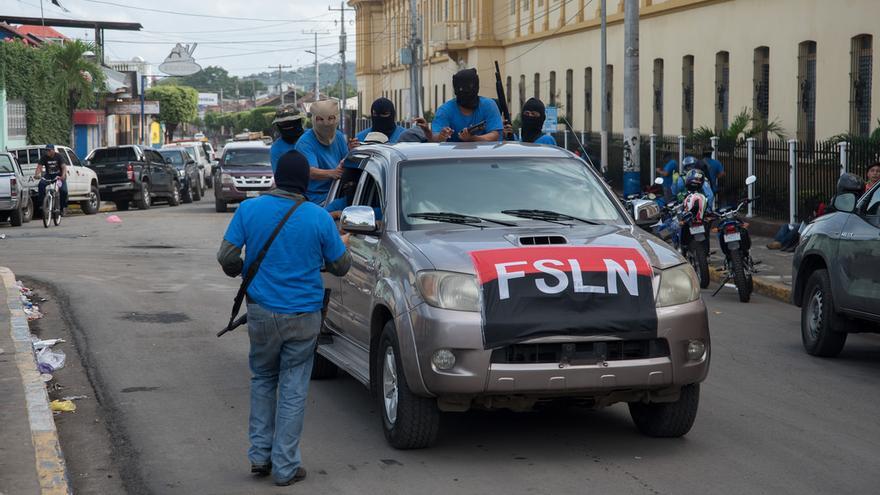
Ortega’s paramilitaries in Masaya. (Carlos Herrera)

14ymedio bigger14ymedio, Wilfredo Miranda Aburta, Managua | February 18, 2019 — Giancarlo Fiorella, a Venezuelan and author of the Bellingcat investigation detailing the paramilitaries’ arsenal during the Ortega massacre, is surprised by the level of collusion between the paramilitaries and the police in their lethal operations, something which, he insists, he hasn’t seen in Venezuela.

“As a point of comparison, the level of cooperaction between paramilitaries and police is higher than in Venezuela. In Venezuela, the Chavista groups don’t have this type of arms, and it isn’t clearly seen that they collaborate closely with the police,” explained Fiorella in an interview with the journalist Carlos Fernando Chamorro on the TV program Esta Noche.

The analysis he carried out shows the deployment of at least seven types of weapons of war employed, and also suggests that the Police Tactics and Arms for Intervention and Rescue (TAPIR) unit was involved in the massacre. continue reading

Bellingcat is a portal dedicated to carrying out journalistic investigations from open sources. To analyze the paramilitary arsenal, Bellingcat was based on different videos of the repression, the final report of the Independent Group of International Experts (GIEI), and the investigation of Confidencial, “They fire with precision: to kill!,” a piece that won the 2018 King of Spain Iberoamerican Journalism Prize.

Fiorella is currently pursuing a doctorate at the Center of Criminology of the University of Toronto, in Canada, and previously published another revealing investigation on the execution of the rebel Venezuelan pilot Óscar Pérez at the hands of Chavista security forces.

“The groups in Venezuela have a greater proportion of civilians or of individuals that have no connection with the State, like the paramilitary groups in Nicaragua. The chief of police said that many of them were police officers who were in secret operations,” explained the journalist.

Bellingcat focuses on two of the most brutal episodes of paramiltary repression: the attack on the UNAN-Managua and the church of Divine Mercy on July 13, and the taking of Masaya on July 17 and 18.

From a detailed analysis of video and photographic proof, Bellingcat identifies a deployment of military rifles used by the paramilitaries: AK-74, Dragunov sniper rifles, PKM machine guns, and M16 rifles. They also found Remington 700 rifles, Jericho 941 pistols, and magazines of Soviet-model drum bullets with capacity of up to 75 bullets.

A few weeks ago, the Norwegian newspaper Dagbladet published an interview with the first commissioner and police chief, Francisco Díaz, who assured that the paramilitaries were, in the majority, professional police carrying out covert operations. The rest, he said, were “volunteer police.” The statements of the relative by marriage of the presidential Ortega-Murillo couple left clear the responsibility of the institution in the worst massacre committed since after the war in Nicaragua. The casualty toll is at least 325 confirmed dead and thousands of wounded, in accordance with international human rights bodies.

In the videos analyzed by this investigation, it was found that paramilitaries used MOTOTRBO brand radio communicators (like the DP4800, XPR 7000, and Tait TP8100 series). “These radios are sold for commercial and industrial use, and there is evidence that suggests that the TAPIR unit of the National Police has used similar radios in the past, as can be seen in these videos,” affirms Bellingcat.

“One of the videos shows the close connection between the Nicaraguan Police and the paramilitaries. At minute 1:40 in the video, a man in a black uniform appears. The word Police is written in white on his back. At minute 1:50, the man turns around and begins to walk. When he does so, a patch on his right sleeve becomes briefly visible. The patch seems to be that of the TAPIR unit of the National Police,” specifies Bellingcat, in a video on the massacre of Masaya. “The patch of the man in the Police uniform in the video (left) seems to be that of the TAPIR unit of the National Police,” it sustains.

Fiorella explained that in the two pieces of evidence there is participation of uniformed agents. The attacks on Masaya and the UNAN-Managua are being referred to. After seeking open-source information, Fiorella found in YouTube videos that the TAPIR unit was using similar radios to those of the paramilitaries who massacred the UNAN students.

“In Venezuela, although there is participation of armed groups in the repression of protests, the number of dead has never reached what was seen in Nicaragua. The arms aren’t even of the same caliber. Normally, in Venezuela they only have pistols. There are cases of bigger weapons, but not like has been seen in Nicaragua,” said Fiorella.

“The Confidencial investigation offers even more evidence that the government of President Ortega is resolved to put a stop to the demonstrations by any means. The indiscriminate use of arms in the hands of paramilitary groups and of the Police meant that the type of wounds discovered by Confidencial were not only possible, but practically inevitable,” concludes Bellingcat.

According to Fiorella, the findings of his investigation squares with everything that was already known and was established by bodies like Amnesty International and the Independent Group of International Experts (GIEI), who worked with sources in Nicaragua, proving that the paramilitary groups who operated during the repression were working very closely with police squads.

“This is evidenced in the weapons used. Weapons of war, as the study has highlighted. We can say that the paramilitaries, probably, shared weapons with the police forces of the State of Nicaragua,” emphasized Fiorella.

Editors’ note: this text was published by the Nicaraguan digital outlet Confidencial, which has authorized us to reproduce it.

Translated by: Sheilagh Carey

______________________________

The 14ymedio team is committed to serious journalism that reflects the reality of deep Cuba. Thank you for joining us on this long road. We invite you to continue supporting us, but this time by becoming a member of 14ymedio. Together we can continue to transform journalism in Cuba.

Scrutiny / Regina Coyula

Regina Coyula, Havana, 24 February 2019 — My neighborhood is colonels and vice ministers; managers and owners of successful private businesses. That said, the vote at my polling place was as follows:

Total registered voters: 489

Not voting: 74

Annulled the ballot: 9

Blank ballots: 1

Voted No: 62

Voted Yes: 343

Intrusive Little Pioneers, Pressures and Pencils

In many of the polling places posters have also been visible supporting the official campaign for a Yes vote, with photos of Fidel and Raúl Castro or calls to preserve the Revolution. (14ymedio)

14ymedio bigger14ymedio, Havana, 24 February 2019 — Pressures to vote Yes, lack of privacy and the refusal to let voters to use a ballpoint pen to mark their ballots, instead of the “official” pencil, are some of the irregularities that have been reported to 14ymedio during the constitutional referendum that is taking place this Sunday in Cuba.

“When I went to vote in the cubicle, the president of the polling station asked a pioneer [elementary school student] to accompany me,” an anonymous architect living in Centro Habana in the vicinity of the Malecon told this newspaper. “The girl went into the booth with me and told me that if I wanted to vote for the homeland I had to check Yes.”

After much insistence, the woman managed to remain alone on the booth and exercise her right to vote with privacy, but she reports that “evading the pressure was difficult” and that she felt that “everything was prepared to avoid a No vote.” continue reading

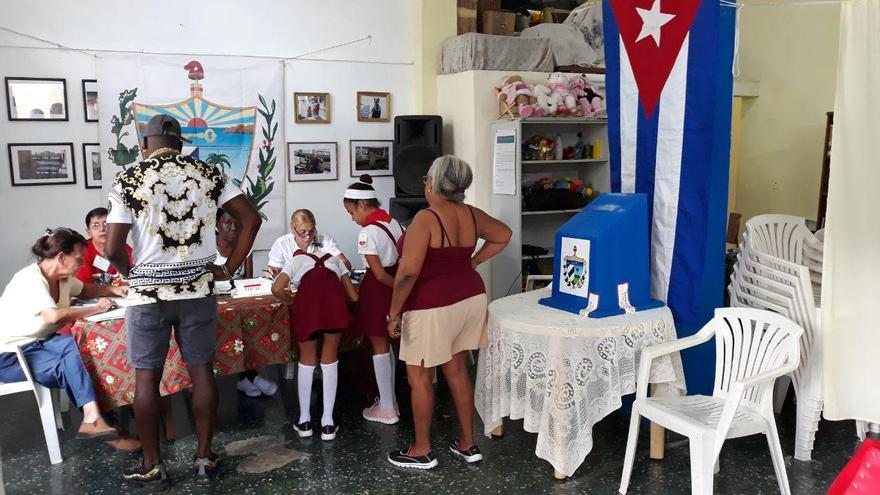
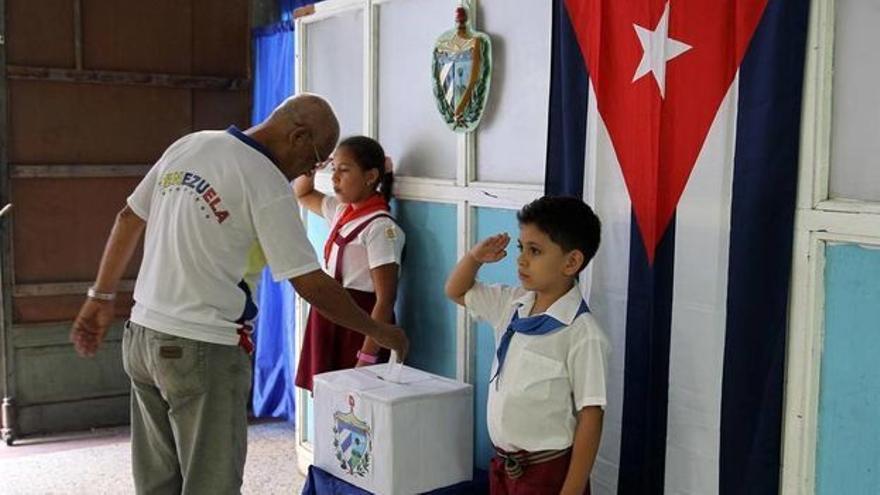
The current Electoral Law establishes that the authorities must ensure that “the booths have the required conditions to ensure the secrecy of the vote,” while schoolchildren, the uniformed little pioneers, must remain by the ballot box to be witnesses to the moment in which the ballot is placed through the slot.

However, more than twenty reports arrived at the newsroom of this newspaper giving accounts of cubicles without doors or curtains and people loitering around the voters as they voted. There were also reports of an “overreaching” performance by the pioneers with regards to the privacy of the voters.

Another complaint is that people are not allowed to use a ballpoint pen to exercise their vote with an indelible ink that prevents the later erasure of the ballot, a suspicion that many voters have. “I took a pen to the polling place in Trinidad where I voted, because I’m traveling outside Havana,” writes a reader of this newspaper that brought a pen to exercise the vote.

“They told me that if I voted with a pen I was going to cancel the ballot,” she said. “In any event, I marked next to the No with the pen but now I’m worried about whether my vote will be valid or not.”

Recently, the independent media El Toque published 10 tips for Cuban voters and recommended the “indelible vote” noting “that’s what the pens are for and not the pencils commonly found in Cuban polling stations.” Article 114 of the Electoral Law establishes that ballots are declared null and void where “the will of the voter cannot be determined.” It is never said that a pencil should be used and that ballpoint pens are prohibited.

In the town of Placetas, several residents also complained of pressures to go to vote, with members of the Committee for the Defense of the Revolution knocking on their doors so that “nobody stays home.” The vote in Cuba is not obligatory but many fear sending a social signal if they do not go to the polls.

In many polling places posters have also been visible with the official campaign for Yes, with photos of Fidel and Raúl Castro, or calls to preserve the Revolution and socialism.

As of 9:00 am this Sunday, 2,690,419 voters had voted, 30.64% of the total registration, according to María Esther Bacallao, secretary of the National Electoral Commission.

________________________

The 14ymedio team is committed to serious journalism that reflects the reality of deep Cuba. Thank you for joining us on this long road. We invite you to continue supporting us, but this time by becoming a member of 14ymedio. Together we can continue to transform journalism in Cuba.

Polling Stations Open for Referendum on New Constitution

With voter turn out low, polling stations opened on Sunday (14ymedio).

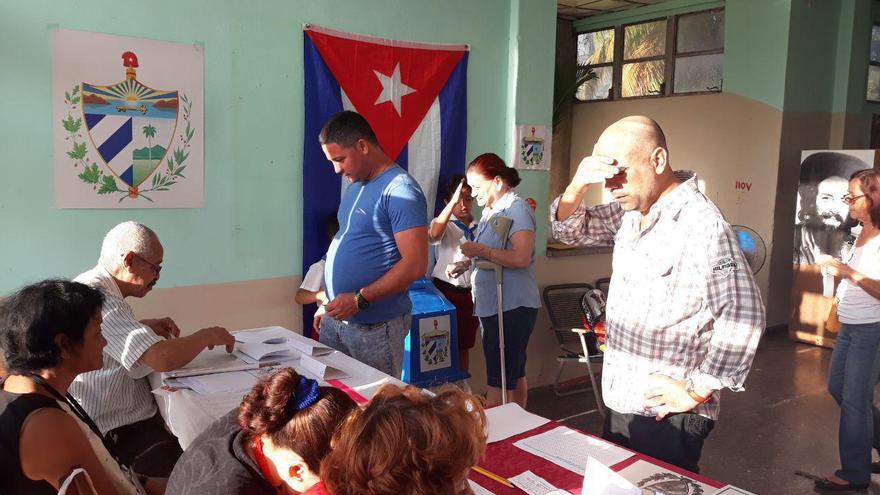
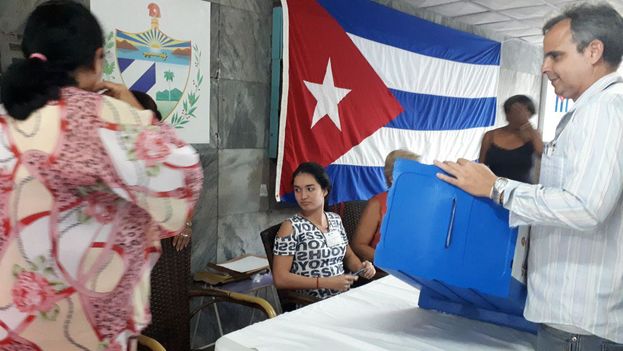
14ymedio bigger14ymedio, Havana, 24 February 2019 — Starting at seven in the morning this Sunday, more than 25,000 polling stations opened for Cubans to vote in the referendum on the new Constitution. On a warm morning in which official nervousness can be felt in the wide police presence in the streets, more than 8 million Cubans are summoned to the polls.

The polling stations will remain open until 6:00 p.m., and special polling stations in hospitals, airports and bus stations have also been set up. Within the first minutes of the openings, there was still little attendance, as 14ymedio was able to verify in a tour of more than twenty polling places.

In Havana, the daily routine continued despite the fact that the process engages more than 1.6 million people in the city. Agricultural markets showed long lines to buy food in a city that has seen increases in the shortages of several products in recent weeks. continue reading

Throughout the country, 25,348 polling stations have been set up, according to data from the National Electoral Commission, 7.6% of them located in private homes. The process excludes people who are serving a sentence in prison and those who are on parole, such as the former prisoners of the Black Spring who still remain on the island.

Prior to this Sunday, the authorities opened 122 election stations in 130 countries, but only Cuban diplomats and professionals who are serving on official missions could participate. The large community of emigrants from the island was excluded from the process, an exclusion that generated a flood of criticism towards the Plaza of the Revolution.

The voters who are in the national territory have before them this Sunday a ballot with one box for Yes and another for No and the question “Do you ratify the new Constitution of the Republic?” The final draft of the new Constitution has 229 articles, 11 titles, two special provisions, 13 transitory and two final, and was approved last December by the National Assembly.

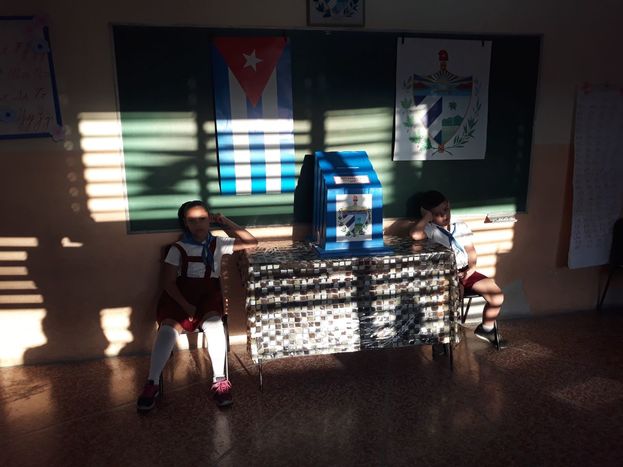
Children guard the ballot boxes, as in every election in Cuba (14ymedio).

The new Constitution maintains the control of the Communist Party over the most important decisions in the country and describes it as “the leading force of society.” In its preamble it consecrates communism as the goal to look forward to and in its Article 4 it says that “the citizens have the right to fight by all the means, including an armed fight, (…) against anything that tries to demolish the political order.”

Among the steps of progress of the constitutional text in comparison with the Constitution of 1976, is that it recognizes private property, accepts foreign investment as necessary, establishes the figures of the President of the Republic and the Prime Minister, and sets a limit of two consecutive presidential terms.

However, in the process of developing the text, the article that opened the door to same-sex marriage was eliminated and the constitution states that fundamental means of communication cannot be privately owned.

The government has deployed an intense campaign for a Yes vote, using the national media, billboards, signs on buses and campaigns in schools. In contrast, a part of the citizenry has called for the rejection of the Constitution through the slogans #yovotono (I’m Voting No) or #yonovoto  (I’m Not Voting) but without being able to access the channels of mass communications.

__________________________________

The 14ymedio team is committed to serious journalism that reflects the reality of deep Cuba. Thank you for joining us on this long road. We invite you to continue supporting us, but this time by becoming a member of 14ymedio. Together we can continue to transform journalism in Cuba.

Scrutiny and Repudiation, Chronicle of an Election Observer

Nothing else interrupted the counting, with 400 votes for Yes, 25 for No and 4 blank ballots, a woman stood a few inches from my ear and shouted with all her might “Long live the Revolution.”

14ymedio bigger14ymedio, Yoani Sanchez, Havana, 24 February 2019 — I chose the place at random. A polling place in my neighborhood where I could attend, as an observer, the process of counting the votes. It was about six o’clock in the evening when I went to the entrance of the building, a twelve-story concrete block located on Lombillo Street. The voting was about to end and I waited outside, talking on the phone with a friend and finalizing some details about work.

The evening was warm and a reddish sun glimmered through the windows of the entrance. The count began. They asked me if I lived there as a requirement to observe. According to the current Electoral Law, any citizen can be present at the counting anywhere in the national territory, regardless of how near or far it is from their home. So I invoked the legislation, showed my identity card, wrote down my information and they emptied the ballot box on the table.

At one point, a young man arrived with a white envelope that seemed to be carrying some ballots. I thought it was votes from people with mobility problems, old people or other voters who had not been able to come to the premises. I asked the origin of the documents and right there detonated the ill-will. A man, who was not at the counting table, started shouting at me that I had no right to inquire about that and that I had asked “the wrong question.” continue reading

I responded by saying that he was not part of the Electoral Board and that the question I had raised had to be answered by those who were a part of it. The tension in the air could have been cut with a knife. One of those who reviewed the votes couldn’t control the unceasing trembling of his hands, and “a neighbor” located at the other end of the table kept taking pictures of me. Then another man approached me, wearing a striped sweater and with a mustache.

“Come with me outside,” he told me. I flatly refused, because I knew that as long as I was in the polling place I was, at least, a little more protected. “I do not go outside with strangers,” I snapped. Then came another who “rubbed” my arms in a show of confidence but started pulling me towards the door and I told him to stop touching me. Then, they told me that I had to stay “as far away from the table as possible.” I shut up and waited while the process went on.

Nothing else interrupted the counting, with 400 votes for Yes, 25 for No and 4 blank ballots, a woman stood a few inches from my ear and shouted with all her might “Long live the Revolution.” Thus the true act of repudiation was detonated, a choreography that I know so well that I had anticipated it with certainty.

I refused to sign the act as an observer because during the entire time I was there I felt harassed, threatened and not respected in my right to witness the counting. I perceived that they wanted to make me pay dearly for having dared to attend.

I left the premises, with a score of people shouting at my back. The slogans were repeated, they cheered the process, they accused me of not loving my country and a group of children joined the hullabaloo without really knowing why they were there. A woman dressed in white, a practitioner of Santeria, was confused with a Lady in White and also received some insults.

The man who filmed, disciplined, did not stop holding the phone in front of my face, so I took advantage of “the coverage” to claim my right and reject the Constitution. The shouts continued; an egg – perhaps thrown from a balcony – fell near one of my shoes. The sun was now completely hidden. Election day ended and some of those who had repudiated me crossed the sidewalk to buy some beers in a cafe across from the building.

I had just lived an unforgettable experience as a citizen, voter and journalist.

___________________

The 14ymedio team is committed to serious journalism that reflects the reality of deep Cuba. Thank you for joining us on this long road. We invite you to continue supporting us, but this time by becoming a member of 14ymedio. Together we can continue to transform journalism in Cuba.

Cuba and Fundamental Rights / Dimas Castellano

Dimas Castellanos, 17 January 2018 — The impact of fundamental rights on the development of society is of such magnitude and significance that it becomes impossible to comprehend the advancement, stagnation or regression of a population without accounting for it.

To mark the tenth anniversary of Convivencia (Coexistence), the current issue addresses a central theme of our magazine: the causal relationship between the loss of fundamental rights and the crisis in which Cuba now finds itself.

Introduction

Liberty — inherent in human beings — emanates from an inner conscience. That origin permits man to be free to the extent that he insists on being so, for liberty grants extraordinary power, the use of which becomes a factor in human growth and creates conditions for personal and social development.

Since men achieved establishing the existing relationship between conscious and liberty, this has come clearing a growing role in the evolution of humanity. Thanks to this relationship, even though a person is submitted to limitations or prohibitions from outside forces, the underlying layer of the liberty permits him to think and be free in such conditions. continue reading

Ignacio Agramonte (1841-1873), in defense of his thesis of Bachelor’s of Law in 1866, titled On individual rights, summarized masterfully this relationship in the following words: The right to think freely corresponds to the right of examine, of doubt, of opinion, as stages or directions from that. Fortunately, these, different from the right to speak or work, are not submitted to direct coercion and will be able to obligate one to shut up, to permanently disable, in case saying what is right that is highly unjust. But how can we be able to impede the doubt of what they say? How can we examine the actions of the rest, that which is about instills as truth, all, finally, and that about which they formulate the opinion?

The basis for this argument is that liberty is an essential and inherent right of each person; a condition such that, all intent to suppress/abolish or limit it, more than constituting an attack against humanity, it has been is and will be condemned to failure.

“To renounce one’s liberty,” said Rousseau, “is to renounce the human condition, the rights of humanity and even its duties… Such a renunciation is incompatible with human nature. To relinquish liberty is to relinquish morality.”

The fundamental rights, that is, those of consciousness, information, expression, assembly association, suffrage and habeas corpus, constitute the basis of communication, the exchange of opinions, of codes of conduct and decision-making.

The historical experience demonstrates that the maximum expression of liberty is only possible there, where the fundamental liberties are institutionalized in the rule of law.

The constitutional history of fundamental rights, whose guiding principle is located in the Magna Carta that the English nobility imposed on King John in 1215, contributed key features to the Declaration of Independence of the thirteen colonies of North America (1776) and in the Declaration of the Rights of Man and of the Citizen of the French Revolution (1789). It had a part in the Universal Declaration of Human Rights (1948) and made its way into the International Covenant on Civil and Political Rights and on Economic, Social, and Cultural Rights approved by the United Nations (1976).

In Cuba the constitutional history of liberties has its origin in the Autonomal Government Project of Fr. José Agustín Caballero (1811); it was made flesh in the nineteenth century Mambisa constitutions and the republican constitutions of the twentieth century, whose highest expression was the constitution of 1940.

Continuing that trajectory, and in fulfillment of the Pact of Zanjón (1878), which ended the Ten Year War, laws were implemented in Cuba for freedom of the press and freedom of assembly and association. Endorsed in Article 13 of the Spanish Constitution, these laws gave birth to Cuban civil society: a whole range of associations, spaces and media that reflect plurality and diversity.

Civil society, the permanent school of civility and ethics, constitutes a solid link in the bond between citizens and their nation, culture, history and development, whose existence and functioning require the institutionalization of human rights.

Civil society as well as the State are organs of the social body. The existence of both is not indisputable–rather, what is debatable are their functions and areas of competency.

In Cuba, civil society reached its greatest development around the mid-20th century, as Fidel Castro described it when referring to the situation in Cuba before the 1952 coup [by Fulgencio Batista]: “I will tell you a story. There once was a republic. It had its constitution, its laws, its liberties; a president, a congress, and courts; everyone could associate, assemble, speak and write with full liberty. The government did not satisfy the people, but the people could change it… There was a respected and heeded public opinion, and all issues of collective interest were freely discussed. There were political parties, educational hours on the radio, debate programs on television, public events….”

The logical question that emerges from the history of freedoms in Cuba is this: How was it possible that, following the described advances in areas of rights and liberties, Cuba should regress to a situation that was more backward than what it achieved after the Peace of Zanjón?

 The Cuban Totalitarian System

If its most immediate cause is in the 1959 Revolution, the genesis of the Cuban totalitarian system lies in certain characteristics of our development as a people that contributed to the establishment of a model foreign to our history, and to human nature. Among these characteristics, the interrelation of the following four stands out:

  • The Cuban national character, resulting from the mix of diverse ethnicities and cultures that arrived in Cuba with the Europeans and Africans–some who came to enrich themselves and return home, others who were brought as slaves, neither with the intention of setting down roots in the Island.  To this, according to Fernando Ortiz, can be ascribed the psychological weakness of the Cuban character: the impulsiveness, a trait of this psychological type, that frequently drives us to commit intense acts, but rapid-fire, precipitous, unpremeditated and violent…  Men, economies, cultures, and ambitions–here, everything felt foreign, temporary, changed, like migratory birds flying over the country on its periphery, contrary and ill-fated.
  • Violence, which arrived on our shores with the Spanish warriors, took its first victims from among the aborigines, and assumed horrible forms on the sugar plantations which gave way to escapes, runaway slaves, stockades and rebellions. It was present in the attacks by the corsairs, in the banditry that ravaged our countryside, in the independence conspiracies and wars. It manifested in coups d’etat, insurgencies, gangsterism, armed assaults and terrorist acts before and after 1959. These events turned violence into political culture.
  • The utilitarian ethic, an attitude rooted in colonial and slaver tendencies – a creole variant of 18th century philosophy of utilitarianism–which found in Cuba as fertile a soil as did the sugarcane. This ethic sustained an egotistical individualism and easy living, it took form in corruption, gambling, laziness, and the violation of all that was established, eventually becoming generalized behavior. The concept of man as a means and not an end, as an object and not a subject, the priority that the Cuban-creole oligarchy ascribed to crates of sugar and coffee, the use of power for personal or group gain, the presidential re-elections, the coups d’etat and the generalized use of physical and verbal violence–all are manifestations of the utilitarian ethic that marked the mold of our national character.
  • Exclusion, which runs through the history of Cuba from beginning to end: Félix de Arrate y Acosta (1701-1765) called for the putting the rights of his class on an equal footing with those of native-born Spaniards, while excluding blacks and those whites who had not been able to amass fortunes; Francisco de Arango y Parreño (1765-1837) defended the rights and liberties of his class and the enslavement of half the Island’s population; and José Antonio Saco y López (1797-1879), whose concept of nation did not include those born in Africa nor their descendants.

Against the constitutional crisis provoked by the coup d’etat of 1952, there arose two responses: one armed, the other civil. The first was made public on 26 July 1953, with the attack on the Moncada barracks headed by Fidel Castro. Following the fraudulent elections of 1954, Fulgencio Batista reestablished the Constitution of 1940 and granted amnesty to political prisoners–among them the Moncada assailants, who in June 1955 founded the 26 of July Movement (M-26-7) to continue the armed struggle.

Fulgencio Batista’s opposition to a negotiated settlement caused the civil efforts to fail. Violence was imposed: armed movements, attacks, military conspiracies, assaults on barracks and the presidential palace–trademark acts of the movement headed by Fidel Castro, who landed in Cuba in December 1956 and after two years of waging guerilla warfare and sabotage, achieved victory over the professional army on 31 December 1958.

In 1959, the triumphant Revolution, now a source of rights, replaced (without public consent) the 1940 Constitution with the Fundamental Law of the Cuban State. This set of statutes was in force until the Constitution of 1976 was promulgated that affirmed the existence of a sole political party–the Communist one–as the dominant driving force of society and the State.

A system foreign to human nature

A revolution that proposes to liberate men while at the same time does not posit the need for a public space that allows the exercise of freedom, can only lead to the liberation of those individuals from one dependency so as to attach them to another–perhaps one more rigid than the former. Those words of Hannah Arendt are corroborated by the Cuban revolutionary process of 1959. The issue is one of such universal value that it assumes the character of a philosophical generalization. As simple as it is complex, this thesis consists in that every social project that conceives the human person as a means and not an end–besides the anthropological damage it produces–is condemned to failure.

In January 1959 the Provisional President Manuel Urrutia Lleó made public the designation of Fidel Castro as Commander-in-Chief of the Armed Forces. In the Council of Ministers, made up jointly of figures from the armed and civil struggles, José Miró Cardona assumed the office of Prime Minister. In February, when the Fundamental Law of the Cuban State was substituted for Constitution of 1940, the faculties of Chief of the Government were conferred to the Prime Minister, and the functions of Congress to the recently-created Council of Ministers. Some days later, Fidel Castro replaced José Miró Cardona, at which time the charges of Prime Minister and Commander-in-Chief remained with the same person.

The Revolution meanwhile implemented a series of measures of popular benefit, tossed aside the existing institutional, political and economic culture, and proceeded in a sudden manner to “take care of” the problems inherited from an unsustainable trajectory: the concentration of power and property, and the hijacking of civil liberties.

The Spanish philosopher and essayist José Ortega y Gasset warned that the greatest dangers that today threaten civilization are the takeover of life by the State, interventionism of the State, appropriation of all social spontaneity by the State; that is, the annulment of historical spontaneity which, in the final analysis, nourishes and propels human destinies–which is summarized in Benito Mussolini’s argument: “Everything for the State, nothing against the State.”

That process, whereby civil society was swept away and in its place were established associations that are auxiliaries to power, cannot be understood outside the dispute between the Cuban government and the North American administrations. This quarrel was utilized in the name of popular sovereignty to obscure the contradictions between State and society, and to cover up the unsustainability of an inefficient model–but even more, to hijack civil liberties. As Rousseau said, “Even admitting that man can hand over his liberty, he cannot hand over that of his children, born free men. Their liberty belongs to them, and nobody has the right to dispose of it.”

The duration of this model has been so prolonged that the vast majority of Cubans today have known no other option that totalitarian socialism–wherein the economy, the culture and society are monopolized by the State, the State by a sole Party, and the Party under the rule of a Commander-in-Chief–a model that if yesterday satisfied a good portion of our grandparents, today does not satisfy their children, and much less their grandchildren and great-grandchildren.

 A possible exit

Despite having access to such a rich source of thought, the events prior to 1952 led to the past: a regress that is inexplicable if one ignores the importance of Cubans’ ethical and civil formation, for which–among the many thinkers who were preoccupied and dealt with these deficiencies, I cite the following six:

  • Félix Varela y Morales (1778-1853), the first Cuban who understood the need for changes in thinking. Upon assuming the direction of the Constitution professorship of the San Carlos Seminary, Varela introduced ethics in social and political studies as the bearer of the principle of equality among all human beings, and the foundation of those rights upon which are constructed human dignity and civil participation.
  • José de la Luz y Caballero (1800-1862), who understood politics as a process and who came out against suddenness of action. From this vision, de la Luz posited a relationship among education, politics and independence, and conceived the art of education as a premise for social change. He placed his main emphasis on the conviction that liberty is the soul of the social body, and that there is no greater brake upon it than reason and virtue.
  • José Julián Martí Pérez (1853-1995), the greatest 19th century Cuban thinker, set himself the mission of directing the inconclusive independence movement. For this he established a linked relationship among party, war and republic –this last being the form and destiny — rather than conceiving war and party as mediating links to arrive at the republic. In his visionary essay, “The Future Slavery,” he more or less said the following: If the poor become habituated to asking the State for everything, they will leave off making any effort toward their subsistence, and–being that public necessities would come to be satisfied by the State–the bureaucrats would achieve an enormous influence, so that “from being slaves to the capitalists they would go on to be slaves to the bureaucrats.” These thoughts he concluded with that even more remote ideal: “I want the first law of our Republic be the reverence of Cubans for the full dignity of man.”
  •  Enrique José Varona (1849-1933) In My Counsels, written in 1939, Varona complained that the Republic had entered a period of crisis, because a great number of citizens had believed that they could disengage from public affairs. “This selfishness,” he said, “has a high price.” So high, in fact, that we have been able to lose everything. Convinced of these deficiencies, Varona understood that a new way needed to be learned, and to this he dedicated himself: education to form citizens.
  •  Fernando Ortiz Fernández (1881-1969) In his 1919 work, The Cuban Political Crisis: Causes and Remedies, Ortiz outlined our limitations: the historic lack of preparation of the Cuban people for the exercise of political rights; the ignorance of the governed that impedes their appreciating the true worth of political leaders; the deficient education within the leadership classes that keeps them from checking their selfish aims and aligning them instead with the greatest national interests; the disintegration of the diverse social elements into races and nationalities whose interests are not founded in a supreme national ideal.
  •  And Jorge Mañach Robato (1898-1961), when referring to the permanent quarrels among Cubans, said: “Every person has his small aspiration, his small ideal, his small program; but what is lacking is the aspiration, the ideal, the program of all–that supreme brotherhood of spirits that is characteristic of the most advanced civilizations.” And he added: “The individualism embedded in our race makes each one the Quixote of his own adventure. Efforts towards generous cooperation are invariably stymied. Selfless leaders do not emerge. In the legislative assemblies, in the intellectual guilds, in the academies, in the organizations, bickering spreads like weeds through the wheat fields from which we await bread for the spirit. It is all about jockeying for position.”

From this analysis we can derive a set of useful lessons for any project directed at improving the situation in which Cuban society is mired. I refer to a way towards a society less imperfect than the current one.

The analysis presented here reveals a set of useful lessons for any project directed at improving the situation in which Cuban society is mired. I refer to a way towards a society less imperfect than the current one.

The most important of the above cited lessons is that responsible public participation in the destinies of the country requires the existence of the citizen–a non-existent concept in the current Cuban political map.

Fundamental liberties must be reincorporated. In their implementation, even if introduced gradually, their indivisible character will be imposed for one simple reason: if civil and political rights constitute the basis for participating in public life, then economic, social and cultural rights are essential for the functioning of society, and the collective rights of all humanity are necessary for preserving life and the planet. Each one of these generations of rights guarantees a particular aspect, and the three in conjunction constitute the buttress for the recognition, respect and observance of the legal guarantees for their exercise.

If we accept that a social system’s degree of evolution depends of the degree of evolution of its constituents, then we must accept–whether we like it or not–that we Cubans, as people, have changed very little, and that in some aspects, we have regressed. Therefore, individual change becomes paramount. Because of all this, to paraphrase the concept of affirmative action, in Cuba there must be an educational initiative–in the absence of which there will be changes, as there have always been, but not the changes that society requires.

Therefore, that possible and necessary exit from the current crisis occurs because each Cuban occupies and makes use of his political share. To this end, the gradual reestablishment of the fundamental rights of the human person should be accompanied by a program of civic formation to serve as the basis of inner changes in the individual, without which economic and political reforms will have very little value–as those have had that were implemented during the era of the Republic up to 1958, and those that were implemented following the 1959 Revolution.

Translated by: Logan Cates and Alicia Barraqué Ellison 
Cuban Authorities Threaten a Baptist Pastor for Preaching Against the New Constitution

The Baptist pastor Carlos Sebastián Hernández Armas called on the faithful of his congregation to oppose the new Constitution. (Facebook)

14ymedio bigger14ymedio, Havana, 23 February 2019 – The Communist Party of Cuba categorized the Baptist pastor Carlos Sebastián Hernández Armas a “counterrevolutionary” for a sermon in which the pastor called on the faithful of his congregation to oppose the new Constitution that will be submitted to a referendum this February 24.

Sonia García García, an official of the Office of Religious Affairs of the Central Committee of the Communist Party, telephoned Dariel Llanes, president of the Baptist Convention of Western Cuba, to inform him that Hernández Armas “going forward will not be treated as a pastor but as a counterrevolutionary. ”

The complaint was shown on his Facebook profile by Hernández Armas himself, secretary general of the Baptist Convention, and confirmed to this newspaper by Llanes. This newspaper tried to communicate by telephone with the Office of Religious Affairs but García was not “available” for press inquiries. continue reading

“The official demonstrated outrage at my message last Sunday, when I spoke to the church, with over 200 brothers gathered, that it is a Christian duty to vote NO on the new Constitution,” the pastor wrote.

According to the text, the official told the president of the Baptist Convention that she “does not understand” how it is possible that Hernández Armas occupies positions of responsibility in the organization.

“I have been categorized as a counterrevolutionary since 2004, when leading the church of Yaguajay we recovered the temple and the pastoral house in a story that’s too long to tell, but in which the Government was for years an accomplice of its thieves and then stole the bordering land”, adds Hernández Armas.

According to the pastor, it’s about persecution for his religious beliefs and the friendship he has with Pastor Mario Félix Lleonart and Oscar Elías Biscet, well-known opposition leaders.

The Baptist Convention of Western Cuba was one of the evangelical churches that appealed to the Government to prevent the approval of the controversial Article 68 of the constitutional project on equality of marriage.

In the document, subscribed by the Evangelical League of Cuba, the Baptist Conventions of the West and East, as well as the Methodist Church and the Evangelical Assembly of God Church, it was affirmed that “gender ideology” has no relation whatsoever with Cuban culture “nor with the historical leaders of the Revolution.”

The Commission that drafted the constitutional reform was in charge of substantially modifying the article due to the supposed majority rejection that it received during public consultations. To generate consensus, the Commission announced that an amendment to the Family Code should be ratified by another referendum within two years.

“We are living a very delicate situation in Cuba right now. They (the Communist Party) are very angry, they have put pressure on religious communities to support this constitutional project, but if we do that, we are going against our faith,” a high representative of the Evangelical Church on the island who requested anonymity for fear of reprisals against his organization told this newspaper.

“In Cuba there are still many people with dignity who love this country and God. We will be firm in following Christ even if we are persecuted for it,” he added.

The Christian, Evangelical and Catholic Churches have openly manifested their opposition to the constitutional referendum, as have LGBT groups, opponents and human rights activists.

A recent message from the Catholic Conference of Bishops laments “the exclusion” in the constitutional text “of other forms of full realization of the human being different from those of socialism and communism.”

According to the bishops, “a Christian cannot be forced to submit to a conception of reality that does not correspond to his human conscience enlightened by faith.”

Translated by Wilfredo Díaz Echevarria

____________________________

The 14ymedio team is committed to serious journalism that reflects the reality of deep Cuba. Thank you for joining us on this long road. We invite you to continue supporting us, but this time by becoming a member of 14ymedio. Together we can continue to transform journalism in Cuba.

Several Opponents Arrested Protesting Against the New Constitution in Havana

Opponents Antonio Rodiles and Ángel Moya were arrested after staging a protest this Saturday in downtown Havana. (Captura)

14ymedio bigger14ymedio, Havana, 23 February 2019 — Opponents Antonio Rodiles and Ángel Moya were arrested after staging a protest in downtown Havana against the constitutional referendum that will be held Sunday.

Moya and Rodiles walked down Galiano Street and were followed by dozens of people who recorded the protest with their cell phones, without participating in it, while others came up to them with official slogans. The activist Maikel Herrera, of the Patriotic Union of Cuba (Unpacu), joined the opposition and was also arrested, as confirmed to this newspaper by the organization’s leader, José Daniel Ferrer. continue reading

Ángel Moya, Antonio Rodiles, other activists and people mobilized by Galiano, Havana in protest against the dictatorship.pic.twitter.com/4j3g2HG6tD

– José Daniel Ferrer (@jdanielferrer) February 23, 2019

Ferrer was the first to transmit the video of the protest through his Twitter account, where activists are seen shouting “freedom” and “enough of the manipulation.” Moya was released shortly after, while Rodiles and Herrera remain detained. In the vicinity of the Capitol, an indeterminate group of Unpacu militants was arrested by the police when they tried to join the protest.

In conversation with 14ymedio Moya explained that his arrest lasted about two hours and that both he and Rodiles were taken to the Zanja unit. “They issued me a warning for disorderly conduct and a fine of 4,000 pesos for dirtying public ornaments,” he said. He also stated that he saw Rodiles in a dark cell before leaving the unit and that he has not yet been released.

The former political prisoner Ángel Moya and Antonio Rodiles are in favor of boycotting the constitutional referendum and not participating in a process that they have described as a “farce”. Other organizations on the island have asked Cubans to go to the polls and vote NO to send a strong message to the executive Miguel Díaz-Canel.

The Government has deployed a campaign for the YES vote through its monopoly on the media and its domination of the public spaces. Several NO activists and referendum observers have been threatened with jail if they campaign and more than 100 Unpacu members are holding a hunger strike to protest the arbitrary raids and arrests.

The Government finds itself in a delicate situation with its main ally and benefactor, Venezuela, plunged in a deep crisis. Nicolás Maduro, a key figure in the alliance with Cuba, is not recognized as president by more than fifty countries and a change in Miraflores Palace could trigger a crisis like the one of the ’90s — a time that Fidel Castro called “The Special Period in Time of Peace” — when the Island lost its privileged trade status with the Soviet Union.

This Friday the Baptist minister Carlos Sebastián Hernández Armas denounced that the Communist Party had threatened to withdraw his status as pastor for preaching against the new Constitution. Hernandez had called on faithful of his congregation to vote NO in the referendum.

Cuban police on Friday arrested Roberto Veliz Torres, minister of the Assemblies of God in the town of Los Benítez, in the municipality of Palma Soriano. According to a denunciation of the faithful of his Church, Veliz had called all Christians to vote NO because, he says, the Constitution that the Government wants to impose is not compatible with the Christian faith.

The Christian, Catholic and Evangelical churches have demonstrated a strong rejection of the new Constitution, which leaves the power of the Communist Party intact and introduces small changes such as the approval of private property.

Translated by Wilfredo Díaz Echevarria

_____________________________

The 14ymedio team is committed to serious journalism that reflects the reality of deep Cuba. Thank you for joining us on this long road. We invite you to continue supporting us, but this time by becoming a member of 14ymedio. Together we can continue to transform journalism in Cuba.

Do You Want Transparent Elections in Cuba? Report Violations of the Electoral Law: Here We Tell You How… / Cubalex

“Clean Elections”

Cubalex, 3 January 2019 — Last December 26th, the Council of State appointed members of the National Electoral Commission, but without announcing it publicly to the electorate in the Official Gazette of the Republic, as required by electoral law. This goes against normal electoral procedure, violates our electoral rights and takes away any transparency from the already discredited voting in the referendum.

We have time to insist that they comply with the law which they themselves enacted. You can go to the President of the National Assembly and require that he orders the Council of State to correct the errors committed. continue reading

Publicising in the Official Gazette of the Republic the invitation to the referendum vote.

Respecting the legal 90 day requirement to fix the date of the event.

Technically, the Council of State is an organ of the National Assembly, responsible to it and to which it must account for all its actions. Will they listen to our demands? Let us give it the benefit of the doubt. Why not? What can we lose?

Below you will find a complaint form you can use to report it. Print 2 copies. Take one to the Assembly and use the other to ask for confirmation of receipt (evidence that they have received the report, it could be a stamp with signature, date, and entry number.) Scan the document with its acknowledgement of receipt and send it to us at:  diversentido@gmail.com

If there is no response, Cubalex will act to publicise the report internationally.

If they prevent you from presenting the document or get back at you for having presented it, write to us too.

It doesn’t matter whether your option is  #I VoteNo or #IDoNotVote. You can make a difference

Model form for a written complaint or report of a violation of electoral law

TO THE PRESIDENT OF THE NATIONAL ASSEMBLY OF PEOPLES’ POWER

(first and last name), Cuban citizen with identity number (11 digits from your identity card) and normal address (street or avenue name, number of the building, cross-street, district, city, province and country) Republic of Cuba, I wish to state:

(This may be presented by an individual or a group. In the latter case, each person must set out his or her personal details.)

The signatory/ies of the document, with the support of Art. 63 of the Constitution of the Republic, confirm the following:

FIRST: Last December 26th, the official daily newspaper Granma published a report, headed “The Council of State designates the members of the National Electoral Commission and fixes the date on which they take up office” informing us that the “Council of State, in accordance with the provisions of Law No. 72 of October, 29th, 1992, [The Law on Elections], and in conformity with the announcement of the National Assembly of People’s’ Power, has resolved to designate the seventeen members of the National Electoral Commission, authorised by the referendum, by means of which the Cuban people with voting rights ratified the new Constitution of the Republic”.

SECOND: That the Council of State violated the position set out in Arts. 162, 163 and 167 of Law No. 72 of October 29th, 1992, [The Law on Elections], which regulates voting in the referenda called by the National Assembly of Peoples’ Power, by way of Art. 1. As established by Art. 162 of the said body of regulations, the National Assembly of Peoples’ Power, by agreement, summons the electors to indicate whether or not they ratify the Constitutional Reform project, which, according to official media, occurred last December 22nd, but which, up to the present date, has not been published in the Official Gazette of the Republic, for the general information of the public.

THIRD: By means of Art. 163, the “Council of State, in accordance with that which has been established by the National Assembly of Peoples’ Power, orders the publication of the invitation to a referendum in the Official Gazette of the Republic, and designates the national Electoral Commission”. Art. 167 establishes that the “voting be arranged in the form pre-established by the elections of delegates and Deputies to the Assemblies of Peoples’ Power”. In accordance with this law, “(a) all elections shall be preceded by a corresponding summons issued by the Council of State and are to be published in the Official Gazette of the Republic, with not less than 90 days’ notice of the date of the event”.

FOURTH: From the foregoing one understands that, following the agreement of the Assembly, the Council of State should have made public the calling of the referendum in the Official Gazette of the Republic, prior to designating the Members of the National Electoral Commission and respected the legally-required 90 day term for the announcement of the date of the event. The violation of the electoral law in this case is an attack against the normal roll-out of the electoral process and deprives the voting in the referendum of any transparency.

THEREFORE

Taking into account what is set out in Arts. 74 and 79 of the Constitution of the Republic, which establishes that the Council of State is an organ of the National Assembly, responsible to it and to which it is liable to account for all its activities, we urge that the Council of State be required to comply in good faith with its obligations in respect of Electoral Law 72 of October 29th, 1992, to publicise in the Official Gazette the calling of the referendum, put right the errors committed and to respect the 90 day legal term for the fixing of the date of the event.

Havana, ______ of _________, 2018

Name/ names of the person/s presenting the representation

Claimant

Translated by GH

Surveys in Cuba: What Do Cubans Think?

A man exercises his right to vote in the elections to for the National Assembly of People’s Power in Havana. (File EFE)

14ymedio bigger14ymedio, Carlos Alberto Montaner, Miami, 23 February 2019 — CubaData has surveyed Cuban society. It has asked people about the new Constitution that will be voted on in the referendum on February 24. According to the sample, 42.4% will say Yes, 41.6% will opt for the No and 16% will not vote. It is a “technical draw,” but the No votes, plus those who will not vote, account for 57.6% of the electoral rolls, despite the fact that the No supporters have been denied access to radio, television or national written media, in the middle of a fierce campaign of intimidation, threats, beatings and arrests.

Defending a No vote is equivalent to “treason to the fatherland.” Among others, Guillermo Toledo, from Puerto Rico, director of the Cuban National Meeting, and Rosa Maria Payá, from everywhere, in charge of Cuba Decides, have been able to “sneak in” working very hard for the few slots in the social networks that Cuban State Security has not managed to close. To this is added the indefatigable work of the dissidents: there are more than 100 Cubans on hunger strike in support of No vote, led by José Daniel Ferrer, a legendary dissident who has suffered constant condemnations and beatings.

CubaData is a company associated with the Diario de Cuba, a good digital newspaper published in Madrid. It is presided over by journalist Pablo Díaz and co-directer Salvi Pascual, a university professor and great computer expert. The survey was conducted a few days before the referendum. They asked 1,000 Cubans throughout the country. The results are compatible with the simple observation of the Cuban disaster and with what happened in the Eastern European nations subjected to communism. continue reading

After all, Cubans are the same as other human beings. Sixty years of failures, unfulfilled promises and conspicuous deterioration, make a dent in the perceptions of any society. You have to be profoundly idiotic to maintain illusions in an inflexible system directed exclusively by the Communist Party, without counterweights or independent evaluations, despite the horror stories of an island subject to the whims of trying to grow coffee on rocky outcrops, immense dairy cows from the stage of Soviet gigantism, or the plan for sweet dwarf cows that each family would keep in their living room to stock up on milk when the communist world collapsed.

This is not the first time that a reliable survey has been carried out in Cuba. At the end of 2014, the engineer Joaquín Pérez-Rodríguez, head of The Campol Group, and, today also president of the Pedro Arrupe Institute, set out to find out what Cubans on the Island wanted. With with the help of several mathematicians and sociologists, he managed to carry out an unofficial evaluation which showed that 82% of people between 18 and 49 years were “not satisfied” with the economic system that exists in Cuba. The percentage of dissatisfaction fell to 71% in those over 50. He relates it, very descriptively, in his book La voz cubana (The Cuban Voice).

These differences in the preferences between “young” and “old,” or between “urban” and “rural” populations, are typical of any society. Young people believe in the future, want to succeed, travel abroad, break out, be entrepreneurs. The old are more conservative, they tend to fear changes. A government that has completed 60 years in absolute control of society has necessarily suffered tremendous waste and has no emotional connection with its contemporaries.

It doesn’t surprise me, then, what José Gabriel Barrenechea says from Cuba, that in Havana the No vote is backed by the youth. He affirms this in his article What will happen this Sunday in Cuba? Although I also share his pessimism about the final results: “I have no doubt that, in any case, there will be electoral fraud.” And then he explains how and why: “In the Municipal Commissions data will be altered by orders of the first municipal secretaries, so as not to look bad before their superior authorities […] Nobody wants to lose the ’little benefits’ attached to any important position in Cuba, supposedly socialist.”

Another writer, who prefers not to give his name for fear of reprisals, explains to me how some people who totally reject the system will vote Yes: it is the custom of the double standard typical of totalitarian societies. They are painfully accustomed to the dissonance between what they believe, what they say and what they do. The inertia generated by 60 years of one-party government also prevails. In the elections the vote is always what the Government indicates. I remember a candidate from the end of the Franco regime in Spain, in the first half of the seventies, who had a sincere and candid way of asking for a vote: “Vote for me. What more can he give you?”

_____________________________

The 14ymedio team is committed to serious journalism that reflects the reality of deep Cuba. Thank you for joining us on this long road. We invite you to continue supporting us, but this time by becoming a member of 14ymedio. Together we can continue to transform journalism in Cuba.

Controversy in French Guayana Over the Project to Hire Cuban Doctors

French Guayana needs at least 15 dental surgeons, three oncologists, and five pulmonologists. (OPS)

14ymedio bigger14ymedio, Havana, February 22, 2019 — The project announced in the middle of February to contract Cuban doctors to address the shortage of personnel in French Guayana is facing resistance from the organizations of national professional health workers, who question the technical skills of the Cuban doctors.

Rodolphe Alexandre, President of Guayana, explained to the AFP agency that last Tuesday, February 12, he met in Paris, together with Senators George Patient and Antoine Karam, with the Cuban ambassador in France, Elio Rodríguez Perdomo, and with the Vice Minister of Health Marcia Cobas, to discuss the details.

Since 2005, Guayana has had an ordinance that permits the hiring of doctors outside the European Union. continue reading

Alexandre explained that there is a real urgency in Guayana and that the idea would be to bring “one hundred specialized (Cuban) doctors into hospitals to overcome the medical shortage. At least 15 dental surgeons, three oncologists, five pulmonologists,” said the French agency.

The President added that it would be the Cuban State that would directly receive payment for the service.

If the project manages to be finalized, he would study on a case-by-case basis the candidates who want to offer their services overseas.

This possible new agreement happened two months after the exit from Cuba of Mais Médicos, the program that supported 8,471 Cuban doctors in Brazil.

The rift with Jair Bolsonaro, who wanted to revise the agreement so the professionals would stop receiving their salaries through the Government of Havana, caused the precipitous return of the doctors from the South American country.

Translated by Regina Anavy

__________________________________

The 14ymedio team is committed to serious journalism that reflects the reality of deep Cuba. Thank you for joining us on this long road. We invite you to continue supporting us, but this time by becoming a member of 14ymedio. Together we can continue to transform journalism in Cuba.