
The Cuban Government’s Surveys Are a State Secret

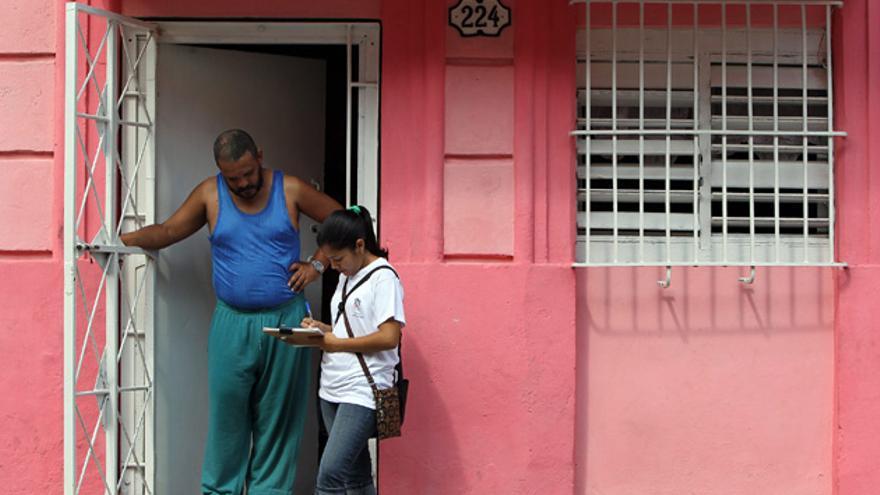
When a pollster goes to a house in Cuba, the citizen assumes that it is someone trusted by the government and is reluctant to give their opinion. (EFE)

14ymedio bigger14ymedio, Reinaldo Escobar, Havana, 22 February 2019 — As a sociological research tool, surveys have enormous utility in testing the state of opinion of the population in relation to different issues.

The credibility of a survey depends on several factors, including the selection of the sample, the veracity of the respondents and, of course, the honesty of the interviewers who are not supposed to demonstrate what answers they prefer but rather collect the data to learn the truth.

In a country like Cuba, where opinions that different from the official thinking are often penalized, it is difficult for respondents to say what they really think, especially if what they are being asked about is related to political issues. continue reading

When a pollster shows up at a house, tablet in hand, to ask a citizen whether or not they plan to approve the new Constitution in the February 24 referendum, it is likely that, before answering, they will look in all directions to check if they are being filmed. It’s not paranoia, it’s pure self-preservation.

The respondent presumes, quite rightly, that if the woman or man, young or old, has authorization to ask questions on the street, it is because she or he is a person trusted by the Government, which automatically makes him or her an informant for the political police. Can we trust the answers?

When an organization independent of the State, inside or outside of Cuba, tries to carry out a survey with this type of questions, it cannot count on the services of “the comrades of the CDR [Committee for the Defense of the Revolution].” They are obliged to ask opposition activists or independent civil society to carry out the survey.

These citizens, however elevated their sense of responsibility and above all, however high their honesty, will go to their environment, to the people they deal with. Can you trust that the answers they collect are from a representative sample of the population?

With these reservations, we should look at two recent surveys on voters’ opinions regarding the constitutional referendum on February 24.

One, carried out by the Study Group on Social Dynamics of the Cuban Observatory of Human Rights (OCDH), found that 33.5% of Cubans intend to reject the new Constitution. This disagreement is broken down by 19.2% with the intention of supporting NO (19.2%), 9.2% who will leave the ballot blank and 5.1% who will annul* their ballot.

The other survey, also carried about by a non-government organization, Cubadata, believes that 42.4% of the voters will vote YES, 41.6% will go to the polls to mark NO and 16% will opt to abstain.

Most likely, the government has its own surveys, conducted with much more resources. Unfortunately, they are not public.

There is talk about at least two surveys conducted by the authorities. The Union of Young Communists conducted one in Havana high schools, where students are 16 or older and eligible to vote. According to testimonies collected by 14ymedio from representative students, most of the respondents expressed their outright indifference to the referendum and, at the insistence of the pollsters, said they were not decided.

The other survey was conducted by the People’s Opinion Department belonging to the Central Committee of the Party. Their results are considered a  “State secret” and only the recommendations have emerged in the form of “directions” to the media.

What seems indisputable is that if the party-government had overwhelming YES results in a survey on the referendum, it would have been published a while ago. Clearly scruples would not be an impediment.

The countdown can now be expressed in hours. There are many signs that the rulers are nervous, because they are used to winning with majorities close to 100%. Today they know that they will not be able to get the support of 97.7% of the electorate that they supposedly received in the referendum of February 15, 1976.

For revolutionary triumphalism, a YES vote of 70% or less would be a humiliation. In contrast, for opponents, who barely got 1% (plus 1.3% blank and annulled ballots) 43 years ago, a 30% NO vote would be a great victory after an overwhelming campaign by the Government in favor of YES.

*Translator’s note: Annuling the ballot can be accomplished by writing something on it or crossing out everything, but not checking any of the boxes.

______________________________

The 14ymedio team is committed to serious journalism that reflects the reality of deep Cuba. Thank you for joining us on this long road. We invite you to continue supporting us, but this time by becoming a member of 14ymedio. Together we can continue to transform journalism in Cuba.
Havana: Venezuela Sneaks in Between the Tornado and the Referendum / Ivan Garcia

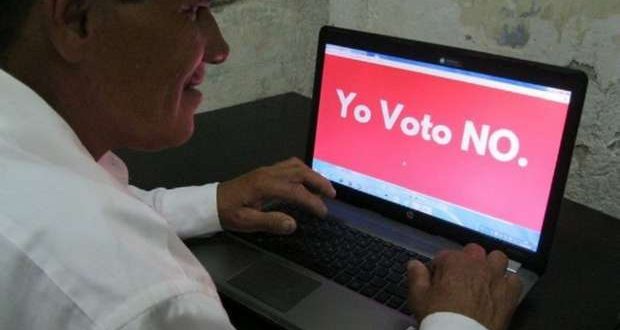
“I’m Voting No.” Source: Diario Las Américas.

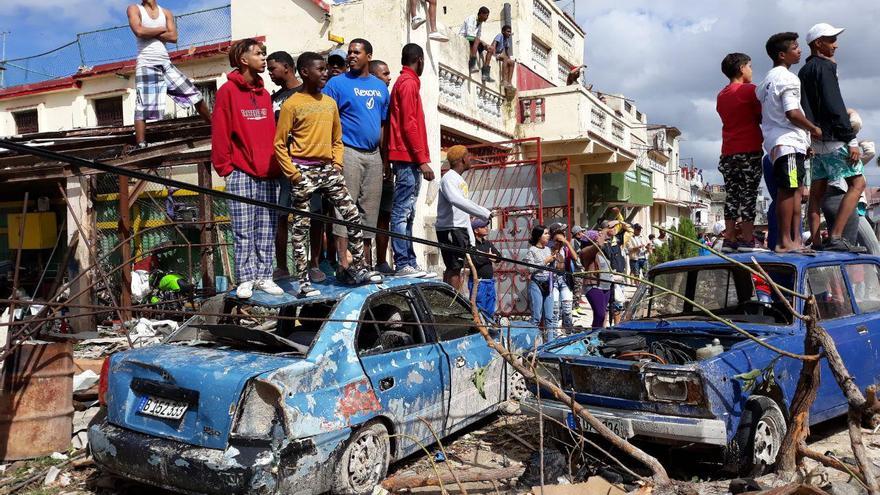
Ivan Garcia, 22 February 2019 — Collecting the masonry rubble and the trees severed by the powerful tornado that it several Havana municipalities on 27 January, when the night falls the residents of Luyano take turns to stand guard until dawn to protect the construction materials piled on the sidewalk, bought at half price from the state stores.

Three weeks later, the inhabitants of the old workers’ quarter are still telling their stories of panic. Ángel, a chef, says that after the government’s propaganda highlighting its own effectiveness in serving the victims, restoring electricity and telephone services, “the Mayimbes* forget to talk about replacing the furniture and appliances that people lost under the collapse of roofs and houses.”

And it wasn’t a small number. The last official count talks about 7,800 damaged houses, of which 730 are total collapses and almost 1,000 partial collapses. The most affected municipalities were Regla, Guanabacoa and Diez de Octubre. continue reading

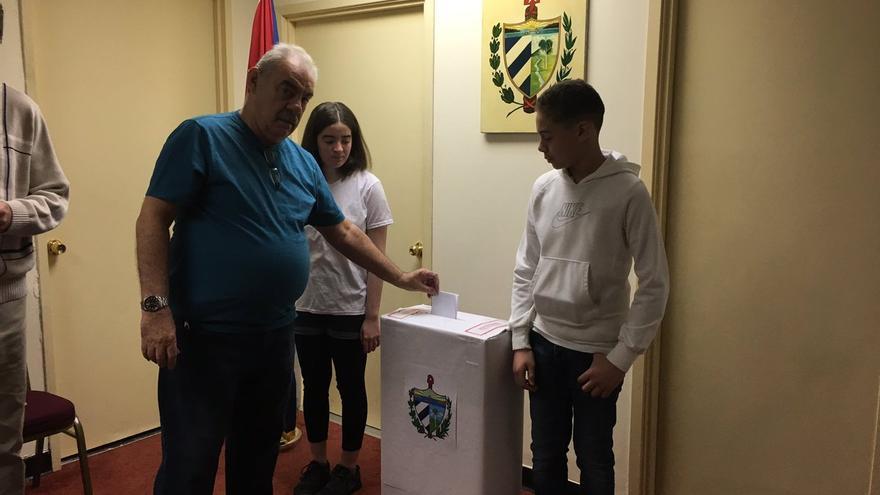
Angel considers himself a ’wealthy’ neighbor: he did not have to wait for the state brigades to start repairing his home. He already put up the roof plate and two masons are fixing the exterior walls. “But the tornado left me penniless. Where do I get the money? “Inventing” in my workplace. On Saturday, for example, we made the snacks and lunches for several electoral colleges in the municipality of Diez de Octubre that held a voting test in advance of the referendum on February 24. I sold the food that day and invested the money in the repair of my house.”

A few hours before the constitutional referendum, an authentic staging of the military autocracy, which tries to feign democracy, the propaganda of the regime is increasingly unbearable. “It’s an attack by land, sea and air. Not even covering your ears gives you an escape from the chant for the people to vote Yes,” confesses Sheila, a nurse, who recommends using the Weekly Packet to rent movies and American serials to escape the tedious political campaign.

When Mayra is disgusted, as now, while waiting in line to buy chicken quarters at a state market, she says aloud: “On Sunday, the 24th, I’m getting desperate. I’m going to put a big NO on the ballot [for the Referendum on the Constitution]. The government does not do anything right and wants Cubans to applaud their nonsense.”

Social networks became a battlefield of dissidents, both for those who support the NO and those who ask people to abstain, tonot vote. Each and every one of them turn the internet into a boxing ring, but everyone is aware that it would be a great irresponsibility to grant a new blank check to a dictatorship that has failed to administer public services and guarantee a decent standard of living.

According to some analysts, Sunday 24 February will be a victory in the tune of Yes. “But the number of negative or blank votes could approach 35 percent. We are talking about more than three million Cubans. It is a force that grows with each vote. In the near future it will be necessary to take them into account,” says Egberto, a graduate in political science.

Saul, a former diplomat, believes that “the dissidence should have asked in international forums sfor experts to monitor the referendum to protect from possible fraud. That would have placed the government in a dilemma. If it opposed, it was marked as intolerant and there was the suspicion of a plebiscite without guarantees.”

You do not have to be a legal expert to recognize that the future Constitution does not reflect the wide diversity that currently exists in Cuba. The result is a Constitution designed by the regime and for the regime. An ideological text to cement the power in place. Castroism would become a monarchy of a single party. A papacy.

Carlos, a sociologist, affirms that “even winning, the government will be questioned, because if the two million Cubans residing abroad and those temporarily abroad had voted, the majority vote would be NO.” Hundreds of Cubans living for a time in other countries, and who still maintain their rights in Cuba, in social networks have complained that the regime, in a clear violation of current laws, is not allowing them to vote.

“In Ecuador live thousands of Cubans who want to vote, but the embassy told us that to do so we should travel to the island. It is blackmail. Pay seven hundred or a thousand dollars for a round trip just to go to vote. When now, by new technologies, you can vote at a distance. As the government did with its international collaborators, to whom they guaranteed the vote,” says a Cuban resident in Quito, referring to the government’s having assured that all Cubans serving on government missions abroad were given a chance to vote.

In its attempt to win at any cost, the government plays in the arena inclined in its favor. While the regime’s propaganda invites a YES vote, in Caracas the anachronistic left that Fidel Castro founded is fighting for its life. The news from Venezuela sounds worse every day. In a media display, the neo-Castro rulers have burned all their ships. And they have deployed a campaign entitled “Hands outside Venezuela”.

Due to the absolute social control of the regime, in schools and workplaces, they are collecting signatures against a hypothetical intervention of the United States in Venezuela. The Cuban armed forces have joined the chorus of support for the unpresentable Nicolás Maduro. On the street, people wonder how Cuba can support Venezuela, when Cuba itself needs to be supported, especially after the passage of the tornado through Havana.

“If Fidel were alive or we were in the 1980s, when the FAR [Revolutionary Armed Forces] had a modern and logistical weapon to deploy troops abroad, I do not doubt that military officers would have been sent to fight in Venezuela. But the context is different. The generals are dedicated to businesses that generate dollars and the weapons that we possess are antiquated. We have no merchant marine to move large contingents of soldiers. And we should ask ourselves how many Cubans, voluntarily, would be willing to fight for Maduro.

Cuba’s support is only of a moral and publicity nature. When things are heating up there, they send back to the island the advisers in intelligence and military counterintelligence that they have in Venezuela,” predicts a former officer of the armed forces.

For now, the regime’s strategy is to get more than 4 million YES votrd in the referendum on February 24. And entrenched from a distance, attempting to shore up Maduro. As far as it can.

*Translator’s note: Mayimbe is a Taino (pre-Columbus Caribbean native) word for chief. 

Cubanos ‘Go Home’

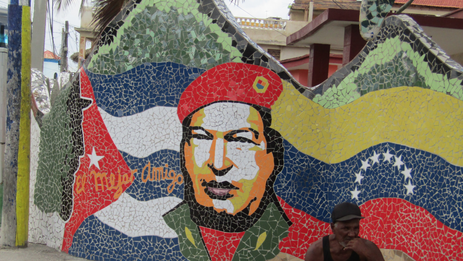
A mural in Havana celebrating Hugo Chavez. “The best friend” it reads.

14ymedio bigger14ymedio, Joaquín Villalobos, 21 February 2019 — In July of 1968 I finished my baccalaureate in a Catholic school with a professor who was a soldier for the dictator Francisco Franco. The students had to go to receive Lyndon Johnson, president of the United States, who visited the country. It was the first time I heard “Yankee go home” screamed by some college students. The Vietnam War was at its height, the Cuban Revolution was only nine years old, the military ruled my country and almost the entire continent with American support . Those who fought against colonialism demanded non-intervention and the self-determination of the peoples.

Half a century later everything changed, right-wing dictators were finished, communist utopias collapsed, elections defeated the armed struggle and now, seeing what is happening in Venezuela and Nicaragua, the evil seems to have changed its ideological side.

As of the year 2000, governments in Latin America fell in Peru, Argentina, Bolivia, Ecuador, Honduras, Paraguay, Brazil and Guatemala. They collapsed with moderate civic pressure, little international pressure, without prisoners, without exiles and with little violence; the most serious were 50 deaths in Bolivia. continue reading

In all these cases the institutions played a role in the crisis, even in Honduras the military coup was ordered by Congress, and ultimatey elections allowed the preservation of democracy. The judgment on the fairness or unfairness of these events is a broad debate, but compared to what happened in the twentieth century, objectively it seemed that, with imperfections, we were in another civic age.

The cases of Venezuela and Nicaragua have broken the rules of the game established in 2000, when the Democratic Charter was signed in Lima. Maduro and Ortega have accumulated more than 700 deaths, 800 political prisoners, thousands of exiles and engaged in the systematic use of torture. Venezuelan refugees total in the millions and Nicaraguan refugees are also on the rise. Both have brutally repressed the largest and longest-running civic protests in Latin American history and both are resisting isolation and international sanctions unprecedented on our continent.

The international community and the Venezuelans themselves have been making forecasts based on the premises established in 2000, and believe that at some point Maduro and Ortega will negotiate their exits. However, if this is correct, they should have collapsed. Why hasn’t this happened? The answer is that the obstacle is not in Venezuela or Nicaragua, but in Cuba.

Colonialism basically consists of political, military and cultural control, a puppet government and an extractive economy. The British dominated India for almost a century with the few thousand Englishmen sent to a country of some 300 million inhabitants and more than three million square kilometers.

Fidel Castro, through the instrument of Chavez, managed to conquer Venezuela. He defined the government model; aligned the country ideologically with 21st Century Socialism; reorganized, trained and defined the doctrine of the Armed Forces; assumed control of the intelligence and security services; sent hundreds of thousands of soldiers, teachers and doctors to consolidate his political dominance; established the Bolivarian Alliance of the Peoples of America (ALBA) for the geopolitical defense of his colony; chose Maduro as the puppet successor to Chavez and established an extractive economy that allowed him to obtain some 100,000 barrels of oil a day to sustain his regime.

In the last 15 years Cuba has received more than 35 billion dollars. At present, Maduro delivers 80% of the oil destined for cooperation to Cuba and 15% to Nicaragua. Any need of the Cuban regime has priority over the humanitarian emergency suffered by Venezuelans.

In Venezuela, life is played by the revolutionary leftist religion that has Cuba as its Vatican. The transition from Cuba to democracy and the market economy is a huge change for Latin America, comparable to what the fall of the Berlin Wall meant for Europe. When the collapse of the Soviet Union was clearly inescapable, the aspiration of its aging leaders was to die in bed, as Fidel Castro did in Cuba. The political, economic, ideological and above all personal interests of thousands of Cuban leaders and bureaucrats are the main obstacle in this crisis. This explains Ortega’s and Maduro’s ferocious resistance and elevated willingness to kill and torture.

The Cuban regime has opted for Venezuela and Nicaragua to be destroyed in a futile containment strategy to avoid its own inevitable end. Cuba has been resisting a transition for twenty years while its citizens suffer from hunger and misery. There is no visible emigration like the Venezuelan one because it is an island, but the most brutal massacre of Castroism is the more than one hundred thousand Cubans devoured by sharks while trying to cross the Strait of Florida since the Castros took power.

Cuba, the country that considered itself a leader in the fight against colonialism, ended up becoming a colonizer. Its leaders are dragging the entire left off a moral cliff that could leave a long conservative hegemony. Saving the useless and irredeemable failed Cuban model now means defending killings, torture and enormous corruption.

It does not make sense to defend Maduro from a hypothetical intervention of the United States when Venezuela is a country intervened in by Cuba. Whether the “left” likes it or not, in Venezuela there is a national liberation struggle and the dilemma is not to choose between Nicolás Maduro or Donald Trump, but between dictatorship or democracy. Faced with this reality, not aligning with democracy is to align with the dictatorship.

It is impossible to predict whether or not there may be a military intervention in Venezuela. The United States will make its own calculations in the face of Maduro’s absurd resistance. The automatic reaction to reject a intervention is understandable, but beyond the desires, the main thing is to pragmatically consider what could happen if it occurs.

In Venezuela there was never a real revolution, Chavismo did not cohere over revolutionary mysticism, but rather over clientelism and monetary ambition. Venezuela can not become a Vietnam, nor can there be a civil war. Venezuelans have persistently rejected violence, from Chávez, who surrendered twice, to the opposition, which for 18 years has resisted taking up arms.

Given the extreme unpopularity of Maduro, the deep division in the Armed Forces and some decorative militias that the military does not dare to arm permanently, the most likely scenario facing an intervention would be Panama in 1989 or Serbia in 1999, but with technology 20 years more advanced. In Panama, thousands of new rifles destined for militiamen who never existed were left abandoned. In Venezuela, they have been talking for years about a rifle factory that surely never existed because someone stole the money.

In conclusion, an intervention would be forceful, quick, successful and widely celebrated by millions of Venezuelans and Latin Americans. To say this is not to support a military solution, but to foresee a political reality. Therefore, if we want to avoid intervention and resolve the crisis politically, the right thing is not to confront Trump, but to demand that Cuba takes its hands off Venezuela.

_______________________

Editor’s note:   Joaquín Villalobos was a Salvadoran guerrilla and is a consultant for the resolution of international conflicts. This article has  been published  by the newspaper El País  and we reproduce it with the authorization of the author.

The 14ymedio team is committed to serious journalism that reflects the reality of deep Cuba. Thank you for joining us on this long road. We invite you to continue supporting us, but this time by becoming a member of 14ymedio. Together we can continue to transform journalism in Cuba.
“Joy is Coming”: The “Happy” Campaign That Promoted a NO Vote to End a Dictatorship

The power of cheerful positivity to end a dictatorship.

Lyrics

Chile joy is coming
Chile joy is coming
Chile joy is coming

Because whatever I say, I am free to think
Because I feel it’s time to win freedom
As long as there are abuses, it is time to change
Because enough of misery, I will say no

Because the rainbow is born after the storm
Because I want my ways of thinking to flourish
Because without the dictatorship, joy will come
Because I think about the future, I’m going to say NO

We say no, with the force of my voice
We say no, I sing it without fear
We say no, all together to succeed
We say no, for life and for peace

Get over death, this is the opportunity
To overcome violence with the weapons of peace
Because I believe that my country needs dignity
For a Chile and for all, we say NO

We say no, with the force of my voice
We say no, I sing it without fear
We say no, all together to succeed
We say no, for life and for peace
We say NO

Chile joy is coming
Chile joy is coming
Chile joy is coming

February 24, the Cry of the Ballot Boxes

The defeat of Yes could be the fruit of the sum of gestures, of those who vote No, those who abstain, and those who annul or leave their ballot blank. (Susana González/DPA/México)

14ymedio bigger14ymedio, Reinaldo Escobar, Havana, February 21, 2019 — February 24, 1895 is remembered in Cuban history as the Cry of Baire and marks the moment in which the second War of Independence against Spain began. The insurrection broke out in at least 30 other places on the island, but in the village of Baire, in the east of the country, it set itself in the collective imagination and ending up marking the identity of the event.

History — or legend — says that on that day 124 years ago, an order for an uprising signed by José Martí traveled in a cigar sent to Juan Gualberto Gómez. Underneath the successive plant layers went the message that detonated the last military conflict of that century on the island.

This February 24 no order has arrived from anywhere to produce a cry. Like in Fuenteovejuna, the work of Lope de Vega, the initiative to reject the text of the new Constitution has arisen from the heart of the people. Nobody has the right to claim authorship of the peaceful uprising that might occur at the polling places. continue reading

For the first time in 60 years we Cubans will have, for around half a day this Sunday, the opportunity to shake the foundations of the dictatorship.

It’s fewer than 12 hours during which we must agree. It’s not necessary to join a party or to put oneself underneath a suspicious umbrella. It’s not even necessary to endorse with a signature. It is an ephemeral, voluntary act, which can be public if one opts for abstention, or anonymous if one chooses to vote No, but can also be a defiant and decisive act of which we can feel proud.

Before seven in the morning and after six in the evening each person can go on about their preferred slogans, whether it be demanding the freedom of political prisoners, that the government ratify the treaties on human rights, that the wholesale market be opened, that marriage equality be legalized or prohibited; that taxes be lowered and salaries raised. But, in the time that the referendum will last, the struggle to achieve each one of these different aims goes through whatever is achieved at the ballot boxes.

During those magical twelve hours anyone who wishes “to do something” should support the initiatives of staying home or of writing the two crossed strokes of an X, to demonstrate their will as a voter to not accept either the irrevocability of the system or the primacy of the only party.

If the National Electoral Commission fulfills what is established in Article 137 of the current Constitution, the new Constitution will only be considered ratified if more than half of the registry of voters votes Yes in the referendum. So the defeat of Yes could be the fruit of the sum of gestures, of those who vote No, those who abstain, and those who annul or leave their ballots blank.

What is going to happen this February 24 will not have a geographic location, it will be the Cry of the Ballot Boxes: a magnificent libertarian chorus, the acceptance of a civic challenge, bloodless, peaceful, and civilized.

Translated by: Sheilagh Carey

_______________________________________

The 14ymedio team is committed to serious journalism that reflects the reality of deep Cuba. Thank you for joining us on this long road. We invite you to continue supporting us, but this time by becoming a member of 14ymedio. Together we can continue to transform journalism in Cuba.

Number of Unpacu Activists on Hunger Strike Rises to 111

The strikers are concentrated in three spots in Santiago de Cuba. Some are in the Antonio Maceo suburb, others in Vista Hermosa, and the rest in the principal headquarters of Altamira. (Unpacu)

14ymedio bigger14ymedio, Havana, February 20, 2019 — The leader of the opposition group Patriotic Union of Cuba (Unpacu), José Daniel Ferrer, reported this Wednesday that 111 members of that organization are now on hunger strike. The action, begun on February 11, is aimed at “calling attention” to the repression of the government against activists promoting the No vote to the new constitution that will be submitted to referendum on February 24.

 We are now 111 activists on hunger strike. #HungerStrikeVsRepression

– José Daniel Ferrer (@jdanielferrer) February 20, 2019

Since that same February 11, Unpacu’s headquarters in Santiago de Cuba has been surrounded by police, who control the passing of residents and visitors. As the Unpacu activist Jorge Cervantes explained to 14ymedio, those participating are “covert forces from State Security dressed as civilians, motorized police and patrol cars, and paddy wagons from the special forces.” He also said that the neighbors “are really upset” because the officials are blocking access to 9th Street in the Altamira neighborhood “to anyone who they suspect of being an Unpacu activist.” continue reading

The first to begin the hunger strike was Ferrer himself, a few hours after the exhaustive search of two of Unpacu’s headquarters and eight homes of that organization’s activists. The police action was condemned by the United States embassy in Havana and the Organization of American States (OAS).

The strikers are concentrated in three spots in Santiago de Cuba. Some are in the Antonio Maceo suburb, others in Vista Hermosa, and the rest in the principal headquarters of Altamira.

The number of strikers grows daily and their names and photos with a No painted on their shirts are updated via social media with the hashtag #HuelgaHambreVsRepresion (Hunger Strike Vs. Repression).

On Monday Ferrer broadcast live via Facebook from Céspedes park in the capital of Santiago province, but he was immediately violently arrested by several police officers. “Of course my voice fails me, I’ve had seven days without eating, only water,” said the opposition figure during the broadcast. Additionally, he explained on his Twitter account that he had escaped from the police blockade that they have at the headquarters “to continue with the #YoVotoNo [I’m voting no] campaign.”

According to the young leader of Unpacu, Carlos Amel Oliva, the hunger strike will conclude at midnight on February 24, hours after the closing of polling places. “So we will not be able to go vote, but we are calling on Cubans to vote No and many of our activists will go to vote No that day, and will also be there as observers.”

Translated by: Sheilagh Carey

______________________________

The 14ymedio team is committed to serious journalism that reflects the reality of deep Cuba. Thank you for joining us on this long road. We invite you to continue supporting us, but this time by becoming a member of 14ymedio. Together we can continue to transform journalism in Cuba.
Official Press Sees Electoral Advantages in the Tornado

The head of the information department of Solvisión, Yaneysi Nolazco, requests “taking advantage of the response the state has given to the disasters caused by the tornado.” (14ymedio)

14ymedio biggerMario J. Pentón/14ymedio, Miami/Havana, February 20, 2019 — The official press on the island has received guidance to take advantage of the tragedy of the tornado that, at the end of January, devastated Havana, in order to advance propaganda for the Yes vote in the February 24 referendum on the new constitution.

This newspaper has had access to an internal communication from the Solvisión telecenter, in Guantánamo, which gives instructions on coverage of this upcoming Sunday’s vote.

In that email, the head of Solvisión’s information department, Yaneysi Nolazco, requests “taking advantage of the response the state has given to the disasters caused by the tornado to claim that only a socialist state is capable of acting in that manner, [of] mobilizing workers […] raising awareness of young people, children, and women to offer its efforts in solidarity.” continue reading

The government has been heavily criticized for the response it gave to the tornado, which left seven dead and thousands of victims. Authorities have sold food and construction materials to the victims, which has triggered protests, some of which have spread to social media.

Nolazco asks Solvisión’s journalists to avoid the presence of electoral propaganda at the polling places, because calling for a Yes vote “isn’t the job of electoral authorities.” In the case that there are banners of this type, journalists should focus the camera “in another direction.”

The head of information asks the journalists to show the leaders “lining up to vote.”

“Right there take their statements, while interacting with residents, in some cases going forward with them inside the polling place and we’ll show everything that is happening,” she specifies.

Official journalists should interview young people and “demonstrate” that the new generations are “participating” in the referendum “not only as voters.”

Cuban authorities have promised “jail cells” to independent observers and promoters of No, who in an unprecedented and rudimentary campaign have used social media to champion their position against the ratification of the constitution approved by parliament.

In exchange for the recognition of the little private property and of foreign investment, the new constitutional text leaves intact the control of the Communist Party, postpones the decision on marriage equality, and guarantees the monopoly of the state over communication media, healthcare, and education, while at the same time affirming that “Cuba will never return to capitalism.”

Translated by: Sheilagh Carey

_________________________

The 14ymedio team is committed to serious journalism that reflects the reality of deep Cuba. Thank you for joining us on this long road. We invite you to continue supporting us, but this time by becoming a member of 14ymedio. Together we can continue to transform journalism in Cuba.
Free Letters

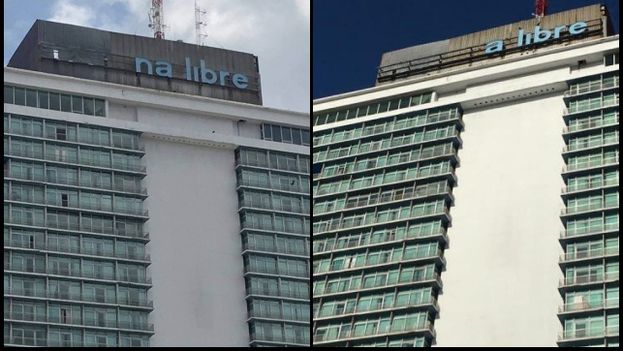
The emblematic sign of the Habana Libre hotel has lost several letters in recent days. (Facebook / 14ymedio)

14ymedio bigger14ymedio, Havana, 19 February 2019 — The Habana Libre Hotel, an emblem of the Cuban capital and the entire Island, has been converted, lately, into a symbol of the times that are coming. Little by little, the sign with the name of the celebrated lodging place has been losing letters, a deterioration that has not escaped the popular humor, intent on reading a code in the phrase that is left: “”bana Libre,” “na Libre,” “a Libre” have been some of the final variations suffered by the icononic blue lettering.

“Now we just need the “a” to drop off so that Cuba can be libre (free) again,” joked a passer-by who stood for several minutes looking up, waiting to witness the moment when “freedom comes,” at least on the roof of the hotel that was managed by the American company Hilton before the Revolution and from where Fidel Castro ruled the country during the first months of 1959, and later, in 1960, the hotel was seized and nationalized.

In 2018, the hotel celebrated six decades. With 27 stories and an initial investment of 28 million dollars, the building has gone through moments of light and shadow, years of glamor and others of frank deterioration. But few Havanans remember an image like the current one, with its sign falling apart.

The allegory seems appropriate a few days before the constitutional referendum that has filled society with questions and officialdom with fears. The 500th anniversary of the city’s founding will be celebrated in 2019, and that has also contributed to the interpretation of that progressive spelling as a sign of the changes that Cubans are asking for.

Whether it is laziness or the result of some strong winds, the Habana Libre has once again starred in the photos and selfies of those who expect the uncomfortable letter “a” to fall, leaving only the word “free” on top of one of the most famous buildings in the Cuban capital.

_________________

The 14ymedio team is committed to serious journalism that reflects the reality of deep Cuba. Thank you for joining us on this long road. We invite you to continue supporting us, but this time by becoming a member of 14ymedio. Together we can continue to transform journalism in Cuba.

And If Venezuela Succeeds?

Miguel Díaz-Canel, Nicolas Maduro and Raúl Castro in 2017, at the close of the XV Political Council of ALBA in Havana. (EFE)

14ymedio bigger14ymedio, Yoani Sanchez, Havana, 20 February 2019 — Coincidence or destiny, this is a defining week for Cuba and Venezuela. February 23 will be the key date for the humanitarian aid accumulated on the border with Colombia to reach Venezuelans and, a few hours later, Cubans will face, for the first time in decades, a ballot with the option of No.

That both events are occurring almost in unison complicates the scenario for both the Miraflores Palace and the Plaza of the Revolution. The sealed block that has been formed in the last two decades could be about to crack on one of its sides, but the other – irredeemably – will be touched by whatever happens. Both countries are “sewn to the same star,” in the words of the Chilean poet, Vicente Huidobro.

Raúl Castro knows that Nicolás Maduro is condemned. With a long experience of breathing energy into and sustaining guerrilla movements, leftist parties and presidents with whom it shares an ideology, Havana is an expert in detecting when the end has come. Its intelligence network, woven into the South American country, has also helped, in recent months, to complete the portrait of the death throes. continue reading

Juan Guaidó’s majority in international support, the deep economic crisis that Venezuelans are experiencing, and the disrepute that overflows the ruling cupola are precipitating Maduro’s fall. His administration becomes more indefensible every day, in step with what is learned about repressive excesses and the volume of looting it has perpetrated against one of the richest countries of Latin America.

The big question is what will Havana do when that end is closer and the so-called Bolivarian Revolution is left with barely a pulse or a breath.

For the time being, Castro is betting on closing ranks with Maduro and warning in international forums of a possible “foreign invasion of Venezuela,” while, behind closed doors, he revives the political rallies in support of Caracas, the massive signing of a commitment of solidarity with the Chavistas, and an intense media campaign in all the keys of the Cold War. Will he go from saying to doing and turn these gestures into military support?

To answer this question, we have to take into account the internal situation on the Island. The Cuban regime is experiencing a moment of extreme fragility. The “historical generation” that controlled the country for more than half a century has, for years, been filling the empty niches in the mausoleums, and can barely captain a strategy from the conference tables. The economy is touching bottom and in the streets the scenes of huge lines to buy basic products have returned, while the young people are ideologically apathetic.

The Constitution conceived by Raul Castro as the obligatory road map that his heirs must follow has not managed to arouse massive sympathy and campaigns to vote no or to abstain, at the expense of the results, have permeated society. Since he was hand-picked for the presidency, Miguel Diáz-Canel has had to deal with growing popular discontent, which was seen in a video that went viral on social networks when his caravan raced away while dozens of victims of the tornado in Havana’s Regla neighborhood screamed reproaches.

The country seems to be coming apart on all sides and the arrival of the internet on cellphones last December, despite the high prices and the unstable service, contributes to the sensation that throats and eyes have sprung up on every corner, reporting and denouncing what officialdom hid from view. This, along with the growing belligerence from Washington, makes the short-term future of Castroism quite uncertain.

In these circumstances, embarking on military support for Maduro would be a death sentence for Castroism, and the regime knows it. The authorities are aware that a good part of public opinion will applaud a reprisal against Havana if it dares to send armed troops to Venezuela. As a cunning survivor of endless diplomatic and political strife, Raul Castro has realized that this time it’s serious. Very serious.

Thus, he is likely to support his disciple until the moment comes to abandon him or to rescue him and bring him to Havana to live a long exile on this island that will become his home, a refuge, a prison. We cannot rule out that he will “choose to die” in the contest to give a “heroic closure” to the Bolivarian Revolution and to place the photo of another martyr in the pantheon of the Latin American left. As soon as it is clear that the Venezuelan wet nurse is offering more losses than benefits, the Plaza of the Revolution will depart, but not before shouting to the four winds “the struggle continues.”

If Venezuela manages to recover the path towards democracy and Guaidó calls for elections that Chavismo will not have the remotest chance of winning, that wave of changes will also reach Cuba’s coasts. Castroism’s diplomatic solitude will become more acute in the region, the few resources that continue to arrive from Caracas will end up on the lapels of the generals, and the senior officials of the Communist Party will be left with the shameful insignia of a defeat.

Diaz-Canel will be pushed to undertake deeper economic and political reforms in the absence of a patron and the resurgence of daily problems; the opposition will have a scenario more conducive to winning new battles with each flexibilization that is made from above or with each frustration that springs from below, while Cuba’s young people will have a close referent to inspire them and a Venezuelan mirror to see themselves through.

If Venezuela succeeds, we Cubans will be closer to also achieving it.

_________________________________

The 14ymedio team is committed to serious journalism that reflects the reality of deep Cuba. Thank you for joining us on this long road. We invite you to continue supporting us, but this time by becoming a member of 14ymedio. Together we can continue to transform journalism in Cuba.
Victims Without Rights

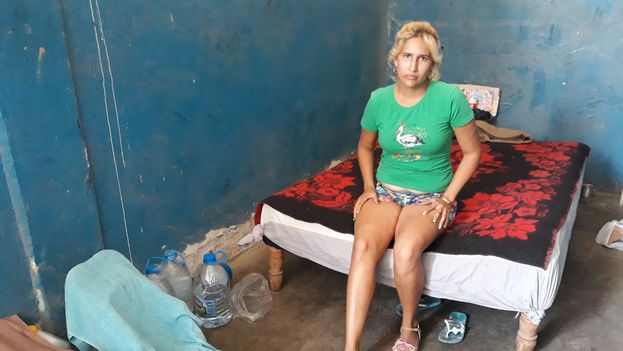
Isbet Acosta Valle had been in Havana for three years when the tornado destroyed the home where she was living. (14ymedio)

14ymedio bigger14ymedio, Luz Escobar, Havana, February 19, 2019 — There are those who lost everything or almost everything in the tornado, but there are also those who can’t even legally prove that the winds on that January 27 took everything they had. Before that night, Isbet Acosta Valle lived with her daughter in a borrowed apartment but her identity card didn’t say “Havana.” She is one of the many “illegals” who live in the city, who can’t ask for help to rebuild their homes.

Born in Las Tunas, Acosta arrived in the capital with the dream of making it there. A friend offered her a modest house and told her: “Stay for however long you can.” Three years had passed by the time the storm destroyed everything and flew off with her dreams.

“I can’t make claims because my name isn’t on the papers,” she tells 14ymedio. “Unfortunately the house was made of wood and the roof of fiber cement. It was in really bad condition but at least it was something, now I’m left on the street with my seven-year-old daughter.” continue reading

In the first 19 days, no authority came by the improvised warehouse in which they were sheltering. (14ymedio)

According to data on internal migration gathered in the 2012 census, the province where the most people live who were born in another province is Havana, with 462,677 (41.6% of the emigrants).

In 1997, authorities toughened the law on the settlement of inhabitants originally from other regions of Cuba in the capital. The regulations have led thousands of them to live in illegality or settle the matter via irregular methods, like paying a landlord who adds them as a resident in a home or marrying for convenience.

Frequently the police carry out raids and check the place of residency on identity cards. If it doesn’t match a Havana address, the person can be deported to their original province. Many of them live without access to the rationed market, higher education, and jobs in the state-controlled sector. Havana natives sometimes refer to them, derogatorily, as “Palestinians.”

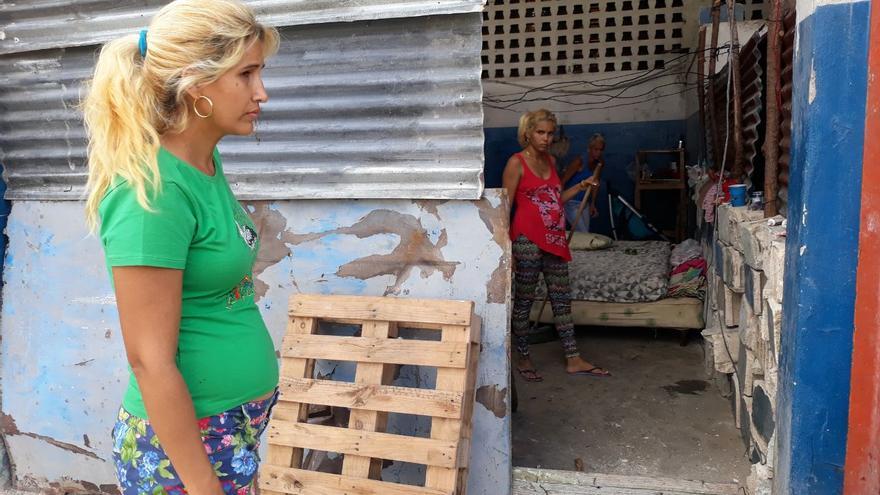
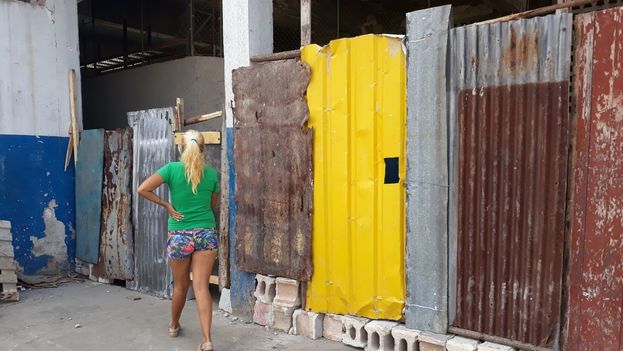
Isbet Acosta has become familiar with all those vagaries in the past few years, and now her conditions have worsened. She stayed in an old warehouse of interprovincial buses in the days after the tornado along with other families who have been left without a roof, but living together is complicated and privacy is null.

In the first 19 days, no authority came by the place. “We’re trying to find a solution for our housing because here we don’t have the proper conditions and there are small children, pregnant women. The state needs to give us an answer, I don’t care if it’s land to build on or materials to repair what’s here.”

In the warehouse where they spent the first days there was neither water nor electricity. (14ymedio)

The government has agreed to subsidize the price of construction materials by 50% for families who suffered total or partial collapses of their homes. However, an indispensable requisite to access these subsidized prices is being able to demonstrate ownership of the affected house, something that Acosta has never had.

To regularize her status in Havana she must first have her own home or the consent of the owner. The owner must register her at a private address, but the process includes procedures in several offices, verification of whether the house has sufficient square feet to accommodate another person, and numerous documents. In some neighborhoods an additional authorization is needed because they are considered “frozen zones.”

Without those formalities, Acosta cannot have a Havana address on her identity card, and without that requisite she remains on the margin, as well, of the possibility to request a bank loan or ask for some social help given her economic precariousness.

Despite her condition, every day the young woman appears at the Processing Office on Pedro Perna street in Luyanó, set up after the tornado, but they answer her that her case “is complicated” and “she has to wait.” At night, she sleeps between three moldy and chipped walls of the old warehouse, where she keeps her belongings in a strict order, as if she wanted to stop the chaos at least in the small space around her bed.

It wasn’t until last Friday that local authorities came with a concrete proposal for the victims sleeping in the place, the majority of them illegal. “They came early and told us to gather all our belongings because we were going that very day to a shelter in Boyeros and that’s what we did.” Everything that they had they put in small cases and they even gave away some things that they couldn’t carry.

“It was a total humiliation, we were waiting all day for the bus to come get us and nothing happened, at night another official came to tell us that we were no longer leaving for the shelter and that we had to wait.” The woman laments that they just have to “keep waiting” after the passing of the tornado.

On Friday night Acosta was desperate. She had given away her mattress because she didn’t have transportation to take it with her and she didn’t have anywhere to sleep. Saturday passed in the same way until on Sunday they were finally moved to the shelter. “We don’t have anywhere to go and for two weeks the state didn’t worry about whether we ate, whether we were alive, nothing,” she says.

As she recalls, there were days in which people came by bringing water, clothing, or food of their own initiative. “The water that some people have brought us as a donation is what we were using to clean ourselves the days when there was no water from the sink. With my daughter I had to live asking favors from neighbors to bathe her with lukewarm water because we didn’t even have electricity.”

The desperation of not having an answer has already passed, now she and her daughter are situated in a shelter that, although it doesn’t have all the conditions of the home that she lost, at least has the minimum necessary to spend the days. But Acosta is still an illegal and she fears that her situation will surface when she begins to complete some legal procedures and they will return her to Las Tunas.

Her dilemma is whether to make herself noticed and make claims to get a roof, or to keep quiet to avoid detection of the irregular status of her residency in Havana. To be or not to be, that is her quandary.

Translated by: Sheilagh Carey

_____________________________________

The 14ymedio team is committed to serious journalism that reflects the reality of deep Cuba. Thank you for joining us on this long road. We invite you to continue supporting us, but this time by becoming a member of 14ymedio. Together we can continue to transform journalism in Cuba.
February Declaration / Rafael León Rodríguez

Rafael León Rodríguez, General Coordinator of the Cuban Democratic Project, Havana, 7 February 2019

1.- Last year, after the appointment of Miguel Díaz Canel as president of the Republic of Cuba by the highest leadership of the Cuban regime, new expectations emerged, both inside and outside the country, about the possibility of starting a process of real changes in Cuban society that not only encompasses the economic and social realms, but also the politics. The president himself denied, repeatedly and in different scenarios that this would happen, pointing out that the key to his government was based by continuity, not on changes.

2.- Within the framework of the legal rearrangement determined by the new spaces occupied by private workers, mainly in the fields of services, agriculture and construction and the creation of new management structures for the government, the authorities of the islands initiated the project of revising the Constitution of the Republic of Cuba which, after being promulgated in 1976, had already undergone changes in the years 1978, 1992 and 2002. continue reading

In this latest version of the Law of Laws, already approved by the National Assembly last December, they have maintained the articles that define the Communist Party as a leading force of society and the state, as well as the irreversibility of the sociopolitical system that has governed Cuba for more than 60 years, in its various modalities. Martí, our Apostle, has told us,“It is always a misfortune for freedom if freedom is a party” [1] and also that: “A Constitution is a living and practical law that can not be built with ideological elements”[2].

3.- During the process of consultation, discussion and reception of proposals from the citizenry last October, which can be considered as the analysis of the preliminary draft of the Constitution put to public consideration, although the participation was estimated by the authorities and their media as very significant, it is noteworthy that the articles imposed that define and guarantee the continuity of the dictatorial regime could not be discussed or questioned.

4.- A referendum on this new Constitution will be held on February 24, which will decide whether or not it is approved by the citizens. But, beyond this plebiscite, the new constitution continues to ignore political plurality, continues to obscure the peaceful democratic opposition and disrespects, by action or omission, in parts of its articles, both the Universal Declaration of Human Rights and the United Nations Covenants on International Economic, Social and Cultural Rights and Civil and Political Rights.

5.- The Message from the Cuban Catholic Bishops dated February 2 of this year, regarding the new Constitution of the Republic of Cuba and the upcoming referendum to which it will be submitted, after the analysis of the fundamental issues of the text, concludes:

“21. We urge every citizen, with their vote and from their conscience, to contribute to the edification of a society in which all Cubans feel ourselves respected in our rights and, at the same time, build a dignified and prosperous life with the participation of all, with no exclusions.”

“22. We entrust these intentions to the Virgin of Charity, Mother of all Cubans and implore the blessing of God on our beloved Fatherland.”

6.- The Proyecto Demócrata Cubano (Cuban Democratic Project) joins the spirit and the letter of the Message of the Cuban Bishops and endorses all the considerations on the text of the new Constitution that will be put to the consideration of those who should be the true sovereign, the Cuban people.

7.- The reiterated discourse of the island’s authorities regarding the defense of “unity in diversity” is significant when it comes to policies towards and with the exterior; when it comes to policies within, in relation to the Cubans, they continue to demonize the different politicians, maintaining an antidemocratic contradiction of evident moral double standard. While this contradiction is sustained and fed by the regime, many of the words of the Apostle José Martí will continue to be a pending issue, among them, those of great importance for the theme that brings us together: “The republic, for all must be fair, and it has to be   with everyone”[3] , and finally: “A neglected vote is a lost right, and the indifference in the suffrage is the prelude to the despot” [4].

[1] Escenas Mejicanas – 1877
[2] Escenas Norteamericanas – 1882
[3] “Patria” N.Y. – 1892
[4] “Patria” N.Y. – 1893

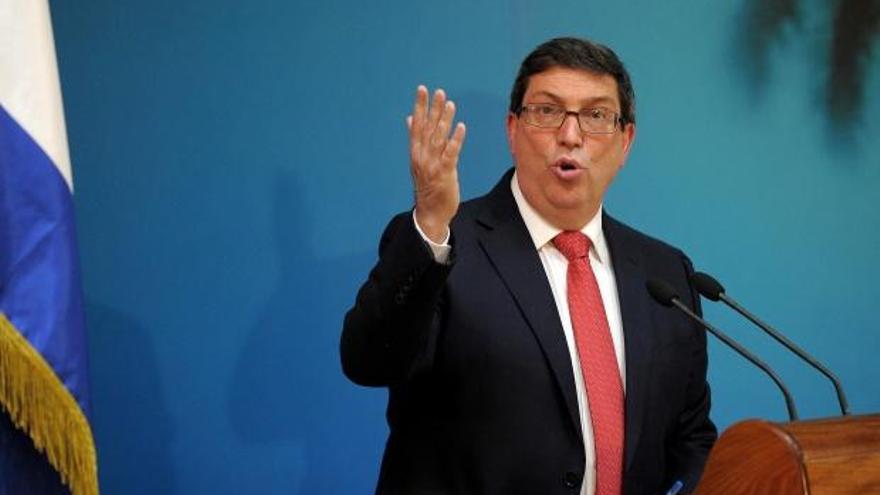
Cuba’s Foreign Minister Challenges Trump to Demonstrate That Cuba Has Troops in Venezuela

Bruno Rodriguez dismissed as a “clumsy and crude statement” the speech that the US president, Donald Trump, delivered Monday in Miami. (EFE)

14ymedio bigger14ymedio, Havana, 19 February 2019 — Cuba’s foreign minister, Bruno Rodríguez, challenged US President Donald Trump on Tuesday to demonstrate that the island has troops in Venezuela. Rodriguez insisted that the United States “manufactured” a “humanitarian pretext” to invade Venezuela and refrained from answering the question of what would happen in case of an armed intervention in the Caribbean country.

“The accusation by the US president that Cuba has a private army in Venezuela is infamous, and I urge him to present evidence, and our government rejects that slander in the strongest and most categorical terms,” said Rodríguez Parrilla, who said that the more than 20,000 Cuban professionals in Venezuela are civilians.

According to the foreign minister, 94% of Cubans in Venezuela are “healthcare workers” although he also acknowledged that others provide services in educational areas and other economic spheres. continue reading

Rodriguez Parrilla added that the “Cuban aid workers” in Venezuela already participated in the referendum for the approval of the constitutional reform “in a massive way” and “despite the circumstances” they live normally in that country.

“I firmly reject President Trump’s attempted intimidation of those who, in a sovereign manner, decided to build and defend socialism,” added Rodriguez Parrilla. One day earlier the president of the United States said at the International University of Florida that the “days are numbered” for socialism in Cuba, Venezuela and Nicaragua.

The Cuban foreign minister again denounced that the United States plans a military invasion in Venezuela for which military transport flights are ongoing in the Caribbean. To the question of what Cuba would do in the face of a military intervention in Venezuela, Rodríguez Parrilla shied away from answering a “hypothetical question.”

“The government of the Republic of Cuba has consistently denounced that the US government is preparing a military aggression against Venezuela with humanitarian pretexts,” he said. According to the foreign minister, the United States continues to transport troops “with complete ignorance” of the governments of some countries in the area.

The high official claimed to have evidence of US military movements that presage an imminent invasion. “Cuba calls on the international community to support peace and against military intervention in Venezuela,” he said.

Rodríguez Parrilla responded to Trump’s speech in Miami accusing the United States of having a “corrupt” political system, where elections “are won by manipulating people.” The foreign minister also touched on, in a long “anti-imperialist” speech, the situation of unions, the African-American community, the poor and migrants in the United States.

The Cuban Foreign Ministry also responded that the country is prepared for an eventual enforcement of Title III of the Helms-Burton Act. “We have a program, with a predictable plan for the economy until 2030. The Cuban economy has a strong international anchor,” argued the foreign minister.

Rodriguez Parrilla said that the application of the section of the Helms-Burton Law that would allow suits against international companies that “traffic” with properties expropriated by the Cuban government in the early 1960s will have “strong resistance” from the countries that have investments in the island.

“I know of a strong opposition from many member states of the European Union and other industrialized nations, I know of substantial diplomatic exchanges and I am convinced that these nations will defend not only the sovereignty of their states but also their national interests,” said Rodriguez Parrilla.

Rodriguez dismissed as “a clumsy and crude statement” the speech that the US president, Donald Trump, delivered Monday in Miami, where the Republican proclaimed the death of socialism in America and said that Cuba controls Venezuela.

“How many times have US characters announced the end of socialism?” asked the Cuban minister, who criticized Trump’s “amoral government” and his “polarization of society” through “hatred and division.”

___________________________________

The 14ymedio team is committed to serious journalism that reflects the reality of deep Cuba. Thank you for joining us on this long road. We invite you to continue supporting us, but this time by becoming a member of 14ymedio. Together we can continue to transform journalism in Cuba.
“Peter Pan” in the Air / Fernando Damaso

Fernando Damaso, 19 February 2019 — Lately I’ve been hearing the phrase “the horrendous Operation Peter Pan” and I ask myself: Was it really horrendous?

“Operation Peter Pan” consisted of many parents sending their children to the United States through religious organizations, to avoid losing “parental authority,” which was a broadly-held concern among the members of the middle and upper classes in the year 1959.

It was a decision made within families and no one was forced to do so. In addition, nobody expected that the political process just started — the triumph of Fidel Castro’s Revolution — would last. Most people believed the separation would be temporary. continue reading

But it didn’t happen that way and many of the separations continued for years. Some children grew up and thrived in their new surroundings and others didn’t manage to do so, as is normal. Some, as the years passed, expressed their gratitude to the program, and others condemned it.

Did Cuban parents lose “parental authority” over their children or not?

Well, in reality, yes. They lost the right to educate them according to their wishes, principles and beliefs, be they secular or religious, in public or private schools. When all the schools in Cuba become public, that is, belonged to the State, it instituted atheism and the teaching of its ideology.

Cuban children were under duress, from their earliest childhood, to declare themselves “pioneers for communism” and, later, to swear “to be like Che,” as they repeated in their daily oaths during the morning assemblies at school. Although this extemporaneous militancy, with colored “neckerchiefs” and all, was said to be voluntary, in practice it became mandatory. Because any child who did not follow it, immediately suffered the induced repudiation of his or her classmates, creating the breeding ground for the “double standard” where I say one thing (what everyone wants to hear) and I think something else.

Also, in Cuba, young people were separated from their parents and the family environment for long periods of time in mobilizations, the Literacy Campaign, schools in the countryside, sent to study in what are now the  former socialist countries, compulsory military service and other forms.

Among the last was sending them to fight and die in other people’s wars, under the excuse of strengthening them physically and ideologically as men of socialism. There was also the constant exodus of family members, dismantling and vaporizing this important institution of the social fabric, and prohibiting their reunifications for years, under the absurd concept that “whomever left the country was a traitor and could never return.”

Remembering all these barbarities, in reality parents in Cuba lost “parental authority” over their children, without the need of any law to that effect.

I do not think that “Operation Peter Pan” was horrific: it was, simply, a response to a danger that was coming and that, unfortunately for many generations of Cubans, became real.

Current assessments may be different, even when they are colored by political and ideological interests, not always fair, nor worried about true human feelings.

Authorities Promise Jail Cells for Those Promoting a No Vote

Zelandia de la Caridad Pérez and Juan Moreno were detained in the municipality of Bauta when they were trying to carry out a campaign for No. (14ymedio)

14ymedio bigger14ymedio, Havana, February 18, 2019 — “The next time they will end up in a jail cell,” the Ministry of the Interior official warned two activists who had just given a workshop on voting observation this past Saturday in Bauta (Artemisa).

The electoral process does not need “independent observers because the Revolution has its own observers,” added the official.

The message was clear in the form of a threat that Zelandia de la Caridad Pérez, national coordinator of the Cuban Commission on Voting Protection (COCUDE), and Juan Moreno, executive secretary of the organization Candidates for Change, received. continue reading

That is the trend of the campaign undertaken by authorities to silence those attempting to carry out a campaign for No and, with barely a week left before the vote, seems to be intensifying.

Arrests, threats, and raids on homes are some of the strategies employed against those promoting a position that differs from the Yes backed by the government and for which an intense campaign has also unfolded in national media, schools, and public transportation.

This Sunday, in Santiago de Cuba, the opposition figure José Daniel Ferrer was detained while he was promoting voting against the constitution in the central Céspedes park. The leader of the Patriotic Union of Cuba is on a hunger strike along with more than 70 members of his organization who have been uniting in protest over the raid that they experienced in eight of their homes last Monday.

During the police search, Ferrer was also arrested, and two police officials, who were identified as Dayron and Quiñones Zapata, explained to the ex-prisoner of the Black Spring that the raids and the seizure of numerous work resources were motivated exclusively by the campaign that Unpacu is carrying out to encourage the No vote in the referendum.

Adriano Castañeda Meneses, municipal vice-coordinator of the United Antitotalitarian Forum (FANTU) in the city of Sancti Spíritus, has also just had a similar experience. His house was raided this Sunday by the police in order to, allegedly, search for propaganda from the Write Down No campaign that the opposition organization is promoting. The initiative explains in 16 points the reasons to reject the new constitutional text on February 24.

The pressures have led the Cuban Observatory of Human Rights (OCDH), headquartered in Madrid, to once again reject, this Sunday, “the wave of arbitrary arrests, raids on homes of human rights activists, and confiscations from activists who have publicly demonstrated their reservations and questioning of the new constitution.” The organization specifically highlights what happened last week at the Unpacu headquarters and denounces that, among the items being confiscated in the searches are “all the tools and resources of work,” in that particular case, for example, “623 registers of observers from civil society for the referendum.”

The OCDH also laments in its communique that “during seven weeks of campaigning for the referendum, not one article recommending No or abstention has been published in the official press,” which “violates international standards for voting material.”

Translated by: Sheilagh Carey

________________________________

The 14ymedio team is committed to serious journalism that reflects the reality of deep Cuba. Thank you for joining us on this long road. We invite you to continue supporting us, but this time by becoming a member of 14ymedio. Together we can continue to transform journalism in Cuba.
Thieves of Memories

Kata Mojena (Facebook)

14ymedio bigger14ymedio, Yoani Sanchez, Generation Y, Havana, 18 February 2019 – A practice frequently repeated in the raids carried out by Cuban State Security against the homes of activists, opponents and independent journalist is, precisely, the seizure of personal photos and videos. They take away that unique image of a grandmother that sat on a shelf, the snapshot of a grandson’s birthday, and the film of the baby’s first steps in the living room of the house. As if they wanted, by snatching the memories of the past, to leave the person without emotional support and sentimental roots.

I recall a few years ago talking to a Lady in White who most regretted, among the personal items she lost during a police search of her home in March 2003, the loss of the photos of her wedding. That dawn of the Black Spring, when her husband was arrested, she lost the only images she had of that very special moment when they exchanged rings, cut the cake and kissed in front of the camera. They never returned them to her, although those photos had nothing to do with the accusation leveled by the prosecutor against her husband, who spent more than seven years in prison. continue reading

Now, I read this text by Kata Mojena*, and confirm that last Monday’s raids against several homes of Patriotic Union of Cuba (Unpacu) activists have repeated this same model of repression, the same absurd confiscations of private effects, of family memories and of images that have no value to the police, but are of incalculable importance to a human being. The strategy continues to be the same: take from the person what makes them a person; reduce them to the present; eliminate all those emotional elements that complete them; snatch the testimony of what they can no longer take as a lived experience. In short, take ownership of their history.

Luckily there are now social networks to denounce this immediately and we do not have to wait long years for the world to find out, so the reactions rejecting these activities are heard and the public scorn falls on these “memory thieves” who – from the so many outrages they have committed in the past – have ended up deeply panicked about their own future.

*From Kata Mojena on Facebook: Seeing the photos I have uploaded these last years, has made me feel melancholy because they are the only ones that remain after the assault I suffered. Of course I am not going to forget the disaster they left in my house nor all the information I lost which I had worked on for years, and I will remember with sadness this event every time I want to see videos of my children as babies or my wedding and can’t because they no longer exist. I still have no answer for my older son when he says to me, Mamá those aren’t police they are thieves in disguise, nor for my youngest son when he asks me to put on his favorite cartoons. It pains me greatly that my little sister, 16, remembers with shame how they stripped her naked and searched her like a criminal. But this is true: they did not manage to take my dignity, my decision to fight, my need to live in freedom. They cannot take these because they live in my mind and heart.

Therefore, I join the hunger strike in protest against so much barbarity and the impossibility of campaigning for a No [vote] on that shameful constitution. I had already started it on the first day but my husband explained that they needed me to be strong for other tasks. Now I have finished them. So we are 71 #enhuelgadehambreVsRepresion (on hunger strike vs Repression).

________________________________

The 14ymedio team is committed to serious journalism that reflects the reality of deep Cuba. Thank you for joining us on this long road. We invite you to continue supporting us, but this time by becoming a member of 14ymedio. Together we can continue to transform journalism in Cuba.