Of the list of 51 agreed upon with the Holy See, 24 still remain to be released.
Released prisoners walk outside La Lima prison in Havana. / EFE/STR
EFE (via 14ymedio), Havana, April 5, 2026 – The NGO Prisoners Defenders (PD) reported this Saturday that the number of political prisoners released by the Cuban government has risen to 27 since the announcement, on March 12, of a process agreed upon with the Vatican that contemplates the release of 51 inmates.
“Of the 51 prisoners the regime said it would release in March, only 27 are political prisoners. To reach the announced 51, 24 political prisoners still remain to be released, since the rest would be common prisoners. In March, 14ymedio confirmed that more than 10 of that group were common inmates,” the NGO stated in a message on social media.
It also clarified that the figures published this Saturday regarding “the release under threats of 51 prisoners in March” should not be confused with “the release/pardon of the 2,010” that the Cuban government announced this Thursday.
The figure reported by Prisoners Defenders refers to the information provided by the Havana government on March 12, when it announced the release of 51 prisoners. These individuals, according to officials, had served “a significant part of their sentence and maintained good behavior in prison.”
These releases are not pardons, but rather a benefit that allows the prisoner to leave the penitentiary even though the sentence has not been completed.
At the time, Cuban authorities framed the decision as part of “a spirit of goodwill and the close, fluid relations between the Cuban State and the Vatican.” continue reading
These releases are not pardons, but a measure that allows inmates to leave prison before completing their sentence, subject to compliance with certain conditions during the remaining time.
Separately, on April 2, the Cuban government announced the pardon of 2,010 prisoners, describing it as a “humanitarian and sovereign gesture of solidarity” in the context of Holy Week celebrations.
The regime has excluded in its statement those convicted of “crimes against authority,” a category that applies to 95% of political prisoners.
In its statement, the regime indicated that those included “feature young people, women, adults over 60, those nearing the end of early-release periods in the final semester and the coming year, as well as foreigners and Cuban citizens residing abroad.”
Cuba closed February with 1,214 people detained for political reasons, according to PD’s latest monthly report, the highest figure recorded since the organization began documenting prison conditions on the Island.
Translated by Regina Anavy
______________________
COLLABORATE WITH OUR WORK: The 14ymedio team is committed to practicing serious journalism that reflects Cuba’s reality in all its depth. Thank you for joining us on this long journey. We invite you to continue supporting us by becoming a member of 14ymedio now. Together we can continue transforming journalism in Cuba.
If the State guarantees neither electricity nor internet, those who can afford it try to become independent of both at the same time.
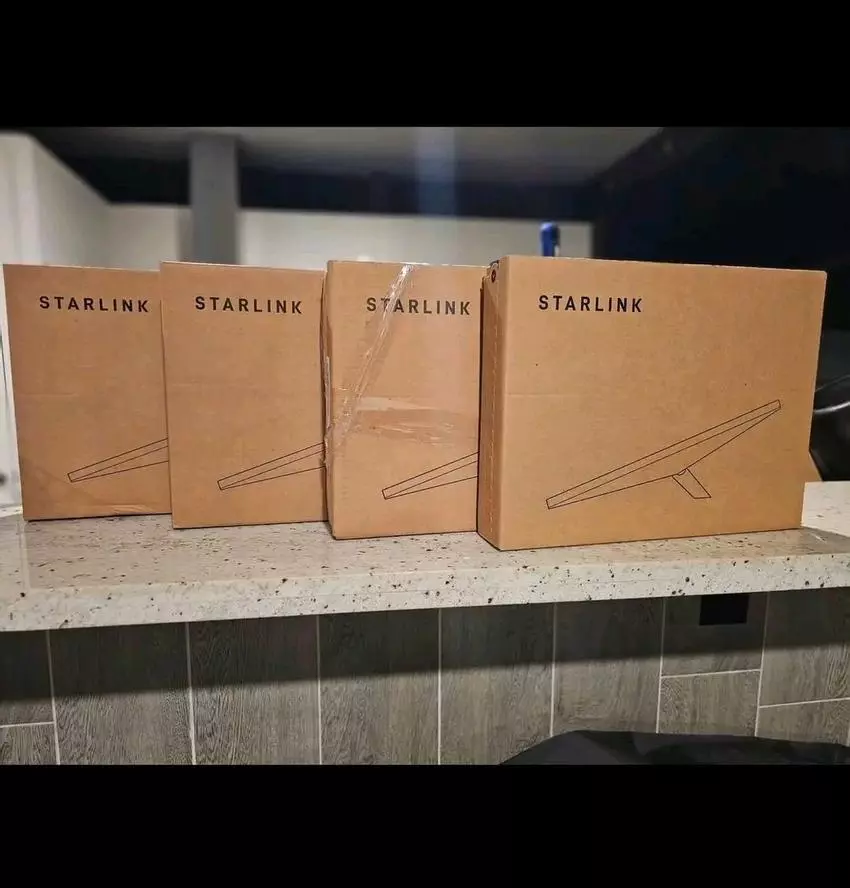
The antenna needs to see the sky, but it must not attract the neighborhood’s attention. / 14ymedio
14ymedio, Matanzas, Pablo Padilla Cruz, April 5, 2026 – On some rooftops in Havana, Matanzas, or Santa Clara, it’s no longer just water tanks, clotheslines, pigeon coops, and old television antennas that stand out. Now another object is beginning to appear, or rather to hide: the rectangular Starlink dish. In a country where internet access remains expensive, unstable, and vulnerable to blackouts, some Cubans have decided to bypass the ban and set up their own gateway to the world.
The operation begins long before turning on the equipment. The first obstacle is Customs. Marlon -a fictitious name- tells 14ymedio some of the tricks used to evade controls. “An assembled antenna shows up immediately on the scanner,” he explains. “You have to make it unrecognizable: take it apart into pieces, put it inside a television or a computer tower, mix it with cables, tools, and electronic scrap.” Sometimes it works. Other times, the difference between losing everything or leaving the airport depends on finding an official willing to look the other way in exchange for two or three $20 bills folded inside the passport.
Once inside the country, the antenna is assembled in silence. Then it has to be installed in a spot with enough open sky, but without being too exposed to view from the street or a neighbor’s house. After that, it is connected to a backup battery (UPS) or a small solar system to withstand blackouts.
Elon Musk: “It works in Cuba, it’s just not allowed to be sold there”
Damián, a programmer from Matanzas who works for clients abroad, justifies the investment. “With Etecsa [the State telecommunications monopoly] I couldn’t sustain a full meeting. Everything would drop. Now I pay the subscription with help from my brother in Miami. It’s expensive, yes, but it lets me work.” Like him, other professionals have reached the same conclusion: a stable connection is no longer a technological luxury, but a condition for job survival. continue reading
The most visible trigger came on March 16, 2026, when Elon Musk wrote on X a phrase that confirmed what had already been circulating as a clandestine rumor among users on the island: “It works in Cuba, it’s just not allowed to be sold there.” The statement did not change the legal situation, but it did clear up the main technical doubt. Coverage exists. What does not exist is authorization from the Cuban State to market the service or tolerate its open use.
That’s where true Cuban ingenuity begins. Because the signal over Cuba alone is not enough. Ordinary mobile phones are not designed to connect directly to Starlink satellites as a full substitute for a fixed or mobile network. For that, the company’s specific terminal and a router are required to distribute the connection. The option of direct satellite-to-cellphone connection remains limited and does not yet offer the capacity needed to sustain a full workday, a stable video call, or an internet-based business.
The failure of Cuban connectivity is explained not only by Etecsa’s monopoly, but also by the energy collapse
One of the most common tricks is registering the service outside Cuba. Since Starlink does not officially sell on the Island, many users rely on accounts activated in third countries, such as Mexico or the United States. The equipment enters already linked to a roaming plan and is used in Cuban territory through that channel. It is not a stable or guaranteed long-term solution, as it depends on the service’s own rules and authorized markets, but today it sustains a large part of the clandestine installations.
The second trick is camouflage. The antenna needs to see the sky, but must not draw attention. Some people hide it inside fake air-conditioning boxes. Others place it behind walls or paint it cement gray to blend in with the rooftop. Some even put it inside modified plastic structures made of materials that do not block the signal, so that from below it looks like something else.
The third trick has to do with electricity. The failure of Cuban connectivity is explained not only by Etecsa’s monopoly, but also by the energy collapse. A fixed line is of little use when a neighborhood can go hours or more than one day without power. That is why many users connect the antenna and router to lithium batteries, UPS systems, or small solar setups. If the State guarantees neither electricity nor internet, those who can afford it try to become independent of both at the same time.
A single unit can supply a small neighborhood network and turn its owner into an informal Wi-Fi provider. / Facebook / Ventas Santa Clara Cuba
In terms of cost, Starlink is far beyond the average Cuban’s means. While in the United States or Mexico a standard kit may cost between $300 and $450, on the Island that same equipment shoots up on the black market to $1,300-$1,800, a difference driven not by technical improvements, but by import risks, camouflage, bribes, and the possibility of confiscation. On top of that comes the monthly fee: roaming plans, the ones that allow use in a country where the service is not officially sold, range from $90 to $120 per month, although in Cuba many end up paying around $150 to resellers who manage the account from abroad. In practice, users are not paying just for internet, but for the entire chain of illegality and financial dependency that makes it possible to turn on the antenna.
Around this banned technology, a small economic ecosystem has already emerged. There are those who use it to sustain a private business, those who depend on it for remote programming or design work, and those who resell it. A single device can power a small neighborhood network and turn its owner into an informal Wi-Fi provider. Just as people once shared signals from antennas to watch foreign TV channels, now they are starting to share Starlink connections. In practice, it is an invisible small business.
This proliferation explains the authorities’ unease. The Government can confiscate antennas, tighten inspections, and label these devices as contraband technology, but it has not managed to erase demand. Every dish hidden on a rooftop confirms the failure of a monopoly unable to provide a sufficient, stable connection compatible with contemporary economic life.
Starlink alone will not democratize Cuba. It remains expensive, clandestine, and limited to a minority. It almost always depends on money sent from abroad and on a chain of illegalities that keeps it out of reach for most. But each antenna leaves behind a difficult truth to conceal: the demand for connectivity has already outgrown the State’s capacity for control.
Translated by Regina Anavy
______________________
COLLABORATE WITH OUR WORK: The 14ymedio team is committed to practicing serious journalism that reflects Cuba’s reality in all its depth. Thank you for joining us on this long journey. We invite you to continue supporting us by becoming a member of 14ymedio now. Together we can continue transforming journalism in Cuba.
“I can’t carry much, I only pick up skinny people,” says the motorcyclist who takes me through the streets of the capital.
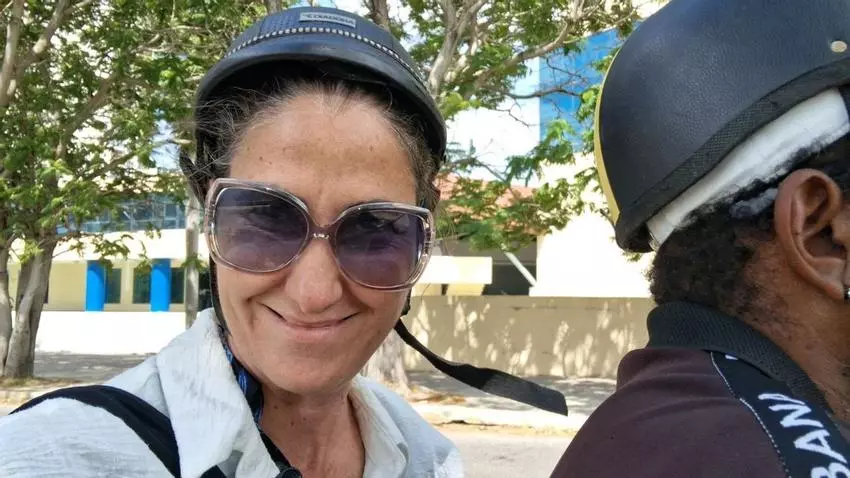
My grandmother always refused to call the House of Three Kilograms “Yumuri”. / 14ymedio
14ymedio, Yoani Sánchez, Havana, 4 April 2026 / “Put on your helmet,” the young man tells me before I get on the motorcycle. In Havana, almost paralyzed by the energy crisis, there are motorcyclists who serve as taxis. They assess you from head to toe before quoting a price, because body weight influences what you’ll pay. “I can’t carry much, I only pick up thin people,” the young man assures me. The vehicle is electric, and he bought it after a trip to Spain. He starts telling me wonderful things about Madrid as we cross the Iron Bridge.
“I’m going all the way to La Sortija,” I warn him. The famous store, a few meters from Fraternity Park, continues to be an important landmark even though it has been sinking into decay for years. We Havanans cling to the old names of places, as if by pronouncing them we could pull them up from the ruin. Thus, we still say Carlos III for the now rebaptized Salvador Allende Avenue, but hardly any of its former grandeur remains. No one refers to La Cubana hardware store by that name anymore, but rather with the catchy “Feíto y Cabezón” [Ugly and Pig-Headed].
My grandmother always refused to call the House of Three Kilograms department store by its previous name, “Yumuri.” She repeated the old name and remembered the mannequins in their long dresses, but all I saw in the windows were the clunky briefcases that all the government officials carried. There were also some shirts that became the least ugly thing among the clothes the “new man” was supposed to wear. In those 1980s, I liked to go into the shop on Reina and Belascoaín to breathe in the air conditioning. That smell conveyed luxury, sophistication, and the future. Today it’s closed and exudes a musty odor.
Nobody refers to La Cubana hardware store like that, but rather with the catchy “Ugly and Pig-Headed”
The motorcycle is already on 23rd Street. To my right rises the former Havana Hilton. The building seems dwarfed by the colossus they’ve erected just a few meters away. The K Tower isn’t quite right. Too big, too cold, too lonely. The hotel inside is closed due to a lack of tourists. On the avenue in front of the 42-story giant, you could set up an impromptu casino rueda [dance party] without the traffic being a problem. Only occasionally does an electric tricycle or a classic American car pass by. “The only good thing about all this is that it’s unlikely you’ll get hit by a car,” the motorcyclist quips.
We headed down San Lázaro. We passed a bicycle taxi loaded with sacks of charcoal. The man pedaled hard to move the valuable cargo. Right now, lighting a stove is a headache for thousands of families in this city who don’t have piped gas or liquefied gas reserves. On balconies and rooftops, makeshift fires are visible where coffee is brewed and lunch is cooked. A smoky smell clings to the clothes and sheets hanging on the lines.
There are still many people in this city who call Galiano’s store the ‘Ten Cent’ and the building converted into the Computer Palace, almost always empty and dark, is still called ‘Sears’. Hardly anyone in Havana calls Revolution Square ‘Civic Square’ or the complex where the Yara cinema is located the ‘Radiocentro CMQ Building’. Those who used those names went into exile or died. But every now and then I run into someone who gives me directions, specifying that “you have to turn right at the La Marina newspaper building” or “go straight past Lámparas Quesada.” The map of what’s been lost remains alive in our memory.
The map of what has been lost remains vivid in our memory. / 14ymedio
After nearly seven decades of a system obsessed with renaming everything, it’s a miracle that any of those references still remain. Castroism never had much of a knack for naming things. The era of acronyms lasted an eternity. They say that among all the monstrosities spawned by that mania was Ecodictafo (Consolidated Company for the Distribution of Cigars, Tobacco, and Matches… or something like that). I don’t remember. Maybe it’s just a joke. What I know for sure is that since I was born, matches have always been bad in Cuba, no matter what the company that produces them is called.
The motorcycle trip ends. My destination is the informal vendors who display their wares in the doorways of La Sortija. A friend told me they have good locks. Thefts are rampant, and Havana is increasingly barred with security grilles and locks. The hallways of my building resemble prison cells. There are apartments where residents have to pass through up to three gates to get inside. Keyrings weigh a ton in our pockets. Everything outside these enclosed spaces is susceptible to theft or vandalism. Exterior light bulbs are gone. The glass in the stairwell windows disappeared years ago.
“What are they going to take from us that they’re giving us so much?”
My neighbors are very nervous. We’ve barely had any power outages lately. “What are they going to take away from us that they’re giving us so much of?” an engineer asks me when we’re alone in the elevator. The excessively long power surges make us uneasy. We experience every hour of electricity as a privilege that we’ll have to pay for with darkness upon darkness. Guilt gnaws at me thinking that my present self is consuming the megawatts meant for Yoani’s future self. I feel sorry for her: groping around, searching for a candle or a rechargeable lamp.
I go up to the rooftop as night falls to see if I can spot anything of the Artemis 2 building, but it’s cloudy. In the distance, I can make out the lights of the Focsa building. “It’s a miracle they didn’t change its name,” I tell myself, and I start thinking about all the possible variations they could have slapped on one of Havana’s most beautiful buildings. I go back inside. I check that the padlock is securely fastened on the first gate. And on the second. For the third, I use the one I bought across from La Sortija.
COLLABORATE WITH OUR WORK: The 14ymedio team is committed to practicing serious journalism that reflects Cuba’s reality in all its depth. Thank you for joining us on this long journey. We invite you to continue supporting us by becoming a member of 14ymedio now. Together we can continue transforming journalism in Cuba.
Among the few options are standing guard duty and taking on garbage collection
“How are we supposed to relocate if most of our companies are affected by the lack of fuel, electricity, and transportation?” / 14ymedio
14ymedio, Darío Hernández, Havana, April 4, 2026 / “For you to tell me that after five years of university I have to go collect garbage is unbelievable.” The speaker is Miguel, a Cuban worker outraged by the government’s proposal to reassign employees to tasks such as waste collection rather than leave them “idle.” “They can go farm, produce, and collect garbage, those who are strong, healthy, and in optimal condition,” he snaps.
Barely two weeks after the Minister of Labor and Social Security, Jesús Otamendiz Campos, said that job “relocation” was the “number one priority,” complaints have multiplied, and layoffs, especially in tourism, have been massive. “That possibility isn’t for all regions,” says Yudith, from Melilla in the province of Holguín, a community that depends heavily on a sector that has been steadily collapsing over the past five years, culminating in the final blow: the suspension of the vast majority of international flights on February 11 due to a lack of jet fuel.
Most workers in that sector, she says, “were sent home as idle workers without guaranteed pay after that first month.” Ángel, formerly a bartender at a hotel in the heart of Holguín’s tourism hub, says the current situation reminds him of the worst of the coronavirus pandemic. “From working surrounded by people, making cocktails until two or three in the morning, to just watching reels on my phone, because everything here in Cayo Coco and Cayo Guillermo is closed,” he explains.
“That’s what they said during the COVID-19 pandemic, when companies and organizations did whatever they wanted. They left half the town unemployed.” / 14ymedio
“I’ve seen this movie before,” says Alfredo, also a worker in the sector. “That’s what they said during COVID-19, and companies and institutions did whatever they wanted. They left half the town without jobs,” he says. “How many people lost long-held jobs because of the so-called multi-employment policy, leaving many unprotected? Get ready for season continue reading
two.”
The good intentions expressed by the labor minister, who promised to “guarantee labor and salary protection” to safeguard workers’ rights and those of their families and to reassign as many state employees as possible to avoid layoffs, have remained just that: intentions. In that appearance on the Mesa Redonda program, Otamendiz mentioned alternatives such as remote work, telework, adjusted working hours, and reassignment to tasks like food production, communal services, and educational support amid a shortage of teaching staff.
State media, however, is trying to paint a rosy picture. This Friday, the newspaper Escambray boasted that in Sancti Spíritus more than 11,000 workers “have adopted new forms of employment included in current labor legislation.” Most of them, according to Yaiselín Quesada López, deputy director of the Provincial Labor Directorate, are “workers incorporated into remote work” (more than 2,600), followed by employees with “adjusted working hours” (over 1,440), those in “telework” (nearly 870), and only 460 in “other roles within the same entity”; that is, actually reassigned.
“My daughter hasn’t even received a call from the hotel to find out what she can do.” / 14ymedio
Revealing which sectors have been hardest hit by the crisis, Escambray also notes that the main areas where workers have been “reemployed” are tourism, transportation, the food industry, and construction.
“How are we supposed to relocate if most of our companies are affected by the lack of fuel, electricity, and transportation?” Iván asks skeptically. He points out that in the current context, telework and remote work are practically impossible, since most of these “relocations” are for jobs as guards and watchmen. “No one accepts them because of the low salaries and the risks involved, especially since most workers are near retirement age.” Very few young people, he says, are willing to take on guard duty. Nor does he see “an engineer or any professional working in solid waste collection. That’s a punishment.”
Arlenis, mother of a woman who was completing her mandatory social service in the tourism sector, suggests that managers are not transparent when assigning relocations. Her daughter, a mother of a three-year-old, still has no assignment. “Many managers are applying the rules however they want. Some prioritize years of service, favoring those close to retirement, while young people are the most affected. My daughter hasn’t even been called by the hotel to see what she can do.”
The current crisis has also led private businesses to reduce their working hours or close several days a week.
Years of service, however, are no guarantee of anything, says Lisandra. “My husband was declared idle verbally, without any official document. The first month he got 100% of his salary and nothing more. A worker with 42 years on the job and only four months away from retirement.”
In short, workers feel disappointed and warn of deception by the authorities, who force them to accept offers unrelated to their professional profiles and that are not appealing. “If you don’t accept, the State looks good, and the worker has to figure out how to survive,” Lisandra concludes. “It’s sad that the few workers who still believe in working for the State, from professionals to manual laborers, are being left out.”
The situation is not limited to the state sector. The current crisis has also forced private businesses to reduce hours or close several days a week. This is the case of the Fábrica de Arte Cubano, which has limited its opening to Fridays and Saturdays, compared to four days before. Restaurants like El Cocinero have reduced their staff, while images circulating on social media of others, such as El Sibarita, have gone viral due to the evident lack of customers.
COLLABORATE WITH OUR WORK: The 14ymedio team is committed to practicing serious journalism that reflects Cuba’s reality in all its depth. Thank you for joining us on this long journey. We invite you to continue supporting us by becoming a member of 14ymedio now. Together we can continue transforming journalism in Cuba.
What was once a prosperous establishment in the center of San José de las Lajas is now a ruin overrun by waste and mosquitoes.
The former grocery store El Tostadero looks like a skeleton stranded in the middle of the town. / 14ymedio
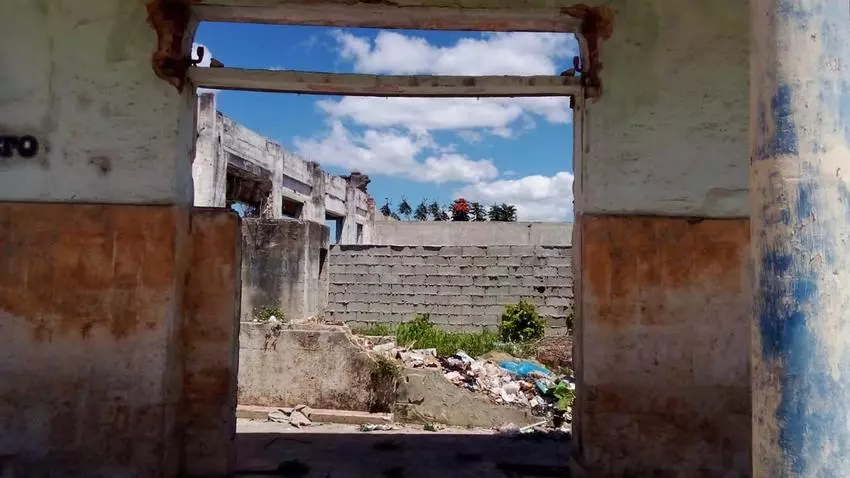
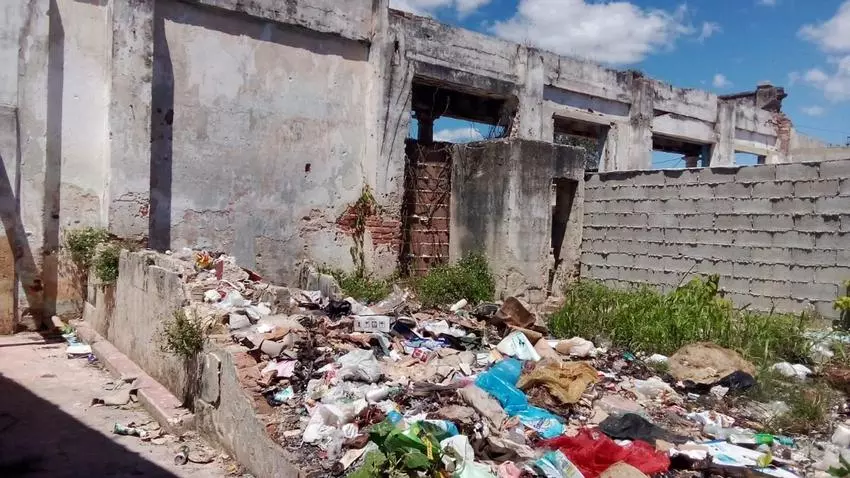
14ymedio, San José de Las Lajas, Julio César Contreras, April 3, 2026 – At high noon, when the sun beats down on the street and only the faint sound of a distant engine can be heard, the old grocery store El Tostadero looks like a skeleton stranded in the middle of San José de las Lajas (Mayabeque). Where sacks of rice, cans of oil, and bottles of rum once lined up, piles of garbage now accumulate, growing like a second structure made of torn plastic bags, damp cardboard, and rubble. The scene has become routine for nearby residents, who no longer look at the building with nostalgia but with concern.
Amid the ruins of what was once this emblematic establishment, garbage continues to take over, turning what remains of the building into an improvised dump that no one seems willing to clean up. From the sidewalk, the store’s name can still be read on a peeling wall, as if resisting disappearance. A few meters away, a couple rides by on a scooter, slowing down to avoid potholes, while a skinny dog crosses the corner unhurriedly. The neighborhood goes on with its routine, but the decay of the old shop has become a constant reminder of decline.
“People come here with wheelbarrows, dumping everything from construction debris to toilet paper. It hasn’t been officially declared, but in practice this is a small landfill right in the center of town,” Abelardo, a local resident, tells 14ymedio, watching with resignation the steady flow of people unloading their waste there. The 54-year-old remembers when the store was a gathering point for neighbors, a place where people discussed the day’s news while waiting their turn to buy goods. continue reading
“Little by little they took everything that could be reused. What was once a prosperous private business ended up like this in government hands.”
According to him, once the building was declared at risk of collapse, its quiet dismantling began. First the roof tiles disappeared, then the wooden beams, and later the doors and windows. What the wind didn’t take, necessity did. “Little by little they took everything that could be reused. What was once a prosperous private business ended up like this in government hands,” Abelardo laments, pointing inside, where grass now grows among the remains of floor tiles still visible beneath the dirt.
From the porch of her house directly across from the store, Dignora watches the site with a mix of irritation and fatigue. At 72, she says the biggest problem is not the ruin itself, but what came afterward: mosquitoes, foul odors, and a sense of insecurity. “A swarm of mosquitoes comes out of there every night and keeps us from sitting outside. Sometimes the smell is so strong that I have to close doors and windows,” she explains, pointing to a corner where food scraps and black bags torn open by dogs are piled up.
Sometimes the smell is so strong that I have to close doors and windows,” she explains, pointing to a corner where food scraps and black bags torn open by dogs are piled up. / 14ymedio
The woman admits that, reluctantly, she has also had to throw her own trash there. “I wish there were a nearby dumpster or that a sanitation truck came regularly, but they show up whenever they feel like it, maybe once or twice a month. So I have no choice but to toss my little bag in a corner. Everyone does the same, otherwise we’d be swallowed by filth inside our own homes,” she says, aware of the health risks posed by the improvised dump.
The building’s deterioration is evident from every angle. The walls are cracked, the columns expose rusted rebar, and the roof has almost completely disappeared, leaving the interior open to the sky. Through one opening, the backyard can be seen, now a vacant lot overgrown with tall weeds and strewn with construction debris. The image contrasts sharply with the memories of those who knew the place in its prime, when the aroma of freshly roasted coffee justified the store’s name.
Ernesto, a resident who lives two blocks away, says complaints to authorities have been constant but useless. “It’s been falling apart for more than ten years. My fear is that part of what’s still standing could collapse onto a neighboring house and cause a tragedy. Someone could also get hurt if a section falls while they’re dumping trash,” he warns, looking at the cracks running along one of the side walls.
The makeshift trash dump at the abandoned bodega El Tostadero, in San José de las Lajas (Mayabeque). / 14ymedio
To avoid the risk, he prefers to walk several blocks to Avenida 40, where a functioning garbage container still exists. However, he admits not everyone can make that trip every day. “The People’s Power delegates elected in this neighborhood never did anything to save the store from becoming the ruin it is today,” he says, with a tone mixing frustration and resignation.
Despite the abandonment, the building still occupies an entire corner of the town, like a silent witness to the passage of time and the lack of maintenance. Its structure, though weakened, retains a certain presence, making the contrast between what it was and what it is today even more striking. For many residents, El Tostadero has become a symbol of institutional neglect and the deterioration of public services.
“This is a monument to the lack of respect for heritage, to that virus spreading across the entire country,” Ernesto concludes, watching as the wind lifts papers and dust at the corner. Meanwhile, the name of the old store remains stuck to the wall, a final mark of identity amid the ruins, reminding the people of San José de las Lajas that where there was once commerce and life, abandonment now reigns.
Translated by Regina Anavy
______________________
COLLABORATE WITH OUR WORK: The 14ymedio team is committed to practicing serious journalism that reflects Cuba’s reality in all its depth. Thank you for joining us on this long journey. We invite you to continue supporting us by becoming a member of 14ymedio now. Together we can continue transforming journalism in Cuba.
“It cannot be properly measured in kopeks, dollars, or pesos,” says Sergei Ryabkov.
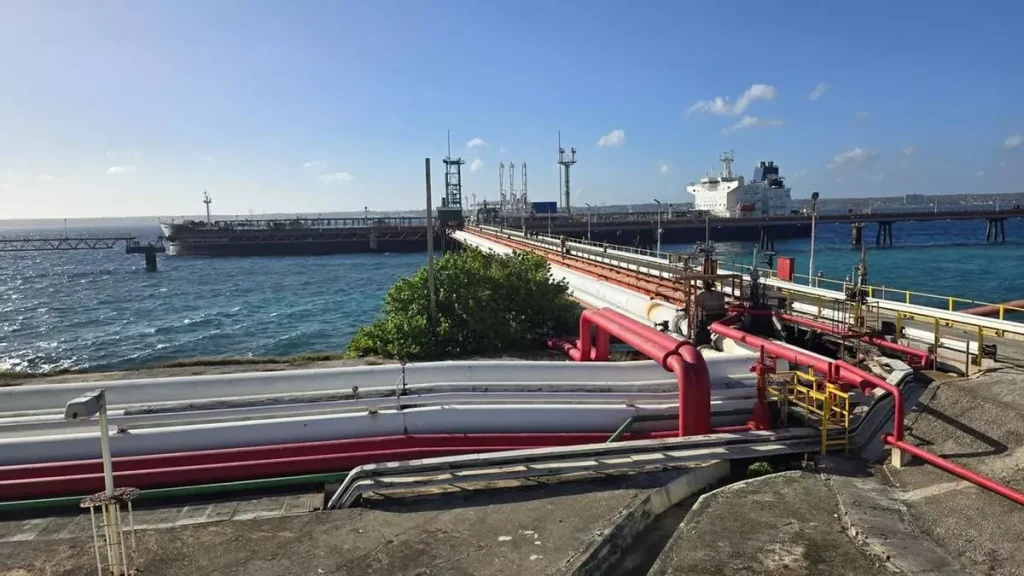
The Russian tanker Anatoly Kolodkin at the dock of the Supertanker Base in Matanzas. / Facebook / Oliver Zamora Oria
14ymedio/EFE, Madrid/Moscow, April 3, 2026 – The friendship between Russia and Cuba is enduring, declared Russia’s Deputy Foreign Minister, Sergei Ryabkov, on Friday, stating that Moscow will continue supporting Havana despite U.S. pressure on the Island. “It cannot be properly measured in kopeks, dollars, or pesos. It is an enduring value. We value it highly,” the Russian diplomat emphasized in an interview with the TASS agency.
Both countries, he recalled, have interacted for decades “across the full spectrum of issues aimed at ensuring high human development, the development of science and education, cultural and human exchanges, and the development of the arts.”
“Not to mention our shared history and the solidarity, mutual support, which has always been felt and continues to be felt. And Russia maintains its commitment to this policy, especially at the current difficult stage,” he added. The senior Russian diplomat also reiterated the demand to end U.S. pressure on the Island.
“We insist that Cuba’s security be guaranteed. We demand an end to the blockade of the Island, which is absolutely illegal and illegitimate.”
“We insist that Cuba’s security be guaranteed. We demand an end to the blockade of the Island, which is absolutely illegal and illegitimate. And I am sure that the results Washington hopes to achieve with this blockade will continue to go unrealized,” he said. continue reading
The tanker Anatoly Kolodkin, sanctioned by the United States and the European Union and carrying 100,000 tons of crude oil, arrived Tuesday in Matanzas, marking the first oil shipment to reach the Island in three months, following the oil blockade imposed by the United States at the end of January. “This valuable assistance arrives amid the energy siege imposed by the United States, which seeks to suffocate the Cuban population,” Havana’s Foreign Ministry said on the social network X.
U.S. President Donald Trump had downplayed Moscow’s move to break the blockade imposed by Washington and dismissed the idea that the arrival of crude oil in Cuba would have any impact on the Island’s current situation. “It doesn’t bother me (…) they have a bad regime, they have bad and corrupt leadership, and whether a ship of oil arrives or not, it doesn’t matter,” the president said.
On Thursday, Russia’s Energy Minister, Sergei Tsiviliov, reported that after sending the Anatoly Kolodkin, his government is preparing a second shipment of crude oil to Cuba. “We will not abandon the Cubans,” Tsiviliov told local media at an energy forum held in the city of Kazan.
Cuba requires about 100,000 barrels per day to meet its energy needs, of which around 40,000 come from domestic production, mainly used to keep its outdated thermoelectric plants running. The inability to cover the remaining demand has resulted in long daily blackouts and the near-total paralysis of the economy.
Translated by Regina Anavy
______________________
COLLABORATE WITH OUR WORK: The 14ymedio team is committed to practicing serious journalism that reflects Cuba’s reality in all its depth. Thank you for joining us on this long journey. We invite you to continue supporting us by becoming a member of 14ymedio now. Together we can continue transforming journalism in Cuba.
Under pressure from the United States, the leftist government of the Central American country decided not to renew the contract in place since 1998.
An investigation by the Prosecutor’s Office revealed that only three out of every ten “collaborators” sent by Havana were doctors.
“There are complaints filed against Cuban doctors in Guatemala, under various circumstances.” / Facebook / Cuban Consulate Guatemala
14ymedio, Madrid, April 3, 2026 – Guatemala is already sending back the Cuban doctors who were part of the bilateral agreement that ended two months ago. This Thursday, a first group arrived on the Island, following a farewell ceremony held in the Central American country, according to official press reports, which indicate that the return of the “health collaborators,” after the end of the agreement between both governments, will be “gradual.”
Without giving names or figures, Guerrillero reports the words of the coordinator of the cooperation program of the Directorate of Integrated Networks of the Guatemalan Ministry of Public Health and Social Assistance, Sheila Pamela Leyla, who stated that “the members of the Antillean medical brigade made the mountains, the jungles, and the poorest neighborhoods of this land their own home.”
The official added: “You arrived not with weapons or conditions, but with stethoscopes and an iron will. Since then, you have been the face of hope for millions of Guatemalans who, before seeing a Cuban doctor, had never had access to proper medical care.”
For his part, the Cuban ambassador to Guatemala, Nazario Fernández, praised “the services provided” and urged people “not to pay attention to perverse minds, to empty hearts that try to denigrate that work, since the humanism demonstrated every day over nearly 28 years remains alive in the people of this sister nation.” continue reading
Guatemala stated that its Ministry of Health will fill the positions left by the 412 Cuban specialists, who cost 4,513,872 dollars annually.
Last February, the Government of Guatemala, led by leftist President Bernardo Arévalo, announced it would not renew the contracts of the Cuban medical brigades, present in the country since 1998 after Hurricane Mitch. In doing so, it followed the path of other countries in the region such as Honduras, Jamaica, and the Bahamas, under pressure from the Trump administration, which considers the Cuban missions forced labor and seeks to reduce the Cuban regime’s main source of foreign currency.
Guatemalan authorities said at the time that their Ministry of Health would cover the positions left by the 412 Cuban specialists, who cost 4,513,872 dollars annually, with medical students doing their residencies. They also said they were working on measures for the “reorganization of current human resources to avoid neglecting the population,” including “incentives for those who take positions in hard-to-reach areas.”
According to Guatemala’s Minister of Health, Joaquín Barnoya, 80% of the brigades from the Island were located in communities across eight departments: Petén, Huehuetenango, Alta and Baja Verapaz, Quiché, Izabal, Zacapa, and San Marcos, while another 40 physicians were in the capital.
The investigation conducted by the Prosecutor’s Office examines the proportion of healthcare specialists sent by the Cuban government and indicates that only three out of every ten Cubans sent were doctors.
Last week, Guatemala’s Public Prosecutor’s Office announced it is investigating more than 60 complaints against Cuban doctors, related to impersonation of professional qualifications, failure to meet legal requirements, and public safety concerns. “There are complaints filed against Cuban doctors in Guatemala, under various circumstances, ranging from crimes committed individually to issues related to the performance of their duties in Guatemala,” said the MP’s Secretary General, Ángel Arnoldo Pineda.
According to Pineda, the prosecutor’s investigation analyzes the proportion of healthcare specialists sent by the Cuban government and indicates that only three out of every ten Cubans sent were actually doctors. “If one conducts a numerical analysis of 100% of the people assigned by the Cuban regime to provide medical support in different countries, it is said that only 20% or 30% of those who come are truly doctors, and the rest assume the role of doctors and perform other functions,” the secretary stated.
In 2019, UN special rapporteurs had already sent an urgent letter to Cuban President Miguel Díaz-Canel, denouncing abuses such as opaque contracts, salary withholding of up to 75%, and reprisals against those who refused to participate. Havana never responded.
Translated by Regina Anavy
______________________
COLLABORATE WITH OUR WORK: The 14ymedio team is committed to practicing serious journalism that reflects Cuba’s reality in all its depth. Thank you for joining us on this long journey. We invite you to continue supporting us by becoming a member of 14ymedio now. Together we can continue transforming journalism in Cuba.
This is indicated by reports from Prisoners Defenders in Havana, Las Tunas, Villa Clara, and Santiago de Cuba.
The operation appears aimed at easing overcrowding and reducing prison costs. / X / Patrick Oppmann CNN
14ymedio, Havana, April 3, 2026 – The Cuban regime began this April 3 to release some of the inmates included in the official announcement of the pardon of 2,010 people. But far from the image of openness that Havana is trying to project, the first data verified by human rights organizations point in another direction: those benefiting are not political prisoners, but common inmates, in an operation that appears aimed at relieving overcrowding and reducing prison costs without touching the core of repression.
The decision was presented this Thursday by the Government as a “humanitarian and sovereign” gesture, in the middle of Holy Week, but so far it has not been accompanied by a public list of names or transparent information about the real selection criteria.
The reports that have begun to arrive from different provinces dismantle, at least for now, any expectation that the process includes opposition members, activists, and demonstrators sentenced for political reasons. Javier Larrondo, president of Prisoners Defenders, reported this Friday that 41 prisoners were released from the Toledo 2 Forced Labor prison in Marianao (Havana), all of them common inmates.
At El Típico prison in Las Tunas, six common inmates were released, along with “dozens more” prisoners linked to forced labor centers near that prison. According to the Madrid-based NGO, the trend is repeated across the country, where “only common prisoners are being released; not a single political prisoner in any prison, so far.” continue reading
Seven common inmates were released from the Remedios forced labor prison and no political prisoners
The same is happening in Villa Clara. Seven common inmates were released from the Remedios forced labor prison and no political prisoners. Opposition members and activists remain imprisoned there, including the octogenarian Miguel Díaz Bauzá, with no indication so far that they will be included in this round of releases. In Boniato, Santiago de Cuba, four common prisoners were freed. The conclusion drawn by Prisoners Defenders is that the operation is not a political shift, but rather a “prison drain” of common inmates in a country with one of the highest incarceration rates in the world.
The very design of the official announcement pointed in that direction. Authorities made it clear that those convicted of certain crimes would be excluded, including so-called “crimes against authority,” a broad category often used by the Cuban repressive apparatus to prosecute, under charges such as contempt, resistance, assault, or public disorder, those who protest, film abuses, criticize the government, or simply refuse to obey an officer. This is compounded by the total absence of a verifiable list.
What is happening inside the prisons also confirms that the political problem not only remains intact but is also worsening. While the regime opens the doors to common inmates, it keeps behind bars people detained for protesting and continues to extend repression toward particularly vulnerable sectors.
The teenagers Jonathan and Cristian remain detained and face sabotage charges
Cubalex warned this Friday about the situation of teenagers arrested after the March 13 protest in Morón, Ciego de Ávila. The organization has verified at least four adolescents linked to those events: Jonathan David Muir Burgos, 16; Cristian Crespo Álvarez, also 16; Kevin Samuel Echeverría Rodríguez; and Yohasnel Estrada Rodríguez. At least Jonathan and Cristian remain detained and face charges of sabotage, a very serious crime that authorities are using to punish social protest. (see also)
In Jonathan’s case, Cubalex reported that he was arrested on March 16 along with his father, who was released a few hours later. Since then, the teenager has remained in detention, and his family has reported emotional distress and deterioration in his health. Cristian was arrested a day later, amid an opaque identification process and without his relatives having access to official case documentation. His family has also reported severe communication restrictions, brief and supervised visits, and signs of physical deterioration. In both cases, there were failed transfers to Canaleta prison and returns to the detention center, a practice that adds psychological pressure and increases uncertainty. Cubalex warns of a pattern of delayed detentions, disproportionate charges, pretrial detention as the rule, family isolation, and lack of procedural transparency.
The regime’s real message is not one of openness but of managing punishment. The figure of 2,010 released prisoners serves more as a headline than as proof of change. What is already becoming clear, as the first reports emerge from Havana, Las Tunas, Villa Clara, and Santiago de Cuba, is that political prisoners are not on that list.
Translated by Regina Anavy
______________________
COLLABORATE WITH OUR WORK: The 14ymedio team is committed to practicing serious journalism that reflects Cuba’s reality in all its depth. Thank you for joining us on this long journey. We invite you to continue supporting us by becoming a member of 14ymedio now. Together we can continue transforming journalism in Cuba.
During his visit to Russia, Pérez-Oliva secured promises of support from Putin’s government
The Russian tanker Anatoly Kolodkin, loaded with 100,000 tons of crude oil, in Matanzas Bay. / CNC TV Granma
14ymedio, Havana, April 2, 2026 – Moscow is preparing a second shipment of crude oil to Cuba following the arrival of the Anatoly Kolodkin, authorized by the United States after three months of an oil blockade on the Island, reported Russian Energy Minister Sergei Tsiviliov this Thursday.
“A Russian vessel broke the blockade. Now the second is being loaded. We will not abandon the Cubans,” Tsiviliov told local press at an energy forum held in the city of Kazan.
The minister noted that the decision was made after a meeting held in St. Petersburg with Cuban representatives.
Deputy Prime Minister in charge of Foreign Trade and Foreign Investment, Óscar Pérez-Oliva Fraga, is on an official visit to Russia, where he is trying to present Cuba as an attractive economic partner and is seeking Moscow’s support to ease its energy deficit.
Russian Deputy Prime Minister Dmitry Chernyshenko stated that the immediate goal is to alleviate the fuel shortage
At the meeting of the Cuba-Russia Intergovernmental Commission, Moscow reaffirmed that it will continue to support the Island economically. Russian Deputy Prime Minister Dmitry Chernyshenko indicated that the immediate goal is to ease the fuel shortage.
Chernyshenko also stated that once fuel supply in Cuba is normalized, direct flights will be fully restored, with the aim of recovering previous tourism levels. continue reading
Both sides also discussed pharmaceutical projects, including the shipment of supplies from Russia and an agreement between the Russian company Prommed and the Center for Molecular Immunology to develop cancer vaccines.
These efforts are accompanied by plans to export food, reactivate a vehicle assembly plant, and create a taxi service in Havana using Russian cars, as part of a broader cooperation agenda.
Pérez-Oliva said of this bilateral cooperation, “it is the most sustainable way we have to collaborate in the energy sector.”
The tanker Anatoly Kolodkin, sanctioned by the United States and the European Union and loaded with 100,000 tons of crude oil, arrived in Cuba this week, marking the first oil shipment to the Island since January 9, when Mexico sent a fuel tanker.
U.S. President Donald Trump downplayed Moscow’s delivery of crude oil to Cuba, saying it would have no impact on the Island’s current situation
Energy specialist Jorge Piñón of the University of Texas noted that as of this Thursday there are four Cuban-flagged tankers in Matanzas, “all candidates to provide shipping service to Havana for the Russian Ural crude transported by the Anatoly Kolodkin.”
He added that “the tanker Vilma may be carrying out a ship-to-ship transfer in Matanzas, thereby shortening operation time by avoiding onshore storage tanks. This tanker could load an approximate maximum of 400,000 barrels.” According to Piñón, “it cannot be ruled out that all the crude aboard the Anatoly Kolodkin is destined for Havana; it must also be considered that the Cienfuegos refinery remains in play.”
U.S. President Donald Trump downplayed Moscow’s delivery of crude oil to Cuba, saying it would have no impact on the Island’s current situation.
“It doesn’t bother me (…), they have a bad regime, they have bad and corrupt leadership, and whether or not they receive a ship of oil, it doesn’t matter,” the president said. A White House spokesperson even described it as a “humanitarian” decision.
For his part, President Díaz-Canel thanked Vladimir Putin for the shipment of crude and announced that “work is already underway on unloading, then processing, distribution, and the rational use of this shipment, which, although insufficient amid the acute shortage, will gradually ease the situation in the coming weeks.”
Cuba requires about 100,000 barrels per day to meet its energy needs, of which fewer than 40,000 come from domestic production and can only be used in thermoelectric plants, since it is very heavy crude that cannot be refined on the Island. The inability to meet the remaining demand has resulted in prolonged daily blackouts and the near-total paralysis of the country’s economy.
Translated by Regina Anavy
______________________
COLLABORATE WITH OUR WORK: The 14ymedio team is committed to practicing serious journalism that reflects Cuba’s reality in all its depth. Thank you for joining us on this long journey. We invite you to continue supporting us by becoming a member of 14ymedio now. Together we can continue transforming journalism in Cuba.
The moral dilemma of those of us who aspire to democratic change on the Island
José Martí defined love for one’s homeland as a bifurcation of angers. / 14ymedio
14ymedio, Madrid, Yunior García Aguilera, April 2, 2026 – A large part of the world looks toward Cuba without fully understanding what is happening on the Island or the moral tensions that run through its citizens. Some are scandalized that there are Cubans who come to wish for foreign intervention to escape the regime. Others do not understand how there are still people willing to defend, even with their lives, a system that has ruined the country and can only offer misery, surveillance, and calls to battle. There are also those who view Cuba as an abstract symbol, a stage of sacrifice useful for feeding others’ ideological nostalgias.
In Abdala, written when he was barely 15 years old, José Martí defined love for one’s homeland as a bifurcation of angers: “the invincible hatred of those who oppress it” and “the eternal resentment toward those who attack it.” More than a century and a half later, the Cuban drama remains trapped in that same emotional logic, though distorted by history.
A portion of Cubans who long for a free Cuba concentrate their moral energy on invincible hatred toward the dictatorship; that is, toward the apparatus of control, fear, and servitude that Castroism turned into a system. Another portion, made up of regime loyalists or those still trapped in its worldview, cling to eternal resentment toward the United States: its threats, its real or imagined grievances, and the ever-invoked hypothesis of intervention. Between hatred and resentment, Cuba risks never becoming a true project of freedom but merely an endless battlefield of grievances.
In countries where free elections, alternation of power, and institutional channels exist, it would be absurd to wish for a foreign army to enter and overthrow the government
It must be said plainly: I do not want bombs to fall on the land where I was born. But neither do I want a regime that has destroyed the nation and represses its inhabitants to remain in power, condemning us to a slow extinction. That is my moral dilemma.
From consolidated democracies, this may be difficult continue reading
to understand. In countries where free elections, alternation, and institutional channels exist, it would be absurd to wish for a foreign army to enter and overthrow the government. But Cubans have been stripped precisely of that basic possibility.
In Cuba, the electoral system is hijacked by the Candidacy Commissions and State Security. There is not a single deputy who represents the opposition, even though its weight within society is already undeniable. The ballot used by the National Assembly in 2023 to “elect” the president contained a single name: Miguel Díaz-Canel. To call such a procedure an election is a mockery. If Cubans cannot organize politically, compete at the polls, protest in the streets, or express themselves without risk on social media, then the question becomes inevitable: what real options do we have left to remove the tyrants from power?
Cuban civil society has attempted even the most peaceful and civic avenues imaginable within a dictatorship. Opponents such as Oswaldo Payá died under never-clarified circumstances. Others were exiled. Many are imprisoned or subjected to constant harassment. It should not be surprising, then, that ideas once considered marginal, such as foreign intervention or annexation, have gained ground. Those of us who oppose such outcomes must at least recognize that they are a direct consequence of the Revolution’s failure as a national project. When a regime closes off every internal avenue for change, the temptation of an external solution stops seeming like an extravagance and becomes a symptom of disaster.
Almost no one can seriously defend the “achievements of the Revolution” anymore, because little remains of them but rubble
Meanwhile, part of the international left celebrates our misery as if it were a badge of dignity. From comfortable stages, scarcity, repression, and immobility are exalted as proof of resistance against the Empire. We are expected to preserve the authoritarian system intact to satisfy the nostalgia or ideological fascination of those who would not have to suffer its consequences.
Many of these admirers only know Cuba from hotels, ruins turned into photographic scenery, or the screens of their phones. Almost no one can seriously defend the “achievements of the Revolution” anymore, because little remains of them but rubble. Yet the embargo continues to be invoked as a universal excuse. It is forgotten that when Cuba received nearly unlimited resources from the USSR, it did not use them to modernize the country but for military and ideological adventures abroad. It is also forgotten that the Venezuelan subsidy did not correct the model’s structural flaws. The problem was never a lack of resources. The problem has been, above all, the system.
That is why the metaphor of Cuba as a “new Numancia*” -used to praise its supposed resistance- is so perverse. Numancia does not symbolize abstract dignity, but siege, hunger, degradation, and extermination. Presenting Cuba as Numancia amounts to suggesting that its greatness lies in enduring suffering indefinitely.
In Cuba, those in power seem more willing to negotiate with external actors capable of pressuring them than with their own citizens, whom they treat as subjects
Talking about solutions requires abandoning both naïve epic narratives and providential superstition. It is unlikely that Cuban civil society, alone and without fractures within the power structure, can defeat the regime through open rebellion. Asking an unarmed, impoverished, and surveilled citizenry to overthrow a police state willing to fire on its people resembles an invitation to sacrifice. This does not make civil society irrelevant. Without an active citizenry, there is no real transition. But almost no recent transition from authoritarianism has occurred without a combination of internal resistance, fractures within the elite, and external pressure.
History shows that authoritarian regimes do not usually yield through moral persuasion alone. They do so when the cost of staying in power becomes unbearable. In Cuba, moreover, those in power seem more willing to negotiate with external actors capable of pressuring them than with their own citizens, whom they treat as subjects. Recognizing the possible role of external factors does not mean calling for occupation or renouncing sovereignty. It means accepting that, when all internal channels have been closed, international pressure can open space for a transition.
But that transition should not repeat the worst vices of our history. Cuba carries a traumatic legacy of coups, armed solutions, and messianic leaders. We have already paid too high a price for the temptation to replace politics with epic narratives, law with exception, and citizenship with obedience to the savior of the moment. The goal cannot be to replace one command with another, nor to move from one form of tutelage to another. The goal must be to rebuild the republic on civil, pluralist, and legal foundations.
Cuba does not need the miserable immortality of a symbol. It needs the concrete life of a country. It does not want to be admired for enduring. It wants to stop enduring. It does not want to remain an emblem of others’ sacrifice. It wants, like any mature nation, the basic right to live in freedom.
*Translator’s Note: Numancia was an ancient city in Spain that resisted the Romans for 20 years, a symbol of stubborn and hopeless endurance.
Translated by Regina Anavy
______________________
COLLABORATE WITH OUR WORK: The 14ymedio team is committed to practicing serious journalism that reflects Cuba’s reality in all its depth. Thank you for joining us on this long journey. We invite you to continue supporting us by becoming a member of 14ymedio now. Together we can continue transforming journalism in Cuba.
The city government accuses him of striking a worker and claims he has a record for sexual offenses in Florida.
The assaulted migrant was identified as Eduardo Tosco, who has a record for a sexual offenses in Florida. / Facebook
Ángel Salinas, Havana, April 2, 2026 – The city government of Tapachula, Chiapas, “removed” the officer on watch who on Wednesday assaulted the Cuban Eduardo Tosco in Miguel Hidalgo Plaza. Public services authorities, headed by Carlos Bracamontes, told 14ymedio that they “do not tolerate aggression.” However, they stated that earlier, the 72-year-old man had assaulted a female worker, and a complaint was filed against the migrant with the Attorney General’s Office of the State of Chiapas.
According to the Tapachula city government, the migrants involved in the incident are “mentally ill.” Luis Rey García Villagrán, director of the Center for Human Dignification, refuted the claim and denounced “xenophobia” by officials. “The accusation is serious, and for someone to be referred to as mentally ill there must be medical and psychological evaluations.”
According to Teresa Estrada, the man “hit her in the face.” In a video* uploaded to the city government’s Facebook account, she said that “this is not the first female sentry to be assaulted and this cannot keep happening.” In her complaint, she reiterated that “violence against women must not be allowed under any circumstances, not in Tapachula, not in Chiapas, not in Mexico, not anywhere.”
Estrada said that “the sentries are not police and are not armed,” and that their duties are continue reading
limited to maintaining order, cleanliness, and taking care of Miguel Hidalgo Central Park and its surroundings.
A migrant who requested anonymity told this newspaper that the woman arrived demanding that they “remove the mobile phones” from the public outlets located in the plaza. Seeing the delay, she tried to unplug the devices and was confronted, but “they never hit her.” At that moment, “a man pushed the migrant, knocked him down, and started hitting him.”
According to the same source, Tosco was deported by the United States and had been staying in Hidalgo Plaza for some time, but “since Wednesday night he has not been seen.” The Florida Department of Law Enforcement lists him in its database as a sex offender.
Tosco is one of the criminals deported to Mexico. As Oliver, Cuban, told 14ymedio last December, these individuals “have their records erased before being sent across.” They are abandoned “without documents or money” in the country, leaving their future in limbo.
Last March, García Villagrán reported that around 50 Cubans deported by the United States have been “abandoned at dawn over the past month in different locations.” “These people have lost all their rights” and are “in a situation of statelessness.” They are migrants, he said, whom Cuba does not want and who in the United States “have already lost their rights.”
According to lawyer Roger Ernesto Goitia, the video* shows “discrimination and mistreatment of the foreign migrant,” which is recurrent “in public spaces and institutions such as the National Migration Institute, the Mexican Commission for Refugee Assistance (Comar), and health centers.”
COLLABORATE WITH OUR WORK: The 14ymedio team is committed to practicing serious journalism that reflects Cuba’s reality in all its depth. Thank you for joining us on this long journey. We invite you to continue supporting us by becoming a member of 14ymedio now. Together we can continue transforming journalism in Cuba.
The anguished testimony of Juan, who fears losing the $1,650 ticket he bought to travel to Managua
In addition to the halt in consular procedures, confusion generated by Nicaragua’s own immigration system has worsened the situation. / 14ymedio
14ymedio, Havana, April 2, 2026 – Thousands of Cuban citizens who purchased airline tickets to Nicaragua before the abrupt imposition of a visa requirement last February now have their visa applications stalled. “Every time people go to ask, they tell us we have to wait,” Juan—an assumed name—tells 14ymedio. He is an artist employed by the Ministry of Culture who was supposed to fly more than a month ago and still sees no end in sight.
He bought a ticket with the Venezuelan airline Conviasa for $1,650 and says around 3,000 fellow citizens are in the same situation. “They haven’t granted visas to any Cuban since they introduced the new requirements on the website,” he claims. Although, he notes, the airline has decided to keep the tickets open for one year, he is not willing to wait much longer: “I’d rather leave through a cultural exchange to another country even if I lose the money, because I think they’re not going to grant anything: they just want to keep the money.”
The same is stated by a Cuban resident in Nicaragua whose relatives on the Island had planned to travel to Managua. “No flights have been able to leave because hardly anyone is being granted a visa,” he confirms. According to his statememt, many passengers fear losing the money invested in tickets. “And the worst part is that Conviasa is not refunding the money,” he adds.
The uncertainty began after a new policy took effect on February 8, once again requiring Cubans to obtain a consular visa to travel to the Central American country. Although free of charge, the measure, continue reading
formalized through provision 001-2026 of Nicaragua’s Ministry of the Interior, reclassified Cuban citizens with ordinary migration category “A” passports, which since November 2021 had allowed visa-free entry, to category “C,” corresponding to a “consulted” visa.
The uncertainty began after the new visa policy took effect on February 8. / 14ymedio
According to statements collected by the Nicaraguan media in exile, the Nicaraguan Embassy in Cuba indicated that applications should be sent by email and promised a free process of about 35 business days, waiving requirements such as criminal records or proof of financial solvency for those who already had tickets.
Hundreds of Cubans began the process trusting those conditions. However, after an initial issuance of about 70 visas in mid-February, complainants told Confidencial that the process stopped without clear explanation. “We don’t know whether our applications are still being processed,” said one of those affected in a complaint sent to the Nicaraguan media.
In addition to the halt in consular procedures, confusion has been compounded by Nicaragua’s own immigration system. At the end of February, the Ministry of the Interior enabled a digital platform to process electronic visas. This new system included requirements from which those who bought tickets before the policy change had initially been exempt.
Among the documents requested on the platform are bank statements to prove financial solvency, updated criminal background checks, proof of employment, and a confirmed accommodation reservation.
Those affected are asking Managua to allow travel for those who purchased tickets before the migration policy change
The Nicaraguan Consulate informed applicants that use of the digital platform was optional and that applications submitted by email would remain valid. However, those affected say that so far there have been no reports of visas approved through that system.
The group is asking Managua to allow travel for those who purchased tickets before the migration change or, at least, to establish a mechanism that guarantees the validity of tickets bought under the previous conditions.
The visa-free regime was announced by the government of Daniel Ortega on November 22, 2021. Although it was presented as a measure to promote commercial and family exchange, in practice it turned Managua into one of the main departure routes for Cubans attempting to migrate to the United States.
The tightening of measures by Donald Trump in his second term starting in January 2025, which included sealing the border to prevent any irregular migrants from entering, largely eliminated the Central American country as a “springboard,” though not as a destination. Over the past year, and even before the new migration measures, a new wave of Cubans, discreet and silent, have arrived in Nicaragua to build a new life.
Translated by Regina Anavy
______________________
COLLABORATE WITH OUR WORK: The 14ymedio team is committed to practicing serious journalism that reflects Cuba’s reality in all its depth. Thank you for joining us on this long journey. We invite you to continue supporting us by becoming a member of 14ymedio now. Together we can continue transforming journalism in Cuba.
The event was called by youth organizations under the slogan “Here, with Fidel”
This Thursday’s march had far fewer participants than usual/EFE/ Ernesto Mastrascusa
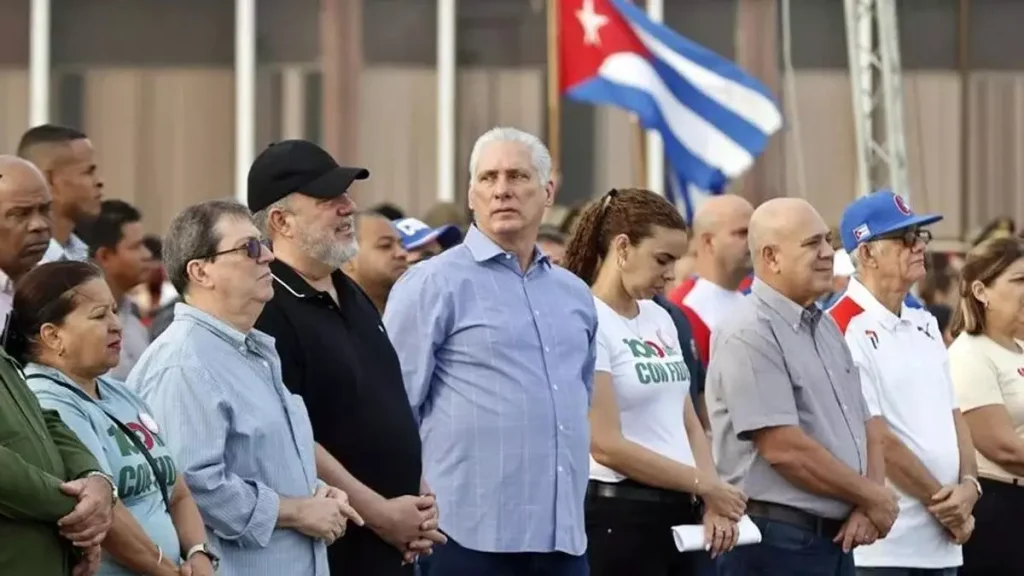
EFE (via 14ymedio), Havana, April 2, 2026 – Cuban president Miguel Díaz-Canel took part this Thursday in a march in Havana called by state-run youth organizations, amid the energy crisis and pressure from Washington for political and economic change on the Island.
The march, which reached the Anti-Imperialist Tribune in the Cuban capital, a site for various political events on the Island, was markedly different from those historically held there. This Thursday’s turnout was much smaller than usual, and those who did attend arrived on bicycles and electric tricycles.
Díaz-Canel appeared at the parade without giving any speech and was accompanied by members of the Political Bureau of the Central Committee of the Communist Party of Cuba, the only legal party in the country, along with other government leaders, the Armed Forces, and the Ministry of the Interior.
The state organizations Union of Young Communists (UJC) and the José Martí Pioneer Organization (OPJM) called the march, which was attended by students and young people from the capital under the slogan “Here, with Fidel,” as part of activities marking their anniversaries on April 4. continue reading
Díaz-Canel appeared at the parade without giving any speech
The organizations had announced that the so-called “Anti-Imperialist Youth Parade” would serve as a space to mobilize young people “on wheels, with bicycles, scooters, and electric motorcycles,” means of transportation that many Cubans have turned to in recent months due to fuel shortages, to denounce the U.S. oil blockade against Cuba.
Tensions between Washington and Havana intensified following the capture of Nicolás Maduro in Venezuela on January 3, after which the flow of Venezuelan oil to the Island was cut off.
The oil blockade has driven chronic blackouts in the country to record levels and has nearly paralyzed the State sector, from hospitals and public transportation to factories and government offices. The measure has been described by the UN as contrary to international law.
From the administration of U.S. President Donald Trump, Cuba has been urged to reach an agreement, apparently centered on economic reforms.
Cuba officially acknowledged on March 13 that a dialogue with Washington exists and later stated that “the Cuban political system is not subject to negotiation,” in response to reports suggesting that the U.S. government might be seeking in negotiations with Havana a replacement for the Cuban president.
Translated by Regina Anavy
______________________
COLLABORATE WITH OUR WORK: The 14ymedio team is committed to practicing serious journalism that reflects Cuba’s reality in all its depth. Thank you for joining us on this long journey. We invite you to continue supporting us by becoming a member of 14ymedio now. Together we can continue transforming journalism in Cuba.
Prisoners Defenders Raises to 26 the Number of Prisoners Released Following the Agreement with the Vatican
Political prisoner from 11J JorgeBelloDomínguez together with his wife Yuleydi López González. / Facebook/JorgeBelloDomínguez
14ymedio, Havana, April 1, 2026 – The Inter-American Commission on Human Rights (IACHR) [CIDH in Spanish] granted precautionary measures in favor of political prisoner Jorge Bello Domínguez, his mother Marta Domínguez Galero, his wife Yuleydi López González, and his daughter Yésica Bello, considering that all four are in a situation of “seriousness and urgency” and that their right to life, personal integrity, and health are at risk of suffering “irreparable harm” in Cuba.
The decision is recorded in Resolution 21/2026, adopted on March 30, following a request submitted by the organization Prisoners Defenders. The ruling represents a new setback for the Cuban regime, which once again comes under international scrutiny for its treatment of political prisoners and their families.
The IACHR also emphasized that the Cuban State did not respond to the Commission’s request for information, despite the deadline having already expired. In its decision, the body asked Havana to immediately protect the four beneficiaries, ensure a comprehensive medical evaluation for Bello, guarantee specialized treatment, adequate food, detention conditions compatible with international standards, and measures to prevent further threats, assaults, or acts of harassment within the prison. continue reading
His medical condition is especially delicate
Jorge Bello Domínguez, a journalist and protester from 11 July 2021, has remained imprisoned since that date. He was sentenced to 15 years of deprivation of liberty after a process in which the petitioners denounced that he did not have independent legal defense and in which he was charged with disproportionate offenses. The Commission also recorded that Bello was disappeared for 12 days after his arrest, subjected to isolation, interrogations without a lawyer, and torture to force him to confess guilt.
His medical condition is especially delicate, as he suffers from type 1 diabetes mellitus, hypertension, persistent asthma, chronic gastritis, progressive vision deterioration, acute dental pain, a history of heart attack, malnutrition, generalized weakness, and testicular inflammation with bleeding and severe pain that, according to the file, has not been treated by a specialist since February 2024.
The IACHR also took into account allegations of beatings, forced nudity, humiliation to access insulin, use of pepper spray, lack of medication, poor nutrition, and arbitrary restrictions on visits and phone calls. Added to this is the harassment against his family, who have been subjected to threats, surveillance, police summons, interrogations, arbitrary detentions, and forced relocations in retaliation for their activism in defense of the prisoner.
The list of 26 released prisoners includes those sentenced to between six and 18 years
Although precautionary measures do not amount to a ruling on the merits of the case, they do imply that the body considers there to be, preliminarily, a real and imminent risk that requires urgent protection.
The decision also comes amid the opaque process of releases that the authorities are attempting to present as a gesture of flexibility, but which independent organizations describe as a control maneuver.
This Wednesday, Prisoners Defenders reported the release of Renán Julio Vilches Wong, 37, sentenced to six years in prison for “speaking badly” about leaders of the Communist Party. According to the organization, Vilches would be the 26th political prisoner released “under threats,” with his sentence still in place and subject to a “de facto home detention regime.” The prisoner leaves the cell, but the repressive apparatus retains the ability to return him to prison, and the threat continues to operate as a disciplinary mechanism.
Prisoners Defenders maintains that of the 51 releases announced by the regime on March 12, only 26 have been carried out. “There are still 25 left,” the organization said, adding that it is auditing the process “to ensure that all those promised to the Catholic Church are released.”
The list of 26 released prisoners includes individuals sentenced to between six and 18 years, many of them held in forced labor camps or maximum-security prisons.
Translated by Regina Anavy
______________________
COLLABORATE WITH OUR WORK: The 14ymedio team is committed to practicing serious journalism that reflects Cuba’s reality in all its depth. Thank you for joining us on this long journey. We invite you to continue supporting us by becoming a member of 14ymedio now. Together we can continue transforming journalism in Cuba.
The lack of direct flights is not preventing the return of detainees to the Island.
Russian authorities are deporting increasing numbers of migrants, including many Cubans, who entered the country due to visa exemptions. / La Tijera
14ymedio / EFE, Moscow, April 1, 2026 – Authorities in Moscow are detaining and massively deporting Cuban migrants who have not regularized their immigration status, despite the absence of direct flights between the Russian capital and Havana due to the Island’s energy crisis, according to the Telegram channel Ostorozhno, Novosti on Wednesday.
According to relatives of those detained, police checks on Cuban citizens regarding their immigration status have intensified in recent months.
“Those with issues in their documents are sent to the Sakharovo deportation center (on the outskirts of Moscow), where they are held and kept incommunicado for weeks,” the outlet reported.
Because there are currently no direct flights between the two countries, due to Cuba’s alert over a lack of fuel to supply international flights, Cubans are being deported via the Turkish city of Istanbul.
“Those with issues in their documents are sent to the Sakharovo deportation center, where they are held and kept incommunicado for weeks.”
According to Ostorozhno, Novosti, relatives search for detainees through groups created on Facebook.
Because detainees are held incommunicado, and there is little precise information, since deportation cases are not processed through the courts but decided at the level of Russia’s Interior Ministry. Much of the information circulating on social media is false, the outlet said.
As an example, Ostorozhno, Novosti cited the case of a Cuban detainee who was rumored to have been deported but was actually arrested for drug trafficking, a crime severely punished in Russia.
Although the chances of legalizing immigration status in Russia are quite limited for Cubans, especially compared to nationals from former Soviet republics, who can obtain work permits, thousands of Cubans travel to Russia in search of jobs and better living conditions.
Translated by Regina Anavy
______________________
COLLABORATE WITH OUR WORK: The 14ymedio team is committed to practicing serious journalism that reflects Cuba’s reality in all its depth. Thank you for joining us on this long journey. We invite you to continue supporting us by becoming a member of 14ymedio now. Together we can continue transforming journalism in Cuba.

 EFE (via 14ymedio), Havana, April 5, 2026 – The NGO Prisoners Defenders (PD) reported this Saturday that the number of political prisoners released by the Cuban government has risen to 27 since the announcement, on March 12, of a process agreed upon with the Vatican that contemplates the release of 51 inmates.