If the State guarantees neither electricity nor internet, those who can afford it try to become independent of both at the same time.

 14ymedio, Matanzas, Pablo Padilla Cruz, April 5, 2026 – On some rooftops in Havana, Matanzas, or Santa Clara, it’s no longer just water tanks, clotheslines, pigeon coops, and old television antennas that stand out. Now another object is beginning to appear, or rather to hide: the rectangular Starlink dish. In a country where internet access remains expensive, unstable, and vulnerable to blackouts, some Cubans have decided to bypass the ban and set up their own gateway to the world.
The operation begins long before turning on the equipment. The first obstacle is Customs. Marlon -a fictitious name- tells 14ymedio some of the tricks used to evade controls. “An assembled antenna shows up immediately on the scanner,” he explains. “You have to make it unrecognizable: take it apart into pieces, put it inside a television or a computer tower, mix it with cables, tools, and electronic scrap.” Sometimes it works. Other times, the difference between losing everything or leaving the airport depends on finding an official willing to look the other way in exchange for two or three $20 bills folded inside the passport.
Once inside the country, the antenna is assembled in silence. Then it has to be installed in a spot with enough open sky, but without being too exposed to view from the street or a neighbor’s house. After that, it is connected to a backup battery (UPS) or a small solar system to withstand blackouts.
Elon Musk: “It works in Cuba, it’s just not allowed to be sold there”
Damián, a programmer from Matanzas who works for clients abroad, justifies the investment. “With Etecsa [the State telecommunications monopoly] I couldn’t sustain a full meeting. Everything would drop. Now I pay the subscription with help from my brother in Miami. It’s expensive, yes, but it lets me work.” Like him, other professionals have reached the same conclusion: a stable connection is no longer a technological luxury, but a condition for job survival.
The most visible trigger came on March 16, 2026, when Elon Musk wrote on X a phrase that confirmed what had already been circulating as a clandestine rumor among users on the island: “It works in Cuba, it’s just not allowed to be sold there.” The statement did not change the legal situation, but it did clear up the main technical doubt. Coverage exists. What does not exist is authorization from the Cuban State to market the service or tolerate its open use.
That’s where true Cuban ingenuity begins. Because the signal over Cuba alone is not enough. Ordinary mobile phones are not designed to connect directly to Starlink satellites as a full substitute for a fixed or mobile network. For that, the company’s specific terminal and a router are required to distribute the connection. The option of direct satellite-to-cellphone connection remains limited and does not yet offer the capacity needed to sustain a full workday, a stable video call, or an internet-based business.
The failure of Cuban connectivity is explained not only by Etecsa’s monopoly, but also by the energy collapse
One of the most common tricks is registering the service outside Cuba. Since Starlink does not officially sell on the Island, many users rely on accounts activated in third countries, such as Mexico or the United States. The equipment enters already linked to a roaming plan and is used in Cuban territory through that channel. It is not a stable or guaranteed long-term solution, as it depends on the service’s own rules and authorized markets, but today it sustains a large part of the clandestine installations.
The second trick is camouflage. The antenna needs to see the sky, but must not draw attention. Some people hide it inside fake air-conditioning boxes. Others place it behind walls or paint it cement gray to blend in with the rooftop. Some even put it inside modified plastic structures made of materials that do not block the signal, so that from below it looks like something else.
The third trick has to do with electricity. The failure of Cuban connectivity is explained not only by Etecsa’s monopoly, but also by the energy collapse. A fixed line is of little use when a neighborhood can go hours or more than one day without power. That is why many users connect the antenna and router to lithium batteries, UPS systems, or small solar setups. If the State guarantees neither electricity nor internet, those who can afford it try to become independent of both at the same time.
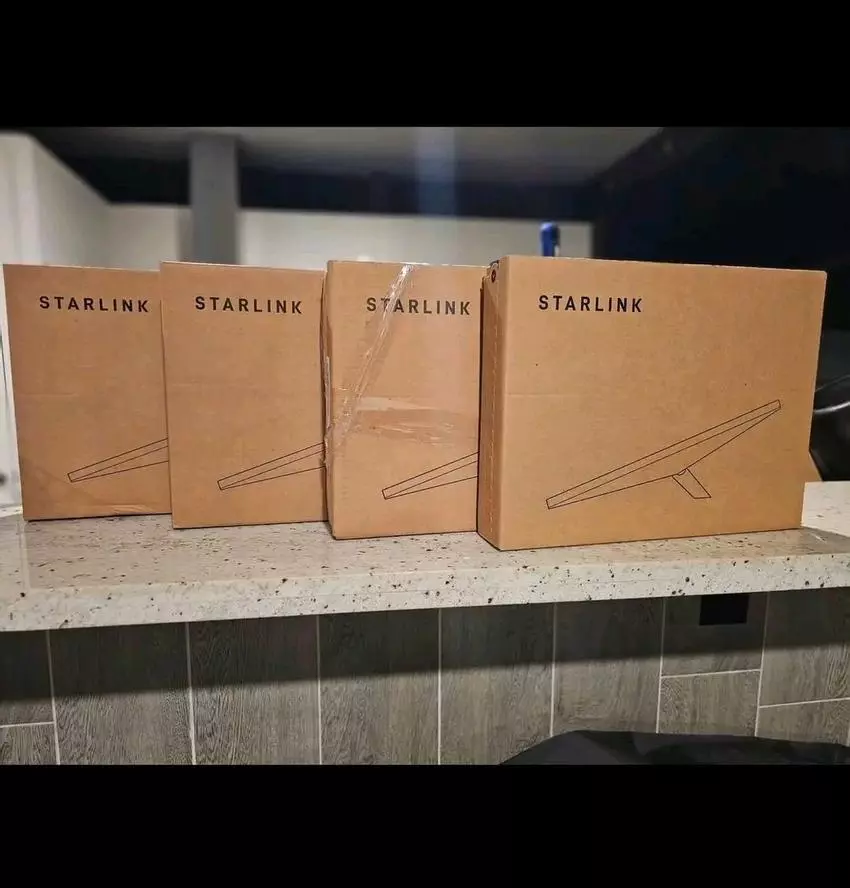
In terms of cost, Starlink is far beyond the average Cuban’s means. While in the United States or Mexico a standard kit may cost between $300 and $450, on the Island that same equipment shoots up on the black market to $1,300-$1,800, a difference driven not by technical improvements, but by import risks, camouflage, bribes, and the possibility of confiscation. On top of that comes the monthly fee: roaming plans, the ones that allow use in a country where the service is not officially sold, range from $90 to $120 per month, although in Cuba many end up paying around $150 to resellers who manage the account from abroad. In practice, users are not paying just for internet, but for the entire chain of illegality and financial dependency that makes it possible to turn on the antenna.
Around this banned technology, a small economic ecosystem has already emerged. There are those who use it to sustain a private business, those who depend on it for remote programming or design work, and those who resell it. A single device can power a small neighborhood network and turn its owner into an informal Wi-Fi provider. Just as people once shared signals from antennas to watch foreign TV channels, now they are starting to share Starlink connections. In practice, it is an invisible small business.
This proliferation explains the authorities’ unease. The Government can confiscate antennas, tighten inspections, and label these devices as contraband technology, but it has not managed to erase demand. Every dish hidden on a rooftop confirms the failure of a monopoly unable to provide a sufficient, stable connection compatible with contemporary economic life.
Starlink alone will not democratize Cuba. It remains expensive, clandestine, and limited to a minority. It almost always depends on money sent from abroad and on a chain of illegalities that keeps it out of reach for most. But each antenna leaves behind a difficult truth to conceal: the demand for connectivity has already outgrown the State’s capacity for control.
Translated by Regina Anavy
______________________
COLLABORATE WITH OUR WORK: The 14ymedio team is committed to practicing serious journalism that reflects Cuba’s reality in all its depth. Thank you for joining us on this long journey. We invite you to continue supporting us by becoming a member of 14ymedio now. Together we can continue transforming journalism in Cuba.