“I can’t carry much, I only pick up skinny people,” says the motorcyclist who takes me through the streets of the capital.

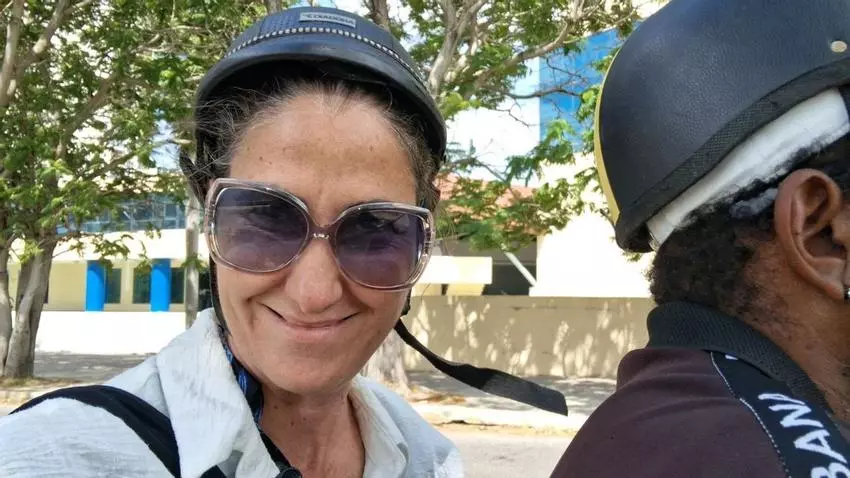
 14ymedio, Yoani Sánchez, Havana, 4 April 2026 / “Put on your helmet,” the young man tells me before I get on the motorcycle. In Havana, almost paralyzed by the energy crisis, there are motorcyclists who serve as taxis. They assess you from head to toe before quoting a price, because body weight influences what you’ll pay. “I can’t carry much, I only pick up thin people,” the young man assures me. The vehicle is electric, and he bought it after a trip to Spain. He starts telling me wonderful things about Madrid as we cross the Iron Bridge.
“I’m going all the way to La Sortija,” I warn him. The famous store, a few meters from Fraternity Park, continues to be an important landmark even though it has been sinking into decay for years. We Havanans cling to the old names of places, as if by pronouncing them we could pull them up from the ruin. Thus, we still say Carlos III for the now rebaptized Salvador Allende Avenue, but hardly any of its former grandeur remains. No one refers to La Cubana hardware store by that name anymore, but rather with the catchy “Feíto y Cabezón” [Ugly and Pig-Headed].
My grandmother always refused to call the House of Three Kilograms department store by its previous name, “Yumuri.” She repeated the old name and remembered the mannequins in their long dresses, but all I saw in the windows were the clunky briefcases that all the government officials carried. There were also some shirts that became the least ugly thing among the clothes the “new man” was supposed to wear. In those 1980s, I liked to go into the shop on Reina and Belascoaín to breathe in the air conditioning. That smell conveyed luxury, sophistication, and the future. Today it’s closed and exudes a musty odor.
Nobody refers to La Cubana hardware store like that, but rather with the catchy “Ugly and Pig-Headed”
The motorcycle is already on 23rd Street. To my right rises the former Havana Hilton. The building seems dwarfed by the colossus they’ve erected just a few meters away. The K Tower isn’t quite right. Too big, too cold, too lonely. The hotel inside is closed due to a lack of tourists. On the avenue in front of the 42-story giant, you could set up an impromptu casino rueda [dance party] without the traffic being a problem. Only occasionally does an electric tricycle or a classic American car pass by. “The only good thing about all this is that it’s unlikely you’ll get hit by a car,” the motorcyclist quips.
We headed down San Lázaro. We passed a bicycle taxi loaded with sacks of charcoal. The man pedaled hard to move the valuable cargo. Right now, lighting a stove is a headache for thousands of families in this city who don’t have piped gas or liquefied gas reserves. On balconies and rooftops, makeshift fires are visible where coffee is brewed and lunch is cooked. A smoky smell clings to the clothes and sheets hanging on the lines.
There are still many people in this city who call Galiano’s store the ‘Ten Cent’ and the building converted into the Computer Palace, almost always empty and dark, is still called ‘Sears’. Hardly anyone in Havana calls Revolution Square ‘Civic Square’ or the complex where the Yara cinema is located the ‘Radiocentro CMQ Building’. Those who used those names went into exile or died. But every now and then I run into someone who gives me directions, specifying that “you have to turn right at the La Marina newspaper building” or “go straight past Lámparas Quesada.” The map of what’s been lost remains alive in our memory.
After nearly seven decades of a system obsessed with renaming everything, it’s a miracle that any of those references still remain. Castroism never had much of a knack for naming things. The era of acronyms lasted an eternity. They say that among all the monstrosities spawned by that mania was Ecodictafo (Consolidated Company for the Distribution of Cigars, Tobacco, and Matches… or something like that). I don’t remember. Maybe it’s just a joke. What I know for sure is that since I was born, matches have always been bad in Cuba, no matter what the company that produces them is called.
The motorcycle trip ends. My destination is the informal vendors who display their wares in the doorways of La Sortija. A friend told me they have good locks. Thefts are rampant, and Havana is increasingly barred with security grilles and locks. The hallways of my building resemble prison cells. There are apartments where residents have to pass through up to three gates to get inside. Keyrings weigh a ton in our pockets. Everything outside these enclosed spaces is susceptible to theft or vandalism. Exterior light bulbs are gone. The glass in the stairwell windows disappeared years ago.
“What are they going to take from us that they’re giving us so much?”
My neighbors are very nervous. We’ve barely had any power outages lately. “What are they going to take away from us that they’re giving us so much of?” an engineer asks me when we’re alone in the elevator. The excessively long power surges make us uneasy. We experience every hour of electricity as a privilege that we’ll have to pay for with darkness upon darkness. Guilt gnaws at me thinking that my present self is consuming the megawatts meant for Yoani’s future self. I feel sorry for her: groping around, searching for a candle or a rechargeable lamp.
I go up to the rooftop as night falls to see if I can spot anything of the Artemis 2 building, but it’s cloudy. In the distance, I can make out the lights of the Focsa building. “It’s a miracle they didn’t change its name,” I tell myself, and I start thinking about all the possible variations they could have slapped on one of Havana’s most beautiful buildings. I go back inside. I check that the padlock is securely fastened on the first gate. And on the second. For the third, I use the one I bought across from La Sortija.
Previous Havana Chronicles:
The Shipwreck of a Ship Called “Cuba”
Havana Seen From ‘The Control Tower’
In Havana, the Only Ones Who Move Are the Mosquitoes
Reina, the Stately Street Where Garbage is Sold
Searching for Light Through the Deserted Streets of Havana
The Death Throes of ‘Granma’, the Mouthpiece of a Regime Cornered by Crisis
The Anxiety of the Disconnected Cuban
One Mella, Three Mellas, Life in Cuba Is Measured in Thousands of Pesos
It Is Forbidden To Leave Home in Cuba Today Because It Is a “Counter-Revolutionary Day”
Vedado, the Heart of Havana’s Nightlife, Is Now Converted Into a Desert
______________________
COLLABORATE WITH OUR WORK: The 14ymedio team is committed to practicing serious journalism that reflects Cuba’s reality in all its depth. Thank you for joining us on this long journey. We invite you to continue supporting us by becoming a member of 14ymedio now. Together we can continue transforming journalism in Cuba.