The event was called by youth organizations under the slogan “Here, with Fidel”
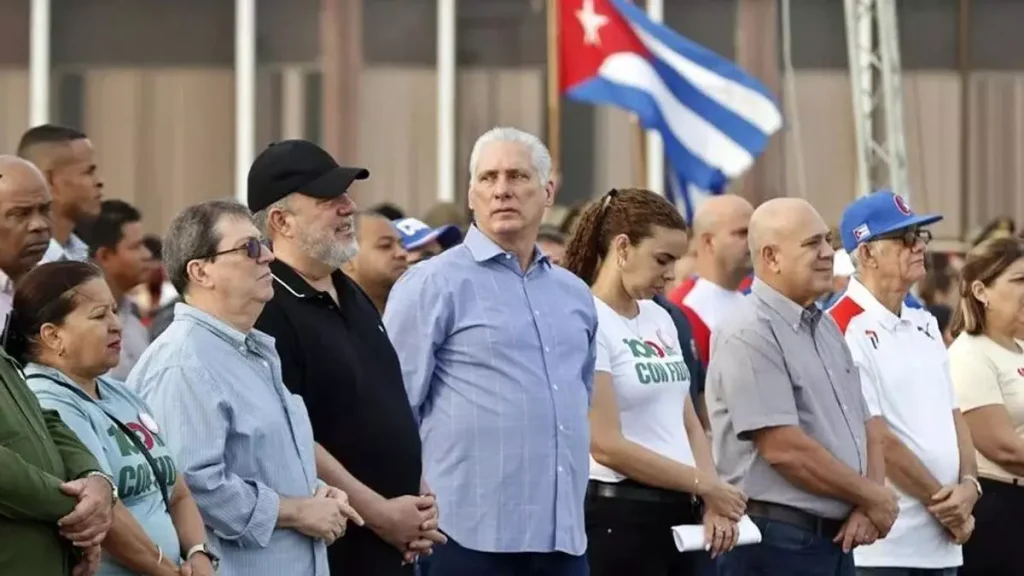
 EFE (via 14ymedio), Havana, April 2, 2026 – Cuban president Miguel Díaz-Canel took part this Thursday in a march in Havana called by state-run youth organizations, amid the energy crisis and pressure from Washington for political and economic change on the Island.
The march, which reached the Anti-Imperialist Tribune in the Cuban capital, a site for various political events on the Island, was markedly different from those historically held there. This Thursday’s turnout was much smaller than usual, and those who did attend arrived on bicycles and electric tricycles.
Díaz-Canel appeared at the parade without giving any speech and was accompanied by members of the Political Bureau of the Central Committee of the Communist Party of Cuba, the only legal party in the country, along with other government leaders, the Armed Forces, and the Ministry of the Interior.
The state organizations Union of Young Communists (UJC) and the José Martí Pioneer Organization (OPJM) called the march, which was attended by students and young people from the capital under the slogan “Here, with Fidel,” as part of activities marking their anniversaries on April 4.
Díaz-Canel appeared at the parade without giving any speech
The organizations had announced that the so-called “Anti-Imperialist Youth Parade” would serve as a space to mobilize young people “on wheels, with bicycles, scooters, and electric motorcycles,” means of transportation that many Cubans have turned to in recent months due to fuel shortages, to denounce the U.S. oil blockade against Cuba.
Tensions between Washington and Havana intensified following the capture of Nicolás Maduro in Venezuela on January 3, after which the flow of Venezuelan oil to the Island was cut off.
The oil blockade has driven chronic blackouts in the country to record levels and has nearly paralyzed the State sector, from hospitals and public transportation to factories and government offices. The measure has been described by the UN as contrary to international law.
From the administration of U.S. President Donald Trump, Cuba has been urged to reach an agreement, apparently centered on economic reforms.
Cuba officially acknowledged on March 13 that a dialogue with Washington exists and later stated that “the Cuban political system is not subject to negotiation,” in response to reports suggesting that the U.S. government might be seeking in negotiations with Havana a replacement for the Cuban president.
Translated by Regina Anavy
______________________
COLLABORATE WITH OUR WORK: The 14ymedio team is committed to practicing serious journalism that reflects Cuba’s reality in all its depth. Thank you for joining us on this long journey. We invite you to continue supporting us by becoming a member of 14ymedio now. Together we can continue transforming journalism in Cuba.