A Peculiar Almanac

Reading has become like a secret sect: its members recognise one another in trains and cafés. (Facebook/La Nave Antiquarian Bookshop)

14ymedio bigger14ymedio, Xavier Carbonell, Salamanca, 31 December 2023 – In a freezing bookshop in Burgos; with an antiques dealer in Salamanca; talking to a bookseller in Seville; awaiting the post from a miserly bookseller from La Rioja; rooting through a hundred stalls at the Madrid fair; unpacking packages that arrive from Cuba: to narrate my year is to narrate my books. In each case I know how much they cost, where I bought them, and what they brought to me that was new to my life and to my library.

A sporting spirit brings a reader to make lists – not only of the books they’ve read but also the ones they’ve acquired, the ones they’ve lost and the ones most wanted. My list – which contains all of the above – is divided into months, and it resembles a list of diary entries of where I found each book, as well as any notes or reflections that seemed worth jotting down at the time. It’s not a bad habit to have if you’re going to want some content for future use in novels or in columns.

In my diary – a lovely little Moleskine – I also describe meals, or the weather, people I’ve met and places visited. Observations from a bewildered point of view, because, for someone who has left their native country, although they might have a bed and a roof over their head, beyond that, everything appears exotic. The reader’s diary is not short of heroes and villains, unexpected luxuries and moments of extreme hardship. (In interviews, Borges said that he had known extreme poverty. “When, Borges?”, Soler Serrano asked him in 1980. “The poverty of not getting to the end of the month”, the blind man replied.) continue reading

People who read, they get up every day with an impulse that asks them “to save Shakespeare, the Mona Lisa, Havana cigars, penicillin, the iPhone and the Kalashnikov”

People who read, they get up every day with the sense of responsibility described by María Stepánova: it’s an impulse that asks them “to save Shakespeare, the Mona Lisa, Havana cigars, penicillin, the iPhone and the Kalashnikov”. Stepánova wanted the same thing as Walter Benjamin, W.G. Sebald and George Steiner – all stateless people whom I have read with some attention this year.

I discovered Sebald via his book Austerlitz, (published by Anagrama) in Burgos, just after hitting my head on a ceiling beam: I was on the second floor [third floor, to Americans] of a bookshop, and I’d just had to climb a narrow staircase in order to reach it. When I recovered, I saw the spine of the book. Pain and illnesses also form part of memory’s arsenal. A simple example is a strip of esomeprazol, a pill with literary prestige – Arturo Belano and Roberto Bolaño took them – which marks the rhythm of my own week.

But if anything has defined my ups and downs this year it has been the hunt for the catalogue of a publisher which doesn’t exist: The Kingdom of Redonda. There are 40 coloured volumes, published by Javier Marías, with a sharpened arrow on the cover, by little known but always exceptional authors. These are cult books, other-worldly objects, which are disappearing from the bookshops. The quest for them and for reading them has shaped even my travel.

I travelled through Castilla y León by train whilst reading Los Recuerdos de este fusilero (Memories of this Fusilier), the tale of a British soldier who made this same journey on foot during the Napoleonic Wars. I travelled to Seville in search of The Religion of a Physician – the classic essay by Sir Thomas Browne – but I couldn’t find it. I eventually ended up haggling in a raised voice over the price of a copy, with a bookshop owner in Logroño. I discovered, in The Fall of Constantinople (which inspired more than a few passages from The Lord of the Rings), that the Ottomans were planning to do what Cortés actually did, shortly after, on the other side of the ocean – he dragged his ships overland, because the sea was closed by a “thick chain”, similar to the one that blocked the way of English ships during the Siege of Havana in 1762. As I’ve already said, other-worldly books, for readers from another world.

Like an inquisitive dog, a reader will always try to see what book a potential ’partner in crime’ has under his arm

Reading has become like a secret sect: its members recognise one another in trains and cafés, they show kinship for one another through the simple fact of each having the same book in their hands. Like an inquisitive dog, a reader will always try to see what book a potential ’partner in crime’ has under his arm. And if he recognises it, at the risk of appearing indiscreet, he can’t avoid breaking the ice (or at least enjoy the coincidence in silence if he’s too timid).

Winter, of endearing and indifferent books like Lolita; Spring, of Simic, Paz and Abilio Estévez; tropical August, with Divine Bodies by Cabrera Infante and The Colour of Summer by Arenas; Autumn, of classics – Jenofonte, Seneca, Homer and of obsession with Steiner, the “lay rabbi” whose books offer so much calm and optimism. Tonight, that which awaits me is The Seven Pillars of Wisdom by T E Lawrence, the unforgettable Lawrence of Arabia; and for desserts an English edition of King Solomon’s Mines.

I’ll spend the close of the year reading, or talking about books. Or, at least surrounded by them, which – in these times of people being wrapped up in radicalism or poverty, political correctness or intellectual destitution – continue to be the best of company. And, obviously, with a cigar and a glass of something to hand. No need to overdo it.

Translated by Ricardo Recluso

____________

COLLABORATE WITH OUR WORKThe 14ymedio team is committed to practicing serious journalism that reflects Cuba’s reality in all its depth. Thank you for joining us on this long journey. We invite you to continue supporting us by becoming a member of 14ymedio now. Together we can continue transforming journalism in Cuba.
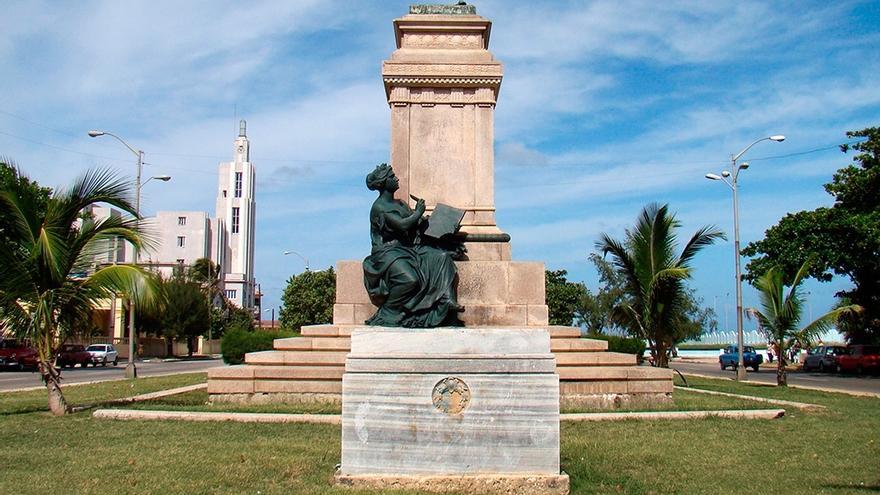
Putting Yourself in the President’s Shoes

All that remains of Tomás Estrada Palma are his shoes, which sit atop a desecrated monument on Avenue of the Presidents.

14ymedio bigger14ymedio, Yunior Garcia Aguilera, Madrid, January 4, 2023 — If you came here thinking that I would be talking about Díaz-Canel or his shoes, you would be mistaken. To be president of a republic, you need to be elected, at least by a parliament. And electing someone implies being able to choose between two or more options. In the case of this individual, he was the only candidate on the parliamentarians’ ballot. So they elected nothing and he presides over nothing. Díaz-Canel is just an appointed director, a front man, Raul Castro’s latest whim.

The person I intend to talk about in this column was the first Cuban president to be elected by popular vote. At school they told us little more than that he favored annexation by the United States. Official historians have emphasized that he requested, begged, implored the U.S. to occupy Cuba a second time. Less mainstream journalists revel in anecdotes about his legendary stinginess. But the truth is that, in Cuba, little is known about who our first elected president was.

All that remains of Tomás Estrada Palma are his shoes, which sit atop a desecrated monument on Avenue of the Presidents, known locally as Avenue G, in Havana’s Vedado district. His statue, which was the creation of the Italian artist Giovanni Nicolini, was unveiled in 1921 and destroyed in 1959 in a fit of collective hysteria. continue reading

Estrada Palma’s presidency was austere, yes, but no one could call him corrupt. His motto — “more teachers than soldiers” — was consistent with his vocation and the needs of the country

The story goes that it was the people who ripped his statue off its pedestal back in the 1970s but ordinary people do not have cranes. Its destruction was not the result of a truly popular rejection but rather an order from powerful officials with a very clear purpose: to erase history. They say that one of Estrada Palma’s sons was staying at the Hotel Presidente Hotel at the time and witnessed this official act of iconoclasm. Perhaps his only revenge was seeing how his father’s shoes clung to the marble.

Years later, a group of pedestrians happened to walk past it without any idea what the monument represented. Some thought it was perhaps an homage to that poem about the rose slippers by Jose Martí. The stubborn bronze shoes remained there until 2020, when the Office of the City Historian finally decided to finish the job, remove them from public view and store them in their archives.

Tomasico* was was born, it is said, on July 9, 1835. He was the only child of Andrés Maria his wife Yaya. His father died when he was little and he developed a singular attachment to his mother. Perhaps because of that bond, he was unable to finish his studies in Seville. He returned to his hometown to be with her and to run La Punta, his family’s hacienda. He was named petty-lieutenant in Bayamo, an administrative position with about as much authority as its pleasant phonetics imply.

When war broke out, Tomás was sent to by the authorities to negotiate with the insurrectionists but ended up joining them. He managed to rise through their ranks, ultimately becoming president of the Republic in Arms. There were more losses than victories, however, and those defeats would leave their mark on him.

La destrucción de la estatua de Estrada Palma no fue el resultado de un rechazo auténticamente popular, sino una orden del poder con un propósito muy claro: borrar la historia. (CC)
The destruction of his statue was not the result of a truly popular rejection but rather an order from powerful officials with a very clear purpose: to erase history. (CC)

His dearly beloved mother died in the mountains of hunger after being captured by the Spanish and then released into the wilderness alone. He himself was captured near the end of the war by Cubans who sympathized with Spain. During his imprisonment in Morro Castle, no Cuban went to visit him. The colonial government spread the news that he had switched sides and he was unfairly assumed to be a traitor. To withstand the December cold, he had to rely on clothes given to him by Spanish soldiers.

Perhaps this is why he had little faith in Cubans’ ability to govern themselves. It was in the United States where rediscovered his love of teaching and where he found a degree of respect and dignity. He regained his belief in Cuba only because someone with the stature of Jose Martí rekindled that hope in him.

Estrada Palma’s presidency was austere, yes, but no one could call him corrupt. His motto — “more teachers than soldiers” — was consistent with his vocation and the needs of the country. Those who insist he favored annexation by the United States ignore his efforts to make sure the Isle of Pines remained part of Cuba and to reduce the number of American naval bases from five to just one.

He was not perfect by any means, but nor was he the rube nor the sellout portrayed in Cuban history classes. A country was being forged and, in such times, it is all too easy to get burned. Perhaps one of his most famous lines says it all: “We have a republic but it does not have citizens.

*Translator’s note: Spanish diminutive of Tomás.

____________

COLLABORATE WITH OUR WORKThe 14ymedio team is committed to practicing serious journalism that reflects Cuba’s reality in all its depth. Thank you for joining us on this long journey. We invite you to continue supporting us by becoming a member of 14ymedio now. Together we can continue transforming journalism in Cuba.
Three Hours Stranded on the Highway, Cubans and Tourists Suffer the Negligence of Viazul

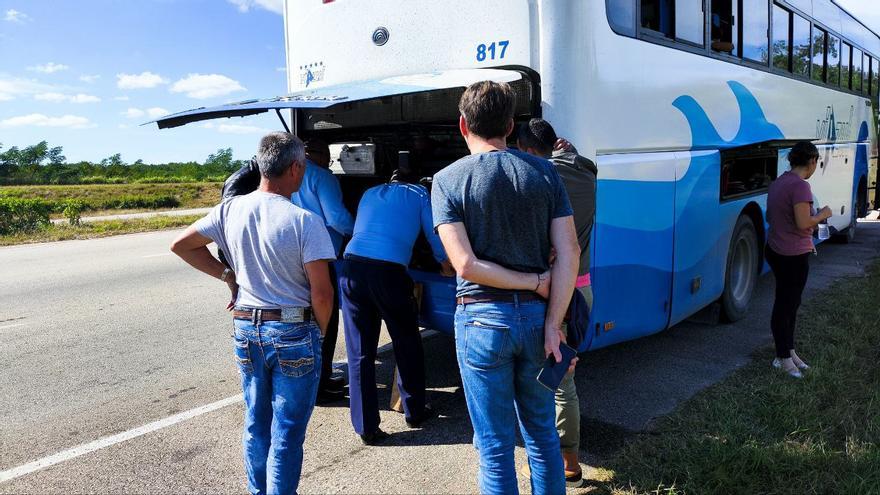
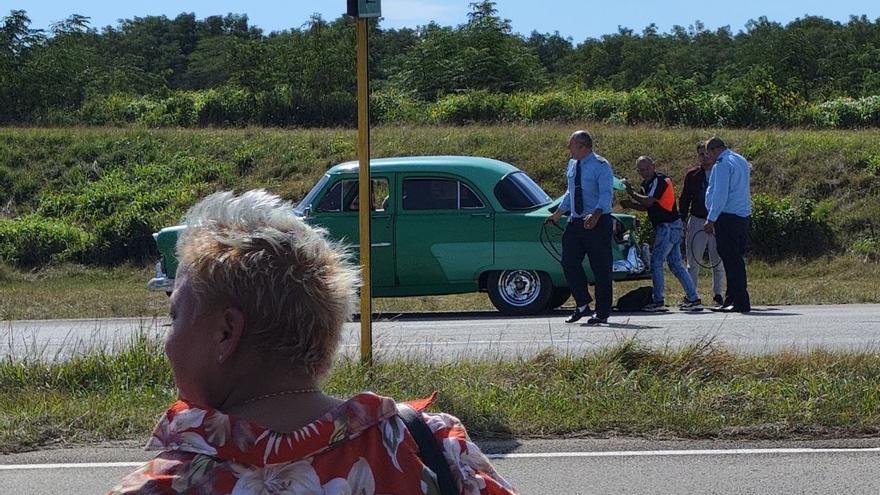
After half an hour, the driver gave his diagnosis: the transmission belt broke and, worst of all, he didn’t have a spare. (14ymedio)

14ymedio bigger14ymedio, Olea Gallardo, Havana, 4 January 2024 — The trip from Ciego de Ávila to Havana by bus is neither short nor cheap, but Maidelys is already used to it. This habanera has been traveling that road by public transport for ten years every time she has a vacation, to visit a sister in the central province. Although the distance is about 400 kilometers, or 250 miles, the trip between the two cities by road takes almost eight hours. That is, if there are no unforeseen events like those that happened this Wednesday, which caused her to arrive three hours later.

As has been customary for a long time, another brother, an emigrant, had given her the ticket, which cost 28 euros, buying it on the Viazul website, where payment is only accepted with foreign cards. Very few can afford these prices, so the vehicle, coming from Santiago de Cuba, was full of foreign tourists, many of them Cuban-Americans, with very few domestic travelers.

The bus left at six in the morning from Ciego de Ávila, and Maidelys fell asleep right away, until they reached the next stop, Sancti Spíritus. “Fortunately it was one of the comfortable buses, because in some Astros [National Bus Company] I can’t get a wink of sleep,” she says. “Once I traveled in one that had no floor in front of my seat, and I spent the whole trip thinking that if I fell asleep I would fall through the hole.”

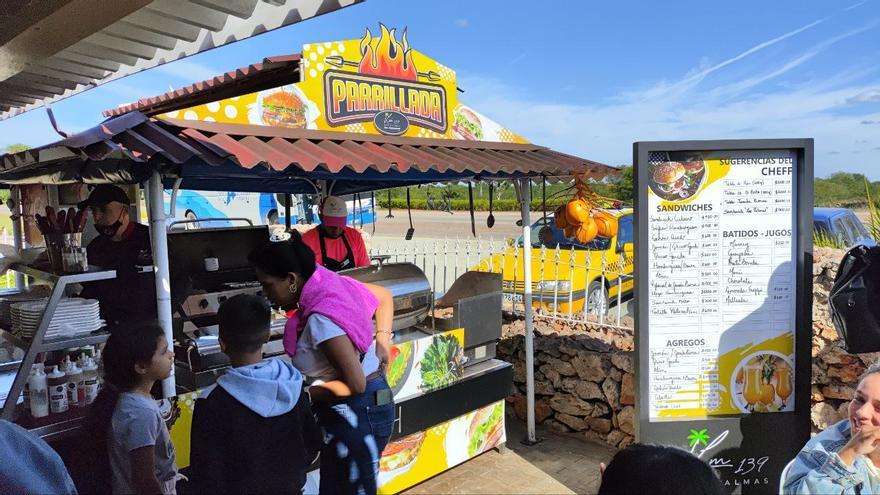
“There’s a goldmine here,” is how Maidelys described the atmosphere of Las Palmas restaurant. (14ymedio)

Another advantage of going in a “tourist” vehicle is that they have hot food at the stops. “With the bus of the proletariat, there’s only sugar and more sugar,” Maidelys jokes, referring to the soft drinks and cookies sold at the government stops.

At kilometer 139 of the National Highway, after passing Santa Clara, the bus stopped for breakfast. “There’s a goldmine here,” is how Maidelys described the atmosphere of the Las Palmas restaurant, a “grill” where the meat dishes cost 2,000 pesos, the sandwiches go from 600 to 1,200, and a continue reading

malted milkshake costs 500. They also sold boxes of cigars for 120 dollars, although some foreigners haggled until they got them down to 110.

Everything seemed to be in order – they had already passed through the provinces of Cienfuegos and Matanzas – when with just under an hour and a half left to reach the capital, at kilometer 72 on the highway, at the height of Nueva Paz in Mayabeque, the vehicle stopped.

“At first you only heard the driver and someone else, like a baggage handler, and no one worried,” says Maidelys. “But then the air conditioning turned off, and people began to protest, saying it was a lack of respect, what with the cost of the ticket.”

An almendrón — a classic American car operating as a shared taxi — stopped to help, but they didn’t have the right part, and then a Transgaviota bus, which didn’t have any spare parts either.” (14ymedio)

After half an hour, the driver gave his diagnosis: the transmission belt broke and, worst of all, he did not have a spare. He did not say  if they would have to wait for another vehicle or if the company would send help. “There is a review department that is supposed to handle all breakdowns,” Maidelys says. “It shouldn’t happen because they’re charging you up the nose, and none of these buses have the comfort they’re supposed to have.”

The driver himself, she says, acknowledged his impotence before the travelers who complained about the breakdown: “He told us that the rule said that after five years the buses should be renewed, but that Viazul has not had new buses for at least 15 years.” The laughter of those present testified to the lack of credibility of the driver’s excuse for such precariousness: “the blockade.”

Soon, as the minutes passed and there was no solution, the good mood gave way to restlessness. “There were people with flights at two in the afternoon, another with a ticket for 1:00 pm, but he already knew it was lost,” says Maidalys. The most dramatic case was that of a young mother who was traveling with her daughter to get to Nicaragua — from where she would probably make the journey to the United States:  she cried when she saw her money for the bus tickets wasted.

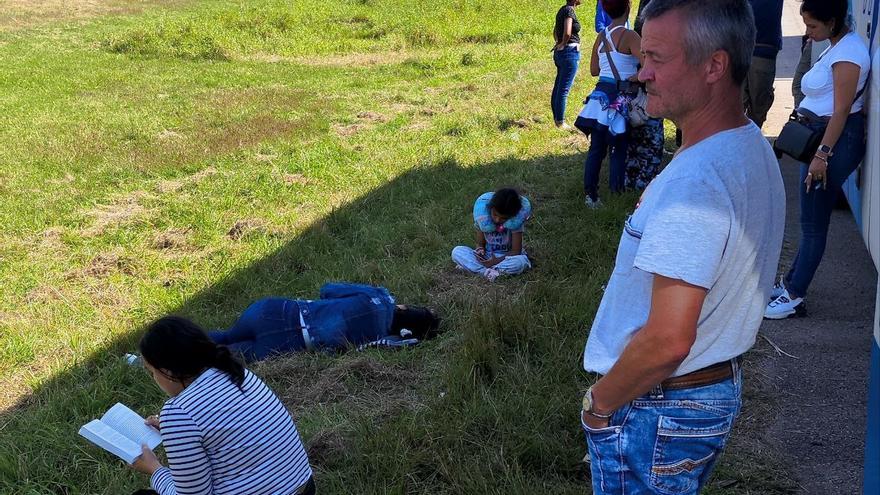
Those who did not have a plane to catch were the most resigned, and they spread out on the ground. (14ymedio)

Those who did not have to catch a plane were the most resigned, and they spread out on the ground, like Maidalys. From a mound she saw how the bus driver desperately stopped other vehicles to ask for help. “An almendrón [a 1950s American car operating as a shared taxi] stopped, but they didn’t have the right part, and then a Transgaviota bus, which didn’t have spare parts either,” she says.

And she continues with the surreal parade that soon populated the place: “A pastry seller appeared and then someone who sold preserves, to get us to buy a kilo, but the worst thing was that an old woman who got on in Santa Clara began to hyperventilate. I don’t know if it was from anxiety or fatigue, but they said that there was no ambulance to pick her up.”

It was more than an hour after being stranded that they began to call the passengers whose final destination was terminal 3 of the José Martí International Airport, to get them into another vehicle. “But they were warned that they had to stand up,” Maidelys says. With that bus, a fan belt also arrived, but it didn’t solve the problem either.

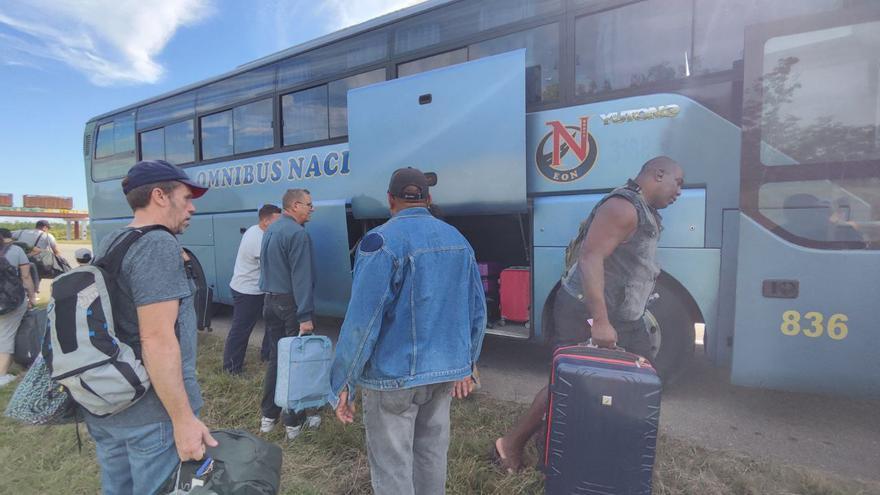
“We had to wait almost three hours for another bus to come and pick us all up.” (14ymedio)

“We had to wait almost three hours for another bus to come and pick us all up,” says Maidelys, who finally arrived at her destination, the bus terminal near the Plaza de la Revolución, at the end of the evening. “I had a piece of meat in my suitcase. It was frozen but I was already afraid that when I arrived in Havana it would be cooked. Rather than Viazul, they should call it Viacrucis [the Way of the Cross].”

The only happy person during the trip, she indicates, was a passenger who, in the middle of the journey, learned that she had received Spanish citizenship: “She started screaming like crazy, and it’s no wonder. She’s not going to have to put up with the things of this country anymore.”

Translated by Regina Anavy

____________

COLLABORATE WITH OUR WORKThe 14ymedio team is committed to practicing serious journalism that reflects Cuba’s reality in all its depth. Thank you for joining us on this long journey. We invite you to continue supporting us by becoming a member of 14ymedio now. Together we can continue transforming journalism in Cuba.
With Its Alternative ‘Therapies,’ Cuba Wants To Become a Paradise for Sick Tourists

Customers will be able to buy packages of 14 and 21 days to be treated on the Island, beginning in January. (Invasor)

14ymedio bigger14ymedio, Juan Izquierdo, Havana, January 4, 2024 — Ready to take out the artillery in the face of the tourism crisis in Cuba, the ministries of Public Health and Tourism returned this Thursday to their strategy to make the Island a paradise for the sick traveler. The Cayería Norte of the province of Ciego de Ávila will be converted into an enclave of “oriental and western therapies, along with therapies with dolphins,” where “ancestral energies” will have as much weight as “the use of Cuban medicines.”

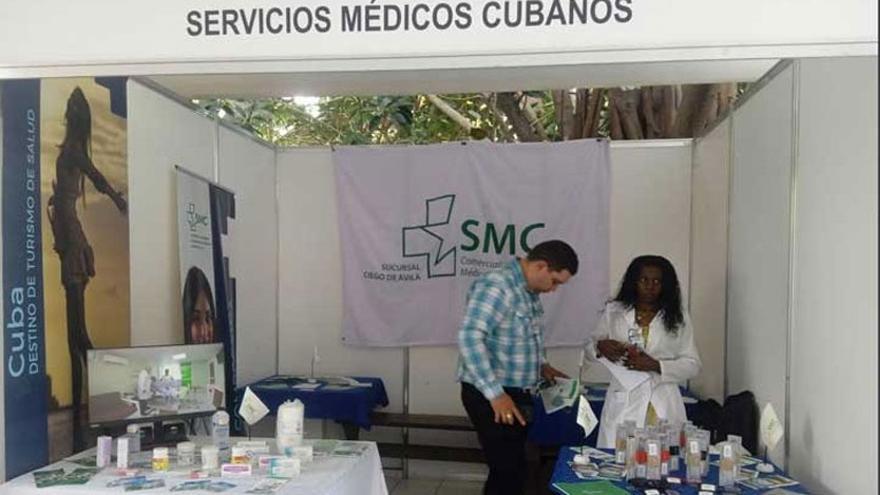
The Medical Services Marketer (CSMC) explained to the official press that the “traditional” Cuban sun and beach tourism is already medicinal in itself, but that they plan a whole package to contribute “to the well-being and improvement of the quality of life” of those who relapse, afflicted by any ailment or a desire for relaxation on the beaches of Seville.

Agnerys Cruz, director of the state company in Ciego de Ávila, pointed out to Invasor that the services will include all kinds of innovative “therapies”

 Agnerys Cruz, director of the state company in Ciego de Ávila, told Invasor that the services will include all kinds of innovative “therapies,” as well as “the consumption of healthy food and drinks” and direct interaction with the dolphins of Cayo Guillermo, which offer proven benefits to the mental health of patients.

“To this is added the possibility of attention to different disorders, from the autism spectrum, in all its varieties, to others that hinder socialization,” Cruz added, without going into details. continue reading

The limits of the program are only imposed, judging from the announcement, by the imagination. “The possibility of visiting cities and rural areas is added, including agricultural farms and local development projects, where they can enjoy ecological walks, farmers’ lunches, traditional Cuban drinks, tropical fruits and fresh vegetables. These proposals reinforce the initiative to travel to Cuba to receive well-being and quality of life services,” the director said.

On a more practical note, Cruz offered customers packages of 14 and 21 days, beginning in January, although she did not delve into the costs. “The experience will be wonderful for both tourists and therapists,” she said.

Both the state facilities and the hotels of Jardínes del Rey will be involved in the new program, which already includes the Canadian Blue Diamond Resorts as one of its partners. “These offers are added to the existing ones at the Starfish Cayo Guillermo hotel, but the purpose is to extend them to other facilities,” the director explained.

However, the CSMC plans an ambitious expansion in its services and is already targeting other audiences. “The Grand Muthu Rainbow hotel, destined for the LGBTIQ+ segment, develops specific therapies that meet the demands of that market and make the stay more pleasant,” Cruz celebrated.

Also inaugurated, in the capital city of the province, was a medical office at the Rueda hotel, “with the aim of ensuring healthcare for those who engage in city tourism in hotel facilities, rental houses or are passing through the province,” she added.

The staff will promote the use of Cuban drugs such as vaccines against covid-19 and Heberprot-P

The office will promote the use of Cuban drugs such as vaccines against covid-19 and Heberprot-P, the latter described as a “stimulant and accelerator of the healing of diabetic foot ulcers” that reduces the risk of amputation.

“In the same way, the medical office staff will promote services aimed at guaranteeing the well-being and quality of life of tourists, such as massages and cosmetic dermatology,” Cruz said.

The initiative, Invasor alleges, is based on data from the World Tourism Organization, which assures that this year health tourism will be a “trend,” since it “increased the number of travelers eager to regain their energies, take a ’breather’ and feel comfortable with themselves.”

It is not the first time that the regime has tried to create a “favorable climate” to attract this type of traveler. After the coronavirus pandemic, the authorities offered foreigners a trip to the Island to recover or receive treatment. The controversy was not long in coming from the population, who feared an increase in the number of infections with the arrival of thousands of tourists.

To this is added, today, the health debacle that the country faces, unable to offer treatment or perform a surgery without the patient’s emigrated relatives sending everything from the simplest supplies, such as needles and thread, to the most expensive drugs. The situation has reached the point where the Government has had to extend again and again the tariff exemption for food, toiletries, medicines and even generators that travelers can bring to the Island for non-commercial purposes.

Translated by Regina Anavy

____________

COLLABORATE WITH OUR WORKThe 14ymedio team is committed to practicing serious journalism that reflects Cuba’s reality in all its depth. Thank you for joining us on this long journey. We invite you to continue supporting us by becoming a member of 14ymedio now. Together we can continue transforming journalism in Cuba.
More than 18,000 Cubans Requested Asylum in Mexico in 2023

After nine days of walking, the “Exodus from Poverty” caravan was dissolved. (EFE)

14ymedio bigger14ymedio, Ángel Salinas, Mexico, 4 January 2024 — The Mexican Refugee Aid Commission (COMAR) processed documents for 18,386 Cubans during 2023. All of them were part of the 140,982 migrants who requested documents for visitors for humanitarian reasons, which includes asylum cases. This is a “record figure,” the coordinator for COMAR, Andrés Ramírez Silva, told 14ymedio.

Migrants from the Island were the third largest group to which they provided assistance, behind Haitians, with 44,239 applications and Hondurans, with 41,935. Ramírez Silva stressed that despite the fact that the figure is considerable, between “November and December” they observed a decrease in the number of irregular foreigners who went to their facilities.

“Since October it has been agreed with the Ministry of the Interior to give priority to migrants who request asylum and want to remain in Mexico,” the official also explained, who attributed the collapse suffered during the year to the misinformation among foreigners who came to obtain transit permits so as not to be arrested. continue reading

Not to be confused with those who continue to arrive in Mexico. The flow has been very large and that is why the meeting took place between Mexico and the United States”

Ramírez Silva clarified that this decrease refers to migrants who approach COMAR: “Not to be confused with those who continue to arrive in Mexico. The flow has been very large, and that is why the meeting between Mexico and the United States took place.”

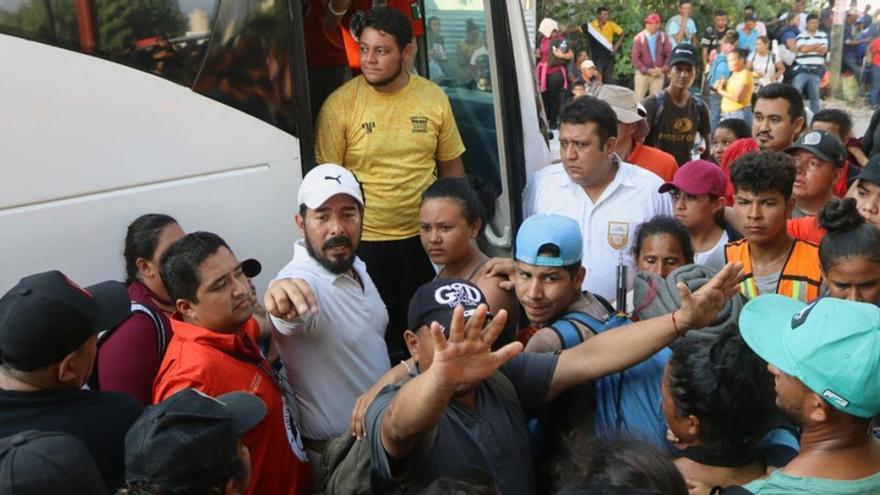
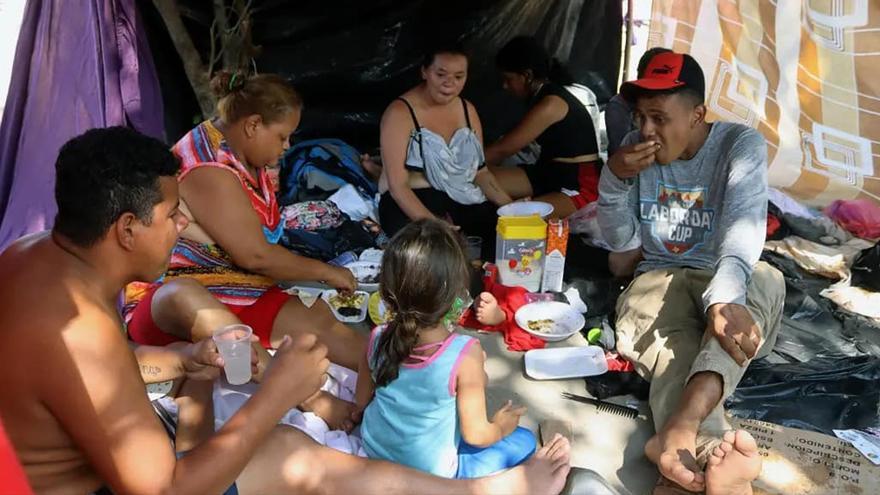
Guillermo wants to reach the United States, but he distrusts the Mexican authorities who have offered the almost 5,000 migrants who make up the so-called “Exodus of Poverty” caravan a “humanitarian visa” to be able to transit to the northern border. “They are going to return us to Tapachula and put us in prison,” he fears.

This Cuban tells 14ymedio that neither he nor nine other Cubans are going to get on the buses that Migración sent to the municipality of Mapastepec to transfer them to the custom facilities of Cerro Gordo, located on the Huixtla-Villa Comaltitlán section. He says that they will get the documents, but they will continue walking.

Zuselmi García López and the other 12 Cubans whom Migración tried to extort, charging 1,500 Mexican pesos (88 dollars) each, have left the caravan. “The same day of the complaint they took advantage of the night to continue in a van,” says Guillermo.

A group of the so-called “Exodus of Poverty” caravan in the municipality of Mapastepec (Chiapas). (Facebook/Girasol TV)

The coordinator of the Center for Human Significance, Luis Villagrán, told this newspaper that Migration committed to provide special attention to the vulnerable groups of the caravan (minors, women, the elderly). These will be attended to through the DIF (National System for the Integral Development of the Family) and will be provided with “assistance and services to meet their family needs.” The remaining migrants will be transferred to other parts of the country, but he did not specify where.

While the procedures are being carried out for the members of the caravan, the Secretary of the Interior, Luisa Alcalde Luján, reported the rescue of 31 people who were kidnapped in the state of Tamaulipas.

Without breaking down the figures by nationalities, Migration said that last year 135,382 documents were issued for visitors for humanitarian reasons, of which 97,545 were refugees, 25,402 were victims of persecution and 9,103 were given documents for humanitarian reasons.

They also delivered 136,235 documents for temporary residents, 83,529 to applicants for permanent residence, 69,517 to regional visitors and 6,637 for border workers.

Translated by Regina Anavy

____________

COLLABORATE WITH OUR WORKThe 14ymedio team is committed to practicing serious journalism that reflects Cuba’s reality in all its depth. Thank you for joining us on this long journey. We invite you to continue supporting us by becoming a member of 14ymedio now. Together we can continue transforming journalism in Cuba.
Cuban Athlete Osvaldo Lara Dies in Misery After a Successful Career

Former athletes Osvaldo Salas, Marcia Garbey and Sigfredo Bandera died during the first two days of 2024. (Collage)

14ymedio bigger14ymedio, Havana, 4 January 2024 — Cuban sports have said goodbye at this beginning of the year, in just three days, to three former figures in its history: former sprinter Osvaldo Lara, at 69 years old; former jumper Marcia Garbey, at 74; and coach Sigfredo Bandera, at 75.

On January 1st, sprinter Osvaldo Lara died, according to PlayOff Magazine. Lara was widely recognized for his sprinting and represented the Island at the Moscow Olympic Games in 1980.

Some of his best records were the silver medal in the 4×100 relay, with 38.36 seconds, in the Continental Cup held in Dusseldorf, Germany (1977); the 10.11 seconds in Medellín (Central American and Caribbean Games, 1978) in the 100 meter dash, and the 20.94 seconds in the 200 meter dash in Havana (Central American and Caribbean Games, 1982).

Lara participated in several international events between 1977 and 1986, including the Central American and Caribbean Championships, in Xalapa, Mexico (1977), and in Nassau, Bahamas (1985); and the Pan American Games in Caracas, Venezuela (1983). continue reading

Lara told the official newspaper, for example, that he only charged 700 pesos for one of the medals won in his years as a professional athlete

Despite his successful career, an interview published by Workers in 2022 showed the terrible conditions in which he was spending his old age. Lara told the official newspaper, for example, that he only charged 700 pesos for one of the medals won during his years as a professional athlete. However, he did not receive retirement pay because he requested sick leave when he developed high blood pressure.

The former sprinter also suffered from diabetes and the after-effects of a stroke. His wife reported that the sports authorities did not visit him and Workers published the photo of the former athlete with his eyes full of tears and holding a worn medal.

Also on January 1, in Santiago de Cuba, Marcia Garbey died, recognized for being the first Cuban jumper to reach the final of the Olympic Games, in Munich 1972.

Marcia Garbey’s feat in Munich was a jump of 6.52 meters that placed her in fourth position, very close to the podium. Other notable results include the bronze medal at the Central American and Caribbean Games in San Juan, Puerto Rico, and the gold medal in the 4×100 relay at the Pan American Games in Winnipeg (Canada), in 1967.

In this black week for Cuban sports, the official media Jit also lamented the death of coach Sigfredo Bandera, who guided several Cuban athletes to the Olympic and world podiums.

Coach Bandera led Yoelbi Quesada to third place on the podium at the 1996 Atlanta Olympic Games, as well as the triple jumpers Alexis Copello and Yoel García, and Enrique Cepeda, Paralympic champion of Barcelona 1992 and Sydney 2000.

____________

COLLABORATE WITH OUR WORKThe 14ymedio team is committed to practicing serious journalism that reflects Cuba’s reality in all its depth. Thank you for joining us on this long journey. We invite you to continue supporting us by becoming a member of 14ymedio now. Together we can continue transforming journalism in Cuba.
Paying with Hard Currency Cards, A Scam for Tourists in Cuba

A ticket just to enjoy the Tropicana show regularly ranges between $75 and $95, depending on whether it is standard or premium. (Facebook)

14ymedio bigger14ymedio, Natalia López Moya, Havana, 4 January 2024 — Twinkling lights, sculptural bodies and music. The propaganda about the Tropicana cabaret in Havana has barely changed in decades. The environment has changed and customers looking for a night of relaxation will have to overcome some obstacles, including the method of payment: a convoluted and frustrating mechanism that many see as a scam.

“They told us just to come and pay the entrance, but it is more complicated,” lamented an American this Saturday, at the  entrance of Havana’s most famous cabaret. The man, who traveled to the island with a group that had previously toured several Cuban evangelical communities, found that entry to the “paradise under the stars” could only be paid with magnetic cards, not cash. And the magnetic card had to be one bought in Cuba, loaded with ‘freely convertible currency’ [MLC].*

A ticket to just enjoy the Tropicana show regularly ranges between $75 and $95, depending on whether it is standard or Premium. If dinner is included, it can cost up to $120 and, this Sunday, December 31, as a special New Year’s Eve offer, with several services included, each person had to pay $300 dollars with the promise of also enjoying a special presentation of the dancers. continue reading

At the suggestion of a Tropicana employee, one of the foreigners went to a nearby hotel and bought a ’hard currency’ card on which he deposited 800 dollars

“American cards do not work, so to enter they have to buy one in freely convertible currency [MLC]”, the employee at the Tropicana access checkpoint clarified to the group. With night already falling and temperatures cool for Havana, the last thing the anxious customers wanted was to delay their entry and postpone the first drink of rum to warm up their bodies.

Prepaid cards in Cuban ‘MLC’ are purchased at airports, hotels and the Island’s exchange offices known as ’Cadecas’. The cards can then be used to pay for hotel reservations, excursions, purchase of airline tickets, in stores, to rent a car, and to eat in restaurants. Their main function is to help travelers from the United States overcome the restrictions that the embargo imposes on financial operations between both countries.

However, after its implementation in mid-2021, what should have been a convenience has become a headache due to the continuous connection problems between the businesses that use them and the Central Bank. Distrust also accompanies this form of payment, which many tourists see as a nuisance, since it involves waiting in line to get them and, in addition, any balance that is not used on the Island is lost.

At the suggestion of a Tropicana employee, one of the foreigners went to a nearby hotel and bought an MLC card on which he deposited $800, an amount that covered the cost of entry for all the members of his group. But, his problems had just begun. “When we went to swipe the card, the device did not read it. We tried, but nothing,” the saddened tourist told 14ymedio.

Once, twice, three times and the device screen always gave an error message. “We have problems communicating with the bank,” insisted another employee, who assured that the payment terminal was “working perfectly for non-US Visa or Mastercard cards,” but “since the afternoon it has been having problems with the MLC cards,” an explanation that left the customers overwhelmed.

“We are losing money, because there are people who, when they find out that they have to go back to the hotel and buy an MLC card they do not return for the show”

“We are losing money, because there are people who, when they find out that they have to return to the hotel and buy a card an MLC card, they do not return for the show,” a tourist guide who frequently takes groups of foreigners to visit the Tropicana acknowledges to this newspaper. “Everyone knows that it would be best if tourists could pay in dollars directly, but they don’t want to implement that for fear that the fulas [dollars] will end up in the workers’ pockets.”

“To prevent employees from pocketing part of the ticket money [which they do by giving a fake or recycled ticket to some tourists] they have created a mechanism that does not work and that only brings headaches to visitors,” he complains. Finally, after several attempts, the Americans paid with a Visa card from a bank in Spain that one of them, with business in that country, had on him.

“The problem is that these cards in MLC are not refundable, now they have to spend the money they deposited on it because they are not going to get it back even if the card has not worked due to problems for which they are not at all to blame,” emphasizes the official guide. “It can’t be done like that, we all lose from this.”

After obstacles at the entrance, the group of American tourists managed to access the Tropicana. But the night was no longer what they projected. Hanging over them was the question of how they were going to manage, in less than the 48 hours they had left in Cuba, to recover the 800 dollars deposited on the card. The guide, embarrassed, clarified that they could only withdraw Cuban pesos from ATMs – at the official rate of 120 CUP per dollar – or transfer the amount in MLC to the account of a relative or friend on the Island.

More than a cultural spectacle, the ‘paradise under the stars’ seemed, to the overwhelmed Americans that Saturday, a complete representation of the Cuban absurdity.

*Translator’s note: The irony is that the MLC cards must be bought with foreign credit cards, but the American cards cannot be used for anything else, and the MLC cards are worthless outside of Cuba.

____________

COLLABORATE WITH OUR WORKThe 14ymedio team is committed to practicing serious journalism that reflects Cuba’s reality in all its depth. Thank you for joining us on this long journey. We invite you to continue supporting us by becoming a member of 14ymedio now. Together we can continue transforming journalism in Cuba.
The Cuban Leinier Domínguez, Eighth Best Chess Player in the World Despite His Stumble in Barcelona

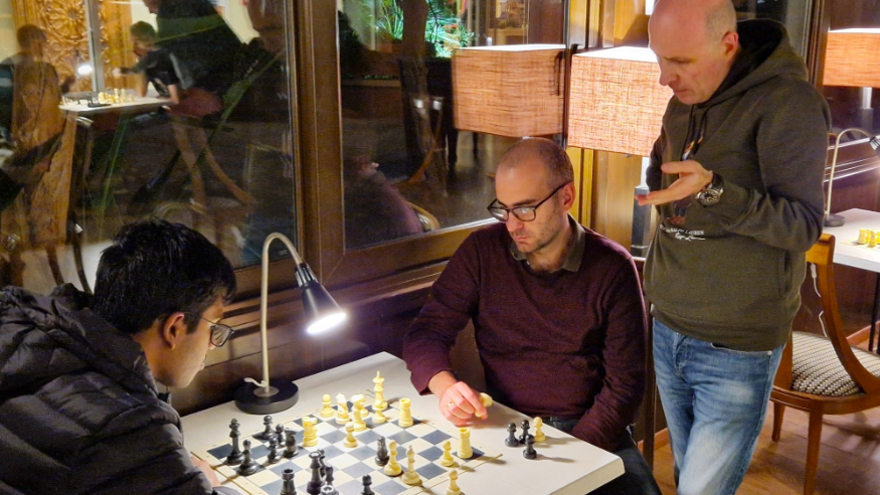
Domínguez, in the center, analyzes his game against his Indian rival, Pranav, and his coach, Vladimir Chuchelov, in Sitges. (ChessBase)

14ymedio bigger14ymedio, Havana, 2 January 2024 — The unexpected departure of Leinier Domínguez in the Sunway Sitges tournament (Barcelona) last December did not prevent the Cuban from starting the year as the eighth best chess player in the world, according to the International Chess Federation (FIDE). With 2,752 Elo* and playing under the American flag, it is not the most notable score of the great master, but it is his best mark in the international ranking.

The Cuban has been one of the top ten of FIDE on three other occasions, always with a better score than this year and in 10th place. In May 2014, he had 2,768 Elo; in August 2019, 2,763, and in October of that same year,  also 2,763.

Domínguez – who at 40 is the oldest member on the list – was in seventh place for several weeks and had his sights set on the Candidates Tournament, which will be held in April in Canada. However, on September 16, in Barcelona, he agreed to a draw with the young Indian chess player Anand Pranav and withdrew from the tournament for health reasons. continue reading

His participation in the Sitges contest responded to a FIDE requirement that participants in the Candidate Tournament win in a competition outside the country they represent

His participation in the Sitges contest responded to a FIDE requirement that participants in the Candidate Tournament win in a competition outside the country they represent. According to the Spanish journalist Leontxo García, the measure – which has generated great controversy – forced Domínguez to “fly urgently” to Spain, with a view to complying with the Federation and guaranteeing the points he needed.

It couldn’t be. García himself, in his comment on the Cuban’s performance in Sitges, where he was the great favorite, concluded that Pranav – a 17-year-old prodigy and with only 2,520 Elo – had “embittered” the day.

In fact, after 43 moves and playing with white, Domínguez could only reach a draw with his opponent. The Cuban started with a Spanish opening and built a solid defense, but from the 23rd move he made a series of mistakes that cost him the victory. When they agreed on a draw, Pranav kept his rooks and a bishop, and Domínguez his queen and a knight.

Two days later he appeared on television talking about his departure from the tournament. “I had all the desire in the world to fight for a spot in the Candidates Tournament,” he said. “I’m simply risking too much if I continue. I could have played better. I don’t regret it.”

The FIDE world ranking included this January, in addition, the Camagüeyan Carlos Daniel Albornoz in the group of chess players with more than 2,600 Elo. The Cuban, towards whose career the official press remains vigilant, was the winner of the Carlos Torre in Memoriam tournament, held last December in Mexico. Until February, when FIDE updates its results again, Albornoz will occupy 186th place in the world.

None of the successes of the so-called ’Idol of Güines’ is echoed by the official Cuban press, which this Tuesday celebrated the results of Albornoz

At the top of the list remains the Norwegian genius Magnus Carlsen, with 2,830 Elo, followed by far by one of Domínguez’s traditional rivals, the Italian-nationalized American, Fabiano Caruana, with 2,803. Below 2,800 are the Japanese Hikaru Nakamura, the Chinese Liren Ding, the Russian Ian Nepomniachtchi, the French Alireza Firouzja and the Filipino Wesly So, who is followed by Domínguez.

None of the successes of the so-called Idol of Güines is reported by the official Cuban press, which on Tuesday celebrated the results of Albornoz and reviewed the list up to Nepomniachtchi, without daring to allude to Domínguez.

The Cuban Chess Federation, of which Domínguez was the most valuable asset until he left for the United States, invited emigrated chess players to play in Cuban national championships if they left the foreign federations with which they had affiliated. In the best of his world game, Domínguez did not react to the measure or to the statements of the ruling party, who promised to make an “exception” if he requested it.

The person who was definitively ruled out, because he was “disrespectful” of the regime, was the great master Lázaro Bruzón. Following his critical position against the Government, Bruzón did not refrain from commenting on the draconian conditions of the Cuban authorities. “They have the Cuban people sunk into the utmost misery and despair and they know what they have to do, which is a radical change of the system,” he said at the time.

*Translator’s note: The Elo rating system calculates the skill level of chess players.

Translated by Regina Anavy

____________

COLLABORATE WITH OUR WORKThe 14ymedio team is committed to practicing serious journalism that reflects Cuba’s reality in all its depth. Thank you for joining us on this long journey. We invite you to continue supporting us by becoming a member of 14ymedio now. Together we can continue transforming journalism in Cuba.
Cuban Santeros Predict Disease and an Increase in Crime in 2024

Among other predictions is a decrease in the birth rate and more marital breakdowns. (EFE)

14ymedio biggerEFE (via 14ymedio), Havana, 1 January 2024 — The Yoruba Cultural Association of Cuba fortells for 2024 an increase in disease, crime, alcohol and drug use, and it drew attention to the increase in “abuse of women” on the Island, according to its predictions released this Monday.

A group of priests from the Cuban Santería or “babalawos” met on New Year’s Eve at the headquarters of the Association in Havana, as is tradition, and on January 1 they published the well-known Letter of the Year, one of the traditions rooted in practitioners and believers on the Island.

The predictions of the oracle of Afro-Cuban religions foreshadow, among other things, a decrease in the birth rate, an increase in criminal activities and more marital breakdowns.

Priests advise “to take precautions with belongings during national trips

Also diseases of the lower abdomen, genetic ailments, the increase of neurological ailments and skin conditions. continue reading

The priests advised Cubans “to pay more attention to agricultural productivity and the use of land” and “to take precautions with belongings during national trips,” in addition to asking the “corresponding authorities for preventive work on the intake of alcoholic beverages and the consumption of narcotics, especially among young people.”

In Santeria, one of the most widespread syncretic cults in Cuba, each letter or sign includes a history of the deities or the “orishas” of the Yoruba pantheon, who speak for it and implicitly carry a teaching or a general recommendation.

In 2024, among the recommendations are to ” not leave children in the care of anyone, as they can be harmed, and be careful with them even in your own home

In 2024, among the recommendations are to “not leave children in the care of anyone, as they can be harmed, and be careful with them even in your own home” and to “be respectful of the differences between human beings to avoid conflicts and unnecessary disagreements.”

The syncretic cults arrived in Cuba with the African slaves in the colonial era, and their practices are transmitted by oral tradition from one generation to another through prayers, rites, spells, magic formulas, sayings, dances, songs, sacrifices and liturgies.

Santería uses divination as one of its main practices, and among its elements are snail shells for the act of consultation and the use of the so-called “foundation necklaces,” made with beads of the colors that characterize each deity.

Translated by Regina Anavy 

____________

COLLABORATE WITH OUR WORKThe 14ymedio team is committed to practicing serious journalism that reflects Cuba’s reality in all its depth. Thank you for joining us on this long journey. We invite you to continue supporting us by becoming a member of 14ymedio now. Together we can continue transforming journalism in Cuba.
Cuban Gasoline Set to Rise to 200 Pesos a Liter, 250 for Diesel, while Service Stations Await the Go-Ahead

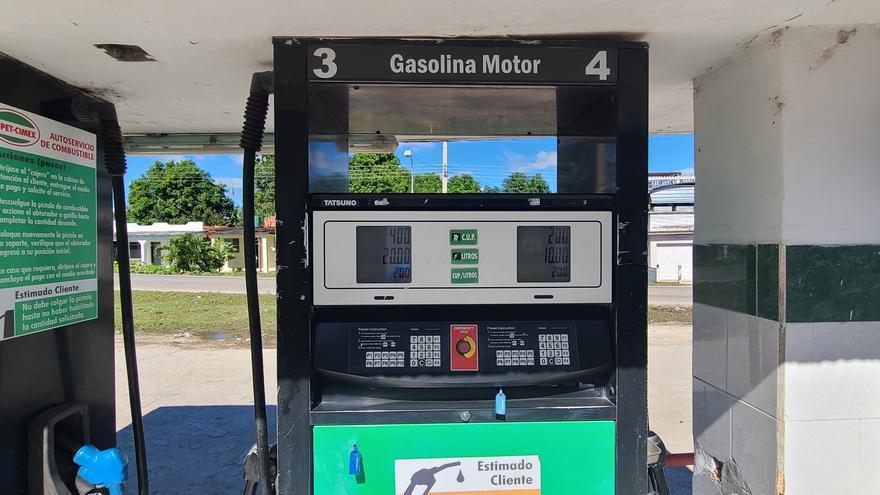
Gas pumps still display the old prices while a filling station manager in Camajuaní awaits instructions from his bosses before charging the new prices.

14ymedio bigger14ymedio, Pedro Espinosa and Juan Matos, Camajuaní/Manzanillo | 2 January 2024 — The impacts of the new macro-economic readjustment measures that the government announced at the end of the year have yet to be felt at Cuban filling stations. During visits to several of the island’s gas stations, reporters from 14ymedio found that employees of the Cuba Petroleum Union (Cupet) were still waiting for instructions from officials, who have ordered them not to allow customers to take photos of the new prices or the facilities.

That is the case at a filling station in Camajuaní, a village on the outskirts of Villa Clara. Though the pumps still display the old prices, a company source has confirmed that the cost of a liter of gas will rise from 25 to 250 pesos. The station’s  manager is still waiting for confirmation from his bosses before charging the new price. When asked about sales to tourists, he says he is unable to answer the question but refers the reporter to the town’s other gas station, in the direction of Cayería Norte, which is already operating under the new guidelines.

What is clear to the employee is the ban by the local government and police on taking photos of gas pumps. “The DTI (Directorate of Intelligence) chief was just here to pass along that information,” says the worker, casting a sideways glance at the police station located a few yards from the gas station.

The situation is much the same at filling stations in Manzanillo. “Prices haven’t changed but there’s still not much gas to be had,” explains a Cupet employee to a driver at the Celia Sanchez Hospital’s gas station. continue reading

Meanwhile, the gas station at the corner of Boyeros and Ayestarán, one of the most important in Havana, had not a single car parked next to its pumps. In addition to the strange absence of a line at the establishment is the lack of employees to answer customers’ questions and concerns. Expectations are that the Cuban government’s economic readjustment plan will be devastating for Cubans but we won’t know until the holiday lull is over.


During visits to several of the island’s gas stations, reporters from 14ymedio found that employees of the Cuba-Petroleum Union (Cupet) were still waiting for instructions from the officials before implementing the new 2024 fuel prices.   — 14ymedio 

In yet another change in economic direction, Havana announced a series of austerity measures that include a sharp increase in prices for fuel, electricity, water and food.

Government leaders feel some urgency to implement the plan, which they have stressed is not intended to further impoverish the population but rather to make those who spend the most pay more. It is keeping Cubans in suspense, worrying that the package will significantly affect their daily cost of living.

One Cuban economist who has criticized the plan is Pedro Monreal, who claims, “An economic package does not necessarily have to be neo-liberal to have affects similar to those of a traditional neo-liberal package” 

Prime Minister Manuel Marrero likened past several years of crisis to  a “war economy,” which he claimed is caused by “waste.” This stands in contrast to the dozens of ships loaded with fuel that were seen docked in the nation’s ports in 2023.

Since the plan was announced, the government of Miguel Díaz-Canel has taken pains to point out that it is neither a “neo-liberal* package” nor a “crash program.” This claim, which has been a constant refrain in recent days, is in response to accusations from some in the opposition that these measures are similar to those adopted in recent decades by other, mostly right-wing, governments in the region, including that of the Argentina’s new libertarian president, Javier Milei.

One Cuban economist who has criticized the plan is Pedro Monreal, who claims, “An economic package does not necessarily have to be neo-liberal* to have affects similar to those of a traditional neo-liberal package.”

*Translator’s note: A term used to refer to market-oriented reform policies such as eliminating price controls, deregulating capital markets, lowering trade barriers and reducing — especially through privatization and austerity — state influence in the economy. (Source: Wikipedia)

____________

COLLABORATE WITH OUR WORKThe 14ymedio team is committed to practicing serious journalism that reflects Cuba’s reality in all its depth. Thank you for joining us on this long journey. We invite you to continue supporting us by becoming a member of 14ymedio now. Together we can continue transforming journalism in Cuba.
The Great Depression 2023 Threatens to be Repeated in 2024 in Cuba

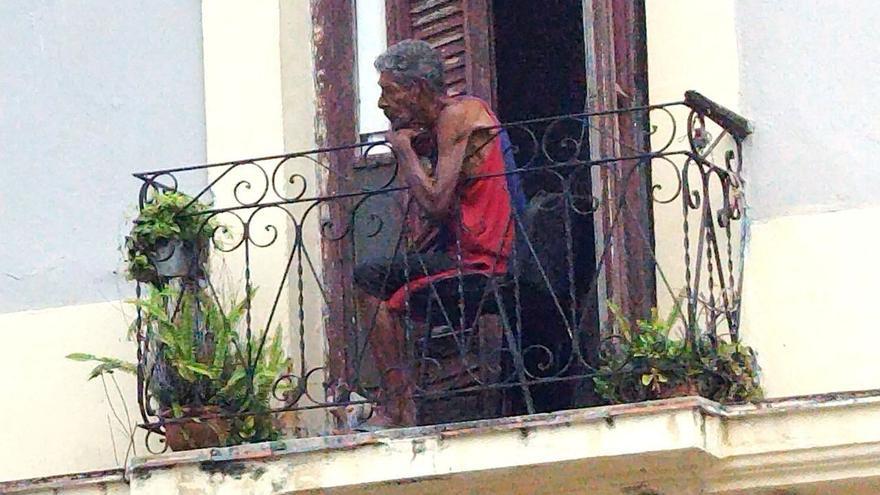
This year, cases of homeless elderly became more visible in Cuba. (14ymedio)

14ymedio bigger14ymedio, Havana, 1 January 2024 — There was no reason to think it would be better, after all 2023 had been preceded by disaster. The economic crisis had already given clear signs of having become chronic in Cuba, the mass exodus marked the bleeding of families escaping to anywhere, the official discourse maintained its commitment to continuity and, in prisons, around a thousand political prisoners served their sentences or awaited trial. Nothing indicated that this was going to be a good year, but hope always clings to the smallest signs.

After twelve months of experiments, failures and difficulties, this can only be defined as another time that we Cubans have spent in “limbo.” Neither the necessary economic reforms arrived, nor did the social protests against inflation and the rising cost of living took to the streets. While the regime approached Vladimir Putin’s Russia in its speech and gestures, it also did not stop winking at the US Administration of Joe Biden. A single egg began to cost more than 100 pesos on the streets of this Island, but micro, small and medium-sized businesses (MSMEs) filled their shelves with candy, beer and frozen chicken at prices unaffordable for the majority of the population.

The clamor of the protests of July 2021 faded away with the repression and the departure of a good part of the potential protesters from the country

The clamor of the protests of 11 July 2021 faded away with the repression and the departure from the country of a good part of those who might have been the potential protesters of the next outbreak. The universities were left with open arms waiting for many students, with good grades, who preferred to put aside their dreams of having a diploma, waiting for an internal change, or for a plane to take them out of here. Countless women postponed pregnancy waiting for “things to get better” and, among the exiles, there were many who, after a trip to the Island or a conversation with their relatives, postponed their schedule to return waiting for “a new scenario.” continue reading

Something similar happened to tourism. “We’d better go to the Dominican Republic,” “Cancun would be easier,” said thousands of travelers who planned vacations throughout this year. The financial collapse, the low quality standards in Cuban accommodation and the anxiety of being caught in a popular outbreak made many opt for other destinations. That did not discourage, however, the Cuban leaders, who continued building four or five star hotels and fracturing the profile of Havana with their defiant Tower K Hotel construction.

Agriculture also remained in no man’s land at this time. The state giant Acopio was not buried, nor did the producers comply with the agreed plans for the delivery of milk, meat and food. Anyone who could put in less effort did so. Anyone who could steal more resources from the State resorted to that quick and traditional way of filling their pockets. The Cuban peso was not even the reference currency. With the dollar running ahead, some 270 times faster, according to the informal exchange rate this December, the national currency could not withstand the barrage of its loss of value, the collapse of ATMs and the failed financial policy of the Central Bank.

Once the Covid-19 pandemic is over, it has not even helped the health authorities to remember that the Island has several of its own vaccines against the coronavirus – none validated by the World Health Organization – to justify the lack of basic medicines in the network of state pharmacies. There are millions of doses of Abdala to sell to other countries, but there is a lack of drugs for high blood pressure, diabetics and those who suffer from an infection for which they need antibiotics.

In that zone of “there is and there is not” Cuban legislation was also installed which, in addition to the steps taken by the new Family Code, continued to assist, undaunted and incapable, the wave of femicides that hit the Island. The cases of children abandoned by their families, who cannot support them, mothers who sleep on the streets with their children and chronically ill people who must resort to social networks to complete their pharmaceutical treatment became more visible.

No one won in 2023. Independent journalism lost, within Cuba, numerous voices that emigrated throughout these months

No one won in 2023. Independent journalism lost, within Cuba, numerous voices that emigrated throughout these months, while the official press desperately published its advertisements again and again to fill positions that few are interested in due to the low salaries and required ideological conditioning.

The most complete representation of this limbo are the “pre-migrants,” all those Cubans who have stopped their lives waiting to leave the Island. Nobody counts them among the numbers of the mass exodus but, while still inside the country, they act as if they no longer inhabit it. Many certainly do not even have the possibility of taking a plane, nor the resources to do so. But the day they decided that they no longer wanted to continue here, they also began a process of disengagement that turned them into beings from nowhere.

They are those who do not get married, do not accept a new job, do not commit to anyone, refuse to continue studying, do not watch official television, but do not have the freedom to choose their own news sources. They do not protest so as to avoid reprisals, and act with the opportunism they learned as children, so as not to jeopardize their visa, parole or political asylum case in another country. They are the children of the limbo that exists in Cuba. The most complete expression of 2023 that ended and threatens to extend into 2024.

____________

COLLABORATE WITH OUR WORKThe 14ymedio team is committed to practicing serious journalism that reflects Cuba’s reality in all its depth. Thank you for joining us on this long journey. We invite you to continue supporting us by becoming a member of 14ymedio now. Together we can continue transforming journalism in Cuba.

Cuba’s Independent Yorubas Dedicate the Year to Elegba, Protector of Private Enterprises

Headquarters of the Miguel Febles Padrón Independent Commission, in Diez de Octubre, Havana. (Facebook)

14ymedio bigger14ymedio, Havana | 2 January 2024 — Devoid of the critical tone against the Regime that characterized it in another era, the Letter of the Year of the independent Cuban Yorubas, published this Tuesday in Havana by the Miguel Febles Padrón Commission, focuses on international trade and on requesting “the prompt sanitation of the country.” After the announcement ceremony, presided over by the priest Gaspar Mesa, the organization insisted that its prediction – contrary to the one signed this Monday by the ruling Yoruba Cultural Association – is the legitimate Letter.

As in 2023, the text came out a day late with respect to officialdom’s Letter. Faced with the claims of the believers, the commission asked for patience and assured that the predictions would be revealed this Tuesday morning, during a press conference in the Yoruba temple of the municipality of Diez de Octubre.

Among the advice of social interest, the independent santeros [priests of the Santería religion] asked to “respect trade agreements” and “increase imports,” and announced an “increase in foreign financing,” although they avoided specifically alluding to the regime’s allies, such as Russia, which have marked the Island’s trade in recent months. Hence, the year, they explained, is consecrated to Elegba, an Afro-Cuban orisha or deity that protects “shopkeepers and merchants.”

However, they devoted several points of the Letter to commenting on the unhealthiness of the country and predicted “an increase in insect and rodent pests.” In addition, there will be “an increase in homicides,” robberies, divorces and disagreements among couples. The santeros predict continue reading

multiple child abandonments and call for a higher birth rate.

The containment of disease, on which the commission is thorough, will depend on removing the piles of garbage

The containment of disease, on which the commission is thorough, will depend, they add, on “removing the piles of garbage: cerrestravascular, bacterial and parasitic, respiratory and infectious diseases, and diabetes with danger of mutilation of the extremities.” Finally, they recommended going to the “godparents” in search of “specific guidelines,” which the brief message cannot offer.

This Monday, the Yoruba Cultural Association – to which a militant complicity with the regime is attributed – also published its Letter. Focused on the increase in “abuse of women,” the consumption of alcohol and drugs, and crime, the text was more incisive with the situation of the Island than that of the independents.

The Letter of the Year, a tradition that orthodox believers resort to as much as the occasional ones, faces once again the schism in the leadership of Cuban Santería. The division between officials and independents results in the issuance of two texts, with different series of advice, prophecies and ruling divinities.

Inside Santería, the divided loyalties of their babalawos or priests and the emigration of thousands of religious Cubans – who aspire to take their practices with them, adapting them to the country of emigration – causes, in practice, a serious confusion among practitioners, who prefer to go to their personal “godfathers.”*

*Translator’s note: In Santería, the “godfather” (or “godmother”) is the one who initiates and guides the new devotee.

Translated by Regina Anavy

____________

COLLABORATE WITH OUR WORKThe 14ymedio team is committed to practicing serious journalism that reflects Cuba’s reality in all its depth. Thank you for joining us on this long journey. We invite you to continue supporting us by becoming a member of 14ymedio now. Together we can continue transforming journalism in Cuba.

The UN Points Out Spain, Qatar and Italy for the ‘Dubious’ Hiring of Cuban Workers

Roberto Occhiuto, president of the Calabria region in Italy, with the first contingent of 50 health workers who arrived in January 2022. (Facebook/Roberto Occhiuto)

14ymedio bigger14ymedio, Havana | 2 January 2024 — On Tuesday, the organization Prisoners Defenders (PD) announced a letter signed by the United Nations Special Rapporteur for Contemporary Forms of Slavery, in which several governments are denounced for hiring, under “dubious conditions,” workers from Cuba. According to the text, signed by Tomoya Obokata on November 2, Spain, Italy, Qatar, in addition to the cruise company MSC Malta Seafarers, received a request from their office to clarify the situation. So far, none has responded.

According to PD, for months it has secretly helped the Rapporteur’s administration in the collection of information on the cases of exploitation of Cubans by the Government of Havana and the level of complicity of the countries mentioned in these contracts. The document was also sent to the authorities in Doha, Rome and Madrid, who were asked to respond within 60 days.

What is new is the accusation against the Spanish Government, which the Rapporteur indicates for hiring, at the local level – through companies, municipalities or autonomous communities – “athletes, artists, musicians, dancers and other Cuban professionals” in “precarious working conditions and exploitation.” The document also alleges that a part of their salaries is retained by companies on the Island that mediate the hiring.

For its part, PD says that many of the testimonies it managed to gather in Spain involved Cubans. It explains that they ended up applying for asylum, and Madrid had to grant it for “the conditions of slavery and evidence they presented.” One of these stories that was made public was that of the Basque handball player Lisandra Lima, who abandoned her delegation while competing in 2018 in Barcelona. continue reading

The Government of Spain has not taken measures to control the working conditions of the workers and the artistic, technical and sports personnel who arrive in the country

“However, the Government of Spain has not taken measures to control the working conditions of the workers and the artistic, technical and sports personnel who arrive in the country through intermediaries from the Cuban Government and its companies,” says PD.

In the case of Calabria, an Italian region that hired Cuban health workers in 2022 through the state Commercialization of Cuban Medical Services, the complaints revolve around the “insufficient” salaries of the professionals. “It is stipulated that the total salary amount per medical person is 4,700 euros, but 3,500 euros are transferred from the Government of Calabria to the Marketing Company (…). Only an amount of 1,200 euros is given to each medical worker. That gross income is considered insufficient to survive in Italy,” the Rapporteur stressed.

In similar conditions are the health workers hired in Qatar, who are only given 10% of what the country pays for them (between $5,000 and $13,000 per person). The salary, the letter alleges, is not enough for them to live, so “many of the Cuban professionals who work in the country depend on a subsidy called an ’Index’, granted by the Government of Qatar.”

The report also denounced that Cubans hired in this country work an average of 64 hours a week and are closely monitored by their supervisors, to whom they must report each romantic relationship they establish, in addition to their movements outside their homes and intentions to travel or meet family and friends.

MSC Malta Seafarers Company Limited, one of the largest maritime tourism companies in the world, was also accused of exploitation by the Rapporteur. The company, based in Geneva (Switzerland), hires sailors through the Cuban state-owned Selecmar and takes away their passports “during the trip and in the countries where they touch port, to prevent the Cuban workers from ’escaping’.” According to the document, Selecmar receives up to 80% of the salaries paid by the Maltese for the Cubans, while the foreign company has the power to fine those who are “absent” up to $10,000.

A similar case came to light in Cuba years ago, when Alexander Morales, from Havana, complained that the Greek company Northsouth Maritime owed him 60,000 dollars as compensation

A similar case came to light in Cuba years ago, when Alexander Morales, from Havana, complained that the Greek company Northsouth Maritime owed him 60,000 dollars as compensation for injuring himself on one of their ships while doing excessive work. Selecmar then mediated his hiring with the foreign company, which continues to withhold the payment.

Other violations denounced by the UN were the prohibition of entry into the country for eight years to Cubans who leave missions abroad, the conditions of harassment or sexual violence to which they are often subjected and the label of “traitors” and “deserters” that is given to those who breach the contracts.

So far, none of the governments cited by the Rapporteur has responded to the complaints. Dita Charanzová, vice president of the European Parliament, did express her concern about the report: “This United Nations accusation brings to light very serious violations, from forced labor, contemporary slavery, harassment, sexual violence and threats, to physical violence. Once again, it is evident that the Cuban regime systematically and with impunity violates the human rights of its people,” said the MEP.

Translated by Regina Anavy

____________

COLLABORATE WITH OUR WORKThe 14ymedio team is committed to practicing serious journalism that reflects Cuba’s reality in all its depth. Thank you for joining us on this long journey. We invite you to continue supporting us by becoming a member of 14ymedio now. Together we can continue transforming journalism in Cuba.
More than 520,000 Migrants Crossed the Darien Jungle in 2023. 120,000 Were Minors

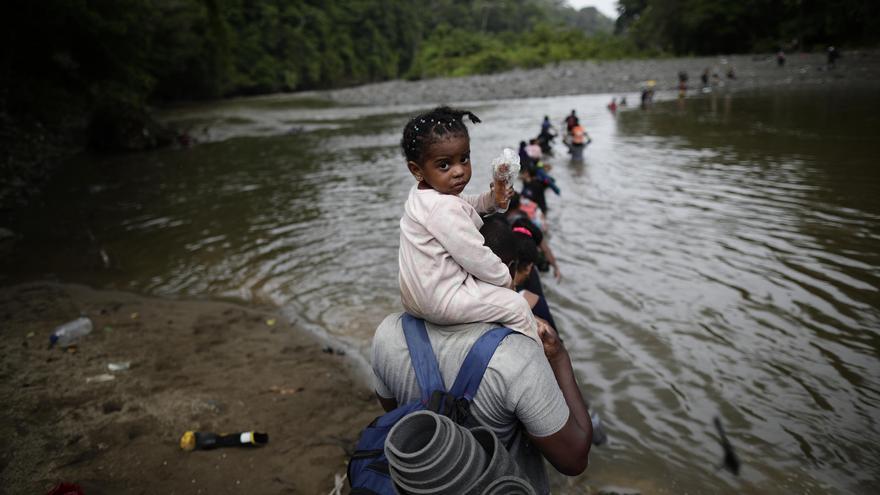
Migrants cross the Turquesa River, in the Darién (Panama), in an archive photograph. (EFE/Bienvenido Velasco)

14ymedio biggerEFE (via 14ymedio), Panama, 2 January 2024 — Panamanian authorities said on Monday that 2023 closed with 520,085 migrants having crossed the Darién jungle, of which 120,000 were minors, a record figure compared to the 248,283 migrants in 2022, who followed this dangerous route to North America in pursuit of better horizons.

Venezuelans, 328,667; Ecuadorians, 57,222; Haitians, 46,558; and Chinese, 25,344, “were the most recurring nationalities this year to cross” the jungle border with Colombia and arrive in Panama, the Panamanian Ministry of Public Security (MINSEG) reported on its social networks.

Similarly, the report provides figures that report a “significant decrease” in the entry of migrants through the dense Darién jungle in the months of October, November and December 2023, with 49,256, 37,231, and 24,626, respectively.

The report provides figures that show a “significant decrease” in the entry of migrants through the dense Darién jungle in the months of October, November and December

The new registration of transit of migrants by Darién to North America at the end of 2023 leaves behind that of previous years: in 2020 8,594 immigrants crossed the Dariíen jungle; in 2021, 133,726; and 2022, 248,283, according to MINSEG. continue reading

Thus, this year the record of more than 500,000 migrants in transit through the Darién, the jungle that connects the isthmus and South America, has been broken, a figure that doubles last year’s record and includes a marked increase in minors.

This 2023 “has been a year in which a record has been broken. More than 100,000 children and adolescents have passed through, 50% of whom are under 5 years old,” the gender-based expert of the United Nations Children’s Fund (UNICEF), Johana Tejada López, told EFE in mid-December.

Most of the families that migrate are from Venezuela, Haiti, Ecuador and Colombia, Tejada López explained in the Lajas Blanca shelter which, as in Bajo Chiquito, is the scene of numerous families with children and adolescents.

The UNICEF expert also warned of an increase in the arrival of minors separated from their parents during the crossing and of adolescents who were traveling “alone.”

The migrants arrive first in Bajo Chiquito after crossing the jungle, where the authorities record their data and they spend the night. The next day they take canoes (paid for by them) that take them on the Tuquesa River to one of the two existing hostels in Darién.

There are several organizations that offer humanitarian and medical aid as well as the Panamanian authorities, which provide food assistance in an operation in which they have invested about 70 million dollars in recent years

 There, known by migrants as ’the UN,’ there are several organizations that offer humanitarian and medical aid as well as the Panamanian authorities, which provide food assistance in a single operation on the continent in which the Government has invested about 70 million dollars in recent years, according to official data.

From the Darién, the migrants must board a bus – at their own expense  – to neighboring Costa Rica.

The restrictions announced by several of the transited countries, such as the deportations of irregular migrants with a criminal record by Panama, or by the United States, which has put in place more obstacles to accessing asylum, do not stop the migratory flow.

Translated by Regina Anavy

____________

COLLABORATE WITH OUR WORKThe 14ymedio team is committed to practicing serious journalism that reflects Cuba’s reality in all its depth. Thank you for joining us on this long journey. We invite you to continue supporting us by becoming a member of 14ymedio now. Together we can continue transforming journalism in Cuba.
Cubans to Pay More for Gasoline in 2024 While Tourists Will Pay in Dollars

Customers waiting in line to buy gas at a service station at San Rafael and Infanta streets in Havana in September. (14ymedio)

14ymedio biggerEFE (via 14ymedio), Havana, 2 January 2024 — One of Cuba’s biggest economic reform measures in decades will take effect in 2024, raising prices for energy, water, natural gas and petroleum and ending the universal food subsidy.

While stressing that its plan will not affect the poorest segments of the population, the government has highlighted the urgent need to address the economic crisis afflicting the country, which has seen a shortage of basic goods, a drop in gross domestic product (GDP) of between 1% and 2 % in 2023, and a fiscal deficit close to 19%.

The plan has sparked criticism from independent economists and opposition figures, however, who have pointed out that it will only exacerbate the island’s already obvious economic inequalities. Rather than an economic adjustment plan, they claim the reforms are little more than cosmetic changes with little substance.

One example is electricity, the cost of which will rise 25% this year for the top 6% of income earners

After making a surprise end-of year announcement of the so-called Macro-economic Stabilization Plan to the National Assembly, Prime Minister Manuel Marrero claimed that, given the “war-time economy” the country is facing, the state could no longer afford to waste money on certain subsidies. continue reading

One example is electricity, the cost of which will rise 25% this year for the top 6% of income earners.

Another change is that tourists will now have to pay for gasoline in hard currency while everyone else will see fuel prices rise. The government does not anticipate that this increase will apply to transport workers such taxi drivers, however.

Meanwhile, water bills will triple for those whose service is not metered while the price of liquified gas will increase 25%.

One of the most notable features of the government’s measure is an end to the subsidy which allows all Cuban consumers to purchase products at heavily discounted prices using a ration card, which has been around for over sixty years.

The other measures have a similar purpose. Given the severe liquidity crisis, the  government says it will attempt to prioritize subsidies for people it considers to be economically vulnerable.

It pointed out that this does not mean the end of the ration book, only that prices for rationed goods will be based on an individual’s income.

Alejandro Gil tacitly acknowledged the island’s social differences, saying that “not everyone is in the same state of economic solvency”

In an interview on state television, economics minister Alejandro Gill was asked if it was feasible to maintain the same level of subsidy on products for the entire population when “not everyone is in the same state of economic solvency,” a tacit acknowledgement of the island’s social differences.

The ration system costs Cuba around 1.6 billion dollars a year at a time when the government lacks all the foreign reserves it needs to access the international market, which it relies on to supply 80% of the food the country consumes.

Cuba will adopt a new currency exchange rate, which for businesses transactions has been set at twenty-four Cuban pesos (CUP) to the dollar since 2021, when monetary reforms did away with the convertible peso (CUC), whose value was at parity to the dollar.

Independent economists have criticized that policy, pointing out that the elimination of the country’s dual-currency system almost three years ago has encouraged the growth of currency exchange on the black market where, as of Monday, the rate was 265 CUP to the dollar.

The government itself has admitted that this reform measure did not meet its objectives.

“Among the measures being proposed is one to restore state control of foreign exchange earnings. Part of what is happening today is that there is less supply in the state sector and more supply in the private sector because the private sector is, in some way acquiring hard currency through the informal market, the illegal market, and those currencies are not finding their way into the national financial system,” Gil explained.

Since the plan was announced, the government of Miguel Díaz-Canel has taken pains to point out that it is not a “neo-liberal package” or a “crash program”

Since the plan was announced, the government of Miguel Díaz-Canel has taken pains to point out that it is neither a “neo-liberal* package” nor a “crash program.”

This government’s claim, which has been a constant refrain in recent days, is a response to accusations from some in the opposition that these measures are similar to those adopted in recent decades by other, mostly right-wing, governments in the region.

Officials argue that this is merely an attempt to correct a handfull of economic “distortions” and that the objective is for the state to retake the reins and make corrections.

One Cuban economist who has criticized the plan is Pedro Monreal, who claims, “An economic package does not necessarily have to be neo-liberal to have affects similar to those of a traditional neo-liberal package.”

Translator’s note: A term used to refer to market-oriented reform policies such as eliminating price controls, deregulating capital markets, lowering trade barriers and reducing — especially through privatization and austerity — state influence in the economy. (Source: Wikipedia)

____________

COLLABORATE WITH OUR WORKThe 14ymedio team is committed to practicing serious journalism that reflects Cuba’s reality in all its depth. Thank you for joining us on this long journey. We invite you to continue supporting us by becoming a member of 14ymedio now. Together we can continue transforming journalism in Cuba.