The walking vendor sells one of the 42 known portraits of José Martí, made by the Organizing Committee of Cuban Patriots in Key West / 14ymedio
14ymedio, Juan Diego Rodríguez, Havana, May 30, 2024 — How much can a piece of cardboard with the portrait that Andrés Estévez made of José Martí in Key West during Christmas 1891 cost in Havana? The answer comes from a man who walks along Obispo Boulevard, without people paying much attention to him, with filthy clothes, his keys tied with a cord around his waist, a cap and a bag made of jute.
The walking vendor sells one of the 42 known portraits of Martí. His face, captured after an event at the Cuban Patriots Organizing Committee in Key West, is neither heroic nor inspiring. He avoids the camera’s gaze and there is a certain skepticism in his eyes. 1891 is the year of Con todos y para el bien de todos y de Versos sencillos (With All and for the Good of All and Simple Verses). According to his biographers, that December he was very ill, and the photo is the best testimony.
In the jute bag the vendor also carries notebooks that he sells at the same price as Martí, and other objects that he has found and intends to resell / 14ymedio
Nor is the man carrying the portrait in good health. The employees of Obispo’s restaurants, the riders, passers-by and even a beggar who rests his crutches on the walls of a tourist information agency look at him with some caution. In the jute bag he also carries notebooks that he sells at the same price as Martí, and other objects that he has found and intends to resell. His Via Crucis begins in the Plaza de Armas and ends, in case it gives him a little good luck, under the statue of the Apostle — as Cubans call José Martí — in Central Park. continue reading
If the writer Eduardo del Llano – father of Nicanor and staunch defender of the regime – said that “the History of Cuba is not for sale,” the quote does not matter in the least to the walker. Everything has a price, and even more so when you are poor and food is, when it exists, too expensive. It is enough for the first interested party to approach him and, to his surprise, ask him: “Partner, how much is the Apostle worth?” He will answer: “20 pesos.”
____________
COLLABORATE WITH OUR WORK: The 14ymedio team is committed to practicing serious journalism that reflects Cuba’s reality in all its depth. Thank you for joining us on this long journey. We invite you to continue supporting us by becoming a member of 14ymedio now. Together we can continue transforming journalism in Cuba.
Cuban officialdom does not mention several obvious problems of this approach: blackouts, lack of products and corruption in the food sector in the province.
In the opinion of the authorities, the night markets or “new type” markets work well because they are “chained” with the ’MSMEs’
14ymedio, Havana, May 29, 2024 — At least five state markets in the province of Ciego de Ávila will begin working until midnight every day of the week. The decision, made by the Ministry of Agriculture, through Acopio, Cuba’s State Procurement and Distribution Agency, is based on the “experience” that two centers in the main municipality have been carrying out since March, and which – according to the authorities – allows the “working age population” to be able to buy food at that time.
The two markets in Ciego de Ávila that began working two months ago until midnight – El Cubanito, on Carretera Central, and Sabor Avileño, on Marcial Gómez Street – demonstrate, in the opinion of Yanisley Garlobo, Director of Development and Businesses of Collection, that there is an “improvement in the offer to the population, in the income of the workers and in the consolidation” of the entity.
Garlobo did not mention several obvious problems of this approach: blackouts, which make all commercial transactions difficult; the lack of products – which Acopio tries to mitigate with photographs of both markets, apparently stocked; the corruption of the food sector in the province, about which the official press frequently reports; and the increase in crime and danger in the streets, which means that Cubans do not dare to travel as the night progresses. continue reading
There will be more markets “as long as Acopio has the financial and material resources to undertake the maintenance work”
In the opinion of the official, the night markets or “new type” markets work well because they are “chained” with local agricultural MSMEs and give a “renewed image” of commerce. Garlobo said that more establishments in the province will soon join the night operation – three more in Ciego, two in Morón and others, he did not say how many, “in the second half of the year” – but their incorporation will depend on financial support from those that already exist.
There will be more markets “as long as the financial and material resources are within Acopio’s reach to undertake the maintenance work and construction modifications that the properties demand,” he added.
Less clear was the statement that market workers will take on “collaboration in the furrows” when necessary, suggesting that employees will also have to work the land. The practice, warned the Acopio Purchasing specialist, “is part of the company’s ways of doing things.” Indeed, the organization’s social networks show that the workers of these stores have come to “work together” with the famers of Avilanian municipalities, such as Venezuela.
The Acopio Facebook page in Ciego de Ávila has shown several photos showing how they work “successfully” until midnight. Pumpkins, pineapples and papayas appeared on the tables at the El Cubanito market, but there were no signs of customers. The photos were also not taken at night. Acopio, whose motto promises food “available to everyone,” also does not refer to the prices of the food it sells.
The newspaper Invasor, which published the announcement of the “reconversion” of the markets, does not offer good forecasts for food production in Ciego de Ávila. Rather than being “stagnant,” the different crops are “regressing,” admitted the province’s Communist Party newspaper this Monday.
“There is a lack of effectiveness and consistency in the actions,” the authorities of the Provincial Delegation of Agriculture argued when they noted not only the low production, but also the alarming level of crime in the fields of Avila. “In many cases, the monitoring of food procurement is lost and, therefore, it does not reach the people at reasonable prices,” lamented the governor of the province.
“There is the case of some farmers whose land is prepared by state entities or they are given fuel, and they join the ranks of repeated offenders”
The first secretary of the Party in Ciego de Ávila, Julio Gómez, uttered a phrase in a meeting with the producers that went down in history: “Food exists,” he said – alluding to the fact that private points of sale, not state ones, are stocked – the problem is that “from the furrow to the table” there is an entire process that seems destined to “further deteriorate the population’s pockets.”
Their solution: “take stronger measures” with producers, “who violate marketing commitments with open and continuous impunity to established state destinations.” “More drastic provisions such as the dismantling of electrical transformers for irrigation, and even withdrawing land from those who fail to comply or demonstrate their unjustified violation of the leasing terms known as usufruct. There is the case of some farmers whose land is prepared by state entities or they are given fuel, and they join the ranks of repeated offenders,” he alleged.
The formula that summarized the meeting bordered on the utopian: “Arrive with more and cheaper food for the people.”
____________
COLLABORATE WITH OUR WORK: The 14ymedio team is committed to practicing serious journalism that reflects Cuba’s reality in all its depth. Thank you for joining us on this long journey. We invite you to continue supporting us by becoming a member of 14ymedio now. Together we can continue transforming journalism in Cuba.
Prison 1580 is located in the Havana municipality of San Miguel del Padrón / Institute for War & Peace Reporting
14ymedio, Havana, 30 May 2024 — A handwritten letter sent to activist Martha Beatriz Roque by political prisoner Nilo Abrahantes Santiago this Tuesday denounces the precarious living conditions of the inmates of Prison 1580, located in the municipality of San Miguel del Padrón, in Havana. The letter, to which this newspaper had access, insists that many inmates suffer from malnutrition.
This prison’s inmates “are about to suffer from serious illness due to hunger (…). Among them is me, weighing 47 kilograms (101 pounds) and being 1.65 meters (5’4″) tall,” Abrahantes details to the former political prisoner of the Black Spring of 2023.
The political prisoner, arrested for participating in the demonstrations of 11 July 2021 (’11J’), included with the letter the signatures of nine other inmates — incarcerated for different reasons — who signed their names and gave an account of their heights and weights “in their own hand,” to demonstrate the disproportion between their size and their body mass.
This is the case of Yohany Lázaro Ramos Cartaya, 5 feet tall and 86 pounds, and Javiel Cárdenas González, 5’10” and only 110 pounds. They are followed by Rolando Guerra Lombillo, 6’2″ and 128 pounds; Joel Crespo Gutiérrez, 5’4″ and 101 pounds, and Ángel Lázaro Castellano Ramírez, also 5’4″ m 101 pounds. Four others, Liván Díaz Machado, Jonathan Delgado Traba, Bárbaro Oviedo Rosell and Wilber Luis Pérez, stand about 5’7″ tall, but in no case exceed 119 pounds, a body mass index considered low for men of their height. continue reading
Abrahantes included a list of nine other prisoners who signed their names, weight and height / Courtesy
Abrahantes has already denounced the situation faced by prisoners in Cuban prisons on several occasions. In the case of Prison 1580, the political prisoner has described it as “a concentration camp” where food is scarce and of poor quality, hygiene is precarious, and medical care for inmates is almost non-existent.
Other detainees in anti-government demonstrations in the rest of the country have denounced similar conditions. Yoandri Reinier Sayú Silva, sentenced to eight years in prison for sedition for demonstrating on 11 July 2021, denounced a case of medical negligence and an outbreak of tuberculosis in Prison 1580 a week ago.
The 22-year-old man suffered from severe pain in the abdomen for 10 days, was unable to defecate and had a high fever, it was then that the prison commanders transferred him to the Salvador Allende General Hospital, where he arrived with a burst appendix and a severe infection.“Inmates fall ill and have no medicine. I survived, but I could have died and there are some who did not survive because of poor care and poor hygiene,” said Sayú Silva.
Another case is that of Lisdani Rodríguez, sentenced to eight years, one of the two sisters of Placetas, Villa Clara, arrested after demonstrating on 11J. She was granted a one-year extra-penal leave on Tuesday for her pregnancy. News about Rodriguez’ pregnancy began circulating at the beginning of the year, when her mother, Barbara Isaac, denounced the pressure by the political police officers at the Guamajal women’s prison, in Santa Clara, for her to have an abortion. Now, she says, the authorities hid, for several weeks, a condition suffered by the young woman that puts her pregnancy at risk.
Likewise, Isaac has denounced the poor diet that the inmates receive in the prison, which is accompanied by poor medical care, which causes the imprisoned women’s health to deteriorate. “They take her to the consultations but do not fully inform her of the results. She asked and only then did the doctor tell her she had to rest, but that’s impossible. She has to make physical efforts all the time because they don’t have water and they have to carry it,” Isaac said about the care her pregnant daughter is receiving.
Translated by LAR
____________
COLLABORATE WITH OUR WORK: The 14ymedio team is committed to practicing serious journalism that reflects Cuba’s reality in all its depth. Thank you for joining us on this long journey. We invite you to continue supporting us by becoming a member of 14ymedio now. Together we can continue transforming journalism in Cuba.
With more than 98 million Mexicans called to the polls, what happens next Sunday will determine the complicity or firmness of the Mexican Government in the face of dictatorships in the region
Andrés Manuel López Obrador, president of Mexico, hugs his Cuban counterpart, Miguel Díaz-Canel, after the awarding him the Mexican Order of the Aztec Eagle Decoration. (@lopezobrador_)
14ymedio, Yoani Sánchez, Havana, 29 May 2024 — Several electoral processes of vital importance for the region will impact the short and medium term path of Latin America. But none of these elections will leave a greater mark on public relations and the consensus positions taken by the continent than the elections that will take place on June 2 in Mexico. The northern nation sets, to a large extent, the pace of diplomacy in this part of the world.
With more than 98 million Mexicans called to the polls, what happens next Sunday will determine the complicity or firmness of the Mexican Government in the face of the region’s dictatorships. Although the polls show the official candidate, Claudia Sheinbaum, 61, as the favorite, her mandate does not have to strictly follow what was laid down by her predecessor, Andrés Manuel López Obrador, regarding the Cuban, Venezuelan and Nicaraguan regimes. The first woman to become president of Mexico can opt for position that is less benevolent and complicit with the authoritarianisms of this hemisphere.
The first woman to become president of Mexico can opt for position that is less benevolent and complicit with the authoritarianisms of this hemisphere
In the six-year term that López Obrador has been in power, blindness to the excesses committed by Havana, Caracas and Managua has been a hard blow for the millions of citizens of those nations. The politician has not only remained silent in the face of the repressive waves that, as in Cuba after the popular protests of 11 July 2021, left more than a thousand political prisoners, but he has supported in international forums, invited to official events and propped up with oil Mexican a ruler whom no one elected at the polls, as is the case of Miguel Díaz-Canel.
The leader of Mexico’s Morena Party has made clear his sympathy towards Castroism and the old ideological ties that unite him to a failed regime that has condemned its population to permanent economic crisis and lack of civic rights. In the mass exodus that Cuba is experiencing, with part of that scenario the Mexican territory through which the “ordinary rafters” cross to reach the southern border of the United States, López Obrador has failed continue reading
to point out the responsibilities of Havana. The Island in flight is fundamentally determined by inefficient economic policies and the reduction of fundamental rights that have characterized the Cuban model for more than half a century.
Should she become president — and the polls indicate that she is the favorite — Sheinbaum can distance herself from that path of concomitance and myopia that her predecessor has followed in relation to Havana. It would be enough to lower the tone of camaraderie, reduce Díaz-Canel’s prominence in regional events and provide greater support to Cuban emigrants, recognizing them as refugees fleeing authoritarianism, to distance herself from the path of collusion that her predecessor has plowed.
It would be enough to lower the tone of camaraderie, reduce Díaz-Canel’s prominence in regional events and provide greater support to Cuban emigrants
The priority of the new president’s mandate, whatever name the polls show, will undoubtedly focus on the deep problems that afflict Mexico. Violence, caused largely by organized crime, is a priority that the president will probably have to face with different methods than those of López Obrador, given the little effect of these strategies in a reality where insecurity has not stopped growing in the last years.
However, a Mexico absorbed in its emergencies is also a problem for the region that needs its active leadership and without half measures. A first step is to assume that leading role would be to make clear an unrestricted attachment to democracy and a rejection of regimes such as those of Daniel Ortega, Nicolás Maduro and Miguel Díaz-Canel. These men of bad company only diminish the prestige, credibility and diplomatic strength of a country that is destined to assume leadership for freedom in this region.
____________
This text was originally published in Deutsche Welle for Latin America.
____________
COLLABORATE WITH OUR WORK: The 14ymedio team is committed to practicing serious journalism that reflects Cuba’s reality in all its depth. Thank you for joining us on this long journey. We invite you to continue supporting us by becoming a member of 14ymedio now. Together we can continue transforming journalism in Cuba.
Tatiana Neroeva buried Faraj Allah Jarjour believing him to be her husband, whose body she is still waiting for
The family of the Canadian tourist charged that the body was picked up by a normal car, not a hearse, in the absence of the undertakers. / Rebel Youth
14ymedio, Madrid, 29 May 2024 — Thousands of kilometers away from Montreal, where the family of Faraj Allah Jarjour resides — the Canadian tourist who died in Cuba last March — a woman, Tatiana Neroeva, waits for corpse of her husband Ilya in Chelyabinsk, Russia. The destinies of both men were united when the Cuban Government sent the wrong bodies to their widows, an error which for the Russian woman is hardly coincidental.
“I suspect that my husband died violently. The replacement of the bodies did not happen by chance, but intentionally,” she said last week in an interview with Russia Today.
Neroeva affirms that her husband, who was on vacation on the island in March, had agreed to exchange currency in the informal market at a very advantageous price for the first day of his stay. He went to change the money and was never seen alive again. The body was found in the sea,” she explained.
“He went to change the money and was never seen alive again. The body was found in the sea”
Her version coincides with that of Anna Neroeva, Ilya’s daughter, who days before denounced Cuba’s lack of interest in clarifying the facts. “Most likely, the country’s authorities simply don’t want to know what happened. As for my father, I only know that he went to change money and didn’t come back,” she said. continue reading
Both Anna and Tatiana suspect that the Cuban authorities sent a different body in order to hide an alleged criminal act that could be detected with n autopsy. Although, they claim, they had doubts when receiving the body, the burial was carried out.
“I was in shock. My relatives asked me questions: ‘Who is this? Why does he look so different?’ The priests assured me that it is normal for these types of changes to occur when embalming the body,” said the deceased’s daughter.
A few days later, they received a call to alert them of what happened in Canada. “It turned out that the body of a Canadian was sent from Cuba to Chelyabinsk and the other body is in Canada,” she added. Since then, cooperation between both parties – including the Canadian Prosecutor’s Office – has been constant.
“We will have a DNA test and an exhumation to send to the Canadians. They said that they did not bury my father, who is still in the morgue. That is, for two months,” added Neoreva, who affirms – without data – that she has heard of more cases similar to her father’s.
This April, Faraj Allah Jarjour’s daughter gave an interview to a Canadian television channel in which, with relief, she related the case. “Until now I felt lost, I had to look for my father’s body. At least we now know where he is,” she declared, after learning that the Cuban authorities had delivered the body to Russia, where he was buried.
More distrustful, the employees of the Canadian funeral home that received Jarjour’s alleged body were not satisfied when they compared it with the photographs provided by the relatives and raised the alarm.
More distrustful, the employees of the Canadian funeral home that received Jarjour’s alleged body were not satisfied when comparing it with photographs
The body of the deceased – due to a heart attack – had remained on a beach chair covered with a sheet for more than eight hours (from 3:30 p.m. to midnight), according to relatives. Afterwards, the morgue employees came to pick him up with a simple car, not an ambulance or a funeral van.
At the end of April, the Canadian Minister of Foreign Affairs, Mélanie Joly, spoke with her Cuban counterpart, Bruno Rodríguez, about the case and the Cuban Foreign Minister stated on X that the Cuban authorities were investigating what happened, while expressing his “condolences and apologies” to the family of the Canadian citizen.
At that time it was not yet known that the body was thousands of kilometers away, buried in the grave of a man twenty years his junior. While the facts are clarified, the families are still waiting to be able to bury the deceased person that belongs to them.
____________
COLLABORATE WITH OUR WORK: The 14ymedio team is committed to practicing serious journalism that reflects Cuba’s reality in all its depth. Thank you for joining us on this long journey. We invite you to continue supporting us by becoming a member of 14ymedio now. Together we can continue transforming journalism in Cuba.
The data threatens to exceed 5,305 in 2022 in the territory, since in just four months 36.8% of that figure was reached
Las Tunas is the Cuban province with the highest number of cases of theft and slaughter of livestock / Periódico 26
14ymedio, Havana, May 29, 2024 — Las Tunas reported, in the first four months of the year alone, 1,954 cases of theft and slaughter of large livestock, which authorities blame for the calamitous decrease in the cattle mass in the province. However, far from looking for the causes of the disproportionate increase in crimes, the local government called the ranchers irresponsible for not improving the safety of the cattle.
The figure threatens to exceed 5,305 cases in 2022 in the territory – latest data available – since in just four months 36.8% of that number was reached.
As published this Tuesday by the official Periódico 26, the Police reported that the crimes occurred in 341 units of the agricultural sector and affected some 3,480 animals, including cows and horses. The municipalities with the highest incidence, declared the authorities, are Jobabo, Majibacoa and the main city of Las Tunas.
A meeting was recently held in the province to address the issue. “In the investigative processes – carried out by the Ministry of the Interior after the complaints – negligence on the part of animal owners in the private and state sectors was detected; among them, the lack of ‘watchers’ during the day, areas full of weeds and tenants without land,” was the conclusion. continue reading
“There are many perimeter fences in poor condition and, lacking food, the cattle leave their usual spaces”
In summary, the ranchers were reprimanded for “the lack of security and protection, both in the corrals and in the pastures” which, according to the newspaper, was one of the most frequent circumstances in the crimes. “There are many perimeter fences in poor condition and, without food, the cattle leave their usual spaces,” the media clarified.
The governor of Las Tunas, Walter Simón Noris, urged several guajiros to “extreme campesina vigilance to stop once and for all the occurrence of these crimes, which place Las Tunas as the territory with the highest incidence of this phenomenon in Cuba,” adds Periódico 26.
Likewise, he called on the directors of the Ministry of Agriculture and the National Association of Small Farmers to take action on the matter, which hinders the delivery of milk and meat to the State.
“He indicated that there is already experience in reducing the theft and slaughter of large livestock, but that the main responsibility lies with the producers, in charge of guaranteeing water, food and the safety of the animals, as well as quickly reporting any incident,” continues the newspaper, which, like the authorities, ignored the constant complaints of the ranchers.
Numerous articles have been published in both the official and independent press about the scarcity of resources that ranchers suffer to maintain their animals. From the lack of water to the inability to buy wire, fertilizers or food supplements, the list of needs grows and the State, due to lack of funds or resources, does not adequately supply the guajiros. This has been denounced by many of them, who claim that livestock farming is becoming an increasingly less profitable business.
Last February, 72 Las Tunas farmers from the main city refused to sign contracts with the State for the delivery of milk. The authorities, who at that time were facing the failure of the dairy plan in the municipality, had no choice but to recognize that the plans were “derailed” and proposed visiting the farmers one by one to “convince” them.
A month later, in March, the national livestock and land control process began, with which the authorities have taken the opportunity to “cash in” to the guajiros. The inspection has been carried out by the authorities and the press, which has uncovered in recent weeks several old cases of trials for theft and slaughter of livestock to keep complaints at bay.
With barely a fifth of the inspection task completed in April – in which it is intended to “survey” 13,601 ranchers and producers – the Ministry of Agriculture had managed to add 30,170 liters of milk, 27 tons of beef to the state inventory and 142 tons of agricultural products in the province.
At the same time, crimes involving livestock have gotten out of control in recent years. The 2022 figure increased by 2,207 cases compared to the 3,098 reported in 2021 and is twice as many as in 2020, when there were 2,394.
Of the cases of theft and slaughter that occurred throughout the Island in 2022 (82,445), 45,315 corresponded to cattle and 37,130 to horses. The increase is considerable compared to the amount from the previous year, with the loss of 33,690 heads, 17,144 of cattle and 16,546 of horses.
____________
COLLABORATE WITH OUR WORK: The 14ymedio team is committed to practicing serious journalism that reflects Cuba’s reality in all its depth. Thank you for joining us on this long journey. We invite you to continue supporting us by becoming a member of 14ymedio now. Together we can continue transforming journalism in Cuba.
Of these, 320 receive temporary monetary aid from the Government, which boasts of benefiting 495 people.
A house in Yaguajay, in Sancti Spíritus / 14ymedio
14ymedio, Havana, 30 May 2024 — At least 559 families in the municipality of Yaguajay, in Sancti Spíritus, live in conditions of extreme poverty, a situation that authorities describe with the euphemism of “vulnerability.” Of these, 320 receive temporary monetary aid from the Government, which boasts of benefiting 495 people.
However, even this money – the official press omits the amount – is insecure, since a “socioeconomic study” is about to be carried out that will analyze the degree of need in which these families find themselves and how much they really need.
Among those requiring assistance are families whose members are unfit to work due to age or disability. Added to this is the serious general crisis that the entire country is experiencing, which in itself entails energy instability and shortages.
According to the official press, “vulnerable” families are also given food modules
According to the official press, “vulnerable” families are also given food modules and toiletries, among other resources, but it is insufficient. The residents of Sancti Spiritus do not even receive the basic family basket on time – a common problem on the Island. Julio Águila, an older man who worked as a driver in the province, denounced it on his social networks, alleging that “in April, soap was not distributed in the basic family basket in Yaguajay.” continue reading
“This month of May we are almost at the 20th and those in charge of solving this problem have not come either. They have gotten the idea that in Yaguajay people don’t bathe or wash [their clothes],” he laments.
In just 15 years Cuba has fallen thirty places in the Human Development Index (HDI) prepared by the United Nations and is at risk of moving from the group of States at a high level to a medium level This would be a severe blow to the Government, which for years has displayed this indicator – which, along with income, takes into account the life expectancy and literacy of the population – as one of its great successes. The data is even more worrying if one observes that in 1995, in the middle of the Special Period, the Island was 13 positions higher than it is today.
Last February, Manuel David Orrio del Rosario, economist, former spy and retired journalist, published an article in which he alludes to the data and shows the percentages of public money on the Island destined for business and real estate services, hotels and restaurants and investment in agriculture. The regime dedicated 47.6% of these funds to these sectors in 2020 – the most severe year of the pandemic – in contrast to just 5.9% that was allocated to food.
Cuba has fallen thirty places in the Human Development Index (HDI) prepared by the United Nations in just 15 years
“This policy is causing, from the beginning, a severe deficit in the supply of food and subsequent inflation, recognizing that this deficit is the first cause of the galloping rise in prices, without prejudice to the impacts caused in other sectors and the effects on the value real wages and pensions, which have long been below 1989!” said the author of several recent texts that are very critical of government policy.
Last April Cubadebate published a report in which the authorities acknowledged that the State was not capable of dealing with the number of homeless people in the country, although they are pleased to offer meals to more than 4,000 homeless and “vulnerable” people a day, in the Quisicuaba dining room, in Havana, a cultural and religious association related to the regime.
If this figure were true, it would mean feeding three people per minute for 24 hours a day. They also did not explain where the food and resources to serve them comes from.
____________
COLLABORATE WITH OUR WORK: The 14ymedio team is committed to practicing serious journalism that reflects Cuba’s reality in all its depth. Thank you for joining us on this long journey. We invite you to continue supporting us by becoming a member of 14ymedio now. Together we can continue transforming journalism in Cuba.
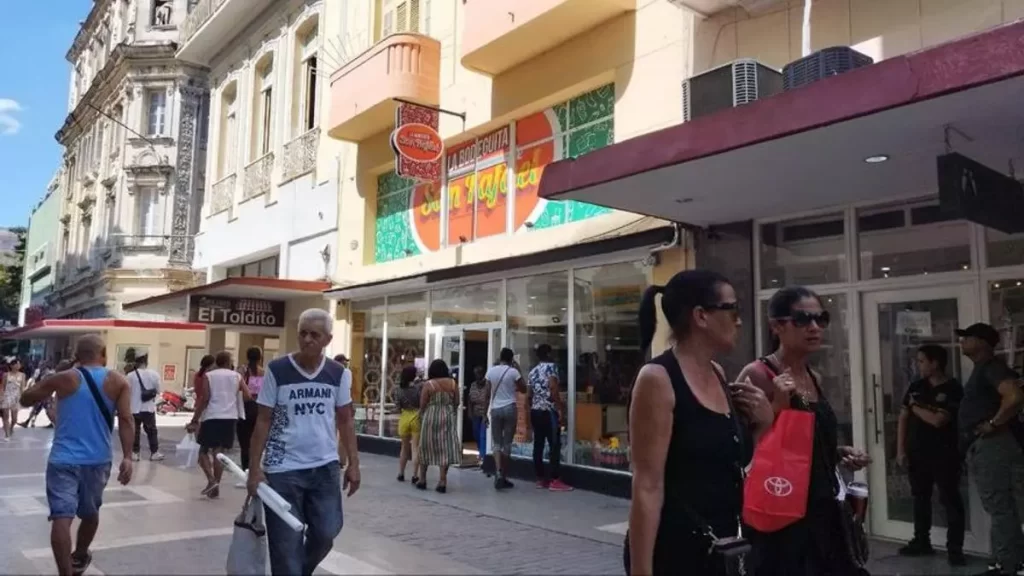
La Bodeguita de San Rafael, on the Boulevard of the same name in Havana, is a private initiative. / 14ymedio
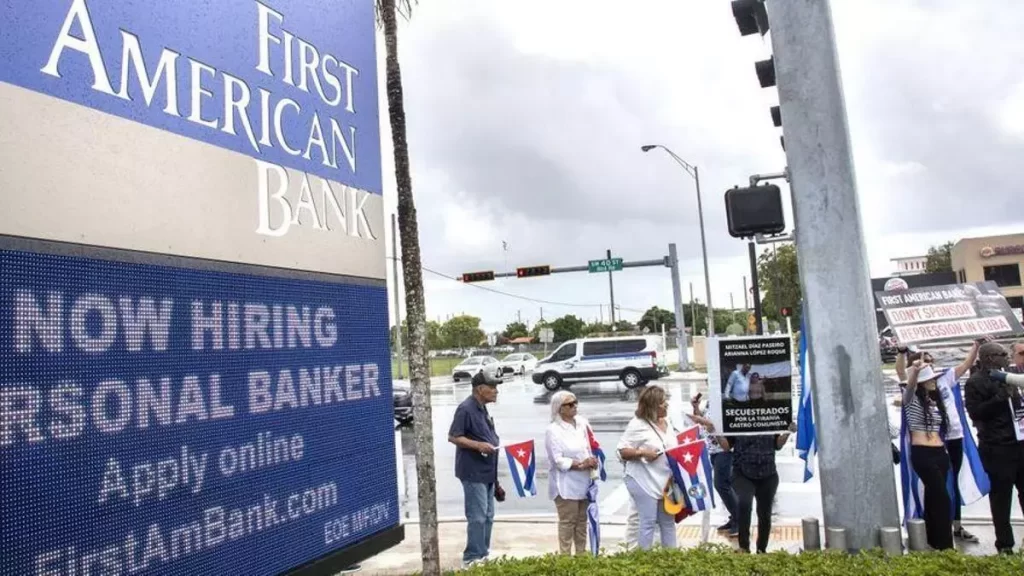
14ymedio, Madrid, 30 May 2024 — The decision of the United States to authorize Cuban entrepreneurs to open bank accounts in the United States through the internet responds, according to Miguel Díaz-Canel, “to a subversive design, outlined in known strategies, that contemplates the manipulation and employment of this sector as a potential agent of change in the country.” The Cuban leader took a day of reflection to react with stronger words than those of his Ministry of Foreign Affairs and did so through his account on X.
“They are limited, restrictive and do not touch the fundamental issue of the blockade against our country, nor the other sanctions of its maximum pressure policy,” he argued, in line with the statement of the Foreign Ministry, published on Wednesday. “They do not eliminate or change the coercive measures that most affect the Cuban economy and public services, with which they today severely damage the well-being of our entire population,” he added.
Although Díaz-Canel did not mention it, he was referring to what almost 24 hours earlier the Ministry of Foreign Affairs described as “the absurd inclusion of Cuba in the list of states that allegedly sponsor terrorism.” Fifteen days ago, Washington removed the Island from the other list, that of countries that “do not fully cooperate with (U.S.) anti-terrorist efforts,” but the regime wants to get off the first list, which has greater implications, including restrictions on some economic and financial aid and access to international credits, in addition to the cancellation of arms exports. continue reading
“They do not eliminate or change the coercive measures that most affect the Cuban economy and public services, with which they today severely damage the well-being of our entire population”
“As long as the intensified blockade remains in force, criminally affecting the entire Cuban people, the United States will not be able to get rid of the global condemnation of this genocide-without-bombs that seeks to wipe out Cuba’s admirable resistance,” Díaz-Canel insisted in another message.
Republicans reject the Biden Administration’s measure, estimating that the Cuban regime will collaterally benefit from improvements that may come from the private sector. Hence, despite the rhetoric, the U.S. has said it will not place obstacles in the way of the rule issued by the Department of the Treasury and in force since May 28. However, the argument focuses on the defense that all “economic actors” are part of a single country, as does the title of the Foreign Affairs statement and the label used by Díaz-Canel this Wednesday in his message: Cuba is one.
“The concern about the development of the non-state sector of our economy is not genuine,” emphasizes Díaz-Canel, and “their plan to direct them [the measures] only to a segment of our people shows their historic intention to fracture unity among Cubans.” Paradoxically, what’s historic is the division established by the Cuban Revolution between the state sector, which was unique for half a century, and the private sector, which they are still reluctant to call by name.
The UN supports the Island with the shipment of 144 metric tons of milk powder per month
Packages of powdered milk in an establishment in Havana / EFE
14ymedio, Havana, 30 May 2024 — The Congress of Spain approved, on Monday, an initiative presented by the Sumar coalition, made up of 20 left-wing political parties, to “contribute to overcoming the shortage of milk destined for children in Cuba.” The proposal, which was approved with 33 votes in favor and three abstentions, aims to “allocate funds” through the Spanish Agency for Development Cooperation (AECID) to be able to ship milk to Cuba and also includes the creation of groups for the supply of “basic necessities” on the Island.
In defense of the initiative presented by Sumar, the deputy of the Socialist Party, Alba Soldevilla Novials, recalled that last January the Government of Cuba requested “urgent aid” from the United Nations World Food Program (WFP) to “facilitate the shipment of powdered milk” to the Island. The response was quick and “the WFP has begun to send a kilogram of milk powder for Cuban children under seven years of age” in Pinar del Río and Havana.
The UN “has begun to send a kilogram of powdered milk for Cuban children under the age of seven” in Pinar del Río and Havana
The regime tried last March, through a text published in the official press, to minimize the dust raised by the news, stating that the request was part of a practice of the bilateral relationship, long-standing cooperation and the actions identified within the Country Strategic Plan for Cuba through 2024.
However, the shipment of 144 metric tons of milk powder, which temporarily covers the needs of 48,000 Cuban children, “is not enough to guarantee the longer-term supply,” Soldevilla stressed. continue reading
With the antecedent that Spain is a “country with dairy surpluses,” Soldevilla said that the Government of Pedro Sánchez could “study collaboration formulas” for a long-term cooperation program.
The shipment of 144 tons of milk powder temporarily covers the needs of 48,000 Cuban children
For his part, José Francisco Alcaraz, representative of VOX, specified that the initiative demonstrated that “communist dictatorships in the world are not capable of feeding their citizens, their children and, obviously, are a threat to freedom.”
Alcaraz said that the socialist support left out “a condemnation of the regime and the lack of freedom,” in addition to “the request that the political prisoners be released.”
The parliamentarian said that a “member of the communist party – without giving his name – took advantage of such a good initiative,” but the money was not for the purposes requested. In view of this, he suggested ensuring that these funds “be destined entirely for the Cuban population.”
The deputy pointed out that it is important to help the children of Cuba, although he told the socialist bloc that “there are more than half a million children in Spain with malnutrition and a 33% risk of poverty.”
Translated by Regina Anavy
____________
COLLABORATE WITH OUR WORK: The 14ymedio team is committed to practicing serious journalism that reflects Cuba’s reality in all its depth. Thank you for joining us on this long journey. We invite you to continue supporting us by becoming a member of 14ymedio now. Together we can continue transforming journalism in Cuba.
In June of last year alone, more than 260 breakdowns were reported that affected more than 380,000 people
“Around 2,070,000 people receive the service every three days or more, and there are 478 population centers with more than 2,000 inhabitants who don’t have aqueduct networks” / 14ymedio/Archive
14ymedio, Havana, 29 May 2024 — The Kuwaiti Fund for Arab Economic Development (KFAED) has donated 102 million dollars over 20 years for hydraulic repair projects in the three most populous provinces of Cuba, according to local media on Wednesday. Kuwaiti cooperation has already benefited 1,454,000 people, more than 10% of the population, and 85% of the total amount has been spent, according to the state Cuban News Agency (ACN).
The projects provide, in addition to repairs to pipelines and aqueducts, a study for the comprehensive solution of the floods along the Havana Malecón, the construction of more water tanks, and the rehabilitation of supply networks and plants for drinking water.
Kuwait’s ambassador to Cuba, Adel Mubarak Farjan Al-Adgham, said last week that KFEAD began in 2003 with the construction of hydraulic works in the provinces of Santiago de Cuba, Holguín and Havana.
Water shortages affect 450,000 people in Cuba, of which more than 156,000 lack adequate access due to the poor state of the infrastructure
Water shortages affect 450,000 people in Cuba, of which more than 156,000 lack adequate access due to the poor state of the hydraulic infrastructure and other problems, according to data from the National Institute of Hydraulic Resources (INRH). continue reading
“About 2,070,000 people receive the service every three days or more, and there are 478 population centers with more than 2,000 inhabitants who don’t have – totally or partially – aqueduct networks,” said the president of the INRH, Antonio Rodríguez, as quoted in the official newspaper Granma.
The director of the INRH mentioned that in June of last year alone, more than 260 breakdowns were reported that affected more than 380,000 people.
He added that aqueduct systems often lose a lot of water “due to the poor technical condition and inadequate operation of the hydraulic infrastructure.”
One measure taken by the Government is the completion of 206 hydraulic works by investment and maintenance, as well as a plan to acquire 1,390 pieces of pumping equipment to alleviate the “tense situation” of recent years.
Translated by Regina Anavy
____________
COLLABORATE WITH OUR WORK: The 14ymedio team is committed to practicing serious journalism that reflects Cuba’s reality in all its depth. Thank you for joining us on this long journey. We invite you to continue supporting us by becoming a member of 14ymedio now. Together we can continue transforming journalism in Cuba.
One of the most dramatic scenarios took place in Sancti Spíritus on Tuesday when they couldn’t even comply with the agreed blackout schedule / 14ymedio
14ymedio, Havana, 29 May 2024 — Blackouts in Cuba reached a new record on Tuesday when the power deficit exceeded 1,400 megawatts (MW) during peak demand hours. The desperation due to the lack of electricity at night caused dozens of residents of Ciudad Nuclear, in Cienfuegos, to take to the streets to protest. Videos posted by Martì Noticias on Wednesday showed the crowd banging on pots and pans and shouting slogans, and the police arriving.
Tuesday’s report from the Electric Union of Cuba (UNE) predicted the worst – an availability of 1,980 MW and a maximum demand of 3,350 MW; that is, a deficit of 1,370 MW, which would cause an “impact” of 1,440 MW at this time – but Wednesday’s forecast barely improves the situation. For a similar maximum demand (3,360 MW) the availability improves slightly (2,319 MW), so the peak hour deficit will be 1,041 MW with an “impact” of 1,111 MW. This means more than a third of the Island will experience blackouts today.
According to the UNE’s statement, the slight improvement is due to the commissioning of generators – until now out of service due to lack of fuel – as well as the entrance of 3 power plant units: unit 6 of the Mariel thermoelectric power plant (CTE) into the national energy service (SEN), even though it is damaged; unit 4 of Energas Varadero, which is under maintenance; and the Puerto Escondido unit. continue reading
The official press tried to calm the waters on Wednesday. Lazaro Guerra Hernandez, UNE’s technical director, assured that the “synchronization” of several thermoelectric units to the SEN “in the coming days” would reduce blackouts.
Specifically, the official referred to unit 6 of the Nuevitas plant, one that “should follow” unit 1 of Felton and “the combined cycle” of Energas Varadero. Then, unit 3 of Santa Cruz del Norte, and, “towards the end of the week,” unit 5 of Mariel. In total, there will be an additional 500 to 550 MW, promised Guerra, who acknowledged that “the situation during Monday and Tuesday has been very complex, given the impossibility of meeting the demand and the exit from service due to breakdowns in three units.
One of the most dramatic scenarios was in Sancti Spíritus, where they could not even comply with the agreed blackout schedule this Tuesday
“We can’t comply with the usual schedule, since the deficit exceeds what was expected in each block” was how the UNE’s division in that territory apologized, while at the same time warning that power from one of the blocks would be cut off for six hours (during peak hours, from 4 pm to 10 pm).
The worst is not only the heat but also the mosquitoes; because the fans can’t work, the rooms are filled with them. Hence the almost surreal scenes that the inhabitants of the Island share on social media, like people sleeping outdoors covered by a mosquito net.
Visiting Havana from Sancti Spíritus, Alicia shares with this newspaper an eloquent anecdote. “I’m overwhelmed by the blackouts. Here in Havana, I wake up at dawn exactly the same time as the power goes off. It sounds funny but it’s not. ”
Translated by LAR
____________
COLLABORATE WITH OUR WORK: The 14ymedio team is committed to practicing serious journalism that reflects Cuba’s reality in all its depth. Thank you for joining us on this long journey. We invite you to continue supporting us by becoming a member of 14ymedio now. Together we can continue transforming journalism in Cuba.
The outcome: A six-year-old boy with minor injuries
Collapse at number 57 Malecón, between Cárcel and Ángeles / 14ymedio
14ymedio, Havana, 28 May 2024 — Debris piled up this morning at number 57 Malecón, between Cárcel and Ángeles, in Central Havana. Hours earlier, a set of stairs had collapsed in the building, leaving a six-year-old boy with minor injuries. According to neighbours, the child has been transferred to the Juan Manuel Márquez hospital and appears to be out of danger.
A whirl of officials from the Communist Party and the provincial government chatted with residents in the area on Tuesday, while Comunales workers [public services, including garbage collection] collected the remains and shored up the building; nobody seemed to be moving out of the building. The situation invites us to think the residents should remain in a building whose decrepitude is in plain sight.
Collapse at 57 Malecón, between Cárcel and Ángeles / 14ymedio
The event is unfortunately common in a country where housing construction is another of the many sectors fading away, as the report published by the National Statistics and Information Office (Onei) last week shows. On the island, the need to renovate the housing stock coexists with empty buildings due to mass emigration. Havana is the province that best reflects that schizophrenia: in five years it has gone from building 10,280 properties in 2019 to just 1,394 in 2023, according to data from the Construction Ministry. continue reading
The document also reveals other data, such as the heavy weight of private construction in the total and the falling supply of almost all the necessary materials in the last year.
According to the document, 16,065 homes were built in 2023, compared to 20,232 the previous year, 20.5% fewer. Of these, most were built by their owners by hiring specialists, 61.4% (9,869), while state companies took over 38.6% (6,205), a drop not only in their amount but also in their percentage compared to 2022 when they built 40.1% (8,103).
In 2023, 16,065 homes were built, compared to 20,232 the previous year, 20.5% fewer
The numbers increase if we look at the ones that are currently underway. Some 97,164 homes are being built by their owners and only 4,733 by the state. There are also 40,274 works at a standstill, all belonging to the do-it-yourself category, predictably (although not indicated) due to bureaucratic reasons.
Province-wise, only three improved their data on finished homes compared to the previous year, most notably Pinar del Río, with an increase of 25%. Hurricane Ian, which hit hard in September 2022, may be one of the factors that stimulated activity, although it is precisely this territory where the figures remained constant during the last three years. In any case, compared to 2019, fewer than half of the 3,006 houses built that year were completed in the westernmost province of Cuba.
In Havana, in a five-year span, the numbers went from 10,280 properties in 2019 to just 1,394 in 2023
Holguín, with 12.5% more finished homes than in 2022, and Isla de la Juventud (2%) complete the list of those that improved on this indicator. On the other hand, the eastern provinces of Santiago de Cuba and Granma finished 30% fewer buildings than the previous year and Havana sank to almost 52% fewer, with 1,394 compared to 2,875 in 2022, a number that was already close to half of those that were finished in 2021. Its sustained drop is also consistent with the rise in the number of people leaving the Capital during the last two years, whereas the population of the provinces tends to emigrate less.
The document also highlights the shortage of construction materials, which is in turn a decisive factor in the decline in work completion, which explains the high number of units still under construction. Crushed stone and corrugated iron bars are the only materials whose production remained stable (0.3% growth for the former) or increased (17.3% for the latter).
There is a shortage of construction materials, which is a decisive factor leading to the decrease in the completion of the works
The rest of the raw materials suffer significant drops in production, the most serious being ready-mix concrete (30%), concrete blocks (26%) and grey cement (24.5%). The scarcity of these materials has led the Government to insist since last year on “taking advantage of the potential” of the territory and building with mud and clay.
However, the population has not used this resource as much as the authorities would like, so much so that last November Cubans earned the scolding of an unbridled deputy prime minister Ramiro Valdés Menéndez. At a sector’s meeting, he raised his voice to demand more results: “There are orders to build the ovens. The plans have been delivered to the territories. Do they carry out the work? They do not. Why don’t they do it? Where is the discipline? Where is the control? There are instructions but they are simply not executed in the territory. ”
Translated by LAR
____________
COLLABORATE WITH OUR WORK: The 14ymedio team is committed to practicing serious journalism that reflects Cuba’s reality in all its depth. Thank you for joining us on this long journey. We invite you to continue supporting us by becoming a member of 14ymedio now. Together we can continue transforming journalism in Cuba.
The Municipal Assembly proposes forcing companies to lower their prices for their “essential” imported products
An ’MSME’ from Holguín dedicated to the sale of toiletries and food / Facebook / Dimensions
14ymedio, Miguel García, Holguín, May 22, 2024 –Bleeding MSMEs [Micro, Small and Medium Enterprises], the only entities on the Island that remain afloat in the unstable Cuban economy, seems to be the new plan of the city of Holguín to raise money. Raising taxes on companies and forcing them to sell “essential products” at the official exchange rate of one dollar for 120 pesos are among the measures that the authorities threatened to implement last week during a meeting of the municipal Assembly with a group of businesspeople, as confirmed by local sources to 14ymedio.
The possible increase in taxes, just a few months after the announcement of the end of the 10% exemption in taxes for one year for newly created private companies and for six months for converted ones, coincides with the desperation of the State to raise everything possible on the Island to oxygenate its budget. The measure puts the noose around the necks of private owners, but another threat, even worse, suggests the obligation to apply the official exchange rate of one dollar for 120 pesos for the sale of products that have been purchased at the much higher rate that holds in the informal market (between 350 and 400 to 1), the only market where they can get foreign currency to import goods.
In an interview with this newspaper, one of the MSMEs owners who attended the meeting with the authorities, and who prefers not to reveal his name, assures that the businesspeople did not sit idly by in the face of the Assembly’s proposal. “The fact that they want to raise taxes would force us to increase the price of the products, because it is something that works like a chain: the more expensive the procedures, the higher we must charge. But now they tell us to open our doors so that they can audit our prices and that we must lower them,” he explains. continue reading
The possible measures were proposed by the Holguín authorities who, like each local government, have jurisdiction over these issues in their territory
The possible measures were proposed by the Holguín authorities who, like each local government, have jurisdiction over these issues in their territory. At the moment, it is not known if similar actions have been proposed in other provinces. In this sense, the businessman regrets that state policies towards private businesses are, in his opinion, misguided. “They pressure us more and more and what we sell we have to pay taxes on, imports, salaries of employees and also generate profits. If not, the company is going to collapse because it does not have a state budget to maintain it,” he claims.
Osmany, the owner of another Holguín MSME that sells food, who also attended the meeting, told 14ymedio that, while waiting for “the happy audit,” he has had to stop all deliveries from his suppliers. “I don’t know when this process is going to start, but they are going to review all the cost sheets and tell us the prices at which we will have to sell our products,” he laments.
“I already have some debts with my suppliers and if they force me to sell at the official rate, I will be bankrupt. It makes no sense for us to buy the dollar at almost 400 pesos in the informal market because the State itself does not have enough liquidity to sell it and then we must sell at the official exchange rate,” he explains.
According to Osmany, he was not the only one who was uncomfortable with the authorities’ announcement. “Other businesspeople also said they did not agree. One even clarified that they could supervise whatever they wanted in their business, but that as soon as they finished they were going to close it, because the accounting didn’t work,” he says.
As the Holguín resident explains, neither the authorities nor the press have not offered an official version of these measures, but rumors of the closure of MSMEs are already heard in the streets of Holguín. For Jesús, a tricycle driver from the main city, “that is the worst thing that could happen in this crisis situation.” “It is true that MSMEs are expensive, but they are the only place where you can get food. They are necessary,” he says.
“Private stores are the only places where you can buy a bottle of oil or flour or sugar. With the blackouts, which are in all their glory, if they also take away our food, I have no doubt that people will take to the streets to protest,” he points out.
“Private stores are the only places where you can buy a bottle of oil or flour or sugar”
The owners of private MSMEs in Holguín have been the focus of attention for weeks. On May 10, this newspaper published an article about the agreement of at least 14 businessmen to try to lower the price of the dollar.
“At the Foremp (Business Forum) the topic that was talked about the most was precisely the price of the dollar, which is practically becoming priceless,” according to the owner of a private business who participated between April 30 and May 2 in the second edition of this event, which took place at the Brisas Guardalavaca hotel in Holguín. Among the more than 180 participants, the biggest concern was the depreciation of the Cuban peso, which, they complain, forces them to need more and more national currency to acquire dollars, essential for the import of products and raw materials.
During the meeting, the 14 entrepreneurs from Holguín agreed to publish on their social media accounts and other anonymous profiles alleged sales or purchases of foreign currency at a price lower than the El Toque rate and not to pay more than 350 pesos, convinced of achieving a fall, even if minimal, of the currency.
The dollar did suffer a “temporary” decline this week, although the cause, according to El Toque, is far from being related to Holguín businessmen. In fact, the media expects that, as the causes of the depreciation of the peso do not disappear – fiscal deficit, inflation, the issuance of currency without backing, among others – the trend will remain the same.
____________
COLLABORATE WITH OUR WORK: The 14ymedio team is committed to practicing serious journalism that reflects Cuba’s reality in all its depth. Thank you for joining us on this long journey. We invite you to continue supporting us by becoming a member of 14ymedio now. Together we can continue transforming journalism in Cuba.
The decision was communicated this Tuesday by the US Department of the Treasury. / EFE
EFE/14ymedio, Washington/Madrid, May 28, 2024 — The United States has announced that as of this Tuesday it will allow entrepreneurs in Cuba to open and use US bank accounts over the internet to carry out financial transactions.
In a statement, the Treasury Department explained that the decision seeks to “promote internet freedom in Cuba, support independent entrepreneurs in the private sector and expand access to certain financial services for the Cuban people.”
Until now, Cubans who visited the United States could open bank accounts in that country, but they could not use them once they returned to Cuba due to the embargo that weighs on the Island.
The Treasury Department detailed that, as of May 28, Cuban entrepreneurs are authorized to “remotely open, maintain and use US bank accounts through an online payment platform to carry out authorized transactions,” whether from the United States, Cuba or any other country in the world.
It also updated its definition of a Cuban entrepreneur to include cooperatives and companies with up to 100 employees
The United States also updated its definition of a Cuban entrepreneur, from “self-employed individuals” to “independent private sector entrepreneur.” This includes, in addition to self-employed workers, cooperatives and small private companies with up to 100 employees. Excluded from that definition, however, are government officials and members of the Cuban Communist Party who are sanctioned by the United States. continue reading
Similarly, the Joe Biden Administration updated the regulations regarding internet services allowed in Cuba, including social media platforms, videoconferencing, games and maps. From now on, the export of software of Cuban origin from the United States to other countries is also authorized so that Cuban entrepreneurs can offer these services through stores offering global mobile phone applications.
“OFAC (Office of Foreign Assets Control) also clarifies that persons subject to US jurisdiction can provide cloud-based services (including remote data storage, data transport service, data distribution networks content, virtual machines, software as a service and infrastructure as a service) to support services related to the exchange of communications over the Internet,” the statement says.
Finally, OFAC announced that it is restoring an authorization for so-called “return” transactions, that is “transfers of funds that originate and terminate outside the United States, where neither the sender nor the beneficiary are subject to the US jurisdiction,” something that had been eliminated in September 2019, under the Administration of then-President Donald Trump.
That private Cubans could operate a bank account in the United States from the Island was something that has been announced as imminent for months
Cuba described the permission granted by Washington for entrepreneurs from the Island as a “limited measure.”
For the Government of Cuba, the new provisions of President Joe Biden’s Administration “exclude the majority of the population,” in addition to “they do not touch the body of the blockade [i.e. the US economic embargo on the Island] nor do they modify the extreme measures” implemented during the presidency of Donald Trump (2017-2021).
“If it means a real opening and not an election-related announcement, the Government of Cuba is determined not to hinder its implementation,” said Johana Tablada, Deputy Director for U.S. Affairs at Cuba’s Foreign Ministry, speaking at a press conference.
Tablada stressed that “it will be very difficult” to apply the measures due to Havana remaining on the list of countries that sponsor terrorism.
“It will be very difficult for a Cuban to find a bank (…) that wants to open an account,” she stressed.
That Cuban private individuals could operate a bank account in the United States from the Island was something that had been announced as imminent for months, although last January the Government of Joe Biden denied that it was going to do so.
In September 2023, various American media published that the Administration would take measures to help Cuban micro, small and medium-sized businesses (MSMEs) that same week , not only allowing them to open an account, but also annulling the prohibitions imposed by the Administration. of Donald Trump on transactions with third countries to send remittances to the Island.
The plan, however, sparked controversy on both sides of the Florida Straits among those who see MSMEs as “Trojan horses”: “Ideological communists perceive them as a threat to the Cuban Revolution, now in its 64th year. The anti-communist exiles in South Florida suspect that they are a front for the successors of the Castro brothers,” said a report published in the Palm Beach Post at that time.
One of the most vehement opponents of this measure is the Republican congresswoman of Cuban origin María Elvira Salazar, who in January warned that many owners of these new businesses are actually people linked to the Cuban Government, which she defined as “the Hamas of the continent.”
In fact, Congresswoman Salazar was one of the first to react to the Treasury Department’s announcement this Tuesday. Through social networks, she criticized that the Biden Administration is giving the Cuban private sector access to the US financial system, arguing that “no progress has been made towards freedom on the Island and that repression has intensified.”
As I warned, the Biden Admin is now giving the “Cuban private sector” access to the U.S. financial system.
This would make a mockery of American law, considering no progress has been made toward freedom on the Island and repression has intensified.https://t.co/5RQGhQKlEk
— Rep. María Elvira Salazar (@RepMariaSalazar) May 28, 2024
Congressman Carlos Giménez, born in Havana, spoke in the same vein, criticizing Joe Biden for “granting more concessions to the murderous regime in Cuba.” He added that the White House is complicit with Havana and that “it is perpetuating the Castro dictatorship in power and has left the Cubans who fight for freedom in total abandonment.”
____________
COLLABORATE WITH OUR WORK: The 14ymedio team is committed to practicing serious journalism that reflects Cuba’s reality in all its depth. Thank you for joining us on this long journey. We invite you to continue supporting us by becoming a member of 14ymedio now. Together we can continue transforming journalism in Cuba.
The Cuban capital occupies position 536 overall among the 1,000 cities included in the Oxford Economics Global Cities Index
Averaging all sections, Havana is ranked 536th of the 1,000 cities in the index / 14ymedio
14ymedio, Mexico City, 24 May 2024 — Havana, the only Cuban city in the Global Cities Index carried out by Oxford Economics, ranks among the worst in 2024, on several factors. The ranking, which measures governance, human capital, quality of life and economy, places it in some cases very low in the table of a total of 1,000 cities.
Specifically, the area of governance, which evaluates decision-making and application of public ordinances, but also the business environment, political stability and civil rights, is the measure on which it fared the worst, with 828th place.
It does not do much better in the economy – where GDP, economic diversity and job growth are analyzed – where it earned 818th place.
Regarding quality of life, which measures longevity, per capita income and internet speed, it is also found in the second half of the table, in place 529
The area in which Havana has the most success is the environment. Having analyzed air quality or natural disasters, the report places the capital in 203rd place. continue reading
It doesn’t do much better in the economy, where it gets 818th place
In the final balance, after averaging all the sections, Havana is in 536th place of the 1,000 cities in the index.
Havana’s poor results in the Oxford Economics report contrast with United Nations estimates for Cuba. For 2023-2024, for example, the UN Human Development Index (HDI) places the Island in 85th place worldwide.
The ratings also include life expectancy in the country, which is 78.2 years, and the annual per capita income of Cubans, which was set at $300, in 2022.
It also contrasts with the inclusion of the city, in 2016, as one of the seven “Wonder Cities of the Modern World,” by thousands of people in the Swiss foundation New7wonder contest.
Havana appeared on the list of 1,200 candidates from 220 countries. An online vote placed the city among 77 finalists who were reduced to the 28 official candidates by a commission of experts. Along with the Cuban capital, Beirut (Lebanon), Doha (Qatar), Durban (South Africa), Kuala Lumpur (Malaysia), La Paz (Bolivia) and Vigan (Philippines) appeared.
________________
COLLABORATE WITH OUR WORK: The 14ymedio team is committed to practicing serious journalism that reflects Cuba’s reality in all its depth. Thank you for joining us on this long journey. We invite you to continue supporting us by becoming a member of 14ymedio now. Together we can continue transforming journalism in Cuba.

 14ymedio, Juan Diego Rodríguez, Havana, May 30, 2024 — How much can a piece of cardboard with the portrait that Andrés Estévez made of José Martí in Key West during Christmas 1891 cost in Havana? The answer comes from a man who walks along Obispo Boulevard, without people paying much attention to him, with filthy clothes, his keys tied with a cord around his waist, a cap and a bag made of jute.