When ’14ymedio’ arrived at the scene, the almendrón, which had overturned, was a few steps from the Toyota, both empty / 14ymedio
14ymedio, Juan Diego Rodríguez, Havana, 28 May 2024 — The Toyota logo was barely visible on the destroyed hood of a car belonging to the Cuban Foreign Ministry that, this Tuesday, hit an almendrón* on the corner of 17th and G, in Havana’s El Vedado. The impact mark was left on the right side of the old vehicle – whose driver was taken by ambulance to the hospital with injuries – while the modern car had activated the airbag to protect its passengers.
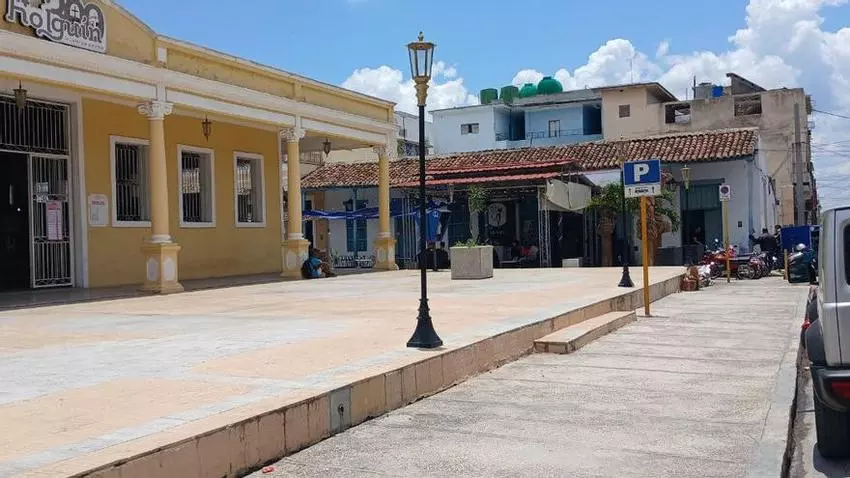
Not a single one of the traffic lights on the Havana corner was working. Blackouts have put traffic in the capital in check and crashes due to lack of coordination of vehicles are becoming more frequent. A police officer guarded the place.
When 14ymedio arrived at the scene, the almendrón, which had overturned, was a few steps from the Toyota, both empty. We were struck by the fact that the first one – with a more resistant body – was more damaged than the second, which had more safety measures in its favor. Because they lack interior padding and seat belts, almendrónes are less safe for passengers. Another danger of these vehicles are the windows, which are often not the original ones and which, upon impact, tend to crack, not fragment, so the risk of being stabbed by a broken glass increases. continue reading
Not a single one of the traffic lights on the Havana corner was functioning / 14ymedio
The official press put the number of crashes that occurred in Cuba in 2023 at 8,556, with 729 deaths and 5,938 people injured. According to information offered by the official newspaper Granma in January of this year, the irresponsibility of drivers and pedestrians caused 91% of these crashes. Other times it is the distraction of pedestrians, combined with disorientation due to the lack of traffic lights, that causes the crash.
17th and G is a dangerous corner. In March 2023, also in the middle of a blackout and without traffic lights, a white Volkswagen hit an orange Polski Fiat, which came to rest on its side on the street. The accident left two injured and, minutes later, the power was back on. This Tuesday history repeats itself, but the blackout continues.
*Translator’s note: An “almendrón” — named for its almond shape — is a classic American car, commonly in use as a fixed-route shared taxi.
____________
COLLABORATE WITH OUR WORK: The 14ymedio team is committed to practicing serious journalism that reflects Cuba’s reality in all its depth. Thank you for joining us on this long journey. We invite you to continue supporting us by becoming a member of 14ymedio now. Together we can continue transforming journalism in Cuba.
The wheat that arrived this month in Santiago de Cuba from Russia “has a high level of impurities”
“It feels like I’m chewing on ground glass,” is one of the consumers’ comments/ Facebook/Yandy Mesa Figueredo
14ymedio, Havana, 26 May 2024 — “It feels like I’m chewing ground glass,” “you can build a house with this,” “it’s sandy”… This is how hundreds of angry commentators describe the bread sold these days in Las Tunas’ rationed market. The widespread annoyance over the poor quality of the product has forced the local authorities to give an answer: the flour has “a high level of impurities” but is suitable for human consumption, they say.
“Does the bread from the bakery in Las Tunas have sand?” the local newspaper Periódico 26 inquired on its social media platforms on Saturday.
Several readers had sent their complaints to the official publication, which contacted the Food Industry’s management in the province due to the pressure. The officials’ response points to the low standards of the imported raw material.
“This May, a shipment of wheat from Russia arrived in the port of Santiago, it has a high level of impurities,” the management said.
“Does the bread from the state-owned bakery in Las Tunas have sand?” the local newspaper Periódico 26 inquired on its social media platforms on Saturday
“The technological characteristics” of the Cuban milling industry do not allow the total elimination of this residue that ends up, significantly, in the bread that the ’Tuneros’ [people from Las Tunas] put in their mouths. continue reading
“When you chew, you feel a grainy, sandy sensation,” they said in their statement to Periódico 26, although they added that “the flour is being systematically monitored in the mill’s laboratories in Santiago de Cuba; and laboratory tests in Las Tunas’ soil corroborated that it is suitable for human consumption.”
The officials’ words seem to have added yeast to the customers’ dissatisfaction, who do not conceive that a food with such poor quality is marketed. This is made with wheat from Russia “collected on the ground, a waste from the industry destined for animals,” concludes an outraged user who identifies himself as Camilo Agramonte. “It is totally disrespectful, collecting garbage from other countries and distributing it to the Cuban people,” he said to drive home his point.
Along the same lines, there are angry messages from other consumers who have already tried the product.”It is quite unpleasant to eat that bread,” says María Mercedes Peña, who recommends sending the product “to the tourist resorts” to see if the customers in those hotels want to eat the food with a texture that children reject and adults consume because “there is nothing else.”
Other Internet users describe the glossary of problems that the province is going through, such as the long blackouts, the lack of fuel that severely hampers the transport of people and goods, and “now this, bread is no longer bread,” summarizes one of those affected. “It’s better if they don’t sell anything because that bread is bad, it’s humiliating to the people.”
“It is totally disrespectful, collecting garbage from other countries and distributing it to the Cuban people,” he said.
According to Miguel Perez, this happens “because that flour is given away or was bought at animal feed prices. In sum, for us, pigs, anything is good,” an idea that is repeated throughout all the opinions that the text has generated, illustrated with an image of some buns that “do not resemble at all” the product causing the controversy, denounce the Internet users.
Neither the administrators of Periódico 26’s social media nor the managers of the Food Industry have confronted the barrage of criticism. In less than 20 hours, the publication has more than a hundred comments, none of them in support of or with any sign of understanding the sector’s authorities.
The problem seems to have no solution in the short term. The situation of the mills in Cuba is extremely precarious, according to the authorities. Last April they estimated that six million dollars were needed to maintain them. But only 23% of that amount has been secured in the last five years.
Yanet Lomba Estupiñán, Cuban Milling Company’s technical director, said on national television that the technology used is mostly European, without specifying the country – which could be Russia – and that its exploitation is already more than 20 years old. The machinery’s old age is compounded by a lack of funding, resulting in only 700 tons a day being processed, when its actual capacity is 1,000 tons.
Translated by LAR
____________
COLLABORATE WITH OUR WORK: The 14ymedio team is committed to practicing serious journalism that reflects Cuba’s reality in all its depth. Thank you for joining us on this long journey. We invite you to continue supporting us by becoming a member of 14ymedio now. Together we can continue transforming journalism in Cuba.
The spill has also caused damage to crayfish, crabs, fish and waterfowl in the area.
The photographs that accompany the article show the measure of the damage: it is not only garbage and other waste, but toxic material / Radio Sancti Spíritus
14ymedio, Havana, May 25, 2024 — Meliá Trinidad Peninsula, the hotel colossus that accounted for 60% of the construction budget for 2023 in Sancti Spíritus, has caused a significant deterioration of the province’s mangroves in just six months of activity. In a warning call published by the local radio station, the Ministry of Science, Technology and Environment denounced the “dumping of waste” from the hotel into sensitive ecosystems on the southern coast of Sancti Spíritus.
The photographs that accompany the report give the measure of the damage. It is not only garbage and other waste, but also toxic material that produces a “pestilence of contaminated water,” especially on the stretch of road that connects the town of Casilda with the southern beaches. The cause of the spill appears to be – according to ministry specialists – an obstruction in the hotel’s waste processing system.
In addition to the mangrove ecosystem in the Las Piñas area, the first affected have been Cuban “drivers and vacationers,” who cannot afford to stay at the Meliá and who, traditionally, have swam on those beaches. The Ministry says it has forwarded its complaint to the provincial delegation of Hydraulic Resources, in charge of managing the hotel’s drainage. From one official source to another, there has been no solution.
Residents in the area have expressed concern about the pestilence and have complained to the official media
“So far, the waste spill that caused damage to the mangrove ecosystem and its biodiversity has not been resolved: crabs, crayfish, fish and aquatic birds are victims of the contamination,” they lament. continue reading
Residents in the area have expressed their concern about the pestilence and have complained to the official media, a fact that – the Ministry considers – is the only “positive edge” it sees in the matter. “This confirms the knowledge acquired by citizens about the care and conservation of the environment,” they argue.
The Cuban Government, Radio Sancti Spíritus points out, has the responsibility of resolving the incident caused by the Spanish hotel company. There is, they emphasize, the plan known as Tarea Vida (Life Task) which should, by a law approved by the Council of Ministers in 2017, penalize all “negative actions of the human species against nature.”
Distancing itself from the crisis, Meliá has not commented so far on the damage caused to the Sancti Spíritus coast. Inaugurated by the Prime Minister Manuel Marrero, as a “tribute” to Trinidad for its 510 years, the Meliá Trinidad is one of the jewels in the crown of the Spanish hotel industry in Cuba. The not very optimistic data on the current tourism numbers for the Island did not prevent the hotel company managers from betting on strengthening their position on the Island.
Last December, when the hotel began to offer its services, Francisco Albertí – the financial guru of Meliá and other companies with interests on the Island – asked the Cuban authorities to give more opportunities to European companies, to have a say in the “recovery” of tourism” as “great actors.”
Sancti Spíritus has been raising the alarm for months about the general environmental deterioration of the province
The business would be great for Havana, Albertí argued, because along with the money from the hotels would come a “private investment in all the sectors that suffer: energy, supplies, food, agriculture or livestock.” “Cuba is at a time when important decisions have to be made at the tourism and country level” if it wants to “raise its head,” Albertí added.
Sancti Spíritus, for its part, has been sounding the alarm for months about the general environmental deterioration suffered by the province. The most serious case is that of the Zaza dam, the largest on the Island, which is at 13% of its capacity, according to Cubadebate. In the report that the state media dedicated to the situation of the dam there were also photos that attested to the crisis that the reservoir is going through, and not only due to the lack of water.
Several Acopio trucks open their doors, on the edge of the dam, so that the fishermen – who have launched a frantic fishing operation before Zaza completely dries up – can sell them all the fish they can catch. According to the testimonies collected by Cubadebate, it was not even necessary to cast the nets anymore. The shallow depth of the water, and the fact that there are only a few streams and areas with living beings, have made it possible to “catch the fish with your hands.”
Zaza is “dying,” lament the workers and families who depend on the reservoir for their livelihood. It is a matter of time before, there too, life underwater is exterminated, and what was once one of the cleanest provinces on the Island ends up weighed down by pollution.
____________
COLLABORATE WITH OUR WORK: The 14ymedio team is committed to practicing serious journalism that reflects Cuba’s reality in all its depth. Thank you for joining us on this long journey. We invite you to continue supporting us by becoming a member of 14ymedio now. Together we can continue transforming journalism in Cuba.
The official newspaper Escambray reveals the information in an article dedicated to the “intolerance” of the Communist Party for these cases
This is only one of 13 cases of the same type that occurred in Sancti Spíritus. / Granma
14ymedio, Madrid, May 27, 2024 — Alexis Fuentes de La Cruz, director of the Sancti Spíritus Municipal Commerce Company between May 2022 and July 2023, has been sentenced to eight years in prison for a corruption case. The news slips between the paragraphs of a text published this Monday by the official newspaper of the province, Escambray, entitled Double Discourse or the Yagruma Syndrome*. It vindicates the regime’s intolerance with this type of case – proclaimed by Miguel Díaz-Canel at the beginning of this year – whose greatest example is, they cite, the cause of the former minister of the former vice prime minister and former head of Economy and Planning, Alejandro Gil Fernández.
“There are those who—due to their double talk—suffer from what could be called ‘yagruma syndrome’, named for a plant whose leaves look two faces: dark green, on one side, and white, on the other. Incidentally, some of these pretenders have found themselves neck-deep in the mire of corruption.”
The MSME (Micro, Small, Medium-sized Enterprise) involved sold 42,000 units of a Pool brand soft drink to the group with a close expiration date. A specialist in Legal Advice and Assistance prepared a report warning of anomalies that had to be examined by the contracting and purchasing committee before carrying out the transaction, but Fuentes de La Cruz got rid of the document to avoid the loss of the 3,241,860 pesos that it would cost the company to stop selling 22,830 soft drinks. continue reading
Fuentes de La Cruz got rid of the document to avoid the loss of 3,241,860 pesos that it would cost the company to stop selling 22,830 soft drinks
In addition, he falsified two minutes of the aforementioned committee meeting notes to make it appear that the committee did meet to discuss the contract and presented the papers to the group to continue with the operation, all in order to hide his own irregularities.
The article highlights the fact that there were four of the company’s 12 units that marketed the product despite the fact that the Provincial Center for Hygiene, Epidemiology and Microbiology indicated twice that the sale should be stopped. “In other words, these establishments continued selling the soft drink at their own expense and risk,” it emphasizes.
Escambray emphasizes that this is only one of the 13 cases of the same type that occurred in Sancti Spíritus, but that this one stands out because the convicted person himself, Fuentes de la Cruz, spoke out furiously against acts of corruption close to him that occurred months before.
The newspaper, specifically, notes having reported five cases of embezzlement in company units for which they required statements from the manager. “Today we have greater internal control and greater confrontation with crime, and corruption in our units and the controls we are carrying out are comprehensive and direct, without prior warning or notification,” the manager said at that time.
“Is there anything more similar to the popular saying: do what I say and not what I do?” reproaches Escambray, who also takes the opportunity to confront Gil Fernández
The media also addressed, in an investigative report, how the lack of control in some companies facilitated corruption, in response to which Fuentes denied indolence and vindicated the work carried out by his entity.
“Will there be anything more similar to the popular saying: do what I say and not what I do?” reproaches Escambray , who also takes the opportunity to confront the recently ousted Minister of the Economy Gil Fernández, whom it accuses of being a hypocrite.
“In the face of the simulators and their double discourse – no matter the level of the position they hold – the ethics of the Revolution are erected, exemplified in two paradigms: Fidel and Che,” declares the article.
____________
COLLABORATE WITH OUR WORK: The 14ymedio team is committed to practicing serious journalism that reflects Cuba’s reality in all its depth. Thank you for joining us on this long journey. We invite you to continue supporting us by becoming a member of 14ymedio now. Together we can continue transforming journalism in Cuba.
The “virtual line” was more scary than the real ones: 7,362 people were waiting for a turn to buy the 100 dollars allowed by the authorities
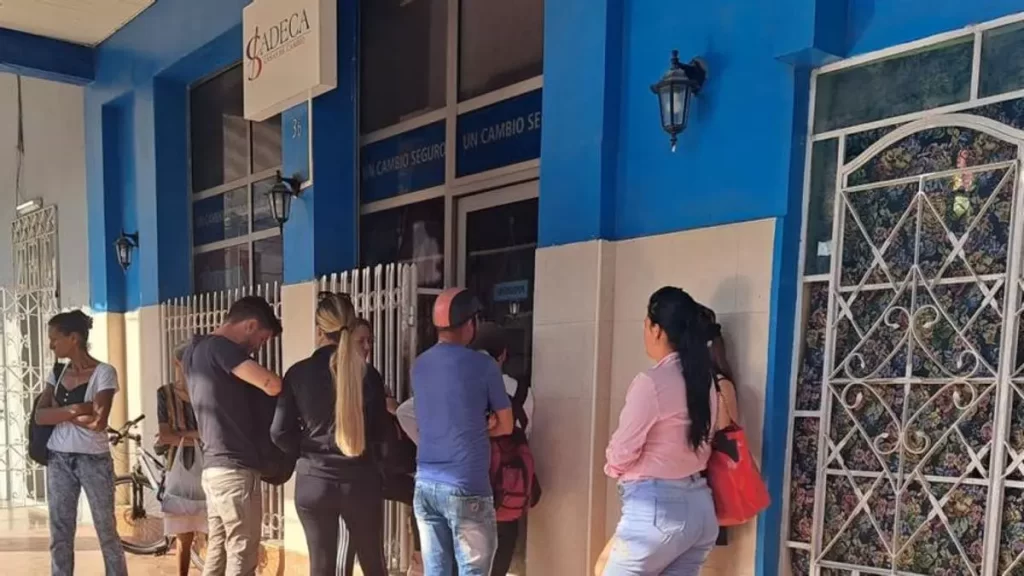
Camajuaní Cadeca (Currency Exchange) / 14ymedio
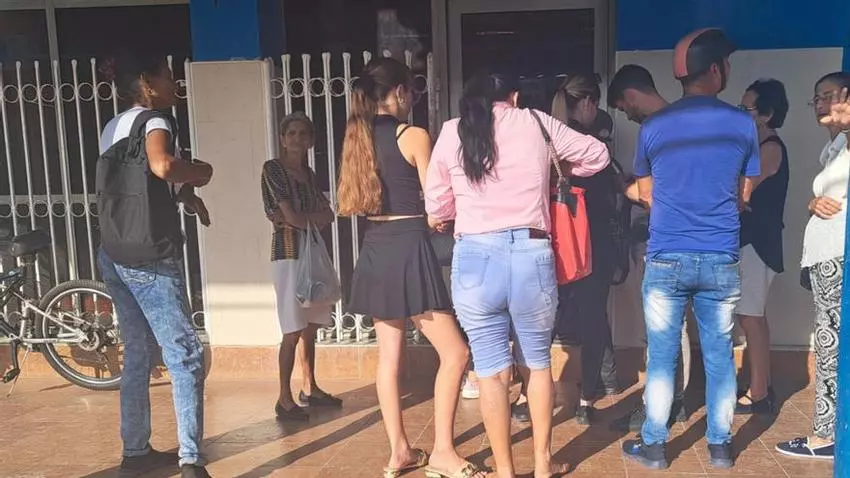
14ymedio, Yankiel Gutiérrez Faife, Camajuaní (Villa Clara), 26 May 2024 — Painted bright blue and with a white grill, the Camajuaní Cadeca (Currency Exchange) is one of the high points of the “boulevard,” the two blocks where almost all the town’s commerce takes place. With only two counter positions and a small office, the dollars that those waiting in line on the side of the building so desperately desire come out of their vault – in dribs and drabs.
Nine months ago, in July 2023, Osmany, 24, and five other family members signed up on the Cadeca waiting list organized by the official Ticket application. The “virtual line” was more frightening than the real ones: 7,362 people were waiting for a turn to buy the 100 dollars allowed by the authorities.
“My intention was to use these dollars on a shopping trip to Caracas, but the wait lasted longer than expected and I decided to make my trip earlier, in February of this year,” Osmany tells 14ymedio. He adds that only upon returning from Venezuela did he receive the news that he had been “lucky” to get one of the 25 daily ‘turns’ for the Cadeca.
The Camajuaní Cadeca (Currency Exchange) is one of the high points of the “boulevard” / 14ymedio
To get to the Cadeca he had to cancel a trip to Havana. Nothing could come between him and the “opportunity,” he says. After juggling – and passing through the Ticket line again, but this time for a bus ticket – he was able to reorganize his agenda, get up early and go to the “boulevard.” continue reading
On May 16, at 8:00 in the morning, around thirty people were already loitering around the Cadeca. At first glance one could distinguish those who came to solve a specific problem and those who were lining up for business. In a small town like Camajuaní, where everyone knows each other, it is already well defined who each neighborhood’s ‘colero’ — that is the ’professional place-in-line holder’ — who goes to the “boulevard” with the same punctuality as the state workers.
Osmany found “elders waiting to cash their squalid check; people waiting to deposit and withdraw cash from their magnetic cards” and young people like him, eager to “get the dollars.”
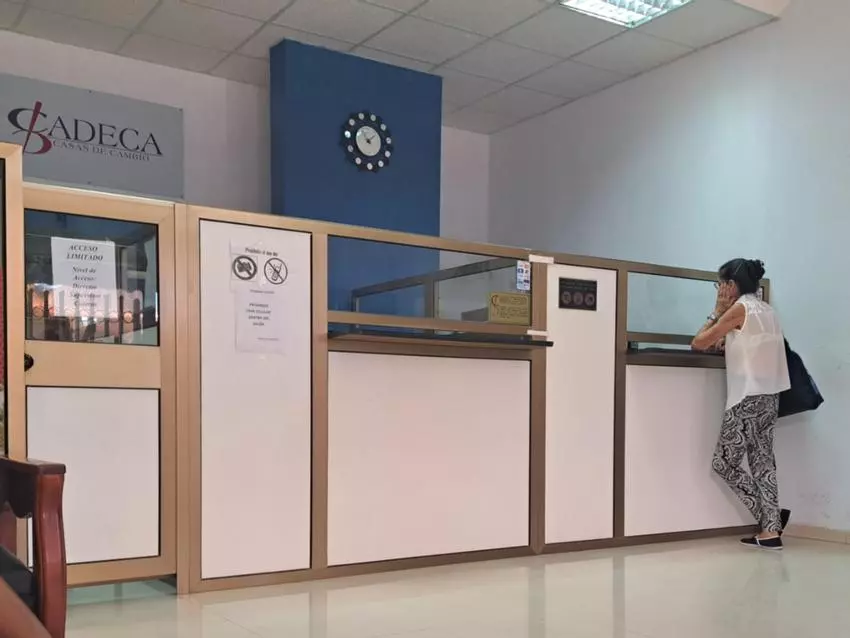
The space at the Cadeca was minimal. A couple of seats, the counter positions, a clock and a sign with a warning: “it is prohibited to use cell phones inside the room.” “Only one counter position served those present and my number was 32,” recalls Osmany.
At eleven in the morning the inevitable happened. A blackout in Santa Clara affected the transaction system and paralyzed the connection. With a grim face, the cashier explained the situation to the members of the line.
After a few moments that Osmany describes as “of confusion and chaos” – as people began to get nervous – the clients began to be served one by one, much more calmly. Finally it was his turn. “I received 50 dollars in cash and another 50 in freely convertible currency, MLC. For this I paid 12,360 Cuban pesos,” he calculates, relieved.
The space at Cadeca was minimal. A couple of seats, the service desks, a clock and a sign with a warning: “it is prohibited to use cell phones inside the room” / 14ymedio
Located between Caibarién and Santa Clara – the two points marking the tourism center of in Villa Clara – Camajuaní has always benefited from that intermediate position. In the town, known for being the mecca of footwear on the Island and for the mansions that the shoemakers have built, the dollar is not lacking. It is also a fixed point of Cuban President Miguel Díaz-Canel’s visits to Villa Clara. There he has, as in neighboring Placetas, family and businesspeople who are related to him.
The possibility of traveling to Venezuela or other nearby countries to buy clothes and other products to resell on the Island is a growing business among Camajuaní residents. Last month 14ymedio reported on the story of María, a 42-year-old mule who maintains a store on the “boulevard” – bringing clothes, shoes and perfumes to Cuba and carrying rum, tobacco and wines to other destinations.
After going once to Guyana, twice to Russia, three times to Peru and twice to Colombia, this year she left, like Osmany, for Venezuela. After the trip, they both came to the same conclusion: the dollar, that poderoso caballero — powerful gentleman — is the language that is best understood on the streets of Camajuaní as well as Caracas.
____________
COLLABORATE WITH OUR WORK: The 14ymedio team is committed to practicing serious journalism that reflects Cuba’s reality in all its depth. Thank you for joining us on this long journey. We invite you to continue supporting us by becoming a member of 14ymedio now. Together we can continue transforming journalism in Cuba.
The tricycle served as a police “patrol car,” with its luminous turret and its white and blue colors.
A Rali brand tricycle slowly makes its way along Infanta Street in Central Havana / 14ymedio
14ymedio, Juan Diego Rodríguez, Havana, 23 May 2024 — “Just one kick and you can knock them over” observe two handsome young men at a bus stop on Thursday. They are talking about a Rali brand tricycle that is slowly making its way along Infanta Street in Central Havana. What is striking in this case is that the tiny vehicle is operating as a police patrol car, outfitted with the customary blue turret-shaped lights on top.
A woman selling cigars at a nearby covered walkway joins in, joking, “Now even the cop cars can’t get fuel. Next thing you know, they’ll be using chivichanas* to get around.”
“Have you noticed, there’s no gasoline and no electricity for anyone except the police?”
If Cubans thought the previous vehicles looked like aspirin tablets, this new version more closely resembles half a pill, or maybe just a quarter of one. A prescription to treat the growing sense insecurity locals feel on the island’s city streets.
Awhile back, local police officers were issued electric scooters, which they used to patrol the Malecón and nearby streets such as San Lázaro and Carlos III. But no one paid them any notice until these unusual tricycles suddenly appeared.
“Do you realize there’s no gasoline and no electricity for anyone except the police,”observes the same vendor.
*Translator’s note: A chivichana — a kind of skateboard — is a wooden board mounted on four wheels, with an operable front axle, used by children to slide down hilly streets.
continue reading
____________
COLLABORATE WITH OUR WORK: The 14ymedio team is committed to practicing serious journalism that reflects Cuba’s reality in all its depth. Thank you for joining us on this long journey. We invite you to continue supporting us by becoming a member of 14ymedio now. Together we can continue transforming journalism in Cuba.
In the so-called “market alley” there are, from Mártires to Gómez, Rhino’s Bar, Benjuly, Gato Negro and Destellos Café, all private
Drinking something in the bars of La Marqueta is a kind of rite of passage or “password” to close the deal / 14ymedio
14ymedio, Miguel García, Holguín, May 18, 2024 — Mártires Street and three avenues named after heroes – Martí, Máximo Gómez and Luz y Caballero – frame the brand new red light district of Holguín, Cuba: Plaza de la Marqueta. In the old colonial market, restored several years ago, coming together are the prostitutes, their clients, local millionaires, scammers of various kinds and several yarinis* — named in honor of the mythical Havana pimp — who do not lose sight of their employees.
A decade ago, the tenants of the square – the center of Holguín life in Republican times – were very different. “Beggars who urinated and defecated,” recalls Heriberto, an employee in one of the bars that Marqueta enjoys today, taking advantage of the abandonment and ruin. The change from a homeless shelter to a brothel does not seem to have been too radical, he believes.
In the past there were shops, inns, butcher shops and fishmongers in La Marqueta. Now, however, the cartography of the square is made up almost exclusively of “upscale” bars and restaurants, at whose tables no one sits without knowing what’s happening. “They,” says Heriberto, referring to the prostitutes – who “are always groomed and well dressed” – “make their clients sit in a bar and consume.”
The cartography of the square is made up almost exclusively of “upscale” bars and restaurants
The price, depending on the services requested by the client, ranges between 3,000 and 5,000 pesos. Having a drink at the bar, explains Heriberto, is a kind of rite of passage or “password” to close the deal. “I don’t know if the owners of the establishments have any business with the yarinis, but that’s always the case,” he adds. continue reading
The Police know it, of course. From the red light districts of Havana – the same ones that made Alberto Yarini famous — his wars with rival pimps cost him his life in 1912 – to those of Santiago or Camagüey, passing through the nooks and crannies of El Condado Santa Clara, the Police always know and don’t get involved. “It’s a complicated territory,” says Heriberto, and not only because everything happens in bright sunlight and in a busy place, but because prostitution is just the tip of the crime iceberg.
Marijuana growers and their traffickers also visit La Marqueta, each with their own well-defined signs and rates; the cardholders, who know the techniques to steal currency from the MLC (freely convertible currency) cards of absent-minded or drunk clients; businessmen who prefer to discuss their sales with a beer in hand; and, from time to time, a train of tourists, who approach the chairs and bars without the slightest suspicion of what is taking place there.
Everything happens in bright sunlight and in a crowded place. Prostitution is just the tip of the crime iceberg / 14ymedio
Drinks and a Cuban version of tapas, that is the food available at the “little tables” of La Marqueta. In the so-called “market alley” – the backbone of the square – from Mártires to Gómez, there are Rhino’s Bar, Benjuly, Gato Negro and Destellos Café. They are all, says Heriberto, managed by private parties.
Each one has a group of burly guards, who take turns guarding the area around the square. Security is essential, as several businesses in Havana have demonstrated, exposed not only to problematic customers but also to “ninja” children, who steal to survive. Sometimes business gets out of control and a fight breaks out. “There haven’t been many fights, but what there was was loud and the ’boys’ had to intervene,” says Heriberto. Bosses do not like to be caught off guard by conflict and that is why they have constant surveillance. “Some have up to five guards working,” he says.
About the owner of Benjuly, Julio César Paredes – a “young and enterprising owner,” according to his website – there is a rumor: his alleged friendship with Lis Cuesta, wife of Miguel Díaz-Canel, who is attributed to being a “godmother,” or owner of the bar. This protection is what keeps its operation free of obstacles, assumes Heriberto, who assures that the same protection as above exists at the Bodegón Holguín, a business located on the Central Highway.
What started here has already spread to other areas, such as Pueblo Nuevo, and cases of drug sales have been detected
What started here has already spread to other areas, such as Pueblo Nuevo, and cases of drug sales and “strange” businesses have been detected in two high schools: Alberto Sosa and José Miró Argenter. But the center of the hurricane remains the square.
When the sun goes down and the city streets are not so hot, the young people of Holguín also go to Marqueta. Dressed up and careful not to invade other people’s territory, the prostitutes take their seats. The yarini sip their drinks and the card holders go into action. Cornered and trying to be discreet, the addicts begin to light their cigarettes. “The only thing missing is for El Químico** — the chemical — to arrive,” laments Heriberto, alluding to the fashionable drug in Havana. “It’s just a matter of time.”
Translator’s notes: *Yarini: Alberto Yarini, Cuba’s most famous pimp, was murdered in 1910, and has featured in novels, films and song. **El Químico: A very cheap drug, marijuana- or synthetic marijuana-based and laced with other substances. See here.
____________
COLLABORATE WITH OUR WORK: The 14ymedio team is committed to practicing serious journalism that reflects Cuba’s reality in all its depth. Thank you for joining us on this long journey. We invite you to continue supporting us by becoming a member of 14ymedio now. Together we can continue transforming journalism in Cuba.
Misery is part of the tourist experience, although the travel agencies promote it as “cultural immersion,” and they are not wrong
A vendor offers, on a tray, three lobsters in the Havana market on 19th and B /14ymedio
14ymedio, Juan Diego Rodríguez, Havana, 16 May 2024 — “Look what I brought,” says one seller to another, jokingly, this Tuesday at the Havana market at 19th and B, in El Vedado. In his hands he carries – a true extinct species from the Cuban table – three lobsters with fat tails, orange tails, like the rust of the tray that carries them.
As mythological as the lobster, whose capture this year is now prohibited until June, a group of young tourists – Canadians, Americans, English? – takes a tour of the market. Very white, blonde and with red cheeks, of that tone that the sun and the “historical proteins” put on the visitors’ faces, the kids take photos of everything they see.
Misery is part of their tourist experience, although travel agencies promote it as a “cultural immersion,” and they are not wrong. For telephones, modern and minimalist, dwarf onions, rancid chili peppers, outdated guavas and stinking meat, to which the butcher’s ancient fan does no favors, pose.
The kids look around restlessly and it seems to them that they are visiting a poor camp in Africa, a refuge after the war, an orphanage in Vietnam / 14ymedio
They also find the empty shelves, the hospital green walls, the heat of the tropics and the sweaty salespeople who approach them in search of purchases “in hard currency.” The kids look around restlessly and it continue reading
seems to them that they are visiting a poor camp in Africa, a refuge after the war, an orphanage in Vietnam. They prefer not to be touched and to everything – what they understand and what they don’t – they respond with a pitying smile.
Vendors and tourists do, however, have one thing in common. They recognize in the food market, contradictorily, the stench of hunger. Hot, they press their backpacks against their bodies and leave. For Cuban merchants, toasted and sticky, they leave only the desired and unmistakable “smell of yuma*.”
*Translator’s note: “Yuma,” previously used to refer to Americans, now applies to foreigners from any non-Spanish speaking country. ’La Yuma” refers to the United States.
____________
COLLABORATE WITH OUR WORK: The 14ymedio team is committed to practicing serious journalism that reflects Cuba’s reality in all its depth. Thank you for joining us on this long journey. We invite you to continue supporting us by becoming a member of 14ymedio now. Together we can continue transforming journalism in Cuba.
Cuban migrants will have the ability to become legal citizens in Uruguay and obtain documentation
Two Cuban women show the refugee application documents processed in Uruguay / El País
EFE/14ymedio, Montevideo, 17 May 2024 — The Residency by Rootedness program created by the Government of Uruguay will regularize the situation of some 20,000 migrants – the majority of whom were born in Cuba – who will be able to obtain residency.
This was explained this Thursday during a press conference by Uruguay’s Foreign Minister, Omar Paganini, who indicated that this mechanism will allow these people to abandon an irregular situation and have the possibility of becoming legal citizens and obtaining documentation.
“This allows us to resolve the issue of family reunification of these people, which is one of the very important issues from the point of view of their rights. So we believe that it is very good news for an important group in our country, that was waiting for procedures in the Refugee Commission, but that they were procedures that could not be favorable to the extent that they do not meet the conditions of political refuge,” he noted.
“This allows us to resolve the issue of family reunification of these people, which is one of the very important issues from the point of view of their rights
Paganini explained that this will solve the situation of some 20,000 people who need a visa to enter Uruguay and who did so without having one under the category of refugees. continue reading
“This above all has to do with people who request refuge because they do not have a visa and are not eligible for refuge. So basically we are talking about people of Cuban origin or from other countries for which a visa is required,” he said.
And he added: “They enter as refugees but they are not refugees and that is where this regulatory limbo is generated, which is what allows us to resolve the decree,” said the minister, who added that the majority of these are Cubans.
On the other hand, he explained that in order to process residency through rootedness, people must be working, housed or must have family in Uruguay.
Finally, the head of the portfolio stressed that this is a temporary solution for all the people who have already started the process, and that how the process continues and the steps to follow will then be evaluated.
“For now it is not a definitive solution, therefore it is not ‘come on, this works automatically’,” Paganini concluded.
Last April it emerged in the Uruguayan press that more than 7,000 Cubans who requested refuge in the country in 2023 remained “in limbo” because the system to address them is “suffocated,” according to the newspaper El Observador. The Ministry of Foreign Affairs then said that the country ended that year with 24,193 accumulated applications.
“For now it is not a definitive solution, therefore it is not ‘come on, this works automatically’
The same newspaper reiterated that Uruguay had no intention “of deporting undocumented immigrants, much less accumulating irregular inhabitants,” with the consequent problems that would arise from this, so Montevideo was rushing to find a solution.
A year earlier, Alberto Gianotti, from the Migrant Support Network, had warned that between 9,000 and 10,000 Cuban nationals had to apply for a visa to maintain their legal status in the South American country.
between9abd10-
Since the president of the United States, Barack Obama, ended the wet foot/dry foot policy in that country in 2017, Cubans have found an alternative route in Uruguay, which begins in Guyana, the only South American country that does not require a visa. From there they make a journey through Brazil where they have to resort to coyotes until they reach Uruguay, where they ask for refuge.
____________
COLLABORATE WITH OUR WORK: The 14ymedio team is committed to practicing serious journalism that reflects Cuba’s reality in all its depth. Thank you for joining us on this long journey. We invite you to continue supporting us by becoming a member of 14ymedio now. Together we can continue transforming journalism in Cuba.
Memories of the streets of Cuba in the 1950s / Nostalgia Cuba
14ymedio, Pedro Corzo, Miami, May 26, 2024 — Cuba was not a paradise. It never was, but it was one of the countries with the best social and economic indexes in all of Latin America.
There were numerous problems, but more had been resolved than remained, although from my perspective, the military coup of March 10, 1952, which broke the constitutional rhythm, led to an imbalance that seriously affected the nation and facilitated the emergence of the totalitarianism in our country.
It is true that the 1940 Constitution had been reestablished in 1955. However, the political climate and coexistence were not the same again despite economic progress.
In the period prior to the triumph of the insurrection, the economic and social situation was in a clear process of improvement. So much so that Dr. Salvador Villa, in his book Cuba, Zenith and Eclipse, states: “many of us ourselves were unaware of the extent of the degree of development achieved compared to the rest of Latin America and the world and it is necessary to know and remember it,” with pride, to feel more Cuban. continue reading
We had broad economic freedoms and notable social mobility. Foreign investments were important and labor legislation was significantly positive, although it was not fully complied with.
The Constitution of 1940, a charter drawn up in a public assembly by all the country’s political forces, including the communists, established the division of public powers and their independence, along with social and economic prerogatives much more advanced than most other legislations of the hemisphere.
Minimum wages were set by joint commissions of employers and workers. It was prohibited to deduct workers’ wages or salaries; workers’ stipend had to be paid in money, not goods; social insurance was compulsry, including disability and old age; right to retirement was based on seniority and a pension was due until death; and Cuba was the first country in the world to grant this right to agricultural workers.
Eight-hour work days, six-hour for those between 14 and 18 years of age. Paid rest of one month for 11 months of work; protection for workers’ maternity, with forced rest and payment of wages to pregnant women six weeks before childbirth and six weeks after.
Freedom of unionization and membership; right to strike, collective labor contracting, mandatory for employers and workers. Labor immobility, obligation of the State to build cheap housing for workers and social assistance by the Ministry of Health.
Villa points out, with information gleaned from, among other sources, United Nations yearbooks, that the average salary of the Cuban agricultural worker was the seventh in the world and the second in America, and the industrial salary was the second on the continent.
We cannot affirm that these provisions in the national Constitution were fully complied with throughout the country, but they were in broad sectors of productive life.
Education was a constant concern of the Governments of the Republic. The Constitution established that it was mandatory until the sixth grade and free until the eighth. Vocational schools were free. Tuition at State universities was 50 pesos, with free registration included.
On the Island, private, religious or secular education could be provided, governed by the standards of Public Education. There were 10,600 primary educational centers in the country, of which 8,900 were public; There were 14 Normal Schools for teachers and the same number of Commerce Schools and 21 Secondary Education Institutes, not counting the private ones, in addition, schools of Journalism, Fine Arts, Agriculture and Technology.
In 1958, we had 12 universities, three of which were public, and all enjoyed full autonomy.
Unfortunately, only 77.9 percent of Cubans knew how to read and write. However, Cuba occupied the third position in literacy in Latin America, after Argentina and Uruguay.
Health was superior to other countries on our continent. Infant mortality was the lowest in all of Latin America, 37.6 per thousand, and general mortality was one of the lowest in the world, 5.8 per thousand inhabitants.
The economy showed signs of constant strength and growth, as evidenced by the national financial system, which was made up of specialized banks including, among others, the Agricultural and Industrial Development Bank, Foreign Trade, Economic and Social Development, the National Financial Institution and the Fund of Insured Mortgages.
I do not want to exhaust you with figures, but only these facts and the current devastation can testify to the Republic that we Cubans lost.
____________
COLLABORATE WITH OUR WORK: The 14ymedio team is committed to practicing serious journalism that reflects Cuba’s reality in all its depth. Thank you for joining us on this long journey. We invite you to continue supporting us by becoming a member of 14ymedio now. Together we can continue transforming journalism in Cuba.
As is known, the spontaneity of that feat, which was its great merit, was also its Achilles heel
The arrest of one of the protesters on July 11, 2021 in Havana / Marcos Évora
14ymedio, Reinaldo Escobar, Havana, 26 May 2024 — One way to evaluate the time that has passed is to inventory the achievements; another, to list the outstanding issues.
It is the responsibility of the press to point out faults, demand compliance with what was scheduled and also denounce the unfeasibility of what was promised.
These days, as our newspaper, 14ymedio, celebrates its first decade of existence, I have set myself the unpleasant task of relating everything that has not happened in Cuba yet. I’ve limited the list to ten, just to play with our birthday.
The salary that Cuba’s workers earn has failed to become the most important form of support for families.
The rationing system, instead of becoming a way to subsidize people, has extended its tentacles of control and limitations to other goods that were previously unrationed.
The salary that Cuba’s workers earn has failed to become the most important form of support for families
The mythical little glass of milk, promised in 2007, not only remains out of reach of consumers, but has become even further removed, along with other products previously considered accessible and popular.
The promise of guaranteeing decent housing for families continues to be a populist formula that is impossible to carry out under the current mode of production.
The criminalization of political dissent, far from decreasing, has been implemented in a penal code that criminalizes all dissent.
In all this time there has not been a single amnesty that benefits political prisoners.
Economic reforms remain timid and insufficient, and policies absent.
We Cubans are still obliged to return to the country before 24 continuous months have passed, under penalty of losing our resident status. Those who have transgressed this limitation still need a permit to enter the national territory. That elimination of the exit permit has been reintroduced selectively with travel bans on those who are arbitrarily “regulated” (the regime’s term for “forbidden to travel”). To make matters worse, a new arbitrariness has been introduced, which prevents the return of those who “behave badly” abroad even if they have not exceeded the 24-month limit.
Cubans are still obliged to return to the country before 24 continuous months have passed, under penalty of losing our status as residents
The new Agrarian Reform that grants land ownership is still pending. Both by omission of reforms and by reiteration of unnecessary and abusive control measures, Cuban agriculture has not taken a significant step, not even mentionable, in all these years towards the purpose of guaranteeing the food of its citizens.
Everything inventoried up to this point is the result of the deficiencies of those in power in Cuba and the defects inherent to the imposed system. If, by a miracle all these shortcomings disappeared, the dissatisfaction of citizens would remain the same because the essentials would still need to be changed.
It seems logical to warn that the people of Cuba are the ones who have a big pending issue. What happened on 11 July 2021 can be considered as an entrance test to the civic consciousness of recognizing oneself as the protagonist of history. As is known, the spontaneity of that feat, which was its great merit, was also its Achilles heel.
The independent press does not have it easy.
____________
COLLABORATE WITH OUR WORK: The 14ymedio team is committed to practicing serious journalism that reflects Cuba’s reality in all its depth. Thank you for joining us on this long journey. We invite you to continue supporting us by becoming a member of 14ymedio now. Together we can continue transforming journalism in Cuba.
To reach our pages from Cuba readers must overcome censorship and technological difficulties
A reader informing himself about events on the Island through ’14ymedio’ / 14ymedio
14ymedio, Havana, 26 May 2024 — Capable, on many occasions, of carrying out fierce debates at the bottom of our notes, the readers of 14ymedio have also congratulated this newspaper on its tenth anniversary. To reach our pages from Cuba they must overcome censorship and technological difficulties. For those who live abroad, it is a way to stay connected with the day-to-day life of the country they left behind.
Reader and commenter Alfredo David Zayas knows this well, and considers the newspaper’s work “a technological feat” as well as a journalistic one. “14ymedio is one of the very few truthful sources of information about Cuba and, furthermore, it is amazing what they can publish while in Havana,” he says.
Making a free press on the Island is “increasingly more difficult,” says user Ale, 65, a member of the Communist Party until he woke up from his “lethargy” reading independent newspapers, he says. “I wouldn’t miss a Cafecito Informativo for anything in the world,” he says. “I am convinced that their work is transparent, with the greatest interest in keeping us well informed. It can be said that they are almost war reporters, since they risk everything for their work.” continue reading
Making a free press on the Island is “increasingly more difficult,” says user Ale, 65, a member of the Communist Party until he woke up from his “lethargy” reading independent newspapers
From West Palm Beach, Florida, user Alberto Pérez reads 14ymedio, and is grateful that the newspaper offers the immigrant community in the United States “truthfulness, first-hand information and impartiality.” While Eduardo Sotelo considers that “it is necessary for everyone on the Island to read it” although “the dictatorship does not like that” nor does the government newspaper Granma, he emphasizes, whose press model is the complete opposite of the work of this newspaper.
It would not hurt the official press and the Cuban leaders – says the user Gatovolador, the reader with the most comments on our newspaper – to consult the news from 14ymedio from time to time. “If you read it you can learn a lot, and putting into practice everything that is said in it, perhaps this way you can get out of the total catastrophe that is upon you,” he emphasizes.
“Thank you for allowing me to give my opinion all this time,” says Cacique – another of our regular commentators – who has been proud to read the newspaper since 2020. The coverage of an event marked him: the explosion of the Saratoga hotel in Havana. Also loyal “since the Generation Y blog began” is the user Calamar, who congratulates the newspaper for “so many years of uncensored news.”
“They cannot give any more than what they give: continue accompanying the Cubans who are waiting for freedom from Cuba and those who are waiting for it in many other cities on the planet,” celebrates Laura Tedesco. “They have provided an example of perseverance, courage and professionalism; a critical and honest look; information in a country full of lies and inspiring many journalists in dictatorial contexts,” adds the co-director of the Dialogues about Cuba project and vice dean of Humanities and Social Sciences at the Saint Louis University-Madrid Campus.
For academic Ted Henken, professor of Sociology at Baruch College in New York, 14ymedio is “a constant source of information on current Cuba, reported with professionalism and passion, not easy in the polarized Cuban context.” In his teaching work, he has used our articles on multiple occasions as a means “to closely follow what is happening on the Island with the independent civil society and the increasingly weak, desperate and illegitimate Government.”
The writer José Prats Sariol, for his part, believes that “courage and self-confidence have accompanied 14ymedio since its foundation, without believing themselves to be owners of the truth, but rather of intelligent, plural dialogue.”
The commenter Medinavi appreciates “courage and perseverance to keep citizens who want to think informed.” He agrees that it is a “challenge” to work under a regime like the Cuban one, since it means bearing witness to a “dystopia” that began in 1959. The newspaper rescues “the culture of good thinking, promoting tolerance and laying the foundations for a not-too-distant political change.”
The newspaper rescues “the culture of good thinking, promoting tolerance and laying the foundations for a not-too-distant political change”
It is precisely the “decent language” – in every sense of the word – that commenter Gusano de Corazón praises, defining the work of 14ymedio as a contribution “with the truth.” Maintaining a newspaper in Cuba has everything to do with the defense of “civility and democratic values” and culture, argues Eduardo Sintes, who describes those who collaborate with the newspaper as people “full of love for Cuba and for the highest ideals of freedom.”
When ten years have passed since this anniversary – commenter Aesop hopes from Sao Paulo, Brazil – that 14ymedio will be read on the Island without the Government blocking it. “A couple of years ago,” he says, “on one occasion when Cuba was in the news in Brazil, a great journalist and commentator from TV Globo News said: ‘Since there is no credible information about Cuba, I had to get information from 14ymedio, the newspaper of Yoani Sánchez that is published in Havana’. She is the only one worthy of credibility on the Island.”
Readers of 14ymedio believe that, after a decade, the newspaper has become “an open window to the reality of Cuba.” Aside from the notes and reports, starring in multiple controversies and closely observing the work of the Editorial Team, they also have the satisfaction that, along with the best wishes, expresses the message: “Ten years already. Thank you so much.”
____________
COLLABORATE WITH OUR WORK: The 14ymedio team is committed to practicing serious journalism that reflects Cuba’s reality in all its depth. Thank you for joining us on this long journey. We invite you to continue supporting us by becoming a member of 14ymedio now. Together we can continue transforming journalism in Cuba.
The walls and a part of the roof of the Calixto García stadium “are peeling off” / 14ymedio
14ymedio, Miguel García, Holguín, 15 May 2024 — The lack of maintenance and deterioration are the last blow for the Calixto García stadium, home of the Holguín baseball team. According to a source in the city, its walls “are peeling off ” and the authorities have prevented the fans from sitting near the areas where the collapse is imminent.
“The scaffolding of the towers on the left side has been declared in a state of collapse,” the official journalist Ernesto A Jomarron Cardoza denounced on Tuesday on the Facebook account ’Somos los Cachorros de Holguín’.
The communicator noticed the problem because the traditional third-base stands were empty during the match between Holguín and Artemisa. “The doors on the left side were kept closed and they are going to stay that way.”He lamented the lack of maintenance of the stadium’s towers, founded in 1979 and considered by Fidel Castro as an “architectural jewel”. continue reading
One of the Calixto García stadium’s entrances exhibits a lack of maintenance / 14ymedio
“As something never seen before, the team will play without an audience above its dugout (the area where players wait for their turn during the game),” said Cardoza.
What is even more outrageous is that last March, days before the voice of “play ball” was heard to start the National Series, the National Baseball Commission (CNB -Spanish acronym) detected “serious problems” in some fields.
During a tour of the provinces, the officials identified that in several stadiums maintenance was required on the “mound, lawn, benches, changing rooms and bathrooms”. They also mentioned that “clay was needed to work the field; they also needed to raise the pitching mound, center the home plate, water the lawn more to make it growth and finish the mowing”.
One of the stadiums was Calixto García. The national baseball commissioner, Juan Reinaldo Pérez Pardo, supervised the building and detected the “need for conditioning the bases and the home plate,” the pro-government newspaper ’¡Ahora!’ published at the time.
At that time they did not notice any damage or cracks in the roof, which have forced the closure of the towers on the left side.
The traditional Calixto García stadium third-base stands side was empty during the match between Holguín and Artemisa / Facebook/’Arriba los Cachorros de Holguín’
The sports authorities’ neglect of the stadiums has also occurred in the buildings for the practice of soccer. Last January, 14ymedio denounced the state of oblivion which the Pedro Marrero stadium has fallen into. The colossus located in Havana’s municipality of Playa has turned into “grazing land,” a track and field coach lamented. The deterioration is visible: the grass is worn out and the track is full of potholes.
This stadium has not received any of the eight million dollars the International Federation of Football Association (FIFA) gave to Cuba between 2016 and 2022 to improve its sports facilities. However, the property did receive money for its renovation, stressed Ariel Maceo Téllez. Unfortunately, it is still just as bad.
Another abandoned colossus is the Pan American Stadium in Havana. The sports complex built by Fidel Castro in 1991 is in decline. The lack of maintenance together with the poor quality of the construction materials that were used for its construction and its proximity to the coast has caused the salt residue from the seawater to wear down its structure.
Translated by LAR
____________
COLLABORATE WITH OUR WORK: The 14ymedio team is committed to practicing serious journalism that reflects Cuba’s reality in all its depth. Thank you for joining us on this long journey. We invite you to continue supporting us by becoming a member of 14ymedio now. Together we can continue transforming journalism in Cuba.
Making a newspaper is not easy at all. Doing it from Cuba is even more complicated
Mario J Pentón working in Miami in 2017 / Courtesy
14ymedio, Mario J. Pentón, Miami, May 23, 2024 — The first time I heard about Yoani Sánchez was on the midday news on Cuban television. Mariuska Díaz, the announcer, called her a “cyberterrorist” and an enemy of the country. Dark hands were writing on a keyboard and behind her appeared the American eagle, dollars and what was then United States Interests Section in Havana.
By then I could already understand that the regime wanted to hide something when that woman, who was exposed on official television, was not allowed to defend herself or offer her point of view. And one of my first searches, on the day I was finally able to access the internet, was the name Yoani Sánchez.
Mariuska, by the way, that firm defender of Castroism who read those pamphlets, went to live under brutal capitalism, first in Mexico and then in Spain.
That is how I met 14ymedio, Yoani’s niño pequeño, this newspaper that is now 10 years old. And that is how I decided to collaborate with it. At first with a lot of fear, like all Cubans born and raised under the totalitarian regime. Later with passion and dedication, so that the people of Cuba would be more informed.
My first texts in ’14ymedio’ were a real labor and delivery. Years of study in Cuban universities do not teach you how to do journalism
My first texts in 14ymedio were a real labor and delivery. Years of study in Cuban universities do not teach you how to do journalism, but the sustained support of the editors of the 14ymedio Newsroom in Madrid allowed me to correct those deficiencies. continue reading
Trying to connect with people, tell their stories, talk about what really matters to people is not something that interests the Communist Party. Their interest is propaganda, defending a model that is falling apart and repeating the ‘guidelines’. At 14ymedio I had the opportunity to create and grow.
In my years working at 14ymedio I documented Cuba’s serious immigration crisis. I remember, by the way, the annual figures of Cubans arriving across the border into the United States that were so scandalous at the time, today are the equivalent of the statistics of a single month.
I had the opportunity to interview hundreds of immigrants and recount the dramas of the exodus: the young Cuban woman raped and murdered in Urabá, Colombia. Her traveling companion who financed the trip with the sale of his mother’s house. The departure of Cardinal Jaime Ortega and the arrival of a new head in the Cuban Church. The oil spill in Cienfuegos Bay and its pollution while the authorities hid information… The plane crash in Havana that left 112 dead and the disastrous way in which the regime managed the catastrophe.
They were years very rich in information and work. Fidel Castro died and it was my turn – after receiving Yoani’s call from Havana – to write the first obituary and choose the photograph that would accompany the text. The wet-foot-dry-foot policy ended and with it the thaw of former President Barack Obama. We were one of the first media to break the news.
Making a newspaper is not easy at all. Doing it from Cuba is even more complicated. The connection difficulties, the arrests, the very harsh conditions in which our collaborators work in Cuba, with threats to them and even their families by State Security agents, make the work of 14ymedio even more valuable.
Those who know me know that I am very impatient. I always wanted 14ymedio to get to the news first. I remember with special affection the way in which Yoani Sánchez and Reinaldo Escobar “pulled my ears” for wanting to publish the headline and some paragraphs while we were still giving substance to the note.
“The important thing is not just to arrive first. It means doing it well,” Yoani told me. Those words have always marked me
“The important thing is not just to arrive first. It means doing it well,” Yoani told me. Those words have always marked me in my work as a journalist.
It was the years of work and experience at 14ymedio that led me to be offered a position as a journalist at el Nuevo Herald, and then on television and radio. Without what I learned at 14ymedio, the work I do today on my networks, specifically so that millions of Cubans are informed, would not be justified.
When I remember my years of work at the first independent newspaper made from Cuba, I do so with great affection, as someone who treasures a precious memory. Thank you, 14ymedio, for making me grow as a person and as a society. Thank you for teaching us that journalism can be done from Cuba.
____________
COLLABORATE WITH OUR WORK: The 14ymedio team is committed to practicing serious journalism that reflects Cuba’s reality in all its depth. Thank you for joining us on this long journey. We invite you to continue supporting us by becoming a member of 14ymedio now. Together we can continue transforming journalism in Cuba.
More and more Cubans have the possibility of accessing the independent press, which has seen unprecedented development in the last decade
Internet access allowed people to choose the press they read and be aware of the support they receive from Cuban civil society abroad / Cubadebate
14ymedio, Karel J. Leyva, Montreal (Canada) — Rwanda and Botswana are not exactly the first countries that come to mind when thinking about examples of well-being and progress. Both have faced and do face monumental challenges, with a history marked by chronic poverty, unemployment, violence and levels of corruption that could discourage even the most optimistic of social engineers. And yet, in the last decade, these two countries have achieved remarkable transformations.
Rwanda, devastated by a genocide in 1994 that left the country in ruins, has emerged with a series of reforms in technology and governance that have catalyzed notable economic growth. Since 2014, Rwanda’s GDP per capita has more than doubled, and development policies have lifted more than a million people out of poverty. For its part, Botswana has been able to take advantage of its rich natural resources to finance substantial improvements in infrastructure, education and health. These investments have not only raised its human development index, but have also strengthened its economy, transforming it into one of the most stable and prosperous in Africa, with sustained growth of 5% annually in the last decade.
While the governments of these, and other countries with comparatively unfavorable contexts, have shown a clear willingness to adopt policies aimed at improving the quality of life of citizens, the Government of Cuba has made the opposite choice: aggravate suffering, increase misery and vigorously encourage the hopelessness of its people. continue reading
The Government of Cuba has made the opposite choice: aggravate suffering, increase misery and vigorously encourage the hopelessness of its people
In the last decade, life expectancy in Cuba has fallen, the population has decreased, and emigration continues to undermine the country’s productive capacity. There has also been a significant increase in the number of citizens imprisoned for political reasons. Between September 2019 and March 2024, the number of prisoners of conscience increased from 128 to 1,092 (an increase of 773.6%).
Such an increase results from the growing number of manifestations of discontent that have taken on dimensions never seen before on the Island, since it is known that exercising a universally recognized right is punished in Cuba with repression. In the misnamed “Republic of Cuba” the republican virtue that constitutes civic participation is suffocated with violence, imprisonment and torture.
In addition, in this period forced exile and the so-called ’regulation’ (prohibition of departure) have been normalized with the consequent violation of at least a dozen rights, not counting those that are violated through threats, blackmail and more brutal psychological pressures.
And what can we say about runaway inflation, the enormous deterioration of infrastructure, the alarming decline in Public Health and Education services, and the devastating exacerbation of poverty – which led us to be crowned in 2021 as the most miserable country in the world according to the Henke index – or the exponential increase in social inequality.
As curious as it may seem, the last 10 years have also witnessed what I call “the dilemma of authoritarian control of information.” If in 2014 only 22 out of every 100 people had access to a cell phone, currently this number has tripled, as has internet use (all thanks to exiled family and friends). It is true that allowing such access has swelled the coffers of the military conglomerate Gaesa due to its monopoly control over the media, but at the same time it presents them with the dilemma of granting the population unprecedented access to information (global, thanks to the use of VPNs [Virtual Private Networks] to circumvent censorship).
Such access allows people to choose the press they read, be amazed at all the good that capitalism – supposedly evil – offers their exiled compatriots, and be aware of the support they receive from abroad for the fervent activity of Cuban civil society. Since the military oligarchy cannot give up the millions it pockets, it has had to bet everything on its brutal repression being enough to counteract the benign effect of the flow of news from unofficial sources.
14ymedio is, without a doubt, one of the most serious media outlets, respected and admired by both Cubans and the international community
More and more people have the ability to access the independent press, which has seen unprecedented development in the last decade. It is enough to mention the founding of 14ymedio, in 2014, and the essential work they have done since then. It is, without a doubt, one of the most serious media outlets, respected and admired by both Cubans and the international community. A newspaper that, to make matters worse, is published from Cuba (in the very jaws of the hyena), and that takes on the arduous task of circumventing communist censorship to get information to the people in multiple ways.
To summarize, in these last 10 years everything that the people wanted to increase has been reduced, and almost everything that should have been reduced has expanded, with the notable exception of access (reluctantly) to information and the consolidation of the independent press as a reliable source.
But to be fair, there are also things that haven’t changed. For example, the fact that everything is so disastrously wrong that it seems unreal. Or that Cubans are forced to live a life they do not want, to give up what they love, to say what they do not think, to silence what they want to shout.
The totalitarian effort to stifle talent, applaud mediocrity, call traitors heroes, and to try to convince us that we are a weak, isolated and unprotected people has not changed. The uninterrupted advance towards decadence, moral collapse has not changed and, above all, the persistent idea that it is not worth living in our own country remains unchanged.
____________
COLLABORATE WITH OUR WORK: The 14ymedio team is committed to practicing serious journalism that reflects Cuba’s reality in all its depth. Thank you for joining us on this long journey. We invite you to continue supporting us by becoming a member of 14ymedio now. Together we can continue transforming journalism in Cuba.

 14ymedio, Juan Diego Rodríguez, Havana, 28 May 2024 — The Toyota logo was barely visible on the destroyed hood of a car belonging to the Cuban Foreign Ministry that, this Tuesday, hit an almendrón* on the corner of 17th and G, in Havana’s El Vedado. The impact mark was left on the right side of the old vehicle – whose driver was taken by ambulance to the hospital with injuries – while the modern car had activated the airbag to protect its passengers.