For One Year, South Africa Paid Seven Cuban Doctors Who Had Already Returned to the Island

Cuban doctors returning from South Africa are received in Havana in 2021, after serving during the Covid-19 pandemic / EFE

14ymedio bigger14ymedio, Madrid, 2 October 2024 — The hiring of Cuban doctors is, once again, a source of controversy in South Africa. As was revealed in the local parliament last week, the Gauteng Department of Health – the province where Pretoria and Johannesburg are located – mistakenly continued to pay, for one year, seven Cuban health workers who had already left the country.

The specialists, who were part of a group of 28 hired in 2020 to help at the peak of the Covid-19 pandemic, ended their contract on May 14, 2021, but continued to receive their salary until the same date the following year. In total, the province paid more than 3.9 million rands (about 225,000 dollars); that is, 557,000 rands for each person (more than 32,000 dollars).

Of that amount, said the provincial head of Health, Nomantu Nkomo-Ralehoko, 1.2 million rands were recovered, but not yet the remaining 2.7 million. To do this, the authorities say, they have contacted the Cuban government, which has not publicly commented on the issue. Nor has the Cuban government given details of where they deposited those salaries, if inside or outside the country, or to whom; if in an individual way, to each worker or to the Marketer of Medical Services, the usual intermediary between the Regime and the contracting countries. continue reading

The authorities also excused themselves by saying that the officials who extended the contracts claimed not to have been aware that the Cuban professionals were no longer in South Africa.

“Someone made a mistake. It could be a crime, in fact”

“There was an overpayment that was made as a result of the extension of the contracts of those health workers without following the required process,” Nkomo-Ralehoko said on television. In addition, “Someone made a mistake. It could be a crime, in fact, but investigations have been carried out, so we will definitely take action in this regard.”

The data was revealed last week in a written response to South Africa’s opposition Democratic Alliance (DA) party, persistently critical of the Government for the import of specialists from the Island. Jack Bloom, a member of DA who has been overseeing and denouncing the hiring of Cuban doctors for years, described in a statement as “outrageous” the fact that the missing money has not yet been recovered – “more than two years after it was squandered” – and complained that the responsible officials “have not yet been sanctioned.”

For Bloom, what happened is “one more example of the deep incompetence and possible corruption in this department.” There is no reason, says the opposition politician, “to hire Cuban doctors when so many local doctors are unemployed.”

Last April, DA managed to get the Gauteng government to reveal what it had paid annually for 11 health workers from the Island: approximately 14.3 million rands or 750,218 dollars. The authorities then detailed the spending by district: in Johannesburg, 4,788,600 rands ($251,328), for four doctors; in Sedibeng, 2,833,917 rands ($148,754) for two doctors; in Thelle Mogoerane, 1,642,858 rands ($86,224) for one doctor; and in the Tembisa Hospital 1,197,150 rands ($62,845) also for one.

At the beginning of 2024, South Africa put at 700 the number of national doctors who did not get a job in the public sector, a figure that, according to the Government, has improved compared to last year, when the number was 800.

What happened is “one more example of the deep incompetence and possible corruption in this department”

In 1996, South Africa and Cuba signed a bilateral agreement for the implementation of the Nelson Mandela/Fidel Castro Medical Collaboration Program. “The program was established to address the excessive concentration of health personnel in urban areas and in the exclusive private sector, as well as to increase the number of qualified health professionals,” said the Minister of International Relations and Cooperation, Naledi Pandor, during a parliamentary debate on Cuba.

The matter, however, has been the result of countless controversies over the years. One of the most recent was linked to a donation of three million dollars (50 million rands) from the Government of South Africa to Cuba that has remained blocked by the courts since October 2023, when a judge ordered it stopped until a legal scrutiny was properly carried out, since it was adopted without a quorum in the advisory committee.

It is not the only case that has generated friction between the Government and the opposition. The sending of engineers and additional doctors during the pandemic – for which at least 14 million dollars were spent – have caused different controversies, in addition to the one in 2021 concerning a party held by several South African students at the University of Villa Clara, which ended in blows by the Cuban Police, who said they had received an “out of control” report that forced them to intervene.

Another major scandal was the sale of interferon alpha 2b, whose purchase was not authorized by the pharmaceutical authority of South Africa but was acquired with the consent of the Armed Forces, under the category of a “defense weapon” by believing – they claimed – that Covid-19 could be a bacteriological attack. The amount paid for that product amounted to more than two million dollars, which would have been much more if two subsequent shipments had not been canceled.

Translated by Regina Anavy

____________

COLLABORATE WITH OUR WORKThe 14ymedio team is committed to practicing serious journalism that reflects Cuba’s reality in all its depth. Thank you for joining us on this long journey. We invite you to continue supporting us by becoming a member of 14ymedio now. Together we can continue transforming journalism in Cuba.

A Fourth Cuban General Joins the FAR Pantheon This Month

The recently deceased Jorge Luis Guerrero Almaguer was part of the “cleansing” of the Escambray, of the literacy campaign, and of the war in Angola.

On the left, Cuban General Jorge Luis Guerrero Almaguer // Screenshot / Canal Caribe

14ymedio bigger14ymedio, Havana, 19 September 2024 — The list of generals who died in the last month continues to add names. After he passed away on Tuesday, the major general of the reserve, Jorge Luis Guerrero Almaguer will become part of the pantheon of the Armed Forces (FAR) in the Colón cemetery in Havana. The military officer is the fourth of his rank to die this month and the third of the week.

On the Cuban Television newscast, the official press assured that the military will bid farewell, in their umpteenth visit to the Havana cemetery, to Guerrero Almaguer with full honors this Thursday. The soldier was cremated and his ashes will be deposited next to those of other “combatants” of the so-called historical generation.

According to the newscast, since joining the FAR in 1960, Guerrero Almaguer was part of key actions such as the Cleansing of the Escambray – as the hunt for “counterrevolutionary bandits” in the mountains of the center of the island is called – and the literacy campaign, and he even served as a major general in the war in Angola and participated in the battle of Cuito Cuanavale. A militant of the Communist Party, a member of the Central Committee and head of artillery in the Army, his military career is described as impeccable for the Revolution. continue reading

A militant of the Communist Party, a member of the Central Committee and head of artillery in the Army, his military career is described as impeccable for the Revolution.

A day before his death, Juan Antonio Hernández, former head of the Youth Army of Labor, died at the age of 91; his ashes were also buried in the FAR pantheon. A member of the Youth Labor Army of which he would later be in charge, head of transport and armaments in the Army of Camagüey, a militant of the Communist Party, a literacy teacher, and even a student in the defunct Union of Soviet Socialist Republics: the record of his life – also unquestionable, according to the obituary – shows his loyalty to the regime.

Curiously, Hernández was part of the internationalist contingent “to repair the damage caused by the war in the People’s Republic of Angola,” while Guerrero Almaguer also participated in that campaign.

Before Hernández’s death, the death of Juan Israel Cervantes Tablada was in the news, in which he is credited with “the modernization of war material” in the country and the creation of the Union of Military Industries. A minor figure in the history books of Castroism, Cervantes Tablada was buried in niche 47 of the Pantheon of the Armed Forces.

Weeks earlier, on September 1, a notorious Cuban repressor, General Romárico Vidal Sotomayor García, died.

Weeks earlier, on September 1, a notorious Cuban repressor, General Romárico Vidal Sotomayor García, died. A member of the Central Committee, a deputy in the National Assembly and a senior official in the FAR and the Ministry of the Interior for decades, he was one of those responsible for the violence unleashed during the demonstrations of July 11, 2021 (11J), for which he was sanctioned by the United States.

Despite the fact that their military careers are described as exceptional, none of the generals merited that Miguel Díaz-Canel or Raúl Castro Ruz – who limited themselves to sending floral arrangements – attend their funerals. Only the funeral of Cervantes Tablada had some figures from the top brass such as the prime minister, Manuel Marrero – who has a military background and is a retired colonel – or Álvaro López Miera.

Translated by: Hombre de Paz

____________

COLLABORATE WITH OUR WORKThe 14ymedio team is committed to practicing serious journalism that reflects Cuba’s reality in all its depth. Thank you for joining us on this long journey. We invite you to continue supporting us by becoming a member of 14ymedio now. Together we can continue transforming journalism in Cuba.

Cuba’s Official Press Warns Leaders About Legal Consequences if They Dodge Responsibility

The Law of Social Communication, which has just entered into force, targets officials who refuse to “give answers” to the regime’s journalists

Staff, journalists and PCC ideologues must attend a training seminar on the law / Venceremos

14ymedio bigger14ymedio, Havana, 3 October 2024 — The Cuban press wakes up this Thursday celebrating the entry into force of the Law of Communication, approved by Parliament last June. For Escambray – the newspaper of the Communist Party in Sancti Spíritus, which publishes an enthusiastic article about it – there is no better news than knowing that the leaders, who until now have ignored the responsibility of offering information to the population and the media, will not be able to “avoid the consequences.”

From this Wednesday until next Friday, the heads of the ideological departments of the Party in each province, accompanied by journalists, must attend training sessions to “deepen the study of the Social Communication Law and achieve its intelligent, consistent and distortion-free application.”

They must “respond with immediacy, opportunity, transparency and veracity, particularly to facts and situations that by their nature, sensitivity and public connotation demand urgent communication with the population,” according to the law.

Escambray says that for each “infraction” there will be fines of between 3,000 and 30,000 pesos

Escambray says that for each “infraction” there will be fines of between 3,000 and 30,000 pesos, but it clarifies that “the logical thing, the reasonable thing” is for the leaders to comply with the law and avoid those extremes. It’s especially important for “managers and officials who have been on the left foot with social communication,” if they don’t want to get into trouble.” continue reading

The warning, in a more overlapping way, is repeated in many provincial newspapers and even in the State newspaper Granma, which celebrates its 59th birthday this Thursday. Granma, founded in 1965 after the suppression of media such as Hoy and Revolución – which, with various approaches and loyal to Fidel Castro, were still considered “free press” – recalls that since then its “commission” was “to disseminate the work of the Revolution.” This precept is repeated by the Law of Communication, which again insists that anyone who discredits the Regime can be sanctioned.

“The Social Communication System acts in accordance with the socialist State principles of law and social justice, democratic, independent and sovereign; the expression of the thought and example of Martí and Fidel; and the ideas of social emancipation of Marx, Engels and Lenin,” clarifies Article 5 of the document.

The new law barely affects the independent press, which is patently illegal according to the Constitution itself

The new law barely affects the independent press, which is patently illegal according to the Constitution itself, the Criminal Code and other laws that limit freedom of expression and the press, including Decree-Law 370. Therefore, “the legal obligation of managers, officials and employees of State bodies, agencies and entities to provide the information requested by journalists and managers of media organizations,” is an exclusive right of the State media.

The work of the independent press is considered an act of “communicational aggression that takes place against the country” and an instigation to “terrorism and war in any of its forms and manifestations, including cyberwar.”

The Law of Social Communication, which includes the obligation to register a medium in the national registers – something that would be denied to anyone “against the Revolution” – contemplates a regimen of sanctions for those who violate any of its precepts. For the independent press, however, the Criminal Code approved in 2022 remains, which provides for the punishment of ten years in prison for anyone who receives funds or finances “activities against the State and its constitutional order.”

In fact, not only can any independent media not, like the official media, demand answers from the leaders and institutions of the country, but their work is directly considered an act of “communicational aggression against the country” and an instigation to “terrorism and war in any of its forms and manifestations, including cyberwar.”

The Law of Social Communication does not include the possible sanctions that infringing these precepts would entail – which creates a legal vacuum that can be taken advantage of by the regime’s courts – and vaguely refers to other legal instruments (“The non-compliance with what is regulated in the previous article implies the requirement of responsibility, in accordance with the laws and other regulatory provisions”). The Criminal Code approved in 2022, for example, provides for the punishment of ten years in prison for anyone who receives funds or finances “activities against the State and its constitutional order,” something similar to some of the provisions in the Law of Social Communication.

It will be enough to contravene the law to make a comment or react to a publication that is considered to have the “objective of subverting the constitutional order”

For the population, the worst part remains. In practice, it will be enough to make a comment or react to a publication that is considered to have the “objective of subverting the constitutional order” – another ambiguity – to contravene the law.

Article 51 contains a no-less-disturbing section that calls for “implementing and informing users of the self-regulation procedures that avoid publications that violate the provisions of the Constitution, this Law and other normative provisions on this matter,” from which it follows that Cubans will also be told what they can and cannot share, applaud or complain about on their social networks.

Some citizens have already been investigated for their publications, as stipulated in Decree-Law 370. This is the case of the opponent José Manuel Barreiro Rouco, arrested in June last year for sharing memes that affect “the honor and integrity of relevant figures of the Cuban Revolution,” including President Miguel Díaz-Canel.

Barreiro finally had his trial in early September in the Provincial Court of Cienfuegos. The Prosecutor’s Office requested a sentence of two and a half years in prison for the crimes of contempt and illegal possession and sale of dollars.

In August, Samuel Pupo Martínez – who was imprisoned for two years, eight months and 21 days following the demonstrations of 11 July 2021 (’11J’) – was threatened by State Security agents to be returned to prison for his posts on social networks. The posts that sting the Regime, for which he was forced to sign a warning, are, in the words of the authorities, proof that Pupo is “prone to commit a crime of propaganda against the constitutional order.”

Translated by Regina Anavy

____________

COLLABORATE WITH OUR WORKThe 14ymedio team is committed to practicing serious journalism that reflects Cuba’s reality in all its depth. Thank you for joining us on this long journey. We invite you to continue supporting us by becoming a member of 14ymedio now. Together we can continue transforming journalism in Cuba.
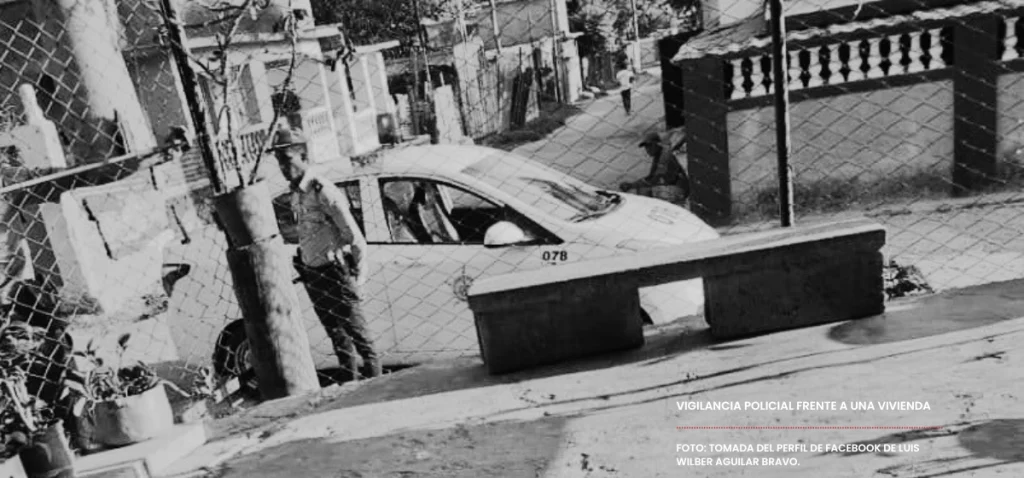
Surveillance and Repression Operations in Guantanamo Following Power Outage Protest / Cubalex

Cubalex, Alertas, 03 October 2024 / On Wednesday, October 2, we received information about surveillance and repression operations in Guantanamo, following a protest in the sugar town of Argeo Martinez, due to the prolonged blackouts in the area.

Juan Luis Bravo Rodríguez, member of the Union for a Free Cuba Party (PUNCLI) and manager of the Emilia Project, complained that State Security interrupted his Internet access and that his home was under surveillance.

Activist Miguel Angel Lopez Herrera was also under surveillance by State Security and paramilitary groups, and his home was attacked with stones.

Independent journalist Niober García Fournier was also subjected to surveillance, with the presence of an officer known as “Víctor Víctor” and a member of Inder around his home.

These repressive acts occurred one day after the protest in Argeo Martinez, Manuel Tames municipality, as part of the regime’s strategy to intimidate activists and prevent these demonstrations from gaining strength.

On October 1, after a 14-hour blackout, local residents took to the streets for several hours, banging pots and chanting anti-government slogans, due to being unable to prepare food.

According to information sent to Cubalex, officers of the National Revolutionary Police (PNR), State Security and provincial government authorities went to the site to try to quell the protest. The following day, vehicles carrying food arrived at the locality. So far, no arrests have been reported among the protesters.

The blog Operativos de Vigilancia y Represión en Guantánamo Tras Protesta por Apagones was published first in Cubalex.

Translated by GH

As of August, Cuban Authorities Have Built only 1.1 percent of the Homes the Country Needs

Officials point out that “there are several provinces and municipalities without directors” of the Housing program, which has barely completed 39% of its activities.

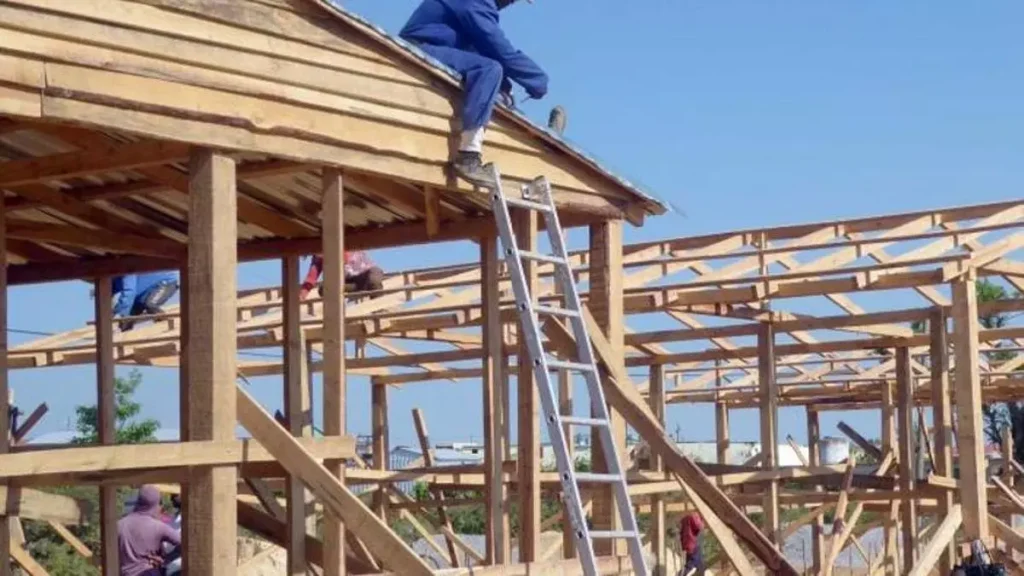
The only municipality in Granma province that complied with the housing plan was Pilón, which built wooden houses. / Granma

14ymedio bigger14ymedio, Madrid, 2 October 2024 — Of the 13,492 homes that the 2024 plan had planned, as of August only 5,262 had been built, 39%. The figure is even worse when compared to the number needed on the island, it represents 1.1% of the 447,375 properties that, according to the Government in June, are required to meet demand. In three months between the end of May, when the count stood at 3,579 homes, and August, only 2,047 were built.

The data, part of the report presented at the meeting between Prime Minister Manuel Marrero and the governors, is not the only negative one. According to the official press, “all provinces show setbacks” in the local production program of construction materials, another conclusion that must not have satisfied the Cuban government, which is determined to delegate the issue to the territories.

Nancy Acosta Hernández, head of the Office for Assistance to Local Administrations, pointed out an unprecedented element in these analyses. According to the official, the Housing Program at the territorial level is being affected by the lack of human resources. “There are serious weaknesses in the appointment of staff, since there are several provinces and municipalities without directors in this area,” she generalized.

“All provinces show setbacks” in the local production program of construction materials

Staff shortages have been widespread on the island since the largest exodus in recent Cuban history began at the end of 2022, but in the case of executives, this shortage can also be attributed to the decline in the number of Communist Party cadres, a fact denounced on several occasions by Party leaders. continue reading

Havana, Camagüey, Las Tunas, Santiago de Cuba and Guantánamo are the territories where the situation is worst, a problem largely due to “the marked limitations of resources,” as the director said, calling for “urgent reversal” of this situation “which, although it will not translate into higher levels of cement and steel, which are very deficient today, will contribute to optimizing the available resources.”

Acosta Hernández was most likely referring to the progress of the program promoted by the authorities since the middle of last year for the manufacture of bricks with clay. “We live in a country rich in clay; in other regions there is natural sand, limestone. There is a diversity of natural resources that together make up different alternatives and possibilities for each of the regions to obtain their own materials for construction,” said Delilah Díaz Hernández, Director General of Materials of the Ministry of Construction, as she asked to build houses without cement as far as possible. In the same speech, the increase in the export of marble, mortar, grey cement and processed sand was announced “as the only way to obtain income.”

In the months since then, various ministers and senior officials have scolded local authorities for not following the guidelines properly, and although reports in the provincial press of successful local brick and ceramic production thanks to kilns, whether ecological or not, have not ceased, the tally has not yet been added up, spurred on by the energy crisis.

Salvador Valdés Mesa, vice president and one of the most emphatic high-ranking officials when it comes to blaming subordinates and citizens for non-compliance in all areas, insisted that autonomy has been given to municipalities, but that this entails responsibilities. “Not only are fuel and the allocation of foreign currency decentralized, this is a decentralization of decisions, which are assumed by the Government,” he said.

“It is not just fuel or the allocation of foreign currency that is being decentralized, this is a decentralization of decisions, which are assumed by the Government”

Other issues of local interest were discussed at the meeting, such as the deficient water supply service, the delivery of idle land, the slowness of the bureaucracy and “territorial planning,” in reference to illegal constructions, which will be legalized with a recent decree that, however, prohibits those built after the rule.

Manuel Marrero also insisted on the message that price controls are not a declaration of war on the private sector, in light of the complaints of some merchants. “We are not against points of sale, as long as they comply with the law, do not violate the planning, have fair prices and legal products,” he said, despite criticism from private companies about the fairness of prices. “We have responsibilities to cover, such as salaries, rent for the premises, freight of goods, electricity, legal services, taxes…”, a merchant from Villa Clara recently denounced to this newspaper.

The Prime Minister also noted that these days accountability meetings are being held, “which – he praised – constitute the very essence of Cuban democracy.” Marrero asked that these meetings be used to exchange ideas with the population. “All the cadres, at all levels, have to speak with the people.”

____________

COLLABORATE WITH OUR WORKThe 14ymedio team is committed to practicing serious journalism that reflects Cuba’s reality in all its depth. Thank you for joining us on this long journey. We invite you to continue supporting us by becoming a member of 14ymedio now. Together we can continue transforming journalism in Cuba.
The Owner of the Restaurant El Patio De Olga in Santa Clara Is Murdered

The 31-year-old offered transvestite shows in the restaurant

Luis Miguel Llanta was 31 years old / Facebook

14ymedio bigger14ymedio, Havana, 2 October 2024 — Luis Miguel Llanta, 31, who worked as a transvestite with the stage name Gia D’Yenifer in the restaurant he owned, El Patio de Olga, was murdered this Tuesday in Santa Clara by another man with whom he had a relationship. The news was confirmed to 14ymedio by Kiriam Gutiérrez Pérez, a friend of the victim. The actress posted the event on her Facebook page, without giving details of the event.
italic

“Luis Miguel was murdered by a boy with whom he had an informal relationship a while ago. His friends say that there was blackmail and that’s when Luis broke it off. The boy demanded money that Luis Miguel did not want to give him and yesterday summoned him to his house around 11 in the morning and murdered him,” Kiriam Gutiérrez said on Wednesday.

The neighbors say there was blackmail. The boy demanded money that Luis Miguel didn’t want to pay him

The aggressor’s home is next to Llanta’s sister’s, and it was she who heard screams and called their mother. The two entered the house and found Llanta’s body, “wrapped in a sheet under the kitchen table,” Gutiérrez said. The aggressor confessed the fact, and his own mother called the police. Later he left the neighborhood “looking for a suitcase.” According to the actress, “it seemed that he had intentions of dismembering the body and burying it or dispersing it.”

Gutiérrez Pérez pointed out that Llanta was a very dear person “for the entire LGBTI community, for his neighbors and for his workers,” and that he “helped everyone.” “Many times he fed people in need and didn’t charge them. He was one of those people that friends always turn to. He was always unconditional with me. In the middle of the pandemic he was attentive to everything that happened. He always supported me,” said the actress. continue reading

The death disrupted the community of Santa Clara and his friends on social networks. People close to the 31-year-old regretted the incident and demanded justice for the homicide. “Oh, my sister, Luisa, as we called you, ’The [female] Cousin.’ You have left us in the worst way possible, which is when they take away your life,” wrote the user Crîs Dîamond.

The death disturbed the community of Santa Clara and his friends on social networks. People close to the 31-year-old regretted the incident and demanded justice for the homicide

Although there are no official figures on the number of murders on the Island, independent organizations and media have documented the trend of this crime in Cuba. In August alone, at least 22 people (almost one every day) were killed in the country in 11 provinces of Cuba – including three femicides – according to Cubalex. That number of homicides equals the one recorded last March, which was, until now, the month with the most homicide victims so far in 2024.

In addition, according to Cuba Siglo 21, in a report on public safety, the monthly average of homicides on the Island during the first half of this year was 15 cases, with a total of 91 murders in that period, 22 of which occurred in March.

Also, El Toque estimated, in an investigation carried out in August, that more than one person per day has been murdered in Cuba,, at least, in the last five years.” The study took the population figure of 2023, published by the National Office of Statistics and Information (from more than 11,000,000 inhabitants, in 2019, to 10,055,968, in December 2023), and calculated the rate of intentional homicides at 4.97 percent.

Translated by Regina Anavy

____________

COLLABORATE WITH OUR WORKThe 14ymedio team is committed to practicing serious journalism that reflects Cuba’s reality in all its depth. Thank you for joining us on this long journey. We invite you to continue supporting us by becoming a member of 14ymedio now. Together we can continue transforming journalism in Cuba.

Neither Green nor Red, Havana’s Traffic Lights Go Dark With the Blackouts and Breakdowns

A traffic light goes out at the foot of Tower K, on Avenue 23, El Vedado, Havana. / 14ymedio

14ymedio bigger14ymedio, Natalia López Moya, Havana, 2 October 2024 — Being a pedestrian in Havana is a high-risk sport. To the gaps in the sidewalks and the balconies that threaten to fall on the heads of those who pass by must be added the deterioration of the traffic lights. To cross the most important avenues of the Cuban capital you need a quick glance, a good dose of courage and fast feet that allow you to take advantage of the opportunity between one vehicle and another. More than the traditional green, yellow or red from those boxes with bulbs and circuits, only the darkness caused by breakage and blackouts is now exhibited.

With the signals out, not only due to lack of electricy, the traffic light in front of the opulent López-Calleja Tower, known as the Tower K, that stands in the heart of El Vedado sets the standard for the environment that surrounds the tallest building on the Island. While the colossus rises above the city and is covered with glass, the neighborhood shows the crisis that affects the whole country. “It’s been broken for months, no one cares,” murmured an old man on Wednesday who moved to the nearby corner of L and 23 to try his luck and get to the other side of the street. “They’re probably waiting for the first guests to arrive at this luxury hotel to repair the traffic light,” he said, disgusted.

Pedestrian traffic lights go out on G Street in Havana. / 14ymedio

Almost two decades ago, the official press was filled with headlines about the devices, of Chinese origin, which would be installed on some important streets in Havana. Manufactured by the Lopus company, and distributed in Cuba by the Cuban-Chinese marketer GKT, those traffic lights had a digital continue reading

clock to control the light changes and that indicated to drivers and pedestrians how much time they had left to cross an intersection. Local media reported that the devices could be programmed according to traffic in the area. But the lack of maintenance and spare parts made them go out little by little.

Along 23rd Street, the sophisticated traffic lights stopped working and generated true chaos for road and pedestrian traffic. At the end of last year, at the intersection in front of the Habana Libre hotel and the Coppelia ice cream parlor, the authorities had to place a conventional device to try to control traffic. But the constant breakdowns had already made people lose the habit of waiting on the sidewalk until they see the little green man and they may throw themselves into the crossing.

“It’s lucky that with the lack of fuel there are far fewer cars circulating,” acknowledged a señora who, with a fan and sun glasses, made a diagonal to get from El Quijote Park practically to the Yara cinema. “That and the fact that there are fewer and fewer people in this country,” she added.

On her way, she passed in front of the traffic light that went out right in front of the López-Calleja Tower hotel, which, at that time of morning, shone on its four sides with the obscene reflections of the sun on its windows.

Translated by Regina Anavy

____________

COLLABORATE WITH OUR WORKThe 14ymedio team is committed to practicing serious journalism that reflects Cuba’s reality in all its depth. Thank you for joining us on this long journey. We invite you to continue supporting us by becoming a member of 14ymedio now. Together we can continue transforming journalism in Cuba.

Wild Pigs, Vultures and Dumpster Divers Live From the Garbage in a Giant Landfill in Matanzas, Cuba

The “buzos,” dumpster divers, arrive at the landfill, looking for treasure and food in the depths of the garbage. /Girón]

14ymedio bigger14ymedio, Havana, 29 September 2024 — From the satellite cameras it looks like a stain on the outskirts of Matanzas. Those who walk by have the impression of visiting a museum of Cuban ruins from the last 20 years. It is the city’s landfill, “founded” – if the word can be used – in 2003 by the authorities in an old quarry four kilometers from the Central Highway. The Communist Party newspaper in the province defines it as an “old lavatory dug in the stone.”

On Saturday, the official press published photographs of the place, where – according to the Communal Services – 700 cubic meters of waste are thrown every day. Without offensive words, the report lets the images speak for themselves. Vultures resting on a bicycle handlebar, satisfied after devouring the remains of food; pigs – “hundreds of them” – refreshing themselves in a mud puddle; herons of an immaculate white circling over the mounds, in search of rodents and banana peels.

When there is fuel, the Communal Services trucks collect the garbage from Matanzas, skirt the University of Medical Sciences and arrive at the dump, visible on Google Maps. The data, Girón reflects, are useless. Only two types of people go to the citadel of garbage: those who work there and those who benefit from the landfill.

Wild pigs roam freely, eating the garbage and cooling off in the pestilent puddles. / Giron

Among the latter there are not only dumpster divers – for whom each mound is a buffet: they take everything they can carry – but also farmers who release their animals so that they can find food themselves. Not only the pigs attest to this, but also a black and white cow that, in a panoramic view of the garbage dump published by the newspaper, appears as a tiny continue reading

figure among mountains of waste.

The quarry belonged to a guajiro named Conrado Marrero, whose land was exchanged for “a few hectares” of land in a less rough area of the province. Originally it was a gap; now it has grown and – Girón calculates – the amount of garbage that is thrown for four days could fill an Olympic pool.

The landfill located on the outskirts of the city of Matanzas is more than 20 years old. / Giron

The garbage dump of the University of Medical Sciences has two “younger brothers”: one in Guanábana and the other in Ceiba Mocha, also in the vicinity of the city. But none receives as much garbage as the first, and if it has seen a relief in recent months it is because the Communal Services trucks do not have the fuel to keep up. The garbage that is missing in the landfill, however, remains in the streets of Matanzas, which threatens to become the fourth and most unhealthy landfill in the region.

The enumeration of objects by the newspaper touches on pathos: a “dirty teddy bear” next to an anachronistic CUC bill; coffins that have lost their nails and linings; underwear, condoms, toilet paper and stripped cables; “clumps of rice, blackened tomatoes, red beans covered with white fungus”; and pigs, many pigs.

The case of these animals is peculiar. The landfill caretaker reports that they escape from neighboring farms and live there, wild. Testimony of this is that their fur is short and black, their body is agile, and they are frightened when they hear the steps of those who go to the garbage dump. There are also chickens, rats and flies, in addition to frequent territorial disputes between “roosters and vultures” over a portion of land.

The Communal Services trucks skirt the University of Medical Sciences and arrive at the dump, visible on Google Maps. / Google Maps

There are also jejenes – gnats – that not only “are big enough to carry you” but also transmit dengue fever, the Oropouche virus and other arboviruses. The only human sign – in addition to the mountains of waste – is a wooden shed and a bulldozer that keeps the debris at bay. “When the wind directs the stench towards the guard house, it smells like a decomposing corpse,” says the caretaker.

To that smell is added the stench of burning. Its cause is also unusual: a spontaneous fire in the landfill began four months ago and has not yet been completely extinguished. The bulldozer operator has tried in vain to cover it with dirt and they left it like that. It is the garbage gas that continues to fuel the fire, he explains.

Vultures, dogs, rats, pigs, herons and, from time to time, even cows reside in the garbage dump, sharing the spoils. / Giron

The caretaker’s worst enemy is the dumpster divers. “They don’t like to be seen,” he points out, and he has instructions to “alarm them” by screaming. If they don’t leave, which often happens, he has to call the police. The guard has another task: to classify waste for Raw Material, but he hasn’t done it for a while.

The Girón reporters admit to having left the place devastated. The only authority in the landfill seems to be the vultures, which spread their wings on the mounds to warn strangers who is in charge in each sector. One of them – it can be seen in the photos – looks insistently at the city of Matanzas.

Translated by Regina Anavy

____________

COLLABORATE WITH OUR WORKThe 14ymedio team is committed to practicing serious journalism that reflects Cuba’s reality in all its depth. Thank you for joining us on this long journey. We invite you to continue supporting us by becoming a member of 14ymedio now. Together we can continue transforming journalism in Cuba.

Raúl Castro Multiplies His Public Appearances To Show He’s Still Alive

Rumors about Raúl Castro’s death usually coincide with moments of high national tension

Castro says goodbye to General Ramón Espinosa in the Granma room of the Ministry of the Armed Forces. / Estudios Revolución]

14ymedio bigger14ymedio, Juan Izquierdo, Havana, 1 October 2024 — Raúl Castro’s appearances on Cuban Television, after the increasingly frequent flood of rumors about his death, have become a kind of State ritual. At the beginning of the year, it was an official media – the very faithful Cubainformación – that coined the term “resurrection” to designate these sudden incursions of the nonagenarian general in front of the cameras.

Last September, five generals of the Armed Forces died, and the rumors circulated like never before. Castro, however, did not appear until the end of the month, to receive the president of Vietnam and say goodbye to one of his closest collaborators. In the Granma room of the Ministry of the Armed Forces, together with the leaders of the regime, Raúl Castro paid a late “tribute” to Ramón Espinosa Martín, who died four days earlier.

The scene has been repeated many times in recent years. The family of the deceased soldier is placed in front of a double row of leaders: in the center, Miguel Díaz-Canel, Raúl Castro and Ramiro Valdés; next to them, Manuel Marrero, Esteban Lazo, the Minister of the Armed Forces – Álvaro López Miera – and the Minister of the Interior, Lázaro Álvarez Casas. Presiding over the hall are the ashes of the deceased, his medals and a wooden mural with the Granma yacht. continue reading

Without saying a word – the ceremony has been described over and over again by the official press – Castro approaches with a white rose, bends down with more and more difficulty, and places it on a small table in front of the remains. Then, the military and leaders of the room stand at the same time.

The general’s “short stay” guarantees the family that the deceased had Castro’s utmost confidence

The general’s “short stay” guarantees the family that the deceased had, as is the case of Espinosa Martín, Castro’s utmost confidence. They describe his presence at the funeral as a “meaningful gesture,” which the former leader of the Communist Party tops off by personally greeting each family member.

In July 2022 – when rumors of his death were circulating – Raúl had to go to the same room to give his own family his condolences. Luis Alberto Rodríguez López-Calleja, his former son-in-law and the man who took the economic reins of Cuba at the head of the Gaesa military conglomerate, had just passed away. Like this weekend, Castro spent time “without saying words” and was followed closely by his grandson and bodyguard, Raúl Guillermo, son of the deceased.

Predictions about Raúl Castro’s death usually coincide with moments of high national tension, fueled by the economic crisis and blackouts. His appearance is intended to mitigate another rumor: the breakdown of the regime’s structure if the general dies and leaves the current leaders without the “shelter” of the historical generation.

This is the scenario in which Cubainformación – not without a certain religious fervor – spoke of Castro’s “resurrections.” Last January, when several rumors once again gave him up for dead in the midst of “difficult moments,” the media boasted of his appearance in Santiago de Cuba.

“It must now be like the fifteenth time this month that they say that Raúl Castro has died,” the Spanish journalist José Manzaneda said, laughing. “Today he reappeared or revived. These people (several influencers) don’t get tired of making fools of themselves. When a person reappears and gives a speech of almost half an hour, with perfect diction, despite his age – and he is now pretty old – with an absolutely coherent speech … they make fools of themselves.”

The co-host, Lázaro Oramas, also celebrated Raúl’s “resurrection”: “All these unpatriotic people, all these enemies, all these scoundrels will be eating their words,” he said. Another good omen, Manzaneda said: with the old man present, the flag of the cathedral square of Santiago de Cuba had begun to wave – a “good sign” in his opinion that the year was going to go well.

Educated by the Jesuits, the Castro brothers took advantage of religious symbolism on numerous occasions and speeches

Educated by the Jesuits, the Castro brothers took advantage of religious symbolism on numerous occasions and speeches. From the enthronement of the “martyrs” – the rebels killed by Fulgencio Batista’s army – to the white dove that Fidel made perch on his shoulder in 1959 through a trick, the idea that a kind of mysterious will accompanies the Revolution (atheist and Marxist) has been constantly recreated. On July 26, 2023, without going any further, Raúl’s appearance coincided with the dawn.

During Fidel Castro’s long convalescence, there was also talk of his sporadic “resurrections.” In 2012, in one of the moments when the rumor of his death ran from mouth to mouth – there was still no mass access to the Internet – the old man appeared in front of the cameras. He had not given signs of life for almost seven months, and several Miami media had already taken his death for granted.

Castro dressed as a gardener appeared in several photos taken by his son. He was then 86 years old and had four years left. His brother Raúl is 93 today, and many Cubans have predicted – as they did in 2016 with Fidel – that his death will cause the disappearance of a regime that always seems to have its days numbered and is now approaching its seventh decade of existence.

Translated by Regina Anavy

____________

COLLABORATE WITH OUR WORKThe 14ymedio team is committed to practicing serious journalism that reflects Cuba’s reality in all its depth. Thank you for joining us on this long journey. We invite you to continue supporting us by becoming a member of 14ymedio now. Together we can continue transforming journalism in Cuba.

A Cuban Baseball Player From the Matanzas Team Who Traveled to Spain Without Bats Escapes

Baseball player Yoisnel Camejo disassociated himself from Cuban baseball after the failure of the Matanzas team in Spain / Facebook/Cuba Grand Slam

14ymedio bigger14ymedio/Swing Completo, Havana, 1 October 2024 — Yoisnel Camejo, a member of the Matanzas team, left the club’s training in Spain. The player, according to the Cuba Grand Slam Facebook page, “decided to stay on Spanish soil” after the failure and elimination of the team in the Catalan Cup.

It will be difficult for the Matanzas team to participate again in an international event. Camejo “took advantage of the opportunity and embarked on a new path through Spain although it may not be linked to baseball,” said Pelota Cubana journalist Miguel Rodríguez.

Camejo did not show up with the rest of his teammates to board the 6:00 a.m. flight from Spain that was returning the team to the Island, thereby “breaking any link with the Cuban athletic movement.” The athlete chose to “start a new process in his life,” the magazine Swing Completo added.

During the tournament, in which Matanzas recorded two defeats and one victory, Camejo participated in two games and struck out in one of them. The athlete participated in six National Series with the Cocodrilos team. In 50 games he had 82 times at bat, 31 hits, two doubles, five triples, a couple of home runs and 18 assisted runs. continue reading

The Catalan Cup confirmed that Cuban baseball “is bogged down and has lost the gift of victory,” said Por la Goma after Matanzas’ failure. The team’s result showed the lack of foresight on the part of the Cuban Baseball Federation (FCB) in the processing of visas for the players and the team’s lack of preparation.

The former player for Industriales is now in the US / Facebook / Francys Romero

Pelota Cubana reported this Monday that in addition to the fact that the players of Matanzas traveled without training, they also did so “without a complete team and, what is more alarming, without bats.”

The club had to “borrow” the bats. “How can such an improvisation be explained in an international competition? The answer is simple: the Cuban player, like the rest of the citizens on the Island, has been forced to survive instead of fully dedicating himself to his profession,” stressed the same specialized media.

Cuban baseball players seem more concerned about what they can take back home, the same specialized media highlighted. The reason many players did not carry bats is because “if they load down their luggage with bats, the weight they can bring back is much lower,” the publication pointed out, referring to the weight of luggage allowed by the airlines.

This Monday, the arrival in the United States of baseball player Óscar Valdés, who was absent from the national team’s lineup for the Premier 12, was also confirmed. So far it is unknown if there is interest from a major league club in the player from Industriales.

In his career in the National Series and the Elite League, Valdés has a batting average of .282 with 99 doubles, 11 triples, 32 home runs, 303 RBI runs and 304 scored.

Translated by Regina Anavy

____________

COLLABORATE WITH OUR WORKThe 14ymedio team is committed to practicing serious journalism that reflects Cuba’s reality in all its depth. Thank you for joining us on this long journey. We invite you to continue supporting us by becoming a member of 14ymedio now. Together we can continue transforming journalism in Cuba.

At the Central Post Office in Cienfuegos, a Single Employee Serves the Public

“Today it will take two hours, at least,” estimates Antonio, a retiree who comes to collect his pension

The post office on San Carlos Street in Cienfuegos is buzzing with dissatisfied customers. / 14ymedio

14ymedio bigger14ymedio, Julio César Contreras, Cienfuegos, 30 September 2024 — A few blocks from Cienfuegos Bay, the post office office on San Carlos Street is buzzing with dissatisfied customers. They have no place to sit, and as the sun hits the avenue, tension and annoyance increase. People come to transact business or to buy stamps, but before asking who’s the last in line*, they have to calculate if they have enough time and patience.

“Today it will be two hours, at least,” estimates Antonio, a retiree who comes to collect his pension, perceiving the long line as a field of cane that he has to cut with a machete. He has plenty of time and has acquired patience – as a remedy – over the years. Now he has his “door jamb”; that is, a space on the sidewalk where he sits with great difficulty. From there, the line advances. The sun and the discomfort too.

If the post office put its employees in more than one window, the story would be different, says Antonio. On the contrary, there are a series of “trenches” – a counter, a glass sideboard, an empty armchair – that prevent passage and regulate the movement of the line. Everyone must go “through the channel” to the only available window.

The office is gloomy. Several burned-out light bulbs hang from the ceiling, which don’t improve the appearance of the premises. The paint – a greenish gray – absorbs the light and gives the place a suffocating atmosphere. The windows of the facade are covered with tinted plastic, the well-known and not very useful measure against cyclones, and someone – it is difficult to imagine why – stole the plastic cabin of one of the public telephones. continue reading

Everyone must go “through the channel” to the only available window

In a place like this, the “coleros” [people paid by others to stand in line for them] thrive with their “little deals,” but Antonio – out of embarrassment, he says – does not get involved. “I wouldn’t have the nerve to get in line with five or six people behind me.” Not without some sadness, he says that saving a place in line is paid at 500 pesos per person. It is the price he pays for avoiding discomfort, embarrassment and not infrequently the insults of those who do suffer the wait.

It’s not often that elderly retirees with pension books pay a colero. The business deal is not economical if it has to be repeated every month, and for a meager state pension it’s not worth it. “Those who do pay want to buy stamps, so it’s normal for another person to save a place in line to collect a pension and at the same time ’resolve’ the purchase of something else. So you wait and earn a little money,” explains Antonio.

But there is no money in the world that justifies the “ordeal” of being in the post office. When there is only one worker at the window – which is usually the case – you have to start lining up at 5:00 am in order to leave, hopefully, by 10:00 or 11:00 am. It’s not worth it, the retiree insists, and he returns to his “door jamb” spot.

To Vilma – self-employed and with much less patience than Antonio when it comes to lines – what bothers her is that two blocks from the Post Office “a man” has all the stamps there have been and will be for an informal sale. “Where do you get them?” she asks. She gives the answer at the same time as those around her, pointing to the post office: “From right there.”

The office is gloomy. Several burned out light bulbs hang from the ceiling, which do not improve the appearance of the premises. / 14ymedio

The corruption is remarkable, she says, because the person selling stamps also has ways of doing business with the National Office of the Tax Administration (ONAT), according to Vilma. For years, she has preferred not to settle her accounts with ONAT through the post office. Every procedure is cumbersome, and the only stamp that the office is quick to put on its papers, she says, is “that of inefficiency.”

The post office is no longer even useful for her to receive the national newspaper at home, she points out. “I canceled my contract,” she says proudly. “In addition to putting up with the newspapers only publishing what suits them, they arrived three and four days late. When I came to complain about the bad service, they justified themselves by telling me that the workers are insufficient to meet the city’s demand.” Now I get the news through social networks.

It would take too many words to describe the deficiencies in the parcel service, Vilma continues. “Someone recently sent me a package from Spain. After three months passed and it hadn’t arrived, I made a claim. They blamed the lack of fuel, transportation and, of course, the blockade.” The matter didn’t stop there. If the package was, as she supposed, in national territory, she was told she could “motivate influence.” Once money changed hands, the package immediately appeared.

Defeating the line does not guarantee anything, since the attention at the window brings properly institutional obstacles

On San Carlos Street, it doesn’t matter if you come to collect your pension, send a letter – a practice that is increasingly disappearing – or do a national transfer: the line, warns the guard, is “only one person at a time.” The defense by blood and fire of that “unit” seems to be the real concern of the staff, says Antonio.

Defeating the line does not guarantee anything, since the attention at the window brings institutional obstacles, such as the fact of not being able to send more than 2,100 pesos in a transfer. “It’s one limit after another,” Vilma complains.

The post office on San Carlos is the “central one” in Cienfuegos. If its operation leaves much to be desired, the booths are even more alarming. Closed firmly, they have only one function: to give shade to those who, overwhelmed by the incompetence and heat of Cienfuegos, seek a moment of truce.

*Translator’s note: Cubans join lines by asking “who’s last” and then, as soon as the next person joins behind them, they can move around freely without anyone ’losing their place’.

Translated by Regina Anavy

____________

COLLABORATE WITH OUR WORKThe 14ymedio team is committed to practicing serious journalism that reflects Cuba’s reality in all its depth. Thank you for joining us on this long journey. We invite you to continue supporting us by becoming a member of 14ymedio now. Together we can continue transforming journalism in Cuba.

The Voluptuous ‘Frutabomba’ Is No Longer Within the Reach of Every Cuban’s Purse

Mrs. Papaya reigned when oranges, cashews, custard apples and soursop disappeared

Fruit has been the victim of inflation that has pushed it past the pockets of many Cubans / 14ymedio

14ymedio bigger14ymedio, Natalia Lopez Moya, Havana, 29 September 2024 — The frutabomba, the most voluptuous of the fruits consumed in Cuban homes has, for decades, also been the ingredient of the most popular desserts and milkshakes when there is a shortage of milk for a good flan or the exclusive mamey disappears from the markets. Painted in paintings and recreated in engravings, in recent years it has ceased to be a product within everyone’s reach.

Also known as ‘papaya’, a moniker commonly used by Cubans to designate the vulva, it has the advantage of being large but the problem of being fragile when transported when ripe. Huge and delicate, it is most often sold whole in markets but can also be purchased in portions that must be swallowed in a short time before they spoil.

Now, a pound of frutabomba is sold for 60 pesos in the market at 19th and B in El Vedado, Havana. A single specimen can weigh quite a bit, so with less than 300 pesos it is unlikely that you will be able to walk away with one of these fruits in your bag, and trying to buy a small portion, for just one person, can be as difficult as convincing a vendor in the downtown store to sell half a head of garlic or just a couple of lettuce leaves.

A pound of frutabomba is sold for 60 pesos at the market on 19th and B in El Vedado. / 14ymedio

While other products have doubled or tripled in price in recent months, the price of frutabomba has remained stable throughout 2024, although in continue reading

November of last year it reached 70 pesos per pound. But even without significant jumps, the fruit has also been the victim of inflation that has pushed it out of the pockets of many Cubans. Its rise began at the beginning of this century, when it began to replace other fruits that were in short supply at that time.

In the absence of oranges, Mrs. Papaya came out on top. In the absence of cashews, sugar apples, custard apples and soursops, their plump appearance and small seeds replaced a long list of delicacies that once sprouted from the branches of so many trees throughout the country. Easy to harvest, with a medium-sized plant but high productivity and without great demands to be transported in its green state, it was the perfect food for the state-owned Acopio to fill figures and organize agricultural fairs.

But people wanted them ripe, ready to be cut into pieces and devoured. That’s where popular ingenuity came into play. They discovered that if a green specimen was dipped in a formula based on nitrogen fertilizers, it quickly acquired a beautiful color that made customers salivate and pushed them to reach into their wallets. When they got home and cut open the beautiful frutabomba, they found a whitish and tasteless interior.

Hence the need to see the inside of the fruit before buying it. A small triangle cut with a skillful knife allowed the inside to be seen. “Yes, I’ll take it,” sealed the deal with the buyer, relieved to know in advance that it was not one of those “hastily ripened” frutabombas. But with popular tricks you never know, over time the “ripening accelerators” have become more difficult to detect.

A frutabomba dessert, made with green or multi-colored pieces, has saved dessert for countless families

For its part, candied frutabomba, made with pieces of green or multicolored fruit, has saved dessert for countless Cuban families for decades. Easy to make, without complicated ingredients, the syrupy recipe has, however, come up against the lack of sugar in the country that was once mistaken for a sugar mill, beating to the rhythm of the machinery of a sugar mill, and the sound of the cutting of the canes in the sugarcane fields.

The stability of the price of frutabomba in recent months is due more to the loss of the ingredients and contexts that enhance it than to the ups and downs of the market. Given the lack of sugar and tourists, the most sensual of fruits does not rise as much as other products, but neither does it fall from the heights to which it has risen. However, it can still be seen in hotel buffets and in the paintings that tourists buy in souvenir markets.

____________

COLLABORATE WITH OUR WORKThe 14ymedio team is committed to practicing serious journalism that reflects Cuba’s reality in all its depth. Thank you for joining us on this long journey. We invite you to continue supporting us by becoming a member of 14ymedio now. Together we can continue transforming journalism in Cuba.

The Cuban Regime and Cultural Colonization

The Island was too small for Fidel Castro and he set about conquering the rest of the world

Fidel Castro with Mengistu Haile Mariam, who overthrew the Ethiopian Emperor Haile Selassie to establish a Marxist regime. / Historical archive

14ymedio bigger14ymedio, Yunior García Aguilera, Madrid, 30 September 2024 — The ideologues of the Castro model repeat ad nauseam that their struggle is based on a supposed “cultural decolonization.” Abel Prieto Jiménez, a storyteller, civil servant and advisor to generals, has become tiresome with this matter. His latest books and conferences are like a catauro [basket] where he inserts loose phrases, gossip and memes, obsessively attacking Sylvester Stallone or Shakira and labeling anyone with a minimally liberal discourse as fascist. One of his most laughable anecdotes is about how Che was worried about young revolutionaries who read comics in the 60s, because Superman demoralized the effort of the Agrarian Reform.

Another of the champions of this “decolonizing battle” is the Spanish journalist Ignacio Ramonet. With his European passport, the highly paid intellectual travels through Latin American dictatorships, offering his unrestricted support to figures such as Díaz-Canel, Nicolás Maduro and Daniel Ortega. The Galician-Parisian says that the handicap of the left is ethics, because the left is incapable of lying. He could not be more cynical. The Cuban Revolution itself was born on the basis of four founding lies: the repeated denial of communism; the hope of free elections; the guarantee of forming several political parties; and the promise to respect freedom of the press. The lies did not last very long. In just two years, that supposedly authentic revolution became a tropical copy of the Stalinist model.

The lies did not last very long. In just two years, that supposedly authentic revolution became a tropical copy of the Stalinist model.

From then on we would learn to say “homeland” in Russian, we would copy the Bulgarian Constitution, we would travel in Ladas, Moskvich or Karpaty cars, we would send our children to study in Leningrad, and we would replace Mickey Mouse with Masha and the Bear, until the mighty Soviet empire said “ konets ” (end). For 30 years, we were culturally closer to a Pole or a Serbian than to our own former culture. We allowed the Russians to establish not only military bases on our land, but even atomic missiles. The crudest slap in the face to the word “sovereignty” was when we applauded the Warsaw Pact tanks entering Prague to crush its spring. Half a century later, the Cuban regime once again applauds interference, shamelessly supporting Putin in his invasion of Ukraine.

Fidel Alejandro Castro was, in essence, a colonizer. An unbounded admirer of his namesake Alexander the Great, he always thought that Cuba was too small for him. And, once he achieved the status of an Antillean demigod, he set about conquering the rest of the world. Cuba did not send its armies to Africa to decolonize that continent, but to establish Marxist regimes loyal to Moscow.

The USSR provided the weapons and we provided the dead. The most notorious case was in Angola, where Cuban soldiers massacred tens of thousands of Angolans, even after their country had gained independence from Portugal. On May 27, 1977, more than 30,000 dissidents were tortured or killed by Agostinho Neto with the help of the Cuban military occupation. In 2019, the president of Angola publicly apologized for that massacre. But the Cuban regime has never apologized.

Not to mention all the damage we caused in Latin America, infesting the region with armed guerrillas. Although almost all of them failed, many were linked to drug trafficking and others mutated into conventional politics. Today we have the Nicaraguan dictatorship, repudiated by the vast majority of the international community, but unconditionally supported by Havana. Ultimately, it is its bastard daughter. And in Venezuela we have shown that the Castro model is not only capable of ruining a small country, but can also metastasize poverty, in record time, even in the richest country in the region.

In Latin America today we have the Nicaraguan dictatorship, repudiated by the vast majority of the international community, but unconditionally supported by Havana

Much has been said about Castro-communism and its characteristics, but not so much about Castro-capitalism. The model example was the Convertible Currency Department (MC). Beyond the four executed in 1989 during the Causa Uno [Cause Number 1], the company laid the foundations for what is now Gaesa. Castro-capitalism is defined by being monopolistic, shady, hermetic, by having relations with drug trafficking, by the use of front men, by being controlled and led by the military, by money laundering, piracy and ghost companies, by being above the law and the comptrollers. Castro-capitalism uses human beings as merchandise, having healthcare providers as its star product. The Cuban State’s trade in doctors is more lucrative than remittances or tourism, and has been described by several human rights organizations as “modern slavery.

We should also define Castro-imperialism, which seeks to replace Uncle Sam with Uncle Putin; to replace Batman posters with T-shirts of a Joker like Che Guevara; to vindicate the ETA, the ELN and Hamas; to impose Maduro as a “democratic paradigm”; to demonize the liberal model; to appropriate the discourse of minorities that it previously persecuted and marginalized; to replace the bourgeoisie with civil servants.

No, Mr. Abel Prieto, you are not seeking to decolonize anything at all, you are seeking to recolonize. You dream of imposing the hegemony of a single party and a single way of thinking throughout the world. Fortunately, fewer and fewer people are buying your rhetoric.
____________

COLLABORATE WITH OUR WORKThe 14ymedio team is committed to practicing serious journalism that reflects Cuba’s reality in all its depth. Thank you for joining us on this long journey. We invite you to continue supporting us by becoming a member of 14ymedio now. Together we can continue transforming journalism in Cuba.

The Cuban Government Sees ‘Discreet Progress’ in the Macroeconomy While the Country Sinks

The Council of Ministers says it has implemented “very important actions,” but they have not yet reached the population

Poverty has increased considerably in Cuba in recent years, with inflation, a decline in the quality of care, and a loss of value of the currency, among other things / 14ymedio

14ymedio bigger14ymedio, Madrid, 30 September 2024 — With a fiscal deficit of more than 15% of the Gross Domestic Product, a GDP contraction of 1.9, an official year-on-year inflation rate of more than 30%, a devalued peso against the dollar and a public debt of more than 20 billion dollars, Cuban authorities say that there are “discrete advances in macroeconomic indicators that have not yet reached the family economy.” The Council of Ministers reached this surprising conclusion this weekend, in a meeting to review the progress of the month of September.

The optimism that overflows from the article published in the official press entitled “A Process That Advances, But Not at the Required Speed” is unprecedented in a country that is experiencing its most tense days in recent decades, in which there has been no shortage of galloping crises that pale in comparison to the current one, marked by a constant shortage of fuel that not only prevents families from sleeping and eating, but also prevents industries from producing, transport from moving and, ultimately, having the slightest chance of minimally improving conditions.

The Minister of Economy and Planning, Joaquín Alonso Vázquez, however, said that the Government’s plan to correct distortions and to revive the situation is not going badly. “Although the actions carried out are incipient, we are already seeing how some economic indicators are moving.” The only data that remotely support his words were those of the state and municipal budget deficit, which are lower than expected, for reasons that are not as happy as they seem. continue reading

“Although the actions taken are incipient, we are already seeing how some economic indicators are moving,” he said.

The Minister of Finance and Prices, Vladimir Regueiro Ale, said that there is a state deficit of 32.125 billion pesos, 23.249 billion pesos less than planned. But the causes are, on the one hand, the “over-fulfillment of income” and, on the other, undoubtedly worrying but vague, “the non-execution of expenses.” Although he does not offer further details in this regard, the savings may come either from the decrease in the population or from the inability to execute works or programs necessary for the population.

At the local level, the deficit is 2.315 billion pesos, 4.990 billion less than the budgeted figure. There are 54 municipalities, among which Havana and Matanzas stood out, with a surplus. These figures will allow for adjustments in the budget, the authorities said without further details. And that is all the good news.

The Government has reviewed the first two months of the price cap for private companies on six basic products. “Both violations and good experiences have been identified,” it said. The number of inspections carried out is striking: 222,300, from which 348 million pesos were obtained from more than 137,000 fines. From these figures it can be concluded that the average penalty is around 2,800 pesos, barely 8.4 dollars in the informal currency market, an amount that many consider to be insignificant.

Another quantified fact was that of the so-called banking sector, which increased by 4% compared to July, although it is still light years away from the wishes of the authorities, suffocated by the lack of money in circulation. According to the top brass of the Government, there are “discreet solutions to begin to better control inflation and also the exchange rate of the Cuban peso.” This last issue, announced numerous times throughout the year, still has no plan in sight to stabilize either the national currency or the foreign exchange market.

Two facts that make clear the divorce between Cuban society and financial institutions: there are more than 300,000 fiscal bank accounts with zero balances and some 152,000 “non-state management forms” without an operating account.

The official press claims that the ministers discussed the current situation of the country’s main sectors, from the harvest to tourism, including imports, exports, agricultural production and relations between the State and private sectors. However, the state of each of the sectors is not specified, although the state of tourism is public knowledge: catastrophic, with year-on-year counts of international passengers falling almost by half.

Another depressing comment also slipped in. “The link between the national economy and the entities located in the Mariel Special Development Zone is still low, affecting the expected result,” the Government admitted to no one’s surprise. After ten years of development in 2023 , Raúl Castro’s star investment project was born to raise 2.5 billion dollars annually and had barely raised 3.5 billion in a decade.

“The link between the national economy and the entities located in the Mariel Special Development Zone is still low, affecting the expected result”

Manuel Marrero used the phrase ’chapucería [botched work] again, as he did last week in Gibara, to criticize local and provincial officials and asked them to “get to grips with subjective problems, each one in their own field, in the tasks that correspond to them and direct them, but also at the community level, which is where problems are first resolved.”

The Prime Minister admitted that the situation is bad due to “the lack of fuel, foreign currency, electricity,” but he urged people to resolve the problems that he called “subjective,” without making it very clear what he was referring to. However, he made clear his belief that at the state level – for which he is responsible – things are not going so badly. “[The Government] has implemented a number of very important actions, the population still does not perceive it, because it has not yet had a direct impact on them,” he insisted.

The meeting also discussed the ’accountability meetings’ that are taking place these days, meetings in which the problems most frequently expressed by the population were the high prices of basic products, the water supply and waste treatment, construction and maintenance of housing and multi-family buildings, the poor condition of roads and public transport and telephone service, although electricity was especially singled out, as expected. This Monday, the Cuban Electric Union again forecast a deficit of more than 1,100 MW, and the days are already piling up on the population, especially outside Havana, where the hours without electricity are already many more than the hours with it.

Meanwhile, the Prime Minister, as if bureaucracy were not his problem, asked officials to give answers to the population when they raise a protest. “These are issues that are there, and what is missing is a response, which sometimes, unfortunately, is not possible; but we also have to explain this with sensitivity,” he concluded.

____________

COLLABORATE WITH OUR WORKThe 14ymedio team is committed to practicing serious journalism that reflects Cuba’s reality in all its depth. Thank you for joining us on this long journey. We invite you to continue supporting us by becoming a member of 14ymedio now. Together we can continue transforming journalism in Cuba.

Former Cuban Prosecutor Who Sent 11J Protesters in Camagüey to Prison Enters the US

Rosabel Roca Sampedro has a hearing in the Houston Immigration Court on April 9

Former Cuban prosecutor Rosabel Roca Sampedro / Facebook

14ymedio bigger14ymedio, Madrid, 30 September 2024 — Despite the alert launched by various organizations and the express request to the Department of Homeland Security by three congressmen that her her request for asylum be rejected, former Cuban prosecutor Rosabel Roca Sampedro entered the United States on July 15. According to Martí Noticias, which had reported on the case last June, Roca Sampedro entered with a CBP One appointment at the border with Mexico in Brownsville, Texas.

The US media also confirmed that the former official — responsible for the sentences of up to four-and-a-half-years in prison for four protesters in  Camagüey who participated in the Island-wide demonstrations on 11 July 2021, known as ’11J’ — has a preliminary hearing in the Houston Immigration Court on April 9 at 1 p.m.

Roca Sampedro, who left Cuba with her young daughter, has been living in Houston, where her older daughter also lives, at least in recent months, Martí Noticias confirmed, pointing out that the work permit she holds will allow her to benefit from the United States’ Cuban Adjustment Act, after a year and one day of being in US territory, and she will be able to obtain a residence permit. continue reading

One of the organizations that raised the alarm about the case last June was the Foundation for Human Rights in Cuba (FHRC), which has the former prosecutor on its list of repressors. Another was Prisoners Defenders, which confirmed that Roca Sampedro prosecuted Case Number 26 of 2022, with Preparatory Phase File 32 of 2021, for “attack and contempt” against four participants in the protests of 11 July 2021.

Roca Sampedro has resided in Houston, where her eldest daughter also lives, at least in recent months

She was involved in the cases of Adrián Quesada Flores, who was 32 years old when he was arrested; Geovanis Sepúlveda Martínez (43); Lesyani Heredia Salazar (22) and Yadisley Ramírez (34). Roca Sampedro is classified by the FHRC as a “white collar” repressor, and her record includes accusations of prevarication, politically motivated persecution and crimes against humanity.

She also participated in the accusation – and subsequent sentencing of Bárbaro de Céspedes to one year and six months in prison for demonstrating on 11J. De Céspedes is the opposition member who carried a wooden cross during Good Friday 2021 in Camagüey. After his pilgrimage to the La Merced church, De Céspedes was arrested by the police and tried for violating health measures against the coronavirus. After serving his sentence after ’11J’, he was released in February.

The former prosecutor follows the path of many other officials of the regime who choose the US to settle. Last August, the former first secretary of the Communist Party in Cienfuegos, Manuel Menéndez Castellanos, arrived in Miami. Other examples of emigrated officials compiled by this newspaper are Misael Enamorado Dager, former first secretary of the Communist Party in Santiago de Cuba between 2001 and 2009, and Yurquis Companioni, a counterintelligence agent in Sancti Spíritus.

Not everyone manages to settle in the United States with impunity. Liván Fuentes Álvarez , former president of the National Assembly on the Isle of Youth, had his humanitarian parole revoked after his application was approved and he was about to travel to the US. Meanwhile, Judge Melody González , who sentenced four young people from Villa Clara to prison – without evidence and on orders from State Security, according to her own statements – for allegedly throwing Molotov cocktails at regime officials, arrived in May requesting political asylum after her humanitarian parole was denied . Currently detained at the Broward Transitional Center in Florida, the former official will have to prove, after a first failed attempt, that she is eligible for international protection.

____________

COLLABORATE WITH OUR WORKThe 14ymedio team is committed to practicing serious journalism that reflects Cuba’s reality in all its depth. Thank you for joining us on this long journey. We invite you to continue supporting us by becoming a member of 14ymedio now. Together we can continue transforming journalism in Cuba.