 While both the European Union and the United States condition their relations with the Island’s Government on progress on human rights, the Cuban State remains silent concerning its ratification of the international agreements in this area.
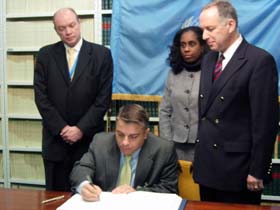
On February 28, 2008, four days after Raul Castro assumed power, the former Chancellor Felipe Perez, signed the International Agreement on Civil and Political Rights and the International Agreement on Economic, Social and Cultural Rights, in New York.
Was this intention, or was it a simple strategy?
I’ll explain. Since December 1966, these two Agreements have been open for signature and ratification by all of the member states of the United Nations. Havana signed these agreements two years ago, but has yet to ratify them. The International reaction has been positive. The new government gave the impression when it signed the agreements that it was emerging from its isolation and was guaranteed legitimacy. There was even talk of possible changes within the closed Cuban system and of a visit to Cuba by Manfred Nowak, the UN’s special envoy on Torture. But there were neither changes nor was the UN’s special envoy able to travel to visit the Island’s jails.
In spite of announcing (and then failing) to lift the prohibitions, the government managed to end the European Union sanctions and a private dialogue, without results, on human rights. However, to date, the Cuban State not has given its consent to enter into international commitments on human rights.
Who can make this decision?
The Cuban Constitution of 1976 and the Decree-Law 191/99, regulate the internal procedure for the ratification of international treaties. The respective decisions or agreements of the Council of Ministers and of the Council of State must be integrated in the process. The Council of Ministers approves, while the Council of State ratifies. No other country has this process in which the approval of the Government is divided in two acts.
As the procedure is different in Cuba, the Ministry of Foreign Affairs has to wait for both consents, both that of the Councils of State and Ministers, and then prepare the instrument of deposit or diplomatic note to ratify the UN agreements.
What is the reason for this delay?
According to specialists that I consulted, the two Covenants have not been ratified because the application of these international agreements in the country is seen as a threat to the dynasty of the Castro brothers. And because States that ratify these Agreements, undertake to take appropriate measures to enact the necessary legislation so that the civil, political, social and economic rights of their citizens are respected.
This would mean that the Cuban Government would have to carry out major reforms in its legal system. It should, for example, to repeal Law 88 (the gag law), which prevents the freedom of expression.
It would have to abolish Law #989 enacted on December 1961, that enforces that permission is required to enter or exit the national territory, as well as the definitive abandonment and the confiscation of property of emigrants. It would also be required to abolish Decree 217 that regulates internal migration to Havana, and prohibits residents from other regions from establishing a household in the capital.
The validity of the Agreements would require a reformation of the Constitution, which penalizes the exercise of the rights of those opposed to the existence and purpose of the Socialist state. In addition, it implies a serious change in the political system, particularly as regards the existence of a single party. The Constitution recognizes to the Communist Party of Cuba (PCC), as the “top leading force of society and State.” This recognition includes its ideology.
Political pluralism is legally forbidden. The PCC does not support equality with other parties, nor recognize the legitimacy of any different ideology. The law of associations also contemplates the existence of other political organisations. The current rules and peculiarities of Cuba’s legal system contradict the principles supported by the Pact of Civil Rights, which recognizes the freedom of opinion, movement and association.
The delay in these ratifications to the United Nations, is the responsibility of the Cuban Government. The main reason for the delay, as an independent lawyer sums it up: “If the regime ratifies and puts into effect the International Covenants on human rights, it would be shopping for rope for its neck”.
What Roque Pérez — who was subsequently fired — signed in New York in 2008, was only a strategy of distraction by the Cuban Government to win political time.
Laritza Diversent
Translated by: Tony D. Saiz
September 21, 2010

 This whole little group sounds like Chomsky and Galeano as if they were systematic and rigorous observes through an acute progressive lens. I still communicate with writers, journalists and activists in the “Latino” world. In addition to writing with spelling mistakes, all of them, their so pompous friends included, repeat clichés about as sophisticated as those on a Che T-Shirt and, SO HAPPY! I wonder: do you think there is anyone in the Latin American left or is it all a pose? It’s not like this in the Anglo world where Professor Michael Harrington, professor at Yale, joined a group of union activists who carefully reviewed the political praxis. In London the New Left Review is published. In North America we have Mother Jones and The New Republic, which are reflective journals. Neither in Cuba nor in other Latin American countries am I aware of any serious thinkers of the academic left.
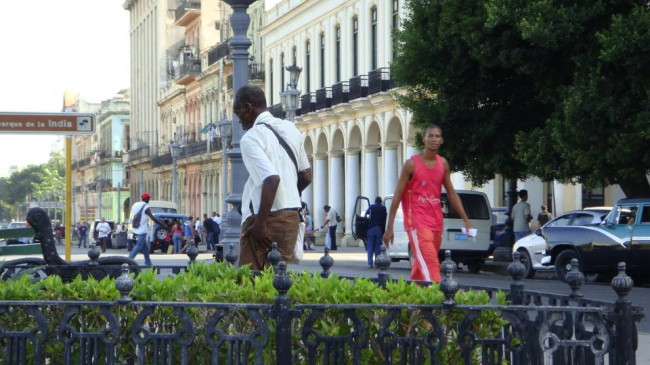
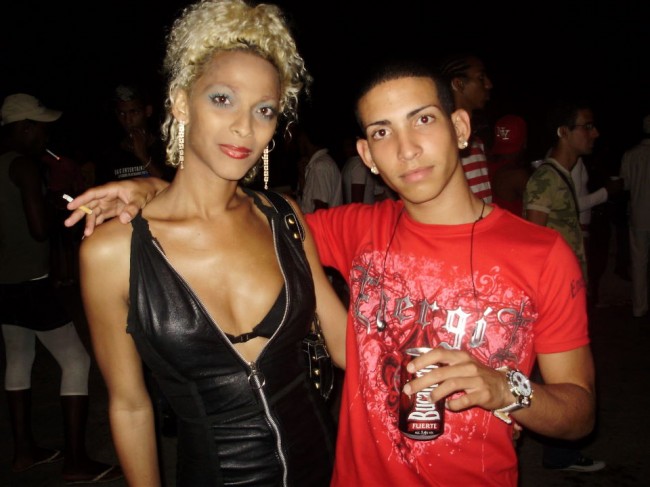
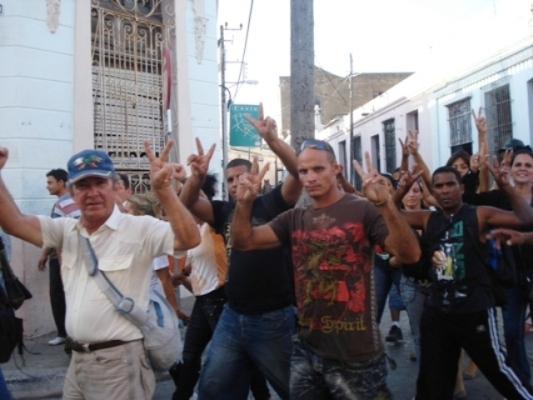 Photo: Luis Felipe Rojas

 Photo: Luis Felipe Rojas

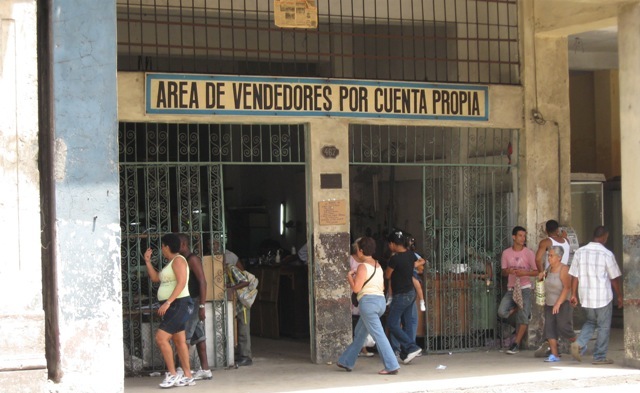
 From all sides comes the news of layoffs in Cuba, some with the illustrious names and surnames of officials who rose to the top of the pyramid of power, where at times they renew the loyalties and new figures swear fidelity and allegiance to the gerontocracy perched on the top of the triangle.
 I suspect that her subordinates in Basic Industry will not be surprised, because in Matanzas she already got her comeuppance when she was leading the region. They had to replace her in 2000 following the uncovering of corruption in Varadero, but the Commander appointed her head of the “Battle for the Rescue of Elian,” and then consecrated her Minister. Maybe she will now re-emerge, like a phoenix, as she doesn’t lack experience, is attractive and wants to survive.
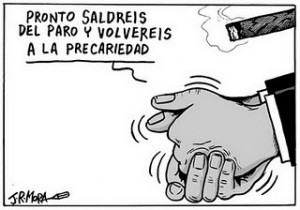 Cartoon: Soon you will recover from unemployment and we can return to uncertainty.
 The friend and his father-in-law were speaking calmly about the subject, when the old man recalled that he was the union leader at West Indian Steel and he knows that behind the problems of that country is the long arm of the U.S. Central Intelligence Agency. Faced with such a long arm, my friend smiled.
 Two weeks into the Tarará Pioneers camp and my sister and I would return home talking about our dips in the ocean. But this time it would be different, because we would be part of an activity to show someone very important that this area that was once private houses was now a place for the enjoyment of the workers’ children. On the lawn beside the stream we clasped hands and, dressed in the clothes typical of each region, made five large circles representing the continents. It fell to me to be Lithuanian.