The Fear of Being Wrong / Claudia Cadelo

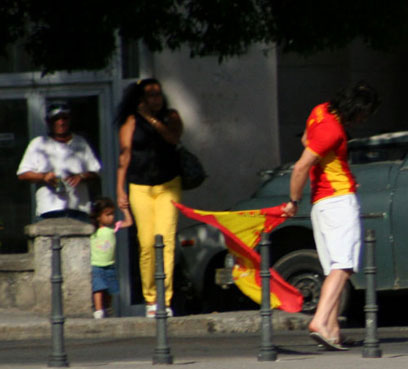
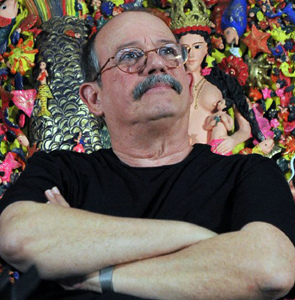
Photo: Leandro Feal

It’s hard to have a conversation these days without landing on the topic of “The list of the 178,” that is the new list of the approved “self-employment occupations.” I personally would like a summary of the most popular occupations of the 16th century, but I know I’m one of the pessimists. Fine, my debate partners tell me that I am among the “pessimists” but to me I’m among the “obvious realists” because for how long are we going to “improve the system”? They say “socialism” but I refuse to call a government socialist that in less then two years plans to lay off a million workers, that has raised the retirement age, that has decreased the number of products euphemistically called “subsidized” and that hasn’t even remotely considered raising wages, not to mention the Sword of Damocles that the dual currency represents in our economy today. I am not going to talk about economic, social or political freedoms because, obviously, for those who consider the Cuban model a socialist model, these freedoms seem something like a capitalist class, or am I mistaken?

Thank god I have not become a “Taliban” — which is what we call the extremists on both sides, especially those of the Cuban Communist Party who are the most abundant in this geographic zone — and I maintain excellent relations with some communists (they say they are communists, I’m not so sure). The fact is that one of my friends has a small private business: custom-made cakes. For several years now she has managed to survive, without luxuries or stealing, by selling little her guava and coconut cakes. With what she earns she has some extra money to give her children, and to fix some of the silly problems with her house, and to eat. When she talks with me she is always on the defensive, so she’s never confessed to me that she buys most of her ingredients on the black market, despite my having seen with my own eyes her doing business with “the egg woman” and the “guy with the flour.” But anyway, citing “American Beauty,” the power of denial is great.

My friend feels guilty, knowing that her little endeavor is included in the occupations on the medieval list and not wanting any part of illegality, at least not much of a part. When we talk she offers a historic phrase: if we all do our part, maybe this time we can move forward. I am not a cruel person so I hold my laughter. She omitted a detail, however, that her husband revealed to me: when he figured her monthly income after taking out a license, he got a round number: 2 CUC (~ $2.00 U.S.).

Note: Starting with this post I will start moderating comments, with the help of a friend. I am still preparing the rules for the forum so we can make Octavo Cerco an interesting place for discussion.

October 16, 2010

An Exemplary Feat / Rebeca Monzo

Today’s most important news was the rescue of the 33 Chilean miners who were trapped in a mine nearly half a mile down for sixty-nine days.

If the work of the Chilean government, sparing no expense or technology, has been commendable, the attitude of the miners themselves has been fantastic; these men who grew up in difficult circumstances have managed to stay calm and even good-natured. They have also constantly received the support of families and friends, who have camped outside the mine and stayed, without moving, giving them encouragement and much needed hope.

Today is undoubtedly a great day for those families who will soon all be together again, safe and sound. The great efforts of the rescuers should also be noted, they have risked their own lives to go down and help in the ascent. Mario Gomez, “the GPS” as he is affectionately called by his colleagues, has done a great job because of his deep knowledge and experience of the mine. Tonight there will be celebrations and rejoicing in all Chilean homes.

Just yesterday was the birthday of Pedri, one of my two beloved nephews, half Chilean, half Cuban. Early in the morning I sent him my best wishes, saying that from now on his birthday would be inextricably linked to the day that a great feat was accomplished in his native country: the rescue of the miners of Copiapo.

Impressed, before so much wisdom, integrity, technological organization, and moral, psychological, technical and other support, I could not contain myself: “Oh My God!” how great it is that on my planet there are no mines nor miners!

October 14, 2010

Calle Obispo / Miguel Iturria Savón

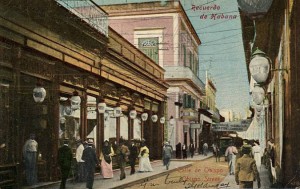
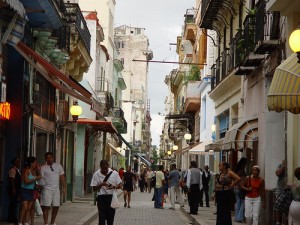
Obispo Street, one of the oldest in Havana, begins in the sea and culminates in Monserrate. It is crossed by dozens of street ranging from the Avenida del Puerto and the neighborhoods adjacent to the Old Quarter, which increases its noisy and colorful vitality without diminishing the glamor lent it by its shopping centers, museums, libraries, hotels, banks, government agencies and other entities the Office of the City Historian is trying to restore.

Only the Municipal Acts, some newspapers and magazines and two or three history books about the Cuban capital relate the names and locations of the various centers that made Obispo into “the street of the streets,” followed later by Galiano, San Rafael and Prado; it is even compared for its elegance with Rue de Paix (Paris), San Fernando (Barcelona), La Sierpe (Sevilla), the Carrera de San Jeronimo (Madrid) as well as the aged streets of New York.

Almost no one remembers that until 1898 it was crossed each morning by a company of Spanish volunteers who marched under the strains of a band, from the Prado to the sea, where they were spread out to guard the Palacio de los Capitanes Generale, the Palacio del Segundo Cabo, the Castillo de la Fuerza, the Spanish Bank and other civilian and military defenses of the colonial period.

Despite the weather, the expropriations of the 1960s and the circumstances that marked the urban involution, Obispo retains its original layout of a noisy, narrow street with shops on both sides of the pedestrian sidewalk passersby who disappear into a corner, go to a boutique or head off to a scheduled meeting.

Centuries later, Obispo oscillates between a colonial provincial atmosphere and a sense of modernity brought by the merchants and public figures during the Republic. The paving stones were replaced by asphalt, reborn entities and stores in ruins, like the House of Happy Father Varela, recycled into a school library; the Hotel Florida, which had among its guests the Spanish philologist Ramón Menéndez Pidal in 1937; the Almendrares optician and Café Europa, literary scene of the narratives of Carlos Loveira and Luís Bonafoux.

The University of Havana started on Obispo Street, where it was located between 1728 and 1902 in the Dominican Convent, also the venue of Secondary School of Havana, whose students snack in front, in the The Angel Bakery or in the French pastry shop, Brasy. On demolishing the convent, in the late 50’s, the building of the Ministry of Education was built, which shares space with real estate offices.

Where the current Ministry of Finances and Prices was once the Wilson House perfumery and National Bank built by the tycoon Pote; later it was occupied by the General Treasury of the Republic and the Ministry of Finance. Poe should also be credited with The Modern Poetry bookstore, built in 1900 at Obispo and Bernaza, opposite the Ricoy bookstore, now Cervantes, where eminent personalities from the country’s cultural and political spheres met.

These were followed by the Anselmo Lopez piano store, the ironmonger’s, and the Bosque de Boloña store, later relocated to the corner of Compostela. Almost at the beginning and near the Plazoleta de Albear were found the El Casino hat store, and the La Cebada cafe, very popular with the drivers until its sale and conversion to the Floridita Bar, home of writer Ernest Hemingway, who stayed at the hotel Ambos Mundos before acquiring the Vigia in San Francisco de Paula.

Historians and planners say Obispo Street, so hot in summer and cold in winter, owes its charm to its geographical position and the network of shops, banks and bureaucracies, refined by the latest offers of clothing and the cultural flow triggered by the installation of printers, newspapers, bookstores, publishing houses, law firms, pharmacies and other agencies the diverse social sectors attract, turning it into an urban paradigm.

Among financial centers We think of the Bances y Conde Bank, the Spanish Bank, which went bankrupt in 1921, the Trade Development Bank, the Trust Company of Cuba and the Núñez Bank, considered in 1957 to be among the world’s most important institutions.

Obispo integrates the tangible and spiritual heritage of Havana. Many establishments have disappeared, but are the Johnson and Taquechel drugstores are kept, the Anteojo Opticians, and the old houses are repaired for Museums (La Plata), libraries and offices (Department of Housing and Land Registry) and restaurants and cafes for tourists.

September 26, 2010

Sex, Truths and Video Cameras / Ernesto Morales Licea

Nobody knows her name or the sound of her voice. Except for her family or close friends, her individuality doesn’t matter.

And yet she is a kind of atypical national celebrity. Her image has traveled the island from one end to the other, smuggled, multiplied by infinity in hundreds, thousands of personal computers and storage devices.

Currently she’s not a student: she was expelled from school where she intended to graduate in Computer Science a few years ago. Her body shows the perfection of youth in just over thirty digital photos available to any Cuban who owns a computer.

“I didn’t do it for money,” she explains. The occasion just presented itself, and I thought it was fun.  The person who took them was my boyfriend at the moment. There was no money in it.”

“And what did he tell you he was going to do with the photos?” I ask.

“Nothing. We were playing around and he took the camera out and I started to pose.  But it wasn’t something we planned or prepared, it’s something you can notice in the photos, it was just spur of the moment. When we finished having sex we looked at them and he told me he was going to save them on the computer. Then he gave me a copy of all of them. But he made the copies on a computer at school and that’s where they spread from.

She doesn’t doubt my knowledge of these images. She knows that I, just like a thousand other people – mostly men — have seen them on a personal computer, some have been stored with zeal and have been a secret inspiration for desperate single men.

This girl from Camagüey is twenty-three years old. Her beauty is impressive for a young girl from a working class family, without extremes of skin care or silicon devices. She asks me, though her body is better known than that of the Giraldilla, not to mention her name. I nod. It’s the only privacy she has left.

In 2005 she was another one of those purged from the University of Computer Sciences (UCI) in Havana.

After an explosion of digital pornography spread out from the center to the rest of Cuba, the managers had to invest more time in meetings and disciplinary measures than in teaching classes.

The scandal had gotten out of hand like never before in Cuban society.  Dozens of young men and women from every state of the country had been photographed and filmed in erotic poses, semi-naked, completely naked, or during full sexual acts with endless imagination.

The existence of a national or foreign market for this type of merchandise was proven in some cases.  In others, it was only about pure enjoyment of new ways of sexuality, which extended throughout the population by the negligence of whoever saved the material; simply out of desire.

“When we had taken about twenty photos was when he went and looked for the other girl,” she tells me.

Because in fact, the peculiarity of her images is the bisexual practice displayed.  While in the initial pictures it was only about her in diverse positions, including oral sex with her boyfriend (who never appears), later she surrenders to carnal pleasures with another young girl, a roommate, according to what she tells me.

“Are you resentful?” I ask.

“Listen, I think that the only thing that honestly hurt me was getting expelled from school – she says. “I patched it up fast with my parents, they know that I’m young, but that I am also an adult, and I make my own decisions.”

“Tell me something, how have you been able to handle the publicity that those intimate pictures have attracted?”

Her answer, in this case, seemed to me so sincere it scared me:

“Look, that doesn’t worry me one bit. And you know why? , because what I did on there, and what everyone sees, is what the majority of people, especially young people, are doing when they are intimate. Or what many haven’t done but would love to do. I don’t have to be ashamed for something that doesn’t harm anybody. If I had killed someone, if I had stolen, that would be something else.  But for having sexual relations with a man and a woman before a digital camera, not at all.”

I am from the same generation as she is, and despite it all, I cannot get over being surprised by her shameless declaration. The phenomenon seems a bit striking to me. I think about the sexuality I began to discover during adolescence, and I’m aware of the notable differences that exist with today’s practices.

Not only because ten years ago I had never seen a digital camera, not even up close.  But also because not too long ago, the behavior of the most sexually active people still had an intimacy, hidden from the public, like something sacred and inviolable.

FROM ALFRED KINSEY TO TODAY

His name represented a watershed for the understanding of the human sexual behavior, early 20th Century.  Alfred Kinsey, a North American biologist and sexologist, was one of the precursors of the so-called Sexual Revolution that came a bit later.

Nobody, before him had spoken with such freedom and naturalness about the phenomena which were perceived by the public as pathological deprivations, or human psyche deviations.  Let’s say masturbation, (feminine especially, a subject which has not yet overcome its taboo) let’s say homosexuals and bisexuals.

“Kinsey’s Scale,” one of his most fundamental contributions, understands all the steps that, according to the scientist, explain human interests in the sexual area, with its nuances and variations.

In his books “Male’s Sexual Behavior” (1948) and “Female’s Sexual Behavior” (1953), affirmations like the following could be read: “Nothing that takes place between two adults, during their intimacy, and with the consent of both parties, can be considered sick or unacceptable. The supposed immorality is another social farce.

Also, provocations as such: “If all human beings would come together at a stadium, for example, and each one confessed aloud their sexual fantasies, they would all discover that what they assumed to be individual barbarities, in reality area the thought of by almost everyone.”

I think about this, now that the sexual map of my country seems to have changed colors. It is notoriously changing. To see it, it is enough to sharpen the senses. It is enough to put together evidence, declarations. To study with a magnifier the reality that surrounds us, to discover that, to the surprise of many, while in the sociopolitical plan the Island is still the same as a few years ago, Cuban sexuality has experienced an evident transformation, especially in its younger population.  Mrs. Karelia Cobas Ordaz, Master in Sexology and author of a soon-to-be published book about new challenges towards sexual education in adolescents, also recognizes the same thing:

“Despite it not being a private phenomenon in Cuba at all,” she tells me, “this type of freedom is very interesting in our country because of the fact that in other aspects, Cuban society has barely changed. For example: In a country as sexual as this one, places to go on a date for occasional relationships are almost nonexistent, nor does pornography sell as a legal product. So it seems very unexpected that, under these conditions, the sexual practices in the young community have experienced such a notable change.”

She also affirms something very important: according to the data included in her Master’s thesis, the occasional lesbian relationships of young girls between the 18 and 27 years of age, in Cuba, surpasses by a few percentages the data retrieved in studies about sexuality in countries like Chile, Panama, Puerto Rico, and Jamaica.

According to Cobas Ordaz this doesn’t reveal an increase in the young lesbian population, but an openness to practices, especially feminine, where curiosity about of new ways of pleasure, lead to its acting out, for example, sexual threesomes where relations between women are frequent.

About the subject of “advertising” sexual intimacy, the specialist affirms:

“It’s a subject that Sexology in Cuba has pending in a special way.  Is evident that modesty, the fear of exhibiting one’s own body in a public way, has yielded the field to other types of behavior.  It’s true: many young people photograph themselves nowadays without worrying about the spread of those pictures. In many cases, they spread them deliberately.”

For these types of behaviors, which teeter towards the edge of very dangerous terms like pornography or prostitution, the Cuban Penal Code does not recognize sanctions.  According to what Alejandro Mojena Ramirez, a Law School Graduate explains, in this type of material, whether it is pictures or videos, there is no felony as long as the people involved are over age, and no monetary profit is gained by the ones who are involved in such acts.

The truth is that the number of young people, mostly females, whose bodies can be appreciated today in the digital Cuban universe, is not only very large but is also growing.  For some it is about a way of earning easy money.  For others, it’s a way to access new experiences.

While from the beginning connotation of a national scandal that surrounded the case of the University of Computer Sciences (UCI) student was extended to the new “models” who appeared everywhere; there is no doubt this vision has started to change.  It no longer sparks extreme surprise.  All that is left is the inevitable disease and the lewdness that attaches to each new girl whose nakedness becomes common property.

How much do the positive and negative of these tendencies weigh on social patterns?  It is something that sociologists and specialists will have to determine. Or how helpful are the practices that don’t allow us to assume that sex is an act only of two, and bring it back to previous centuries, when the term orgy was patented almost exclusively for sexuality?

Meanwhile, I hold in my mind the last words from that exotic girl from Camaguey, whose flesh and attitude are a sample of this new era of Cuban sexuality.  Before saying my goodbyes from that unusual interview, she asks:

“It seems to me that at least in the subject of sex Cubans have stopped being obedient to the norms and have started to do what they really want. I think young people are very free in the sexual field.  Don’t you think that’s a good thing?”

And I, with an amused smirk on my face, say, “Yes.”

Translated by Angelica Betancourt

September 13, 2010
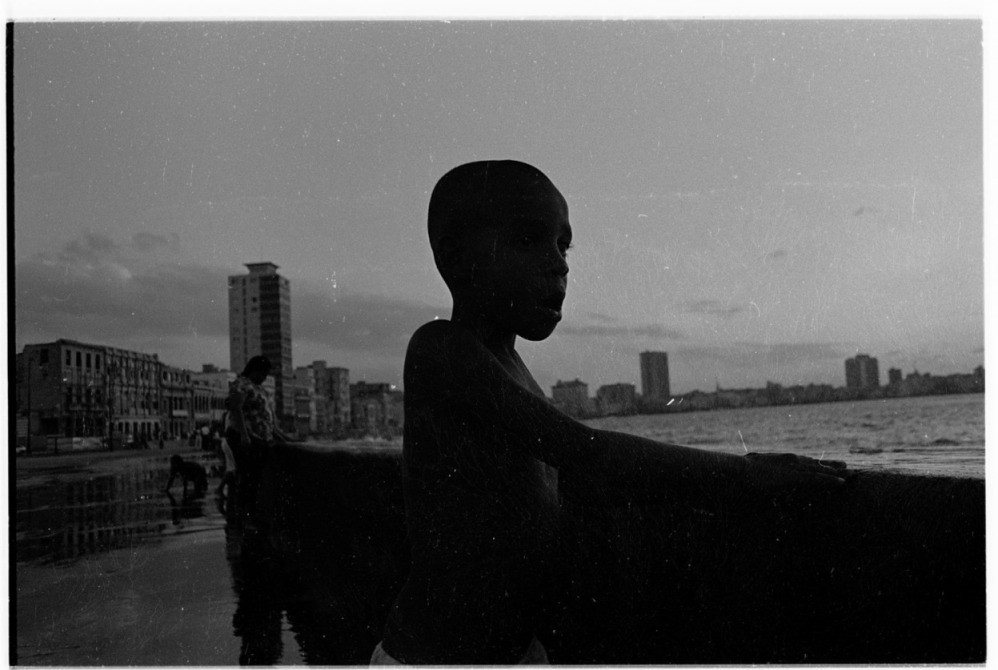
Family Remittances, The Surest Line Item / Miriam Celaya

It is a real irony that after 50 years of a socialist revolution in Cuba, the surest foreign currency income that the government is counting on today is the income in the form of family remittances from abroad. Such remittances, a monolithic truth, are, for the most part, sent by Cubans who live in no other place but in the bowels of the dearly beloved monster, since that is the place where the great majority of emigrants from this island live. This turns capitalist labor, the terrible imperialism, and the demonic currency into sources of continuing permanent support for the regime that — oh, paradox! — has led to the largest emigration of nationals since Christopher Columbus landed, almost by accident, on this, the most fair of lands.

Surely, the astute reader will have understood that the title of this post refers to the uncertainty that arises for the olive-green tower from the results of the recent parliamentary elections in Venezuela. Apparently, with the reawakening of the opposition in that South American country, after the unfortunate political mistake that had led to its withdrawal from the last presidential election — leaving the door open for the populist chieftain and thereby promoting his ratification in power — Chávez’s adversaries have gained ground in public opinion and today there is an effective force against the dictatorial pretensions in Venezuela, which means that things are going to be uncomfortable for the boisterous Mr. Chávez, who — after failing to gain the seats he sought with all the usual ventriloquists — must start submitting for approval his hitherto unilateral decisions which have allowed him to freely dispose of Venezuelan resources. Ergo, the horizon of the Caribbean military caste gets overshadowed at times in the face of the real possibility of the end or of a drastic reduction of Venezuelan subsidies in the medium-short term.

For its part, despite new laws that offer attractive opportunities for those wanting to buy a parcel of Cuban land for tourist purposes — provided they meet the prerequisite of not being Cuban-born — potential foreign investors are being a bit reluctant to a financial venture on this sort of postmodern Turtle Island, ruled by the most cheating and greedy pirates all time, where there is no respect for any agreements, contracts or foreign coffers, and is set at the whim of the capital of unsuspecting investors who once fell in the trap. There have been many a sheep who, shorn by the insatiable pirates, are still bleating their disappointment and showing their scrapes. Now the Buccaneers seek to lure none other than the pragmatic and calculating gringos, who don’t seem to have the urgency of the decadent military elders. It is an open secret that, despite the official media – just like a jilted lover, they keep reviling the “eternal enemy of the people” — all hopes of the Cuban elite are codified on the Empire: I hate you, my love.

And since, meanwhile, the stealing must go on, Cubans remain the perpetual victims, in this case the émigrés and their families in Cuba. Lacking an honest recourse, and in the absence of any other ability, official turpitude uses family ties as emotional blackmail to raise hard currency. An enormous number of émigrés — more knowledgeable about Cuban reality that any foreign investor, and appreciably involved with the fate of their family in Cuba — budget part of their income to the saving remittances that help alleviate the hunger and poverty of their kin, subjects of the slavery of this dismal plantation. As soon as they arrive on the Island, the remittances are taxed immediately and ostentatiously by the gluttony of the landlords, and converted into headquarter tokens (they call them CUC), with which the slaves acquire, at astronomical prices, products offered at the company stores, owned by the same landlords. No Way Out is a perfect cycle of robbery, “legal” and assured, because the dictatorship knows that the majority of Cuban émigrés will avoid by all means letting their parents, children or siblings suffer deprivation and will strive to spend even a handful of dollars or euros to ensure the minimum safety of their families.

And I hope nobody thinks that I am launching a criticism to those who send their remittances, or those who receive them. I wouldn’t be able to enjoy food, clothing, shoes and medications knowing my family is lacking them, nor would I deprive my children of certain benefits that, unfortunately, in Cuba are only available to a few. I just want to remind readers how subjected we still all are — or nearly all — in or out of Cuba, to the dictatorship’s diabolical machinery. The ones “over there” are forced to work harder to meet the needs of their Cuban family and to ensure the government’s free juicy slice; those “over here” are permanent hostages of the official extortion, and unwitting accomplices in the exploitation of their exiled families, with whom they don’t know when or how they will reunite, because the reunion also depends of the humiliating entry or exit permit of the masters. And in addition, these olive-green parasites, with haughty contempt, dare to call us “subsidized”! The condition of today’s Cubans is really sad. A regime that condemns us to so much material and emotional poverty depends so much on us!

Translated by Norma Whiting

October 15, 2010

THE LATEST FROM OMNI ZONA FRANCA / Orlando Luis Pardo Lazo

http://omnifestivalpoesiasinfin.blogspot.com/2010/09/protesto-todos-unidos-26-flow-de-los.html

Exclusively in the most recent issue of PROTEST of Omni Zona Franca and 26 underground Cuban rappers ALL UNITED against censorship and official lies.

Since last Thursday, September 3, the audio is distributed free inside the island and will be collected in several albums of Cuban alternative groups, to say loud and clear to the Ministry of Culture Omni Zona Franca Cuban culture is that all resolutions and subsidies together.

Since last Thursday, September 3, the audio has been distributed free within the island and will be collected in several albums of Cuban alternative groups, to say loud and clear to the Ministry of Culture that Omni Zona Franca is more culturally Cuban than all their resolutions and subsidies put together.

September 4, 2010

The New National Joke / Ernesto Morales Licea

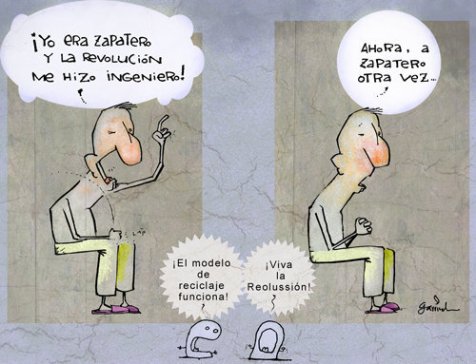
Big Guy: I was a shoemaker and the Revolution made me an engineer.
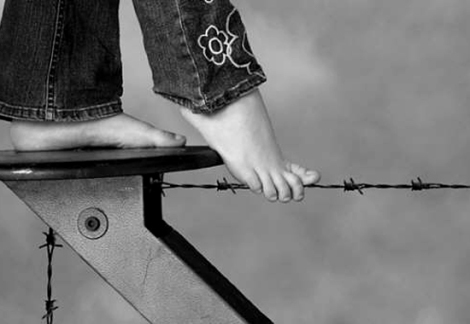
Big Guy again: Now I’m a shoemaker again.
1st Little Guy: The retraining model is working!
2nd Little Guy: Long Live the Re-Use-Olution!

For the forward-looking among us, who lost their jobs before the Government announced its layoffs, the social chess game on this Island of the Absurd has a different connotation. Recent events don’t surprise us too much.

I, who was a pioneer in this expendability, will one day claim my diploma and prize.

So I opened the double pages of the newspaper Granma last Friday with a different mood from most people; less biased, perhaps. More “light.” When you’re already unemployed, little that is printed in the official newspaper frightens you.

Howling with laughter cleared my head. Getting to start the morning roaring gave me another lens through which to write the truth.

I’ve gone over and over the list of 178 new occupations that my Government benefactor has created for the support of its citizens, and every time the scene repeats itself: I start with a suppressed smile, and end up laughing my head off.

Someone told me not long ago: “This is a crazy country.” That is, it is not a country of crazy people, but a nation that has lost its sanity. This time even our leaders have contributed to the joke

I look at the list, ordered alphabetically, and I ask myself if any of these great careers would be suited to my talents as an idled scribe. After discarding “Tutor,” thinking myself lacking in pedagogic talent, I start to sort through them.

As a teenager I never got the chance, during my stay at high school, to climb a coconut palm and tear off its fruit. And not because it might have cost my life; my hunger was so fierce I would have climbed Everest. OK, maybe not this one.

I cross off “Palm Tree Harvester.” I imagine the fortune within my reach, but reason helps me to see my way to refusing it. If starving to death and adolescent hunger weren’t enough to get me to the top of a coconut palm…

2. In my house there’s a talking parrot and a dwarf turtle which, although nearly 20 years old, fits in the palm of a hand. With the profession of “renter of animals” now approved, I searched my brain trying to figure out how I could exploit the pets in my home, and in this way reactivate my non-existent economy.

The parrot is such an egomaniac that 99 percent of its entire repertoire starts with it mumbling its own name. It is also surly and phlegmatic, and I’m sure that the instant someone rents her from me to amuse their family, she will shut her beak entirely until the day of her return.

The turtle has the most boring existence any animal could experience. Except for filling the house with luck with its mystical ways, I see no other utility to it through which I might be able to raise some capital.

3. As the list is explicit, although I was trained in the art of weaving I could not exercise the profession. I would not be safe from doubts and malicious eyes. To acquire a license for an activity that says, with no margin for doubt, “Embroiderer-Weaver,” does not make me feel comfortable.

4. One of the options, which they’ve even marked with asterisks, is “Collector-Payer.” I like the idea of responding, when someone asks me my profession, “Well, I work at collecting and paying.” I could pass for an investor or a businessman, even if my pockets haven’t heard about it. Either way, a certain social recognition would attach to me.

5. Quite the opposite of those who announce their official status as, “Hairdresser for domestic animals.” True, it is an honorable profession where it is practiced, frequently in developed nations. But I automatically distrust the home environment of a girl I just met, for example, who confessed to me that her father earned a living cutting the bangs of poodles in his city.

6. There are some professions recently recognized that need a little public clarification in order to address popular misconceptions. Item number 156 says, “Dandy,” and no one has any idea what could be going on in the minds of our leaders. That said, some of my best friends have started to shave their chests, hone their muscles, and even buy themselves hats and canes. Who knows.

7. On the other hand, the newspaper Granma should have provided some kind of key to go with this compilation of legendary trades of the most mysterious and indecipherable; they need an explanation. I have to confess I couldn’t sleep thinking of the devils who devote themselves to the position of “Button coverer,” or “Book possessor.”* I think my optimism will be confirmed if I find that I am able to support my current and future family through the latter line of work. If they are going to pay me for having books… Hallelujah!

8. Not even the astral world has been passed over by our Government in its effort to provide every Cuban with a living and personal well-being. Now the “Fortuneteller” can read in peace, (license in hand), the future of her client in a deck of cards. Even guessing the fate of the inspectors who ask to see the license for their illuminating work.

Also the “Tropical fruit peeler,” could remove the skins of bananas and mangoes without worrying about being caught out; for a small tax the State will authorize him to devote himself to this juicy business.

The only thing not clear to me is when our sardonic newspaper will publish the tag-line that clarifies everything. The text that finishes off this incredibly original joke with which the highest echelons of power wanted to favor us. For a Creole joke it’s not bad, but we have all laughed heartily already, let them start taking us seriously… Deal?

*Translator’s note: The idea of “Book possessor” is funny in two languages/cultures: English/Spanish; Capitalist/Communist. The term is actually the equivalent to the English “bookkeeper”… But what Cuban keeps books? In the socialist paradise where the State owns all…

September 28, 2010

Is Now The Time To Eliminate the Travel Permit? / Ernesto Morales Licea

The question has been going around and around in my mind, with a subtle persistence, since I found our recently that for the eighth time in three years the Cuban government has denied Yoani Sanchez an exit permit.

For those unaware of the Cuban reality, let me clarify: This country of ours demonstrates, today, one of the most backward and arbitrary travel permit systems that can be found anywhere in the world. A system expressly designed, without failures or slip ups, to endlessly impede any personal effort to come to know another country, and, at will and without any effort at all, to impede the travel of an “uncomfortable” citizen.

This is one of those points where my socialist Cuba does not admit moderation, pros or cons, or lukewarm analysis: it is an official aberration, that we deliberately crush point 2 of Article 13 of the Universal Declaration of Human Rights:

“Every person has the right to leave any country, including their own, and to return to their country.”

There are two possibilities: either we Cubans cannot count ourselves as human beings, and if so this prerogative does not apply to us; or, I don’t know how else to say — what other words to use — to stand in any forum, before any international competition, and categorically deny that Cuba violates any human rights.

In the endless arsenal of terminology and “bureaucratese” to leave Cuba, I think there is not other evidence more flagrant in the authoritarian will of the system, than the so-called “white card,” which is popular parlance for the Permission to Leave granted by the Department of Immigration and Foreigners.

A White Card because, apparently, that is a complete description of it: a sheet of paper where the Government concedes the questions and with immense grace allows you to leave the country. Temporarily or permanently — “definitively” as the latter is called.

So great are the obstacles to be overcome, so important the privilege of that card, that more than a few people, after obtaining one, make an offering to the Virgin of Charity of Cobre in Santiago de Cuba, a devout promise for a favor granted. The Patron Saint knows what that fragile sheet represents.

This Permit to Leave is the exclusive patrimony of the Department of Immigration. They grant it, they deny it. There are no ways to access the oracular voice that pronounces the Yes or the No. Although it is an open secret that the institution which, in these matters, gives the last word is: State Security.

The citizen exhausts himself in the hundreds of suffocating procedures, collects such a large number of letters and certificates that, with so much paper, it is an attack on the permanence of the forests; and in the end… he never knows if all his effort and hours of waiting for officials makes any sense, because the white card is never discussed. When it is denied, there is no explanation.

Now, looking at this through the lens of the new reality that, it seems, is starting to spread across the Island, I think my question takes on a different meaning. Is this the precise moment to put out to pasture this monstrosity, this Cuban immigration system?

And I clarify that with this approach, I only pretend to assume for a second the logic of those who erected the white letter as a compulsory procedure. Otherwise, my question would be disingenuous: there should never have existed such a violation of our individualities.

But looking through the lens of power, we can analyze what this prerogative, this faculty that the Government claims for itself to decide who leaves this country, as if it were a private plantation. Why, then? Because, in the nation as we have it today, I don’t believe there is anything they were trying to show the world, by establishing this Exit Permit.

What other purpose can they have to deny a human being the right to travel freely, except to prevent the mass exodus that would lead the world to suspect the truth behind the social paradise?

Or to put it more simply, at some point the white card must have fulfilled an ideological objective: preventing the testimony of those who abandoned the Island from destroying the Revolutionary myth of a united and happy Cuba. It was the same principle of those who strafed the Berliners who chose to tackle the wall and cross into West Germany. But let’s be clear: do we have, today, a mentally challenged world, incapable of reasoning?

After seeing that in 1980 ten thousand people took refuge in the Peruvian embassy; after the Rafter Crisis when young people chose the sea and the jaws of the sharks rather than the reality they suffered at home; after hundreds of thousands of Cubans chose international visa lotteries, Spanish citizenship, and the legal loopholes that let them escape this Caribbean island… In truth, what is the use of the iron Exit Permit? What hidden truth and illusion does it sustain?

None, save to prove clearly the militaristic character of the State that decides who will escape the fence, and how, and who will grow old within it.

However, now our leaders have added and subtracted points, now they have placed in the balance of a benefit-cost ratio, for example, repressing peaceful opponents with prison. Now that they have also launched a cry for help for the rusty national economy, would now not be the perfect time to rid themselves of the political cost involved, nationally and internationally, of not letting Cubans travel freely throughout the world?

I believe letting the white card evaporate, eliminating the steel barriers, and allowing Cubans to have the same opportunities to travel as the rest of the free citizens of the world, would begin to solve a specific problem: permanent — “definitive” — emigration.

Why do Cubans leave their country forever? Why do they “desert” (another aberration of terminology)? Those athletes, doctors, artists, who leave to settle permanently in other countries. Elementary: Because it is so difficult to leave the country, they must seize the opportunity. Now or never.

But the Jurassic apparatus aside, I am convinced that the vast majority of Cubans would choose to travel, to work for a time outside of Cuba, raise capital and, then what? Take advantage of the opportunity to spend that money in their own country, among their family and friends.

Like so many Mexicans do, who cross the border to earn a living however they can; as the South Americans do to find work in Europe, while leaving their family in their birthplace: returning to invest or spending their earnings elsewhere.

We all know that a serious percentage of the national economy is supported by… Whom? The exiles. The emigrants. The just under two million Cubans who have scattered across the world. So what would be the impact if those with capital could enter and leave the country, like other citizens with money, they could get on a plane?

Finally, I believe that there could be no stronger evidence of real change, verifiable, in the way the country is run, no better way to improve national opinion, than to remove these travel barriers. Cubans would start to feel respected by their government. They would start to believe in a will to find solutions beyond permits to run a barber shop, or depriving them of their jobs. And they would start to plan their lives not according to whether or not they will leave the island forever, but how they will come to know other countries, make a living with hard work and honesty, and then return home like the prodigal son.

Putting an end to the virtual prison in which we are forced to survive, would also avoid the rigmarole of the indefensible, the desperate explanations, when an uninhibited Cuban asks them why they can’t travel like so many workers and middle class and lower class people in other countries.

Ricardo Alarcon, the President of our Parliament, would have been saved, for example, from that demeaning argument that still today surprises us, when a Computer Institute student wanted to know why he could not go to Bolivia, to see where his admired Che Guevara died.  (“Imagine if 3 billion people in the world could travel, the congestion there would be on the airlines…”)

But above all, our leaders would stop using the sacred right to travel freely as a means of repression against those who choose to meet their arbitrariness with words and peace.

It is not about Yoani Sanchez, or many artists “who can’t be trusted,” or the peaceful opposition, or the children of “deserters” from a sport or a medical mission. It is about the fact that this is the right time to show, not the world, but Cubans, that our rights are part of the review that a more sensible and humane government wants to undertake in the country today.

If the arrogance didn’t cloud their reason, I think the logic of this thinking would ultimately prevail. By cruel misfortune, our recent history is marked by the disregard of logic.

October 12, 2010