Nickel / Regina Coyula

So tell me that truth isn’t stranger than fiction. In Moa, the city of nickel, in Holguin province, the workers at one of the plants, faced with the impossibility of meeting an agreed delivery to China and the prospect of losing their pay in foreign currency, decided to send the agreed-upon number of tons… making up the weight with dirt and the dregs from the nickel processing. The Chinese were not very pleased.

October 21, 2010

A Speech and a Cyclone / Yoani Sánchez

A zinc roof tile flies off, performing an incredible choreography in the air before falling onto the roof of another building. The winds of the tropical storm Paula tore off branches, caused 22 buildings to collapse in Havana, and left us without power for more than a day. On an island accustomed to the passage of powerful hurricanes, this little meteor with a woman’s name has been a disagreeable surprise, keeping us semi-paralyzed for more than 24 hours. It was so unexpected because the media, not wanting to trigger an alarm, underestimated the effects of the wind and rain. Nor did they take into account the country’s housing stock, so deteriorated that any meteorological phenomenon can wreak havoc.

After Paula made landfall in the town of Artemisa, people were simply cursing the Institute of Meteorology and assessing the damage, obviously upset. The storm caught many of us off-guard — in the street, in schools, in workplaces — because the Civil Defense institutions never called for people to leave work or school and take cover. We all thought it would be enough to carry an umbrella that day, but we could barely open it in the midst of the gale. I myself was left stranded at the entrance to the tunnel on Linea Street, fearing that at any moment the waters would rise and cut the city in two. Fortunately a friend rescued me in his car but when I got home the situation was alarming. There, fourteen floors above ground, I could see things flying around, trees falling, and the dangerous dance of the palms, bent nearly double, on Independence Avenue. We hadn’t prepared ourselves for this. What was going on?

More than a cyclone, Paula was the evidence that our authorities couldn’t bear to add one more ounce of discomfort to our already tense reality. At other times, they would have announced, ad nauseum, that we should reinforce our windows, stay on top of the news, and buy candles and batteries to prepare for possible blackouts. But this time their silence revealed guidance coming from above not to create any kind of nervousness among the citizenry. But we have paid dearly for that silence and today the worry and distrust in the streets is on the rise, because for many it has become clear that a good part of the buildings that make up this city cannot withstand a stronger hurricane. The feeling of helplessness is growing.

Curiously, on the evening of that windy rainy Thursday, the television news spent almost half an hour reading the fourth part of a long reflection written by Fidel Castro. Under the title, “The Empire From Within,” the former president devoted himself to reeling off internal details of American politics, while in his own backyard we were all expecting news of the tropical storm. The announcer, in his pompous tones, read the lengthy text while hundreds of thousands of viewers lost patience on our side of the screen and got up from our chairs. It seemed that no danger was befalling us, to judge by the share of prime time occupied by the Maximum Leader’s diatribe against the United States government. We ended up knowing more about Barack Obama’s private conversations, than about the damage caused by Paula in her passage through our country. It might appear that we Cubans swallow such absurdities with patience and move on, but that’s not the case; what remains in us is the irritation. The annoyance caused by seeing how something so important and momentous in our everyday lives is whisked away by political discourse, and how empty phrases and the mania to always look for the mote in another’s eye, keeps us from feeling the enormous stick in our own that is blinding us. Disgust, yes, because even the mention of a storm coming is concealed by politicians who have determined that it is not convenient to deliver bad news.

It makes you want to urge the families who lost their homes to Paula — the phenomenon we didn’t see coming — to assemble at the same television studio where they hid the truth, or at the office where it was decided that it would be better not to alert people of the danger. Not one of those who cautiously held back the news this time has lost their roof, no one who ordered the newspapers not to contribute to the shock is sleeping under the open sky tonight. For them, it was just a tropical storm that faded away after it left Cuba; for many others it will always be the day they witnessed their home collapse, or the day on which, finally, they lost their faith in the official media.

Photo: Orlando Luis Pardo Lazo

This article originally appeared in Spanish in Penultimos Dias.

October 20, 2010

Demagoguery in Education Too / Miguel Iturria Savón


School Principal: So your daughter has come to start her schooling. And which do you prefer, the sea or the mountain?
Mother: The sea or the mountain?
Principal: Yes, the seas of mediocrity or the mountains of incongruities.

The school year is starting with the Cuban education system transforming itself to try to adapt its programs to the structural crisis affecting the country, which suffers from general despair, financial ruin, foreign dependence, and the old schemes that try to model the thinking and block the paths of children, youth and adults.

In these primitive days the official press interviews the leaders and managers of the Ministries of Education and Higher Education, who agree to speak about the rigor of the education, the rising educational level, state subsidies, and the need for political and ideological work.

They also speak of the importance of the mother tongue, educational assessments, continuity of studies and exams at higher level, and of the return to the classrooms of 10,000 retired teachers, and the incorporation of nearly 2,000 who worked in political and mass organizations.

The highlight of the transformations lies in the creation of 300 mixed centers where trade schools, technical schools, basic high schools and pre-university high schools coexist. The innovations include the reduction in boarding schools from primary through university; the opening of teaching schools in all provinces; the revitalization of Professional Technical Education; the elimination of the position of general teacher, the architects of which destroyed the middle schools; formation of double major professors in the middle and upper levels, who will be full time during the first and second courses and who will be teaching pedagogy from the third.

Some of these changes re old ideas warmed over, such as the reopening of schools teaching in each province, or the return of pre-university high schools to the cities, after decades of forced closure to put the kids in boarding schools where they work in the field, far from the family environment. There are still, of course, dozens of schools in remote locations and without conditions for the formation of the New Man conceived by the ideologues of the Communist Utopia.

And speaking of the past, we remember that in Cuba, since the educational reform undertaken by our teachers during the U.S. Occupation from 1899 to 1902, special importance was given to primary education and to arts and crafts, free and compulsory since 1901, six decades before the nationalization of education which did away with the coexistence of different models of education, abolished private schools and the prestigious Teachers Normal Schools and other institutions that shaped generations of Cubans.

The 2010-2011 school year begins with more propaganda than educational changes. As life is a continuous learning adventure, we hope that those who administer the axes of wisdom have learned that the keys of knowledge are passed on through rigor, freedom of conscience and the need to communicate and share in an environment of respect and acceptance.

September 10, 2010

Work For Yourself… Controlled by Others / Miguel Iturria Savón

Nearly half a century after the devastating “Revolutionary Offensive” of March 1968 — in which the State took control of virtually all private businesses remaining in Cuba — the same government officials that ended the small and medium-sized private ownership, approved a list of 120 activities people can pursue on their own. Nice! The measure becomes a door in the wall of intolerance, but is insufficient because it does not release the means of production now in the hands of the State, which preserves almost absolute control to the detriment of millions of people and the national economy.

Lately many Cubans have sought out the list of approved occupations, to photocopy it, or take notes about it, and distribute it among friends and relatives who were laid off from the inflated company payrolls, or will be laid off in the coming months. The document is a stimulus for the million unemployed that the government has sent home, finishing off the little game of giving everyone a job, but it does not come with sources of raw materials, transportation to distribute production, nor salaries that give dignity to those who work.

In reviewing the list I noticed that of the 120 occupations people can pursue on their own, subject to getting a license and paying taxes, 22 are essentially rural activities and 98 are urban. Thirteen relate to transportation, six to construction, fifteen to culture, five to education, two top public health and a number of agricultural tasks, the priority sector for the freeing up of carriers and carters, animal sellers, palm tree toppers, blacksmiths, diggers, shearers, herbalists and scalping grudge keepers of the army of agricultural inspectors and the officials of the National Association of Small Farmers (ANAP), whose president speaks the new language of power.

The small hole in the wall of control does not preclude state surveillance, but opens a personal path in the totalitarian forest. So, for example, commerce will have messengers, tailors, hairdressers, watchmakers, florists, piñata sellers, barbers and others who will depend on themselves and contribute to the treasury, while employees of State bodegas, stores, cafes, restaurants, and garages will continue on the collective model, without competing with anyone, neither having to find the goods nor pay the taxes on local sales.

For their part, the construction sector will send its employees home to work for themselves as bricklayers, carpenters, painters, plumbers, electricians and decorators who, in a few months, will be licensed and paying taxes. Woodworking will be limited, however, because there is no wholesale supply of wood and the costs of tools and equipment is very high, all of it in the hands of government businesses.

Even culture has been freed up a bit with a list of approved activities for self employment. Among the trades authorized are musical instrument tuners, artisans who are both registered and not-registered with the Cuban Association of Craft Artists (ACAA), buyers-sellers of old records, bookbinders, engravers, photographers, art restorers, and language translators and interpreters.

A wolf in sheep’s clothing because the government still owns all the movie theaters, cultural centers, art schools, art galleries, bookstores and theaters, and the network of centers and businesses that control music programming, dance groups, and of course radio, television and the printed press. Hardly anything? Right?
Dozens of legitimate jobs have been released to thousands of drivers for hire, parking attendants, bicycle taxi drivers, boat captains, drivers, shoeshiners, manicurists, makeup artists, typists, language and music teachers, school cleaners, and chiropodists — all of whom can now work at their own risk in accordance with demand for their services.

There are those who are quick to associate this great List with profound changes in the model of State domination over individuals. The self-employed activities unleash the hope of independence and self-improvement; but Watch Out! Those who imposed the chaos and appropriated everything in the name of egalitarian ideals are still holding the reins. If they open a door in the wall, it is to retain their power.

September 30, 2010

Moderating Comments / Claudia Cadelo

There’s nothing better than a new day to demonstrate that our decisions are not infallible.  I’ve been watching my own evolution with respect to the moderation of comments.

First I swore I did not want to moderate them.

Then that I would like to but I could not.

And now, that I will, as I have found a way to do it through a friend.

I recently wrote that all I knew about my political leanings was that I was not a communist; thanks to the comments on Octavo Cerco I have discovered that I am not an anarchist. Little by little one comes to find oneself.

I have spent several days trying to flesh out the rules for the forum, and here they are.  Any suggestions, of course, are welcome.

  • Every commentator is responsible for his comments (even if he is a G2 agent and is following orders. Sadly, now with moderation, some will become “dispensable”).
  • Comments entirely in capital letters will be erased. In the language of cyberspace that means you are shouting and my blog is not a platform for virtual repudiation rallies.
  • Any offensive or insulting comments, or threats against other commentators, will be erased (exercising your right to privacy, do not publicly strip the skin off of others).
  • Comments that incite violence will be erased (my resistance is peaceful, if you want to rise up in the Sierra Maestra open your own blog before you take off for Pico Turquino).
  • Comments that contain more than two links will be moderated to prevent spam.
  • Repetitive comments will be erased (it’s bad enough with Granma having to read the same thing over and over again).
  • Comments that usurp someone else’s identity will be erased (I do not care for aspiring secret agents).
  • Comments that do not use the Roman alphabet will be erased (even if I could translate them, it takes too long).

I think that’s it and I hope you can live with it.

October 20, 2010

Occupational Therapy / Yoani Sánchez

Some make figurines out of paper, others string colored beads on a necklace that never ends, or paste pieces of fabric onto an infinite quilt. Occupational therapy they call it; keeping the hands busy so the mind doesn’t lose control, is what I would call it. Occasionally one of these repetitive occupations manages to divorce me from reality, though I don’t do it with needles and glue, but with the help of screwdrivers and clippers. I get to disconnect circuits, rebuild cables, open up every kind of appliance to see if their working diagram is more logical than our absurd reality. I make and remake technology.

Perhaps one day I will manage to create some gadget that not only will relax tensions, but will serve, finally, to connect us to the Internet.

October 20, 2010

The Idiots’ Dinner / Miguel Iturria Savón

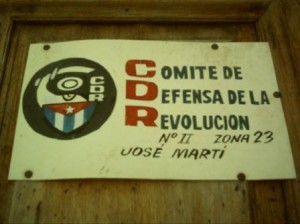
Two signs about 30 inches wide by six feet long were displayed by state officials in many offices and shopping centers in Havana and in other cities in Cuba. They both have the Committee for the Defense of the Revolution (CDR) logo. One says: “Caring for the neighborhood, vigilant and united”; and the other says, “Combative and united with the Fatherland.”

These signs are dedicated the “official holiday” for the fiftieth anniversary of the Committees for the Defense of the Revolution, founded by Fidel Castro on September 28, 1962. His purpose was to persecute, betray and control the enemies of his government, then understood as collaborators of the former regime, but later expanded to include anyone suspected of speaking out against the decisions of the Maximum Leader.

From the outset, the CDR became a kind of Neighborhood Inquisition, with a management structure at national, provincial and municipal levels, in turn subdivided into Zones, urban blocks and rural villages; all ready to expose a neighbor, shout slogans, assign tasks and carry out the many directives and orders that might occur to the government mandarins and the single party.

For half a century the history of this grassroots organization has had a record of vileness impossible to calculate. Through it, many things became widespread: coercion at home, collective snitching, the “secret operational work of the police,” surveillance of the neighbors, family distrust, the mobilization of the people to mass political rallies, agriculture, health campaigns, acts of repudiation, and support for the so-called People’s Power elections.

With the CDRs the Castro regime acquired a “flexible entity” of unquestionable auxiliary value. Perhaps the secret purpose of its creation at a time of social disintegration was to make the people accomplices and hostages of their own repression and to harness them to “Revolutionary tasks.” This organization, decimated but visible, marked the lives of millions of Cubans, who still depend on the “endorsement” or “good opinion” of the president of their block’s CDR to obtain a local position, a job as a custodian or a grocer.

To not belong to the CDR is a challenge that inscribes your name in bold type on the political police blacklist. Whoever says “No” when they knock on the door falls out of favor, however much of a “combatant” they may have been, however virtuous or humane. Failure to pay your CDR dues or to attend their worthless meetings is equivalent to untying the strings of the lackluster Revolutionary fanfare, whose icons continue on despite the passage of time, along with the police reports and the dependence of thousands of unfortunates who felt important before “the call of the Fatherland.”

The CDRs are as discredited as the  Cuban Workers Center (CTC), the only labor union allowed, the Federation of Cuban Women, the Association of Combatants, and other organizations that move no one, but which play a role in the bureaucratic structure of a regime that came to power in the name of freedom and eliminated all the rights and freedoms of citizens.

Now that the government is dismissing half a million people, the CDR leaders will explain the need for a “labor adjustment” as if they were idiots invited to the table of power. Many will eat the soup on the 27th, waiting for the 28th, with their hands in their pockets wondering when they will return to work. Perhaps with the help of the CDR, that takes care of the neighborhood, “combative, vigilant and united for the Fatherland,” just like in 1962.  Congratulations!

October 3, 2010

The Validity of our Anthem / Miguel Iturria Savón

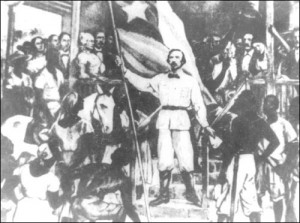
Since 1980, Cubans have celebrated 20 October as National Culture Day, in evocation of a local date of warrior exaltation, the triumphal entry of the small Bayamo Liberation Army, centered around the planter Carlos Manuel de Céspedes, who on 10 October 1868 gave freedom to the slaves of his sugar mill and proclaimed the beginning of the struggle for the independence of Cuba.

As the colonial regiment commanded by Julian Udaeta surrendered before the cheering citizens, supporters of independence, Céspedes and his followers celebrated the victory in the Plaza of the Parish Church with a ceremony and a festive conga for the people.

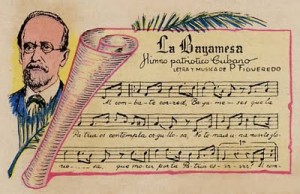
At that time, Pedro Figueredo Cisneros distributed the verses of The Bayamesa, whose music and lyrics he had composed in the previous year with the help of his wife, the poet Isabel Vazquez, upon request of the illustrious Francisco Maceo Osorio, who later was the assistant Carlos Manuel de Cespedes along with Figueredo.

It has been said that amid the euphoria, the creator and Bayamese patriot improvised lyrics about his horse to sing in chorus for the first time, but the testimonies of his contemporaries reveal that music and the verses were known by many conspirators who had kept silent for their own safety. Perucho, they called Peter Figueredo, played the score at home to dozens of trusted friends and entrusted the orchestration of the piece to the maestro Manuel Muñoz Cedeño, who first performed it publicly in the main parish on the occasion of Corpus Christi, in the presence of the priest Diego José Baptista and the aforementioned Julian Udaeta, military governor of Bayamo, which faulted the instrumentalists for the subversive nature of the march.

The Bayamo Anthem, played on 20 October 1868 and published on 22 and 27 of that month and year in The Free Cuban, embedded itself in the minds of the independence fighters, who often sang it in combat or to start sessions of the House of Representatives, a sort of parliament in the jungle.

Although José Martí praised what happened on that October 20, 1868 and reproduced in Patria the stanzas of the Bayamo Anthem, in June 1892, and on January 21 and October 4, 1893, it was the Constituent Assembly in November 1900 which declared it a national symbol.

In October we commemorate other historic ephemera, such as the discovery of America – 12 October 1492 – and the arrival of Christopher Columbus on our shores days later, an event of great significance for the encounters of peoples and cultures, and international mobility that erupted between Europe and the so-called West Indies.

More than a fact of cultural consequence, the evocations of October 10 and 20, 1868, signals the warrior affinity of those who rule the island like those Captain Generals appointed by the Spanish overlords until 1898.

The story gallops in the memory of the people, but does not model the culture, it complements it. We will have to rewrite the story of war, unilateral and simplistic, that creates myths and masks the oppression. Today, as in 1868, the stanzas of the Bayamo Anthem, turned into the National Anthem, represent a dilemma of our reality, but no one calls to combat nor thinks about guns. Is it that we fear a “glorious death” or that we have gotten used to “living with shame and ignominy”?


Translator’s Addition:

October 13, 2010

A Firing in the Holguin Culture Sector / Luis Felipe Rojas

As expected by many for some time, the boss of the National Union of Cuban Artists and Writers (UNEAC), came down from his presidential throne in Holguin.

Miguel Barnet himself, accompanied by an entourage of the ten heads of the various sections, appeared in this city to inform members about the irregularities detected by a committee with regards to the management of funds by its president, the writer and painter Jorge Hidalgo Pimental.

What is laughable on this occasion is that the investigation of irregularities was sparked by anonymous complaints from the artists and workers at the cultural center where Hidlago Pimental is accused of abuse of his position and the possible enrichment of his executive secretary, by the name of Zara.

Diario de Cuba has already published an article about it but I’ll share some details with you here.

Of the 45 works of art that UNEAC bought in the last three years from local fine artists, 15 were the works of Mr. Jorge Hidalgo. Among the other niceties appear payments under Resolution 35 (which offered payments of 135 and 200 pesos for public lectures and conferences among others) made to Mr. Hidlago. One of these was a talk he gave at the headquarters of the Cuba Workers Center in the mountainous city of Mayari and for which he was paid 600 Cuban pesos.

According the report read before a couple of hundred members, the amount that this director paid himself totaled more than two hundred thousand pesos in just three years. Can the committee still not believe that this constitutes a crime? We see in one program, “artistas al fin”, that this gentleman had the right to receive the remuneration that the Culture Ministry intended for this purpose, and even with that he is not before the court?

What happens is that the Cuba penal code doesn’t address those who slice the necks, rip off the heads and climb with their dirty boots on the shoulders of others. One indication of the stinginess which some artists have called attention to, is that for the poetry recitals and the cultural afternoons at the Holguin UNEAC there was almost never a sip of coffee or a miserable drop of locally manufactured rum.

The same Jorge Hidalgo Pimental, almost a year ago, launched himself into a witch hunt against the center’s vice president, Manuel Garcia Verdecia*, and its cultural promoter, Rafael Vilches Proenza*, both well-known writers with a national reputation. Vilches Proenza, as a prelude to that afternoon of the long knives had written some verses:

Let fear not seize the city
Prisoners worry not, be not amazed
In these times of plague
The larger specimens will die.

*Translator’s note: These two men were stripped of their positions for “mis-use of the internet.”

The Chavez Disaster: A Brief Recapitulation / Dimas Castellanos

The amazing results of the Venezuela elections were unexpected. Hugo Chavez’s government has just lost the complete control he held over the National Assembly for a decade, making it impossible, from now on, to pass new laws that require the approval of parliament without consent of the opposition, which limits their pretensions re-election.

The centuries of social injustice, lack of democracy, warlordism, violence and government corruption, exacerbated by the failure of developmental projects and neoliberalism generated in Venezuela a degree of social discontent that manifested itself in several attempts to repeat the experience of the Cuban revolution. Lieutenant Colonel Hugo Chávez, after failing in a coup attempt in 1992, tried to come to power through elections, and in the 1998 elections presented himself with a nationalist message and captured a large segment of the population dissatisfied with the existing inequalities. Upon assuming the presidency in 1999, Chávez announced a “peaceful and democratic revolution” and called for a referendum to amend the Constitution, which, when approved, strengthened presidential power, eliminated the Senate, took power from the unicameral legislature in the Assembly and established national and greater state control of economic activity and the media.

In 2001 Chávez called for the creation of the “Bolivarian Circles,” a copy of the Committees for the Defense of the Revolution in Cuba, and with aggressive language began to blame everything bad on the “external enemy.” To be reelected in 2002 for another six-year term, the President announced a profound transformation of the economic and social structures of the country and requested special powers from the National Assembly to legislate by decree in economic, social and public administration matters, which generated a wave of strikes and clashes with the opposition, which described Chavez’s measures as dictatorial. Violence and civil disobedience led the coup that overthrew Chavez in 2002 followed almost immediately by his return to power. However, the persistence of his intentions to perpetuate his power, led again in the same year, to military and civilian demonstrations against him, including the taking of the Plaza Altamira in Caracas and the general strike, including employees of the PDVSA oil company who demanded the resignation of the President. The response was the laying off of thousands of workers who supported the strike. The climate of violence created continued until 2003, when thanks to the mediation of the OAS, the Carter Center and “friends,” the government and the opposition signed an agreement.

Returning to the non-violent path, the opposition opted to call for a recall referendum, collected the required signatures and the National Electoral Council announced a referendum for August 2004. At that time, Chavez has concentrated his efforts on the most marginalized and those who did not go to the polls in previous elections. The result was 5,553,209 votes (59.06% of those cast), almost two million more than in the elections of 2000, while the opposition gained more votes than previously as well, but their growth was lower than that obtained by the President.

In 2006, Chavez called for a consultative referendum to amend 69 articles of the Constitution in order to increase his powers, however, most said NO to the reform; but winning again in 2008 regional elections, the President took his success and once again urged the National Assembly to out forward another referendum in 2009, this time to reform a single article, which would allow his re-election in 2012, which he won with about 55% of the vote.

The Venezuelan president, submerged in his desire to remain in power, lost sight of the fact that electoral victories are nothing more than a challenge and an opportunity. That is, success is measured not by majority vote but by the structural changes intended to address the accumulated debt of social justice and participatory democracy, as demonstrated by Ignacio Lula da Silva in Brazil, who proposed by social justice to increased production, but did not take the wealth of the owners for redistribution to the dispossessed.

In Venezuela, although oil hit a price that exceeded $144 per barrel, GDP declined, inflation rose, the real value of wages fell, while corruption and violence soared. In the end, Chavez was unable to transform the revolutionary populism into effective action, while the Venezuelans have learned to make use of effectively institutionalized democratic mechanisms. The mixture of demagoguery, militarism, aggressive language and control of political power, and his self designation as the “Bolívar” of today, is a new aspiration to totalitarianism in a region where this style is simply exhausted.

The result is clear: the populist caudillo can not find the solution of the backwardness of Latin America, which explains why the percentage of the population does not share Chavez’s policies has held steady in the ongoing elections at about 40%, preventing the government from reaching the two-thirds of the Assembly needed to pass anything they propose. Government and Opposition were tied with regard to the elected representatives in the Latin American Parliament (five for each side) and in terms of popular vote, the opposition for the first time pulled off a dead heat, which predicts that attempts to re-elect the President will fail.

What happened in Venezuela contains at least seven valuable lessons:

1. Venezuela has been an important demonstration of accepting, at each opportunity, the results of elections, which is a test of maturity, and a guarantee of social peace and future prospects.

2. The division of votes in the recent electoral process, split about half each between Government and Opposition, both legitimizes each to the other and Venezuela and the world, which prevents both parties speaking for all the people of Venezuela.

3. Chavez, in his quest to develop a revolution in the image and likeness of Cuba, and making use of the additional powers granted him, limited, but could not sweep away, the existing civic spaces, mechanism and procedures. It is a lesson: the establishment of a revolution, albeit through the ballot box, has to be constantly revalidated by the polls.

4. The attempt to lead modern nations as a personal cult under the hegemony of one party over others, leads to totalitarian governments that ultimately deny the freedoms in the name of which came they to power.

5. If the loss of control of the National Assembly is not surprising, nor will Chavez’s failure be in the 2012 presidential election. His possible re-election depends on the willingness to transform revolutionary populism into something positive and permanent, something nearly impossible and too late.

6. Venezuelans, for or against Chavez, have learned to make use of democratic mechanisms institutionalized, which is a valuable civics lesson, especially for the Cubans, who have no such mechanisms and institutions.

7. What is happening in Venezuela will have an impact on the new Cuban scenario, characterized by timid reforms inside and search for outside funding sources, which will force the acceleration of the process of change if they don’t want the outcome to be similar to that which caused the demise of socialism in the Soviet block, because the current terms of trade with Venezuela are very fragile, since they are based on a political relationship. At the same time it indicates the way forward for Cuba — the only country in the region without legal opposition and the support of elections — with regards to the public policy debate and the winds blowing in the region.

September 28, 2010

More on Crossed Signals and Other Absurdities / Fernando Dámaso

  1. A few days ago I wrote all about self-employed vendors Tulipan Street, first evicted and then located in a small park at Loma and Tulipan. I wrote that I hoped they would let them stay in that place.
  2. The peace lasted exactly one week. And they were forced to disappear again. It happens that the manager and the players continue with the crossed signals. Or maybe it happens that the team owner, who is directing it, is bypassing the manager.
  3. Today I was surprised not to find plastic bags in the foreign currency stores (in the Panamerica it is common), nor the usual old men and women who resell them at the entrances to the farmers’ markets. The first is becoming routine. The second is due to a police operation against them, making them disappear, despite the fact that they are compensating for the lack of pensions, the miserably retirement which is not enough to survive.
  4. The people selling in the market stalls complained that sales had declined, as buyers, having no bags, could not carry their products. It happened to me: I couldn’t find any bags, so I didn’t buy anything.
  5. We all know that the model does not work. It’s so bad that they are are incapable of producing even simple plastic bags or simple paper cones to carry products sold in stores. We must devote more attention to bread and less to the circus.

October 7, 2010

An Outdated Model / Rebeca Monzo

Although the worn-out model hasn’t worked, not even for the country which recommended it, there are people who believe in the reincarnation of the liberators, and insist on implanting it, despite its failures, one after another, where they are copying it, they don’t react. Sure, there are those who took more than seventy years to realize it, others have taken more than half a century, but it seems that they don’t realize (unless it has slipped their minds), that they no longer know how to reverse such a great disaster.

This morning, listening to the shortwave, my blood froze, listening to the new measures taken, in great haste (before January) by the reincarnated one; when the new deputies are debuted it will be very difficult to act.

I thought, how is it possible, having examples so close, to insist on repeating what doesn’t work. But I was thinking of the ordinary people. These others think only of themselves; to perpetuate themselves in power at all costs. Then I realized that the famous outdated model worked very well for them. It doesn’t matter what industries fail, that negligence extends the length and breadth of the country, that violence reigns in the streets, that the press is muted by censorship. The only thing that matters to the reincarnated one is that his power endures.

October 13, 2010

Media Silence About the Fire in the Hermanos Ameijeiras Hospital / Katia Sonia

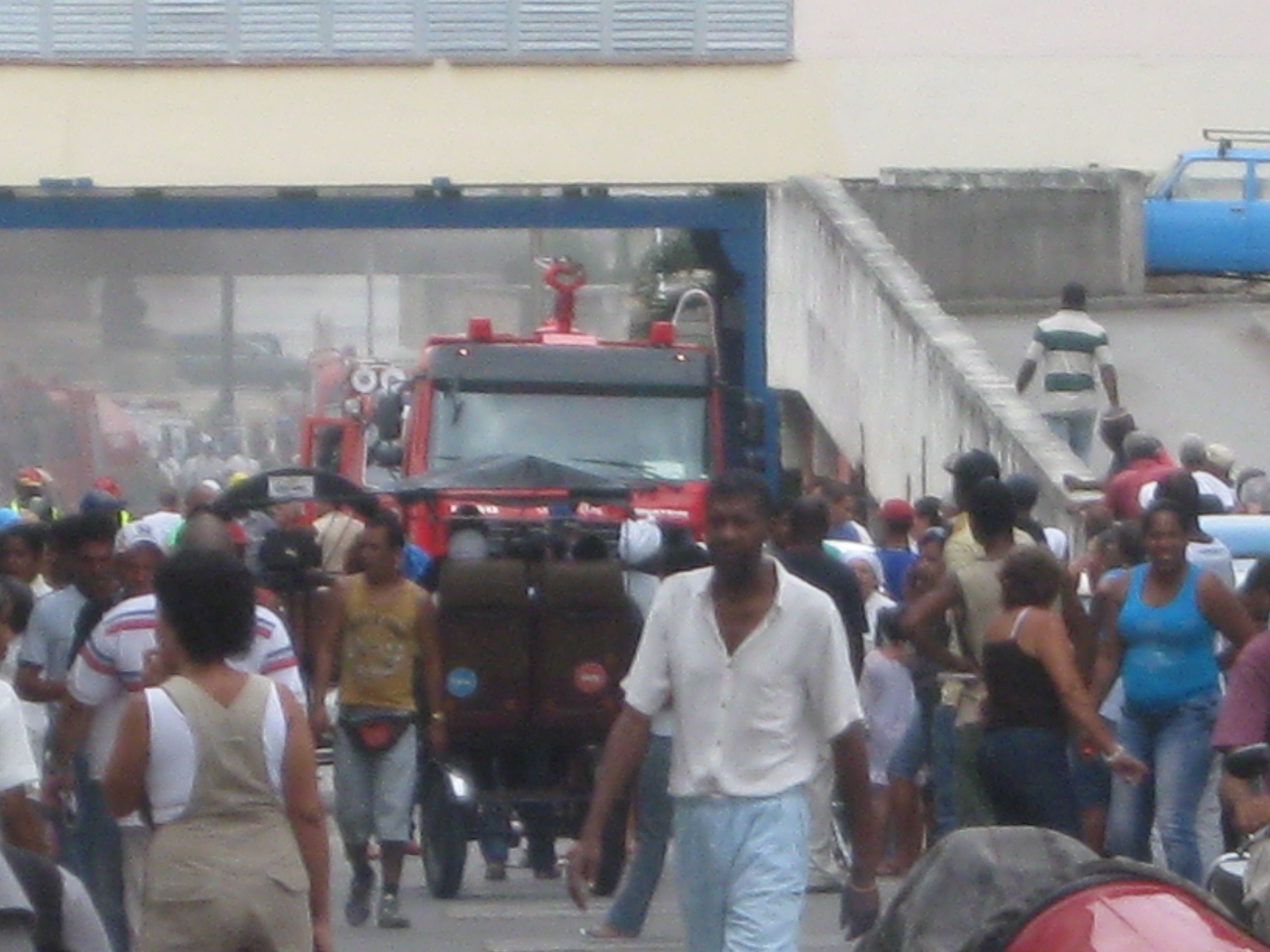
The Hermanos Ameijeiras Surgical Hospital suffered the blow at 10:00 am, October 12, a fire following the explosion of a steam boiler, located in the basement, which blew up for lack of maintenance, without the regrettable loss of, while the media ignored the event.

According to hospital workers they had been having problems preparing of food because of defects in the unmaintained boilers. At 10:00 am there was a thunderous explosion in the basement which started a fire classified by specialists as Q-103 class. The fire stations 1, 5, and 15 from the Havana Fire Department responded along with the Search and Rescue Brigade. An aggravating circumstance was that in that same area there is a storeroom for oxygen and carbon dioxide nitrogen, the latter a highly explosive element.

Several burns were reported along with injuries from getting run over, there was no reported loss of life. On the 1:00 pm news and in prime time at 8:00 pm no mention was made of the events, nor was their coverage in other media.

As part of the rescue nuns of the Congregation of Daughters of Charity of St. Vincent de Paul were evacuated, from property owned by the local hospital, where the Havana Children’s Home is now located.

October 16, 2010