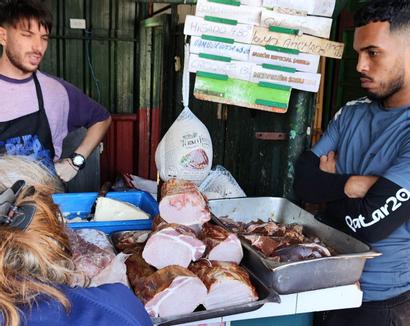
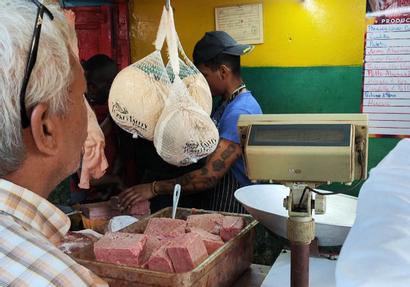
Sale of meat in the market of 17 and K, in El Vedado, Havana, on December 24, 2024 / 14ymedio
14ymedio, Natalia López Moya, Havana, 24 December 2024 — Turkey breasts from Minnesota, pork loins and legs that say “Made in USA” on the label, chickens raised in Brazil and pieces of impeccable beef fed with grass from the Iowa plains. A few hours before the Christmas Eve festivities, the platforms of Havana’s markets are mostly stocked with imported products, in a country where agriculture and livestock have reached rock bottom.
In the market on Tulipán Street in Nuevo Vedado, previously managed by the Youth Labor Army (EJT), of which only the name remains, the sellers announce this Tuesday pieces of pork at 1,000 pesos a pound, “clean, with little fat and without skin,” clarifies a smiling young man behind the counter. To convince the undecided customers, faced with the high prices, he emphasizes that the pieces “are yumas, no cubiches [foreign, not Cuban].” A few feet away, the packages of the Turkey Valley Farms brand display breasts “ready to put in the casserole or in the oven,” according to another employee. Each of the pieces is around 6,000 pesos.
A few feet away, the packages of the Turkey Valley Farms brand display breasts “ready to throw in the casserole or put in the oven,” according to another employee / 14ymedio
Cut into cubes, for those who have fewer resources, in the market on 17th and K streets, once also in the hands of the EJT, minced chicken was also being sold. Despite not having the colorful packaging of the turkey or the appetizing presence of pork legs, the label that accompanies the product says it comes from the United States. Tired of the adulterations and the bad taste of animals raised with remains collected from the garbage or with fishmeal, those Cuban diners who can afford the dinner of this December 24 opt for animals born and slaughtered outside the Island.
To complete the panorama of the foreign, a bag of rice with the label of a Turkish company rests next to others of corn flour from Spain and some packages of sweets that make clear their Mexican or Panamanian origin. The dried spice packets from Goya and Iberia have also displaced the fresh cilantro continue reading
of other years, the wild oregano that was added to the black beans, and, instead of the Creole sour orange to smear on the pork, a mojo of the Badia brand monopolized the looks and longings of those who passed by.
Cut into cubes, for those who have fewer resources, in the market on 17th and K streets, minced chicken was also being sold / 14ymedio
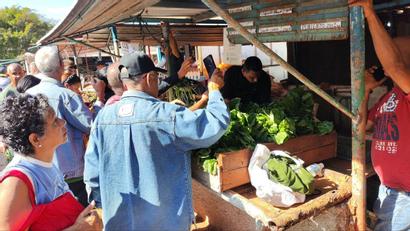
Of course, next to the butcher’s area, the platforms with yucca and lettuce exhibited only national goods. As soon as you saw them, you could tell they were coming from the yard. Some stunted cassava, full of dirt, attracted numerous elderly people who, with their bags hanging from their shoulders, formed a line at full speed. The leaves of the vegetables were beginning to get musty but, most likely, the vast majority will be sold before the sun sets.
Despite the inflation and the hard year that is coming to an end, many try to guarantee tonight’s family meal. As if of a spell to leave hardships behind, people are trying to rescue a certain festive atmosphere and the greeting that is most repeated in the streets says: “Merry Christmas.”
As the hours pass, the sorcery that some habaneros use to prepare their tables for tonight is more like an exorcism to expel the demons from the national debacle. It will also be accomplished with the foreign food that came from outside the country.
Despite the inflation and the hard year that is coming to an end, many try to guarantee tonight’s family meal / 14ymedio
Translated by Regina Anavy
____________
COLLABORATE WITH OUR WORK: The 14ymedio team is committed to practicing serious journalism that reflects Cuba’s reality in all its depth. Thank you for joining us on this long journey. We invite you to continue supporting us by becoming a member of 14ymedio now. Together we can continue transforming journalism in Cuba.
Cuba says goodbye to a man who, with the tools of the painter and the journalist, made courage the main fuel of his work
Born in Sagua la Grande, Villa Clara, in 1948, César Leal graduated from the National School of Plastic Arts, Havana, in 1968 / Facebook
14ymedio, Havana, 24 December 2024 — This Monday the Cuban painter César Leal Jiménez died in the town of Regla, Havana, according to the artist Jorge Mata on his Facebook account. The 76-year-old creator had announced this Sunday that he was suffering from a urinary tract infection that forced him to stay in bed.
“We talked on some occasions and shared opinions about the networks and the importance of following at the foot of the cannon, with our pedagogical and artistic works,” Mata commented in an emotional publication. “Leal has been a constant and very private artist. Unfortunately, his work is little disseminated and recognized, although in the guild he is respected.”
Born in Sagua la Grande, Villa Clara, in 1948, César Leal graduated from the National School of Plastic Arts, Havana, in 1968. Later he also studied Journalism and worked as a teacher in three educational centers dedicated to artistic teaching on the Island, including the Academy of San Alejandro.
“We talked on some occasions and shared opinions about the networks and the importance of following at the foot of the cannon, with our pedagogical and artistic works”
The Provincial Center for Plastic Arts and Design of Havana joined the mourning for the death of the creator and cataloged Leal as “a pillar in the art world.” The official entity recognized “his exceptional talent” and “his work, marked by a deep sensitivity and a unique vision.”
Throughout his fruitful career he won countless awards, such as the Young Latin American Painting Award, in 1966, in Mexico; two years later he won one of the awards of the Salón de Mayo, in Paris, France and, in 1980, continue reading
obtained the maximum recognition of the Salón Quinquenal Carlos Enríquez. His work “Sequence in One” is part of the permanent collection of the National Museum of Fine Arts and is currently on display there.
With a work that distinguishes him among the artists of his generation, Leal was a deep scholar of the history of art and its multiple manifestations. In his paintings, human forms are combined with countless contexts and situations to express the overwhelming lack of freedom and the sharp scissors of the censors.
With a very critical look at the current Cuban situation, Leal recently turned his social networks into an open window to his study, where he painted tirelessly, and to his work in the community of Regla to teach the first steps of the plastic arts to children and young people. He also observed the deterioration of life in his community and the country.
Through his artistic work and his Facebook posts, he denounced the controls on creators that have intensified in recent years in Cuba. He also spoke about the inflation, the crisis of basic services and the constant blackouts. He expressed his regrets over the economy and the suffocation of civic freedoms that have led so many young people and artists to emigrate from the Island.
With a work that distinguishes him among the artists of his generation, Leal was a deep scholar of the history of art and its multiple manifestations
His sympathy for the independent press was a constant. In 2004, he collaborated with the birth of the digital magazine “Consenso” and shared with his editorial team many of his pieces to be used in the design of the digital site. His paintings, with bureaucrats curtailing thought, mouths sewn shut to show disrespect for the right to free expression and figures that managed to sneak between the bars marked the visual imprint of that magazine.
With the death of César Leal, Regla loses one of her most important artists; Havana loses an adopted son who portrayed the hardness of his daily life but also the potential of his people; and Cuba says goodbye to a man who, with the tools of the painter and the journalist, made courage the main fuel of his work and freedom the model best expressed through his brushes.
Translated by Regina Anavy
____________
COLLABORATE WITH OUR WORK: The 14ymedio team is committed to practicing serious journalism that reflects Cuba’s reality in all its depth. Thank you for joining us on this long journey. We invite you to continue supporting us by becoming a member of 14ymedio now. Together we can continue transforming journalism in Cuba.
García Granda predicts only 2.6 million international travelers to Cuba by 2025, after five years of failed forecasts
According to the minister, for the first time insecurity is perceived in tourism to Cuba / EFE]
14ymedio, Madrid, 17 December 2024 — As has already happened with the sugar industry, the Government presented on Monday a projection of declining tourism. The strategy – premeditated or not – consists of underestimating the annual forecasts, even if in the end the results are even worse than the official forecasts. For 2025, the authorities of the sector are forecasting 2.6 million tourists, 18% more than than the 2.2 million they announced, Minister Juan Carlos García Granda said before the National Assembly.
Let’s review the sequence. Excluding 2020, when the pandemic forced the closure of airspace in much of the world, Cuba projected a recovery of tourism for 2021, when 2.2 million international visitors should have arrived. The figure was modest if you take into account that in 2019 – the last year before Covid – 2.4 million people visited the Island, but evaluating the pandemic was expected to be complex, and it was estimated that Cuba would receive only half as many as two years ago. Only 573,944 tourists arrived, 61% less than official forecasts.
The desire to travel and the savings achieved in the pandemic strongly reactivated the sector, and García Granda was encouraged enough to say that by 2022, 2.5 million international travelers would arrive on the Island. Manuel Marrero, who before being prime minister was the strongman of Tourism in Cuba, warned in May that Cuba would have to wait one more year for the improvement, but no one listened to him until, almost at the end of 2022, the ambitious forecast was reduced to 1.7 million, and the total reached 1,614,087 foreign visitors. continue reading
The desire to travel and the savings achieved in the pandemic strongly reactivated the sector, and García Granda was encouraged enough to say that by 2022, 2.5 million tourists would arrive
For 2023, an optimistic forecast was made again: the goal was 3.5 million tourists. But the monthly data made it clear that it was not going to be reached, and the final figure remained at 2.4 million. Despite the fact that the data were very far from the projections, at least they improved, but 2024 has been a disaster.
The latest available data, for the month of October, indicated that 1,844,917 tourists had arrived. The forecast at the beginning of the year was to achieve 3.2 million for the 12 months, lowered to 2.7 million this September. Yesterday, García Granda – in an unexpected twist – spoke of a forecast that had never been cited in public. “It was proposed to reach 4.3 million visitors taking into account the frequency of international flights entering the country. This was only fulfilled by 62%,” he said, according to Cubadebate, although the accounts indicate that it would be 51 percent.
The official press finally admits that 2024 represented “a decrease compared to the previous year and for the first time since the pandemic,” something that the independent press and economists have warned about since at least April, when the data began to worsen with respect to the same month of the previous year.
García Granda said on Monday that it is necessary to “perfect a closed financing scheme and ensure compliance with standards throughout the country’s tourism system. This is essential for the recovery of the sector. We must present a decent tourist product, which stimulates demand,” he said, ignoring that the problems of tourism are not of the sector itself, but of the country.
In a scenario of shortages affecting even the best hotels, the authorities have made it easier not only for Meliá to have an import company to obtain what it cannot get on the Island, but also Vima, the Galician food company, would have privileges. “It was approved for Vima and Meliá to have import companies and carry out wholesale trade, so they can supply the tourist facilities directly,” the minister said on Monday.
As if he wanted to hide from the criticism of the exaggerated investment in hotels made by the regime, García Granda stressed that this year “no new investments have occurred, only works that are already in progress”
As if he wanted to hide from the criticism of the regime’s exaggerated investment in hotels, García Granda stressed that this year “no new investments have occurred, only works that are already in progress.” Be that as it may, the official data speak of an economic imbalance towards the tourism sector. Between January and September, 64,973.3 million pesos (2,707 million dollars, at the official exchange rate for the State) were invested in the sector, 4.6 times more than the sum for Agriculture, Education and Health. In view of the results, it is indisputable that resources are being directed unproductively.
The minister also mentioned the impact of the high cost of aviation fuel on tourism. Two weeks ago, the Island was about to plunge into chaos after having to suspend and modify air routes due to lack of fuel. The alert could have been canceled just a day later by managing to finance a load and guarantee the A-1 Jet until at least January, but the scenario does not engender confidence in the airlines. A week ago, the German airline Condor announced that it has been suspending summer routes since May, the first time since 1990.
García Granda also mentioned that emigration and the lack of jobs tourism generates does not help to raise the sector, as well as the blackouts and meteorological disasters. But he also cited a novel factor: growing insecurity is having an effect. “Since the beginning of 2024, there has been a downward trend in Cuba’s security perception index,” he admitted. Warnings by some of the main Canadian and European providers of tourism increased as problems grew in Cuba, with notices to clients about shortages of food and fuel, diseases and blackouts.
“When there are resources, rice and grain are prioritized, but currently there is no funding”
In the same session of Parliament, Minister of Internal Trade Betsy Díaz Velázquez together with Tamara Valido Benítez, explained the problems with the “basic family basket.” Generalities and empty words abounded, such as “the population longs to hear possible solutions,” “high prices are daily concerns,” “attention to the population’s approach is an indicator of efficiency,” and so on.
The only concrete information that slipped in was the absolute lack of funding to guarantee a basic basket that has already been killed punctually every year, without being buried. “Every day we evaluate how to incorporate food, what is imported and donated, and also how to distribute it. When there are resources, rice and grain are prioritized, but currently there is no financing,” the minister said. “We must get all forms of management incorporated,” although many that are already private are starting to close because of the ban on importing and because they refuse to sell to the State.
Translated by Regina Anavy
____________
COLLABORATE WITH OUR WORK: The 14ymedio team is committed to practicing serious journalism that reflects Cuba’s reality in all its depth. Thank you for joining us on this long journey. We invite you to continue supporting us by becoming a member of 14ymedio now. Together we can continue transforming journalism in Cuba.
Through the messaging app, this teacher by profession was in charge of making the daily list of buyers and establishing strict instructions
Esther Lilian Pérez Trujillo jealously guards her social networks, but she does give away one thing: she is a teacher by profession. / X/@EstherLilianPr2
14ymedio, Havana, 25 December 2024 — Before the government acknowledged the magnitude of the energy crisis in the country – through the mouth of Minister Vicente de la O Levy the first time, in March, after mass protests in Holguín due to blackouts – Cubans had been aware for months of the lack of fuel due to rationing and the kilometer-long lines at gas stations.
In order to put things in order, the government of the municipality of Guanabacoa, in Havana, had a list of customers drawn up during the fuel crisis in June 2023, which, after being abandoned for a while, was reactivated a few days before the announcement of the increase in fuel prices, scheduled for February 2024, although it finally came into effect a month later .
Customers of the Los Paraguas and Corral Falso service centers, who were on the previous list, were told to sign up for separate Telegram groups to stay up to date with information about turns to purchase gasoline or diesel. Through the messaging app, the person in charge of making the daily list of buyers and establishing strict instructions was simply called Esther. continue reading
“This is not anarchy, it is line control, avoiding hoarding, profiteering, and line-huggers”
Esther demanded names, surnames, ID card numbers, vehicle license plate and a phone number, and she mediated severely in the event of a brawl. “This is not anarchy, it is line control, avoiding hoarding, profit, line-jumpers, etc.,” she used to say. During a visit to these gas stations in Guanabacoa, this newspaper confirmed how her iron fist also worked in person and managed to find out her full name: Esther Lilian Pérez Trujillo.
Following an initial report published by 14ymedio on her work, Pérez Trujillo reacted by saying in her Telegram groups: “They are watching,” while scathingly commenting on a photo with this newspaper’s note: “In addition to indiscipline and so on, subversion.” By then, the gas station boss had launched a crusade against the “doubles” – people registered several times on her client list – and had strengthened her authority by claiming, once again, that she was a “public servant.” The official even allowed herself to criticize the new rules for fuel distribution established in February.
The example of the organization of the Guanabacoa service stations was first extended to Tángana, in El Vedado, and then to the rest of the gas stations in the municipality of Plaza de la Revolución, last November. Once again, Esther reviewed the rules: only 40 liters of fuel per vehicle, a full tank per motorcycle and 20 liters per customer, with prior authorization, for generators.
Pérez Trujillo jealously guards her social networks, but she lets one thing slip through: she is a teacher by profession, and has taught in centers in the municipality of Guanabacoa itself. Her poise and spelling skills are evident as she commands the lines for Cupet with an iron fist.
____________
COLLABORATE WITH OUR WORK: The 14ymedio team is committed to practicing serious journalism that reflects Cuba’s reality in all its depth. Thank you for joining us on this long journey. We invite you to continue supporting us by becoming a member of 14ymedio now. Together we can continue transforming journalism in Cuba.
The opposition leader’s record, like that of her sister, includes beatings, threats and solitary confinement.
Garrido served three years in prison for contempt and attempted murder. / Screen capture
14ymedio, Havana, 24 December 2024 – When Angélica Garrido left the El Guatao women’s prison last July, after serving a three-year sentence for protesting on 11 July 2021, what she considered her “normal” life had completely changed. Her children had grown up, her parents died without seeing her free, and her sister María Cristina was still in prison to serve the remaining four years of her sentence.
“I have just completed three years of an unjust sentence for crimes fabricated by State Security. I leave my soul, my heart and my spirit with my sister María Cristina,” said Garrido as soon as she left the prison in a video posted on her social media. The opposition leader also vindicated the rest of the political prisoners and “victims of this ineffective and tyrannical system that has kept the people in constant misery and repression.”
Several months passed without any news from Garrido until last November, when the activist once again appeared in the headlines of the independent press for her trip to Brussels to participate in the Transatlantic Parliamentary Forum for a Free Cuba. “I have come today to raise my voice for them and also for my people, who are dying in silence,” she declared in reference to the Cuban prisoners detained for protesting or dissenting from the Cuban regime.
In front of a group of European Deputies and politicians from the United States, Canada and several Latin American countries, Garrido recounted her arrest, without omitting details, in San Antonio de las Lajas (Mayabeque province). She also spoke of the mistreatment suffered in prison and the other side of repression, which is almost always ignored: “Our children have psychological scars from the arbitrary arrests that were made in front continue reading
of them. My parents died in the first year that my sister and I were in prison, they were very adult people and they could not bear so much pain and so much injustice and they died.”
Nor did Garrido forget her sister, and that month she presented a book written secretly by María Cristina.
Nor did Garrido forget hrt sister, and that month she presented a book written secretly by María Cristina and smuggled out of prison on small pieces of paper with the help of friends. Voz capilar is for the activist a testimony and another promise that she will not remain silent while stories like hers are repeated. “Unfortunately, every day they spend in prison has repercussions on their lives, their health, because they are victims of repression, of torture, because they are already feeling the consequences of these three years in prison,” she argued in Brussels.
Garrido served three years in prison for contempt and assault, which was confirmed by the Mayabeque Provincial Court, ratifying the sentence imposed in the first instance and after rejecting an appeal. But she never bowed her head. The sisters frequently denounced torture and staged several protests, such as the one in September 2022, when they refused to wear the uniform of common prisoners and began a hunger strike.
Garrido’s record, like that of her sister, includes beatings, threats and solitary confinement in a punishment cell, but the opposition member says that her determination, far from diminishing, grew during her time in prison. “It is forbidden to lose heart, my brothers, for the country looks upon us proudly.”
____________
COLLABORATE WITH OUR WORK: The 14ymedio team is committed to practicing serious journalism that reflects Cuba’s reality in all its depth. Thank you for joining us on this long journey. We invite you to continue supporting us by becoming a member of 14ymedio now. Together we can continue transforming journalism in Cuba.
The woman made visible a phenomenon that is increasing: the exile of officials from the Island to the United States
González Pedraza is in prison awaiting a ruling to obtain refugee status in the US. / Facebook
14ymedio, Havana, 24 December 2024 — On May 30, days after sentencing four young Cubans to three and four years in prison for throwing Molotov cocktails at property owned by regime officials in November 2022 in Villa Clara, Judge Melody González Pedraza appeared in the United States. She arrived at Tampa Airport in Florida thanks to Humanitarian Parole; but there she was denied entry into the country and decided to request political asylum.
Since then, the judge has been waiting in prison for a ruling to obtain refugee status. Her militancy in the Communist Party and that decision, with which she snatched away years of freedom from four young people, earned her a place on the white-collar repressors list of the Foundation for Human Rights in Cuba.
Last July, in an interview with Diario de Cuba, González Pedraza attempted to distance herself from the ruling and said she had received instructions from the president of the Provincial Court of Villa Clara and the president of the Security Chamber to condemn Andy Gabriel González Fuentes, Eddy Daniel Rodríguez Pérez, Luis Ernesto Medina Pedraza and Adain Barreiro Pérez for the crime of attack. continue reading
“But the order I received was that the evidence from the Prosecutor’s Office was sufficient and had more value. The provisional detention should be maintained and they should be punished.”
“They gave me precise instructions; I argued that the defense lawyers had presented a group of important evidence, especially witnesses. But the order I received was that the evidence from the prosecution was sufficient and had more value. The provisional detention should be maintained and they should be punished,” she declared. Following these statements, the Cuban Observatory of Human Rights requested the acquittal of the young men, which was denied.
González Pedraza made visible a phenomenon that is on the rise: the exile of officials from the island to the United States. In the last year alone, at least 115 have entered the US. The figure was released last August by the Foundation for Human Rights in Cuba, which indicated that it has identified more than 1,000 people with histories of repression on the island who live in the United States.
Another case was that of Rosabel Roca Sampedro, the former prosecutor responsible for sentences of up to four and a half years in prison for “attack and contempt” for four protesters from Camagüey during the Island-wide protests of 11 July 2021.
Also on the list is Liván Fuentes Álvarez, president of the Municipal Assembly of People’s Power on the Isle of Youth between 2019 and 2022, who was denied entry by the United States immigration authorities last May after revoking his humanitarian parole. On social media, he showed himself to be a staunch defender of the regime, as evidenced by official images alongside President Miguel Díaz-Canel.
A more recent case was that of Manuel Menéndez Castellanos, former first secretary of the Communist Party in Cienfuegos, who was “coordinator of the Coordination and Support Team of Commander in Chief Fidel Castro.” Last August, he managed to enter the United States. He arrived at Miami International Airport – seeking to go unnoticed – in a wheelchair, wearing a mask and a cap.
COLLABORATE WITH OUR WORK: The 14ymedio team is committed to practicing serious journalism that reflects Cuba’s reality in all its depth. Thank you for joining us on this long journey. We invite you to continue supporting us by becoming a member of 14ymedio now. Together we can continue transforming journalism in Cuba.
On the broken benches of El Prado lie old people, beggars and drunks who have no other place to spend the night.
When they see a patrol, the beggars hide so they don’t get kicked out of the park. / 14ymedio
14ymedio, Julio César Contreras, Cienfuegos, 22 December 2024 — Night falls with low temperatures in El Prado de Cienfuegos this December. Only a few people walk through the streets, dark due to power outages or the lack of public lighting. State bars and restaurants close before 11:00 but Cristina, a retired teacher, could not alleviate her hunger even if the establishments were open.
Cristina says she has been abandoned to her fate by the Social Security system, without even being able to enter an old-age home. “My nephew, despite having raised him, threw me out of my own house and the social workers ignored my problem; that is the reality. My only bed is the floor of the doorway where I find a place to rest and my only clothes are the ones I am wearing,” she laments.
“I belong to El Prado just as the statue of El Benny belongs,” says Gustavo.
Cristina’s tragic situation is not an isolated case. On the broken benches of El Prado lie old people, beggars and drunks who have no other place to spend the night. Some carry sacks or bags where they keep their few belongings. Others go empty-handed, tired of wandering and begging so that, if luck and charity help them, they can eat once a day.
“On the Paseo de El Prado is my little shop and my house at the same time. I go through all the garbage bins collecting cans and bottles to sell as raw material. That’s how I survive. I go to sleep wherever I feel sleepy first, whether it’s in the library porches or outside the Baptist church. I belong to continue reading
El Prado just like the statue of El Benny belongs,” says Gustavo, another of the park’s occasional residents.
According to what he told 14ymedio, he dedicated his best years to the sugar industry, until a work accident prevented him from continuing. “I don’t have a home and sometimes I go months without being able to shower, but I am an industrial engineer, graduated in 1971, and I lived through the dismantling of the sugar mills in the 90s. After so much sacrifice, the debacle also came for me,” confesses the Cienfuegos native, leaning on his crutch.
Many beggars are dedicated to collecting garbage to sell as raw material. / 14ymedio
“My accident happened in the middle of the harvest and after that I didn’t hear anything more from the union or the management of the 14 de Julio sugar mill in the municipality of Rodas, where I worked. They always accused me of being ’conflictive’ for clearly saying what I thought and, at the first opportunity they had, they took me to the medical commission to get rid of me. Then I lost my house in a fire. Eight years later, I’m still waiting for the government to address my case,” Gustavo complains.
Cristina and Gustavo are not alone. Protected by the quiet of the night and without a better option, other beggars rest their heads every night on the marble steps or the hard wood of the benches. When a patrol car approaches, they press themselves to the stones and do not move until dawn. Despite everything, they do not want the police to take them away.
____________
COLLABORATE WITH OUR WORK: The 14ymedio team is committed to practicing serious journalism that reflects Cuba’s reality in all its depth. Thank you for joining us on this long journey. We invite you to continue supporting us by becoming a member of 14ymedio now. Together we can continue transforming journalism in Cuba.
The Catholic hierarchy has lost the moral authority it had before the Revolution and in the years that followed.
Bishops Juan Gabriel Diaz, Juan Garcia, Dionisio Garcia, Marcos Piran and Arturo Gonzalez, current president of the Conference. / Archdiocese of Santiago de Cuba
14ymedio, Juan Izquierdo, Havana, 21 December 2024 — The Christmas message published this Thursday by the Cuban Episcopal Conference gives an indication of how much the tone has been lowered when it comes to questioning the government. An undisputed moral authority in times past, a bastion of freedom of expression in a country that has progressively become submerged in censorship, the Catholic Church now only dares to allude – with extreme timidity – to Cuba’s “difficult realities.”
Allegory and long circumlocutions, as well as never directly addressing the authorities, mark every message from the Cuban bishops since the protests of 11 July 2021. This Thursday, the text barely dared to regret the “too many” difficulties and warn that the Church can only provide one “service”: prayer, in addition to promoting “charitable and solidarity initiatives.”
Not confronting the government – which could complicate or suspend the entry of aid and money for the Church, take away the clergy’s import licenses for certain supplies, as well as their allocation of materials and fuel, and hinder the development of public celebrations – seems to be the code of conduct of the Catholic hierarchy on the Island. The cautious tone that defines each communication and the docility of some high-ranking ecclesiastical officials, such as the secretary of the Conference, Ariel Suárez, when meeting with officials of the Communist Party, demonstrate this.
The difference is notable if one compares a message like the one on Thursday with, for example, the Christmas message from the Archbishop of Santiago de Cuba, Enrique Pérez Serantes, on December 24, 1958. This prelate, born in Spain in 1883, was the one who protected Fidel Castro after the attack on the Moncada barracks and ensured that his life and rights were respected.
Pérez Serantes, guided by another priest, during the National Catholic Congress of 1959, which Castro attended. / Ernesto Fernández/On Cuba
“In this province of Oriente we have been enduring the horrors of a civil war for a long time, without our brothers in a large part of the national territory apparently being properly informed, despite the fact that Oriente is home to a third of Cuba’s population,” Pérez Serantes’ message stated. “Let no one continue to have fun carefree, while millions of Cubans writhe and moan in anguish of intense pain and misery.”
The bishop, who openly criticized Fulgencio Batista, later became one of the fiercest opponents of the revolutionary regime. He was accompanied in the Episcopal Conference by other prelates who were no less “inconvenient” for the new authorities, such as Evelio Díaz, Eduardo Boza Masvidal – arrested and exiled in 1961 – and Adolfo Rodríguez.
In the face of the first steps of the Castro regime, Pérez Serantes and his companions quickly understood the direction the country would take and tried to warn about the loss of democratic values and the dismantling of the free society. continue reading
There were clashes and controversies on all the major issues of the time: agrarian reform, the nationalization of education, the confiscation of property and assets, and the communist turn of the Revolution, which caused the bishops to multiply their diatribes against Castro. The circulars and pastoral letters of the time, with titles as suggestive as “Rome or Moscow,” “Neither traitors nor pariahs” and “Problems of the moment,” were compiled during the Special Period in The Voice of the Church in Cuba, 100 Episcopal Documents, published in Mexico and distributed in Cuban parishes.
A phrase from Pérez Serantes encapsulates the atmosphere in the churches in the 1960s: “With communism, nothing, absolutely nothing.”
A phrase from Pérez Serantes encapsulates the atmosphere in the churches in the 1960s: “With communism, nothing, absolutely nothing.” Even then, the Episcopal Conference – which identified itself with “the Revolution that cost so much” – asked the Government for dialogue and not the imposition of an ideology.
The government did not sit idly by. In November 1960, in the letter Let us Live in Peace, the bishops lamented the “lack of civility” of some revolutionary groups, who burst into churches to shout slogans if a priest read a circular against communism.
By 1961, and despite protests directed at government institutions and Castro himself, the bishops were considered – in the words of Pérez Serantes – as “shepherds of those conspiring against the people” and protectors of “agents of counterrevolution and pillage.” This open letter is the last episcopal document included in The Voice of the Church in Cuba until 1969.
Harassed by State Security and with no media outlets to publish his letters, Pérez Serantes had died the previous year.
In the 1970s, a new generation of bishops began to arrive – most of whom were mentors to those who now hold the office – which changed the tone of the already all-powerful personal government of Castro. The rules of the game had changed definitively and the new prelates had understood, as priests, how far the political police were prepared to go.
Cardinal Jaime Ortega presiding over the funeral of Oswaldo Payá along with other high dignitaries of the Church in Havana. / EFE
The Christmas message in 1969 – very similar in tone to the one published this Thursday – is a sign of mistrust towards free speech. It called for “better understanding between different generations and between different ways of thinking.” That was all.
Having become accustomed to silence when it came to dealing with political issues, the bishops only referred to the country in 1973, with a condemnation – No to Terrorism – of the attack against the so-called Barbados Plane Flight 455. At that time, Pope Paul VI also sent his condolences to the families of the victims.
In 1978, they supported The Dialogue with the Cuban Community Abroad, a government initiative to attract those who had fled the Revolution and were willing to return to the Island. At that time, the bishops took the opportunity to ask Castro to release political prisoners and improve the situation of those released from prison, who had been marginalized from society even after serving their sentences.
A private note from the archbishop of Santiago – at that time, Pedro Meurice, no less combative than his predecessor and teacher – recommended in 1980 that priests and nuns support families who decided to emigrate through the port of Mariel.
The entire Special Period was spent in the search for a “climate” that was not free of tensions or difficulties.
Since 1990, and in particular since the middle of that decade – with the appointment of the Havana archbishop Jaime Ortega as cardinal – the tone of relations has consolidated its diplomatic nature. The entire Special Period has been spent in the search for a “climate” not free of tensions or difficulties.
In 1989, Castro told Prensa Latina that he was willing to receive Pope John Paul II, who was proud – always in “humble” terms – to have made his pontificate a war to the death against communism in his native Poland and the Soviet Union.
The test of fire for the Episcopal Conference in recent decades was the execution of Arnaldo Ochoa and three other soldiers. At that time, Ortega was the one who was calling the shots and could speak in his personal capacity. His condemnation of the death penalty was total and uncomfortable.
Requested in the late 1980s, Pope John Paul II’s visit to Cuba had to wait a decade. / Archbishopric of Santiago de Cuba.
They would return to the charge in 1992, regarding the irruption of the Rapid Response Brigades in liturgical celebrations in which opponents participated. El amor todo lo espera [Love hopes all things], the great pastoral letter of the time, in 1993, was also the last criticism of the general structure of the country. Accused of calling for a “bloodbath,” the letter earned them “a strong dose of aggressiveness” in the State newspaper Granma, they lamented.
In this “climate,” the long-awaited visit of the Pope had to wait almost ten years, until 1998.
“What should we do then? Raise our voices? Will they be heard?” asked the Cuban bishops in the 1980s. Their response: not to remain silent. Relatively immune – due to its international character – to a large-scale attack by the regime, the Episcopal Conference acted with aplomb and knew it had a voice. Now, to remain silent is to survive.
____________
COLLABORATE WITH OUR WORK: The 14ymedio team is committed to practicing serious journalism that reflects Cuba’s reality in all its depth. Thank you for joining us on this long journey. We invite you to continue supporting us by becoming a member of 14ymedio now. Together we can continue transforming journalism in Cuba.
A collaborator of ’La Hora de Cuba’ is prevented from delivering toiletries to the detainee
Henry Constantin thanked the messages of solidarity that have called for his release on social networks / Facebook/Henry Constantin
14ymedio, Havana, 23 December 2024 — Henry Constantín, director of La Hora de Cuba and regional vice president for Cuba of the Inter-American Press Society (IPA), has been in detention for 96 hours in El Vivac de La Habana. This Monday he was able, however, to communicate with the media he directs and declared that “he dedicates his Christmas to all the political prisoners of Cuba, without exception,” especially to Félix Navarro, his daughter Sayli Navarro and Sissi Abascal. He thanked the messages of solidarity that have asked for his release on social networks.
According to La Hora de Cuba, a collaborator – whose name they do not offer – approached the detention center of the Ministry of the Interior, located in the municipality of Arroyo Naranjo, but the authorities refused to provide him with any type of information and would not let him deliver the toiletries that he was carrying for the journalist.
“The officer on duty – who could not be identified by his military rank – told me that on Sundays nothing is received, that on Sundays they do not receive any package for any detainee,” this source told La Hora de Cuba. “They insist that nothing can be known about any detainee.” They only receive packages on Monday, Wednesday and Friday on a strict schedule, from 9 am to 11 am and from 2 pm to 4 pm.
“The visit corresponds to that detainee this Thursday, but in his case headquarters has to assess whether he is allowed or not”
In the same way, they warned him about Constantín: “The visit corresponds to that detainee this Thursday, but in his case the headquarters has to assess whether he is allowed or not.” continue reading
The journalist from Camagüey was arrested last Thursday, on the eve of the “march of the fighting people” organized by President Miguel Díaz-Canel in response to Cuba’s maintenance on the US list of countries that sponsor terrorism. That same day, the independent media adds, he was interrogated by six State Security agents who told him that he would be transferred to Camagüey “according to the availability of fuel from the Ministry of the Interior.”
La Hora de Cuba indicates that on Monday an appeal of habeas corpus was filed before the Provincial Court of Havana, “which will be settled tomorrow due to lack of staff today,” and that it must be legally answered within three days.
Other dissidents harassed on December 19 were journalist Juan Manuel Moreno, director of the Cuban Institute for Freedom of Expression and Press (ICLEP), Amanecer Habanero, and activist Yamilka Lafita, alias Lara Crofs. State Security forbade both of them from leaving their homes under threat of arrest.
Translated by Regina Anavy
____________
COLLABORATE WITH OUR WORK: The 14ymedio team is committed to practicing serious journalism that reflects Cuba’s reality in all its depth. Thank you for joining us on this long journey. We invite you to continue supporting us by becoming a member of 14ymedio now. Together we can continue transforming journalism in Cuba.
The migrants from the island, including two women, have been detained in a facility of the National Migration Institute
Municipal police officer Dagoberto Canul confirmed to this newspaper the abandonment of a raft in Punta Cancun / Facebook/Amanecer QR – News
14ymedio, Mexico City, 25 December 2024 — At least 15 Cuban rafters landed on Christmas Eve at Playa Caracol, near the Continental Hotel, in Cancun, Mexico. According to the Reporte24Qr website, Navy personnel “secured the migrants, including two women” and handed them over to the National Migration Institute (INM) in Playa del Carmen.
At the Immigration office, 14ymedio was denied details about the migrants from the island. “The staff on duty is not authorized to offer information,” a woman responded by phone when questioned about the status of the rafters. “Leave your number and we will call you back,” she stressed.
The rafters will remain under the protection of the authorities and their situation will be defined in the first days of 2025, the period in which the Migration officials will return to their activities.
The rafters will remain under the protection of the authorities and their situation will be defined in the first days of 2025
Municipal police officer Dagoberto Canul confirmed to this newspaper that a raft had been abandoned in Punta Cancún. According to testimonies from tourists, “more than 15 people had arrived on the boat, but it would be risky continue reading
to give a number.” Inside the boat they found cans of food and some clothes. The officer has no report of the names of the migrants because the operation was carried out by the Navy, which “at this time of year conducts patrols on the beach.”
Canul acknowledges the increase in clandestine journeys from the Island. In the most recent case, “I have no doubt that it is linked to a network of coyotes, who abandon them upon disembarking.” With this group, says the municipal police officer, “between January and December so far there are a total of 117 irregular migrants who were placed at the disposal of Immigration.”
The official, who has closely followed several of the clandestine arrivals, regrets that no one has been arrested in connection with the operation. “The Cubans are very secretive, I don’t know if it’s out of fear or because it’s part of the agreements they reach with human traffickers.”
A clandestine trip, according to Canul, costs Cubans between $5,000 and $7,000 per person
A clandestine trip, according to Canul, costs Cubans between $5,000 and $7,000 dollars per person. The editorial staff of this newspaper has received information about the routes exploited by coyotes. The main arrival points are the Sian Ka’an Biosphere Reserve due to “its poor surveillance,” Isla Mujeres and Cancun. “Dozens of rafters have been allowed to come from Isla de la Juventud and land in Cancun,” said the official.
Javier Robles, a fisherman who owns a catamaran that he rents to tourists in Cancún (Quintana Roo), told 14ymedio that the clandestine arrivals have left several boats stranded on the coast, to the point that “Isla Mujeres is becoming a cemetery of abandoned rafts used by Cubans to reach Mexico.”
In mid-November, a rustic raft named Esperanza was found by a local resident while he was running with his dog on the beach. It contained Cuban money, clothes, cans of food and some fuel canisters. A fishing boat with license plate PR5348F5a was found last June on the rocks at Playa de Mascotas, located in the La Gloria neighborhood.
____________
COLLABORATE WITH OUR WORK: The 14ymedio team is committed to practicing serious journalism that reflects Cuba’s reality in all its depth. Thank you for joining us on this long journey. We invite you to continue supporting us by becoming a member of 14ymedio now. Together we can continue transforming journalism in Cuba.
’Girón’, the official newspaper of Matanzas, criticizes the fact that menstrual pads are sold in hard currency when there are none in pesos in pharmacies
With manufacturing in the basement, the Cuban pharmacy network is unable to meet demand. / EFE
14ymedio, 20 December 2024 — A video published this Friday by Girón, the Matanzas newspaper, aims to give a panoramic view of the cost of menstruating in Cuba, according to its title. The news for Matanzas women, and Cuban women in general, is not good: between 10% and 30% of their salary is spent each month on purchasing menstrual hygiene products, and that is if they can find them.
Girón is clear on this point and admits that, despite the fact that “so-called intimate hygiene products are as necessary as soap, deodorant and toothpaste, the problem in this matter lies in the fact that Cuban state production of sanitary pads has been dramatically reduced due to the impossibility of accessing imported inputs that allow them to be manufactured.”
The inability of the health industry to meet this need is an almost historic problem on the island. What is new, however, is that the official press offers concrete data – at least at the provincial level, as is the case here – to describe the situation. According to the media, a woman uses between five and seven sanitary pads a day during each period, up to 500 in one year and about 17,000 throughout her life.
With production running low, the Cuban pharmacy network is unable to meet the demand, which, given that Matanzas is home to some 82,000 menstruating women, amounts to 41 million pads per year. The current continue reading
level of production is not even close to that figure. Last August, the province received just 15,000 packages of 10 units (150,000 pads).
The market for ’intimate goods’ does not reach much further, except for those who can afford to pay for them in dollars.
Added to this are the high prices of the packets on the informal market – in the absence of their sale in pharmacies – which range from 300 pesos for a packet of 10 units of poor quality Cuban manufacture (Mariposa), up to 800 for a packet of 24 units of better manufacture, although also national (Angélica). If the product is imported, the value rises to two hundred pesos above national pads, taking into account the quantity.
The market for íntimas does not go much further, except for those who can afford to pay for them in dollars, something that, even for the Communist Party newspaper in Matanzas, escapes socialist logic. “The straw that broke the camel’s back is that, while the national pharmacy system cannot provide sanitary pads to the population, in the stores in freely convertible currency (MLC) the package of imported menstrual products is sold at a price equivalent to five dollars, 600 pesos at the official exchange rate and more than 1,500 at the informal exchange rate. This situation causes women in Matanzas to have to buy such an indispensable hygiene item by any means, at any price.”
The situation, Girón admits , forces women to seek cheaper solutions to the problem, ranging from making their own pads – from used fabrics – to buying other items, such as menstrual cups. The latter are somewhat popular on the island, especially among young girls, but those that end up on the black market are usually the least friendly options for women and of poorer quality.
Although it is a “recommended” article, the media regrets that the right to menstrual hygiene is not fulfilled in Cuba
Although it is a “recommended” article, the media regrets that the right to menstrual hygiene is not fulfilled in Cuba, which includes “that women can freely choose how to do it [face their cycle] and for this they must be guaranteed access to all products. Not to mention that when a group of people cannot access a product or service to satisfy a basic need, which is also a right, we are faced with a clear example of inequality,” it concludes
Hopes for a short-term solution to the situation are slim if we look at the path taken by the main sanitary pad manufacturers, such as Mathisa – located in Sancti Spíritus and responsible for supplying from Matanzas to Camagüey. In 2016, the factory closed with a debt of three million units due to logistics problems and, by 2021, the company’s debt, which was never paid off, was four million.
Since then, logistical obstacles have been compounded by a lack of fuel and the State’s growing inability to obtain raw materials, meaning that Mathisa’s production has been intermittent. The company was only able to restart production last April – after stopping it in February – when it received imported padding for its sanitary pads, and since then, despite the official silence, it is likely that another production stagnation has occurred.
____________
COLLABORATE WITH OUR WORK: The 14ymedio team is committed to practicing serious journalism that reflects Cuba’s reality in all its depth. Thank you for joining us on this long journey. We invite you to continue supporting us by becoming a member of 14ymedio now. Together we can continue transforming journalism in Cuba.
Pedro Garce Fights Against ’Imperialism’ and the Bureaucracy of Those ’From Above’
Line for the El Tángana gas station in El Vedado, Havana / 14ymedio
14ymedio, Havana, 23 December 2024 — Every time he starts writing in his Telegram group, Pedro Garce, organizer of the lines for fuel in El Tángana and two other gas stations in the municipality of Plaza de la Revolución, makes customers tremble. For days, the administrator – committed to “order and discipline” – has only brought bad news, almost always linked to the breakdown of a pump or the suspension of sale.
Garce doesn’t like to “collide” so often with the bureaucracy and makes it clear in the chat. On Saturday night, for example, he sent a message announcing the suspension of the El Tángana service. The appearance of problems in the pumps that dispatch the fuel and a “cultural activity” on the Esplanade of La Piragua, forced him to make the decision.
The interruption of the sale implies that Garce must reorganize the gas line and the schedule for each customer to buy. They can spend weeks on the list to acquire a few liters of fuel. In this specific case, he must deal with the 75 drivers who were on the previous day’s list for regular gasoline and who had to be reorganized this Sunday.
“Be punctual and disciplined, remember that if you miss your turn you lose it”
The energy situation and the frequent shortage of fuel do not make his life easy, and many times, when gasoline appears, he must summon customers in a hurry; hence, his mantra: “Be punctual and disciplined, remember that if you miss your turn you lose it,” whether it’s at dawn or early morning. The arrival of always meager amounts of fuel forces drivers to remain “prepared and alert,” as if they were expecting a hurricane.
Last Thursday, one day before the “march of the fighting people” called by the regime, the El Tángana service center had one of its most chaotic days. Garce not only had to announce the suspension of the service until 3:00 pm due to a sudden blackout, but, two hours after resuming it, he also had to stop the sale again “due to the measures taken for the development of the march [of the fighting people],” scheduled for the next day.
The administrator hoped that the delays would not be too long, but at 8:30 p.m. he made a hopeless announcement in the group: “Activities continue on the Anti-Imperialist Platform, and, once completed, the dismantling continue reading
process begins, maintaining the restrictions on access to the gas station. It has been collectively decided to resume the service from tomorrow.”
The manager regrets that “situations occur” in which customers do not empathize with his work. “My commitment is only to the people, to the masses. Got it?” he wrote this week in the chat. A little later, he shared a message from the Gente de Barrio channel – dedicated to sharing official content – that criticized the operation of the lines in the gas stations. The text questioned, from the point of view of “those below,” as Garce is considered, something that the organizer of the line himself has described as “irrational”: the arrival of fuel at a gas station that does not have pumps in good enough condition to dispatch it, as happened on Thursday.
“The tanker truck that entered El Tángana is, irrationally, for gasoline, and the pumps there are broken”
“The tanker truck that entered El Tángana is, irrationally, for gasoline, and the pumps there are broken. There is another type of gasoline that arrived 15 days ago, and the pumps were not available either. I’m calling the government and the Cimex authorities but they don’t answer. Don’t worry, we will look for a solution,” he then encouraged the more than 6,000 customers that make up the group.
Just a few days before the administrator apologized profusely for the mess in the line – “this is crazy,” he criticized. “I hope you understand me,” “I’m making an important effort,” “this is not my fundamental function,” Garce explained after making a mistake in which he had summoned more than 1,000 drivers instead of the 625 he had to call. “I recognize it with total frankness. You know that that [amount of] gasoline doesn’t go very far.”
For Garce, as for Esther Trujillo, the organizer of the Guanabacoa gas lines, his work is a constant crusade against “imperialism,” which limits resources, and against those “from above” who do not know how to manage them. In his code, the first law is to provide order and the second is to serve the customers “as they deserve.” It’s a matter of luck whether he can handle the “many tasks” and “the time pressure” in order to fulfill his commitment.
Translated by Regina Anavy
____________
COLLABORATE WITH OUR WORK: The 14ymedio team is committed to practicing serious journalism that reflects Cuba’s reality in all its depth. Thank you for joining us on this long journey. We invite you to continue supporting us by becoming a member of 14ymedio now. Together we can continue transforming journalism in Cuba.
Fifo. To me, you are the oldest of the old. And in a dictatorship, the leader’s expiration date is the closest thing there is to hope.
The voice of the dictator stays with the child forever. / Cubadebate
14ymedio, Xavier Carbonell, Salamanca, 1 December 2024 — Between sips of coffee, with the faith of a true believer, of a fanatic who has earned his place in paradise, a teacher of mine once told me, “You are incapable of having any feelings for the revolution because you’ve only ever known an old Fidel.” Not old, I thought, without interrupting my interlocutor’s mystical outburst. More like decrepit. A mummy, a zombie, the bogeyman, Nosferatu. The Prince of Darkness reduced to a hunchbacked spine. The translucent beard, the ratty hair, the dark circles of the faithful departed
“What does Fidel have, what does Fidel have?” asks the almost pornographic little ditty. A firm chest, an invincible strength, a frightful steeliness, an enormous sword thrust inside and affixed there forever (oh, for God’s sake, Manuel Navarro Luna!), immense tenderness, a fountainhead of tuberoses, a river of triggers running down his belt. He could teach Homer’s heroes a thing or two. And Don Quixote too! But he hates those rotten dollars (though nothing could be further from the truth). You already know what Fidel has.
But not for me, Fifo. To me, you are the oldest of the old. And in a dictatorship, the leader’s expiration date is the closest thing there is to hope. His sacred presence became ever more sacred until death separated him from the masses, which happened on my way to Varadero — a wonderfully surprising gift of a day — on November 25, 2016. “But there was one thing I couldn’t quite shake,” I told my gentle teacher: “the voice of Fidel.”
“Can a human voice cast a long, depressing shadow,” asked George Steiner in reference to Hitler
“Can a human voice cast a long, depressing shadow?” George Steiner asked himself in reference to Hitler. The philosopher’s childhood in Paris took place amid the soundtrack of the Führer’s speeches on the radio. The commanding diction and accompanying gestures — there are voices that are a whole body — defined the soundscape of his generation. Hitler wanted to sweep away an entire vocal culture — Freud, Mahler, Schoenberg, Wittgenstein — and no one can imagine a silent Hitler.
The voice of the dictator stays with the child forever, dear parents and pedagogues. While a young Steiner was listening in terror to Hitler, a young Umberto Ecco heard Mussolini declare war against France and Britain. For him, the Fascist diatribes were as much a part of his childhood as Flash continue reading
Gordon and Dick Tracy comic strips, the adventures of Sandokan and Professor Lidenbrock, music theory and drawing classes.
Our historic moment was a desperate attempt to abandon history, encapsulated in the voice of the dictator
In school, when hordes of students were forced to swear loyalty to “il duce,” those who came from anti-Fascist families always found ways to make fun of the oath. One of Ecco’s classmates would jokingly shout “Arturo!” instead of “Lo giuro!” (“I swear!”). How many times did we ourselves purposely mangle slogans during military preparation marches? One, two, three, four, eating shit and ruining shoes. First of May, horses’ day. April 1st, it’s the worst. No, the fun never ends, Carlos Puebla.
Revolution is a sense of the historical moment. Our historical moment was a desperate attempt to abandon history, encapsulated in the voice of the dictator. Díaz-Canel not only has no balls, he has no voice. His stutter, his inability to speak other languages, his fear of crowds, all disqualify him as a true leader. Neither did Raúl, who speaks with the nasal voice of a Cuban drunkard, a boozer, the family e’er-do-well. Raúl Modesto reminds us of Francisco Franco in some ways: the mustache, the low volume, the annoying, almost telephone-like ring. They all compensated for this by being relentlessly aggressive. Blood will calm any neurosis.
A sonorous museum of cruelty might include the the staccato voice of Hugo Chavez (“Ah, Mr. Danger, you messed with me, little bird.”); the cretinous voice of Nicolás Maduro (“Sometimes I realize that it is me when I look in the mirror.”); the fawning voice of Evo Morales (“Fidel has not fallen ill, he is just being repaired.”); the guttural voice of Adolf Hitler (“People have never been liberated with humanity and democracy”); the ranting voice of Kim (“Nuclear power is a symbol of sovereignty.”); the monotonous voice of Stalin (“I became a socialist in the seminary”); the tense voice of Putin (“Ukraine is an artificial state that Stalin willed into being.”); the pathetic voice of Ceausescu (“This morning we decided to increase the minimum wage.”).
And, of course, the voice of Fifo. (“I have never been nor am I now a communist… I am not a communist… I am a Marxist-Lenist and I will be a Marxist-Leninist till the day I die… I always admired Christ because he was the first communist… I apologize for having fallen.”)
Anyone who thinks that there are no believers left, that no one cries when a dictator dies, that no one sighs at his absence, is very wrong. Fidel has his mourners, perhaps thousands of them. On November 25, while I was celebrating these eight wonderful years of silence, a couple of “Granma” journalists reached the climax with a disturbing article about the leader.
“Fidel, whose umbilical chord was cut from two wombs — that of Lina, his biological mother — and Cuba, forged with his nation an alliance founded on love. He loved it like a father loves his children… Fidel literally opened his heart to danger and, in the midst of the rain, the mud and the roads destroyed by the combined power of the wind and the water, he was with his people in those distressing moments… The Commander’s love for his people is reborn in our president, [Miguel] Díaz-Canel.”
Honestly, who writes this stuff? And what psychiatrist are they seeing?
__________________
COLLABORATE WITH OUR WORK: The 14ymedio team is committed to practicing serious journalism that reflects Cuba’s reality in all its depth. Thank you for joining us on this long journey. We invite you to continue supporting us by becoming a member of 14ymedio now. Together we can continue transforming journalism in Cuba.
“The Communication Law and other demons that complement it practically prohibit the exercise of humor in Cuba”
Ulises Toirac and Jorge Fernández Era in Havana / Facebook/Ulises Toirac
14ymedio, Jorge Fernández Era, Havana, 14 December 2024 – Not everyone can have a hundred thousand followers on Facebook. Ulises Toirac reached this number a few days ago, not only for the prestige of an artistic career of more than four decades, but also for the seriousness with which he assumes humor and faces a heterogeneous audience that applauds as much as it denigrates.
Part of those experiences are reflected in his most recent publication, the book Locos de barrio [Neighborhood Crazies], available on Amazon and other platforms. The central subject of our meeting in Santos Suárez, our neighborhood, was that.
Jorge Fernández Era: Do you consider yourself a humorist who makes you think or a thinking being who makes you laugh?
Ulises Toirac: A little of both. Humor, even if it’s a job, is fun. The best proposals are born by vibrating your spiritual need with your communicational need. I consider myself a guy who is always looking for a way to complicate things by over analyzing, and in that way I surprise myself and try to surprise others. When I succeed, I feel self-realized.
Censorship is instituted by levels: from whether you make fun of a street sweeper to whether you do it of a director of Communal Services or the President of the Republic
Jorge Fernández Era: The line between what is allowed and what is prohibited has been crossed in recent years. For good or for bad?
Ulises Toirac: In Cuba there has always been a manifest censorship. I remember it in our beginnings in the Aquelarre festivals or in the shows that were usually held in the theaters. Unfortunately, that was small stuff compared to what we have now. The Communication Law and other demons that complement it practically prohibit the exercise of humor. Censorship is instituted by levels: from whether you make fun of a sweeper to whether you do it of a director of Communal Services or the President of the Republic. The sanction goes up to the extent that your jokes are directed towards those positions and the inability to develop them.
Before, the danger was not so visceral. At this moment anything can take you to trial if so decided. In addition, the general public does not show intellectual interest in humor. When there is censorship, we look for mechanisms with which to communicate with people. At other times, those who attended the theater identified with intelligent humor. Today, either you do junk humor or you dedicate yourself to something else.
One of the illustrations by Ulises Toirac included in ’Locos de barrio’/ Ulises Toirac/Courtesy
Jorge Fernández Era: When did you realize that you could also write jokes and memories?
Ulises Toirac: It’s a process. I write since I have use of intellectual reason. From a very young age I always liked to do it, not literature itself, but television scripts, librettos for theater… I used near or distant memories to capture them. For a while I have had a purely literary interest, but due to time, interests or work load I didn’t try to gather a series of stories in a book. From the isolation of Covid, and even before, I began to write what we could call stories.
In art, if you don’t find a personal, unique way to express yourself, you can starve to death. I realized that by transferring my personal way of speaking to paper, I achieved that. I was publishing little by little on social networks and before in a newsletter that developed a lot of subscribers. In the last three years it was already a more methodical process. But it wasn’t overnight.
Jorge Fernández Era: With Locos de barrio, does one door close or another one open?
Ulises Toirac: Both. Locos de barrio is the end of literary innocence, that stage in which one is in love with a woman and proposes marriage. With the last stories I wrote I already had the firm purpose of creating the book.
‘Locos de barrio’ is the end of literary innocence, that stage in which one is in love with a woman and proposes marriage / Ulises Toirac
Literature is the greatest incentive of the imagination. You have no limits or brakes; you can scrutinize the universe and do what you want: you close one paragraph, open another, and you move, in no time, from China to the South American cone. It will continue to be the best way to get informed, to acquire culture, to grow.
Nothing is absolute; life is dialectical, and things are intertwined on top of each other. It is clear to me that I want to continue writing and publishing. Another book is going around in my head; it will be called Epistolary without a gun. It is my desire, through letters, to talk about the topics that interest me. The letters will be addressed to a historical character, to my first preschool girlfriend, to my teenage bicycle, to my terror of heights, to the President of the Republic… Or – if the Law applies to me for the latter – to you, so that you can finish this interview.
Translated by Regina Anavy
____________
COLLABORATE WITH OUR WORK: The 14ymedio team is committed to practicing serious journalism that reflects Cuba’s reality in all its depth. Thank you for joining us on this long journey. We invite you to continue supporting us by becoming a member of 14ymedio now. Together we can continue transforming journalism in Cuba.
“Isolation hasn’t worked for the last 60 years,” says Jeffrey DeLaurentis
Jeffrey DeLaurentis, former head of the US embassy in Havana / EFE
Juan Carlos Espinosa/EFE, Havana, 17 December 2024 — Diplomat Jeffrey DeLaurentis, Chargé d’affaires of the US Embassy in Havana during the thaw in bilateral relations of the Obama era, maintains in an interview with EFE that the policy of rapprochement instead of the isolation of Cuba was a success and is still valid 10 years later.
“Despite the fact that this policy was reversed after two years, it was a success and resonates even today, despite the efforts of the (first) Trump administration to bring it down,” says DeLaurentis, who believes it is “totally false” that it failed.
Few know as well as this former US diplomat the meaning, on the ground, of the process of rapprochement between the United States and Cuba. It was announced on December 17, 2014, by Barack Obama and Raúl Castro, after months of secret negotiations involving the mediation of the Vatican and Canada.
In an exclusive interview with EFE conducted via Google Meet, the Chargé d’affaires of the US embassy during the thaw (2014-2017) highlights the legacy left by Obama’s policy (2009-2017) in the relations between the two countries after decades of Cold War.
In his opinion, not even the first term of Republican Donald Trump (2017-2021), with the tightening of sanctions and the inclusion of Cuba in the list of countries sponsoring terrorism, has managed to erase that mark. continue reading
In his opinion, that approach is “the best way to advance the interests” of Washington by “encouraging” the opening of reforms on the Island
“The thaw,” he says, needed “more time” to be “sustainable.” In his opinion, that approach is “the best way to advance the interests” of Washington by “encouraging” the opening of reforms on the Island and “improving the life of the Cuban people,” in contrast to the hard-line policy of the Republicans.
“During my first mission in Cuba (in the nineties), I arrived thinking that the US approach was the right one. But, frankly, I left recognizing that isolation was not the right approach, and, honestly, it had not worked and has not worked in the last 60 years,” he says.
The retired ambassador, who previously worked in the US Interests Section (a category lower than that of an embassy) in Havana in the nineties and 2000s, highlights the rise of the private sector in Cuba after decades of prohibition and demonization.
“You could see how people’s mentality was changing. Young people were enthusiastic and focusing their energy on the Island’s future instead of leaving everything behind and emigrating,” he tells EFE.
After four years of serious economic crisis – with a shortage of basic goods and services, galloping inflation and daily power cuts – Cuba is once again experiencing a great migratory exodus. In the last three fiscal years, more than 600,000 Cubans have entered the United States, according to official figures.
Cuba is once again experiencing a great migratory exodus. In the last three fiscal years, more than 600,000 Cubans have entered the United States
The former diplomat – proposed by Barack Obama as ambassador, the first on the Island since 1960 – recalls the resistance encountered by the Democratic administration to achieve a total political turn towards Cuba.
“Given the long and tortuous history between the two countries, this process was never going to be linear. There were always ups and downs. My feeling was always that the Cuban authorities knew how to deal with the tough posture, but that they were a little more uncomfortable with the approach we were defending,” he recalls.
After Obama’s visit to the Island in 2016, the culminating moment of the thaw, former Cuban President Fidel Castro said, in an article published by state media, that the country did not need “the empire” to give it anything and strongly criticized Obama’s speech during his stay.
On the other hand, DeLaurentis points out that the Obama administration assumed that there would be resistance from hard-line sectors in Cuba and that “there were also people, I suppose mostly from South Florida, who were very much against” the rapprochement.
DeLaurentis highlights how the issue of Cuba awakens a different level of attention between those who believe in dialogue and those who advocate for a hard hand
In view of the next Trump government, which will take office in January and has proposed as Secretary of State the Cuban-American Marco Rubio, defender of increasing sanctions against Havana, DeLaurentis highlights how the issue of Cuba arouses a different level of attention between those who believe in dialogue and those who advocate for a hard hand.
“I think Obama’s approach was very popular at the national level, and, certainly, there are many people who think that this is the best way to proceed. But it is also true that those who defend a harder line, for many of them, that is possibly their main priority. Meanwhile, for those who support the approach, it is important, but they have many other priorities,” he adds.
Translated by Regina Anavy
____________
COLLABORATE WITH OUR WORK: The 14ymedio team is committed to practicing serious journalism that reflects Cuba’s reality in all its depth. Thank you for joining us on this long journey. We invite you to continue supporting us by becoming a member of 14ymedio now. Together we can continue transforming journalism in Cuba.

 14ymedio, Natalia López Moya, Havana, 24 December 2024 — Turkey breasts from Minnesota, pork loins and legs that say “Made in USA” on the label, chickens raised in Brazil and pieces of impeccable beef fed with grass from the Iowa plains. A few hours before the Christmas Eve festivities, the platforms of Havana’s markets are mostly stocked with imported products, in a country where agriculture and livestock have reached rock bottom.