Cuban Baseball Player Esteban Terry Leaves the Cocodrilos De Matanzas and Stays in Mexico

Last year, in the same tournament, two players from Las Tunas defected
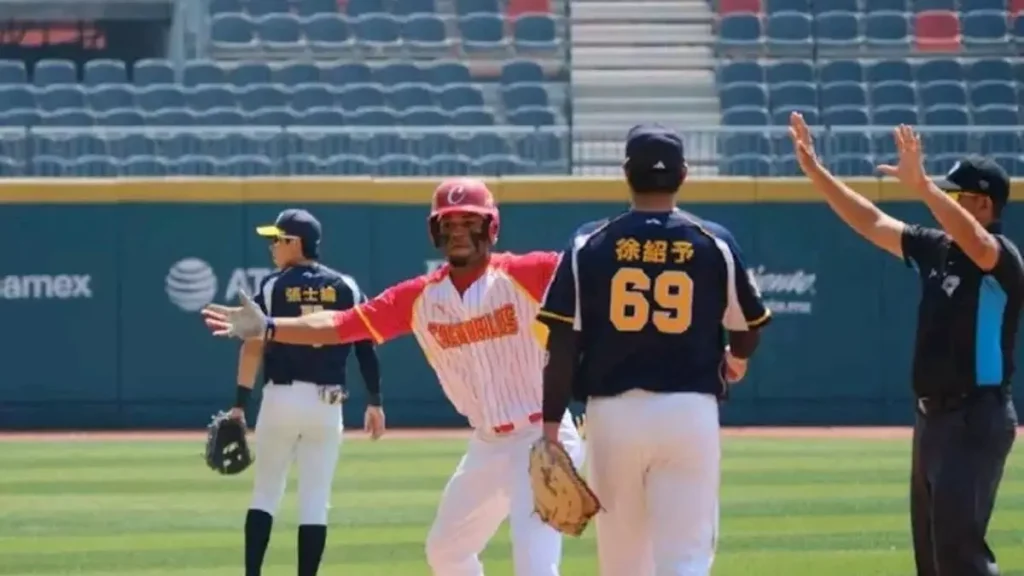

Esteban Terry recorded six hits in 17 at-bats, for an average of .353, in the Baseball Champions League Americas / Radio26

14ymedio bigger14ymedio, Havana, March 31, 2026 – Esteban Terry has become the latest case of an athlete who leaves a Cuban delegation abroad. As reported this Tuesday by Cuba Grand Slam, “the Matanzas outfielder did not return to Cuba with the Cocodrilos team that recently participated in the Baseball Champions League Americas” in Mexico.

The athlete participated with the Matanzas selection in the most recent edition of the Champions League that ended this Sunday in the Mexican capital, in which the Cuban team recorded the second worst performance of a Cuban representative in the tournament.

Although the National Series champions were battered during their appearance on Mexican soil, allowing 69 runs in four games, for an average of 17.25 per game, the 28-year-old player born in the Matanzas municipality of Limonar had an acceptable performance, recording six hits in 17 at-bats for an average of .353.

The 28-year-old player born in the Matanzas municipality of Limonar had an acceptable performance

The provincial outlet Radio26 even highlighted his performance in the first game of the Champions League. It emphasized that the outfielder was the architect of the Cocodrilos’ only victory, in a game in which they were losing 5-0 to the CTBC Brothers of Taiwan: “Sports, like life, give revenge, continue reading

and Terry got the opportunity to redeem himself. When the Asian pitching had dominated the Yumurino lineup without difficulty, the fiery player hit a double down the left field line that sparked the comeback from lethargy. His contribution in the rally in the bottom of the seventh inning was crucial, as he opened the inning with a hit and scored the first of the six runs that turned the scoreboard around.”

In the last National Series, the player had experienced a sporting resurgence after spending four years seeking opportunities in Pinar del Río, due to being sidelined by Matanzas sports authorities in 2021, despite having stood out in the national under-23 tournament.

After working his way back, in 2025 Terry participated in the 1st Jorge Luis Valdés In Memoriam Provincial Cup, which featured four teams with Matanzas players. This tournament became the perfect platform for his resurgence, as he posted a .404 batting average, with 10 hits, including four home runs, in addition to stealing six bases, driving in 19 runs, and scoring another 16. These numbers led to him being named the Most Valuable Player of the tournament. Finally, in the last National Series, he received the opportunity to join the ranks of the Cocodrilos, with whom he won the title in Cuba.

In the last National Series he received the opportunity to join the ranks of the Cocodrilos, with whom he won the title in Cuba

The Baseball Champions League Americas held in Mexico has become one of the stages for player defections in recent years. In the previous edition, players from Las Tunas Rafael Viñales and Denis Peña left the competition venue and began a new life in Mexican territory after winning the runner-up title.

At that time, the National Institute of Sports, Physical Education and Recreation (Inder), in a brief statement and as is customary, confirmed the defection and accused Viñales and Peña of “turning their backs on the commitment assumed.”

In the case of Esteban Terry, the authorities have not issued an official position on the matter. However, his departure could be treated differently from previous cases due to the new Law 179, which anticipates a “historic” change and formally eliminates the requirement of permanent residence in the country for Cubans living abroad to be able to join sports teams, both at the national and international level. Likewise, it expands the possibility of calling up descendants of Cubans residing in other countries to join the Island’s sports movement, so the Matanzas native would no longer have doors closed to him in the future.

It formally eliminates the requirement of permanent residence in the country for Cubans living abroad to be able to join teams

Before the last World Baseball Classic, several Cuban-American players, such as Los Angeles Angels shortstop Zach Neto, expressed their intentions to play for Team Asere but were rejected by sports authorities.

The measure is not retroactive, as those who have been sanctioned with separation or expulsion from the system are excluded.

Likewise, in parallel with the Government’s announcement of economic opening, the legislation also authorizes, for the first time, advertising and sponsorship in Cuban sports, allowing accredited foreigners and Cubans abroad to finance projects, from domestic tournaments to teams competing internationally. Cuban and foreign individuals who do not reside in the country “may participate in the guidance, promotion, encouragement, and development of the Cuban Sports System,” the law states.

Translated by Regina Anavy

______________________

COLLABORATE WITH OUR WORK: The 14ymedio team is committed to practicing serious journalism that reflects Cuba’s reality in all its depth. Thank you for joining us on this long journey. We invite you to continue supporting us by becoming a member of 14ymedio now. Together we can continue transforming journalism in Cuba.
Russian Oil Tanker ‘Anatoly Kolodkin’ Docks in Matanzas: “The AK We Need Now”

Experts estimate it will take between 15 and 20 days to process the crude oil and convert it into diesel, and another week to deliver the refined product.

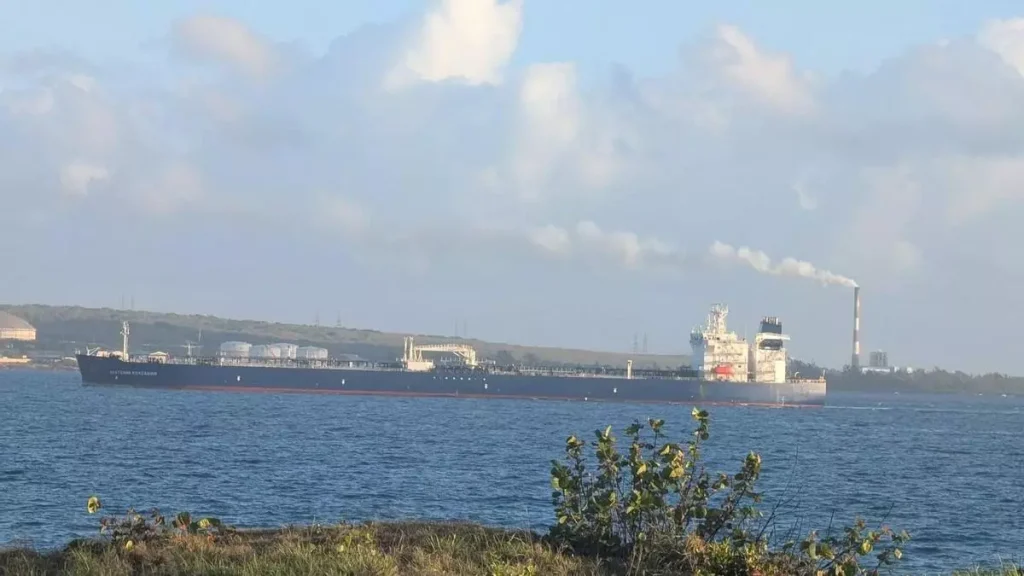
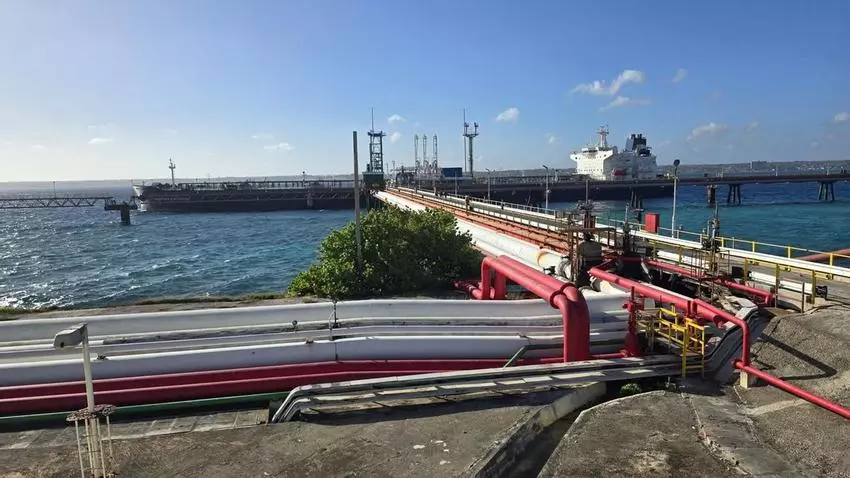
The Russian tanker ‘Anatoly Kolodkin’ arriving at the dock of the Matanzas Supertanker Base. / Facebook/Lázaro Manuel Alonso

14ymedio bigger14ymedio, Havana, March 31, 2026 / No oil tanker that has sustained Cuba’s energy system for decades had generated as much anticipation as the Anatoly Kolodkin , which finally docked in Matanzas this Tuesday. Loaded with some 730,000 barrels of Russian crude, equivalent to about 100,000 tons, it is the first tanker to arrive on the island since the Ocean Mariner arrived on January 9 with more than 80,000 barrels of fuel from Mexico .

Dozens of journalists were waiting early in the morning at the port of Matanzas to broadcast the arrival of the ship, which docked at the Matanzas Supertanker Base around 8:50 a.m., as reported by Pedro Rizo Martínez of TV Yumurí. “After docking, the unloading of the crude oil begins,” the state-run reporter also said.

Oliver Zamora Oria, a contributor to the Russian state broadcaster RT from Cuba , didn’t miss the opportunity to take a selfie next to the ship, while expressing on his social media: “As someone said: the AK we need now.”

“This is like a drop of water in the desert,” Marino Gálvez, 66, a resident of Matanzas, told the British news agency.

Cubadebate also reported the news , highlighting the statements of Russian presidential spokesman Dmitry Peskov, who said that Russia “considers it its duty” to offer the necessary assistance to Cuba and assured that Moscow will continue working to supply more oil to the island. continue reading

Also present at the port were Lázaro Manuel Alonso, a broadcaster for Canal Caribe, as well as correspondents from foreign media outlets, such as the EFE and Reuters news agencies. “This is like a drop of water in the desert,” Marino Gálvez, 66, a resident of Matanzas, told the British agency, as he watched the ship’s maneuvers in the bay from the city’s waterfront.

The man lamented, referring to the oil blockade imposed on Cuba by Donald Trump after the United States’ intervention in Venezuela and the capture of Nicolás Maduro: “What they are doing to us is very unfair, and people shouldn’t have to pay for the policies of any government.”

Once the crude oil is unloaded from the newly arrived ship, it must be transported to refineries in Havana and Cienfuegos, where it could be converted into approximately 250,000 barrels of diesel, according to Jorge Piñón, an energy specialist at the University of Texas. Processing will take between 15 and 20 days, and the refined product will take another week to be delivered.

This fuel would allow for a few days’ supply of generators, transportation, and agriculture, although the expert also fears the government will keep some for itself. “Are we so naive as to think the government won’t keep a significant amount of diesel for its own reserves, instead of supplying it to those who need it most to survive?” he told 14ymedio .

The Anatoly Kolodkin belongs to the main state shipping company, the Sovkomflot corporation, sanctioned by the US since 2024, and departed from the Russian port of Primorsk on March 9.

Two days ago, the US president downplayed the arrival of the tanker . “They have to survive! I have no problem with that,” he told reporters, while also opening the door to other similar operations: “I told them, if a country wants to send oil to Cuba right now, I have no problem with that. Whether it’s Russia or not.” He asserted: “They have a bad regime, they have bad and corrupt leadership, and whether or not they get an oil tanker, that doesn’t matter.”

El tanquero ruso ‘Anatoly Kolodkin’ en el muelle de la Base de Supertanqueros de Matanzas. / Facebook/Oliver Zamora Oria

However, on Monday, White House spokeswoman Karoline Leavitt said that if the US allowed the Anatoly Kolodkin to reach the island, it was for “humanitarian reasons,” and that the country will analyze each case to determine whether or not to authorize the arrival of other ships.

“There has been no firm change in our sanctions policy,” Leavitt stated at a press conference. “We will continue to consider each case individually, whether for humanitarian or other reasons.”

Before this appearance yesterday, Mexican President Claudia Sheinbaum had avoided clearly answering whether she would continue sending oil to the island, in light of Trump’s statements on Sunday. The president reiterated that the Mexican government is helping the Cuban people with humanitarian aid while also maintaining trade agreements with its counterpart in Havana. “What we have always said is that Mexico has every right to send fuel, whether for humanitarian or commercial reasons, but we don’t want to harm Mexico,” she explained.

At the same time, she referred to the “tariffs, well, duties” with which Trump threatened nations that send oil to the island. “In that context,” she summarized, “we will make the decision, and it will always be reported whether or not oil is sent to Cuba.” Furthermore, as something “very important,” Sheinbaum mentioned that “there are private companies in Cuba,” such as “hotels and others,” that “require fuel,” and that “they are looking for private companies willing to supply them with fuel, not necessarily government-to-government.” She continued, without clarifying whether this is the method they have found to send oil or which companies are involved, on either side: “There are private companies that have approached us, for example, to buy fuel from Pemex and then deliver it to private companies in Cuba.” 

______________________

COLLABORATE WITH OUR WORK: The 14ymedio team is committed to practicing serious journalism that reflects Cuba’s reality in all its depth. Thank you for joining us on this long journey. We invite you to continue supporting us by becoming a member of 14ymedio now. Together we can continue transforming journalism in Cuba.
The Central Bank of Cuba Creates 2,000 and 5,000 Peso Banknotes To Facilitate Transactions ‘In the Current Moments of Inflation’

For the first time, Cuban banknotes feature the faces of women, Mariana Grajales and Celia Sánchez.

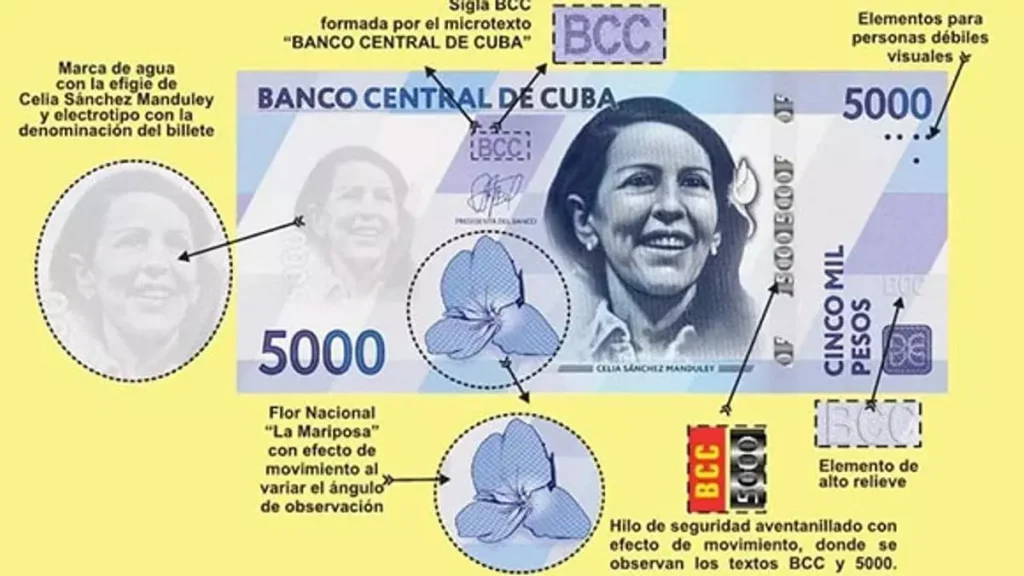
New 5,000 peso banknote with the face of Celia Sánchez Manduley / Central Bank of Cuba

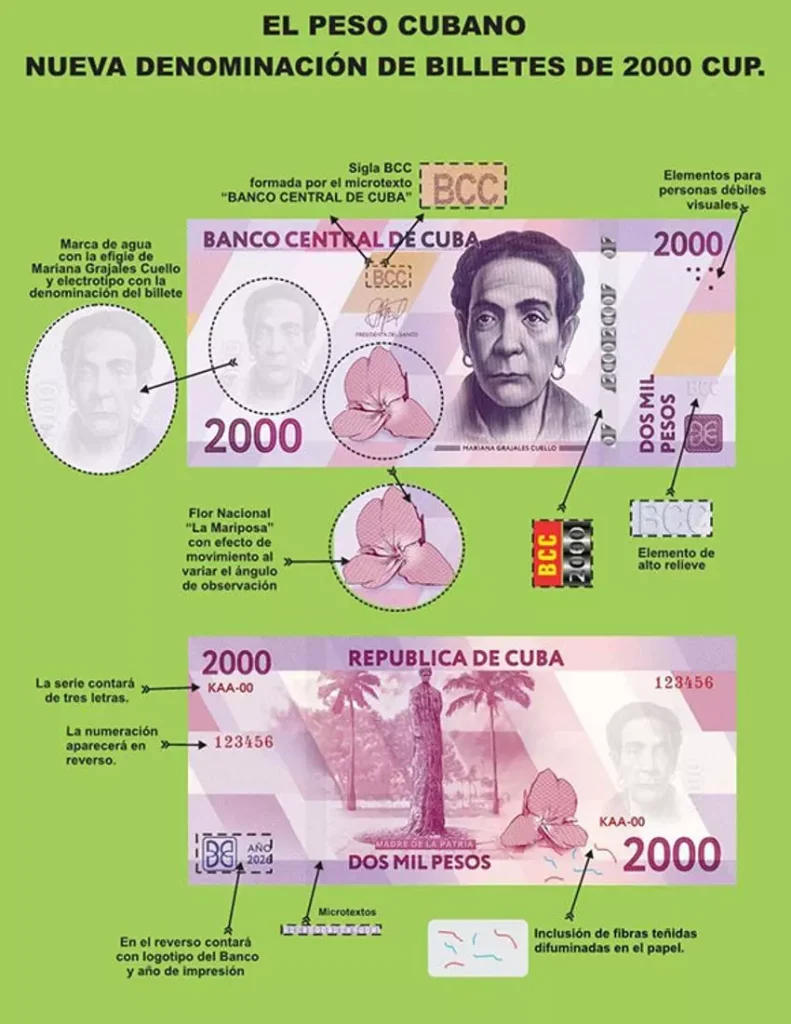
14ymedio bigger14ymedio, Havana, March 31, 2026 – Mariana Grajales and Celia Sánchez will be the first female faces to appear on Cuban banknotes starting this Wednesday, when the Central Bank of Cuba (BCC) puts into circulation new denominations that have emerged driven by inflation. Grajeles, the mother of Antonio and José Maceo will appear on the 2,000 peso notes, while the guerrilla fighter Celia Sánchez Manduley, who was already present in the watermark of the 200, 500, and 1,000 peso notes, will now take center stage on the 5,000 peso notes.

The new banknotes of this very high denomination will begin circulating this Wednesday in the capital and will gradually extend to the rest of the country, the BCC announced. The 2,000 peso notes will appear somewhat later, although the official report does not provide exact dates.

“The issuance of the new banknotes aims to facilitate cash transactions, respond to the real needs of the economy that demands large amounts of cash, helping to reduce costs related to cash logistics and to gain agility in operations in the current moments of inflation the country is experiencing,” the statement emphasizes, published in all official media.

New 2,000 peso banknote with the face of Mariana Grajales / Central Bank of Cuba

The bank has described with precision each of the new banknotes, both measuring 150 by 70 millimeters and made of special security paper for their function. The 2,000 peso notes will be pink and violet, while the 5,000 peso note is continue reading

blue. Both will carry the watermark of Celia Sánchez, like their high-value predecessors.

Other details include the integration of two additional security features: a vertical thread and the mariposa — the national flower — on both the front and back, which will have a rainbow movement effect.

The initials of the BCC, the signature of the bank’s president, Juana Lilia Delgado Portal, and other embossed elements will characterize the new denominations, which will also each feature a commemorative set. The 2,000 peso bill shows the monument to Mariana Grajales in Santa Ifigenia Cemetery, while the 5,000 peso bill will feature the monument to Celia Sánchez Manduley in Lenin Park.

The BCC has provided all the essential details to identify the validity of the two banknotes, although it does not reveal the amount invested in issuing these new denominations.

The expert then spoke of the possibility that China might print the Cuban banknotes, although he also pointed to the Russian option, a manufacturer that supplies many countries.

Since 2023, the need for higher-value denominations had become evident, since for foods as common as a carton of eggs, more than three banknotes of the highest denomination were required. However, the shortage of paper currency to produce them was so evident that the State acknowledged having problems printing.

At that time, the issuance of more 100 peso banknotes was announced, but with new paper that would circulate simultaneously with previous versions but without the raised print or the Braille system.

“With inflation and devaluation, more banknotes are needed to buy the same product or service, or new banknotes with higher denominations, and this is where the cost of printing paper money and the decision about banknotes with denominations higher than 1,000 come in,” explained Cuban economist Pedro Monreal at the time.

The expert then spoke of the possibility that China might print the Cuban banknotes, although he also pointed to the Russian option, a manufacturer that supplies many countries. The Asian option was one of the most economical in the world, where each banknote costs between 0.05 and 0.10 cents of a dollar. Monreal already warned at that time that it would be necessary, in any case, to consider replacing the denominations that would substitute the current ones that had “become obsolete due to inflation and devaluation,” although that “would imply an outlay of millions of dollars.”

Translated by Regina Anavy

______________________

COLLABORATE WITH OUR WORK: The 14ymedio team is committed to practicing serious journalism that reflects Cuba’s reality in all its depth. Thank you for joining us on this long journey. We invite you to continue supporting us by becoming a member of 14ymedio now. Together we can continue transforming journalism in Cuba.
France: It Is “Important” That Cuba “Make Gestures” of Economic Openness and Human Rights

Nicolas Forissier, Minister Delegate for Europe and Foreign Affairs, said that the dialogue between the U.S. and the Island “must be constructive, but it must also be demanding”

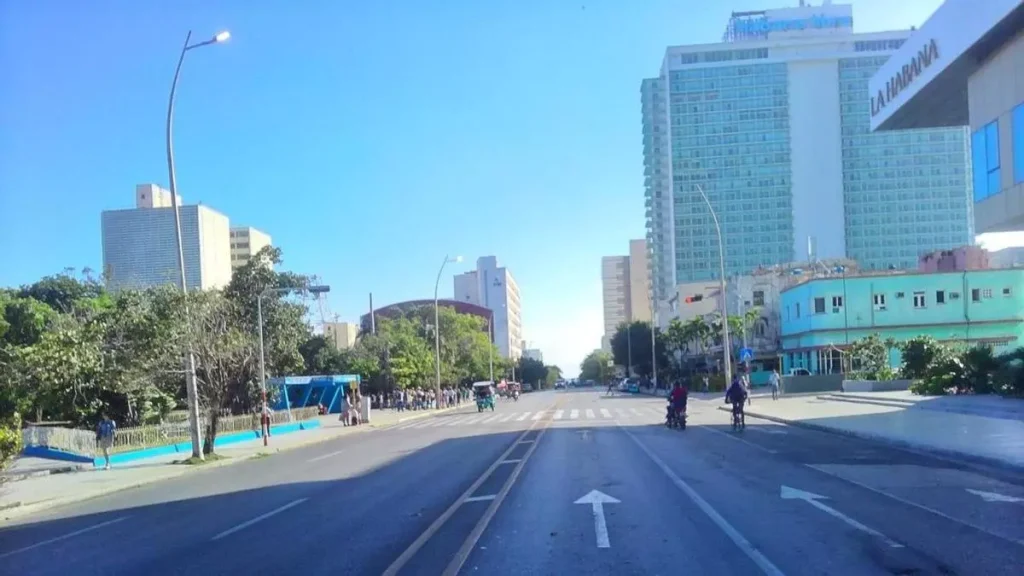
The central 23rd Street, in Havana’s El Vedado, empty of vehicles, this Tuesday / 14ymedio

14ymedio bigger14ymedio / EFE, Paris, March 31, 2026 – France welcomed the talks initiated between the United States and Cuba this Tuesday, intended to achieve a “stabilization” of the situation on the Island, and considered that it is “important that Cuba, especially in matters of human rights and economic openness, show signs of goodwill.”

“With regard to Cuba, since 1992 we have continuously requested from the United Nations that the embargo be lifted. We constantly call for dialogue in order to promote prospects for the stabilization of Cuba,” Nicolas Forissier, Minister Delegate for Europe and Foreign Affairs, said this Tuesday in the French National Assembly.

He was responding to a question from Macron-aligned deputy Frantz Gumbs about Paris’s position regarding the crisis on the Island, which in Forissier’s words is going through a situation of “economic suffocation” that affects “the entire Cuban population in a totally indiscriminate way” and that may have consequences for the stability of the Caribbean region, where France has continue reading

territories.

France is, within its means, “available for initiatives led by the UN in terms of emergency humanitarian aid”

Forissier indicated that his country supports talks to find a negotiated solution and insisted that the dialogue “must be constructive, but it must also be demanding.”

“And from this point of view, it is important that Cuba, especially in matters of human rights and economic openness, make gestures,” he stressed, while also recalling that the Island is very present within the framework of the French presidency of the G7, which is following the situation “very closely” with “initiatives and exchanges that are underway.”

Regarding the possibilities of humanitarian support for the inhabitants of the Latin American country from Paris, Forissier assured that France is, within its means, “available for initiatives led by the UN in terms of emergency humanitarian aid and in response to calls from the WHO.”

Translated by Regina Anavy

______________________

COLLABORATE WITH OUR WORK: The 14ymedio team is committed to practicing serious journalism that reflects Cuba’s reality in all its depth. Thank you for joining us on this long journey. We invite you to continue supporting us by becoming a member of 14ymedio now. Together we can continue transforming journalism in Cuba.
Fidel Castro’s Grandson Criticizes Cuban President Díaz-Canel: ‘He Is Not Doing a Good Job’

In an interview with CNN, Sandro Castro says that “most Cubans want capitalism, not communism”

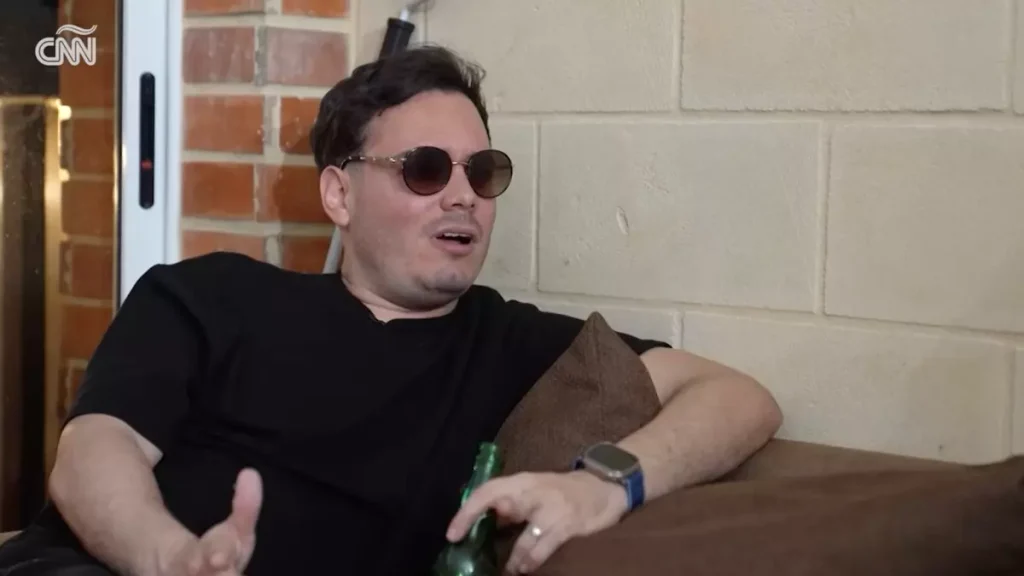
Sandro Castro wore sunglasses at all times, despite it being nighttime and being inside the apartment. / Screenshot/CNN

14ymedio bigger 14ymedio, Madrid, March 31, 2026 – The interview that Patrick Oppmann, from the American channel CNN, conducted with Sandro Castro, grandson of the late leader of the Revolution, has generated more ink than its mere length deserves. Barely a little over four minutes for a statement that will go down badly in the Palace of the Revolution, but will not go down in history.

Asked about his opinion on the performance of the current president, Miguel Díaz-Canel, the grandson and grand-nephew of his two predecessors does not hold back. “For me, he is not doing a good job, because he should have done many things a long time ago. Many things that have not been done well and today are harming us,” he says. He says nothing that most Cubans aren’t thinking, but they detest him.

CNN paints a harsher portrait in writing than what the video suggests, recorded in Castro’s small apartment. Influencer, businessman, and provocateur, the grandson of the dynasty is described as a member of a kind of “royal family” who “seems to be auditioning for the role of court jester.”

Influencer, businessman, and provocateur, the grandson of the dynasty is described as a member of a kind of “royal family” who “seems to be auditioning for the role of court jester”

Castro, who does not remove his Chanel sunglasses at any moment despite the conversation taking place entirely at night and inside his home, portrays his already well-known personality in just a few minutes. A refrigerator short on food and full of Cristal beer, an air conditioner and continue reading

generator running, making his home one of the only illuminated ones in the area and highlighting his strong connections. Today, there is no greater status symbol than having what it takes to keep a generator running. As a finishing touch, decorative light bulbs illuminate his terrace over a dark Havana.

“There are many people who want there to be capitalism with sovereignty in Cuba,” he blurts out. He does not say it as a reflection or develop a theory; he simply knows that millions of people will react to the remark.

Thus goes each of the phrases he throws out while drinking a beer with the journalist. “My grandfather was a person who had his principles. He had his principles – everyone is as they are, logically – but he also respected those of other people,” he says. And again he does not argue about a man who ordered executions for thinking differently; no clarification is possible. He
simply knows it will go viral.

The influencer says he is proud of his origins but systematically rejects that they provide him with any privilege. “My last name is my last name. I am proud of my last name, of course, but I do not see that help you are mentioning in the preamble. I am like any other citizen,” he maintains.

He does not, obviously, miss the chance to comment on Washington. “Cuba faces unprecedented pressure from the United States to open up politically and economically. We have to fight, and as all Cubans say, it’s hard. It’s hard even for a Castro, it’s hard to have a business, very hard. Very hard, because you suffer with thousands of difficulties. One day there may be no electricity, there may be no water, a shipment may not arrive…,” he complains.

“My grandfather was a person who had his principles. He had his principles -everyone is as they are, logically- but he also respected those of other people”

The journalist presses him again about his origins, but he again rejects them and feels like a victim of others’ hatred toward his family. “It’s complicated, because I think that most Cubans want capitalism, not communism, and maybe that has created a divide and a hatred that, sadly, is not productive,” he says, while also noting that he agrees with Trump that there should be an economic opening on the Island, although he rejects the idea of threatening to take it.

The text accompanying the video by CNN, in addition to being very critical of Castro, leaves some details that further sketch the character, among them the fact that he boasts that “his nightclub on a main avenue in Havana ‘only’ cost him $50,000, a sum beyond the wildest imagination of most Cubans.” The grandson also told the network that he aspires to create his own beer and would like to have more venues, but the bureaucracy overwhelms him.

“What little I have is thanks to my effort, my sacrifice,” he said, doing honor to Ted Henken, a professor and expert on the Cuban internet, who summed up Sandro’s attitude in a simple way to CNN. “He is capitalizing on ‘hate me.’”

Translated by Regina Anavy
______________________

COLLABORATE WITH OUR WORK: The 14ymedio team is committed to practicing serious journalism that reflects Cuba’s reality in all its depth. Thank you for joining us on this long journey. We invite you to continue supporting us by becoming a member of 14ymedio now. Together we can continue transforming journalism in Cuba.
Cuba, a Country That Can Barely Sleep

Just as Villa Marista disrupts the cycles of detainees, the Island suffers its own sleep deprivation

The result of this chronic lack of sleep is the constant irritability and confusion seen on the streets. / 14ymedio

14ymedio bigger14ymedio, Yoani Sánchez, Generation Y, Havana, 29 March 2026 — They say that the detainees at Villa Marista, the feared headquarters of State Security in Havana, have their circadian rhythms disrupted, that biological rhythm that regulates sleep, wakefulness, body temperature, attention, and even one’s emotional state. Deliberately, jailers turn lights on and off in windowless cells and prolong interrogations to induce disorientation, false confessions, extreme fatigue, and cognitive impairment.

In Cuba, we all feel like we’re in Villa Marista. We get up in the middle of the night to wash clothes, cook, or carry water. At some point during the day, we have to try to catch a nap because we don’t know what chores await us after midnight. Even in the middle of that daytime rest, we might not be able to sleep because the stench of burning garbage wakes us up or the mosquitoes prevent us from taking a siesta. The result of this chronic lack of sleep is the constant irritation and confusion that we see on the streets.

In Cuba, we all feel like we’re in Villa Marista.

I ran into a neighbor in the elevator during one of those rare moments when we have electricity. She’d left for work and when she got to Boyeros Avenue, she realized she didn’t have her wallet with the money to pay for an electric tricycle. She went back home, picked up her wallet, and—surprise!—when continue reading

she went to pay the taxi driver, it was empty. Another neighbor went downstairs as soon as a power outage ended to charge his electric motorcycle in a nearby parking lot, but when he was standing next to the vehicle, he realized he’d forgotten the charger and cable.

These aren’t just random lapses in memory. It is the poor quality of sleep that leads to decreased concentration, memory lapses, and a higher risk of mistakes or accidents. We’re a country that barely gets any sleep.
______________________

COLLABORATE WITH OUR WORK: The 14ymedio team is committed to practicing serious journalism that reflects Cuba’s reality in all its depth. Thank you for joining us on this long journey. We invite you to continue supporting us by becoming a member of 14ymedio now. Together we can continue transforming journalism in Cuba.
Havana Chronicles: The Shipwreck of a Ship Called “Cuba”

On an island that is sinking, the arrival of a Russian oil tanker dominates all conversations in the streets of Havana.

Interior of the abandoned Cuba cinema, on Reina Street, Central Havana. / 14ymedio

14ymedio bigger14ymedio,Yoani Sánchez, Havana, March 30, 2026 — “The ship is coming!” a flower vendor on Estancia Street greets me as I pass by his buckets of sunflowers and gladioli. After days of uncertainty, it is now known that the Anatoly Kolodkin has arrived in Cuba with a cargo of 730,000 barrels of oil. The tanker’s arrival has become a topic of conversation on the streets this Monday, in a country where the downpour of bad news hasn’t let up for weeks.

At the traffic light at Boyeros and Tulipán, the energy crisis is more noticeable than in previous days. I cross all the lanes without stopping, while thinking about another occasion when we were waiting for a ship. It was in September 2019, when President Miguel Díaz-Canel announced that we were entering a “juncture” and that we shouldn’t worry too much since an oil tanker was about to arrive. Seven years have passed, and, as a neighbor said, “this doesn’t even have a name anymore.” The ability to assign a bureaucratic label to what we’re experiencing has also been exhausted up there.

Vendors selling items collected from the garbage have scattered their wares on top of the wall of a fountain that hasn’t flowed for years. / 14ymedio

Until yesterday, Cuba seemed like an island perched on an electric tricycle, but today we’ve all climbed onto the bow of the Russian ship that’s coming here. “Do you think they’ll refuel the gas stations?” a friend asks me hopefully. She has a small shop in Alamar where she sells costume jewelry and other imported goods. Last year, this lawyer-turned-shopkeeper and her husband bought a used Volkswagen. “I could only use it for the first three months because the fuel ran out,” she tells me. Since then, the car has been “sleeping the eternal sleep” in the family garage.

For each person, the ship takes the shape of their desires. “It’ll go, and they won’t cut off our electricity so much after it arrives,” I overhear in a doorway on Carlos III Avenue as I venture deeper into Central Havana. Vendors of items salvaged from the trash have scattered their wares on top of the wall of a fountain that hasn’t flowed for years. Are there any working fountains left in Havana? In my long walks, I haven’t seen a single one. This political model seems to have a fight with water and cleanliness.

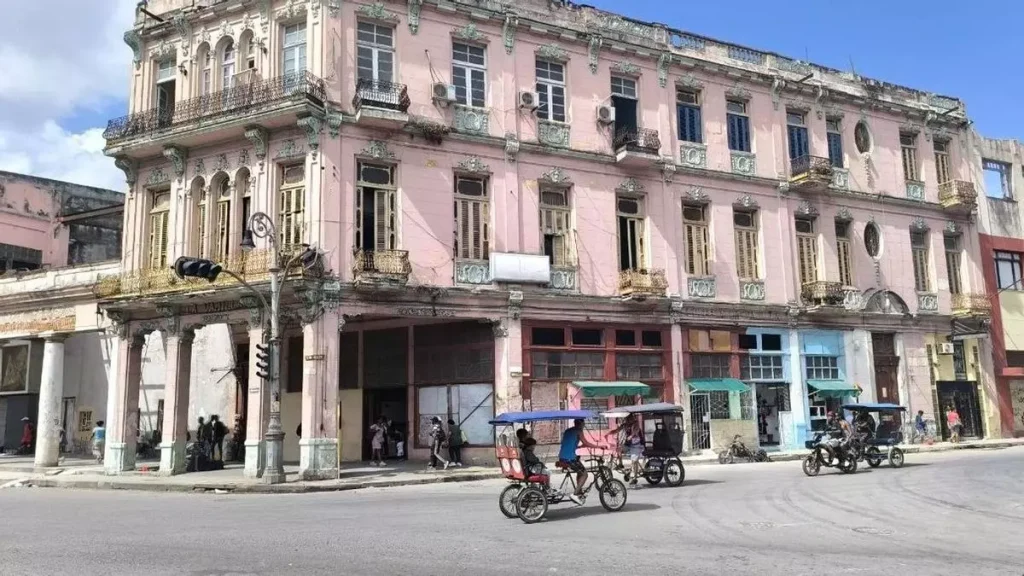
An ordinary corner with Reina Street, in Central Havana. / 14ymedio

When I was a girl, before leaving the house, my mother would warn us not to use the bathroom or drink water in the street. This strict rule almost gave me a kidney infection, but I eventually came to understand: public restrooms in Cuba are a journey to hell most of the time, and the liquid that comes out of the pipes is best consumed only after being treated or boiled. To this day, I always carry a bottle of water with me to quench my thirst and hold my urine until I get home. The traumas of Castro’s regime last a lifetime.

“Do you think we’ll get any of that oil?” one employee asks another outside a government building, plunged into darkness by the blackout. The response is a grimace of sulking lips and raised eyebrows that sums up the people’s distrust of any official promise of improvement. “Let’s paddle! Let’s see who gets to that boat first,” taunts a cart vendor selling papayas and peppers near the corner of Marqués González.

Everyone wants at least a drop of the combustible brought in by the Anatoly Kolodkin. But skepticism casts a shadow over any celebration. “That oil is all for them; we won’t get a drop,” grumbles an old man in the long line outside a state-run bakery on Reina Street. “Today I’m going to bet big,” says an old woman, her ration book folded in her hands. Anything related to the sea will see a lot of betting these days on the illegal bolita, the lottery. Woe to the bookies if one of those numbers comes up.

Until yesterday it seemed that Cuba was an island perched on an electric tricycle, but today we have all climbed onto the bow of the Russian ship that is coming here.

A few meters from the bakery, the door to the Cuba cinema has been left open. Where the rows of seats once stood, where I used to sit as a child, there is now dust, rust, and the twisted machinery of a makeshift workshop. I can only make out an arch that, on the stage, marked the threshold where fiction began and reality ended. I was captivated by that place, so close to my house, where hardly a month went by without me going to see a movie. Scaffolding blocks my way, right where the lobby used to be .

The ship that the Cuba cinema needed didn’t arrive in time. Part of its structure collapsed, the sewer pipes burst, and one day it closed. Almost all the cinemas of my childhood suffered the same fate: Astor, Negrete, Duplex, and Rex. It wasn’t during this particular crisis. It happened with the previous one, or the one before that. I don’t remember exactly because we’ve spent decades lurching from one crisis to another, a long sequence of setbacks and collapses.

I approach the Aldama Palace. Several street vendors offer me medicine. One enumerates for me that he has antibiotics of every kind, painkillers, and pills to make me feel “nice and sedated.” I run into some friends in Fraternity Park who almost cut me off mid-sentence when they receive a call from home. “They’ve turned the power back on, and I have to go back and do the laundry,” she apologizes. “I have to finish some work on my laptop, now that there’s electricity,” he adds.

What remains of the old Ultra store in Havana. / 14ymedio

To get home, I manage to hitch a ride on a pisicorre, one of the few jeeps adapted for passenger transport that still makes the trip to Santiago de las Vegas. “It’s 400 pesos to Tulipán,” the driver explains. The fare has gone up 100 pesos since the last time I took one of these cars last week. But I don’t complain. Another passenger is going near the psychiatric hospital, and the driver specifies: “To Mazorra it’s one mile (1,000 pesos).” Nobody protests the price increase. There’s no point in complaining now.

Near Quinta de los Molinos, the driver tells us we’re lucky because he’s going to stop driving this afternoon. “I don’t believe that story about the ship,” he says. He says he’s stepping away from the wheel until “everything goes back to normal” and he can go to the gas station to buy fuel without waiting in line or being pushed around. I don’t remember what “normal” means. Was it a period before the current situation?

Previous Havana Chronicles:
Havana Seen From ‘The Control Tower’

In Havana, the Only Ones Who Move Are the Mosquitoes

Reina, the Stately Street Where Garbage is Sold

Searching for Light Through the Deserted Streets of Havana

The Death Throes of ‘Granma’, the Mouthpiece of a Regime Cornered by Crisis

The Anxiety of the Disconnected Cuban

One Mella, Three Mellas, Life in Cuba Is Measured in Thousands of Pesos

It Is Forbidden To Leave Home in Cuba Today Because It Is a “Counter-Revolutionary Day”

Vedado, the Heart of Havana’s Nightlife, Is Now Converted Into a Desert

Havana, in Critical Condition

______________________

COLLABORATE WITH OUR WORK: The 14ymedio team is committed to practicing serious journalism that reflects Cuba’s reality in all its depth. Thank you for joining us on this long journey. We invite you to continue supporting us by becoming a member of 14ymedio now. Together we can continue transforming journalism in Cuba.

Jorge Gómez and the Silence Surrounding His Fall From Grace During Cuba’s Five Grey Years

Jorge Gómez / Moncada group (Photo: Prensa Latina / blogspot)

  Cubanet, Luis Cino, Havana, 24 March 2026 — There is much talk about Jorge Gómez Barranco, leader of the band Grupo Moncada, who died on March 23—and it’s almost always good talk, because there is no doubt that Gómez was a good person and much loved by many in the cultural sphere, particularly music and television.

What is not talked about (it seems that few remember or prefer not to remember) is how in 1971, when Gómez, a young philosophy professor at the time, fell out of favor with the regime because of his connection to the magazine, Pensamiento Crítico (“Critical Thinking”).

This publication, which brought together left-wing intellectuals—veritable human think tanks but who differed from the Soviet line, such as Aurelio Alonso and Fernando Martínez Heredia—was shut down shortly after that infamous and misnamed “Congress of Education and Culture” that ushered in, on orders from Raúl Castro, the Five Grey Years. Castro, then-Minister of the Revolutionary Armed Forces, labeled the periodical, along with the University of Havana philosophy department, “a bastion of revisionists and counterrevolutionaries.” All because they dared to dabble in the ideas of Marcuse, Gramsci, Sartre—and, perhaps, even Bakunin and Trotsky—precisely at a time when the Castro regime, still reeling from the failure of the Ten Million Ton Sugar Harvest, didn’t want to upset the Kremlin, to whose chariot they had hitched themselves so that the Soviets could pull them out of the crisis.

Jorge Gómez, like most of his colleagues at Critical Thinking and in the philosophy faculty, preferred to forget that time of closed-mindedness and censorship of intellectuals, to downplay its importance. He even ignored the controversy that led a recalcitrant commissioner to accuse him, playing on his second surname*, of wanting to send Marxism tumbling off a cliff.

After all, the end of his foray into philosophy allowed Jorge Gómez, who had learned to play the piano as a child, to return to music, his great passion. In 1972, along with several university students, he formed a group that continue reading

combined Cuban son with Andean music, and which he named Moncada in honor of his uncle, the poet Raúl Gómez García, who died in the attack on the Santiago barracks on July 26, 1953.

Years later, after replacing the influence of Quilapayún and Inti Illimani with more pop and catchy tunes—and the overly serious Alberto Falla and Manuel Calviño, first with Carlos Enríquez and then with other long-haired, handsome and younger singers—Moncada managed to become popular in the 1980s and mainly during the years of the Special Period, when his concerts packed the steps of the University of Havana.

Music lovers, and especially rock fans, have Jorge Gómez to thank for his 80s television program, Perspectiva, where we had the opportunity—unusual at that time when prohibitions on rock music remained staunchly in place—to see groups like Pink Floyd, Deep Purple, etc. on the small screen.

Ten years ago, on August 30, 2016, when singer-songwriter Amaury Pérez  interviewed Jorge Gómez on his TV show, Con dos que se quieran (“With Two Who Love Each Other”)—a kind of confessional for the singer-songwriter’s big and little friends—Pérez asked Gómez how the philosophy department came to be terminated and why Critical Thinking magazine was shut down.

When asked that question, Jorge Gómez dodged it, sidestepping the issue. He said the magazine “had been gradually losing circulation,” excusing this development by saying that “these things happen in revolutions.” It would have been too presumptuous for the obsequious Jorge Gómez to say more and thus jeopardize his moment in the spotlight as a successful musician within the mainstream culture.

Besides, I would think, why would he look for trouble by stirring up the past? What for? After all, most guests on With two who love each other—when asked this type of confrontational question by Amaury Pérez—far from complaining about grievances and reprisals, evade the issue, choose forgiveness, and almost always end up proclaiming their devotion “to Fidel and the Revolution.”

Jorge Gómez preferred to forget ‘the mistakes of the past,’ to turn the page, as did some of his Critical Thinking colleagues, who after being rehabilitated, became tin-pot repairmen dedicated to reinventing socialism.

* A “barranco” is a narrow, winding river gorge.

Translated by: Alicia Barraqué Ellison


Author’s biography:

Luis Cino. Born Havana, 1956. He worked as an English teacher, in construction, and in agriculture. He began working in independent journalism in 1998. He was a member of the editorial board of the magazine De Cuba and deputy director of Primavera Digital. A regular contributor to CubaNet since 2003, he writes about art, history, politics, and society. He lives in Arroyo Naranjo. He dreams of being able to dedicate himself fully and freely to writing fiction. He is passionate about good books, the sea, jazz, and blues.

The Number of Cuba’s Political Prisoners Released Under the Agreement With the Vatican Has Reached 25

The NGO laments that the number is still only half of what they promised: “We are on top of the regime. We will not let them lie to the Church, nor, of course, to the people of Cuba

A group of relatives of those arrested on July 11, 2022 [’11J’], during a peaceful protest on the steps of the Havana Cathedral / Wilber Aguilar/Facebook
14ymedio bigger14ymedio/EFE, Havana, March 30, 2026 /  The Cuban government has released two more political prisoners under the agreement announced by the Cuban regime with the Vatican for the release of 51 prisoners, according to an announcement by the NGO Prisoners Defenders this Sunday.

One of them is Evelio Luis Herrera Duvergel, 25, who was sentenced to seven years in prison – which he was serving in the Quivicán prison in Mayabeque – for participating in the anti-government protests of 11 July 2021 [’11J’]. The other, Jarol Varona Agüero, 52, was in El Típico prison in Las Tunas, serving a 13-year sentence for “propaganda against the constitutional order” for calling for a protest on Facebook that never took place.

With these decisions, the number of political prisoners released has risen to 25, less than half. “We demand the release of all political prisoners in Cuba,” the NGO stated. “We are on top of the regime. We will not let them lie to the Church, nor, of course, to the Cuban people,” it added in a publication that included the updated list.

Most of those released so far participated in the Island-wide anti-government protests of 11 June 2021 and were serving sentences of between six and 18 years in prison for crimes such as public disorder, contempt, assault and sedition. continue reading

Most of those released so far participated in the anti-government protests of July 11 and were serving sentences of between six and 18 years in prison for crimes such as public disorder, contempt, assault and sedition

PD criticized, this week, on social media that only some of the 51 beneficiaries of the measure are political prisoners and stressed that something similar happened in the January 2025 process when “only 40%” (219) of the 553 released prisoners were political prisoners, while the rest “were common prisoners.”

He also reported that among the released common prisoners “there is at least one with a murder on his record,” as well as other people convicted of “robbery and other common crimes”.

The first releases in this process coincided with the announcement by the Cuban Executive that it had begun a dialogue with representatives of the US Administration, although Havana has never linked the two issues.

These releases are not pardons, but a benefit that allows the prisoner to leave the penitentiary even though the sentence has not been extinguished (a measure that is conditioned on compliance with certain requirements during the remaining time of the sentence).

Cuba ended February with 1,214 people detained for political reasons, according to PD’s latest monthly report, the highest number since the organization began documenting the prison situation on the island.

Translated by Regina Anavy

______________________

COLLABORATE WITH OUR WORK: The 14ymedio team is committed to practicing serious journalism that reflects Cuba’s reality in all its depth. Thank you for joining us on this long journey. We invite you to continue supporting us by becoming a member of 14ymedio now. Together we can continue transforming journalism in Cuba.

Trump Welcomes the Arrival of a Russian Oil Tanker in Cuba: “They Have To Survive”

The U.S. president assures that anyone can send crude to the Island, despite the sanctions in force until now.

The Russian tanker carries 100,000 tons of crude and is already in Cuban waters, Moscow confirmed. / EFEThe Russian Tanker Carries 100,000 Tons of Crude and Is Already in Cuban Waters, Moscow Confirmed. / EFE

14ymedio bigger14ymedio, Madrid, March 30, 2026 – U.S. president Donald Trump downplayed the arrival of the Anatoly Kolodkin, loaded with Russian oil , which arrived this Monday in Cuba. “They have to survive! (…) I have no problem,” he said this Sunday in remarks to the press from the presidential plane. The vessel is advancing loaded with about 730,000 barrels of crude without the U.S. having placed any impediment, as University of Texas expert Jorge Piñón told 14ymedio this Sunday and hours later a Washington source confirmed to The New York Times.

“I told them, if a country wants to send oil to Cuba right now, I have no problem with it. Whether it is Russia or not,” said the president, who added that he even “prefers” that this happen. “People need heating and air conditioning, and all the other things one requires,” he said. Trump considered that this does not affect the situation of the Island. “They have a bad regime, they have bad and corrupt leadership, and whether a ship of oil arrives or not, that does not matter,” he concluded.

The statements are surprising after the White House, which suspended sanctions on Russian crude for a month – until April 11 – added a paragraph to the license a week later specifying that Iran, North Korea and Cuba could not be recipients of that oil.

“People need heating and air conditioning, and all the other things one requires,” he noted

The tanker, which transports about 730,000 barrels of oil and belongs to the Russian government, is scheduled to dock in Matanzas around 6 a.m. Tuesday. Then, the crude will have to be transported to the refineries in Havana and Cienfuegos, where the 730,000 barrels will be converted into about 250,000 barrels of diesel, according to Piñón. This fuel would allow supplying the power generators and transportation or agriculture for a few days, although the specialist also believes that the State may reserve a continue reading

portion.

“Will we be so naive as to think that the Government will not keep a significant amount of diesel for its own reserves, instead of supplying it to those who need it most for their livelihood?” he asked 14ymedio.

The NYT says it has not obtained any clarification on why the U.S. Government has made this decision, after the Sea Horse, flying the Hong Kong (China) flag and heading toward Cuba with 200,000 barrels of Russian diesel two weeks ago, changed course toward Trinidad and Tobago and ultimately docked in Venezuela, coinciding with the addition of the new paragraph to the license that prevented sales to the Island.

The newspaper notes, however, that Trump thus avoids an open confrontation with Moscow, which had spent weeks saying it would look for a way to help Cuba and finally, last week, confirmed that the ship was heading toward the Island as “humanitarian aid” through Energy Minister Sergei Tsivilev.

This Monday, at his morning press conference, Kremlin spokesman Dmitry Peskov said that “Russia considers it its duty not to stand aside and to offer the necessary help to our Cuban friends.”

“The desperate situation in which Cubans now find themselves cannot, of course, leave us indifferent, so we will continue working on this matter,” he said.

Peskov, who welcomed the arrival of the Anatoli Kolodkin in Cuba, admitted that the situation had been addressed “in advance” during contacts with representatives of the White House.

Peskov, who welcomed the arrival of the Anatoli Kolodkin in Cuba, admitted that the situation had been addressed “in advance” during contacts with representatives of the White House

The Coast Guard had two patrol boats in the region that could have attempted to intercept the Russian tanker, but this Sunday, when it was confirmed that they had not moved from their position, it was assumed they would do nothing to prevent the operation, as happened with the Bella 1. That ship, which changed its name to Marinera and its flag to Russian in January, was a sanctioned tanker used for transporting hydrocarbons from Russia, Iran, and Venezuela that began to be pursued by the U.S. in December. Despite being escorted by a Russian submarine, the vessel was ultimately boarded and its crew detained, although an agreement between Trump and Putin facilitated the release of the Russian workers.

The last time Moscow sent oil to Cuba was in 2025, in two voyages carried out by the Akademik Gubkin. The first trip took place in February, with about 790,000 barrels, valued at 55 million dollars at that time. The crude had to be distributed to the refineries in Havana and Cienfuegos using the Cuban ships Vilma and Lourdes, to produce the different types of fuel the country needed.

In September, the ship returned to Nipe Bay (Holguín) with about 740,000 barrels of crude to begin the transfer, since the Matanzas supertanker base, which burned in August 2022, is still undergoing slow repairs. Although the reconstruction process of the four main tanks began years ago, at this point none is yet ready to receive fuel.

Translated by Regina Anavy
______________________

COLLABORATE WITH OUR WORK: The 14ymedio team is committed to practicing serious journalism that reflects Cuba’s reality in all its depth. Thank you for joining us on this long journey. We invite you to continue supporting us by becoming a member of 14ymedio now. Together we can continue transforming journalism in Cuba.

Cuba: In the Bank Line, Customers Live With the Fear That the Power Will Go Out or That the Cash Will Run Out

When retirees collect their monthly pension, the services of the Popular Savings Bank of San José de las Lajas collapse.

Line at the Popular Savings Bank in San José de las Lajas / 14ymedio

14ymedio bigger14ymedio, Mayabeque, Julio César Contreras, March 29, 2026 – At seven in the morning there is already activity in front of the Popular Savings Bank of San José de las Lajas. The line begins to form long before the doors open, and as the minutes pass, it turns into a compact row of tired bodies, canes leaning against the wall, and eyes fixed on the entrance. Some retirees sit on the metal chairs in the entryway; others remain standing, holding their checkbooks as if they were a lifeline amid uncertainty.

The days set for paying pensions to retirees turn into a true ordeal for people who go to the bank in search of other services. Service no longer depends only on there being electricity but on there being employees available to handle the different operations. At any moment the power can go out and paralyze everything: the computers shut down, the fans stop turning, and a murmur of discontent runs through the line like a hot wind.

“The first problem is that it’s the same line for all procedures and, as expected, pensioners are the majority. I have no choice but to come back later,” comments Mayra, who practically has no cash left and therefore urgently needs to make a withdrawal. The woman looks at the door anxiously, aware that time is running against her and that, if she cannot withdraw money, she will have to postpone basic purchases such as bread or medicine. continue reading

Receiving her salary on a card keeps her enslaved to the bank, because on the street no one is accepting payment by transfer

According to the worker from the Commerce Company, receiving her salary on a card keeps her enslaved to the banking institution, because on the street no one is accepting payment by transfer. “Here at the bank the most I can withdraw is 1,000 pesos a day, but not even that small amount is guaranteed. Today, for example, all the money is earmarked for paying out the pensions. That means that until that is finished, the rest of us customers will have to look for other solutions, such as buying things through Transfermóvil at 10 or 20% above their original price,” the woman says.

At a glance, impatience is evident among those who ask who is last, peek toward the door, or leave frustrated at being unable to complete a transaction. An elderly man with a red cap and denim jacket moves forward with short steps toward the entrance, while a woman with white hair rests in a chair and fans herself with a folded sheet. No one wants to lose their place, because everyone knows that the money may run out before noon.

“There are only two tellers working, so they are forbidden from making deposits. All banking activity is concentrated in a single operation, as if they were just learning how to work now,” complains Mario, who urgently needs to deposit 20,000 pesos on his daughter’s card. “It’s true that the elderly deserve priority. However, concentrating the work in a single area goes against all logic,” he emphasizes.

For the accounting professor, his most difficult days of the month are precisely when the bank is paying out pensions. “I have to regularly send money to my daughter, who is studying in Havana. Sometimes when I leave here I have to take a pill because my blood pressure has shot up,” says Mario, after having a brief argument with an employee over the inefficiency of the banking institution.

It is incredible how time is wasted on a procedure that could be resolved with a bit of interest on the part of the bank. Anything in this country costs a lot of effort

Although it has nothing to do with the payment of pensions, Yesenia has been leaning against a column in the entryway for an hour and a half, waiting for her turn to go in. “I am in the process of applying for a loan to finish my house. In the line there is no one for that kind of thing, but they informed me that today only one commercial officer came to work and he is currently busy with other tasks. I don’t understand anything,” says the employee of a private cafeteria who can dedicate herself to these procedures twice a week. “It is incredible how time is wasted on a procedure that could be resolved with a little interest on the part of the bank. Anything one wants to do in this country costs a lot of effort,” she insists.

The atmosphere grows more tense as the morning goes on. Some retirees check their watches with concern. There are those who leave resigned, promising to return the next day, even though that means starting over from scratch.

Pressed by the time, Yasenia feels she is losing the morning without achieving her goal. The discomfort is shared by some people in the line who, sitting on a doorstep or with their hands resting against the wall, channel their frustration by talking. “The bank closes at 12:00 noon, even when there are still customers out here. It doesn’t matter who is left without collecting their money or who has to spend a month just to get a form filled out. I know the bank employees want to leave early to deal with their personal matters, but then, who takes care of ours?” the young woman asks.

In San José de las Lajas, collecting a pension is no longer a monthly procedure but a daily battle. For many retirees, the money they are waiting for is not just income, but the difference between eating or not, between buying medicine or staying home enduring the pain. That is why they return to the bank again and again, wake up before dawn, and endure hours of waiting amid uncertainty, hoping that this time there will be enough cash.

Translated by Regina Anavy

______________________

COLLABORATE WITH OUR WORK: The 14ymedio team is committed to practicing serious journalism that reflects Cuba’s reality in all its depth. Thank you for joining us on this long journey. We invite you to continue supporting us by becoming a member of 14ymedio now. Together we can continue transforming journalism in Cuba.

Mexico Pays More Than 12 Million Dollars to a Cuban Pharmaceutical Company Accused of Delivering Expired Medications

The administration of Claudia Sheinbaum once again favored Neuronic, from which it buys drugs and finances research.

Warehouses of the Biologicals and Reagents of Mexico laboratories (Birmex) / Birmex

14ymedio bigger14ymedio, Havana, March 29, 2026 – The Cuban-Mexican pharmaceutical company Neuronic, which in 2023 delivered poor-quality and late medications worth more than two million dollars, continues to be favored by the government of Claudia Sheinbaum. Last year Mexico acquired thousands of doses of cancer drugs such as vincristine, methotrexate, doxorubicin, and ketamine for 227,000,000 pesos (12,516,883 dollars).

The drugs approved by the Mexican health system entered the country under the designation of “generics.” According to a report by the portal Latinus, three contracts were awarded directly in which Tania Urquiza Rodríguez appears as the legal representative of Neuronic, identifying herself as a Cuban businesswoman.

Through agreement DAF/AD-LPI-0052/2025, 19,572 boxes of injectable doxorubicin were acquired, each containing 10 vials, used in chemotherapy processes to treat leukemia, breast, ovarian, and thyroid carcinomas, and Hodgkin’s lymphoma. In addition, 19,060 packages of vincristine were purchased, used in Wilms tumors and neuroblastoma. The substances have a shelf life of two years.

The payment was made “directly to Neuronic,” through the laboratories of Biologicals and Reagents of Mexico (Birmex), a Mexican company founded in 1999 for the production, importation, and distribution of vaccines and medicines. The Cuban-Mexican pharmaceutical company in turn made bank transfers to Laboratorios AICA and BioCubafarma Treasury.

Mexico signed two other contracts with Cuba, which were entered into by the Mexican Social Security Institute (IMSS) to continue benefiting Neuronic. The first, under continue reading

registration 012NEF001I01725-017-00, was for the purchase of 28,200 units of methotrexate, a drug that since August of last year has been supplied to cancer patients and for which 10,575,282 pesos (583,505 dollars) were paid.

The methotrexate drug from the Cuban laboratory AICA. / @NARIZROJAAC

The distribution of the medication began in the state of Querétaro. “It is strange that, with so many national suppliers available, they would go with a foreign one,” Alejandro Barbosa Padilla, spokesperson for the Nariz Roja association, which has more than 15 years helping oncology patients, told 14ymedio at the time.

Cuba was also paid 15,131,250 pesos (834,887 dollars) for 33,600 units of ketamine, an adjunct in pain control that is sometimes administered together with morphine.

The Government of Mexico has favored Neuronic again and again. The National Council of Humanities, Sciences and Technologies (Conahcyt) granted it 7,427 dollars three years ago for a pharmacokinetics project aimed at early detection of Alzheimer’s in rats.

Conahcyt received notification in March 2022 of four grants for other projects by the Cuban-Mexican company. It released the funds on September 27 of that same year. For the so-called “validation of the production process and preclinical trials with CNEURO-120”—the drug intended for early detection of Alzheimer’s—3,439 dollars were granted. Later, as part of that same project, 15,037 dollars were delivered and, in another phase of the research, 4,028 dollars.

Translated by Regina Anavy

______________________

COLLABORATE WITH OUR WORK: The 14ymedio team is committed to practicing serious journalism that reflects Cuba’s reality in all its depth. Thank you for joining us on this long journey. We invite you to continue supporting us by becoming a member of 14ymedio now. Together we can continue transforming journalism in Cuba.

‘Cuba Is Next,’ Trump Says From Miami, ‘But Pretend I Didn’t Say It’

Experts in New York argue that the U.S. could accept economic changes on the Island without an immediate replacement at the top of power.

The phrase came during a speech in which he praised the military capacity of the United States. / Screenshot

14ymedio bigger14ymedio, Havana, March 28, 2026 – Donald Trump once again put Cuba at the center of his speech this Friday by stating in Miami: “Cuba is next.” The phrase came during a speech in which he praised the military capacity of the United States and its recent actions in Venezuela and Iran. Immediately afterward, the president tried to downplay it with an ambiguous remark: “But pretend I didn’t say it.”

Trump linked his comments to the worsening of the Cuban crisis and the deterioration of the government of Miguel Díaz-Canel, in a context in which Washington is holding talks with sectors of power in Havana to avoid a larger confrontation.

It is not the first time Trump has used that tone. Previously, he had said that his plans for Cuba involved a “friendly takeover,” although afterward the head of the United States Southern Command, Francis Donovan, told Congress that the U.S. military is not preparing for a takeover of the Island. Along the same lines, the Treasury secretary stated that a potential regime change in Cuba would be “in slow motion.”

That dual approach—bellicose tone in public and parallel contacts—coincides with the assessment presented this week by several experts in New York

The Cuban government itself eventually acknowledged, after repeatedly denying it, that talks with Washington do exist. Behind the rhetoric of confrontation, therefore, there is a line of political pressure that does not appear aimed solely at a direct clash. Trump’s ambiguity does not reduce the scope of his words. On the contrary, it leaves several scenarios open, ranging from a tightening of sanctions and economic coercion to a forced negotiation under extreme pressure.

That dual approach—bellicose tone in public and parallel contacts—coincides with the assessment presented this week by several experts in New York, at a forum organized by Americas Society and the Council of the Americas on the renewed interest of the White House in Latin America. There continue reading

, Brian Winter, vice president of policy at both organizations, summarized the logic that, in his view, guides Washington’s policy toward Cuba: “Everything points to the U.S. prioritizing its stability and its national security, and that some kind of transition in Cuba’s economic policy could occur without necessarily implying a change at the top of power.”

Winter added that Cuba “has always had a unique importance for U.S. national security,” especially due to two factors: competition with other powers, such as China, and the impact of Cuban migration to U.S. territory. As he explained, around 20% of the Cuban population has emigrated in recent years, a figure that helps explain why the Island’s internal deterioration has also become a security issue for Washington.

Marco Rubio: “Any report about Cuba that does not come from the president or from me is a lie”

The forum also pointed to another key figure in this hardening: Marco Rubio. Winter stated: “I think it is fair to say that Secretary Rubio’s personal history influences U.S. policy.” But he immediately set a limit to that interpretation, warning that the White House’s intentions do not appear to be limited to an operation of political or family revenge against Cuban power. “If it were only about overthrowing the regime in Havana for family reasons, they would be adopting a different policy,” he commented.

For his part, the Secretary of State declared from France, at the end of the G7 meetings: “Any report about Cuba that does not come from the president or from me is a lie.” Rubio also repeated what he had already said days earlier from the Oval Office: “We have to change the people in charge, the system of the country, and the economic model they have. It is the only way Cuba can have a better future.”

The current Cuban crisis did not begin with Trump, nor can it be explained solely by U.S. sanctions. The Island has been burdened for years by unproductivity, centralization, reform paralysis, and political repression. The regime has been unable to offer a credible way out of the deterioration of basic services, food shortages, the transportation crisis, and blackouts, while keeping intact a control apparatus that blocks any real opening.

Translated by Regina Anavy

______________________

COLLABORATE WITH OUR WORK: The 14ymedio team is committed to practicing serious journalism that reflects Cuba’s reality in all its depth. Thank you for joining us on this long journey. We invite you to continue supporting us by becoming a member of 14ymedio now. Together we can continue transforming journalism in Cuba.

The Anatoly Kolodkin Is Scheduled To Arrive This Monday in Cuba With 730,000 Barrels of Russian Crude

If the U.S. does not intervene, it will be the first fuel delivery since January

The expert Jorge Piñón believes that, at this stage of the journey, a possible interception of the vessel by the U.S. is unlikely. / VesselFinder

14ymedio bigger14ymedio, Havana, March 29, 2026 – Russia has tested the pressure of the United States on energy supply to Cuba with the dispatch of the tanker Anatoly Kolodkin, a ship loaded with crude oil heading toward the Island and whose arrival in Matanzas is scheduled for this Monday. The tanker carries about 730,000 barrels of crude and is this Sunday north of Haiti, just hours of sailing from the Cuban coast, according to maritime tracking data.

The vessel loaded at the Russian port of Primorsk on March 8. During its passage through the English Channel, the tanker was monitored by the Royal Navy while it was escorted by the Russian sloop Soobrazitelny. After that stretch, both vessels separated and the tanker continued alone toward the Atlantic and then toward the Caribbean.

The Anatoly Kolodkin appears on the sanctions list of OFAC (U.S. Treasury Department) since February 2024, linked to Sovcomflot, Russia’s largest state shipping company, and is also on the British list of sanctioned vessels.

The Havana refinery is an old and inefficient installation, “a relic of the industrial transformation system of Cupet”

The Cuban energy expert Jorge Piñón believes that, at this stage of the journey, a possible interception of the vessel by the United States is unlikely. “In my opinion it is already too late. I am not a military expert, but if there had been a confrontation with the U.S. Navy it would have been in Atlantic waters, with more room for political and naval maneuvers,” he told this newspaper.

For the researcher at the Energy Institute of the University of Texas at Austin, the central question is no longer whether the Anatoly Kolodkin will reach Cuba, but what the Government will do with the limited volume of fuel that could be obtained from that shipment. According to his estimate, from the 730,000 barrels of crude carried by the tanker, no more than 250,000 barrels of diesel could be derived, an amount insufficient to resolve the crisis but still relevant for deciding priorities. continue reading

Piñón notes that the Havana refinery is an old and inefficient facility, “a relic of Cupet’s industrial transformation system.” From there, he outlined two scenarios: that the State distributes that diesel among sectors considered critical—generator sets, transport, and agriculture—or that it keeps it as a reserve in case of a future political or military escalation.

“Will we be so naive as to think that the Government will not keep a significant amount of diesel for its own reserves, instead of supplying it to those who need it most for their livelihood?”

In any case, the expert adds, “the refining process will take between 15 and 20 days and another five to ten days will be needed to distribute the fuel.”

The approach of the Anatoly Kolodkin has been closely followed because, although it will not solve the crisis, it could offer partial and temporary relief.

The arrival of this shipment coincides with a critical stage for Cuba. The Island has not received oil since January—the last delivery of crude came from Mexico with the Ocean Mariner—an interruption that has worsened the energy crisis and made the country’s external dependence more visible. The lack of fuel has affected transportation, electricity generation, the distribution of goods, and the daily life of millions of people.

The fragility of the electrical system, which has gone years without adequate maintenance, has worsened as a result of the oil embargo decreed by the U.S. in January. Cuba has suffered seven nationwide blackouts since October 2024, including two in March of this year, a sequence that confirms the deterioration of the grid and the lack of backup capacity. Havana has tried to contain the impact with emergency measures. The Government has imposed dollar sales to the public and strict gasoline rationing; public transport has been reduced, and some services have been cut. In that context, the approach of the Anatoly Kolodkin has been closely watched because, although it will not resolve the crisis, it could provide partial and temporary relief.

The immediate backdrop to this operation is the breakdown of regular supply from Venezuela. Since January 3, Cuba lost its main regional oil benefactor, following the capture of Nicolás Maduro by the U.S., and since then it has not received fuel from Caracas.

Although Mexico has maintained donations and humanitarian aid, it has not resumed shipments of oil or fuel to the Island

Mexico has not filled that gap either. Although it has maintained donations and humanitarian aid, with shipments of food, medicine, and other supplies, it has not resumed shipments of oil or fuel to the Island. Mexican caution comes amid threats by Donald Trump to impose tariffs on any country that sends oil to Cuba, a warning that has raised the political cost of any supply attempt.

Recent experience also shows that not all shipments manage to complete their route. The clearest precedent is that of the Sea Horse, a tanker flying the flag of Hong Kong (China) that was carrying about 200,000 barrels of diesel of Russian origin initially destined for Cuba. Faced with the risk of seizure by the U.S. Navy deployed in the Caribbean, the vessel changed course toward Trinidad and Tobago and finally appeared in Venezuelan waters after spending weeks adrift in the Atlantic. The case demonstrated how far Washington’s pressure can go in frustrating a shipment even when it is already underway.

If the Anatoly Kolodkin ultimately manages to dock and unload in Matanzas, or stops beforehand in the Bay of Nipe (Holguín) to transfer its cargo to the fleet of Cuban tankers, no one doubts that it will be the result of a decision made by the U.S. and that it will be presented as a humanitarian gesture.

Translated by Regina Anavy

______________________

COLLABORATE WITH OUR WORK: The 14ymedio team is committed to practicing serious journalism that reflects Cuba’s reality in all its depth. Thank you for joining us on this long journey. We invite you to continue supporting us by becoming a member of 14ymedio now. Together we can continue transforming journalism in Cuba.

With a 90% Shortage of Medications, the Closure of Several Pharmacies in Matanzas, Cuba Is Being Considered

The collapse is due to the lack of transportation to bring drugs from Havana, explains a Health sector official.

Arrivals are sporadic and, generally, it is not known exactly which medications will be available. / 14ymedio

14ymedio bigger14ymedio, Matanzas, Pablo Padilla Cruz, March 28, 2026 – In the city of Matanzas, a panorama of shortages has become the norm for residents who depend on public pharmacies. Empty shelves, widespread confusion, and endless lines to obtain medicines have marked the reality of many citizens, especially the most vulnerable: the elderly and patients with chronic illnesses.

The day when the arrival of some medication is announced, especially those that require a card, becomes a kind of hope. However, that hope rarely materializes with certainty. Arrivals are sporadic and, generally, it is not known exactly which medications will be available. “It is almost always one Tuesday a month, but it is also almost never known what they will send.” That day, from dawn, patients, mostly elderly, stand in long lines at pharmacies to try to pick up the pills that will relieve their ailments. However, the arrival of medications seems increasingly uncertain.

The situation has gone beyond a recurring shortage crisis. This time, the message spreading by word of mouth among residents of Matanzas is even more alarming: “The pharmacies in Matanzas are going to close permanently.” Although the rumor is widespread, the truth behind this statement remains uncertain, although health workers do not rule out the possibility. continue reading

Measures such as the permanent closure of several pharmacies are being considered, leaving only a few open. / 14ymedio

“We are considering that we may be left without medications and for that reason, interrupted,” stated a pharmaceutical technician at the pharmacy located on Ayuntamiento Street. Surrounded by empty shelves, she explained that although some medications do arrive at times, these are insufficient. In some cases, medications arrive for patients with cards, such as enalapril for blood pressure, metformin for diabetics, or to a lesser extent, insulin. However, the levels of shortage are so high that patients are often sent back home without being able to obtain what they need.

An official from the provincial directorate of the health branch provides more details about the crisis. “In the province there is a shortage of almost 90% of medications in general,” she explains. This collapse is worsened by the lack of transportation, which prevents medications from reaching pharmacies in a timely manner. “Medications must be transported from Havana to the Medicuba warehouses in the industrial zone of Matanzas, and from there to the pharmacies, but currently this logistical movement is almost paralyzed,” the official notes.

As a result, measures such as the permanent closure of several pharmacies are being considered, leaving only a few open to distribute medications on a rotating basis among neighborhoods. In addition, some have reduced their service hours until 2 pm due to the lack of essential products.

“We are considering that we may be left without medications and for that reason, interrupted,” stated a pharmaceutical technician. / 14ymedio

The shortage has also affected specific medications such as insulin, which requires special storage conditions. Frequent blackouts worsen the situation, as they prevent pharmacies from maintaining supplies under proper conditions, further limiting their availability.

In this context of scarcity, residents of Matanzas are forced to resort to other alternatives to obtain the medications they need. Some choose to contact relatives abroad, while others turn to the black market or online pharmacies, which offer imported medications at prices ranging from 500 to 5,000 pesos, depending on the type of drug. However, as Pastrana, a pensioner who must take enalapril twice a day, explains, his monthly pension of 3,106 pesos is barely enough to cover his basic needs, much less to buy imported medications. “The pension doesn’t even cover rice, what am I going to do with medicines from abroad?” he laments.

The situation not only affects medications; medical supplies also suffer from the same problem. At the Ensume warehouse, which distributes and stores medical supplies for the entire province, the shortage of inputs is critical. An employee of the institution comments that they are currently receiving less than 30% of the materials necessary for their operation. “Ten years ago, we received supplies even at night, even on weekends. Now, we have nothing to do at 2 pm,” he recounts. According to him, hospitals sometimes have to divert ambulances to collect supplies, and sending them to places as distant as Cayo Ramona, in Ciénaga de Zapata, becomes a titanic undertaking.

Translated by Regina Anavy

______________________

COLLABORATE WITH OUR WORK: The 14ymedio team is committed to practicing serious journalism that reflects Cuba’s reality in all its depth. Thank you for joining us on this long journey. We invite you to continue supporting us by becoming a member of 14ymedio now. Together we can continue transforming journalism in Cuba.