Another Ship Bound for Korea / Henry Constantin

6a00d8341bfb1653ef01901e67ea1d970b-550wiI have been to Korea a couple of times and the memory of it feels like a weight on my chest. People there work from sunup for a monthly salary that only gets them through a week. They do not know what the internet is and have never used email. They arrive punctually for political rallies and applaud mechanically, as they have been taught to do since childhood. When they leave, they look as though they feel they have wasted their time. They disparage American imperialism and capitalism but seem to have a certain envy of people from there, with their mobile phones and brand-name shoes.

That is Korea. In the hills fourteen kilometers north of Mayarí Arriba in Santiago de Cuba there is a little house belonging to Empresa Forestal Sierra del Cristal filled with men subject to the same gag orders and shortages as their counterparts in North Korea, where our arms are being sent without consent from us, their owners.

People in North Korea do not need to import more armaments. They already have enough — nuclear ones too — and they are not being brought in to make them happy. Like us, what they need besides the essentials of life are to have the tools of freedom put in their hands, not in those of the huge state which wastes them on surveillance.

These include computers, cell phones, flash drives, photo and video cameras, satellite antennas for internet and television, books and manuals on digital technology, human rights, peaceful resistance, a free press and civil society. They need access to Twitter, Youtube and Facebook so they can learn to publish whatever they want. They need roundtrip tickets to anywhere, to learn and bring about their hopeful ideas about the reality of their twin brothers in the south who enjoy an excellent standard of living.

Because Cuba’s foreign policy should never be that of “happiness now in your own home.” As we become more free as people and more prosperous as a nation, Cuba should not forget all the people in the world who are going through things as bad so bad as we are going through. Human solidarity, at the end of the day, is what has been preached for 50 years in our schools and media, though not always with peaceful, innocent or disinterested intentions.

Cuba and the world need to change a great deal. The humble workers cutting timber in the Korea of Crystal Mountain, where I got the traveler pretext for this article, deserve a better life. The North Koreans of the peninsula, which have similar scarcities, too.

And we Cubans need better international politics, one that in addition to looking after ourselves, also includes solidarity with all human beings who are down — regardless of their flag — with the oppressed, not with the little men clinging to eternal and total power: some day our shops will carry internet and computers and books, instead of hidden arms. Some day.

20 July 2013

Communication About the Unknown Whereabouts of Angel Santiesteban and the Reponsibility of Raul Castro

Today is the third day that Angel Santiesteban remains kidnapped, whereabouts unknown, at the mercy of the repressive forces of the Castro clan dictatorship.

We demand that they inform us where and how he is, and that his family can visit him, consistent with what is expressly established in the law of criminal procedures, and we demand his immediate release, pending the review of his trial which locked him up, though he is innocent of everything they charged him with, with no proof.

We hold Raul Castro Ruz and his entourage of henchmen completely responsible for the physical and moral well-being of Angel.

The family and friends of Ángel Santiesteban-Prats

4 August 2013

A Life With Dignity / Cuban Law Association, Odalina Guerrero Lara

By Odalina Guerrero Lara

The Constitution of the Republic of Cuba establishes:

Article 41: All citizens enjoy equal rights and are subject to equal duties.

Dignity is a inherent value of rational human beings, providing liberty and creative power, so people can shape and improve their lives through making decisions and exercising their liberty.  Human beings posess dignity from within themselves, it doesn’t come from external factors or individuals, they have it from the instant of their fertilization or conception and it is inalienable.

I am an ordinary Cuban; daily life, the coming and going of things and the situation of my country hits me; but for my family life becomes very difficult when they discriminate for reasons of conscience against people like me, who belong to an organization such as the Cuban Law Association, or for their political opinion.

Today Cuba is going through a process of change, and in changing the mentality of human beings, I hope it achieves fulfillment of what is stated in this article of the Fundamental Law and at least doesn’t impede me in enjoying the rights and responsibilities that are by law given to Cuban citizens, considering that the Universal Declaration of Human Rights of 1948, invokes in its Preamble the intrinsic dignity (…) of all the members of the human family, to later affirm that all human beings are born free and equal in dignity and rights.

28 July 2013

Urgent Communication: Angel Santiesteban Transferred to a Military Facility in Complete Isolation

The family of writer and blogger Angel Santiesteban Prats have learned that he was transferred to a military facility, where he will not have the monthly visit he is entitled to, according to what the prison officials have told us, nor will he have the three minutes of weekly telephone calls that he had in Prison 1580.

This is another attempt to make him pay for his position against the Castro government.

Although Angel was unable to communicate, we know his upright position given his ideas.

We trust that the totalitarian state understands and returns the citizen rights stolen from Cubans for more than five decades, from Angel and all the political prisoners whom they hold in captivity for the sole fact of dissenting against the political maneuvering of Fidel and Raul.

We hold Raul Castro Ruz responsible for the integrity of Angel, we demand he comply with the applicable law and order his immediate release, during the process of review of the trial, which was already requested by his attorney, Ms. Rodriguez Cala.

5 August 2013

Prison Diary XLIII (From a Disappeared Prisoner.) Dignity: According to the Dictator / Angel Santiesteban

Angel is still missing, for the fourth consecutive day today. The worry of all us, family and friends, is huge, but it will not silence our voices. Fortunately, but mainly from the enormous effort Angel put into it, we have many denunciations and chronicles that he has sent us from Prison 1580, from where he has now been moved to an unknown location, a complete violation by the Regime, once again, of all legality. We know that no matter what prison they’ve confined him in, what he fervently expects is that the blog will never silence his voice. And so it will be.

The Editor

Speech of the Dictator – 1

Raul Castro has made a call, in his speech to the National Assembly, asking that “dignified Cubans…comply with and enforce what is established.” That means another call for Cubans to denounce, betray, squeal on each other: in other words, we need more police, or paraphrasing the Cuban writer*, “we need to inform on each other.”

Is this what the “President” calls “dignity”? Perhaps not coming out against his policies is being dignified? In all times, this has been cowardice and so it will remain.

Undignified, then, would be those who live without masks, who have chosen to suffer and face persecution for saying what they think of the political process and for demanding social change, democracy for the nation.

If that is undignified, then put me in the top of the list. If having  preferred the beatings, threats, harassment, cuts me off from the cultural life of the country, a complete marginalization, such that they invent legal processes against me, that they wait three and a half years because they pray I will stop and that I’ll tell them I want to be a “dignified Cuban,” then I want to continue being undignified.

The words, manipulated and distorted in the mouth of President Raul Castro, are an offense to Cubans with dignity.

* Refers to Eliseo Diego a writer who published a book titled “Report on myself”, which tells how State Security tried to recruit him to report the activities of his father and his family.

Ángel Santiesteban-Prats, Prison 1580

5 August 2013

Last Letter from Angel Santiesteban from Prison 1580 Shortly Before Being Transferred From the Prison to Whereabouts Unknown

I want to share a letter that my brother Angel wrote to me, just today when I don’t know where he is or how he is doing, and they have changed his prison, and right now he is still missing. I request immediate release for him, the writer Ángel Santiesteban-Prats, innocent of all charges for which he was sentenced to five years of unjust imprisonment. He is only guilty of wanting a homeland without tyrants.

Maria Santiesteban-Prats

Sister dear,

Your hugs will always be the maternal nest and the only where I feel the deepest love, and that our dear mother laid there as eternal guardians. Your letter excited me greatly because one word from you causes an earthquake in my chest. I have delighted in each image, with which you call my memory to reminisce. I know that you suffer more than I do; I also know you are strong like the women of my family, you all taught me to be a centaur, half man, half you, and in this mixture of tenderness and justice, trying to be the dictate of my call, of my duty towards my time and my country.

You know that this sacrifice has a name; I do it for you, for Ana, my children, Cubans, my Masonic aptitude and attitude, in payment to my readers, for the sacrifice of those men who from before the eighteenth century were already fighting for our independence, first in Spain, later of those who broke their oath, and especially for José Martí.

I know that you will respect my decision despite the suffering, you’ll keep your promise to never ask for clemency for me, and to accept the fate that God throws at me with the utmost stoicism; you know that what he does for us is good. Not by choice he has never abandoned us, and in the worst moment I cling with my nails to his sandals, his blue mangle. I am optimistic, once day soon, we will feel pleases to have helped, with our grain of effort, the urgent changes we need.

Wait, my love, you know you’re the most important person in my life, without you I lose my roots, my path in life, you are like the compass to my feelings. You are the mast of my boat, the lighthouse that warns where truth and reason lie, and shows the distance in space of the land that lies ahead for the repose of our virtues.

In you I trust, so I feel strong, so I resist the storms. My books are yours, I write for you, thinking of you, and in the morning, I remember your picture that gives me the strength to continue to grow as a writer, as a human being and as part of the process of change in our society. This prison is not enough to lock me up, here I raise my flight, I escape, travel, and live my literature, there is no space larger and more opportune for me to live in.

When you think of me, close your hands, leaving a vacuum inside like a house, then through a crack find me, I’ll be there forever, like the light of a firefly giving signs of persistence and love, because I live in you, live for you.

Kisses until exhaustion,
Your Angel
Prison 1580

3 August 2013

The Evil Not Mentioned / Fernando Damaso

Photo Rebeca

The economic update, whose measures are tested and applied in drips and drabs, has not ended up, because it cannot, liberating productive forces, the only possibility for beginning to solve our critical situation.

Authorizing the exercise of all professions and trades, without any kind of limitation, and permitting the establishment of small and medium enterprises, whether individual, cooperative or any other type, are indispensable conditions for development.

Together with those, it is also necessary to reform the current Foreign Investment Law which, as its name indicates, does not encompass investment by Cuban residents in this country or abroad, and only accepts that of foreigners, something that leaves the quite vaunted national independence and sovereignty at a standstill.

Also, this foreign investment has not been produced in the amounts foreseen, due to a deficient legal foundation that protects against changes in political winds, so common in the country, nor does it stimulate people to assume risks, because to the meager earnings possible.

Complicating the situation, the latest judicial proceedings initiated against some established firms, that has led to their closure and the prosecution of their foreign owners and Cuban collaborators, have only added fuel to the fire of worries.  With so many thunderclaps there is no one who invests, especially when they can do it in other countries of the region, with better deals and greater stability and respect accorded to the signed agreements.

Dismantling the political and ideological bureaucratic web which, having primacy over the economy, grips all initiative and makes its oxygenation difficult, is a condition that must be met, if we are really trying to solve something.  Continuing to languish by drops, waiting for better times, something that, unfortunately has turned into a chronic ill, though it has not appeared on the list presented at the end of the last session of the National Assembly, only leads to the abyss.

Translated by mlk

5 August 2013

Chong Chon Gangsters, S. A. / Orlando Luis Pardo Lazo

(ELHERALDODELHENARES.ES)

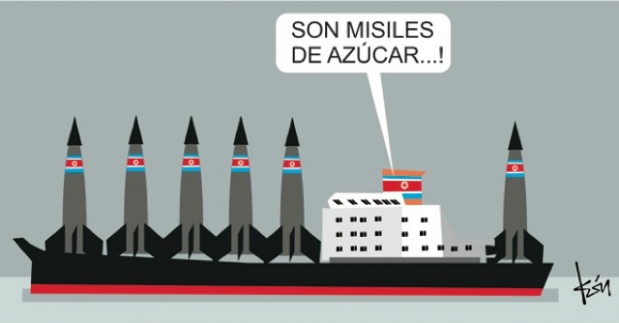
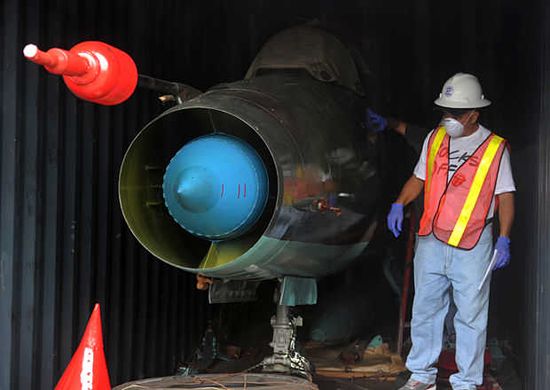
The North Korean vessel Chong Chon Gang, with its belly caramelized in arms and detained in the Panama Canal, floats above the level of State terrorism to settle itself in the much more explosive field of fiction.

Like a Tarantino totalitarian puppet – similar to the 5 Spies/Heroes of the Wasp Network in the USA… here all roles are relative – the supposed captain took a knife from the art (?) director and tried to cut his own throat, perhaps to later save the Great Comrade from the third litter, Kim Jung-Un, the trouble of doing so.

The Cuban government was quick to secretly negotiate a settlement with Panama, before the shit hit the media. Given the magnitude of smuggling – for less than this many capitals have been bombed – it would not be surprising that from Havana they offered a free license to open in Cuba, not one, but a thousand Panama canals the length and breadth of the island. Benicio del Toro promised it in Vietnam and Alfredo Guevara almost did so in the Caribbean.

The Panamanian President in person, with his neorealist name of Ricardo Martinelli, was the one who sounded the alarm, as a dramatic effect to his electorate. And he did it, of course, on Twitter, which is the measure of all things, and where even God now has verified accounts in different languages.

Our Minister of Foreign Relations then made his mea Cuba, and acknowledged that he had shipped some old rockets and planes that, at this point in the comic strip, couldn’t do any more damage. They were weapon props, those that now and again accidentally kill an extra or a double, who don’t even show up in the film credits.

Then, more and more containers appeared, including some with explosives. It was a classic cut to the chase because there’s no decent dramaturge without a bomb as the climax. The tanks, wandering suffering souls in greater misery than the thinkers of Havana and Pyongyang, should have sat down right away to rewrite the ending. Even in a democracy there are leaders that work like this, without all the loose ends tied up beforehand by the government script.

The sugar sacks were packed molecularly in a clandestine Cuban port, so now they must be unloaded by hand, one by one. At the beginning, it was to take days. As of now, it will take a few weeks. Nobody knows for sure the actual number of sacks, so no expert dares dismiss the possibility that this constitutes an irrational number. Or infinite. In that case, the Panama longshoremen have fallen into a trap worth of Borges. Perhaps into a Chinese Box. In any case, the perpetual downloading is another discovery of the aleph.

In the aftermath of the Revolution, it is pertinent to erase the evidence of the barbarities. Under the sugar, weapons as an element to divert attention. Beneath or within the arms could be camouflaged the key narrative of this entire debacle.

What are the North Koreans really taking from the Cuba of Castro 2.0? I recognize that my despair as a writer begins here.

Cadavers, for starters, that source of irreplaceable suspense: illustrious dead – or falsely disappeared – whose DNA remains they want to send to the cosmos or make into plasma thanks to the nuclear program of Kim 3.0. Of course, it could be a wholesale money flight, drawn from remittances of the entire Cuban exile, to mock for the millionth time the Washington trade embargo (another obsolete weapon, in this case against the Revolution).

Given the interminable tons of sugar, it’s possible they are also taking entire dynastic families, who perhaps haven’t figured out yet that the ship isn’t moving any more; so they are still in their high-tech containers, playing Go or digital golf, not knowing that Pyongyang is no longer expecting them. Ricardo Martinelli should tweet a little less and ensure the safety of these stowaways who, until recently, were the political thugs of the fatherland. If it’s “with all and for the good of all,” the emigrants of the elite and the revolutionary repressors can’t be excluded.

It is true that the Chong Chon Gang might explode from its undeclared criminal cargo — in Cuba there is a tradition of civilian planes and boats that flew for this reason — but it’s no less certain that the tragedy could have occurred in the narrowest region of the American continent, which by all rights would reduce any international condemnation to the rank of terroristhmus.

It’s true that they violated several provisions of the United Nations, always so controversial and manipulated when it comes time to vote, but we already know that many powers ignore them when they block their interests. It’s true that in Cuba today we barely produce the sugar consumed by our own people, but no one has yet literally tested a single grain from these sacks (perhaps it’s Caimanera salt, or sand from Veradero passing off this luxury item?). It’s true that Cuba could end up more isolated along with the ALBA block, and forced to pay millions for what could be considered an act of military aggression in times of peace.

But the obsession with the truth shouldn’t blind us before the triviality of verisimilitude, without which no art is authentic. Condemn us, it doesn’t matter: Hollywood will absolve us.*

Orlando Luis Pardo Lazo |  2 Aug 2013

*Translator’s note: A reference to Fidel Castro’s declaration at his trial for leading the attack on the Moncada Barracks: “Condemn me, it doesn’t matter; History will absolve me.”

A Curious Anniversary / Rebeca Monzo

This seems to be the year for varied and curious anniversaries. The one most “clucked about” is the sixtieth anniversary of you-know-what. There is also the fiftieth anniversary of Radio Encyclopedia, the fortieth anniversary of the Youth Labor Army and most notably the very curious thirty-fifth anniversary of the Isla de la Juventud (Isle of Youth), which with the stroke of a pen swept away the Isla de los Pinos (Isle of Pines), which for so many years had been the younger sister to the Island of Cuba.*

I have come to visit my friend Lisa, whose daughter is twenty-seven and pregnant. She tells me she is going with her to “González Coro” Hospital, formerly the “Holy Cross” clinic. After listening to me talk about the avalanche of this year’s anniversaries and commemorations, she says it would be a good idea to add to the list the water leak that has been present at this facility ever since she was expecting her daughter. At first they put a metal bucket under it to catch the dripping water, she says. But the leak is still there — though in the interim it has become more like a waterfall — so now they have a big plastic container to catch the “precious liquid.” However, from time to time it overflows and spills onto the granite floor over which the expectant mothers walk, putting them in danger of slipping and falling.

The fake roof in the area of leak has rotted from moisture and is coming off, but this does not seem to trouble anyone. When they can no longer use the space for medical exams, they will close it and later the entire hospital, as was the case with its counterpart, “Clodomira Almeida,” which has been in total ruins for years, as well as “Maternidad de Línea,” which is also closed, to name just two examples of this type. This leak is now as old as my friend’s daughter, twenty-seven years and counting. Like the Puerta de Alcalá,** it “watches time go by,” faced with the indifference of the hospital director, the medical personnel, the Ministry of Public Health and even the patients themselves. Will this be yet another curious anniversary to celebrate?

Translator’s notes:
*Isla de los Pinos is the second largest of Cuba’s islands. Its name was changed in 1978 to Isla de la Juventud.

** A well-known traffic circle in Madrid, marked by a triumphal arch.

4 August 2013

For Sale: Auctioning Off the Past / Yoani Sanchez

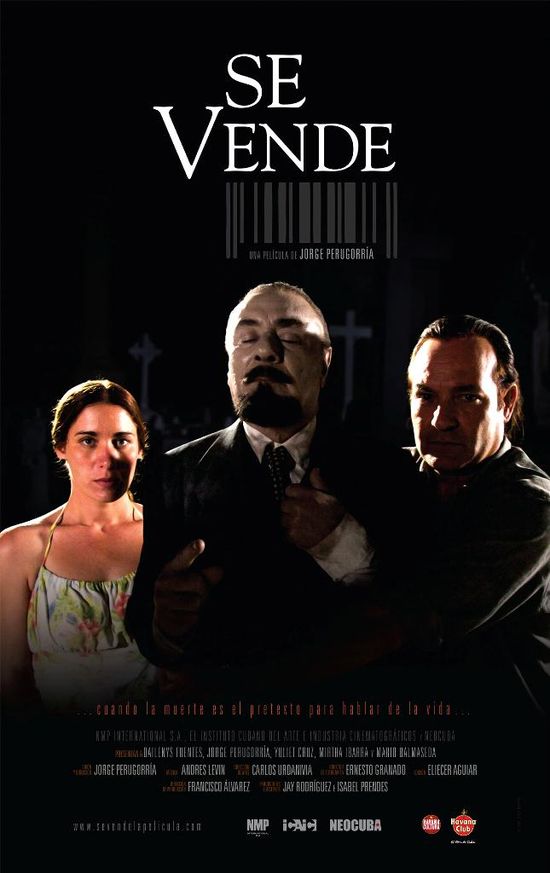
se vende6a00d8341bfb1653ef01910496c10e970c-550wiPeople laugh in the darkened room, the seats creak, and from the bathroom a reek invades everything. It’s nighttime at a Havana movie theater and the audience is enjoying the most recent Cuban comedy. Titled For Sale, it was directed by the well-known actor Jorge Perugorría and has already been shown in an extended series of openings. A controversial film that provokes laughter on the one hand, and fierce criticism on the other, it has its favor that it doesn’t leave its viewers indifferent. Either they laugh with pleasure, or get up in the middle of the screening and leave. Such reactions are also symptomatic of how we Cubans respond to certain issues, work and people. We tend to love or repudiate; to applaud or reject, with no intermediate points.

This is a humorously macabre story, with dead people who must be disinterred at the cemetery in the middle of the night. The script takes us by the hand through the absurdity of a reality where the sale of a tomb and the bones sheltered within it is the only path to financial relief for a young professional. For Sale unwinds in an also cadaverous Havana, a city of faded houses with balconies on the point of collapse. It presents us with a society where scruples and urges give way before the imperatives of survival. A wake-up call about the ferocious pragmatism that invades us, leaving nothing safe. A metaphor, perhaps, of a time in which the past is viewed with irreverence and a desire to liquidate it, by we who live in the present.

In its favor, the movie also makes several references to the classics of Cuban filmography. The well-known game of mirrors — the film within the film — amplified and referenced. An explicit tribute to Tomás Gutiérrez Alea (Titón) and Juan Carlos Tabío. The Death of a Bureacrat, For Trade, Strawberry and Chocolate, are some of the films referred to throughout the movie. However, some of these references pass unnoticed by a large audience, one that younger or less versed in national cinema doesn’t know its antecedents. Rather than a difficulty, this lack of reference points allows another way to understand the story being told. If the script wanted to turn these hints into evocations, they’re left for many as events at the same level as others. The trick of the lens looking into the lens needs an aware viewer, otherwise it’s seen as one more point in the story.

And then came the actor…

The figure of the director also cast as one of the protagonists is something new in the cinematography of the island.

Few native directors have alternated between both sides of the camera. In For Sale, the union of these roles doesn’t occur in the cautious manner of Alfred Hitchcock, where we see, for a few seconds and in the shadows, his chubby profile. In this case the spectator senses that the character of Noel recalls, too much, the actor who plays him, perhaps because his designer and interpreter are the same person. It is clear, however, that the entire filming must have been like a huge party for all the participants. To the point that at the end of the filmstrip it rushes to conclude in a great celebration where it seems to offer a solution to all the problems. An abrupt and often repeate, closing in Cuban comedies, that bore more than entertain.

Although with Nácar, the female protagonist, the script reaches for it, it misses an intimacy leaving only a timidity that is not credible. Lacking the weight of interior emotion that has nothing to do with the easy laugh, something we have become accustomed to in movies made in Cuba. The excessive sex scenes and erotic allusions, designed to fill theater seats, in hopes of seeing a nipple here, a thigh there… a couple kissing in the shower. “Wankers” all over the country are pleased with a script that offers them many minutes of bedrooms, beds, cunnilingus and even lesbian moments. Another contribution to the hackneyed stereotype of a hyper-eroticized national identity obsessed with the pleasures of the body. The ideological clichés are harmful, but the carnal also echos banal and enduring perceptions.

If you have to sacrifice the dead to feed the living…

Beyond the pitfalls and limitations of For Sale, its main achievement is to convey a message of particular importance for Cubans today. Filled with laughter, the myths of the past are picked apart, yesterday’s buried bodies are liquidated. The dead stay dead and serve only in regards to the imperatives of the living, every minute of the film seems to tell us. The corpse of the protagonist’s father, an ideologically inflexible man, at the end of the reel is a mere mannequin in an exposition. Played by the actor Mario Balmaseda in the manner of a rigid Lenin, index finger raised, this character embodies the political leaders whose old-fashioned speech provokes laughter more than sympathy. Leaders and ideas in liquidation once their time is passed; the stark conclusion of this filmstrip.

I am among those who stayed until the final minute of Jorge Perugorría’s film. I laughed through several of its scenes and reflected during others. Despite my own objections and criticisms, I preferred to find its nuances and intermediate points. I gave it a chance and I think it was worth it. Because through its 95 minutes, the script reaffirmed an idea I have pondered for years: no one can bear so much past, carrying on their back the weight of all the deceased. A nation is not a cemetery where the living must comply with the designs of those who are gone. The same thing ends up happening to political last wills and testaments as happens to the bones in the film For Sale: they are auctioned off for the imperatives and pragmatism of now.

From El Pais: Cuba Libre

5 August 2013

Who Provoked the Riot in the Guatao Women’s Prison? / Dania Virgen Garcia

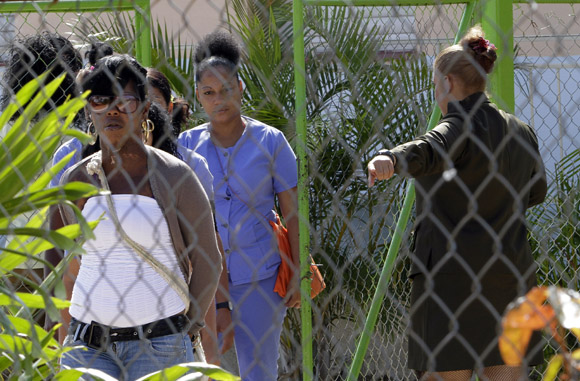
Havana women’s jail. Photo: Ismael Francisco/Cubadebate

Havana, Cuba, July 25, 2013, Dania Virgen Garcia / www.cubanet.org.  A reliable source who asked to remain anonymous for reasons of safety — it is clear that this source is not political prisoner Sonia Garro, illegally confined in that prison — said that those who provoked the riot in the Guatao women’s prison west of Havana this last May 26 were male and female officers of internal order.  These had been transferred to other prisons without being prosecuted for incitement to commit crime, among other crimes that were sanctioned by military laws.

The source blames the riot on the first petty officer of internal order, Yunieski Figueredo Garcia; Yasnay Velez Hariarte, Chief of Re-Education, transferred to prison 1580 in San Miguel del Padron, a municipality where they conferred on her an apartment near this prison; Ismari Torres Pexidor, re-educator of detachment 3; and the chief of internal order, Rosaidi Osorio Palmero, alias “Iron Lady,” who was transferred to the prison Valle Grande.

All those mentioned maintained strong corruption with the so-called White Collars.

The deputy warden of the prison, officer Betty, was transferred to the National Direction of Jails and Prisons, located at 15 and K, El Vedado, in Havana.

The six prisoners who initiated the riot, most very young, still are in the Manto Negro women’s prison.

According to the source, “They sent the worst management team from MININT (Ministry of the Interior).”

The new head of the prison, Major Sara, was previously the second.  She arrived sanctioned by another prison. Until she serves out the sanction, Lieutenant Colonel Diaz is standing in for her.

Yunieski Figueredo, alias El Negro, husband of the chief of internal order, Rosaidi Osorio, still continues in the prison as if nothing had happened.  This deputy receives the new inmates.  He is accustomed to harassing the prisoners to force them to have sex with him.

The source alluded to the fact that the White Collar prisoners, who run the economy and finances in the prison, were prohibited from exercising their duty and were replaced by officers who had no experience in the matter.

One group of prisoners who worked in the “Luis Ramirez Perdigon” military school dealt with the location of prisoners in the penitentiaries as well as other military details.

Now, the White Collars are located as cleaning helpers in different Havana hospitals, like the Surgical Clinic, the Pediatric “Juan Manuel Marquez,” Calixto Garcia and the Oncology Hospital.

A racist jail

The Guatao prison hosts more than 100 prisoners for economic crimes, embezzlement, corruption and theft in customs packages, among others.  Every week women with these crimes enter.

“Lieutenant Colonel Diaz is racist,” assured the source.  She refers to fact that the jailers who direct the leading platoon, who are mostly black, were replaced by white jailers, which has inconvenienced the officials.

She said that the prisoners who are pregnant or have recently given birth, who are in the galleries of the Manto Negro prison, live in extremely deplorable conditions. The galleries are very humid due to the seepages in the walls and roofs.

She indicated that in the Guatao prison there are two jailers who belong to the repressive rapid response body that put down the Ladies in White; their names are Yarelis Hernandez Herrera and Maria Pedroso Herrera, both deputies.

The former director of the Manto Negro women’s prison, Lieutenant Colonel Mercedes Luna, was promoted a couple of years ago to the National Directorate of Jails and Prisons (15 and K).  Now she is serving on an international mission in the Republic of Angola.

dania.zuzy@gmail.com

Translated by mlk

3 August 2013

Unionism for the Self-Employed / Yoani Sanchez

Self-employed. Photo by Silvia Corbelle.

The National Tax Administration (ONAT) office is open and dozens of people have been waiting from very early. An employee shouts directions for what line to get into for each procedure, although a few minutes later confusion will reign once again. At a desk without a computer another official writes the details of each case attended to, by hand. The wall behind her back is damp with humidity, the heat is unbearable and people constantly interrupt to ask for forms. An institution that takes in millions of pesos in taxes every year carries on with feet of clay, suffering from material precariousness and poor organization. Congested offices, interminable paperwork and lack of information are only some of the problems that hinder its management.

However, the setbacks don’t stop there. The lack of stable wholesale markets with diversified products also slow down the private sector. The inspectors fall on the cafes, restaurants and other autonomous businesses. Strikes or any public demonstrations to reduce taxes are strictly forbidden. It is expected that the self-employed will contribute to the national budget, but not that we will behave like citizens willing to make demands. The only union permitted, the Central Workers Union of Cuba (CTC), tries to absorb us in their straitjacketed structures. Paying monthly dues, participating in congresses where little is accomplished, and parading in support of the same government that lays off thousands of workers: it is to this that they want to reduce our collective action. Why not create and legalize our own organization, one not managed by the government? An entity that is not a transmission line from the powers-that-be to the workers, but the reverse?

Unfortunately, most of the self-employed don’t consider that salary independence and productivity must be tied to union sovereignty. Many fear that at the slightest hint of a demand their licenses will be cancelled and other measures taken against them. So they remain silent and accept the inefficiencies of ONAT, the inability to import raw materials from abroad, the excesses of the inspectors and other obstacles. Nor have emerging civil society organizations managed to capitalize on the needs of this sector to help them achieve representation. The necessary alliance between social groups that share nonconformity and demands doesn’t materialize. So our labor demands continue to be postponed, caught between the fear of some and the lack of attention from others.

4 August 2013