Current Ideas / Dimas Castellanos

One hundred and twenty-five years after his death on August 11, 1888, the scientific results that the eminent chemist, physiologist, agronomist, industrial technologist and science writer Alvaro Reynoso y Valdez bequeathed us are still on the waiting list.  While the official Cuban press pays exaggerated attention to events and people linked to politics and wars, it limits mention of Reynoso as part of the celebrated anniversaries without investigating his work or pressing for his contributions to become productive results.

Alvaro Reynoso, one of the Cubans who collaborated through science for the progress and formation of the basis of the Cuban nation, studied at San Cristobal (Carraguao) college, graduated with a Bachelor of Science from the Havana Royal and Literary University, continued his studies at the Sorbonne in Paris, where he graduated in 1856 and obtained a doctorate, becoming one of the best chemists of his era.

From the earliest years of study he began to publish his scientific results: a new procedure for the recognition of Iodine and Bromine; diverse new combinations of ammonia in ferrocyanides; action of the bases on salts and in particular on arsenides; separation of phosphoric acid from its combinations with metallic oxides; the presence of sugar in the urine of sick hysterics, epileptics and its relationship to respiration; the effect of bromide on poisoning by curare (a poison used by Indians to poison their arrows); studies about the artificial breeding of freshwater fish, and others.

On graduating in 1856 some twenty of his works had been presented in specialist publications in France and Spain.  He was elected a Corresponding Member of the Academy of Exact, Physical and Natural Sciences of Madrid and the Royal Academy of the History of Spain, he received the Royal Order “Professor of Chemistry Applied to Agriculture and Botany” from the Havana General Preparatory School and the “Professor of Enlarged Organic Chemistry” at the Central University of Madrid, among many honors.

On returning to Cuba in 1858 with a laboratory endowed with the most modern equipment and instruments, an excellent mineralogical collection and a valuable scientific library, he took possession of the Chemistry Chair and in 1859 replaced Jose Luis Casaseca as the director of the Havana Institute of Chemical Investigations, an institution that he converted into one of the world’s first agronomic stations.

Parallel with his investigative work he dedicated himself to writing.  In 1868 he began to collaborate as scientific writer for the Marina Daily, where he had a column in which he published articles about drinking water; he reviewed the first trial carried out in Cuba in April 1863 of the Fowler steam-powered plow, with which he began the mechanization of sugar cane in Cuba; he was a writer of the Annals and Memories of the Royal Development Board and the Royal Economic Society; he published in the Magazine of Agriculture of the Ranchers Circle on the island of Cuba and in other press organs.

Among his published works are: Details About Various Cuban Crops, where he compiled his contributions about non-sugar cane agriculture such as corn, coffee, cotton, tobacco; Progressive Studies on Various Scientific, Agricultural, and Industrial Subjects, a collection of articles published in the press about the cultivation of sugar cane in all its phases, as well as experimentation plans by the Institute of Chemical Investigations and the planting of sweet potatoes, yams, corn and rice destined for human and animal consumption.

In the middle of the 19th century, when Cuba was first in the world in production of sugar and the last in productivity, supporting his thesis that the true making of sugar is in the reeds, he devoted himself to resolving this contradiction. The results were gathered in his crowning work Study of the Culture of Sugarcane where he integrated all the related operations with the culture and harvest of the grass, from the negative effect of the logging of virgin forests to fresh grinding for avoiding alteration of the juices.  This work published in 1862 was re-published in Madrid in 1865, in Paris in 1878 and in Cuba in 1925 where it was re-printed in 1954 and 1959 in addition to being published in Holland.

An aspect of his ideas which is barely mentioned, is that Reynoso considered the autonomous participation of the Cubans in the political estate reform of the colony as a legitimate demand.  That’s why, in his systematic analysis he never avoided the topic of agricultural property.  He considered, just the same as Francisco de Frias and Jose Antonio Saco, the need to establish a sugar cane agriculture with native small farmers and immigrants, where the incentive of ownership, much different from the slave system, was a basic component to push forward the modernization of the agricultural economy.

However, in the year 2001, when due to the continuous decrease in sugar production, less than 3.5 million tons, the then Sugar Industry Minister, General Ulises Rosales del Toro announced two projects to reverse the situation: one, to restructure the sugar industry aimed at achieving industrial performance of 11% or extracting from each 100 tons of sugar cane, 11 tons of sugar; and the other one baptized with the name of the distinguished scientist with the objective of reaching 54 tons of sugar cane per hectare.  With both projects, as announced then, Cuba could produce 6 million tons of sugar (the amount produced in Cuba in 1948).

Towards that end, instead of taking into account all the elements which participated in the production process as taught by Reynoso, some 100 sugar factories were closed, with the land distributed for the use of other crops and sidestepping the damaging state monopoly on land ownership.  The amount of 2002-2003 harvest – the first after the implementation of the “novel task and one of the worse of all times” – was 2.1 million tons, barely half of the production in 1919.

From there and until the present time the industry inefficiency, the unavailability of sugar cane, the low results of land usage and the high cost of production per ton has repeated year after year.  In the last harvest, 2012-2013, the plan of 1.7 million tons was not reached for many reasons, but especially because of the unresolved problem of the land tenancy was attempted to be resolved through the leasing approach known as usufruct, maintaining the inefficient State as owner and the economy subordinated to politics and ideology; which shows not only in the sugar production but in the agricultural production and all facets of the economy.

Taken from: Diario de Cuba

14 August 2013

Prison Diary LVIII: Inside Prison, Outside the Drawer / Angel Santiesteban

This last 13 September, a Friday, while the Instituto Cervantes de Berlín was presenting my novel El verano en que Dios dormía (The Summer God Was Sleeping), the winner of the Czech Republic’s International Franz Kafka Prize of Novels from the Drawer, I was overcome by fever. The dengue fever virus had taken over my body and sapped my strength.

While my strength gave way, my mind, in turn, was concerned with defending, as always, that little space of harmony in which, like an inner island, I live and immerse myself, to protect myself from so much injustice and evil coming from the Communist Government. From that imaginary place, I feed myself and construct the events in that distant and endearing country where my friends and brothers await, and where I was close to those excellent intellectuals — Jorge Luis Arzola, José Miguel Prieto, and Amir Valle — and as a panelist, the German editor, cultural maven and person of immense feelings, the imponderable friend and godmother of writers from the “Los Novísimos*” generation, Michi Strausfeld — who is presenting my novel, promoting it, and as if that weren’t enough, making the world aware of the injustice committed against me, and why I am incarcerated.

Knowing the work of the Cuban Government, presumably they would elaborate a scathing plan to wreck this cultural space, and they tried to through a public letter from the German “Cuban Network” foundation, accustomed to giving its support to the Castro brothers’ totalitarian regime, a foundation whose right we recognize to do so, however unjust it seems, coincidentally the same right to criticize, expound on reasons, points of view, that we demand for all Cubans, and which for realizing we are punished with impunity, as every dictatorship does against those who reject its designs.

The truth is that neither the regime nor illness diminished the joy of feeling myself a physical part of the presentation at the Berlin International Literature Festival. Between the fatigue and high fever, I thought about the book, friends, readers.

It is my infinite desire to thank those who have, for several years, supported the competition and brought to light books that the Regime censors, and thanks to this beautiful and just effort, prevented these literary creations from sleeping in drawers; I also thank the Jury who awarded the prize to my novel; and the intellectuals, cultural promoters from different countries, and my friends who put so much effort into this presentation, and above all for their political and social ideals, giving weight to culture, our primary reason for being. And to the Czech NGO “Banned Books,” and their clear cultural management.

The novel “The Summer God Was Sleeping,” like the rest of my books, attempts to be a photograph of my time, to give a voice to those testimonies of Cubans who risked and are risking their lives to achieve freedom and rights, and who cross the Strait of Florida, trying to evade the pursuit of the dictatorship, in order to leave behind the material shortages and political repression. On this they wager their most precious possession, their lives. Once again, I try to present my time and our time. I know that’s not enough, I need to double my efforts, and to this I bravely turn my efforts.

Ángel Santiesteban-Prats

Lawton Prison Settlement. October 2013

*Translator’s note: “Los Novísimos” (The Newest) is a name that has been  given to Cuban writers such as Angel who began to publish in the 1990s — during the so-called “Special Period” — and whose works reject the values of the Castro regime.

8 October 2013

Another Scandalous Political Maneuver in the Trial Against Angel Santiesteban / Angel Santiesteban

The so-called Cuban justice, which is nothing more than another of the pathetic military arms of the political police of the dynastic dictatorship which is clinging to power for more than half a century, has shown – once again, of course – the audacity and impunity with which it always tramples on the law and the rights of those on the island, believing that we would sit idly by, complicit in another violation of the law and ethics.

On the 11th of February, Ángel Santiesteban’s former defence lawyer, Miguel Iturria, presented before the Havana Court of Appeals a request for clarification on the sentence imposed on the 15th of January 2013, regarding the serious irregularities which occurred during the whole trial and sentencing. The request, which would have been responded to if Cuba was a state which adhered to the rule of law, never received an answer.

On July 4th, Ángel Santiesteban-Prats’ new lawyer, Amelia Rodríguez Cala, presented to the Judgement Appeals Review, complying with all arranged elements under existing law, demonstrating that the trial was based on offenses which were not proven because he did not commit them, the use of false testimony on the part of the prosecution, refusal to accept testimony showing the defendant’s innocence, scandalous links between the political police and judicial the bodies which violate the separation of powers, and judicial irregularities throughout the whole process. Nor, until today, has there been a response to that request for review of the trial and on August 28th, Angel marked 6 months in unjust incarceration.

A few weeks ago, the lawyer Muguel Iturria received the ruling in response to the request for clarification on the sentence which was made on the 11th of February. On the 8th of August the answer to his request was, as many feared, negative.

That they have announced this ruling 6 months after clarification was requested and that this announcement happens “coincidentally” at a time when a response to request of the lawyer Rodríguez Cala is expected, once more provides evidence and lays bare the scandalous justice of Castro, revealing that it only works for those who are driven by opportunism and political maneuvering, trying to outwit those who proceed according to law. This time they have done this with another blatant overbearing maneuver which doesn’t adhere to what is established in law, to avoid being told that justice does not answer the claims of citizens. However such maneuvers don’t fool anyone, it proves once again that in Cuba justice doesn’t exist, they lost another opportunity to rectify their violations of the law against Ángel and, at least for once, to do justice.

This unjust ruling adds to the lengthy record that teaches the world how in Cuba there is no rule of law, as they violate human rights and there is no separation of powers in the state.

Raúl Castro Ruz, the world is watching you: sooner rather than later, those who shall be accountable to justice shall be you and your minions.

The Editor

Translated by Shane J. Cassidy

9 September 2013

No Remedies, Political Changes / Martha Beatriz Roque Cabello

HAVANA, Cuba, October, www.cubanet.org — Raul Castro has repeated constantly that errors are the greatest enemy of the Revolution, those that have been committed and new ones that may be committed.  Nevertheless, he does not speak of the political changes necessary for correcting those errors, since the so-called reforms are not enough, particularly because of how slowly they advance.

Such “reforms” have been good only for the discourse abroad, but within the country they have negative results, from the social and economic point of view. Income inequalities are more noticeable, and today begging is significantly increased.  The small role they have given to the private sector does nothing to confront the grave crisis.

Economic reforms require political changes.  And although modifying the Constitution of the Republic has been spoken of superficially, the fact that the communist party is the superior directing force of society and the State perpetuates the lack of liberties, installing the government as all-powerful so that it does not worry about the people’s problems.

Although the regime maintains a policy of centralization of the means of production, it could think about speeding up some services.  Nevertheless, we are already seeing symptoms of the Nicaraguan style of “piñata.”  And as is natural, the beneficiaries are the high officials of the army and of the ministry of the interior.  The possibility of creating non-agricultural cooperatives is accompanied by this characteristic syndrome of regimes in decline.

Those who think that the current situation will end with solutions like the Mariel Special Development Zone are wrong. Modifying or updating the economic model is talked about, but you cannot modify something that does not exist.  If they tried to copy what is permitted in China and Vietnam, they fell short, and the legislation is very far below what should have been allowed.

The Legal Decree that establishes the Special Development Zone shows that the regime knows that a profound change towards a market economy is necessary. Among the objectives it pursues are attracting foreign investment and creating a logistical system that permits high levels of efficiency in the import, export and distribution processes.  Both areas behave inefficiently within the Cuban economy.

They may keep taking mediocre measures (including those who propose that they legalize lottery gambling, as in the early years when the National Institute of Saving and Housing existed and one could buy lottery bonds), but that will only contribute to delaying the true change by some years.  Sooner rather than later, the situation of increasing poverty, the enrichment of a few, and the “piñata” that now is distributed among those at the top, will defeat the worn out “construction of socialism.”

A good recommendation would be to stop the suffering of the people and affect true political, economic and social reform.  As a first step, they should free the political prisoners and stop the harassment and beatings of dissidents, while leaving aside the false discourse that calls for strengthening national unity around the Party and the Revolution, because without doubt the regime knows that, although they continue prohibiting it, in Cuba there now exists broad ideological diversity.

Martha Beatriz Roque Cabello

From Cubanet, 10 October 2013

Translated by mlk

Angel Santiesteban-Prats on “The Night” on NTN24 / Angel Santiesteban

The programme ” The Night” on NTN24, exclusively revealed a letter [which can be read here, in English] from the dissident writer Ángel Santiesteban, who is currently serving a five-year prison sentence in Cuba.

The writer alleged that he had received “constant death threats” since he was incarcerated. Equally, the dissident defended his innocence through his writing and questioned the justice of the Castro brothers, Fidel and Raúl, on the island.

Translated by Shane J. Cassidy

10 October 2013

Latin America Witnesses the Repression in Cuba Thanks to Television / Angel Santiesteban


NTN24’s programme “The Night”, directed by Claudia Gurisarri and Jeferson Beltrán and hosted by Jason Calderón, has dedicated its 9th of October broadcast to Cuba and the terrible situation and the terrible repression its people are suffering from the Castro dictatorship. Far from seeing some improvement with false “reforms”, the regime wants to make the international community believe that it is leading the country towards openness; the only thing that they are really doing is an unparalleled multiplication of repression and violence against all peaceful opposition on the island.

“The Night”, on top of doing an excellent job denouncing the dictatorship of the Castro family, the repressive situation which has existed in Cuba and the violation of human rights on the island, has dedicated a privileged space in its programme for Ángel Santiesteban-Prats, who will soon have completed eight months incarcerated after a judicial farce with invented charges by the political police, using the mother of his son to place false accusations against him with the only objective to silence his critical voice against the regime, and therefore they intend to keep him imprisoned for five years.

But so clumsy and so thinly disguised are the crimes that it wasn’t sufficient for them to jail him for being innocent but to jail him for political crimes according to them, they offered him his freedom in exchange for renouncing his political position, becoming the first ordinary criminal to whom they offered the freedom in order for giving up his political activism. A strange way of understanding freedom which the dictator Castro Ruz has.

All our gratitude to Claudia Gurisatti, Jeferson Beltrán, Jason Calderón and the Cuban Lilo Vilaplana, tireless figther for the freedom of Cuba for the rights of their brothers and Friend  (with capital letters),

in the name of Ángel Santiesteban-Prats,

The Editor

Translated by Shane J. Cassidy

11 October 2013

Letter from Angel Santiesteban to NTN24 / Angel Santiesteban

Hello to the viewers, the team who works for “The Night Moves”, in particular to their presenter, greetings to the persistence of friends like the director and the writer Lilo Vilaplana and to Antonio Rodiles, who directs the cultural space and social project State of SATS.

Dear friends, this month marks eight months that I have been imprisoned, and my departure on this primetime programme with a continental reach.

I am not lying to you if I admit to you that I never could have believed that the dictatorship would be able to imprison me knowing that I’m innocent, not because there remains an ounce of sanity of justice in them but because they provoked a wave of protests, so that to expose the evidence of the prosecution and that of the defence, the political game behind the circus mounted against me is clear.

Of course, as a totalitarian regime they have made a show of force, they have once more shown what they are capable of doing to voices which oppose the dictatorship, especially if they are within the Cuban archipelago. I know that my life has been thrown into danger, the mysterious deaths of the opposition leaders exposes their crimes. I have received constant death threats since my arrival in prison, where they have assured me that I will not leave with my life. What also makes it difficult is that there are many eyes of solidarity watching me on an international level. They have also offered to give me liberty if I desist from my opposition ways, or if I change them they proposed my definite departure from the country. In both cases, I refused flatly.

At any rate, the worst will come if needs be, it was a path I took with full conscience and for the necessity of my soul, I took it knowing the risks, because even before opening the blog, I, an intellectual and exemplary citizen to society thus far, many family and friends predicted jail or death for me.

Of course, I don’t want to be a martyr, my dream is to continue being a writer and be able to tell what is happening in my country the hopes and disappointments of my contemporaries. They know that if this doesn’t come to pass, I prefer it, since what I could not tolerate is to continue living in my country under the slavery of one of the most intelligent and ferocious dictatorships which has existed on the face of the earth.

When all will be revealed, many will be ashamed of having supported it, justifying that they did not know.

To you all, my eternal gratitude, long live Cuba and may it be free!

Ángel Santiesteban-Prats

Lawton prison settlement. October 2013

Translated by Shane J. Cassidy

10 October 2013

As Much in Cuba as in Spain

The letter by friends from Spain is a cruel reminder that when it comes to confronting the government, repression can happen anywhere.  One of their sons was detained at a demonstration of the CNT and accused of assaulting a police officer.  Although in this time of smart phones there exists documented proof that it was the police who assaulted the young man while he hoisted a banner, he has to confront a trial where he could be sentenced to up to seven years in jail.  The illegality is so flagrant that Amnesty International has taken an interest in the case.  I am no philosopher or political scientist, my knowledge of economics is precarious, in times past I thought that culture could save us, but also that is an illusion.  It is justice, with eyes blindfolded and a true balance, that they should erect over governments and ideologies to protect any citizen.

Translated by mlk

11 October 2013

Blackouts Wreak Havoc in Villa Clara / Yoel Espinosa Medrano

SANTA CLARA, Cuba, October 9, 2013, Yoel Espinosa Medrano / www.cubanet.org.- Blackouts of up to ten hours a day have been seriously affecting residents in the province of Villa Clara for several weeks now. Electricity is the main choice for cooking.

Last week in Santa Clara about 200 people in the Condado neighborhood went out into the street at night in front of their homes and launched a spontaneous “pot banging protest.” Fifteen minutes later electricity was restored.

“I do not know what is happening at the Electric Company, the blackouts are more prolonged and continuous, they have three different circuits and they aren’t making repairs on any of them or maintaining the power lines, but there’s no power between 8:00 in the morning and 6:00 in the evening,” said Guillermo del Sol Perez, a resident of 3rd Street and Circunvalación in the Brisas del Oeste neighborhood in Santa Clara.

Utility officials announce the daily blackouts on the local radio, saying that the service is down for maintenance. They also interrupt the service intermittently for periods of 30-60 minutes in the morning or evening hours.

In the offices of the Commercial Department of the Electric Company, the damage to domestic equipment reportedly exceeds two thousand, because of service irregularities, according to a worker who requested anonymity.

“This is the worst, they turn off the power in the early morning and don’t turn it on again until dusk; the most affected are those of us with children crying from hunger and we have no way to heat even a glass of milk,” said Dania Conception mother of two children living on 1st Street in the La Vigia neighborhood, also in the provincial capital.

In most nuclear families, accounting for the number of members, they are given an emergency fuel reserve. Those who receive liquid gas are allowed 20 kg per 12 months, and for the rest they receive five liters of alcohol and some 15 liters of kerosene for the same period, through the ration book.

The blackouts paralyze work, state and private, as well as the preparation of snacks, lunch and dinner for thousands of students in regular schools and boarding schools.

Yoel Espinosa Medrano

From Cubanet, 9 October 2013

Maria is Disillusioned With Life, She Would Rather Die / Yoel Espinosa Medrano

María-y-Felinciano-en-su-vivienda-3-224x300SANTA CLARA, Cuba, October 9, 2013, Yoel Espinosa Medrano /  www.cubanet.org.- María de la Cruz Martín Concepción is a lady of 65. She lives in the central province of Villa Clara, one of the territories with the highest rates of an aging population in Cuba. Relatives and neighbors are keeping and eye on her. She is determined to take her life if the situation in which she lives isn’t addressed.

She says she has lost the joy of living. Death has played with her on several occasions. She has had three heart attacks. She also suffers from Ischemic Heart Disease, Diabetic Neuropathy, Hypertension, among other conditions common to her age, exacerbated by poor diet.

Martin Concepcion is experiencing a crisis of diabetes and high blood pressure . She hasn’t bought the medicines to control her conditions for three months. Her drugs — Glibenclamide, Cartopril, Nitropental, Dipyridamole and others — cost about 100 Cuban pesos a month.

Fatally, General Raul Castro took 198 pesos (some 7 dollars) from the pension she receives from social assistance. To control her illnesses she drinks infusions made from medicinal plants, and also subsists on the charity of others who give her the occasional pill.

Her husband, Joseph Felinciano Fernandez, 72-years-old, nearly died of a bowel obstruction complicated by peritonitis recently. He earns a monthly pension of just over 200 Cuban pesos (about $7) .

Three years ago, a man driving a Russian brand Ural motorcycle with a sidecar hit the horse-drawn wagon Felinciano was driving and caused a skull fracture that affected his hearing. He also has an abdominal hernia.

The motorcycle driver was under the influence of alcohol and fled the scene. Eventually the police found him. The old man was in serious condition for several days in a hospital.

The trial for the accident was prearranged. The accused, the person who hit the back of the cart, had “patrons” and money. He got of scot-free and the old man was sentenced to pay a fine.

The couple’s home, located on Callejón del Salado S/N and Circunvalación, in the Brisas del Oeste neighborhood of Santa Clara, in Villa Clara province, is in deplorable condition.

An official of the Municipal Housing Authority, named Minerva, classified it as in a state of total collapse.

María and her husband now spend the night at the home of a daughter who has one room, a kitchen and bathroom. Also living there are her son-in-law, grandson and wife.

Raúl Fernández is a paramilitary who holds the position of Coordinator of the Area , a notorious organizer of mobs and a member of the so-called Rapid Response Brigades who generally take actions against human rights activists. He visited the shack and told the elderly couple they would get together the money for lumber for repairs.

María sent letters to the various levels of government and the Party in Villa Clara.

A gentleman who identified himself as delegate of the People’s Power in the area analyzed the housing situation and said they could not spend another minute in it because the roof might fall in at any moment. He also said they did not have ownership of the house, so they were classified as illegals, despite having lived there for over 20 years.

The official said that without title to the property they could not subsidize their housing repairs.

Meanwhile, María waited for a formal response. She herself won’t see the end to their odyssey because with poor nutrition and no medications, her heart can’t withstand another attack.

Yoel Espinosa Medrano

From Cubanet, 10 October 2013

Our Hospital / Rebeca Monzo

Raimundo arrived early to an offsite clinic affiliated with General Calixto García Hospital that was located in the basements of two old satellite buildings. The waiting room was full and the rumble of voices prevented him from concentrating on the book he had brought along to make the obligatory wait more tolerable. Suddenly an older woman entered the waiting room. She was a newspaper vendor hawking Workers and inviting everyone there to buy a copy to pass the time while waiting their turns. She went on and on, telling everyone she had to do this in order to eat, that she had been a worker at the hospital for many years and that, if she did not do this, she would die of hunger because her pension was so meager, though even when she was working, she still barely made a living.

It was then that an eighty-year-old man, who was waiting to be seen, spoke up and said, “Señora, this is fascism and all our rights are being taken away. This hospital is disgusting. It looks like it hasn’t been cleaned for months. We’re in a dark, humid basement and no one has even put a fan down here to get a little air circulation. If the doctors can’t take it, then what about the patients?”

“Tell it like it is, old man,” someone there said.

The murmur of voices rose in crescendo. Everyone began commenting on the filth, the shortages, the lack of sanitary conditions, the hassles they had to endure to get there by bus because not everybody had ten pesos for a tarecón (a taxi from the 1950s).

Suddenly, a male nurse looked down the wide stairway leading to the basement and called out to the patients in the waiting room, “This man has had surgery. Can someone give me a hand getting him and his wheelchair down the stairs?” The clinic’s door opened and a doctor, fanning himself with a piece of cardboard, said in a loud voice, “Next”

The same old man takes the floor again and raising his voice, so that everyone can hear, says, “Gentlemen, this is our hospital!”

9 October 2013

Independent Journalists: Journalists / Yoani Sanchez

Last week a friend asked me if the coming of democratic changes to Cuba would result in independent journalism. I stopped to meditate, because there are answers that shouldn’t be thrown out there without carefully weighing them. In the seconds I remained silent passing through my head were all the images and moments of those reporters of risks and words that have influenced my life. I thought about Raúl Rivero, who left journalism and the official institutions to take a dangerous leap toward freedom for his pen.  I remember the typewriter permanently on the table in his apartment on Peñalver Street, the smell of his cigar, his arms reaching out to receive everyone who came. Undoubtedly a man who loved his profession which put him at the center of so much repression and damage.

I kept going over the names. Reinaldo Escobar who permanently infected me with the virus of journalism, my colleagues of Primavera de Cuba, the many friends who have fed the pages of Cubanet, Diario de Cuba, Café Fuerte, HablemosPress, Misceláneas de Cuba, Voces Cubanas, Penúltimos Días and of so many other sites, blogs, press agencies and simple bulletins with just a single sheet folded in half. Spaces in which they have narrated this country concealed by the official media and the triumphalism of political slogans. People who choose the most difficult path, instead of remaining silent, faking it, staying out of trouble like the vast majority. Thanks to them we have heard innumerable news stories silenced in the national newspapers, television and radio, the private and hegemonic property of the Communist Party.

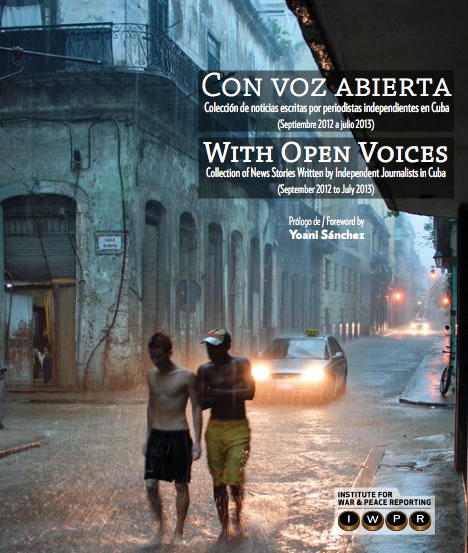
So, when my friend sprung that question on me, I concluded that in a democratic nation journalism has no need of surnames. It is not “official” or “independent.” And so, as a small tribute to all those reporters of yesterday and today, I have written the prologue to the anthology, “Con voz abierta/With Open Voices,” which presents a selection of news and opinion written from within Cuba and in the most precarious of conditions from the legal and material point of view. It is a book of journalists… simply journalists, without qualifiers that determine their affiliation to any ideology. A compilation that will bring about this future in which we will not need to make distinctions between professionals of the press.

The post Periodistas independientes: periodistas appeared first on Generación Y by .

10 October 2013

A Message for Grethel / Ahmel Echevarria Pere, From Sampsonia Way Magazine

Artwork by Luis Trápaga

Translated by Zach Tackett

We met at the Cinematheque. We had taken the same bus and watched the city though the small window without trying to talk. In truth, I watched her when she wasn’t looking. At the theatre I noticed her in line behind me. There was a smile, and another ten minutes of waiting to buy a ticket. I realized when it came time to pay that I only had four coins worth 20 cents and a peso in my pockets. I had forgotten my wallet at home.

I looked through my pockets again: Keys, a peso, coins, and the bus fare bulletin. Nothing else. The ticket clerk was impatient with my delay. As the line grew longer he got angry.

I cursed.

—Two, please —she said to the ticket clerk and looked back at me. –Today is my turn to pay. Did you forget?

She gave me a wink. I wanted to go along with her game, but I couldn’t find the words.

She smiled.

I thanked her.

The employee muttered again.

We walked into the movie.

From my seat, I saw her choose her own seat a few rows away. She put on her headphones. She was listening to her Walkman until the lights went down. No one sat next to her.

I left for the lobby before the final credits, feeling ridiculous. The entire way to our seats and I had only said a stupid “thank you.” I needed to see her, apologize, make up some story in the hope that I could appear less stupid to her. I was so worried I could barely pay attention to the movie.

I didn’t have time to invent some excuse. She came out to the lobby right away. I walked toward her. –Excuse me, I don’t even know your name, and I’m in debt to you.

I suggested we met up some other time. She smiled. She said that it’d be pointless to meet up again if I forgot my wallet.

—Putting it in my pocket wouldn’t help me much. Do you have a pen?

Then I wrote my number on the back of the bulletin that I always carried in my pocket.

She looked into her purse, ripped a page from her agenda, and wrote something.

—When you call, say that it’s for me and leave a message. I don’t like to bother my neighbor.

READ THE REST OF THE STORY IN SAMPSONIA WAY MAGAZINE, HERE.

The publication of this story is part of Sampsonia Way Magazine’s “CUBAN NEWRRATIVE: e-MERGING LITERATURE FROM GENERATION ZERO” project, in collaboration with Orlando Luis Pardo Lazo, and a collection of authors writing from Cuba. You can read this story in Spanish here, and other stories from the project, here.

A Che Not Printed on Money / Luis Felipe Rojas

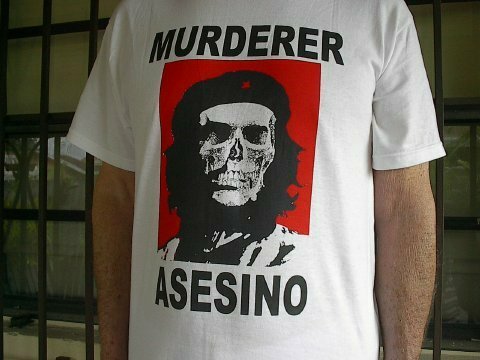
I now see how an asthmatic who was too sick to travel became someone who could kill and command his own army of troops. But twenty years would have to pass before I would be able to write such a simple statement. When you are six Februaries old and they force you to bring your hand up to your forehead in a salute and say that you want to be like the Argentinian Rambo… (the good guy), who killed Batista’s henchmen (the bad guys) and wanted all the countries of the third world (?????!!) to be free, then you think, he is not only Rambo, he is Elpidio Valdés.*

The Che I learned about in school made his way through the intricate byways of the Sierra Maestra, teaching his men how to read and use rifles while “slapping around” the knuckle-heads and brown-nosers among his troops. According to textbooks he was the one who captured Santa Clara and organized the army of bearded men who entered Havana in 1959. But then came the other Che, the one introduced to me through books wrapped in newspapers by dissidents in the 1990s. In pamphlets and newspaper articles the other Che (no longer a guerrilla hero) arranged executions at La Cabaña, screwed over Virgilio Piñera and called forth a river a blood in an attempt to overturn capitalism.

Five years ago I saw a photo of a bearded man dirtied from months spent in the jungle. I was with Javier Palacios, the Peruvian nephew of a former guerrilla army leader. The Peruvian man and his family want nothing to do with the icon immortalized by Alberto Korda and his camera. The stories they have heard about him are horrifying. They have buried once and for all the idyll of internationalism manufactured in the offices of the Central Committee of the Cuban Communist Party.

A guy who bullies, curses, walks around all day in a bad mood and years later seizes on several Cuban families (almost all of them peasants) with the story of doing away with imperialism…cannot be a nice guy. A guy who did not sing, did not laugh and did not play a musical instrument cannot be a nice guy. About five years ago a Spanish newspaper published a photo of his corpse lying in a laundry in La Higuera, Bolivia, all the veils fell away. The songs of adulation which had been sung for decades, the sea of ink and even the famous letter of farewell no longer mattered, even if you find out at the end of the story that it was read ahead of time as an order to kill. To Cuban ears it sounds like a settling of scores, like high-spirited taunting. Like saying, “You can go straight to hell.” As the saying goes, “He who lives by the sword…”

*Translator’s note: The hero of an animated television cartoon for children from the 1970s and 1980s who fights in Cuba’s 19th century armed struggles for liberation. 

8 October 2013

More of the Same / Fernando Damaso

Photo Rebeca

Self-employment, in the face of capricious decisions by the authorities in charge, continues to lurch along, and its progress and solidification as a lawful way of life for thousands of people becomes more complicated by the day. Although it has been officially declared that the policy continues the same as when it was first authorized, and the only thing intended by the new regulations is to set up greater order, in practice it is not so.

Apart from the widespread confusion between what is authorized and what is unauthorized, caused primarily by the generic, ambiguous, extremist, and bureaucratic regulations of the Ministry of Labor and Social Security, the Ministry of Finance and Prices, the Councils of Administration of the People’s Power, and others involved, plus the arbitrariness of inspectors and others in control, requiring compliance with nonexistent provisions, and imposing excessive fines according to their personal interpretations, the chaos created makes the practice of self-employment a living hell.

Day by day, because of all this institutional disorganization, it survives by the tenacity of those who practice it, risking resources and efforts on activities that not even its proponents have been able to define within serious legal boundaries, leaving everything to future studies, adjustments, and details, as the authorities are wont to respond to those who ask, demonstrating their professional precariousness for holding the positions they occupy. While the unconditionally incompetent constitute a majority in the different levels of state administration, the solutions shine by their absence, the rope continues to tighten to the breaking point, with the implications that entails, and the problems pile up.

It seems that self-employment, which emerged as a necessity to resolve the employment that the state is unable to assure to its citizens, continues to terrorize those who were forced to authorize it, those who, without the help of their many advisors, find ways to control it without completely strangling it and, what concerns them more, without losing any of the perks of power accumulated over so many years. But it turns out that the citizens of today do not look anything like those of yesterday: they are now tired of fables and impositions and are willing to defend their rights of survival.

9 October 2013