English Translations of Cubans Writing From the Island
 HAVANA, Cuba, October, www.cubanet.org – Recently returned from the Republic of Angola where she served as a volunteer, an official still can’t hide her astonishment while telling her story. I’ll call her Mireya because she asked me not to reveal her real name.
She is fifty years old. Thirty-two years ago she gave herself to the Socialist Revolution. She really internalized the “New Man” advocated by Che; at twenty-three she held dual membership in the Communist Youth and the Party. She was serious, deep, devoted to her work and above all to the Party.
She transferred from a job as a quality inspector at the municipal flour company in Guantanamo, to the National Bread Administration in Havana. During the inspections, the administrators and inspectors feared her. Over the years she had learned how to find when a problem was being hidden and always uncovered violations and crimes in fulfilling the technology directives.
The drivers also feared her, they said she “looked like a general.” And even the Board of Directors respected her. Besides being an excellent professional, she was the secretary of her Party cell.
She was selected to advise the Angolan Food Ministry with regards to bread, as reflected in an agreement signed by both countries in 2002. Mireya was tasked with implementing Cuban technology directives in the far off African country. For three years, she organized the work of seven Angolan provinces and the capital, Luanda.
She was under a contract with the Cuban firm ANTEX, SA, with an employer who was paid six thousand a month for her work, but she was entitled to only six hundred, of which she never got more than one-hundred-sixty. And at the bottom of the contract it said the other part was for “Cuba sí” (for the victims of hurricane Sandy), and forty for food. During her mission her two granddaughters were born and she was crazy to see them, and in order to save money and be able to take it to Cuba, she skipped the evening meal.
But when Mireya arrived at José Marti airport, she says she met with a capitalism worse than Angola’s. The Customs officials demanded that if she wanted to bring in her household goods she had to pay as if she’d bought them there, a huge amount of money they left her stunned. She argued that she’d already paid for them to ANTEX, but the Customs officials responded that this was another payment, a different one. And Mireya, crazy to get home and meet her granddaughters, paid very grumpily.
And at home, with her granddaughters in her arms, she said the shock didn’t end. She learned she had lost her job, the law stipulated she could only be gone two years and a day and she had to start from scratch.
And when she went with the letter to buy the car, they told her there was a delay with the older volunteers, of two years. And she had to deposit the money in the bank and wait her turn. And she couldn’t touch it because she would lose the “right to a car.”
Now Mireya, with no job, no money and no car, authorized me to write her story. Everyone knows that three years in Angola isn’t easy.
Frank Correa
From Cubanet, 16 October 2013
Today the director of the civic organization State of Sats, Antonio Rodiles, filed a petition for a writ of habeas corpus with the Provincial People’s Tribunal of Havana on behalf of two pro-democracy activists who were detained and who remain incommunicado.
The first petition was filed on behalf of José Díaz Silva, who was arrested near his home last Thursday, October 10, when he was arbitrarily detained by an agent from State Security identified only as Gastón. Díaz Silva was transferred to the detention center known as “El Vivac.” So far, no preliminary injunction has been brought against him and he has been denied visits from family members.
The other petition was filed on behalf of Díaz Silva’s wife, Lourdes Esquivel Veiyto, who was detained at 11 AM on Friday after appearing at the Santiago de las Vegas police station to seek information on the whereabouts of her husband. Esquivel Veiyto is a member of the Ladies in White.
Rodiles believes Díaz Silva was detained because the activist had been leading a workshop on the UN’s International Convention on Civil and Political Rights and the International Convention on Social, Economic and Cultural Rights.
“This is a reaction to the Citizen Demand for Another Cuba, which calls upon the government to ratify the conventions signed in New York on February 28, 2008 at the United Nations,” explains Rodiles in his petition for Díaz Silva’s release.
The couple lives in Santiago de las Vegas in the Boyeros district on the outskirts of the capital. Due to repeated punitive detentions of Díaz Silva and his family, the Inter-American Commission of Human Rights (CIDH) has issued a precautionary injunction to protect their rights, lives and physical well-being.
From Cubanet, 14 October 2013

Photo: professors and students of Public School #10 in the 1950s.
By the end of the 1940s everyone working as a teacher in Cuba was an accredited professional in education. In the 1950s there were many illustrious professors in our country, teachers who were recognized internationally for the work they had published, which was used as textbooks both at home and abroad. They included Valmaña, Baldor and Añorga, to name but a few authors of textbooks used even today by teachers and students throughout Latin America.
After 1959, when private schools were seized by the government, an absurd law was promulgated which “invited” teachers actively working in primary and higher education to retire after only twenty-five years of service, which was the case for many, regardless of a teacher’s age. This and other issues forced many teachers, who also saw themselves disparaged for having been trained under capitalism, to go into exile. Most would retire and very few were able to continue teaching given the adversities they faced. Subsequently, the quality of education began to decline as young people from the countryside had to be trained as teachers hastily, in order to fill the void the government itself had created. These so-called “Makarenkos” were trained according to the methods of a Soviet pedagogue of the same name.
In the 1970s there were still good teachers in many schools who helped mentor the newcomers, but low salaries, the lack of incentives, and the growing evident deterioration of teaching facilities, lead to the gradual increase of high turnover across the teaching sector, especially in elementary and high schools. And yet, considering the time, the universities relied on a luminary lineup of professors on faculty.
Another factor that incited the decline in the quality of education was that teachers found themselves pressured — so as to not affect their performance evaluations, which were based on rank and not quality — to commit fraud. This lead to many teachers revealing exam questions in advance to their students and, on many occasions, even whispering the answers in their ears, so as to secure positive evaluations.
Facing the rapid decline of education and the lack of teachers in specific subjects, many parents decided to turn to retired teachers to review and, in some cases, even teach the subjects to their children. Other parents, in a better economic situation, achieved the same effect with their kids by giving costly gifts to the current teachers on staff. The quality of education kept falling more and more; and students and families lost respect for teachers. Then, as the coup de grace, came the so-called “emerging teachers”, trained by quick, low-quality courses, and the replacement of teachers by televisions in the classrooms. These marked the final blow to the quality of education.
Alongside this decline, the number of people seeking to earn a little more income by privately tutoring and charging for it, to be sure, swelled progressively. The “reviewers”, they were called. This was, until the recent appearance of the new licenses, a clandestine service. Now reviewers exist legally, but the government is already looking for ways to disparage this service, seeking to vilify active teachers who also work as reviewers and, as such, are not authorized to apply for a license. The media mount the charges against them, accusing them of a lack of ethics and civility, without having the courage to face and divulge the fundamentally economic causes that have provoked this situation — the miserable salaries teachers are paid, which are not enough to satisfy their minimal needs as citizens — and overlooking that, if once again they feel cornered, teachers begin to flee the country, creating a new vacuum in education, each time harder to fill.
A legal solution is necessary to resolve this man-made chaos, without harming teachers or students and, above all, the nation’s future. Reviewers exist precisely due to the increasingly low quality of education. This is the responsibility of the entire citizenry in general but, first and foremost, of the Ministry of Education and its highest echelons.
Translated by: Yoyi el Monaguillo
15 October 2013
 I’m in the same park where thirty years ago my sister and I ran and played. Two girls turning pirouettes similar to ours hide behind some bushes. However, there is something very different in this deja vu: missing is the fountain with its sound of rain falling on marble. With rare exceptions, a very similar panorama repeats itself in every Havana plaza. Scarcity, negligence or urban policy, no one can explain it, but in recent decades this city has lost the moist presence of its fountains.
Guided by my memory, I decided to take a water tour. At the corner of Belascoaín and Carlos III all that is left of that pond where we dunked our hands and sometimes our feet is an empty tank. A few blocks further on, rusted iron marks the site of one of the more ephemeral fountains of my memory. It only lasted a few weeks after its inauguration in an official event, speech and all. Known as “Paulina’s bidet,” near Sport City, now and again downpours turn it into a greenish lake with tadpoles. And don’t even talk about the Fountain of Youth — drab and decrepit — so close to the sea, so far from its former glory.
In a brief investigation of why this city has lost so many sources, I find varied and revealing answers: “The problem is they stole the pump that supplies the water,” an official told me. At another site an annoyed employee assured me, “We had to close it because some people ended up bathing here, because they don’t have showers in their homes.” The nicest was a lady who looked at me with narrowed eyes while reproaching me, “Oh my, what a tremendous memory you have, this fountain hasn’t worked for decades.” In the center of Plaza Vieja stands one of the few that still functions, surrounded by an imposing fence, to keep the neighbors from taking the precious liquid bucket by bucket. My water tour ended, desert-like, at the well-known La India fountain, also without a drop of H2O.
As residents of this city we must do something so that our children can experience the beauty of parks with fountains. I know there are other priorities to be resolved, but how gray is the asphalt, how solitary a little square and how oppressive the heat without this sound of water skipping over the stones.
The post Habana, Habana, la fuente se rompió appeared first on Generación Y – Yoani Sánchez by Yoani Sánchez
16 October 2013

Photo Rebeca
The phony honeymoon between the self-employed and the State could not last long: their interests are totally different. While the former try to develop themselves, the latter does everything it can to prevent it. The trite theme of their having reached their legal limits, with the current attempt by the authorities to eliminate individual stores that offer mainly imported products, as well as other successful businesses, such as 3D movie rooms, has raised the social tension, leading to major confrontations, absent for years in our unchanging environment.
Without understanding that feudal methods, with the mighty lord of the castle and his henchmen on one side and the submissive serfs on the other, are outmoded and are obsolete, the authorities intend, through regulations, limitations and repression, to maintain the state’s commercial domination over obedient citizens and complacent unions that they have enjoyed for more than 54 years, doing and undoing at their whim, without any social restraint.
After taking over a developed and efficient light industry — made up primarily of companies financed with Cuban capital, which were important sources of employment, and which produced virtually everything that was necessary to meet the needs of the population — and making it disappear with absurd economic measures, today the government has to import everything, using the few credits it receives, besides having failed miserably in the production of material goods.
They have tried to alleviate this situation with the establishment several years ago of various state chain stores, where low-quality imported goods are sold at high prices in order to extract from the few citizens the few economic resources they have, mainly the product of remittances sent from abroad, under the pretext of responding to the patriotic necessity of recouping hard currency.
With the appearance of privately-owned stores, some better outfitted than others, with higher quality items, more variety, and at more attractive prices, buyers gravitated to them, abandoning the state stores, which in this competition have everything to lose. Hence the reaction of the authorities and the entire bureaucracy of ossified officials, worried that their privileges would disappear. The conclusion is: the State with all its resources, is unable to compete in a fair fight with individuals. Examples abound in the world and in Cuba. Despite the difficult conditions in which they have to survive, besieged by exorbitant taxes and absurd regulations and limitations, they pull it off: privately owned rooming houses, eateries, shops, 3-D theater rooms, equipment repairs, and other kinds of successful businesses.
In this confrontation, you need to say a prayer for the self-employed, and what they represent as new economic players, and firmly defend them, not allowing them to again be swept from the national scene, as happened on other occasions in the face of citizen apathy and passivity. The current conditions are very different; before acting hastily, Cubans as well as the state should assess the high social and political price they would have to pay for a new mistake.
Translated by Tomás A.
15 October 2013
 Monday, October 14th, 2013 | By Miriam Celaya, www.cubanet.org — If there is something in the past 55 or so years in which Cuban regime has been efficient it’s in the administration of news according to its own interests, a trick that consists in covering with words several printed pages and all the “news” media, without actually saying anything. Or another variant, not less crafty, which consists in launching information that they know will cause expectations and agitation in the public’s opinion, and then placing another, more significant story, though at first glance it may not seem so, and then it can pass virtually unnoticed.
Such was the case of a convoluted news story published in the newspaper Granma last October 3rd, 2013 (“They Explain Changes in Criminal Legislature”, front page), at a time when the announcement of the ban on the sale of imported clothing to the self-employed and their seizure by the authorities was capturing all of the attention of public opinion. In fact, there has been no reaction of opinion on the subject of the legislature, though they complement the recent official measures against the self-employed.
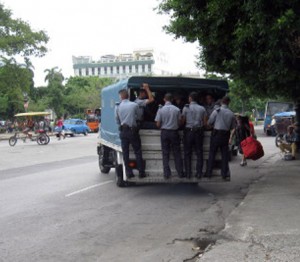 The preliminary survey revealed that the amendments to the Criminal Code and the Criminal Procedure Act do not seem to have aroused the people’s interest. However, they legitimize the atmosphere of impunity that characterizes the relationship between the repressive forces and the population. With the Decree-Law 310/2013 “the powers of the municipal courts are extended to adjudicate offenses punishable to up to eight years’ imprisonment” (previously it was up to three years), while “the acting authorities, such as the Revolutionary National Police and others have other jurisdictions, so they don’t necessarily have to send all cases to the tribunals”. The police force –that niche of uniformed filibusters- will be both guardian, captor, judge and executioner of citizens

Another newly introduced amendment in the law is Decree 313/2013 of the Council of Ministers, which states “in which cases goods associated with a crime should be seized, and what entities should be in charge of the property directly related to a crime and what entities should be responsible for their acceptance or for securing them…” Items thus confiscated “could be marketed immediately and contribute to the state budget” and if “it is decided to return the goods” to an individual and the goods have already been marketed, the individual will be given goods of “similar characteristics” or he will be compensated financially. That is, the authorities will have the prerogative to establish the legitimacy or lack thereof of people’s assets and of what rights they may or may not have over the goods; the assumption of the power to sell particular properties to the State and the decision to determine in what cases property will be returned to citizens and at what values if they are to be compensated, all, of course, at the discretion of the same authorities.
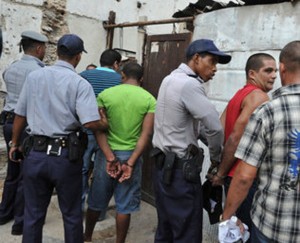 It is scary to think what levels of helplessness the common Cuban has reached, with the increases in the power of the PNR and the courts, that is, the repressive institutions at the service of the government. All this in a scenario marked by corruption at all levels, and particularly among the agents of “order”, in theory responsible for ensuring the public peace. I cannot think of anything more absurd of this government than to try to maintain social control by empowering an army of semi-illiterate corrupts supported by law professionals, as if this way the chaos that is upon us could be avoided.
A few years ago, the General-President, whom some optimists considered a reformist pragmatist, announced that the measures to “renew the model” would not be retracted. He lied, but perhaps the original intention was truthful. The reality, however, showed that even the slightest chance for prosperity and economic independence goes beyond official controls and a totalitarian system cannot survive a reform process, however tentative and insufficient they may be.
The recent amendments introduced to the Criminal Code and the Criminal Procedure Act are an attempt, as useless and it is desperate, to put the genie back in the bottle. A twist of the screw so unfortunate that it will heighten the shift toward the worst case scenario: more corruption and repression against people increasingly unhappy and frustrated, just the least prone components to the control and order which the Cuban authorities are pursuing.
Translated by Norma Whiting
From Cubanet, 14 October 2013
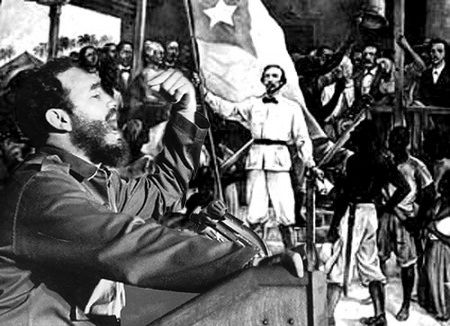
GUANTÁNAMO, Cuba, October, www.cubanet.org — Today there were commemorations marking the 145th anniversary of the beginning of our first war of independence. At a celebration on October 10, 1968, the centenary of this historic event, Fidel Castro gave a speech in which he suggested that — faced with the same conditions experienced by those who took up arms against Spanish rule — contemporary Cuban revolutionaries would have behaved in the same way as those distinguished patriots and vice versa. The expression he used was, “Today, they would be like us: back then, we would have been like them.”
In 1968 Fidel was not the feeble, crumpled-over, almost unintelligible old man shown on television on February 3 during elections for delegates to the National Assembly. He was a vigorous, forty-two-year-old dreamer of a man, who took a mocking stance towards the embargo. Without the slightest sense of propriety he imposed his vision of what he thought government ought to be, first obtaining power through force of arms and then creating a cult of personality. He turned Cuba into his own encampment. The above-mentioned expression, repeated over and over, came to be accepted as fact after the news media, educators and government officials actively promoted the claim.
Any reasonably informed person knew, however, that this expression was simply one more speculative tidbit from the comandante’s extensive oratorical collection. A review of the names of those executed during the first few years after the revolution would be enough to indicate that there were many revolutionaries fighting with Fidel against Batista’s dictatorship who were never sympathizers of communist ideology. It was lauded by the astute members of the Popular Socialist Party, who almost effortlessly infiltrated every branch of the nascent revolutionary government. They also managed to convince the young revolutionaries to abandon the Moncada Program, the Mexico Convention and the Sierra Convention, and to begin imbibing the “sweet nectar of power.” (1)
Frank País, José A. Echevarría and Camilo Cienfuegos were no communists. Had the first two not been killed by Batista’s police and had the latter not died under mysterious circumstances shortly after the Revolution, it is well worth asking if they might have ended up facing a firing squad or serving long prison sentences much like Huberto Matos and hundreds of other officials and soldiers from the rebel army. And if it is worth asking in the case of these three young men, the question is even more pertinent when discussing the lives of patriots like José Martí, Ignacio Agramonte and Carlos Manuel de Céspedes, especially in light of the comandante’s above-mentioned expression. One of the preferred arguments used by Castro’s ideologists to justify his claim is that these men — of whom I have presented only the three most notable examples — did not live long enough to experience Marxism and, therefore, were not able to express opposition to it.
Nothing could be further from the truth. The opinions expressed by Agramonte and Martí as they relate to the ideas of Karl Marx leave no room for doubt. In the case of Martí, one need only read what the “Father of the Country” wrote in the historical document “Acta de El Rosario, Acuerdo del Levantamiento” to be aware of his very deep commitment to democracy, support for liberal ideas and complete rejection of all forms of authoritarianism.
In this document the patriots who take up arms against Spain declared, “To the God of our consciences and to the verdict of civilized nations we appeal. We aspire to popular sovereignty and universal suffrage. We want to enjoy freedom, for whose use God created Man. We sincerely profess the dogma of brotherhood, tolerance and justice, and consider all men to be equal. We exclude their benefits from no one, not even from Spaniards, provided they are willing to live in peace with us. We want the people to be involved in the formation of laws, and in the distribution and investment of their contributions. We want to abolish indemnified slavery for those who have been harmed. We want freedom of assembly, freedom of the press and freedom of conscience. And we are asking for sacred respect for the inalienable rights of Man, which is the foundation of independence and the grandeur of its people. We want to shake off forever the yoke of Spanish oppression and to move forward as a free and independent nation.” (2)
Ignacio Agramonte made eloquent statements in opposition to totalitarianism, among them this one I read recently in the fifth issue of “Vocablo,” a publication of Asociación Pro Libertad de Prensa: “A government which destroys the potential for full development of individual action and restrains society from progressive advancement is not one founded on justice and reason but merely on force. A state built on such a principle could at any moment in time declare itself to be stable and unshakable to all the world. But sooner or later, when men realize their rights have been violated and set about to regain them, they will proclaim with canon fire that the state’s lethal domination has ended.”
Biographies of this noted author, however, cannot be found in any bookstore and it is extremely difficult to find them in libraries as well. And what of the writings of our apostle Martí? To add insult to injury, his Complete Works are now sold with the volumes containing his thoughts and critiques on Marxism and socialism removed.
There is no evidence whatsoever to back up the claim that men like Camilo Cienfuegos, many of the guerrillas who fought in Oriente province or members of the Second Escambray Front held communist beliefs either when they were fighting against Batista’s dictatorship or on January 1, 1959. Given the overwhelming body of evidence, we can state the following without the slightest shadow of a doubt: No, Cuba’s 19th century Mambisa warriors would not have been as portrayed by Fidel Castro in 1968!
Footnotes:
(1) An expression used by Fidel Castro in reference to his removing from office the Vice-President of the Council of State, Carlos Lage Dávila, and the Minister of Foreign Affairs, Felipe Pérez Roque.
(2) This document, known as “Acta de El Rosario, Acuerdo del Levantamiento” appears on page 103 in the book Carlos Manuel de Céspedes by Fernando Portuondo and Hortensia Pichardo and published by Editorial de Ciencias Sociales, Havana, 1982.
From Cubanet, 10 October 2013


 LA HABANA, Cuba, 8 October 2013, Juan Carlos González Leiva/ www.cubanet.org.- The life of political prisoner is in serious danger. He has been on a hunger strike for three weeks, in Guamajal prison in Villa Clara. The news was passed on this Monday, October 7, to the Cuban Council of Human Rights Rapporteurs (CRDHC) by his sister, Maritza Abreu.
Maritza said this this Sunday morning she was able to converse with her brother by phone for a moment, during which she heard some unintelligible words because he can barely speak
The source added that she received a phone call from the head of prisons for the province of Villa Clara, who authorized the brief phone contact. He told her he would let her see Bonora to ask him to abandon his hunger strike.
Abreu Bonora, who remains in legal limbo and has been waiting 14 months for a trial, had announced to the protest to the CRDHC before beginning it, at which time he told them he would not abandon it until he was released, because, according to what he said, he had been unjustly imprisoned.
He was imprisoned on August 13 of last year, for making anti-government statements that day, on Obispo boulevard in Old Havana, the date on which Fidel Castro’s birthday is celebrated. He had been paroled a year earlier, after having engaged in a long and dramatic hunger strike in the prison, proclaiming his innocence, in relation to an accusation of the supposed crimes of Assault and Contempt.
Marcelino Abreu Bonora, 49, belongs to the Hard Line and Orlando Zapata Tamayo Boycott Front, the Patriotic Union and Municipal Democratic Circles pf Cuba. He resides in Caibarién, Villa Clara.
From Cubanet, 8 October 2013
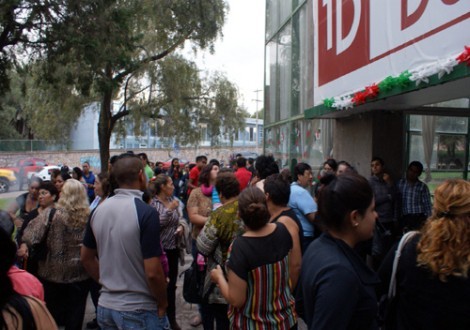
Durango, Durango (Agencias) — The coronation of Miss Gay 450 Durango was just coming to a close in the IMSS Theatre here when a group of unknown people threw containers of tear gas into the crowd in order to clear out the 600 spectators and participants at the event.
The president of the organization “Nosotros Nosotras Durango,” Tadeo Campagne Noriega, said that the culprits had not been identified, but he noted that it was a very worrisome situation.
He pointed out that PRD deputy in the local Durango Congress, Israel Soto Peña, proposed discussing a law regarding equal marriage in this Mexican state.
After the sad attack, Tadeo Campagne demanded the authorities in Durango to firmly support the LGBT community during this type of event. He then mentioned that there were various radical religious groups capable of realizing attacks such as this.
He also indicated that they would take legal action and lodge a complaint regarding human rights, since during the attack not only were there members of the LGBT community, but also entire families and even young children.
Ezequiel García, president of the Gay Association in Durango reported that it was two women who spread the pepper gas, affecting contest participants as well as attendants.
The Durango LGBT community remains alert for more attacks and asks for the support of the authorities.
Translated by: M. Ouellette
14 October 2013
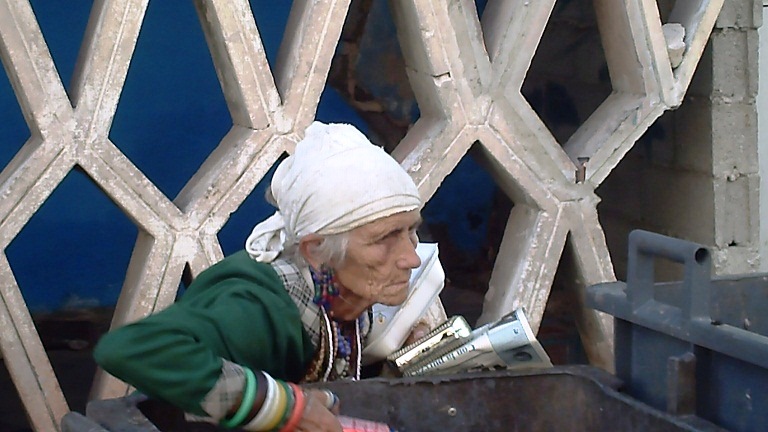 LA HABANA, Cuba, October, www.cubanet.org – The authorities have assured us that the aging of the population and the declining birth rate makes us the equal of the developed countries. What cynicism! The latest Population and Housing Census only demonstrates the profound socioeconomic crisis has converted the existence of every Cuban into a difficult ordeal.
The collapse of the totalitarian statist model, the low purchasing power, the high cost of living and the housing crisis, dissuade young couples from having children.
There are many young people who refrain from starting a family because they put all their hopes in leaving the country. In finding, abroad, the personal realization that is closed to them in Cuba.
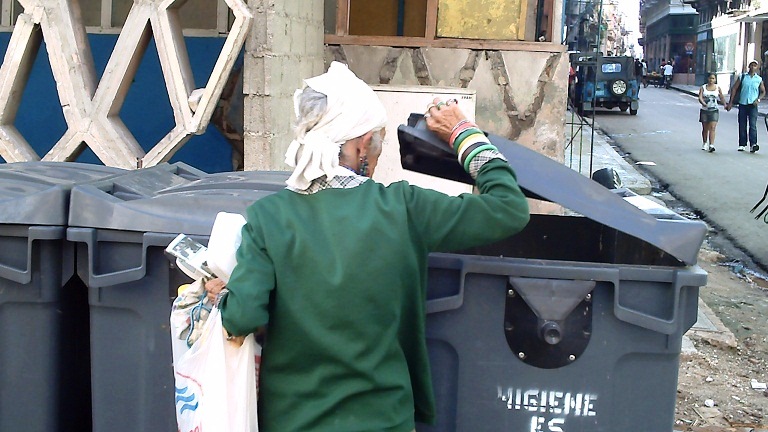 There are more than two million compatriots scattered throughout the world.
But the hardest hit by our crisis, are the elderly. The weakness of the Cuban economy can not guarantee quality of life for our old people, who after working for decades, suffer poverty level pensions and the lack of social protections.
Our Elderly
It’s shocking to see our elderly and disables thrown into the informal economy, or begging, while the top leadership doesn’t change its discourse of being the paternalistic supreme benefactor.
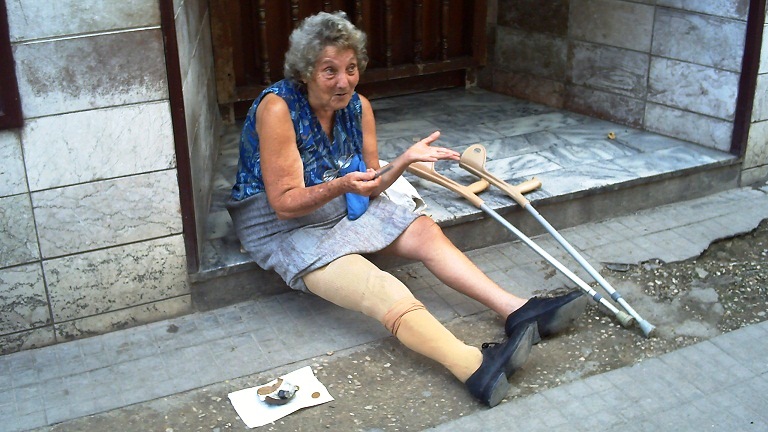 The frustration comes through in every testimony: Arturo Ponciano, 79, retired from construction thirteen years ago. Speaking haltingly he wonders when he will be able to relax if not in his grave. “So much hard work, so many shocking works, internationalist missions, to have to keep struggling in the street, selling candy, fighting the insatiable inspectors for the needs of the people.”
Aurora, 71, from Havana, says that she still felt strong when she retired from the tobacco factory after 38 years of work… “but I couldn’t take the pressure and the persecution of the bosses to prevent the stealing of materials, or the aggressive behavior of the young people (so different from what we were like).” Aurora feels frustrated that what she earns in retirement isn’t even enough to buy a sweet treat for her grandchildren.
After calming down from her panic, thinking I was an inspector coming to fine her or take her money, Nina, 74, said that she is exhausted every morning after walking miles in the sun as a roaming seller. “If I don’t do it, I don’t know how I’m going to live. As long as I have the strength I will keep pushing the cart of candy, popcorn and “chicharritas” (friend banana chips) that has become so heavy by the afternoon.
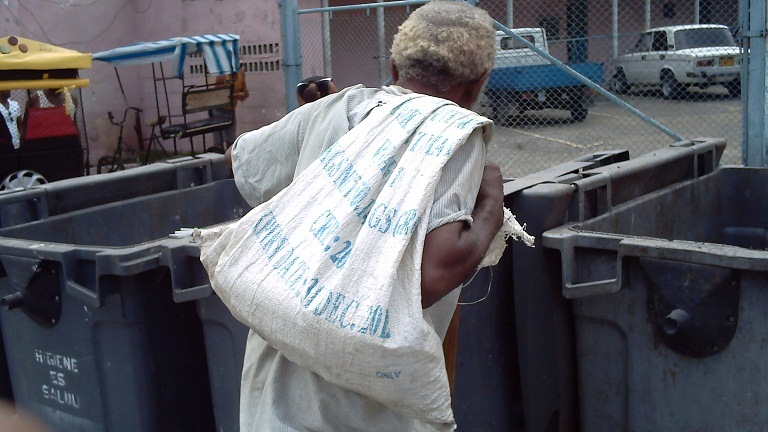 Berta Lina, 69, a retired clerk, says that the government talks a lot but in reality abandons old people to their fate after working for so many years, “the police produce nothing, they earn much more than others and they don’t even pay bus fares, the retired don’t even get a discount on that.”
“My younger sister has lived in Belgium for many years and people can’t even imagine the benefits enjoyed by the elderly in that country … And I, working in private homes, earned in a day more than they pay me in retirement.”
Manolo, a retired teacher and widower of 81, said that his two children are very well positioned occupationally and his daughter living in the United States doesn’t hesitate to help. Manolo says, “My luck doesn’t keep me from recognizing how hard it is to see so many elderly in poverty or trying to sell what they can to survive… I came back from my visit to the United States to see my grandchildren, but they can say what they want, over there you don’t see any old people in this lamentable condition.”
Wilfredo, a retired lieutenant colonel, 73, recognizes that, “It is very hard at the end of the day to accept that this Revolution to which gave his entire life and his efforts proved to be a lie and a failure… Many old people who are still suffering the consequences of that failure refuse to accept the harsh reality.”
There are old people who, at a quick glance, one can see that their poor physical condition is premature. At this point neither the family nor the government seems prepared to face the challenges of such a broad segment of the population entering old age.
Apparently the Cuban authorities are more concerned with the status and socio-economic needs of their sister ALBA countries than with the fate of the elderly of the island. For us, an ever growing share of Cubans are approaching old age that we aren’t prepared for, if there isn’t a miracle, they will suffer more down the road.
Leonardo Calvo Cardenas – Montesinos3788@gmail.com
From Cubanet,14 October 2013
This weekend the Police and State Security temporarily detained at least 81 Ladies in White to prevent them from honoring their founder, Laura Pollán, who died two years ago, Berta Soler. Leader of the organization, informed Diario de Cuba.
The women gathered for a “literary tea” in the group’s headquarters in Havana. According to Soler, more than 40 Ladies in White managed to reach the place, including residents from the interior of the Island, despite operatives in several provinces to detain — or restrict to their homes — the activists who were trying to travel to the capital.
The regime’s forces also deployed a four block ring around the organization’s headquarters in Neptune Street. Soler said that several women were intercepted and beaten while trying to get there.
Communication with the leader of the Ladies in White was difficult because of the sound of the loudspeakers places by the regime to disrupt the tribute to Pollán with Castro hymns and music.
“They do not respect other people’s pain,” said Soler. She explained that at three doors to the Ladies in White headquarters platforms were placed to “mount a show” against the women.
Some thousand people were brought by the regime to an act of repudiation in Neptune Street in Havana.
Arrests and beatings
The activist also detailed the violent arrests of members of her group. She said that Bárbara Moreira, of Ciego de Ávila, ended up in the hospital after being intercepted at the bus terminal.
In the same province, Tania Maceda Guerra and her husband, human rights activist Juan Carlos González Leiva, endured acts of repudiation all weekend and even a raid on their home, said Soler. The aim was to prevent them from traveling to the capital.
The arrests to hinder the honor of Laura Pollán was added to the usual weekend practice of the Police and State Security to prevent the Ladies in White from attending mass.
This Sunday 18 women were arrested in Matanzas and eight in Villa Clara. In that province 31 opponents were also arrested and beaten when they went to a police station to protest the abuse of the women.
Laura Pollan died on October 14, 2011, victim of a heart attack at the Calixto Garcia Hospital in Havana, where she had been admitted for a week with severe respiratory failure.
Together with Soler and other mothers, wives and relatives of the 75 dissidents sentenced to long prison terms in 2003, Pollán founded the Ladies in White, a group dedicated to demanding the release of the political prisoners and denouncing their situation in being imprisoned on the island.
From Diario de Cuba
14 October 2013

In September, two religious leaders living in Cuba, Reverend Mario Félix Lleonart and his wife, the missionary Yoaxis Marcheco, both of the Baptist Convention of Western Cuba, travelled to Washington, D.C. as guests of a Christian Solidarity Worldwide event. With them was Apostle Omar Gude of the Apostolic Movement, who was previously a political prisoner in Cuba and today lives in exile in the US.
At the end of their visit, they released a joint statement on religious freedom on the island, titled “Thirty Questions for the Cuban Government,” which has already gone down in history. It’s a manifesto that in some ways recalls Martin Luther’s redemptive discourse in the absolutist Europe of the sixteenth century.
The revolutionary Cuban state, which according to the Constitution is communist and atheist, officially became “secular” in the early 1990s. However, Religious education has been banned for half a century and there is not a single space available to utter God’s name in the Cuban media. The Cuban Communist Party Central Committee’s all-powerful Office of Religious Affairs monitors, controls, and manipulates any situation of this kind.
The thirty questions range from demands for the return of property confiscated from Cuban churches, to remembrance for the atheist apartheid against believers (the latter were sent to re-education camps in the 1960s). The statement also asks for a denunciation of the repression that has taken place during the few authorized religious processions and during Pope Benedict XVI’s visit in March 2012 (at which there were hundreds of preemptive arrests without charge), as well as revelation of high-level infiltration of cult organizations (such as the Great Masonic Lodge) by State Security agents. There is also a call for the release of US contractor Alan Gross (imprisoned in Cuba for improving internet access for the Jewish community) as well as an independent investigation into the unexpected deaths of dissident Christian leaders such as Laura Pollán of the Damas de Blanco (Ladies in White) and Oswaldo Payá of the Movimiento Cristiano Liberación (Christian Liberation Movement).
If the Cuban government today wants to feign even a small amount of legitimacy, it should take responsibility for responding to these thirty questions, which our citizens should have posed decades ago.
Translated by Alex Higson for SAMPSONIA WAY MAGAZINE
14 October 2013
 It seems that the battle against trees on our streets and avenues continues, carried out by the authorities as well as individuals. A few weeks ago the authorities cleared the trees that were in front of the Havana Zoo, at the intersection of 26th Avenue and Zoo Avenue, and in particular those at the corner of 37th Street and 24th, all in Nuevo Vedado. These are just two examples, taken at random from the many available.
 It’s gotten to the point that no one complies with the regulations (if any exist) established for their protection, and the city continues to lose its trees. Maybe if, for every tree felled, the one responsible was required to plant one in the same place, and care for and protect it until it reaches adult stage, the problem could begin to have a solution. That is, of course, if the authorities also assume the progressive restoration of the thousands of places where trees have been cleared (there are acres of land where they once were, along the sidewalks of our streets and avenues).
 I don’t think the embargo had anything to do with it, since the resources required for their restoration are minimal: dig a hole, bring a young tree, and plant it. When they’ve wanted to, it’s been done. There are examples of hotels and other buildings where, for the official opening, a grove of mature trees has appeared from one day to the next, transported in trucks, hoisted with cranes, and planted.Apart from the lack of culture for vegetation, it’s all happened through indifference and accumulated irresponsibility, with much televised propaganda and little real practical action. Will this destructive escalation ever stop?
Translated by Tomás A.
12 October 2013