Why Do I No Longer Speak With “Them”? / Reinaldo Escobar

Six years ago I published a text titled “Disqualified for Dialogue,” where I related what occurred in a police station with some State Security agents. Since that date they haven’t returned to attempt one of these semi-friendly conversations in which “they” try to make me believe that they are keenly interested in hearing my concerns, differences or discrepancies with politics of the Party. Since then I have made the decision never to talk to them again. Why?

Because talking with State Security signifies rewarding the belligerence of a repressive institution that has no legal, political nor moral right to engage in making economic or ideological decisions for the country. Because the main purpose of these conversations is to draw out information from us that will affect other civil society opponents and activists.

Because those are the occasions they also take advantage of to cause trouble, to make us believe that others are selling themselves to a foreign power or collaborating with the intelligence agencies, and are people of low moral stature, lacking in ethics and principles. continue reading

Because they try to manipulate us saying that we are salvageable, not mercenaries like the rest, and they misinform us with false hopes, as if they were the ones who were in command of all the destinies of the nation and had the power to be the appropriate vehicle to channel criticisms and complaints.

Because the conditions in which these conversations usually occur involve our going to a site, saying our names and showing our identity cards, while they only introduce themselves using pseudonyms.

Because we do have not opportunity to terminate the dialogue and they are the ones who decide how long to continue listening; we can barely gesture or use appropriate terminology without their saying that we are showing a lack of respect or contempt for authority.

Because we are not allowed to record what they say, nor to invite a witness, while they, for their part, can film and edit the conversation, putting their arms around us or putting a pen in our pockets to give the impression that we are their collaborators.

Because we shouldn’t let them convince us that they know everything: our sexual preferences, the routes our children take to school, the private weaknesses of our friends, the money we have at our disposal, the people we see…

Because nothing of what they say, none of the threats they make or the prohibitions they establish, is delivered in writing, with letterhead, stamp, name, grade, title, signature, appealing to the terms and articles of established laws, as these official institutions should express themselves; rather everything is left on the plane of what these anonymous subjects say “personally,” perhaps because they believe themselves to be “more of a man” (or more of a woman) than any of us.

I don’t talk to them any more, because I am a free man and do not have to give an accounting to anyone of where I go, who I meet, or what projects I have.

– See more at: “Disqualified for Dialogue.”

30 December 2013
Abused Cuban Teachers / Ernesto Garcia Diaz

educadora

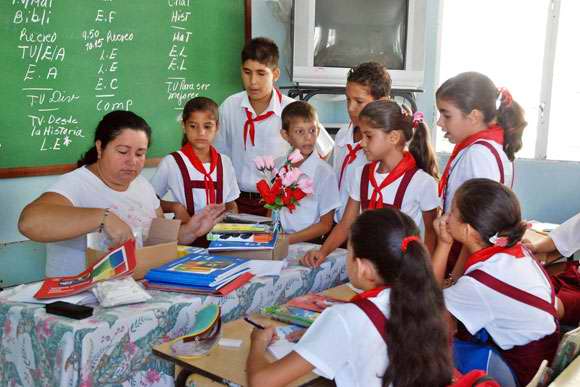
HAVANA, Cuba , December, www.cubanet.org – While the celebrations for the Day of the Educator succeeded as a cultural fact, in the Palace of Conventions at the Second Regular Session of the Eighth Legislature of the National Assembly of People’s Power, with rhetoric of “the changes are more socialism,” but they did not publicly honor the work of teachers. Nor did they envision real changes to the education sector which urgently needs attention, given the profound problems suffered in Cuban society with regards to the development of values.

It’s worth remembering that the Castro regime, from the early years of its government, transformed a secular educational system into an atheist one. From that point forward, students and teachers studied in the schools in the countryside and teaching outposts.

Since then, Cuban education has remained under the “scientific” doctrine of Marxism-Leninism, idealizing the New Man as if he were sculpted in bronze. Martí’s ideas faded from the schools, to the point where it was questionable to call the Apostle (as we refer to José Martí) our National Hero. continue reading

Decades later the dictatorship has tried to refocus the works and thoughts of the Apostle to suit the convenience of the Communist autocracy, but without retracting their errors. However, none of these measures could extinguish the secular educational doctrine of Father Felix Varela, nor the historical memory of the Cuban nation, tied to beautiful traditions.

Teacher’s Day is of special significance to the Cuban family, dignifying their role and exalting their qualities, in a way that transcends different nuances. On December 22, parents and students try to get a gift for their teacher, but most do not have the resources to do so, something that highlights the social differences. The teachers also suffer and share in the poverty of our people.

Today, the scandalous disaster of educational policy is painfully obvious. The teacher in Cuba, with the education required, barely earns $25 a month. The regime earns large sums of money from lending out scientists and teachers to other countries, but Cuban teachers do not receive the compensation they deserve.

Ernesto Garcia Diaz

Cubanet / 31 December 2013

Castro, Correa and Maduro Awaiting 2014 in Varadero / Juan Juan Almeida

We are almost at 31st December and in all the world people celebrate that holiday. In Cuba, the incoherence of our life obliges us, at midnight, to make a toast and express our wish that the next year, 2014, will be better and less painful for the prisoners, the ill, and for all those people who, without much choice will receive the coming year awaiting a call or a hug from those people who cannot be here. For everyone, a prosperous new year.

The president of the Republic of Cuba as you would expect, will also celebrate this date, receiving a select and chosen group of friends, the first day of January, and with that, the coming of another anniversary of the Revolution, number 55.

Yes, Raúl Modesto Castro Ruz will welcome in 2014 in his house in Varadero. In his private villa, or, rather, in the complex of houses which make up the “discreet” and modest mansion, recently done up for the occasion. continue reading

All prepared with punctilious care. The doors and windows (made by KÖMMERLING) imported from Germany and installed afterward by trusted specialists in this shameless summer house, for family recreation. Appropriate for a great leader who publicly advances a stubborn policy of austerity.

The menu is no problem, in the purest and most exquisite Parisian style, with island tweaks. The culinary offer will be professionally served by glove-wearing waiters, and supervised by an official of the FAR (Cuban Revolutionary Armed Forces),whom they call Albert Einstein because he has no talent, and who authorised the music to be provided by an orchestra of such cultural ineptitude that they played recorded music instead.

And, how can we speak of the food without mentioning the guests? Right, we will take it one step at a time, because the story still has some unknown quantities.The current president of the Bolivarian Republic of Venezuela, his majesty Nicolás Maduro is expected, and, they say, the Ecuadorian head of state, his excellency Rafael Correa. Friends whom they will put up in the recently repaired guest houses, inside the private villa.

And the drink won’t be lacking, catering for all tastes, there will be drink waiters, equally trustworthy, for whatever last-minute fancy. And for those drinkers who lose it after drinking too much, they will serve a reinforcing consomme with meat and chicken and lamb. To finish the night, or start the day as the case may be, they will provide beautiful white deckchairs, in the Mediterranean style, on the sand.

If there are any snags with the party, or if at the last minute they change the plans due to my fateful indiscretion, you need to know that I was happy to break the secret, but the credit isn’t mine, rather that of an army of idiots wearing sunglasses who made it impossible to hide it.

Now I remember the braying, sorry, the speech of the comrade General when he predicted, during the recently-finished second regular session of the 8th term of the National Assembly of Popular Power, that in 2014 we hope to get to a prosperous and sustainable socialism, less egalitarian and more just, with new targets and more sacrifices. The politics of obsolete octogenarians racing against the calendar.

Tomorrow we will drink a toast to all Cubans, those who are here, those who are there, and those who are over there. And we wait for the new year with the absolute conviction that our day is just around the corner.

Translated by GH

30 December 2013
Christmas in Cuba has no Carols, but Villains in Power

The majority of the Cuban community will celebrate Christmas and the advent of the new year, unaware that a political prisoner, David Piloto Barcelo, is serving his punishment in the worst conditions, for defending his unobjectionable right to choose a president, to openly criticize government conduct, to protest, to demonstrate, to join the party that better fits him, etc.

Possibly also, the majority of Cubans will die without testing the state of rebellion and liberty that being an activist in opposition to the dictatorship offers.  Piloto Barcelo practices it daily, his screams against the henchmen that mistreat us day after day in the prisons, could be heard in Prison 1580.

From my barracks, some thirty meters away from his, with several walls and roofs in between, his voice arrives full of truths against the executioners in each arbritray action or appearance.  His protest is constant, all in spite of his precarious health. He contracted tuberculosis in their cells, and not even that condition has impaired his upright posture as permanent opponent. His crime: demonstrating on “Revolution Plaza” and throwing leaflets demanding the freedoms of which they deprive us. continue reading

Some days ago Piloto Barcelo was transferred to Cinco y Medio Prison in Pinar del Rio. That is another punishment that he will have endure far from his family. What is left, because after the State Security threatened his mother, she suffered a heart attack, and it killed her. Now his sister will have to travel to that distant place in order to provide him with what is necessary to survive, because otherwise we die.

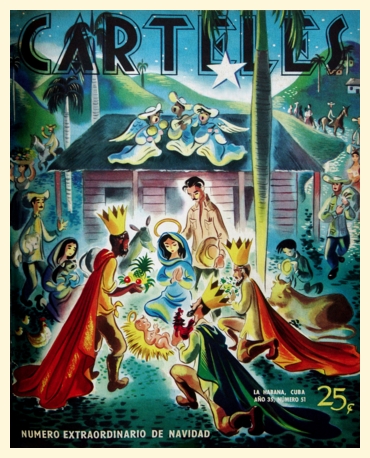
And it is not that being happy or eating turkey on Christmas is a crime; may those happy ones who manage it multiply until all Cubans can do it in their own land; but do not forget that someone suffers for you at this moment, and that he is also summoned, from wide ranging possibilities, to fight and give tribute to these human beings that have preferred the sacrifice before the pleasure.  And that self denial is for the good of all, because when Cuba is free, we will enjoy it equally.

Not forgetting Piloto Barcelo, Sonia Garro, Ramon Munoz, Armando Sosa Fortuny, Marcelino Abreu Bonora, Ernesto Borges Perez, Madelaine Lazara Caraballo Betancourt, Makiel Delgado Aramburo, Ivan Fernadez Depestre, Angel Frometa Lobaina, Allan Gross, Bismark Mustelier Galan, Ángel Yunier Remón Arzuaga, to mention only a few of those among hundreds of prisoners confined plus those who are on parole and make the humiliating list of  political prisoners of the Regime recently “distinguished” for safeguarding Human Rights on the UN Council.

Even so, to everyone Merry Christmas and Happy New Year!

Angel Santiesteban-Prats

Lawton prison settlement.  December 2013.

Translated by mlk.

30 December 2013

To All My Friends and Readers / Rebeca Monzo

This year marks four years since I started a blog, without really knowing how to pull it off. With the help and advice of Yoani, “Through the Eye of the Needle” — the title based on a biblical phrase that was also the name I gave my first major exhibition outside “my planet,” as I refer to Cuba in my posts — went into cyberspace to describe our everyday reality.

I wanted to share this satisfaction with you, and to wish you with all my heart a 2014 of recovery of our liberty and sovereignty, as well as reconciliation, forgiveness without forgetting, and the union of all Cubans in a future homeland without charismatic leaders but with very efficient ones, where democracy reigns for everyone without any exceptions.

30 December 2013
Mattresses / Yoani Sanchez

A woman shouts from the balcony and they stop, along with the cart they are pushing. On the sidewalk itself they set up a workshop. On some boards and in sight of everyone. The broken springs are replaced, enormous needles sew up the edges and the old lining, stained here and there, is replaced with another made from the cloth of a flour sack. Their hands move quickly. In less than an hour they’re done and continuing down the street looking for new customers. A mixture of dust, lint and the accumulated odor of years of intimacy floats on the air.

Mattress repairers always have work, a lot of work. In a country where many still sleep on the same bed their grandparents slept on, this work is vital. These days experts in padding and bedframes are everywhere. With their spools of thread, they loudly shout out their promises of thirty-day guarantees after the renovation. They repair that which passed its expiration date decades ago, returning a comfortable sleep to those who find some out of place spring poking into their backs every night. continue reading

Also abundant are the scammers. Creators of an illusion that barely lasts and leaves the buyers with pains all over their bodies and in their wallets. They stuff in successive layers of dry banana leaves, plastic fibers or sawdust. Then they cover them with brightly printed fabric, taking special care to tightly stitch the edges. They situate themselves near commercial centers and assure people that their merchandise is “just like in the store.” In a country where a professional needs a year’s salary to purchase a marital mattress, the offerings — outside the state stores — are cheaper, and always very tempting. However, much of the time the advantage turns to frustration in a very short time.

The scenario repeats itself when the repairers come to a neighborhood. A mother is annoyed by the urine stains that her youngest child has left on the bed. Others are embarrassed because the neighbors will see the successive patches that have been made to their mattress over the years. Phrases such as, “It’s not mine, it belongs to a relative, but I’m doing them the favor of fixing it,” are common. Some appear with an amorphous structure, lacking defined corners and sunken in the middle, that needs more than magic to restore it. “Let me make it like new,” says the repairer, and he starts to move his hands, sink the blade in a few points, and finally name a price.

More than a restorer of mattresses, he is a restorer of dreams.

30 December 2013

The Need to Speed Things Up / Fernando Damaso

Photo: Peter Deel

Anyone who has had the strength to watch and listen to the sessions of the National Assembly of People’s Power has reached the conclusion that 2014 is looking grimmer and grimmer.

After detailing a string of failures from various causes in both manufacturing and services, we are once again told that in the new year we will have to work smarter and more efficiently. In other words it is still all about good intentions and slogans which, as we have seen, solves nothing.

No matter how necessary, each measure to be taken must first be analyzed by a commission and then tried out in a provincial laboratory (usually Aremisa or Mayabeque) before it is implemented. Results, if any, are slow. continue reading

The authorities argue that those who want them to speed things up are doing the enemy’s bidding, trying to cause them to stumble. Besides being repetitive and unoriginal (it’s always the enemy’s fault), the argument is childish. The person who wants faster results is the average citizen, who cannot afford to keep wasting time on commissions and experiments.

Aren’t fifty-five years of experiments and innovations enough? Very few government leaders have had so much time to govern, especially after they have made mistake after mistake at the expense of their impoverished citizens. 

To free up the sale of propane gas to the public, was it really necessary to try it out in Special Municipality Isla de la Juventud first? Even in the 1950s this was not normally how it was done. Just by picking up your phone and calling a gas company such as Shellane or Tropigas, a tank would be brought to your home and hooked up within a few hours. Must we first try out every measure, no matter how simple, before putting it into practice? It would appear the authorities feel the need to reinvent the wheel every day.

In short, everything that has been done so far is to correct some of the many mistakes that were committed through simple volunteerism and so-called openings amount to nothing more than the restoration of violated rights. They are aimed mainly at an emerging middle class and not the ordinary citizen, who lacks the resources to travel, buy a car, purchase and maintain a cell phone or pay 4.50 CUC an hour for an internet connection. This is the harsh reality.

When riders of Havana’s defective mass transit system board a bus through the front door, to deal with the overcrowding, the conductor repeats a ridiculous phrase: Move to the back. But they only move forward; moving back means moving backwards. This phrase seems to have become the principal currency of Cuban authorities.

27 December 2013

Life and Death of Cuban Railways / Ernesto Garcia Diaz

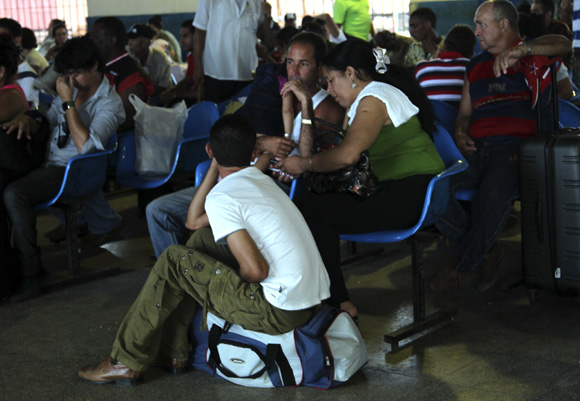
They wait for days in La Coubre Station for a ticket

Havana, Cuba, December 27, www.cubanet.org – In Havana’s Central Railway Station, they were fumigating — against the Egyptian aedes mosquito — with passengers inside (children, pregnant women, old people), violating all health standards.  And don’t mention freshening up.  They charge a dollar to use the bathrooms.  And even paying, the bathrooms do not have soap or toilet paper.

The self-employed cleaner told us:  “Some time ago the bathrooms lacked water, they were disgusting, they put a bucket for discharge, we washed them without faucets, the broken toilet bowls, the blocked urinals, we rehabbed the service, but we did have to watch that, because they stole even the brooms from us.”

The disaster of the railways

Almost 20 percent of Cuban trains do not leave or arrive on time. Train departures have been reduced. We asked, “How many trains run from Havana to Santiago de Cuba?” continue reading

“There are two trains, one regular and the other special, every three days,” the girl at the counter told us. “Today an extra leaves for Santiago De Cuba at 11 at night. The special from Santiago runs in December on the 24th, 27th and 30th at 6:27 in the afternoon, and the regular leaves on the 25th, 28th, 31st at 4:00 pm.”

The tickets to Santiago de Cuba have to be reserved in La Coubre Station, some 700 meters from the Central Station.  But those going to provincial town be careful! The regular train stops in some municipal stations, but the special to Santiago is express, it only stops in the provincial capitals.

And as the trip from Havana to Santiago lasts 15 hours, prepare to be hungry! They sell a few preserves in the cars, they run out fast. Vendors of bread rolls climb on at the stops with whatever. The railways do not offer drinking water, either. Bring your water. And if you can, bring a bottle for urinating, because the bathroom of the car may be overwhelmed, or worse, closed.

The same information employee, laughing, told us: “I prefer to urinate in a bottle.”

In La Coubre Station, under a fiber cement roof, a sign announced:  “There are no reservations until January 4.”  If you decide to travel, you have to go to the waiting list and sign up.  With luck they will sell you a passage in five days. For those who spend days sprawled on the floor, grumpy, the worst still awaits, boarding a dirty, stinky car, and suffering a tortuous trip.

One on the waiting list commented: “I’m going to Guantanamo, I have been here three days, I have number 500 in the second round, I’m not going today either.” Passenger number 2 added: “I am signed up for Guantanamo, but I am going to Santiago de Cuba. There is no other.”  Another told me, “I’m going to Guantanamo, I spent four days on the list, to be able to go today, I almost had to live and sleep here, but it’s the only way of hoping to spend New Years with my family.  And I almost have no money to arrive with; here, in the terminal, the food is very expensive, to eat I’ve used what little I had.”

In 2012, the railway transported 9.9 million passengers.  More than a million fewer than in 2005.

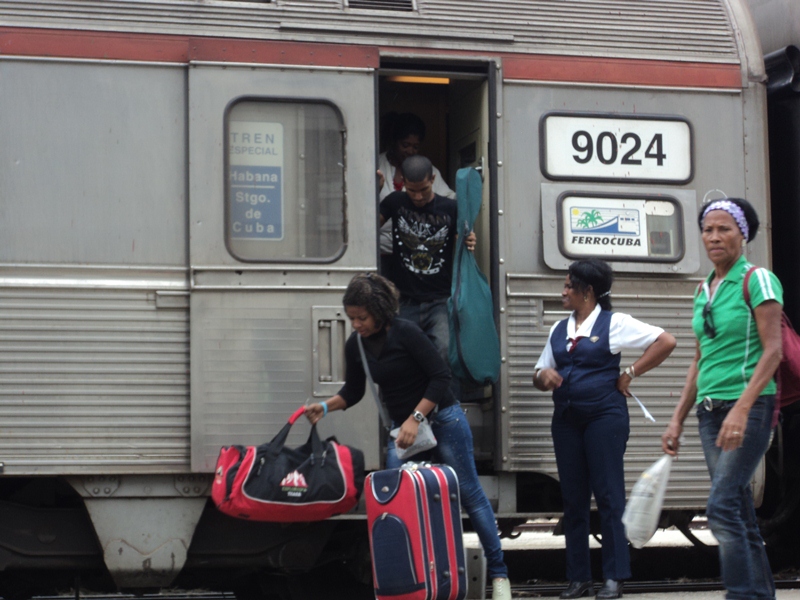
Special Havana-Santiago train.

Cuba was the second country in America to have a railway. On November 19, 1837, the first section from Havana to Bejucal was inaugurated. In 1859, the capital counted on streetcar service.  A decade later, the railway reached Calabazar, Santiago de las Vegas, Marianao, Cardenas, Jovellanos.

In the first decades of the 20th century, the island would complete the line from downtown Havana to Santiago de Cuba, with secondary branch lines to Pinar del Rio, and even la Bahia de Guantanamo. And it had an electrified network, the little Hershey train, which linked the Cuban capital with the city of Matanzas.

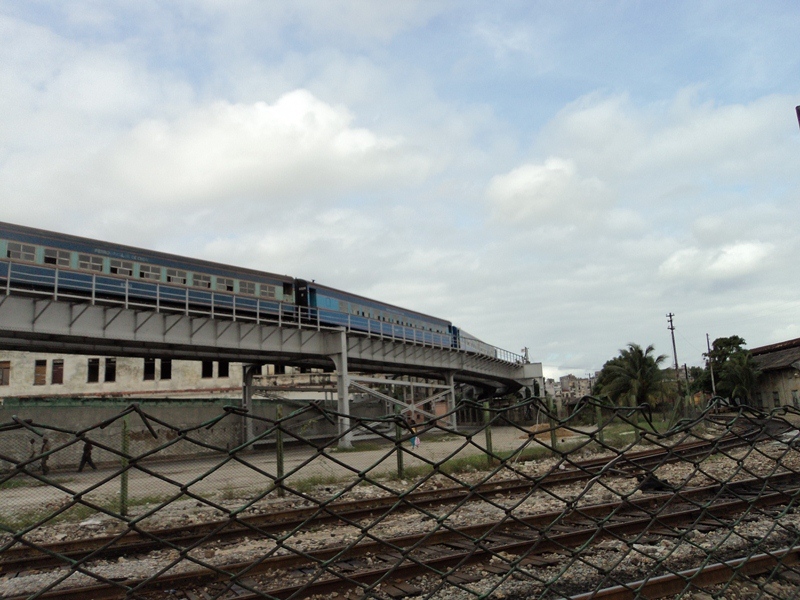
Elevated at the entrance to Havana.

In 1959, the trains were the soul of sugar production, they gave life to towns and cities. They went to almost all corners of Cuba.

In 1961, the revolutionary government nationalized the railways. In a few years, the Cuban rail network which extended over 12,060 kilometers was reduced to 8,367 km.

In Cuba, the official press does not report — except in cases of death — railway accidents.  The Castro administration turned the shining gem of Cuban railways into a true disaster.

Ernesto García Díaz

December 26 2013 / Cubanet

Translated by mlk

28 December 2013

The Cuban Economy in 2013 and Perspectives for 2014 / Miriam Leiva

The Council of Ministers met on December 19-20 in conjunction with the National Assembly of People’s Power, to hear information about the fulfillment of the 2013 Economic Plan, approve the Plan for 2014, and the draft State Budget for the coming year, and to release the report about the compliance with the Party’s Political, Economic and Social Guidelines and the Revolution, according to what was reported in the Cuban media.

With regards to 2013, Adel Yzquierdo, vice president of the Council of Ministers, reported only that the Gross Domestic Product grew 2.7%, less than the 3.6% forecast, mainly due to the reduction in revenue from freely convertible currency, manufacturing and construction, but said that most of these activities showed increases compared to 2012. He did not offer data about the results of any sector, which prevents analysis of the behavior of the economy.

However, he highlighted the decline in hard currency revenue, it has already been reported that remittances primarily from the United States have increased and total over 2 billion dollars, plus those from visiting Cubans, Cuban-Americans and Americans, as well as the new revenue from sending around 7,000 doctors to Brazil and other countries, along with those in Venezuela, are the principal export and source of foreign exchange revenues. The hard currency coming from Caracas has probably decreased, among other reasons because of problems with oil and derivatives which Havana re-exports to the world market.
continue reading

As for 2014, GDP growth is projected to be 2.2%, “beginning with the strengthening of internal reserves from the efficiency of the economy and the dedication of resources to those productive activities that generate exports and investment financing,” but he notes the expectation that sugar and nickel prices will fall.

In the first case, the sugar industry has been in slight recovery over the past two years, and in 2013-14 the harvest is expected to grow 17.5% compared to the last one, but it will be only 1.8 million tons, and of these barely a million for export. It is striking that the manufacturing sector is not prioritized to compensate and increase exports. Despite an almost 50.0% reduction in nickel since 1989, a slight reduction is projected for 2014, citing financial limitations. However, at that meeting, President Raul Castro stressed the need to diversify production for domestic consumption and export.

In addition, an increase of 7% in the agricultural sector was announced. Clearly the market remains undersupplied with prices high, evidence that the policies followed to date have not provided incentives to the farmers, and essential foods must be imported from the world market at high prices.

The plan projects a increase of 9.3% in trade, 8.8% increase in hotels and restaurants, and aims to increase tourism which, in 2013, did not grow as expected.

Difficulties in national passenger transportation continue, as evidenced by the “reorganization” of the activity through cooperatives created in Havana, Artemisa and Mayabeque, generated by the leasing of taxis, as well as the simultaneous announcement of the elimination of the restrictions on nationals and foreigners selling their cars, and the retail sale of new and second hand motorcycles, cars, vans and microbuses, with prices similar to those of the private market, which supercedes Decree 292 of 2011. In addition, state sales of bicycles, including electric ones, are prioritized, with reasonable prices. However, they continue to harass taxis, biketaxis and animal-powered carts, which are important means of transport for Cubans.

With regards to social services, the plan projects maintaining levels similar to the last two years, “under the premise of protecting education, public health and social assistance, based on achieve greater efficiency and effectiveness,” although there no mention of increasing the infinitesimal pensions.

Vicepresident Murillo also referred to the intention to continue growing the exporting of health care to guarantee the sustainability of the system and contribute to the national economy and support the national economy, along with the increasing medical attention in Cuba, academic and teaching services, and others associated with optical, pharmaceutical products and natural and traditional medicine and scientific events. Surely, to achieve this they won’t use the impoverished facilities lacking medical staff, all over the country.

In addition, with regards to foreign trade he addressed the promotion of companies and partnerships that foster better positioning of Cuba’s interests in foreign markets.

Notably, Murillo announced that in the next two years they will undertake more technical and complex tasks with regards to economic policy and emphasize creating confidence among Cubans in the process of monetary unification, while warning that doing away with the dual currency will not solve the country’s problems, it will require broad measures across the entire economy, focused on increasing production and productivity, according to what was heard on TV.

In this regard, during his speech at the closing session of the National Assembly on 21 December, President Raul Castro said that the timetable for monetary unification and exchange rate unification is intended to create conditions for improving efficiency, properly measuring economic events, and stimulating the sectors that generate export earnings and replacing imports. He also said that, by itself it does not constitute a magic solution, but it will contribute in a decisive manner to improving the workings of the economy and the building of a prosperous and sustainable socialism, less egalitarian and more fair, which ultimately will foster greater benefits for all Cubans.” But he did not clarify how or when that will be achieved.

Miriam Leiva

27 December 2013, From Cubencuentro

An Odorless, Colorless and Dull New Year / Rebeca Monzo

1388171012_cena-frugalThe streets are empty and unadorned. With their paltry displays of gifts, shop windows only hint at the season, which was once so colorful. There is an absence of ornaments but also of products and resources, and 2014 is forecast to be full of hardships and difficulties. Christmas Eve and Christmas Day do not seem to exist for the media, which only makes reference to the “celebration” of the 55th anniversary of an event that brought pain to the Cuban nation.

In the early hours of the appointed day, we could not observe the old sight of happy people full of packages circulating through the neighborhood. At night the streets are dark with only a few neighbors about. Unlike us, very few people bother to decorate their balconies and doorways with garlands of lights, not only because the custom has been disappearing, but also because they are expensive and are very few shops sell them. continue reading

On the 24th the rich aromas were absent. There was nothing to remind us of those wonderful evenings when we shared with family and close friends our dreams and fantasies for the coming year at tables laden with delicacies. Back then, even the humblest home had at least a little ham or a nice piece of pork, black beans, yucca and salad to share on that magical evening.

Though our families are spread across the globe, I refuse to give up one of the few traditions we have left, so I prepared an early dinner for my husband, who is recovering from an operation, and myself. This was because, unlike other years, we were not at the home of the only family member left in Cuba or of a friend.

I prepared some black beans, yucca with garlic sauce, thin pork cutlets and a nice salad. A friend gave us some wonderful Jijona almond brittle and I allowed myself the “luxury” of buying a bottle of Spanish wine, which costs almost the same as the domestic brand but is much better. And so it was just the two of us. We dined, toasted our family members and friends, and later watched a very good English television series that we rent called Spooks from the BBC, which I highly recommend.

27 December 2013

The Sats Refugees / Camilo Ernesto Olivera

Havana, Cuba, December, www.cubanet.org — It was after 10 am Saturday, December 7.  The patrol car of the PNR (National Revolutionary Police) braked at my side, a few meters from where I live.  The uniformed officers got out of the car, and one of them asked me for my identity card.  With no further explanation, they pushed me against the patrol car, searched me, and put me in handcuffs.  Then they put me in the vehicle.

For almost an hour, we rolled through various zone of Mariano and La Lisa.  In an area near 100 Street and 51st, a Suzuki motorcycle approached.  The driver, dressed in civilian clothes, face hidden in the helmet, told the uniformed officers:

“Take hiim to Melena del Sur.”

After 5 pm I managed to return home.  It was growing dark when Antonio Rodiles called me by phone, and I told him what had happened.  A little later I was entering his house with a backpack loaded with necessities for surviving as a refugee there in the following days.  Like me, other members of the work team of Estado de Sats were coming together in the next hours. continue reading

When I arrived, Walfrido Lopez was polishing the details of the conference about means of communication and human rights.  The First International Meeting about Human Rights and Accords of the UN was due to open on the 10th.  Kissi Macias, wife of Luis Eligio, from OMNI, was there too, editing videos sent by various personalities.  At dawn on Sunday, Boris Larramendi arrived directly from Club Fabio, together with Ailer and Antonio who presented their concert there on Saturday night.

By that time, the news about detentions of activists and members of independent civil society was shaking the whole country.  On Sunday the 8th, Dixan, Sats collaborator, could not leave his house, and if he did, he would be sent to Vivac, detention center for political cases located in Calbazar.  Antonio and Ailer went to look for him, and a traffic patrol car, obeying orders from a motorcycle rider, intercepted them and then tried to capture them at the door to Rodiles’ house.  The police officers confiscated the car’s authorization document, and warned Antonio not to go out driving the car again.  Fortunately, now Lia Villares and her husband Luis Trapaga were sheltered together with us.  By that time, the wall of DSE (State Security) troops and uniformed police officers from the PNR (People’s Revolutionary Police) intensified.  By pure miracle, and with the darkness of night in his favor, David from OMNI passed through it and arrived at the house.  Also, Claudio Fuentes, Regina Coyula and the journalist from Hablemos Press Pablo Marchan jumped the fence.

On Monday we were 19 refugees.  The next days were of entrenchment, deep fellowship, and survival.  Also of much tension and stress, especially in the hours that followed the detention of Antonio, Walfrido, Calixto Ramon and Kissi on the 11th.  State Security surrounded the house, even on the ocean side.  The providential downpour that closed the area during the first hours of that night prevented greater evils. They were obliged to dismantle the repudiation platform that had been retrofitted with a powerful audio system.  The participation of two popular dance music groups was expected:  Arnaldo and his Talisman and Elito Reve and his Charangon.

Several stalls for the sale of rum and beer had been set up.  Evidently, the intention of the DSE was to ply with alcohol the “mass” of concert attendees and then use them in order to hide their civil troops among them, and to attack Rodiles’ house.  The suitable cloak  of night helped them to justify the witches’ sabbath. While it was raining, Boris Larramendi gave a concert of “pure blood,” and David of OMNI offered his own to welcome the return of the detainees at the stroke of 7 pm.

The silence that the ruling champions of the “Cyberwar” have kept during these days is a clear symptom of the demoralization in which their bosses of the DSE (State Security) find themselves.  A small group of refugees in Sats curbed the bullying of a corrupt and decadent regime.

December 23, 2013 / Cubanet

Translated by mlk

The Age of Innocence / Orlando Luis Pardo Lazo

Imagine. That this coup d’etat on the first of January 1959 would be considered a Revolution by half the planet. Or planet and a half. Imagine. And that the whole country would be militarized and export war for more than 55 years of world history. Imagine. That what could not be conquered by death, would finally be conquered by the ballot box and capital. Imagine. That in 2014 we Cubans would still be talking about some Fidel or whatever his name was. Imagine.

28 December 2013

Christmas Divided / Tania Diaz Castro

Havana, Cuba, December 24, www.cubanet.org — As a good predictor of the future, this man forecast that Christmas would not be necessary in a socialist country.  He knew since then that there would be no victuals and much less family for the days of celebration.

It is noteworthy that in the Population and Household Census carried out in September 2012, from which definitive results were recently offered, the National Office of Statistics and Information has not included in its questions how many of us Cubans are distant from our families.

Without any doubt any of the 11,167,325 inhabitants of the Caribbean archipelago suffers that pain.  So it is difficult in more than three million Cuban homes in the country, to be able to evoke these Christmas days happily, if those we love are not present since we opened our eyes to the world. continue reading

Even the dictators themselves Raul and Fidel, generals and colonels, representatives of all the new social class — human beings after all — are not exempt from that suffering.

Sonia and Pedro Yanez, my neighbors from across the street, are those who suffer more.  Two years ago their oldest son went in a boat and what remains for them is the same idea of leaving.

Much more these mothers from Santa Fe, who lost their sons in a sea infested with sharks.

Even I myself, with my only three sons scattered across the world, because they cannot live in Fidel’s Cuba.

Those of us older than 70 suffer most from the collapse of the Cuban Christmas. We remember the Christmas Eve dinner, always with family, the marvelous dawning of the Day of Kings, where we discovered in a corner of the room the toys that the invisible mythological kings left us with so much affection, the year’s end, when grandmother threw into the street a pail of old water so that good luck might enter the house.

They were times when we could dream, in which hope had still not been lost, which hope disappeared when the Commander arrived and ordered it to stop, hope that has revived again in spite of repression and draconian laws.

That’s why, this December 24, I am going to toast my sons, my father who walked alone through the streets of Miami before dying, my mother, who did not want to tell me that communist tyranny had killed Christmas so that the divine fantasy might disappear from the mind of civilized Man, my dissident friends, whom I remember with love, my last sweetheart, polititical prisoner for more than 20 years who some day will return.

23 December 2013/Cubanet

Translated by mlk

Christmas In Cuba ”Paradise” With Many Slaves / Angel Santiesteban

Enslaved prisoners

December 25th: The inmates of Cuban prisons have worked in the condition of slaves which they find themselves.

The Blockade: The Longest Genocide in History

For them there is no Christmas or New Year. All they will have is to exercise their muscles to fulfill the tough work which the regime obliges them to do.

At a recent meeting, a chief of prisons, publicly stated that he preferred working with prisoners versus civilians, because the latter left when they finished their 8-hour working day, while the prisoners could go many days with no rights, not even to protest, infinitesimal pay, and cheap food. Compare that to what the Cuban officials say in Geneva, that Cuban prisoners are respected with regards to salaries and hours, when from dawn to dusk the sweat runs down their poorly paid and badly fed backs. continue reading

After several days with a menu of rice, soup and eggs alternating with hash, they offer them for Christmas dinner, rice, peas and eggs. They don’t protest because the blackmail is constant. If they don’t go along they’re sent to closed prisons, lose their passes and the annual two months credit, and even the possibility of getting out on parole when they’ve served half their sentence.

The only thing that remains is ability to work, bite your tongue, and every time you have the opportunity to take revenge, do your work badly.

After every sunrise they look at the horizon, and all they see is permanent darkness.

Ángel Santiesteban-Prats

Lawton Prison settlement. December 2013

Translated by: Shane J. Cassidy

27 December 2013