The energy crisis and inflation are transforming a food that was abundant on Cuban tables for decades into an almost exclusive item.
 14ymedio, Yoani Sánchez, Havana, 4 July 2026 / “You all really slept with electricity last night,” a woman selling bags of groceries chides me outside the Tulipán market. The woman, who lives across Rancho Boyeros Avenue, managed to see from her neighborhood that our building was lit up while her block was shrouded in darkness. The new source of tension among Cubans is no longer politics, or even food: it’s the number of hours some enjoy electricity while others learn to live in the shadows.
Just a few months ago, the Facebook pages of the National Electric Union were flooded with comments demanding that Havana residents be subjected to the same endless blackouts that plagued the rest of the country. Their wish was granted, but only partially. Now, in the capital, we also suffer outages that last more than 24 hours straight, and yet, nothing has improved in the provinces. Our time without electricity hasn’t resulted in a single new lightbulb being lit in Santiago de Cuba, Holguín, or Pinar del Río. It has only spread the darkness.
Dividing us and turning us against each other seems to have been an all-too-effective strategy. While we argue about who was hotter last night, who lost the contents of the refrigerator, or who managed to charge their cell phone, we stop looking at those who are mismanaging an electrical system that is falling apart. That’s why I avoid responding defensively. I comment to the woman that the Antonio Guiteras thermoelectric plant has just gone offline and that most likely, tomorrow morning, we’ll all be trying to get to sleep drenched in sweat and plagued by mosquitoes.
The breakdown does not follow an increase in production or an economic improvement. It is simply the result of a lack of energy to refrigerate food.
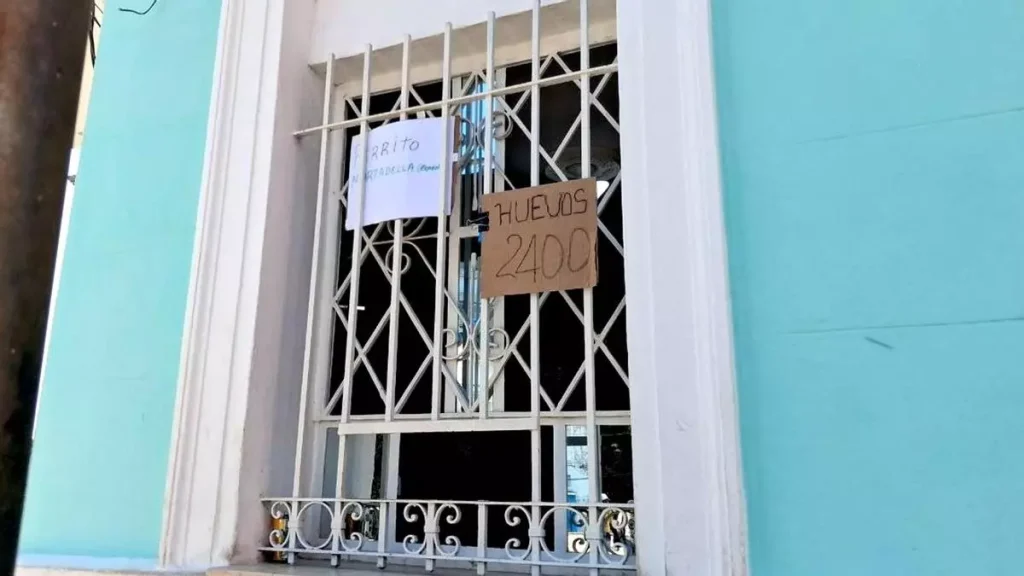
I say goodbye and continue towards Ayestarán until I reach Carlos III. Then I take Aramburu towards San Lázaro. The walk brings a surprise. The blackouts have achieved something that neither price controls nor state inspections had managed: lowering the price of a carton of eggs. Just a couple of weeks ago a carton cost 3,200 pesos; now it has dropped to 2,400, and in some private businesses a sign announces the “deal of the day”: 2,300 pesos for 30 eggs. The price reduction is not due to increased production or an economic improvement. It is, simply, the result of the lack of energy to refrigerate food.
With so many hours without electricity, few risk buying large quantities of food. A refrigerator out of service turns any purchase into a gamble against time and the tropical heat. Merchants need to sell before the merchandise spoils, and customers only buy what they are sure they will consume as soon as possible.
As I gaze at the stacks of egg cartons piled up outside a small shop, I’m reminded of how much the fate of this food has changed. In the 1980s, when Soviet subsidies fueled the illusion of seemingly endless abundance, telling a classmate that they “only ate eggs” at home was a source of ridicule in primary school. Eggs overflowed the markets, appeared far too often in workers’ canteens, and many rejected them with disdain. No one could have imagined then that they would eventually become a luxury item.
During the Mariel boatlift, hundreds of people had eggs thrown at their faces or against the facades of their houses simply for wanting to leave the supposed socialist paradise.
It was also used as political ammunition. During the Mariel boatlift, hundreds of people had eggs thrown at their faces or against the facades of their homes simply for wanting to leave the supposed socialist paradise. What was plentiful in the pantries was then used to humiliate those who were leaving.
More than four decades later, that disdain has vanished. The egg has risen in stature to occupy a privileged place on the Cuban table. People dream of it fried, boiled, poached, or transformed into an omelet large enough for the whole family. Its price also dictates the cost of many other foods. When it rises, so do birthday cakes, pastries, croquettes, breaded items, cold salads, and any recipe that needs a bit of egg white or yolk.
Round and fragile, the egg now behaves like an aristocrat who only visits the tables of those who can afford its exorbitant price. Those children who once mocked their classmates for eating scrambled eggs several times a week probably now long to be able to offer such a dish to their own children. But to achieve this, they not only need to be able to afford the high price of this food, but also have enough electricity to preserve it.
Finally, when I return from my long journey through Central Havana, the woman selling bags is no longer outside the market on Tulipán Street. Tonight, she’ll surely look back toward our building to see if they’ve cut off our electricity too. In her refrigerator and mine, most likely, there won’t be a single egg left for fear of the blackout.
Previous Havana Chronicles:
Cuba Is Once Again Without Internet
Under the Shadow of a Giant Syringe, Cuba Remains the Land of Waiting
The Time For Reforms Has Passed
Surrounded by Garbage, Miramar Is No Longer the Glamorous Neighborhood It Once Was
A Circus Facing Off Against Power, and a City Growing Increasingly Lonely
Chronicle of a Monday That Feels Like Wednesday
“We Used to Complain About the ‘CUC’, But Now We Miss It”
The Roar of Despair of a Cuban Woman Returning to Her Country After Many Years
The Tulipán Market Closed: “They’ve Given the Order To Go to the March for Raúl”
Along Carlos III Street and towards Ethiopia
Sleeping Is Also a Privilege in Havana
A Desperate Plea in the Middle of the Dark Havana Night: ‘Light!’
Under a Picture-Postcard Blue Sky, the Country is Crumbling
Fatigue Barely Allows One to Enjoy the ‘Lights On’ in Havana
Dollars, the Classic Card, and a Havana Without Tourists
A Journey Through the Lost Names of Havana
The Shipwreck of a Ship Called “Cuba”
Havana Seen From ‘The Control Tower’
In Havana, the Only Ones Who Move Are the Mosquitoes
Reina, the Stately Street Where Garbage is Sold
Searching for Light Through the Deserted Streets of Havana
The Death Throes of ‘Granma’, the Mouthpiece of a Regime Cornered by Crisis
The Anxiety of the Disconnected Cuban
One Mella, Three Mellas, Life in Cuba Is Measured in Thousands of Pesos
It Is Forbidden To Leave Home in Cuba Today Because It Is a “Counter-Revolutionary Day”
Vedado, the Heart of Havana’s Nightlife, Is Now Converted Into a Desert
_________________
COLLABORATE WITH OUR WORK: The 14ymedio team is committed to practicing serious journalism that reflects Cuba’s reality in all its depth. Thank you for joining us on this long journey. We invite you to continue supporting us by becoming a member of 14ymedio now. Together we can continue transforming journalism in Cuba.