According to sources cited by Café Fuerte, shipments will begin in July and include food and medicine.
 14ymedio, Madrid, July 3, 2026 – The United States has responded to criticism from Cuban President Miguel Díaz-Canel, who said in an interview with Dominican television last week that the $100 million in aid announced by Washington did not include food or medicine. In statements to the independent media Café Fuerte, the State Department categorically rejected the claim and announced that shipments will begin this month.
“We can confirm that the aid is ready to be shipped and that Miguel Díaz-Canel’s illegitimate regime has been delaying the approvals,” a senior State Department official told the outlet on Thursday. “We expect major shipments in July, if the regime allows it.”
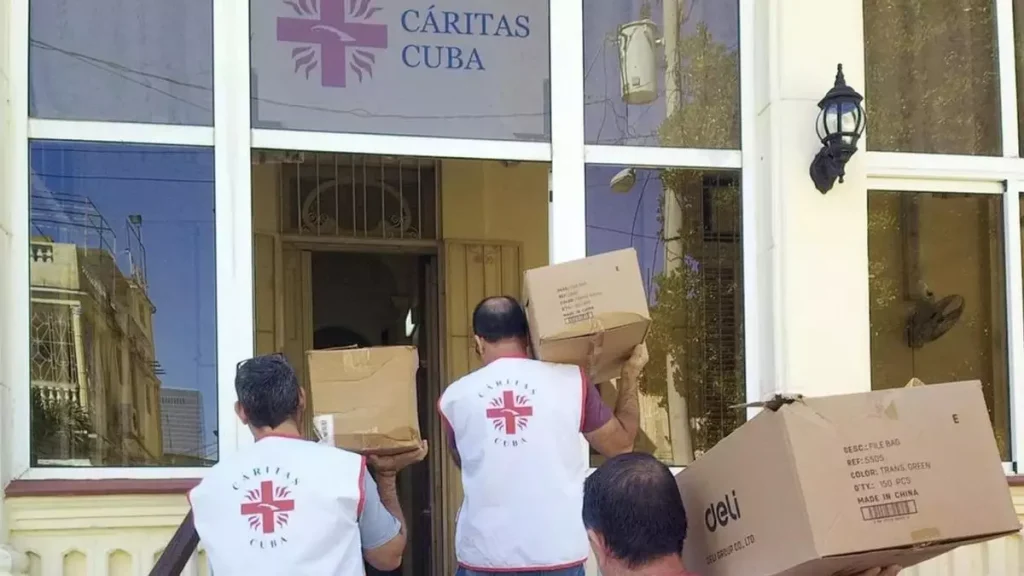
Asked about the contents of those shipments and Díaz-Canel’s claim, the official added: “That is totally and absolutely false. The shipments offered by the State Department include food, as was demonstrated during inspections conducted during the humanitarian relief phases following Hurricane Melissa, and this can be verified by the Catholic Church and other NGOs.”
“That is totally and absolutely false. The shipments offered by the State Department include food, as was demonstrated during the inspections conducted”
The same source also said that the United States has offered to bring medical care equipment to Cuba and that the regime has refused to accept it, without providing further details.
The U.S. Embassy in Cuba announced on June 17 that $60 million of the $100 million package will be managed by the Catholic Church, while the remaining $40 million will be administered by other NGOs. The agreement was finalized during a meeting between the head of the diplomatic mission, Mike Hammer; Sean Callahan, president of Catholic Relief Services; and Carmen María Nodal Martínez, director of Caritas Cuba. Also present was Dionisio García Ibáñez, Archbishop of Santiago de Cuba, known as one of the Church’s most outspoken critics of the regime.
“During these meetings, coordination was discussed for distributing humanitarian aid to ordinary Cubans, with the goal of ensuring that assistance reaches those who need it most in an effective manner,” a statement issued by the U.S. Embassy said.
In October 2025, after Hurricane Melissa struck eastern Cuba, Marco Rubio offered the Cuban regime $3 million in aid. Following a back-and-forth between the two sides, mainly over how the distribution would be organized, shipments began arriving on January 14, and their distribution was handled by Catholic Relief Services and Caritas, which have remained responsible for all subsequent deliveries.
The organizations have encountered serious logistical problems due to the fuel shortage, to the point that Miami Archbishop Thomas Wenski told The Washington Post that it was ultimately necessary to reach agreements with the Cuban regime to transport the aid by ship from Havana to Santiago. According to Café Fuerte, its source acknowledged that this issue had been discussed. “Of course, both humanitarian aid and oil and energy issues have been topics at the negotiating table,” the official said.
“Of course, both humanitarian aid and oil and energy issues have been topics at the negotiating table”
The first round of aid has been almost completely delivered, according to Miguel Díaz-Canel himself in the interview with Roberto Cavada. “Then they proposed another $6 million in aid, which is only now beginning to be implemented,” he added. He then claimed, however, that he knew little or nothing about the controversial $100 million package.
The president suggested that there was a political calculation behind beginning its delivery after September. “Why? We don’t know,” he said. He also claimed that the shipment did not include food or medicine. “So what is the aid for? We’ll have to see because they haven’t defined it, they haven’t clearly said what it is for,” he added. He also insisted that the cooperation is appreciated and accepted, but that it is “hypocritical.” “It means nothing compared with the damage the embargo has caused Cuba,” he argued.
According to Caritas, 82% of the donations have so far been delivered to the affected areas, reaching approximately 8,800 families in Santiago de Cuba, Holguín, Las Tunas, Bayamo, and Guantánamo.
Translated by Regina Anavy
______________________
COLLABORATE WITH OUR WORK: The 14ymedio team is committed to practicing serious journalism that reflects Cuba’s reality in all its depth. Thank you for joining us on this long journey. We invite you to continue supporting us by becoming a member of 14ymedio now. Together we can continue transforming journalism in Cuba.