The founder of Cuba Próxima speaks about his return to the island, surveillance by State Security, and the need to build a political alternative for the Cuban transition
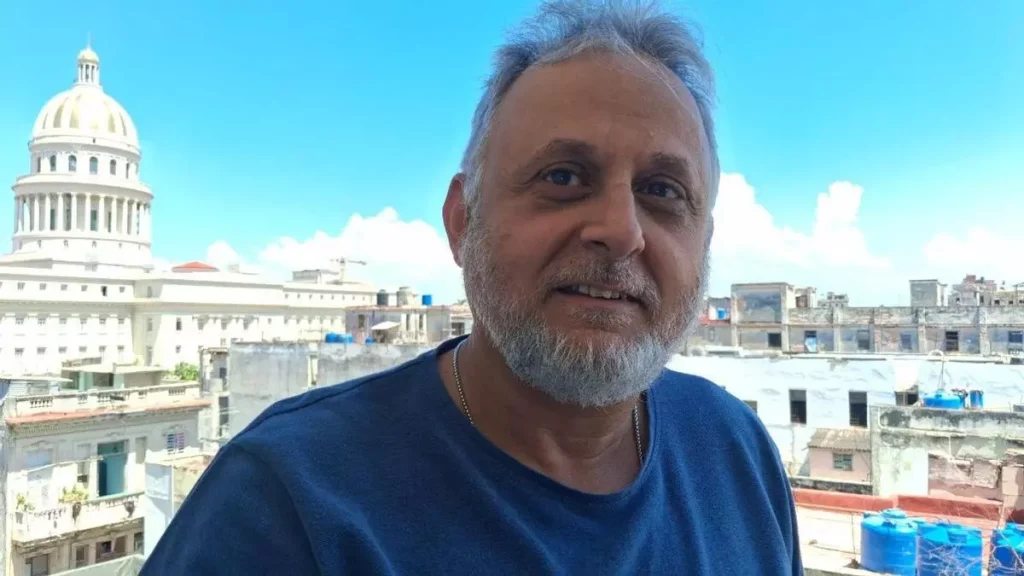
 14ymedio, Reinaldo Escobar, Havana, July 2, 2026 / Roberto Veiga was known as a Catholic layman in charge of a church magazine called Espacio Laical, as well as a political scientist and jurist specializing in human rights. Today he is a politician trying to save the country, in his own way.
One month after returning to Cuba following an attempted exile in Spain, he speaks with 14ymedio about his Cuba Próxima project.
Escobar: Your departure from Cuba in January 2020 turned into an exile, but now you have returned without asking permission. Have conditions been imposed on you? Have you made any commitments?
Veiga: When I left Cuba, my idea was to rebuild my personal situation, but then 11 July 2021 happened, and together with other people, we decided to start what we call Cuba Próxima as a human rights study center. I spent more than a month thinking about returning. I am convinced that Cuba has reached a turning point. What form it will take and in what sense, it’s impossible to know. It’s going to be very difficult, but that turning point has already begun.
I am convinced that Cuba has reached a turning point. What form it will take and in what sense, it’s impossible to know
The most normal thing would have been to stay in Spain waiting for events to unfold. That was one option, perhaps the most normal one, perhaps the one I should have taken, but no matter how much one works from outside, one remains a spectator. You have to work in here, because that is where things are going to happen, work to help ensure that what happens, happens in the best possible way. That has been the explanation I’ve given to all the friends who’ve asked me, and many have concluded that I’m crazy.
Escobar: What was your arrival in the country like?
Veiga: When I arrived at José Martí Airport on May 30, State Security was waiting for me, which I expected, because I had announced my trip, but it was very frustrating, because I had assumed I could engage in a debate with them, and I couldn’t. In the three hours that the encounter lasted, the only thing they were interested in, besides thoroughly searching my luggage, was finding out who was paying me and who was giving me orders. I could discuss anything except that, because nobody pays me, nobody gives me orders. Afterward, about fifteen days went by during which I felt under surveillance, and during that time I had no contact with anyone. I don’t believe the surveillance has stopped, but today it’s less obvious.
Escobar: Have any prohibitions been imposed on you? Have you had to make any commitments?
Veiga: So far no prohibitions have been imposed on me, nor have I made any commitments. Many people believe that to take a step like the one I’ve taken, it’s essential to feel safe, and that’s fatal. That’s precisely why this country hasn’t changed. If I had had to accept any conditions in the middle of a process being carried out by others, I wouldn’t have come. Returning had to be a personal decision. Unfortunately, we live in a society with a culture opposed to this kind of undertaking, one that assumes that if you do something, it’s because you’re someone else’s pawn, especially the government’s.
Many people believe that to take a step like the one I’ve taken, it’s essential to feel safe, and that’s fatal
Escobar: What does it mean that Cuba Próxima has stopped being a study center and become a center for action?
Veiga: We’ve worked hard on analysis, on presenting proposals, we’ve tried to influence those who should take up these proposals both inside and outside Cuba. We already have that groundwork laid, but it’s action that turns ideas into history, and strategic action has been missing.
The paths for action have been closed off. But if we never take them, they will never open. We felt more comfortable doing analysis and proposals, which is part of the nature of most of us at Cuba Próxima. But to be consistent with what we’ve been doing, we had to move to action. The country is in ruins and it needs to be rebuilt, we have to take part in that reconstruction, and without organizing ourselves that’s not possible, nor would it be possible without a vision of what kind of country we want. We are determined to pay whatever price, whatever political cost, to help get this country out of the situation it’s in.
Escobar: This new way in which Cuba Próxima is presenting itself suggests it will end up becoming a political party seeking a share of power in a future Cuba.
Veiga: What that political undertaking needs is a programmatic project, a political vision with a clear strategy, functioning bodies, and above all a membership, which is the muscle, the vitality of a society willing to act along those lines. We call it a “platform.” A party is something very rigid, very vertical; a movement is something closer to what we want, given the horizontality involved, but for that horizontality to be large enough, the mechanisms for participation have to be expanded and the executive dimension reduced. The programmatic project has to be a minimal one, which is why we don’t want to be either a party or a movement. This dynamic we’re immersed in will tell us what bodies need to be created, what our relationship with the membership we need will look like, and what it will become. What’s beyond doubt is that it must be a political grouping committed to saving this country.
Cuba Próxima’s political position moves between democratic liberalism and social democracy, and that doesn’t make it an ambiguous position
Escobar: The program you’ve hinted at is far from the classic positions that end up being labeled radical left or far right. Where would you place it on that left-right spectrum? Is there room for centrism?
Veiga: To put it in familiar terms, Cuba Próxima’s political position moves between democratic liberalism and social democracy, and that doesn’t make it an ambiguous position. It’s a stance that integrates both of those outlooks, that opens horizons for both, but with very concrete, very direct proposals. Not to the center, nor to the right, nor to the left, but forward.
In the constitutional proposal we have, for the day when there is a constituent assembly here, a semi-parliamentary system is proposed. We aspire to work within that Parliament.
Escobar: You recently warned that Cuba’s rulers still had the opportunity to at least carry out economic reforms. Do you think the newly announced 176 measures could be that first step, one that would make the need for political reform even more evident?
Veiga: There’s always a tendency to doubt what they do, because so often what they decree goes unfulfilled, or they backtrack. As a matter of principle, one has to be skeptical, but the country is in a difficult situation, and for the first time, so are they. It gives the impression that they’re determined to carry these measures forward, even if they’re not convinced.
To implement the reforms, they are forced to simultaneously implement institutional and political reforms, because otherwise it won’t work
The problem is that this now hinges on a response from the United States. In practice, those measures can’t be implemented without a concession from the United States that opens the financial door, fuel, just a little. And if those in power can’t make this benefit them, not just the country but themselves, then they won’t expand the reforms. Why would they, if it’s not going to gain them anything except weakening the control they hold? To implement the reforms, they are forced to implement institutional and political reforms at the same time, not afterward, because otherwise it won’t work. And I’ll say more: they would have to replace 99% of the people currently in government.
Escobar: And do you believe the United States is willing to open those doors that would allow the announced reforms to move forward?
Veiga: I don’t think so. Trump has lost interest in Cuba, and if the Democrats were to regain Congress in the midterm elections coming up in November, they wouldn’t attempt anything bold either, because it costs them politically, because they have to focus heavily on defending their domestic role. They’ll use different language, but they won’t do anything. Back in 2019, when Obama’s thaw failed, the United States made the decision not to open up to Cuba again, but rather that it would be Cuba that would have to open up, and then they, whether Democrats or Republicans, would decide whether or not to come in.
Escobar: So it all comes down to pressure?
Veiga: They are subject to pressure from the United States and to internal pressure. When there’s that much pressure, there has to be an alternative way out, and that way out cannot be the project the rulers present, nor the steps they’re willing to take amid their own precariousness and fears. And that’s where a key player is missing from this equation: Cuban political actors who are not part of the government, who would need to present their own proposals for the country, or more than one, viable alternatives for everyone. Someone under pressure needs to be given an alternative to the pressure.
People can’t keep enduring this, or keep waiting for someone to find a way to fix it
Escobar: But those proposals do exist, even though they haven’t been able to be widely disseminated due to the lack of freedoms.
Veiga: Yes, but proposals can’t stop at what we want; they also have to explain the how. A proposal that fails to build trust with others, with society, is just a document, an idea put on paper. What’s been lacking is the effect of these proposals, because we don’t have the democratic space to achieve it.
Escobar: Everything seems to indicate that the dictatorship is just trying to buy time.
Veiga: Things have reached a point where, without deep change, there’s no way to fix any of what’s been destroyed in recent years. We’ve reached a point of no remedy. If the decision is to buy time in order to make the country disappear before the Americans get here, maybe they’ll manage it, but what they’re actually doing is wasting time. They are not going to restore the way they used to manage poverty and maintain acceptable levels of survival. They simply can’t. Not even the best of politicians could pull that off without changing the system. People can’t keep enduring this, or keep waiting for someone to find a way to fix it. It will be long and difficult, but the country has to be given back to the people, they have to be given back the possibility of having a purpose.
Escobar: Or else?
Veiga: It’s over for everyone. We’ll become a fourth-world country.
Escobar: A Haitianization?
Veiga: That would be the best-case scenario. It could also be a North Korean-style Haitianization.
Escobar: How much time do you estimate is left before the change of system happens?
Veiga: Time has run out, but I believe that before this year ends, the process that will make it possible to save Cuba should begin, one way or another.
Translated by GH.
______________________
COLLABORATE WITH OUR WORK: The 14ymedio team is committed to practicing serious journalism that reflects Cuba’s reality in all its depth. Thank you for joining us on this long journey. We invite you to continue supporting us by becoming a member of 14ymedio now. Together we can continue transforming journalism in Cuba.