No News of Political Prisoners Luis Manuel Otero Alcántara, Maykel Castillo, Sissi Abascal or Sayli Navarro

The PEN Club of Cuban Writers in Exile calls for the “immediate release” of the poet María Cristina Garrido, imprisoned in El Guatao


Luis Manuel Otero Alcántara and Maykel Castillo ’Osorbo’ in a file image / Facebook / MSI

14ymedio bigger14ymedio, Madrid, 6 February 2025 — The Pen Club of Cuban Writers in Exile, a subsidiary of the international organization that works for freedom of expression and protects persecuted authors, has demanded that the Cuban regime “immediately release” poet María Cristina Garrido Rodríguez, “and all human rights writers and activists who still remain in prison.” Garrido is serving a seven-year sentence in the women’s prison of El Guatao (Havana) for protesting on 11 July 2021 (11J).

In a statement made public this Thursday, the Miami-based NGO celebrates the release “after the agreement between the Biden Administration and the Castro dictatorship” of “several political prisoners,” who “should should never have been sentenced to prison.” However, they say, “many Cubans still remain in prison, including writers like Garrido, whose only crime was to speak out against the Cuban dictatorship.”

María Cristina Garrido was arrested in San José de las Lajas (Mayabeque) on July 12, 2021, the day after the historic protests, along with her sister, Angélica Garrido, who was released last July, having served her sentence of three years in prison. PEN points out that the poet “has faced very difficult detention conditions, which include isolation, abuse and lack of water and food.”

Accused of public disorder, contempt and resistance in March 2022, Garrido, like her sister, participated in prison protests in September 2022, refusing to wear the uniform of common prisoners and starting a hunger strike. continue reading

“With discretion and contempt for the authorities, she managed to get hold of some scarce paper, a pencil and a twisted pen cartridge”

PEN also says that her most recent book, Voz cautiva (Captive Voice), was written in prison. “María Cristina Garrido could not begin writing until the 349th day of her imprisonment. With discretion and contempt for the authorities, she managed to get hold of some scarce paper, a pencil and a twisted pen cartridge.”

The poet was one of the prisoners that the organizations hoped would appear on the list of the 553 released by the Government, announced by the Ministry of Foreign Affairs on January 14, not as a pact with Biden – which took Cuba off the list of countries sponsoring terrorism that same day – but with the Vatican. Along with her, the Ladies in White Sissi Abascal and Sayli Navarro, and the artists, Luis Manuel Otero Alcántara and Maykel Castillo, are among the other prisoners of conscience expected to be released.

Far from granting them release, on the contrary, Abascal and Navarro continue to follow a “severe regimen” for being “negative prisoners” and are denied the benefits to which they are entitled.

The Cuban regime, which with the first releases hastened to clarify that they were “neither an amnesty nor a pardon” but “benefits” that did not exempt them from returning to prison if they did not comply with the “obligations,” stopped these releases the same day that Donald Trump took office as president of the United States and, a few hours later, revoked the order of his predecessor and returned Cuba to the blacklist.

Until then, organizations such as Prisoners Defenders (PD) reported that only 200 political prisoners were released from prison, of which 31 had already served their sentences. Among them were historical opponents such as José Daniel Ferrer and Félix Navarro, as well as activists Pedro Albert Sánchez, Luis Robles and the Lady in White, Tania Echeverría.

Precisely, Ferrer denounced again the pressure he is receiving from the regime by stating that they took a summons to his house to appear this Friday before a court, which he refused to receive. “If that’s why I have to go back to prison, I’ll gladly go back and stay in prison until the tyranny falls,” he said in a video shared on his social networks.

https://www.facebook.com/100025267088029/videos/559647329867985/?ref=embed_video&t=34

For Prisoners Defenders, the releases were no more than “a macabre game of the regime.” The total number of released prisoners that the regime had given, 553, was “very emblematic,” said Javier Larrondo, president of PD. It was the same number that PD had for the imprisoned 11J demonstrators. “What they have done, subliminally, is to let us deceive ourselves into thinking that they aee all 11J prisoners,” he told this newspaper on January 23.

Translated by Regina Anavy

____________

COLLABORATE WITH OUR WORK: The 14ymedio team is committed to practicing serious journalism that reflects Cuba’s reality in all its depth. Thank you for joining us on this long journey. We invite you to continue supporting us by becoming a member of 14ymedio now. Together we can continue transforming journalism in Cuba.

Overwhelmed by Garbage, the Inhabitants of Manzanillo Fear the Arrival of a New Epidemic

“What started in a corner with a small nylon bag, today is a mountain of branches, rubble and dead animals,” they say.

A dumpster was on fire for several days, next to a playground and a medical office / 14ymedio

14ymedio bigger14ymedio, Carlos. A. Rodríguez, Manzanillo, Granma Province, 6 Febraury 2025 — “I woke up with chest discomfort and shortness of breath. It was after 2 in the morning, and I could tell that something was burning. In the morning, when I took my child to daycare, I saw a metal container burning all kinds of waste five blocks from my house.”

This is how Gisela explains why she has to follow a new route to take her son to school in order to avoid the garbage dump that is growing in front of a playground and a doctor’s office. “What started in a corner with a little nylon bag is today a mountain of branches, debris and dead animals.”

“The Comunales [Communal Services] take so long to collect the garbage that the container overflows. They tell you that the truck broke down, that there is no fuel. It’s always something,” she laments. “In spring, the neighbors set fire, supposedly to scare away mosquitoes, but it is no longer justified. Many of us think that the officials are really the ones who set the fires, so that there is less to collect. They burn sanitary pads, plastics or who knows what. Now we are in the dry season with a lot of wind, so it’s better not to think about what you breathe or what gets in your eyes.”

A dumpster and a garbage heap block the street / 14ymedio

The city, once synonymous with culture and splendor, today is a distant memory. Manzanillo has gone from being the Pearl of the Guacanayabo to a huge open dump.

“There is no one living here anymore,” says Eduardo, a neighbor of La Kaba, an agricultural market. “They throw out garbage from the houses the same as the decomposed merchandise from the shelves. They continue reading

thought they were going to solve it with a metal container but it made things worse.” He refers to the huge orange dumpsters scattered around the city center that have proliferated in the face of the inability of Communal Services, subordinated to the municipal government, to do its job, and which, in addition to ruining the ornamentation, legitimize the garbage piles.

“It will take a century to clean it up, and in the meantime you have to stomach all that filth. There are coffee shops in the surroundings, and they are now disgusting because of the flies and the plague,” says Eduardo, who remembers better times.

“There was a time when you didn’t see so much filth on the streets. They managed to hire carretoneros, horse-cart drivers, who were quite efficient. They stopped working because they were paid very little, and the raw honey for the horse feed went up in price. It even affected the closure of the sugar mills,” he said. The same thing happened in Las Tunas, where the carretoneros hired by Communal Services complained about the low wages and the terrible conditions.

The dumpster was eventually located half a block from Céspedes Park / 14ymedio

“With the coming of the dumpsters, the ‘divers’ resurfaced. It’s terrible that someone survives like this. They dive in looking for scrap metal, firewood or anything they can sell. It’s depressing, and I’ve seen old people eat rotten fruit thrown away by street vendors. We have reached that extreme.”

Despite the pride they have always shown for their city, the residents of Manzanillo admit that it has entered an unstoppable spiral of decadence.

They fear that at any moment a new epidemic like COVID will arrive, this time caused by the contamination and the lack of sanitation. And what saddens them the most is to see children and the elderly who, pushed by necessity, rummage through the trash for a piece of metal or an empty can of beer that can be exchanged for food.

Translated by Regina Anavy

____________

COLLABORATE WITH OUR WORK: The 14ymedio team is committed to practicing serious journalism that reflects Cuba’s reality in all its depth. Thank you for joining us on this long journey. We invite you to continue supporting us by becoming a member of 14ymedio now. Together we can continue transforming journalism in Cuba.

An Opposition Group Urges the EU To ‘Temporarily Suspend’ Its Agreement With Cuba

The Council for Democratic Transition argued that the Havana regime sells “an image and narrative of modernization, without assuming real commitments to political openness or the improvement of human rights.”

The High Representative for Foreign Affairs of the European Union, Josep Borrell, during a visit to Havana in May 2023 / @JosepBorrellF/Twitter

14ymedio bigger

EFE (via 14ymedio), Havana, 4 February 2025 — On Tuesday, the Council for the Democratic Transition in Cuba (CTDC), one of the main opposition groups in Cuba, urged the European Union (EU) to “temporarily suspend” its Political Dialogue and Cooperation Agreement (ADPC) with Cuba.

The group argued in a statement that the Cuban Government “has instrumentalized this agreement to obtain economic benefits and sell an image and narrative of modernization, without assuming real commitments to political openness or to the improvement of human rights.”

Therefore, the CTDC – which already made a similar request last September – urged the EU to “re-evaluate and temporarily suspend the ADPC until there is “concrete progress in the field of human rights and democracy” on the Island (…) and compliance with “democratic and economic” standards. continue reading

“Only with a clear and coordinated response from western democracies will it be possible to achieve respect for human rights and a peaceful change to democracy in Cuba”

It also asked the organization to “guarantee the participation of Cuban civil society in the negotiations and dialogues on the possible revision of the agreement” and to support the CTDC’s proposal for a law of amnesty and decriminalization of dissent in the country.

“Only with a clear and coordinated response from western democracies will it be possible to achieve respect for human rights and a peaceful change to democracy in Cuba,” the group argued in its statement.

The organization indicated that one of the main reasons for its request is the deterioration of human rights in Cuba, and it denounced the “systematic persecution and repression” of opponents, the “flagrant violation” of constitutional rights, the escalation of arbitrary detentions and a lack of collaboration with international organizations.

Secondly, it alleged the “failure” of Cuba’s economic model, with the “monopoly” exercised by Gaesa, “a military conglomerate that controls the country’s resources, represses the private sector” and does not pay its foreign debt.

Finally, it highlighted Cuba’s “opaque strategic alliances” with Russia, Belarus, North Korea, China and Iran, and its “logistic and military” support to countries such as Nicaragua and Venezuela, “factors in regional destabilization.

It highlighted Cuba’s “opaque strategic alliances” with Russia, Belarus, North Korea, China and Iran, and its “logistical and military” support to countries such as Nicaragua and Venezuela

The agreement that currently governs bilateral relations between Cuba and the EU was signed in 2016 and includes a clause of respect for human rights, whose violation allows it to be suspended.

The ADPC, not exempt from controversy within the EU (it has not been ratified by Lithuania and is criticized by conservative political parties), replaced the so-called “common position” of the EU towards Cuba, which the bloc had maintained since 1996, and which linked any progress in the bilateral relationship to progress in democratization and human rights on the Island.

The agreement promotes cooperation in favor of sustainable development, democracy and human rights, as well as the possibility of finding shared solutions to global challenges through joint actions in multilateral forums.

Translated by Regina Anavy

____________

COLLABORATE WITH OUR WORK: The 14ymedio team is committed to practicing serious journalism that reflects Cuba’s reality in all its depth. Thank you for joining us on this long journey. We invite you to continue supporting us by becoming a member of 14ymedio now. Together we can continue transforming journalism in Cuba.

The US Head of Mission in Cuba Visited the Opponent Martha Beatriz Roque in the Hospital

Martha Beatriz Roque, en una imagen de 2016. / 14ymedio

14ymedio bigger14ymedio, Madrid, 4 February 2025 — The Head of Mission of the United States Embassy in Cuba, Mike Hammer, visited Cuban opponent Martha Beatriz Roque on Monday at the Manuel Fajardo hospital in Havana, where she has been hospitalized since last Saturday. According to CubaNet, Hammer transmitted to the activist a message from Secretary of State Marco Rubio, who wished her a speedy recovery and hoped to be able to see her soon.

After the diplomat’s visit, it was revealed that Roque had been “transferred” to the Hermanos Ameijeiras Hospital, which the leader of the Ladies in White, Berta Soler, who announced the transfer, described as “temporary.”

“The director of the Fajardo hospital, Dr. Mirtha, told us at 2.30 pm that they decided to transfer Martha Beatriz Roque to the Nephrology Department of the Hermanos Ameijeiras hospital. The transfer will be carried out by the Integrated Medical Emergencies System, and in the company of two trusted friends, said Berta Soler, the current leader of the Ladies in White.

Roque, spokesman for the Cuban Center for Human Rights, arrived at the Manuel Fajardo intensive care unit in critical condition, with very low blood pressure, dehydration and hyperglycemia, coming from the Miguel Enríquez hospital, known as La Benéfica. As Soler and her husband, Ángel Moya, reported last Wednesday, Roque had been taken to La Benéfica due to the worsening state of her health. Roque has diabetes and is also suffering from a kidney infection. continue reading

Since then, the activists have continued to report on her medical condition, specifying that Roque had “trusted friends” by her side.

The activists have continued to report on her medical condition, specifying that Roque had “trusted friends” by her side

These days, the opponent has been improving, and this Monday she went from a “critically unstable” condition to “serious but stable.” According to a publication by Soler this Tuesday, Roque is “conscious but disoriented in time and space.”

Roque was the only woman who was part of the Group of 75 Cubans who suffered imprisonment during the so-called Black Spring of 2003. Founder of the Cuban Institute of Independent Economists, in 1997 she started the Internal Dissent Working Group. The document La patria es de todos – (The Country Belongs to Everyone) – signed with Félix Bonne Carcassés, René Gómez Manzano and Vladimiro Roca – pointed out the management errors of the Communist Party during the Special Period in the 1990s, and it dates from those years.

Roque was one of the Faces of 2024 chosen by 14ymedio, which also celebrated the delivery of the Woman of Courage award, which the US Government gives to those who “have demonstrated exceptional courage, strength and leadership in defending peace, justice and human rights.” Roque, however, could not go to Washington to receive the award because she is “regulated,” that is, banned from leaving the national territory.

At that time, she told 14ymedio something that gives the measure of her work in favor of democracy in the last 35 years, and its impact on the regime: “The hatred they have for me is terrible.”

Translated by Regina Anavy

____________

COLLABORATE WITH OUR WORK: The 14ymedio team is committed to practicing serious journalism that reflects Cuba’s reality in all its depth. Thank you for joining us on this long journey. We invite you to continue supporting us by becoming a member of 14ymedio now. Together we can continue transforming journalism in Cuba.

Several Cubans Are Among Dozens of Undocumented Immigrants Detained in Florida

Four of the 32 arrested had committed a minor crime

Irregular migrants arrested in Florida at the end of January /ICE

14ymedio bigger14ymedio/EFE, Miami, 4 February 2024 — A total of 32 undocumented immigrants were arrested in Florida in several operations by the Immigration and Customs Control Service (ICE) and other federal agencies, on January 27 and 28. Among those arrested in the raids, carried out in Palm Beach County, there is an unspecified number of nationals of Cuba, Guatemala, Haiti, Mexico, Honduras, El Salvador, Venezuela, Colombia, Brazil and Nicaragua.

In a statement from the immigration authorities, detailed data are given about four detainees who committed a crime, including a 24-year-old Cuban convicted of fraud, failure to appear, theft and violation of probation.

In addition, there are cases of a 30-year-old Venezuelan with crimes of resistance to authority, drug possession and theft; a 44-year-old Haitian convicted of assault, drug possession and prostitution; and a 25-year-old Guatemalan convicted of illegal re-entry, possession of cocaine and driving under the influence of alcohol.

The four are awaiting deportation, while the remaining 28 are waiting continue reading

for a hearing before an immigration judge, who will decide if they will also be returned to their countries of origin.

The four are awaiting deportation, while the remaining 28 are waiting for a hearing before an immigration judge, who will decide if they will also be returned

In addition, the Florida Highway Patrol (FHP) said on Monday that, in a joint operation with federal agents carried out in Tallahassee, it arrested “alleged members of the Tren de Aragua” – a transnational gang of Venezuelan origin – for alleged conspiracy to smuggle weapons, criminal gang affiliations and illegal entry into the United States.

Different security forces are participating in the migration operations, as the governor of Florida, Ron DeSantis, had already warned. This Monday, on social networks, ICE boasted about the cooperation achieved for these arrests by the FHP, the Office of Homeland Security Investigations (HSI), the Office of Enforcement and Removal Operations (ERO), the Department of Homeland Security (DHS) and the Drug Control Administration (DEA).

On January 31, the Argentine newspaper La Nación published an article in which relatives of several migrants detained in Delray Beach (Palm Beach) on the 27th denounced “deception” by ICE agents. “They took them by surprise and for no reason,” said a relative of one of the detainees. Some of those arrests occurred, according to testimonies, when those affected went to a routine appointment at the immigration supervision office.

The cousin of one of the detainees told Telemundo that her relative was summoned at 8 in the morning for a routine visit and had not returned. “He has a license, he has a social security card, he was given the appropriate documentation. All he had to do was register with immigration weekly, through a phone call, and continue complying. Today was a normal check-in,” she told the media.

“He has a license, he has a social security card, he was given the appropriate documentation. All he had to do was register with immigration weekly.”

The interviewee said that, hours later, after losing contact with him, she went to the office to look for him and found out that he was detained. “Without any reason. My cousin is not a criminal, he has never been in jail, he is not doing anything wrong,” she said.

The mother of a Venezuelan who was allegedly arrested in similar circumstances said she feared deportation, because they no longer have family in the country. “They told him to come at 2 pm because they needed to fix something on his phone for the application and supervise it. And yes, that was a lie.” The 30-year-old arrested man had been in the United States since he was six.

The report relates the cases of several other people who were apparently summoned for the usual check-ins and ended up detained.

Garrett Ripa, interim deputy director of the Office of Detention and Deportation in Miami, defended himself from the criticism and said that the work currently carried out by the agents is the same as always, “with the difference that they work together with more federal agencies.” In addition, he categorically stated that “they only arrest people with a final deportation order.”

Translated by Regina Anavy

____________

COLLABORATE WITH OUR WORK: The 14ymedio team is committed to practicing serious journalism that reflects Cuba’s reality in all its depth. Thank you for joining us on this long journey. We invite you to continue supporting us by becoming a member of 14ymedio now. Together we can continue transforming journalism in Cuba.

Of the 200 Prisoners Released by the Cuban Regime, 31 Had Completed Their Sentences

Prisoners Defenders denounces that the released prisoners were banned from giving interviews or contacting human rights NGOs

Mailene Noguera Santiesteban and Yessica Cohimbra Noriega after being released from prison / José Díaz Silva/Facebook

14ymedio bigger14ymedio, Havana, 4 February 2025 — Prisoners Defenders (PD) confirmed on Tuesday a total of 200 political prisoners among the 553 released by the Cuban government through an alleged agreement with the Vatican. Of these, the organization said that at least 94% already had the right to parole, to an open regimen or even to immediate freedom. All this then, says PD, has been nothing more than “a macabre game of the regime.”

In a statement published on Tuesday, when the NGO counted 198 political prisoners released from prison, they said that 31 (15.66%) of the 198 “had already served their sentences but were still imprisoned”; two others (1.01%) would complete their sentences in four months or less, and 57 (28.79%) still had between six and 18 months left to serve. Another 67 (33.84%) had between 18 and 42 months left.

“Only 12 of the total number of political prisoners released in Cuba (6.06%) had sentences of up to 15 years, and their release can be considered a ’measure of grace’,” said the organization. continue reading

Those released, in most cases, “are obliged to perform forced labor assigned by State Security.”

Therefore, Prisoners Defenders stressed, the releases are not a real liberation. The prisoners are now in “home detention,” under draconian conditions. These restrictions include “the prohibition of leaving their city of residence, expressing themselves on social networks, giving interviews or contacting human rights organizations.”

Those released, in most cases, “are obliged to perform forced labor assigned by State Security.” The objective is to keep opponents in a state of constant surveillance and fear, preventing them from resuming their political activity or denouncing human rights violations.

The NGO also criticized the lack of transparency in the process, since many families of the inmates were not informed in advance. On the other hand, the figure of 553 released prisoners that the Government of Cuba publicized includes common criminals, without their proportion having been clarified.

As part of this “fraud,” PD adds, the regime leaked names of people who were never in prison, with no other intention than to confuse public opinion and divert attention.

It was Javier Larrondo himself, president of Prisoners Defenders, who told this newspaper on Tuesday that they had reached the figure of 200 confirmed political prisoners. It was the number he had already estimated for 14ymedio on January 23, when he emphasized that the total number of released prisoners that the regime had given was “very symbolic,” because it was the same one given by both his organization and included the imprisoned demonstrators from the Island-wide 11 July 2021 protests. “What they have done is, subliminally, let us deceive ourselves into thinking that they are all 11J prisoners.”

Translated by Regina Anavy

____________

COLLABORATE WITH OUR WORK: The 14ymedio team is committed to practicing serious journalism that reflects Cuba’s reality in all its depth. Thank you for joining us on this long journey. We invite you to continue supporting us by becoming a member of 14ymedio now. Together we can continue transforming journalism in Cuba.

One of the Two Cubans Arrested in Florida for Falsifying Credit Cards Had a Deportation Order Going Back to 2019

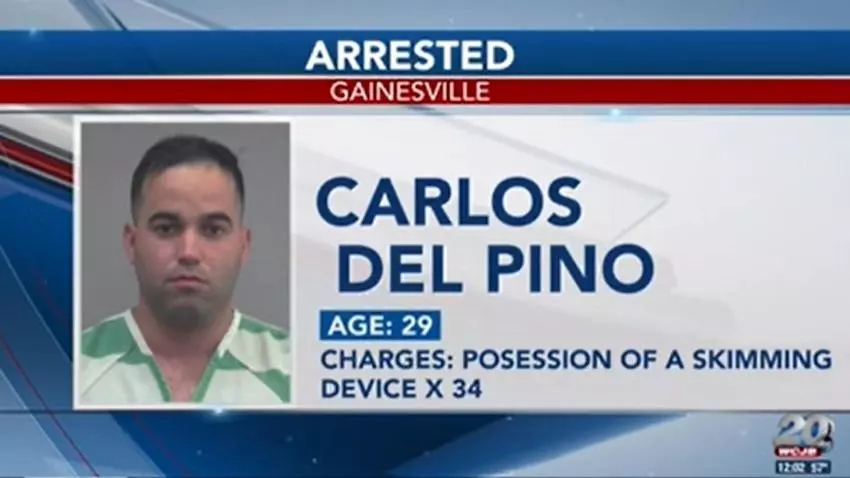
Carlos del Pino and Yandi Valdes Rodriguez were taken to the Sumter County Jail and face 113 criminal charges

Carlos del Pino and Yandi Valdés Rodríguez were found with 20 fake cards / Florida Highway Patrol

14ymedio bigger14ymedio, Havana, 31 January 2025 — Cubans Carlos del Pino, 34, and Yandi Valdés Rodríguez, 35, face 113 charges in Tampa, Florida, for crimes related to credit card forgery. The couple was arrested last Wednesday for various traffic violations on Interstate 75 (I-75) in Sumter County, and the Highway Patrol found cloning devices, 20 fake cards and dollars inside the vehicle.

Since the detainees were both of Cuban origin, the presence of the Border Patrol was requested when they were arrested to verify their immigration status. Since last Sunday, the Office of the Department of Homeland Security (HSI) and the Immigration and Customs Enforcement Service (ICE) have been carrying out anti-immigrant raids in the state.

The immigration agency specified that Del Pino “had an active deportation order in force since 2019” but was “on probation.”

The data obtained by the Sumter authorities showed that the 2019 Range Rover truck driven by Del Pino had multiple infractions. The migrant also has a criminal record related to the falsification of credit cards.

Del Pino and Valdés were arrested and taken to the Sumter County jail while the investigation is being carried out. continue reading

Cuban Carlos del Pino was also arrested in 2019 for the same crime of cloning cards. / Capture/WCJB

Last Wednesday, the President of the United States, Donald Trump, promulgated the Laken Riley Act, which empowers federal authorities to deport migrants who are in the country illegally and who have been accused of crimes.

“It is a law that authorizes the Department of Homeland Security to arrest and deport people who are accused of crimes,” said Mario J. Pentón, speaking to a lawyer from the Gallardo law firm. “The interesting thing about this rule is that they can arrest people who have not even been convicted,” and it is enough for them to have a case in process in a Federal Court.

The lawyer trusts that this new legislation will generate a debate for being “a violation” of the Constitution. Pentón said that in the Migration Courts, “when you request bail, you have not been convicted of any crime.”

However, he acknowledged that there are criminal charges such as “murder, terrorist acts and actions that are considered aggravated crimes” that make you inadmissible in the United States. “These people will be deported and will be subject to this law,” he stressed.

The new rule has been extended to minor crimes such as “theft and assault.” However, the lawyer specifies that the Migration Law establishes that “a store robbery is considered an exception when considered a case of “moral turpitude,” an act that violates community standards, and the courts can limit the rule for its final application.

Donald Trump said on Wednesday that he would send the “worst foreign criminals” to a detention center at the Guantánamo Naval Base in Cuba. “Some of them are so bad that we don’t even trust their own countries to keep them. We don’t want them to come back, so we’re going to send them to Guantánamo,” he said.

Translated by Regina Anavy

____________

COLLABORATE WITH OUR WORK: The 14ymedio team is committed to practicing serious journalism that reflects Cuba’s reality in all its depth. Thank you for joining us on this long journey. We invite you to continue supporting us by becoming a member of 14ymedio now. Together we can continue transforming journalism in Cuba.

Cuban Doctors Monopolize Internships for Mexican Students

The University of San Luis Potosí has ​​been forced to negotiate with hospitals to obtain new positions for Mexican graduates

Ismael Francisco Herrera Benavente said that Cuban doctors are displacing Mexican doctors in San Luis Potosí / Video capture/@Potosinoticia01

14ymedio bigger14ymedio, Mexico City, 3 February 2025 — The president of the Faculty of Medicine of the University of San Luis Potosí in Mexico said that Cuban doctors hired by Mexico lack the necessary “certifications” to practice. According to Ismael Francisco Herrera Benavente, the training of Cuban health workers is not only doubtful, but their arrival has also begun to “displace” university graduates, especially in the internships they must do as part of their social service.

“We have to pass several accreditations (studies), validations, evaluations and exams for medical residency,” Herrera Benavente told local media, and he doubts that the Cubans are as well trained as their own students. The doctor’s complaint adds to the discontent shown last September by the College of the Medical Profession. “Cubans do not have a professional ID and cannot issue prescriptions,” stressed the president of the Antonio Chalita Manzur institution.

The lack of places for internships, which have been filled with Cuban health workers, has forced the union to arrange more internships with hospitals, so that the teaching of Mexicans is not truncated.

The program of hiring Cuban doctors in Mexico, initially designed to cover rural and remote areas, has left more disappointment than relief for the national medical union. continue reading

A Cuban doctor in the community of San Juan de las Vegas in San Luis Potosí / Facebook/Cuban Medical Brigade San Luis Potosí, Mexico

The governor of San Luis Potosí, Ricardo Gallardo Cardona, who promised – like the former president of Mexico Andrés Manuel López Obrador (2018-2024) – to have a medical service like that of Denmark, said that 80 Cuban doctors work in San Luis Potosí.

According to official data, Mexico has 669 hospitals in different states, 11,935 clinics and 274,977 doctors, nurses and administrative workers. The director of the Mexican Social Security Institute, Zoé Robledo, confirmed last December the arrival of 3,100 Cuban specialists to reinforce López Obrador’s health project in rural areas. For 610 of these doctors, the Government disbursed 23,227,156 euros according to three contracts concluded between July 2022 and 2023.

The program promoted by the López Obrador Administration is continuing with his successor, Claudia Sheinbaun. “We continue with the hiring,” she said on Sunday. The president argued that the lack of specialists was because “during the entire neoliberal period, medical specialists stopped training. It was thought that restricting admission would lead to greater excellence in training, but, in reality, what happened was that they stopped training medical specialists.”

Sheinbaum said that due to this lack of doctors, there was “a need to hire other nationalities to help and support us in the care of the population.” In addition, she said she was not hiring foreign health workers over Mexicans.

Translated by Regina Anavy

____________

COLLABORATE WITH OUR WORK: The 14ymedio team is committed to practicing serious journalism that reflects Cuba’s reality in all its depth. Thank you for joining us on this long journey. We invite you to continue supporting us by becoming a member of 14ymedio now. Together we can continue transforming journalism in Cuba.
With the Unforeseen Departure of the Guiteras Power Plant, Cuba’s Expected Deficit of the UNE Reaches 2,595 Megawatts

Cuban authorities also recovered a unit from the Antonio Maceo thermoelectric plant in Santiago de Cuba, but admit that the shortage is high in the country

The Guiteras, at the time of its disconnection, provided 250 MW / Antonio Guiteras Thermoelectric Power Plant/Facebook

14ymedio bigger14ymedio, Havana, 2 February 2025 — The anxiety of living from blackout to blackout has no end for Cubans who, in recent days, have once again suffered a deficit of more than 1,500 megawatts (MW). This Sunday, the Antonio Guiteras thermoelectric plant in Matanzas unexpectedly dropped again from the National Electric System (SEN) around 8:15 in the morning “for a cause not yet identified,” the official press said.

With a generation capacity of 330 MW, the largest plant in the country had disconnected from the SEN in the middle of last month after a technological failure in the boiler. The problem lasted nine days, after which the thermoelectric power plant managed to synchronize without any setbacks on January 27, but only for a week.

“The origin of the problem is being investigated,” and should no damage be reported that entails a repair, the plant “could begin the start-up in the next few hours,” the Cuban News Agency reported, quoting Rubén Campos Olmo, general director of the plant. continue reading

“The origin of the problem is being investigated,” and should no damage be reported that entails a repair, the plant “could begin the start -up in the next few hours”

At the time of its disconnection, the Guiteras was contributing 250 MW to the SEN. In this morning’s report, the SEN predicted a deficit of 1,525 MW with a possible affectation of 1,595 MW. When the power went out, the government recalculated the lack, and it is now expected to be 2,595 MW during peak hours.

Work is currently being done on breakdowns in the Renté (Santiago de Cuba), Felton (Holguín), Guevara (Mayabeque) and Diez de Octubre (Camagüey) thermoelectric plants. Work is also being done at the Cienfuegos plant, the National Electric Union (UNE) reported.

The country has been immersed in an energy crisis for years due to the lack of fuel; e.g., the lack of foreign exchange to import it, and the frequent breakdowns in its obsolete thermoelectric plants, with decades of operation and a chronic investment deficit. The situation has worsened since the end of August, and at the beginning of 2025, despite low temperatures, the deficit has remained above 1,000 MW.

Translated by Regina Anavy

____________

COLLABORATE WITH OUR WORK: The 14ymedio team is committed to practicing serious journalism that reflects Cuba’s reality in all its depth. Thank you for joining us on this long journey. We invite you to continue supporting us by becoming a member of 14ymedio now. Together we can continue transforming journalism in Cuba.

‘50 Stories of Cuba in Exile’ and an Essay on Sugar Among the January Books

Last month, Azúcar, an essay that compares the history of sugar with that of civilization, arrived in bookstores.

The Ácana mill, in Matanzas, drawn in 1857 by Eduardo Laplante as part of his “collection of views” of colonial sugar mills / Project Gutenberg

14ymedio bigger14ymedio, Xavier Carbonell, Salamanca, 2 February 2025 – “Azúcar!” It was for decades the battle cry of Celia Cruz, sung in vibrant and honeyed syllables. “Without sugar there is no country” was the mantra of the Republican landowners, which in the light of the current sugarcane debacle sounds like a spiteful prophecy against Fidel Castro. In fact, Cuba owes its opulent nineteenth century – railways, cities, mills – and also its sickly attachment to slavery, abolished late, to sugar.

Manuel Moreno Fraginals, in the prologue to his controversial study on the sugarcane industry on the Island, described like no other the ferocity with which sugar shaped the history of Cuba. The author of El ingenio [The Sugar Mill]- who ended up disgusted and going into exile in Miami, where he died in 2001 – traced “the footprints that start in sugar and manifest themselves in the establishment of a university chair, or in a decree on tithes, or in the characteristic form of the Cuban architectural complex, or in the terrible effects of the razing of forests and the erosion on the soils.”

Azúcar [Sugar] (publisher Ariel) arrived in bookstores this January, an essay of almost 500 pages signed by the Dutch researcher Ulbe Bosma, which equates the history of sugar with that of civilization. For the text, where it is not difficult to find the imprint of Moreno Fraginals, “the rise of sugar speaks to us of progress, but also of a much darker history of human exploitation, racism, obesity and environmental destruction.” continue reading

In an interview, Bosma illustrated the political and economic importance of the so-called Creole saccharocracy

In an interview offered in Barcelona to the newspaper La Vanguardia, Bosma illustrated the political and economic importance of the so-called Creole saccharocracy during the 19th century and the first half of the 20th. If today it is the technology tycoons Elon Musk and Jeff Bezos who pull the strings of world politics, he said, at that time the influence of the big sugar surnames – Fanjul, for example – was decisive in the United States and Europe.

For Bosma, social networks are just as addictive as sugar, and the key to dealing with both is moderation. He says that he adds sugar to his coffee, but only “a teaspoon.” “Despite everything I’ve found out,” he says, “I’ve gotten used to its flavor and don’t want to lose it.”

Independent Cuban publishers have had a modest production during the first month of the year. One highlight is Como el ave fénix [Like the Phoenix] (Rialta Magazine), 50 interviews published by Cuban journalist William Navarrete in recent months on CubaNet. They are, for its author, “stories of Cuba in exile.” They narrate, according to the life experiences of those involved, the last 100 years of the Cuban nation.

“For years, William Navarrete has had the sense of smell and sagacity to locate many of the protagonists of the politics and culture of the Island of the twentieth century and get them talking about the lost city, the political prison, the purges, the labor camps, the exile or the great names and events of their life stories,” say its editors, who qualify the book as “one of the most powerful collective testimonies” after 1959.

Rialta also publishes, in its ’Files’ section, a recount of Antonio José Ponte’s career in ’La Gaceta de Cuba’

Rialta also publishes, in its Expedientes [Files] section, an account of the career of Antonio José Ponte in La Gaceta de Cuba. What was published by the poet and essayist in one of the most disgusting magazines of official culture gives the measure of how his critical caliber was gestating. This dossier is also a sample of the work of Ponte in Cuba, the attempts at “civic extermination” to which the regime subjected him and his emergence as one of the indisputable voices of his generation.

Ediciones Memoria, a small publishing house in Camagüey dedicated to the rescue of Cuban civic thought, publishes Las conferencias de Shoreham, by Manuel Márquez Sterling. “His prose is a long and subtle examination of both his own and the national conscience. There is no lack of irony, even mockery, but above all, in the sometimes light ease of speech, there is always the seriousness of the duty to be,” explains his editor, Alenmichel Aguiló.

The anthology of poems by the Russian Nobel Prize winner Joseph Brodsky, who died in 1996, translated by Ernesto Hernández Busto for the Siruela publishing house, is already in bookstores. Devoted to the writer exiled from the Soviet Union, the Cuban has written: “With Joseph Brodsky I am always tempted to make different versions, perhaps because in his poetry there is also an effort to communicate a certain universality, a certain transcendence.”

Translated by Regina Anavy

____________

COLLABORATE WITH OUR WORK: The 14ymedio team is committed to practicing serious journalism that reflects Cuba’s reality in all its depth. Thank you for joining us on this long journey. We invite you to continue supporting us by becoming a member of 14ymedio now. Together we can continue transforming journalism in Cuba.

The Whole Truth About the Case of Former Cuban Minister Alejandro Gil

Or how the lack of transparency gives us the right to speculate

Alejandro Gil, former Minister of Economy and Planning, was dismissed in February 2024 / Cubadebate

14ymedio bigger14ymedio, Reinaldo Escobar, Havana, 1 February 2025 — Those who rule in Cuba, from the powers that emanate from their positions, promised that there would be transparency in the trial of Alejandro Gil, former deputy prime minister and former minister of Economy. But instead of transparency, opacity has prevailed, not to say the darkest secrecy.

After that “Official Note of the First Secretary of the Central Committee of the Party and President of the Republic” published in the official newspaper Granma on March 7, 2024, the only comment that has been heard from an official source was that of the Comptroller of the Republic, Gladys Bejerano, who, in an interview with the EFE agency on May 21, 2024, said that what happened with Gil felt “like a betrayal.” Two months later she was removed from her position as part of the “process of normal renewal of the cadres.”

The Comptroller of the Republic said that what happened with Gil felt “like a betrayal”

Exercising the right to speculation (without abusing it) granted by government secrecy for a whole year, I dare to launch these hypotheses:

Alejandro Gil is innocent of the charges attributed to him, and to the surprise of his kind interrogators he has resisted all pressure to accept guilt.

Alejandro Gil is partially or totally guilty of the charges against him, but he has threatened to say everything he knows about those who are hierarchically above his old position, which has prevented or delayed their indispensable public presentation.

The charges that are imputed to him could be related to acts of corruption, such as appropriating funds intended for social use or declaring money as representing expenses that he later pocketed; nepotism, by taking advantage of his position to benefit private businesses of family or friends; adulterating in his reports the real data of the economy for the purpose of pretending to be successful in his management. Furthermore, salacious data about his personal morality could be included, and even worse, accusations of passing information to the enemy or that he intended to promote measures aimed at demolishing the socialist system.

And one last hypothesis: We will never find out what really happened.

Translated by Regina Anavy

____________

COLLABORATE WITH OUR WORK: The 14ymedio team is committed to practicing serious journalism that reflects Cuba’s reality in all its depth. Thank you for joining us on this long journey. We invite you to continue supporting us by becoming a member of 14ymedio now. Together we can continue transforming journalism in Cuba.

Cuba’s Foreign Minister Protests Against the US Restricted List of Companies Under Military Control

According to Bruno Rodríguez, Trump’s measures “will lead to greater shortages, separation and increased emigration”

For Rodríguez, the announcement is “gratuitous abuse” and a “criminal measure” / Cubadebate

14ymedio biggerEFE/14ymedio, Havana, February 1, 2025 — The Cuban Foreign Ministry described this Friday as a “provocative act” Washington’s decision to reinstate and expand the Restricted List of Cuba, which bans transactions with companies linked to the regime. The head of Cuban diplomacy, Bruno Rodríguez, said that Donald Trump’s government promotes “irresponsible scenarios of confrontation” with Havana.

Regarding the decisions announced by the US Secretary of State, Marco Rubio, Rodríguez said that they are “deceptive pretexts with which he intends to justify the unjustifiable,” alluding to the increase in sanctions against the regime.

Rubio approved this Friday the reinstatement of the “black list” that bans commercial exchanges with companies under the control of the Cuban Armed Forces, State Security or other military or counterintelligence organizations. For Rodríguez, the announcement is “gratuitous abuse” and a “criminal measure,” which “will cause greater shortages, increased emigration and separation.” continue reading

Rubio explained that he is re-issuing the list “to deny resources to the same branches of the regime that directly oppress and monitor the Cuban people

For his part, Rubio explained in his statement that he is re-issuing the list “to deny resources to the same branches of the Cuban regime that directly oppress and monitor the Cuban people while controlling large sectors of the country’s economy.”

He stressed that in addition to putting back the companies that were already on that list until the last week of the Biden Administration, he has added Orbit, “a remittance processing company that operates for or on behalf of the Cuban military.”

“The State Department holds the Cuban regime responsible for oppressing its people and rejects Cuba’s evil interference in the Americas and around the world,” he said. Rubio also recalled that on January 20, in the first hours of Donald Trump’s second term, the latter revoked the decision of his predecessor to remove Cuba from the US list of states promoting terrorism.

Miguel Díaz-Canel also reacted to Washington’s announcements about its policy towards the regime

Miguel Díaz-Canel also reacted to Washington’s announcements about its upcoming policy towards the regime. This Friday, he defined Trump’s decision to use the US naval base in Guantánamo to detain 30,000 undocumented immigrants as an “infamy.” He attributed to the Republicans “fascist ideas,” which are the “fruits of capitalism.”

Trump said that he would send thousands of undocumented immigrants to Guantánamo, an act – in the words of Díaz-Canel – of absolute “brutality,” since for Havana the territory of the base is “illegally occupied” by the US Army.

In his demands to the Cuban regime, Rubio once again put on the table the issue of the dozens of terrorists for whom Havana has provided refuge. Such is the case of the American of Puerto Rican origin William Morales, who put a bomb in the Fraunces Tavern in New York and was given asylum by Fidel Castro in 1988. In an act of tribute to the victims, Rubio demanded that the Cuban government return Morales – who still lives in the Cuban capital – to be held for trial in the United States.

Emphatic about Washington’s justification for including Cuba in the list of countries sponsoring terrorism, Rubio recalled that “to this day,” the regime protects those responsible, in addition to other “fugitives and terrorists” sought by the United States.

Translated by Regina Anavy

____________

COLLABORATE WITH OUR WORK: The 14ymedio team is committed to practicing serious journalism that reflects Cuba’s reality in all its depth. Thank you for joining us on this long journey. We invite you to continue supporting us by becoming a member of 14ymedio now. Together we can continue transforming journalism in Cuba.

The US Reinstates and Expands the Restricted List of Cuba for Certain Business Transactions

Trump Administration Adds Orbit, “a Remittance Processing Company Operating for or on Behalf of the Cuban Military” to the list

Orbit handles remittances through companies such as Western Union, VaCuba or Cubamax. / 14ymedio

14ymedio biggerEFE/14ymedio, Washington/Havana/ 1 February 2025 — The new US Secretary of State, Marco Rubio, approved this Friday the reinstatement of the Restricted List of Cuba, a “black list” that bans certain transactions with companies under the control of or acting on behalf of the Cuban military, intelligence or security services personnel.

Rubio stated that he is reinstating that list “to deny resources to the same branches of the Cuban regime that directly oppress and monitor the Cuban people while controlling large sectors of the country’s economy.”

Rubio stressed that, in addition to putting back the companies that were already on that list until the last week of the Biden Administration, he is adding Orbit, “a remittance processing company that operates for or on behalf of the Cuban military.”

“The State Department holds the Cuban regime responsible for oppressing its people and rejects Cuba’s evil interference in the Americas and around the world,” he said. continue reading

“The State Department holds the Cuban regime responsible for oppressing its people and rejects the evil interference of Cuba in the Americas and around the world.”

Republican congressman Mario Díaz-Balart, of Cuban origin, said on X that with the reinstatement and expansion of the list, Rubio fulfills “his promise to support the freedom of the Cuban people, denying resources to its oppressors while promoting the national security of the United States.”

Rubio’s message also expressed Washington’s support for “human rights and fundamental freedoms for the Cuban people” and demanded “the release of all unjustly detained political prisoners.”

“Our embassy in Havana is meeting with relatives of those unjustly detained, as well as dissidents, so that they know the United States supports them unconditionally. We are firm in our commitment to the Cuban people, and we hold the Cuban regime responsible for its actions,” he said.

Rubio recalled that on January 20, in the first hours of Donald Trump’s second term, the President revoked the decision of his predecessor to remove Cuba from the US list of countries promoting terrorism.

Rubio’s message also expressed Washington’s support for “human rights and fundamental freedoms for the Cuban people

“The Cuban regime has long supported acts of international terrorism. We demand that it end its support for terrorism and stop providing food, housing and medical care to murderers, bomb makers and foreign kidnappers, while Cubans go hungry and lack access to basic medicines,” Rubio said.

The Trump Administration added that it is also committed to US citizens “having the ability to take private action related to their properties that were confiscated and trafficked by the Cuban regime.”

The Office for Latin America of the State Department in turn welcomed the revocation of the last-minute, ill-advised policies of the previous administration in regard to Cuba.

In 2022, the Central Bank of Cuba (BCC) licensed the non-bank financial institution Orbit S.A. to manage remittances on the Island. The company, established in Havana in February 2020, was authorized to process international transfers from abroad and to provide payment services from abroad through its infrastructure, for duly authorized goods and services, according to current legislation.

“The Cuban regime has long supported acts of international terrorism”

Orbit manages remittances from the United States through entities such as Western Union, VaCuba or Cubamax and is backed by Financiera Cimex (Fincimex), belonging to Cuba’s powerful military conglomerate Gaesa (Grupo de Administración Empresarial S.A.). In an extensive report published last December, The Miami Herald confirmed Gaesa’s ties with the Cuban military.

Orbit’s data, the newspaper points out, appear alongside those of Fincimex on remittances in the reports prepared by the latter for its meetings with the executive president of Gaesa, Ania Lastres Moreras.

According to the Herald, Orbit has been managed by Fincimex executives since its creation. Currently, its president is Diana Rosa Rodríguez Pérez, appointed this year by the president of Gaesa; she previously served as vice president of Cimex.

Translated by Regina Anavy

____________

COLLABORATE WITH OUR WORK: The 14ymedio team is committed to practicing serious journalism that reflects Cuba’s reality in all its depth. Thank you for joining us on this long journey. We invite you to continue supporting us by becoming a member of 14ymedio now. Together we can continue transforming journalism in Cuba.

Two Cuban Fishermen Survive Seven Days on the High Seas by Eating Raw Fish

Carlos Francisco Rodríguez González and Yusuan Fundora Massaguet were swept away by the current and rescued near the Bahamas

Carlos Francisco Rodríguez González, in an image published by the official press / Girón

14ymedio bigger14ymedio, Mexico, 30 January 2025 — “How did we survive? Nature is great.” Fisherman Carlos Francisco Rodríguez González, 55, tells how he was shipwrecked and set adrift with Yusuan Fundora Massaguet, only 15 years old, for seven days, until they were rescued near the Bahamas. “I, who am neither Catholic nor a Christian, prayed to all the virgins, everyone,” he said in an interview with the newspaper Girón. What he thought would be a “quick fishing trip, got complicated.”

At midnight last Thursday, January 16, Rodriguez left his home in Cerro (Havana) alone, planning to return at nine in the morning. After fishing in Havana Bay, however, he wanted to go to Chivo Beach, “but my legs were giving out on me,” he said. A young man he knew on another raft tried to help him, but the wind pushed them both out to sea.

“The current was taking us east and toward the sea, and nothing was there, not even a boat to give us a hand. The boy didn’t have experience either. We were overcome by the current and fatigue,” said the fisherman.

At nightfall, Rodríguez’s polyfoam cork boat broke up completely, so he got onto the boy’s raft, and “that’s how we both were stranded for a week, without eating or drinking water.” continue reading

“The boy at some point even told me that he wanted to just jump in the water, that he couldn’t go on any more. But I didn’t let him give up.”

With barely three years of fishing experience, he said that when he usually goes out, he carries a gallon of water or a bottle of soda. On this occasion he didn’t bother. After the first day on the high seas, Carlos Francisco threw in a hook and caught a goldfish. “We took out the bones with a knife, laid it down on the cork to dry a little and ate it raw. The boy even ate the egg sac, which disgusted me. He also drank some salt water.”

The fisherman said there were many sharks. “You saw the big ones jumping and fins in the water.” Rodríguez says that he is not afraid of sharks. “If there is no injured fish around that is bleeding, there is no need to be afraid. I was more afraid of dying from dehydration than from being bitten by a shark.”

As the days passed, despair took hold of the fishermen: “The boy at some point even told me that he wanted to jump in the water, that he couldn’t go on. But I didn’t let him give up.”

Rodríguez says he was reborn when the current took them in sight of a ship. “On unsteady legs, one of us kept rowing and the other steering towards the center of the boat,” he said. “Then we started screaming at the top of our lungs: ’Help! Help!’ Someone appeared and called the captain. And that rope they threw to us was a life-saver.”

Carlos Francisco Rodríguez González was admitted to the Faustino de Pérez provincial hospital, while the youngest fisherman was taken to the pediatric Eliseo Noel Caamaño. “After this I told everyone: ’I’m done’. But I’m not going to die of hunger either; if I have to go back (to fish), I will. And I’ll have to respect the sea.”

Translated by Regina Anavy

____________

COLLABORATE WITH OUR WORK: The 14ymedio team is committed to practicing serious journalism that reflects Cuba’s reality in all its depth. Thank you for joining us on this long journey. We invite you to continue supporting us by becoming a member of 14ymedio now. Together we can continue transforming journalism in Cuba.

Discontent in Pyongyang Over the Relationship Between Cuba and South Korea, Which Sends Its First Ambassador

Lee Ho-yul is officially appointed amid a rapprochement that, judging by recent actions, has not gone down well in the North

Acting President Choi Sang-mok (left) poses with Cuban Ambassador Lee Ho-yul

14ymedio bigger14ymedio/EFE, Seoul, 31 January 2025 — On Friday, South Korean authorities officially appointed diplomat Lee Ho-yul as the first ambassador to Cuba. Relations between the two counties were re-established a year ago.

Lee, who until now had been a minister in the South Korean embassy in Mexico, is, according to local media, an expert in commercial matters. In addition to being a career diplomat, he also served as general director of the Office of International Cooperation of the Ministry of Health and Welfare.

He will be the first ambassador that South Korea has on the Island after the historic re-establishment of diplomatic ties that took place between the two countries in February 2024.

He will be the first ambassador that South Korea has on the Island after the historic re-establishment of diplomatic ties that took place between the two countries in February 2024

It is believed that the relationship established between Seoul and Havana may be angering Pyongyang, given its traditional friendship with Cuba, supported by similar ideological positions.

In fact, the North Korean media have reflected that apparent discontent since the re-establishment of relations a year ago, barely publishing content that refers to Cuba.

For example, the state news agency KCNA reported very briefly on the New Year’s message sent by North Korean leader Kim Jong-un to Cuban President Miguel Díaz-Canel and also omitted the usual references to the “brother people” of Cuba. continue reading

For his part, the Cuban ambassador to South Korea, Claudio Monzón, has already presented his credentials to the interim president of South Korea, Choi Sang-mok, on January 7, and Cuba is expected to open its first embassy in South Korea before July 1.

The rapprochement between the two countries began in February 2024, when both parties announced that they were re-establishing relations that were broken in 1959, when, with the triumph of the Revolution, a historic, political and ideological alliance was forged between Cuba and North Korea.

In May 2016, in the midst of the thaw with the United States, the chambers of commerce of both countries signed a memorandum of understanding to share business information, carry out exchanges between their delegations and organize joint forums.

South Korea expressed interest in Cuba in energy matters, in addition to considering it “a potential market for medical and tourism businesses on the American continent

South Korea expressed an interest in Cuba in energy matters, in addition to considering it “a potential market for medical and tourism businesses on the American continent.” Trade between the two countries began to flow, and in 2022 South Korea exported goods to Cuba worth 14 million dollars and imported goods worth 7 million.

Although many Cubans were surprised by the announcement of the opening of embassies a year ago, Seoul argued that, among other things, every year about 14,000 South Korean citizens traveled to the Island – before the pandemic – and 1,100 descendants of Koreans who migrated during the Japanese occupation (1910-1945) resided in Cuba. All of them need “systematic consular assistance,” they said.

The romance between both nations has even reached the streets. At the beginning of this year, Havana opened the K-Mart, the first market with South Korean products in Cuba. Located on 27 th and J, in El Vedado, the private business sells everything from ramen, soju, tea and instant coffee to juices and energy drinks.

Translated by Regina Anavy

____________

COLLABORATE WITH OUR WORK: The 14ymedio team is committed to practicing serious journalism that reflects Cuba’s reality in all its depth. Thank you for joining us on this long journey. We invite you to continue supporting us by becoming a member of 14ymedio now. Together we can continue transforming journalism in Cuba.