The United States Deports 12 Cuban Rafters and Reiterates That Anyone Who Enters Illegally Will Suffer the Same Fate

A Honduran tells the newspaper ‘La Nación’ that migrants from Florida have stopped going to work for fear of being detained

The U.S. Coast Guard has increased its presence in the Florida Straits, the Windward Pass and the Mona Pass / X/@USCGSoutheast

14ymedio bigger14ymedio, Havana, 30 January 2025 — The United States Coast Guard deported 12 Cuban rafters on the Isaac Mayo ship on Wednesday, who were prosecuted after the interception of two boats. “Anyone who tries to enter the United States illegally by sea will be repatriated,” the agency stressed in a statement.

The US authorities specified that on January 19, a group of five Cubans on a foreign raft was detected 21 miles from Kayo Largo, during the overflight of an aircraft belonging to the Customs and Maritime Air and Maritime Operations team. The migrants were intercepted by the coast guard cutter Charles David, which after providing medical care handed them over to the Border Patrol for deportation.

A second contingent of seven Cubans on a “damaged boat” was located 50 miles southwest of Cuba, in the Yucatan Pass. The rafters were assisted by the crew of the Coast Guard ship Reliance.

Lieutenant Commander John Beal said that the Coast Guard “has increased its presence in the Florida Straits, the Windward Pass and the Mona Pass to prevent attempts at illegal maritime migration before they reach our coasts.” continue reading

Lieutenant Commander John Beal said that the Coast Guard “has increased its presence in the Florida Straits

Beal added that as part of the operations, sailors and recreational boat users have been asked to “inform the authorities about illicit maritime activity” through the VHF marine radio on Channel 16. The purpose of the mission is to protect the United States by securing the borders.

Meanwhile, several anti-immigrant operations have been carried out in Florida. According to figures from the Immigration and Customs Control Service (ICE), 5,537 people were arrested after raids that occurred between January 23 and 28. In addition, another 4,433 foreigners were transferred to other institutions, including prisons.

“Many people are afraid,” Honduran Eduardo Mature, owner of a property construction and remodeling company, told the Argentine newspaper La Nación. “I have 12 undocumented people working for me, and this week eight of them did not show up. One of the contractors I know in Miami told me that out of his entire work team of 10 people, only the driver came to work.”

Mature said that “before, they made them pay a fine, but now they are afraid that they will be handed over to immigration authorities. The construction project is very, very affected.”

Translated by Regina Anavy

____________

COLLABORATE WITH OUR WORK: The 14ymedio team is committed to practicing serious journalism that reflects Cuba’s reality in all its depth. Thank you for joining us on this long journey. We invite you to continue supporting us by becoming a member of 14ymedio now. Together we can continue transforming journalism in Cuba.


Cuba’s Official Press Calls Las Tunas ‘Bad News for Cuban Baseball’ in the Series of the Americas

Curazao showed the weakness of the Las Tunas team / Jit

14ymedio bigger14ymedio/Swing Completo, Havana, 27 January 2025 — Curaçao won by 15-2 over the Leñadores de Las Tunas, who represent Cuba in the Baseball Series of the Americas, based in Nicaragua. Faced with the catastrophic result, the official media Granma reported that the Island’s team “had their hands tied” (was immobilized in the sport), and that their performance was “bad news for Cuban baseball, whatever the competition.”

Those led by Abeysi Pantoja, according to the same media, succumbed to players who had already turned the corner of stardom. The Curaçao team “has the wisdom and the craft” for their participation in teams of the US Major Leagues, in addition to the fact that some currently play in the Minor Leagues.

Cuban baseball is in crisis, and Cubadebate also recognized that nothing worked for the Cubans against Curaçao. The offensive line barely achieved three hits, and the Las Tunas pitchers allowed 16 runs. “You can’t win that way in baseball,” the same report emphasized.

“The pitchers allowed 15 uncatchable hits, and, to top it off, the defense also failed, not only because of the two errors, but also because there was no solution for throws that did not commit,” Granma summarized.

Sports analyst Juan Carlos Guerra Alonso “JuanK” in Por la Goma, reiterated that this bad moment of Cuban baseball “has a lot to do with the suffocating and obsolete policy of those who direct and pull the strings of the sport: those at the top, those in the middle and those “phantoms” who make decisions from behind a desk.” continue reading

JuanK specified that “you can’t have a good performance without playing baseball. You can’t live on Saturn, wanting to compete on Earth.” He recalled that the Cuban players have not played for a winter, and in the face of results like those against Curaçao, “we are losing the credibility and respect that our history gave us.”

Cuba’s first defeat against Nicaragua left doubts in some fans and accusations in others. “The Island did Managua a favor, they were clever,” José Pablo, a regular at the stadiums of the Central American country, told 14ymedio. “I have no doubt; those drunken pigs that make up the team (of Nicaragua) could never beat the Cubans for good, no matter how many desertions they have had and not even if they’re tied up and blindfolded.”

Baseball in Nicaragua is also in “decline.” According to a report in La Prensa, despite the investment of 4 billion córdobas for the “construction of 13 stadiums and the remodeling of another 24 sports facilities,” the fans have been absent from the games.

According to sports journalist Pablo Fletes, one of the causes is the local “quality of competition” caused by a championship that brings together 20 teams. The “saturation” has generated the disinterest of fans. Meanwhile, sports reporter Edgard Tijerino commented that national baseball has fallen behind in the international context, so “it has been left out of events such as the World Classic and the Premier 12.

Curazao has three wins and leads the Baseball Series of the Americas. Nicaragua and Águilas Metropolitanas follow, both tied with two games won and one lost. Cuba and Club Daom are equal in fourth and fifth place with one victory and two defeats. In the background is Caimanes de Barranquilla (Colombia) with three consecutive stumbles.

Translated by Regina Anavy

____________

COLLABORATE WITH OUR WORK: The 14ymedio team is committed to practicing serious journalism that reflects Cuba’s reality in all its depth. Thank you for joining us on this long journey. We invite you to continue supporting us by becoming a member of 14ymedio now. Together we can continue transforming journalism in Cuba.

Cimex and Caribe Will Open Dollar Stores in All Cuban Provinces

Instead of coins, customers who pay with cash must accept their change in the form of candies or ‘other products available by the cash registers’

According to the authorities, up to 7 % of Cimex and Tiendas Caribe supermarkets will follow the business model of 3rd and 70th supermarket in Havana / 14ymedio

14ymedio bigger14ymedio, Madrid, 30 January 2025 — The military conglomerate Gaesa plans to progressively expand trade in dollars to a large number of establishments in its network through Tiendas Caribe and Cimex, starting with the capitals of each of the 15 Cuban provinces. The decision was made as a result of the good results obtained by the recently opened 3rd and 70th supermarket, on the ground floor of the luxury hotel Gran Muthu Havana, which accepts payment only in dollars, both by card and in cash.

The spread of sales in US currency was the main idea transmitted to the population this Wednesday in State TV’s Round Table program, which brought together Mildrey Granadillo de la Torre, first deputy minister of Economy and Planning, along with several senior officials of the Central Bank of Cuba (BCC) and the two retail companies of Gaesa involved in the titanic task of raising dollars quickly, an objective declared by the participants in the talk.

According to Yamilé Álvarez Tejo, head of the commercial department of Tiendas Caribe, sales at the 3rd and 70th supermarket are going smoothly. “The revenues have been significant, with good acceptance of the variety of products, from the cheapest to the highest-end. The customers even appreciate the fact that the prices are favorable with respect to nearby markets and other markets in Cuba.” The director said they hope to attract staff – 90 workers to serve 3,000 people a day. “Per capita consumption is also quite high,” although customers showed less satisfaction with the method of payment.

“The revenues have been significant, with good acceptance of the variety of products, from the cheapest to the highest-end”

“They have not behaved as we would like,” she said, explaining that customers continue to show a preference for cash. “This creates operational stress and makes certain processes in cash control mechanisms and cash validation more complex. At certain times there is a lack of dynamism in the cash registers, since the 100-dollar bills must be validated, and there are a lot of them,” she added. continue reading

In any case, the intention is to progressively continue along this path. Granadillo recalled that in March 2024 the payment of fuel in dollars began to be allowed – sometimes almost forced, since these gas stations are the only ones stocked. Since June, this has spread to other products, mostly linked to the tourism sector, such as the Casas del Habano, and international pharmacies and opticians.

They were “the first steps we took based on the partial dollarization,” stressed the minister, who insisted that the measure was temporary and that “during the year this new network of stores should not exceed 7% of all the Cimex and Tiendas Caribe stores.” In addition, the BCC official assured, despite the evidence to the contrary, the peso will continue to be “the center of the Cuban financial system.”

They also guaranteed that the freely convertible currency (MLC) will be maintained, about whose disappearance there has been much speculation. Those accounts denominated in MLC and the commitment of banks to the obligations with their customers are maintained, based on the funds they have represented or the funds they may have in the future,” said Alberto Javier Quiñones Betancourt, vice president of the BCC, who added that the cards associated with those accounts will continue to work “in the network designed for them to operate.” The issue has generated perplexity among Cubadebate readers, who insistently ask why payment in MLC is not allowed in those stores if it is backed by foreign currency.

They also guaranteed that the freely convertible currency (MLC) will be maintained, about whose disappearance there has been much speculation

Another fundamental axis of yesterday’s intervention was to insist that dollarization is the previous step to de-dollarization. “We have evaluated international experiences that show that a forced de-dollarization, without the creation of previous conditions, could lead to more negative effects for the Cuban economy than those it is currently facing. Faced with the currency deficit, we assessed that a short-term, transitory measure with a gradual implementation was necessary to partially dollarize the economy,” Granadillo said.

You don’t need to have the memory of an elephant to remember that a month ago the Prime Minister, Manuel Marrero, said in Parliament that to de-dollarize “you have to go down this previous path.” Also, the then Deputy Prime Minister and head of Economy, Alejandro Gil Fernández – now arrested for an alleged corruption case – said the same in 2020, when referring to the stores in MLC, which had begun a year ago to sell appliances and months earlier to offer food products.

The official said that these “undesirable but necessary and transitory” measures “subsidized” “social justice.” The idea was – as now – “to do something because the currencies are escaping” and replenish them to “guarantee a minimum supply in national currency,” practically the same words used yesterday by the officials participating in Randy Alonso’s TV program to defend the expansion of dollar stores. The move is the same, and we will have to see if the result will be the same.

The deputy minister welcomed the reduction of the fiscal deficit by “more than 39%” but admitted that this is insufficient and that “a group of services and activities that can also raise cash is being evaluated.” She specifically mentioned the remittances and the scarce exports that exist, since, she said, “Cuba is an open economy, highly dependent on imports.”

The vice president of the BCC explained that they have decided to accept dollars in cash respecting the principle that the customer can choose the payment method, although it was clear that a key element was the greater willingness of Cubans to pay in paper money. “It was analyzed, studied and the possibility was seen, as we are also talking about a faster capture of the currency,” he said. However, electronic payment is preferred, and for this the financial products of this type have multiplied, which also solves the problem of returning change to the customer.

The matter of returning change after an overpayment was mocked when it was learned that candies were given to customers to compensate for the lack of coins, specifically referring to the director of Tiendas Caribe

This matter of refunding overpayment was mocked when it was learned that candies were given to customers to compensate for the lack of coins. of Tiendas Caribe. “When paying dollars in cash, when it is necessary to return change, there is no availability of fractional currency, because it is a foreign currency that the bank does not have. This is an inconvenience. Before, with the CUC [Cuban Convertible Peso, no longer in circulation], there was no such problem, because it was a national currency. Therefore, we clarify to customers that, as long as they do not require change, the use of electronic payment channels is preferable,” she said.

After stating, annoyed, that this matter was a source of ridicule, she explained: “We don’t only give change in candy; there are other products available by the cash register to offer to customers, according to what they are owed.”

The director also referred to the supplying of stores. She said that last year, they began financing nine suppliers “who had the installed capacity and were ready to produce. But this year we are adding another ten. We will continue to increase suppliers, and we will also achieve this in other ways, from establishing formal sales relationships to true productive chains.”

In addition, she talked about other businesses resulting from “partnerships with foreign investors who are suppliers,” who will also charge in foreign currency, because “in this type of business you have to quickly achieve a return on your investments.”

Translated by Regina Anavy

____________

COLLABORATE WITH OUR WORK: The 14ymedio team is committed to practicing serious journalism that reflects Cuba’s reality in all its depth. Thank you for joining us on this long journey. We invite you to continue supporting us by becoming a member of 14ymedio now. Together we can continue transforming journalism in Cuba.

Cuba’s Minister of Transport Acknowledges the ‘Accumulated Deterioration’ of Cuba’s Roads

Rodríguez Dávila suggests that this could be the reason for the massive accidents this January

The lack of qualified personnel, fuel and other resources limits the repair of roads / 14ymedio

14ymedio bigger14ymedio, Havana, 28 January 2025 — Cuba’s Minister of Transport, Eduardo Rodríguez Dávila, has acknowledged that, although the accident data in 2024 were better than those of the previous year, “deterioration is accumulating” for roads and vehicles. His recognition may indicate an improvement, and he has become popular among those who follow his reports. In fact, he points out the massive accidents that have occurred this January as a worrying sign of that deterioration.

“The repeated news about accidents in Cuba in recent days have hurt, and they have to shake up those of us who have some responsibility in this matter,” the minister said on his social networks on Tuesday. However, he does not stop criticizing the publication of that news in the independent press: “Some headlines intend to generate the idea that we blame the drivers and do not analyze the causes in their complexity. And it’s not like that.”

Dávila maintains that the human factor is the main cause of traffic accidents on the Island, but he recognizes that the state of the roads – a parameter that accident reports do not include – “is directly related to accidents and the deterioration of vehicles.”

“It is difficult to know precisely the impact of roads in poor condition on the number and severity of accidents”

The minister claims that “it is difficult to know precisely the impact of roads in poor condition on the number and severity of accidents. Even some recent accidents with fatal consequences have occurred on roads in better condition.” However, he admits that this is a pending task of his portfolio, and that for the time being, there is little hope of effectively and quickly combating the debacle. continue reading

“In recent years, the road conservation program has not advanced as we hoped for material reasons, mainly the fuel deficit suffered by the country. In addition, the lack of a specialized work force, the lack of equipment and the obsolescence of existing equipment, among other reasons, are also determining factors,” he explains.

According to the official, the situation is worse for minor roads and side streets, which do not receive as many resources as the “roads of national interest” – highways and main thoroughfares – where there is more traffic.

There is not much more that his portfolio can do – in addition to the little he already achieves – due to his limited resources, explains the minister, who even assures that he spent “some time” driving a taxi to “understand the complexity of certain issues and to be able to better contribute to the formulation of public policies in our sector.”

In 2024, Cuba recorded a total of 7,507 traffic accidents, 12% fewer than those reported in 2023 (8,556). Deaths also decreased by 13% (634), and the number of injured people was 6,613, 4% less. The year was, it is worth adding, a period weighed down by low mobility due to lack of fuel.

Among the main causes of accidents on Cuban roads, the authorities have cited the lack of attention to control of the vehicle – in 30% of cases – not granting the right of way (29.9%), speeding, driving under the influence of alcoholic beverages and technical defects in the vehicles.

The first four causes are related, as Dávila explains, to the behavior of drivers: “It is often said that in Cuba there is no road courtesy, but when the consequences are fatal, the education of drivers cannot be optional, especially when it comes to the professionals.”

Translated by Regina Anavy

____________

COLLABORATE WITH OUR WORK: The 14ymedio team is committed to practicing serious journalism that reflects Cuba’s reality in all its depth. Thank you for joining us on this long journey. We invite you to continue supporting us by becoming a member of 14ymedio now. Together we can continue transforming journalism in Cuba.

The Sugar Harvest Begins in Granma Province, Cuba, but the Machinery Breaks Down After Two Hours

The Enidio Díaz Machado sugar mill in Granma / La Demajagua

14ymedio bigger14ymedio, Havana, 28 January 2025 — Almost two months later than planned, the province of Granma “officially” celebrated the launch this Monday of the 2024-2025 sugar harvest, although the jubilation lasted just two hours because “technical problems stopped the machines from grinding.” This was reported on Tuesday by the newspaper La Demajagua, which assured that the problem was resolved after “several lost hours and enormous effort” by the workers.

The article describes a litany of blunders. The harvest, the text reports, was supposed to begin last December, but it could not start due to a “lack of lubricants and fuel” for the machinery. After several weeks of trying to solve the “technical failures and inconveniences,” the Enidio Díaz Machado mill, located in Ceiba Hueca, Campechuela, began to grind the cane, but only from 5:00 am to 7:00 am and at barely 70% of its capacity.

After the official start this Monday, says the provincial newspaper in an apocalyptic tone, brigades of macheteros worked with the cutting, transport, lifting and pulling teams, “imposing themselves on the shortcomings that the brutal American blockade imposes on the Island.”

The harvest was supposed to begin last December, but it could not start due to a “lack of lubricants and fuel” for the machinery

The sugar workers of Granma must work with care to achieve a “harvest that exceeds 19,000 tons, and thus compensate for the forecasts of the previous harvest.” However, the Enidio Díaz Machado is running against the clock, since 17 weeks are planned for grinding. To achieve the goal, the media says, it will require “greater effort and commitment of everyone involved in the campaign.” continue reading

The sugar industry, once the Island’s economic engine, is in free fall, and the few mills that work have countless ailments: only six of the 14 planned for this campaign began production on time.

As a result, by the first week of January, barely 25% of what was planned had been ground, and “sugar production was at an insufficient 21%,” according to Dionis Pérez Pérez, director of Informatics, Communication and Analysis of the Azcuba Sugar Group. In an article published in Granma on January 9, the official added that “this scenario is aggravated by the late start-up and the non-incorporation of eight sugar mills, which represent 75% of the producers in the sector.”

Pérez Pérez explained that the electro-energy situation has also delayed the repair work in the mills, as well as in the cleaning centers and mechanization workshops. “This includes national factories, which provide essential parts and pieces for the operation of the sugar industry,” he said.

Pérez Pérez explained that the electro-energy situation has also delayed the repair work in the mills, as well as in the cleaning centers and mechanization workshops

In addition, he added, the lack of fuel availability has limited operational capacity and complicated the logistics needed to meet demand. According to the official, only 10% of the minimum financing required to carry out the harvest has been secured, which puts the sustainability of the production process at risk.

The condition of the mills is one of the reasons why grinding is minimal. It should be remembered that, in 1959, Cuba had 161 mills in private hands that produced 5.6 million tons of sugar that year. The mills remained in good condition during the decades of the Soviet subsidy, with the best sugar production data between the 70s and 80s – more than 8.5 million tons – without reaching, however, the Fidelist utopia of “ten million.”

The symbol of the harvest in recent years has been the debacle. For the 2022-2023 campaign, only 350,000 tons of sugar were achieved, the worst harvest since 1898, and well below the more than half a million tons of national consumption, not to mention the more than 400,000 tons that were exported.

Translated by Regina Anavy

____________

COLLABORATE WITH OUR WORK: The 14ymedio team is committed to practicing serious journalism that reflects Cuba’s reality in all its depth. Thank you for joining us on this long journey. We invite you to continue supporting us by becoming a member of 14ymedio now. Together we can continue transforming journalism in Cuba.

The ELN, Linked to Cuba, Initiated a Bloodbath in Colombia To Control the Cocaine Trade

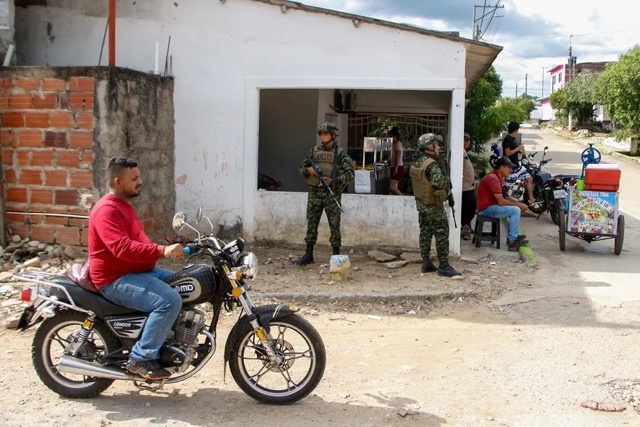
Archive photograph of soldiers of the Colombian Army before a day of peace talks between the Government and the Estado Mayor Central, the main dissident faction of the FARC, in Tibú (Colombia) / EFE / Mario Caicedo

14ymedio bigger14ymedio, Madrid, 27 January 2025 — There are 60 to 80 dead and about 50,000 displaced in 11 days, after clashes in the Catatumbo between the National Liberation Army (ELN) and the 33rd Front of the dissidents of the Revolutionary Forces of Colombia (FARC), according to estimates of the Ombudsman’s Office and the Government of Norte de Santander. However, the situation in that territory is such that the authorities have only been able to collect the bodies of 41 victims, since they cannot access certain areas.

As a report published a few days ago by Bloomberg explains, the Catatumbo mountains “are so dangerous that the police and the army do not usually go far away from their barracks for fear of snipers.” The reason for this peak of violence, the most intense of the last decade, lies in the offensive launched by the ELN against its rival group to take control of the cocaine business, from which both are financed. In the border area, not only does smuggling to Venezuela take place, but there are also laboratories and clandestine airstrips.

The ELN are proponents of Marxist ideology who emerged in the 1960s with open sponsorship by the Cuban regime, which provided them with training and weapons for decades, before recently becoming a “guarantor” of the peace negotiations, currently suspended. In recent days, the ELN has been spreading terror by going door to door “with death lists of local peasants suspected of supporting their enemies,” according to Bloomberg. continue reading

Among the fatalities are six former FARC guerrillas who signed the peace agreement with the Government

Among the fatalities are six former FARC guerrillas who signed the peace agreement with the Government. In addition, 12 other former FARC members are missing, accused by the ELN of belonging to the 33rd Front, a dissident FARC faction that has not laid down its arms and is fighting for control of the coca crops and drug trafficking routes.

In a statement issued on Monday, the ELN assures that it has not carried out actions against the civilian population or people just for “being signatories of peace,” but that it has attacked those who are armed and are “active under a military command in plans against the ELN and the communities of Catatumbo.”

It also said that “we will never accept either submission or surrender as a policy of peace.” Colombian President Gustavo Petro suspended peace talks due to the violence unleashed by the ELN after January 16 and decreed, on Friday, a state of internal disturbance. This will last 90 days and will extend to 16 municipalities in the department of Norte de Santander, including the 11 of Catatumbo affected by the violence. The decree includes Cúcuta, the departmental capital, and two municipalities in the department of Cesar, which is receiving displaced people.

The Government considers that “there is an extraordinary disturbance of public order in the Catatumbo region, resulting from armed confrontations, threats, massive forced displacements, effects on the exercise of the fundamental rights of the civilian population, alteration of security and damage to protected property and the environment.”

Petro’s claim to achieve “total peace” through dialogue seems to be an illusion

In this context, Petro’s claim to achieve “total peace” through dialogue seems to be an illusion Moreover, it could favor the conservative candidates for the Presidency and Congress in 2026, according to what analyst Sergio Guzmán told Bloomberg. “The worsening of security throughout the country and the extension of criminal gangs to areas that were previously peaceful have made many Colombians impatient with attempts to negotiate with groups that extort, kidnap and traffic cocaine,” the agency said.

According to UN data, the potential production of pure cocaine in Colombia rose by 53% between 2022 and 2023, and the hectares of coca leaf planted in its territory reached the historic record of 253,000. Ceasing to fumigate crops – the Colombian government considered drug trafficking a source of financing for guerrilla groups – was, in 2016, one of the conditions of the FARC to sit down to negotiate with the Government, under the argument – supported by the World Health Organization – that fumigation harmed legal farmers and caused serious health problems to the poorest population.

One of the consequences of the peace agreement was the overproduction of cocaine that has flooded the market ever since, and control of the trade is still disputed by guerrilla groups that have not laid down their arms.

The Colombian Prosecutor’s Office reactivated, last week, the arrest warrants for 31 members of the ELN, including the members of its leadership, alias Antonio García, Pablo Beltrán and Aureliano Carbonell, who had been peace negotiators. Guerrilla leaders have been traveling for years between Venezuela and Cuba, the country that hosted those dialogues between 2018 and 2019, the year in which they were frozen.

The potential production of pure cocaine in Colombia rose by 53% between 2022 and 2023

The relationship between Havana and the leadership of the ELN is, in fact, at the origin of the inclusion of Cuba on the US list of countries sponsoring terrorism in 2021, during the first Trump Administration. It was at the request of Colombia, because Cuba refused to extradite members of the group who were on the Island. The talks had stalled after a guerrilla attack against the Police School in Bogotá in January 2019, where 23 people died and 100 were injured.

None of this – neither the causes of the bloodbath in the Catatumbo nor the role of the regime in the negotiations with the guerrillas – has been echoed by the official Cuban press, which has limited itself to giving news of the displaced people and extolling the “solidarity of Venezuela with Colombia.”

For his part, Petro was confident on Monday that his government can consolidate control on the border with Venezuela. “Today there will be a meeting of the entire cabinet in the area to issue the decrees of internal disturbance that will give life to the social pact in the Catatumbo and the financing of the military operation to consolidate State control at the border,” he said on X.

The Colombian president will hold his usual weekly council of ministers meeting in the municipality of Ocaña, which, like the Catatumbo, is located in the department of Norte de Santander and is one of the main recipients of the more than 48,000 displaced people left by guerrilla violence. Specifically, 9,272, according to figures from the Ministry of Defense. The rest of the displaced went to Cúcuta (21,300) and Tibú (13,313).

Translated by Regina Anavy

____________

COLLABORATE WITH OUR WORK: The 14ymedio team is committed to practicing serious journalism that reflects Cuba’s reality in all its depth. Thank you for joining us on this long journey. We invite you to continue supporting us by becoming a member of 14ymedio now. Together we can continue transforming journalism in Cuba.

“If Their Intention Is To Threaten Me With Going Back to Prison, They’re Wasting Their Time”

  • Cuban opponent José Daniel Ferrer refused to appear in court after receiving an official summons
  • The US representative in Havana, Mike Hammer, visited the family of political prisoner Sissi Abascal
Other released prisoners like Ferrer have also been cited / José Daniel Ferrer / Facebook

14ymedio bigger14ymedio, Havana, 28 January 2025 — Cuban opponent José Daniel Ferrer, released on January 16 after spending three and a half years in prison, refused to appear before a judge in Santiago de Cuba on Tuesday, after receiving a summons. “You don’t have to be a fortune teller to know that this is a threat to return me to prison if I do not stop my political and social activism in favor of freedom,” he said in an audio. Ferrer is also the leader of the Patriotic Union of Cuba (Unpacu), which has its headquarters in his house, where two policemen arrived to deliver the summons.

Ferrer did not take long to display the piece of paper on social networks along with a text that said: “I’m not going anywhere. If their intention is to threaten me with going back to prison, they’re wasting their time.” Then he sent out an audio message that reached 14ymedio: “Save those threats. I am not going to appear before any execution judge, I have never committed any crime, and the many times I have been imprisoned is for defending human rights.”

The opponent added: “If they are going to return me to prison, to those dens of evil and terror, where political prisoners die, where common prisoners die, where conditions for the criminal population in general are very similar to a concentration camp, they must keep in mind that for the well-being and freedom of my nation I am willing not only to go to prison, but also to give my life.” continue reading

The summons to appear in court did not arrive just at Ferrer’s house. “Today all the political prisoners released from Villa Clara were summoned to the courts of the respective municipalities where they reside, to begin the harassment, blackmail and repression,” journalist and former political prisoner Carlos Michael Morales denounced on X.

The Council for the Democratic Transition in Cuba, of which he is also president, stood in solidarity with the leader of Unpacu

The Council for the Democratic Transition in Cuba, of which he is also president, stood in solidarity with the leader of Unpacu. It published a video of the opponent Manuel Cuesta Morúa warning about the regime’s harassment of Ferrer. “You want to commit an injustice against a person who should have been liberated, not just released from prison,” he said.

Ferrer’s post on social networks was also shared by the US Office of Western Hemisphere Affairs, which said that “the Cuban dictatorship is again attacking and persecuting the brave pro-democratic leader” after “the regime made a deal with the Catholic Church to ’free’ political prisoners.”

“We will not be fooled by their games or participate in them. The illegitimate regime is directly responsible for its treatment of Ferrer and all the political prisoners that it continues to detain unfairly,” the Office added in its publication, which was replicated shortly after by the US Embassy on the Island.

Mike Hammer, the new US representative in Havana, has held meetings in recent days with relatives of Cuban political prisoners and activists, such as the academic Alina Bárbara López.

Annia Zamora, Sissi Abascal’s mother, arrested for demonstrating during the protests of 11 July 2021, also received the representative in her home. In conversation with 14ymedio, Zamora said that Hammer’s visit was “very pleasant. Everything flowed very well. He is very interested in knowing the situation of our prisoners and about my daughter. The family is very grateful for his concern, his interest and for visiting us,” she said.

She also explained that the meeting helped Abascal’s family to feel that they are not alone and that there are “people fighting for our prisoners.”

Since the prison authorities communicated this to Abascal last week, her mother has not heard more news

Both Sissi Abascal and Sayli Navarro, who is also a Lady in White and daughter of the opponent Félix Navarro, were two of the names expected to be on the regime’s list of released prisoners. Far from it, the regime has been cruel to them, forcing them to adhere to a “severe regime” and denying them even the prison benefits to which they are entitled because of their “negative attitude.”

Since the prison authorities communicated this to Abascal last week, her mother has not heard more news. “I haven’t known anything about Sissi since Thursday. On Monday she was allowed a call, but there was a blackout and it was impossible for her to communicate with us,” says Zamora, who clarifies that “Sissi was denied the 120 days of reduction [in sentence] that they do every year. They told her that in 2024 she didn’t have a single day of reduction, it was zero.”

Regarding Navarro, the woman explains that she was denied a less severe regime for another six months, when she will be evaluated again. “Sissi had already been denied in September,” she adds. In a previous interview with this newspaper, Zamora explained that this is the fourth time that the prison authorities have rejected the transition to a less severe regime. “The situation of my daughter and all the political prisoners is worrying. The repression against them is very strong,” she said at the time.

According to Zamora, the conditions in which both opponents find themselves in the La Bellotex prison, in Matanzas, continue to worsen. “They are given water only at night. There is little food, poorly prepared,” she says, and adds: “When Sissi and Sayli call they have a high-ranking officer monitoring them.”

Translated by Regina Anavy

____________

COLLABORATE WITH OUR WORK: The 14ymedio team is committed to practicing serious journalism that reflects Cuba’s reality in all its depth. Thank you for joining us on this long journey. We invite you to continue supporting us by becoming a member of 14ymedio now. Together we can continue transforming journalism in Cuba.

‘Granma’ Denounces the “Unscrupulous People” Who Steal Solar Panels Throughout Cuba

Thieves steal the cables and pumps from the water supply panels

The crimes occur in isolated communities / Granma

14ymedio bigger14ymedio, Havana, 26 January 2025– So much enthusiasm over the installation of photovoltaic parks, which the press mentions as the solution to all the energy ills of the Island, has made the Cuban authorities look for a pretext to wash their hands of the project if it fails, like so many other projects have. The thefts of panels and electrical components that, according to the government, destroy photovoltaic parks, have become the perfect excuse.

The main objective is the solar panels that guarantee the supply of water in “isolated communities of the nation” and the perpetrators are “unscrupulous people who steal electrical installations and even solar panels, in order to obtain certain economic gains, without stopping to think about the damage they cause to the residents of those sites,” reports Granma, the official organ of the Communist Party.

The State newspaper adds that, just in Holguín, “at least three pumping systems have been affected by robberies. One occurred in the town of Pedernales, near the city of Holguín, where solar panels were stolen on two occasions.” continue reading

The authorities have concluded that “the rate of acts against the equipment of photovoltaic pumping installations has been increasing” 

The “inquiries” of the authorities have concluded that “the rate of acts against the equipment of photovoltaic pumping facilities has been increasing. These are technologies that are not in large parks, but in isolated places, in the vicinity of communities, which makes them vulnerable to harassment by unscrupulous people, who try to profit from collective goods,” said Alexander Valdespino, president of Cubasolar, which promotes the use of renewable energies.

The company is especially involved because it is their equipment – donated or financed many times by foreign governments and entities – that ends up in the hands of thieves. The managers no longer know what to do about the criminals, and the list of robberies continues to grow, Valdespino claims.

“In Manantialito, belonging to the community of Rejondones de Báguanos, they installed one of those pumping systems, but after a while, they stole the cables,” says Granma quoting the manager. The same happened in Tacámara Cuatro, where the thieves took “two pumps and the cables,” and in Playa Girón, where they looted a pump and “other components.”

In Desembarco del Granma, in Banes, the thugs were not so lucky: “They were close to taking the pump, but when they were detected, they withdrew in a hurry with the cables,” said the media, which attributed to the thieves the failure of the “extraordinary effort made by Cuba to improve the quality of life of the population.”

In recent years Cuba has installed dozens of solar parks financed by China, Russia and the European Union

In recent years, Cuba has installed dozens of solar parks financed by China, Russia, the European Union and even international institutions such as the United Nations. During that time, the propaganda about the benefits of the use of clean energy has not stopped in the official press, which forgets that despite the installation of the equipment, the Island has been reporting an energy deficit of around 1,000 megawatts per day for months.

However, the thefts that have occurred reveal that Cubans have an interest in the panels that is far from the wishes of the Government, and it is not the first time that Granma has tried to defend the Government by alleging “crimes.” In December, the newspaper published information that revealed that the panels installed four months earlier to supply energy to a multitude of pumping stations in Las Tunas had already suffered “eight criminal acts, specifically theft.”

A few days earlier, a fire in the Alcalde Mayor solar park in Abreus alarmed the Cienfuegos Electric Company. The fire originated in an area where some solar panels were stacked, waiting to be installed, but “no other equipment was affected,” Granma reported at the time.

Translated by Regina Anavy

____________

COLLABORATE WITH OUR WORK: The 14ymedio team is committed to practicing serious journalism that reflects Cuba’s reality in all its depth. Thank you for joining us on this long journey. We invite you to continue supporting us by becoming a member of 14ymedio now. Together we can continue transforming journalism in Cuba.

Useful Idiots

It is sad, but also evident, that 66 years later there are plenty of idiots who continue to yearn for the regime’s scraps.

To clarify, I’m not talking about the nostalgia for Cuba felt by Cubans, an open wound for many of us. I am writing about the people who defend the sinister Cuban government / 14ymedio

14ymedio bigger14ymedio, Pedro Corzo, Miami, 26 January 2025 — Many years ago, at the dawn of Castro’s tyranny, people in Cuba often heard about those described as “useful fools” or “fellow travelers,” for defending Marxist proposals and their spokespersons, without being part of that horde that has done so much damage to humanity.

I met several of those people, including family members, men and women of good faith who believed all the stories of Castroism for a period of time and then joined the armed struggle against the regime. There were also those who, without any good faith, lent themselves to the dictatorship’s game until they feared being burned themselves and decided to emigrate.

Some of these, despite being abroad, never stopped serving Castroism, either by spying for it or by simply white-washing the face of the regime and organizing, in other countries, particularly from the United States and Puerto Rico, trips and conferences to Cuba. continue reading

Others created institutions with the aim of making totalitarianism palatable to foreigners willing to fulfill the role of useful idiots in favor of Castroism, a function in which the intelligence and diplomatic services of Cuba have played an important role by providing resources to those who have served them from abroad.

There were also those who, without any good faith, lent themselves to the dictatorship’s game until they feared being burned themselves and decided to emigrate

Castroism, to expand that influence, founded the Institute of Friendship with the Peoples (ICAP), an entity that is dedicated to attracting politicians, social leaders, intellectuals and anyone who, as a result of their frustration, is willing to serve in hell. The ICAP and La Casa de Las Americas (House of the Americas) were instruments that provided great services to the Cuban dictatorship, because they could cover up its subversion and its spying.

The Castro leadership quickly realized that it wasn’t only Cubans who supported dysfunctional and tyrannical governments. They became aware that, in all countries, including the most advanced in law, there are useful idiots and fellow travelers ready to serve them over the years.

A few weeks ago, my friend Luis Rolle, a retired captain of the United States Army, told me that he was convinced that the Biden Government was preparing to take measures in favor of the Cuban regime. I listened to his comment very carefully, so it was not surprising that Cuban totalitarianism, an eternal threat to the security of the United States, was once again favored by those who some consider the continuation of Barack Hussein Obama’s policy towards Cuba.

It is incomprehensible that those who promote policies favorable to regimes of force, despite the accumulation of failures of those autocracies, still enjoy public favor and can continue to provide violators of civil rights with coverage that favors them, which, at the least, makes them “fellow travelers.”

The Castro leadership quickly realized that it wasn’t only Cubans who supported dysfunctional and tyrannical governments

Unfortunately, we find many personalities who enjoy being fellow travelers of autocrats. We see them in the entertainment industry, academia, powerful corporations and in US politics, as demonstrated by the exclusion of the Cuban regime from the list of terrorist states, fortunately reinstated with that designation by President Donald Trump the same day he assumed the leadership of the country.

It is painful, but also evident, that 66 years later there are plenty of idiots who, despite having abandoned Cuba, continue to long for scraps from the regime, letting themselves be manipulated in different ways by the Castro authorities, always ready to fish in their troubled waters in order to make money, even if it is stained with the blood of their compatriots.

Let me clarify, I’m not talking about the nostalgia for Cuba felt by Cubans, an open wound for many of us. I am writing about people who, despite having made the decision to leave their country, defend the leaders of the nefarious Government that forced them to leave. I suggest that both terms, “useful fools and fellow travelers,” be summarized in “useful idiots,” because after so much devastation, we should be more categorical in these qualifications, which show that thousands of years of evolution do not prevent some human beings from still having the genes of rats.

Translated by Regina Anavy

____________

COLLABORATE WITH OUR WORK: The 14ymedio team is committed to practicing serious journalism that reflects Cuba’s reality in all its depth. Thank you for joining us on this long journey. We invite you to continue supporting us by becoming a member of 14ymedio now. Together we can continue transforming journalism in Cuba.

Migrants in Mexico Search for a Plan B Now That Humanitarian Parole Has Been Cancelled

Migrants remain stranded in the border town of El Chaparral, in Tijuana / EFE

14ymedio bigger14ymedio, Sergio Castro Bibriesca, Mexico City, 21 January 2025 — “It was heartbreaking to hear that he fulfilled the threat,” says Gabriela Hernández, director of Casa Tochan, a shelter for migrants in Mexico City, about the cancellation this Monday of the CBP One mobile application, which allowed migrants of any nationality to enter the United States through Mexican “ports of entry.” In that same executive order, President Donald Trump cancelled the Humanitarian Parole Program, which allowed the arrival in the United States of 531,690 immigrants, including 110,240 Cubans in two years.

The cancellation disrupts the plans of thousands of applicants, who have been stranded in different Mexican states, mainly at border points, waiting for a new plan to continue their journey. For the migrants in Mexico City, “the first thing they had to do was cancel their flights to the border. They had planned to leave this week for their appointments,” says Hernández.

For the migrants in Mexico City, the first thing they had to do was cancel their flights

However, the hardest thing for those who hoped to enter US territory legally is to see their life plan change in the blink of an eye. “We tell the kids to stay calm. They lost a battle, but not the war. There were tears. It’s very sad to see a child cry, but it was more shocking to see adult men cry. You cry and then move on,” adds the director of the shelter, which has space for only 50 people but today serves more than 150, because, “thanks to the solidarity of many people,” they managed to rent three nearby apartments to accommodate more migrants. continue reading

This scene is replicated in the north, in Tijuana, on the border with San Diego: the shelters are full. There are 3,500 people stranded who would have requested the CBP One, and 10% already had an appointment to apply for asylum in the United States. This was reported on Monday by José Luis Pérez Canchola, who was head of the Municipal Directorate of Migrant Attention until Tuesday morning. He was dismissed, he said, for demanding effective coordination of the three levels of government (federal, state and municipal) to address the migration crisis.

At the international crossing of El Chaparral, about 200 migrants who already had an appointment were transferred to a shelter, although this Tuesday some returned to the crossing with more hope than certainty. Aylin, a Venezuelan migrant, tells 14ymedio that the announcement took her by surprise. “We didn’t think that by the time we got here the appointments would be eliminated.” When she arrived at the Tijuana airport, the authorities asked her to show that she had an appointment. “They saw the application and it was working, but by the time we got here the appointments had already been cancelled.”

“They saw the application and it was working, but by the time we got here the appointments had already been canceled”

She arrived in Mexico from Maracaibo, on a trip that was quite an odyssey. First she went through Colombia. From there she left with a coyote and crossed the Darién jungle with her five-year-old daughter. After five days she reached Central America, but when she arrived in Guatemala, the authorities took all her money. Then she went to the Mexican border city of Tapachula and walked north with a caravan.

In Chiapas, the news fell like a bucket of cold water, although the migrants who remained in the area knew that the cancellation of the application was inevitable once Trump came to power. “We had been giving up CBP One for dead for weeks, but we were hoping that they would keep the appointments of those who were already registered since last year,” says Emilio, a 48-year-old Cuban from Alquízar, in Artemisa.

On Monday, the Mexican authorities alerted the migrants in Tapachula about the end of the program. According to the EFE agency, a federal agent announced with a megaphone that they would only attend to those who had appointments until January 30.

On Monday, the Mexican authorities alerted the migrants in Tapachula about the end of the program

“As you know, as of today (Monday) we still do not have enough reliable and truthful information to be able to attend to future dates. If the program continues, you will be informed through the National Institute of Migration,” explained the official.

For Emilio, the cancellation of that migratory path opens the door to new questions, but he recognizes that “something will come out of this. What we are clear about is that there is no return to Cuba.”

Although he is the only one in his family who undertook the migratory route through Central America to Tapachula, in the Mexican town he has woven new bonds of friendship and collaboration. “There are eight of us who watch each other’s backs and help each other, and we have rented an apartment together,” he explains.

Emilio has been in Mexico for more than a year and has found a job as a welder, an occupation he learned in a Cuban company where he worked for a couple of years. “In Alquízar, the welding gave me some pesos and was my main source of income,” he recalls. Now his skills as a welder in a vehicle workshop allow him to “pay the rent, build a pigsty, and eat and send something to my family,” who suffered great damage to their home with the passage of Hurricane Rafael last November. “There is no more life there. I can’t go back, not even to take a break,” he says.

“I think this will improve things for those of us in Mexico. Maybe they will give us credit “

Despite the cancellation of the CBP One, through which he had an appointment for the end of January, Emilio is hopeful. “I think this will improve things for those of us in Mexico. Maybe they will give us credit to start our own business, facilities to settle here and some financial aid to bring part of our family,” he speculates.

The end of the CBP One application has left about 270,000 people stranded, according to an estimate by the American network CBS.

Launched by the Joe Biden Government, the application started working in January 2023 and has helped more than 930,000 people to submit their cases.

Mexico faces two complex scenarios. On one hand, there are the thousands who have remained at the borders, many of them without resources, and on the other, there will also be those who will be deported by the new Trump Administration. On Tuesday, Mexican President Claudia Sheinbaum promised, at a press conference, that Mexico will provide “humanitarian care” to migrants from other countries, although we will seek to return them to their places of origin.”

“If possible, repatriation to their countries will be sought and, if not, reintegration into Mexico”

“If possible, repatriation to their countries will be sought and, if not, reintegration into Mexico, but there are fewer cases,” she said. “If these people are on Mexican territory, we will take care of them for humanitarian reasons, but being foreigners, we will seek their return, within the framework of our migration policy,” she stressed.

At the press conference, Sheinbaum was asked who would pay for those trips. To this question the president replied: “That’s what we’re going to talk about with the United States Government.”

Regarding the support for the population to stay in Mexico, the president, however, did not give further details. In this regard, the director of Casa Tochan questioned that there was talk of support for migrants, because there is a lack of resources, “especially when sometimes the Government itself does not even give a letter to asylum seekers because there is no paper.”

Translated by Regina Anavy

____________

COLLABORATE WITH OUR WORK: The 14ymedio team is committed to practicing serious journalism that reflects Cuba’s reality in all its depth. Thank you for joining us on this long journey. We invite you to continue supporting us by becoming a member of 14ymedio now. Together we can continue transforming journalism in Cuba.

Cuban Yaquelin Domínguez-Nieves Pleads Guilty to the Death of 16 Rafters in 2022

The US Coast Guard rescues an overcrowded boat near Cayo Rodríguez /(EFE/USCG Southeast)

14ymedio bigger14ymedio, Havana, 24 January 2025 — A Cuban woman, Domínguez-Nieves, pled guilty to the crime of “conspiring to smuggle immigrants” to the United States. The woman, living in Sebring, Florida, will be sentenced in the federal court of Miami on April 11, where she could receive five years to life in a federal prison, according to the WPLG Local 10 station.

Domínguez-Nieves, 26, was arrested in 2024 and accused of causing the death in 2022 of at least 16 rafters; four bodies were recovered on the high seas. There were 10 charges against her related to illegal immigration, detailed by the Key West Coast Guard, the U.S. Border Patrol, the Monroe County Medical Office of the Coroner and the Highlands County Sheriff’s Office.

The US authorities specified that Domínguez-Nieves charged the families of the victims 11,500 dollars and promised to bring them from Cuba to the United States. According to the investigations, the accused sent the money to an unidentified accomplice in Havana, who was in charge of organizing the trip.

US authorities specified that Domínguez-Nieves charged the families of the victims 11,500 dollars and promised to bring them from Cuba to the United States

On November 16, 2022, the boat sank 30 miles from Cuba. In the reconstruction of the facts, it was confirmed that 18 migrants were crossing in the fishing boat, which had a capacity of eight people. In addition, according to a survivor, “many of the victims were children between 9 months and 7 years of age and two 16-year-olds.” continue reading

The autopsies performed on the four recovered bodies determined that the cause of their death was “drowning.” Arturo Verdecia, father of one of the rafters, told Telemundo last June that Domínguez-Nieves asked him for “6,000 dollars to contribute to the fuel.”

Verdecia said that his son boarded the boat named El Alba and set sail from Playa Jaimanitas, but “not with six people, as he had been told.” Three days after the shipwreck, investigators told him they had found his son’s body.

In his story he identified the survivor as Alexander Piloto, who was rescued by a second boat. According to the Coast Guard, the survivors reported having seen four people “drown immediately.”

The lifeless bodies were transferred to the Monroe County medical examiner’s office in the Florida keys. Another five bodies were later found by the U.S. Coast Guard. The survivor, Alexander Piloto, was returned to Cuba.

Translated by Regina Anavy

____________

COLLABORATE WITH OUR WORK: The 14ymedio team is committed to practicing serious journalism that reflects Cuba’s reality in all its depth. Thank you for joining us on this long journey. We invite you to continue supporting us by becoming a member of 14ymedio now. Together we can continue transforming journalism in Cuba.

Another Building Collapse, This Time of the Exterior of the Dilapidated Higher Institute of Design in Havana

Much of the exterior wall of the building, in Centro Habana, collapsed towards San Carlos Street

Partial collapse of the ISDi, this Friday in Havana / Facebook / Yosvelito Danielito

14ymedio bigger14ymedio, Havana, 24 January 2025 — The building of the Higher Institute of Design (ISDi) in Central Havana suffered another collapse this Friday, this time of the exterior. The news was posted on Facebook by Yosvelito Danielito, a neighbor, who published images of the accident, which occurred shortly after two in the afternoon. Subsequently, it was picked up by the official journalist Lázaro Manuel Alonso.

Although “no victims are reported,” Alonso says that “a 78-year-old lady” had to be evacuated. In addition, he specified that four families do not have access to their homes after the collapse. “Construction companies are working on site to remove approximately 800 cubic meters of debris,” he posted.

In the images shared on social networks, much of the exterior wall of the building can be seen falling toward San Carlos Street, in addition to Belascoaín, Maloja and Enrique Barnet Streets. That road had been closed to vehicles for some time precisely because of the bad state of the ISDi, not only interrupting the traffic but also affecting the families, who had to walk through a narrow passage to get to the sidewalk.

Likewise, in videos shared on social networks, one can see how the debris expands to the building across the street, so that its residents now cannot leave their homes.

This collapse is added to others that the building had already suffered before, in the back area and inside. The latter happened last July. Then, with a few days to go to finish the ISDi classes, the authorities suspended them and informed that from now on they would be given at a distance. continue reading

Since mid-2022, an area of the center’s headquarters was propped up and closed, but this Tuesday it couldn’t take it anymore. Access to the building was prohibited “until further notice.”

In March 2022, the institution explained in a statement the problems that existed with the headquarters. “The property has a complicated architectural fault. Teaching activities have been developed in other spaces of the UH (University of Havana) momentarily. The training of Cuban designers has not stopped,” he said.

“Uncertainty is overshadowing trust. The Revolution founded the universities and always stood by them. The country’s management maintains its commitment and recognition for our ISDi, the design school in Cuba that gives and contributes so much. We must fight and trust. The lack of a physical place should not overshadow our creative will,” said the statement issued then, in which it was announced that classrooms would reopen in “solidarity spaces of different faculties of the University of Havana.”

Among the comments to that announcement stood out the extensive text left by the architect Lourdes Martí, who was, together with Iván Espín, the creator of the ISDi and its rector until mid-1989. In it, he told how the center was founded in a house in Miramar and a year later, in 1985, he moved to the current building, in Belascoaín between Estrella and Maloja. “A remodeling was started in the area where the workshops would be located on the first floor, and a general repair. Although it was not really in such bad condition, its completion took a long time,” he said, while regretting the lack of interest of the authorities.

“What happened during those last 33 years? Was it never been maintained again? What architectural flaw is there that does not allow the recovery of the building or part of the building? Do you want to destroy the building and eliminate the training of Industrial and Information Designers? Are we witnessing the end of the country’s industrial development?” he asked.

A user then thanked the school’s clarification with a simple: “Thank you, maybe it will end up as a hotel.” The ISDi itself responded by stating that they were trying to “recover that great building,” but the truth is that, according to the students, only a few areas were open, and they were prohibited from entering most of them.

The area where the building is located, far from the historic center of the Cuban capital, which has more tourists, and the modern neighborhood of El Vedado, with hotels and ministries, is suffering a profound process of deterioration in its buildings. Decades of lack of maintenance and erosion, a product of the proximity of the sea, hurricanes and overcrowding, have turned that area into a sequence of broken balconies, cracked columns and collapsed old buildings. Walking through the neighborhood has become a danger for pedestrians.

Translated by Regina Anavy

____________

COLLABORATE WITH OUR WORK: The 14ymedio team is committed to practicing serious journalism that reflects Cuba’s reality in all its depth. Thank you for joining us on this long journey. We invite you to continue supporting us by becoming a member of 14ymedio now. Together we can continue transforming journalism in Cuba.

Cuban Police Profiles on Social Networks Warn of the Increase in Arrests for Trafficking the ‘Chemical’

The Prosecutor’s Office asked for a 20-year prison sentence for a citizen convicted of selling marijuana, synthetic cannabinoid and hashish / Tribuna de La Habana

14ymedio bigger14ymedio, Havana, 24 January 2025 — “Tolerance for you? No.” These were the words of Cazador Cazado [Hunter Hunted], a profile related to the Ministry of the Interior, in the site’s report on the arrest of a man who carried “85 cigarettes with a type of químico [chemical].” The arrest, reported last Wednesday, occurred on Tuesday night, in the town of Pueblo Nuevo, in Holguín.

According to the report – which did not spare morals and scolding – Osmany González Medel “was traveling without remorse on public roads” when he was intercepted by patrolmen. This is the only thing that the profile, which has no qualms about publishing photos and identities, was willing to reveal about the case.

It added that the police are involved in “a constant battle against the trafficking of illicit substances” and that “preventing this type of behavior from proliferating is everyone’s task.” They also recognize that there is an “escalation” of concern about drug trafficking on the Island.

It was reported that two women were arrested in Havana and accused of selling drugs

On January 17, it was reported that two women were arrested in Havana accused of selling drugs in the town of Punta Brava, in the municipality of La Lisa. The official journalist Frank Enrique reported in a post – headlined “zero tolerance for drugs” – that the arrest was made possible by an operation carried out two days earlier.

In his message, the journalist offered more details: “They had more than 20 pieces of paper with the químico and methamphetamine, as well as a lot of money for these women, who do not work and were dedicated to enriching themselves through drug contamination among adolescents.” continue reading

Another example was given last December in Tribuna de La Habana, in a text entitled “Zero Impunity.” A drug trial against Osleyvis Alexey Tejeda González showed no tolerance. In the oral hearing, whose date was not specified, the Prosecutor’s Office asked for a 20-year prison sentence for selling marijuana, synthetic cannabinoid and hashish.

According to the media, the man was carrying “a capsule” with 24 marijuana cigarettes 

According to the media, the man was carrying “a capsule” with 24 marijuana cigarettes and 0.20 grams of ADB-Butinaca, a synthetic cannabinoid that – although the report does not say this – is the basis for the químico/chemical, a drug that has gained notoriety in Cuba due to its low price and its growing consumption among young people.

“The químico first gives them a lot of euphoria; they become hyperactive and even dangerous. Then comes a phase in which they are still, like stones,” Moraima, a 67-year-old woman, a resident of the neighborhood of La Rosita in Havana, told this newspaper.

The composition of the most popular drug on the streets of the capital can vary significantly, but the basis is synthetic marijuana mixed with drugs, something intended for the treatment of epilepsy, and some tranquilizer or any anesthetic. A dose can cost between 300 and 500 pesos, depending on the concentration and quality of its ingredients.

Drug trafficking is a topic in vogue and affects Cubans more and more. The officials can no longer hide it, and the official press attests to it. In Las Tunas, for example, the Ist Provincial Addictions Workshop was held this Thursday. In the forum, several specialists pointed out that the main substances consumed in the country are the chemical, marijuana, cocaine and some medicines.

One of the biggest challenges they face from the medical side – they pointed out – is in prevention. “Any approach to drugs and abuse is insufficient, because patients have lost the notion of danger.”

Another issue is awareness of the consequences of consumption, such as schizophrenic disorders and geno-embryotoxic effects

Another issue is awareness of the consequences of consumption, such as schizophrenic disorders, geno-embryotoxic effects during fertile ages, neurological alterations of the baby, ectopic pregnancies and neurodegenerative diseases.

According to Dr. Alejandro García Galcerán, director of the Mental Health Center of Centro Habana, in an article published by the official newspaper Granma last April, there is a “high rate of young women and pregnant women who consume drugs.”

In the interview, he added that “the use of substances is becoming, to some extent, a lifestyle in population groups. What is happening is that you start consuming earlier and earlier. The first experiences are between 13 and 14 years old; from 17 and 20 they can become addicted, and at 25 years there is an increase.” He also remarked that adolescents and young people represent “the most vulnerable group.”

Translated by Regina Anavy

____________

COLLABORATE WITH OUR WORK: The 14ymedio team is committed to practicing serious journalism that reflects Cuba’s reality in all its depth. Thank you for joining us on this long journey. We invite you to continue supporting us by becoming a member of 14ymedio now. Together we can continue transforming journalism in Cuba.

Etecsa Will Start Charging for Some Services in Dollars Inside Cuba

The state communications monopoly has millions of pesos in cash but needs foreign currency to modernize

Etecsa has been fined for not using its whole 2024 budget of Cuban pesos

14ymedio bigger14ymedio, Natalia López Moya, Havana, 14 January 2025 — The Cuban Telecommunications Company (Etecsa) is trapped in a paradox. While it lacks foreign currency to invest in its deteriorated infrastructure, the monopoly has been fined for not using its entire budget in Cuban pesos allocated by the State for 2024. The national currency abounds in its coffers but is not good for buying antennas, cables or fuel.

“We were fined because last year’s accounting showed we had millions of unspent pesos,” Moisés, an Etecsa administrative officer at its headquarters in Old Havana, with his name changed for this report, told 14ymedio. “The problem is that there was no way to use them, because you can’t buy anything with pesos that you need to make repairs or new installations.”

Etecsa’s accounting department had already warned management that “there was a surplus with no time to spend it before the end of December,” the worker adds. “But there was no way to do anything with those millions of pesos, because no foreign company based in Cuba wants to accept them to buy equipment or pay for services. It’s money that is very difficult to get rid of.”

“The way they got rid of that money was to distribute it, as profit, among some of the employees”

“So we were fined, and the managers had to come up with something,” says Jorge. “The way they got rid of that money was to distribute it, as profit, among some of the employees. In other words, they spent the national currency not on investments but as wage incentives.” To prevent the scenario from being repeated this year, Etecsa is preparing new payment methods for its services to collect as much hard currency as it can. continue reading

“Several scenarios have been evaluated, and so far the one that seems the best is to limit the number of recharges in national currency for the same customer. When he gets down to a certain monthly amount, he will have to recharge in dollars,” clarifies the administrator. “Together with the recharges from abroad, the purchase in Cuba will be enabled, directly in dollars or with a Classic card.”

“What happens now is that mobile phone customers sometimes have thousands of pesos left and can buy as many navigation packages as they want. They can even make transfers of that money so that others can buy a connection package. It will remain limited, because there’s not much Etecsa can do with that Cuban money. It’s worthless for investments and purchasing infrastructure.”

“We are just now restructuring everything, and that is one of the reasons why we are removing some monthly offers of recharges with a bonus, because there are many customers whose relatives abroad buy the recharge for them, which includes a balance and a recharge package, but then they resell it to others who pay them in Cuban pesos, and these in turn buy new navigation packages. We even know that many relatives send them dollars, and they change them on the black market and buy the packages in national currency. So Etecsa doesn’t earn foreign exchange and can’t go on like this because this is a telecommunications company and has to earn a lot of money.”

“Etecsa doesn’t earn foreign exchange and can’t go on like this because this is a telecommunications company and has to earn a lot of money”

Etecsa has not updated the exchange rate between foreign exchange and the Cuban peso – as the state exchange houses did almost three years ago – and continues to be governed by the obsolete rate of 1 dollar for 24 pesos. “For example, a standard recharge from the United States costs the emigrant between 20 and 23 dollars, and their relatives in Cuba receive about 500 pesos of fixed balance, plus the bonuses that Etecsa promotes at the time,” he explains.

“But that same amount of money paid in Cuba to a telecommunications agent or in an office is now equivalent to 6,000 pesos, enough to obtain up to 12 packages of 500 pesos each, and they can buy anything from telephone minutes to gigabytes of web browsing. That distortion cannot continue; no telephone company in the world can balance the books with the contradiction between the currency it charges and the one it really needs.”

The sudden increase in money in employee accounts, due to the hasty liquidation of last year’s budget, has not brought much joy to the workers, who have run into a new problem.

“I have to pay much of the money they gave me in personal income taxes,” explains Tatiana, an employee, also from the administrative area of Etecsa, but from the municipality of Playa in Havana. In addition to taxing wages, there is tax on the profits and incentives that state workers receive.

“People are upset because they know that this is not a prize nor something they gave us in recognition of so much sacrifice, but a last-minute trick,” the woman laments. “On the one hand they have given us that money, and on the other the working conditions are getting worse. At this time of year we are saved because temperatures have dropped, but in my office we have to bring our own fan to cool off because the air conditioning cannot be turned on.”

“There are no land lines to replace, we lack the boxes for home installation, and there are also many problems with supplying cables”

Etecsa’s financial limitations are not felt only in the work environment. In October 2022, this newspaper collected the testimonies of several workers who reported the lack of resources to undertake basic repairs in the fixed telephone network or replace the batteries of the telecommunications towers that, most of them obsolete, stop providing service when a power cut affects the area where they are located.

“We are tying pieces of cables together to repair the breaks,” explained José Ángel, a worker of the state monopoly. He said that the company was going through “the worst crisis since its creation.” The list of what was missing was long, and over the years it has continued to grow: “There are no fixed telephone devices to replace, we lack the boxes for home installations, and there are also many problems with the supply of cables. Even our mobility is affected by the lack of fuel.”

Most of the currencies they receive for top-ups from abroad are not invested in telecommunications infrastructure. “About 90% of what Etecsa collects comes out of the company in a large item with an ’undefined’ concept,” another employee linked to the accounting area and who preferred to remain anonymous told 14ymedio. “With the rest of what remains it is very difficult to maintain a quality service because you can hardly make large investments.”

The lack of liquidity has been taking its toll on Etecsa for years, especially with its foreign investors. In 2022, for the first time in 15 years, the company could not fulfill its financial commitment to Nokia, the Finnish company that has worked on the Island implementing the data service for mobile telephony.

For the 2025 budget, the Minister of Finance and Prices, Vladimir Regueiro Ale, has warned that a “special tax on telecommunications services” will be implemented. According to the owner, “this will generate a tax in addition to the invoices from the Cuban Telecommunications Company of more than 13 billion pesos,” a sea of national currency for some dollar-thirsty coffers.

Translated by Regina Anavy

____________

COLLABORATE WITH OUR WORK: The 14ymedio team is committed to practicing serious journalism that reflects Cuba’s reality in all its depth. Thank you for joining us on this long journey. We invite you to continue supporting us by becoming a member of 14ymedio now. Together we can continue transforming journalism in Cuba.

‘It’s a Little Crazy To Think That the Ordinary Cuban Can Buy One of These Cars’

 Mercedes-Benz in Havana sells its own models and many Chinese ones

MCV Comercial, a joint company between the Cuban State and Mercedes-Benz, is not new to the car import business /14ymedio

14ymedio bigger14ymedio, José Lassa, Havana, 10 January 2025 — In black suits and shiny shoes, the agents of MCV Comercial, a vehicle importing company, presented to customers this Thursday their most recent acquisition: seven newly arrived cars on the Island parked at the intersection between Vía Blanca and Vía Monumental, in Havana. Except for the Mercedes-Benz, which the company acquired on its own and which can cost between 50,000 and 60,000 dollars, the vehicles had something in common: they have all had owners for months.

“The Chinese ones we had in the square are already sold. Customer demand is brutal. People have come from Villa Clara, Pinar del Río and other places,” one of the sellers proudly told a customer while listing the brands in stock: the Chinese Foton, SkyWell, Faw Bestune and DFSK, the Korean Kia or, its specialty, the brand new Mercedes. “We are accepting orders, and a second batch is arriving in February,” he said.

MCV Comercial, a joint company between the Cuban State and Mercedes-Benz, is not new to the car import business. For years, the company has been dealing, almost exclusively, with everything that has to do with the German manufacturer, whether they are donations of ambulances, passenger cars or imports authorized by the Government. With the entry into force on January 1 of a decree that facilitates the purchase of vehicles abroad for individuals, the company has opened its horizons. It was one of the nine companies selected to manage the importing of vehicles. continue reading

Customers’ eyes shine while trying the interior of a Bestune T55, “the best seller by far”

Eight days later, MCV organized the showroom where several customers came in to try the interior of a Bestune T55, “the best seller by far.” The price of the vehicle, even if it is Chinese-made, has made it one of the most demanded by wealthy Cubans. Its final value, including the payment of taxes and customs fees, is about 26,846 dollars, although it can go up to 30,000, “a bargain.”

It is enough to take a look at the event to notice that several requirements must be met to negotiate with the company. Exclusivity is, after all, a guarantee of MCV. “The best or nothing,” promises its catalog, and its agents have no qualms about confirming it. “It’s a bit crazy to think that the ordinary Cuban can buy one of these cars,” admitted the sales agent, answering the question of a curious person.

Payment is accepted from abroad through international cards, in addition to the Classic prepaid card, which is recharged with dollars, from Cuba. Cash or prepaid cards such as Bandec and Metropolitano are not accepted.

Despite the Government’s tax cut, vehicles are still impossible for the pockets of employees on the Island, and the difference between those who have the economic power to acquire one and those who cannot even afford to look at them is evident in the event itself. All the visitors wore elegant clothes and arrived by car. MSMEs, traders, relatives of big-shots and, thanks to the new law, Cuban professionals who have completed more than two years of missions abroad, make up the usual clientele of the importers.

“We have a small stock of those Mercedes, about 20 or 25 vehicles of the two models that are there. They cost between 45,000 and 55,000” / 14ymedio

MCV doesn’t worry about whether the products it offers are affordable, because it has plenty of customers with money. “Don’t worry. They are going to call you, and at that moment if you do not want the vehicle or want another one, you can change it,” explains the agent to an annoyed buyer because, of the cars on display, none is free to buy at the moment. “And how long does it take to arrive?” the man asks: “Two to four months. That depends on the shipping companies and the ships, but the car comes with a pin number, identifying that it is yours. Once you sign the contract and pay, even if it takes 140 days, it’s yours,” he said.

“And those?” the buyer inquired, without being satisfied yet. “We have a small stock of those Mercedes, about 20 or 25 vehicles of the two models that are there. They cost between 45,000 and 55,000.”

On the other side of the exhibition, a lady insisted to one of the sellers that she wanted a T55. “Go to the counter and give your details. The sales clerk will write up the contract, and you can specify the color you want and schedule an appointment. The day it arrives you can buy that vehicle and any others you want. Although there is a special tax for those who buy more than three,” he explained.

A man arrives in the parking lot driving a newly acquired Bestune, the same one the woman wants. She doesn’t hesitate to approach him to ask his opinion. The answer is what she expects: the process of buying it is a pain, but “it turns out well. The problem is gasoline. You have to buy the ’special’ fuel in the gas stations, which is hard to find.”

Translated by Regina Anavy
____________

COLLABORATE WITH OUR WORK: The 14ymedio team is committed to practicing serious journalism that reflects Cuba’s reality in all its depth. Thank you for joining us on this long journey. We invite you to continue supporting us by becoming a member of 14ymedio now. Together we can continue transforming journalism in Cuba.