Religious Dissidents Form an Alliance in Cuba for ‘Freedom of Worship’

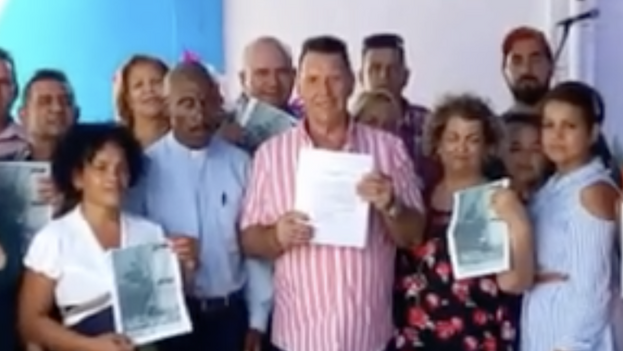
The Alliance of Christians of Cuba was constituted last week, the OCDH reported. (Captura)

14ymedio biggerEFE (via 14ymedio), Havana, 22 November 2022 — About thirty community leaders have formed the Alliance of Christians of Cuba with the aim of “working for freedom of association and worship” and “demanding the immediate release of all political prisoners.”

According to a statement released on Monday by the Cuban Observatory of Human Rights (OCDH), based in Madrid, the alliance was formed last weekend in the east of the Island.

The group, the note added, will also work for “the immediate invalidation of the new Family Code,” a legislative package approved in a referendum last September that provides, among other things, the right to same-sex marriage and adoption. continue reading

The code was already rejected by Catholic groups in Cuba and also by some of the opposition, either because participating in the referendum was a “validation” of the Government or because minority rights were put to a vote.

Similarly, the “alliance has among its purposes to extend pastoral work to all regions of the country,” the text highlighted.

“Our people today suffer the worst difficulties after decades of hardships, years of constant deprivation of their rights and freedoms, and shortages that have corroded society and poison all areas of human work,” the statement said.

Translated by Regina Anavy

____________

COLLABORATE WITH OUR WORKThe 14ymedio team is committed to practicing serious journalism that reflects Cuba’s reality in all its depth. Thank you for joining us on this long journey. We invite you to continue supporting us by becoming a member of 14ymedio now. Together we can continue transforming journalism in Cuba.
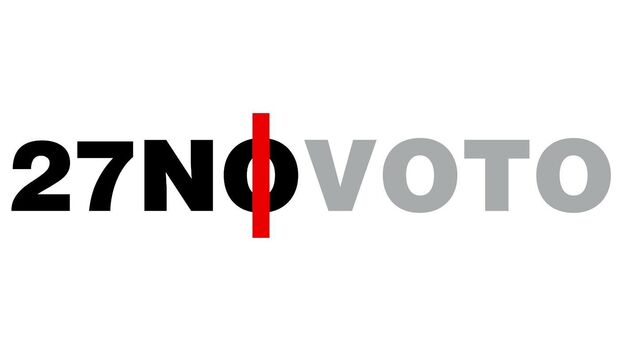
Abstaining in Cuban Elections Means Disagreeing Politically

Campaign for not voting in the next Cuban elections. (Reynier Leyva Novo)

14ymedio bigger14ymedio, Reinaldo Escobar, Havana, November 21, 2022 — Once again, abstention appears as an option to demonstrate political disagreement in Cuba. It already happened in 2019 when the Constitution of the Republic was put to the vote, 15.6% abstained, more recently in the referendum where the Family Code was approved, 25.88% abstained, and it now appears before the elections of the district delegates next Sunday, November 27, where abstention is estimated to exceed 30%. The time when Cubans went to Electoral Colleges to choose their delegates with apparent enthusiasm are long gone.

The numbers are boring and overwhelm the reader, but to understand what will happen on this occasion it is essential to review them.

The approximately eight and a half million registered voters in the country will decide, among 26,746 candidates, who will be the 12,427 district delegates that will make up the 168 Municipal Assemblies of People’s Power.

According to official data, among the candidates there are 18,621 who are affiliated with the Communist Party or the Union of Young Communists, and only 125 who don’t belong to these political organizations. Considering that dissenters with the Government are inclined not to go to the polls, it can be assumed that the militants will have an advantage to fill the positions.

No opponent, not even a declared dissatisfied person, managed or was interested in presenting as a possible candidate in any of the 44,929 area assemblies held and in which, by show of hands, the voters proposed the names of those who will appear on the ballots. A few recorded attempts ended in obstacles to prevent a person from leaving their house or other tricks to make it impossible for the “inconvenient” to participate in these area assemblies, traditionally convened by the Committees for the Defense of the Revolution (CDRs), controlled by the Party and monitored by State Security. continue reading

The next time Cubans with the right to vote will be summoned to the polls will be in 2023, when the renewal of the National Assembly of People’s Power (ANPP) will happen. On that occasion the voters will not be in the situation of electing, but rather of approving, a list of people proposed for deputies that will be presented by the National Candidacy Commission. This list will have the same number of names as there are seats in Parliament.

It remains to be decided how many members the ANPP will have in 2023, but the Electoral Law establishes that at least half of them will come from the members of the Municipal Assemblies. If the current figure of more or less 600 deputies were maintained, the Candidacy Commission would have the opportunity to select about 300 of its preference among the 12,427 who are elected on Sunday.

To the extent that, as planned for 2023, the total number of parliamentarians is reduced, the presence of those who come from the base elected by the voters will also be reduced. The other half will come from government officials, military personnel, party cadres and some athlete, artist or scientist “committed to the process,” who will give the ANPP an appearance of plurality, alien to the diversity of ideological tendencies.

Not only will the political will to demonstrate nonconformity be a reason not to go to the polls, but also the indifference of citizens, who perceive the uselessness of the local bodies of so-called “people’s power,” will also have an enormous weight.

The frequent blackouts, growing inflation, shortages, the deterioration of health services, long lines to acquire basic necessities, and the loss of values overwhelm the vast majority of the population that sees its deputies raising their hands unanimously to approve everything proposed by the Government, but the decisions taken there don’t alleviate anguish or solve the problems.

Going to the polling stations is increasingly a formal act where citizens only worry about being seen, because staying at home marks them, betrays them. So fear is for many the only reason to simulate that they vote for candidates who will pretend to govern on behalf of the people.

The enthusiasm has been over for a while; now the fear is beginning to end.

Translated by Regina Anavy

____________

COLLABORATE WITH OUR WORKThe 14ymedio team is committed to practicing serious journalism that reflects Cuba’s reality in all its depth. Thank you for joining us on this long journey. We invite you to continue supporting us by becoming a member of 14ymedio now. Together we can continue transforming journalism in Cuba.

Cuba’s Foreign Ministry Sees ‘Some Adjustments’ in Washington Although Not ‘A Political Change’

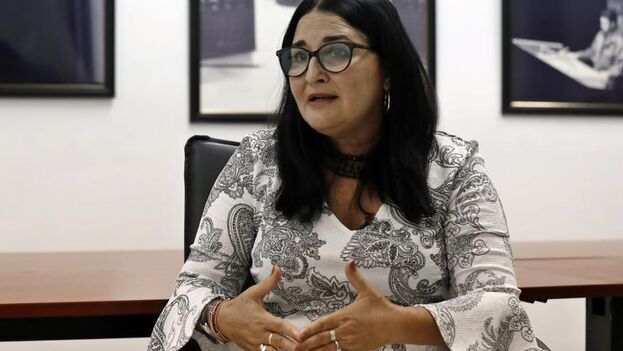
The Cuban Ministry of Foreign Affairs deputy director for the US, Johana Tablada,  during an interview with the EFE news agency, on Monday in Havana. (EFE/Ernesto Mastrascusa)

14ymedio biggerEFE (via 14ymedio), Havana, 21 November 2022 — The Cuban Ministry of Foreign Affairs deputy director for the US, Johana Tablada, perceives “some adjustments” in Washington although not “a change in policy,” and she says that “hopefully” a second “thaw” will take place, something that the Island “needs,” although she believes the ball is now in President Joe Biden’s court.

“There are some signs, from the increase in bilateral dialogue, that, if the Biden government wanted, important adjustments could be made,” Tablada says in an interview with EFE. “If the United States opens a door, it can always find us,” she adds.

In her opinion, “there are no reasons to have a relationship with Cuba that is not only normal, (but) a good relationship. There are many common issues.”

She points out that a “thaw,” like the one that occurred during the presidencies of Barack Obama in the United States and Raúl Castro in Cuba, is what their country “needs” and it “deserves” to get out of the serious economic crisis — with great scarcity, galloping inflation and elevated migration — that has been dragging on for two years.

The deputy director, present at the migration round of talks held last week in Havana between the United States and Cuba, notes that she observes “some adjustments in the way in which the policy is applied” by Washington.

“In recent months we have seen and recorded, and it’s obvious and visible, an increase in official bilateral exchange between the two governments and an increase in the exchange between agencies of the two governments” on a series of issues from migration to the environment, through health and air regulation, she says. continue reading

However, she hasn’t seen a “change of policy” in Washington, because “unfortunately” the sanctions — even the last twist introduced by the previous president of the United States, Republican Donald Trump — persist “practically” without modifications.

“We will have to see if the Biden administration, beyond increasing the conversation with Cuba, is willing to stop being faithful to Trump’s measures,” she says.

Tablada assures that Cuba has the “will” to solve the problems with “cooperation” and “dialogue” but makes clear its red line: “What Cuba is not willing to do is to negotiate issues of internal and constitutional order with a foreign government.”

She affirms that her country has not changed its strategy toward Washington, despite the lowering of tone, the intensification of contacts, and Cuba’s unusual request for help after Hurricane Ian, to which the United States responded with two million dollars in humanitarian aid from the United States Agency for International Development.

Cuba, Tablada emphasizes, seeks to “find a civilized way in which both countries can take advantage of” what unites them and not what divides them, and the two “can move forward for the benefit” of their peoples. Similarly, the US State Department spoke last week about dialogue with Havana to “advance national interests.”

In the opinion of the deputy director, the electoral results in the mid-term elections in the United States open “a window” for Washington and Havana to move towards the normalization of bilateral relations. In the elections, the Democrats demonstrated unusual strength for being the party in the White House, and they retained the Senate.

“The only way is for us to understand each other, to respect each other, to learn to deal with our differences,” Tablada points out, paraphrasing some recent statements by the president of Cuba, Miguel Díaz-Canel.

Tablada, who denies that Cuba has used migratory pressure against the US at the negotiating table, maintains that it’s the sanctions that are “strangling” their country and promoting emigration, mainly to the United States. In fiscal year 2021-2022, about 225,000 Cubans arrived irregularly at the southern border of the United States, a record figure.

“Vice President Kamala Harris can go to Honduras and say — and I agree with her — that schools must be built so people don’t leave their towns; that hospitals must be built so people don’t have to leave; that people’ lives must be improved… And now they come to Cuba, where there are schools, hospitals, social security… and they say the opposite,” she argues.

She emphasizes that “American incentives” to migration such as sanctions and the Cuban Adjustment Act (which grants permanent residence to Cubans once they have remained in the United States for one year) should not continue. She also says that Washington should end the “injustice” of including Havana on the list of state sponsors of terrorism.

“I am hopeful that Cuba will be removed from the list, but not because the US Government has given us any signal” in this regard, she says.

On the other hand, she assured that “there was no discussion” about human rights with the United States “nor any mention of names” in last week’s bilateral migration round, and that she is willing to resume dialogue on that matter with Washington during the “thaw.”

The official stated that the issue of human rights is, in her opinion, “a pretext, completely fictitious,” from Washington, as well as an “excuse” to keep the sanctions in place.

“There was no discussion on the issue of human rights. There was no mention of names,” Tablada said, despite the fact that this issue was cited in the statement of the Department of State after the meeting.

“We have told the US Government that we are open to resuming the human rights dialogue we had during the Obama and Raúl Governments,” she said.

Tablada also maintained that it’s not true that the US sanctions against the Island are maintained — despite the electoral promises of President Joe Biden — because of the repression after the anti-government protests of July 11, 2021 in Cuba, the largest in sixty years.

She argued that maintaining sanctions is in fact against human rights, because they harm Cubans on a daily basis by depressing their quality of life, and that the United States has good diplomatic relations with countries that are also accused of violating human rights.

The deputy director also indicated that they have provided “accurate information” to Washington about human and drug traffickers “linked to organized crime” and established in Florida, people who participate in human rights violations.

“We have told them and given them precise information that people who organize human trafficking operations are linked to organized crime and that many boatmen who traffic people are the same ones who are involved in drug trafficking and take people to Florida just like they do drugs,” she said.

Tablada stressed that “there has been bilateral collaboration” in this area and that Havana is willing “to strengthen it.” Recently, a meeting was held between the maritime border protection bodies of Cuba and the United States.

In the round of migration talks last week, the second of Biden’s term, along with Tablada, the Undersecretary for Western Hemisphere Affairs, Emily Mendrala, and the Cuban Deputy Minister of Foreign Affairs, Carlos Fernández de Cossio also participated.

Translated by Regina Anavy

____________

COLLABORATE WITH OUR WORKThe 14ymedio team is committed to practicing serious journalism that reflects Cuba’s reality in all its depth. Thank you for joining us on this long journey. We invite you to continue supporting us by becoming a member of 14ymedio now. Together we can continue transforming journalism in Cuba.

Fallen Trees and Branches in Central Havana Almost Two Months After Hurricane Ian

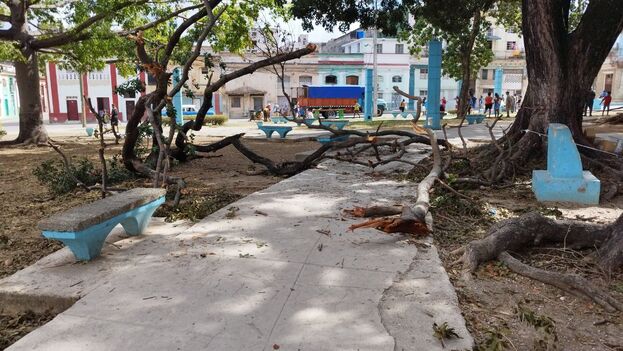
Trees destroyed in Trillo Park in Havana, this Thursday, seven weeks after the passage of Hurricane Ian. (14ymedio)

14ymedio bigger14ymedio, Juan Diego Rodríguez, Havana, 17 November 2022 — Although Hurricane Ian crossed Cuba seven weeks ago, the neighbors of Cayo Hueso, in Havana, have already become accustomed to the collapses and walls stained by moisture. The gritty and grimy buildings, in addition to the potholes in the streets, were part of the landscape long before the hurricane. But now, in addition, they have to live with the huge branches that the wind ripped off the trees in Trillo park.

To get from one street to another you have to go around the poorly paved sidewalks, where the banks and other buildings are also neglected. No workers from the Communal Service, the firefighters or the Armed Forces — whose support after the hurricane was proclaimed by the official press — have cleared the impassible sections of the street.

“In this neighborhood the residents lament that everyone has gone to “see the volcanos” — using a phrase that implies emigrating via Nicaragua. When an old cargo truck appears  people quickly crowd onto one of the streets that surround the park. The vehicle travels every week from Villa Clara and exhibits its merchandise — it’s not known if with permission or secretly — of meat, fruits and vegetables.

“Pineapples, for example, cost me 100 pesos in the San Rafael market, which has become impossible,” complains one of the women who waits her turn in line. “But at the truck I buy them at 25. They are smaller, but they’re not bad.”

Sitting on the curb at Trillo park, trying to dodge the dirt and desolation, the inhabitants of Cayo Hueso put their hope of being able to buy from the truck the food they need for the week.

A pound of malanga — “which is softened,” clarifies the seller — or guavas costs only 30 pesos; a pot of chili, 40, and beans — black or colored — can be had for 140. Compared to the prices of the capital, a pound of rice at 55 pesos is cheap, although a bunch of onions costs 80, and a bulb of garlic doesn’t fall below 400 pesos. continue reading

The ruin of public areas after Ian’s passage is not exclusive to Cayo Hueso. Throughout Havana one can see trees torn up by their roots, broken branches, leaf litter and property that no one will clean.

In the vicinity of the so-called “twenty plants” of Centro Habana, at Zanja and Hospital streets, the neighbors not only have to fence their houses to protect themselves from robberies and growing violence on the Island, they also now contemplate, from the balconies, an old broken tree trunk that, as if that weren’t enough, also destroyed the pavement.

Translated by Regina Anavy

____________

COLLABORATE WITH OUR WORKThe 14ymedio team is committed to practicing serious journalism that reflects Cuba’s reality in all its depth. Thank you for joining us on this long journey. We invite you to continue supporting us by becoming a member of 14ymedio now. Together we can continue transforming journalism in Cuba.

The Cuban Government is Committed to Reducing ‘Obstacles that Hinder the Business Climate’

The Government has been discreet about the identity of Cuban-American businessmen, and the official press has not described the alleged opportunities offered to the group. (Twitter/Fihav)

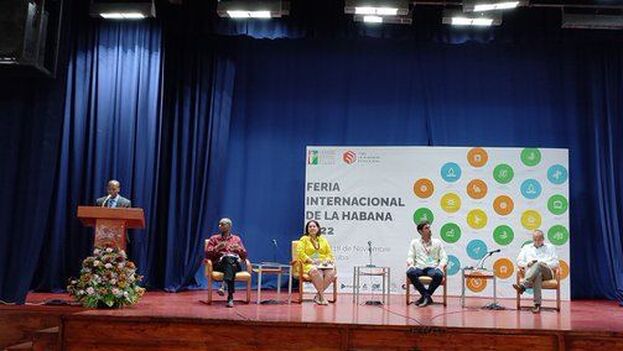
14ymedio biggerEFE/14ymedio, Havana, 19 November 2022 — The Government of Cuba concluded this Friday the 38th edition of the Havana International Fair (Fihav) with the commitment to reduce “the obstacles that can hinder the business climate” on the Island.

During the closing of the event, Interim Minister of Internal Trade and Foreign Investment, Ana Teresita González, stressed that the “biggest milestone” of the fair was the presence of “new economic actors and Cubans living abroad.” Since 2021 almost 6,000 small and medium-sized enterprises [SMEs] have been approved.

This year, Fihav focused on attracting the investment of Cubans abroad, especially from the United States, who had a special panel dedicated to them for the first time. The Government has been discreet about the identity of these Cuban-American businessmen, and the official press has not described the supposed opportunities offered to the group.

Rodrigo Malmierca, Minister of Foreign Trade, stated that Fihav was designed “specifically so that they know better what can be done” and “to give them all the information so that they can do business with Cuba.” Fihav’s official sites have avoided disseminating the content of these “special” panels and meetings, although the minister reported that American firms — including those of Cubans living in the United States — should in any case ask for permission from the U.S. Treasury Office of Foreign Assets Control. continue reading

The Island’s main commercial exchange ended with more than 50 agreements signed between Cuba and foreign companies, according to the president of the Chamber of Commerce, Antonio Luis Carricarte, speaking on state television.

In total, 402 Cuban companies were present, 70 of them SMEs, and delegations from 62 countries.

The Organizing Committee recognized the pavilions of South Africa, Italy, Venezuela and Mexico “for the quality of their designs and the massive participation of their companies,” according to the Cuban News Agency.

The Mexican pavilion — with 40 companies — received special attention from the Island executives, who are aligned with the Government of Andrés Manuel López Obrador.

On the Fair’s Mexico Day, last Tuesday, three Cuban ministers were present: Malmierca of Foreign Trade and Foreign Investment, Juan Carlos García Granda of Tourism and Eloy Álvarez of Industries.

Cuba took advantage of this opportunity to present, as it usually does at this event, its portfolio of investment opportunities with 708 projects, 30 more than in 2021, in which the food production sector cornered 197 of them.

Due to the health measures from the coronavirus pandemic, the Fihav had been replaced in 2020 and 2021 by a business forum and a virtual fair.

The last face-to-face edition, in 2019, was attended by more than 4,000 participants from about 70 countries, of which Spain was the most represented with 110 companies, 30 more than in this edition, according to official data.

Two hundred eighty foreign companies from some 40 countries operate on the Island, including Spain, Canada and China.

The Cuban Government has relaxed its rules to attract more foreign capital in different areas of the economy, in the midst of a deep crisis — and the lack of currency in circulation — as a result of the pandemic, US sanctions and errors in management.

Translated by Regina Anavy

____________

COLLABORATE WITH OUR WORKThe 14ymedio team is committed to practicing serious journalism that reflects Cuba’s reality in all its depth. Thank you for joining us on this long journey. We invite you to continue supporting us by becoming a member of 14ymedio now. Together we can continue transforming journalism in Cuba.

The Spanish Consulate in Cuba Receives an Avalanche of Nationality Petitions

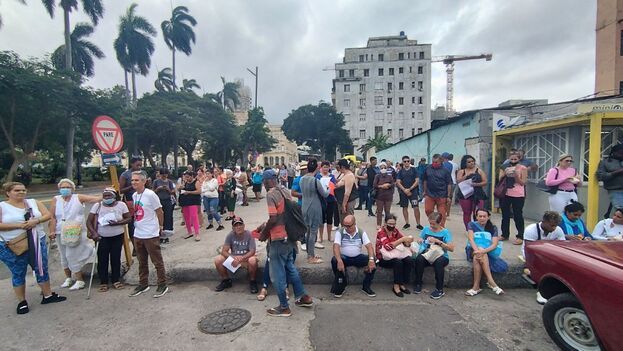
The line in front of the Spanish Consulate in Havana this Friday. (14ymedio)

14ymedio bigger14ymedio, Juan Diego Rodríguez, Havana, 18 November 2022 — The Consulate General of Spain in Havana is already receiving appointment requests to process nationality applications under the new Democratic Memory Law (LMD). They will address this procedure from November 21, as reported by the diplomatic headquarters on its networks on Thursday night.

There is a link to the procedure for obtaining that appointment, which includes collecting all the necessary documentation according to the applicant’s case and sending it by email to: cog.lahabana.lmdsol1@maec.es.

In the subject line, applicants must put “citas LMD” [LMD appointments], and in the body of the email, their personal data as follows: first name; first surname; second surname; identity card number, without accents, spaces or any other special character. In addition, they must attach a photo with their identity card visible in their hand.

If everything is in order, the applicant will receive a response from the same address with a username and password to enter another page and effectively select the date of the appointment.

The Consulate asks people not to book the appointment if all the documents are not available, and to send a single email. If they receive several messages from the same account, they warn, they could block it. Once the applicant receives the appointment, they must supply additional documentation and will have only 30 days to deliver it. If this deadline is not met, the application will be denied. continue reading

The announcement had barely been made for a few hours on Thursday, even with an error on the instruction page, when the automatic response from the Consulate arrived with this warning, in capital letters: “We have a very high number of applicants, which causes longer response times. You may receive your credentials with a delay of up to one month.”

This Friday, the Embassy of Spain communicated via Twitter that appointments will be processed at the Consular Civil Registry, located in the Lonja del Comercio, in Old Havana. At the headquarters on Zulueta Street at the corner of Cárcel, a crowd of people came for various procedures.

Although none were there for the LMD, but rather to resolve other issues, some regretted the bureaucratic difficulties in getting a hearing at the consular office. “From here, the appointment page didn’t work for me, but I solved it with a person who offered me the service.” Thus, a procedure that by law should be free, cost him $600.

Translated by Regina Anavy

____________

COLLABORATE WITH OUR WORKThe 14ymedio team is committed to practicing serious journalism that reflects Cuba’s reality in all its depth. Thank you for joining us on this long journey. We invite you to continue supporting us by becoming a member of 14ymedio now. Together we can continue transforming journalism in Cuba.

United Airlines Returns to Cuba with Daily Flights from Houston and Newark to Havana

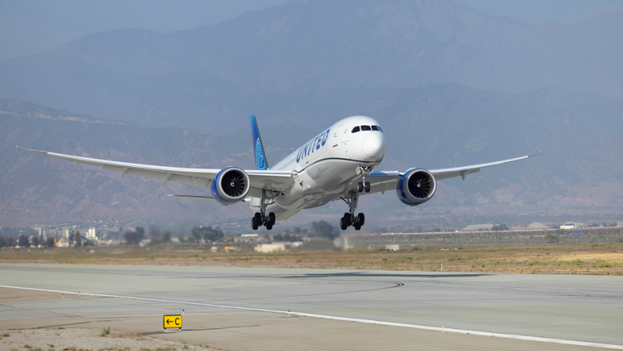
Negotiations for the resumption of operations in Havana coincide with the lifting of the restrictions imposed by the Department of Transportation. (Facebook/United)

14ymedio bigger14ymedio, Havana, 16 November 2022 — United Airlines resumed its direct flights to Havana from Houston, Texas, and Newark, New Jersey, on Monday, after two and a half years of suspension due to the covid pandemic. The Cuban Airports and Airport Services Company (ECASA) reported that the airline will operate a daily flight with both cities.

The first flight arrived on Monday morning at José Martí International Airport from Houston, after several months of negotiations and infrastructure adjustments. United, based in Chicago, planned to restart operations on October 31, 2022, but requested an extension from the United States Department of Transportation because it needed more time to review expired contracts with service providers and equip the terminal where it would be accommodated.

The airline operated 14 weekly flights to Havana in March 2020, seven from Houston and the same number from Newark, when it suspended its operations due to the closure of borders and restrictions on the entry of travelers due to the spread of the coronavirus.

Negotiations for the resumption of operations to Havana coincide with the lifting of the restrictions imposed by the Department of Transportation during the government of former President Donald Trump, which prohibited the commercial flights of American companies to small airports outside the capital. continue reading

The first to operate a flight to an airport outside Havana was American Airlines, which on November 3 began operations at Abel Santamaría International Airport, in Santa Clara, to revive tourism in the provinces. The airline also plans to connect Miami with the destinations of Varadero, Camagüey and Santiago de Cuba.

Cuba is at the beginning of its high season for tourism, and through the streets of the historic center of Havana, the increase in travelers is already visible, this newspaper can confirm.

The Cuban authorities expect that with the increase in flights, , the second largest currency generator after the export of health services, will recover, compared to the meager tourism results recorded in 2022. Official data confirm that the sector will close this year well below the levels of 2019, when more than 4.2 million travelers arrived on the Island.

The Government celebrates with pomp the growth of tourism by more than 552% in 2022 compared to 2021, when there were still travel restrictions. This year has seen the arrival of 1,553,461 travelers from January to September, including travelers from the Cuban community abroad. However, the results are far from the set goal of receiving 2.5 million tourists before the end of the year.

Thus, the Ministry of Tourism had no choice, in October, but to recognize that the goal will not be met and reduced the projection to 1.7 million international travelers.

Translated by Regina Anavy

____________

COLLABORATE WITH OUR WORKThe 14ymedio team is committed to practicing serious journalism that reflects Cuba’s reality in all its depth. Thank you for joining us on this long journey. We invite you to continue supporting us by becoming a member of 14ymedio now. Together we can continue transforming journalism in Cuba.

Russia and Cuba Address the ‘Unacceptable’ Unilateral Sanctions Against Their Countries

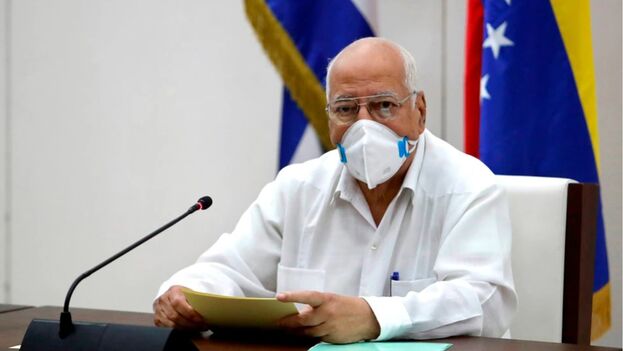
Ricardo Cabrisas, Deputy Prime Minister of Cuba and main negotiator of its foreign debt. (EFE)

14ymedio bigger EFE (via 14ymedio), Moscow, 18 November 2022 — On Thursday, the Russian Deputy Foreign Minister Sergey Riabkov and the Deputy Prime Minister of Cuba, Ricardo Cabrisas, addressed the “unacceptable” unilateral sanctions against their respective countries.

Both “underlined the firm position of both countries that unilateral sanctions in violation of the UN Charter and the principles and norms of international law are unacceptable,” the Russian Foreign Ministry said in a statement.

Riabkov also expressed his “unconditional support of Cuba for lifting the illegal US embargo on the Island.”

The deputy minister and Cabrisas held a meeting on the eve of the XIX meeting of the Russian-Cuban Intergovernmental Commission on Commercial, Economic, Scientific and Technical Cooperation.

During the meeting, Riabkov and Cabrisas also discussed current issues for the strengthening of the strategic partnership between Moscow and Havana in the political, commercial, economic, investment, cultural and humanitarian spheres.

In addition, they exchanged views on key issues of the international and regional agenda.

The meeting takes place before the arrival of Cuban President Miguel Díaz-Canel on Saturday night in Moscow, where at the beginning of the week he will meet with his Russian counterpart, Vladimir Putin.

Boris Titov, Russian Presidential Commissioner for the Rights of Workers, who was invited to the Havana International Fair (Fihav), said hours earlier from the Island that Cuba and his country are negotiating the possibility of carrying out transactions in rubles and cryptocurrencies with the aim of dodging international sanctions and facilitating “mutual payments.”

The politician stated that “compensation mechanisms” and other “private” options are also valued as an alternative to payment in dollars.

Translated by Regina Anavy

____________

COLLABORATE WITH OUR WORKThe 14ymedio team is committed to practicing serious journalism that reflects Cuba’s reality in all its depth. Thank you for joining us on this long journey. We invite you to continue supporting us by becoming a member of 14ymedio now. Together we can continue transforming journalism in Cuba.

“The Silences and Scandals of Cuban Freemasonry” is Presented at the Miami Book Fair

Acosta defines the post-1959 stage as the “decay of Cuban Freemasonry.” From one of the nations with the greatest influence of the order worldwide, it became one of the weakest. (14ymedio)

14ymedio bigger14ymedio, Xavier Carbonell, Salamanca, 18 November 2022 — The book, Del templo al temple. Silencios y escándalos de la masonería cubana [From Temple to Temple. Silences and Scandals of Cuban Freemasonry] (Editorial Primigenios, 2022), by journalist Camila Acosta, will be presented from November 18 to 20 at the Miami Book Fair. It’s a history of the Masonic order on the Island, which details in a special way the order’s vicissitudes after 1959.

Acosta’s research, which had as its background a documentary that she recorded for her graduation thesis at the University of Havana, is presented as the reverse of the story that the regime — in the figure of historians such as Eduardo Torres Cuevas — has attributed to Cuban Freemasonry.

In the back-cover note, the writer and Freemason Ángel Santiesteban Prats points out that the book allows access to a history that “had been extinguished for six decades because that was decided by Fidel Castro,” and he affirms that Acosta has provided a “response to the censorship of the totalitarian regime” on the circumstances in which the order was forced to operate after the revolutionary triumph.”

“Camila Acosta entered a world forbidden to those outside the Masonic fraternity,” continues Santiesteban, who also regrets that the “majority of the Masons themselves barely knew about their own history.”

In a volume of 422 pages that is now for sale on Amazon, Acosta reviews the historiographic tradition that precedes the order and provides details about the female branch, the Daughters of the Acacia, and about the Masons who, in turn, have participated in movements opposed to the Government. continue reading

Criticizing the material she addresses, Acosta defines the post-1959 stage as the “decay of Cuban Freemasonry.” From one of the nations with the greatest presence and influence of the order worldwide — with more than 34,000 members — it became one of the weakest in its context. Confiscations of property, infiltrations and aggressive propaganda against its postulates were part of Castro’s strategy to dismantle Cuban Freemasonry.

Obsessed with the possibility that institutions such as fraternities, secret orders and churches would form an opposition front, the Revolution launched systematic attacks on the Masonic infrastructure and threatened young people not to join its ranks.

The exile of many Cubans — including numerous Masons — between 1959 and 1970 is another cause for the decay of the order, says Acosta. Those who remained in the country were forced to report to the Government who attended the meetings, what issues were discussed and who espoused them, as well as “deliver copies of the minutes” and “pay heavy fines for not doing so or delaying,” she says.

“The very fact of belonging to Masonry or some fraternal or religious institution was interpreted by the authorities as a symptom of lack of revolutionary devotion,” Acosta explains in the ninth chapter of her book, which details the schism that the order experienced when it tried to move the headquarters of the Great Lodge of Cuba to Florida.

From the more or less intense persecution of those years, the Cuban Freemasonry organized different initiatives such as the Clandestine Masonic Movement, with expressly anti-communist guidelines.

After several decades of tension, with the arrival of the so-called Special Period, after the collapse of the Soviet Union and the loss of its financial support, and the return of Cubans to religion and other related practices, Freemasonry experienced a boom in membership. However, in 2011, the program Razones de Cuba [Cuba’s Reasons] revealed the complicity of former Masonic Grand Master José Manuel Collera Vento with State Security, which increased disappointment with the order and suspicion among its members.

This episode triggered numerous difficulties and tensions between the Government and the order, and exposed the constant “manipulations” — in Acosta’s opinion — that Freemasonry suffered at the hands of the Office of Religious Affairs of the Communist Party.

The most recent stage in the history of the order, including the imprisonment of several Freemasons during the so-called Black Spring of 2003, or the letter signed by the Masonic Grand Commander to Miguel Díaz-Canel against the police repression of 11J [the protests of 11 July 2021] are also addressed by the journalist in her investigation.

Acosta, born on the Isla de la Juventud [Isle of Youth] in 1993, is a correspondent for the Spanish newspaper ABC in Havana and writes for several independent media. From Temple to Temple was published by Primigenios, a Cuban publishing house based in Miami with a catalogue of almost 500 titles, directed by the writer Eduardo Casanova Ealo.

Translated by Regina Anavy

____________

COLLABORATE WITH OUR WORKThe 14ymedio team is committed to practicing serious journalism that reflects Cuba’s reality in all its depth. Thank you for joining us on this long journey. We invite you to continue supporting us by becoming a member of 14ymedio now. Together we can continue transforming journalism in Cuba.

The ‘Prisoners’ Voices’ Campaign Begins and Calls for the Release of Three Cuban Artists

The Voces Presas campaign demands prompt freedom for the poet María Cristina Garrido and rappers Richard Zamora Brito and Randy Arteaga Rivera. (14ymedio)

14ymedio bigger14ymedio, Havana, 18 November 2022 –The writer María Cristina Garrido and rappers Richard Zamora Brito and Randy Arteaga Rivera, arrested by the Cuban regime, are the three faces of the Voces Presas campaign launched this Friday by the organization Artists at Risk Connection (ARC), in partnership with Civil Rights Defenders (CRD, from Sweden). The movement appeals to the international community for solidarity, and it demands the prompt release of the artists, imprisoned for their political opinions.

Many people in Cuba who have dared to “challenge the false problems and narratives promoted by the Cuban regime,” said Julie Trébault, the director of ARC at PEN America, “have paid a very high price for their creative expression, becoming victims of imprisonment, surveillance and house arrest, or being forced into exile.”

The Voces Presas campaign uses digital platforms to disseminate the profiles and trajectory of the three artists, as well as music videos and fragments of their works. To this is added documentation on the harassment and imprisonment they have suffered at the hands of the Cuban regime.

The poetry of María Cristina Garrido, born in 1982 in Quivicán, province of Mayabeque, addresses issues of the daily life of Cubans. Her career as an activist prompted her to be part of the Cuban Women’s Network, a space to visualize the problems of Cuban women. In March 2022, she was sentenced to seven years  in the Guatao women’s prison after being accused of resistance, aggression, incitement to crime and public disorder for participating in the large demonstrations of July 11, 2021 (11J) in favor of freedom.

For the same reason, rapper Richard Zamora Brito, known as El Radikal, was arrested. Initially detained in the Combinado del Sur prison, in Matanzas, he was released on bail and is now under house arrest and subject to forced labor.

Rapper and anti-racism activist Randy Arteaga Rivera also participated in the July 11 demonstrations in Santa Clara, for which he was sentenced to five years in prison. The Government accused him of being involved in the organization of the protests and of shouting insults against President Miguel Díaz-Canel. continue reading

“The Cuban authorities continue to use the judicial system to repress dissent and freedom of critical expression,” said Erik Jennische, director of the Latin American Department of Civil Rights Defenders, who pointed out that this campaign is directed at the Cuban Government so that they immediately release all imprisoned artists and guarantee the free exercise of art and activism on the Island.

They also urge the embassies of the European Union and the American continent based on the Island to demand that they be allowed to visit the three imprisoned artists and issue a report on their conditions.

The organizations ask that the Cuban Government be pressured to eliminate the need for state approval to exhibit their works freely, as required by Decree 349, which limits independent artistic expression.

Translated by Regina Anavy

____________

COLLABORATE WITH OUR WORKThe 14ymedio team is committed to practicing serious journalism that reflects Cuba’s reality in all its depth. Thank you for joining us on this long journey. We invite you to continue supporting us by becoming a member of 14ymedio now. Together we can continue transforming journalism in Cuba.

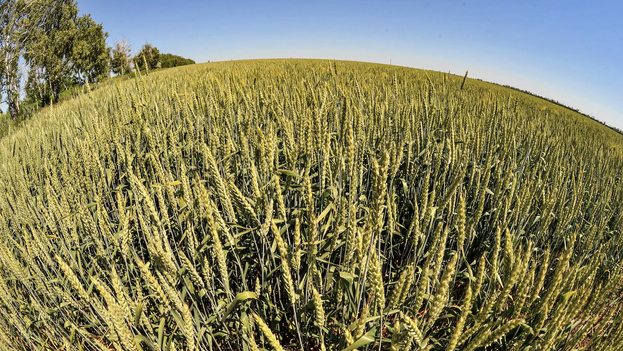
Cuba Wants to Import Russian Fertilizers, Hydrocarbons and Wheat

Wheat field in the Rostov region, in Russia, in an archive photo. (EFE/EPA/Arkady Budnitsky)

14ymedio bigger14ymedio (With information from EFE), Madrid, 18 November 2022 — Cuba has shown interest in fertilizers, hydrocarbons and wheat from Russia at the XIX meeting in Moscow of the intergovernmental commission for cooperation between the two nations.

“The Cuban side expressed its interest in stable supplies to the Island of fertilizers, hydrocarbons and Russian wheat,” the Russian Ministry of Economic Development told the official TASS agency.

During the negotiations, the parties also discussed the current state and prospects of bilateral trade and economic relations.

In particular, cooperation in the humanitarian, scientific and educational fields was addressed, as was the implementation of projects in the industry and energy sectors, although no details were offered.

To deepen ties in the humanitarian field, an agreement has been signed between the government of the Russian Federation and the government of the Republic of Cuba on cooperation in the field of higher education, the statement concludes. continue reading

The meeting of the Russian-Cuban intergovernmental commission takes place on the eve of the arrival in Moscow of the Cuban president, Miguel Díaz-Canel, who will meet early next week with his Russian counterpart, Vladimir Putin, to participate in the inauguration of a monument in honor of Fidel Castro.

These days, both countries have intensified contacts and statements. The Russian Deputy Foreign Minister, Sergey Riabkov, and the Deputy Prime Minister of Cuba, Ricardo Cabrisas, addressed on Thursday the “unacceptable” unilateral sanctions against their respective countries.

Riabkov also expressed his “unconditional support for Cuba to lift the illegal US embargo of the Island.”

A day earlier, within the framework of the Havana International Fair, Boris Titov, Russian presidential commissioner for workers’ rights, said that both nations are negotiating the possibility of carrying out transactions in rubles and cryptocurrencies, with the aim of dodging international sanctions and facilitating “mutual payments.”

In confirming Miguel Díaz-Canel’s official trip to Moscow, the spokesman for the Russian Presidency, Dmitri Peskov, said that it was “a very important visit”: “Cuba is a very important partner for us. We have a lot to talk about.”

Translated by Regina Anavy

____________

COLLABORATE WITH OUR WORKThe 14ymedio team is committed to practicing serious journalism that reflects Cuba’s reality in all its depth. Thank you for joining us on this long journey. We invite you to continue supporting us by becoming a member of 14ymedio now. Together we can continue transforming journalism in Cuba.

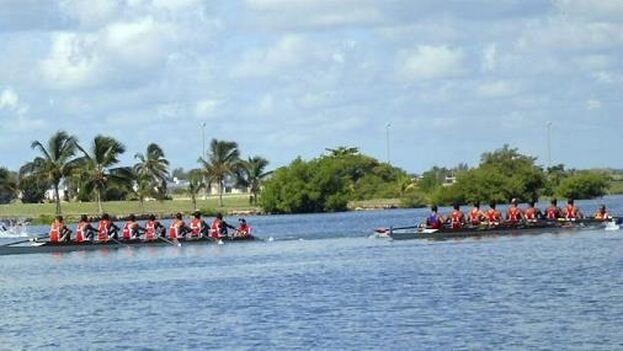
The Desertion of Cuban Athletes Continues, Now a Pentathlete and Three Rowers Escape

The three Cuban rowers are hoping to cross the US border. (Jit)

14ymedio bigger14ymedio, Havana, 17 November 2022 — The escape of athletes continues to fracture Cuban sports. This Thursday, the abandonment of the pentathlete Melissa Garlobo in Brazil, joined the Wednesday escape of rowers Ernier Tamayo, Alexei Carballosa and Nayala Torres in Mexico. According to journalist Francys Romero, the latter are close to “crossing Mexico’s border with the United States.”

So far this year “there are already 53 athletes of different specialties,” who take advantage of their stays abroad to end their sports relationship with the Island, the reporter said on his social networks.

Garlobo’s desertion occurred on October 28, just after finishing in 33rd place in the specialty tournament that took place in Rio de Janeiro, Brazil. In this contest Cuba won six places for the Pan American Games in Santiago 2023. The decision of the granmense was signaled as “a serious indiscipline,” said the official media Jit.

Melissa Garlobo, together with Diana Leyva and Delmis Pérez, won the bronze medal in August during the Pan American Modern Pentathlon Open Championship in Santo Domingo, in the Dominican Republic, thus guaranteeing their participation in the Central American and Caribbean Games San Salvador 2023.

In Mexico, this Wednesday three other rowers, Ernier Tamayo, Alexei Carballosa and Nayala Torres, took advantage of an oversight to sneak away and follow in the footsteps of Boris Luis Guerra, who on Sunday separated from the team of 15 Cubans who have been developing their training on the Virgilio Uribe Olympic track in view of the Central American and Caribbean Championship that will begin on November 23 in El Salvador. continue reading

In recent months, there have been defections of Cuban athletes from various disciplines: baseball, boxing, volleyball, Greco-Roman wrestling, handball and athletics. Official data in the last decade show that more than 800 athletes have left Cuba and take advantage of their stay abroad to separate from the delegations.

One of the most recent baseball defections was that of receiver John Andy Rodríguez, who left the Island for the Dominican Republic. Rodríguez had an outstanding performance in the Matanzas U-15 team “with eight matches in the last National [where he] achieved 38 innings and an average of .250 and a double,” Francys Romero stressed.

Carlos Yoel Amat, on the other hand, took a flight to Nicaragua. Born in Güira de Melena, in his last National Series he defended the Hunters team, averaging .375 in 48 games with 36 hits in 96 turns at bat. Amat’s intention is to reach the United States. Another of the players is the habanero José Enrique Aballí, who participated in Cuban youth teams and the National Under-23 Series.

Translated by Regina Anavy

____________

COLLABORATE WITH OUR WORKThe 14ymedio team is committed to practicing serious journalism that reflects Cuba’s reality in all its depth. Thank you for joining us on this long journey. We invite you to continue supporting us by becoming a member of 14ymedio now. Together we can continue transforming journalism in Cuba.

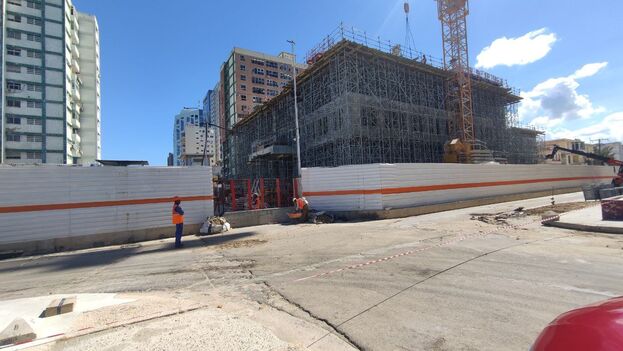
The Cuban Government Seeks More Than 3 Billion Dollars in Investments for Tourism / 14yMedio

5-star hotel under construction, on Primera and B, Havana. (14ymedio)

14ymedio bigger14ymedio, Havana, 18 November 2022 — Although the Cuban Government has emphasized this year the need to raise foreign capital for sectors in extreme emergency, such as food, agriculture and transport, the bulk of its offers return to the usual: tourism. Of the 708 businesses that are part of the new portfolio of opportunities, there are six that exceed 250 million dollars. Of these, three involve tourism.

Although it could be argued that building a hotel complex is more expensive than many of the other projects, the example of the imbalance is given by the comparison between the first investment and the fourth. The most expensive, at 1,072,000,000 dollars, is a golf real estate complex, almost double the 650,000,000 dollars that they budget for the construction of a completely new sugar mill.

The star project of the portfolio, by its value, plans to urbanize an area of 568 acres in Guardalavaca, Holguín, through a mixed joint venture with Cubagolf. There will be a course with 18 holes, a club, a 5-star hotel and another super luxury hotel with spa, in addition to 1,648 homes, including houses and apartments, with sales in perpetuity, and sports and commercial and service areas.

A little less expensive, the second project in order of investment is extremely similar to the first. The national investor is also the state golf company and foresees a course of the same size, surrounded by a resort hotel, another 5-star hotel and spa, a 4 star hotel equipped with different water sports and 1,122 houses. In addition, this real estate development would have a club, spa, commercial and service areas and green spaces. Its budget is 951,561,400 dollars and its location, ironically, is Bahía Honda, in Artemisa, where just three weeks ago the Border Guard troops sank a boat of balseros [rafters] fleeing Cuba, resulting in eight deaths, including one girl under two years of age. continue reading

The third most expensive project planned by the Government is, in this case, related to food. The goal is to build a factory of ammonia and nitrogen compounds that will serve the agricultural industry by producing fertilizer. The cost is $900,000,000, and the plant would produce 400,000 tons of ammonia per year and 370,000 tons of urea. The waste would be used to produce carbon dioxide, argon and ammonium sulphate. This plant will be located, if it is possible to move it forward, in Matanzas, north of the long-suffering thermoelectric plant, Antonio Guiteras.

In the midst of a radical crisis of what was its star product, sugar, Cuba proposes to invest 650,000,000 dollars in a new sugar mill “with high standards of efficiency in productive and energy processes.” It is the most open project since neither the location nor the investment modality has been determined, and it offers — as an alternative to the joint venture — the completely foreign company option. It should be remembered that last year, the harvest was — and the adjective is not new — the “worst” in history, and the lamentable state of the sugar mills has forced this year’s production to be concentrated on just 23 of the 56 that still exist.

It is followed, in fourth place, by another development linked to tourism and golf. In this case, the complex is valued at $641,500,000 and would be built in Cumanayagua, Cienfuegos. Here the golf courses are doubled — two of 18 holes — and the club, the 5-star hotel, 2,055 homes and commercial, service and sports areas are repeated, in an area of 865 acres.

Lastly, with an amount of $251,500,000, the Government proposes the construction of a complex for the production of solid oral generic drugs in tablet form, antiretroviral drugs, contraceptive hormones, aerosols and dry powder inhalers. It is intended, they claim, to cover national demand and replace imports and even be able to export if successful. This factory would be one of those located in the Mariel Special Development Zone, created in partnership with MedSol laboratories.

In addition, in investments above 200,000,000 dollars there are two other hotels in Holguín. The projected high amounts, not to mention those spent in recent years, come at a time when tourism figures are at their worst.

This Thursday, the numbers of foreign visitors who arrived on the Island in October reached 123,588. This is the fifth best data of the 10 months, and with it, tourists total 1,198,402. So it’s already perfectly viable that the Island won’t even reach the lowest official goal of closing the year with 1,710,000 travelers. The Government had planned for 2022 to have 2.5 million tourists after two years of closure due to the pandemic, but all efforts have been in vain, and in mid-October the target had to be lowered by -31.7%.

Although there are two of the best months of the year in the sector, it is unlikely that the goal will be reached, since it will take more than half a million travelers between November and December, an average of 250,000 tourists per month, which seems excessive considering that July, with 152,480, was the best figure of the year.

This has not prevented the new construction of the Spanish Iberostar hotel with the Cuban Gran Caribe located on the beach of Santa María del Mar, east of the capital, to be presented at the Havana International Fair yesterday.

The 5-star establishment will be ready in four years and will be constructed “under the concepts of sustainable development” contributing “largely to the diversification of the offer” of sun and beach, which now aspires to be extended to events and congresses.

Translated by Regina Anavy

____________

COLLABORATE WITH OUR WORKThe 14ymedio team is committed to practicing serious journalism that reflects Cuba’s reality in all its depth. Thank you for joining us on this long journey. We invite you to continue supporting us by becoming a member of 14ymedio now. Together we can continue transforming journalism in Cuba.

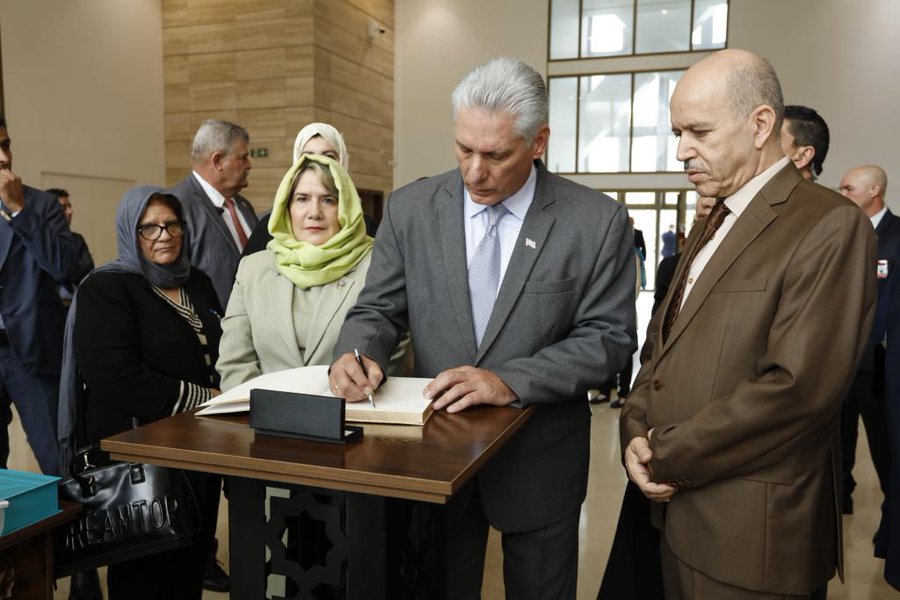
Cuba President Diaz-Canel is Going on a Business Trip

Cuban President Diaz-Canel in Algeria, with his wife Liz Cuesta at his side. (Twitter)

14ymedio bigger14ymedio, Elías Amor Bravo, Economist, 17 November 2022 — Nothing to object to. This is among his functions as a communist leader, and in addition, with this international journey, leaving FIHAV [International Business Fair] halfway done in Havana, what we all know is confirmed once again: the embargo/blockade that he talks about so much doesn’t exist. However, before continuing, it’s worth explaining why this blog, dedicated to economic affairs, pays attention to Díaz-Canel’s international relations. Very easy.

First, a trip like this is not improvised from one day to the next. A good indicator is that Raúl Castro, with a wide range of leaders, was to say goodbye at the Rancho Boyeros international airport. Go and find out what the old communist said to his successor. If anything. The snapshot from the official government newspaper Granma, with Rodríguez behind, is eloquent. On the other hand, the state press has already assured itself by saying that this trip arises from official invitations received by Cuba.

Second, the trip is due to economic reasons. For a long time, there has been no money in the state coffers. It is urgent to seek support, whatever it may be, to weather the storm until a new USSR or Venezuela appears ready to carry the deadweight Cuban communist country.

Third, the choice of countries on this trip has not been trivial. Algeria, Russia, Turkey and China confirm the ideological bias of the Cuban communist bet and the urgent search for a financier willing to pay the bills.

Let’s go in parts.

At his first stop in Algeria, where he will be from November 16 to 19, Díaz Canel told the communist state press, “we have high expectations with this visit.” What expectations? Who has the expectations? The grandson of Fidel Castro who organizes parties for millionaires, or the Cuban who receives a miserable pension with an inflation rate of 32.7%? continue reading

At the Algerian international airport, Díaz-Canel, accompanied by his wife Lis Cuesta, was received by a second-level court, Aiman Benabderrahmane, the prime minister, and the ministers of Health and Culture, Abdelhak Saihi and Soraya Mouloudji. The president was not there.

Then, in an airport enclosure, there was a meeting between the delegation of Cuban communists and their Algerian hosts where they remembered Fidel Castro, who visited the African country on more than one occasion and where he maintained very good political relations with its leaders. With this fanfare, which came out of the blue, because they were stories of more than six decades ago when the world was different from the current one, Díaz-Canel intoned the main issue: bilateral ties, consolidating “good relations.” Translated into understandable language: money, money and money.

And, basically, because you can’t be wasting time, Díaz-Canel’s main objective seems to be to solve the serious crisis of the Cuban electroenergy sector and put an end to the blackouts that alter the conditions of production and life in the country.

The Cuban communist leader’s Twitter has been the source of information for his followers, and so in a message, he said that “after two years under the impact of COVID-19, we crossed the Atlantic again,” adding that the journey “responds to Cuba’s political and economic priorities, as well as to efforts to alleviate the effects of a post-pandemic crisis that overwhelms everyone, and, in our case, is exacerbated by the effects of the U.S. blockade.”

Before proceeding, it’s advisable to review the available data. At their first stop in Algeria, Díaz-Canel and Lis Cuesta, accompanied by an entourage that included Bruno Rodríguez, Alejandro Gil, Rodrigo Malmierca (who was also absent from FIHAV), José Angel Portal and the new guy, Vicente de la O Levy, minister of energy and mines, had no choice but to recognize that Cuba’s foreign trade with the African country is unbalanced and complicated.

Cuba’s exports amounted to $904 million while imports amounted to a figure of over $277 billion (2021, last available year). The balance sheet is very favorable to Algeria, and the foreign trade coverage rate is 0.32. Cuba’s annual deficit with the African country is more than $227 billion, so payment, for a bankrupt regime, can be problematic. Algeria occupies a prominent position on the list of creditors and is getting nervous. On the other hand, what can Cuba offer to this country? More doctors? Artists? Advisors of various branches? Technology maybe? It’s difficult and complicated. Algeria is on another wavelength, nor does it seem that it’s going to send tourists to the Island either.

It seems that the trip involves negotiating the payment of the accumulated debt, which can be much higher than billions of  dollars, observing the figures of recent years. The state press threw out balls and described the work agenda on Algerian soil with activities such as “the exchange of Díaz-Canel with his host counterpart,” (who did not receive him at the airport), “a meeting with collaborators of the Cuban medical brigade and members of the state mission of the Island” and a little tourism, with visits “to places of cultural and historical importance of this nation.”

It’s too early to assess the consequences of this trip. There is the impression that no more can be expected than a certain continuity and that the Algerians will continue to wait to collect what is due them. A few commitments may even be signed to muddle through, in the style of the aviary deal of the former Soviet CAME*. The relationship between the two countries doesn’t admit alternative scenarios. And get ready for the best in this journey, which has just begun.

*Translator’s note: CAME, the Council for Mutual Economic Assistance, was an economic organization from 1941-1991 under the leadership of the Soviet Union that comprised the Eastern Bloc countries and other socialist states.

Translated by Regina Anavy

____________

COLLABORATE WITH OUR WORKThe 14ymedio team is committed to practicing serious journalism that reflects Cuba’s reality in all its depth. Thank you for joining us on this long journey. We invite you to continue supporting us by becoming a member of 14ymedio now. Together we can continue transforming journalism in Cuba.

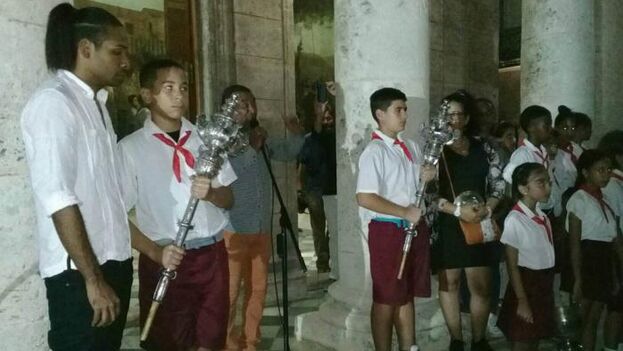
Cuba’s Unusual Procession of Little Pioneers With the Silver Maces of the Old Cabildo of Havana

Children dressed as Pioneers with the maces of the old Cabildo of Havana, from the 17th century. (Tribuna de La Habana)

14ymedio bigger14ymedio, Juan Izquierdo, Havana, November 16, 2022 — A strange mixture of rites, which have become commonplace in recent years, came together on Tuesday night at the ceremony held at the founding site of Havana, the Ceiba de El Templete, on the eve of its 503rd anniversary.

It was attended by the highest authorities of civil power, Luis Antonio Torres Iríbar, first Secretary of the Party in the capital, and Reinaldo García Zapata, governor of the city, but also those of the church. Specifically, Juan de la Caridad García Rodríguez, archbishop of Havana, from whom “the people received a blessing” and who accompanied a procession through the streets surrounding the Plaza de Armas.

However, the most surprising image of the evening — in addition to being extremely worrying if it’s confirmed that the maces are the original pieces — was that of two children, dressed in white shirts and red scarves, the uniform of the Pioneers, holding the maces of the old Havana Cabildo. Made of silver in 1631, they are, according to Emilio Roig de Leuchsenring in his book Havana. Historical Notes, “the oldest works of art in Cuba.”

Both valuables objects are in the custody of the Office of the Historian, founded by Roig and administered until 2020 by the late Eusebio Leal, and they are stored in the former Palace of the Captains General, today the City Museum. It’s not the first time they have been taken out of safekeeping for the same ceremony. continue reading

The official press echos “an emotional letter calling for the conservation of historical heritage,” “warm and simple words” that, says Tribuna de La Habana, “sixth-grade pioneer Laura Hernández García, from Camilo Cienfuegos Primary School, read” at the ceremony.

The ceremony ended, the official press reports, with the song Razo a la Ceiba by Leo Vera, and a concert on the esplanade of El Templete.

Beyond the unease caused by seeing the little Pioneers, ignorant of the historic value of what they carried in their hands, no one is surprised that the celebration of the foundation of the capital mixes ideology and religion.

In 2019, the Cuban regime paid tribute to the priest Guillermo Isaías Sardiñas Menéndez, known as Father Sardiñas, on the 55th anniversary of his death.

Nicknamed the “father of the olive green cassock,” the official press has frequently praised “the coherence between his religious faith and his conviction as a patriot and revolutionary,” although in the historiography of the Catholic Church the mentions of his actions have been more discreet.

But the intersections have not only been between Cuban communist ideology and Catholicism. In 2008, fifty santeros officiated a ritual with drums and animal sacrifices to wish “long life” to Fidel Castro on the day of his 82nd birthday, then convalescing from an intestinal disease.

Translated by Regina Anavy

____________

COLLABORATE WITH OUR WORKThe 14ymedio team is committed to practicing serious journalism that reflects Cuba’s reality in all its depth. Thank you for joining us on this long journey. We invite you to continue supporting us by becoming a member of 14ymedio now. Together we can continue transforming journalism in Cuba.