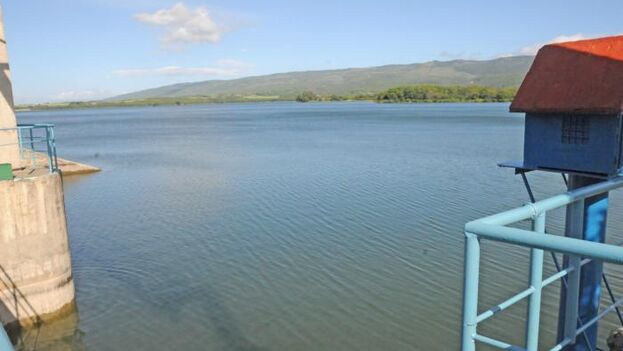
14ymedio, Madrid, 15 November 2022 — The reservoirs of Guantánamo province are in a critical situation. According to an article in the official newspaper Venceremos, in all they accumulate 29,851,442 million gallons of the 88,233,466 their million capacity; that is, they are only filled at 33%.
According to the article, more than 76,000 people are at risk of drought, “due to the partial or total depletion of 32 sources of supply in the municipalities of El Salvador, Imías, Maisí, San Antonio del Sur, Guantánamo, Manuel Tames and Niceto Pérez.”
The increase in rainfall since last month, says José Antonio Reyes, an official of the Hydraulic Utilization Company, is hardly a relief. The “more than 3,698,409 million gallons” that fell, says the provincial newspaper, is “a welcome but insufficient figure,” which does not fill “even half” of the storage capacity.
The information details that the reservoir that received the most water was that of Jaibo (1,585,032 gallons), but that this was “in part due to the total restriction of its deliveries,” followed by Faustino Pérez (1,056,688), which supplies the city of Guantánamo, with 203 gallons per second.
The La Yaya reservoir, continues Venceremos, only gained two million gallons, with a capacity of 160 million, and is at 32% capacity. This dam supplies the agricultural areas of Guantánamo, Niceto Pérez and Caimanera.
In any case, the official press blames the situation on the fact that “the rainfall maintains irregularities,” which “have benefited above all the upper areas of the municipalities and not to the same extent the receiving basins that contribute to the reservoirs.”
The easternmost of the provinces is the one with the most problems of drought and desertification. That, together with the strong emigration to the western part of the Island, has extended the saying that “Guantánamo is a desert.”
Translated by Regina Anavy
____________
COLLABORATE WITH OUR WORK: The 14ymedio team is committed to practicing serious journalism that reflects Cuba’s reality in all its depth. Thank you for joining us on this long journey. We invite you to continue supporting us by becoming a member of 14ymedio now. Together we can continue transforming journalism in Cuba.
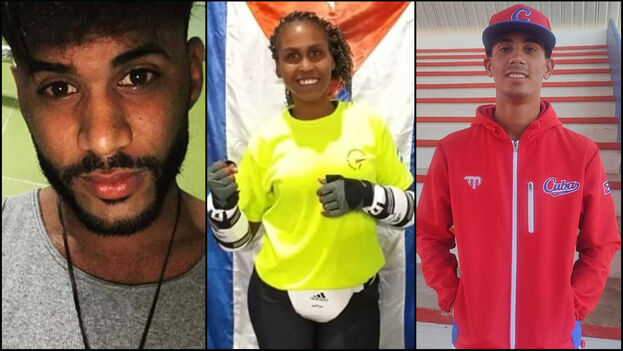
With the escape of these athletes, there are now 49 Cubans who have abandoned their teams abroad in 2022. (Collage)
14ymedio, Havana, 15 November 2022 — Mexico is again an escape platform for Cuban athletes, in this case the taekwondo martial artist Yamitsi Carbonell, the rower Boris Luis Guerra and the baseball player Miguel Flores. As usual, the official press called them “traitors” to their team and “their country.”
The bad news came for the regime on Sunday, when the Jit sports site confirmed the escape of Carbonell, who was part of the team that represents Cuba in the Taekwondo World Championship, which is held in Guadalajara between November 13 and 20. The woman from Santiago left the national delegation as soon as she arrived in Jalisco.
Carbonell was a team leader in the 160 lb. category. Her most outstanding participation was at the Pan American Games in Lima in 2019, where she took fifth place and, locally, last June won the silver medal at the Havana Taekwondo Open.
The Island squad was left with eight athletes led by the Olympic bronze medalist and current world champion in taekwondo, Rafael Alba, and the outstanding Akely Matos (119 lbs.), Kelvin Calderón (163 lbs.), Yarobis Michael Castañeda (176 lbs.), Guillermo Enrique Pérez (192 lbs.), Dalila Oneida Villamil (101 lbs.), Tamara Robles (117 lbs.) and Arlettys de la Caridad Acosta (137 lbs).
Carbonell’s abandonment was joined by the escape, this Sunday, of rower Boris Luis Guerra. The Havanan escaped from the group of 15 athletes who have been concentrated since November 1 in Mexico City and are developing their training on the Virgilio Uribe Olympic track for the Central American and Caribbean Championship that will begin here on November 23 in El Salvador. continue reading
Guerra, along with Adrián Oquendo, won the silver medal in double pairs of short oars at the Pan American Games in Lima 2019; in September, he reached the quarterfinals in the same category with Carlos Andrei Ajete, in the World Rowing Championship, in the Czech Republic.
After the flight of Guerra, the president of the Cuban Rowing Federation, Ángel Luis García, highlighted the presence of the Olympic medalist in Tokyo 2020, Milena Venegas, and the Pan American medallist, in Lima 2019, Carlos Ajete, as the athletes who lead the representation.
This Tuesday, the escape of baseball player Miguel Flores was also confirmed. According to journalist Francys Romero on his social networks, the member of the Under-18 team slipped away an hour before boarding the flight at Mexico City International Airport bound for Havana. “He is the 49th athlete to leave a delegation in 2022,” Romero stressed.
The left-hander was highlighted by the reporter as “among the best prospects of Under-18 baseball in 2022, backed by a fastball between 88-90 miles per hour and dreamlike numbers in the National Championship of the category.”
In recent months, there have been defections of Cuban athletes from various disciplines – mostly baseball — to which have been added boxing, volleyball, Greco-Roman wrestling, handball and athletics. Official data estimate more than 800 athletes who have left Cuba in the last decade.
Translated by Regina Anavy
____________
COLLABORATE WITH OUR WORK: The 14ymedio team is committed to practicing serious journalism that reflects Cuba’s reality in all its depth. Thank you for joining us on this long journey. We invite you to continue supporting us by becoming a member of 14ymedio now. Together we can continue transforming journalism in Cuba.
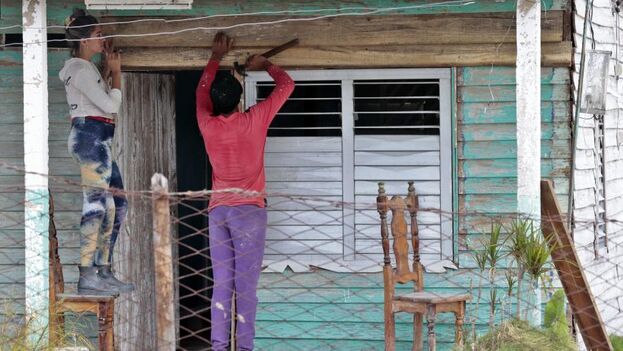
Two women try to repair a home in San Juan y Martínez after Hurricane Ian. (EFE)
14ymedio, Madrid, 14 November 2022 — Pinar del Río’s recovery work after the passage of Hurricane Ian never ends. It has been almost 50 days since the hurricane landed in La Coloma, one of the westernmost points on the Island, and there are still 3,673 people without electricity, according to the latest update published this Sunday by the Electric Company in the province.
Pinar del Río has, according to official data, 235,311 customers, of whom 231,638 (98.44%) have recovered electricity. But in San Juan y Martínez, the tobacco cradle of the Island, and San Luis, most people continue to be without service.
“We buy food for one day, because if you do it for two or three days it spoils. We have to go to Pinar del Río (22 kilometres away) and get it ’from the left’ [’under the table’] or pay for it in MLC (freely convertible currency) because at the bodega (ration store) there isn’t any,” a resident from San Juan y Martínez told the Spanish agency EFE this weekend.
In her house, where the kitchen — like so many in Cuba — is electric, she has been buying coal and oil or cutting firewood for more than a month to be able to cook.
But this is not the only one of the shortages that this report has mentioned about the situation in Pinar del Río. José Ariel continues living in his half-fallen-down house and with no electricity. The pinareño received his first government visit one day before being interviewed by EFE, and the result couldn’t have been worse. continue reading
“We said we needed cement but (they said) there was none. They told us: ’you already have a roof, you already have a home’, and they don’t give you anything,” complains this fisherman who managed to put up some zinc plates as a roof with the help of neighbors and now must nail wood over the windows to cover the holes.
“We paid about 2,500 pesos for some pipes that arrived,” he added. In his case, the power came back two weeks ago, but the rest is a disaster.
Caridad Martínez, a 79-year-old resident in San Juan y Martínez, survives by selling honey in the doorway of her house. She explained that her bed is soaked because she can’t get any cement to plaster her ceiling.
“They told me that there was no need to give me anything,” said the retiree, also outraged by the resellers who proliferate on networks trying to sell the construction materials they manage to obtain illegally at unbearable prices. “They’re not ashamed; look, it’s already difficult to get things, but this is taking advantage of people,” she said.
The Government recently recognized that it would be very difficult for it to obtain in the short term all the materials for the reconstruction of the more than 108,000 homes partially or totally destroyed by the hurricane, and that only 7,000 have been repaired.
“More than a month after the hurricane, we are still discussing the same problems that we addressed on the first day,” Esteban Lazo, President of the National Assembly of People’s Power, said last weekend in one of the many visits that the leaders have made to the area, possibly in an attempt to calm the waters.
This same Sunday, Cuban President Miguel Díaz-Canel sent a message to piñareos via Twitter that contrasts with some of the eye-witness reports that the neighbors post on social networks, in press comments or in complaints to the press.
“The recovery from the effects caused by Hurricane Ian continues. In Cuba no one is left homeless,” the president said, sharing a tweet from the Minister of Energy and Mines in which he had written: “We continue to work until we reach everyone. Our workers have experienced the affection of a people who know about solidarity and commitment.”
Vicente de la O Levy, head of the branch after the dismissal of Liván Arronte, indicated that as of Saturday, 97.74% of customers already had electricity, and the linemen from Santiago de Cuba, who have for weeks been trying to recover the fallen poles and the miles of cables destroyed in Pinar del Río, have been advancing.
“What I still don’t understand is why they haven’t restored the electricity in Mantua, which has the generation plants for the municipality. They should do something, because we know that they use the profits like they want,” a Facebook user claimed, writing about the province’s electricity company.
“Please, can anyone tell me when they are going to turn on the power in the Pepe Chepe neighborhood like they did at La Espa?” says another. “Will they deign to pass at least through the P 990 circuit on Sol Street? With so many brigades distributed in Pinar, some could at least pass through here,” adds another.
And the worst thing is that the day the power arrives pinareños know that their problems, , will be far from over, as another user said. “They are working like crazy to reach 100% so they can start with the scheduled blackouts.”
Translated by Regina Anavy
____________
COLLABORATE WITH OUR WORK: The 14ymedio team is committed to practicing serious journalism that reflects Cuba’s reality in all its depth. Thank you for joining us on this long journey. We invite you to continue supporting us by becoming a member of 14ymedio now. Together we can continue transforming journalism in Cuba.
Appearance of the sugar in Cárdenas sold in poor condition. (Telebandera)
14ymedio, Havana, 14 November 2022 — It’s a bad weekend to talk about food sovereignty. Matanzas residents, los matanceros, have been the first to complain to the authorities about the future law that aims to protect the right to food, after several days of new trouble in that area.
The neighbors went to bed this Sunday with the news that the milk from three areas of the provincial capital, Naranjal, Matanzas Este and Peñas Altas, had been spoiled by a massive breakdown whose causes are still unknown. As announced by the Dairy Products Company of Matanzas, the facts are being investigated, since the milk arrived on Sunday afternoon and had been pasteurized.
According to the official explanation, the milk would begin to be replenished from 6:00 in the evening of the same day, and it would be pasteurized as well. But there is no powdered milk that can replace the lack caused by the losses, which “makes it impossible for this response to be in the shortest possible time.”
“The truth is that only we mothers know what we are going through with this issue. The same thing happens every night, when the children fall asleep exhausted from crying because they didn’t have any milk to drink before bedtime. It’s in short supply, and they tell you it will be replaced tomorrow,” said a Facebook commenter. She was not the only one who complained about the delay.
“Here what is ’broken’ is the schedule, which is the same at 12 p.m. as at 6 p.m. Anyway, it’s playing with something that is a delicate matter for a child,” says another.
“What about the diet of the sick, especially of people on a special diet, or bedridden? Here, in Matanzas, the provincial capital, someone retired a year ago and they never gave him more information. Now it’s happening in the villages of the interior. Where is that food sovereignty that they mentioned on TV? It’s the same old thing, another gross joke and poorly told,” a mother reproaches. “Yeah, and with a stylish name: ’food sovereignty, culture of resistance …’ It’s the latest trend to adorn the same shit or worse,” another replies, annoyed.
For decades, Cuban leaders installed in the population the idea that milk was an essential food that should be consumed daily by children and adults. Fidel Castro had his own obsession with the product, whose cult hit the roof with Ubre Blanca [White Udder], the cow that entered the Guinness record book by giving more than 100 liters of milk in three milkings in 1982. continue reading
Fidel’s successor, General Raúl Castro, promised in 2007 that it was necessary to “produce milk so that you can drink all you want,” when already in that year it was known that calcium (the element that makes dairy products important for the diet) is found in many other foods, including all dark leafy vegetables, except spinach. However, the policy has led generations of Cubans to experience the loss of each drop of milk as a greater drama than that of cabbage, which contains the same nutrient.
The disgust has been added to the one already dragged up by the matanceros for the “fragments of non-soluble foreign matter” found in the sugar of this month’s family ration basket. State television confirmed that the images broadcast by users on social networks of the product mixed with blackish particles were real. After taking a sample to the laboratory of the Municipal Centre for Hygiene and Epidemiology of Cárdenas, “the presence of objectionable particles (pieces of materials that vary in size and quantity) was confirmed.”
Dr. Bella Canosa Besú, director of the laboratory, said that the product will be certified throughout the province, and its sale will be gradually restored depending on the result of the analysis.
An article published in Telebandera made it clear that “according to specialized standards, under current conditions, that food product is not suitable for human consumption,” and it asks consumers who have sugar of that type to return the product in poor condition, as explained by Heykel Vázquez Moreno, deputy director of the Municipal Trade and Gastronomy Company.
The entity has been forced to stop the sale and carry out the sampling investigation at each bodega (ration store) to determine where it can be sold again.
“All the raw sugar that has been marketed for months in several bodegas in the city of Matanzas is simply not suitable for consumption. There are a lot of foreign particles, some of them metallic and others whose composition is unknown, and so we consume it, without knowing the effect on our health and that of our children. Now by a complaint the sale was paralyzed, and if you don’t complain it’s not detected, because there is no effective system to control food production and sales to either the private or state sector. Hopefully the matter will be reviewed, and the quality of the sugar that is marketed to the population will be improved. It’s the only sugar we can consume because there is no other market where we can buy it,” summarized one of the many comments of outraged matanceros.
Although a similar event has not yet occurred in other provinces, another user says that in Villa Clara the situation is not far from that of Matanzas. “Here the sugar, for Villa Clara, the bean seeds sold… they look like horror stories. Now who is responsible for the fact that the sugar has arrived at the bodega? And what will happen if there are people who have consumed it, including children? We are living in horrible times, Cubans against Cubans, envy, products in bad condition, high and abusive prices, and still the prices of MLC stores [which only take payment in foreign currency] continue to rise and so far no one responds. In conclusion, I don’t know how much more Cuba can take,” he says.
Translated by Regina Anavy
____________
COLLABORATE WITH OUR WORK: The 14ymedio team is committed to practicing serious journalism that reflects Cuba’s reality in all its depth. Thank you for joining us on this long journey. We invite you to continue supporting us by becoming a member of 14ymedio now. Together we can continue transforming journalism in Cuba.
At least 29 femicides have occurred in Cuba so far in 2022, according to reports released on social networks and in newspapers. (Alas Tensas)
EFE (via 14ymedio), Havana, 14 November 2022 — A campaign promoted by activists of the Cuban Feminists’ Network platform will start this Monday on social networks in order to raise awareness of the “urgency” of having a Comprehensive Gender Law on the Island.
“We do not want more gender violence,” they said this Sunday when disclosing the campaign, in which they invite you to upload videos with stories, messages and short promotional texts on social networks and thus join the campaign they promote with the hashtags “We have a name” and “Gender law now.”
The initiative also calls for the signing of the campaign petition through the leydegeneroya.org website during the 16 days of activism they plan to develop from November 25 to December 10.
“The idea with our campaign is to involve the entire Cuban society and raise awareness of the urgency of having a gender law in Cuba,” the activists explain and clarify that “it’s not a campaign only to involve women.”
The Women’s Network says that “we cannot wait for 2028,” referring to the date scheduled for the next legal provisions to be approved by the National Assembly of Peoples’ Power on the Island. continue reading
“We can’t keep waiting or allow more women to die. We need a law that protects them,” says this platform, born in 2019, which among other objectives aims to train women, coordinate the visibility of the women’s movement in networks and actions for their defense, and defend their rights and empowerment to end sexist violence.
The Cuban Women’s Network and other independent platforms such as Yo Sí Te Creo (YSTC) [Yes I Believe You] in Cuba and the Cuban feminist magazine AlasTensas insistently demand the existence of a law in the matter by observing an increase in acts of gender violence in the country.
These groups have reported 32 cases of femicides in Cuba so far this year.
In the first half of the year, 24 women died violently; there were four attempts at aggression and a vicarious murder [committed during another crime] was verified, according to YSTC, which, together with other organizations, collects these data in the absence of an official count.
In comparison, this group verified 36 femicides in the year 2021, and 32 in 2020, including four vicarious murders.
Femicide is not criminalized in the current Code, and there are no shelters for victims of abuse, nor a comprehensive law against sexist violence.
The new Criminal Code, approved on May 15, which enters into force next December, contemplates gender-based violence but does not criminalize femicide.
Translated by Regina Anavy
____________
COLLABORATE WITH OUR WORK: The 14ymedio team is committed to practicing serious journalism that reflects Cuba’s reality in all its depth. Thank you for joining us on this long journey. We invite you to continue supporting us by becoming a member of 14ymedio now. Together we can continue transforming journalism in Cuba.
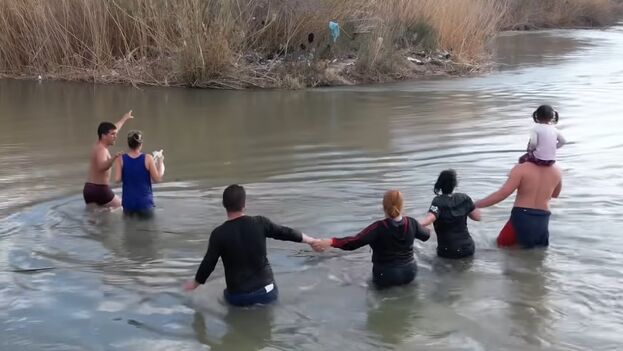
The measure sends a “symbolic message” to deter other groups of potential Latin American migrants from trying to cross the Mexican border. (ImpactoVisión News/YouTube/Captura)
14ymedio, Havana, 12 November 2022 — The Cuban Government again accepts the return by air of migrants detained by the United States at its border with Mexico, although this option will only apply for the time being to “occasional” groups, according to the Reuters agency.
The measure, promoted by the Barack Obama Administration in 2017 and suspended during the coronavirus pandemic, is a “new but limited tool to stop the number of Cubans crossing the border,” three anonymous US officials told Reuters.
Officials pointed out that the Immigration and Customs Enforcement Service (ICE) is holding a dozen citizens of the Island, whose asylum application was rejected, and that the United States intends to return them to Havana. However, they are waiting for enough Cubans in the same conditions to organize a deportation flight.
Despite the fact that the repatriations of Cubans detained at the border with Mexico had been interrupted during the pandemic (there were 1,500 deportations the previous year), Joe Biden’s Administration regularly returns Cubans arriving by sea. The number of people sent to Havana by the US Coast Guard has risen to more than 5,600 so far this year.
According to Reuters, the measure sends a “symbolic message” to deter other groups of potential Latin American migrants from trying to cross the Mexican border, and seeks to contain, at least partially, the flow of Cubans advancing to the United States from Nicaragua, through the “route of volcanos.” continue reading
The United States arrested 2.2 million Latin Americans at its border during 2022, which represented a record. At least half of them were prevented from passing and returned to Mexico, while only 2% of the Cubans detained were not allowed to enter US territory.
The agency adds that the US State Department, the White House and the Immigration Service declined to offer any comments on the cases.
This week, two senior U.S. officials — Rena Bitter, Undersecretary of Consular Affairs of the State Department, and Ur Mendoza Jaddou, Director of Citizenship and Immigration Services – visited Havana to talk to the Government about the serious immigration situation between the two countries.
In addition to the complete resumption of consular services in Havana beginning in 2023, Bitter and Mendoza expressed their “concern” about the human rights situation on the Island, the lack of freedoms and the imprisonment of hundreds of activists.
The mass exodus from the Island has already surpassed 224,000 Cubans who arrived in the United States in just one year. The figure exceeds that of the previous migratory waves in 1980 and 1994, and it is increasing.
Translated by Regina Anavy
____________
COLLABORATE WITH OUR WORK: The 14ymedio team is committed to practicing serious journalism that reflects Cuba’s reality in all its depth. Thank you for joining us on this long journey. We invite you to continue supporting us by becoming a member of 14ymedio now. Together we can continue transforming journalism in Cuba.
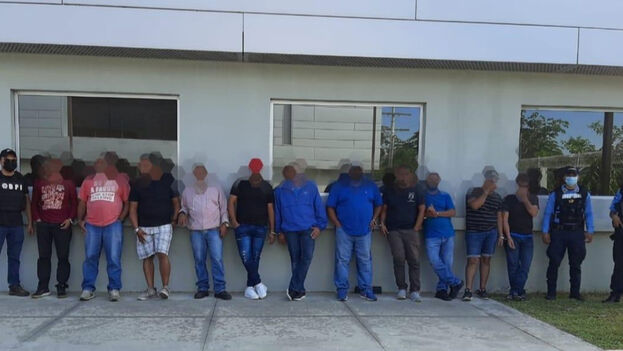
The coyotes used the municipality of Santa Cruz de Yojoa, in the department of Cortés, as a base of operations. (National Police of Honduras)
14ymedio, Havana, 11 November 2022 — The Transnational Criminal Investigation Unit (UTIC) of Honduras dismantled on Thursday a network of coyotes that transported migrants, mostly Cubans, through the Central American country to Guatemala. The National Police confirmed in a statement the capture of “eleven polleros* carrying 45 Cubans in vehicles.”
The traffickers used the municipality of Santa Cruz de Yojoa, in the department of Cortés, as a base for their operations. This is an obligatory route for migrants. According to data obtained by the UTIC, they approached people when they got off the wagons at the border.
The criminal group used homes in the Honduran municipalities of Guaimaca, Central District, Maraita and San Antonio, all in the department of Francisco Morazán, where they kept the migrants, and used cars to transport groups of four or five to avoid attracting the attention of the authorities. The detainees will be prosecuted for the “blatant crime of illicit trafficking in people.”
At the time of their arrest, the coyotes carried 21,200 lempiras (Honduran currency), 244 dollars, 150 Cuban pesos, 1,000 Costa Rican colones, 2,000 Colombian pesos, 120 Nicaraguan córdobas, 20 Uruguayan pesos and 20 Venezuelan bolívares. In addition, several cars and a van were confiscated. continue reading
The Cubans were handed over to the National Institute of Migration of Honduras where they began the procedures to regularize their stay in the country and be able to continue their journey to the United States.
According to the figures on migrants, updated until November 7, 145,959 people have illegally entered Honduras, of which 59,055 are of Cuban origin.
Migrants from the Island have complained that in their passage through the Central American country they face the collection of fines by the immigration authorities and extortion of the police, who demand the payment of 20 dollars at the checkpoints.
The passage from Honduras to Guatemala is essential for the journey of Cubans to the US border. On Tuesday, the Guatemalan National Civil Police arrested 50 Cubans, including seven minors, who were traveling in a truck that covered the route between Buenos Aires and Río Dulce, in Livingston, department of Izabal.
This group was taken to the Agua Caliente border. By not carrying the category C control visa, one of the requirements for entry into Guatemalan territory, in addition to a current passport, the Migration authorities can authorize expulsion.
*Translator’s note: pollero — derived from pollo, or chicken — literally means ‘chicken herder.’ The term is equivalent to coyote — that is people smuggler.
Translated by Regina Anavy
____________
COLLABORATE WITH OUR WORK: The 14ymedio team is committed to practicing serious journalism that reflects Cuba’s reality in all its depth. Thank you for joining us on this long journey. We invite you to continue supporting us by becoming a member of 14ymedio now. Together we can continue transforming journalism in Cuba.
The deterioration of hospital facilities, the scarce state budget dedicated to improving them and the lack of health personnel aggravate the situation. (Cubadebate)
14ymedio, Havana, 11 November 2022 — With infant mortality of 7.4 per thousand live births since January 2022, Cuba fails to reverse the negative trend of previous years, particularly 2021, when the rate reached 7.6, the worst since 1996.
In a meeting of high-level officials, broadcast two weeks ago on Televisión Cubana, Dr. Tania Margarita Cruz, Deputy Minister of Public Health, attributed that situation to the lack of “staff and officials” involved in the hospital care of mothers and children.
Since January, 72,800 live births and 539 deaths have been recorded, said Cruz. The vice-minister’s statements stand out not only for the dramatic increase in deaths, but also because the Government points to its mismanagement as the first cause, without using the usual excuse: the US blockade and its consequences on the sector.
Nor does it insist on the responsibility for the COVID-19 pandemic, although it does point out that the coronavirus had an impact on the health of pregnant women and on the functioning of the Cuban health system. However, this doesn’t justify the fact that in 2022 the rate has been minimally reduced compared to the previous year, when the majority of the population is already vaccinated against the virus.
Cuba held a rate of less than 5 per 1,000 living infants for more than a decade. The current increase, the Deputy Minister of Public Health said, represents a setback of almost thirty years in which the Island had controlled child mortality. continue reading
During the Special Period, specifically in 1996, the country recorded a rate of 7.9, but it improved the birth rate so that, since 2000, 7 deaths per 1,000 were not exceeded. The lowest figure, of 4, was achieved in 2017 and repeated in 2018.
The Government did blame the pandemic for the rise (5 children per 1,000) in 2019, while it is now accusing the “incomplete spreadsheets” of each health care center.
Healthcare personnel — ranging from doctors and nurses to caregivers and managers — are also part of the mass exodus of Cubans, who quit their jobs and try to leave the country, despite the fact that Public Health is one of the sectors with the most restrictions against traveling.
The nefarious effects of migration on the health sector had been calculated at the end of 2021 by Ernesto René, a 34-year worker of the Maternal and Child Program (Pami), who commented in the newspaper Invasor that it was necessary to “review the motivations and barriers for the staff who work in that sensitive area.”
The year 2022 will not represent a turning point in child mortality, Cruz recognizes, since the lack of personnel rules out “the necessary effectiveness in the control and supervision that the staff must carry out,” and favors “violations of processes in some institutions of the country.”
The provinces where there is the greatest staff deficit are Pinar del Río, Ciego de Ávila, Camagüey, Guantánamo, Santiago de Cuba, Granma, Mayabeque, Villa Clara and Havana. With 13.6 deaths per 1,000 live births, Ciego de Ávila continues to have the worst results, followed by Pinar del Río (9.6), Santiago de Cuba (9.3) and Las Tunas (8.7), at the end of 2021.
The low infant mortality rate was, traditionally, one of the figures most used by the Cuban Government to demonstrate its “achievements” in public health. The deterioration of hospital facilities, the low state budget dedicated to improving them (only 2% of the total) and the lack of health personnel aggravate the situation, which has been critical for years.
Translated by Regina Anavy
____________
COLLABORATE WITH OUR WORK: The 14ymedio team is committed to practicing serious journalism that reflects Cuba’s reality in all its depth. Thank you for joining us on this long journey. We invite you to continue supporting us by becoming a member of 14ymedio now. Together we can continue transforming journalism in Cuba.
The Ministry of the Interior didn’t offer more details about its operations against the buying and selling, but warned that it had already arrested several criminals. (14ymedio)
14ymedio, Havana, 12 November 2022 — Determined to uncover the anthill of illegal trade, the Cuban government doesn’t publish reports in official newspapers to air cases of corruption, surcharges, thefts, illicit distribution, electronic scams and, lately, robberies in foreign exchange operations on the black market. The timid daily reports of the Ministry of the Interior don’t allow measuring the extent of the problem, but they say a lot about the seriousness of the situation.
A report published on Tuesday in the newspaper TribunadeLaHabana announced the results of a police operation in the municipality of Cotorro. The agents arrested a group of Cubans who stored “high quantities of food, hygiene and personal use products” in two Girón buses, with Matanzas registration, belonging to the state cooperatives Flor de Cuba and José M. Duarte.
The network, which operated at the interprovincial level, had accumulated an inventory that the newspaper had the pleasure of detailing: almost 1760 pounds of chicken, 446 packs of sausages, 77 gallons of oil, 660 cans of beer and 83 of Red Bull, 150 tubes of picadillos, in addition to small shipments of chocolate, wheat, concentrated broth, butter and soaps.
The Ministry of the Interior assured that the products will be distributed in Social Security centers and in the State’s commercial network, which will receive the dividends resulting from their sale.
Another operation fell on a “warehouse” in San Miguel del Padrón, which the police located after an accusation and from which they extracted 128 boxes containing 508 gallons of oil. The newspaper attributed the success of the operation to the “municipal groups of confrontation with illegalities” in the popular council of Luyanó Moderno. continue reading
The hunt for “corruption” always ends up locating State establishments as the main suppliers of resale networks. In the well-known Ultra store, in Central Havana, 190 tubes of ground meat were seized that cost the director, the floor manager and the warehouse manager a penalty.
On the other hand, in the La Palma agricultural market, in Arroyo Naranjo, a shortage of 371,300 pesos was discovered in sales, after the manipulation of product prices, for which the inspectors decided to fine those responsible.
Another case of price misrepresentation occurred in the Artex store in the municipality of Boyeros, about which a brief note was reported in TribunadeLaHabana, accompanied by abundant photographs of the operation. The culprits, the Ministry of the Interior notes, were both the sellers and the administrators.
This Wednesday, the Police described a new form of scam in the state newspaper Granma. The police, they said, face above all “cases of robbery with the use of violence,” but in recent times “pitiful facts” have occurred through digital communications.
“The use of social networks to propose the illicit sale or purchase of foreign currency is confirmed, mostly at a lower price than that set for commercialization,” they pointed out in their description of the hook used by criminals to attract their potential victims.
“Their purpose is to steal large sums of money, and for this they agree with their victims in order to realize the exchange, usually in high buildings, secluded places or homes with several entrances and exits, an event that ends in a robbery through ruse or deception, intimidation of people, physical force, and the use of knives or other objects,” the agents conjectured.
False names, several foreign telephone lines and numbers are, in the opinion of the police, the tools of the scammers, to whom they attribute “good physical appearance and empathetic characteristics.”
The Ministry of the Interior didn’t offer more details about its operations against the digital sales, but warned that it had already arrested several criminals, to whom “due process has been applied.” According to the note, the police don’t receive too many complaints from the victims, who fear also being implicated in the crime. Therefore, the officers encourage the victims to “go to the stations” to file a complaint.
Translated by Regina Anavy
____________
COLLABORATE WITH OUR WORK: The 14ymedio team is committed to practicing serious journalism that reflects Cuba’s reality in all its depth. Thank you for joining us on this long journey. We invite you to continue supporting us by becoming a member of 14ymedio now. Together we can continue transforming journalism in Cuba.
The terrain lost by national beer has been filled by foreign brands that don’t maintain stability either. (14ymedio)
14ymedio, Natalia López Moya, Havana, 13 November 2022 — At another time, Havana’s Malecón would have been filled with lines around the kiosks that this weekend sell drinks and different dishes as part of the 503rd anniversary of the founding of the town of San Cristóbal de La Habana. Now, however, most customers pass by the counters, read the prices and leave without buying. The prices that are the most frightening are those for beer: 250 pesos for a can of Cristal, the brand that once accompanied so many family parties and that filled Cubans with pride.
“Now it’s easier to find a Corona, a Heineken or any other imported beer than a Cristal. When you find it, calm yourself, because it’s the most expensive,” according to one of the curious people on Saturday who approached a small makeshift bar under a blue canvas with a metal platform, a few meters from the National Hotel. “No one can explain why a product that is made in this country is more expensive than another brought from Holland or Mexico,” added the man, who finally left empty-handed.
Known as “Cuba’s favorite,” Cristal has been disappearing in recent years from the shelves of shops and restaurant tables. Its national production, in the hands of the joint venture Cervecería Bucanero S.A, isn’t doing well due to the lack of liquidity, the instability in the arrival of raw materials and the devaluation of the Cuban peso that, increasingly, pushes Cuban beers to exclusive sale in markets in freely convertible currency or to online commerce portals.
The terrain lost by local drinks has been filled by an infinity of foreign brands that don’t maintain stability either. “You come one day and there is a good German lager, and the next day it’s no longer there and instead there’s a Chinese beer,” complained another customer who finally chose to drink a national production malt, also at 250 pesos per can. “When has there been a popular celebration in which people aren’t standing around the drinking kiosks? It’s just that they get scared as soon as they see these prices,” he remarked. continue reading
Inflation and the economic crisis have been combined so that the capital commemorates its birthday with dull parties that raise little enthusiasm among the Havanans. The city of fast-paced nightlife and bars that never seemed to close has been filled with phrases like “Do you remember?” Or “Before we had…” Cristal beer, which refreshed so many throats and fueled the revelry, has also been added to the long list of nostalgia. The drinkers, who once exalted its flavor, have changed the epithet that accompanied it. It has gone from being “Cuba’s favorite” to become “Cuba’s loss.”
Translated by Regina Anavy
____________
COLLABORATE WITH OUR WORK: The 14ymedio team is committed to practicing serious journalism that reflects Cuba’s reality in all its depth. Thank you for joining us on this long journey. We invite you to continue supporting us by becoming a member of 14ymedio now. Together we can continue transforming journalism in Cuba.
The people cannot wait for the institutional formation of a legislative congress composed of democratically elected deputies or a constituent assembly. (14ymedio)
14ymedio, Ariel Hidalgo, Miami, 9 November 2022 — With the increasingly profound crisis of popular representation in the Cuban dictatorship and a government about to collapse, there will come a time when a power vacuum requires the constitution of a Civic Board composed of people who have earned the respect of the population in their struggle for freedom and democracy. For example, among others, there are Guillermo Coco Fariñas, Luis Manuel Otero Alcántara and José Daniel Ferrer, the latter two currently imprisoned.
In such a situation, the humanitarian tragedy that the people are going through cannot wait for the institutional formation of a legislative congress composed of democratically elected deputies or a constituent assembly. From the first day, urgent measures must be taken to alleviate the situation, waiting to be subsequently ratified or, if necessary, repealed, by the corresponding institutions that are later constituted.
In the era of the Internet and social networks, the participation of the largest number of citizens contributing their opinions in a national dialogue is not only possible, but indispensable. And to begin to stimulate it, I validate the right we all have to propose what I consider the first most vital and important measures of immediate fullfilment in what would not be one more reform, but a radical democratic revolution, for the achievement of two fundamental objectives in the economic field: to stimulate the productive forces and to improve the standard of living of the most disadvantaged social sectors; also, one that is more political: ensuring the enjoyment of all fundamental rights and freedoms. continue reading
This is an appeal to the entire population to begin an era of peace and reconciliation. No one should be repressed for the sole reason of having been a member of pro-government organizations during the dictatorship.
Dissolution of the current Council of State and the National Assembly.
Release of all those imprisoned for political reasons, estimated at 1,753 people.
Putting an end to the powers of the Communist Party of Cuba in everything related to state affairs, including economic structures.
Dissolution of the political police, in particular the Department of State Security and the DGI (General Intelligence Directorate), and creation of an anti-corruption and anti-crime investigation department.
Repeal the laws of the Criminal Code that violate the rights and freedoms of citizens, such as enemy propaganda, illicit association, contempt, and decree 370, better known as the “Gag Law,” which restricts freedom of expression, and abolish the death penalty.
Abolition of mandatory military service. All recruits will be able to immediately leave their military units.
Creation of a Truth Committee that has access to the State Security archives and thoroughly investigates serious cases of human rights violations, such as the crimes of the Canímar River, the sinking of the March 13 tugboat and the Bahía Honda case.
People guilty of other less serious violations must be pardoned in exchange for confessing their faults and asking the victims for forgiveness.
Seek the financing of carbon credits to end the energy crisis.
Creation of workers’ councils in the productive centers and companies of the State with the power to supervise and even replace the administrations they consider corrupt or inept, as well as ensuring that each worker periodically receives a percentage of the profits obtained.
Reduce taxes on agricultural producers and allow farmers to sell their products at market price.
Transfer as many as possible cargo vehicles controlled by the Ministry of the Interior and the Armed Forces to agricultural transport, and prioritize the supply of fuel in this branch.
Turn the Armed Forces into a peace corps in support of citizenship in cases of emergency.
Reduce the costs of self-employed licenses and taxes, and extend as much as possible the expenditures and services to which they can be dedicated, including to private teachers and private medical services.
Divert resources from the budgets of the Ministry of the Interior, the Ministry of the Armed Forces and propaganda purposes to create wholesale trades of labor instruments, raw materials and other means of production for agricultural and self-employed workers.
Offer land controlled by the State to all citizens who want to make it productive, with the subsequent option of becoming owners.
Encourage as much as possible investments from abroad; in particular, of Cubans living abroad, especially investments destined for the branches of transport and housing construction.
Start a process of replacing fossil energies with renewables, such as solar panels and the use of bioethanol for automotive transport.
Convene elections to select the representatives of the people in charge of drafting and approving a new Constitution.
All these measures would be feasible to implement in a short time, not only to end shortages and increase the value of the Cuban peso, but also to raise enough resources for others that would lead the country to prosperity and social stability. For example, raising the salaries of teachers, teachers, doctors and other professionals; increasing the pensions of retirees; putting the services of hospitals for the people at the level of those that have been employed in health tourism; establishing ministries of social assistance and environmental protection, and banks in all provinces for the granting of microcredits to new microenterprises; and stimulating the training and development of new technologies in the fields of cybernetics and robotics.
To all those who doubt that measures like these would lead Cuba to become the most prosperous country on the continent, I say: let’s see what can happen in ten years.
Translated by Regina Anavy
____________
COLLABORATE WITH OUR WORK: The 14ymedio team is committed to practicing serious journalism that reflects Cuba’s reality in all its depth. Thank you for joining us on this long journey. We invite you to continue supporting us by becoming a member of 14ymedio now. Together we can continue transforming journalism in Cuba.
Denis Solís, third from the right, holding a Cuban flag next to several compatriots in Germany. (14ymedio/courtesy)
14ymedio, Madrid, November 10, 2022 — The controversial Cuban rapper Denis Solís has been in Germany for a few days with an aunt, an uncle and a cousin, like the activist Daniela Rojo, who is in the same refuge in Nuremberg, and who spoke to 14ymedio. Together with his relatives, the artist crossed the border on foot from Serbia, where he had been since he forcibly left the Island, at the end of last year, after an arbitrary sentence of eight months in prison.
“His immediate plans are to wait for the end of the process of applying for political asylum in Germany, which is slow,” says Rojo, who together with her two children are in the same process of seeking permission to stay.
The arrest of Denis Solís in November 2020, and the subsequent conviction for contempt in a very summary trial, opened a spate of protests by the San Isidro Movement, led by the artists Luis Manuel Otero Alcántara and Maykel Castillo Osorbo, both currently prisoners of conscience in Cuba.
San Isidro Movement members then began a hunger strike at their headquarters in Havana, from which they were violently evicted by State Security agents disguised as health workers, with the excuse of measures to contain the COVID-19 pandemic.
Solís’ release took place in July 2021, after serving eight months in prison. Shortly thereafter, to escape the harassment of the Cuban authorities, he took a flight to Moscow for Serbia, where Cubans are exempt from needing a visa.
Pedro López, father of Andy’s brother-in-law, Jonatan López, said the same thing this Thursday in a direct broadcast on Facebook. Both, accompanied by Pedro’s wife and their youngest daughter, age 15, left the Island on November 3.
In his publication, Pedro López shows the Giessen refugee camp, where they are, and warns those who want to emigrate in the same way that it is “a very difficult process.”
He clarifies, in any event, that his process “is not the norm: we had to flee from State Security.” Although the conditions are complicated, he says, “it’s better here than in prison.”
As Roxana García Lorenzo, Jonatan’s wife, the only one who stayed in Cuba, had anticipated in another video, López was given an “ultimatum”: he would be imprisoned if he remained on the Island on November 3.
“My brother from prison spent a long time asking us to please leave the country, that he didn’t want us to continue going through all these things, that he didn’t want us to be in the same place where he is, with the terrible conditions that exist there. He told us all the time that we had no idea what it’s like to be inside,” Roxana explained at the time, recalling that her brother had been in prison for a year and a half.
The young man, 24 years old, was sentenced to four years on January 10, along with 15 other protesters who took to the streets during 11J, for public disorder, contempt and assault.
After an appeal made at the end of May, he was “momentarily released,” waiting to “continue to fulfil his sentence in an open field.” A few days later he was arrested on the street while traveling with his father on a motorcycle and transferred to El Yabú.
Since he was arrested, his family has been one of the most active in the defense of 11J political prisoners and have repeatedly denounced the harassment by State Security that they have suffered.
Translated by Regina Anavy
____________
COLLABORATE WITH OUR WORK: The 14ymedio team is committed to practicing serious journalism that reflects Cuba’s reality in all its depth. Thank you for joining us on this long journey. We invite you to continue supporting us by becoming a member of 14ymedio now. Together we can continue transforming journalism in Cuba.
Caption: The authorities insist that most of the foci are located inside the houses, in containers with water or bowls for animals. (Invasor)
14ymedio, Havana, 10 November 10, 2022 — With 578 cases of dengue fever identified in the last week, the situation in Ciego de Ávila remains the most critical on the Island. Local statistics, offered in a fragmentary way by authorities, are the only indicator available to gauge the magnitude of the disease in Cuba, a country whose government refuses to disclose the total number of infections.
An extensive report published by the official newspaper Invasor shows pessimism about the possibility of reducing outbreaks and admits that the infestation rate rose to 0.37 percent from 0.05, which the Ministry of Public Health considers “permissible.” All municipalities have cases, but there is a higher incidence in Morón, Ciro Redondo, Baraguá, Majagua and the provincial capital.
Given the health crisis and the terrible conditions in hospitals, Cubans continue to avoid admissions and opt for home treatment, which is complicated by the lack of medicines. In Ciego de Ávila, serotype 2 (DEN-3) is common, which most often turns into hemorrhagic dengue fever, just “when it seems that the symptoms are decreasing.”
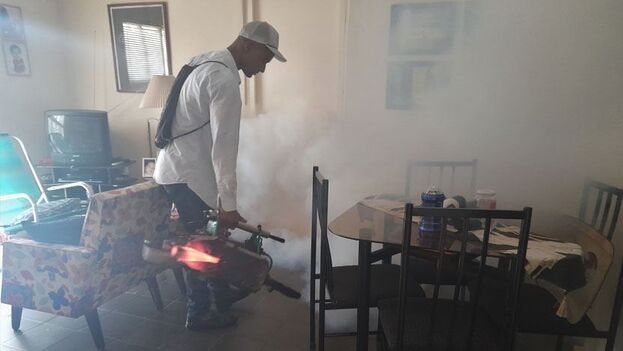
In addition, the newspaper says, in the municipalities “it’s common that people won’t open their homes for fumigation or inspection,” and the authorities must “juggle” the few supplies available to execute the endless “campaign against the mosquito.” The most common excuses, they point out, are that the resident “has an asthmatic child,” “is busy” or “is cooking.”
As if that weren’t enough, mosquito nets, essential to prevent being bitten at night, are lacking on the Island, and patients don’t usually respect the rest prescribed for them. continue reading
The provincial deputy director of Hygiene, Epidemiology and Microbiology of Ciego de Ávila, José Luis López González, described the fumigation process in the municipalities. First, a “blockade” is made around the residence being diagnosed, consisting of the application of an “adulticide” poison against the Aedes aegypti mosquito in neighboring houses, allowing “the use of the chemical product without oil,” which is also in short supply.
Then, they proceed to fumigate with sprinklers only the house and not the block. Regarding this measure, López González admits that “the population distrusts its scope,” although he assures that “it is effective. Any mosquito that lands, dies.”
The authorities insist that most of the foci are located inside the houses, in containers with water or for animals, and there are a few, like Maricel Ramos, one of the supervisors of the fumigation operation of the Onelio Hernández popular council, in Ciego de Ávila, who believe that the greatest problems come from “garbage cans, vacant lots, wastewater and leaks.”
The article criticizes those Cubans who have decided not to go to hospitals and who, in many cases, don’t show up in the infection statistics. Most of the patients diagnosed as serious, says López González, have already stayed at home several days without going to the doctor.
Invasor recognizes that interruptions in the counting of cases due to lack of laboratory reagents are common, which, “logically,” lowers the rates of infection. In six hours of daily work, the Provincial Microbiology Laboratory can process about 50 samples, but without the necessary conditions and materials, the statistics don’t really reflect the seriousness of the situation. “The numbers, sometimes, don’t tell the whole truth,” says the provincial newspaper.
In Ciego de Ávila the Suma technique (Ultra Micro Analytical System) is implemented, which has allowed analyses to be carried out in the municipalities as well, “without major setbacks other than the ups and downs with the reagents,” explains the newspaper.
The authorities have come to accept home treatment, a “wild card” — as the newspaper calls it — to reserve hospital facilities for the most severe patients, who have vomiting, diarrhea, abdominal pain and bleeding, as well as for children.
To all this, at the meeting of the temporary working group for the control of dengue and covid-19, the Minister of Public Health, José Ángel Portal Miranda, explained with the usual triumphalism that the disease had decreased by 13.2% compared to the previous week.
He didn’t mention Ciego de Ávila, Camagüey and Isla de la Juventud, which reported more cases. Nor at this meeting did the country’s leadership offer the number of infections on the Island, a figure that the Cuban government has treated with the greatest secrecy.
Translated by Regina Anavy
____________
COLLABORATE WITH OUR WORK: The 14ymedio team is committed to practicing serious journalism that reflects Cuba’s reality in all its depth. Thank you for joining us on this long journey. We invite you to continue supporting us by becoming a member of 14ymedio now. Together we can continue transforming journalism in Cuba.
The Cuban Baseball5 team finished as leader of key A, waiting to meet its Super Round rival. (WBSC)
14ymedio, Havana, 10 November 10, 2022 — Cuban officialdom has found in the I World Baseball5, a street version that combines baseball and softball, a reason for joy despite the abandonment of athletes in recent months and the failures of Cuban baseball. “The team sweeps its rivals of the moment,” Jit published about the performance of Cuba, which remains undefeated in the tournament held in Mexico.
The official media proclaimed on Wednesday that Cuba “had no mercy” for the host, giving it the “first super knock-out of the series with a 21-0 slate.” During the games, the Cubans scored “a whopping 53 runs and the opponents only got three.” Orlando Amador, Briandy Molina and Roivelis Núñez are Cuba’s best players.
This Thursday, Cuba closed the qualifying phase in the Zócalo of Mexico City with a couple of 2-0 and 5-2 wins over Japan, which placed it as the leader of key A, waiting to meet its Super Round rival.
These performances have placed the Cuban team as a serious candidate to take the title. It goes forward with the best run differential of the +80 event, which surpasses by 54 its closest rival, Taipei.
The other side of the coin is the baseball classic. On Monday, the Under-18 team culminated its participation in the Pan American Championship with a 0-9 whitewash, the same as Nicaragua in La Paz, Baja California (Mexico).
The whole of the Island not only had to swallow the bitter pain of defeat, it was also left out of the 2023 World Cup. “We did not fulfill the goal,” continue reading
accepted manager Severo Crespo. “It was a failure for the delegation. We did everything we could to achieve that long-awaited classification, but it was impossible for us. Now we have to gain experience from the defeat for future confrontations.”
The Cuban team should discuss the “Consuelo Round, a similar story to the one experienced last month by the U-23 national team during the World Cup based in Taipei, China,” the Cuban News Agency published.
The regime cannot hide the escape of its athletes. The exodus of athletes, “like those who have retired, won’t end in the current year,” warned journalist Francys Romero on the BaseballFR! website. “More than a hundred former athletes or players have decided to leave Cuba by any means.”
On Saturday, pinareño baseball player Tony Guerra arrived in the United States. With experience in five national series, this infielder will reside in the Houston area, Texas, and will seek new opportunities within baseball. Romero specified that the athlete’s journey took place on the “via Nicaragua to Mexico.”
This Wednesday, Serguey Pérez Rousseau, son of the player of the same name and a reference for more than a decade with the Havana team, Industriales, left Cuba to settle in the Dominican Republic. “Many of those who come to other places looking for a contract improve their conditions in countless ways that don’t exist on the Island, such as training methods and nutrition,” Romero stressed.
Translated by Regina Anavy
____________
COLLABORATE WITH OUR WORK: The 14ymedio team is committed to practicing serious journalism that reflects Cuba’s reality in all its depth. Thank you for joining us on this long journey. We invite you to continue supporting us by becoming a member of 14ymedio now. Together we can continue transforming journalism in Cuba.
Yudeimi Rodríguez recounted the nightmare she lived with her family and two other Cubans in an attempt to reach the United States on a boat. (Image Captura)
14ymedio, Havana, 10 November 2022 — The younger son of Yudeimi Rodríguez died in her arms. The raft on which she traveled with her husband, Yoandri Espada, her two sons and two other Cubans, “burst” on the crossing. One passenger fell into the sea, and they couldn’t rescue him. The rest were adrift for four days. As she herself told América TeVé, broken from grief, her eleven-month-old baby “couldn’t take it and died.”
The group left the Island on October 30 through the port of Mariel, the young woman said, but the precarious boat shattered. “The waves were immense, the sea turned black, there was a strong current.”
The balseros [rafters] were rescued by a fisherman. In a video disseminated on social networks you can see how her husband asks for help from the approaching boat, with her dying and the remains of the raft surrounded by sharks.
The two deaths are in addition to the eight deaths of Cuban balseros announced last Monday by the sub-commissioned officer of District Seven, Nicole Groll. Of these ten, seven lost their lives at the end of September after the boat on which they were crossing was shipwrecked near the island of Stock, neighboring Key West. continue reading
Republican congress members María Elvira Salazar and Mario Díaz-Balart, recently re-elected, now manage the release of Yoandri Espada, while the other balsero was released to a family in Florida. Meanwhile, Yudeimi and her daughter have received medical aid for their dehydration.
Yudeimi Rodríguez and her daughter Claire, 11, who have sun-induced injuries, are being helped by the religious organization Hermanos de la Calle and a Cuban, Manuel Milanés, who urged people to support this family.
Rodríguez would like to go back in time, but he accepts, in tears, that his little one is “no longer here” and “we have to move on.”
The case was made public on the day the American Coast Guard confirmed the rescue by a good Samaritan of a group of 13 balseros in front of Elbow Cay, Bahamas, in the middle of Hurricane Nicole, which degraded to a tropical storm after making landfall in Jacksonville, Florida. The migrants were transferred to the WilliamFlores ship and were not “reported injured,” the Coast Guard posted on Twitter.
United States authorities have warned that balseros who are detained on the high seas will be returned to their country of origin. So far in November, the Coast Guard has repatriated 227 Cubans in four groups.
Translated by Regina Anavy
____________
COLLABORATE WITH OUR WORK: The 14ymedio team is committed to practicing serious journalism that reflects Cuba’s reality in all its depth. Thank you for joining us on this long journey. We invite you to continue supporting us by becoming a member of 14ymedio now. Together we can continue transforming journalism in Cuba.
 14ymedio, Madrid, 15 November 2022 — The reservoirs of Guantánamo province are in a critical situation. According to an article in the official newspaper Venceremos, in all they accumulate 29,851,442 million gallons of the 88,233,466 their million capacity; that is, they are only filled at 33%.