The report of an official state newspaper doesn’t clarify that its visit takes place more than two weeks after the denunciation in 14ymedio.
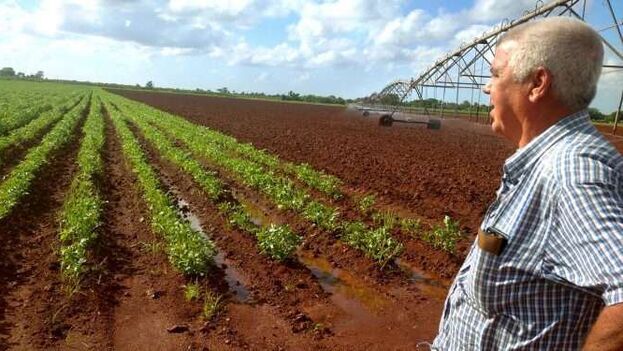
14ymedio, Havana, December 15, 2022 — The authorities of Artemisa Province have recognized that they had to destroy more than 82 acres of potatoes in Alquízar, which spoiled due to the lack of irrigation caused by the blackouts of the last months. This is indicated in a report published this Wednesday in El Artemiseño, which, however, attacks 14ymedio, the first newspaper to report on the situation of the potato crop.
As this newspaper revealed on November 28, from the residents of the area themselves, the cuts in electricity required a change in the irrigation cycles, which damaged a large part of the crop in the Cuba-Mexico Friendship Cooperative of Agricultural Production. Specifically, of the planting of 398 acres, divided into four quadrants, three of the potato crops spoiled.
In addition, the locals reported that the rotting potatoes didn’t let them breathe.
For this reporting, el Artemiseño described 14ymedio — a newspaper censured by the regime and to which there is no access from the Island without VPN — as “fake news that flies the flag of serious journalism.”
“In search of the truth, a group from the newspaper [ElArtemiseño] went to the area affected, which didn’t smell at all,” says the report of the official newspaper, without clarifying that their visit took place more than two weeks after the report by 14ymedio.
Similarly, ElArtemiseño, citing sources of the regime and blaming the United States embargo, criticizes: “Those who call themselves ’speakers of the truth’ omitted in their report the damage caused by the blockade to the agriculture and energy sectors, whose losses amount to more than 270 million and 185 million dollars respectively, just between August 2021 and February 2022.”
The publication acknowledges, however, the destruction of the crop and points out: “We did know that before proceeding with the demolition of the planting, the residents of the area were allowed to enter the field to take advantage of everything possible for animal feed.” And it concedes that in the text of this newspaper “one thing bordered on reality: the energy deficit played a part.” continue reading
Quoting Fernando Ravelo Jaime, president of the cooperative, ElArtemiseño said: “Five days after planting, the potato must be lightly watered and then maintain a stability between 200 and 300 cubic meters so that it germinates and does not rot under the earth.” To irrigate one quadrant, with 27 acres, he continues, “you need 18 to 20 hours of stable flow, at 250 cubic meters. That is, it was taking 80 hours to irrigate four quadrants, which was not possible.”
The result was that “only 60% of the potatoes germinated.” Officials told the official newspaper that “only after really knowing the magnitude of the problem did crop protection measures begin to be adopted.”
Now, of 205 acres planted with national seed, the newspaper says, “there are 124 standing.” In the “damaged area, high-yield corn was planted that should provide about 74 tons per acre,” which, it explains, “allows taking advantage of the fertilized soil to harvest the tender grain in the same period that the potatoes would have needed to sprout.”
ElArtemiseño points out that the director of the Electric Company has assured it that this type of incident will not be repeated, because “today the situation in the country is different, due to the increase in the maintenance of thermoelectric power plants and the diesel and fuel generators, which allow between 21 and 22 hours a day of electricity in the province.” With this guarantee, the local newspaper prophesies that “Alquízar will not stop sowing the 420 acres it has planned for the campaign. The seed is in the municipality and the sowing is ready in another machine.”
Translated by Regina Anavy
____________
COLLABORATE WITH OUR WORK: The 14ymedio team is committed to practicing serious journalism that reflects Cuba’s reality in all its depth. Thank you for joining us on this long journey. We invite you to continue supporting us by becoming a member of 14ymedio now. Together we can continue transforming journalism in Cuba.
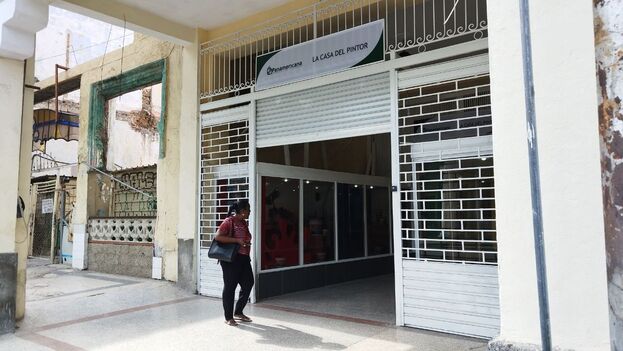
La Casa del Pintor [the Painter’s House], the new foreign currency store on Belascoaín Street in Havana. (14ymedio)14ymedio, Juan Diego Rodríguez, Havana, 15 December 2022 — Throwing a bucket of water off the balcony, burning a doll or painting the house are some of the traditions that Cubans turn to every December so that, when January arrives, the problems of the previous year don’t pass to the new one. It is a list that in 2022 will be shorter due to the high prices involved in repainting the walls in the homes of the Island.
Just this last month of the year, a shop with paints, thinners and brushes opened its doors on Belascoaín Street in Havana. Belonging to the Pan American chain of the Cimex corporation — owned by the Cuban military — the shop is called La Casa del Pintor [The Painter’s House]. The place stands out with its shiny stained-glass windows, its new floors and the fact that all the lamps have bulbs, in the middle of a street marked by deterioration and homes in danger of collapse.
The sparkling appearance of the store caused many curious people to approach this Wednesday morning to inquire about the products it has for sale, but most left when employees clarified that it is a store that takes payment only in freely convertible currency (MLC). “It’s in foreign exchange and very expensive,” said one of the frustrated customers who had his heart set on the 5-gallon cans of interior paint.
With the Devox Caribe S.A. brand, the paint containers offered in the store have a label with the slogan “Proudly Cuban product,” which refers to an industry located in the Mariel Special Development Zone (ZEDM) as the origin of the product for sale. However, three years ago, when the official press announced the start-up of the plant, it catalogued it as a “Mexican company” that used “superior technology for the manufacture of paints and coatings.”
“The paint is brought from Mexico, the technology of the factory is also Mexican, and the labour is Cuban,” clarifies an employee by phone from the company’s office in the Miramar Business Centre. Until very recently, the product was only marketed in mixed markets in foreign exchange, such as the 5th and 42nd shopping center, in the municipality of Playa, and the Plaza de Cuatro Caminos. “La Casa del Pintor is the first store, exclusively, for our products,” he says. continue reading
“This is where we have the largest assortment because in Cuba it’s complicated to find a variety of colors,” he continues. “It’s the best paint being sold right now in the country,” he says, while specifying that all prices are, so far, in MLC (freely convertible money). As long as the Island does not produce the raw materials needed for manufacturing, the industry needs to buy its inputs abroad in foreign currency.
An article published in 2019 by Cubadebate said that “Devox Caribe S.A. is a subsidiary of the Mexican company Devox-General Paint, which has exported its products to Cuba for 25 years.” At the bottom of that text a foreboding comment cautioned: “I will applaud fervently when I see this paint in our stores at an affordable price, or at least one that is not so expensive.” Presently, a 5-gallon can of white interior paint costs 76 dollars on Belascoaín Street.
“It’s expensive, but the paint is good,” recognizes El Chino, a construction worker who, along with three other men, have formed a brigade to repair houses. “It’s the best there is right now in Cuba because it’s not really from here, but they bring it and package it before selling.” The self-employed man considers that “the products from the state factories are not good. They have a very limited color range and sometimes are adulterated.”
El Chino bought a 5-gallon can of white “acrylic latex with matte and anti-mold finish” for an exterior wall. “It was very thick and seemed to be of good quality, but time will tell. Anyway, the price is high, and that increases the total price we ask of the customer. If you add labour and other supplies, painting a two-bedroom apartment with living room, kitchen and bathroom doesn’t drop below 300 dollars.”
“The advertising on the label is doing more harm than good, because people prefer imported paint,” he says. “When a construction or repair product says that it’s made here, customers are frightened because they now imagine the diversion of resources, the water that was added to it to ’fulfill the plan’ and all the mismanagement.”
But even if the quality is doubtful, domestically produced paint is scarce and has high prices. A 5-gallon can of white interior paint of the Cuban brand Vitral costs $79 on an official classifieds site intended for emigrants to buy products for their relatives on the Island.
The state management company isn’t doing well because of the deficit of raw materials, and two years ago its director, Luis Alberto Suárez Ibarra, recognized that in the ZEDM they had “two competitors: Devox Caribe S.A. and Tot Color,” which motivated them to be more efficient. But their products have been diminishing in the markets instead of increasing their presence.
For families who don’t have foreign exchange income, the alternatives to start a new year with retouched walls include appealing to lower quality products such as quartz powder or whitewash, a type of coating that is not very durable and is adulterated in the informal market. However, the most popular option these days is simply to give up painting the home. “The proud Cuban thing now is to wait,” recommends El Chino.
Translated by Regina Anavy
____________
COLLABORATE WITH OUR WORK: The 14ymedio team is committed to practicing serious journalism that reflects Cuba’s reality in all its depth. Thank you for joining us on this long journey. We invite you to continue supporting us by becoming a member of 14ymedio now. Together we can continue transforming journalism in Cuba.
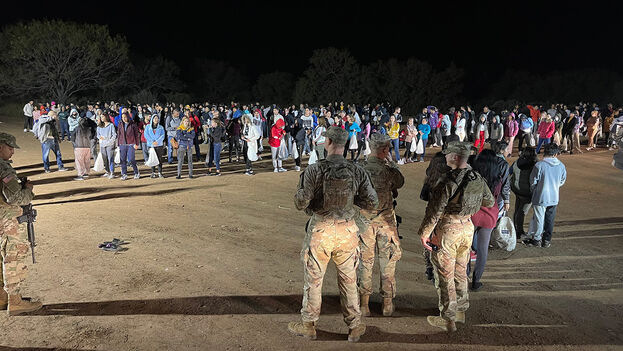
In recent days, large groups of migrants have entered through Eagle Pass and El Paso (Texas) and have surrendered to the Border Patrol. (@BillFOXLA)
14ymedio/EFE, Havana, 13 December 2022 — In just 48 hours, 16,000 irregular migrants have entered from the Mexican border to the United States, according to Border Patrol data. The officers have the order to “process faster” and take at least 10,000 people out of custody “by any means,” before Tuesday’s visit to El Paso (Texas) by the Secretary of National Security, Alejandro Mayorkas, said journalist Ali Bradley.
On Monday, the largest crossing of a single group made up of 1,500 migrants through El Paso was recorded. “The Border Patrol has more than 5,000 undocumented people in custody and left hundreds free on the streets of the city,” said journalist Bill Melugin, of Fox News. These people spent the night outdoors with temperatures below 32 degrees Fahrenheit.
For El Paso, an average of “2,460 illegal daily crossings” of groups of Cubans, Nicaraguans, Ecuadoreans, Venezuelans, Guatemalans and Hondurans have been recorded, according to officer Peter Jaquez. A week before the end of Title 42, which addresses the expeditious return of migrants, border cities and charitable organizations feared the daily and massive arrival of migrants as has happened in El Paso and have asked the Biden Government for help to receive these families.
Migrants are being processed and released, according to American journalists. (@USBPChiefEPT)
“We were asked for support and received family groups. We give them a way to work,” Ana Laura Rodela, general coordinator of the Leona Vicario Integration Centre for Migration, told EFE on Monday. “Everyone who enters can have a formal job. Right now there are three trucks arriving, with 600 people. They are families mainly from Ecuador and Nicaragua. We will have to disperse people in this shelter because they won’t all fit here.” continue reading
Last Thursday, 535 Cubans swam across the Rio Grande and surrendered to the Border Patrol in Eagle Pass, Texas. It was then the largest group that had suddenly entered the United States. The Cubans were gathered in an area near the Lehmann ranch along with 74 other migrants from Nicaragua, 49 from Colombia, three from Ecuador, three from Mexico and 12 unaccompanied children.
Speaking to the ABC channel, Lieutenant Chris Olivarez, of the Texas Department of Public Security, warned that “El Paso had never experienced anything like this massive migration. The numbers are historic. We must find a way to stop this, a policy needs to be implemented.”
NEW: In Brownsville, TX we once again witnessed Border Patrol mass releasing hundreds of migrants at a parking garage. A NGO across street then helps organize their travel around the US. BP source tells me they release hundreds here almost daily, sometimes 10 busloads in a day. pic.twitter.com/mpgNTSkErU
Texas Congressman Henry Cuéllar, for his part, asked President Biden for greater security at the border and said that the problem is that criminals are taking the opportunity to do business by taking migrants across the border, because it is open.
On the border of Chihuahua (Mexico) there are several groups of migrants organizing their entry into the United States. In Matamoros, Tamaulipas, a Mexican border city on the other side of Brownsville, Texas, there are thousands of migrants waiting for December 21, the day Title 42 comes to an end.
Title 42 is a measure ordered by the Donald Trump Administration (2017-2021) under the excuse of the pandemic, which has allowed the expeditious expulsions of more than 2.7 million migrants.
Several media outlets have reported that the Department of Homeland Security (DHS) seeks to obtain an additional 3 billion dollars from Congress to deal with the increase in the arrival of undocumented migrants once Title 42 is cancelled.
Translated by Regina Anavy
____________
COLLABORATE WITH OUR WORK: The 14ymedio team is committed to practicing serious journalism that reflects Cuba’s reality in all its depth. Thank you for joining us on this long journey. We invite you to continue supporting us by becoming a member of 14ymedio now. Together we can continue transforming journalism in Cuba.
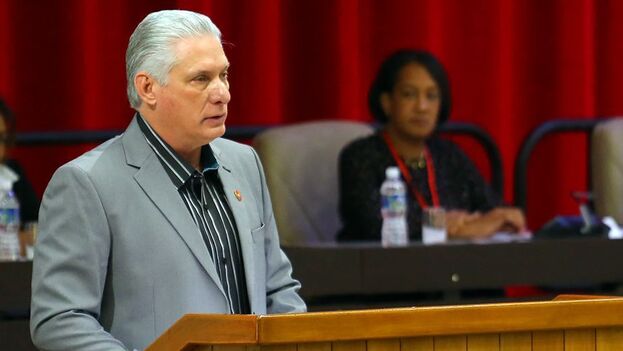
Díaz-Canel stated that he felt guilty “for not having been able to achieve, as the country’s leader, the results that the Cuban people need.” (Cubadebate)
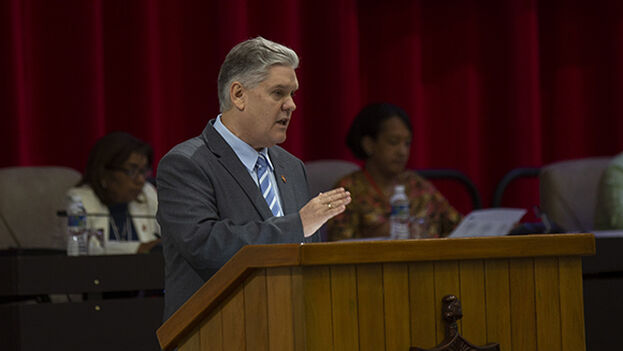
14ymedio, Juan Izquierdo, Havana, 12 December 2022 — With a tearful speech about his “personal dissatisfactions” as the head of the Government and in the presence of Raúl Castro, Miguel Díaz-Canel was accountable this Wednesday, at the Havana Convention Center, for his management of the country during 2022.
To the usual justifications to explain the economic drift of the Island — the US ’blockade’, the aftermath of the coronavirus pandemic and the disasters caused by Hurricane Ian and the explosion of the Supertanker Base — he added, with care not to offend Russia, “the new problems generated by the conflict in Europe” and international inflation.
Faced with the economic crisis, he said he felt like the “main person responsible,” but nuanced this by stating that he had limited himself to assuming “continuity from a dialectical perspective.” He did not miss an opportunity to rebuke local and provincial bureaucrats and clarified that, although he knows what the problems are, he hopes that “no one will use them as justification.”
The National Assembly of People’s Power, he warned, will continue in 2023 its “important legislative work” to enact other laws that “develop the Constitution” and address the “difficult Cuban daily life.”
The president was slow to enter into economic matters, and when he did it was to repeat the opinion of the Minister of Economy, Alejandro Gil, during the plenary of the Communist Party: the situation is “difficult”; the Government no longer knows where to extract the necessary currency, and the measures of the Ordering Task* were not enough to alleviate the financial disaster. continue reading
He spoke cryptically about the “increase in the income of natural people without productive support” and was alarmed by the “partial dollarization of the economy,” which has had a significant impact on the rise in product prices.
After vaguely criticizing Washington for keeping the ’blockade’ as a “weapon of coercion, cruel, illegitimate and immoral,” Díaz-Canel praised the Biden Administration. He said he was interested in the “two million people of Cuban origin and their descendants” who live in Florida and stated that he wanted to “promote broader ties” with the US.
He mentioned the technical advice offered by US authorities during the explosion of the Supertanker Base, despite the fact that the official press initially denied the existence of such aid and then considered it “insufficient.”
Díaz-Canel also recalled that the US donated 100 fire suits, in addition to fire and protection equipment, which arrived in Cuba a week ago. It was a “welcome and accepted” initiative, he said with modesty.
In addition, he spoke of the two million dollars sent by the United States Agency for International Development (USAID) — one of the US institutions that the regime has criticized with the most emphasis — after the passage of Hurricane Ian through Western Cuba. “A help without conditions,” he said, attributing it not to USAID but to the Biden Government, “for which we also are thankful and accept it.”
However, he did not miss the opportunity to regret the “open policy of subsidies and attempts to destabilize the country,” paid with “tens of millions of dollars from the federal budget.” The US “trained individuals to commit violent acts against Cuba,” he said, referring to the accusations launched by Cuban Television against alleged criminals against the State captured by the police.
Finally, he recognized that despite everything, Cuba and the US are experiencing a kind of thaw, although with “very discreet steps, aimed at directing bilateral cooperation for compliance with immigration agreements and also in other priority areas between both countries.”
About Vladimir Putin’s invasion of Ukraine, he limited himself to also blaming the US and its “harmful imperialist determination to try to divide the world,” although he admitted that the war complicated the global economic situation.
Regarding his political influence in Latin America and the possibility of alliance with the governments of the Latin American “new left,” he welcomed the rapprochement of Cuba by several presidents, such as Gustavo Petro and Andrés Manuel López Obrador. The “greetings” also reached Daniel Ortega, Luis Arce and Nicolás Maduro, and discreetly pointed out the “mutual benefit” of relations with Argentina, but there was no reference to Chile, with whose president, Gabriel Boric, Havana doesn’t sympathize.
The president avoided mentioning, of course, the former president of Peru, Pedro Castillo, whose self-coup did not merit a comment from the Cuban leadership until two days later.
At the end of the speech– and without finally deciding on triumphalism or self-criticism — Díaz-Canel stated that he felt guilty “for not having been able to achieve, as the country’s leader, the results that the Cuban people need for the desired and hoped-for prosperity.”
*Translator’s note: The “Ordering Task” is a collection of measures that include eliminating the Cuban Convertible Peso (CUC), leaving the Cuban peso as the only national currency, raising prices, raising salaries (but not as much as prices), opening stores that take payment only in hard currency which must be in the form of specially issued pre-paid debit cards, and a broad range of other measures targeted to different elements of the Cuban economy.
Translated by Regina Anavy
____________
COLLABORATE WITH OUR WORK: The 14ymedio team is committed to practicing serious journalism that reflects Cuba’s reality in all its depth. Thank you for joining us on this long journey. We invite you to continue supporting us by becoming a member of 14ymedio now. Together we can continue transforming journalism in Cuba.
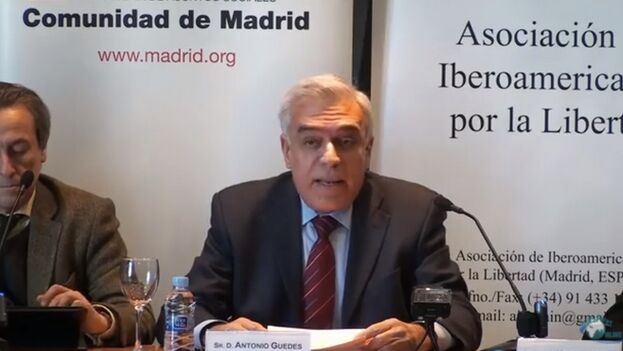
“It is one thing to be exiled and another to be an immigrant, to improve life or for issues like wars and cataclysms,” says Guedes. (The New Herald/Capture)
14ymedio, Madrid, 13 December 2022 — Cuban physician Antonio Guedes, founder of the Liberal Union, told 14ymedio on Tuesday that the controversy generated by the presentation in Miami of the book Cuban Privilege (Cambridge University Press, 2022), by the American sociologist Susan Eckstein, was a natural response of the community of Cuban residents in the United States.
“In the face of an issue of this nature, within an exile community that has suffered so much and still suffers, it is normal and even necessary to offer answers, let’s say sociological, as long as they are peaceful,” Guedes said from Madrid.
Cuban Privilege, a study of the migration policies of the United States toward Cuba since 1959, poses — supported by archives and state documents — that Cuban immigrants have enjoyed multiple political, social and economic benefits from which other groups of migrants have been deprived under the same conditions.
Both the postulates of the book and Eckstein’s favorable vision of the Cuban regime motivated, during the presentation of the book last Friday at the International University of Florida (FIU), a protest that was held in the vicinity of the campus.
On the university campus, where the academic debate between Eckstein and Cuban politician Orlando Gutiérrez-Boronat took place, several of the attendees shouted slogans of “Down with communism!” “Free Cuba!” and “Homeland and life!” in addition to expressing their annoyance with the opinions in Cuban Privilege during the question-and-answer period. continue reading
Guedes is familiar with the work of Eckstein, who is the author of several books on Cuba, among them, the also controversial Back from the Future: Cuba under Castro. “She has always been one of the many left-wing academics who, from American universities, have done and do horrible damage to the exile,” he says. In addition, Eckstein has demonstrated several times her “benevolence toward the communist dictatorship, from the apparent bourgeois equidistance.”
Regarding the presentation of the book at FIU, the doctor welcomed the fact that Eckstein found “a high-level response that demonstrates the false premises and gaps in her book,” such as the one offered by Gutiérrez-Boronat, who put in context several of the statements that the professor put “lightly.”
However, Guedes says, it is logical that a book like Cuban Privilege will awaken the anger of the Cuban-American community. The reaction is comparable to that in other contexts where people have experienced dictatorships and totalitarianism.
“What would happen in Israel if a book had been presented that remotely questioned the Holocaust?” the doctor asks. “What would have happened in Chile, if positive Pinochet things were considered? Or in today’s Spain, governed by the Spanish Socialist Workers’ Party and Podemos, about Franco? Or perhaps in today’s American universities, a presentation against abortion rights or gender ideology?”
However, it is also necessary to qualify. According to Guedes, there has been a “use, abuse and fraud” of the Cuban Adjustment Act for at least two decades. “If someone arrives at the U.S. border and requests that a law be applied to him conceived for persecuted people — or at least people discriminated against or marginalized for political, religious reasons, etc., and not for those who emigrate for economic reasons — and then after a year and a day they return to the ’house’ of their repressor, without apparent fear, as a mula [mule], a tremendous inconsistency is committed,” he says.
This is frequent and unjustified, although it is true that many Cubans had to leave Cuba when their properties were confiscated or nationalized. In that sense, the expropriation process executed by Castro was closely linked to the political sphere and, therefore, was a reason for reception in the United States. But this is not a frequent case, and the only reason to invoke the Cuban Adjustment Act should be “intimately linked to the lack of freedom.”
“All that is an incoherence, a fraud and a bad example for other groups and societies,” Guedes insists. “It is one thing to be exiled and another to be an immigrant, to improve life or for issues like wars and cataclysms.”
This does not mean, the doctor assures, that the Cuban Adjustment Act should be eliminated. “But it should be modified and made clear to those who take advantage of it that they cannot happily return to where the jailer is supposed to be,” he says.
Eckstein dedicates not a few pages of her book to the “false argument” of political persecution. But if Guedes and the academic agree on anything, it’s on the fact that the migration mechanisms must be applied correctly. “In this way, not only is the spirit of the act being complied with and fraud greatly diminished,” says the doctor, “but a message (an example) is also sent to the rest of the world and, incidentally doesn’t help support the repressive machinery, which is the cause of Cuban exile and emigration.”
There is much more to discuss about CubanPrivilege, such as Eckstein’s silence about the contributions of the Cuban community to American culture and even to the urban development of cities like Miami, or the “repressive nature of Cuban communism.”
There are also good reasons for revising the Cuban Adjustment Act, but “it should not be suppressed,” Guedes says. It should be modified or applied well, “because the causes for migration persist with the communist dictatorship.”
Translated by Regina Anavy
____________
COLLABORATE WITH OUR WORK: The 14ymedio team is committed to practicing serious journalism that reflects Cuba’s reality in all its depth. Thank you for joining us on this long journey. We invite you to continue supporting us by becoming a member of 14ymedio now. Together we can continue transforming journalism in Cuba.
The Tribe Caribe Cayo Hueso Hotel opened on Saturday in Havana. (14ymedio)
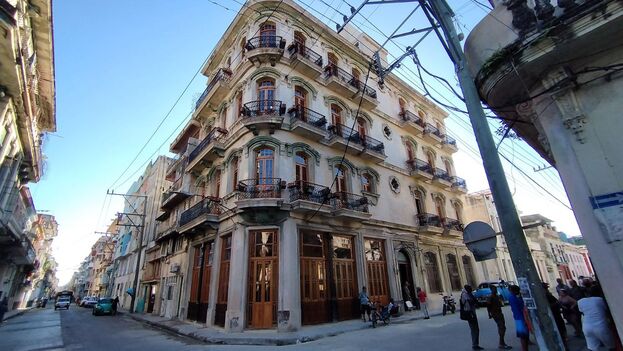
14ymedio, Juan Diego Rodríguez / Olea Gallardo, Havana, 13 December 2022 — The neighbors of the hotel Cayo Hueso, in Centro Habana, watched with intrigue, for months, the remodeling of the building located at Aramburu 253, at the corner of Neptune. Little by little, the property — built in the 1930s and in decline, like all its surroundings — was becoming a luxurious establishment, judging by what could be glimpsed through the windows of the ground floor.
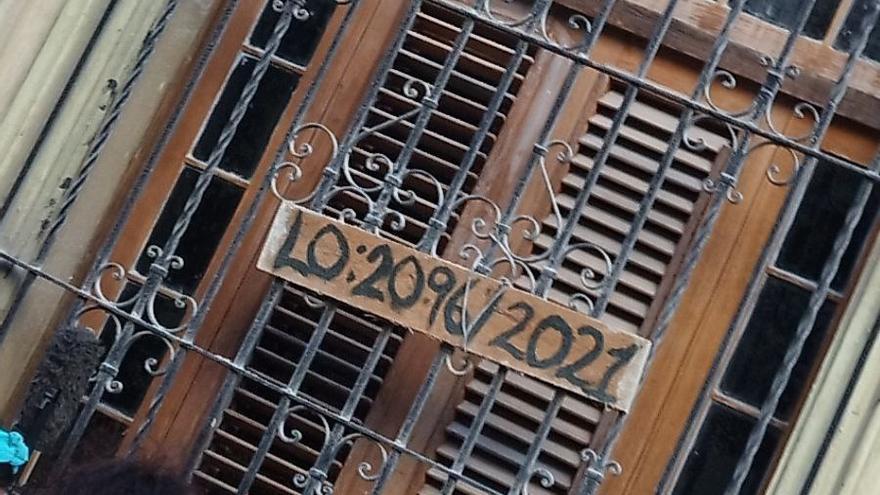
Nothing, however, reported its future use, and the only sign it displayed was the work license number written on a piece of cardboard and poorly hung on a window. The gossip began to flow without confirmation: a yuma had bought the property and was turning it into a hotel.
And not only that, but he had bought other houses and planned to relocate everyone who lived there.
If it was true that the project was for an American, in any case he had to be influential. In this regard, several residents of the place tell another anecdote. One day a cement truck was parked in front of the building, and a police patrol car arrived to ask the construction workers for identification. One of them phoned someone, and, after having a brief conversation, passed the device to the policeman: “Someone wants to talk to you.” “The policeman changed his expression, apologized, and they never bothered the workers again,” says a neighbor who asks for anonymity.
Thus, a name began to be repeated during the last few weeks by the neighbors. They dared to say that behind the project, headed by two American businessmen, was none other than Raúl Castro’s daughter. “There the meter is running, but it’s not for the Americans. That’s not theirs, but Mariela’s,” the residents said confidently, insisting they saw her on Friday inside the building.
True or not, no one saw Mariela Castro last Saturday, when the hotel was inaugurated and several unknown people were cleared. To begin with, its name: Tribe Caribbean Cayo Hueso (Key West). continue reading
The only sign that the establishment had was the construction license number written on a piece of cardboard and poorly hung in a window. (14ymedio)
On its webpage, where you can now book a room for 150 to 550 dollars a night — booking a full floor costs 1,000 — the “founders” appear: an American investor, Chris Cornell, and music producer Andrés Levín, born in Venezuela but with a US passport. In Cuba, Levin is known for participating in several cultural projects such as the Havana Biennale, in addition to his marriage to Cuban-American singer Cucú Diamantes.
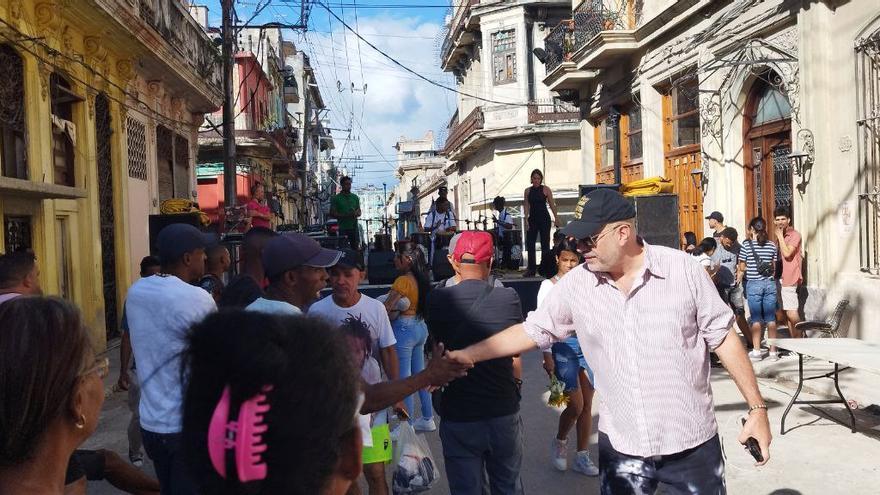
Hence, he was the most recognizable figure on Saturday, at an unusual “neighborhood” inauguration party, which lasted six hours and included an exhibition by photographer Juan Carlos Alom, the sale of items by private businesses such as the Clandestina brand and musical performances. “Here in Cuba this is not allowed for just anyone,” commented a young man, who stopped humming what they were singing on the stage: El Necio [The Fool], by Silvio Rodríguez, to the rhythm of salsa.
Levín, with a cap and characteristic dark glasses, came and went, smiling, greeting with familiarity the neighbors gathered in front of the street stage, for whose installation the traffic on Aramburu Street between Neptune and San Miguel was closed off.
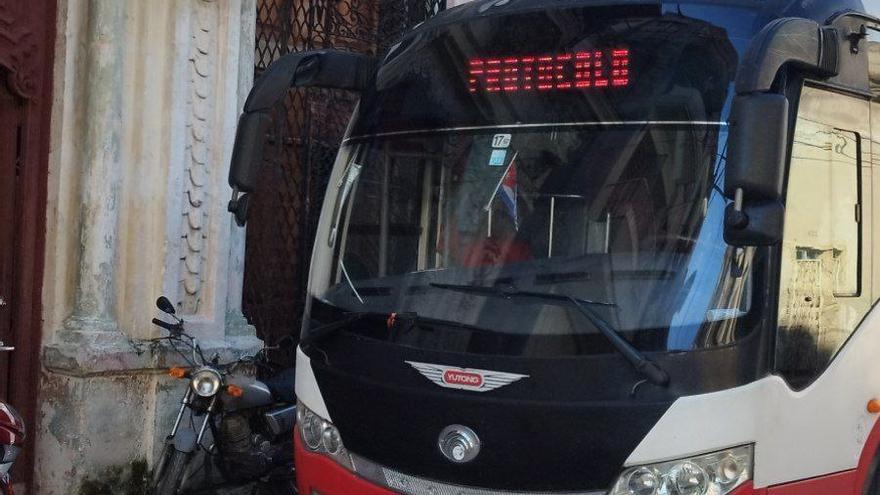
Nearby was a bus with the electronic sign “PROTOCOL” in capital letters, and the various Lada vehicles with drivers normally used by public officials, parked nearby, were obvious.
A group of young people dressed in T-shirts saying “Tribe Caribe” prevented people from entering the hotel and monitored the movements of the curious.
Tribe Caribe is a company registered on April 30, 2021, in Florida, with the address 1521 Alton Road 460, in Miami Beach. Levín and Cornell both appear as directors. The company, linked to the world of music, affirms that it “promotes and distributes exceptional original Caribbean content,” according to its website, and is “a proactive force, a voice and an educator in the continuous emergence of the rich cultural offerings of the Caribbean.”
On the hotel’s page, Chris Cornell points out that he is “a long-time professional entrepreneur and investor in arts, creative businesses and impact projects, who provides momentum and entrepreneurial spirit to the project,” and who “has directed all the important decisions of restoration, construction and design of the hotel, and is deeply aware of how these decisions affect the neighborhood, the local cultural identity and the preservation of the artistic heritage of Cayo Hueso.”
Andrés Levín came and went smiling, familiarly greeting the neighbors gathered in front of the street stage. (14ymedio)
Of that mysterious investor, with unknown biography and background, there are no traces other than his alleged signature in the office in North Palm Beach, Florida, where the Tribe Caribe company was created. Of course, his name and surname coincide exactly with those of the famous singer of the Audioslave band, the first American rock group to play live in Cuba, in May 2005, at a venue none other than in the Anti-imperialist Bandstand, and for hundreds of thousands of fans on the Havana Malecón.
Levín emphasizes that he has been nominated for 26 Grammy awards — he won one in 2009 for the recording of the musical In theHeights — and that he has “propelled initiatives and produced numerous cultural events in Cuba, including TEDxHabana.”
Founder of the Afro-Cuban band YerbaBuena, the producer has collaborated, as mentioned on the official website, with artists such as Miguel Bosé, Aterciopelados, Orishas, David Byrne, Caetano Veloso, D’Angelo, Julieta Venegas and Tina Turner.
In addition, he is the producer of several film projects such as Amor crónico, directed in 2012 by the Cuban Jorge Perugorría, with whom he has a personal friendship, according to the photographs that show them together and messages.
An actor who prefers not to give his name and who was in business with Levin years ago, tells 14ymedio that both had agreed to collaborate on several projects, but that the producer cut off all communication after the artist’s participation in the demonstration on November 27, 2020 in front of the Ministry of Culture.
At that time, the actor attended two parties organized by Levín. One, in a house that he had rented in the municipality of Playa, near 5th Avenue, and another, in Siboney, where the mansions expropriated by the main architects of the Revolution are located, to celebrate the birthday of the producer’s father.
The source did not see, on any of these occasions, “anyone who was a heavyweight in politics,” but just “plain show business.”
Nearby was a bus with the electronic legend in capital letters “protocol,” and the various Lada vehicles with drivers were obvious. (14ymedio)
But if he is associated with Mariela Castro, it is because Levín himself appears on social networks next to her, for example, in an “anti-homophobia” gala held in 2016. The Spanish singer Marta Sánchez, who performed on that occasion, also posted on Facebook about it: “Thank you Cuba for so much love and recognition! Thanks to Mariela Castro for that support to those who choose in this country to love as they want! Thanks to Andrés Levín for counting on me!”
In addition, the producer himself mentions Raúl Castro’s daughter in an interview granted in 2016 to Tablet, a magazine on issues of the Jewish community (the producers’s roots, whose parents, “very left-wing” according to their own description, were Argentines exiled in Caracas).
“It seems to me that I was at a dinner with you a few years ago and there were secret service people there and one of the Castros was with us or something like that. What happened?”, asks the interviewer, to which Levín replies that he does not remember well, but that it would surely have to do with the TEDxHabana event, in which he collaborated with “designers, programmers, artists and scientists” of the Cuban LGTBQ community.
The “neighborhood” opening party, last Saturday, lasted six hours and included an exhibition by photographer Juan Carlos Alom, sale of items by private parties such as the Clandestina brand, and musical performances. (14ymedio)
“One of the most advanced LGBTQ sex education programs in Latin America is led by Mariela Castro,” says the musician, who recognises having collaborated with her “on many projects related to culture and education.”
And then Levín unravels into praise for the Cuban people, whom he affirms “have a lot of potential and desire to prosper and are very different from what people think,” and who have “things that most of the world doesn’t have”: “Healthcare and education. Eleven million educated people. It is the most educated country in the world,” he says.
Tribe Caribe Cayo Hueso is offered precisely as a cultural project: “We continue a 25-year mission to preserve and pay tribute to Afro-Cuban culture and its musical legacy, we celebrate multi-generational artistic expression, and we come to share our exclusive access to a side of Cuba that visitors and guests could not experience on their own.” Not a word about the business purposes, nor the obvious opulence that the project exudes, nestled in the depleted heart of Centro Habana.
Translated by Regina Anavy
____________
COLLABORATE WITH OUR WORK: The 14ymedio team is committed to practicing serious journalism that reflects Cuba’s reality in all its depth. Thank you for joining us on this long journey. We invite you to continue supporting us by becoming a member of 14ymedio now. Together we can continue transforming journalism in Cuba.
The value of the American chicken reached a new record in October, at 1.29 dollars average per kilo, five cents more expensive than the price recorded in September. (14ymedio)
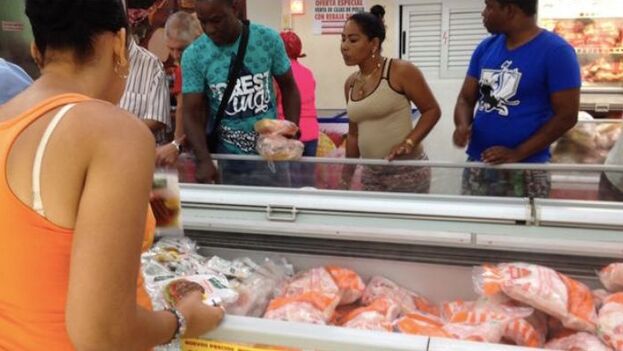
14ymedio, Havana, 14 December 2022 — The price paid by Cuba in October for chicken imported from the US reached the historic high of 1.29 dollars per kilo, 48% more than at the beginning of this year, when it was at 0.87. According to data from the US Department of Agriculture collected by Cuban economist Pedro Monreal, Havana reduced its purchases by a third compared to September.
After reaching, the previous month, one of the highest figures in chicken imports from the United States, the largest supplier of this product to the Island, in October the volume contracted 36% from 25,100 to 15,980 tons.
Cuba spent 20.54 million dollars in October for its chicken purchases in the United States, 33.9% below the amount paid in September, 31.08 million dollars. These figures are the lowest after the results of April 2022, when imports plummeted 30% against the peaks of February and closed that month with a little more than 21,000 tons, which cost about 23 million dollars. Only the month of May was worse, with the purchase of a little less than 15,000 tons.
The value of American chicken reached a new record in October, at $1.29 per kilo on average, five cents more expensive than the record recorded in September for $1.21. As a result, the economist said, the purchasing power of Cuban families is further reduced with respect to “a high-demand food with very low national production, without a productive solution in sight.” continue reading
In the group of meats, the price of chicken rose the most throughout the year, driven by the high costs of raw materials, mainly the concentrate and feed that are needed for poultry. The Food and Agriculture Organization of the United Nations (FAO) warned in its latest report on the world price index, corresponding to November, that the value of this product will not relax its upward trend due to a drop in production in the large producing countries after outbreaks of avian influenza intensified.
For Monreal, who analyzes data from the U.S. Foreign Agriculture Service, the drop in poultry imports from the neighboring country was not compensated by the supply from Brazil, the second largest supplier of chicken to the Island. From the South American nation, 2,642 tons worth 2.84 million dollars were received, seven times below the volume brought in on American ships.
The economist Elias Amor also replied to Monreal’s publication: “There is no money left in the ATM,” he said, referring to the shortage of liquidity faced by the Cuban Government to fulfill its commitments.
Cuba has to bring in most of the food it consumes, and imported chicken meat has long been an essential on the tables of Cuban families due to the disappearance of other sources of protein — fish, eggs and beef — as well as the stratospheric rise in the price of pork.
While the Cuban regime continues to blame the US embargo for the lack of basic products on the Island, ships with frozen products from the United States continue to arrive at the port of Havana. The last to dock this December 11 was the GreenMaveric ship from New Orleans.
Translated by Regina Anavy
____________
COLLABORATE WITH OUR WORK: The 14ymedio team is committed to practicing serious journalism that reflects Cuba’s reality in all its depth. Thank you for joining us on this long journey. We invite you to continue supporting us by becoming a member of 14ymedio now. Together we can continue transforming journalism in Cuba.
The session confirmed that the changes that have been introduced so far to improve agricultural and livestock production have failed. (14ymedio)
14ymedio, Havana, 12 December 2022 — Without knowing exactly why, satisfaction reigned in the parliamentary agro-food commission for the announced Law on the Promotion and Development of Livestock, which in recent days has been the focus of several reports in the local press. The preliminary draft, without any real innovations, can influence the pressing problem of shortages in the country. The new regulations essentially foresee changes in terms of sustainability, animal welfare and meat quality control that are more typical of countries where there is meat, which is far from being the case in Cuba.
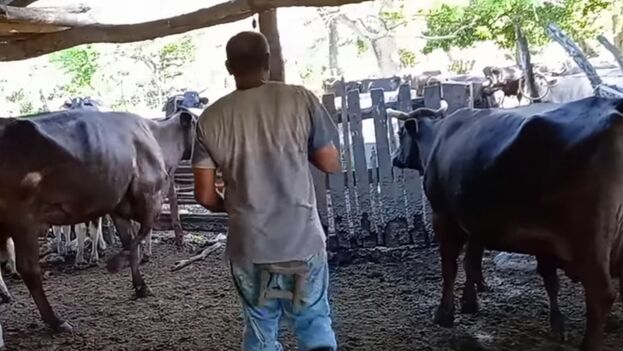
The session confirmed, in fact, that the changes that have been introduced so far to improve agricultural and livestock production have failed. “The measures and agreements are not complied with in practice, and this affects producers and makes us lose credibility,” said Emilio Interián Rodríguez, deputy for Arroyo Naranjo and a rancher himself, who urged an “immediate solution” to the problem of non-payments to producers. “Farming families depend on those profits; in addition, non-payments discourage production,” he lamented. And he didn’t have to go far to give an example.
“I recently sent three animals to the slaughterhouse, and I still don’t know when I’m going to collect that money. On the other hand, to buy a stallion, necessary to improve livestock, I must pay in cash. So, how do I do it? It’s not possible to move forward in agriculture like this,” he said, recounting his own experience.
The vice president, Salvador Valdés Mesa, recognized that Cuban laws are insufficient for the promotion of production and that, in addition, resources have not “been put” into it, but there have been recent transformations such as allowing the sale of livestock “and the privatization of part of the sector.” He forgot that there has been money for other issues and that, as the deputy of Arroyo Naranjo reminded him, the changes are of no use if there are no effects beyond the on-paper ones. continue reading
Valdés Mesa, in any case, was not very convinced about the innovations, judging by his words. “The state’s control over livestock is weakened. We have disorder in the field. There are many complaints from producers about the damage from animals to other crops and thousands of livestock holders without land,” he said.
As outlined in the commission, reality has forced some changes in the preliminary draft, although we will have to wait to see the final text to learn more. “There are elements related to food and nutrition, for example, that cannot be met, because not even companies have that capacity. Only universities and scientific centres have it,” said the authorities, who aspire to increase the amount of livestock, something that, they admit, they won’t achieve.
“In the country, 40,000 cattle are killed illegally, and 200,000 die,” a producer told Escambray on Wednesday in a report where nothing was hidden about the serious situation. “In livestock, life cannot remain the same, applauding plans and results that barely benefit a small number of inhabitants, recycling, year after year, statistics that make society shudder.”
According to the text, among the worst problems are banditry, which, he explains, forces cows to be cooped up for too long, and emigration, which additionally causes a lack of attention to rural communities and the countryside in general.
The report follows another one published days earlier in Periódico26, which warned that, in the province of Las Tunas, there were more than 11,500 deaths of livestock in the year, and the planned birth rate didn’t even reach 41%. In addition, and delving into the serious problem of robberies that shakes the Island more than ever, it indicated that some 2,580 cows left the production cycle due to theft and illegal slaughter.
Milk is also affected, and according to the territorial authorities, deliveries of this product and meat have not been fulfilled, and contracts for production in 2023 do not even reach 14%. The issue is not trivial, since as long as the producer doesn’t fulfill his contract with the State, he cannot sell independently. Minister Ydael Pérez Brito said that, out of more than 9,000 owners, only about 256 animals are slaughtered, and added that the measures taken by the Government are intended to “woo the producers.”
Translated by Regina Anavy
____________
COLLABORATE WITH OUR WORK: The 14ymedio team is committed to practicing serious journalism that reflects Cuba’s reality in all its depth. Thank you for joining us on this long journey. We invite you to continue supporting us by becoming a member of 14ymedio now. Together we can continue transforming journalism in Cuba.
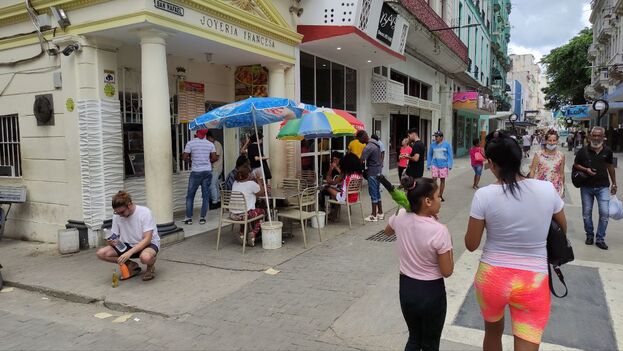
Private cafeteria on Boulevard de San Rafael, in Havana. (14ymedio)
14ymedio, Havana, 13 December 2022 — As if the current legislation, including the list of 124 prohibited activities, were not limiting enough for the creation of private companies in Cuba, the Government seems to be determined to stop this process, even going against its own laws. This is, among other things, what Oniel Díaz Castellanos, founder of the consultancy Auge, denounces.
On Monday, the National Assembly of People’s Power approved the law on the State budget for 2023 and, as part of it, eliminated the tax exemption for micro, small or medium-sized enterprises (SMEs) during their first year of life. As reported in the official press, “from the need for all economic actors to contribute to generate income for the financing of social services and programs, the tax exemption for SMEs is without effect, for a period of six months when they arise from a reconversion and one year when they are newly created, beginning in 2023. The previously constituted SMEs that are enjoying this benefit will keep it until the end of the period for which it was granted to them.”
The measure, says Díaz Castellanos in a direct Facebook broadcast, is not only lethal for new entrepreneurs and for attracting investments, but also goes against the laws approved by the regime itself.
“There is a decree-law for SMEs, a list of prohibited activities, but there is no exchange market, there are no inputs, there are not enough credits, there is a rigid regulatory framework and, on top of that, now there is zero incentive, zero support, because the company since it begins to exist already has to pay taxes as if it had been operating its whole life,” the consultant argues.
Faced with this, he notes that, in the Mariel Special Development Zone, foreign or domestic investors “have ten years free of utility taxes, are exempt from the labour force tax and have several incentives.” The measures announced, he says, “tremendously contradict that phrase of equal conditions among economic actors.” continue reading
The government trend against SMEs, however, is not something new. Díaz Castellanos himself has been warning for weeks of the setback that the process of creating private companies seems to be suffering. One example is that the State, which had been approving between 100 and 120 small businesses weekly, has spent “two consecutive weeks without any new SMEs being announced, unprecedented in the last twelve months.”
“You can’t whistle and stick out your tongue at the same time. Either the private sector is accepted or it is not. And the second option no longer fits with the guidelines and congresses of the last ten years,” the founder of Auge wrote this Sunday on his social networks. Faced with an avalanche of questions and comments, Díaz Castellanos promised details directly and finally transmitted them on Monday night.
The entrepreneur said that there are more than 10,000 applications to be SMEs and that, of them, more than 4,000 remain unapproved, “not a small number.” They are encountering several obstacles; among them, forcing them to withdraw the commercialization of their main activities and put them as secondary activities, or questioning those companies that have a broad corporate purpose (something common in societies where the free market governs, which allows companies not to stick to a single purpose but to many possible ones, so that they have flexibility in their activities and the risk of investment is reduced). All this, Díaz Castellanos reiterates, does not appear either in the decree-law of SMEs or in the list of prohibited activities, which is the current regulatory framework.
None of this, he adds, “affects the country’s system, violates the Constitution of the Republic, or causes economic, social or political damage to our country.”
As for the changes in start-up conditions, “the only thing they do is compromise the credibility of the country’s economic policy and the credibility of the institutions that apply it,” says the businessman, for whom “without stability, without confidence in the regulations, in the way they are applied, in the institutions, the country will not move forward.” A “powerful business fabric,” says the entrepreneur is, among other things, what Cuba needs to get out of the great crisis in which it finds itself.
Díaz Castellanos defends himself from the criticism received on the part of officialdom, which argues that these are “union demands.” He explains that these “hesitations” harm “everyone.” “For those who think that they are facing Monsanto, Tesla or Amazon, the great monopolies of global capitalism, I must tell them that no, they are simply criticizing small companies that have few workers, few resources — small companies that at the moment are extremely limited by the current context,” said the consultant, who pointed out that enterprises “are already controlled,” such as restricting one SME per capita with a limit of 100 workers.
Similarly, he declares, “there is no turning back in the role of the private sector,” which, he says, based on data from the National Assembly itself, represents 34% of the labour force and between 12 and 14% of GDP. In his conclusion, he cautiously believes that what was built in Cuba in the last sixty years “was a mistake, turning its back on the market.”
Translated by Regina Anavy
____________
COLLABORATE WITH OUR WORK: The 14ymedio team is committed to practicing serious journalism that reflects Cuba’s reality in all its depth. Thank you for joining us on this long journey. We invite you to continue supporting us by becoming a member of 14ymedio now. Together we can continue transforming journalism in Cuba.
Adonis Alexander Remon León left the Island on a raft on December 6 along with 29 balseros [ rafters]. (Facebook) 14ymedio, Havana, 12 December 2022 — Adonis Alexander Remon León is the last of the Cuban demonstrators arrested on July 11, 2021 (11J), who managed to reach the United States. According to what his mother, Elizabeth León, told Radio and Televisión Martí, the young man, 28, “is under investigation” on an American Coast Guard ship to “see if credible fear is true.” For demonstrating peacefully, the regime accused him of public disorder, attack, incitement to commit crime and damage, according to the report of detainees prepared by the Justice 11J platform.
Remon León was placed in “home detention” awaiting trial, after spending a few months incarcerated in the Combinado del Este, the largest prison in Cuba, where he was even in the hospital in critical condition, according to the Justice 11J report. In September 2021, the measure was changed to house arrest and, released, he received threats not to take to the streets on November 15, the date that Archipelago chose for the frustrated Civic March for Change.
On December 6, he left the Island in the company of 29 other people from La Güinera, but on the journey they were intercepted by the Coast Guard. “They left looking for freedom,” said his mother, who added that they repatriated everyone from the group except Adonis, who asked for political asylum.
“He emphasized that if he returned, they would put him back in prison,” Elizabeth León stressed. Adonis had also been denied work. “They told him not to go anywhere else, that they won’t give him work here in Cuba.”
In the group of balseros [rafters] there was another 11J protester, whose name was not revealed and who was not allowed to stay on the ship. After being deported, he was arrested by State Security. continue reading
Remon León was arrested for his participation in peaceful demonstrations last year and detained for 59 days in the detention centre of the Technical Investigation Department of the Ministry of the Interior, at 100 and Aldabó. Subsequently, he was placed in pretrial detention in the Jóvenes del Cotorro prison in Havana and, finally, in the Combinado del Este, from where the precautionary measure was changed to house arrest.
Activist Salomé García Bacallao revealed through her Twitter account that the demonstrators of July 11, Yunier Soto Sanabria and Deoban Rodríguez Morales, had also fled the Island. “Everyone has the right to request political asylum, and there are enough arguments to demonstrate their credible fear.”
García Bacallao recalled that “the protests in the capital neighbourhood of La Güinera lasted until July 12, when a protester, Diubis Laurencio Tejeda, was killed by the police and others were injured, including a minor.” The regime brutalized this neighbourhood.
Last Saturday, the Coast Guard repatriated 152 balseros to Cuba on the ships RayEvans and CharlesDavid. According to official figures, since the first of October, 2,982 rafters have seen their attempts to reach Florida frustrated. “Every day our teams work together to protect our borders and serve the United States,” said Air Operations and Marines of Customs and Border Patrol, Gerald Burgess.
Despite the surveillance by sea and air, this Sunday the Border Patrol reported the landing of 79 rafters in Florida. The chief officer of the Miami sector, Walter Slosar, shared images of the rafts. The Cubans who arrived on them were placed in custody. Slosar mentioned that from October to date, 131 people have been arrested for “maritime smuggling.”
The balseros were also in the news in Mexico. On Friday, 10 Cubans, two women and eight men, landed on the island of the La Pasión, a protected natural area of Cozumel surrounded by mangroves. The group applied for asylum, but the immigration authorities have not yet defined their situation.
Last September, fisherman Javier Robles told 14ymedio that the escape route for Cubans through Cancún, in the Mexican state of Quintana Roo, had been reactivated. “There are people who fish at night, needless to say. Suddenly fishermen’s boats from Cancún appear in Cuba, and no one knows anything.”
The coyotes, as a Cuban revealed to this newspaper this same month, organize trips to Pinar del Río and charge Cubans $7,000. The departures, he said, respond to the despair, and “at this point many people will start leaving.”
Translated by Regina Anavy
____________
COLLABORATE WITH OUR WORK: The 14ymedio team is committed to practicing serious journalism that reflects Cuba’s reality in all its depth. Thank you for joining us on this long journey. We invite you to continue supporting us by becoming a member of 14ymedio now. Together we can continue transforming journalism in Cuba.
Alejandro Gil Fernández, Cuba’s deputy minister and minister of Economy and Planning, before the National Assembly of the People’s Power of Cuba. (14ymedio)
14ymedio, Reinaldo Escobar, Havana, 12 December 2022 — In February 1970, while doing my work as a journalist (still a student) to cover the sugar harvest in the municipality of Florida, I attended an important meeting chaired by Armando Hart Dávalos, the member of the Political Bureau assigned to guarantee the goal corresponding to the province of Camagüey to produce 10 million tons of sugar that year.
The central point of the meeting was to examine the fullfilment of the commitments of the different sectors of the municipality to complete the number of macheteros [cane cutters] that would be part of the Jesús Suárez Gayol brigade.
One by one, the committed local bosses explained the causes of their non-compliance. The dairy company’s boss argued that if he lost one more man from the dairy farms it would not be possible to satisfy the supply of milk to the population; the head of the trade sector explained that not one more store could be closed; that of the railway workshops alleged that without mechanics the trains could not be moved, and the head of Forestry justified himself by invoking the inability to protect the forests with the few personnel at his disposal.
Armando Hart did not flinch. As if he had not paid attention to the arguments, he said that he was not there to hear excuses but to convey to them the news that the initial commitments had been insufficient and that now there were higher goals. After reading the new figures assigned to each sector, he said: “I hope you know how to fulfil this new task of the Revolution.”
One by one, each local boss promised to send more men to the cane fields.
I, who had not yet turned 23, published in a municipal tabloid named AlMachete my first critical journalistic text, where I questioned the honesty of the local officials. “At what time were they lying: when they said they could not meet the goal or when they promised to meet a higher one?” I wondered then. Still without questioning the honesty of the national leader, who thought he had looked good by demanding something impossible. continue reading
Two days later, one of those little bosses attacked me for that text, and I still keep my promise to keep him anonymous. “Look, young man,” he told me as he took off his hat, “If in the name of the Revolution a leader tells you to jump into the void from a great height, you can jump or fake that you are going to make the leap; what you can’t do is mention the law of gravity.” He paused and finished: “Or are you going to tell him that he’s stupid?”
That unforgettable lesson of wisdom and survival — not honesty — came to my mind when I read the justifications that were intended to explain, in the last plenary session of the Central Committee of the Party, why the measures taken by the Government to face the crisis have not had the expected result.
As is known, the 10 million tons of sugar were not produced in 1970. Surely Armando Hart knew it in advance along with everyone who knew something about the harvest, but no one dared to reveal the stupidity of the purpose.
How is it possible that those who plan the economy today do not take reality into account? How can you make a plan and then blame the “blockade” for your non-compliance? Did the planners assume that the restrictive measures imposed by the United States were going to be lifted, that there would be no administrative corruption, that no cyclones or accidents would occur?
Did they forget the law of gravity?
*Translator’s note: The “Ordering Task” is a collection of measures that include eliminating the Cuban Convertible Peso (CUC), leaving the Cuban peso as the only national currency, raising prices, raising salaries (but not as much as prices), opening stores that take payment only in hard currency which must be in the form of specially issued pre-paid debit cards, and a broad range of other measures targeted to different elements of the Cuban economy.
Translated by Regina Anavy
____________
COLLABORATE WITH OUR WORK: The 14ymedio team is committed to practicing serious journalism that reflects Cuba’s reality in all its depth. Thank you for joining us on this long journey. We invite you to continue supporting us by becoming a member of 14ymedio now. Together we can continue transforming journalism in Cuba.
Cuba is experiencing a deep shortage of commodities, high inflation, partial dollarization of the economy and frequent and prolonged blackouts. (14ymedio)
EFE/14ymedio, Havana, 12 December 2022 — The Cuban Government hopes that the national economy will grow by 3% in 2023, compared to 2% this year and 1.3% in the previous year, which would not be enough to recover the levels of 2019, prior to the COVID-19 pandemic.
The Minister of Economy and Planning, Alejandro Gil, announced these figures when presenting the 2023 Economic Plan on the first day of the tenth session of the current legislature of the National Assembly of People’s Power.
The Cuban regime, by making these data public, recognizes, without openly subscribing to it, that the forecast of the Economic Commission for Latin America and the Caribbean (ECLAC) that the Island would grow this 2022 by only 2% was finally correct compared to the 4% that the Government claimed.
The ECLAC also indicated last October, that the forecast for 2023 is even lower and remains at just 1.8%.
Gil indicated that in 2023 there will be “continued progress in the gradual recovery of the economy,” a “hard” job, although he assured that there are “bright spots, alternatives,” and “solutions.” continue reading
“2023 will be better than 2022,” said Gil, who who urged work to achieve the forecasts, because “nothing is going to fall out of the sky.” “Without triumphalism, but with optimism,” he added.
At constant prices, the gross domestic product (GDP) in 2023 can reach – according to the ministerial plan — 53,931 million Cuban pesos (2,248.4 million dollars), compared to the 52,360 million pesos (2,182.9 million dollars) for 2022, the 51,334 million pesos for 2021 (2,140.1 million dollars), the 50,698 million pesos (2,113.6 million dollars) for 2020, and the 56,932 million pesos (2,373.5 million dollars) for 2019.
“The trend towards growth experienced during 2021 and 2022 is maintained, although the activity levels of 2019 are not yet achieved,” read the minister’s presentation.
Gil appreciated certain “conditions” that favor the economic recovery, such as the control of covid-19, the improvement that is expected for the tourism sector and the “results” of the international tour recently made by President Miguel Díaz-Canel.
Díaz-Canel visited Algeria, Turkey, Russia and China in November with the restructuring of public debt and energy supply as the main points of his agenda.
Cuba suffers a serious economic crisis due to the combination of the effects of the pandemic, the tightening of US sanctions and errors in economic policy.
This situation translates into a deep shortage of basic products (food, medicines, fuel), high inflation, partial dollarization of the economy and frequent and prolonged blackouts.
Translated by Regina Anavy
____________
COLLABORATE WITH OUR WORK: The 14ymedio team is committed to practicing serious journalism that reflects Cuba’s reality in all its depth. Thank you for joining us on this long journey. We invite you to continue supporting us by becoming a member of 14ymedio now. Together we can continue transforming journalism in Cuba.
In terms of sexist violence, October was the bloodiest month of 2022, with six murders reported by the independent press and feminist platforms. (14ymedio)
14ymedio, Havana | 10 December 2022 — Miriam del Pilar Vidal Escoda, from Camagüey, is the 34th victim to die of sexist violence in Cuba so far in 2022. According to sources close to the 54-year-old woman, she was murdered by her ex-partner, from whom she had separated on several occasions.
The platforms that keep an unofficial record of sexist murders on the Island still do not confirm the death, but those close to Vidal Escoda said on social networks that it was a femicide. They even left comments on the Facebook profile of the alleged attacker, identified as José Alonso, in a post on November 7, 2022, where he had posted that he was “in a relationship.”
A source close to the victim confirmed to the newspaper ADNCuba that the crime occurred between 6 p.m. and 8 p.m. on Wednesday, December 7, when the alleged attacker stabbed her in the chest with a knife. The source said that the subject cleaned up the blood and blocked the door with a bar.
“He left with bloody but dry hands,” the source added, heading to the house of the woman’s cousin, not far from his residence, where he gave him a cell phone with the request to give it to Vidal Escoda’s daughter. Then he went to work in a bakery, where the police captured him hours later. The source said that the same relatives of the subject alerted the police to the incident, and when they knocked down the door, they found the woman’s lifeless body. continue reading
Vidal Escoda worked as a senior gastronomy specialist for the Provincial Tourism Company in the city of Santa María, and her daughter graduated with a degree in tourism from the University of Camagüey.
This femicide joins the long list that now has 34 violent deaths in 2022, most of them brutal murders by ex-partners. The most recent case was that of Yamila Batista, in the Mantilla neighborhood, in the Havana municipality of Arroyo Naranjo, who had recently moved home. Her aggressor took his own life after several days of harassment.
In terms of sexist violence, October was the bloodiest month of 2022, with six cases reported by the independent press and feminist platforms; the authorities don’t publish official records of these crimes. The only data available in state sources on gender violence come from a 2016 survey, which revealed that 26.7% of Cuban women between the ages of 15 and 74 said they had suffered some type of violence in their relationship in the twelve months prior to the study, and only 3.7% of those assaulted asked for institutional help.
Translated by Regina Anavy
____________
COLLABORATE WITH OUR WORK: The 14ymedio team is committed to practicing serious journalism that reflects Cuba’s reality in all its depth. Thank you for joining us on this long journey. We invite you to continue supporting us by becoming a member of 14ymedio now. Together we can continue transforming journalism in Cuba.
“The objectives of the Economy Plan for 2022 were not achieved,” Gil summarized. “The approved measures have not had the necessary impact.” (Twitter/Communist Party of Cuba)
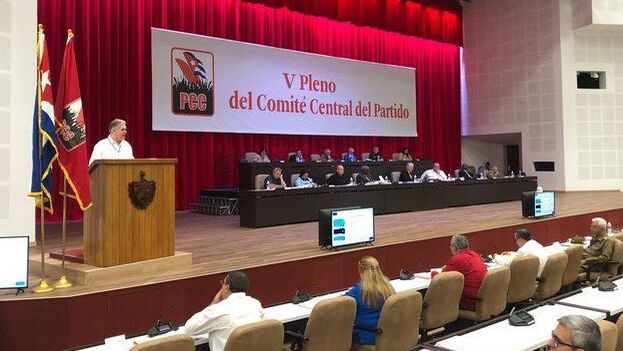
14ymedio, Havana, 10 December 2022 — The leaders of the Communist Party of Cuba (PCC) took advantage of the closure, this Saturday, of the 5th Plenary of the Central Committee, to justify their actions, which have led the country to a generalized crisis with daily blackouts. “It was a hard and difficult year,” admitted the Minister of Economy, Alejandro Gil Fernández, without at any time recognizing the responsibility of the leaders in the collapse of the national economy.
Raúl Castro was not present at the Party plenary, but it was attended by Ramiro Valdés Menéndez, in spite of rumors circulating this week about his death, and a special guest, José Ramón Machado Ventura, a member of the “auxiliary structure” of the Central Committee.
The official press was discreet when it came to discussing the specific issues addressed by the PCC cadres. Chaired by a silent Díaz-Canel and closely monitored by the military members of the Central Committee, the leaders have, since Friday, expressed their concerns about the critical situation of the Island and the “deviations of the Ordering Task”* implemented since January 2021.
“The objectives of the Economy Plan for 2022 were not achieved,” Gil summarized. “The approved measures have not had the necessary impact.” The minister quickly amended the pessimism of his statement and attributed the Island’s failures to the “hardening of the blockade” [referring to the American embargo], the covid pandemic, the rise in prices in the world market and global inflation, “beyond our organizational problems.”
Although nothing is as serious, he lamented, as the lack of hard currency. Everything necessary to boost the development of the country is approved by the leaders, he said, but simply “we do not have the resources.” continue reading
He added that there was some “recovery” thanks to the export of nickel, tobacco, rum, honey and seafood, but pointed out that only 1.7 million tourists have arrived in the country, leaving a need for 800,000 more to meet official forecasts, and almost 3 million more to reach the figures of the years before the pandemic.
“We cannot compare ourselves to 2021,” Gil said, after lashing out at agricultural leaders, whose results were remarkably low. “The country has induced or imported inflation,” he said, because importation “forces” the Government to raise prices. “We can’t do anything about that inflation,” he warned.
About the extra cost, he said, “we are including an internal component of indiscipline, diversion, speculation, resale.” He again stoked the idea of encouraging the “hunting” of resellers by ordinary Cubans.
Other leaders underlined Alejandro Gil’s observations. The common factor of the interventions was to describe the Government’s measures as “bold and innovative” and denounce their implementation by local cadres and the general population.
During the first session of the plenary, held this Friday, they pointed out the “progressive socioeconomic complexity,” attributed not only to the ’blockade’ and the coronavirus pandemic, but also to the explosion of the Saratoga hotel, the fire at the Matanzas Supertanker Base and the passage of Hurricane Ian in the western part of the island, whose “devastation” destabilized the National Electric System.
“The effects of this scenario are reflected in an aggravated situation of material deficiencies that affects all social and economic sectors of the country. Undersupply and inflation persist, with insufficient results in the measures adopted, which maintains a direct impact on the quality of life of the people,” admits the report published by the Party during the event.
The text also points out that the shortcomings have had “a harmful political and ideological impact on different sectors of our society,” and caused an increase in “subversive and destabilizing plans, using a fierce media campaign as a spearhead.”
They considered it urgent to “improve the Party’s work in universities” and to “take into account the states of opinion of the population.” Although they referred — according to the newspaper Granma — to the East-West Transfer project,** carried out in Mayarí, Holguín, they did not offer too many details about the state of the investment in the work, which Vice President Salvador Valdés Mesa described as “futuristic.”
During the plenary, the deaths of two recently deceased military members of the Central Committee were noted: Brigadier General José Alberto Yanes and Major General Luis Alberto López-Calleja, former son-in-law of Raúl Castro, president of the Armed Forces Business Administration Group and one of the most powerful men on the Island.
Translator’s notes:
*The “Ordering Task” is a collection of measures that include eliminating the Cuban Convertible Peso (CUC), leaving the Cuban peso as the only national currency, raising prices, raising salaries (but not as much as prices), opening stores that take payment only in hard currency which must be in the form of specially issued pre-paid debit cards, and a broad range of other measures targeted to different elements of the Cuban economy.
**The East-West Transfer project involves major construction of aqueduct networks to conserve water and increase agricultural production.
Translated by Regina Anavy
____________
COLLABORATE WITH OUR WORK: The 14ymedio team is committed to practicing serious journalism that reflects Cuba’s reality in all its depth. Thank you for joining us on this long journey. We invite you to continue supporting us by becoming a member of 14ymedio now. Together we can continue transforming journalism in Cuba.
Reineris Andreu was one of the medal options that Cuba had in the wrestling discipline. (Jit)
14ymedio, Havana | 9 December 2022 – The double world wrestling champion, Reineris Andreu, left Cuba’s national team after his participation in an event held in the Dominican Republic, the official media Jit confirmed on Thursday. The athlete’s escape is the sixth in this sport so far this year and was revealed, as usually happens, as “an indiscipline.”
The news was a bucket of ice water for the Cuban team that finalized the regional qualifying event in the Dominican Republic with 16 gold medals, one silver and one bronze. Andreu’s escape limits the Island’s possibilities at the Central American and Caribbean Games, said Miami-based Cuban wrestling coach Daniel Gómez.
With the escape of the Sancti Spíritus athlete, Gomez said on his social networks, “Cuba has few options for a gold medal in this division at the Central American and Caribbean Games.”
The coach, originally from Villa Clara, recalled that the regime punished the wrestler. “They didn’t give him the resources to participate in international youth tournaments.” Without Reineris Andreu and Alexei Alvarez, who “a few months ago asked for his release from the national team and currently resides in Spain,” the Island suffers from a lack of people in this sport.
“The exodus of Cubans transcends any category or branch of society,” published journalist Francys Romero, after learning that the first “undisciplined” from the event in Mexico, as the ruling party calls deserters, was the Olympic champion of Rio de Janeiro 2016 and two-time world champion Ismael Borrero.
To the desertions of Borrero, Solenzal and Cordero were added those of the pinareños Leonardo Herrera (60 Kg) and Amanda Hernández (53 Kg), two young talents who will seek to grow in their sport outside the Island.
Translated by Regina Anavy
____________
COLLABORATE WITH OUR WORK: The 14ymedio team is committed to practicing serious journalism that reflects Cuba’s reality in all its depth. Thank you for joining us on this long journey. We invite you to continue supporting us by becoming a member of 14ymedio now. Together we can continue transforming journalism in Cuba.
 14ymedio, Havana, December 15, 2022 — The authorities of Artemisa Province have recognized that they had to destroy more than 82 acres of potatoes in Alquízar, which spoiled due to the lack of irrigation caused by the blackouts of the last months. This is indicated in a report published this Wednesday in El Artemiseño, which, however, attacks 14ymedio, the first newspaper to report on the situation of the potato crop.