
Silence of the Cuban Foreign Ministry in the Face of the Failure of the Coup in Peru

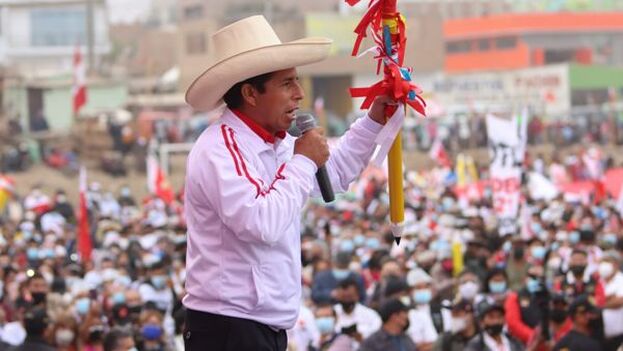
A division is perceived between those who believe that the Congress has aligned itself with the “imperialist powers” and those who reproach Castillo’s performance this Wednesday. (Facebook/Pedro Castillo)

14ymedio bigger14ymedio, Madrid, 8 December 2022 — The Cuban chancellor, Bruno Rodríguez, so quick to comment on everything on his Twitter account, has not yet pronounced on the events in Peru and the imprisonment of an ally of Havana after his failing in an attempt at a coup. This silence contrasts with the stridency of his reaction, the day before, to the condemnatory sentence for Argentina’s Vice-President Cristina Fernández de Kirchner, when he wrote on Twitter: “We ratify our solidarity with @CFKArgentina in the face of judicial and media harassment, which has clear political purposes.”

Nor did Miguel Díaz-Canel spare any emotion: “We reiterate our rejection of politically motivated judicial processes and reaffirm all our support and solidarity to @CFKArgentina in the face of judicial and media harassment against her.” The president used the hashtags #CubaTeAbraza [Cuba Hugs You] and #TodosConCristina [Everyone With Cristina].

The two accounts remain in absolute silence so far about the fate of now former President Pedro Castillo in Peru, who this Wednesday tried to dissolve Parliament before a third motion for his impeachment, in a suicide move that didn’t even have the support of his own government.

Faced with the apparent bewilderment of Cuban leaders, who are traveling in several Caribbean countries, Granma, the Communist Party newspaper was ahead of the official position. On Thursday, Granma published a short article entitled “Another Parliamentary Coup” that contains some elements of what happened in the intense day experienced yesterday in Lima, mentioning very briefly the announcement of the dissolution of Congress by Castillo.

Granma’s peculiar interpretation consists of explaining that the Andean country is going through a “political crisis” caused by “the actions of the Peruvian opposition, the majority in Congress, that hasn’t let the president, elected by the people 16 months ago, govern.” continue reading

Unlike the chavista Diosdado Cabello, who accuses Washington of being behind the fall of Castillo, Granma doesn’t pronounce on this aspect, but everything indicates that the members of the Sao Paulo Forum, including Cuba, are going along with that line.

Last night, the same newspaper published a text delving into the matter of Cristina Fernández with the headline “Adjustment of right-wing accounts,” in which the author says: “This procedure is not new, and I would say that it is quite recurrent on the part of right-wing governments against sectors of the left in the Latin American region, in order to stigmatize them as ’corrupt’ by resorting to a toxic system of ’justice’, accompanied by media work aimed at creating states of opinion based on lies.”

In Cubadebate, the information about Castillo’s case is even more like shorthand. So much so that some readers even ask for explanations about what happened. “And could he finally legally do what he did? Because by right he talks about a ’dissolved’ Congress, while Telesur talks about Congress without an adjective. The truth is I don’t understand anything,” a user asks. Another comes in, with little detail, to shed light on the matter: “He shouldn’t have done it. He committed the crime of sedition. Namely, he can be put in prison for 5 to 10 years.”

The division is perceived between those who believe that the Peruvian Congress has aligned itself with the “imperialist powers” to make life impossible for Castillo and those who, even so, reproach his performance this Wednesday. “Something is true: even if they don’t let you govern, you can’t take the law into your own hands,” says a reader.

To learn more, the readers of the official press will have to wait for the Cuban authorities to clarify their position.

Castillo is not Kirchner. Although the Cuban authorities never hid their preference for the leftist schoolteacher over his opponent, the right-wing Keiko Fujimori, Castillo did not show the gratitude that the Havana regime usually demands of its allies. In January of this year, the former president gave an interview to CNN where he talked about international politics and was insistently asked about his relations with the governments of Cuba, Nicaragua and Venezuela. Uncomfortable, Castillo did not dare to go against them but was not in favor either.

“President, would you adopt the Cuban, Nicaraguan or Venezuelan model?” “Never,” he ended up responding. At the insistence of the interviewer on whether he considered Cuba a democracy, the Peruvian again showed doubt. “Cuba is a sister country,” he tried to escape before he ended up saying: “We will have to ask the Cubans. I would not like any other country or person to interfere in the lives of Peruvians.” He did the same when he spoke about Managua and Caracas.

His chancellor did not have the same delicacy and was clear when it came to condemning the elections in Nicaragua, whose development he said he had “followed with concern.” The Ministry of Foreign Affairs categorically said that the elections did not meet “the minimum criteria of free, fair and transparent elections established by the Inter-American Democratic Charter, damaging their credibility, democracy and the rule of law, and they deserve the rejection of the international community.”

This hesitant attitude of the Peruvian did not go unnoticed by Venezeulan President Nicolas Maduro. He wanted Castillo fully in the group, along with Gustavo Petro and Gabriel Boric, who criticized the Bolivarian regime at the beginning of the year. “Every day there is a campaign against Venezuela. There has emerged a cowardly left that bases its discourse on attacking the successful, victorious Bolivarian model, on attacking the historical legacy, and on attacking me as president,” said Hugo Chávez’s successor.

Translated by Regina Anavy

____________

COLLABORATE WITH OUR WORKThe 14ymedio team is committed to practicing serious journalism that reflects Cuba’s reality in all its depth. Thank you for joining us on this long journey. We invite you to continue supporting us by becoming a member of 14ymedio now. Together we can continue transforming journalism in Cuba.
The Cuban Electoral Council Describes Local Voting as a ‘Victory’, Despite the Record Abstentions

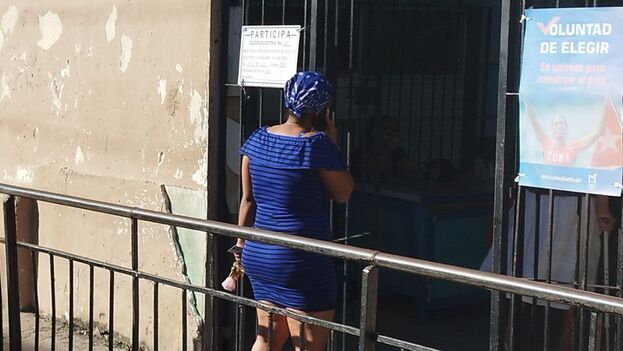
The western provinces were the ones that reflected the greatest number of abstentions. (14ymedio)

14ymedio bigger14ymedio, Juan Carlos Espinosa, Havana, 8 December 2022 — The Cuban provinces most punished by Hurricane Ian — which hit the western end of the Island at the end of September — recorded the highest rates of abstention and blank votes in the municipal elections of November 27, according to official data released this Wednesday.

In these elections, the highest percentage of abstentions since 1959 was recorded: 31.44%, according to official figures, cross-checked by EFE.

Although this data may be normal in other latitudes, it’s unusually high for Cuba. The Island is accustomed to participation rates even above 90%, although they have progressively decreased in recent years.

In Havana the abstention was 42.89%, an unprecedented rate and the highest among the 15 provinces, while in Isla de la Juventud it was 31.63% and in Matanzas, 31.14%.

These three western territories, among the most damaged by Ian, were among the five with the lowest participation. In the previous municipal (2017) elections, they were not among the highest rates of abstention.

In addition, three of the five provinces in which abstention increased the most compared to the municipal elections of 2017 and those of this November were also in the west: Havana (+27 percentage points, the fastest growing), followed in third and fourth place by its neighbors Mayabeque (+23.01) and Artemisa (+22.69). continue reading

Pinar del Río, the territory most affected by Ian, recorded the highest percentage of blank votes, 7%. For its part, in Mayabeque, practically one in 10 voters annulled the vote.

For three experts consulted by EFE, this demobilization is a form of rejection, which in a Western liberal democracy could be translated as a “punishment vote.”

The president of the country himself, Miguel Díaz-Canel, already used this expression in the referendum for the new Family Code and advocated incorporating it in the face of controversial issues “in the midst of a complex situation,” in reference to the serious economic and energy crisis that the country is suffering.

Experts consider that abstention, in the Cuban case, has a message. “Not voting in Cuba is a very important act of rebellion,” Leandro Querido, executive director of Electoral Transparency and author of the book Así se vota en Cuba [This is How Cuba Votes], tells EFE.

In similar terms, Diosnara Ortega, Cuban sociologist and director of the Chilean School of Sociology of the Silva Henríquez Catholic University, also speaks of “a politicized abstention.”

“Although in the rest of the world (abstention) responds to a process of depoliticization (…) in Cuba it is the opposite because (citizens) find in that recourse a way of dissenting from a power structure, not just from a Government,” she tells EFE.

Some experts go further and add the abstentions to the null and blank votes for what they call the “rejection” rate.

In the November municipal elections, that rejection rate reached 38.91% throughout the country, which is 17 percentage points higher than in 2017. In comparison, the Family Code rate was 30.13% (not counting the “no” votes), and in the 2017 municipal elections it stood at 21.59%.

Here the western provinces stand out again: Havana (49.75%) in first place and Mayabeque (39.85%) in second, followed by Isla de la Juventud (39.18%) and Artemisa (38.92%).

The region also stands out in the increase in the rejection rate compared to the municipal elections of five years ago. Havana (+26.07 percentage points) is at the top of the list, followed by Cienfuegos  (+23.85), Mayabeque (+23.36), Artemisa (+21.07) and Isla de la Juventud (+20.57).

The president of the National Electoral Council (CEN), Alina Balseiro, stated that this rejection rate “is not a legal term” and considers that the results of these elections cannot be compared with those of previous elections, because they are “processes of a different nature” and because of the changes that the country has undergone since then.

Experts believe that the reasons for abstention are multifaceted, although they coincidentally point to the boredom and frustration of the population after two years of serious economic and energy crises as common elements.

The sum of the pandemic, the tightening of US sanctions against Cuba and errors in domestic economic policy have caused a great shortage of essentials from food to medicines and fuel, plus galloping inflation, prolonged and frequent blackouts and massive emigration.

In the west is added the damage caused by Ian, with winds of up to 125 miles per hour, which caused damage to more than 100,000 homes and serious damage in the countryside. Repair work is progressing slowly despite efforts.

Experts go beyond the economic and say that electoral criticism points to the entire political system in Cuba. This is pointed out by Ortega and Hilda Landrove, Cuban researcher, cultural promoter and candidate for a doctorate in Mesoamerican Studies from the National Autonomous University of Mexico (UNAM).

The latter reminds EFE that these demobilization percentages were not recorded even in the so-called Special Period, the serious economic crisis that followed the fall of the Soviet bloc.

“In Cuba 15-20 years ago, the speech of unanimity continued. We cannot forget that when there are elections, what comes into play is the validation of a system,” concludes Landrove.

Despite the adverse data, Alina Balseiro yesterday declared the election as “a victory for the people.” The president of the CEN even went so far as to say that the participation was a “clear expression of support” by “a majority.”

Electoral Transparency, which already made a critical statement at the end of the first round, made public a second text in which it insisted on the need to carry out an audit to verify the data of elections that are “incontestable.”

Translated by Regina Anavy

____________

COLLABORATE WITH OUR WORKThe 14ymedio team is committed to practicing serious journalism that reflects Cuba’s reality in all its depth. Thank you for joining us on this long journey. We invite you to continue supporting us by becoming a member of 14ymedio now. Together we can continue transforming journalism in Cuba.
Etecsa Contracts with the French Company Orange for an Underwater Cable Between Cuba and Martinique

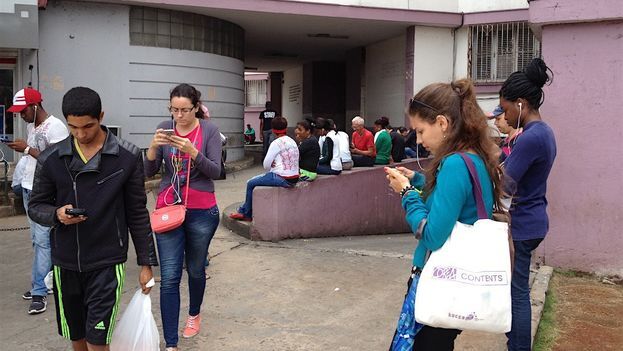
This connection “will give the country a new route for international services, geographically diversifying current connectivity,” Etecsa said. (14ymedio)

14ymedio biggerEFE/14ymedio, Havana, 7 December 2022 — The Cuban state telecommunications company Etecsa announced on Wednesday an agreement with the French company Orange to build an underwater cable between Cuba and Martinique to improve internet access on the Island.

The announcement came just a week after experts from the U.S. Department of Justice advised against installing what would have been the first submarine telecommunications cable to connect the Island to U.S. territory.

Etecsa explained in a statement that it has signed an agreement that will allow it to “expand and diversify international capacities, given the growing demand for internet connection and broadband services” and “support its international expansion.”

“It will allow, in accordance with the country’s economic possibilities, to continue expanding international connectivity,” the company said.

This connection “will provide the country with a new route for international services, geographically diversifying current connectivity.” Cuba has only one submarine cable for the internet, the ALBA-1, which has been connecting it to Venezuela since 2012. continue reading

It added that Orange will deploy the submarine cable through its subsidiary Orange Marine, to connect the province of Cienfuegos with the island of Martinique, a French overseas territory almost 1,200 miles away.

Etecsa did not announce deadlines or the cost of the plan. It only indicated that the project is “under development,” that it has “all permissions for deployment” and that “the physical structure” of the cable will be ready in 2023.

The week before, the U.S. Federal Communications Commission recommended not granting an underwater cable license to the ARCOS-1 USA system to connect Florida to the Island.

The U.S. Department of Justice stated that the Cuban government represents a “counter-intelligence threat” to the United States because Etecsa would manage the cable landing system, and then Havana could “access sensitive U.S. data traveling through the new segment of the cable.”

The Cuban government criticized this decision and said that it causes “harm to the Cuban people.”

On the other hand, the Cuban Minister of Foreign Affairs, Bruno Rodríguez, on Wednesday, “strongly” denounced a cyberattack on the website of the Ministry of Foreign Affairs that occurred yesterday.

The Ministry of Foreign Affairs reported on Twitter that its internet portal “had limited access to users for several hours from 11:00 a.m. on Tuesday.”

The cause, according to the Chancellery, was “a cyberattack that was intended to intentionally saturate bandwidth on the network.”

Rodríguez said that “illegal actions by cyberpirates are part of the unconventional war against Cuba in (the) communication and digital spheres.” The Foreign Ministry’s statement also pointed to the “communication war” against the Island, without offering more details.

The Foreign Relations complaint happened just two weeks before the Government held its “National Cybersecurity Day, whose “objective is to raise awareness and propose concrete actions in the technological field.”

“A computerized society, increasingly present in cyberspace, requires and defends its security,” said the Ministry of Communications, which used the hashtag #CybersecurityForAll in several publications.

Translated by Regina Anavy

____________

COLLABORATE WITH OUR WORKThe 14ymedio team is committed to practicing serious journalism that reflects Cuba’s reality in all its depth. Thank you for joining us on this long journey. We invite you to continue supporting us by becoming a member of 14ymedio now. Together we can continue transforming journalism in Cuba.
Cuban Bishops Call for Freedom for a ‘Good Number’ of Prisoners at Christmas

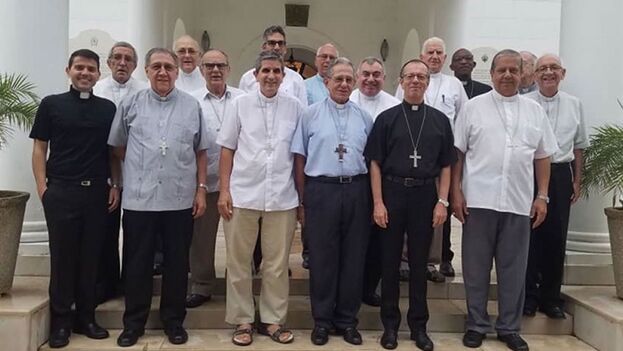
Prelates reflect on the current Cuban reality, but avoid explicit mention of the Government’s responsibility in the situation. (COCC)

14ymedio bigger14ymedio, Havana, 1 December 2022 — On Wednesday, the Conference of Catholic Bishops of Cuba published a message in which it signaled “the hunger, loneliness and lack of freedom” experienced by the citizens of the Island and once again called for freedom for the political prisoners. The statement, whose theme is the preparation for Christmas, also recalls that 25 years ago the Government agreed to declare the day as a holiday.

The bishops announced the visit, this coming January, of Cardinal Beniamino Stella, who served as apostolic nuncio — ambassador of the Vatican on the Island — during the Special Period. Stella, a top diplomat and critic of Castroism, was the one who organized the trip of Pope John Paul II in 1998, the first made by a pontiff to Cuba.

The commemoration of the half-century of that visit, which “marked the history” of relations between the Catholic Church and the Cuban Government, was proposed by the bishops to Pope Francis at a recent meeting in Vatican City. Beginning January 24, Stella will tour all Cuban dioceses, the statement says.

The rest of the message is dedicated by the prelates to reflecting on the current Cuban reality, avoiding the explicit mention of the responsibility of the Government in the different crises that the country is experiencing. They suggest that an atmosphere of “fear, distrust, daily routine, lies and hatred” prevails in Cuba.

They alluded to “the families who suffer emigration” and called, cryptically, to recognize the “signs,” that are “guiding, encouraging and warning us of the dangers” in the country in which our history is being “woven.” They also regretted the “pain and loneliness of so many elderly people, sick or suffering from serious difficulties and deficiencies.” continue reading

At the most critical moment of the statement, the bishops mentioned “those who suffer hunger, loneliness, lack of freedom and who expect from us a gesture of clemency or mercy. How much joy it would bring for their families and people in general to know that, this Christmas, a good number of those who are imprisoned would be granted freedom and returned to their homes to re-insert themselves into their usual lives and begin the new year!” they declared.

The requests of amnesty for the prisoners have been frequent on the part of the Catholic Church, which in 2015 took advantage of the visit of Pope Francis and managed to get the Government to release more than 3,500 inmates. However, it has had little success in its demands for release of Cubans detained after the protests of July 11, 2021.

They called for the hope of the Cuban people “in the midst of so much darkness and discouragement,” and to commit to the transformation of history “from within.” “No one can fight in life in isolation,” they said, while pointing out the need for a “community, a homeland of brothers where everyone can live with dignity, where we listen to each other and engage in dialogue to discern the future, where we fight for the good of all, especially those who have been marginalized for different reasons.”

The text concludes by sending the blessing of the prelates to the Cubans of the Island and to those who are “dispersed around the world.”

For Jorge, a Catholic layman from the diocese of Santa Clara consulted by 14ymedio, the message of the bishops “has to do more with forgiveness,” although “the situation in Cuba stands out: hopelessness, sadness, divisions.”

“Some of us believe that the messages could be more out front against the Government,” he says, “but the bishops didn’t forget the families who suffer from the emigration of their members, the condition of the prisoners, the pain and loneliness of the elderly, those who suffer great shortages and lack of liberty. It’s a very simple message that is more about hope,” he says.

Jorge points out that the most interesting thing in the statement is the announcement of Cardinal Stella’s visit, “a nuncio who knows our reality perfectly.” The Vatican envoy will find, he thinks, “a Government that is on the defensive,” which will not welcome this visit or will interpret it as “supervision.” In addition, “they won’t have much time to prepare.”

Cardinal Beniamino Stella’s last visit to the Island took place in 2015, in the midst of the “thaw” between Cuba and the United States. His return occurs in a similar context, when new attempts at dialogue are being developed between the two Governments, which, unlike the last time, have dispensed with the mediation of the Catholic Church.

Translated by Regina Anavy

____________

COLLABORATE WITH OUR WORKThe 14ymedio team is committed to practicing serious journalism that reflects Cuba’s reality in all its depth. Thank you for joining us on this long journey. We invite you to continue supporting us by becoming a member of 14ymedio now. Together we can continue transforming journalism in Cuba.
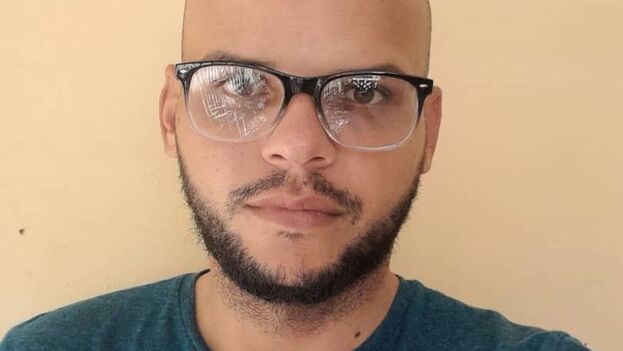
‘Cuban Students Are Waking Up Now, They Don’t Believe in the Revolution’

The University of Camagüey tried to “wash its hands” of him by offering Tan Estrada several jobs as a technician in places that have nothing to do with his profile. (Courtesy)

14ymedio bigger14ymedio, Havana, 3 December 2022 — Last Monday, the directors of the University of Camagüey (UC) detained professor and journalist José Luis Tan Estrada, when he was about to go home. In a kind of improvised trial, they recited to him a rosary of “incidents” against the Government. They notified him that he could no longer teach at his faculty and — as a consolation — they offered him a couple of jobs in a canning factory and at the municipal headquarters of Hydraulic Resources.

It goes without saying that he did not accept. Upon leaving the UC, he could not help but take a picture of the old mantra of State Security, freshly painted on the wall plaster: “The university is for the revolutionaries.”

14ymedio. It gives the impression that you are accused of carrying an “ideological poison.” What is the negative influence attributed to you on the faculty?

Tan Estrada. For a while now, I have more followers on social networks, mainly on Facebook, for my work as an activist and my journalism. There I have denounced the arbitrariness of the regime, telling life stories and giving voice to people whose problems are not solved by the Government or the local authorities.

At the university, the head of human resources and the dean told me that the students follow me on social networks, they agree with what I publish and with my ideas. No one has published anything, of course, because they are afraid of losing their university career. They are afraid of being repressed or closely monitored by a professor.

Another element, according to them, is that I am a negative influence on the students, due to my openly contrary position to the Island regime. If I do not agree with the political system or the people who lead it, how can I prevent students from feeling themselves reflected and doing the same? continue reading

It seems that they do not know that a university student – and much more so those in journalism – has the ability to reason and realize the social problems we are experiencing. Everyone is suffering from them equally.

14ymedio. Why take this measure against you right now? Did you expect that level of radicalism that involves discarding a professor in the midst of the educational crisis that the Island is going through today?

Tan Estrada. Cuban universities have been characterized by being a repressive body against anyone who, within the faculty or students, opposes the Government. Because, supposedly, as it is written on that famous sign at the entrance of the UC, “the university is for revolutionaries,” complemented by that other no less famous: “Within the Revolution everything; against the Revolution nothing.”

There are plenty of examples. At UC itself, we have José Raúl Gallego, José Alemán, Henry Constantín, Eliecer Jiménez… countless students and professors who have gone through the university and who have experienced that type of repression. I am neither the only nor the first, nor will I be the last.

Of course, I knew that a measure would come against me, because of my “antecedents.” I lived closely the case of Professor Gallego, as he was prosecuted and discriminated against for his political ideas, despite being an excellent professional. One of the best I’ve had, without a doubt. What I did not expect was that the summons would be surprising, without prior notice, almost at the time of going home.

It was a kind of circus. How could I imagine it? That half hour showed me that the dictatorship can be unpredictable and knows how to shuffle its cards well.

Of course, having a regime opponent inside a university is not the same as being expelled “washing their hands,” of me as they did. They told me openly that the reason was because my statements, ideas and attitudes were against the principles of the Cuban Revolution. In addition, I was told that I used my knowledge and intelligence based on that negative influence.

Unfortunately, students do not decide, or do not have the courage yet, to pronounce openly.

14ymedio. What did you teach them?

Tan Estrada. The subject of Hypermedia Journalism, in the day course, to journalists; and that of Digital Language and Hypermedia Communication to social communicators, in the course for meetings for workers.

14ymedio. What did those young people think of your expulsion?

Tan Estrada. Many sent me messages of support, standing against the measure and the way it was taken. They tell me that I will continue to be their professor, as I said on Facebook. I posted those messages to show them what my “bad influence” on students consisted of. If I were so bad, they wouldn’t have sent even a message. I am very attentive to them and if something happens to them I will report it.

14ymedio. Don’t the most innocent “other jobs” that they offer you have a kind of humiliating intention?

Tan Estrada. Humiliating, crushing, repressive. A low intention and blackmail. I am sure that both the provincial director of Labour, the Human Resources and the dean of my faculty knew that none of those places have to do with my profession. The intention was to lower myself from graduate to technician. They want to shut me up and overshadow me. It’s normal.

14ymedio. Does the radicalism of the State and its “educational arm” force it to be more radical?

Tan Estrada.  The radicalism of the State consists of repressing everyone who wants to unmask it. If you have a photo [on Facebook] and don’t use a fake profile, they increase the  repression. And then you’re forced to increase your fight against this dictatorship. They force you to separate yourself from your friends, from your students, from everything you have built.

My commitment, my strength, is with the Cuban who has to fight to see what to wear, how to dress, what to eat. Those stories that the regime silences and hides, through my weapon, which is journalism, I need to make known.

14ymedio. Can you expect an awakening from university students?

Tan Estrada. University students are already waking up. Camagüey, with the famous “conga” of protest, was a clear example. Without fear, everyone, more than a thousand young people, rushed to demand water, electricity, food. They don’t believe in the Revolution or in student organisations, even less in the Party. They are disappointed and don’t see a life project in thiis country. They don’t see their future here. This dictatorship doesn’t not have the capacity to guarantee a life for a young person.

The reality is direct, it is raw. University students are no stranger to it.

14ymedio. How do you evaluate the scenario of the Cuban press, both the official and the independent?

Tan Estrada. The official Cuban press is far removed from the real problems of Cubans. The Cuban public agenda does not correspond to the media agenda. They are nothing more than means of propaganda of the Communist Party, where a tweet from Díaz-Canel determines the headline of the news. They put the most absurd degree of pressure on critical journalists, those who think, because they are unacceptable for their press media.

The official press is “mechanized”; no one believes in their triumphalism or propaganda anymore. It lacks, of course, the basic standards of journalism

That is where independent journalism plays an essential role, it has been in charge of showing the world the reality of the country. Truthful, accurate, direct and timely information, which does not mask reality. Despite the limitations and danger, it is the only one that reflects the day to day.

14ymedio. Do you think the regime’s pressure will make you go into exile?

Tan Estrada. I don’t know. There are many examples of independent journalists, opponents, activists whom the regime has repressed and censured, even with the threat of imprisonment and death, which has forced them to leave. My only plan now is to fight for Cuba and denounce the arbitrariness that the regime commits on a daily basis.

Translated by Regina Anavy

____________

COLLABORATE WITH OUR WORKThe 14ymedio team is committed to practicing serious journalism that reflects Cuba’s reality in all its depth. Thank you for joining us on this long journey. We invite you to continue supporting us by becoming a member of 14ymedio now. Together we can continue transforming journalism in Cuba.
Even the Stamps for Paperwork Have Disappeared From the Post Offices in Cuba

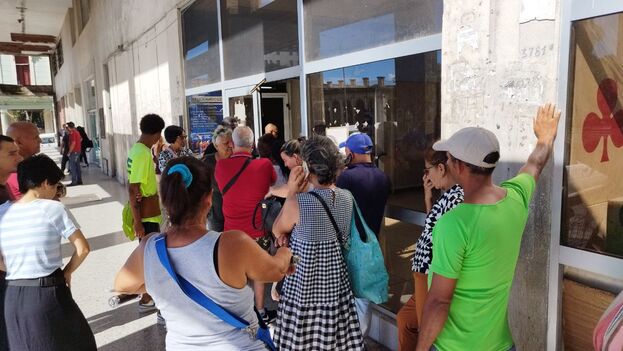
Line at the post office at Carlos III and Belascoaín this Tuesday. (14ymedio)

14ymedio bigger14ymedio, Juan Diego Rodríguez, Havana, 29 November 2022 — A long line of people winds around the corner of Carlos III and Belascoaín and crosses the door of the imposing building located in that central point of Centro Habana. The reason for the tumult is not the purchase of frozen chicken or the much sought-after cigarettes, but to acquire stamps for processing paperwork, an increasingly non-existent product in the Cuban Post Offices.

“In recent days there has been a deficit of stamps for processing paperwork in the Cuban Post Offices, due to the increase in the realization of procedures by the citizens and state entities of the country,” begins a note released by the Tax Administration Office (Onat) and the Correos de Cuba Business Group (Gecc).

Both entities classify the situation as “unforeseen” and blame “increased demand” for the impact on the service. Although the text doesn’t mention the reasons for the increased interest in these stamps, everything points to the mass exodus that the Island is experiencing and the need for migrants to have documents such as birth certificates or criminal records for their departure, among other things.

“My son arrived at the United States border a few months ago. He has already managed to enter, and now he needs to prepare everything for when he has to appear before a judge for his asylum request. They asked him for several documents, including a birth certificate,” said Juan Carlos, a Havanan who this Tuesday passed through the Post Office on Infanta and San Lázaro Street in search of official stamps.

“They didn’t have any kind of stamp. The employees stood with their arms crossed but unlike other times, they didn’t put a sign on the door clarifying that there were no stamps of 5 or 10 pesos, which are the most sought after,” he explains. “In the few minutes that I was there, other people came in asking for the same thing, but we all left empty-handed.” continue reading

In its official note, Correos de Cuba has called for calm, assuring that this week “the existing reserves in the different territories have been circulated, in order to ensure a balance between them,” and that “a new stamp is being printed.”

To avoid hoarding and reselling the stamps, they have established strict rationing. “The limit of sale allowed per person will be up to three units of stamps of the denominations of 10, 20, 40, 50, 125, 500 and 1,000 pesos. For the stamps of 5 pesos the limit allowed per person will be 5 units,” they clarify.

But the measure has not managed to alleviate the despair of those who are against the clock in some paperwork that needs to be processed. “I have to present an exchange at a notary and I don’t have the stamps,” said one of the clients on Tuesday, who was waiting outside the Correos de Carlos III and Belascoaín, where the 20, 40 and 1,000 peso stamps were for sale.

“They are going to close at 11 and don’t open until 1:00 pm because they have to do the mandatory blackout to save electricity at that time,” a woman complained. “People are protesting because they say that, even without electricity, stamps can still be dispatched, but employees refuse, so I will have to stay until the afternoon, because from here I have to leave, no matter what, with the stamps.”

Correos de Cuba assures that in the month of December “the printing of another seven million stamps will begin, in order to stabilize the sale in all units,” and will have “the main post offices of each municipality” as the priority. But distrust in state institutions is deeply rooted.

Together with the General Customs of the Republic and the telecommunications company Etecsa, the Cuban Post Office is one of the entities least valued by citizens. The frequent loss of letters, the violation of the privacy of parcels, the delay in attention to the public in their offices and other ills have made their official announcements unbelievable.

“The one of 500 comes out in 1,000 and the one of 5 I have in 80,” explains briefly and quietly a young man with a folder, who hangs out a few feet from the post office in Centro Habana. “I’m already out of 50, but tomorrow I’ll bring it again,” he added to the interest of several customers who weighed whether to stay in the line or opt for the informal market to get that tiny piece of paper with its holographic band and its watermark in the light, indispensable for fulfilling their dreams.

Translated by Regina Anavy

____________

COLLABORATE WITH OUR WORKThe 14ymedio team is committed to practicing serious journalism that reflects Cuba’s reality in all its depth. Thank you for joining us on this long journey. We invite you to continue supporting us by becoming a member of 14ymedio now. Together we can continue transforming journalism in Cuba.
First Warning Signs of the Cuban Economy in 2022

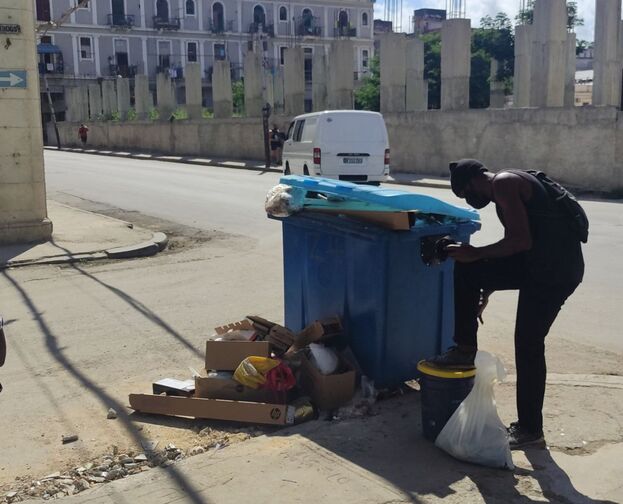
Some Cubans survive by selling rum and beer bottles to individuals. (14ymedio)

14ymedio bigger14ymedio, Elías Amor Bravo, Economist, 29 November 2022 — There is just over a month left until the end of this fateful year 2022, and in all countries, the time comes when economists begin to make the first estimates of what happened during the year.

In the case of Cuba, this task is conditioned by the overwhelming scarcity of data for the analysis of the situation, which, exposed in concrete terms, means that only tourism information by month is available from the CPI.

For the rest, it is necessary to accept longer time periods, the quarter or the semester, and even in most indicators the statistical production is addressed annually. This makes the task of carrying out the analysis of the economy complicated and forces us to formulate proposals that, in many cases fall short, lacking the support of the objective data of reality.

In any case, and based on information already known and contrasted, what seems evident and recognized is that economic growth in Cuba has been declining significantly during the year.

The initial forecasts of the economy plan had established for this year a GDP growth of 4%, which remained until a few weeks ago, when the authorities (in this case, a director of the chamber of commerce) recognized at the inauguration of Fihav that the growth of the economy plan was not achievable, revising the figure by half, 2%. continue reading

It should be remembered that this data had been included months earlier in a ECLAC forecast report, where the Cuban economy had one of the lowest growths in Latin America during 2022, and was headed for a scenario even more negative  in 2023, with a lower increase of 1.8%. The regime, given the evidence of its data that it rarely discloses to the state media, was forced to recognize that the growth of the economy was reduced by half, with the impact that this has on most activities and productive sectors.

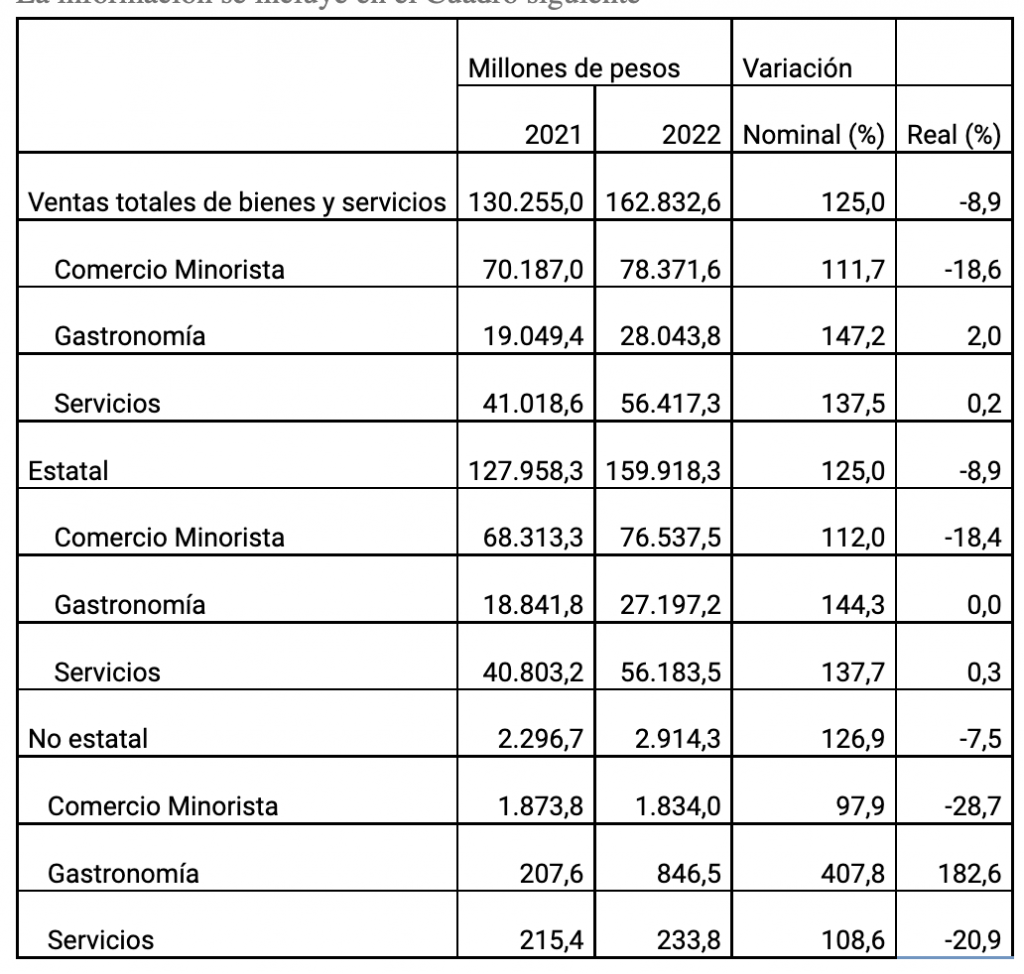
What indicators does the communist regime use to accept its defeat in terms of economic growth planning? A few days ago, ONEI published the statistic, “Sale of goods and services at retail January to September 2022” that includes information regarding the preliminary behavior of some of the indicators associated with sales of goods and services to the population, in addition to total sales and domestic production to the domestic market in CUP. It could be interpreted as an indicator of spending, of the behavior of consumer demand, which in most economies, is a powerful indicator of their behavior.

The information is included in the following Table:

The data reveal that in the first nine months of 2022, compared to the same period of the previous year, total sales of goods and services reached a nominal or current growth of 125% to 163 billion pesos. Other spending concepts increased even more. Gastronomy 47.2% and services 37.5%. If we look at the breakdown between the state and non-state sectors, significant differences are observed. The highest growth took place in the gastronomy of the non-state sector, 307.8%.

These data could be indicating the behavior of a buoyant, powerful economy, with a sharp increase in family consumption spending, which is obviously not the case, if the reports and day-to-day news of Cubans are taken into account. Is it that statistics do not adequately reflect reality? What is the problem that causes economic data to indicate one thing and real experience another?

The culprit of these differences is the year-on-year inflation rate until September, 37.24%, and that gastronomy (hotels and restaurants) reached 44.3%. Inflation, as if it were a tax on the poorest, erodes the nominal incomes of workers and pensioners who are paid in Cuban pesos and reduces the growth of the nominal magnitudes of column 3 of the Table, once they deflate.

This correction of the current data by the evolution of prices, to obtain the real or constant data, is made because they more adequately reflect the behavior of the spending and demand indicators. When this task is performed, the data in column 4 of the Table arise and present notable differences with respect to the nominal values.

To begin with, total sales are in the red, -8.9%, indicating a notable contraction in spending demand that explains the remarkable weakness of the Cuban economy throughout the year, which breaks with any possible consumerist vision, forcing the regime to forget about the planned figure of 4% of GDP.

Sales in gastronomy must be deflated by their corresponding year-on-year inflation rate, and with it, the real variable grows by a modest 2%, which is explained by a stagnation in state gastronomy, 0%, while the non-state one increases by 182.6%. But its volume, 846 million pesos, is insignificant and barely represents 3% of the state one, 27,197.2 million pesos, Once again, economic totalitarianism pays a high price. If the regime allowed all gastronomy to be non-state, other data could have been obtained.

Finally, sales of services, corrected by average inflation, increased by only 0.2%, which in the case of non-states registered a decrease of -20.9% in the period under analysis.

These data, in particular real sales of goods and services, set off alarms and have to be incorporated into the forecast models of the economy in 2022. If they don’t improve in the last quarter of the year, which seems unlikely since inflation tends to increase, everything points to an intense reduction in the growth of the economy from real spending and demand, which is expected to be less than the current 2% and could even point to a certain recessive or stagnation period. The most intense real drop in spending occurred in retail trade in Cuban pesos, -18.6% for the economy as a whole, -18.4% in the state and up to -28.7% in the non-state.

Throughout 2022, Cubans have lost almost 20% of purchasing power in their retail stores when they pay in Cuban pesos. Poverty is a real fact.

Translated by Regina Anavy

____________

COLLABORATE WITH OUR WORKThe 14ymedio team is committed to practicing serious journalism that reflects Cuba’s reality in all its depth. Thank you for joining us on this long journey. We invite you to continue supporting us by becoming a member of 14ymedio now. Together we can continue transforming journalism in Cuba.
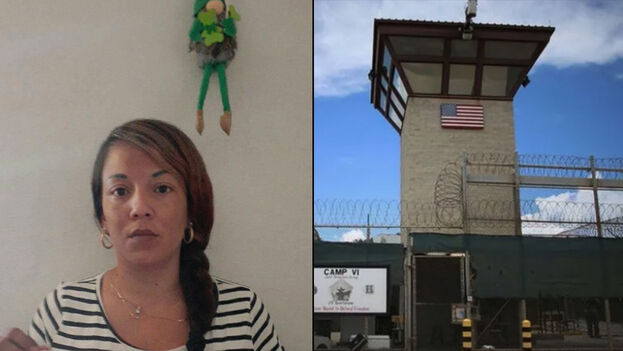
Yeilis Torres and 21 other Cubans are at Guantanamo Base Awaiting Resettlement in a Third Country

Activist Yeilis Torres Cruz has been at the Migrant Operations Center (MOC) in Guantánamo since last May. (Collage)

14ymedio bigger14ymedio, Havana, 28 November 2022 — The United States Department of Homeland Security (DHS) confirmed that 22 Cubans are waiting for “resettlement in a third country” at the Migrant Operations Center of the Guantánamo Naval Base (MOC). Among them is activist Yeilis Torres Cruz, who spent ten months in prison under investigation for the crime of attack after she was assaulted by the official announcer Humberto López.

The former prosecutor, who was ’regulated’ [the term for being formally forbidden to leave the country], found a way out and escaped on a raft with seven other people, but on their journey to Florida they were intercepted, and only she was given to opportunity to stay at Guantánamo because of “a credible fear.”

With a six-month stay in Guantánamo, Torres “remains in migratory limbo,” her husband, Pavel Pérez, explained to Radio y Televisión Martí. “Basically, the disciplinary regulations are rigorous. They have restrictions on free mobility, lack internet access and must be escorted when going to the nearest beach.”

On November 18, the day she turned 35, Torres received a video call from her husband, who showed her a stuffed animal and chocolate candy as a gift. As he revealed, among the rules to follow in Guantánamo is the possibility of making three five-minute calls, “always under the presence of a custodian” and having a bicycle to take tours. It’s forbidden to talk to the media and receive money.

Those detained in Guantánamo were rescued by the Coast Guard between October 1, 2021 and September 30, 2022, according to Radio Martí.

According to an official from the same publication, the balseros [rafters] were interviewed by staff of the United States Citizenship and Immigration Service (USCIS). “They demonstrated a credible fear of persecution and torture,” noting the risks they ran in case of being returned to the Island. continue reading

The State Department provides for the custody and care of migrants in the MOC until the time of their resettlement in a third country.

A spokesperson for the US Department of State assured the BBC that 445 people had been relocated to third countries through the Migration Operations Center based in Guantánamo since 1996. The vast majority were Cubans.

In addition to the 22 Cubans, there are three Haitians and three Dominicans in the Migrant Operations Center who, according to USCIS, “are not detained and can request return to their respective countries whenever they wish.”

This Monday, the Border Patrol rescued two migrants who were about to drown in the Florida Keys. The chief officer of the Miami sector, Walter Slosar, specified on his social networks that 18 people were rescued, without publicizing their nationality.

On Saturday, Slosar reported the landing of eight rafts in the Florida Keys of 180 Cubans in the last 48 hours. All were placed in the custody of the Border Patrol to continue being processed.

That same Saturday, 53 people were repatriated to the Island aboard the William Flores ship. “The Coast Guard and partner agencies are patrolling the Straits of Florida, the Windward and Mona Passages to stop illegal migration,” reiterated non-commissioned officer of District Seven, Nicole Groll.

Translated by Regina Anavy

____________

COLLABORATE WITH OUR WORKThe 14ymedio team is committed to practicing serious journalism that reflects Cuba’s reality in all its depth. Thank you for joining us on this long journey. We invite you to continue supporting us by becoming a member of 14ymedio now. Together we can continue transforming journalism in Cuba.
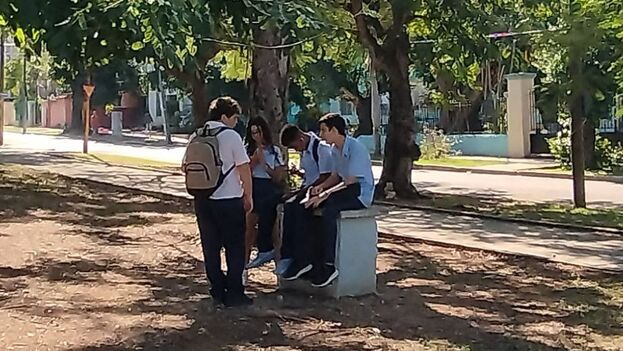
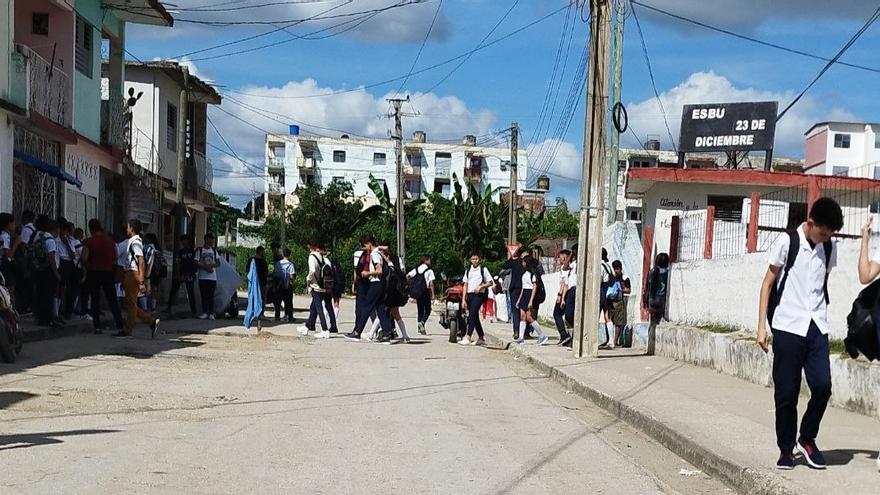
With Uniforms Donated by China and Without Textbooks, This is How the School Year Begins in Cuba

14ymedio bigger14ymedio, Juan Diego Rodríguez, Havana, November 28, 2022 — Not even in Cuba, immersed in a deep economic crisis, do children cease to be excited about the first day of school. Thus, this Monday, when the 2022-2023 cycle begins, enthusiasm and shouts were evident at the school doors, not only in Havana but in other provincial cities.

Parents, of course, know full well that the course not only begins off balance, once again, due to the various interruptions from the COVID-19 pandemic, but with worrying shortages. Hence their long faces, distant from the enthusiasm of the children.

We walk around like crazy people looking for polyester for linings and fasteners,” a Havana mother complained this Monday. “Not to mention the price of backpacks or shoes, or all the notebooks that will have to be bought, because they have already said that they’re not going to distribute what they did in other years.”

Indeed, the Minister of Education herself, Ena Elsa Velázquez, explained the situation last week in State Television’s Roundtable program.

On the one hand, students would receive half of the notebooks that are usually given to them, Velázquez said, an “adjusted standard” that will also be applied to pencils: one per month, unlike the two that used to be offered.

Students will continue to use the dilapidated textbooks that have already passed through hundreds of hands. “We have indicated the need to recover the existing ones for redistribution,” the minister said, alluding to the custom of many students to “stay” with their books, often “solved” by paying the teachers for the privilege of a copy in good condition.

However, Velázquez assured that the books are also available in digital format for “students who have conditions for it,” a measure that, in her opinion, will be beneficial for “those who don’t have the necessary resources.” Although the school year is about to begin, the workbooks are barely “in production,” and the minister warns that there is little paper available in the print shop. continue reading

As for school uniforms, to the lack of which the population is already accustomed, there is a demand for 2,153,310 garments, according to Mirla Díaz Fonseca, President of the Light Industry business group. According to the official, the blackouts have prevented achieving the “work rhythm” necessary for the uniforms to be ready for the beginning of the school year.

Students in Sancti Spirits. (14ymedio)

Thus, only 1,274,000 garments can be delivered. The rest, if the materials are obtained, will have to wait until February. Díaz Fonseca explained that not even that amount would have been possible without “a donation from China” and the “new method” of re-dyeing the old mustard-colored uniforms blue.  The old uniforms were worn in basic secondary schools before the change of design, which was carried out in the midst of a serious commodity crisis, and the dying process is now carried out by the textile manufacturer of Villa Clara.

The deficit of uniforms will be felt in the establishments provided by the Ministry of Internal Trade to sell them. Although it is customary to bribe the salespeople of these shops or to resell garments, the fact that the uniforms will be available for sale in only 1,900 stores will make the purchase even more difficult.

Those who don’t manage to get the uniforms or don’t reuse the ones they already have will still have to “attend school with the appropriate clothes,” said the Minister of Education. Without explaining where and how parents will be able to buy those clothes for their children, or defining what she considers “appropriate,” Velázquez apologized by stating that the school year was “a challenge for everyone,” and that things would be different if not for the US blockade, which is “hardening.”

Food is another issue that will not improve, and Velázquez avoided talking about it, although it mainly affects boarding schools, semi-boarding schools, households without subsidiary protection and basic secondary schools that follow the school snack regimen.

What she did say was that “the confrontation with cultural colonization” is, now more than ever, a priority of the educational system and its “political-ideological work system.” Invoking as “paradigms” Fidel Castro and Che Guevara, Velázquez said that the Ministry of Education is targeting those “young people who do not study or work” and teachers and managers who support “unacceptable” behavior, because “from indiscipline come crime and corruption.”

This newspaper has collected numerous testimonies of students in primary, secondary* and pre-university* schools who have been prohibited from entering classrooms with T-shirts that include the name of brands, signs or eye-catching figures. In some schools, the wearing of black T-shirts is not allowed, because black is considered “an opposition color.”

Another problem that the official media don’t talk about is the gap between those who have hard currency to buy what is necessary and those who don’t. “And now the cellphone is a problem,” adds a father of Sancti Spíritus. “Imagine that since everyone has a cellphone, my daughter also wants one, and I don’t know if we’re going to be able to afford it.”

As for the foreseeable lack of teaching staff, caused by last year’s unstoppable migratory exodus, the authorities did not give figures, but in schools in Havana they found many “new faces” among teachers. “And not all the positions are covered,” says a teacher from the capital who prefers to remain anonymous.

*Translator’s note: In the United States these designations would be “junior high school” and “high school.”

Translated by Regina Anavy

____________

COLLABORATE WITH OUR WORKThe 14ymedio team is committed to practicing serious journalism that reflects Cuba’s reality in all its depth. Thank you for joining us on this long journey. We invite you to continue supporting us by becoming a member of 14ymedio now. Together we can continue transforming journalism in Cuba.
Raul Castro Spoke In Chinese, Will Diaz-Canel Do It?

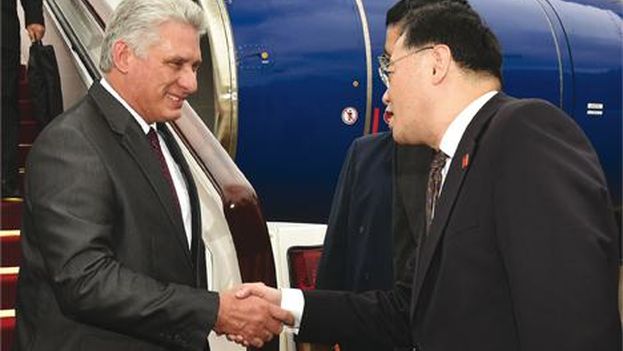
Díaz-Canel in Beijing. (Minrex)

14ymedio bigger14ymedio, Elías Amor Bravo, Economist, 25 November 2022 — The chronicles of the time say that when he had already replaced his brother at the head of power, Raúl Castro received a delegation of Chinese in Havana and surprised everyone by speaking Chinese and singing songs from that country. Will Díaz-Canel do the same? Anything can be expected.

Well, after 15 and a half hours of flight from Ankara, Díaz-Canel’s pan-handling delegation arrived in Beijing, with the aim of raising money, this time from the supposed Chinese friends. And here the term “supposed” can be taken any way you want. Unlike the Russians, with whom there was an ideological connection from the early days of the so-called cold-war revolution, Chinese and Cuban friendship went through different stages, some of them complicated, especially when Fidel Castro publicly condemned Mao Tse Tung’s repressive action in the 1960s during the cultural revolution, standing alongside the Soviets.

Who would have thought? Almost half a century later, Castro’s heir arrives in the capital of the forbidden city precisely on the same day that the death of the maximum leader is commemorated. The Cuban communist state press has made it very clear to him: the front pages are for the immortal. The trip to China has been relegated to second or third place.

Someone might believe that this is due to the preeminence in Cuba of Fidel Castro, who is treated on the sixth anniversary of his death as if he were still alive. But no, it seems that the maneuver of ’disappearing’ the trip of Díaz-Canel’s entourage obeys more obvious reasons, such as, for example, that it is still a failure in terms of the collection of money and in the identification of a “milk cow” that provides the Díaz-Canel regime with financing in exchange for nothing, as the USSR and Venezuela did. Times have changed, and no one is ready for that game. And we shall see what happens with the Chinese. continue reading

Díaz-Canel said that he has presented himself in China with an invitation from the only party, the Chinese communist, whose leader, Xi Jinping, the same character who publicly purged his predecessor during the 20th congress and who questioned the Prime Minister of Canada for disclosing content to the press in the G-20. President Xi is someone who doesn’t mess around. Again, the Cuban communist delegation arrived at the Beijing airport at an untimely hour and was received by a very low-level government official, Xie Feng, Deputy Minister of Foreign Affairs.

Facing the caravan’s media, and for domestic consumption, Díaz Canel said that “it is a pleasure to be in the People’s Republic of China. For us it is an honor that we have been invited, as the first country in Latin America, to visit China, after the successful celebration of the 20th Congress,” insisting once again on the invitation, because the cost of the trip, for a budget like the Cuban one, begins to be scandalous. An independent audit of expenses would show that, apart from the invitation, there is a lot of expenditure in this entourage that is little or not at all justified for the Cuban people, whom they claim to serve, and who are hungry.

It was announced that during the visit there will be official talks with Xi Jinping, Li Zhanshu, President of the National People’s Assembly and Prime Minister Li Keqiang, as well as the signing of more than ten agreements between the parties.

The good relations between China and Cuba are part of the global strategy of the Asian giant to occupy positions of economic control in Latin America. China, in its objective of becoming the world’s leading power, has developed a global extractive model of income and resources in the countries where it is established, and through this mechanism it increases its economic power, grants aid for cooperation, permeates financial systems and occupies commercial positions in sectors of interest.

Its interest in politics is relative. Countries in Asia, Africa and Latin America have witnessed that extractive invasion of China that has benefitted significantly from globalization. The strategy has worked well for the Asian giant. Producing low-cost goods worldwide by international companies installed in its territory, China has obtained substantial trade benefits that have increased its economic power. The rest is known.

And meanwhile, Díaz-Canel is talking about China as if it were an “ancient civilisation whose cultural and historical values have endured over time and constitute a heritage not only of China, but of all humanity”; or he’s recalling Che Gievara’s visit in 1960 to establish relations. And from all this he concludes that “this profile is the one that has captivated the Island despite the geographic distance.” This argument that can look pretty good in a second-class brochure, but it has very little to do with global geopolitics. Getting off the plane in Beijing, and wearing a black beret, Díaz-Canel, according to Granma, sent “the warmest congratulations to my counterpart Xi Jinping,” who at that time was sleeping soundly.

Another mistake by Díaz-Canel is to think that Cuba and China are today references for the construction of socialism. All you have to do is to take a walk around Beijing, or any of the great capitals that are filling up with skyscrapers, to verify the enormous distance between Chinese socialism and the communist destruction that exists in Cuba. Wanting to compare the two countries is an insult to intelligence, and I wouldn’t be surprised if Xi, with the character he has, commented on it.

Díaz-Canel has placed cooperation in the biotechnology sector as the main objective of the visit, but there must be more. In fact, China ranks second in the world as a commercial partner of the Island, a short distance from Venezuela, which is receding. Cuba’s exports to China reached 417 million dollars in 2021 (ONEI yearbook), 21% of the total, just behind Canada, which reached 613 million dollars. On the other hand, Cuba’s imports from China reached 972 million dollars, 11.5% of the total. In this case, China was behind Venezuela, with 1.245 billion dollars. This position of second trading partner of the Island is accompanied by a very unbalanced trade deficit of minus 555 million dollars that requires financing. On the other hand, in 2021 only 799 tourists from China came to Cuba, after reaching 49,000 in 2018.

The Cuban communist regime’s commitment to China carries risks. Basically, because the Chinese don’t give anything for free. They always demand something in return, such as the part of the sugar harvest that corresponds to them and which Cuba cannot manage to deliver, due to the low levels of harvests in recent years. Or in the case of minerals, or tobacco, the Chinese have travelled to Cuba to look for resources to extract, but the landscape they find is well known: devastation and widespread poverty. In addition, the Chinese are not interested in tourism or services, which is what Díaz-Canel offers. The Chinese don’t give a fig about coincidences on the political level with the Cuban regime; they want something else.

The visit to the Asian giant has just begun. The entourage is already tired of so many thousands of miles. The bet is high, but the results are uncertain. It doesn’t seem that China will become the substitute for Venezuela. It will ask for something in return.

Translated by Regina Anavy

____________

COLLABORATE WITH OUR WORKThe 14ymedio team is committed to practicing serious journalism that reflects Cuba’s reality in all its depth. Thank you for joining us on this long journey. We invite you to continue supporting us by becoming a member of 14ymedio now. Together we can continue transforming journalism in Cuba.
In Cuban Prisons, Prisoners Survive Thanks to Private Initiatives

The family of political prisoner Andy García Lorenzo manages the funds and ensures that they are distributed fairly. (Facebook/Roxana García Lorenzo)

14ymedio bigger14ymedio, Yankiel Gutiérrez Faife, Camajuaní, 26 November 2022 — Without the help of charitable organizations and private donors, prisoners would be on the verge of starvation in Cuban prisons, where they receive from the State the bare minimum to survive. “Lately the contributions have been greatly reduced,” laments Jonatan López, brother-in-law of political prisoner Andy García Lorenzo, who inspired the Funds for the Victims of Communism initiative. “We have up to 110 beneficiaries, but now we have resources for only about 44 detainees.”

“We’re a bridge for delivering food to prisoners in Cuba. We receive small donations from people who are sympathetic to the cause and help low-income families,” explains Jonatan López in conversation with 14ymedio.

“Andy knew what it was to go to bed hungry, without being able to satisfy himself with the small portion of food they get in jail,” López says. On each visit, they assure, they tried to bring the young man everything he needed. “But he always asked for more, because he wanted to share his food with the others.”

Funds for the Victims of Communism — promoted on social networks under the name of Help the Brave of 11J [11 July 2021 protests] — is responsible for raising money so that families can provide prisoners with food, toiletries, cigarettes and everything they need during their imprisonment. continue reading

The organization takes care of raising money so that families can provide prisoners with food, toiletries, cigarettes and everything they need during their imprisonment. (14ymedio)

The economic crisis on the Island and the increase in the price of food and basic necessities have had a negative impact on the situation of prisoners, and it’s difficult to provide them with the bag of supplies during family visits.

The visibility of the García Lorenzo family, following the multiple complaints made by its members, contributed to the project gaining notoriety and interest from donors. After initially refusing to send money, they decided — in December 2021 — to create a structure to collect funds.

The initial recipients were 15 families of political prisoners in Villa Clara, but the direct transmissions of Roxana García Lorenzo — Andy’s sister — and the complaints of other activists allowed increasing the number of donations and expanding the scope of the organization.

At the moment, the funds are destined for the families of 44 inmates in the western and central regions of the Island, for whom 3,000 pesos per month are deposited on their cards to buy products intended to cover their basic needs. The same amount has been given, at least once, to 110 prisoners.

Jonatan López, recently exiled in Germany, explained to 14ymedio that “to assist 110 prisoners, 4,500 to 5,000 dollars must be paid monthly, in order to distribute 6,000 pesos to each prisoner. And even so, their needs are not fully met, but it would be a huge relief for those families who, in many cases, have run out of their main economic livelihood,” he said, alluding to the fact that the work of many of the young people arrested was what supported their families.

The García Lorenzos manage the funds and ensure that they are distributed fairly. Activist Samuel Rodríguez Ferrer, a resident of the United States, is responsible for managing the PayPal and Zelle accounts opened for donations, which are then sent in their entirety to Cuba, without subtracting administrative or promotion expenses from the initiative. Ways have been found, says the activist, so that “the dictatorship does not access this currency” at the time of the transfers.

In addition, as they clarify on their website, the organization “is not political, nor is it affiliated with any party, organization or government. We do not receive a federal grant from the United States, or from any other country. Donations come from individuals and independent companies.”

Jonatan López records the donations in a public Excel document, to ensure transparency, while Pedro López, his father — also in the situation of asylum seeker in Germany — and his wife, Roxana García, from Santa Clara, are responsible for managing the organization. Through different channels, with the help of people traveling to the Island, the money reaches the families of the inmates.

“This project is so that they don’t feel alone, and they know that there are people outside and inside helping them,” Pedro López explains to 14ymedio. “You go against the dictatorship, they try to isolate everyone who dissents, and one of the ways is to tell them that they are alone. They try to demoralize them,” he says.

Despite their exile, Pedro and Jonatan López took measures so that the project didn’t stop. So far, they say, State Security has not confiscated their supplies, which in some cases are transported on national buses.

“It’s not difficult to work from the outside. We created an infrastructure made up of the same relatives, so that it wouldn’t stop when we left,” Pedro López says.

The work of the organization has not been without controversy. Several opponents have opined that the project “accommodates the relatives of prisoners,” which prevents them from “protesting” for the freedom of their relatives. These criticisms “do not make sense,” says Jonatan López. “The funds barely alleviate the situation of the families, and, in addition, the prisoners are not to blame for not assuming a ’frontal position’ against the regime in their homes.”

“We believe that it’s unfair to deprive them of this help, which is only the most basic, food, because their families don’t want to protest,” added the young man who, exiled in Germany due to pressure from State Security, confirmed to this newspaper his willingness to continue working on the project, combined with other initiatives such as I lend you my voice, Justice 11J, Where you fall, I’ll pick you up and the Accompaniment Groups of the Cuban Conference of Clergy (Concur).

For her part, Roxana García — known for her strong denunciations of the Government for the harassment of her brother — remains in Cuba, along with her parents, to continue demanding his freedom and that of the almost 1,000 political prisoners of the Island.

Several relatives of the prisoners have expressed their gratitude to the Funds for the Victims of Communism. Yanet Rodríguez from Holguin pointed out that the project has provided “help to the east of the country,” since most of the initiatives of this type are concentrated in the western region or the main cities of the Island.

Saily Núñez, wife of protester Maykel Puig, described the work of the organization as “extremely transparent,” while Niurka Ricardo, mother of prisoner Mario Josué Prieto, described the project as “something extraordinary and very human,” since it guarantees the food and medicines that are sent in the jabito (“little bag) to the inmates.

Translated by Regina Anavy

____________

COLLABORATE WITH OUR WORKThe 14ymedio team is committed to practicing serious journalism that reflects Cuba’s reality in all its depth. Thank you for joining us on this long journey. We invite you to continue supporting us by becoming a member of 14ymedio now. Together we can continue transforming journalism in Cuba.
China and Cuba: a Lot of Noise, Little Action

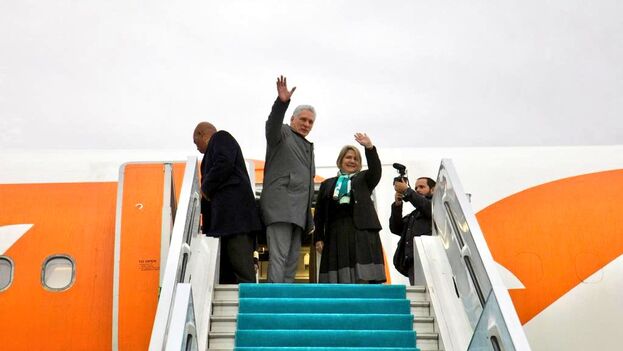
Díaz-Canel with his wife Liz Cuesta boarding the plane from Ankara to Beijing. (Cuba Presidency)

14ymedio bigger14ymedio, Elías Amor Bravo, Economist, 27 November 2022 — Back in Havana, the state press has started a propaganda campaign aimed at exalting the results of a trip, which leave much to be desired. The first to speak has been exactly the one who should be silent, taking into account that little or nothing has been achieved by his department on this trip. We refer to Alejandro Gil, Cuban Minister of Economy, who described relations with China as “a new starting point, a relaunch of our country’s relations with the Asian giant.” So he wishes.

It is true that “twelve legal instruments” were signed as Granma says, but there is a long stretch from the saying to the fact. The minister even dared to quantify at 100 million dollars the Chinese donations to Cuba (practically nothing) and the reopening of new state funding, but in reality, like most of the trip, Chinese support is aimed at old projects that are either underway or have not even started, like the Floating Dam project, which since 2019 and even before has not been completed.

The lesson that Díaz-Canel and his entourage have learned from this trip is that the Chinese have not given money for banalities or to sustain an inefficient political system, as the USSR or Venezuela did, but have provided funding for concrete projects to be developed by the Cuban communist state. And this is the source of the main problem.

The communist regime inherited from Fidel Castro has more than shown its inability to develop investments in infrastructure, in fixed capital, in projects of mid-life cycle, in energy, housing and real estate developments (except hotels). At the same time, it has an extraordinary voracity for spending on current projects, which is consumed in the annual budgets.

The data are eloquent. The share of the investment aggregate in the GDP of the economy, about 10%, is less than half of that recorded in Latin American countries. The low investment in Cuba is the result of a political choice that has conditioned the state’s intervention in the economy, which has resulted in the deficient general state that it presents. continue reading

The Chinese money is a double-edged sword, because it requires discipline, efficiency and effectiveness from the Cuban communist state — attributes that it lacks — in order to undertake projects of a certain magnitude with the guarantees provided. So the money will be there, in front of the eyes of Díaz-Canel and company, but its execution will be problematic if things do not change, and by a lot.

It’s like the Algerian power plant. Who is going to build it, with what technology and at what cost of time and money? The Chinese have put their cards on the table, and although they have granted money — this is undeniable — they have sent a message to the Cuban communists that the waste, adventure and the little campaigns to organise trouble in other countries are over. China is not Venezuela, nor does it want to be.

In that sense, one has the impression that the “legal instruments” that Granma talks about are designed, precisely, to adjust the accounts to Cuban partners, and that China plans to give money as the projects progress.

The question is, is the Cuban communist state ready to undertake all those investments and make it through? There are doubts.

In the Cuban economy there is everything. From planned and never-executed investments to investments with an advanced degree of execution, but which are pending some administrative work. And others that, when executed over very long periods, end up being allocated to different purposes than those for which they were planned. The Chinese know this situation and don’t believe in that model. Its economy advances along a different path in which the expected profitability of the projects is the determinant of investment, while the political criteria have gone to a better life.

So in the end, the only thing that will benefit the Havana regime is the donation of the 100 million dollars that Minister Gil talks about. For the moment he is the only one who has mentioned that figure, and the debt negotiations with China are reaching out-of-control dimensions, as this country becomes the second buyer and supplier of Cuba’s foreign trade.

The Chinese, who were sympathetic to the economic situation of the Island, want to collect or at least secure the payment, and there doesn’t seem to be good news there either. And for this they demand adequate plans for the ordering and restructuring of the debt, because otherwise, the credits associated with China’s investment projects in Cuba will be paralysed.

It’s the same as Díaz-Canel’s idea of attracting Chinese companies to invest directly in Cuba and that it not be all state aid. No matter how much political convergence exists between the two countries, these Chinese companies respond to management boards oriented by the perspective of profit, and they will not be willing to invest in ruinous businesses in Cuba. There are no data to justify it, but the low Chinese direct investment in Cuba since the adoption of Law 118 is amazing.

Translated by Regina Anavy

____________

COLLABORATE WITH OUR WORKThe 14ymedio team is committed to practicing serious journalism that reflects Cuba’s reality in all its depth. Thank you for joining us on this long journey. We invite you to continue supporting us by becoming a member of 14ymedio now. Together we can continue transforming journalism in Cuba.
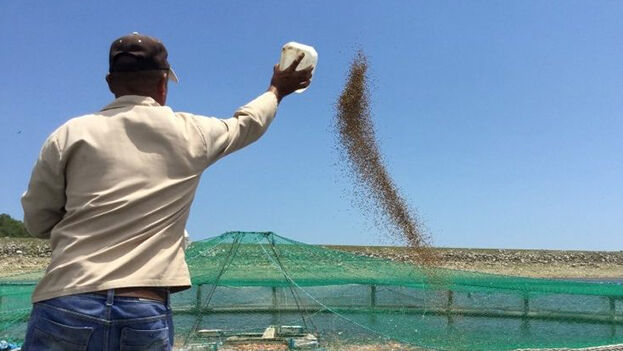
With Dams Invaded by Weeds, Aquaculture Reduces its Production by Half in Cuba

The Sancti Spíritus Fishing Company reports that the catch deficit in the province is 1,694 tons. (Escambray)

14ymedio bigger14ymedio, Havana, 24 November 2022 — The aquaculture workers of Sancti Spíritus have been able to fulfill only 57% of their production plan for 2022. A lower presence of species, the shortage of fuel to carry out the extraction work and the lack of maintenance of the dams are some of the difficulties they face.

Miriam Solano Valle, a specialist in Aquaculture at the Sancti Spíritus Fishing Company, told the provincial newspaper Escambray that the production deficit to date is 1,694 tons. The decline will affect the production of foods that use fish as raw material and that are distributed in the network of specialized ’boxes’.

Solano Valle indicated that the different fishponds, mainly the Zaza dam, have not received maintenance or cleaning in the areas covered with invasive plants since 2017, due to fuel shortages. The same cause hinders the entire food and beverage industry on the Island and has slowed down production from bread-making to meat plants.

As a result, the company spokeswoman explained, 40% of the surface of Cuba’s largest pond is covered with weeds and the invasive marabu, which hinder the fishermen’s maneuvers, since fish find refuge in the weeds. continue reading

To the rosary of problems that afflict the sector are added the damage to the ice plant and the freezing tunnel and delays attributed to the excessive rain from Hurricane Ian, at the end of last September.

Nor has this 2022 been able to increase the offspring at the Alevines Station of the Sancti Spíritus municipality of La Sierpe. Of the 31.4 million offspring that are destined each year for this fish pond, about 30 million were sent to Zaza, where 87% of the catches in the province are obtained.

Solano Valle pointed out that the decline in fishing is also due to unprotected exploitation in the intensive cultivation of clarias and tilapia, which are then used as raw materials in the production of feed for farm animals.

The crisis of the fishing sector in Cuba doesn’t seem to ease, nor is there a glimpse of the possibility of recovery. A year ago, in December 2021, the Government recognized that this sensitive sector for Cuban families will not recover the levels of production it experienced more than three decades ago.

Aquaculture has been a lifeline in Cuba, because the country cannot fish in international waters since it doesn’t meet the requirements and has not renewed its old fleets. In addition, the Island has no truly fast-flowing rivers that allow adequate freshwater fishing.

Translated by Regina Anavy

____________

COLLABORATE WITH OUR WORKThe 14ymedio team is committed to practicing serious journalism that reflects Cuba’s reality in all its depth. Thank you for joining us on this long journey. We invite you to continue supporting us by becoming a member of 14ymedio now. Together we can continue transforming journalism in Cuba.
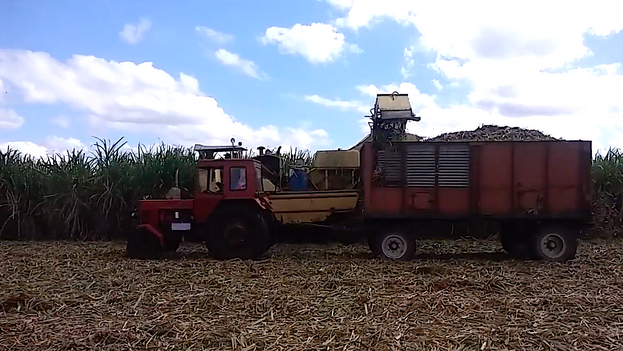
The Harvest Begins in Cuba After the Worst Planting of Sugarcane in More Than a Century

In other times, the sugar industry was the economic engine of Cuba but it suffered a drastic fall in production from the 1990s. (ACN)

14ymedio biggerEFE (via 14ymedio), Havana, 26 November 2022 — Cuba’s 2022-2023 sugar harvest began this Friday with the goal of producing 455,198 tons of sugar in a harvest that will be “small,” seeking to resuscitate the depressed sector.

In this harvest, started in the central province of Cienfuegos, it is planned to grind 6.5 million tons of sugar cane with only 23 factories, 13 fewer than in the previous harvest, according to the strategy set out by the Azcuba state group, which manages the area.

It’s about making an “objective and flexible harvest, although small, with good practices,” concentrating resources in fewer sugar mills with the aspiration to achieve “greater efficiency,” as explained by the president of Azcuba, Julio García Pérez.

The purpose will be to concentrate production for family consumption through the rationing book — which delivers 4 pounds of sugar per person per month — as well as for tourism, medicines, industrial production and export. continue reading

In addition to producing to satisfy national consumption, the sector’s plans aim to produce more alcohol, electricity and derivatives for domestic consumption and the foreign market.

Cuban President Diaz-Canel Gets a Donation From China of 100 Million Dollars and More Cybersecurity

Rodrigo Malmierca, the Cuban Minister of Foreign Trade and Foreign Investment, has carried out all the concrete negotiations in Algeria, Turkey, Russia and now in China. (Cubadebate)

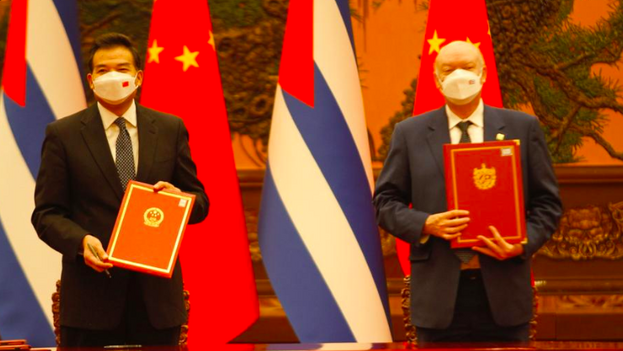
14ymedio bigger14ymedio, Havana, 26 November 2022 — In China, the last station of Cuban President Miguel Díaz-Canel’s panhandling tour, the Cuban delegation signed a dozen agreements and appealed to “friendship among the peoples” to extend Havana’s debt terms with Beijing and get an “emergency donation” of about one hundred million dollars.

The negotiations focussed on biotechnology (essential to continue manufacturing vaccines), energy and the most recent obsession of the Cuban regime: cybersecurity and computer surveillance, which will give it more technological resources to control the population and prevent new protests such as those of July 11, 2021.

Locked in a “bubble” against the resurgence of coronavirus that China is going through, Díaz-Canel told the journalists who accompanied him on the trip that the results “are above our expectations.” According to him, Xi told him that “we have to find solutions to all of Cuba’s problems,” despite “the challenges with debt.”

His “small country” — as he has also defined Cuba in front of Putin and Erdogan — will pay, although he is not sure when. We must provide China, he explained, with guarantees to “help our friends feel secure about what we are doing,” because “they’re taking off a little” to accommodate the default on the debt, whose repayment has been impossible since 2019. continue reading

Díaz-Canel affirmed that he felt the need to “explain” to Xi the rosary of “involuntary” calamities that have shaken the Island: accidents, hurricanes, coronavirus and, of course, the “hardening” of the US blockade, which has caused a “tense situation” for his government. “It’s not the same when you can talk, when you can explain, when things can be understood from sensitivity,” he said.

The Chinese “are open,” the president concluded, which he interpreted as a sign that his arguments about Cuba’s willingness to accept foreign investment had worked.

Díaz-Canel will return to Cuba with an “emergency cash donation” of about one hundred million dollars, the result of one of the twelve agreements signed with Xi. In addition, there will be another donation of food and medicines, signed by Rodrigo Malmierca, Minister of Foreign Trade and Foreign Investment, who has carried out all the concrete negotiations in Algeria, Turkey, Russia and now China.

Beijing will also offer the Island the indispensable raw materials — in addition to an economic donation — to complete the number of school uniforms for the year that begins next Monday, which will start with a notable deficit of material. Another of the contracts guarantees the supply of “kitchen utensils for high-impact programs.”

Several agreements, the most ambiguous, define a “plan of political consultations” between the Cuban and Chinese Ministries of Foreign Affairs. Signed by Chancellor Bruno Rodríguez Parrilla, it was not explained what the nature of these “consultations” would be, which Cuba will be obliged to offer until 2025. The contract for “exchange and cooperation” between the Cuban Communist Party and the Cuban Communist Party is also political.

The expansion of the new Silk Road and the role of “entry” to Latin America that the Island has were ensured by several “memoranda of understanding,” signed by Malmierca.

In an interview published in Cubadebate, Alejandro Gil, Minister of Economy and member of the Cuban delegation, assured that these agreements are the gateway to “new financing” from Beijing. Funds will be provided to activate the Floating Dam installed in 2019 — essential for the construction and repair of ships on the Island — and to execute a program of “reconversion or modernization” of the Cuban press, one of the main interests of the Chinese Communist Party, according to Gil.

In addition, the financing of a wind energy park, another solar park in Las Tunas and two bio-pesticide plants in Havana and Villa Clara will be explored. And Chinese companies have been invited to make “direct investments” on Cuban territory, the minister said.

The most disturbing agreements, however, are those that promise Chinese aid in the digital and telecommunications fields. In addition to the execution of a “Biocubafarma Cloud Telepresence System,” which promotes digitization in the vaccine and drug manufacturing sector, China signed a project to organize a National Identity System for Natural Persons and another Wireless Network Supervision System.

To both projects — backed by an economic donation — is added a Forensic Data Laboratory that the Government plans to execute. The implications of these contracts for espionage and state surveillance of the Cuban population will be notable, since they guarantee the use on the Island of the digital monitoring systems that Xi Jinping and his Government have been implementing in their own country for years.

With the creation, this Wednesday, of a National Working Group for Cybersecurity, the Cuban regime is taking more concrete steps in the surveillance of the digital environment and Cuban communications. A recent alliance of Xetid, the technology company of the Armed Forces, with Etecsa, makes evident the growing government interest in executing an “offensive” on social networks.

This was confirmed by Cuban Prime Minister, Manuel Marrero Cruz, who together with Álvaro López Miera, Minister of the Armed Forces, organised a cybersecurity workshop to display surveillance equipment — several of Chinese manufacture — that the Government will install on the Island.

Translated by Regina Anavy

____________

COLLABORATE WITH OUR WORKThe 14ymedio team is committed to practicing serious journalism that reflects Cuba’s reality in all its depth. Thank you for joining us on this long journey. We invite you to continue supporting us by becoming a member of 14ymedio now. Together we can continue transforming journalism in Cuba.