
‘The Right to Dissent Is Restricted and Criminalized,’ Says Ernesto Daranas at the Havana Film Festival

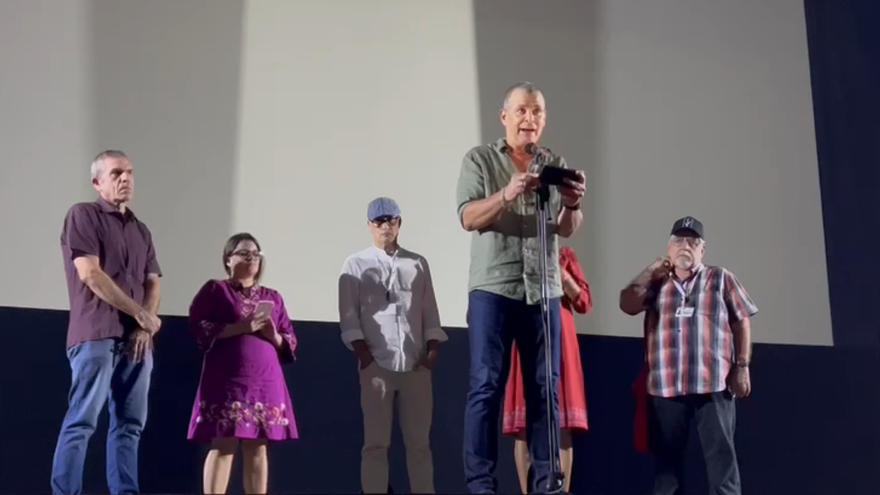
Ernesto Daranas presented his documentary Landrián this Sunday with a very combative speech. (Capture)

14ymedio bigger14ymedio, Havana, December 11, 2023 — On Sunday, three years after the Cuban Institute of Cinematographic Art and Industry (ICAIC) began the restoration of the filmography of the censored Nicolás Guillén Landrián, the Latin American Film Festival showed the documentary titled with the filmmaker’s surname. The director, Ernesto Daranas, surprised the audience when he took the stage and presented the film he described as “visionary of a Cuban cinema submitted to ostracism, imprisonment and finally to exile.”

He did not stop there and managed to deliver a speech of almost three minutes — which was applauded at the end — against a censorship “that is not a case of the past,” since “still today” it is exercised not only on the works, but also on the right of the people “to freely access their films, and on the very institutions of Cuban cinema, which includes this beloved festival.”

“The question then is: why do filmmakers insist on being here? The answer is in you, the people of whom we are part, the true producer and protagonist of our films,” said Daranas, who claimed the event as “the only opportunity” to meet with the public “in a country without cinema,” and to be sure that “a film can change the world, even for 90 minutes.”

The question then is: why do filmmakers insist on being here? The answer is in you, the people of whom we are a part, the true producer and protagonist of our films”

Daranas reclaimed the figure of Guillén Landrián, nephew of the poet Nicolás Guillén, an active fighter against the Batista dictatorship but later repudiated for his “licentious attitude” and comments “not in accordance with a young revolutionary,” according to the documentary itself. His figure embodies the raison d’être of the Assembly of Cuban Filmmakers, said the director, who asked to open a debate on the “stigmas of Cuban culture and society in general.” continue reading

“The true problem has never been in our movies, but in the reality to which they are owed. There can definitely be no different country for cinema than the one we have as a people. That’s why censorship persists; that’s why the right to dissent is restricted and criminalized,” he continued, in the midst of the apparent tranquility of those who accompanied him on stage and the public.

“Permit me then to dedicate this presentation to all colleagues and compatriots subject to exclusion and censorship. To those who in any corner of Cuba and the world are still determined to freely tell their stories, to freely express and defend their ideas. And of course let me dedicate this film today to our Assembly of Cuban Filmmakers, of which I like to think that Landrián, along with so many greats of our cinema, would also have been part,” he concluded.

The video of the presentation was disseminated by the Facebook group of the Assembly of Cuban Filmmakers, which expressed its emotion at what was seen or experienced, according to those who were in the room. Although not everyone assumes that the action will not be punished. “What will happen now with Daranas? Because those of us who were born in Cuba know that censorship and exclusion cannot be condemned without consequences,” said one commentator.

What will happen now with Daranas? Because those of us who were born in Cuba know that censorship and exclusion cannot be condemned without consequences”

The presentation of Daranas’ film was announced in Prensa Latina this Sunday. Landrián was spoken of as a “recognized avant-garde figure within national cinema,” and it was described as a “paradox” that he is “one of the filmmakers least known to the Cuban public” despite his being of great academic interest.

The article also calls the filmmaker “controversial” and adds that the film narrates, among other things, Landrián’s “phase as a poet and the reasons that led him to emigrate to the United States.”

Daranas told Prensa Latina that his film is “a spiritual mass that bears witness to suffering and many things that unfortunately continue to damage our cinema.” The pro-government media did not respond.

Landrián – a Spanish-Cuban co-production – was premiered in the Clásicos de la Mostra program at the prestigious Venice Festival, class A, held in September. The international press then reported details such as the psychiatric hospitalizations that the filmmaker suffered, during which he underwent electroshock therapy for his “ideological deviation,” until in the 80s he managed to go into exile in Miami, expressly authorized by Fidel Castro.

In 2019, 16 years after Landrián’s death from pancreatic cancer, Daranas found his film file on the Island in very bad condition and began the restoration, after an agreement with the ICAIC. “With the restoration that we have made of ten of his films and with this documentary we seek to present to the general public an exceptional filmmaker who faced a problem that unfortunately many Cuban filmmakers still face today: censorship,” Daranas declared in Venice.

The international press did then reported details such as the psychiatric hospitalizations that the filmmaker suffered, during which he underwent electroshock therapy for his “ideological deviation”

With Daranas’ appearance yesterday, the Assembly of Cuban Filmmakers partially removed the discomfort of having two “uncomfortable” films not accepted by the selection committee: Llamadas desde Moscú [Calls from Moscow], by Luis Alejandro Yero, and La Habana de Fito [Fito’s Havana], by Juan Pin Vilar. The latter was precisely the person who started an open war between the authorities and this group, born in June of this year, which was manifested through a letter signed by more than 600 professionals in the sector who demanded changes from the Ministry of Culture.

Ernesto Daranas, director of the award-winning Conducta [Conduct], has been involved in more protests against government policies, such as the G-20 film collective, which in 2014 demanded a new Law of Cinema and the end of censorship. Almost ten years later, the complaint is still valid.

Translated by Regina Anavy

____________

COLLABORATE WITH OUR WORKThe 14ymedio team is committed to practicing serious journalism that reflects Cuba’s reality in all its depth. Thank you for joining us on this long journey. We invite you to continue supporting us by becoming a member of 14ymedio now. Together we can continue transforming journalism in Cuba.
A Breakdown in the Felton Thermoelectric Plant Strains the Energy Situation in Cuba

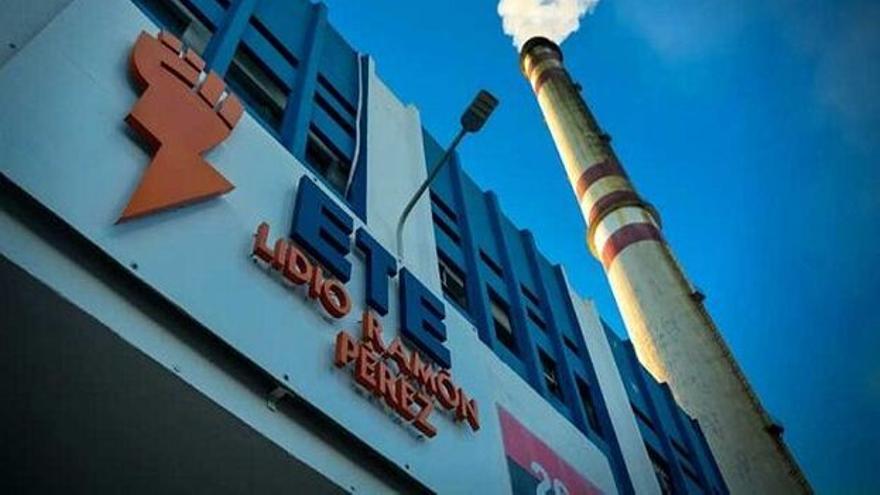
The plant left service on November 20 to undergo scheduled maintenance. (Cubadebate)

14ymedio bigger14ymedio, Havana, December 11, 2023 — The Lidio Ramón Pérez thermoelectric plant of Felton, in Mayarí, managed to operate a little more than three days since it was last synchronized to the National Electroenergy System (SEN). The plant joined the system last Thursday, after a repair that lasted more than two weeks, but on Monday the Unión Eléctrica (UNE) reported that two units of the plant were stopped due to a breakdown.

On Monday, the UNE predicted an electrical impact of 300 megawatts (MW) in peak hours and announced that unit 1 of the Thermoelectric Power Plant (CTE) of Santa Cruz, in Mayabeque, and unit 3 of the CTE Renté, in Santiago de Cuba, were also out of service due to breakdowns. To these are added the exit, for maintenance, of unit 5 of the CTE Mariel, Artemisa, and unit 3 of the CTE Cienfuegos.

After a Sunday in which the UNE boasted that there would be no blackouts, a day that coincided with International Human Rights Day, the customers of the state monopoly received the news of the breakage of Lidio Ramón Pérez as an indication that there will be more power outages in the coming weeks. Criticism of the quality of maintenance work has been at the center of the complaints. continue reading

Yosbel Expósito Martin, annoyed, wrote on the company’s Facebook page that this “proves that the maintenance carried out by the UNE makes things worse; they have now disgraced the good work of the Felton 1.”  “We continue with the same story every week, the same torture,” added Rosa López, another angry netizen.

This proves that the maintenance carried out by the UNE makes things worse; they have now disgraced the good work of the Felton 1

The thermoelectric plant had gone out of service on November 20 to undergo scheduled maintenance that sought to return the plant’s capacity to produce 240 MW. The work included lowering the dome of the boiler, which weighs more than 127 tons and required foreign advice and special lifting equipment, according to the official press.

After more than two weeks, last Friday, on the thermoelectric plant’s Facebook account, the tone was optimistic: “After a very busy morning with a lot of professionalism and commitment, we are raising the load little by little,” said a brief message accompanied by a photo with smoke coming out of the Felton’s smokestack.

Eric Milanés Quinzán, general director of the industry, then confirmed to Radio Mayarí that after a gradual start-up process, the block 1 machine synchronized with the SEN 20 minutes before midnight [on Thursday], and since then, work has been done “on the adjustment of indicators and efficiency parameters to continue assimilating the load, progressively.”

Milanés explained that the maintenance included the startup and output transformers and the replacement of seven fragments of tubes, known as mochetas, inside the boiler. According to the manager, at this time it was not necessary to carry out work on the turbine.

But with the passing of the hours the information about the CTE was not updated again, and Cubans woke up this Monday with the news of its departure from service. The breakdown adds to the random history of damage and stoppage that the industry has suffered in recent years.

Last March, the Felton 1 synchronized with the SEN after spending 20 days in a scheduled maintenance, but only eight days later it left again due to another breakdown. At the end of the month, the plant was disconnected again due to a break in the boiler.

Translated by Regina Anavy

____________

COLLABORATE WITH OUR WORKThe 14ymedio team is committed to practicing serious journalism that reflects Cuba’s reality in all its depth. Thank you for joining us on this long journey. We invite you to continue supporting us by becoming a member of 14ymedio now. Together we can continue transforming journalism in Cuba.
The United States Contributes $25,000 to Restore Hemingway’s House in Cuba

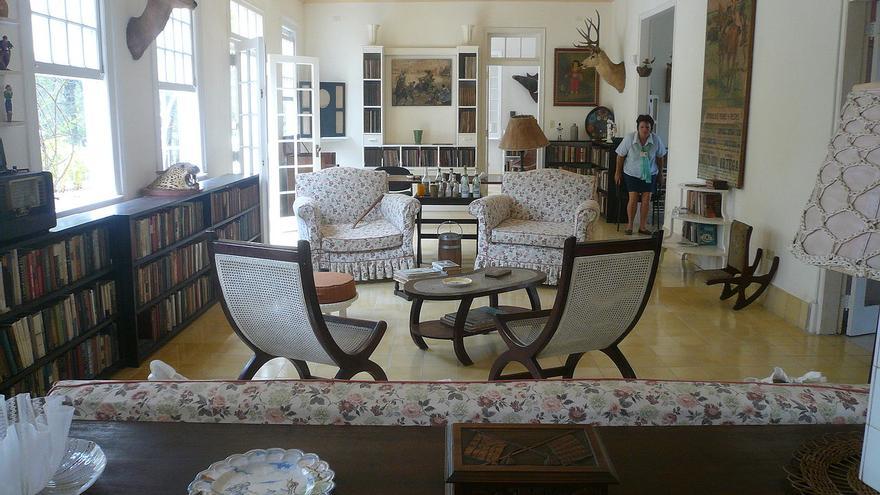
Interior of the Finca La Vigía where the American writer Ernest Hemingway lived for 20 years. (CC)

14ymedio biggerEFE (via 14ymedio), Havana, December 11, 2023 — The United States approved a $25,000 fund to restore the former home of the American writer Ernest Hemingway in Cuba, the Finca Vigía Foundation reported on Monday, the entity that works with the authorities in Havana to preserve the current house-museum.

The money will also be allocated to the creation of a restoration center as well as to the maintenance and rescue of “thousands of documents, manuscripts, letters and photos along with a bookstore with 9,000 copies,” the agency adds in a statement.

For the chargé d’affaires of the U.S. Embassy on the Island, Benjamin Ziff, the fund approved by the U.S. Government highlights the historical and cultural value that the house represents for both Washington and Havana.

“Supporting Finca Vigía represents our commitment to preserving the incalculable history and shared cultural heritage that links the United States to Cuba,” Ziff said. continue reading

Supporting Finca Vigía represents our commitment to preserve the incalculable history and shared cultural heritage that links the United States with Cuba

For his part, Frank Phillips, co-president of the Finca Vigía Foundation, stressed that this fund is the first “financial support of the U.S. Government” and that, therefore, it is “incredibly significant.”

“Our hope is that the embassy’s support will inspire others to contribute,” Phillips added.

The Finca Vigía mansion, located about nine miles from Havana, was the residence of the American writer for more than 20 years and became the Ernest Hemingway Museum after his death on July 2, 1961, when he committed suicide with a shotgun in Idaho (USA).

Ernest Hemingway spent long periods between 1939 and until shortly before his death at Finca Vigía, where he even wrote part of some of his most famous novels, including The Old Man and the Sea, which was cited in his award of the Nobel Prize in Literature in 1954.

The museum preserves a collection of more than 20,000 personal objects and documents that belonged to the novelist, including books, hunting trophies, records, weapons, stationery, photos, a typewriter, where he used to write standing, and the yacht El Pilar, with which he went fishing and sailing in the Caribbean Sea.

Translated by Regina Anavy

___________

COLLABORATE WITH OUR WORKThe 14ymedio team is committed to practicing serious journalism that reflects Cuba’s reality in all its depth. Thank you for joining us on this long journey. We invite you to continue supporting us by becoming a member of 14ymedio now. Together we can continue transforming journalism in Cuba.
Three New Murders Are Reported in Cuba Thanks to Social Networks

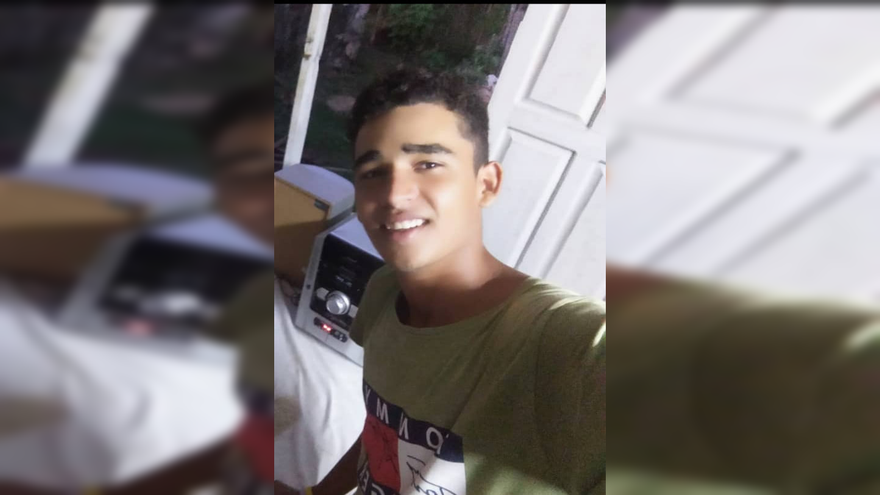
César Alejandro was killed while enjoying the Canchánchara Festival in Trinidad, held between December 8 and 10. (Daismany Palacio/ Facebook)

14ymedio bigger14ymedio, Havana, December 11, 2023 — Social networks have once again highlighted the increase in violence in Cuba, which in recent days left at least three people dead: César Alejandro, Damián Reyes and Jadier Fuentes, in Sancti Spíritus, Santiago de Cuba and Camagüey, respectively.

The case of César Alejandro, 19, has been confirmed by Daismany Palacio, who presents himself as the victim’s uncle. In a post published on his Facebook profile, he claims that the crime occurred during the celebration of the Canchánchara Festival, in the Sancti Spíritus city of Trinidad.

Palacio, currently residing in Dallas, Texas, said in a live broadcast that his nephew was attacked by five young people, one of whom stabbed him in the stomach while the rest beat him.

“Right now my heart is broken into thousands of pieces. Two hours ago I just received the worst news in this world, that they killed my nephew, who was like a son to me,” said Palacio. He added that during the holidays, the police are focused on safeguarding the tourists, relegating Cubans to the background. continue reading

During the broadcast, Palacio expressed, in addition to his pain, the concern that the presence of alcohol in popular festivals helps fuel this type of event.

Right now my heart is shattered in thousands of pieces. Two hours ago I just received the worst news in this world, that they killed my nephew, who was like a son to me

Guillermo Ángel Soto del Valle, who claims to be a doctor at the General Hospital of Trinidad, commented in a post made on the Facebook group “Trinidad Remembers You” that César Alejandro died in the operating room and that it was impossible to save him.

In the case of Damián Reyes, the report was made on Instagram by user Niover Licea, who explained that the young man was murdered in the neighborhood of Portuondo, in the municipality of Santiago de Cuba, when he tried to mediate in a fight between a friend and the alleged aggressor.

According to ADN Cuba, Jadier Fuentes, 32, was recently murdered in the town of Indalla, in the municipality of Vertientes, Camaguey, allegedly by a man known as El Pinto, who killed him with a machete.

After decades of control by the Communist media, the independent press is announcing numerous cases of murders that now are known thanks to social networks. In addition, the population is also warning of an increase in violent crime. Last November, Bohemia magazine published a report, based on a “non-representative” digital survey conducted by the media, which indicated that 92.4% considered that violence has increased a lot, while 42% reported having been aware of 10 or more events of this nature in the last half year. Almost half said that an immediate family member or close person was a victim of crime.

The report also mentioned cases of sexist violence, although the data compiled by the authorities are far from the records of independent media and feminist platforms. According to the 14ymedio database, with the murder of Dorka Velázquez Casal, age 15, in the town of Aguacate, in Santiago de Cuba, this makes 79 feminicides in Cuba during this year.

Translated by Regina Anavy

____________

COLLABORATE WITH OUR WORKThe 14ymedio team is committed to practicing serious journalism that reflects Cuba’s reality in all its depth. Thank you for joining us on this long journey. We invite you to continue supporting us by becoming a member of 14ymedio now. Together we can continue transforming journalism in Cuba.

Almost Always Villains

Caricature that ridicules the Spanish soldier Valeriano Weyler, architect of the Reconcentration. (Cubamemoria.com)

14ymedio bigger14ymedio, Xavier Carbonell, Salamanca, 4 December 2023 — Martí is good, Weyler is bad, Chibás is doubtful and a little hysterical. Cubans were always reckless; the Spanish, lazy; Americans, greedy. The independence movement was inevitable; annexationism, inadvisable; reformism, a symptom of laziness and lack of character. Céspedes is the father of the country; Mariana, the mother; Gómez, the grandfather; Martí the intellectual author; Batista, the mulatto stepfather; Che Guevara, the hippie, pot-smoking nephew; but Fidel… Fidel is everything, alpha and omega, Fidel is the San Antonio cape and the Punta de Maisí, the bearded caiman. Fidel is nothing more and nothing less than the sóngoro cosongo [poem by Nicolás Guillén], the tíbiri-tábara [album by the Cuban band, Sierra Maestro], the cornerstone.

From the ashes of Hatüey to the litanies of the Communist Party, the history of Cuba that remains in our heads is – to carry it well – Manichean and scholarly. It’s logical. A country almost always clumsy in its present will be forgetful of the past and blind to its future. I suppose that any citizen, if he is not a victim of a guilt complex, will take it for granted that his country is decent, that he has fought only just and inevitable wars and that he defends democratic values, culture, freedom and such. But in that the Cuban is bound to lose. continue reading

Those who commanded the Island were almost always villains, enjoyed an unusual talent for manipulating memory and messed with the intellectuals

Those who commanded the Island were almost always villains, enjoyed an unusual talent for manipulating memory and messed with the intellectuals until they said what suited them. If the writers paid a high price for their complicity – the current ruin and mediocrity of Cuban literature – historians must answer for something more serious: having destroyed Cuba’s past, the only thing that could give us a certain pride, a certain joy of being Cuban, despite the distance and disgust.

We lost the books, the tobacco fell to pieces, we were bitten by scorpions, everything went crazy. Instead of looking for history in A pie y descalzo [On Foot and Barefoot: Trinidad to Cuba 1870-71 (Memories of the Countryside) by Ramón M. Roa] or in Humboldt’s essays [Wilhelm von Humboldt, German philosopher and linguist who devised a system of education], in El libro de los peces [The Book of Fish, by William Gould] or El ingenio [The Sugarmill, by Manuel Moreno Fraginals], we return again to the primary school teacher, who forced us to remember, by means of chalk and blackboard, in which year of the Revolution we lived [Each year had a name; e.g., The Year of Education].

Even exile doesn’t save us, because the bad memory knows how to get a passport and cross the sea. Few Cuban publishers did what the Dutch Jew Johan Polak did; after escaping the Nazi extermination he founded a publishing house to save – in luxurious volumes, furthermore – classical literature. We share the exodus and misfortune of the Jews, but not their love of books. It is difficult to find a careful text by Julián del Casal, a facsimile of the engravings of the English invasion of Havana, the almost magical catalog of José Severino Boloña, the Novena to Saint Agustine or the brochure of 1722 that dethroned the Tariff of Prices and Medicines as the first printed matter of the Island.

But this is erudition, material for bibliophiles. What we urgently need is a book that lets Cubans – especially young people – know that Pepe Antonio was not a hero, but a local and undisciplined caudillo. A text that admits how much Cuba and Spain are owed – in both directions – that vaccinates us in advance against the idiocy of tearing down statues and demanding apologies. Let Varela be called a minister or parish priest, and not the aseptic “priest.” Let’s face the great millionaires of the colony, major conspirators; let’s talk about pirates and corsairs and intentional shipwrecks (the big business of the time).

Let the story of the Freemasons, the Jews, the santeros, the Oddfellows, the Rosicrucians and theosophists be told (Sarduy began in literature writing a poem inspired by Krishnamurti). Let them carefully analyze the Reconcentration, the year 1898, the Revolution of the 30th and Castroism (as metastases of a cancer that we have been carrying for decades). You have to edit Cuban libraries – inside or outside the country, it doesn’t matter – and write them down.

To tell a story is to lose it, says Piglia, but we only have the story we know

Only the Cuban exile today has the conditions to rebuild memory. Inside there is no desire, no money, no people. Without that past, you can’t assemble the pieces of a future country, free of communist dullness, with historians by profession who resume the business where Moreno Fraginals and Leví Marrero left it and ask what Oscar Zanetti or Rafael Acosta have been doing, and about the long list of National History Awards, which prides itself on having Raúl Castro among its ranks.

To tell a story is to lose it, says Piglia, but we only have the story we know. In Respiración artificial [Artificial Breathing, by Ricardo Piglia], the novelist dreams of the possibility of a man-museum. Someone, young or old, with a perfect memory of the country, of what it was and what it could be. A man who must be consulted, in the future, as the only and last witness of an era. Less optimistic, I don’t believe in Piglia’s dream. But yes, I do believe in libraries.

Translated by Regina Anavy

____________

COLLABORATE WITH OUR WORKThe 14ymedio team is committed to practicing serious journalism that reflects Cuba’s reality in all its depth. Thank you for joining us on this long journey. We invite you to continue supporting us by becoming a member of 14ymedio now. Together we can continue transforming journalism in Cuba.
Cuba and Iran Agree on a ‘Resistance’ Strategy Against US Sanctions and Imperialism

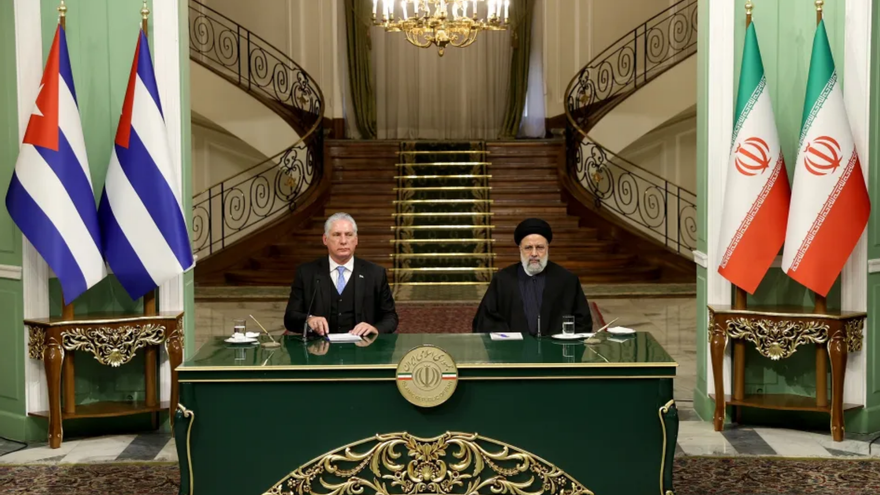
“To deal with these sanctions we are going to increase the exchange of our capacity and potential,” Raisí said. (EFE)

14ymedio biggerEFE (via 14ymedio), Tehran, December 4, 2023 — Iran and Cuba agreed on Monday to strengthen their relations in all areas to face the sanctions of the United States, during an official visit of the Cuban president, Miguel Díaz-Canel, to Tehran.

Díaz-Canel was received by the president of Iran, Ebrahim Raisí, and both leaders met to work on a strategy of “an economy of resistance” to combat US imperialism and neutralize the sanctions suffered by the two “brother countries.”

The Americans believe that with the imposition of sanctions they can stop our countries or force us to surrender. This is not true

“The Americans believe that with the imposition of sanctions they can stop our countries or force us to surrender. This is not true,” Raisí said at a press conference with Díaz-Canel after the signing of seven agreements in various fields.

“To deal with these sanctions we are going to increase the exchange of our capacity and potential,” said Raisí, who described Díaz-Canel’s visit to Tehran as “a turning point” in relations between the two countries. The Iranian president stressed that the sanctions have not been successful and that Tehran and Havana have not renounced their principles. He asserted that their resistance is one of the main points in common between the two countries. “We two countries are against imperialism,” Raisí said. continue reading

Díaz-Canel, for his part, said that Tehran and Havana have conceived a strategy of “economy of resistance” in strategic areas such as energy, food, science, technology and health to face “the unjust sanctions with which imperialism attacks our peoples.”

“We have ratified the conviction that with this strategy we will deal a hard blow to imperialist aggression, sanctions and blockades,” said the Cuban president. Díaz-Canel arrived in Tehran last night, on the first visit of a Cuban president to Iran since 2001, accompanied by a large, high-level delegation. During his visit, the two countries have signed seven agreements and cooperation memorandums in the health, energy, agriculture, science, technology and communications sectors.

In addition, the Cuban president will visit the Pasteur Institute in Tehran, which collaborates with Cuba on medical projects, and will attend an exhibition of the “achievements of the latest technological capabilities of the Islamic Republic of Iran.”

The Cuban president will visit the Pasteur Institute in Tehran, which collaborates with Cuba on medical projects, and will attend an exhibition of the achievements of the latest technological capabilities of the Islamic Republic of Iran

The two leaders did not forget the conflict in the Gaza Strip and called for the creation of a coalition to support the Palestinian people in the face of the “ineffectiveness” of international organizations such as the UN and the Arab League, among others, to stop the war, in which at least 1,200 Israelis and more than 15,000 Palestinians have died.

“The honorable president of Cuba and I agree that a coalition must be created with the participation of allied countries to support the oppressed Palestinian people on different continents,” Raisí said.

Díaz-Canel, for his part, called for the urgent need of the international community to condemn the “genocide” committed against the Palestinian people, in addition to an immediate ceasefire and the creation of a Palestinian state.

Translated by Regina Anavy

____________

COLLABORATE WITH OUR WORKThe 14ymedio team is committed to practicing serious journalism that reflects Cuba’s reality in all its depth. Thank you for joining us on this long journey. We invite you to continue supporting us by becoming a member of 14ymedio now. Together we can continue transforming journalism in Cuba.
Humanitarian Parole Is an Escape Route to the U.S. for ‘Sleeper’ Cuban Communist Party Members

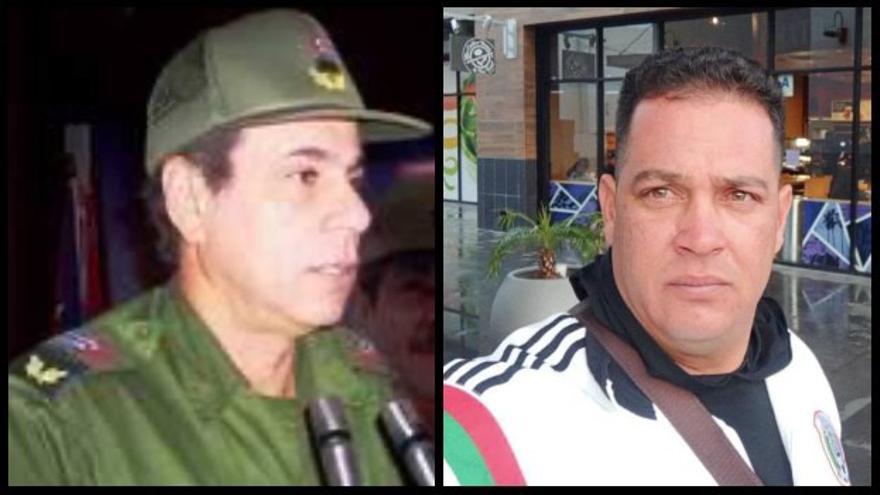
From left to right, Misael Enamorado Dager and Yurquis Companioni. (Collage)

14ymedio bigger14ymedio, Havana, December 8, 2023 — The theory is clear: the official guide of the United States Citizenship and Immigration Service, published in 2020, clarifies that it is inconceivable that members of a Communist Party – and Cuba has more than half a million of them – pronounce the U.S. Oath of Loyalty. The practice, however, is very different: not a few agents of the Havana regime have been admitted within the U.S. border, a country in which they live, work and vote.

This is the case of Misael Enamorado Dager, who served as the first secretary of the Communist Party in Santiago de Cuba between 2001 and 2009, and who now resides in Houston, Texas, after entering the country with humanitarian parole, according to the influencer Niover Licea on social networks.

Interviewed by 14ymedio, a source close to the former leader confirms that he recently managed to move to the United States. “It’s been several years since he left the Party and was in a state research center until he retired, as did Lourdes, his wife,” he explains.

“They are there with their son, who had already been gone for a long time,” and he was the one who allegedly started the parole procedures, he adds. continue reading

Enamorado’s record on the Island leaves no doubt about his political affiliation. In 2011, during the VI Party Congress and two years after leaving office in Santiago, the former official was promoted to Secretary of the Communist Party, along with figures such as Esteban Lazo and José Ramón Machado Ventura.

However, in 2013 his political career plummeted. That year, during the restructuring carried out by Raúl Castro, Enamorado was “released from his status as a member of the Central Committee.”

Since then, his appearances in the public sphere decreased, until he fell into an oblivion that, as his exile suggests, he used to bypass Washington’s ideological controls.

During the restructuring carried out by Raúl Castro, Enamorado was “released from his status as a member of the Central Committee”

It was also reported this week by the independent press that Yurquis Companioni, a counterintelligence agent in Sancti Spíritus, managed to enter the United States through the southern border – after traveling the route from Nicaragua to Mexico – thanks to his sister, who already resided in that country and sponsored him for a six-year parole.

A source of this newspaper in that province confirmed Companioni’s identity and his relationship with State Security. “He seemed like a cool person, but he would sink you in a short time if you if you didn’t suit him. I haven’t seen him in a long time, so I’m not surprised that he’s in the United States,” he said.

According to the source, the former agent worked supervising the recruits in various facilities in the province. “Once he caught me asleep on duty and sent me to detention for 15 days,” he adds.

This type of story is common, he continues. “One day they’re here, taking any bribe that comes their way, and then they leave and appear in all the photos with American flags as if nothing had happened,” he says.

In fact, the cases of Enamorado and Companioni are not even remotely the only ones. A wave of former defenders, repressors and bureaucrats of the regime has arrived in the U.S. in recent years. Complaints on social networks every time any of these cases come to light revolve around the same idea: counterintelligence agents, sent or not by the regime, “have invaded” the Cuban community in exile.

The emigrants, increasingly concerned that the freedom they have achieved with effort could be transformed into a murky reality, firmly demand that the United States thoroughly review the background of those who enter the country.

An update of the inadmissibility policies of the United States Citizenship and Immigration Service in 2020, during Donald Trump’s term made it clear – at least in writing – what had been done for decades with migrants: “Unless exempt otherwise, any possible immigrant who is or has been a member or affiliate of the Communist Party or any other totalitarian party (subdivision or affiliated with them), domestic or abroad, is inadmissible to the United States.”

Translated by Regina Anavy

____________

COLLABORATE WITH OUR WORKThe 14ymedio team is committed to practicing serious journalism that reflects Cuba’s reality in all its depth. Thank you for joining us on this long journey. We invite you to continue supporting us by becoming a member of 14ymedio now. Together we can continue transforming journalism in Cuba.
An Advisor to the Large Spanish Hotels Asks Cuba To ‘Be More Open’ to Privatization

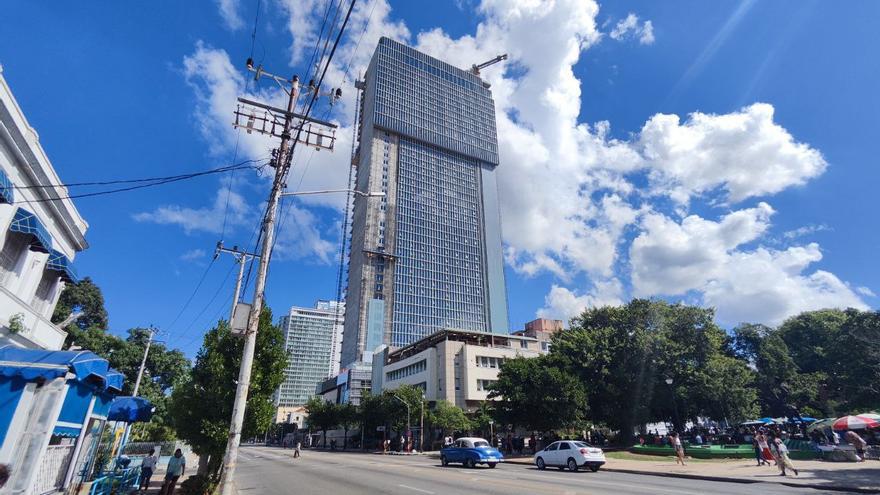
The Spanish hotel company Iberostar will be in charge of managing Tower K in Havana. (14ymedio)

14ymedio bigger14ymedio, Havana, December 7, 2023 — The Spanish advisor Francisco Albertí, who has been the financial guru for almost all the large hotel groups in Spain, this Thursday asked the Cuban authorities to allow the companies, “especially Meliá, to be great actors and advisors of the Cuban Government in the tourist recovery,” suggesting, even, that they could own some of the hotels they manage.

With experience working not only for Meliá, but also for the Mallorcan Iberostar and Riu – all with a history of hotel management on the Island – the expert does not make his proposal in vain. The business, he insinuates, would be good.

Even better, the hotel chains could help oxygenate with “private investment all the sectors that suffer: energy, supplies, food, agriculture and livestock,” which are “paralyzed” by the crisis on the Island.

To do this, he clarifies, the first step must be taken by the Cuban government, which will have to “open the country a little more” so that Spanish companies stop being simple managers and become owners of their hotels on the Island. continue reading

Now is the time for Cuba to make important decisions at the tourist and country level” if it wants to “get back on its feet”

“Now is the time for Cuba to make important decisions at the tourist and country level” if it wants to “get back on its feet,” says Albertí. The tourism advisor also recalled the years in which he worked as an expansion director for the Riu chain, which in 2008 left the last of the three hotels that it once operated in Cuba. “Investing was not allowed for Spanish hoteliers, and the Riu family opted for another model,” he said.

The expansion plan launched later in countries such as Mexico, Jamaica and Costa Rica suggests that the hotel company stopped seeing Cuba as an enclave of interest and began to bet on nearby destinations.

“At that time they had hotels under management and for rent even in Spain. There was no more motivation so they left the Island,” Albertí reflects, insinuating perhaps that the same could happen with Meliá or Iberostar, which he described as “hoteliers who have supported the tourism industry” despite the fact that other destinations provide them with better results.

The intentions of both chains, however, seem to be directed at the moment in the opposite direction. This year Meliá inaugurated two luxury hotels in Varadero (Matanzas) and Sancti Spíritus. The latter, the Meliá Trinidad Península, has been the center of several controversies for its exclusive facilities that captured 60% of the province’s annual budget granted by the Ministry of Construction.

The hotel company also plans to inaugurate three other facilities in central areas of Havana: the Innside Habana Catedral, the Plaza de La Habana and the Seville

The hotel company also plans to inaugurate three other facilities in central areas of Havana – the Innside Habana Catedral, the Plaza de La Habana and the Seville – in addition to a fourth in Holguín, the Sol Turquesa Beach. At the end of the year, the chain will have 34 establishments throughout the island. Iberostar, lagging behind, is trying to reach thirty and will manage the Torre K hotel in the capital, currently under construction and without a name.

Likewise, last May, Gabriel Escarrer, vice president of Meliá, assured that despite the fall in tourism after the pandemic, he has no doubt that Cuba “will recover pre-crisis levels and will be in better condition than ever.” The director also said he had faith that the Island would reach the 3.5 million travelers predicted by the Cuban authorities, something that did not happen. On the contrary, at the end of November the figure did not reach even 2 million.

European tourism has been one of the most affected, which the Island’s authorities attribute to the war in Ukraine. The statistics of the sector, although better than in 2022, do not compare to the more than 4 million travelers who flew to Cuba in the years prior to COVID-19.

The Government, for its part, has tried to counteract the debacle by promoting Russian and Chinese tourism, but so far neither of the two alternatives has shown the results that Havana expected.

Translated by Regina Anavy

____________

COLLABORATE WITH OUR WORKThe 14ymedio team is committed to practicing serious journalism that reflects Cuba’s reality in all its depth. Thank you for joining us on this long journey. We invite you to continue supporting us by becoming a member of 14ymedio now. Together we can continue transforming journalism in Cuba.
France Arrests Two People for the Murder of Cuban Choral Director Reynier Silegas Ramirez

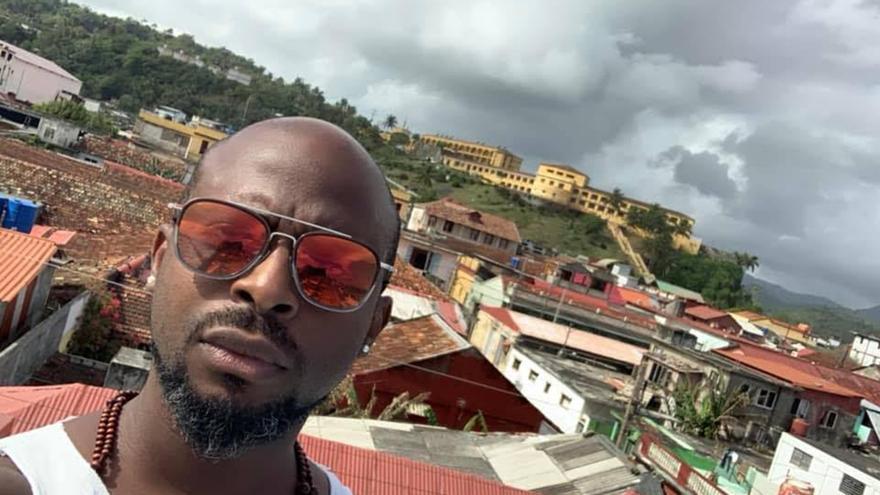
The body of Reynier Silegas Ramírez was found in his house. (Facebook/Reynier Silegas Ramírez)

14ymedio bigger14ymedio, Havana, December 1, 2023 — Two people, aged 27 and 36, were arrested this Thursday in the Malengro neighborhood for the alleged murder of Reynier Silegas Ramírez. The Cuban choral conductor, 43, was found dead last Tuesday inside his home in Barrière de Paris (France). The body, according to local media, showed “signs of violence,” so the crime was handled as a homicide from the beginning.

The authorities located the 27-year-old suspect after tracking Silegas Ramírez’s cell phone. Investigations indicate that this person helped the murderer, a 36-year-old Brazilian, to hide the evidence of the homicide. So the young man is being prosecuted for “covering up a theft.” The Toulouse Prosecutor’s Office is requesting “preventive detention” of the other person arrested, who is accused of “murder and robbery.”

The authorities have two hypotheses about the murder. One of them alludes to “a violent sexual game that allegedly got out of control”; the second is based on a discussion of the Cuban choral director with the Brazilian he met through social networks. However, for now, the reason is still unclear. “There are still many gray areas to be clarified,” the Prosecutor’s office acknowledged. continue reading

The Cuban artist was well known in Alto Garona and in Gers for his musical activity

The public ministry allowed an autopsy and toxicological and pathological analyses to “verify the cause of the death of Reynier Silegas Ramírez,” published the French media La Dépêche. According to the first findings, the victim was “hit with a blunt object and showed signs of strangulation.”

It was specified that the lifeless body of the Cuban director was found by the emergency services “naked, with a telephone cable wrapped around his neck and covered by a sheet.” Choir members told the authorities that Silegas Ramírez missed the rehearsal in the department of Gers.

The same publication highlighted that the Cuban artist was well known in Alto Garona and in Gers for his musical activity. Since his death, the tributes have multiplied.

The president of the Eclats de Voix du Gers festival, Patrick de Chirée, defined Reynier Silagas as “an exceptional artist.”

Meanwhile, the French salsa and Latin music festival Tempo Latino announced “a cheerful, warm and musical tribute” that will be paid to him in the next edition of Tempo Latino. “In memory of your immense talent, your panoramic elegance of Sonero and your magnificent generosity towards everyone.”

Translated by Regina Anavy

____________

COLLABORATE WITH OUR WORKThe 14ymedio team is committed to practicing serious journalism that reflects Cuba’s reality in all its depth. Thank you for joining us on this long journey. We invite you to continue supporting us by becoming a member of 14ymedio now. Together we can continue transforming journalism in Cuba.
Books Arrive at Cuban Schools in the Middle of the Semester

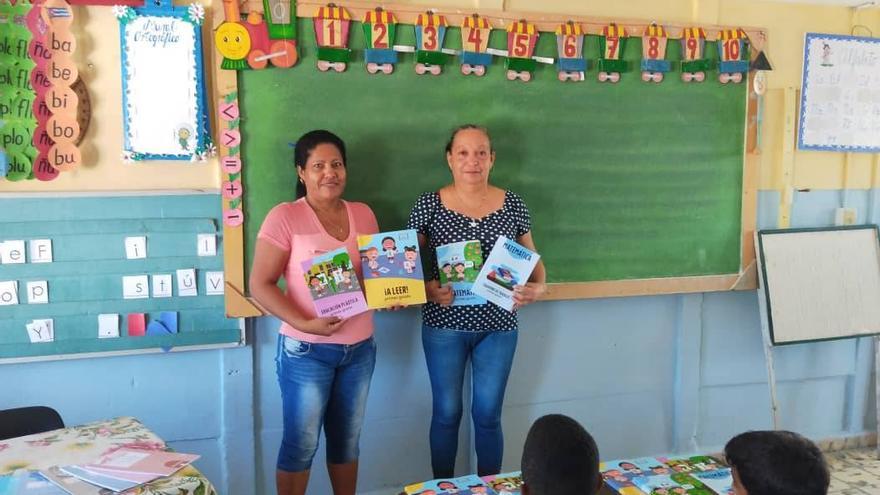
In Nuevitas, Camagüey, the first and fourth grades of primary school now have the new materials. (Radio Nuevitas)

14ymedio bigger14ymedio, Havana, December 7, 2023 — The so-called Third Improvement – an attempt to update the Cuban educational system and its institutions – did not reach the classrooms of Matanzas and Camagüey until this December, when the school year was about to finish its first semester. The new textbooks, which have been delivered to very few groups of students, come with suggestions of caution because they are more “sensitive” than the old ones.

An article published this Wednesday in the official newspaper Girón gave an account of the partial update of the “material base of study” and obliquely mentioned its deficiencies. At the moment, only the first and fourth grades of primary school, the seventh of middle school and the tenth of high school have received the books. The first grades of Technical Teaching and Pedagogy also obtained new books.

The municipality of Nuevitas in Camagüey is in a similar situation, where only the first and fourth grade students received the new materials this Monday. As for the seventh and tenth, the books are expected to be distributed shortly. For the rest of the grades, which will not receive the school supplies this year, there is still no clarity on the delivery date. continue reading

The Third Improvement, which was to provide a “more comprehensive and multifaceted approach” to education on the Island, has been news since at least 2017. However, it has not been until now, six years later, that the education system has begun the first reforms, requiring much patience.

The poor quality of the books – celebrated by the authorities and the official press – has been criticized by several local officials

The poor quality of the books – celebrated by the authorities and the official press – has been criticized by several local officials of the Ministry of Education. According to the provincial newspaper, Yainet Trejo, deputy director general of the sector in Matanzas, the material with which the books are made is less resistant to wear, and each volume has a greater number of pages than previous editions, which causes the binding to break more easily.

As they are the first of the new batch to arrive in the classrooms, the materials will also be monitored with zeal. “Among the measures adopted for their conservation is foliating (assigning them a number in the warehouse) to ensure control, and the books can be covered, but without spiral loop binding or gluing the pages,” Trejo explained.

At the beginning of September, several parents of students told this newspaper that the books would be ready in the first weeks of the course. The teachers told them that the students would temporarily concentrate on reviewing the contents of the previous year.

The late delivery of the texts, however, was not accompanied by an explanation from the Ministry of Education about what content was taught in the classes in the absence of the updated material or how the course will be consistent after a sudden change in the subjects that, according to the authorities, now favor “teaching content, the participation of families in helping with the exercises and the treatment of current topics.”

Days before the beginning of this school period, the disastrous conditions with which the Island intended to start the school year were already news. The delay in the production of uniforms, the delivery of fewer school supplies – erasers, pencils, notebooks – than in previous years and the inability of many parents to buy backpacks or get snacks for their children due to the high prices kept families in suspense.

The chronic shortage of teachers is perhaps the most pressing problem in Cuban classrooms. However, turning a deaf ear to its own crisis, the Island continues to sign education agreements around the world. With a track record in countries such as Angola and Honduras, this week the regime closed an agreement with Colombia to provide assistance in this field.

The memorandum, which had been negotiated in June, will be the starting point of the joint program Education in the First Place, and a Cuban delegation is expected to assist Colombia in the curriculum design, pedagogical follow-up and the “human rights approach in public education,” among other aspects.

The program signed by Havana and Bogotá will be in force until December 2024. The authorities did not clarify at any time whether, as was done with Honduras last January, the Island will send the “education professionals” who are so scarce in its own classrooms.

Translated by Regina Anavy

____________

COLLABORATE WITH OUR WORKThe 14ymedio team is committed to practicing serious journalism that reflects Cuba’s reality in all its depth. Thank you for joining us on this long journey. We invite you to continue supporting us by becoming a member of 14ymedio now. Together we can continue transforming journalism in Cuba.
Almost 500,000 Migrants Have Crossed the Darien Jungle So Far This Year, Twice As Many as in All of 2022

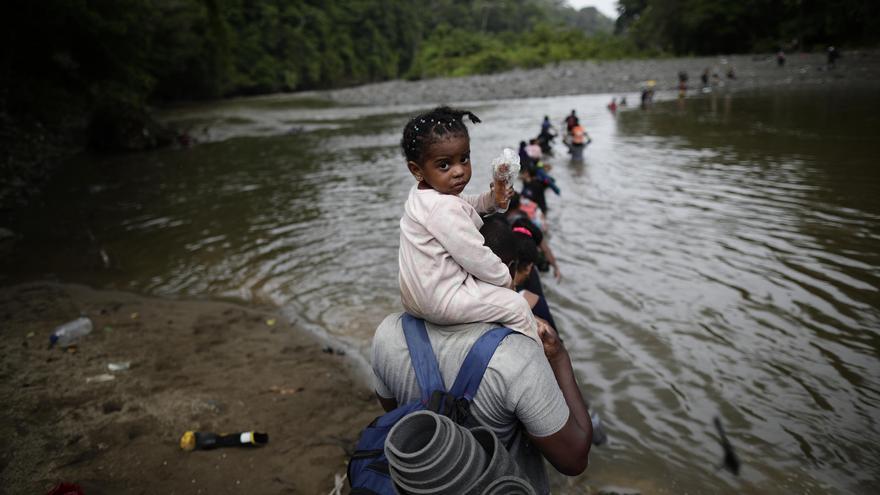
Migrants cross the Turquesa River, in the Darién Jungle (Panama), in an archive photograph. (EFE/Bienvenido Velasco)

14ymedio biggerEFE (via 14ymedio), Bogota, December 1, 2023 — Almost 500,000 migrants have crossed the Darién Jungle region on the border between Colombia and Panama, one of the most used and dangerous routes in the journey of these people on their trip to the United States, Médicos Sin Fronteras (MSF) revealed this Thursday.

According to this organization, the number of migrants who have crossed the 60 miles of “wild nature on horseback” of the Darién Gap is about to exceed 500,000 so far in 2023, a figure much higher than that of 248,000 in all of 2022 and 133,000 in 2021.

“The number of migrants who have crossed the jungle is equivalent to more than 11% of Panama’s population. This is an unprecedented crisis to which not enough global or regional attention has been paid,” said the general coordinator of MSF for Colombia and Panama, Luis Eguiluz.

He added that “safe routes have not been guaranteed to migrants, nor sufficient resources for the organizations that serve them.” continue reading

According to MSF, in addition to the natural difficulties of crossing the jungle, migrants are also exposed to attacks, robberies, kidnappings and sexual violence; this organization has treated 397 survivors of sexual violence – 107 in October alone – including children.

We are crossing the jungle looking for a better future, not to die. A snake doesn’t end your life; it’s the men who rape and kill you 

“How do you survive five rapes?” asks a Venezuelan woman crying, who told MSF that she left her country for economic reasons.

“We are crossing the jungle looking for a better future, not to die. A snake doesn’t end your life; it’s the men who rape and kill you,” she added.

Ninety-five percent of the victims of sexual violence treated by MSF were women, and those who tried to defend them were attacked and even killed.

“What we have evidenced and heard from them is that those who transit through the Americas are exposed to a situation of extreme vulnerability: hunger, absence of shelter and water sources, excessive charges, disinformation and scams, xenophobia and physical, psychological and sexual violence,” Eguiluz said.

The torture of the migrants, according to Eguiluz, starts long before the migrants reach the Darién jungle, “even if it is there where it becomes evident.”

“From Peru I took a bus to Huaquillas (a city in Ecuador on the border with Peru). There some men took 10 migrants and stole all their money, and the women were undressed. They took the phones too and said that if we talked, they would kill us. They were carrying knives and guns,” says David Fuentes, a Colombian-Venezuelan migrant.

Translated by Regina Anavy

____________

COLLABORATE WITH OUR WORKThe 14ymedio team is committed to practicing serious journalism that reflects Cuba’s reality in all its depth. Thank you for joining us on this long journey. We invite you to continue supporting us by becoming a member of 14ymedio now. Together we can continue transforming journalism in Cuba.
Since Russia’s Invasion of Ukraine, Cuba Pays Three Times More for a Ton of Grain

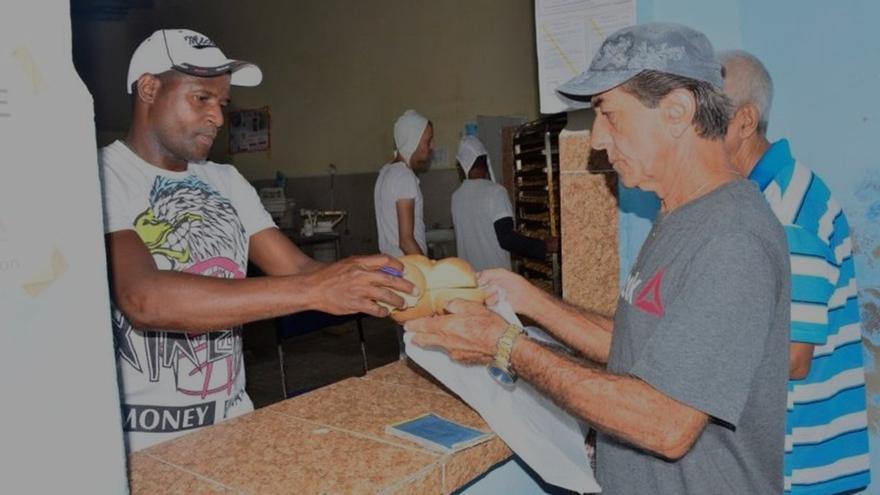
In the case of Sancti Spíritus, 28.4 tons of flour are needed daily to produce the standard bread, but only 24 tons are being received. (Escambray)

14ymedio bigger14ymedio, Havana, 6 December 2023 — The directors of the Sancti Spíritus Food Industry Company complained on Wednesday that what they call “the war between Russia and Ukraine” has triggered the price of wheat imported by Cuba. Each ton of flour costs the country 13 million pesos, they explained, three times more than what it used to pay before the invasion decreed by Vladimir Putin. In the province, the solution to save raw material has been drastic: reduce the size of the bread rolls.

Before the war, COVID-19 had already made the price of bread more expensive, causing a season of shortages on the tables from which the citizens have not been able to recover. A ton of wheat, which the country buys and processes in its mills because it’s cheaper than importing flour, is enough to satisfy 12 days of national production. In the case of Sancti Spíritus, 28.4 tons of flour are needed daily to produce standard bread, but only 24 are being received.

What the leaders themselves call a “small ball” (a roll) of rationed bread has had to be made smaller. The approximately 3.5 ounces that each bread roll weighed has now become 2 ounces. The good news, if there is one, is that the price has also dropped: it costs 25 centavos less, explained the director of the Food Industry in the province, Víctor Díaz Acosta. continue reading

Díaz Acosta also regretted that, since he subsidizes almost 50% of the production cost of standard bread – about 1.40 pesos – his company registers a loss of between three and four million pesos each month, partly compensated by the profits of the “released [unrationed] sale.” The leader admitted, during an interview with the newspaper Escambray, that he is no stranger to the second problem of bread, in addition to the shortage of wheat: its quality.

The debacle of bread production is so alarming in Cuba, that the official press itself has analyzed on several occasions the possible ways to solve it, without ever finding a satisfactory method

This is influenced by the baker, the technical state of the equipment, the quality of the raw material and the blackouts that interrupt the cooking process, which is basically done with electricity, he explained.

However, the provincial section of the Food Industry in Sancti Spíritus has no losses, Díaz Acosta said. It is saved by its alliance with the “new economic actors” (the private sector), which allows it to make other products: a baguette that is sold in state establishments at 75 pesos and dough for pizzas and breadsticks.

In that way, the leader explained, Sancti Spíritus saves the country 39 million pesos. It is the only entity of its kind in the country that can boast of a contribution of that caliber, despite the U.S. blockade and the thousand and one shortages that threaten the “socialist state company,” Díaz Acosta said.

The official also recognizes that, while state production hangs by a thread, the private sector continues to offer bread to their customers, against all odds; of course, at prohibitive prices for most people in the province. This situation does not bother Díaz Acosta, who pragmatically affirms that “it is better to have the availability than not.”

The debacle of bread production is so alarming in Cuba that the official press itself has analyzed on several occasions the possible ways to solve it, without ever finding a satisfactory method. Each new article becomes obsolete in a few weeks, because inflation does not take long to raise the price bar a little more. So much so that many Cubans can no longer afford goods like eggs or meat, which threaten to become luxury items.

Meanwhile, the citizens of Sancti Spíritus have become accustomed to the “original” solutions of the food industry company, which at the end of last year – in the midst of the umpteenth wheat crisis – had consented to bakeries using up to 20% of rice-husk residue to make bread. The end-of-the-year bread will not be as hard and sour as then, but nor will it serve to kill hunger.

Translated by Regina Anavy

____________

COLLABORATE WITH OUR WORKThe 14ymedio team is committed to practicing serious journalism that reflects Cuba’s reality in all its depth. Thank you for joining us on this long journey. We invite you to continue supporting us by becoming a member of 14ymedio now. Together we can continue transforming journalism in Cuba.
The Refinery and Police Fines, the Main Sources of Income in Cienfuegos, Cuba

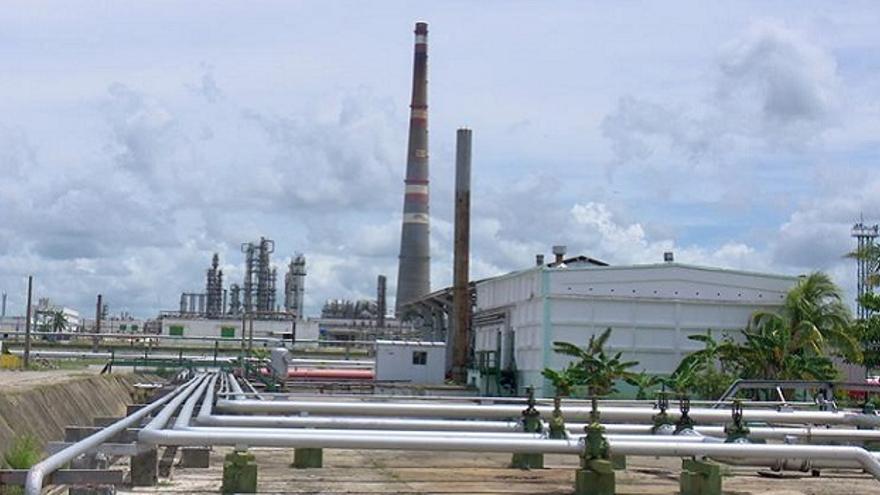
Cienfuegos Refinery. (5 de septiembre)

14ymedio bigger14ymedio, Havana, December 7, 2023 — The government of Cienfuegos has the province’s refinery to thank for more than 8.6 billion pesos in sales during the first half of 2023, 43.8% of all the money generated that year (about 20 billion). The data, one of the many that give the measure of the economic imbalance of Cienfuegos, appeared in the extensive accountability report that the provincial authorities published this Wednesday.

On the other hand, there was not a word about the 706,293 cubic feet per month of stone that the province uprooted from its El Cuero and Arriete quarries to send by boat for the 907 miles of ballast for the Maya Train, which will connect the main tourist cities of the Yucatan peninsula, in Mexico. It was a secret state agreement between the two leaders, Díaz-Canel and López Obrador, and the funds were sent directly to Havana.

The document covers all of 2022 and the first half of 2023. Dozens of meetings, hundreds of agreements and resolutions, and multiple debates demonstrate, according to the authorities, the seriousness of their work, even under two great challenges: blackouts and the “increase in political-ideological subversion.”

The refinery, subjected to repairs that ended last November, also led sales in 2022, when it was responsible for an even higher figure: of the 41,207 million pesos contributed by Cienfuegos to the State coffers, 24,284 million – 58% – came from the refinery. continue reading

Dozens of meetings, hundreds of agreements and resolutions, and multiple debates demonstrate, according to the authorities, the seriousness of their work

Despite the prominence of the factory, in whose port oil tankers with crude oil from Venezuela and Mexico dock, the provincial government refrains from offering other details on the subject in its report. “Without the refinery” – an expression that the text repeats to illustrate how bad the province would be if it did not have its services – the panorama is regrettable: from January to June, 27 state companies failed to meet the targets of their plans and delivered minimum profits.

The rest of the items are in the same situation: the province’s companies employ only 34,560 people, who recieve an average salary of 4,600 pesos per month. Between a rock and a hard place, the workers let the leaders know – and this is stated in the report – their problems: the deficit of inputs and raw materials, the breakage or lack of maintenance of the equipment, the poor quality of the tobacco in the province and the restrictions on the sale of the sugar that is manufactured (the government did not approve the sale of 5% of what was produced at a subsidized price, as the companies had requested).

As for the blackouts, the leaders said, the salvation was again the refinery: “The crude oil was productive,” they celebrated. Hence, the Carlos Manuel de Céspedes thermoelectric plant is “the most stable and efficient in the country.”

The strategy to get out of the debt hole?: “Charge” all the companies that owe them money

However, Cienfuegos owed the State 712,853 million pesos last June. The strategy to get out of the debt hole?: “Charge” all the companies that owe them money and think about what “potentialities” of the province can be exploited to oxygenate their income. In that plan, the police are a powerful ally: their “effectiveness” in the collection of fines – of 97.7%, they calculate – has recovered more than 1 billion pesos.

But the debacle of the province cannot be expressed only in numbers. The provincial government admits that it has received a barrage of requests, suggestions and complaints, although it does not have the means to resolve the situation. It is eloquent, for example, in the case of doctor’s offices. About 18 consultations must offer their services with “extended hours,” and patients do not stop complaining about the lack of “permanence of the doctor and the nurse.”

In the first half of this year, 11 children under age one died, which raised the infant mortality rate in the province to 8.3 per 1,000 live births. At the other end, it was detected that 9,641 elderly people in the province live alone. The so-called Grandparents’ Houses of several municipalities are already overflowing, and there is a lack of wheelchairs and hospital beds to guarantee a tolerable old age.

The situation of medicines is alarming: 196 are lacking, especially in hospitals where they are most used and in rural areas, where the distribution truck rarely arrives. The solution: to resort to “natural and traditional medicine,” whose plan targets, they say, are fulfilled by 105% in the cities and 143% in the countryside.

The authorities close the report with a detailed epigraph on “social illegalities and indisciplines,” in addition to supporting the police in “confronting crime and corruption.” The big problems, they say, are the “theft of livestock” and the illegal marketing of meat and other foods. In the crosshairs are Palmira and Rodas, two municipalities where criminals are active. But there is no need to worry, they emphasize, because soon there will be not only a “strengthening of investigations” but also an increase in the severity of convictions.

Translated by Regina Anavy

____________

COLLABORATE WITH OUR WORKThe 14ymedio team is committed to practicing serious journalism that reflects Cuba’s reality in all its depth. Thank you for joining us on this long journey. We invite you to continue supporting us by becoming a member of 14ymedio now. Together we can continue transforming journalism in Cuba.
Russian Mir Cards Give an ‘Error’ Message at the Store Where the Central Bank of Cuba Did the Tests

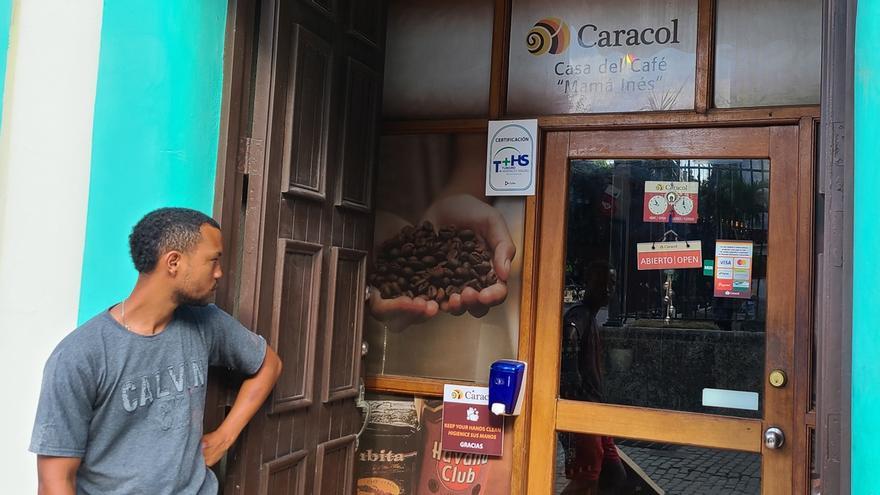
As indicated by the entrance sign, one can also pay with Visa, Mastercard or in hard currency (MLC). (14ymedio)

14ymedio bigger14ymedio, Havana, 6 December 2023 — “Error.” That word, appearing this Wednesday on the payment terminal screens at the Casa del Café Mamá Inés in Old Havana, destroys the illusions of the Central Bank of Cuba (BCC) about the effectiveness of the Russian Mir cards. Despite its commitment to the officials of the Russian National Card Payment System who visited this store belonging to the Caracol state group yesterday, electronic payment, according to its own employees, “is not working.”

“The cards are implemented,” clarifies an employee of Mamá Inés to 14ymedio. “The problem is that, when you pass them, they give an error.” Excited about the premiere of the Mir cards, the BCC authorities published photographs of the Russian envoys, whose “purchase actions” were “satisfactory” and culminated their visit by placing, on the door of the premises, the sticker that indicates that one can now pay with Russian cards.

“Mamá Inés does not accept cash rubles, only Russian tourist cards. Not as many people come as they would like, but they do come,” explains the worker. However, the employee acknowledges, unless the Cuban trying to us the Mir system has a bank account opened in Russia, the card doesn’t work.

As indicated by the entrance sign, a customer can also pay with Visa, Mastercard or in freely convertible currency (MLC). The only thing that has been banished in Mamá Inés – managed by a franchise of the Island’s military – is the Cuban peso. continue reading

Mama Inés does not accept rubles in cash, only Russian tourist cards. Not as many people come as they would like, but they do come 

What none of the employees of the Casa del Café has been able to determine is whether the failure that affects the Mir is general. The precariousness of the Internet connection, the blackouts and the slowness of electronic processes on the Island make every digital payment a nightmare. However, no foreign card has the political caliber of the Mir, in whose effective operation Havana plays one of the essential points of its alliance with Moscow: the digitization of the market, an indispensable step to better control it.

Decorated with photos of Ernesto Che Guevara, with shelves full of bottles of Cuban rum and some cartoonish images of a matriarch with a tray of cups and a coffee pot held above her head, the place includes all the stereotypes that have been used in Cuba for decades to widen the eyes of tourists. But, in addition to the clichés, this Wednesday’s customers were looking for realities.

El Galeón, a tobacco and coffee shop next to Mamá Inés, attests to this. A security agent, outside the establishment, prevents the passage of customers. As in the Casa del Café, there one can also pay with Russian cards, and a Cuban Television team is filming a report about the place.

There is no reason for Mir to be the exception to the disastrous panorama of electronic payment on the Island. It is common that, when using a Visa card issued by a European or American bank, customers are faced with the same error sign in the payment terminals. The Island’s bad connections prevents the purchase information from reaching the bank via the Internet, and it is common for devices to block the transaction for security reasons.

The Mir signal, which must travel over 6,200 miles from the tropics to Russia, is less likely to arrive than the signal of other cards, until Cuba has a less precarious telecommunications technology.

Whatever the reason, something is clear: Cuba is not ready for payment with Mir cards, and its infrastructure is not up to the aspirations of the authorities. The ideological vicinity of Havana and Moscow does not accelerate the speed of the transactions, which, at the moment of truth, are as slow as those activated with the “enemy” cards.

Translated by Regina Anavy 

____________

COLLABORATE WITH OUR WORKThe 14ymedio team is committed to practicing serious journalism that reflects Cuba’s reality in all its depth. Thank you for joining us on this long journey. We invite you to continue supporting us by becoming a member of 14ymedio now. Together we can continue transforming journalism in Cuba.
Patients Go Through an Ordeal To Be Treated in the Calamitous Cuban Hospitals

A doctor working without light, in a polyclinic in Centro Habana. (14ymedio)

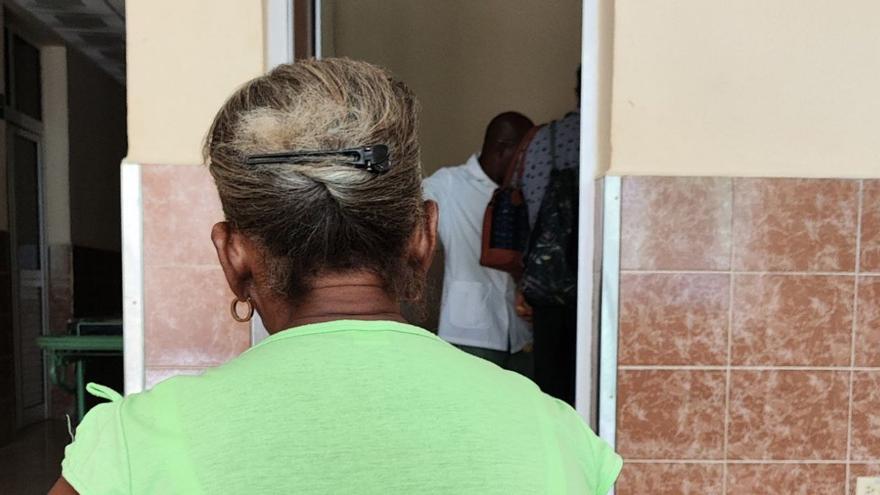
14ymedio bigger14ymedio, Olea Gallardo, Havana, November 30, 2023 — The bursting into tears last Monday of Dr. Yoandra Quesada de Bayamo (Granma), who is being tried along with five other colleagues for the death of a 23-year-old patient, is nothing but the vivid image of what remains of healthcare in Cuba, the eternal jewel in the crown for revolutionary propaganda.

What the surgeon said to the journalist Ernesto Morales – “all your colleagues leave, you are working alone and without materials, exposed to being killed one day by a desperate relative” – is verified daily by any Cuban who steps into a healthcare center. The situation of primary services is especially dramatic.

“There are no syringes, there are no reagents for the tests, there are no nozzles to give aerosol, there are no esfigmos [sphygmomanometers] to take blood pressure.” Aleida, who unravels this litany, is still young, but she is beginning to have problems with hypertension, a condition that leads to the number one cause of death on the Island. continue reading

“One day when I arrived at the hospital with high blood pressure, they wanted to give me oxygen, but there were no mouthpieces, so the doctor gave me the hose and said: ’don’t put it in your mouth, put it close, so that you feel the oxygen.’” Aleida couldn’t do it, because of the stench that the instrument gave off and out of shame. “I took it and told him: look, this doesn’t smell good. But in addition, I felt ridiculous, with that oxygen escaping everywhere.”

That day, she was lucky, because she usually has to walk miles and make a pilgrimage through several centers before finding one where a device to measure blood pressure is available. “The first time I went to the polyclinic near my house, where there were no esfigmos anywhere, the doctor told me: I can’t take your pressure, little girl, but come and sit here, the only thing I can give you is a long talk.’”

There are no syringes, there are no reagents for the analyses, there are no nozzles to give aerosol, there are no sphygmomanometers to take blood pressure

Who does have sphygmomanometers? “Foreign residents often have them and are always given a more pleasant treatment than Cubans by the way,” says Aleida. Faced with the exodus of specialists, outside the Island or to other jobs that provide them with better salaries, the Government tries to solve the lack of labor with exchange students, who cover the emergency rooms.

Luis, who is only 40, is frightened. He has been urinating blood for a few weeks and still doesn’t have the results of the tests he was finally encouraged to do. He was unsuccessful the first time he went to the hospital because “they didn’t have reagents,” but they did the second time. “But then I had to bring the syringe myself because they didn’t have them either.” Now he waits anxiously for an appointment with a specialist: in eight months.

Mild diseases and once-luxurious centers are not spared from the debacle. The 19 de Abril polyclinic, in Nuevo Vedado, for example, the favorite place to take foreign visitors on an official trip to the Island, has serious infrastructure problems.

“There are cracks at a 45-degree angle on several important walls, even cracks that can be seen on both sides of a window,” observes Juan, who for many years dedicated himself to construction and recently had to go to that health center for rehabilitation due to a dislocation. “The building was built during the Revolution, so it is no more than 65 years old.”

The wave of indignation over the trial of the six doctors of the Carlos Manuel de Céspedes hospital accused of negligence not only made the Ministry of Public Health react, which had to clarify that the process is carried out “with adherence to the guarantees established in the laws,” but continues to have echoes.

In the face of the exodus of specialists, the Government tries to solve the lack of manpower with exchange students, who cover the emergency rooms

Thus, in the midst of the controversy, the Communist Party of Cuba in Granma province decided this Wednesday to dismiss its first secretary, Yanaisi Capó Nápoles, and to put in Yudelkis Ortiz Barceló instead. The official press did not detail the reasons and highlighted Ortiz Barceló, who comes from being a member of the Executive Bureau to “attend to ideological political activity” in the Provincial Committee of the PCC in Santiago de Cuba.

This Wednesday, four doctors residing abroad signed a harsh letter addressed to José Ángel Portal Miranda, Minister of Health, in which they sympathize with the doctors “unjustly accused.” The letter, signed by Alexander Jesús Figueredo Izaguirre, Arnoldo de la Cruz Bañoble, Sergio Barbolla Verdecia and Jorge David Yaugel, describes what happened in Bayamo as a “national shame.”

“The accusers should point out those really responsible for that death. These doctors are also victims of the conflict between their professional commitment and the impossibility of succeeding in the conditions in which they are forced to treat their patients,” the doctors said in the text. “The ones responsible for diverting the resources provided by the medical brigades” are the ones who should appear before the courts.

The regime has received “billions of dollars” in the last decade, money that “has not been invested in the Cuban health system as was argued at the time to justify the arbitrary deduction of between 70% and 90% of the salaries* of the brigade members during all these years.” With this, they continue, “there would have been more to keep the health system in optimal conditions and pay decent wages to professionals in the sector.”

These doctors are also victims of the conflict between their professional commitment and the impossibility of succeeding in the conditions in which they are forced to treat their patients

Among their demands is that from now on they pay health workers “the full salary when we go out to provide services to other countries and not just give us a minimum stipend from it,” as well as an “immediate” salary increase for all those who work in the health system.

They also commented on the case of Amelia Calzadilla, who from Spain, where she managed to escape a little more than two weeks ago, asks doctors to refuse to work in such terrible conditions.

She is not the only one who thinks like that on the Island. “The situation requires a general strike, but if you say this in public they’ll put me in prison.” The woman, who doesn’t want to be more precise, predicts: “One day everything will stop working; the doctors will not go to the hospital to work; the teachers will not go to school; the ration-store shopkeepers will not take care of the ration stores; and then the system will collapse. Because if there’s nothing anywhere, what’s the point of all this?”

*Translator’s note: Cuban medical personnel serving on ’brigades’ or ’missions’ in foreign countries are paid a very small percentage of what those countries pay Cuba for their services.

Translated by Regina Anavy

____________

COLLABORATE WITH OUR WORKThe 14ymedio team is committed to practicing serious journalism that reflects Cuba’s reality in all its depth. Thank you for joining us on this long journey. We invite you to continue supporting us by becoming a member of 14ymedio now. Together we can continue transforming journalism in Cuba.