Azcuba Invokes a Confusing ‘Business Model’ To Avoid Another Disastrous Sugar Harvest

The 14 de Julio sugar mill, in Cienfuegos, is one of the few that currently meets the forecasts. (ACN)

14ymedio bigger14ymedio, Madrid, 1 December 2023 — After the “small but more efficient” harvest of 2023, a new edition will begin next week, which will be “superior to the previous one.” This is how Julio García Pérez, director of Azcuba, defined the production scheduled for 2024 this Thursday on the Cuban State Television program Mesa Redonda [Round Table], in the face of the skepticism of a population already accustomed to the collapse of the results year after year.

This year the sugarcane will be ground in 25 sugar mills. Twenty-three of them begin in December, and the other two will be added later, since “the boiler pipes have not yet arrived in Cuba. They are financed, but the funds are held in a bank, subject to agency inspections, due to the restrictions of the blockade,” said García Pérez, who did not dare to offer an official forecast of the number of tons projected for this year.

Although “the blockade” was among the reasons cited as “external” by the manager, there was a list of internal culprits this time. Excessive burning of cane, sugar quality problems, poor business management – “under the same conditions, some companies and cooperatives maintain acceptable production levels and others decrease” – and the lack of control over crime were the causes accepted as their own by the state monopoly. continue reading

García Pérez assumed, as it could not be otherwise, the failure of last year, with a shortcoming of 30,000 tons of the forecasts

García Pérez assumed, as it could not be otherwise, the failure of last year, with a shortcoming of 30,000 tons of the forecasts, so that it was also not possible to cover exports, “affecting very serious commitments,” he stressed, nor to provide energy to the National Electricity System. In addition, the departure of workers to the private sector or from the country reduced the workforce by 10%.

The manager also referred to two serious problems that affect production: illegalities, which will be tackled with more video surveillance, and the land, of which only 60% of the 579 square miles destined for cane is sown, the rest lying fallow due to soil preparation problems.

How it is planned to remedy such a painful situation remained a mystery, despite dedicating more than an hour to the interview. “Among the main strategies to advance in the sector, the approval of a new business model stands out, which allows 84% of the foreign currency to buy inputs for cane, such as herbicides and fertilizers,” said the director, but viewers were left without knowing how such a feat will be achieved.

From the “new business model,” to which they have already referred on previous occasions without further details, it is known that the approval to produce wine and rum is part of it, especially for the sugar mills that aren’t able to produce sugar, but it is not known if exporting that production would guarantee hard currency. Yes, the rum would, but not in the desired amount.

Among the options to improve the harvest, “foreign investment will be essential,” the manager added, since the business portfolio contemplates 16 opportunities. “We have approved foreign investment negotiation directives. In that sense, we are linked to the BRIC countries that are traditional sugar producers and contribute to the sector with modern technology – mainly India, Brazil and China,” said García Pérez.

His optimism, in this sense, is not convincing. The portfolio, presented at the International Fair of Havana, contains about 700 proposals each year, of which only about 30 are approved (mostly in the food and tourism sectors) and which, when they prosper, do so very slowly, which at best could take years.

As novelties, Azcuba pointed out that 14 mills will grind sugarcane that is planted at some distance, due to the need to replant closer to the mill

s novelties, Azcuba pointed out that 14 sugar mills will grind sugarcane that is planted at some distance, due to the need to replant closer to the mill. The mere mention already advances an excuse for the foreseeable bad data of the 2024 harvest: the shortage of fuel will have prevented that transporting of the cane to more than half the mills.

Another issue that left viewers wondering was the mention of the State’s debt to the farmers. “A business model was designed,” said García Pérez, dating back to 2022, “that at first had a debt to the farmers of 2 billion pesos.” The manager said that “products were introduced into the value chain, and a special tax emerged that does not affect the retail price of the products.” And so he settled an issue as worrying as how much the account currently amounts to and how those novelties will change it, which was not clarified.

For the new sugar harvest, seven tons of rice are needed, which must be delivered by national companies, García Pérez said, also leaving doubt as to whether it referred to food for employees. “That’s the way not to represent a burden for the country,” he said. Where he did clarify that efforts are made to retain workers is in the construction of homes, which “allows a different well-being for the sugar company.” Retaining young people is essential, he insisted and spoke of how many new graduates are entering the sector or have been promoted within it.

“We know that an economic recovery of the country happens through the contribution of the sugar sector,” he concluded. A gloomy omen, because if – as does not escape anyone – sugar largely marks the prosperity of the Island, the results of recent years speak for themselves.

In 2022-2023, barely 350,000 tons of sugar were reached, according to the data provided by Homero Acosta Álvarez, secretary of the National Assembly and the Council of State, and derived from a sector report. This amount is far from both the amount destined for national consumption, placed at 500,000 tons, and from the export commitments of 411,000 tons.

Translated by Regina Anavy

____________

COLLABORATE WITH OUR WORKThe 14ymedio team is committed to practicing serious journalism that reflects Cuba’s reality in all its depth. Thank you for joining us on this long journey. We invite you to continue supporting us by becoming a member of 14ymedio now. Together we can continue transforming journalism in Cuba.

After Warnings From the United States, Aruba Airlines Cancels Its Flights Between Cuba and Nicaragua

Although Aruba Airlines has not issued any official statement, travel agencies no longer market their route between Havana and Managua. (@ArubaAirlines)

14ymedio bigger14ymedio, Havana, 1 December 2023 — Following the warning from the United States about the sanctions it will impose on airlines that encourage the migration of Cubans through Nicaragua, Aruba Airlines suspended its connection between Havana and Managua. The company, from the Venezuelan capital, was one of the only two – along with Conviasa – that maintained flights between the two countries after other airlines, such as Air Century and Sky High canceled their routes.

Although Aruba Airlines has not issued any official statement, a journalist from the Telemundo news channel said on Wednesday that travel agencies that marketed flights on the company’s planes stopped offering the tickets corresponding to the Cuba-Nicaragua connection. As they explained, only those who had already bought their tickets before the cancellation of the route will be able to travel.

Except for companies that make flights between Managua and Havana with a stopover in a third country, such as the Mexican Viva Aerobus or Aeroméxico, Conviasa is the only one that has ignored the U.S. warning and continues to maintain flight frequencies between the two countries. continue reading

On November 21, the United States Government announced that it would impose a visa restriction policy

On November 21, the United States Government announced that, in order to control the entry of Cubans through its border with Mexico, it would impose a visa restriction policy on owners and senior officials of airlines that operate charter flights between Cuba and Nicaragua, the first step in a long trajectory that has become a lucrative business for both the regimes of the region and for human traffickers.

According to the Department of State, these airlines have been selling tickets at “extortionate” prices (up to $4,000 per person for a trip from Havana to Managua) to migrants who lack legal conditions to enter or stay in U.S. territory – the goal of their trip – and who, many times, end up facing deportation processes.

Three days after the announcement, several airlines connecting Cuba with Nicaragua began to suspend their charter flights. This is the case of Air Century and Sky High, which canceled all the operations that were scheduled for the coming months.

A month earlier, the Government of Haiti had reported the ban on flights between Port-au-Prince and Managua, a common route among Haitians who, like Cubans, intend to reach the United States. It is not known, however, if there were secret negotiations between Washington and the Haitian authorities to stop the flow of migrants.

On the other hand, the Cuban ambassador to Russia, Julio Garmendia, reported on Thursday that there is an agreement between the two countries to establish a route between St. Petersburg and Cayo Coco (Ciego de Ávila), as well as between Havana and Moscow, at the end of the year.

“At the end of December it is planned to resume Aeroflot’s direct trips, carried out by the Rossiya airline, between the capitals of both countries, as well as one every ten days from St. Petersburg to Cayo Coco,” he said.

The diplomat’s announcement responds to the agreement between Havana and Moscow to boost Russian tourism on the Island

The diplomat’s announcement responds to the agreement between Havana and Moscow to boost Russian tourism on the Island, which so far has not yielded all the fruits that both governments expected.

For its part, the Spanish company Iberojet will stop flying to Havana in 2024. As confirmed by an employee of the company to 14ymedio, they will have no connection with the Island from next January 15, and they do not know when they will resume operations. However, they will open two routes to Santa Clara, the same source explained, from Madrid and from Lisbon, but “beginning next summer.”

The airline already canceled its Madrid-Santiago de Cuba route last September, just a year after inaugurating it, but, on this occasion, it is a measure that will take place in the middle of the high season, which evidences the debacle of foreign tourism on the Island.

Translated by Regina Anavy

____________

COLLABORATE WITH OUR WORKThe 14ymedio team is committed to practicing serious journalism that reflects Cuba’s reality in all its depth. Thank you for joining us on this long journey. We invite you to continue supporting us by becoming a member of 14ymedio now. Together we can continue transforming journalism in Cuba.
Putin’s Adviser for Cuba Calls for More Digitization So That Private Companies Pay Taxes

Titov reported that he was still “waiting for a response” from the “Government of the Republic of Cuba” to his proposals. (Cinemaplex.ru)

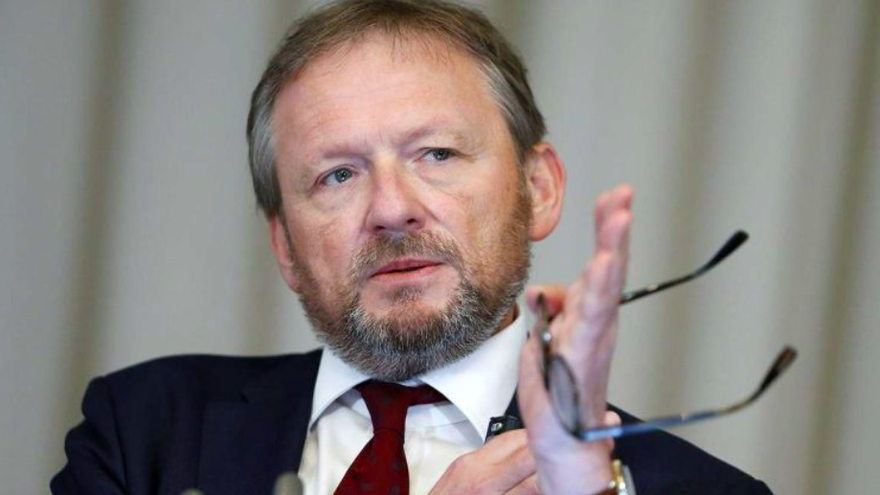
14ymedio bigger14ymedio, Havana, 29 November 2023 — Businessman Boris Titov, president of the Russia-Cuba Business Council and interpreter of the Kremlin’s will for business with Havana, recommended on Tuesday to the Central Bank of Cuba (BCC) to accelerate the “digitalization of relations” between private companies and the State. The adviser argued that, “according to various estimates,” between 50% and 70% of the Island’s private businesses operate “in the shadows,” cheating the authorities; hence, the creation of a “more manageable” tax service is indispensable.

As usual, Titov started from the Russian experience after the fall of the Soviet Union to illustrate the need for new rules in the Cuban economic game. “The path we propose is the gradual introduction of market relations. Allow private companies to freely set prices in national currency,” he summarized. According to the businessman, the result will be a temporary – and probably disproportionate – increase in prices, but, in the long run, the black market will be mortally wounded thanks to “legal” competition.

Titov invited the directors of the BCC and the Island’s tax institutions, who met with him for a “round table” to fully enter a phase of “market reform,” whose cornerstone is the development of private companies. In that project – one of the fundamental steps of its usual list of recommendations to Havana – the Island will have to count on the advice of Russia. continue reading

Titov invited the directors of the BCC and the Island’s tax institutions to fully enter a phase of “market reform”

It is the Russian “digital superservice,” which only an ally with the necessary technological development can provide, and the key to reform, said Titov. Moscow’s “expansion of activities” will prevent the process from excessively benefiting private companies and will operate in response to one of the Government’s top concerns: “maintaining state control over strategic areas,” he admitted.

If private initiative is developed and multiplied, in the long run the BCC will be able to increase its profits “through the expansion of the tax base (taxes).” But, at the moment, taxes cannot be raised until private companies have the financial strength to pay them.

The “superservice” offered by Russia consists of three elements: electronic records, electronic reports and online cash registers. Through the registration – “where everything should begin” – the Government will make a map of the “real structure of the economy” and draw up plans to better manage it. There can be no private companies outside the system, because the registry will give access to other indispensable services, without which it will be impossible to operate properly.

For this, Titov insisted, technology is needed. Hence, Havana and Moscow are considering “creating a new special bank to serve the private companies (possibly together with a Russian partner).” Business owners’ problems in accessing loans, as well as taxes and other obstacles to their development, will be solved if there is a bank that serves them as a priority, he argued.

However, he warned, Cuba will continue to need “a different macroeconomic regulation,” which includes reforms in “exchange rate issues and established salary levels,” about which he did not want to go into details.

Cuba will continue to need “different macroeconomic regulation,” which includes reforms in “exchange rate issues and established salary levels

No agreement came out of the meeting. Titov reported that he was still “waiting for a response” from the “Government of the Republic of Cuba,” and that later more details of the “digital superservice” that Moscow plans to implement on the Island would be revealed.

Since last January, the rapprochement between Moscow and Havana has had ups and downs. Although at the beginning of the year the process seemed to go at full speed – Titov himself, in addition to senior Russian officials, appeared in the official press more often – the Island has taken with calm everything that sounds like profound reform. Diplomatic and military approaches have been of more interest to the Cuban authorities, although the information that several Cuban mercenaries were fighting on the Russian side during the invasion of Ukraine again slowed the conversation between both parties.

However, last Saturday the official press announced that the “technological deployment” for the use of Russian MIR cards throughout the Island was ready. The tourist facilities of Havana, Varadero and the Cayería Norte of Ciego de Ávila and Camagüey – though not those of Villa Clara – already have this possibility, reported the Minister of Tourism Juan Carlos García Granda.

“The Russian payment system will favor the transactions of tourists and businessmen from Russia on the Island. Likewise, it can become an alternative to circumvent the implications of blockades and sanctions and will consolidate its commercial ties in sectors such as energy,” celebrated the article in Cubadebate, which was soon filled with comments from readers with the same concern: “The Russians have never been faithful to Cuba. Not even to themselves.”

Translated by Regina Anavy

____________

COLLABORATE WITH OUR WORKThe 14ymedio team is committed to practicing serious journalism that reflects Cuba’s reality in all its depth. Thank you for joining us on this long journey. We invite you to continue supporting us by becoming a member of 14ymedio now. Together we can continue transforming journalism in Cuba.

The Cuban State Looks to the Private Sector To Repair Hospitals

The Doctor Antonio Luaces Iraola Pediatric Hospital respiratory disease ward will be renovated. (Ecured)

14ymedio bigger14ymedio, Havana, November 28, 2023 — Two private enterprises from Ciego de Ávila will be in charge of repairing the ward for patients with respiratory diseases at the Doctor Antonio Luaces Iraola Pediatric Hospital. The official press, which spread the news on Tuesday, did not explain if the choice of private over State companies is due to the lack of the regime’s resources to restore its own hospitals.

According to the report from the Cuban News Agency (ACN), the restoration work has been taken over by two private companies in the provincial capital, Carnes D’Tres and El Jan, “as part of their contributions to economic and social development.”

The first, dedicated to food, is in charge of financing the works, and the second, whose social purpose is construction, of executing them. continue reading

The first company, dedicated to food, is in charge of financing the works, and the second, whose social purpose is construction, of executing them

The Respiratory Ward, as it is called in Cuba, is located on the top floor of the hospital, and the rain that seeped through the roof affected the infrastructure and caused the deterioration of medical equipment needed for the care of patients who must remain hospitalized for long periods of time.

Infants who suffer from risky diseases such as cystic fibrosis are isolated in the three cubicles of this ward, which has 26 beds, explained Gleibys Liset Fernández García, a pediatric intern, to ACN.

The ruinous state of the room is deduced from the words of Carlos Castaño Oliva, director of El Jan, and Daniel González Fráser, one of the partners of Carnes D’Tres, when they explained that the waterproofing of the roof required a large outlay and pointed out the complexity of changing the false ceiling and the veneers, the replacement of hydraulic networks and bathrooms with the necessary structural fixtures, and even the arrangement of the clinic’s furniture.

Castaño Oliva said that “the actions are aimed at resolving maintenance issues,” although the report doesn’t  mention how much the private entities have had to pay for the renovation. They will also provide air conditioning equipment, refrigerators and televisions.

Castaño Oliva said that “the actions are aimed at resolving maintenance issues,” although the report doesn’t mention how much the private entities have had to pay

Since June 2022, the official newspaper Invasor has published articles about repairs and maintenance work in the Ciego de Ávila hospitals, classifying some of it as an investment because of the magnitude of the work, all under a strategy of “sponsorship” that offloads the responsibility of the Government onto different companies, initially State-run and now belonging to the Island’s emerging private sector.

The article cites as “godparents” the companies of Communal Services, the Electrical Union, Hydraulic Use, Construction Materials and Supply and Health Services, the Provincial Directorate of Culture, the Ministry of Construction and the private companies RTV Comercial and Media Luna.

Also, the articles mention the profound deterioration in which the pediatric hospital, which just turned 72 years old, was found. It needed renovation of the Burn rooms, Gastroenterology, Pediatric Surgery, Gynecology, Cardiology, the Information Center, Radiology, the area of Legal Medicine, the Guard Corps and the colonoscopy, endoscopy and laparoscopy rooms, among others.

The situation of the Ciego de Ávila hospital is not an isolated case. Many healthcare centers on the Island share the same ruinous structural conditions to which are now added the enormous shortage of supplies and the exodus of professionals from the sector.

Last September, the official press also reported the repairs of an educational center in the municipality of Trinidad, in Sancti Spíritus, provided by three private companies. In this case it was La Trinidad, dedicated to transport; Caído del Cielo, which focused on bakeries and desserts; and Construcciones Liz, which does construction and repair of buildings. “Despite their focus on the production of goods and the provision of services, they decided to contribute part of their resources to local social development,” Escambray said, without specifying whether they were private or state companies.

Translated by Regina Anavy

____________

COLLABORATE WITH OUR WORKThe 14ymedio team is committed to practicing serious journalism that reflects Cuba’s reality in all its depth. Thank you for joining us on this long journey. We invite you to continue supporting us by becoming a member of 14ymedio now. Together we can continue transforming journalism in Cuba.

Two Cuban Athletes Under the Age of 20 Flee in Mexico and Nicaragua

The baseball player Miguel Neira escaped before this Wednesday’s match against Panama, in Managua. (X/@francysromeroFR)

14ymedio bigger14ymedio, Havana, November 29, 2023 — The escape in Mexico of María Carla Pérez, a Cuban player of Basque pelota, and that of pitcher Miguel Neira in Nicaragua both occurred this Wednesday. They are the most recent of the stampede that hinders Cuban sports. With these desertions, there are now 69 athletes on the Island who have abandoned their official delegations, according to journalist Francys Romero.

Pérez, a member of the U-19 national team, took advantage of her stay in Mexico, where the Basque pelota, U-22 World Cup was held, to escape. The young woman, a resident of the province of Villa Clara, was one of the stars of her specialty last year, during the National Youth Championship held in Guantánamo.

The regime has not yet pronounced on these departures. “Unfortunately, the Island’s authorities seem to care little about the desertions of high-performance athletes,” said Swing Completo magazine. “No matter when, how or where, abandonments continue to be day-to-day news in Cuba. And so it will continue…,” the sports publication said ironically.

The escape of the Villa Clara athlete in Mexico came several days after the bronze medalist in the Central American Games in weightlifting, Elizabeth Reyes Entenza, escaped in Guadalajara (Jalisco), shortly before her continue reading

presentation at the Paradero Sports Center, where she was to participate in the 192-pound category in the Youth World Championship.

Athlete Maria Carla Pérez left the Cuban delegation in Mexico. (X/@francysromeroFR)

Hours after Pérez’ escape in Mexico, journalist Francys Romero reported that Miguel Neira, one of the players of the Cuban team that participates in the U-23 Pre-World Cup tournament, had also escaped. The young left-handed pitcher of Los Gallos de Sancti Spíritus, had played a prominent role in last Sunday’s match in the pre-World Cup, in which his team beat the Curaçao national team 5-1.

Neira, 19, was on the list of the Cuban team that this Wednesday faces Panama in the U-23 pre-World Cup tournament, held in the Panamanian capital. According to the reporter, “he left the hotel where they were training at noon.”

“I classified Neira as the number 3 prospect on my list of the 25 best under-18 talents of 2022,” Romero recalled, affirming the talent of the player from Sancti Spíritus.

These escapes add to the list of 14 athletes who stayed in Chile after the Pan American and Parapan American Games. While their request for refuge is resolved, 11 of these athletes already have a temporary visa, which has allowed them to train and look for employment in the South American country.

Translated by Regina Anavy 
____________

COLLABORATE WITH OUR WORKThe 14ymedio team is committed to practicing serious journalism that reflects Cuba’s reality in all its depth. Thank you for joining us on this long journey. We invite you to continue supporting us by becoming a member of 14ymedio now. Together we can continue transforming journalism in Cuba.

Mexico Investigates the Links of Coyotes of the Cuban Mafia With 12 Rafters Arrested in Cancun

A group of Cuban balseros (rafters) was arrested while abandoning a boat in Cancun (Quintana Roo). (Saber Politico)

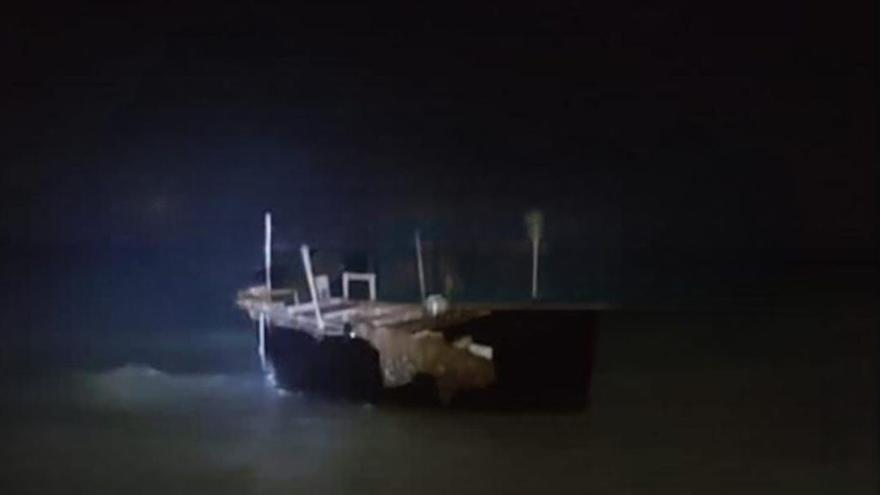
14ymedio bigger14ymedio, Ángel Salinas, Mexico, November 28, 2023 — The authorities of Cancun, in the Mexican state of Quintana Roo, are investigating whether the 12 Cuban rafters arrested this Monday, four women and eight men, are related to the network of coyotes that has operated under the command of the Cuban Mafia since 2009 in the region. “The raft was located when it was approaching Chac Mool beach, and from the moment they disembarked they ran to Kukulcán Boulevard,” officer Jacinto Pech May tells 14ymedio.

The agent says that the migrants were guided by at least three people who managed to escape. “At least six people fled, including three who indicated the route they should follow, but most of them were intercepted on the boulevard.”

Despite the fact that several of the members of the Cuban Mafia are continuing with judicial proceedings in the United States, Pech May does not rule out that “groups of coyotes who have ties to this criminal network are operating on their own and transferring Cubans clandestinely.” However, the detainees would only say that they entered the country illegally. continue reading

According to the investigations, the Cuban Mafia, through Maikel Antonio Hechavarría Reyes and Mónica Susana Castillo, was in charge of nabbing Cubans, and in Mexico, they were subjected to threats and extortion.

According to the investigations, the Cuban Mafia, through Maikel Antonio Hechavarría Reyes and Mónica Susana Castillo, was in charge of nabbing Cubans, and in Mexico, they were subjected to threats and extortion

In September of last year, a fisherman pointed to Cancun as one of the routes used by coyotes and rafters to escape the Island. “We are cantankerous, and if we help, we are not going to confess it,” Javier Robles told this newspaper in reference to fishermen who transport migrants clandestinely.

Before the pandemic, illegal exits took place from Pinar del Río, which is 220 miles from Cancun and 211 miles from Isla Mujeres, two of the points marked by authorities for the rescue and arrest of Cubans on the high seas. The coyotes charge about $7,000 for the transfer.

Pech May accepts that last year several arrivals were recorded, but in 2023, the “rescues” of migrants by land have been registered when “they are intercepted by the National Guard and Migration agents on their crossing by bus.”

Regarding the rafters, the officer mentioned that after verifying that the migrants were in good condition, they were handed over to the National Institute of Migration (INM). “Their situation will depend on the authorities; for our part, there is no crime.”

Translated by Regina Anavy

____________

COLLABORATE WITH OUR WORKThe 14ymedio team is committed to practicing serious journalism that reflects Cuba’s reality in all its depth. Thank you for joining us on this long journey. We invite you to continue supporting us by becoming a member of 14ymedio now. Together we can continue transforming journalism in Cuba.
Cuban State Company Acopio Owes Millions of Pesos to Farmers in the Province of Las Tunas

Las Tunas farmers have demanded that state companies pay them on time. (Periódico 26)

14ymedio bigger14ymedio, Havana, November 28, 2023 — The state companies of Las Tunas are being suffocated by debts, the provincial authorities lamented on Tuesday. Among the defaults to its suppliers, the unpaid credits in the bank and the lack of budget, the worst situation is presented by Acopio, with millions in defaults, followed closely by the provincial Directorate of Education and several cooperatives.

The crisis, the official State newspaper Granma explains, has put Acopio between a rock and a hard place, largely responsible for the lack of food in the province, since it is up to them to manage both state and private food production. The warning of the suppliers, the newspaper admits, has been clear: if they do not pay their debts, they will soon run out of products.

At the moment, the situation is not very hopeful. “Today we have 67 million pesos committed for credits that we have not been able to amortize,” acknowledged Javier Velázquez, commercial director of the company. “With the new measures adopted by the country, we market only 5% of what is produced, destined, for example, for social consumption and medical diets. Due to the credits, the bank withdraws 80% of our daily income, and what we have marketed this year is negligible,” explained the manager. continue reading

In addition, the company is in the middle of negotiations with the Banco de Crédito y Comercio (Bandec), with which they maintain several active debts and many overdue, to receive more financing. “We hope that now, with a certain intention of strengthening the state part, we can also obtain more production. We have been negotiating with the bank the possibility of new financing, to be able to recover as a company,” but, says Velázquez, the prices imposed by the State also take their toll.

According to Maikel Cera, general director of Acopio in Las Tunas, the differentiated prices for the population, imposed by the municipal governments, diminish the profit margin of the company

According to Maikel Cera, general director of Acopio in Las Tunas, the differentiated prices for the population, imposed by the municipal governments, reduce the profit margin of the company, which remains at a few cents. Also, he says, they compete with “intermediaries” who sell the same products at higher prices but pay “cash on the spot,” something that the company cannot do due to lack of liquidity.

As for the Bandec branch that manages the company’s credits, with whose directors Granma also spoke, the panorama they offer about Acopio is no different. So far this year, says Leancy Richard Collazo, director of the bank, three financings were approved for the company. “They have about 66 million in credits in force, of which 23 million are due.”

“We have restructured 18 million to help them have enough solvency to request new financing and liquidity to acquire products,” he says.

Several credit and service cooperatives (CCS) in Las Tunas also revealed their concern about the debts they continue to contract with producers without a guarantee of payment. This is the case of the CCS Sabino Pupo, from the municipality of Manatí, whose associated producers have filed complaints about the delay in payments.

The transfer arrives on time, but then the cash is delayed, and we have hired workers who do not have cards”

“The transfer arrives on time, but then the cash is delayed, and we have hired workers who do not have cards,” claimed Diosmani Ramírez, one of the milk producers associated with the CCS, who explained that the payments are delivered half in cash and the other by transfer. “In addition, there are many payments that are still in cash, so there are ATMs in the municipality. We have to go to the bank, and although they help us, they can’t always give us the figure we ask for,” he added.

The same thing happens in the CSS Conrado Benítez, of the municipality of Colombia, whose directors admitted that “it is almost never possible to pay (the suppliers) within the month” stipulated in the contracts. The debtor, in this case, is precisely Acopio, who has not delivered the corresponding amount to the banana and corn farmers of the CCS.

Arelis Calvo, in charge of economics in that cooperative, admits that the annoyance among the members is widespread. “Some come to me and tell me that it is better to sell on the outside, because they have the money fast in their hands, and they also need to eat and feed their families. “Our CCS complies with what it agrees; we have been vanguards for three years. So, why aren’t we being paid?”

Mailín Utria, general director of the Cárnica Las Tunas Company, also gave a part of the situation of the entity in his charge. “We have managed to maintain some stability in terms of payments. We were managing to make them between 20 and 25 days, but sometimes that period was extended to 30 days,” he said. However, the attempt to be punctual without having the budget brought consequences.

“We have seen the need to apply for bank loans to be able to honor those payments, because the financial situation of the company is tense, due to a high number of accounts receivable because of customer defaults,” said Utria, who acknowledged that in 2023 they assumed credits worth 130 million pesos, and now they have requested 80 million more.

We have found ourselves in the need to apply for bank loans to be able to honor those payments, because the company’s financial situation is tense, due to a high number of accounts receivable 

Education, although budgeted by the State, also has a rope around its neck. “In our case, we have debts amounting to 30 million pesos from accounts payable, including those of the cooperative and farming sector. Those high balances do not respond to negligence or lack of control, but to the tight situation we have with the budget,” explained Yaimara Martínez, head of the accounting and finance department of the entity.

“Our sector needs more than one hundred million pesos today to close the year. At the beginning of this year we stopped receiving more of the 180 million in relation to our preliminary project and, on top of that, up to now they have withdrawn 23 million. In addition, we pay the debts from 2022 with the 2023 budget. The Finance directors have not been able to support our needs,” she complained.

According to the official, Education only receives money permanently to pay the workers’ salaries. The rest depends on the contributions of other companies and “economic actors” to the State budget, but this system is also in crisis, since the tax agencies are having problems with their own finances.

“We are dealing with the Finance and Prices directors to see if at least part of the budget that we used to pay the previous year’s debts is replenished,” Martínez said.

For now, the only solution that Education has found to relieve the debt pressure is to extend the terms of the contracts – which require payment in 30 days – to 60 and 90, “so that they do not become aged debts so quickly, since there is no liquidity to pay.” More than a solution, however, the measure only serves to lengthen the wait of those who demand to be paid for their work.

Translated by Regina Anavy

____________

COLLABORATE WITH OUR WORKThe 14ymedio team is committed to practicing serious journalism that reflects Cuba’s reality in all its depth. Thank you for joining us on this long journey. We invite you to continue supporting us by becoming a member of 14ymedio now. Together we can continue transforming journalism in Cuba.
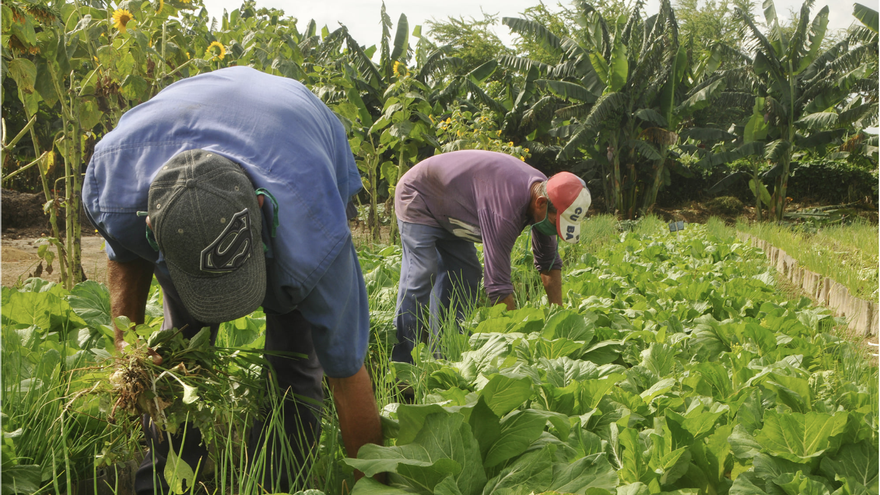
‘Now They’re Closing the Ration Stores in Cuba, Yes, Totally’

Miniscule and dirty, a portion of beans “for two people,” was sold for 20 pesos, said the shopkeeper. (14ymedio)

14ymedio bigger14ymedio, Juan Diego Rodríguez, Havana, 27 November 2023 — A handful of black beans, a little salt and four pounds of rice: the list of what they were distributing this Monday in a bodega (ration store) in Centro Habana, to give an account of the calamitous state of the rationed market in Cuba.

Miniscule and dirty, the beans were sold for 20 pesos a handful, which does not reach a pound “for two people,” said the bodeguero (shopkeeper). Katia, a resident of the area, made a face. “With a teenage son, I don’t have enough to even start with this.” And the little bit of salt, the woman of about 40 continued, she hadn’t been able to get it for two months.

As for rice, the four pounds they gave on this occasion were divided into two: two pounds of one donated, free, and another two parboiled, paid. “One bad and the other worse,” lamented Katia, who recalls that before they gave seven full pounds in state establishments at the beginning of the month, “and now they distribute it divided into three.” continue reading

“With a teenage son, I don’t have enough to even start with this”

“The oil hasn’t come, the eggs haven’t come. Now the bodegas are closed!” she cried. “It’s a total slap in the face. There is nothing, and you have to buy it in the private stores at their prices. Look at the bodeguero there, a whole month doing nothing.”

The spectacle in state establishments is like watching a movie of the living dead, the example of a society with vital minimums. In the bakery, customers showed their ration books, paid and went away shuffling, with such apathy that some forgot to take the bread. “Look at that,” said a man in line. “They have their heads somewhere else, and they know that the bread is inedible.”

Translated by Regina Anavy

____________

COLLABORATE WITH OUR WORKThe 14ymedio team is committed to practicing serious journalism that reflects Cuba’s reality in all its depth. Thank you for joining us on this long journey. We invite you to continue supporting us by becoming a member of 14ymedio now. Together we can continue transforming journalism in Cuba.
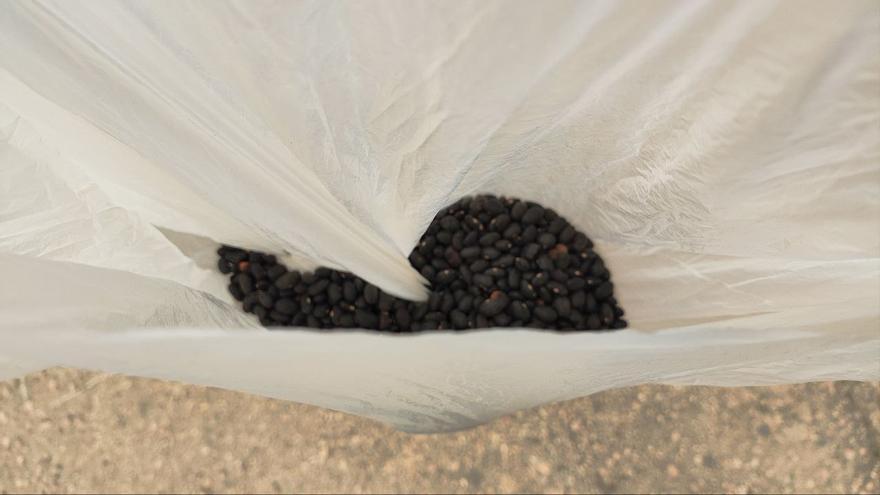
Cubans Threaten To Protest if the Authorities Don’t Restore Water Service

Workers from Aguas de La Habana repairing a leak in the municipality of Cotorro. (Facebook/Aguas de La Habana)

14ymedio bigger14ymedio, Havana, 27 November 2023 — The state company Aguas de La Habana reported this weekend that several municipalities in the capital will not have drinking water for 12 hours, starting at 6:00 am next Tuesday due to “maintenance work.” The announcement did not take long to provoke a barrage of negative comments from those who have gone, they say, up to a week without the service.

“In several areas of the municipality of Cotorro, especially in the center, water arrives with very little force,” Tomás, a retiree who lives in that area, explains to 14ymedio. “The problem has existed for several days, and it is not even one of the municipalities that will be affected” during this Tuesday’s repairs, he says.

Also, he says, in the Paraíso neighborhood of the same municipality there are “supply problems. In other [neighborhoods] there is not as much instability with water, as in San Pedro, where I live, but it is an exceptional case. All of Havana has a serious problem with the water supply,” he adds.

People are very upset, because they call to find out what’s going on and are told that everything will be resolved soon

“People are very upset, because they call to find out what’s going on and are told that everything will be resolved soon, or they just don’t answer the phone,” he says.

Tomás’ words are the same as those that have been repeated by customers for months, in the publications of Aguas de La Habana. “It is disrespectful to publish that from Tuesday the 28th there will be no water in Central Havana, when it has been six days since the Popular Council of the Sites (…) had water. This happens because the water is not pumped and reaches the continue reading

homes by gravity and in our case it doesn’t, because [we are on] the center of the slope with a little more height,” complained a Reina Street resident in the comments of the official media Tribuna de La Habana, which reproduced the announcement.

The netizen also complained that they no longer know who to turn to, because the telephone help lines for the population don’t ’pick up’. “Now, as if that were not enough, the news is that from Tuesday there will be no water, as if these past days everything worked well. We are desperate and helpless,” she said, adding that the provincial authorities promised to send them a water truck, which would solve the problem. “The truck never arrived; it was just words,” she said.

The avalanche of comments that appear in the publication of Aguas de La Habana suggests the cartography of the city’s problems: water scarcity in Bahia, impacts on the Guiteras distribution, leaks in San Miguel del Padrón, and the list continues.

“Do you think someone deserves to go a week without water? They don’t even send a water truck so we can at least cook and bathe, as any human being deserves,” protested another user.

“Today it’s been 15 days since we had water on my block, in the Wajay neighborhood, and complaints have been made. The delegate and the president of the council do not respond or carry out any action; even the bosses of Aguas de la Habana are aware and don’t deign to do anything if there is no signed document. I hope there is no need to have a march with pots and pans [a cacerolazo*], which is what will get their attention with immediate effect and without a signed document,” said another user.

On most occasions, the areas mentioned by customers are not among those where Aguas de La Habana has anticipated interruptions to occur

On most occasions, the areas mentioned by customers are not among those where Aguas de La Habana has anticipated interruptions to occur. The official list includes, for this Tuesday alone, impacts in part of the municipalities of Plaza de la Revolución and Boyeros, absence of service in El Cerro, Centro Habana and Habana Vieja, and minor interruptions in Diez de Octubre,  Luyanó and El Sevillano.

These areas are supplied by the Cuenca Sur reservoir, where  maintenance work will be carried out on the water conductors and the electrical system, the entity reported.

In contrast, other customers report that in their neighborhoods there are water leaks that have been draining for months without being repaired. “If you go from Boyeros to Ayestarán through the area of Bohemia magazine, you will have to roll up your pants because there is a lake of clean water,” says a nearby resident.

Some flooded, others in drought. The habaneros still can’t live in peace with the network of pipes that, instead of headaches, should bring them comfort.

*Translator’s note: A cacerolazo [from the word ’cacerola’ — casserole in English], is a form of protest where people bang on pots and pans.

Translated by Regina Anavy

____________

COLLABORATE WITH OUR WORKThe 14ymedio team is committed to practicing serious journalism that reflects Cuba’s reality in all its depth. Thank you for joining us on this long journey. We invite you to continue supporting us by becoming a member of 14ymedio now. Together we can continue transforming journalism in Cuba.
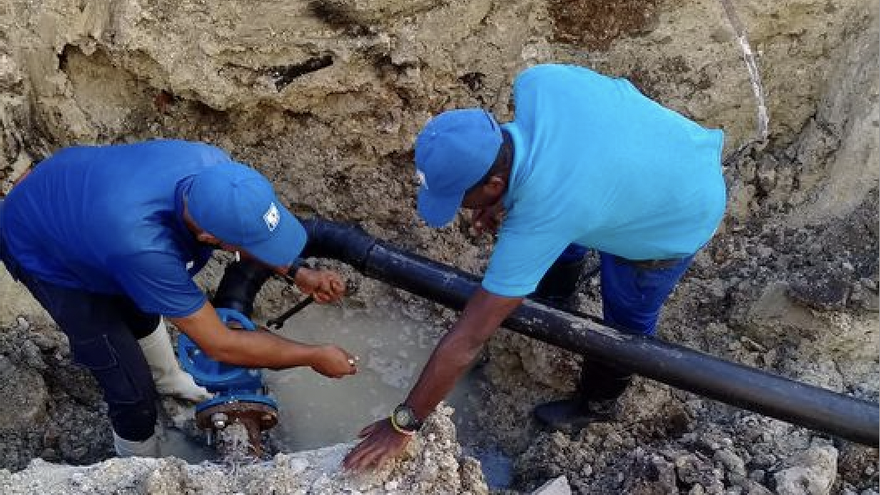
The Housing Construction Plan Is Not Fulfilled in Cuba Due to Lack of Cement and ‘Working Methods’

The plan needs 83 million concrete blocks per year, but in 2023 barely 43 million were fabricated. (Guerrillero)

14ymedio bigger14ymedio, Madrid, 28 November 2023 — For some reason, the plan to build with clay has not penetrated the Island. In the middle of the year, the authorities of the sector spent a long time explaining to the population the benefits of this material, in which the Island is rich, when it comes to building a home: “an economic, environmentally friendly and viable way,” they strongly recommended, while talking about the export of marble and cement to capture foreign exchange.

Five months later, the result is disappointing, and Deputy Prime Minister Ramiro Valdés Menéndez couldn’t hide his anger at the Minister of Construction, René Mesa Villafaña, when he noted that he was supposed to erect “floor, wall and ceiling elements” with these materials. “They were being raised. Where are they?” the commander scolded. “There are directions to build the ovens. There are plans delivered to the territories. Do they do it? They don’t do it. Why don’t they do it? Where is the discipline? Where is the control? There are directions and, simply, in the territory they are not executed.”

By the end of October, the plan had been fulfilled by just over half (54%), having built 13,300 dwellings in the country

The reprimand came in the middle of a meeting of Prime Minister Manuel Marrero with the local and state authorities to analyze the poor progress of the housing program that, once again, will fail miserably. By the end of October, the forecast had been fulfilled by just over half (54%), with 13,300 dwellings having been built in the country. The official press, in line with the conclusions of the meeting, admits that the main responsibility was the lack of steel and cement, but did not hesitate to distribute blame by attributing some to “the methods and ways of working.” continue reading

Dilaila Díaz Fernández, general director of materials of the Ministry of Construction, explained that to meet the needs of the Housing program, 83 million concrete blocks are needed per year, but in 2022 barely 39 million were reached, less than half, although it was “the best production” in the 12 years that the local production plan had been in operation.

In a country accustomed to worse results, it is no small matter that this year production has increased, producing four million more pieces, but this only covers 52% of what is needed. The result is the shortage of housing and the unfortunate conditions that exist.

The official asked for production to be accelerated and, returning to the local, insisted that it is necessary to “design and build with red clay.” This was followed by the scolding of the leadership of the Communist Party, which alternated with the usual calls for voluntarism.*

“We have to start a different system and promote this as an essential, social, revolutionary movement, to be able to give an answer to the population,” said Marrero, who urged companies, organizations and households to get involved in the world of ceramics.

“We need the population to see that in this very complex, sensitive issue, that affects so many people block by block, there is an additional effort, a different way in which this program has been focused, which is more participatory than ever, that companies are helping, that there is popular participation, that there is a different approach,” he continued, stating that “things cannot be delayed.”

The official, however, emphasized the need for new rules that improve relations between state and private entities and take advantage of Idle capacities

The Deputy Minister of Economy and Planning, Johana Odriozola Guitar, spoke of proposed changes, but the two that she mentioned are not a novelty. On one hand, she spoke of decentralization, a task that was already addressed when the State decided to delegate most of the complex issues to the territories. On the other was the “approval of new economic actors.” The production of construction materials is one of the most frequent activities of the private sector, although well below gastronomy and food production, according to official data from the first quarter of the year.

The official, however, emphasized the need for new rules that improve relations between state and private entities: “taking advantage of idle capacities”; increase the supply and income of state workers; increase production by coordinating with private companies; repair paralyzed production lines; and identify new business opportunities and “price agreements.”

As a novelty, this did advance the creation of a National Institute of Non-State Economic Actors, which will be subordinate to the Council of Ministers, with all that this implies.

The meeting also discussed the future budget and the need to protect the most vulnerable, but the results do not allow us to maintain optimism. “We have to face 2024 in a different way. We are going to have the same challenges, the intensified blockade, the same currency limitations, fuel problems. Therefore, we do not have the right to make a plan that is more of the same,” Marrero warned.

The prime minister spoke of a new year of “much justice,” but before which “more planning” will have to be done, due to the difficulties. “We have to play the role that corresponds to us, transform the Government’s control for food production, taking into account that 80% is in non-state productive people and forms, as well as strengthening the local development strategy, based on the real potential of the municipalities to meet the demands of the population,” he said. Again, he didn’t explain how.

We have to face 2024 in a different way. We are going to have the same challenges, the intensified blockade, the same currency limitations, fuel problems

After the echo of Ramiro Valdés’ anger, the prime minister ended the meeting with best wishes and words, talking about the benefits of decentralization, how to better exploit the “potentialities both spiritually and materially, and put together a great movement in tribute to the triumph of the Revolution and the people who work so hard and have had to face so much.”

According to the latest balance sheet of the Ministry of Construction, Cuba needs to build about 20% more houses to end its chronic housing deficit, which exceeds 800,000 homes. Since 2021, barely around 50,000 have been built. In addition, in mid-July the housing program built with state subsidies had only 13% execution, the eradication of dirt floors 9%; and of the 9,000 tenements in the country, barely 154 had been eliminated.

*Translator’s note: Voluntarism means individual initiative, something contrary to Marxist-Leninist ideology.

Translated by Regina Anavy

____________

COLLABORATE WITH OUR WORKThe 14ymedio team is committed to practicing serious journalism that reflects Cuba’s reality in all its depth. Thank you for joining us on this long journey. We invite you to continue supporting us by becoming a member of 14ymedio now. Together we can continue transforming journalism in Cuba.
Steps Towards the Disaster of Cuba’s ‘Bancarizacion’ [Banking Reform]

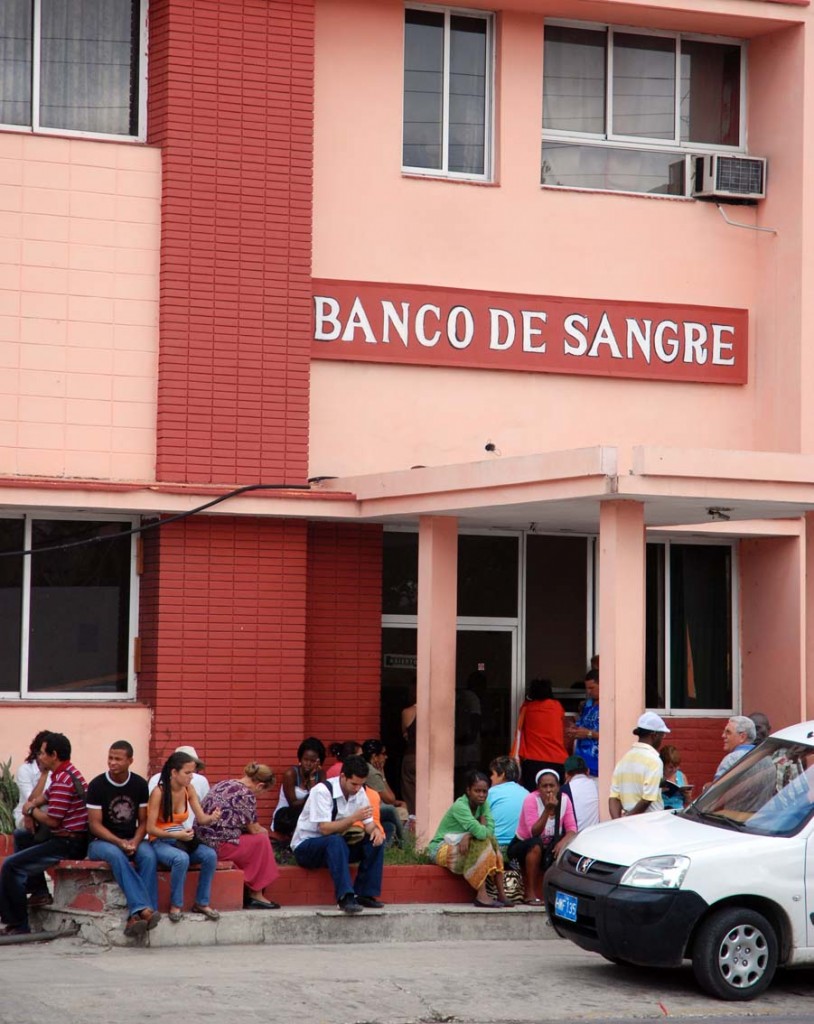
The sign on this building says ‘blood bank’, but in Havana the term could just as well refer a currency bank, with its crowd of tired discouraged people waiting for ‘change’, or at least a cash transfusion. (14ymedio)

14ymedio bigger14ymedio, Elías Amor Bravo, Economist, November 25, 2023 — Bancarización* (banking reform) in Cuba is becoming a one-act comedy for those who are bored with the low quality of the script and the cast that participates. Almost half a year after the approval of Resolution 111 of the Central Bank of Cuba, the conclusion that can be reached is that the process goes on as usual, without order or agreement, and the attempts of the leaders to cover it with a certain order fall on deaf ears. It’s like a second edition of the disaster of the Ordering Task,** but this time stumbling over the same stone. Incomprehensible. Take a look at what was said on State TV’s Roundtable program by Joaquín Alonso, president of the Bank, and his subordinates Julio Pérez, general director of Payment Systems of the Bank, and the vice president, Alberto Quiñones.

It should be emphasized that for any spectator who followed this edition of Randy Alonso’s primetime program, it is most likely that in the end he had more doubts and concerns than at the beginning. All the participants skirted around the issue, and none dared to recognize the obvious: a new failure of the communist regime is just around the corner.

And the first to contribute to the confusion was Joaquín Alonso, when he said that in Cuba there is talk of how to “bancarizar operations, instead of accessing the banking service, because all the actors of the economy already have full access to banking services,” which, he said in a surprising way, “makes us different from other nations.” Of course, saying that and saying nothing is the same thing, because Randy didn’t ask the question he should have asked right away: so why do Cubans continue to use cash in their usual transactions? continue reading

“All the actors of the economy already have full access to banking services,” which, he said in a surprising way, “makes us different from other nations.”

It goes without saying that none of the participants said anything like that. They dedicated themselves to citing the strong investments in technological equipment and point-of-sale terminals, which are then not taken advantage of, highlighting that “with the available resources, the colleagues of Etecsa, Enzona and the banking system have linked to each other, and we have the possibility of continuing to make progress in the bancarización of transactions.” But again, why do Cubans use cash and flee from the banks? It’s the same as tourism: why are they building hotel rooms if they are left empty?

The president of the Bank then said one of the things that attracted the most attention, that one reason it’s necessary to develop bancarización is in the high cost of cash. Yes, you have heard correctly: the president of the Bank said that “using banknotes means importing paper, inks, maintaining the equipment; then you have to transport them, distribute them, count them; and with about 10 uses in the economy they deteriorate, and then you have to destroy the banknotes and produce them again. It is a permanent cost in all banking operations, and it requires a large workforce, equipment and energy consumption.”

Unbelievable but true. Cuba has problems producing banknotes for its monetary system. Have you ever heard of a single country in the world that claims to have this problem? Of course not. It doesn’t exist. Only in Cuba. Now relax, because the farce had just begun. 

Unbelievable but true. Cuba has problems producing banknotes for its monetary system. Have you ever heard of a single country in the world that claims to have this problem? Of course not. It doesn’t exist. Only in Cuba. Now relax, because the farce had just begun. <– leave here and also make a ’quote’

The president of the Bank then said that “among the factors that lead to the increase in the price of transactions is the growth and emergence of new economic actors; there are more and more entities to attend to and more monetary circulation. At the same time, more economic actors involve a greater number of people who go to the bank to deposit and withdraw cash, which also makes banking operations more expensive.” In the absence of blaming the embargo/blockade, they now blame the new economic actors.

Another blunder, because in reality the cause of the increase in monetary circulation is not a small and barely marginal private sector that fights against state power to open spaces, but a deficit of the uncontrolled state sector that has to be financed with sovereign bonds that eliminate the liquidity of the banks and put them at the service of a state that only squanders the money in expenses. Of course no one said this, but it’s the reality.

That is, according to this argument, people leave jobs in state banks because the work is boring, with no expectation of improvement and poorly paid. In other words, it’s the opposite of what happens with banks in the rest of the world.

But the president of the Bank continued and said that “to the above is added a distortion in the salaries of people who work in the state sector in relation to workers in the non-state sector. The bank is not one of the entities that pays the most in salaries and profits, so we have had a significant decapitalization in our workforce, and the employees are affected.” That is, according to this argument, people leave jobs in state banks because the work is boring, with no expectation of improvement and poorly paid. In other words, it’s the opposite of what happens with banks in the rest of the world.

And not content with the ridiculous comments he had already made at this point in the program, the president of the Bank took another leap into the void to say that “two contradictory aspects then come together: we increase wages, and every day more employees leave. Despite the empowerment we have given employees by raising their salaries, establishing indicators of payment by results, we have only 84% of our staff left.” How unfortunate. And of course, where there is more concentration of economic activity and population is where that 84% suffers the most. Nothing to see or say, not a practical solution.

Just the eternally repeated message that “we will continue to face that problem from the Central Bank and, above all, from the Metropolitan Bank. We will continue to identify what to do so that people will go less to a bank to get cash. One of the lines of action in that sense is bancarización, which has been happening gradually for some years.” Unbelievable.

Next he wanted to explain why it was necessary to accelerate bancarización from last August. He said that “since before 2020, transactions and the use of electronic means of payment had been growing. In the pandemic period, home operations also increased, and electronic commerce was enhanced. In 2022 there was still a growth in bancarización transactions, but now in 2023, after the pandemic, there has been a relaxation in all those mechanisms, and we went back, from 78% in the payment matrix of these operations, to 75%.”

Where is the centrally planned economy that is unable to foresee behavior as simple as this?

And he concluded by pointing out that “from August to date, after the approval of Resolution 111, those operations have been growing at a monthly rate of 0.6%; and we expect to close the year with a growth of almost 30% in operations through electronic payment channels.” Where is the centrally planned economy that is unable to foresee behavior as simple as this?

However, the president acknowledged at this point that “the tendency to withhold cash in the hands of the population is maintained, above all, by a group of non-state economic actors.” And in this regard he added that “the cash that is kept out of the bank continues to grow, and this is a harmful phenomenon for the economy, because it causes an increase in prices.” In other words, on the one hand, electronic operations increase, but on the other, cash transactions are maintained. Where exactly are we? How is it possible for all this to happen in an economy that barely grows by 1.8% and is practically stagnant?

“They need to create certain scenarios in the economy so that the new actors can fully develop, without the need to retain cash; a phenomenon related to the reduction of offers and the increase in actors itself.” Have you understood anything? Not me.

Well, in reality, they don’t know, because the president of the Bank said at the time that “they need to create certain scenarios in the economy so that the new actors can fully develop, without the need to retain cash; a phenomenon related to the reduction of offers and the increase in actors itself.” Have you understood anything? Not me. What scenarios must be created in the economy for the development of cashless actors? Let him explain it.

And of course, having arrived at this point and with a threatening tone, he said that “cash withholding is not always due to lawful needs. For example, it is done to access foreign currency, since the State cannot offer a foreign exchange market, because the country’s economy has a deficit in that sense.” The question is why the state does not undertake the reform of the foreign exchange market and maintains the absurd status quo.

In addition, he accused the use of cash as a factor that does not allow the banking system to increase the loan fund necessary to leverage and finance the economy of the private and state sectors. That is, the president of the Bank seeks more liquidity for the state deficit, and he asked for clarity in the transactions. Maybe he should start with his own.

He then asked people to deposit money into their accounts and assured them that “bank secrecy is one of the inalienable principles of the system,” when Cubans of several generations know that this is not the case. As if the population had money left over to deposit in banks and also had some interest in electronic payments in shops. More than one spectator had to turn off the program at this point.

Afterwards, Julio Pérez, general director of the Bank’s Payment Systems, said that one of the commitments is to reconcile the work done in recent months with all economic entities, so that they can see their main ally in the bank. And Alberto Quiñones, vice president of the Bank, said that the premise of bancarización contains a gradual creation of conditions, and accelerated progress happens when those conditions are created.

In relation to Point of Sale (POS) Terminals, he said that they are working, and he encouraged their use mainly in TRD and Cimex stores. In this sense, he pointed out the work of Fincimex and REDSA in sustaining the network of POS and ATMs in the country. A lot of emphasis on the means, but never on the results: that’s the model.

Finally, there was talk of the Caja Extra service, the creation of bank cards linked to salary payrolls and bank accounts to collect taxes from private actors, whom he accused of withholding cash for an alleged practice of price differentiation depending on the payment channel, which he described as an illegality that the population cannot accept.

And in this regard, he insisted that economic actors must have the QR Code of the business available, “and not the staff, who therefore do not receive the bonus percentage for the use of payment gateways.” And for the same reason, he pointed out that “the population cannot be required to pay in foreign currency, except for the stores in MLC***.” In fact, it was confirmed that on January 2, “the business that does not have the conditions created for the population to pay through electronic gateways will not be able to provide services.” Not a good idea.

Translator’s notes

*Bancarización  is a term used in Cuba and other Latin American countries. All economic transactions are made by debit card, including cash withdrawals and the payment of salaries. The term does not have a counterpart in English so the Spanish term is used throughout this translation.   

** The Ordering Task is a collection of measures that include eliminating the Cuban Convertible Peso (CUC), leaving the Cuban peso (CUP) as the only national currency, raising prices, raising salaries (but not as much as prices), opening stores that take payment only in hard currency, which must be in the form of specially issued pre-paid debit cards, and a broad range of other measures targeted to different elements of the Cuban economy.

***”Stores in MLC” only accept payment in hard currency, and are also the primary ‘physical’ stores in the country that sell anything beyond the most basic items, outside the informal/black market.

Translated by Regina Anavy

____________

COLLABORATE WITH OUR WORKThe 14ymedio team is committed to practicing serious journalism that reflects Cuba’s reality in all its depth. Thank you for joining us on this long journey. We invite you to continue supporting us by becoming a member of 14ymedio now. Together we can continue transforming journalism in Cuba.
Private Businesses in Cuban Increasingly Distrust the Country’s Banking Reform

Cuba has no choice but bancarización* (banking reform) Alonso said, because making paper money is an expensive process, and Cuba does not have the resources for this. (14ymedio)

14ymedio bigger14ymedio, Havana, November 24, 2023 — The balance sheet for bancarización* (banking reform) four months after its implementation, is not optimistic: The micro, small and medium-sized enterprises (MSMEs) are increasingly suspicious of electronic payment methods and continue to “retain cash.” The shortage of banknotes is still at its peak, and the Island’s banks are suffering a growing stampede of their staff. These are some of the conclusions that emerge from the appearance this Thursday on State TV’s Roundtable program of the minds behind this process.

“Every day more cashiers leave,” said the Minister-President of the Central Bank of Cuba (BCC), Joaquín Alonso Vázquez. Without attributing it to emigration – outside the Island or to other jobs – the leader explained that the lack of workers was a hard blow to bank reform, because it affects the key point for the circulation and control of the money.

It was useless, Alonso said, to raise the salaries of employees, who were also paid “for good results.”

Escorted by the general director of Payment Systems of the BCC, Julio Pérez Álvarez, and by the vice president, Alberto Quiñones, Alonso focused his talk on celebrating that Cuba has “advanced towards bancarización,” despite the fact that it did not have “strong investments in technological equipment” nor enough “point-of-sale terminals.” Condemned to work with old equipment – “because we are hindered from accessing new technologies,” he said, alluding to the U.S. embargo – the BCC had a single resource available: “innovation.” continue reading

The official assured that “all actors in the economy now have full access to banking services – an element that differentiates us from other nations,” he said proudly, but the MSMEs continue to have multiple reservations and prefer to manage their operations in cash.

Cuba has no choice but bancarización, Alonso said, because making paper money is an expensive process, and Cuba does not have the resources for this. “Using banknotes means importing the paper, the inks and maintaining the equipment. After they are issued you have to transport them, distribute them, count them, and after 10 or so uses they deteriorate. Then you have to destroy the banknotes and produce them again. It is a permanent cost in all banking operations, and it requires a large workforce, equipment and energy consumption,” he explained.

With the growth of the private sector, there is more money in circulation, and “more economic actors involve a greater number of people who go to the bank to deposit and withdraw cash

In addition, with the growth of the private sector, there is more money in circulation, and “more economic actors involve a greater number of people who go to the bank to deposit and withdraw cash.”

The BCC also warned of an important “distortion”: with inflation, private individuals are raising pay for their workers – and therefore demanding more cash – while the state sector continues to pay the same, including to the bank employees themselves. This situation, already serious in Havana, precipitates the resignation of workers, for whom the meager “wage boost” that the BCC can afford is insufficient.

The numbers, the manager alleged, give him some hope about the future of banking. Since the pandemic, electronic transactions tended to increase naturally in Cuba. However, in 2023 – when inflation got out of control – the use by Cubans of electronic platforms declined by 78%. That decline forced the BCC to act; hence, they launched an “acceleration” of the measure in August.

However, “the cash that remains outside the bank continues to grow, and it is a harmful phenomenon for the economy, because it affects price growth,” Alonso said. He criticized the MSMEs that retain cash “not always for lawful needs” but to use it for the purchase and sale of foreign currency, “which the State cannot offer.”

However, “the cash that remains outside the bank continues to grow, and it is a harmful phenomenon for the economy, because it affects price growth,” Alonso said. He criticized the MSMEs that retain cash “not always for lawful needs” but to use it for the purchase and sale of foreign currency, “which the State cannot offer.”

Without cash in the banks, Alonso warned, there will be no loans to “leverage” the private sector either. The best thing, he said, “is to deposit the money in the accounts” and trust that the BCC does not monitor anyone and has as an “inalienable principle” not to violate “bank secrecy.”

Private individuals should view the bank as their “main ally,” added Julio Pérez Álvarez, although his colleague, Quiñones, acknowledged that the BCC itself is responsible for several deficiencies. It failed, according to the vice president, in “awareness, communication, approach to customers, entities and organizations.” In many branches, employees did not know how to explain the process and made the operation complicated.

So far, bancarización works in an acceptable way only in Havana, Matanzas, Villa Clara, Holguín and Santiago. In the other provinces – and in the countryside – it is still a pending matter. To give a glimpse of the situation, Escambray interviewed 765 readers in Sancti Spíritus. To the question of whether the MSMEs “have accepted” bancarizaciónonly 7% answered yes, 35% answered no, and 59% admitted that some businesses do, but most did not.

*Translator’s note: “Bancarización” is a term used to describe banking reform in Cuba and other Latin American countries. All economic transactions would be made by debit card, including cash withdrawals and the payment of salaries. The term does not have a counterpart in English so the Spanish term is used throughout this translation.

Translated by Regina Anavy

____________

COLLABORATE WITH OUR WORKThe 14ymedio team is committed to practicing serious journalism that reflects Cuba’s reality in all its depth. Thank you for joining us on this long journey. We invite you to continue supporting us by becoming a member of 14ymedio now. Together we can continue transforming journalism in Cuba.

While Cuba Blamed the United States for the Escapes, Weightlifter Elizabeth Reyes Had Already Fled

Weightlifter Elizabeth Reyes Entenza won the bronze medal in the last Central American Games. (Jit)

14ymedio bigger14ymedio, Havana, November 24, 2023 — The burden of escapes continues to hit Cuban sports. The 2022 youth world runner-up and bronze medalist at the Central American Games in weightlifting, Elizabeth Reyes Entenza escaped in Mexico before the Wednesday when she was supposed appear at the Paradero Sports Center to participate in the 192-lb. category in the World Youth Championship.

On November 10, Cuba sent only two representatives to the contest to Guadalajara (Mexico). In addition to the competitor from Cienfuegos, Yorelvis Machado Olivera, from Granma, in the 179-lb. division, on November 19 ended in 13th place.

On the Facebook account of the Cuban Weightlifting Federation last Thursday, an image of the athletes with coach Florencio Miguel López Rodríguez was shared. The escaped weightlifter, according to the sports authorities, represented by commissioner Jorge Luis Barcelán Santa Cruz, was going to “improve on the two silver medals she won in the Youth World Cup” last year.

Reyes Entenza broke away from the Cuban sport days before President Miguel Díaz-Canel met with the Pan American medalists and, in a worn-out continue reading

speech, blamed the U.S. for “causing desertions in the national teams.” Despite this, he said: “Cuban sports is alive; Cuban sports is thriving and continues to be among the best in the world.”

Cuban weightlifters Yorelvis Machado Olivera and Elizabeth Reyes Entenza with their coach Florencio Miguel López. (Facebook/Cuban Weightlifting Federation)

The 20-year-old weightlifter, who in the Pan American Games was in sixth place after lifting 298 pounds, joins the list of 14 athletes who stayed in Chile. Twelve of them have asked for refuge, and 11 already have a temporary visa. The blind swimmer Yunerki Ortega Ponce recently left his training and began the procedures to reside in the South American country.

Reyes Entenza represented for Cuban weightlifting a serious exponent to win medals. In the XXIV Central American and Caribbean Games, she won the bronze medal.

Last June, Havana received the best weightlifters from 16 countries, among them athletes from China, Ecuador, Colombia, Mexico, Peru and the Dominican Republic. Elizabeth Reyes Entenza won the bronze medal with a cumulative of 505 pounds. She was surpassed by the Ecuadorian Dayana Lucía Mina Torres (514 lbs.) and the Chinese Ying-Yuan Lo (518 lbs).

The athlete began to stand out from the age of 18, when at the First Pan American Junior Games in Cali 2021, she won a bronze medal and improved her record.

Translated by Regina Anavy

____________

COLLABORATE WITH OUR WORKThe 14ymedio team is committed to practicing serious journalism that reflects Cuba’s reality in all its depth. Thank you for joining us on this long journey. We invite you to continue supporting us by becoming a member of 14ymedio now. Together we can continue transforming journalism in Cuba.

Las Tunas Is Desperate Due to the Lack of Water and the Inaction of the Cuban Authorities

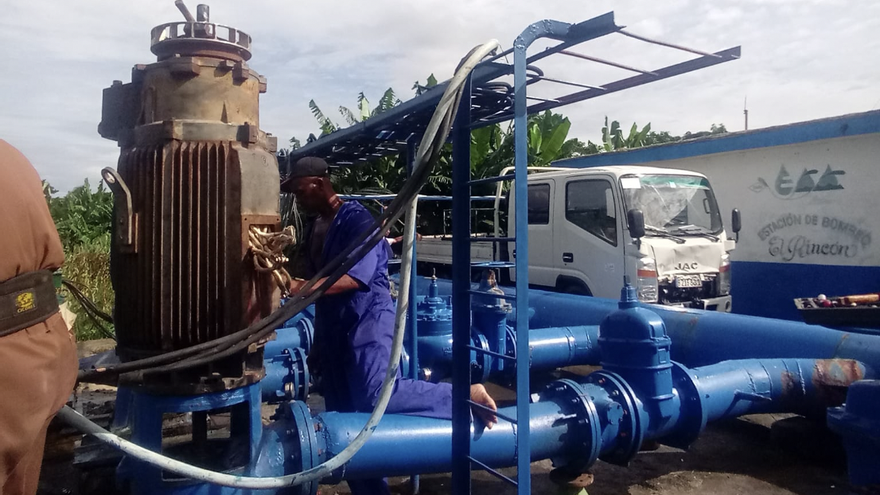
Installation of a water pump in the El Rincón reservoir, located in Las Tunas. (Facebook/Aqueduct and Sewer Company)

14ymedio bigger14ymedio, Havana, November 24, 2023 — A week after the authorities promised that the water supply would stabilize in Las Tunas, thousands of residents in the province remain without service this Friday. The installation of a pump – to whose absence the authorities had attributed the shortage – did not improve the situation, and citizens, who no longer trust the promises of local leaders, have filled their social networks with a flood of complaints.

Of a population of more than 500,000 inhabitants, 393,638 people receive water regularly in Las Tunas. Another 100,000, residents of 487 communities, obtain it through tanker trucks, and 6,267 through train delivery. These figures reflect only the residents who have a piping system, and not the hundreds of tuneros who are supplied from their own wells or directly from bodies of water that are not always suitable for consumption.

We spent weeks carrying water from a well; thank God it’s there, but the neighborhood has itchy skin

“We spent weeks carrying water from a well; thank God it’s there, but the neighborhood has itchy skin. Not to mention where you have to look for drinking and cooking water,” complained a neighbor this Thursday on the Facebook profile of the provincial Aqueducto company. continue reading

Those affected say the situation has become unbearable, and so they have let those responsible know. When Acueducto recently announced the installation of the new pump in El Rincón, which would supposedly improve the situation, customers responded sarcastically: “Improve? We’ll see if at least water arrives, because it’s been failing for months. Hopefully they put it on Saturday mornings, and on Tuesdays and Thursdays we won’t have to wait for it. And I’m not going to mention the quality.”

Another client complained about the reliability of the company. “On Monday there was water on Buena Vista Street and if you got it, you had to pay 3,000 pesos. Of course, although I don’t have service, I still have to pay for it. This only happens in Cuba,” he said.

After being repaired in Havana, one of the motors in the water treatment plant was installed, and this allowed an increase in the pumping from 70 to 85 gallons per second. Also in the El Rincón reservoir, which supplies water to 160,000 inhabitants of Las Tunas, a new pump relieved the old one in October, after it exceeded its capacity of 20 million cubic meters.

The new machinery can expand the flow up to 132 gallons per second, but the low processing capacity of the water treatment plant prevents it. “The necessary 132 will not be reached, because everything is decided in the water treatment plant, and there it is not possible to increase power at this minute,” Oscar Carralero Suárez, director of Aqueducto in Las Tunas, told Granma this Friday.

The authorities’ reports to the official press reveal that even if the water pumps are repaired, Aqueducto’s capacity is insufficient

The authorities’ reports to the official press reveal that even if the water pumps are repaired, Aqueducto’s capacity is insufficient to provide service to all those affected. Exceeding 75% of the water levels of the reservoirs in the province, only Cayojo has operated regularly throughout the year; but being the smallest, its pumping capacity is just 19 gallons per second.

El Rincón, on the other hand, although it can reach 132 gallons per second, this year has seen its power reduced to 50%, and “in the case of Piedra Hueca, which had been working reliably with 45 gallons per second, today does not exceed 26, due to problems with the pumping equipment,” said Aqueducto’s director.

The only option for Las Tunas, the authorities recognize, is to “modify existing equipment,” including pumps, water treatment plants and water pipes, something that is being evaluated by a National Commission but, for the moment, is only an expectation.

Translated by Regina Anavy 

____________

COLLABORATE WITH OUR WORKThe 14ymedio team is committed to practicing serious journalism that reflects Cuba’s reality in all its depth. Thank you for joining us on this long journey. We invite you to continue supporting us by becoming a member of 14ymedio now. Together we can continue transforming journalism in Cuba.

Flight Cancellations Between Cuba and Nicaragua Begin After the New U.S. Measures

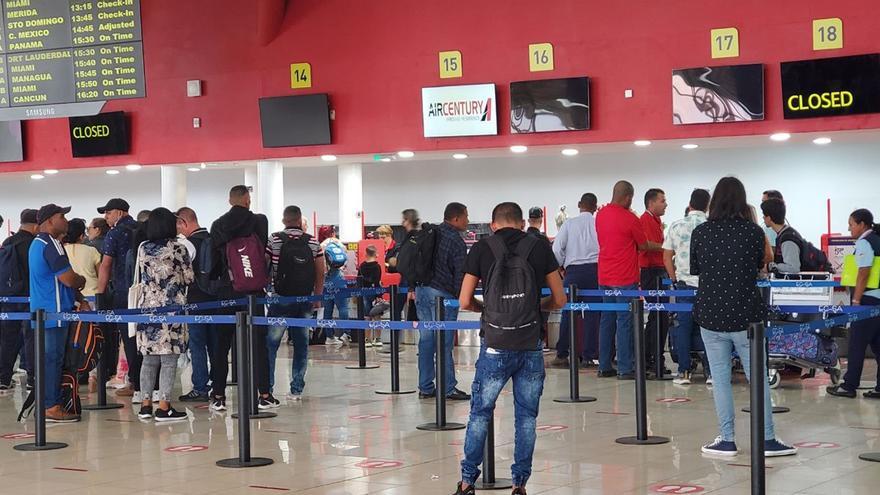
Cubans in line to check in on an Air Century flight at José Martí International Airport. (14ymedio)

14ymedio bigger14ymedio, Mexico, November 24, 2023 — Several airlines connecting Cuba with Nicaragua began suspending their charter flights three days after the U.S. announced penalties for airlines that cover that route. A source from a Miami-based travel agency, which markets tickets between the Island and the Central American country, confirmed to 14ymedio this Friday that for the moment, the only airlines connecting the two nations are Conviasa and Aruba Airlines, while Air Century and Sky High canceled all operations that were scheduled for the coming months.

Representatives of Air Century reaffirmed to Telemundo 51 that this company will no longer fly the commercial route, widely used by migrants from the Island to make the crossing to the southern border of the United States.

On Tuesday, the State Department explained that charter airlines have been selling tickets at “extortionate” prices to those who use Nicaragua as a route to access Mexico’s northern border.

“My world fell apart today. They already canceled my flight twice, and this time it was for real”

The penalty consists of the ineligibility for a visa to the U.S. of “owners, executives and/or senior officials of companies that offer charter flights to Nicaragua” protected by the Immigration and Nationality Act, which establishes that people who carry out activities sanctioned by the U.S. Government cannot enter the country. continue reading

Air Century, according to the source who works at a Miami travel agency, “is organizing a few rescue flights to get people out who were going to fly from Cuba in the few days left of November.”

“My world fell apart today. They already canceled my flight twice, and this time it was for real,” a Cuban resident on the Island who intended to travel with Air Century soon, told Telemundo 51. Her flight was canceled in the middle of this week. The woman’s only hope was to be transferred by the agency where she bought the ticket to another airline.

Days before the Biden Administration announced the visa restriction for the operators of these flights, two U.S. officials warned that the measure was being prepared. One of them was Eric Jacobstein, deputy undersecretary of the Office of Western Hemisphere Affairs, who said that the Government was “aware of these reports about an increase in charter flights arriving in Nicaragua from several countries, and we believe that no one should take advantage of the desperation of vulnerable migrants.”

Between 2021 and 2023, more than 425,000 Cubans arrived at the southern border of Mexico, on their way to the United States. The route through Nicaragua has facilitated the avoidance of an even worse route, the one that involved crossing the Darién jungle, between Colombia and Panama, which many took in the previous migration crisis of 2015.

Translated by Regina Anavy 

____________

COLLABORATE WITH OUR WORKThe 14ymedio team is committed to practicing serious journalism that reflects Cuba’s reality in all its depth. Thank you for joining us on this long journey. We invite you to continue supporting us by becoming a member of 14ymedio now. Together we can continue transforming journalism in Cuba.