Corruption, the Cancer of Cuban Public Transportation / Cubanet, Ernesto Perez Chang

Photo by author
Photo by author

cubanet square logoCubanet, Ernesto Perez Chang, Havana, 7 February 2015 — More than a decade has passed since the first big purchase of busses from China and Russia was made in order to ameliorate the transportation problem in Cuba, and no improvement is in sight. Contrary to what was promised then, moving from one point to another becomes each day a greater agony for low-income citizens.

Although officials from the Ministry of Transportation continue blaming the economic embargo and the world crisis for all the difficulties they face, it is well known that there are other phenomena, many of them related to corruption.

In that sense, it is not surprising to encounter silence in the official media and in the statements by some officials in which they try to hide the million-dollar embezzlements that continue reading

the importing and transportation companies must confront every year such that what is invested on one side passes to the pockets of a few on the other.

Besides the negative figures supplied by Ricardo Chacon, Director of International Relations for the Ministry of Transportation (MITRANS), in the press conference held in 2014 in order to “denounce the embargo,” there were other data missing about the damages caused to the Cuban economy by the frauds and thefts committed by some of the senior leaders of strategic enterprises related to transportation.

According to what we could learn through an official from Havana’s Provincial Transportation Department, who for obvious reasons has asked our discretion as far as his identity, a great part of the economic losses that were suffered last year, as in years before, is due to the chaos and the embezzlement of great sums of money by senior leaders of enterprises like Transimport, whose director, Jesus Jose de Hombre, was arrested some months ago and is under investigation for an act of corruption that also involves the director of the company Autopartes, tied to the illicit sale of thousands of engines that were intended for public transportation.

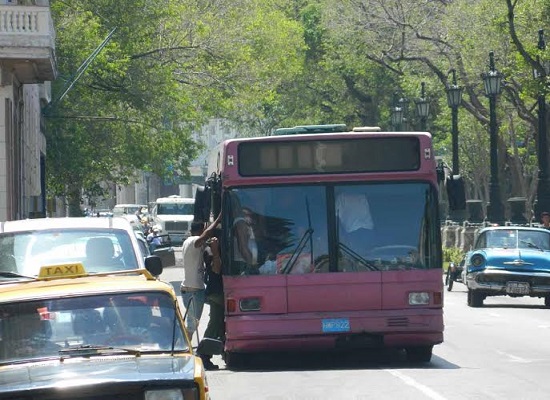
Alternative transportation in Lido, Marianao
Alternative transportation in Lido, Marianao — The people ride in the backs of trucks

On the streets of Cuba it is common knowledge that the black market for parts and vehicles, as well as for all services related to the field, is supplied by a network of corruption that reaches the highest levels in government institutions. The inability to honestly administer all these enterprises that function as true mafias is obvious when the constant resignations by officials are taken into account, the frequent changes of high managers as well as of the ministers and vice-ministers related directly or indirectly to transportation but, also, when it is revealed to us the exaggerated price of a vacant position in any of the warehouses or offices related to the sale or import of automobiles and auto parts.

The lines for the bus

A worker – whom we do not identify for his safety – for one of the warehouses of the Gaviota enterprise group, in the capital, tells us about this particular:

“The job as assistant to the Warehouse Chief goes for a thousand dollars and those that have to do with marketing also are “nibbling close.” There are people here who have entered on the bus and left in a Hyundai. They enter without a peso in their pockets because of what they had they spent on buying the job but later they get twenty times what they invested. Here I have seen new cars being removed, just arrived through the port. Later old cars are put out to rent, as if they were the new ones.”

All of the old trucks and cars that circulate through the city, above all those dedicated to the particular business of transportation, are known to get their spare parts in mechanisms of the dark market due to the absence of legal providers. It might seem like a miracle that cars in use for more than half a century still continue rolling on the country’s highways but a glance inside of any of them would dispel such amazement.

The driver of an almendron (a 1950s American car for hire) says about the expenses that keeping those vehicles functioning implies that necessity has become part of the urban profile.

“You have to go out and look for all the parts. As there are none, they stab you with the prices. If you want to have it running at least eight hours, so that the business pays you, you know that in a year or two you are going to have to “re-motorize yourself.” Every week you have to give it maintenance so that it doesn’t die and adapt all kinds of parts. And none of it is legal, they all require papers and you pay this and that and the other so that everything comes out okay. Everyone who has a car rolling on the street has to make an arrangement if you don’t want to forget about the car. The State requires you to go to the black market because it doesn’t give you anything. They know what they are doing and they have seen a windfall in that. He who makes the law makes the trap.”

Alternatives in the transportation crisis (photo by author)

Even though for the foreign visitor it could all work wonderfully – given that they travel the best routes of the country in comfortable panoramic buses and not in horse drawn carriages or unsafe trucks like those at the Lido terminal in Mariano – the transportation outlook on the island is quite grim. There is no way to break that cycle of corruption that the government itself has created and not because of inability or innocence. So many years committing the same mistakes only points to something quite high, at the head of the State, someone knows how to finish that infallible refrain that seems the slogan of every social project: There’s good fishing in troubled waters.

About the author:

perez chang 448.thumbnailErnesto Pérez Chang (El Cerro, Havana, June 15, 1971) Writer. Graduate of Philology from the University of Havana. He studied Galician Language and Culture at the University of Santiago de Compostela. He has published these novels: Your Eyes Face Nothing (2006) and Alicia Under Her Own Shadow (2012). At the end of this year the outlet Silueta in Miami will publish his most recent novel, Food. He is also the author of books of stories: Last Pictures of Mama Nude (2000); The Ghosts of Sade (2002); Stories From Headquarters (2003); Variations on the Illiterate (2007), The Art Of Dying Alone (2011) and One Hundred Lethal Stories (2014). His narrative work has been recognized with the prizes: David de Cuento, the Union of Writers and Artists of Cuba (UNEAC), in 1999; Gazette Story Prize of Cuba on two occasions, 1998 and 2008; Julio Cortazar Latin American Story Prize in its first call in 2002; National Critic’s Prize in 2007, Alejo Carpentier Story Prize in 2011, among others. He has worked as editor for numerous Cuban cultural institutions such as the House of the Americas (1997-2008), Art and Literature Editorial, the Center for Research and Development of Cuban Music. He was Editor in Chief of the magazine Union (2008-2011).

Translated by MLK
“I am a meddlesome peasant” / 14ymedio, Juan Carlos Fernandez

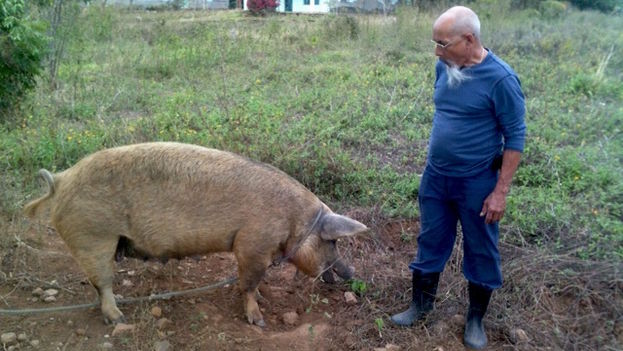
Eduardo Diaz Fleitas on his farm.  (14ymedio)
Eduardo Diaz Fleitas on his farm. (14ymedio)

14ymedio bigger14ymedio, Juan Carlos Fernandez, Entronque de Herradura, 31 January 2015 – Entronque de Herradura is a little village in the Pinar municipality of Consolacion del Sur. I go there in search of Eduardo Diaz Fleitas, a Cuban with rapid speech, skill with the ten-line stanza and proven courage. He was among the 75 dissidents sentenced during the Black Spring of 2003, but not even a long prison stay made him lose his smile or wit.

Fleitas asserts that he is “just a meddlesome peasant.” In this interview he speaks of his life, his early activism and of that other passion, which is the land where he has worked as long as he can remember. continue reading

Question: In other interviews your work as an opponent always comes up, but I would like to speak of your personal history. What did you do before that fateful March of 2003?

Answer: As a child I worked in the fields. I had to grow up fast, and I studied auto mechanics. Later I became a driver and even drove a bus. In 1989 I started driving a taxi and later became a transport inspector. However, in 1993 I stopped working for the State, demanding that they pay me with dollars to be able to buy in the hard currency stores because the national currency had no value. Since then I have worked on the plantation with my father.

Q: Where did the ethical and moral values that guide your life come from?

A: My father taught me respect, kindness, honesty and love of work, spirit of service and help to others. From my mother, a farmer and housewife, I learned effort and integrity as well as loyalty and also love, which I have seen in them, because they have been married since 1950.

Q: What was the process that led you to be disappointed in the political and social process which, from its beginnings, said it was defending the peasantry?

A: With the triumph of the Revolution we thought, like many, that it was something good. But after three or four months things began to get bad; the executions, the land was no longer ours. The discourse ran one way and reality the other. All that was waking me up.

Q: But it’s a long way from discontent to activism. When did you begin to be a dissident publicly?

A: In the year 1988. Since then and until now I have been active in several opposition organizations and held different responsibilities.

Q: During the Black Spring of 2003 you were arrested along with other dissidents, journalists, librarians and independent trade unionists. They sentenced you to 21 years imprisonment and you were behind bars almost nine years. How hard was jail?

A: What most struck me about the Cuban penitentiary system is the great cruelty with which the inmate is treated, whether political or not. There you are not a person, you are at the mercy of your jailers. I saw extremely sick prisoners ask for medical attention, and the guards laughed in their faces. We must humanize Cuban prisons!

I also have to say that prison offered me the chance to see, to my surprise, how many people support, in one way or another, the peaceful opposition movement in Cuba. I never felt alone inside. Prison also gave me the opportunity to harbor not even a drop of hatred against my victimizers. In my heart there exists neither hatred nor rancor towards them.

Q: You have participated in several unity initiatives among opposition forces, the latest of them the Open Space of Civil Cuban Society. Do you believe consensus can be achieved in spite of differences?

A: All proposals of this type are excellent. What I do consider unjustifiable is the dismissive insult and personal attack among ourselves. That is the method the Cuban government uses against us, it is anti-democratic and not at all ethical. No activist should fall for something like that. We must have consensus on basic points, and that is what Open Space has achieved and what we have sought for years. I am happy to be able to participate in that initiative.

Q: What do you think about the intention of the governments of Cuba and the United States to re-establish diplomatic relations after more than half a century of confrontation?

A: As of last December 17 a new era for Cuba began. The government of the United States has realized that the prior policy was a dead end with no way out, and now a host of opportunities is opening for our people.

I have asked people about the measures announced by the American government, and they look favorably on them, because they mean prosperity for the people. But when I have asked them what they think of the Cuban government in the face of this challenge, they answer that they do not trust it. Nevertheless, I am optimistic. We must create awareness that dialog is best. I believe that the United States is committed to us and has intelligently confronted the regime.

We have to have the courage to reclaim democracy and to respect our rights. The era of change may be coming for all Cubans, and it falls to everyone to do it in harmony. Cuba has to flourish again for everyone and for the good of all!
Unanimity is not good. We must live in diversity. But it is good for us to be unanimous when dealing with differences. Well…better I say it in verse:

Cuban,
Why is it that it doesn’t matter to you
To ruin your dignity?
Because so much calamity
Will never produce heroism.
Bury that pessimism
That daily assaults you.
Raise your voice, you are able
To be the example of the titan
Awaken those who are
Prisoners of their own webs.

Translated by MLK
“Check out how free this country is!” / 14ymedio, Victor Ariel Gonzalez

Presentation about the book ‘From Confrontation to Efforts at “Normalization.”  The Policy of the United States towards Cuba.’ (14ymedio)
Presentation about the book ‘From Confrontation to Efforts at “Normalization.” The Policy of the United States towards Cuba.’ (14ymedio)

14ymedio bigger14ymedio, Victor Ariel Gonzalez, Havana, 29 January 2015 — “In Vietnam, Yoani Sanchez would be in prison,” says Rafael Hernandez, editor of the magazine Temas (Topics), comparing the Cuban regime with the Vietnamese one. And he adds: “Check out how free this country is!” According to the official researcher, Cuban bloggers “are arrested and released, but they are not put in prison,” as occurs in the southeast Asian continue reading

country, where these cyberspace activists receive “nothing but” jail for being “anti-government.”

The political scientist and essayist offered these observations last Wednesday at the Juan Marinello Center during the presentation about the book “From Confrontation to Efforts at ‘Normalization.’ The Policy of the United States towards Cuba,” by the publisher Social Sciences. One of the authors, Elier Ramirez, participated in the panel discussion held by the magazine.

Just reading its name, one deduces that the essay by Elier Ramirez and Esteban Morales – co-author – reflects the offical Cuban position about the rapprochement between the Island and its “historical enemy.” The word “normalization” in its title appears in quotation marks because, among other reasons, “the United States has always understood normalization from the position of domination,” says Ramirez. “There is no change in its strategic objectives [basically, regime change in Cuba, but] a profound tactical adjustment” behind the negotiations between Washington and Havana, according to the author.

This work had already been released, at least once, during the presentation of the volume “Back Channel to Cuba: The Hidden History of Negotiations Between Washington and Havana,” written by U.S. researchers Peter Kornbluh and William LeoGrande. But then, last October, the political situation was very different from the current one.

During Wednesday’s presentation about the book, the comparison between Vietnam and Cuba emerged in the context of what Rafael Hernandez considers a double standard in U.S. foreign relations which criticizes Cuba on questions like freedom of expression while not doing the same to other countries. “How do you [the American government] demand from me [the Cuban government] what you do not demand of the Vietnamese who put bloggers in prison?” asked the researcher who is also a moderator of the space Ultimo Jueves (Last Thursday).

Rafael Hernandez also referred to the case of the performance by Tania Bruguera last December 30. In order to justify the attitude of Cuban authorities, he gave as an example a hypothetical megaphone protest in front of the home of the British prime minister. “Before taking out the loudspeaker, they already told him off and got him out of there,” he said, referring to the imaginary protester. “What does that have to do with freedom of expression? What are we talking about?” he added, insisting on the supposed “double standard” of the western discourse with respect to that basic right.

Entering into a process of negotiations that both parties have deemed “historic,” one can no longer speak only of “a relationship between two governments” because now there is also “a relationship between two societies” declared Hernandez, who called for a realization that “there is a new game.”

The official analysts define this “game” as a “form of battle” for preserving the regime, different from all previous battles. This war, certainly is already taking place also in the symbolic realm where the most rancid nationalists have been contaminated by a certain foreign banality, especially American.

It is not strange that an official intellectual like Hernandez expresses himself thus about the rapprochement between the two countries. As far as his comparisons in matters of human rights, it is legitimate to ask what exactly the editor of Temas meant to say. There are three possible interpretations:

  1. Vietnam is a dictatorship.
  2. Cuban bloggers should be prisoners.
  3. We bloggers should feel grateful for the few handouts of freedom that the regime grants us and that it also can take from us at any time, imitating its “sister nation” from southeast Asia.

Translated by MLK

“I Live Happy Because I Live Without Fear” / 14ymedio, El Sexto

Map of the 4H Company in prison hand drawn by Danilo Maldonado, ‘El Sexto’
  • El Sexto tells of his incarceration in the Valle Grande prison

14YMEDIO, Havana, 28 January 2015 — Danilo Maldonado, the graffiti artist known as El Sexto, finished a month in prison this January 25. He was arrested while riding in a taxi whose trunk was carrying two live pigs. The animals were painted green and each bore a name written on his side. On one could be read Fidel and on the other, Raul.

The artist’s intention was to release them in Central Park in order to recreate a rural tradition in which one tries to catch pigs with the added difficulty that their bodies are smeared with grease. His frustrated performance art was entitled Animal Farm, in Memoriam.

The light blue Lada that was transporting him was intercepted by three Revolutionary National Police patrol cars. The agents took away the identity cards of Danilo and the vehicle’s driver and took them to the Infanta and Manglar Station. Two days later, they transferred the artist to the Zapata and C unit where a prosecutor told him that he would be taken to trial. He stayed in those dungeons seven days until he was transferred to the central police station of Vivac de Calabazar, where he spent another seven days.

It happened that Vivac was the destination for dozens of arrestees accused of trying to participate in the performance announced by performance artist Tania Bruguera in the Plaza of the Revolution last December 30, which was interpreted by authorities as a counter-revolutionary provocation. Some of those arrested, who learned of his presence at the place, shouted, among other slogans, “Freedom for El Sexto.”

From the Valle Grande prison, where he is now, Danilo has sent us some jail anecdotes and a couple of drawings.

The Tank

When I arrived at Valle Grande they took blood samples for the lab, shaved my head and beard. They also photographed me. During my stay in Vivac, they had diagnosed me with pneumonia, for which reason I was carrying antibiotics with me, but they took them from me and have not seen fit to return them to me so far, nor has a doctor listened to my chest to find out if I am the same, better or worse than when I arrived here. To make matters worse, I am surrounded by smokers who do not care at all that I am sick and asthmatic. continue reading

I am in Company Four. They call this place “the tank,” and there are all kinds of people. I met four dissidents from Alturas de la Lisa. Yorlay Perez, Yusel Perez, Santiago Perez and Hanoy.

Fidelito

One day a boy came into the tank who said he knew me from the park and that he followed my work on the streets. This swarthy young man of small stature surprised me when he took off his pullover revealing on his back a tattoo of the face of Fidel Castro. I explained to him that I am an opponent of the Castro regime and that the gentleman he wore engraved on his skin was the one responsible for me being a prisoner.

He responded that he had no family and that he was a “son of the fatherland,” for which reason Fidel had given him a home, and that was not happening anywhere else in the world. I told him that was true, that if he had been born in another country no one would have given him a home, but maybe he could have sought it for himself and that really he owed nothing to Fidel. I told him of the case of Amaury Pacheco, who with a family of six children was harassed into an eviction from an abandoned house in the Alamar suburb, where they had gone so far as to refuse him water and electric service.

Later I found out through another boy, whom I met in Vedado, that it was said that he was with State Security and that he always had a pistol under his shirt. His acquaintances nicknamed him the Hoarse One, but I called him Fidelito.

This son of the fatherland was prisoner for falsification of documents, something he had done in order to leave the country. In a single night he tried to hang himself twice.

Yusel, the Opponent

In one of the constant inspections that they carry out here, a major and a second lieutenant thought that the fingernails of one prisoner were too long and that he had to cut them. He explained that he had no nail clippers, much less scissors. The major took a knife from his belt and threatened to cut his nails by force. The boy resisted and then the major told him that he had to bite them off.

Bunks. (El Sexto)
Bunks. (El Sexto)

When they passed by the place where the opponent Yusel was, they noticed that he wore a white bracelet with the word Change on one of his wrists. As he did not obey the order to take it off, they forcibly snatched it from him. Then Yusel started yelling, “Down with the Castros, down with the dictatorship.” The second lieutenant cornered him against a bed to beat him but the rest of the prisoners got in the middle and prevented it. Things got hot but did not go further because the major started screaming that they were not going to beat him. Only then did the prisoners relax. Yusel was in a punishment cell for four days, but they did not beat him.

‘The Cigar’ that urinates

The Cigar arrived without a noise. Strong, tall, he must be between 60 and 70 years old, and he does not sleep. He said that he was a prisoner because he had threatened with a screwdriver some teens who were throwing a ball against the wall of his house. No one got close to him because he did not bathe. One day he urinated in the middle of the hallway, which was understood as “blackmail” for the other prisoners who would have to clean his filth. When they demanded that he wipe up that puddle, he said that he would do it with his clothes but they did not let him because that would mean enduring an even greater stench from him. We understood that he was going crazy the day that they read out loud the cards where our names and crimes appear. Then we learned his case: child sexual abuse.

To my Facebook friends and blog readers

I want to tell you that I really miss finding out about your trips and other events that are reflected in your accounts. I would also like to thank everyone who supported my cause and confess that none of my crazy things would have been possible if I had not known that I was not alone and that I count on the support of many of you. It is possible to fill hearts with hope. Evil will never overpower good. Retrograde minds will never overcome free minds. Violence will never overcome art and reason. Death will never overcome life and love.

I am going through an ordeal that has only been the legitimization of a good work and the confirmation of an iron dictatorship, which must be combatted with wit and cunning.

Believe me, sometimes I laugh alone in this dark place of 18 by 100 feet with 37 triple bunks, that is to say between 118 and 190 people plus those who sleep on the floor. I laugh even though the toilets are stuck next to each other without any privacy. I live happy because I live without fear and, although they persecute and harass my family, they will never manage to make a dent in my creativity. This time I believe they have been ridiculed like never before by anyone. Although they kept the pigs from getting to Central Park, all of us who have an imagination can see them running with their names engraved and people behind them like a true Animal Farm.

Ha, ha, ha. Hugs to all, and I wait to be able to read you.

Danilo Maldonado Machado

Translated by MLK

Institutional Crisis / 14ymedio, Fernando Damaso

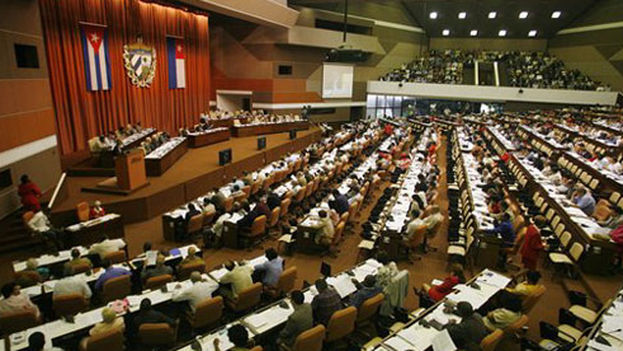
Meeting of the National Assembly (Neo Club Press)

14ymedio, FERNANDO DAMASO, Havana, 22 January 2015 — Among so many crises that affect us, little is said about that related to institutions. In the Republican era, there existed institutions that, without being perfect, worked. If it had not been so, the country would not have developed in the way that it did. When the new regime was put in place in 1959, instead of being perfected, most of the existing institutions were liquidated or their spheres of influence were reduced for the purpose of initiating other new ones on bare ground. Even the family, considered a principal and primary institution, did not escape, being dismembered and atomized to respond to political and ideological interests.

An institution can be many things. There exist formal and informal institutions and, in both cases, they are always social constructions. They must be efficient, that is to say, capable of functioning well, having legitimacy, being able to adapt to changes in the environment and anticipate changes besides demonstrating stability. These components must act together if they want to get results. In the Cuban case, stability has turned into a kind of brake that impedes the necessary changes, giving rise to ossified institutions. The majority of institutions established in the last fifty years suffer this infirmity, mainly the economic, legal and political ones. continue reading

The companies nationalized or seized – financial, production, trade and others – that had functioned independently in accord with the policies of their owners, were subordinated to already existing institutions or ones created for that purpose that had never performed these functions of management and administration, instituting a rigid vertical system that totally eliminated their independence and chances of reacting to changing situations; everything was decided centrally, and they were reduced to mere implementers of orders. Economic institutions not only have been incapable of developing the country but have destroyed what was achieved during the preceding years thanks to the talent and effort of several generations of Cubans.

Legal power stopped being independent and, like the legislative, was subordinated to the executive, represented by a single authority. Judicial institutions respond only to the interests of the State, to the detriment of the citizens without there existing true rule of law.

In the provincial and municipal governments changes were introduced, stripping them of their names and functions, also creating a vertical system that left them financially destitute for having to deliver most of their income to the central authority which later would dole out resources for their needs. These changes reduced the chance of solving local problems, since they no longer had the resources that their own commercial and productive activities previously generated.

In the case of political institutions, the example of the National Assembly of Popular Power is depressing. Being the only constituent entity existing in Cuba, which also is the only legislative body and which retains the important authority to declare the unconstitutionality of laws, decrees, ordinances and other regulations, it has never exercised this authority in its 38 years of existence as the supreme agency of the State. Can anyone believe that everything legislated by the State has been just and correct?

Other negative aspects of its functioning are that almost all the votes in its legislative history have been unanimous and that the deputies have not exercised their right to present legislative proposals as individual members of the Assembly. As if that were not enough, the legal decrees of the State Council and the decrees by the Council of Ministers triple the laws by the National Assembly.

The main problem that affects all Cuban institutions – whether political, economic, legal, cultural, educational, military, medical, athletic or others – is their unconditional submission to a sole political-ideological approach, putting these interests ahead of those that relate to their reason for existing. The only exceptions perhaps are some religious institutions.

Until now the topic of institutions has been treated superficially, more with regards to their form than their content. Life demonstrates that some institutions must disappear, others must be changed, some new ones should be created and a few others can continue functioning. If this does not happen, the economic changes implemented so far and others that should come, as much economic as political and social, will lack the effectiveness, legitimacy, adaptability and stability necessary for producing beneficial results for all Cubans. It is not logical to hope that all this will be achieved with the existing historical leaders, but they could, at least, start.

Translated by MLK

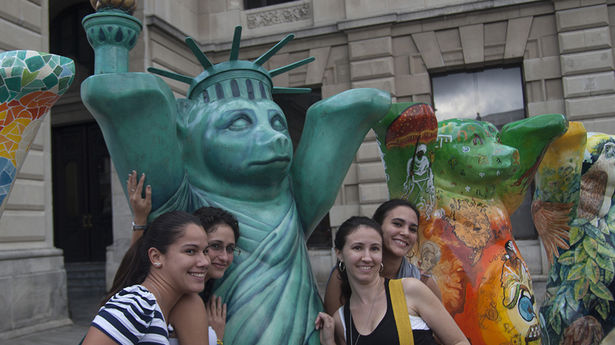
Strange, Like a Bear in a Havana Square / 14ymedio

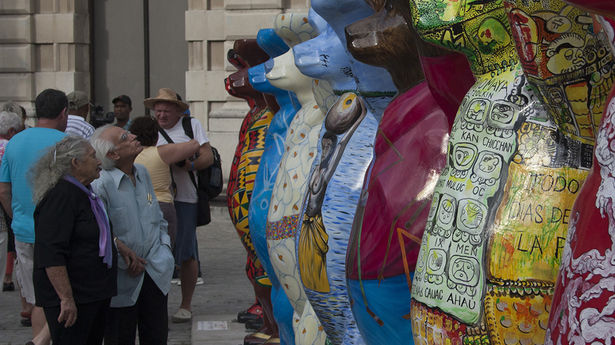
The Buddy Bears in San Francisco Plaza.  (Luz Escobar)
The Buddy Bears in San Francisco Plaza. (Luz Escobar)

14ymedio, LUZ ESCOBAR, Havana, 17 January 2015 — “Where is the end of the line for a picture with the Cuban bear?” yesterday asked a youngster during the opening of the United Buddy Bears show in Havana’s San Francisco Plaza. The project, created in 2001 by Eva and Klaus Herlitz with the collaboration of Austrian sculptor Roman Strobl, promotes a message of tolerance and understanding among all peoples, cultures and religions of the world. The exposition has travelled across five continents with life-sized sculptures of bears that evoke the member countries of the United Nations.

With the participation of artists from each of the represented countries, these bears have visited cities such as Vienna, Cairo, Jerusalem, Buenos Aires, Montevideo, Paris, Hong King, Istanbul, Tokyo, Sydney, Warsaw and Rio de Janeiro. Since its first exhibition in Berlin in 2002 they have been appreciated by more than 30 million people. Now, they are in Havana, which highlights the signature sculpture of our country, made by Cuban artist Nancy Torres.

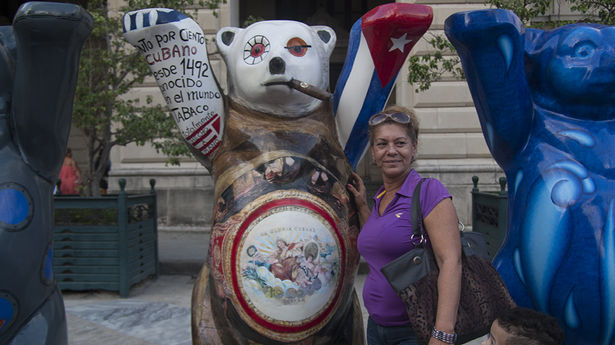
Oso-buddy-cubano_CYMIMA20150117_0010_12With a cigar in his mouth, a cigar band around his waist and a mischievous wink of his eye, the Cuban Buddy Bear is part of this diverse and plural group. His creator explained during the opening that she named him Siboney in homage to the first Cuban Indians continue reading

and that she crafted him to include the colors of the flag. “He has traveled through many countries since 2002 which was when I created him,” added the artist. She also emphasized that, “I have lived in Berlin for more than 50 years. In this bear are rejoined symbolically the two heritages that I have: Berlin and Havana.”

Also participating in the ceremony was the German ambassador to Cuba, Peter Scholz, who said that he hoped that “the bears are capable of sharing much pleasure and happiness during the next six weeks and attracting visitors from all over. Because I hope that the bears give us much zest for life.” The show will be in San Francisco Plaza until the beginning of March of this year and during this time it is expected that a three-foot high replica bear that represents Cuba will be auctioned off.

For his part, City Historian Eusebio Leal Spengler noted the importance of the moment in which the bears have arrived on the Island. “I am happy to imagine that now revived with the colors with which each artist sees the world they are here in the heart of the Historic Center, a World Heritage Site, giving meaning to that vision of opening, and, as has been said, tolerance.”

Leal Spengler’s words alluded metaphorically to the re-establishment of relations between Cuba and the United States when he thanked “the embassy personnel who came to ask if it could be and my answer was, immediately, let the bears come. May they be announcements of a better time, now that the salmon that so please the bears are jumping in the river’s currents.”

Oso-Buddy-americano_CYMIMA20150117_0009_12Havanans have already chosen their preferred bears and stand in line to get their pictures taken in front of the one that represents the Statue of Liberty of the United States. Among the most appreciated also are those of Spain, France and Germany. Meanwhile, the Cuban bear has received several critiques from those who see the inclusion of the cigar as a promotion of the harmful habit of smoking in an exhibit that is aimed mainly at children.

The United Buddy Bears exhibit has been associated with projects by UNICEF and with help for needy children. From donations from local organizations and the auction of some pieces so far about two million euros have been raised for the children. The project promoters Eva and Klaus will accompany the bears during their Havana stay.

Translated by MLK

The ‘Cabanuelas’ for Religious Freedom / 14ymedio, Mario Felix Lleonart

:  Children during a celebration of the Day of the Kings at Taguayabon Church (M. F. Lleonart Barroso)
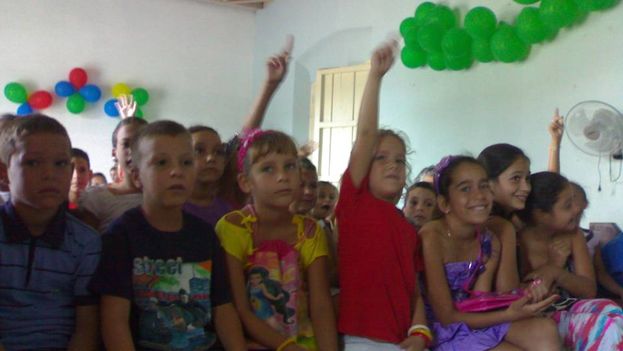
: Children during a celebration of the Day of the Kings at Taguayabon Church (M. F. Lleonart Barroso)

14ymedio, Mario Felix Lleonart Barroso, 16 January 2015 – Cuban peasants have a tradition that they carry out at the beginning of year. They observe the first twelve days of January and complete the observation – in a countdown – with the following twelve days until they get to the 24th day. They have the idea that what happened in the natural environment on those dates can yield some insight on how the year will be.

If it rains on the third day, that means for the men of the field that the same thing will occur in the third month. This way they get an idea of whether the year will be rainy or dry, if there will be hurricanes, much heat or if it will feel cold in the limited winter. The farming traditions call these days that the farmers think of as a preamble to the months of the year cabanuelas.

For those of us who form part of the religious sphere in Cuba, the last year ended with new perspectives on the relations with our counterparts in the United States. After the announcement by President Barack Obama last December 17, there have been more than a few citizens from that country who have been interested in how they might help us in the most effective way, given the opportunities that are opening up. continue reading

The new scenario is positive for those churches on the Island who never stopped maintaining fraternal relations with their peers in the northern country, in spite of all those years that intervened in and served as obstacles to those ties.

Nevertheless, nothing is gained if perspectives feed only on the bright side, ignoring realities present in the landscape. If that were done, one would fall into very illusory readings extremely loaded with subjectivity. There is no doubt about the good intentions of the whole world, of American churches and even of President Barack Obama, but on what obstacles will those good intentions stumble?

In our country there are great impediments that limit exchange in the religious area and that form part of what many call “the internal blockade.” In order for the recently announced policies to have the desired effect, at least the following changes will have to occur on a national level:

  1. The Office of Attention to Religious Matters of the Central Committee of the Communist Party of Cuba must disappear. It is unacceptable that an office embedded in an atheist organization, which is also the only legally recognized party, tries to resolve everything concerning religion in the country.
  2. The Register of Associations by the Justice Ministry of Cuba must act with total independence and not under pressure, as occurs now, coming principally from the Office of Attention to Religious Matters. To begin, it should agree to the legalization of dozens of religious groups that for years have aspired to it.
  3. A Worship Law must be created and approved by all the people to defend religious liberties. In spite of its imperative need until now it has been conspicuous by its absence.
  4. The monopoly and privileges that the said office grants to the Counsel of Churches of Cuba, which does not shield most religious institutions as was intended, must end.

Furthermore, the Baptist Resurrection Church, in the rural community of Rosalia, celebrated Day of the Kings or Epiphany at the beginning of the year. Given that January 6 was a work day, they decided to celebrate it on the weekend and announced it to the residents of the place. The Communist Party in Camajuani and Taguayabon ordered our celebrations counteracted. With such objective they dedicated significant funds so that cultural and culinary institutions would carry out collateral activities, not with the healthy desire to entertain the people, but with the unhealthy one of “confronting” us.

If I stick to this view and the reading of these hard facts, I could prophesy that in spite of the good wishes of the world that is opening up to Cub, the religious scene does not begin well at all for our country, given the obstinacy of those who occupy political and military power. Nevertheless, when I see that in spite of the police apparatus our celebration of the Kings triumphed in a church full of children, I return to optimism and believe that so many good wishes will come to a good end.

Translated by MLK

The Park of Lost Connections / 14ymedio, Yosmany Mayeta Labrada

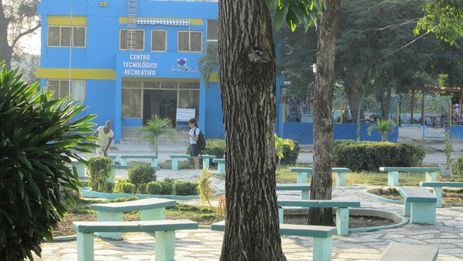
Recreational Technology Center of Santiago de Cuba (14ymedio).

14ymedio, Yosmany Mayeta Labrada, Santiago de Cuba, 16 January 2015 — “Happiness in the home of the poor is brief,” said a young man a few days ago who had been excited about connecting to the Internet through the WiFi network in a park in Santiago de Cuba. The Telecommunications Company of Cuba (ETECSA) denied this Monday the news that users could navigate the web from their phones, tablets or laptops in the new Recreational Technology Center of this city, as the official website Cubaperiodistas (Cuba Journalists) had indicated.

But a worker from the Center itself, who asked to remain anonymous, assures 14ymedio that there has been a change from the initial plan. “At first, the service that would be provided was wireless access to the internet, but after revealing the information and seeing the media coverage that it caused, the authorities decided that they will only supply a connection to the intranet without any cost.” continue reading

The Recreational Technology Center is located near Ferreiro Park and will open this coming January 28. Its facilities will offer services in an Internet navigation room with computers for public use. Also they will teach classes for children, teens and adults who want to learn to use computers and other new technologies.

Specialists consulted by this paper assure that the users obtain more secure connections accessing the Internet with WiFi, thus ETECSA would lose some control over what the web surfers send and receive. Such an advantage would be so remarkable, that many suspected from the first that it was a false report.

Yusmila Reyna, an independent journalist, maintained she had “no hope.” The reporter was skeptical that the Cuban government would offer those facilities “in a place where pro-democratic activism is stronger.”

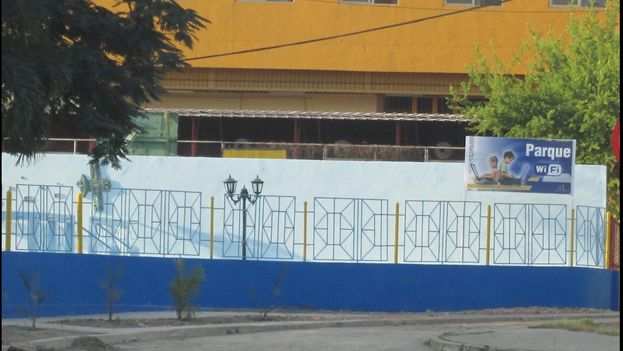
Poster with WiFi announcement at the Technology Center (14ymedio)

Lazaro Borrero, resident of the Mariana de la Torre neighborhood, thinks that the announcement of wireless connection to the worldwide web “had made many people very happy because they thought they would be able to connect directly to the Internet.” Now, with the denial having been made by the state enterprise, in which they also confirmed that they will only offer navigation service on an intranet – that is a network with sites hosted only within Cuba – the young man laments in frustration: “Again, we are back to normal.”

Sulianne Gomez, a young university student, did not believe at first the rumors from fellow students but then thought that if it was true, it would be very positive to “access bibliographies that today we do not have and also to enter sites like Facebook and Twitter with greater speed.” Currently the connection that university students use in their educational center is characterized by low quality and slowness, plus several digital portals and social networks are blocked.

In this situation, the illegal use of wireless networks was a palliative for some. Liudmila Cedeno, computer enthusiast, used to connect to a wireless network clandestinely. “Fifty of us gathered in the Plaza de Marte Park near the Rex hotel, which had an open network, and with the Freedom application we accessed the Internet.” However, “after several months of doing it, the government authorities together with the National Police decided to come down on the people who were gathered there.”

Another young man who did not want to give his name and confessed to being one of those who met to download, taking advantage of the hotel’s open signal, says that he managed to watch the police seize laptops, tablets, and mobile phones, besides imposing fines of up to 2,000 pesos on those who used that connection without authorization.

The hope of those who lacked that chance focused then on the possible service that the Recreational Technological Center would offer. Ridel Brea says that all the teens with smart phones had created great expectations. “They were like crazy people searching for telephones with WiFi to be able to connect, and now what they have is great despair,” he laments.

The chance for a wireless connection to the global network would have been an alternative to the few navigation rooms that the province has, which usually are jammed by high demand and the deterioration of their infrastructure. Santiaguans lament the lost connections that appeared in the headlines of an official media but, at least for now, it does not appear that they are going to reach the park.

Translated by MLK

Why Does Cuba Choke Charter Agencies And Deliveries to The Island? / Juan Juan Almeida

(April 2104) In Cuba, smoke doesn’t always mean fire. Often it is a stragegy to confuse.

This time the smoke comes to us from the Republic’s Customs Office, when last week, on its official website, it published an “updated” list of the entities authorized to make shipments to Cuba. continue reading

The Customs memo alludes to two groups of businesses.  The first consists of five agencies that carry out messenger and parcel service within Cuba; they are Cubanacan Express, CubaPack International, Transcargo, Aerovaradero, and the International Exchange and Messenger Business (EMCI), previously CUBAPOST which for legal reasons had to change its name.  For some reason that I do not know, they omit the Palco Freight Agency which operates under the command of the State Council, belongs to the Conventions Palace and offers identical services.

The second group cites the only 16 agencies authorized to send packages from abroad to Cuba, another deliberate oversight, the figure is not so exact, because all of them can offer the service and in fact they do so, to other agencies without this constituting any kind of alteration to the contractual act.

In order to understand why the government confuses us, and this is as clear as mud, we must cross the border that delineates the taboo topic and even the complicities.

It is normal, and I almost understand it, that a good group of fellow countrymen fly with some regularity to the island carrying foreign packages.  Some do it because of necessity, and to relieve travel expenses; other develop that activity in order to earn a living; easy modus vivendi.

There is no doubt, any traveler with bundles–including the so-called “mules”–brings more money to the island’s government than to their own travel agencies.  The pay dirt is in the cargo, in the packages that are sent and not in the passenger; so, why does Cuba impose obstacles to the point of choking the charter agencies which have already reduced flights and limited destinations?

Moreover, the Cuban authorities impose impediments and deny authorization to fly directly to Cuba to the agencies that have permits from the United States treasury and commerce department to send messages and packages to Cuba.

Here is the question, if according to them, the United States is the one who imposes the embargo, why always raise an objection to an opening as small as it may be? What is Cuba trying to do?

Simple, brutal and twisted. Those who rule in Cuba know that it is not weapons but bullets that kill. They are not interested in the charter flights and they are trying to break them or make fewer fly to the biggest of the Antilles Islands because the strategy is to create much more bother and discontent in the usual victims, the separated families, in order to better manipulate and use us as gladiators against the embargo law. They are bearing down, and doing their best, so that between Havana and Miami there only exist regular flights by airlines like American Airlines, Jet Blue or even Cubana Aviation itself.

Politics, always politics. If it were not for this reason, why does not the Customs Office, and the “always humanitarian” revolutionary government, today issue a tariff payment exemption for the non-commercial cargo that travels from abroad to our families in Cuba? That would be a credible beginning.

Translated by mlk

28 April 2014

Look But Don’t Touch / 14ymedio, Victor Ariel Gonzalez

At Sol and Oficios, there is a closed park and a dry fountain. (14YMEDIO)
At Sol and Oficios, a closed park and a dry fountain. (14YMEDIO)
  • As ancient buildings are crumbling, the vacant lots are transformed into parks that are always closed

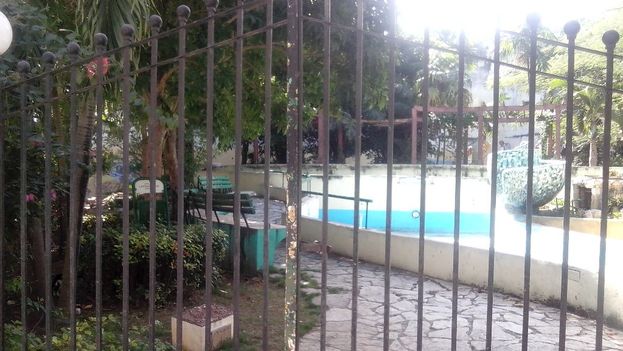
14ymedio, Victor Ariel Gonzales, Havana, 9 January 2015 — A group of tourists stops at the entrance of the “ecological park” on Mercaderes Street, a few steps from the Havana Cathedral. The guide speaks to them about this vacant lot turned into a public space which would be nothing out of the ordinary except for being the only one of its kind that is kept open. Aside from the brief circuit designed for foreign visitors, the parks of Old Havana are always closed.

So functions the fiefdom of Eusebio Leal, Havana’s City Historian. As old buildings crumble, the now-vacant parcels are transformed into gardens to which are added benches, trash cans, shade trees and maybe even a fountain. But, along with all that, they also put a magnificent gate closed with chain and padlock. No one can enter these urban oases.

At the corner of Teniente Rey and Habana there existed until a few years ago a children’s park full of attractions that were never used. The attractions “were burned” in the sun, says a neighbor of the place who remembers the image of children asking why “their park” was closed.

Today, the slides now dismantled, the site remains inaccessible but at least seeks another function in the community. Talking about this is Justo Torres who brought from his native Isabel de Sagua an interest in gardening and urban agriculture. He works at Nelva Oasis, a small gardening business very nearby that coordinated the park’s management with the Historian’s Office – a kind of local government.

Very enthusiastically, Torres confesses to being full of ideas for this place: giving it a “social use,” practicing agro-ecology and vermiculture, among others. “It is a unique experiment,” he says and one that also aims to be economically sustainable. He trusts that, in time, authorities will continue supporting the initiative.

Nevertheless, the rest of the parks have not had the same luck and have no use beyond the visual . . . behind bars. The monument erected in honor of Cuban doctor Carlos J. Finlay at Cuba and Amargura cannot be seen up close. There is also the Las Carolinas park, administered by the modern dance company Retazos, and open only for its interest in “some workshop for children and teens,” according to a custodian.

The list goes on. At Sol and Oficios, next to the Office of Cultural Heritage, an enormous green space surrounds a fountain as dry as a desert, that is their park. And at Acosta and Damas they built a pretty reminder of the Jewish community that lived there, just for the pedestrians to pass by because of having nowhere to rest without jumping the gate.

One of the best examples of this closure of public spaces is the fountain at Plaza Vieja in the heart of Havana within the city walls. The uninformed find the bars that surround the water to be strange. They do not know that this area has so many problems with the supply of the liquid which has had neighbors bringing buckets and tanks to it. A spectacle that reflects the real Cuba, which is not seen on postcards.

Across from the Central Train Station – another decadent icon of the city – a park offers anything except an invitation to relax. Old steam locomotives rust behind bars next to benches that will never be used again either.

This situation forms part of a vicious cycle that is completed with vandalism. The primary idea is that the parks remain closed so that the neighbors – who are not foreigners, but seemingly “uncivilized” Cubans – do no damage to them, while the lack of contact and “entrance prohibited” could be making it difficult to create respect for the urban environment or a sense of belonging.

So Nercy Perez, who works at the previously mentioned garden at Teniente Rey and Havana, would like the area schools to integrate themselves more in the projects she and her colleagues promote. “If children learn from an early age to take care of things, then later it will be easier.” The woman is of the opinion that “people do not have the culture” of caring for things. Indeed, she had to interrupt the conversation to scold a student who passed by and just grabbed one of her plants.

Other neighbors complain about the lack of public spaces. “The children have nowhere to play. They have to be in the street. The old people have nowhere to sit,” criticizes Joaquin from El Cristo neighborhood. The plaza that carries this latter name has been closed by metal barriers for a long time. Its interior does not look anything like a place where generations of Havanans scampered.

Also closed to the public, the Plaza del Cristo faces one of the many interminable repairs that can be seen in Old Havana, between crumbling buildings and dirty streets. What is obvious, unfortunately for those who long for a pretty city, is that not so many tourists pass through here.

“The only option for children is to go to the Inflatable Toys Park,” complains Norma, mother of two little ones. She concludes: “Of course, since that does provide money [from entrance fees], they don’t close it.”

Translated by MLK

According to Washington, Cuba Has Freed the 53 Prisoners It Agreed Upon With the US / 14ymedio

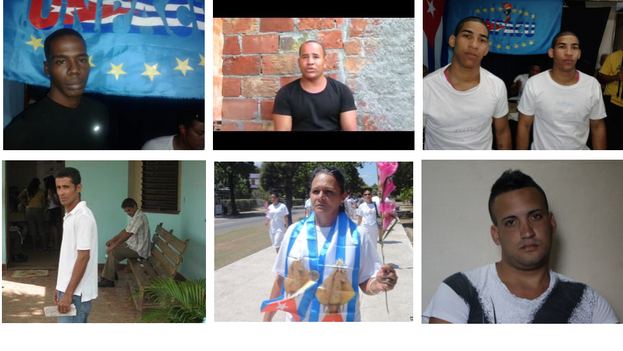
Some of the political prisoners released (Enrique Figuerola, Yordenys Mendoza Coba, Bianko y Diango Vargas Martín, Alexander Otero Rodríguez, Haydeé Gallardo Salázar, Miguel Alberto Ulloa)
  • The Island’s dissidence has insisted it has record of only 39 releases

14YMEDIO, Havana, 12 January 2015 — Cuba has released the 53 prisoners that it had promised to free in talks with the US according to an announcement Monday by the US ambassador to the UN, Samantha Power. According to these reports, the liberations of those prisoners who had been missing was completed this weekend, and the White House will send to Congress the complete list to then make it public.

Dissident groups such as the Cuban Commission for Human Rights and National Reconciliation (CCDHRN) and the Patriotic Union of Cuba (UNPACU) have insisted that they have until now only confirmed 39 releases since last Wednesday. “We will see what happens in the coming days,” Elizardo Sanchez, spokesman for the CCDHRN, has said.

Power has admitted that there were differences in Congress about the way to act, but has assured that there is a common will to advance the rights of the Cuban people. continue reading

The Havana agreement was reached in July, according to Reuters, which also says that it is a question of “days and weeks” for Obama to begin exercising his executive powers to reduce the restrictions on trade and travel. The first changes could be announced, say officials, January 21st or 22nd when Roberta Jacobson, Latin American Deputy Secretary for the State Department, will arrive in Havana to begin the negotiations between Cuba and the United States.

Power has stressed that there are changes underway in Cuba, as also confirmed by the re-opening of the Embassy and the “democratic program” that the US will promote in its talks. Also, she explains that the future of the Guantanamo naval base has not been a topic on the table.

Translated by: MLK

Drug Consumption Increases in Cuba / 14ymedio, ORLANDO PALMA

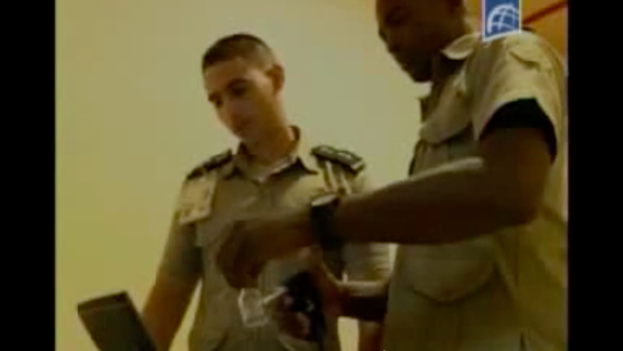
Screen capture from the TV report issued by Primetime News about customs work against drug trafficking

14ymedio, Orlando Palma, Havana, 8 January 2015 – The seizure in 2014 of close to 40 tons of drugs in Cuban ports and airports belies the old official line that for decades presented narco-trafficking as a foreign phenomenon, a characteristic of the “corrupt capitalist world.” The official press boasted that the Island was not used as bridge for the introduction of narcotics into other countries.

Nevertheless, as early as the nineties, some academic studies and journalistic reports began to speak in more realistic terms about national addiction and consumption of prohibited substances. continue reading

Last October Cuban television’s Primetime News published a report from Jose Marti International Airport in which the techniques used by customs to detect the entry of drugs were demonstrated and in which it reported the discovery of at least 40 cases of intent to traffic drugs through the border through mid-October.

The report came out days after the independent press echoed a study published by Customs of the Republic that showed the case of a passenger who transferred to the Island “a certain quantity of drug in an ingested form which was destined for the domestic consumption market.” That brief phrase focused attention on the existence of two problems within Cuba: domestic consumption and the use of “mules” for transport of the substances.

The Customs report, prepared by Moraima Rodriguez Nuviola, chief of the Department of Analysis for that agency, adds other figures. Between January and November 2014, the system for confronting drugs on the border discovered through air, sea and postal channels 38,843 kilograms of drugs, among them 36,587 of cocaine, 2,224 of marijuana and 32 of cannabinoids.
Customs now has 110 dog units trained to find not only explosives but also drugs.

Modern X-ray equipment for the Mariel port, together with other technical means of control have been installed or will be installed soon in all of the country’s international airports. Among them the internal body scan, which is used to find out if a person has ingested drugs and the external body scan to see if there is contraband attached to the body.

Official recognition of the existence of a domestic market for the consumption of drugs has been reflected on official television through signals such as the appearance of a message announcing a telephone help line for addicts and the introduction into scripts of cases brought against networks that distribute crack cocaine or any other substance. Counseling programs have begun to include advice for family members who live with addicts.

Increased tourism and the new economic capacity of some population sectors would be the main causes for the presumed increase in consumption of drugs. Meanwhile, the new official discourse suggests that, to the extent that the country now is looking like the rest of the world, these phenomena are inevitable.

After the announcement of the re-establishment of diplomatic relations between Washington and Havana, the fight to stop drug trafficking could become another area of cooperation between the two countries, since the Island, in contrast with the majority of its neighbors, is not an important point in the circulation of narcotics.

“I do not believe that the Cuban government wants to be a drug trafficking center,” Barry McCaffrey, a White House anti-drug official during the Clinton administration, has said in statements to The Washington Post. McCaffrey has said that there has already been “all kinds of communication between the US and the Island” in this area, although it was not “perfect cooperation.”

Translated by MLK

Twelve Dead in a Shooting at the Headquarters of the French Satirical Weekly ‘Charlie Hebdo’ / 14ymedio

Caption:  Cover of the special edition published in 2006 by ‘Charlie Hebdo,’ the first incident with radical religious Muslims.  In the vignette, Mohammed says, “How hard it is to be loved by imbeciles!”
Cover of the special edition published in 2006 by ‘Charlie Hebdo,’ the first incident with radical religious Muslims. In the vignette, Mohammed says, “How hard it is to be loved by imbeciles!”

14YMEDIO, Madrid, 7 January 2015 — The three presumed perpetrators of the attack against the satirical weekly Charlie Hebdo that claimed the lives of twelve people this Wednesday have already been identified, according to several French media outlets. The attack left at least 10 wounded and 12 dead, eight of whom were journalists. Among them are the editor of the publication, Stephane Charbonnier Charb, and another three long-time cartoonists, Cabu, Tignous and Wolinski, besides two police officers. The chief editor of the weekly, Gerard Biard, was in London, which saved him from the attack.

The daily Metronews website explains that the suspects are three men aged 34, 32 and 18 with histories of cooperating with jihadist networks. According to this outlet, they would be brothers Said K. and Cherif K. of French nationality, while the younger would answer to the name of Hamyd M., but his nationality is unknown. The latter was enrolled last year in secondary school in Reims (northern France), according to these reports, which have not been officially confirmed. continue reading

Cherif K. was tried in 2005 for being part of a cell sending jihadists to Iraq that would have recruited some dozen youths to go to combat in Iraq between 2003 and 2005. He was then sentenced to three years in prison, half of that suspended.

For its part, the weekly Le Point says that the three suspects were identified by an identity card found in the vehicle in which they fled the location of the events and in which they collided with another car in the northeast of Paris.

The French government has raised to maximum level the antiterrorist alert and has mobilized more than 3,000 members of the security forces in the operation to search for and capture the perpetrators of the attack.

Thousands of people have gathered in the emblematic Parisian Plaza of the Republic, in absolute silence, to protest against the terrorist massacre. The protestors have responded to spontaneous calls made through social networks, and many of them carried signs with the legend: “Je suis Charlie” (“I am Charlie”).

Several witnesses have told French television station iTele that three men dressed in black and wearing hoods entered the headquarters of the weekly armed with Kalashnikovs and shot at the people present in the editorial office. One of the Charlie Hebdo journalists has explained to the chain that many shots were heard inside the building.

French President Francois Hollande went quickly to the magazine’s headquarters, located in Paris’s District 11, where he has confirmed the number of victims and has announced that four of the wounded are in serious condition. “France is in shock,” said the president who has classified the attack as “extraordinary barbarity.” “We must demonstrate that we are a united country. I am going to act with firmness in the coming days and weeks,” said Hollande who has declared the highest antiterrorist alert level. Classes have been suspended.

British Prime Minister David Cameron has shown solidarity in statements from London. “We are with the French people in the fight against terror and in defense of freedom of expression,” he declared. His vice minister, Nick Clegg, also has condemned the attack and stressed that it is an act against press freedom.

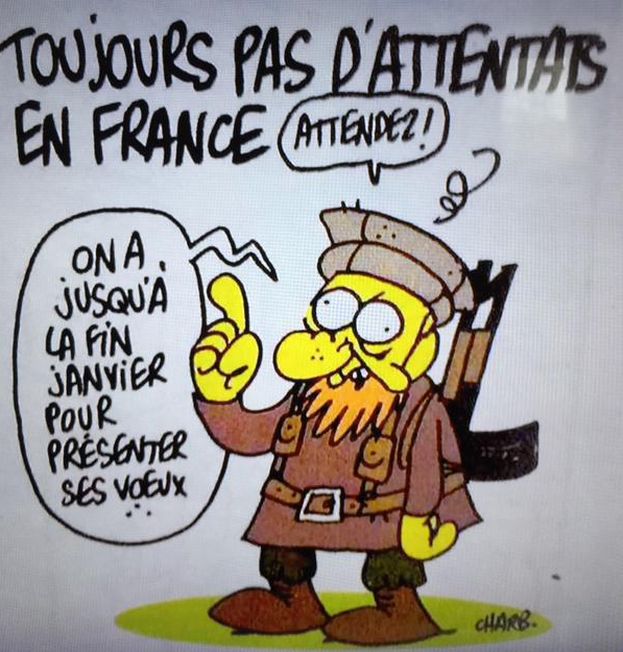
Caption:  One of the last cartoons by Charb, editor of Charlie Hebdo:  “Still no attacks in France.  Wait a minute!  We have until the end of January to celebrate the new year!”
One of the last cartoons by Charb, editor of Charlie Hebdo: “Still no attacks in France. Wait a minute! We have until the end of January to celebrate the new year!”

Solidarity with France has come from other points. Both the Russian President Vladimir Putin and the White House, as well as the German Chancellor Angela Merkel and the Spanish Prime Minister Mariano Rajoy, have expressed their condolences to Francois Hollande. “It is an intolerable act, a barbarity that concerns us all as human beings and as Europeans,” the European Commission has said through a statement by its president Jean-Claude Juncker. US President Barack Obama has offered assistance to France to bring the guilty “terrorists” to justice.

Charlie Hebdo has received threats for having published caricatures of Mohammed. The journalist Vincent Justin, who worked in an office next to the weekly’s headquarter, has assured the EFE agency that the parties responsible for the shooting justified the action with the sentence: “We are going to avenge the prophet.”

Cartoon:  “Bad times for humor.”  Caption:  A cartoon by the Spanish satirical magazine ‘El Jueves’ after learning of the shooting at the ‘Charlie Hebdo’ headquarters.
Cartoon: “Bad times for humor.” A cartoon by the Spanish satirical magazine ‘El Jueves’ after learning of the shooting at the ‘Charlie Hebdo’ headquarters.

French Muslim leaders already have demonstrated their rejection of the attack. The rector of the Paris mosque, Dalil Boubakeur, has classified the attack as a “declaration of war” and has bluntly condemned the shooting. The imam of Paris said that “the cartoons have to be responded to as cartoons,” while the imam of Drancy (in Seine-Saint-Denis, on the outskirts of Paris) has characterized the Charlie Hebdo journalists as “martyrs of liberty:” “Their prophet is not Mohammed, it is Satan,” he added.

In 2011 the headquarters of the magazine suffered an attack with a Molotov cocktail that caused a fire and widespread damage. That attack was carried out a day after the publication of an edition entitled Sharia Hebdo, dedicated to the Islamist advance in Tunisia and Libya, which portrayed Mohammed as the chief editor of the caricature edition.

Translated by MLK

Here Comes the Packet, Knock, Knock / 14ymedio, Orlando Palma

  • Pinar-Rio-JUAN-CARLOS-FERNANDEZ_CYMIMA20150105_0015_16Research shows that among the main forms of cultural consumption in Cuba are television, visiting with friends and listening to music

14ymedio, ORLANDO PALMA, Havana, 5 January 2015 — A Cuban television special this Sunday entitled “They Call Me Cuba” addressed issues of “cultural consumption in the 21st century,” with special emphasis on the well-known weekly packet of audio-visual material that is distributed illegally throughout the country. Some specialists answered questions ranging from musical tastes to the need to impose cultural policy on the private and tourist sectors.

The results of an investigation carried out by the Juan Marinello Center have revealed that among the main forms of cultural consumption in Cuba are “television, spending time with friends and listening to music.” Pedro Emilio Moras, a researcher for that entity, said that, “The main way for the Cuban population to participate in culture is as the public, as the beneficiary of offerings, actions organized by cultural institutions.” Although he also asserted that, “We recognize that the houses where we live (…) are ideal scenarios for the cultural development of people, even our reality is the space par excellence.” continue reading

Just inside the homes, out of the control of the cultural supervisors and far from the censorship scissors, the packet has life. The numbers of audience members lost by official television is never made public, but, in view of the worry that its officials demonstrate, the phenomenon of the packet-ization of Cuban society must be reaching significant levels.

They Call Me Cuba emphasized that the country “is enjoying a moment of transformation not only economically but also socially. The establishments that belong to the non-state sector have taken their own initiative when it comes to animating their environment.” According to the report, there then arises “the question of how these entities are welcomed or not into the country’s cultural policy.”

It has not only to do with the time – ever greater – that people invest in consuming material of their choosing to the detriment of what’s shown on state television, but the social impact that the private spaces have on the formation of taste and musical and audio-visual distribution. In order to decrease that influence theater critic and researcher Jaime Gomez Triana urged that “the Government’s cultural policy be not only a policy for the Ministry of Culture’s institutions but that it be a cultural policy that regulates the way in which these offering are produced in other spaces.”

In interviews conducted on the street, several people referred to their experiences as consumers of the packet. The favorable opinions mentioned that an advantage of this kind of cultural consumption is that it gives better information about what is happening “in the international arena.” Reported among the factors leading to the increased alternative distribution of audio-visual content was the deterioration of the movie houses that domestically offer a poor substitute for public spaces.

The view that this compendium of audio-visual content is only “soap operas and reality shows” was challenged by several survey respondents who mentioned the didactic and instructive character of some materials like documentaries made by The Discovery Channel, as well as courses in make-up, gastronomy and handicrafts that are also included in the so-called combo.

Fernando Rojas, Vice Minister of Culture, in an interview, criticized those who concoct and distribute the packet as being “people who act strictly on their own and have a network that distributes that material that is updated periodically and that is made at the margins of the institutions and regulations for self-employed work.” In the judgment of Rojas, “the packet is made to feed the illusion that people are choosing (…) in reality, in a certain sense, and I stress in a certain sense, that idea about choosing is an illusion.”

In spite of the dread that the cultural institutions demonstrate before the advance of these forms of self-directed consumption, Rojas thinks that “people who talk so much about the topic of the packet, the famous packet, the aforementioned packet, give it greater importance than I believe it really has.” For the Vice Minister, “to the extent to which we move forward to a greater penetration of the Internet, and we are going to move forward, we are certainly going to move forward ever more, people are going to choose directly on the web and not have to depend on an intermediary. The packet is going to have a limited life in my judgment.”

Fabio Fernandez, content and programming director for the Cuban Institute of Radio and Television (ICRT), explained that among the great attractions of the packet is that “people can watch and listen to what they deem appropriate at the moment when they deem it appropriate.” The fact that “there is no direct relationship between the broadcast schedule times and the time a person decides to watch something” makes many choose this option that does not tie them to the screen on a determined broadcast schedule. To recover the viewers that national television has lost, the official bets on “offering ever more high quality products.”

Nevertheless, the formula for improving the official programming bill faces the difficulty of few resources for legally acquiring foreign content or advancing national production. Cuban television has underperformed in terms of quality, dynamism and thematic updates. An industry that was a pioneer in Latin America and the world has been suffering the fact that series and soap operas produced in Mexico, Colombia and Brazil captivate the public. The problem is rooted in issues that range from undercutting wages of actors and technical personnel to censorship that for decades caused bland, complacent scripts closer to sketches for a school morning assembly than to material to captivate and entertain.

Roberto Smith, president of the Cuban Institute of Cinematographic Art and Industry (ICAIC) said that it should be “based on the legitimacy of personal taste (…) some like one thing and others like another and that is their personal right, to prefer something and reject the other.” But later he remarked “that taste is educated, and that education is a process that must begin from earliest infancy. Right now we are developing (…) the possibility of offering different alternatives of audio-visual education from infancy for youth and for adults.”

Faced with the evidence that the demonization of the packet has only increased its attraction, Rojas confessed that “the path before any phenomenon (…) that is not desirable, in the sense that it is not a carrier of solid human values, of convictions and humanist, supportive, socialist feelings; the reaction before something that does not seem to us to fit in that formative educational effort, the reaction cannot be to prohibit it. The reaction has to be to compete.”

But the packet has come first to that competition with the advantage of being customizable, free from censorship, adjustable to all tastes and considered by the majority of Cubans as something outside of state control.

Translated by MLK

An Independent Legal Group Files a Habeas Corpus Petition on behalf of El Sexto / 14ymedio

The artist Danilo Maldonado, El Sexto (Luz Escobar)

14YMEDIO, Havana, 29 December 2014 — On Monday, the independent group CubaLex filed a petition for habeas corpus in the case of artist Danilo Maldonado, El Sexto. In a document addressed to the Provincial Tribunal of Hanvana, the lawyers urge that the arrestee’s rights be respected and also that he be permitted a proper defense. Police have informed the relatives of the prisoner that all trials scheduled for the upcoming days, including that of the artist initially scheduled for next Wednesday, the last day of 2014, are delayed until the new year.

El Sexto was arrested December 25 shortly before carrying out a performance which consisted of releasing two pigs with the names of “Fidel and Raul” in a public square. He is charged with contempt. continue reading

Although the artist had told several friends of his desire to keep the exact date of the performance discreet, the police managed to find out and stopped the car in which he was traveling to the site. At first he was taken to the 4th Precinct Police Station at Infanta and Manglar, and then they transferred him to Zapata and C Station in Vedado, where he remains now.

Lawyer Laritza Diversent in conversation with 14ymedio has emphasized that she believes that “in this case they chose the date of December 31 with a malevolent intention because it is difficult to find a lawyer who wants to participate in a trial.” Nevertheless, Cubalex is advising El Sexto’s relatives to hire a lawyer from a collective firm as soon as possible. If they do not manage it in the next few hours, El Sexto would run the risk of being tried without the presence of his defender.

Habeas corpus is a legal institution that seeks to “prevent arbitrary arrests and detentions.” Its fundamental principal is the obligation to bring all arrestees before a judge within a short time period. In the case of El Sexto, today, Monday, marks four days since his arrest and incarceration.

Translated by MLK