The 73-year-old prelate of Guantánamo-Baracoa was remembered as a humble pastor who was close to the most vulnerable Cubans.
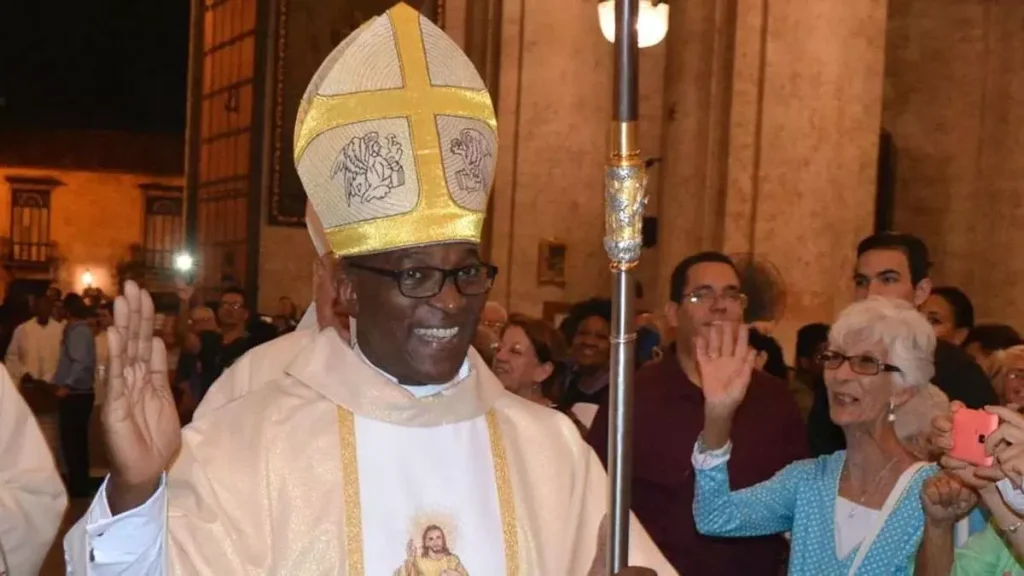
 14ymedio, Havana, 13 June 2026 / Monsignor Silvano Herminio Pedroso Montalvo, Bishop of Guantánamo-Baracoa and first Black prelate of the Cuban Catholic Church, died in the early hours of this Saturday in Havana, at the age of 73, after several weeks in a critical condition due to an oncological illness.
The Cuban Catholic Bishops’ Conference confirmed the death of the cleric and announced that his funeral would take place this same Saturday at the parish of Santa Catalina de Siena, located on the corner of 25th Street and Paseo, in the Havana neighbourhood of El Vedado. After the ceremony, the funeral cortège will make its way to the Colón Cemetery, where his remains will be interred.
Pedroso had returned to Cuba on 3 June, having come from Rome, where he spent several months undergoing various medical tests. During his stay in the Italian capital he received treatment at the Agostino Gemelli hospital and at the infirmary of the Society of Jesus.
The Cuban Church had initially announced, in February, that the bishop was suffering from severe gastritis, but subsequent examinations revealed the existence of an oncological illness. Last Thursday, two days before his death, the Episcopate communicated that his state of health was “very critical” and asked for prayers for his recovery.
Born in Cárdenas, Matanzas, on 25 April 1953, Pedroso came to the priesthood after an unusual path among members of the Cuban clergy. He studied Geography at the University of Havana and worked from 1979 to 1982 at the Institute of Physical Planning in Las Tunas.
Pope Francis appointed him Bishop of Guantánamo-Baracoa on 29 March 2018
He did not enter the San Carlos and San Ambrosio Major Seminary until 1987, when he was 34 years old. He was ordained a priest on 12 June 1995 by Cardinal Jaime Ortega Alamino at Havana Cathedral. From that point on he carried out his pastoral work in various communities in Havana and Mayabeque. He served as parish priest in Quivicán, Bejucal, Melena del Sur, and Güines, as well as being responsible for vocational ministry and director of the San Juan María Vianney Priests’ House. From 2013 he had been in charge of the parish of Nuestra Señora del Pilar, in the Havana municipality of Cerro.
His parishioners describe him as a priest of direct contact, accustomed to walking through neighbourhoods and entering the homes of families. Following his episcopal appointment, he was described as a “street priest” – an expression that summed up his way of understanding ministry and his preference for a Church close to ordinary people.
Pope Francis appointed him Bishop of Guantánamo-Baracoa on 29 March 2018. His episcopal ordination took place on 27 May of that year at Havana Cathedral, and he took possession of the diocese on 9 June, during a ceremony held at the Cathedral of Santa Catalina de Ricci in Guantánamo.
His mission unfolded in one of the poorest and most isolated provinces of Cuba, with scattered rural settlements, transport difficulties, and a shortage of priests
He thus became the third holder of a diocese created in 1998 by John Paul II and the first Black bishop in the history of the Catholic Church in Cuba, a country where the ecclesiastical hierarchy has traditionally had a racial makeup that has reflected little of the composition of society.
On receiving the appointment, Pedroso stated that he wished to be close to the most needy communities, and chose as his episcopal motto a phrase from the Gospel of Saint John: “Love one another as I have loved you.” His mission unfolded in one of the poorest and most isolated provinces of Cuba, with scattered rural settlements, transport difficulties, a shortage of priests, and communities that suffer in an especially severe way from the deterioration of public services, the lack of food, and the energy crisis.
During his eight years at the head of the diocese, he maintained a discreet profile, removed from public confrontations with the authorities, but focused on pastoral and social care. His figure gained prominence through his support of vulnerable families and his visits to remote communities in the Guantánamo territory.
The United States Embassy in Havana expressed its condolences this Saturday to the Catholic Church and to those mourning his death. In its message, the diplomatic mission stated that Pedroso had dedicated his life “to the service of God and of ordinary Cubans.”
With his death, the diocese of Guantánamo-Baracoa, situated at the eastern tip of the country, falls vacant
“A humble and approachable pastor, he distinguished himself by accompanying those who suffered most and by walking alongside his communities in times of difficulty,” said the Embassy, which also highlighted his “deep love for Cuba” and his dedication to ensuring that citizens could live “with dignity and hope.”
Pedroso’s final journey to Rome was connected to the ad limina visit of the Cuban bishops, although the collective meeting had to be postponed due to the severe fuel shortage affecting the Island. The prelate nonetheless managed to meet with Pope Leo XIV on 20 February. The Holy See did not reveal the details of that conversation. By then, his health had begun to deteriorate and he had to remain in Italy to receive medical care.
With his death, the diocese of Guantánamo-Baracoa, situated at the eastern tip of the country, falls vacant. The Church will need to provisionally appoint a diocesan administrator until the Pope designates his successor.
“I have fought the good fight, I have finished the race, I have kept the faith,” wrote the US Embassy in its farewell to the bishop, quoting the Second Letter of Saint Paul to Timothy.
Translated by GH.
______________________
COLLABORATE WITH OUR WORK: The 14ymedio team is committed to practicing serious journalism that reflects Cuba’s reality in all its depth. Thank you for joining us on this long journey. We invite you to continue supporting us by becoming a member of 14ymedio now. Together we can continue transforming journalism in Cuba.