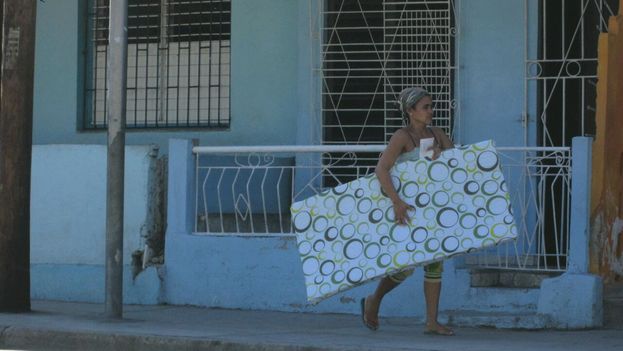

Will the mattress arrive before the baby turns a year old? / 14ymedio, Yosmany Mayeta

Woman with a mattress (Yosmany Mayeta)

14ymedio bigger14ymedio, Yosmany Mayeta Labrada, Santiago de Cuba, 28 March 2015 — The Gonzalez family baby slept her first weeks in a plastic tub lined with sheets and blankets. She could not use the crib because her parents did not manage to buy the mattress that is assigned by the Santiago de Cuba ration market to expectant mothers.

Shortages of the product and delays in its arrival to those in need create discomfort and situations like that of this baby in homes all over the country but with greater severity in the eastern region.

Outside of some stores intended for that purpose there are long lines of pregnant women and their families to buy the so-called “module basket” that is given at a subsidized price to each mother. The prices in the free market are unaffordable for a good many families. They need at least 50 convertible pesos (CUC) in order to get a mattress in the hard currency market, while the average monthly salary does not exceed 20 CUC. continue reading

Many of these mothers will celebrate the first birthdays of their children without the children having been able to enjoy a crib with a mattress. Such is the case of one young woman who preferred to remain anonymous and who was waiting this Wednesday in the line of the El Atardecer industrial products store. Her daughter is about to turn a year old, but she still has to sleep in a crib with an old mat repaired many times and that was loaned to her by a relative.

Yamile Fonseca, resident of the Nuevo Van Van area, had a little more luck and says that “almost when the ration book was expiring I could buy the mattress, but that was a pure pain and a line that no one could stand.” Others simply give up and resort to the illicit market or inherit part of the “basket” items from a sister or a cousin.

Beatriz Mena, clerk at an Industrial store, says that “they have only brought the product twice” to the store where she works. In those cases “they have sold to those mothers whose basket ration book is expiring and whose babies are turning a year old,” the others have had to wait until they are resupplied, she said.

When the product arrives at one of the commercial units devoted to that purpose, then the drama becomes the line. Jose Bonne, father of a 10-month old girl, staked out the front of the Industrial this Tuesday from four in the morning in order to be able to be one of the first. “When I arrived there were already more than ten people who, since earlier hours, were marking their place in line in order not to be left without the mattress.”

The manager of the store in the Altamira suburb said that “it has come to the unit on several occasions but the ones who have not bought are still more than those who have left with the product.” The lady says that “the mattresses that they leave are very few, and we have a great number of pregnant and newly post-partum women and the demand outstrips the quantities supplied.

Another person, who preferred not to give his name, says that “when the mattresses arrive at the industrial products stores, now the clerks in cahoots with the management get most of them, which are sold to those whose turn has not come up, but who pay extra money and so acquire them ahead of time.”

For her part, Yelaine Suarez said that when the mattresses arrive in the commission stores there are people who dedicate themselves to the sale of places in line for the amount of ten convertible pesos. “It is unfair to see how they take advantage of the opportunity in order to do things like that.

Cuban women point to economic problems and difficulties in materially supporting a baby as among the main causes for the low birth rate that the country is now experiencing; the Total Fertility Rate fell in 2012 to the worrying figure of 1.69 children per woman.

David Fernandez, resident of Alturas de Versalles, says that in the Altamira store they got crib mattresses at 300 pesos national currency, sold off the ration book. The resident of the place asks how it is possible that there are stocks for that but not for those women who have the “basket” ration book.

The complaints come and go and many babies keep waiting to sleep in a crib with a mattress. Meanwhile, their parents improvise a little bed and take turns standing in line in front of the store.

Translated by MLK

They Donate Blood for Bread with Ham / Cubanet, Pablo Gonzalez

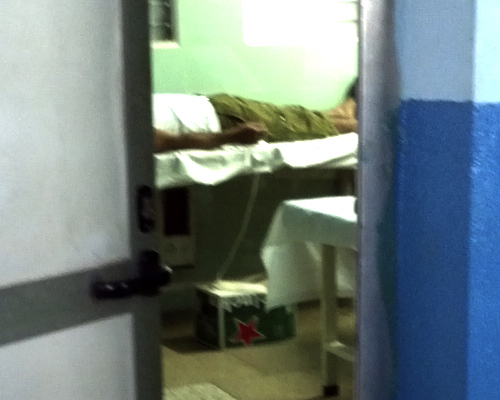
cubanet square logoCubanet, Pablo Gonzalez, Havana, 20 March 2015 – Each state enterprise has to deliver a quantity of blood donations each month in order to comply with the rule established by the Ministry of Public Health (MINSAP). Each clinic has to make one hundred donations per month.

Donor in Cuba, where the sanitary conditions leave much to be desired (photo PG)

The pressure that MINSAP and the Committees in Defense of the Revolution (CDRs) put on the clinics makes their workers go out into the streets desperately searching for donors.

Without doing any prior testing they carry out the blood extractions with poor medical instrumentation.

Voluntary blood donation in Cuba, begun in 1962, has grown to reach and exceed the target set by the World Health Organization for one donation for each 20 inhabitants. According to the Granma newspaper, blood donations exceeded what was planned in the last two years.

Donor Yasmany Machado, 27 years of age from Sancti Spiritus in the Fomento Province, commented on this report in Granma on the web page of the daily itself:

“Since 2005 I have been a blood donor more than 20 times for the benefit of others. Now I ask myself the following question: Are donors encouraged by MINSAP and the CDRs? Is it perhaps resolved with a role for the district? Why does MINSAP not worry about the health of the donors?” continue reading

And Yasmany’s commentary continues: “Why is modest help with food not offered to those who donate blood? Saying that the blood bank is poorly supplied (she refers to the bread with ham and cheese and the soda that they give to the donors). It is insufficient most of the time what is given to the donor … When the CDR wants your help and you are due, they visit you so that you go to donate. But no one is able, not the director of health nor the coordinator responsible for the CDRs, to see how you are. Well, to donate and comply yes, but to see what the bank gives to the donor, no… Why don’t they give two pieces of bread in the blood donor’s snack? Because all the protein, most of it, you donate it at that moment… I don’t understand, I will not understand… Signed: A blood donor, totally disappointed with the country’s policy. I am not satisfied…”

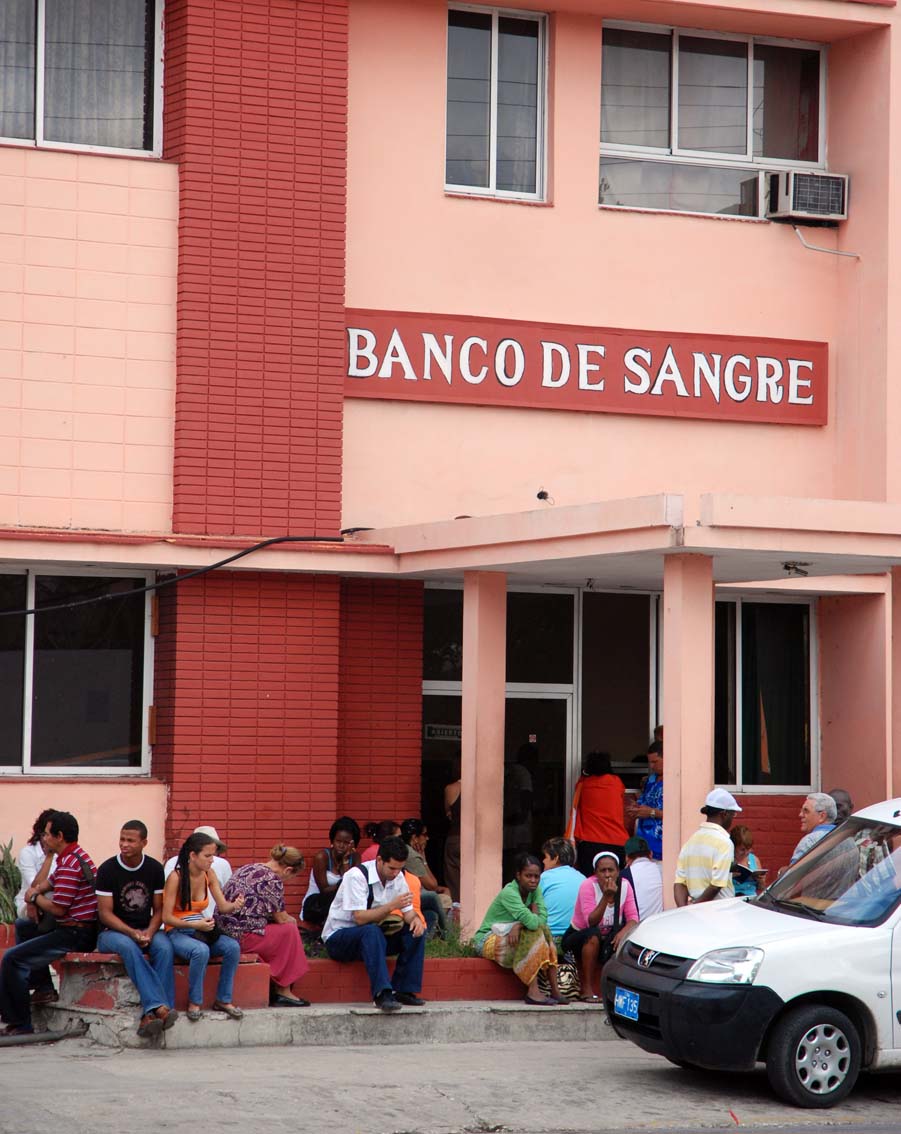
Blood bank in Havana

Most donors, like almost all Cubans, are people who have nothing in their homes for breakfast or they eat a poor breakfast. Sadly, they donate their blood simply in order to eat the bread with ham and cheese, and the soda that they give after each donation.

This phenomenon is understandable. In stores this same bread costs a dollar sixty-five and the can of soda 50 cents. The average Cuban salary being around 20 dollars a month, there are few who can give themselves the luxury of buying bread with ham and cheese for breakfast.

Doctor Luis Enrique Perez Ulloa, chief of the National Blood Program for MINSAP, said that the Cuban blood program is multi-faceted and that in Cuba 340,000 people routinely donate blood.

But a nurse from the “Leonor Perez” clinic-hospital in Boyeros, who preferred anonymity, says:

“We have to do wonders to meet the established standard. We go out to the streets looking for donors. Any person will do to count one more. We tell the workers at the clinics that they have to donate. If they do it we give them the day off as a reward. Always looking for ways to turn them into donors or at least get them to donate once. Many are vagrants, hopeless ones from the streets who easily give their blood without much prodding because of the snack that we give them afterwards, when there is a snack, because often it is lacking.”

There are others who come because they paid them – concludes the nurse – or because they bribed them at some work center.

Soda's and bread and ham for the donors
Soda’s and bread and ham for the donors

Not only do the clinics have to meet a monthly standard for donations. Each state enterprise also must deliver a quantity of donations per month to the local clinic. In order to comply with the standard set, the administrators search for people outside of the workplace. They bribe them with goods gotten from the workplace itself: food, money and even drink. These bought donors present themselves at the clinic posing as employees of the state entity that bribed them.

Enrique Gonzalez, a donor at the same hospital clinic, commented: “I have been a donor for many years, and I am here because my work center sent me. The doctors have told me that I have to continue doing it because if I don’t, my hemoglobin will go up. They give me the day off every time I do it, at work they give me two pounds of chicken per donation, and also I eat the snack that they give after the donation.”

A doctor of the hospital clinic who asked that his name not be revealed said:

“We do not worry much about who the donors are, where they come from or the reasons for which they donate; what is important is that the most people donate to be able to meet the established standard. It is not always met, but we do everything possible.”

There is a black market in blood. For a curettage or any kind of operation, they do not use the blood from the bank; on the contrary, they demand that the patient’s family bring a donation of blood. Donations cost about 20 dollars. And donors always appear for that money.

Voluntary and good faith donations are well-received, but in Cuba most people donate blood for money, for a piece of bread with ham for breakfast.

Translated by MLK

Heavy Police Operation against Merchants and Carriers / 14ymedio, Yosmany Mayeta Labrada

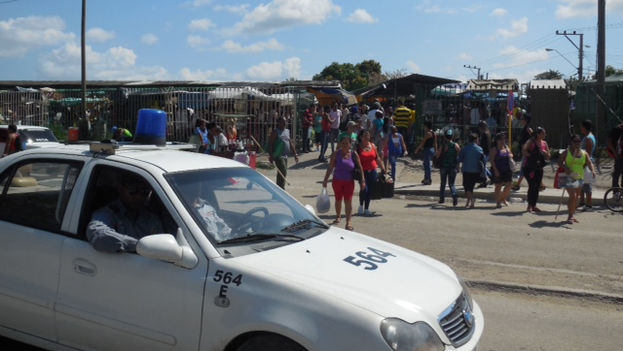
14ymedio bigger14ymedio, Yosmany Mayeta Labrada, Santiago de Cuba, 21 March 2015 — Since early this Saturday, a heavy police operation had as its objective self-employed workers, street vendors and private carriers in Santiago de Cuba. The forces of the National Revolutionary Police (PNR) reported that the raid was aimed against high meat prices in the farmer’s markets and the sale of potatoes in illegal distribution networks.

Most of the arrests and fines occurred in the Venceremos and Altamira suburbs of Santiago de Cuba. The uniformed agents arrived in the first hours of the morning and demanded the vendors show their licenses for engaging in commercial activity. Until midday, the toll of the operation was the seizure of dozens of kilograms of pork meat and thousands of pesos in fines.

Romilio Jardines, vendor of meat and agricultural products, was fined 700 Cuban pesos, although he said that his merchandise was not removed. Nevertheless, he affirmed that “they came prepared in case one refused.” The operation included special forces known as “black berets” who surrounded the area’s markets and the main streets of both suburbs. continue reading

Alexander Benitez was among merchants who suffered the seizure of his products. “The found me selling pork meat at 27 pesos a pound in the doorway of my house and they came and demanded the license,” recounts this Santiago native. “When they saw that I had no license they confiscated the meat, the scales and also fined me 1,500 pesos.” Benitez says that he approached the police to get the scales back “because they were borrowed” but “they handcuffed me and put me in the police car.”

One of the covert sellers, who preferred to remain anonymous, confirmed that it was true that “many self-employed workers have very expensive meat and a pound of potatoes for seven pesos, but the government in the state markets has none at any price.” The residents of the province complain that the tuber has still not been distributed to the people through the network of state markets, although in other cities its sale has already begun.

Not only sellers of meat and agricultural products were the objective of the police operation, but also drivers of cars and motorcycles were investigated. Among them the driver of a private transportation truck who was fined 2,500 pesos and had his license plate taken away. One motorcyclist for a state enterprise also was sanctioned 30 pesos for not having changed the license plate to the new system that has been implemented in the country.

By the beginning of the afternoon, many merchants and carriers in the Venceremos and Altamira suburbs were fined, but once the police began to withdraw their forces, the areas around the farmer’s markets started slowly to fill again with vendors and drivers.

 Translated by MLK

Wheeling and Dealing with Plastic / 14ymedio, Lilianne Ruiz

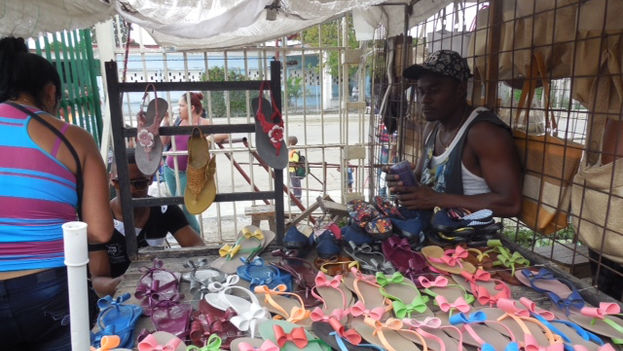
Plastic footwear stall at the market of La Cuevita (14ymedio)

Markets all over the Island are supplied with objects made on the illegal circuit of a material mostly derived from industrial waste or leftovers from the dump

14ymedio bigger14ymedio, Lilianne Ruiz, Havana, 20 March 2015 – At the market of La Cuevita in San Miguel del Padron, some thousand people from all over the Island daily buy household goods, flip-flops and toys, all made of plastic. The purchasers come especially from rural areas where the economic situation is more precarious and the only thing that abounds is scarcity.

In order to sell in the market it is necessary to have a state license and a letter signed by the producers, also authorized, from whom the articles must be bought. The inspectors who pass through the sales stalls may require this letter, but in practice they pass with hand extended seeking money in exchange for not imposing a fine of 1,500 pesos on whomever continue reading

has skipped the State’s rules of the game.

There are many manufacturers who have no license. In the Cotorro township flip-flops are manufactured and in La Guinera, a settlement located in San Miguel del Padron, there are producers of household goods. The toys, with twisted forms and faded colors, are brought from the eastern part of the country.

The first step is gathering the recyclable plastic among the wastes of industrial smelting and rummaging through the garbage in search of plastic items that can be exploited, without discarding the possibility of melting the trash cans themselves. In order to improve the quality of the final product, the manufacturers add virgin plastic. This granulated raw material is bought under the table, gotten directly from state warehouses.

The mishmash is heated. When the material is quite melted it is injected under pressure into various molds. The injecting machines as well as the molds are produced by hand. When it liquefies, the homogenized paste takes on an earthy color, but artisans save the day using different colored dyes.

According to one of these artisans, who allows no photos on his patio, in many neighborhoods of the capital the police would have to search patio by patio and house by house because “reality is stubborn,” as he learned many years ago in a Communist Party school. “Even beer can be canned clandestinely,” he says. “Such machines are all over Havana. Where you least imagine it, there is one. The problem is to make the product and get it immediately out so that the chain is not discovered.”

The bowls and plates, funnels or any other object resulting from this mix of materials are not completely safe for storage of food intended for human consumption. “I don’t use any of the bowls that I buy in the candonga for keeping food from one day to the other. But they are cheaper than those made in China which are sold in the hard currency stores and cost a third of a worker’s salary,” says Morena, a housewife who frequents the market.

The vendors place themselves at the entrance to the market. Some offer strings of onion and garlic, others little nylon bags. An old lady sells a bag of potatoes that she has just bought after a long line, and a teen carries a box of ice where he keeps popsicles that sell for 15 Cuban pesos. They often have to go running. A patrol passes every twenty minutes.

The police pass by often while overseeing legal sales in the market (14ymedio)

“If you resist arrest, they beat you. Then they take you to the 11th Police Station, and railroad you and you don’t know if you’ll come out with a fine of 1,500 Cuban pesos or go directly to the Valle Grande prison,” says the popsicle salesman.

A man in his forties recounts how the police detained him once, accusing him of retailing without any proof, and they asked him for his identity card just because he was carrying a briefcase full of plastic plates that he had just bought. “It would be of no use to say it is my hobby to throw them in the air to practice my slingshot aim. Just like if they want to they seize everything and give you a fine. The police do not act for the benefit of the people,” he laments.

Mireya, almost seventy years of age, is the last link in the productive chain of plastic products. While others work in little brigades for a particular producer, authorized or not, she does it alone. She has put together brooms and brushes manually, with production wastes from state industry, for more than 20 years. “If they catch me doing this I can have serious problems with the authorities. I don’t do it to get rich. I have to assemble 100 brushes to earn 400 Cuban pesos [about $16 U.S.], and from that I have to invest part in order to buy the materials,” she explains.

Mireya does not want to get a license because she thinks the taxes are too high. Besides, she could not justify the materials that she uses to fabricate her brooms because, in spite of dealing with industrial waste, there exists no legal way of acquiring them. The bases and the bristles she buys from someone who, like her, has no license either and sells them more cheaply.

“What I would have left after paying for the license and the taxes would be more or less the same as the wage of a state worker. With that, added to my pension of 270 pesos, I can’t even live ten days. If you don’t believe what I am saying, take the rice and beans from the store, divide it into 30 piles to see how you eat and how you live. Then necessarily you have to live wheeling and dealing,” she concludes without ceasing to close the plastic threads with wire pincers.

Translated by MLK

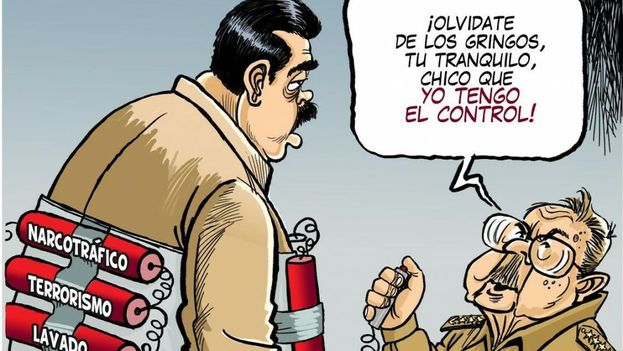
Fidel Castro Warns That Venezuela Has Latin America’s Best Equipped Army / 14ymedio

Cartoon bubble:  "Forget about the Gringos; don’t worry, boy, I have the control!" Cartoon by Manuel Guillen (La Prensa, Nicaragua)
Cartoon bubble: “Forget about the Gringos; don’t worry, boy, I have the control!” Cartoon by Manuel Guillen (La Prensa, Nicaragua)

14ymedio bigger

14ymedio, 17 March 2015 – Coinciding with this Tuesday’s meeting in Caracas of the Summit for the Bolivarian Alliance for America (ALBA) to analyze the latest confrontation between the United States and Venezuela, Fidel Castro has written a letter published by the newspaper Granma in which he praises the attitude of the “heroic people of Bolivar and Chavez” and reminds us that “Venezuela has the best equipped soldiers and officers of Latin America.

The Cuban ex-president stresses the “exemplary discipline and the spirit of the National Bolivarian Armed Forces,” and concludes that “whatever the imperialism of the United States does, it can never count on doing what it did during so many years,” referring to the military coups that occurred in Latin America in the 20th Century. “When you met with those officers in recent days, you could tell they are ready to give their last drop of blood for continue reading

the Homeland,” says Castro.

The historic leader of the Revolution remembers that Hugo Chavez was the one who took the initiative to found ALBA in order to “share with his Caribbean brothers” Venezuela’s natural resources that were, according to the ex-leader, going to American businesses and Venezuelan millionaires.

“Simon Bolivar dedicated himself fully to the colossal work of freeing the continent,” points out Castro going epic. “With less than 1% of the planet’s surface, [Venezuela] possesses the greatest oil reserves in the world. For a whole century it was obliged to produce all the fuel that the European and United States powers needed. Even though today the hydrocarbons formed over millions of years would be consumed in no more than a century, and we human beings who today number 7.2 billion, in ten more years that will double and in two hundred will exceed 21 billion, only the wonders of the most advanced technology may permit the survival of the human species a little longer. Why is the fabulous mass media not used to inform and educate about these realities that each person in his sound judgment must know, instead of promoting deception?”

Fidel Castro says goodbye to Maduro, as is customary, with a “brotherly hug” that he extends this time to all Venezuelans and the peoples of ALBA.

Translated by MLK

Union of Young Communists (UJC): Who Is For That? / 14ymedio, Victor Ariel Gonzalez

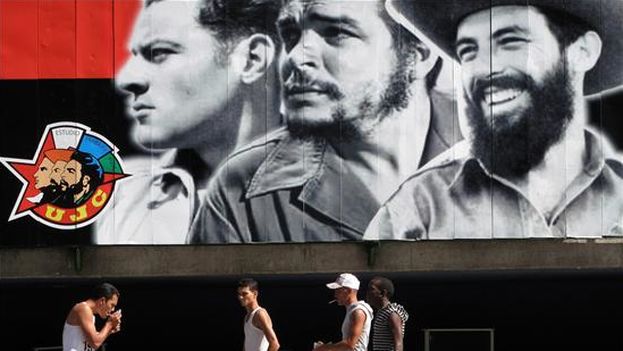
9th Congress of the UJC (EFE)

14ymedio bigger

14ymedio, Victor Ariel Gonzalez, Havana, 24 February 2015 — The only thing Damian shares with Karl Marx may be the thick beard. In everything else, the Havana engineering student is quite different from the German philosopher who wrote Das Kapital. And the main contrast between them is found in their ways of thinking because for this young man who enjoys sporting the lumberjack style – the “lumberjack” fashion is spreading through the capital – the last thing he wants to talk about is class struggle, historical demands or communism. “Who is for that?” he asks.

To judge by his tone, it seems few. Instead, youngsters like Damian and his girlfriend, or the friends with whom they usually meet in places like the Bertold Brecht café theater or the Cuban Art Factory, prefer to talk about European football leagues while drinking beer paid for in hard currency. Things like the 10th Congress of the Union of Young Communists (UJC) appear nowhere in their conversations, despite the official propaganda that has been unleashed in an intense campaign about the event. According to the press permitted in Cuba, this “will be a congress that looks like Cuban youth.”

Adhering strictly to that maxim, for starters, a good part of the delegates to the Congress must come from abroad, given the number of people who are leaving Cuba. Of the almost half million who have emigrated in the last ten years, a high percentage are young continue reading

people seeking opportunities that their country is incapable of offering them. Damian talks about that also, his desire to leave, and about something curious: the majority of his friends who have managed to do it used to belong to the UJC. “It’s a double standard,” he says. The most radical and exclusive leftist militants went on to live under “cruel” capitalism.

Nevertheless, the increasing emigration is a taboo subject in the current municipal assemblies preceding the big meeting of the young communists. According to a leader of the organization interviewed Monday on national television, such assemblies are in their final stage and from them must emerge a document with “the major problems raised” by their members then to be discussed in the “grass-roots committees.” Only then would topics be chosen for taking to the final Congress, and this via mechanisms perhaps too arbitrary, as usually happens in a country governed by an elite that stopped being young a long time ago.

Among those pre-Congress “proposals,” the leader said, “the transformations themselves of the organization” have prominence. Although there are also “recreation as a necessity,” and the ever greater challenges that globalized cultural consumption poses for “proper” values; or the search for fun spaces whose availability in Cuba now depends only on how much money – that beast that communism tried to eradicate with time – the customers are able to offer.

It is also said that other subjects from the official list will be youth employment and opportunities for study. This Congress will be carried out in a context in which the private sector is gaining appeal in the face of the previously omnipresent State and where university courses are of little use in earning a decent wage. The “updating of the economic model” has not prevented the phenomenon of labor migration from skilled positions to others of lower skill but greater remuneration.

One could not miss, among the “proposals made” that the communist leader mentioned, the “responsibility of the youth with respect to the continuity of the Revolution.” Something logical coming from one who defines himself as the “vanguard” of young Cubans and whose main function is indoctrination. “The UJC not only has the responsibility for the revolutionary and communist formation of new generations, but also (…) that the organization that represents them, directs them, guides them, and leads them towards each one of the transformations of our society,” said the interviewee in the morning report.

Accused of being elitist for assuming the right to speak on behalf of the broad spectrum of young society, the Union is demonstrating a lack of a monolithic nature that contrasts with the discourse of assured historical continuity. Rarely do ordinary Cubans hear on official television an expression of lack of trust in an institution that used to be sacred. This is the reason that the organization’s directors themselves are considering working more closely with the “youth universe,” a classification with which they usually refer to non-members.

The most novel feature about this Congress is the new landscape that emerged after December 17 and the consequent view of rapprochement with the United States, the preferred geographic destination of youth who, like the unbeliever Damian, pursue the dream of prospering outside of Cuba.

Belonging to the UJC is no longer a guarantee to access the state meritocracy. Even the most popular singers, even if they keep a prudent distance from the open political opposition, have never carried communist youth membership cards. What icons or deals does the UJC have to offer?

Traditionally, to be part of the organization meant an advantage for those who aspired to good recommendations in their records, obligatory for a university career or a job, the guarantee of belonging to a more favored caste. Today, with young Cubans competing to see who has the best cell phone, it is no longer like that. Without having been officially recognized, the principal enemies today of the Union of Young Communists are political apathy, the loss of its significance and its function as a social placeholder.

The tie to the UJC has turned into a stigma and even a cause of ridicule among youth. Young people often call its members “militontos” (member-idiots) in their private conversations. In a society where intransigence stopped being a virtue and everyone resorts to illegality in order to live, the role of the “correct” has lost too much impact and is even satirized by official media. “Who is for that?” Damian, who definitely “is not for that,” repeats over and over.

Translated by MLK

Rationing in Venezuela: A ‘Déjà vu’ for Cubans / 14ymedio, Miriam Celaya

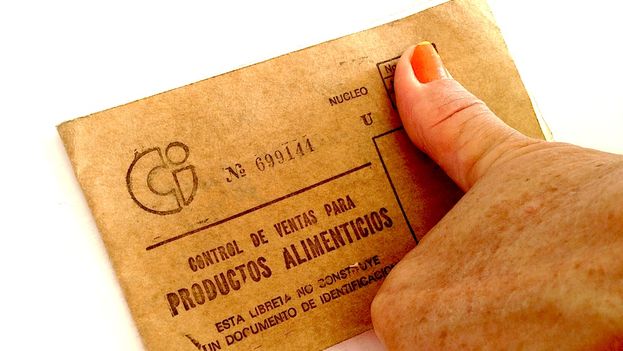
The ration book (14ymedio)

14ymedio bigger14ymedio, Havana, Miriam Celaya, 11 March 2015 — Commissar Nicolas Maduro, president of Venezuela to the misfortune of its people and – let’s admit it – also for the prolongation of our own misfortune, has just announced recently the installation of 20,000 digital fingerprint readers in state food markets and in several private sector retail chains that, according to him, adopted the initiative “voluntarily” after meetings held with the government.

Let’s draw a merciful veil over the aforementioned secret meetings and imagine the atmosphere that must have reigned there in the midst of the “permanent economic war” that Venezuela suffers, the successive “soft coups” that have been provoked almost bi-weekly in that South American nation – according to the president’s denunciations – and the growing repression of opposition factions and civil society that demonstrate publicly and openly against the government. continue reading

It is not very hard to guess what caused the “voluntariness” of these businessmen, who are definitively representatives of the “oligarchies” constantly defamed in official speeches and press.

But returning to the topic of Comrade-President Maduro’s above-mentioned fingerprint readers, his lofty purpose is, while guaranteeing the feeding of the people, to counter smuggling, or more exactly, “the smugglers” since smuggling can exist without socialism but socialism has never existed without smuggling.

This way, the fingerprint readers – which will limit the purchase of foods and other products in high demand whose supply has been greatly depressed causing lines, hoarding and disturbances in the stores – now are added to the prior rationing through magnetic cards established in 2014. It is clear that the Bolshevik Nicolas has not the least ability to overcome his country’s economic crisis, but at least in contemporary times the new technologies permit digital management of the misery. It is without doubt a real contribution of Socialism in the 21st Century which the late Hugo predicted in his glory days, before being planted in the Mountain Barracks and turned into a tiny little bird dispensing bad advice*.

Decades later, the Venezuelan government model – if it is possible to call it that – is dragging the country in a sort of reverse race through experiences similar to those that we Cubans have gone through under Castro-ism.

Those of us born before or in the years immediately following the catastrophic accident of January 1959 remember clearly some of the bureaucratic variants created to manage poverty, an ill that the older ones among us believed had been almost overcome with the economic boom experienced in the 50’s.

This administrative strategy, typical of war and famine economies, was first established for food products, and a little later, with the decline of Cuban industries due to the extreme nationalization of the economy, it was rapidly extended to other consumer products, such as clothing, footwear and other goods. Then came the industrial products book, popularly known as the store booklet, which currently functions only for the acquisition of school uniforms.

This version of control not only indicated the limits of access to the said articles, but it also reached the point of establishing shopping schedules for groups, with subsections inspired in the strongly sexist standards of the Revolution, which assigned two days a week – Monday and Thursday – on which only women workers could shop; an enviable privilege in the widespread poverty that, moreover, took for granted in a Revolutionary way that trifles like shopping were not worthy of men.

Decades of shortages, manipulated in detail by those in power, sowed in ordinary Cubans an extreme dependence on the State – an always insufficient provider but the only one possible – and a whole culture of systematized poverty that includes a peculiar glossary with phrases that we drag around even today in popular speech: “what they are offering” in this or that establishment, “what’s assigned to you,” “what’s expiring,” “plan jaba**,” “chicken diet***” and many similar ones that reflect the national acceptance of misery as the common destiny, something that one day – hopefully not too distant – should embarrass us.

Rationing in Cuba has been quite an institution that has played a role in the socio-economic realm and also in the political, functioning more as an instrument of subjection of the people by the Government than as a true guarantor of a just distribution of consumer goods, established with a vulgar egalitarianism that annulled individual initiative and turned the citizen into dough.

The ration book has constituted a mechanism of social control, even to the point that currently the Government has not been able to eliminate it, on pain of absolutely abandoning the most disadvantaged social sectors, especially the elderly without filial protection and the many humble homes which receive no remittances from abroad nor have any other hard currency income. In spite of that, the food products rationed and subsidized through the book – that artifact that constitutes a complete leftover of the Cold War – are today fewer than a dozen, and they barely cover precariously some of the most pressing food needs while the rate of inflation keeps increasing and wages hardly have even symbolic value.

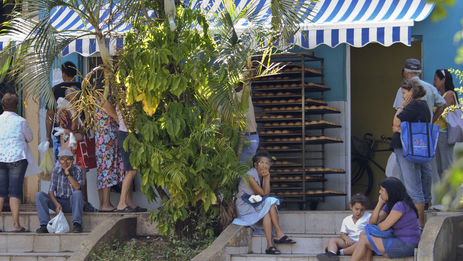
Bread lines (14ymedio)

That is why, when I now witness the Venezuelan rationing process, when I hear the openness with which Comrade-President Nicolas Maduro disguises in modernity the cataclysm of misery that looms for his people, I cannot escape a kind of jolt, like déjà vu. We Cubans already traveled that path, we walked half a century over its thorns and we are convinced that it only leads to disaster. We have painfully and abundantly proven that misery is the only thing that, divided among many, touches more.

Personally, I hope that the poor Venezuelans, who lately pursue their food anxiously and stand in long lines at stores with empty shelves, manage in time to avoid that serious confusion that sometimes leads people to interpret as justice that which is the manipulation and burial of freedoms.

Translator’s notes:
* Nicolas Maduro says that Hugo Chavez appears to him as a tiny little bird, and dispenses advice. In this video, otherwise in Spanish, he imitates the sounds the bird makes flying around his head and then imitates the bird whistling a message. 
** “Plan jaba” is literally “sack plan” and can mean one of two things: (A) you leave your bag and come back and pick it up at a convenient time so you don’t have to wait in line all day, which is allowed for some working people; or (B) you get a “special bag of extras” because of age, illness or pregnancy, and again, you just pick it up.
*** “Chicken diet” means that you get extra protein because of age, illness or pregnancy.

Translated by MLK

Lettuces of Lead / 14ymedio, Rosa Lopez

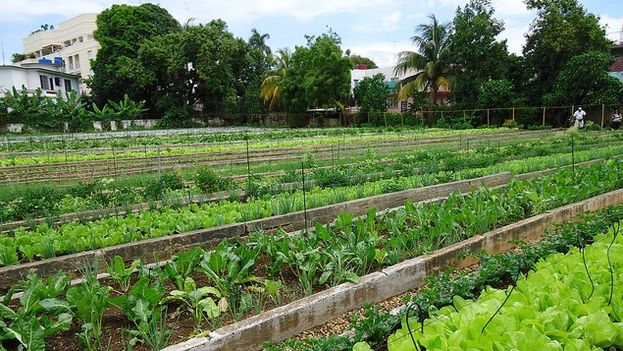
Urban organic garden in Miramar, Havana (flickr)

14ymedio bigger14ymedio, Rosa Lopez, Havana, 1 March 2015 – The raised bed exhibits its curly lettuces a few meters from the rough concrete building. There is an hour to go before the urban organic garden near Hidalgo Street in the Plaza township begins its sale, but already customers are thronging to get fresh vegetables and lower prices. None of them knows that the products they will buy here are neither organic nor very safe for their health.

Urban agriculture is a phenomenon that dawned in the nineties with the rigors of the Special Period. In the words of a humorist, “We Havanans turned ourselves into peasants and planted leeks even on balconies.” The economic crisis and the inefficiency of state farms required taking advantage of empty lots in order to cultivate greens and vegetables.

The initiative helped all these years to alleviate shortages and has many defenders who emphasize their community character, so different from the mechanization of modern agriculture. Nevertheless, together with the undeniable merits are hidden serious problems that point to the contamination of the crops with wastes characteristic of urban areas. continue reading

Hidden, serious problems point to the contamination of the crops with wastes characteristic of urban areas

Nationwide, about 40,000 people work in urban agriculture projects on some 83,000 acres (130 square miles) that are divided into 145,000 parcels, 385,000 patios*, 6,400 intensive gardens and 4,000 urban organic gardens. These last under the leadership of the Ministry of Agriculture, although with some autonomy for crop management.

With these lands planted in populated areas, it has been the goal to reduce food insecurity, offer greater access to fresh produce and to expand green spaces in urban zones.

Havana has 97 high yield urban organic gardens. One of the best known is located in the Alamar neighborhood and is currently managed by a cooperative of 180 members. The capital also has 318 intensive gardens, with crops sown directly in the ground, in addition to 38 crops that are semi-protected and in enriched soil.

The soil enrichment uses a technique known as vermicomposting, which consists of transforming solid wastes by the action of earthworms and micro-organisms. The problem is that many of the urban wastes that serve as a basis for the process are gotten from residential trash and carry a big load of heavy metals that with time accumulate in greens and vegetables.

The compost comes from household trash containing cadmium and lead above the maximum permissible levels

A study carried out in 2012 by several researchers from the Institute of Soils and that included samples from urban organic gardens in Havana and Guantanamo brought to light that “the compost obtained from the urban solid wastes originating in household trash extracted from landfills without prior sorting, and the subsoils prepared from them, contain heavy metals, especially cadmium and lead, above the maximum permissible levels.”

The lack of an effective system of trash sorting and processing works against us, because much of the waste used for compost in the urban organic gardens has had previous contact with materials like cans, paints, and batteries, thrown indiscriminately into landfills all over the country.

Urban agriculture in Havana (flickr)

Furthermore, the process to achieve compost often is not carried out properly, so that the pathogens contained in the wastes are not destroyed. Although part of the material used in this process comes from the garden itself, trash from nearby settlements, market wastes and agro-industrial refuse are also added.

Family gardens account for close to 90% of the greens consumed by the population, so ingestion of high doses of heavy metals could be affecting a great number of Cubans.

Irrigation adds a high content of chlorine and other water purifiers 

Irrigation of the urban organic gardens aggravates the problem because the water comes from the population’s supply network and affects the amount of water available for human consumption, besides also being unsuitable for crops because of the high content of chlorine and other purifying products.

The proximity of streets and avenues to the crops worsens the pollution because heavy metals also arrive through the ground and the air. Add to that the use of pesticides and fungicides for control of pests in the urban organic gardens. An un-confessed but widespread practice.

Most alarming is that the Ministry of Agriculture keeps silent about this matter and does not promote research into the presence of chemical agents harmful to health in produce that consumers imagine fresh and organic. Complicity or apathy? No one knows, but there are many reasons to distrust that bunch of lettuce with its attractive green leaves.

*Translator’s note: “Patios” in this context refers to home gardens producing food primarily for family consumption.

Translated by MLK

Birds of Ill Omen / 14ymedio, Eliecer Avila

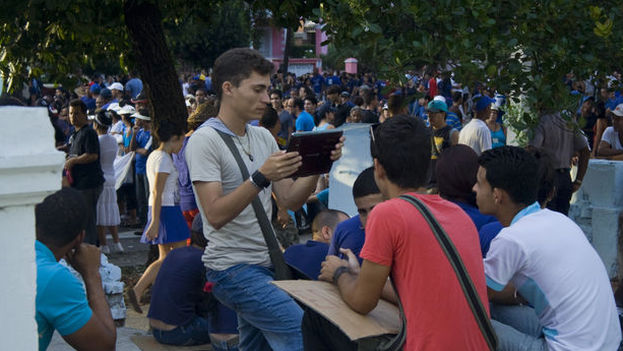
A young man with a tablet

14ymedio bigger

14ymedio, Eliecer Avila, 28 February 2015 — A topic that is raised for discussion these days is the obsolete argument that some official voices never stop repeating at every opportunity they have to strain relations between Cuba and the United States or rather between Cuba and the Outside World. I am referring to the supposed “need” of implementing “appropriate measures designed to avoid the penetration that the enemy hopes to make into Cuban society.”

Just a few days ago, in the context of the first National Workshop on Computing and Cyber-Security held in Havana, with the physical or virtual presence of thousands of computer engineers, really absurd speeches continue reading

were heard that, far from inviting the use of emerging opportunities to propel development, called for “being on guard” in the face of new “maneuvers” by the enemy to “penetrate” Cuban society.

I would like for some of these birds of ill omen really to explain, with what does the United States want to penetrate us? Or at least, with what negative thing? Maybe a virus? For that there are anti-viruses. With information about our own reality? We, the people, are screaming for that on our own.

Our youth (…) already think about the world and conceive their aspirations in the same way as do the youth of New York 

With capitalist propaganda? Our youth do not need it, they already think about the world and conceive their aspirations in the same way as do the youth of New York, sometimes even a little more capitalistic than those. With TV series, soap operas, shows? That is what the Cuban family watches every night, just a week behind. With vice and prostitution? Please, those are fields of enormous potential for replacing imports.

The more I think about it, I do not really find the harmful impact about which these things of which gentlemen speak. Could it be rather that they are preparing the terrain in order to justify the excessive and paranoid control that is planned for the future Cuban web surfer?

I believe that the old scheme of being able to try to survive at all costs, defending its privilege of being the only one that can “penetrate” the minds, every day, 24 hours a day, of all Cubans and many others out there. . .

The reality is that we do not need the Cuban government to “protect” us from any external influence. We are millions of Cuba adults responsible enough to make own decisions in the physical world as well as in the virtual one, who want for our country the same access to the Internet that is widespread on the planet. With all its risks and infinite possibilities.

Do not defend us anymore; no one has asked you to.

Translated by MLK

Amnesty International Denounces Increase in Arbitrary Detentions in Cuba / 14ymedio

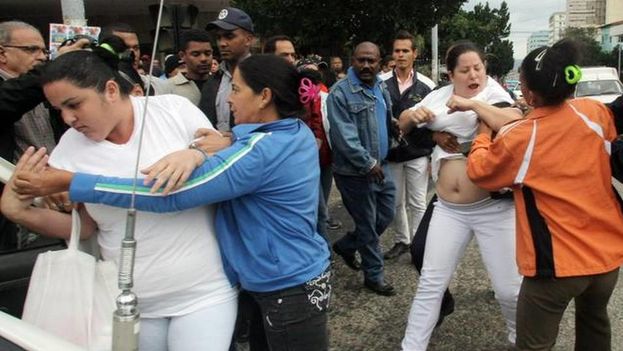
Members of State Security arrest women from the Ladies in White organization (Ernesto Mastruscusa/EFE)

14ymedio bigger14ymedio, Havana, 24 February 2015 — Short-duration detentions increased considerably in Cuba in 2014, according to the annual report published today by Amnesty International. The human rights organization, with headquarters in London, emphasizes that the situation with respect to freedom of expression, association and assembly, infringed on by criminal prosecutions for political reasons, did not improve. Amnesty International expects, nevertheless, that the announcement of the re-establishment of diplomatic relations between the Island and the United States may help produce a significant change in the matter of human rights.

The report highlights the 27% increase in short-duration detentions last year, according to data from the Cuban Commission for Human Rights and National Reconciliation, which counted almost 9,000 brief arrests. The Ladies in White organization suffers the most from this type of repression continue reading

, although Amnesty International also mentions the arrests produced at the end of 2014 on the occasion of the Community Summit of Latin American and Caribbean States (CELAC).

The annual report, which offers an overview of the human rights situation in 160 countries and forecasts trends in this arena for the next year, addresses the issue of the control that Raul Castro’s government exercises over all means of communication and the difficulties of accessing information on the Internet. Among the harassments that independent journalists have suffered, the organization cites the case of 14ymedio, which, on the day of its launch last May 21, suffered an attack on its web page. Since then this digital daily has been blocked on the Island.

The report dedicates a special section to prisoners of conscience and notes that laws that classify “dangerousness” and the likelihood of future offense as crimes have been used frequently to incarcerate citizens critical of the Government. Also, they point to the restriction on travel outside of Cuba imposed on the 12 prisoners of the Black Spring who were released without a clarification of their legal status.

Amnesty International appreciates the immigration reform of 2013 which has permitted Cubans to travel abroad but points out that the government has confiscated materials and documents from opponents and critics on their return to the Island. The international organization complains that Cuba has not yet ratified the International Treaty of Civil and Human Rights or the International Treaty of Economic, Social, and Cultural rights, both signed in February 2008. Also, the Government has not responded to the petition made in October by the special rapporteur on torture and other cruel, inhumane or degrading treatments and punishments. Cuban authorities have denied Amnesty International access to the country since 1990.

A “cruel” year on a regional scale

Amnesty International stresses that 2014 was a “cruel” year in all of the Americas, characterized by outbreaks of protests and impunity for criminal networks.

“Last year, insecurity and conflicts grew on the American continent. Protests exploded in several countries, among them Venezuela, Brazil, Mexico and the United States, often violently repressed by state forces. We also were witness to the tragic increase in violence by criminal networks that acted with total impunity,” Erika Guevara Rosas, director of the organization’s program for the Americas, asserts.

“From the disappeared students in Mexico through the revelations about torture at the hands of CIA agents in the United States and the shooting of protesters by Brazilian police, 2014 was a shameful year in the whole region,” she adds.

Amnesty International warns that, if significant structural changes are not put in place, the region will see an increase of protests and demonstrations, while organized crime and violence will continue devastating countries like Mexico, El Salvador and the English-speaking Caribbean.

The organization notes as positive the peace talks between the Colombian government and the Armed Revolutionary Forces of Colombia (FARC) for the purpose of putting a definitive end to the continent’s oldest armed internal conflict. Nevertheless, the report stresses that at the end of last year both parties continued abuses and violations of human rights.

As for Venezuela, the report insists that security organizations employed excessive force to disperse protests and emphasizes that dozens of people were detained arbitrarily and denied access to doctors and lawyers.

Amnesty International nevertheless harbors a certain hope that movements in defense of human rights in the Americas may improve their form of organization thanks to the help of new technologies and social networks.

Translated by MLK

The Ordeal of Automated Teller Machines / 14ymedio, Rosa Lopez

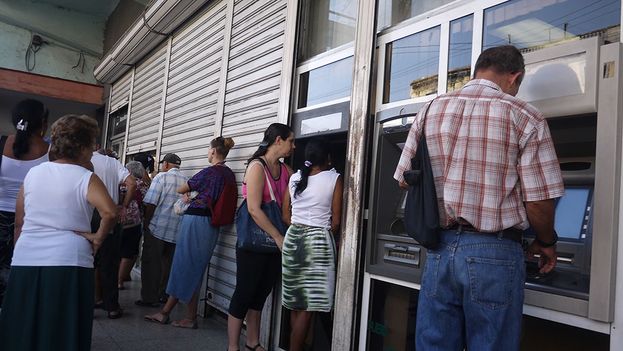
Lines at Cuban ATMs grow on weekends (14ymedio)

14ymedio bigger14ymedio, Rosa Lopez, Havana, 23 February 2015 – The line reached the corner and was moving with agonizing slowness. They were not selling eggs or potatoes. It wasn’t even a line for seeking a visa. Those who waited just wanted access to the automatic teller, the only one working last Saturday afternoon near Havana’s Central Park.

A few days before MasterCard can be used in Cuba, many are asking how the Cuban bank network will deal with the increased demand for money if it can barely keep its service afloat for domestic users and tourists.

The congestion in front of the machines grows even though only 1.3 million magnetic cards have been issued in the country, and for the moment only retirees, customers with accounts in convertible pesos, businesses that have contracts with the bank, self-employed workers and international collaborators can get them. The rest of society continues to depend exclusively on paper currency.

“When the subject is money, people fume,” says a young man whose Saturday night hangs by a thread because of the congested ATM. Even though this weekend the temperature dropped in the city, no one seemed ready to leave before getting their cash.

The scene is repeated at most of the 550 ATMs (Automated Teller Machines or automatic tellers) of Chinese manufacture, of which 398 are in Havana. In 2013 200 new units were purchased in China, but the majority were to replace defective terminals and did not solve the serious deficit of tellers. Cash payment is still the most common method in Cuba for acquiring products and services.

The scarcity of terminals combines with the deficient functioning of the system, affected by electrical outages, frequent connection failures between the ATM and the bank and lack of cash

The terminals are only available in private businesses with great resources and obvious official backing 

Almost all the self-employed workers offer their services for cash payment. The use of point of sale terminals (TPVs) for card scanning and payment, also known as POS, is only available in private businesses with great resources and obvious official backing.

In state business networks, the landscape is different but not very promising either. Although there exist POS terminals in most big department stores and hard currency shops, their service is unstable and slow. “When a client comes to pay with a card, the line stops for minutes because sometimes the communication with the bank is down and you have to try it several times,” explains a cashier from the busy market at 70th Street and 3rd in Miramar.

In the provincial cities and above all in the townships, where they are practically non-existent, the ATM and POS situation is even worse. Tourists who travel deep into Cuba must carry cash with them, increasing the risk of theft and loss in addition to the demand for liquidity.

The problem hits natives and foreigners. “Why do they pay me on the card if in the end I have to go get the money at the bank because I can make purchases almost nowhere with this?” complains Marilin Ruiz, a former elementary school teacher who also was waiting in line on Saturday for the ATM near Central Park. The delay was so long that she wound sharing recipes for making flan without milk and knitting suggestions with another woman.

 “I have a pension of less than 200 pesos (about $8 US) and I spend up to two hours in line at the teller to collect it,” an old woman complained

Between the 4th and 6th of each month, Cuban retirees go to ATMs to collect their pensions. “I have a pension of less than 200 pesos (about $8 US) and I spend up to two hours in line at the teller to collect it,” explained Asuncion, an old woman of close to eighty years of age. Meanwhile, some kids scamper from one side to the other. They are the children of a couple waiting at the end of the line without much hope of getting money before nightfall.

“We are late for everything; when the world has spent decades using plastic, now it is that we are trying it,” laments Asuncion. The first ATMs, of French manufacture, were installed in Cuba in 1997, but after 2004 only Chinese terminals arrived.

Asuncion keeps in her wallet a Visa card that her son sent her from Madrid. “I use this only every three months when he puts a little on it for my expenses.” There are no public statistics about how many of the country’s residents might be making frequent use of debit or credit cards associated with a foreign bank account of an emigrated relative, but the phenomenon has grown in the last decade.

In the line several Chinese student also put their Asian patience to the test with the red and blue cards in hand from the Chinese banking conglomerate UnionPay. More than 3000 citizens of that country study or work on the Island, and they receive their family remittances through that channel. Also, in 2013 alone some 22,000 Chinese tourists visited Cuba.

“We Cubans and Chinese are good at waiting, but let the gringos arrive in great numbers, they are more desperate, they want everything fast,”

“We Cubans and Chinese are good at waiting, but let the gringos arrive in great numbers, they are more desperate, they want everything fast,” says Lazaro, a teen with tight clothes, to a friend with whom he waits in the line.

The alternative to the ATM, which might be the window of the bank branch, is not recommended. In Havana there are 90 branches of the Banco Metropolitano, but at the end of 2014 at least twelve offices were partially or completely closed because of problems ranging from leaks, sewer network blockages, danger of building collapse or other infrastructure issues. Insufficient attention and lack of trust in the banking system make many continue to prefer hiding money “under the mattress.”

The limited work schedule of banks and the scarcity of offices open on weekends cause long lines on weekends in front of ATMs. The more optimistic, however, manage to profit from the wait. Marilin managed to achieve everything by renting a room in her house to the Chinese students who must, of course, pay in cash.

Asuncion could not stand the pain in her legs and left without her money, while the couple at the end of the line had to buy some ice cream to pacify their restless children. Lazaro was luckier, and in addition to exchanging phone numbers with a French woman whom he met in the crowd, he managed to extract twenty convertible pesos from the ATM to spend that same night. At least this time the blue screen did not appear with the “out of service” announcement, nor was there a power outage and, yes, the machine had cash.

Translated by MLK

Why Do Cubans Continue To Be Spaniards? / 14ymedio, Ferran Nunez

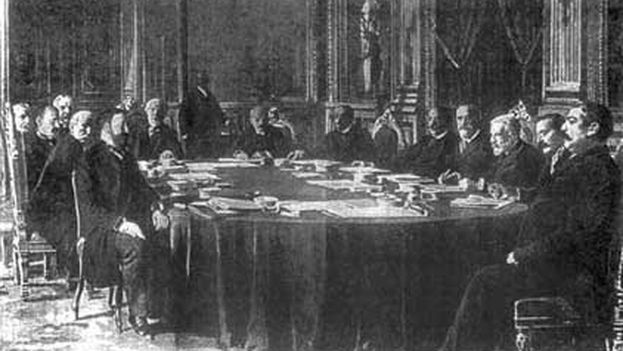
Treaty of Paris 1898
Treaty of Paris 1898 (CC)

14ymedio bigger14ymedio, Ferrán Nuñez, Paris, 21 February 2015 — With the signing of the Treaty of Paris of 1898, Spain ceded or sold the last pieces of its former empire where, in the time of Carlos V, “the sun never set.” This treaty, as has already been proven by Pedro Albizu Campos, had several legal defects that made it invalid. Curiously, no Spanish politician has used these arguments to challenge it outright. This is due to two main factors: The first, ignorance, and the second, of equal weight, reality. Spain today, as it has been for the last 115 years, is not in any shape to oppose the “Pax Americana.”

However, today this legal fissure acquires an unexpected dimension. Spain, through various laws, decrees and circulars, has decided to re-establish the rights of nationality for many of its former citizens who lost their nationality for different reasons in the last century (and even earlier, as is the case of the Sephardic Jews). Over time this worthwhile path is going to turn out partial and incomplete because unfathomable depths of injustice continue reading

are appearing. We are going to neither allude to the notorious inequality of conceding nationality only to descendants of male immigrants or detail the numerous legal ploys that officials abroad use in order to retard or delay the petitions of the interested parties, who could not always access to the documents necessary for validating their rights.

The Treaty of Paris completely dispossessed Cubans and Puerto Ricans born overseas of their status as Spaniards, leaving them to the disposition of the new authorities as if it were dealing with material property of the Crown ceded or sold by virtue of that agreement. Something that was in frank contradiction of the rights of peoples and is one of the reasons that the said treaty was never ratified by The Cortes – the Spanish Parliament – until today.

Few rose then to denounce such injustice, carried to The Cortes by Admiral Cevera, among others. Later a royal decree was published in the Manual of Military and Civil Classes, which declared them foreigners. Nevertheless, according to the current Constitution, the Civil Registry of the Kingdom was the only agency authorized legally to recognize (once registration had proceeded) the loss of nationality of those Spaniards, and this never occurred.

By not duly settling in the Kingdom of Spain’s civil registry the new administrative status of the natives of the island of Cuba, they continued to maintain de facto Spanish nationality.

The creation of the Republic of Cuba did not resolve this legal problem either, given that the Cuban Constitution established that those people had to “opt” for the new Cuban nationality, something that in practice – and from all the evidence – also turned out difficult to put into practice. Those who did not do it, as well as their descendants, kept their de facto status as Spaniards at least until 1940. As a result, their descendants continue to be Spanish and could demand that status currently in Spain’s civil registries.

In 1940, the new Constitution decreed by ius solis (birthright through parentage) Cuban status to those born in Cuba so that Spaniards who did not “opt” at that moment to keep their Spanish nationality ended up losing it as did their descendants.

However, Spanish nationality does not depend on Cuban nationality or vice versa. Each sovereign state decides for itself who are its citizens. Spain cannot impugn the Treaty of Paris but it can do justice to the descendants of those Spaniards, recognizing their right to nationality. Nothing prevents it and it would be an act of basic justice. The recent decisions by the Supreme Court denying Spanish status to those born in overseas territories are a disgrace and a legal aberration. Given the current international political environment, offering nationality to all those descendants of Spaniards who seek it opens unusual prospects – transcendental – for the cause of Hispanic heritage. Only a blind man would not know how to see them.

Translated by MLK

The Malecon as Pier / 14ymedio, Orlando Palma

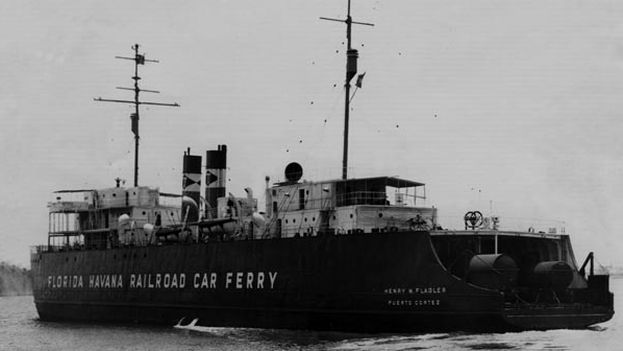
Image of the Cayo Hueso-Havana ferry taken 1951 (History Miami Archives and Research Center)

14ymedio bigger14ymedio, Orlando Palma, Havana, 21 February 2015 — Jose Manuel is 70 years old and has spent more than half his life fishing from Havana’s Malecon. For this retiree with leathery skin and eyes that have seen almost everything, it is a dream to catch sight again of that ferry that used to go to Florida and that he so liked when he was a child. “We kids used to pretend to say goodbye, and although I could never travel on it, my grandmother did every now and then.” Now, while the evening falls, the septuagenarian hopes that some fish will take the bait, and before him a sea without boats extends to infinity.

Maritime transport between Havana and Cayo Hueso came to be very common in the first half of the 20th century until it was suspended in August of 1961 as a consequence of the restrictions from the American embargo of the Island. Now, the ghost of a ferry continue reading

that links the two shores has resurfaced as a result of talks between the governments of Cuba and the United States.

This week, the entrepreneur Brian Hall, who leads the company KonaCat with headquarters in Fort Lauderdale, made public his interest in operating ferry trips to Cuba from Marathon’s yachting marina on 11th Street. Hall told the daily digital KeysInfoNet that he was confident of getting available space for his 200-passenger capacity catamaran with which he plans to travel between the Florida Keys and Cuba twice daily.

The news has barely reached the Island, but since last December 17 when Raul Castro and Barack Obama announced the process for reestablishment of relations between the two countries, the return of the ferry has become a matter of importance for many nostalgic people. In addition to the economic concessions and the political détente that this reconciliation would bring between the two governments, connecting both countries with a maritime route would have, besides its practical effects, a strong symbolism, many assert.

All great human endeavors have something to do with madness, say the elders. The ferry service that connected Florida with the Cuban capital started with the efforts of a man. Henry M. Flagler, an oil magnate who in 1886 founded the Florida Faster East Coast Railway for railway construction and exploitation of Florida’s east coast. In spite of the great obstacles imposed by the geography of the keys and the constant danger of hurricanes, Flagler’s madness led him to trace the rail lines to Cayo Hueso, where the service was inaugurated in January 1912. That work would be considered by many as the eighth wonder of the world, besides being the boldest infrastructure built exclusively with private funds.

Once the railway was in Cayo Hueso, some way was needed to overcome the distance to Cuba. So was born “the train moving over the waters” as the ferry was also called and whose Havana-Cayo Hueso service was inaugurated January 5, 1915. The first shipment consisted of a batch of refrigerated cars, and the boat received the name of Henry M. Flagler, in homage to the visionary entrepreneur who had died two years earlier.

“We kids used to pretend to say goodbye, and although I could never travel on it, my grandmother did every now and then.”

The dispatch of products between both shores grew like wildfire after that moment. In 1957 it came to more than half a million tons of merchandise in both directions, to which was added the transport of passengers and cars. The sea connection between the two shores lasted 46 years, and some remember it as if it were yesterday that the last boat had sailed.

“My grandmother frequently travelled to Florida on the ferry,” explains Jose Manuel, who has had a bad day for fishing. “We were poor, but part of my family went there to work and sometimes would return the same day,” he says wistfully. Near the fishing pole, seated on the wall of the Malecon, a teenager listens to the conversation and smiles with incredulity. He is of the generation that cannot conceive that at some point the Malecon was not a barrier that separated Cuba from the world but a point of connection with the neighbor to the north.

The line tightens, and it seems that something has bit. Jose Manuel concentrates on recovering from the water what is going to be his supper tonight, but in spite of his concentration he manages to say, “The day that I see that ferry arriving here again I will be able to die in peace.”

Translated by MLK

“It Is State Policy To Misinform People” / Cubanet, Roberto Jesus Quinones

Leinier Cruz Salfran (photo by the author)

cubanet square logoCubanet.org, Roberto Jesus Quinones Haces, Havana, 13 February 2015 — Raul Castro’s government, in spite of rapprochement between Cuba and the United States, continues the work of keeping people from freely accessing the internet.

On Monday, January 19 Cubanet published a report about the detention of the young Guantanemero Leinier Cruz Salfran on Saturday, January 17 by State Security agents. The reason? Leinier was gathering together a group of young people outside of the Hotel Marti, connecting through his laptop to the building’s WiFi and sharing the Internet with the others present who had also brought their portable computers to the location.

We contacted the young man who agreed to grant us this interview:

Q: Leinier, why did State Security detain you?

Because according to them I was committing a crime of Illicit Economic Activity.

Q: What did you do?

I shared the use of the Internet with other people through Hotel Marti’s wifi continue reading

connection.

Q: How many users came to connect to the Internet at the same time because of your initiative?

There was no fixed number, there were days when more than fifty people connected on the ground floor of the Hotel Marti which was generally where I was connected.

Q: What was the typical connection speed when everyone was connected at the same time?

The Hotel Marti has a bandwidth of 6 mbps (megabits per second) which equates to a download speed of 600 kb per second. The speed was sufficient for chatting, participating in a video conference or carrying out an audio session on Facebook. The speed was acceptable.

Later the hotel managers applied a speed limit of 2 mbps for each direct client. Only three people could connect directly to the hotel without interference. If another person connected the speed was divided among the four.

In the end, I had to tell the users that they could not do video conferences because now the bandwidth was insufficient for everyone. Everything was limited to opening pages, downloading email and voice sessions.

Q: How would you rate the internet connection opportunities that exist today in the city of Guantanamo?

There are very few internet access points, just two Internet rooms with 10 computers for a city of more than 150,000 residents. Furthermore, now the Hotel Marti denies Internet access to Cubans, who now cannot even pay a dollar to go up to the terrace which is where they have placed the wifi access.

Also, in the Hotel Guantanamo, the equipment for the point of access used to be in the lobby and now they put it on the second floor and even removed the antennas, which they only put up between 4 and 8 pm. Whoever wants to access the internet has to pay one dollar per hour. This part a decision by the government itself.

Q: The police accuse you of supposed illicit economic activity. Did you charge for sharing Internet access or did you share the cost of the connection with your friends?

I never charged because I knew they were following me. After I started sharing the connection I knew that I had become a dangerous enemy for the authorities and I knew that at some point I was going to confront them face to face, obviously on their terms, so I just shared the cost of the connection.

Q: Is there a law in Cuba that prohibits sharing the connection cost among several users?

I don’t know. During the interrogations they spoke to me of a crime called Violation of Contractual Services, something like that, in which the crime of violating a contract incurs a penalty of up to three years incarceration. Apparently they were convinced there was no evidence of any illicit economic activity, however, they emphasized that I violated the contract with ETECSA (Telecommunications Enterprise of Cuba) by using the Nauta (Internet) service, but in my opinion they did not want to go to the extreme of sentencing me.

Q: Did they return your laptop, flash drives and camera that they took during the search of your home?

No, they still have not told me what they will do with them. They took them from me and have left me disarmed because I am a programmer.

Q: Do you plan to do it again?

No, no I cannot trip on the same rock, it would be stupid if I did that. I think I have to focus my efforts on other artists, other projects that I have in mind until I find a person with strength and the chance of helping me carry them out.

Q: Why do you think they authorities hinder cheap Internet access for young Cubans?

I believe that it is the policy of the State to maintain massive disinformation for the Cuban population, and that is demonstrated by the fact that this government has never permitted free access to information. Here we have no chance of getting computers, mobile devices, access to satellite TV, the Internet, there are no satellite phone connections or access to information technology. What they have done to me proves it.

Q: What is your current legal situation?

Apparently I am not going to have a trial. They told the mother of my daughter who communicates with me to go to the Operations Unit to process the application of a fine, God knows for how many pesos, but I have decided not to go until such time as they communicate it to me as the law provides, through a document. The same way that they came with a search warrant the very day that they arrested me in front of my neighbors as if I were a delinquent and arrested me, that’s how they must do it for me to go there.

(We went to the Hotel Marti, the place where Leinier carried out his supposed derelict activity for which he was arrested. This reporter tried on three occasions to speak with the hotel manager, leaving his address and telephone number with a note in which we expressed that our intention was to bring to her attention what Cubanet published so that she could offer her viewpoint. In spite of our efforts, the lady did not agree to an interview.)

About the author

Roberto Jesus Quinones Haces

Born in the city of Cienfuegos September 20, 1957. He is a law graduate. In 1999 he was sentenced unfairly and illegally to eight years incarceration and since then has been prohibited from practicing as a lawyer. He has published poetry collections “The Flight of the Deer” (1995, Editorial Oriente), “Written from Jail” (2001, Ediciones Vitral), “The Sheepfolds of Dawn” (2008, Editorial Oriente), and “The Water of Life” (2008, Editorial El Mar y La Montana). He won the Stained Glass Grand Prize for Poetry in 2001 with his book “Written from Jail” as well as Special Mention and Special Recognition from the Nosside International Poetry Competition in 2006 and 2008, respectively. His poems appear in the 1994 UNEAC Anthology, in the 2006 Nosside Competition Anthology, and in décimas selections “This Jail of Pure Air” by Waldo Gonzalez in 2009.

Translated by MLK

The Honey That Used To Heal Us / Cubanet, Reinaldo Cosano

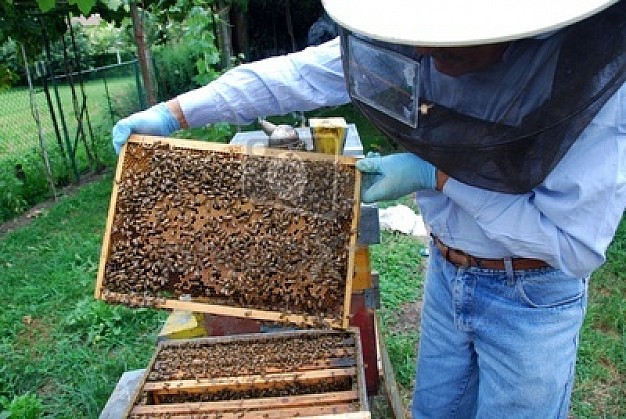
Where to find in Cuba that medicine that cured our grandparents?  (Internet photos)
Where to find in Cuba that medicine that cured our grandparents? (Internet photos)

cubanet square logoCubanet.org, Reinaldo Emilio Cosano Alen, Havana, 6 February 2015 – Bee venom is considered 500 thousand times superior to any antibiotic. But where to find that medicine and food, previously so abundant, older than mankind?

The sick man came to the clinic with a bad cough. The doctor diagnosed bronchopneumonia. She prescribed antibiotics. And issued the challenge: “If you find honey, don’t stop taking it.”

abejas-3After many inquiries he found a farmer who empties his hives, puts the honey into discarded rum bottles and sells them on the black market for 50 Cuban pesos (two dollars; a fifth of the average monthly salary) each.

It is not worth questioning the hygiene of the package or the quality of the honey, issues that are for the European Union and other importing countries. The Apicultural Research Center in Havana analyzes and certifies nine physical-chemical parameters for all honey for exportation.

“Here we check aspects like moisture continue reading

, diastase and hydroxymethylfurfural – which describes the freshness of honey – acidity, electrical conductivity, non-soluble solids, reducing sugars and apparent sucrose,” explains Maidelys Pena Garcia, technician in Food Technology in that laboratory. (…) For the export of honey to the European Union there exist rigorous regulations, among them limits on residues of prohibited substances like pesticides and antibiotics.

Some years ago they stopped selling honey in the pretty pitcher-shaped glass jars in the CUC (hard currency) stores. There was no explanation why the State, which controls honey from the agricultural phase to the retail, gave up the lucrative business in the so-called border market (in foreign currency). It was also sold at reasonable prices in state farmers markets. What happened to the honey?

Even the popular honey-filled candies disappeared from the marketplace some unknown time ago.

“The state buys all the honey from the farmers but the lack of honey in the domestic market incites traffic on the black market, theft of hives. The hives are mistreated because the thieves always are in a hurry,” says Diosdado Ferrer, an old beekeeper from the Mayabeque province.

abejas-2Deforestation and frequent periods of drought are other causes that reduce the production of honey, royal jelly, propolis and wax. The bees can die of hunger. A temporary solution is the transfer of the hives to sites with better blooming, among them the coastal flowering mangroves.


Each worker bee visits some 7,200 flowers during his fifty days of life in some two hundred thousand flights in order to make barely five grams of honey!

Bees and other useful insects effectively contribute to the pollination of flowers and the production of fruit, another cause of the reduction of agricultural production in the country.

“Bees form part of the food production chain, hence the great concern about their deaths. In temperate climate countries 30 percent of foods that are produced are thanks to bee pollination,” says Doctor Adolfo Lopez Pinero, director of the Apiculture Research Center.

Our grandparents cured themselves with honey from bees, which was sold in all the stores of the country. But that was also when we were the world’s sugar bowl. The bees are not at fault.

Translated by MLK

About the Author:

cosano.thumbnailReinaldo Emilio Cosano, Havana, May 1943, graduate in Philology from the University of Havana. He worked as a professor the last twenty years of his professional life. He was fired from teaching for lack of “political suitability,” as recorded in the minutes of the final separation. He was a member of the Cuban Committee for Human Rights and participated in the Democratic Cuban Coalition. He has been writing for more than ten years for CubaNet, through the Sindical Press agency, of which he is manager. E-mail: cosanoalen@yahoo.com