The legislation that has endorsed flagrant human rights violations seems to have its days numbered.
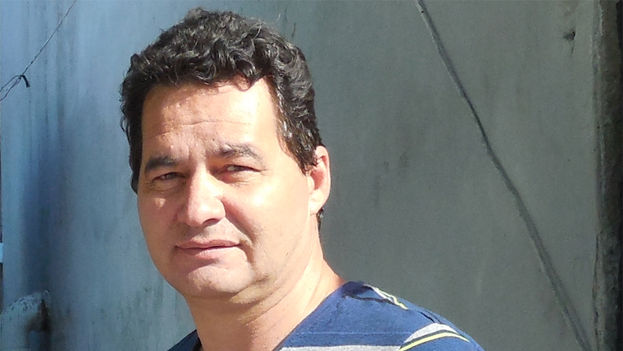
14ymedio, VICTOR ARIEL GONZALEZ, Havana, 30 December 2014 – Following the custom of seeing the speck in the eye of another, the “gag law” that in recent days has caused a waved of protests in Spain has been criticized by Cuba’s official Cuban. The Prensa Latina news agency recently cited a Spanish activist, opponent of the Popular Party’s legal project, who predicted that the edict “will repress rights like that of free assembly” as well as freedom of expression.
Nevertheless, the menacing “Law of Citizen Security” which has raised so much commotion in that European country has a counterpart on this Caribbean island. The “Law No. 88 for protection of national independence and the Cuban economy” has been, since its approval in February 1999, our own gag law, and its description is identical to that offered by the aforementioned activist and quoted by Prensa Latina: “A way of creating fear and exerting media pressure to criminalize protests.”
But in Cuba, unlike in Spain, for more than half a century one simply could not protest, and fear was consolidated into terror. The Cuban “Gag Law” affects, among others, those who “collaborate in any way with radio or television stations, newspapers, magazines or other foreign media,” “disturb the public order” or “promote, organize or incite disturbances of the public order.” The sanctions range from three to 20 years in prison. continue reading
Nothing better characterizes Law No. 88 than its first article, which reads that its objective is “to criminalize and punish those actions designed to support, facilitate or collaborate with the objectives of the Helms-Burton law, the blockade and the economic war against our people.” Throughout the text are repeated ad nauseam the elements that turn the United States into an enemy that wants to see us crushed.
This was the law that sought to justify the mass incarcerations of the 2003 Black Spring. But now the legislation that has supported flagrant violations of human rights seems to have its days numbered.
With the end of the Cuba-US confrontation a document loses meaning that consecrates as “an unavoidable duty responding to the aggression whose object is the Cuban people” who desire to maintain their “independence and sovereignty.” For decades the regime has shielded itself behind this discourse to refuse to open itself to hearing its opponents or, at least, to not repressing them.
The recent statements that ended 53 years of Washington’s “hard” line towards Havana were the exorcism of the imperialist demon who threatened Cuban sovereignty, as the regime defines it. According to the law, which serves above all to imprison peaceful opponents, the actions of the US are designed to “break internal order, destabilize the country and liquidate the Socialist State and Cuban independence.” But Barack Obama himself, when he describes the American strategy as “failed” underscores official Cuban paranoia.
With the December 17 statements from the White House, the foundations of the “Gag Law” wobbled. This shows that its reach was as terrible as it was weak. In the next months we may be witnessing the definitive emptying of its contents, ever more hollow. What remains to be seen is if they withdraw the law, ease it or just replace it.
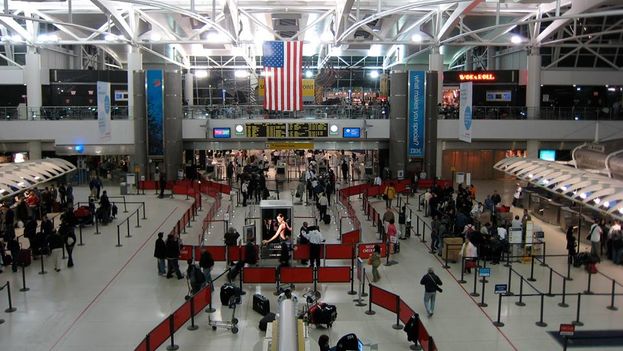
JF Kennedy Airport in New York. (Facebook page: Cuba Travel Services)
Translating Cuba note: This translation got “lost” (due to the site manager’s Thanksgiving travel apparently), and is being belatedly posted now. Our apologies.
14YMEDIO, Havana, 21 November 2014 – The American agency Cuba Travel Services announced last Thursday that it will operate a direct flight between New York’s J.F. Kennedy Airport and Havana. It is envisioned that the trips will occur daily in the afternoon, although company workers have not been able to confirm either the departure days or the frequency of the flights.
Cuba Travel Services has not provided information about the date the service will begin, but it has announced that the price for a round trip ticket on the inaugural flight will start at 849 dollars.
The company organizes travel to popular destinations like Cienfuegos, Camaguey, Santa Clara, Holguin and Santiago de Cuba, with flights operated by Sun Country Airlines. continue reading
The Turbo News site explained this afternoon that “in the spirit of the recent New York Times editorial published October 11, 2014, entitled ‘Time to End the Cuban Embargo,’ the agency Cuba Travel Services chose to provide an important cultural and social link between the two cities.”
The agency maintains that the expansion of its offering will permit travelers who leave from New York to save as compared with the current options on the market, avoiding the delays of connections and the cost of additional fares for stops in Miami, Fort Lauderdale or Tampa.
The company, which organizes daily flights between the US and Cuba, asked for permission to operate flights also from Newark Liberty International Airport, but that request was rejected.
The US government suspended direct air links with the Island at the beginning of the 1970’s and resumed them in 1999 with a flight between New York and Havana. After a slight opening by President Bill Clinton, Barack Obama also opted to soften restrictions on travel by Cuban Americans visiting the Island; now they can travel every year instead of every three and stay as long as they like.
In 2012 the Cuban government suspended landing rights on the Island for two airlines from Miami, Airline Brokers and C&T Charters, explaining the reason for the decision “as over capacity of seats and other operational themes,” although the travel agency operators revealed suspected payment defaults with Cuban authorities. Airline Brokers operated weekly flights to Havana and Cienfuegos from Miami and Fort Lauderdale, while C&T Charters traveled to Havana and Camaguey from Miami, New York and Chicago.
Gerardo and Agustin were stuck for two days with water up to their knees, among the trunks and roots on the coast. They had chosen a point west of Havana that they nicknamed the terminal for its frequent illegal exits, but the trip was thwarted. “They detected us, I don’t know how, because it was in the middle of the night and you couldn’t even see your hands,” they relate, still somewhere between surprised and upset. The capture of the two seems to be due to a new device, half truck, half scanner, that goes in search of rafters.
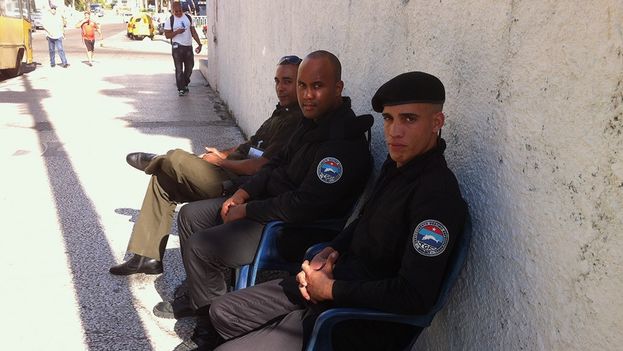
Last Friday a rare entourage was exhibited a few meters from the central Havana corner of L and 23. Two military jeeps, an overhauled vehicle and a motorboat were shown to the stupefied students who formed a circle of interest just outside the Cuba Pavilion. The teens fluttered around the objects, and an officer explained the modern work tools for “protecting the Cuban coasts from illegal entry and exit.”
The purpose was to familiarize the students with every detail of the work in the Ministry of the Interior’s Border Guards in order to attract potential soldiers. The device that they described with greatest pride was a truck that once belonged to the Trasval chain messenger service and that they themselves have fitted with GPS and motion and heat sensing cameras. Its mission? Finding amid the underbrush, darkness and waves those who have decided to escape from the Cuban paradise. continue reading
The curriculum of each of the members includes not only detailed knowledge about the functioning of the new technology but also proficiency in techniques of self-defense and neutralization of the “enemy.” The students seem to listen to the explanation with the playfulness of being halfway between the hiders and the seekers, between the coastal police and the fleeing rafters.
Barely a couple of years separate Gerardo and Agustin from those youngsters in the interested circle. Maybe they once crossed an intersection or shared a jitney or waited for the green light together at a stoplight. Nevertheless, if those students were to decide to become part of the Border Guard Troops, on a night as dark as hell some would be shivering amid the mangroves and others would push the buttons of a device designed to hunt emigrants. “We have to hold them and guard them until the people from Villa Marista come to look for them,” says one of the officers to motivate even more those who listen to him under the December sun of a Havana afternoon.
A girl asks about firearms, and a man wearing a beret pulled tight to his ears tells her that they must not go out armed on these missions due to “incidents that have occurred where fatal shootings have happened.” But continuing, he explains that they plan to place on the truck “an arsenal for confronting possible entry of speedboats with armed people or explosives.”
From the outside, the singular truck looks like a featureless gray box, but passing through its side door one finds a bathroom and a space that can be transformed into a bedroom or meeting room. The table used for discussing upcoming plans and operations folds up and is stored. The benches are opened and converted into two bunks, one on each side, where up to four people can sleep. The climate control permits them to endure the hot nights without opening the door which would cause them to suffer the persistent coastal mosquitoes.
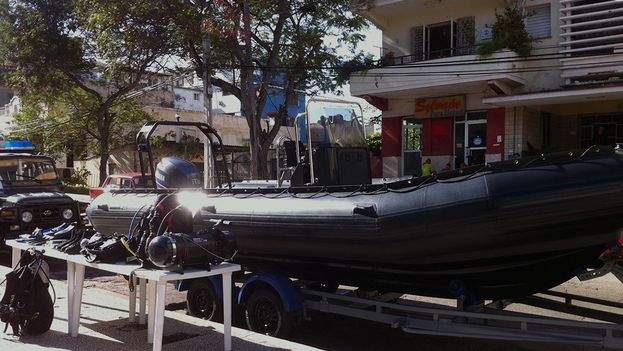
Border guard boat. (Luzbely Escobar)
They carry a coffee maker, a rice cooker and a so-called “Queen” cooker (a Chinese-made pressure cooker) for cooking outside the truck. In order to make it all work, they carry an electric generator “so that the current is not a problem,” they assure with a certain vanity. The boast about resources does not stop there. They relate that they have “a campaign table in tow to set up the outdoor kitchen and a tent with a 40-person capacity.” This last is for the detainees, in case the people of Villa Marista take too long and they have to sleep at the capture site.
“This is a combat truck because it was born in combat,” one of the pompous drivers is heard to exclaim. “It is a unique prototype in the country and is called a mobile command post,” he stresses. “The boss,” he says while he points his index finger up, “says that he is going to make one more advance, but well, this takes financing, this takes resources.”
The news is worst for those who evade because this team acts as if they were really slave hunters with an obsession. “This is a fixed rotation. We go out for 20 days to the coast, and we have no relief. Those are 20 days without seeing the family,” they say, explaining the conditions in which they work.
In order to attract the girls to the circle of interest, an officer with ten years of experience clarifies that “in communications there are many women who do not have to go to the coast.” They laugh and blush, then he returns to the charge saying that “all the communications offices are climate controlled, there are many women who do this work.”
Nevertheless, after looking a while at the device the teens begin to speak of going on vacation with it to the beach, with its bunks and electricity. In the end one of them laughingly says thanks for the “classified information,” and heads down the street to the sea. In the air remains doubt about the next encounter between those adolescents and the officers: Will it be to petition for entrance into the elite group or to beg them not to tighten the handcuffs?
14ymedio, CEDERISTIN DOMINGUEZ, 10 December 2014 — The independent press that usually criticizes the Cuban government using human rights as a pretext should come out into the street today, December 10. Our children, especially those in primary school, will be playing, jumping and doing pirouettes in all Havana’s main plazas. Representatives from the United Nations, the foreign press and especially the national press will enjoy a great time there, watching the carnival of happiness and color that the children will give them spontaneously and voluntarily.
How do I know? Well, because I have lived in Cuba my whole life, and I know our children, and they are very prone to playing on the tenth of December… Why this day? Well, I don’t know, the truth is that now that you ask me it is a little strange. . . It’s cold, it rains and it is a school day.
What I do know is that it coincidentally matches the world day of human rights and at least our children will not be bored in cages learning mathematics, physics or Spanish. After all, we are barbarians in all that. continue reading
But while I do not “cover the sun with a finger,” I also criticize what is badly done. For example, a very pretty activity that they should do more often with the children is acts of repudiation. The last time my boy told me that an old lady almost died while they were dragging her son and that they crushed a pile of people. Those things are very important so that children learn to behave and don’t turn out later to be like those vulgar youth who are rather critical of Raul.
Over there, those strange countries have even prohibited parties and governments from using children for politics. And they call that democracy? Here there is democracy and how. Check it out, even the newborns and fetuses, although they are unaware of their own existences, are already defending the revolution on the national news.
That is what our enemies will not pardon us for. The traitors are determined only to see the little specks in the eye, no different from the whole world’s, and from that they make a huge problem. So what if those children, when they grow up, will not be able to elect their own government, so what if they earn a laughable salary, so what if half of them by age 25 will no longer be here (having gone into exile), so what if they are expelled from their universities or their jobs if they think differently, they will not be able to associate or meet or access the internet, yadda yadda. The same old song as always… The good thing is that the people are aware that all that is false.
Look, why don’t they talk about the beauty of the choreography that the children are doing? Much more open and improvised than that of the Chinese or North Korean children. Here each child throws a ball, jumps or laughs when he feels like it… That is a the painful truth, but of course, that is not what they see… What interests them is all that bunch of nonsense that the neighbors from the north and the Europeans have put in their heads. That’s why we suspended the meeting that we had planned for these days with those evil freaks.
Okay, I am going to grab my raincoat and go out for a walk because today for sure they will sell sweet cookies in the street, and I have to take advantage…
Arrests at a gathering on Human Rights Day (14ymedio)
“Sit down!” ordered ‘Number One.’
“I’m comfortable like this, thanks,” I responded.
14ymedio, VICTOR ARIEL GONZALEZ, Havana, 12 December 2014 — “But you didn’t come here to be comfortable,” he concluded, and for once we were in agreement on something, Number One and I: I was not comfortable. It was Human Rights Day, which in Cuba is a sad date, and a mob of agents dressed in civilian clothes had arrested me together with other journalists as well as dozens of independent activists.
I was taken by force from the bus on which I was returning to the editorial office after taking photographs in the middle of Vedado, and also stripped of my mobile phone from which they also erased information. They put me into a patrol car that was parked at the corner of 21 and L, where they transferred me to bus full of uniformed police officers at the park at 21 and H. From there, accompanied again by plainclothes agents, they took me in a private car and I came to stop at the Aguilera station, an old barracks from the Batista police era.
Obviously, no one feels comfortable if they are trounced like that. During my trip to the Aguilera cells they held me without handcuffing me, maybe hoping for some violent reaction on my part so they could beat me up right there or later insinuate that I am one of them and therefore “they were treating me well.” That’s how these State Security guys work, mine also spoke of “accidents” that have happened because of not handcuffing arrestees. “What I am committing is a violation of procedure,” said the man next to me, in the rear seat of the Greely. True: It is a violation that unknown perpetrators kidnap a free citizen. continue reading
Returning to the scene of the interrogation, here I am next to a couple of henchmen who shared that December 10 with me. I will describe them: ‘Number One’ is older and calls himself Javier. His supposed position as lieutenant colonel was let drop by ‘Number Two,’ who had earlier identified himself as “Captain Ricardo” and is quite a bit younger.
When they brought me up to the interrogation rooms, Number Two was waiting for me, and his intervention started badly. He called me a “spoiled little boy” and “frustrated engineer.” Number One then arrived, authoritarian and even more unpleasant, his head polished by a splendid shave. “Sit down!” had been almost his first words directed to me, because the beginning phase of the choreography of the interrogation was intimidation or the attempt to establish authority.
Seeing that I would only be allowed to speak when they wanted me to, I tried to remain quiet most of the time. I wanted them to end their diatribe as soon as possible. One told me, among other things, to learn “to listen” and drop the “stobbornness” – he meant to say “stubbornness.” Number Two insisted, “You have problems, you have problems, you have problems.” The choreography was in phase two: informative-educational.
In that part of the dance Number One left the room, then entered to interrupt Number Two and then left again. The third act was when Number One interrupted his subordinate again, I don’t remember much of his discourse, and he said from the open door in a paternal and severe tone: “Your brother . . . came looking for you,” concluding with “We’re going to free you soon.”
Before describing the choreography’s fourth act, that of the threat, I find it imperative to clarify something about these guys: It is well for them to know that they do not have to “free” me, simply because I am already free. Freedom, more than walking around on a slave island and in a dilapidated city that individuals like my interrogators police and terrorize, is a state of grace.
They are less free than I because they obey orders, and because they feel the need to arrest someone who thinks differently in order to try to demonstrate that they are stronger. But it is easy to see that they are scared to death, because when they display their little borrowed power – in this country the powerful really are not they, but their bosses – they only demonstrate how startled they are that a little group of peaceful people like me think and express themselves differently.
Watch out for fear, officers, it cuts both ways. The act threat act in your interrogation served to reaffirm my conviction that there will be no going back. You will be able to threaten me and my family, but I will keep writing while I have the means.
Really, you have left me no other option. I only hope that by the next choreography you will have rehearsed your macabre dance a little more and studied the script better.
14ymedio, 10 December 2014 — At least 34 activists have been detained so far in various locations of the country on the occasion of the celebration of Human Rights Day this Wednesday. In Havana are reported some 20 arrests of opponents who tried to reach the meetings opposite the Yara room, one of the headquarters for the Havana Film Festival, which started six days ago. Among those are at least 18 Ladies in White and members of the New Republic movement, intercepted when they headed towards Vedado in order to participate in the announcement by Berta Soler and driven to the Calabazar zone. Before the arrests, some activists yelled, “Down with the dictatorship and long live human rights!” After the first arrests, dozens of Government partisans approached the place, yelling, “Long live Fidel, long live Raul!”
A reporter from 14ymedio, present at the location of the incidents, could confirm the detention of several Ladies in White who began to arrive, separately, to the well-known corner. At first, only civilians were seen, the so-called enraged people, awaiting the activists. However, as the time of the announcement approached, there appeared several uniformed officers and police cars. One of the women from this human rights defense group who managed to get to the place was forced into one of the cars.
Security agent Carlos Serpa Maceira, present at the location, has threatened Luzbely Escobar, one of the reporters for this daily, who took photographs of the arrests. After a three-hour detention, the journalist has been set free. Security agents, especially bothered by her participation in the Havana Film Festival and her credentials for press conferences, have warned her that she cannot “present herself as 14ymedio at official sites.” Another 14ymedio reporter, Victor Ariel Gonzalez, was also arrested on this day and freed on Wednesday night.
The downtown Havana corner of 23rd and L has dawned between expectation and the most absolute vigilance. The announcement several days ago by the Ladies in White to meet at this point of the city to commemorate Human Rights Day made the government activate all its machinery to prevent it. Last night a children’s activity at the Coppelia ice cream stand was announced on national television, a frequent practice used by authorities to neutralize dissident gatherings.
In the Calixto Garcia township in Holguin, some 20 Security agents do not let pass anyone who wanted to enter an activity about human rights.
In Puerto Padre, Las Tunas, only a dozen activists have managed to get to the place they had given as the location for celebrating Human Rights Day, while at least ten others have been arrested.
In Tunas Park, two dissidents have been arrested and many others have not been allowed to get to the house of David Gonzalez, where an event was going to be held in commemoration of the date.
At this time in Guantanamo, there are 35 activists at the headquarters of the Patriotic Union of Cuba (UNPACU) and one detained. Some special troops from the Ministry of the Interior since last night have surrounded the Altamira neighborhood in Santiago de Cuba, where the headquarters of the organization is. Nevertheless, in the morning hours some activists have managed to get to the most important market of the city to share statements about human rights among attendees at the site and also were able to hold a brief ceremony in reference to the subject. In Altamira, barely five activists have been able to participate in an event by the organization because the police will not permit them to pass.
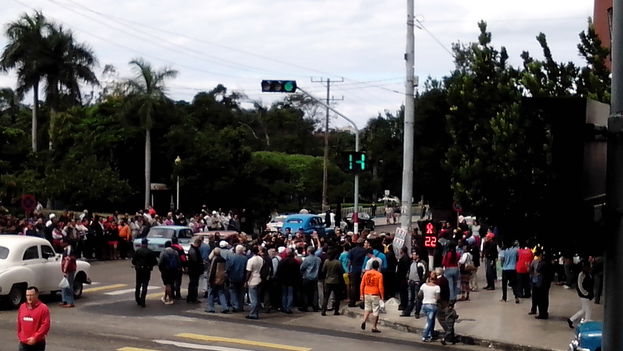
Gathering in Havana on Human Rights Day. (14ymedio)
The foreign press was also present at the site, and several activists have loudly denounced surveillance around their homes. In Palmarito de Cauto, the meeting will be in the afternoon, but Security forces have been present since early in the day, since the Communist Party has organized a “people party” with beer provided, and no passage allowed, in order to occupy the dissident meeting places in the area. The officials have gathered several people across from the headquarters of UNPACU and threatened that if they do not remove posters alluding to the date, there will be reprisals like those of last Friday where there was much violence.
Several activities are planned for the next hours. On the Island of Juventud, in Nueva Gerona, an event will be held at 2 pm.
In Mella there is also found a strong police operation even though there are no activities scheduled.
Translated by MLK
Note: This is and updated and expanded version of information reported in a previous article published earlier in the police operation.
14ymedio, LILIANNE RUIZ, 7 December 2014 — Writer and journalist Angel Santiesteban continues to be detained, since August, in a border guard military unit located on Primera Street in Miramar. His jailers have announced to him this week that he may be transferred to a location yet to be identified.
The hut where Santiesteban has been incarcerated these months overlooks the street, just opposite the security checkpoint. It measures four by four meters. The prisoner cannot walk, stretch his legs, get sun or interact with other detainees. They only let him out once a week to use the phone and every twenty-one days to receive a two-hour family visit.
Santiesteban is thinner and paler. He relates that last weekend he began a hunger strike to demand better conditions like having the right to get sun, walk and run on the ground as is his custom, to have free access to the telephone like the other prisoners, and to receive visits every 15 days. “After an upset stomach, I refused to take oral rehydration salts and I stopped ingesting food in protest of my conditions of confinement,” he reports.
The writer explains that then two State Security officers told him that they would transmit his claim to the command and give him an answer within a week. They told him that “he has done much damage to the Revolution and that if he had accepted the offer they had made him last August his situation would be different.”
Santiesteban explains that in that month, when he was transferred to the border guard unit, officials from State Security proposed freedom to him in exchange for his leaving the country, which he roundly refused.
Wednesday he dropped the hunger strike pending an answer to his demands. Next April he should be released on parole if the authorities comply with the law which calls for release after the completion of half the sentence. Santiesteban also awaits the response from the Ministry of Justice which accepted the appeal of his case indicating that it admits that irregularities were committed in the trial held against him.
14YMEDIO, Havana, 7 December 2014 — The women’s group Women for Democracy has been subject this Sunday to a broad repressive operation in Santiago de Cuba. While they were heading to the church of San Juan Bosco, 28 women from that movement were arrested or prevented from participating in Sunday mass, according to a report by their leader Belkis Cantillo.
The activist, in a telephone conversation with 14ymedio, explained that the political police were waiting for them at “las Alturas de El Cristo,” and the women were forced into several cars to be freed later at locations distant from their homes and the church where they were going.
“Some were left in sugar cane plantations or in the middle of the highway,” Cantillos also told this daily. “They were subjected to quite a bit of verbal and physical violence,” says the woman who, since last September, has led one of the most important dissident women organizations in the country.
Throughout the national territory other activists have complained about an increase in police operations and surveillance around their headquarters or homes. The reason could be the Monday morning start of the 5th CARICOM-Cuba Summit which will be held in the capitals’ Palace of the Revolution.
It is a common practice of State Security to resort to house arrests and detentions during events that involve foreign guests.
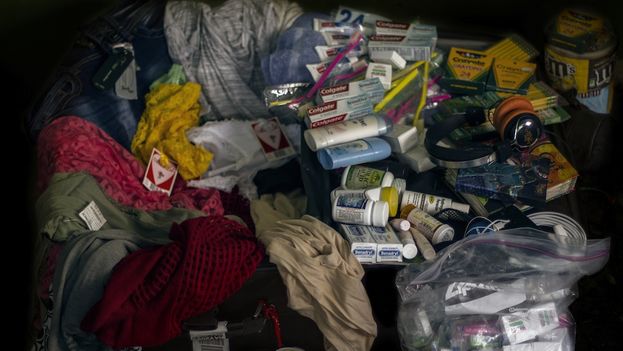
In the suitcase of a traveler coming from Miami (14ymedio)
14ymedio, Victor Ariel Gonzalez, Havana, 6 December 2014 — Establishing the rules of a sport takes time. Let’s take for example baseball, one of the most complicated games that exists; one could ask where the rules for its practice come from, and why some are so convoluted. But when it comes to regulatory whim, let’s go to an activity that increasingly approaches the category of extreme sport, and that is the entry of products into Cuba trying to pass through the controls of the Republic’s General Customs (AGR).
Much curiosity is awakened by the heap of prohibitions, conditions and loopholes that regulate the arrival of luggage and packages to the Island. There are so many questions that the official press devotes a lot of space to explaining how the still-confusing system functions. But more than confusing, annoying, because it affects the way in which Cubans cope with their shortages, while also feeding a bulky staff of officials.
This Thursday the official daily Juventud Rebelde devoted a whole page to detailing, for the umpteenth time, how the mechanism works. With the title of The Other Package – a clear allusion to the demonized “weekly package*” – the text delves into the issues that it considers most important for public awareness in regards to international parcels.
For that it cites, for example, Law Decree 22, where it is provided that the total value of shipments may not exceed 200 CUP (Cuban pesos — roughly $8 US); and Resolution 208 from 2014 whose provisions establish that the import value of one kilo of miscellaneous items equals 20 pesos, so up to 10 kilograms of miscellaneous items can be imported via shipping, with the first 30 CUP (1.5 kilos) being duty free.
Until that point let’s say everything is clear. The complications come when the shipment is made of up “miscellaneous items” and “durable” goods like appliances or tires. In such case, “the sum of both values must not exceed the import limit legally established (…) because all that exceeds that figure will be confiscated after the person chooses the articles that he wants to prioritize.”
This is only the first complication of a thick tangle, because there are also sender-receiver considerations. A Cuban resident on the Island who finds himself on a trip, for example, will not be able to send to himself a package on return to his country. The condition would be that the delivery be classified as “household goods,” and not everyone in the world has this right. Who does? The bulky manual of the AGR offers an imaginative response.
Also, the number of entries into the country determines the quantity of products that can be brought in luggage, and this will affect also the ability to receive packages. In sum, a newspaper page is not enough to explain all that one needs to know when not knowing it could mean that they won’t let your soap or coffee pass through.
In a country where the government lives to complain about external harassment, the citizens live under the harassment of the authorities. Any effort to supply the informal market or even the family economy in an independent way can be considered illegal, without it mattering that said activity serves to remedy the shortages somewhat.
In the capital there are three delivery points for packages. The others are in Holguin, Camaguey, Santiago de Cuba and Varadero. Since there is no courier service, those who live distant from these warehouses are obliged to make inter-provincial trips. More complications, more work, more bother.
The directives of the AGR recognize that the existing installations are insufficient, and they resort to the now usual promise that “we will continue to expand service.”
If there is an excess of luggage or the package is too big – very easy to achieve given the strict margin established – then comes the expropriation, a point that has been avoided by official investigations.
When 14ymedio contacted the AGR asking about the matter, it reported the confiscated articles wind up at the Ministry of Interior Commerce (MINCIN), “so that they can be distributed to the Ministry of Health and Education and others.”
Nevertheless it is extremely difficult, if not impossible, to find in a hospital or school a flat screen television, a bottle of L’Oral cream or other products that are commonly confiscated on arrival into the country.
For its part, at the MINCIN, specifically the “office of attention to the people,” the operator does not know where to direct the question. “This is the first time that someone has called asking what happens to what Customs confiscates.”
One suspects that corruption within the AGR is rampant. After all, the popular wisdom says that in Cuba everyone has a need, so everyone has a price.
It is evident that travelers insist on tricking customs controls, and it is highly likely that they will keep trying. The contraband, another non-institutionalized sport, challenges the imagination, even that of those charged with writing the customs laws.
*Translator’s note: The so-called “weekly package” is a collection of videos and other materials, ranging from news articles to computer games, that circulates hand-to-hand in the ‘grey market’ as an alternative to the very limited official TV and radio programming and other Party-owned media.
14ymedio, Mexico, 5 December 2014 — The meeting Roads for a Democratic Cuba, held in Mexico, closed Thursday with a joint statement signed by the attendees and focused on the consensus points necessary for beginning a democratic transition on the Island.
We reproduce here the entire text of that statement:
We, representatives of diverse organizations and activists of Cuban civil society from the Island and the Diaspora, meeting in Mexico City under the auspices of the Konrad Adenauer Foundation and the Christian Democratic Organization of America, have had the opportunity to concur on matters of common interest which we reflect below:
The urgent need for Cuba to move to democracy
The shared calling that this transition occur peacefully
The respect for diversity of non-violent methods of fighting
Understanding that it is up to Cubans to carry out actions that lead to solving the problems of Cuba, taking into account the role of those who live on the Island and the indispensable support that the Diaspora can and should offer.
How beneficial it would be for the entities of civil society, political actors, governments and international organizations from all over the world to offer greater solidarity in defense of human rights in Cuba.
It is identified as one of the main challenges to work in search of projects for unity of action and strategies for change. Similarly, it is agreed to salute the existence of different projects with these features aimed at achieving a Cuban democracy.
Recognizing the absence from this event of activists whom the Government did not permit to leave the country and others who for various reasons were not present.
Signed December 4, 2014.
Eliecer Avila: We Are More
Yaxys Cires Dib: Christian Democratic Party of Cuba
Manuel Cuesta Morua: Progressive Arc
Reinaldo Escobar: Journalist
Guillermo Farinas Hernandez: Patriotic Union of Cuba and Anti-totalitarian United Front
Jorge Luis Garcia Perez Antunez: Orlando Zapata Tamayo National Resistance Front
Rene Gomez Manzano: Agramontista Current, UNPACU
Eroises Gonzalez Suarez: Liberal Cuban Solidarity Party
Andres Hernandez Amor: Christian Democratic Party of Cuba
Rene Hernandez Bequet: Christian Democratic Party of Cuba
Rafael Leon Rodriguez: Cuban Democratic Project
Omar Lopez Montenegro: Latin American Center for Non-violence
German Miret: Human rights activist
Armando Pena Guzman: Christian Liberation Movement
Marfeli Perez-Estable: Academic
Julio Pichs: National Cuban American Foundation, Cuban Consensus
Vladimiro Roca Antunez: Social Democratic Party of Cuba
Our team had a conversation with the New York Times journalist who has authored the editorials about Cuba.
14ymedio, 1 December 2014 — Ernesto Londoño, who authored six editorials on Cuba published recently by the New York Times engaged in a friendly conversation on Saturday with a part of the 14ymedio team, in the hotel where he is staying in Havana.
Our intention was to interview him, but he told us the rules of his media prohibit his giving interviews without previous consultation. He also declined our proposal to take photos. Instead, he was eager to listen to our opinions in an atmosphere of mutual respect. There were two hours of conversation dedicated to refining, enriching and debating the controversial ideas that the newspaper has addresses in his editorials.
The following is a brief synthesis of what was said there, arranged by topics and ascribed to the author of each opinion.
Journalism
Yoani Sánchez: Cubans are going to need a great deal of information to avoid falling into the hands of another authoritarianism. In 14ymedio we are including a plurality of voices, for example on the issue of the embargo. We leave it to the reader to form his own opinion from a variety of information.
Reinaldo Escobar: The official Cuban press, which is all the press, there are no public media, they are private property of the Communist Party. Now, has there been a change? Yes, there has been a change. Since a few years ago the newspaper Granma has had a weekly section with letters by readers where you find criticism of bureaucrats, things that don’t work or prices at the markets. But look, the emphasis is on the self-employed markets.
So far I have not read a profound criticism of the prices at the convertible peso markets that the Government has, which are abusive. Nor can you talk about the legitimacy of our rulers or the impracticality of the system. Here are two big taboos, and in the third place, the topic of political repression. If they report on a repudiation rally, they show it as something spontaneous on the part of the people, without telling how the political police were behind it, organizing it all.
Miriam Celaya: There are changes indeed. The problem is that there are real and nominal changes, and these changes are generally nominal. Now everyone in Cuba can legally stay in a hotel, which before was forbidden. They never explained why it was forbidden before. But Cubans cannot really afford the luxury of a hotel stay, with wages being what they are; nor can they buy a car, a house, or travel. The problem with the reforms is that they are unrealistic for the vast majority of Cubans. They are a government investment in order to buy time.
There are two of those reforms that are particularly harmful and discriminatory for Cubans. One is the foreign investment law, which is explicitly for foreign investors and it does not allow Cubans to invest; and the other is a new Labor Code which does not acknowledge autonomy, the right to strike, and which spells out explicitly that Cuban workers cannot freely enter into contracts with potential companies investing in Cuba, which constitutes a restraint and a brake.
Víctor Ariel González: Yes, things are changing, but we ask ourselves if really those changes offer a brighter horizon and why people keep leaving, even more are going than before.
More Apathetic Youth?
Miriam Celaya: It is a backlash against ideological saturation, a submissiveness which conditioned almost every act of your life to obedience, to political subordination, whether picking a university career, a job or an appliance, anything. Everything was a slogan, everything a roadblock. This has subsided somewhat, but previously, it was impossible to take a step without hearing “Motherland or death, we will triumph” and go, go… The investigations they undertook to see if you belonged to the Committee for the Defense of the Revolution… the youth of today have not experienced that bombardment of “the enemy that harasses us.” I did not bring up my kids in that, on the contrary, I tried to detoxify them. So this generation, the children of the parents of disenchantment, grew up devoid of that and are at a more pragmatic level, even at a marketing one, whose greatest dream is to leave the country.
Economy
Eliécer Ávila: The law governing the leasing (in usufruct) of lands for farmers to work them was the basis of a plan for increasing food production and lowering prices — so that the average salary for a day’s work might be more than just three plantains.
I come from the banana plantations of El Yarey de Vázquez, in Puerto Padre, Las Tunas. The nation’s food supply is the most critical element in our collective anger. In January of last year, a pound of onions cost 8 Cuban pesos (CUPs). Later, between March and April, the price rose to 15. In May it increased to 25 CUPs and now, the onion has disappeared from low-income neighborhoods. It can only be found in certain districts such as Miramar, at five convertible pesos (CUCs) for 10 onions — more expensive than in Paris — while the monthly Cuban salary still averages under 20 CUCs per month).
I know very few farmers who even own a bicycle. However, any young person who joins up with the Ministry of State Security is in no time riding around on a Suzuki motorcycle.
Embargo
Yoani Sánchez: When talking about the end of the embargo, there is talk of a step that the White House must take, and for me I don’t care for the idea that what happens in my country depends on what happens in the White House. It hurts my Cuban pride, to say that the plans for my future, for my childrens’ future, and for the publication of 14ymedio depend on what Obama does. I am concentrating on what is going to happen in the Plaza of the Revolution and what civil society here is going to do. So for me I don’t want to bet on the end of the embargo as the solution. I want to see when we will have freedom of expression, freedom of association and when they will remove the straitjacket from economic freedom in this country.
Miriam Celaya: The reasons for the establishment of the embargo are still in effect, which were the nationalizing of American companies in Cuba without proper compensation. That this policy, in the limelight for such a long time, has subsequently become a tug of war is another thing. But those of us with gray hair can remember that in the 70’s and 80’s we were under the Soviet protectorate. Because we talk a lot about sovereignty, but Cuba has never been sovereign. Back then, Soviet subsidies were huge and we hardly talked about the embargo. It was rarely mentioned, maybe on an anniversary. Fidel Castro used to publicly mock the embargo in all forums.
Reinaldo Escobar: They promised me that we were going to have a bright future in spite of the blockade and that was due among other things to the fact that the nation had recovered their riches, confiscating them from the Americans. So what was going to bring that future was what delayed it.
Miriam Celaya: The issue remains a wildcard for the Cuban government, which, if it has such tantrums about it, it’s because it desperately needs for it to be lifted, especially with regards to the issue of foreign investments. I am anti-embargo in principle, but I can see that ending it unilaterally and unconditionally carries with it greater risks than the benefits it will supposedly provide.
Victor Ariel Gonzalez: The official justification says that as we are a blockaded country so we have the Gag Law. Because we are under siege and “in the besieged square, dissidence is treason.” There are those who believe that if the embargo is lifted that justification would end. But you have to say that this system has been very effective in finishing off the mechanisms for publicly analyzing the embargo, it has killed off independent institutions.
Then, how will people be able to channel discontent and non-conformity with the continued repression the day after the lifting of the embargo?
Reinaldo Escobar: They will have another argument for keeping repression when the embargo is lifted. Write it down, because “this will be the test” as they say around here: “Now that the Americans have the chance to enter Cuba with greater freedom, now that they can buy businesses and the embargo is over, now we do have to take care of the Revolution.” That will be the argument.
Repression
Yoani Sánchez: In this country people are very afraid. Including not knowing they’re afraid, because they have lived with it for so long they don’t know that this is called “fear.” Fear of betrayal, of being informed on, of not being able to leave the country, of being denied a promotion to a better job, not being able to board a plane, that a child won’t be allowed to go to the university, because “the university is for Revolutionaries.” The fears are so many and so vast that Cubans today have fear in their DNA.
Eliécer Ávila: We also need to understand how Cubans make their living. Ninety percent of Cubans do not work where their calling or vocation would take them, but rather where they can survive and make do. In this country, to be a Ph.D. in the social sciences is truly to be the idiot of the family. This is the same guy who can’t throw a quinceañera party for his daughter, who can’t take his family out to dinner at a restaurant. The successful person in this society is the manager of a State-owned cafeteria. This is because he controls the supplies of chicken, oil, rice, etc. and sells the surplus on the black market — which is really how he makes his living. The fundamental tactic to create social immobility in this country is [for the State] to make as many people as possible feel guilty about something.
Self-employment
Eliécer Ávila: People think that because there is now self-employment in this country, that there is a way to be more independent of the State — which is true up to a point. But the question is, how does a self-employed business person survive? I had to leave my ice cream business. After having received my degree in information technology, I was sent to the interior as a sort of punishment for having an incident with Ricardo Alarcón, who at that time was the President of the National Assembly. It was a turning point for me as I tried to become one of the first self-employed people in my town. I had a 1967 German ice cream maker. The process requires 11 products — including coagulant, which someone had to steal from the ice cream factory. Or rather, I should say, “recover,” because in this country we do not call that kind of thing “stealing.” The milk had to be taken from the daycare center, or from the hospital, so that it could be sold to me. The point is, there simply is no other way.
All of these private businesses that are springing up and flourishing are sustained by illegality.
Yoani Sánchez: … Or in the capital that comes clandestinely from abroad, especially from the exile. There are restaurants in Havana that could be in New York or Berlin, but those have received foreign money or are engaging in “money laundering” from the corruption and from the highest leadership itself.
Eliécer Ávila: Many of these businesses are created so that government officials can place their children, grandchildren and friends in them, people who are no longer interested in the creation of the “New Man” nor in achieving a communist society. Rather, they want to launder their money and insert themselves in society like any other person.
I do not know a single communist worker in Cuba who has been able to launch a business. Those committed Revolutionaries, who gave their all, are today the people who don’t have onions in their kitchens.
Yoani Sánchez: Self-employment has been presented as one of the major indicators of the “reforms” or the Raul regime changes. But on the issue of self-employment many things are not considered: they have no access to a wholesale market, they can’t import raw material nor directly export their products. Thus, the annoyance all Cubans have with the customs restrictions that went into effect in September. The Government justifies is saying that “every country has this kind of legislation,” but in those countries there are laws for commercial imports.
Miriam Celaya: They made a special regulation for foreign investors, so they can import, but not for Cubans.
Yoani Sanchez: Another issue that greatly affects the economy is the lack of Internet connection. We’re not just talking about freedom of expression and information or being able to read 14ymedio within Cuba, but that our economy is set back more and more by people not having access to the Internet.
Luzbely Escobar: It’s not only that: Self-employment is authorized only for selling or producing, but the professionals cannot join that sector with their abilities. You cannot be a self-employed lawyer, architect or journalist.
Miriam Celaya: A large administrative body was created to control the self-employed and it is full of corrupt individuals, who are always hovering over these workers to exploit them and relieve them of their gains. Some tell me that there are fixed fees for inspector bribes. Here, even corruption is institutionalized and rated.
Eliécer Ávila: In this country, for everyone who wants to lift his head towards progress, there are ten who want to behead him. There is much talk of “eliminating the middleman.” However, the great middleman is the State itself, which, for example, buys a pound of black beans from the farmer for 1.80 CUPs, then turns around and sells that pound for 12 CUPs at a minimum.
The New York Times Editorials
Eliécer Ávila: It would be a great favor to Cuba if, with the same influence that these editorials are intended to have on the global debate about one topic [the embargo], they also tried to shed light on other topics that are taboo here, but that go right to the heart of what we need as a nation.
Miriam Celaya: I have an idea. Rather than making gestures about the release of Alan Gross, rather than making gestures about making the embargo more flexible, I think that the strongest and clearest gesture that the Cuban government could make would be to liberate public opinion, liberate the circulation of ideas. Citizens should manifest themselves; this is something that is not happening here.
Reinaldo Escobar: Without freedom there is no citizen participation.
Miriam Celaya: What is going on with these editorials? They are still giving prominence to a distorted, biased view, composed of half-truths and lies about what the Cuban reality is. They are still giving prominence to what a government says, and Cuba is not a government. Cuba’s government today is a small group of old men, and when I say “old” it’s because of their way of thinking, of individuals who have remained anchored in discourse rooted in a cold war and belligerence. The Cuban people are not represented in that government.
Yoani Sánchez: I read editorials when they came out but last night went back to read them more calmly. The first editorial is perhaps the most fortunate, because it achieves a balance between one side and the other, but there are some that I think are really pitiful. Such as the one about the “brain drain” because these medical professionals are living a drama in this country that is not recognized in these texts.
First, I am against the concept of the theft of, or brain drain, because it accepts that your brain belongs to someone, to the nation, to the educational structure, or to whoever taught you. I think everyone should decide what to do with his or her own brain.
That editorial gives no space to the economic tragedy experienced by these professionals in Cuba. I know surgeons who may be among the best in their specialty in Latin America and they can’t cross their legs because people would be able to see the holes in their shoes, or they have to operate without breakfast because they can’t afford breakfast.
Miriam Celaya: There is something in that editorial that cuts and offends me, and it’s that slight of condescension, for instance, in this quote: “Havana could pay its workers more generously abroad if the medical brigades continue to represent an important source of income”… But, gentlemen! To do so is to accept the slavery of those doctors. It is to legitimize the implied right of a government to use its medical personnel as slaves for hire. How can that be?
Yoani Sánchez: With regards to these medical missions, I must say that the human character, no one can question it, when it comes to saving lives. But there has to be a political side and that is that these people are used as a kind of medical diplomacy, to gain followers, and because of this many countries vote at the United Nations on behalf of the Government of Cuba, which has practically hijacked many countries because they have Cuban doctors in their territories. It becomes an element of political patronage.
Another aspect is the economic, which is pushing doctors to leave because they can see the appeal of having a better salary, they can import appliances, pots for their home, a computer. Also, every month their bank account gets a deposit of convertible pesos, which they only get to keep if they return to Cuba and don’t desert from the mission. From a labor and ethical point of view it is very questionable.
Another issue is the negative impact it has on the Cuban healthcare system.
Luzbely Escobar: You go to a clinic and it is closed, or of the three doctors on duty, only one is there because the other two are in Venezuela, and then there is total chaos.
Miriam Celaya: In these editorials, I have read “Cuba” instead of “the Cuban government,” and I have read that the members of “the dissidence” were considered “charlatans.” These definitions, in addition to being disrespectful, put everyone in the same bag. Here, as everywhere else, society is complex, and, while it’s true that there are charlatans among the opposition – and among the government too — there are a lot of honest people who are working very faithfully for a better Cuba, with the greatest sacrifice and risk.
When they demonize it, then it seems that they are speaking the government’s language, as if they had written this in a room of the Party Central Committee and not in a newsroom of a country in the free world. Such epithets, coming from prestigious media, end up creating opinion. That’s a big responsibility.
Dissidence
Yoani Sánchez: In this country the nation has been confused with the government, the homeland with a party, and the country with a man. Then this man, this party and this government have taken the right to decide on behalf of everyone, whether it’s about growing a tomato or a cachucha pepper, or what ideological line the whole nation is going to follow.
As a consequence, those of us who have ideas different from those of that party, that government, and that man in power, are declared to be “stateless” or “anti-Cuban” and charged with wanting to align ourselves with a foreign power. It is as if now, that the Democratic party is governing the United States, all Republicans were declared to be anti-American. This is, like all the countries in the world, plural. If you walk down the street you are going to meet every kind of person: anarchist, liberal, social democrat, Christian democrat and even annexationist. Why can’t this so plural discourse be expressed in a legal way? And why do people like us have to be excluded from speaking and offering opinions?
Translated by Alicia Barraqué Ellison, MLK, MJ Porter and Norma Whiting
14ymedio, Mario Felix Lleonart, Havana, 1 December 2014 — Last November 4, the White House reiterated that the case of citizen Alan Gross, prisoner in Cuba for bringing electronic equipment onto the Island, is not comparable to that of the Cuban spy members of the Wasp Network and that therefore there will be no exchange.
The reaffirmation invalidates the principal objective of the Havana regime in the kidnapping of Gross and took place amidst one of the intense campaigns by the so-called International Conference for the Liberty of the Five, which more than freedom for the prisoners has as its objective making noise and gaining followers from among the naïve of the world who may still be in favor of a Caribbean totalitarianism that approaches its 60th year.
Far and wide, the name of Gross has kept petitions moving that join the regime’s proposal that he should be exchanged for the spies. The Church World Service, for example, which since its beginning in 1948 has served the interests of the extreme left, made a three-day visit to Cuba at the beginning of November in which it made clear that Gross is only its excuse, and its objective: the liberation of the Cuban spies.
Among the saga of the editorials devoted to Cuba by the New York Times, which so far add up to six, the fourth, published at the very beginning of November, aligned with the proposal for exchange contrary to the reiterations by the American government. November, by the way, concludes with the visit by the editorial writer Ernesto Londono to Cuba, and with him, also, the spirit of each editorial arrives on the Island.
The support of the Church World Service for each propagandistic slogan Havana’s political agenda is to be expected, it has always been its trajectory. Never a statement in favor of the victims of the system, always in favor of the victimizer.
But the case of the New York Times has been different, because in its history we remember positions contrary to the dictatorial excesses on the Island, as occurred in the face of the so-called Black Spring of 2003. At that time, Fidel Castro’s “Reflections” did not report favorably on the positions taken by the New York Times, nor did we see the wholesale publication of New York Times editorials in the Communist Party Organ, but all to the contrary.
Like that article in Granma of April 24, 2003, under the signature of Arsenio Rodriguez, which Reinaldo Escobar of 14ymedio reminded us of, where he stated: “…its editorial decisions are neither serious nor liberal, but they obediently comply with the defense orders of the dominant power interests of that nation,” to conclude: “…the true role of The New York Times (sic) was, is and will be to represent the essence of the empire.”
On the other hand, the New York Times has never said that those who hold political power in Cuba are a good government, what it criticizes are positions historically maintained by the United States, which from its point of view have been ineffective in achieving the dismantlement of totalitarianism on the Island and for which it proposes another policy, one of rapprochement, which some call “the embrace of death.”
Even if I do not agree with the New York Times’ thesis, I do hope that after their present visit to the island, the new editorials that are published will correct a little their current direction. For example, in the case of the fourth editorial I have the hope that Londono will not only interview Gross himself in person, but that he will explore other possible resolutions for the case that worries him, that of the spies, more feasible for an exchange and that until now he has not considered: that of the exchange of other probable spies for spies.
This has to do with cases like that of Ernesto Borges Perez, accused of spying for the United States, now confined in the Combinado del Este Prison, in his 16th year of incarceration, the same amount of time as the three who are imprisoned in the United States accused of spying for Cuba.
Under accusations similar to those of Borges are found also Rolando Sorraz Trujillo, sentenced to 25 years since 1995; Claro Fernando Alonso Hernandez, sentenced to 30 years since 1996; the team of Ricardo Alarcon, ex-president of the National Assembly of Popular Power, Miguel Alvarez, sentenced to 30 years, and Mercedes Arce, sentenced to 14; and Eusebio Conrado Hernandez Garcia, close to the ousted Carolos Lage and Felipe Perez Roque, sentenced to 20 years, which he is serving in the Guanajay prison.
It is obvious that the Cuban regime is not interested in packing off these prisoners who seem to be a high priority of general Raul Castro, but one would have to see his reaction if the United States government recognizes that the accusation under which Havana keeps in prison – with severe penalties – these Cubans were correct and were to take an even further step, weighing as more valid the option of exchanging for them the three Cuban spies in United States territory.
Maybe the New York Times, which likes to look for the fifth leg to the table, will redirect its proposal and expose this more comparable option. And that, of course, the exchange of spies for spies will be produced with the antecedent liberation of Alan Gross, who evidently did not spy for anyone and finds himself unjustly imprisoned in Cuba.
This morning several activists reported an act of repudiation against members of the Network of Community Journalists and Communicators in the eastern city of Manzanillo.
According to reports by those to whom this newspaper had access, Leonardo Cancio had organized the celebration in his home for the birthday of a six-year old nephew and invited his colleagues from the Network.
From the day before he could see around his home several women who the activists say were convened by State Security to communicate to them that they would not permit “a party for children organized by the counter-revolution,” and also they visited neighbors’ houses to warn them not to send their children to said activity.
From early hours a crowd, calculated at some three hundred individuals by the members of the Network, surrounded Cancio’s house in order to impede access by the invitees. Nevertheless, some activists like Tania de la Torre, accompanied by her daughter and granddaughter, managed to arrive in advance. De la Torre explains that “the State Security agents called Alexis and Julio” on seeing them come out of the house “pushed us against the crowd” where they would have received blows and threats of future reprisals.
In statements offered to 14ymedio by Martha Beatriz Roque, leader of this group of independent journalists, the dissident remarked, “That is the Cuba that the Spanish Chancellor Margallo comes to visit, where human rights are trampled unceremoniously.”
14YMEDIO, Havana, 28 November 28 — At nine in the morning Friday, 14ymedio correspondent Juan Carlos Fernandez attended his summons at the Piñar del Rio police station. It was the third interrogation to which he has been subjected this year, although on this occasion he did not receive an official warning. A major from State Security, who only identified himself as David, accused him of collaborating with this newspaper, which he characterized as a “confrontational” media outlet that “serves the interests of a foreign power.”
The accusation was accompanied by threatening phrases about a possible “police action” against Fernandez if he continues “doing what you are doing now,” the officer confirmed. Nevertheless, to the question of the accused about a possible arrest and legal prosecution, the interrogator downplayed the seriousness of the reprisals.
Juan Carlos Fernandez defended his right to put his opinions into writing and publish them in any press medium. “I warn you, the weight of the law will fall on you,” responded the man using the pseudonym David, but without giving details. The officer invoked the Constitution of the Republic of Cuba and said that “the Government counts on the support of the people,” at which point the reporter reminded him that the Communist Party has fewer than a million members while the population of the country exceeds 11 million.
Juan Carlos Fernandez is a member of the magazine Coexistence which is published in Piñar del Rio, and since last August he has begun working as a correspondent for 14ymedio in that province. His journalistic works cover the cultural life of the city, reports about social topics and a wide photographic coverage of the territory.
A couple of months ago, Juan Carlos Fernandez brought to light the censorship that Piñareno painter Pedro Pablo Oliva had suffered with the cancellation of his exhibit Dissidences and Utopias.
14YMEDIO, November 28, 2014 — UNPACU issued a statement Thursday night in which it accuses President Raul Castro of having ordered the “liquidation” of the opposition. The organization cites sources from the Ministry of the Interior (MININT) according to which the elimination of the most diligent activists should be carried out in the next three months.
UNPACU believes that the latest attacks on the Ladies in White and Jose Daniel Ferrer fit within that supposed order, given that they involve violent attacks against key dissident figures in the last weeks and come from people tied, in their judgment, to State Security.
In the statement they review last Tuesday’s event in Santa Clara in which activist Guillermo Fariñas asserts he suffered an assassination attempt and in which several Ladies in White were injured, leaving one of them in serious condition. “A similar case occurred at two UNPACU sites in Santiago de Cuba and is now the source of a farce that the government is trying to fabricate against Jose Daniel Ferrer,” continues the statement.
Jose Daniel Ferrer has been called by State Security to give a statement, presumably as a defendant, for the crime of assault against the complainant Ernesto Jimenez Rodriguez. As the statement explains, last November 13th, at the UNPACU headquarters located in Reparto Mariana de la Torre, in Santiago de Cuba, this man, supposedly sent by the political police, provoked a violent altercation.
“Fortunately, with several activists and responsible individuals present at the headquarters, they managed to disable the aggressor, immobilizing him and removing from him the metal weapons that he carried,” the document highlights.
The same individual had sought membership in UNPACU weeks before, for which reason the organization made the usual investigations that “are performed before accepting any applicant.” The conclusion was that he was tied to the Ministry of the Interior.
“In view of such fact, and without telling the individual anything about it, he was allowed to enter the headquarters with the proper control and knowledge by those present of his status as a political police infiltrator and only for events of no significance for activism,” they explain.
Jose Daniel Ferrer, who has denounced the situation, said that “in no case can an individual who has been seen by more than 15 witnesses attacking numerous people cause a peace activist for Human Rights to be taken into police custody with the objective of creating a false accusation and maybe holding him there without a possible defense. We at UNPACU are not going to submit ourselves to this farce in any way.”