My Case File Disappeared / Angel Santiesteban

These days I have wandered with my lawyer through the “legal systems” of Cuba. The Castro brothers, who own the Birán estate that was previously their father’s, later extended the fence to the limit of the jurisdictional waters and converted the estate into Birania. They seized the rest of the nation and have “governed” it as if it were their personal fiefdom, by pure caprice and personal interest.

Back in 1994, they captured me for accompanying my sister to the coast to say goodbye to  her. After 14 months in La Cabaña prison (hell). I was acquitted and they withdrew the charge of “concealment” because I heard at trial that among siblings and parents this offense does not apply. The fact is that I suffered for that year and two months, with its days, hours, minutes and seconds. I should thank them for making me do time, because I matured earlier than I would have by my nature, education and environment. I always say that if God exists he sent me there because thanks to him I was able to prove myself through poverty, the suffering of Cuban youth, and the many tears that I saw fall in those cell blocks. I discovered that my vocation was to be a writer.

I devoted myself to writing in body and soul, and with a literature that highlights the plight of Cubans through the manipulated image that the “revolution” has made us suffer. My characters appeared, shaped into stories and books. These volumes were awarded the most coveted prizes, in spite of officials who tried to see a way of containing my ascent as a writer. Of course I suffered in 1992, when they took away from me the Casa de las Americas prize, according to the testimony of the jurors themselves. In 1994 something similar happened, and finally to run no risk, they decided to remove my work from any contests where there were awards. They also removed my work from portfolios, anthologies and literary events. That was my punishment, the price I paid for writing a critical story that was aggressive according to the dogma of the dictatorship. Honestly I never cared, I was aware it was my duty, and it’s impossible to resist your own nature.

I was visited by several intellectuals who told me to stop.

I don’t hide that I always had the need to write my opinion, my point of view, on the environment, on people I knew, their frustrations, desires, dilemmas, fears, horizons and all that could happen to human beings. I dreamed of writing in a newspaper, on a corner of the last page, but I also knew that was impossible, that with the Cuban system I never could, since all the newspapers are administered by the government, and any attempt to create an independent one is punished with the toughest laws.

On a visit to the Book Fair in the Dominican Republic, I learned there was something called a blog, and it was the closest thing to that little corner of a newspaper, however unimportant it was. I dreamed about posting. On returning I opened my blog. Immediately I was visited by several intellectuals who told me to desist; that was my first warning. I persisted. So I was removed from the Cubarte email, which was paid monthly, to prevent my connection with the rest of the world. I resisted.

After two months I was assaulted by members of State Security, who broke my arm. They thought that this reprisal would be sufficient. They never were more wrong, because by then, with the cast on my arm, I needed to double my effort to write more on the blog and to go meet other Cuban bloggers who offered me support. They staged several repudiation rallies at my front door. Sometimes I went by and greeted them, thinking they were CDR (Committee for the Defense of the Revolution) meetings. Then I found out they were against me, and my neighbors found a way, without being seen, to tell me they were there but had nothing against me and supported me, and they always justified themselves by talking about family, retaliation, etc.

The Prosecutor asked for the laughable sentence of 54 years in prison.

When they realized that blows would not be the way to make me give up, they brought accusations. The first was when I started the paperwork to go to the Word Festival in Puerto Rico. They had to avoid my attending at all costs, and the only way to do this was to bring a civil lawsuit to hide that I was being punished for my point of view.

They began with detaining me, saying I had knocked down a child with my car and I would abscond. The child, as I have said several times, luckily never appeared, nor did the charges. But the time of arrest was on the record.

Finally they manipulated my ex, from whom I had been separated for over two years. They accused me, without any evidence or witnesses, of so many things as if they had happened that perhaps they thought at some point of torment I might ask for mercy and promise to surrender.

The truth is that adding up all those years in prison, according to the prosecutor’s request, amounted to the laughable sum of 54 years (without including the other charges that they brought and then dismissed).

The prosecutor, anticipating how ludicrous that would look to international opinion, decided to “combine” the charges and requested 15 years in prison. For this they invented a “witness” (with acute neurological problems, who was a career criminal with more than 30 convictions, including theft, fraud, harassment of foreigners, etc..), and thanks to a hidden camera the truth came out and he showed the clothing they gave him and other gifts he had been promised, and invitations to dinners and swimming pools, all in exchange for a declaration against me.

When they learned about the video, because I gave it to the prosecutor, they accused me of “attack” because they made him declare that he had been threatened into making the video. Finally an expert showed that the man in the video was telling the truth. I suppose the complaint was not eradicated since I was never summoned to make a statement.

They worked in a feverish manner to make me submit.

Since then I’ve been waiting for the trial. After three years of being summoned to the Picota station at 100 and Aldabó, I can understand they are tired, bored with waiting for my submission, my incorporation into the fold. There is no shortage of advice; I always warned them that it wouldn’t happen, but they have so little capacity to understand that they worked feverishly to make me submit. Finally, from my first statements to what they are today, there are differences, they changed them, but what they didn’t imagine is that the first time they delivered the file I photographed every page, and you can see the rough work of falsification they did to incriminate me. Now they settle for keeping me waiting. My case is in legal limbo.

When I turned up with my lawyer at the Provincial Prosecutor’s, which is in charge of bringing my case, they informed us that my file was sent to the General Prosecutor of the Republic. We went to this office, which is located in Miramar. We were told it was sent back to the Provincial Prosecutor. We left the building and to avoid the trip, as we suspected the answer, we telephoned and were assured that the file had not been returned. Fifteen minutes after my attorney returned to the same office requesting that they get their story straight,  there was no choice but to inform him that my file had been delivered to Officer Ribeiro, at the Villa Marista (the seat of Cuban State Security).

Visit to Villa Marista.

After the information we headed towards Vibora. We stayed for two hours in the waiting room. They told us that the file couldn’t be found. And we had no choice but to return and continue to wait. In fact the “judicial laws” require that notice of any movement of the case file has to be given to the defense counsel. This step was never fulfilled.

In these three years I had to turn down 27 invitations from universities, festivals, book presentations and book fairs. Right now five of my books are being published in different countries. I think that’s the real punishment.

Anyway, I always say, we are the generation of children that nobody wanted, and if they gave me the opportunity to return to the time I opened the blog and caused myself so much trouble, without even thinking about it I would do it again, only with more emphasis.

Ángel Santiesteban-Prats

Translated by Regina Anavy

April 29 2012

Story of an "Occupation" / Yaremis Flores

Yaremis Flores.

The coordinator of the Cultural Project OMNI Zona Franca, Amaury Pacheco del Monte, is a dreamer. He fantasizes he can offer his family a comfortable life. He’s far from juggling enough to meet the needs of his six small children. His family suffers fromthe housing shortage onour island, and on top of that,from institutional and human indolence.

Fourmonths ago Amaury illegally occupied an apartment in the capital district of Alamar. He broke into a building that had been vandalized and used by lovers. The apartment was empty for years, but it was requested by several neighbors who lived stacked on top of each other, or who had serious health problems and needed an apartment like that one, on the lower level. Amaury lived in subhuman conditions, like other Cubans, even if, according to the Constitution, everyone has the right to adequate housing.

The maxim that your best friend is your nearest neighbor doesn’t have as much force today. The neighbor upstairs sleeps peacefully, without turning the passkey that could supply water to the new tenants. He refuses to do it until ordered bysome authority.

Weeks pass without access to water or electricity. Institutionslike the Committee for the Defense of the Revolution, the Federation of Cuban Women and Social Workers have made an appearance, each like a poor student who goes to school just to be present. They appear unfazed by the shortage of essentials. The Neighborhood Council also remains deaf and dumb before these events.

“Representatives of some agencies advise me to say thatthey alreadywent through here if someone checks; they take notes as proof and go away,” points out Iris Ruiz, Amaury’s wife. “I won’t accept a bureaucratic response,” she says, with her newborn daughter in her arms, who, asleep, seems oblivious to what is taking place.

One of the most famous phrases of our National Hero, José Martí, comes to mind: “Children are the hope of the world.” It’s ironic to see a family that has contributed to thealready marked birth rate in our country unable to find a solution to their problem.

The General Housing Act offers some ways to solve cases like this. One is to facilitate the status of squatters so they become renters, with the possibility of purchasing the home and paying the set price.

Ibelieve in the popular saying “if you want it enough, it can happen.” However, Amaury’s family awaits a favorable ruling by the lazy officials. Not out of pity, but because of their duty to uphold the law.

Translated by Regina Anavy

March 8 2012

"Occupy" in Havana / Yaremis Flores

Yaremis Flores.

On the periphery of Havana, in the Alamar district,cases of illegal squatters inunoccupied buildingsare proliferating. The Government and the Municipal Housing Division (DMV), the entities in charge of solving the problem, are simply targets for the numerous complaints and pleas of the population.

“You’re not on the list of priority cases, there are people worse off, and they haven’t committed an offense like you,” said Rita, president of the Alamar Government, to Iris, on Thursday Feb. 9, in an interview, togetherwith the DMV Legal Subdirector.

Iris Ruiz, the wife of the OMNI-ZONAFRANCA coordinator, and her 6 small children, occupied the apartment 4 months ago, Number 1 of the Building E-83, Zone 9 Alamar, where they currently live without water or electricity. Her family was declared an illegal occupant by Resolution 1608/2011, which establishes that “in 2004 the house was confiscated, after the definitive exit of the owner, who went to the U.S.”

“It’s uncertain that the house was confiscated,” said Iris. “The Director of the DMV told me that the apartment is not included in the housing stock. After 2004, two people lived there. One of them is still on the records of Betty, the president of the CDR, even though they abandoned the country more than 5 years ago.”

“They left this apartment ruined, while other people needed it,” Iris added. Neighbors say a DMV inspector visited the site several times with apparent illegal buyers for the property.

“Rosaura, a neighbor of this building, has a son who had a heart operation, and she lives together with 10 people; Estela, a neighbor at Building E-79, has a paraplegic daughter and needs to live on the ground floor. These are two of the parties who tried to get the unoccupied apartment. The Government’s response was negative, because “the apartment is already taken.”

Who gets priority? Iris wonders.

According to the President of the Government of Alamar, at the municipal level no institution has the power to assign housing. Since 2006, this functionhas been the responsibility of the Provincial Government. “Only from me can you get an apartment, since our mission is to combat illegal behavior,” Rita warned Iris, after showing her the extensive list of squatters, waiting for eviction by the authorities.

Yaneisy, known as “the Twin,”already has lived through the experience of an eviction. She’s had a social-work case-file in the Alamar DMV for 16 years. Some time ago, she illegally occupied an apartment. “Theyevicted me with my 2 young children and put all my belongings on the street. They told me I should go back to my place of origin: a 2-room apartment, where 12 people were living together,” she said.

The housing shortage is a sad reality that increasingly affects a larger number of Cubans. Those scattered around by the usual shortage can’t afford to pay monthly rent for housing, let alone buy a house, whose prices don’t invite optimism.

Translated by Regina Anavy

March 6 2012

Mr. Lázaro Fariñas / Angel Santiesteban

“A Miami-based Cuban journalist” is the same one who, a while ago, was complaining, as usual, because in Miami they permitted for only 24 hours a billboardshowing the five spies sentenced by the United States. We should thank him in some way for teaching us that there, in “enemy” territory, at least they can engage in political criticism and disagree with the government. By contrast, in Cuba you can’t even think differently. And I congratulated him for having fled with his family to a land, if not of absolute freedom, at least of limited freedom, as he wanted to explain in his column.

And now this man once again has the nerve to say in a Cuban newspaper, “Cuba is making progress, despite the doomsayers” (29-11-2011), without specifying which way is forward, it may be the abyss, and he states that “I had a friend in Miami who was a radio commentator; heconducted interviews and made comments on that city. He defended Cuba (meaning the dictatorship) to the hilt and attacked the extreme right-wing Cuban Americans with a sarcasm and intellectual ability that few can imagine.”

I wonder if the author hadone lobe of his brainremovedso that he doesn’t mindlooking ridiculous, clumsily trying to manipulate the Cuban opinion. Or ishe just another propagandist, supposedly a journalist, since the paper supports everything they put in it. In short, he is complying with the regime and continuing to receive benefits that are granted in return for the services he provides.

Howcan this guy play with the intelligence of Cubans in such aclumsy and inconsistent way? Or is he laughing cynically about the people of Cuba? I’ll never understandhow someone who left the countryto improvehis professional and private life now defends the cause that made him flee. Because it’s impossible to be an envoy of Castro in Miami, a member of another “Wasp Network” that operates without prejudice in the media there, and thatsurvives olympically under the noses of its enemies.

The fact that someone in Miami had a radio program where he judged, criticized and ridiculed the samepeople who aresuffering deeply fromthedistance from their land, without anyone shutting downhis program, or taking revengewith their own hands, seems to me an act of stoicism on the part of those who had to endure it.

I refuse to believe that Mr. Lazarus Fariña has forgotten the fierce repression and censorship that exists in Cuba,now for over50 years, where we never were permitted to havea personal, private and independent media that would provide free speech. Not even the ability to print something, nor the right to write reviews, newspaper articles, radio spots, not to mention accessing the Internet. How canhe defend a process that punishes, with years in prison, those who voice a thought critical of Fidel Castro?

Characters like Lazarus Fariñas are thosewe sadly see in a future democratic Cuba, also defending the politicians in power.

Later he continueshis contradictory writing, wanting to protect whathe criticizes. Since criticizing censorship in order to defend the Cuban government has put him in a bind. Mr. Fariña talks nonsense by saying that this radio commentator, now deceased, named Álvaro Sánchez Cifuentes, “belonged to the revolutionary militias at the time of the Bay of Pigs invasion.” However, clearly his destiny became twisted, and he ended up living in Miami, with thosehe fought in order to avoid being forced to emigrate years later. And he survived in the city where his enemies live, thosehe provoked tirelessly, according to reports, when he asserts that”I let myself go,gave them nicknames and laughed at the stupidity of thesetragicomic characters of thelocal theater that make up the so-called Cuban exile community of Miami.”

Where Fariñas reaches new levels of cynicism is when he says “I’ve never liked participating in programs run by people who hold my own opinion. I prefer debate and discussion.” I infer that the place referred to is Cubadebate, the space of least possibility of discerningthat exists and in which the official, registered “journalists” publish, like Fariñahimself. Even more contradictory is the fact that his article is published in a country where not even a remote chance exists of challenging an official opinion, and in a newspaper where all opinions go in one direction.

Mr. Fariñas enjoys the benefits of being on both sides. He lives his “fierce” capitalism, which he doesn’t abandon, and he defends the system that doesn’t accompany it. From a short distance the story is different, and he knows it better than anyone. He survives in Miami andtakes his vacationsin Cuba. These peoplewho don’t knowthe meaning of the word”dignity” are the allies that the Cuban government deserves.

WhatI most wish for Mr. Fariñas is that his U.S. citizenship berevoked and he is returned to his Committee for the Defense of the Revolution, that they make him President of his block, and that he experience the stark reality of the Cuban people.

Then we’ll see what he says.

Translated by Regina Anavy

February 17 2012

Another Transportation Crisis in Havana / Iván García

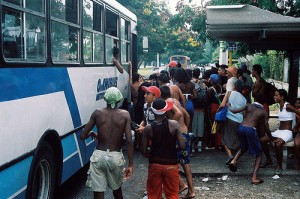
Transportation in Havana is again in a decline. It’s experiencing another crisis. Traveling inside the city limits by public bus can take two hours. If you’re lucky.

Seeing people sweating buckets under a blazing sun and trying to crowd into a small doorway of a house is really something.

It takes 40 minutes for the P-8 to come by, one of those articulated buses belonging to Metrobus, the company in charge of moving large concentrations of people in its fleet of 469 articulated buses.

The P-8 has a route that goes from the Reparto Eléctrico, in the Arroyo Naranjo municipality, up to the Pan American Village, located in the municipality of Habana del Este.

In its journey of one hour and 20 minutes it goes through the municipalities of Arroyo Naranjo, Diez de Octubre, Cerro, Centro Habana, Habana Vieja and Habana del Este.

When in late 2007 the Cuban government opened its wallet and bought 469 articulated buses in Russia, China and Belarus, the city bus service improved dramatically.

Metrobus, the company located in Nuevo Vedado, a stone’s throw from the Zoo on 26th, designed a route that covered all the important and busy roads of Havana.

There were 17 lines. And their frequency varied from 5 to 10 minutes in peak hours. Until mid-2010, with some interruptions, the system worked well.

By the last three months of the past year, bus service began to falter. At the Mulgoba terminal, where the  P-12, P-13 and P-16 buses are kept, for a route between Santiago de Las Vegas, Central Havana and Vedado, 37 out of a fleet of 70 buses were out of service, for lack of spare parts, tires and batteries.

At a session of parliament held in December 2010, the Cuban economic czar, Marino Murillo, recognized the problem and pointed out that there were no financial resources for large purchases of spare parts.

According to Murillo, the bureaucrats were to blame for the collapse of the transport service, because of their erratic calculations and poor management. He didn’t promise anything. He just affirmed that it’s possible the State might stop the tourist buses to keep the peoples’ buses rolling.

But in 2011 the service continues to be in a tailspin. This summer, when thousands of people go to the eastern beaches and the playgrounds or carnivals in Havana, the malfunction of public transport will make travel by bus crowded, and it will take people several hours to reach their destination.

In the Diez de Octubre municipality, the most populous in Havana, at any time of day the bus-stops are full of angry citizens, and between the heat and the bus delays, violence can surface.

Any stray touch on the “guagua” — as buses are called in Cuba — an accidental kick or crazy comment, can unleash verbal or physical aggression among those who are daily forced to board, as if they were expert ninjas, the Metrobus company buses.

What’s worse is that there are hardly any alternatives. In Havana there is another state company, Metropolitan Omnibus, with several hundreds of Yutong buses, manufactured in China. They have been designed to fulfill a supporting role in the scheme of urban transportation.

Their frequency should be between 25 and 40 minutes. But they normally take an hour. Or more. Therefore, the major burden of responsibility for passengers belongs to Metrobus.

When people like Sara, who’s retired, have to arrive on time, they often leave home three hours in advance. And try to maintain an Asiatic calm. Sometimes the buses don’t stop at the bus-stop. And she, with her 60 years and several extra pounds, must run 100 yards, like a Jamaican sprinter, to board the bus through the back door.

Sara sees the bright side. “It gives me some exercise. And if I get on at the back door, I don’t pay.” Bus fare costs 40 cents.

But banks and service centers don’t usually have enough change. Therefore, people pay with one peso (five cents in CUCs). Those who pay. Alejo spends 60 pesos per month to move around the city ($2.50 in CUCS).

It may seem small, but it means a third of his salary as a school custodian. A trip inside one of these buses is infuriating. Their routes are extensive. From the starting point to the end, the trip usually takes between one hour, the fastest, to an hour and a half if it crosses 10 municipalities by going around the city.

If we believe sources inside Metrobus, currently there are 227 bus-stops. And problems because of a lack of spare parts or damages after an accident. To minimize the crisis, the Havana government is taking some measures, such as using workplace vehicles in peak hours and on important routes, in an attempt to alleviate the urban transport deficit.

Since Castro came to power in January 1959, transport in Havana has been a headache.

Not even in better times, when the Communist countries of Eastern Europe and the Soviet Union existed and gave us petroleum and plumbing supplies, has Cuba had a decent transport service in its capital.

It was thought a metro would be built with the help of North Korea. But everything remained in the planning stages. Getting around the city this summer will be an ordeal. Between the heat and the bad service.

Only those who have money, thanks to remittances, working for themselves, getting good tips, having illegal businesses or stealing from their jobs, can afford the luxury of taking private taxis that for 10 or 20 pesos take you quickly to any place in the city.

About 10,000 private cars have become the best fleet of taxis in Havana. Most were made in the United States and have over 60 years of use. Their owners have had to “invent” to keep rolling. But they work. And well. In Cuba there are things that nobody can explain.

Translated by Regina Anavy

October 15 2011

Catholic Cuba / Angel Santiesteban

I’ll never forget when the news came from Radio Marti that we Cubans had a Cardinal. My mother, excited, let me know, and from her tearful eyes came her illusions about the Catholic Church, that had just added to its conclave a high church official. From her hopeless simplicity, my mother intended to convey to me that, hierarchically speaking, “a cardinal is more than Fidel,” as she decreed. I remember that I shook my head yes; I didn’t want to spoil her illusions.

Of course we know what a cardinal means, but those who should have believed it didn’t. ”President” Fidel Castro and his supporters ultimately never finished the work of mowing down the church of the Cuban people. That unfinished task has always been his frustration.

In my humble person Pope John Paul II had one of the faithful who most admired him. My love for him became worship. In addition to being the Holy Father, he was a born political leader. And I will always keep the thrill I felt when he greeted me, an unimportant bystander, when he expressed love from his motorcade.

I will always remember his visit with gratitude. But if I had been his advisor, I would have suggested that he not turn up in a Cuba without freedom, without progress and without the most basic respect for human rights: Freedom of Expression. Many Cubans placed their hopes in his visit, thinking they would gain significant social achievements, political freedoms, and even that it augured multiparty elections.

It’s healthy to remember the years of “politicking” that keep the Castro brothers in power, and needless to say, they wouldn’t accept any visit, not even of Jesus Christ in person, if it jeopardized their power. I always knew that with objective clarity.

After the Pope left, we still have hope, even if we have empty hands, because after all we keep them in our pockets, there’s no point in showing how empty they are.

What we Cubans have to achieve won’t come from anyone’s visit, nor from the “peace concert”, although it had good intentions, nor from the “U.S. blockade.” It will come the day we demand what belongs to us by our own right. Then, after participatory democracy wins and Cubans have the right to choose freely and consistently what they want for themselves, we will welcome the current Pope, and also, spiritually, we will receive the Vicar of God, now in heaven, Father John Paul II, the simple man and scholar who was Wojtyla.

But we know that the road to paradise is paved with good intentions, and so is the one that leads to freedom on the island of Cuba.

Ángel Santiesteban-Prats

Translated by Regina Anavy

January 26 2012

The General’s Speech – An Odd Catharsis / Juan Juan Almeida

The speech by General Raul Castro Ruz at the regular meeting of the National Assembly was opportunistic and authoritarian. To denationalize Cuban society, as a decision of the State, does not mean much, especially when political discourse doesn’t reflect the real need for a non-state sphere, or limit the unlimited powers of the Party and State. On the contrary, it mitigates and releases the State from an obstacle that consumes it.To pretend and gain time is an interplay to recover and strengthen the State. He made it very clear by saying “We are not abandoning, even for a moment, the unity of the majority of Cubans around the Party and the Revolution, that unity that has helped us get here and continue to move forward in building our Socialism.”

Why is Raul blaming the endemic corruption on Cuban leaders, and not putting his brother Fidel at the top the list? What is the meaning of the letter he read before the beginning of the long-awaited regular session of the assembly? It says, “You brought us freedom, gave us land and labor.” Manipulation is the word, a direct way to monopolize opinion. Conditioning the audience is the same as censoring it.

The parliamentary bacchanal only reports. There was no confrontation of ideas nor a free and plural debate. As always it was a poor simulation, a cathartic adulation among people who share the same ideological position, similar ethical principles, a single party and the same aspirations. What else could we expect?

Mr. President, no doubt you need to restore lost confidence to the people. The measures or maneuvers, however you call them, to reshape immigration policy, subsidize the sale of some building materials, make housing policy more flexible, authorize the purchase and transfer of cell phones, cars and houses,rearrange the sugarcane zones, sell agricultural products to tourist-industry complexes, and expand the area of land in usufruct serve only to give credit and acknowledge a young, new social class, so it will give you support and backing.

Talking about the future of Cuban socialism as something new, forgetting the present, creates a laughable disappointment. It crosses the line in its disrespect of the Cuban people.

The President-General, Machiavellian and hypocritical, made a show of a benevolence that he doesn’t profess and needs to represent. He announces as a commendable decision that he is pardoning over 2,900 prisoners. He says further that he took into account the announced visit to Cuba of Pope Benedict XVI, and the celebration of the 400th anniversary of the discovery of the image of the Virgin of Charity del Cobre.

He should be ashamed; at the least he should be scolded. The release of those prisoners, among so many other interventions and pressures, national and international, is the essential result of the unequaled prowess of the LADIES IN WHITE. Raul Castro is too dishonest, and too insignificant for my taste.

Translated by Regina Anavy

December 28 2011

Silito Tabernilla, A General / Juan Juan Almeida

JJ: There are men who unwittingly become part of history. That is the case with General Tabernilla.

Where were you born?

ST: I was born in beautiful Guanabacoa, son. I lived there a year and a half, then we moved to La Cabaña where my father belonged. I kept living in Guanabacoa, I never left. My uncle Marcelo, my father’s brother lived there. There were three brothers: Francisco, Carlos and Marcelo.

JJ: When did you join the military?

ST: I told you that when I was a year old or so we moved to La Cabaña from Guanabacoa. From early childhood I lived among soldiers. I am a soldier by birth and by calling, but I officially entered military life in 1937, the same year my wife was born.

My brothers became pilots, but aviation didn’t do anything for me. I didn’t like taking a plane to go from here to there. If they gave me an order I’d do it, but I don’t like to fly. Even here, every time they invite me I say no ….

JJ: What do you remember about that last flight,when you left Cuba?

ST: Well, it was a long process. The American ambassador told Fulgencio Batista that he should leave Cuba and that the United States would not recognize the government of Rivero Agüero.

Batista accepted, but if he had acted like a President, people would have supported him, and the military also, although many soldiers were disgusted because every time they presented well-thought-out plans to finish off Fidel, Batista rejected them. It was unbelievable how he defended Fidel. Of course, Batista was not a soldier, neither by career nor mind-set.He was in the army as a sergeant stenographer.

On December 2, 1956,the telegram came about the landing of Fidel Castro and a group of around 100 men. We found out even before the landing, and we could have acted. By then I was head of the infantry division in the military town. At 11:00 I asked the CIM for Batista, and they informed me that he was eating at the home of Dr. Garcia Monte. I went there, and when I arrived they were playing canasta –the Admiral, Rivero Aguero, Garcia Monte, some others and Batista. He stared at me. I talked to him about the landing and our lack of reaction. He asked me for discretion, he said: “Silito, let’s talk about this later, I don’t want Martica (his wife) getting nervous.” After a while he got up and asked for a map. They brought him one from the Esso gas station. He opened it and immediately asked where the landing had been. He knew nothing about it. He proposed sending 40 men.It was totally crazy, but he believed he was invincible.

JJ: Invincible, like any dictator….

ST: Yes, invincible. Batista under-estimated Fidel Castro, or maybe he wanted to help him. With respect I suggested to him that he send 2,000 men to put a quick end to the incipient insurrection, but Batista answered: “Listen, Silito, you’re crazy, don’t you know that no one lives in the Sierra Maestra?”

Look, he had no idea about what it means to be a soldier. Then they sent a battalion under the command of Juan Gonzalez. In Alegria de Pio Captain Morelos Bravo had made contact with those we called “the rebels” in a sugarcane field that was on fire. I’ve never seen a cane field burning, it must be horrible.

JJ: And hot.

ST: Impressive. There were casualties on both sides. Our troops regrouped to organize the final offensive, but General Robaina arrived with instructions from the President and ordered a return to Havana. Leaving that situation in the hands of the rural guard was another tremendous insanity. Commander Juan Gonzalez was insubordinate and was punished for it. One can say that Fidel Castro arrived in the Sierra Maestra because Batista let him win. And there were many times that Batista spared Fidel’s life; all those decisions were taken in my office at Columbia, in the military town. Any effective action would have ended that war, but this one extended it, it finished nothing, and the troops were eager to stop and return. Batista had delusions of being democratic, pretending to be something he wasn’t, and because of that he was never photographed with any solider.

Then came the campaign of Herbert Matthews. First he interviewed Fidel Castro in the Sierra Maestra and then Batista in the palace. The publicity from that meeting, a little manipulated,had a significant effect, especially on the businessmen. General Cantillo was named chief of operations and prepared a perfect plan to kill Fidel, but the same problems that set Batista against his own military led him to conspire. That was a process which,in private, ended with the Americans taking part in the affair. On November 1958 Mr. Powell met with Batista. After that meeting Batista himself told me “Listen, Silito, when that guy called me, I wanted to give them a kick.” Things were getting complicated,the elections were approaching, and the Americans began to intervene openly in favor of Fidel Castro. This was something incredible that we could talk about for hours. They even took away our weapons, and we had to buy them in the Dominican Republic. When the American ambassador told Batista that he must leave Cuba and that they would not recognize the government of Rivero Agüero, Batista agreed.

I was in the military town, it was about 5:30 in the evening, calm, when my phone rang and it was Fulgencio Batista asking for Cantillo. I called the Air Force and they answered that Cantillo was flying from Santiago de Cuba and would land in Columbia in about an hour. I told Batista, and he said that when the plane landed, to order Cantillo to meet him at his house at 8:30 pm. It was Cantillo’s wedding anniversary, so they met at 10:30,not at 8:30 as previously ordered. When I got to Kuquine,there were several people. Cantillo arrived at 10:30, and they enclosed themselves in the office for 10 or 15 minutes.

When I returned to Columbia, I went with the order to deliver the division under my command to General Cantillo (he who has the division has control of Columbia). I had sent for the top officers. We did the transfer of power.Here I have it saved as a historical document of my immediate resignation. There Cantillo informs us that the president has decided to resign to avoid bloodshed. Some were happy thinking about the end of the war.Others were sad, envisioning perhaps that there would be a much longer and worse war.

I returned to the residence and Batista was eating. When he finished, he told the duty officer to let us come in. We generals entered, and Captain Martinez picked up the charts and the operations dispatches in the room. The planes were ready; our route was to fly to Daytona Beach. Batista’s fate would be decided during the flight itself. The last thing I remember about Cuba is that I got on a plane, and with the same gun I had when I rode into Columbia, I landed in Jacksonville.

JJ: And tell me, General, have you thought about returning?

ST: Yes, absolutely yes, I’ve thought about returning. It’s what every Cuban yearns for.

Translated by Regina Anavy

Concave and Convex / Juan Juan Almeida

The good, the bad, the beautiful and the ugly are just points of view. The legal or illegal is something different altogether. I don’t believe in the truthfulness of any political discourse, at least not until someone begins by saying, “Ladies and gentlemen, what I’m about to say is false and manipulative.”

I’m all for theappearance of Pablo Milanes in the city of Miami. Look, that doesn’t make me an enemy of those who rightly protest the presence of the singer in the capital ofCuban exile.

For me, the controversial concert and the performance of a bulldozer breaking Pablo’s CDs are acts with the same cultural value. I like both; they inflame and fascinate me. Antagonistic positions always create diversity, and they generate freedoms. But it’s sad to see that even today, Cuba and Miami continue to show the sad pride of being fiefdoms dominated by the same dictator.

If there is anything that accompanies me since I started thinking, it has been my doubts. Free will is a gift for which you have to fight.

Translated by Regina Anavy

August 27 2011

Friends / Laritza Diversent

I was a little busy at the end of the year, but I did not forget you, and I want to take advantage of the first post of 2012 to wish everyone the best for this year — health, prosperity and happiness — and especially to all Cubans who follow my post, I hope we achieve the freedom we so much desire.

I also want to thank you for the strength and encouragement you give me in your comments. You have allowed me to see different points of view. Even though I can’t exchange comments with you, I like them, although I’ve never seen your faces or heard your voices. Thank you very much.

Translated by Regina Anavy 

January 5 2012

Cuba: A Country Being Auctioned / Angel Santiesteban

Emilio's Daughter (1974), by Servando Cabrera Moreno, one of the works being auctioned off by the Cuban government.

These days the Cuban nation should be crying and writhing in its own betrayal. It gives the sensation of a country winding down, that sells quickly, like someone trying to extract every possible benefit before leaving.

For years it has been auctioning off its cultural heritage on the Internet. Works by leading artists who are not even alive to replace them. Creations that would be difficult to return to our country. This year important works by Servando Cabrera Moreno have been auctioned off for more than 600,000 dollars: A 1957 painting, “Figure with Bird,” “Cocoon” (1945), “Emilio’s Daughter” (1974), and “Kisses” (1966). Also “Last Journey” (1979) by Wilfredo Lam. Among the 44 artists were Tomás Sánchez, Mario Carreño, René Portocarrero, Amelia Peláez and Raúl Martínez. In recent years we have lost an important part of the pictorial wealth of the nation.

In other countries, when private collectors decide to sell, government regulations to preserve the cultural heritage, which is untouchable, establish that the State has priority over cases of interest. Owners have to accept three propositions. They can keep the work but not sell it. They do not have the right to take it out of the country. Also, if they keep a work considered to be part of the nation’s heritage in their house, an annual tax must be paid to the State. This seems a laudable idea to me. I believe that the place for the best paintings of every nation is in its museums, so that they can be admired by both nationals and visiting foreigners.

Theft and demagoguery

Yet lately we hear denunciations from Cuban government spokespeople lamenting the “thefts in the museums by the Allied troops when they entered Iraq.” Also, the world still mourns for the cultural works destroyed and sacked by the Nazi hordes in the invaded countries, a great part of which remain hidden.

But in Cuba it’s like we don’t have the ability to look at ourselves. Education was required for the sake of protecting the supposed Revolution of 1959, and that was no more than a way of allowing Fidel Castro to commit his outrages without being criticized. I realize that to try to do so would have been a grievous mistake. Confronting him would have immediately led to a fierce punishment. Trying to criticize, even constructively and for “revolutionary” honesty, is seen as suicide.

Few of that generation, none of those who today live in the country and participate in the official social life, confronted the designs of Tsar Fidel Castro, and in cowardice they remained silent so they would not be considered eligible for punishment. They preferred to be slaves, silent accomplices, incapable of dissent. They considered this appropriate for survival, and they forgot their place before their own consciences and before history, which will remember them as they were and still are today.

And they tried to transmit that education to the three generations that followed them. And because we don’t accept it they brand us as traitors, saying that we are complicit with an enemy we don’t even know, one that hasn’t tried to “buy us,” “capture us,” or whatever other accusations the spokespeople make on that insufferable Round Table TV show. They don’t still believe in the consciousness of Marti. Later, in personal conversations, they acknowledge that there are problems with the system, and on occasion they even discover a certain admiration for the opposing positions that their fears, in moments of rebellion, don’t let them develop.

Beneficial Intellectuals

So what can remain of a cultural milieu whose Cuban Book Institute sent a group of intellectuals to a Book Fair in Mexico without guaranteeing them economic support? Especially since they were sent to represent Cuba, to obey the orders of the officials who sent them,   and to attack whomever opposed the State. They looked like a “delegation of famine,” and as official writers they were willing to wave the little flags so they could continue being considered “trustworthy” by the regime and keep receiving handouts as mercenaries.

Outside Cuba I have attended the National Literature Awards, to beg from the organizers of international events, with the excuse that “Cuba is poor,” so they will assume that its people are as well, and they bury their pride and decorum. The “Revolution” asked so many to sacrifice; there were times when it made them grovel to ask for pardon for words or actions committed, and the politicians were not grateful and made them lose their shame. I would have to quote the Indian Hatuey, “If that is the revolution, then I’d rather not be a revolutionary.”

Intellectuals, despite not sharing political views, are immeasurably respected for their creative and spiritual work and, in many cases, for their social mission. But they assume an attitude of silence, despite having their souls wounded by seeing how the cultural riches of a nation are lost. The Historian of Old Havana himself, Eusebio Leal, who has returned to the historic center the pride and respect it deserves, is silent before the government’s robbery. The great poet, Roberto Fernández Retamar, Director of the House of the Americas, also remains silent before the depredation, and will leave this life with the blood on his soul of the young men shot for trying to escape in a boat. The President of the Union of Writers and Artists of Cuba (UNEAC), the ethnologist and writer Miguel Barnet, also is silent, as he has always known how to be. They, among many who are respectable voices, should join together to defend the cultural treasures of the nation.

What shall we do with the yacht Granma? Sink it into the sea?

Why doesn’t the Government of Cuba sell the yacht Granma? I know some who would buy it, to destroy it or worship it – the fate of that barge would be their choice. Why not sell all the possessions of the Argentine Ché Guevara? He has many fans in the world who would buy his weapons and uniforms with economic generosity. Let them strip those heroic museums throughout the island, filled with their materials of war. They could be auctioned off! But the egoism of the regime and their lack of respect for the culture has been constant. They get rid of art because they underestimate it. It bothers them because it doesn’t reflect their epic or because its authors are homosexual. They see it only as a source of wealth, and before the economic crisis they prefer to lose the nation’s heritage rather than the symbols that support their ideology, its great farce and fraud. And all this happens before the cowardly silence of the voices called to guard this heritage.

Ángel Santiesteban-Prats.

Translated by Anonymous and Regina Anavy

December 22 2011

A Little Report about Governmental Fraud / Ángel Santiesteban

The last thing able to survive from our Cuban heritage is housing, owing to the totalitarian will of Fidel Castro, who dictated for more than 50 years that everything was his property and only he would decide what was whose and when it stopped being so. Fortunately or unfortunately, the family home was the only thing that couldn’t be sacrificed to survive the debacle that has lasted over 50 years. Soon that ban on the sale of real estate will be a memory.

In the 1980s, the Cuban people were robbed of jewelry inherited from their ancestors; the elderly, to satisfy their children and grandchildren and alleviate their extreme poverty, handed over their goods in exchange for a few “chavitos” [Cuban convertible pesos], which had value only in hard-currency stores, where the prices of the items were laughable. And everything worked like a robbery because there were no other stores where they could get these products, which were nothing special, other than the opportunity to acquire them.

Having dollars in those days could send you to prison for many years. People were confronted with the perfected gears of a governmental blackmail, which left some in bad shape, those who refused to sacrifice the memory of their ancestors for their family. In the end, the old women who gave up their engagement rings, relics that they exhibited on their hands as a window into profound feelings, did it with a mixture of pain and satisfaction, to please their families. They were left with the perception that they were duped like the Indians at the arrival of the Spanish, when they traded gold nuggets for stained glass.

The State also bought their porcelain vases, silver and gold, paintings that their ancestors hung on the walls to admire, design furniture, wealth that went into the coffers of politicians or their families and that now rest in safe deposit boxes in foreign banks. If I may say, it reminds me of the Jewish Holocaust, where they even removed gold teeth by force.

Our people are like the sugar cane: squeezed.

Cuban society has been sacked spiritually and materially, like the cane, which is repeatedly passed through the mill, where it loses consistency, becoming bagasse and powder. What’s painful is that everything happens in total silence, under the auspices and complicity of Cuban officials and intellectuals, who don’t comment because of the fear that always accompanies them in their artistic souls. They remained silent before the grand theft that exchanged jewelry for bread. For once they didn’t fulfill the role, so vaunted, that makes intellectuals the voice of society, its defender, its living memory. Instead, they preferred to turn their backs on the people, and history will recognize this in its righteous assessment.

But circumstances have changed so much for the ruling elite, that it has no choice but to revise its extreme methods and wave the flag, always for the sake of its benefit, ignoring the repeated and lengthy speeches that claimed that “private property will never return to Cuba.” Have you ever wondered how much pain it must cause Fidel Castro to see how the whole house of cards he forced us to visualize is crumbling? He wanted us to believe it as if it were true and palpable. What must be happening and what plans do they have for beginning to return some small freedoms that they took away before and that makes them feel they are losing their valued power? Surely it’s the same feeling of helplessness  the masters felt when they were forced to free their slaves. For let’s not deceive ourselves, no measure of this Government will ever improve things for the people, not even to restore the freedoms and rights that correspond to being human.

The right to be born….in the wrong place?

Now the government has approved the sale of houses, something that had already been announced. But it’s also been more than a year, as “by chance” they began in Cuba, after 50 years of stagnation, to update the property registrations. Everything has been done with the utmost urgency. It has been a so-called mandate for the state enterprises, with the inescapable management of citizens for any procedure involving their homes. In each municipality offices were opened to enter into the books the names of the current owners, with extreme urgency and pressure. They know that time is running out. The locals have handed over premises for these offices, given training courses, printed flyers that have been corrected, and delivered computers, files and office supplies. Visits by the Provincial Director of Justice and political officials are constant. They also are pressured with other requests. They have to answer for how much the total climbs when they get an entry on the books. The first person who began this task, as part of his duties as Prime Minister (Mayor of Havana), Juan Contino Aslan (may his small power rest in peace), was dismissed and now is on the “pajama plan,” (like his predecessors and political mentors, who allotted houses to their mistresses).

The Government of Cuba never makes a move that will not bring it compensation. But in this case, all the trappings lead us to the true intent, which is to take back the properties belonging to the old owners, who have left the country or died in Cuba.

The goal is to erase the past. When the State gets in its possession all the old properties, it will make them disappear and, with the registration, only the updated properties will remain. No property owner whose property was “nationalized” beginning in 1959, nor their heirs, will be able to reclaim something that doesn’t exist and that they can’t prove officially.

Perhaps some have conveyed their properties from exile, but they were the minority. And you might think it’s a commendable gesture of the Castros to assure Cubans that they will not be thrown into the street when the inevitable political change appears, but that would be naive. The real reason is that the power elite is trying to hide the family estates that were seized or inventoried after the departure of their original owners. Inside the great mountain of paper that contains the entries, the personal properties will be lost. By the way, this will reassure the generals and acolytes that they will not lose the confiscated property given to them when they came to power.

The country is bleeding 

The Cubans, in this carnival of small, unknown freedoms, in their desperation to change their reality, in the desire to fulfill some dreams, especially that of emigrating, now can sell their homes. Those who wish to stay on the island immediately think about how that money will solve all their pressing needs: eating, dressing and sleeping without the torture of not knowing what you will eat the next day. The government is already warning that it is “not responsible for the bad decisions of owners who spend the money and end up in homes in poor condition that may fall down, or for those who are wandering around without a roof over their heads.”

Once again, we wonder what function this supposed revolution had, which presumably was made to guarantee people a secure life with equal rights. What do we gain from suffering a dictatorship for more than 50 years, if at the end we find ourselves selling the only things we posses, the only things we could keep? And what’s worse, it’s a “socialist” state that has nothing to do with its people, who were its only standard and justification in this long march of agony.

 The Comandante’s bag

As a child, we thought the “coconut” would come for us, for our body; it would come to take us away for not eating all our sweet potatoes, or for not going to bed on time. After growing up we knew that the man with the bag, the bogeyman, had passed through our lives, and he took in his bundle more than wealth and family belongings. He took the lives and dreams of my grandparents, parents, siblings, friends, those relatives who still grasp me with their nails and their teeth so they won’t be snatched, and already he controls my children and now, if we permit him, our grandchildren.

The Cuban State, for more than half a century, has held up the monster of “capitalism,” which it constantly criticized, to children who were frightened that the “coconut” would come, and by studying so thoroughly the original, it now has become the reflection and has converted itself into the image of “the bogeyman who is coming to take us away,” in order to frighten us with capitalism as communist propaganda.

We Cubans have been scammed. The socialist State is slowly giving way to ideas with which they can perpetuate the dictatorship, a frank regression to capitalism. With the difference that now it will be more vulnerable, because there is no knowledge of either family or social infrastructure, which is necessary to meet and sustain a dignified life.

The big difference is in who wins at the considerable sacrifice of millions of Cubans in this more than half a century. The Castro family lives in luxurious mansions They own several cars and yachts. They travel constantly and have prosperous businesses, fortunes and properties in other countries. They definitely enjoy an income that allows them to live like millionaires.

The beginning of the 21st century has begun to be their end. They sense that they are running out of time. The only thing I don’t know is how and what they will develop for the family to maintain its status and wealth, and to ensure, of course, that it will not be returned later to the Cuban people.

While they prolong the strategies for usurious benefits for the Castro family, the Cuban peoples’ dreams of freedom and a prosperous economy are put off and continue being deferred.

Ángel Santiesteban Prats

Translated by Regina Anavy

November 16 2011


Leaders Die in the Land of Good and Evil / Ángel Santiesteban

Two political leaders have died only a few hours apart. But aside from the timing, they were also incompatible in their ways of seeing life, acting and delivering for their people. One represented Justice on earth and the other personified evil. The first, Václav Havel, was a born fighter, an intellectual and politician by nature, one of those who did not wait for more suffering to oppose one of the most ferocious dictatorships of mankind. For this he was persecuted, humiliated, put into prison and tortured. At the end he died from the after-effects caused by his daring to face a dictatorship that suffocated its people. But at least his people knew how to reward him, and today they mourn him, because he gave them the gift of a free and prosperous country. He was President for the time he needed; he served his term and then watched as his country took off and developed.

The other death, of the dictator Kim Jong Il, we can’t call “human loss,” because for that we would have to have feelings that justify that category. He was no more than a tyrant, the most perverse and egomaniacal that ever lived. After his death, he left behind only the suffering that all of his kind guarantee: punishment, famine and death.

Václav Havel was not content to see his country sovereign, but also fought for the freedom of other nations such as Cuba. In his personal geography the Cuban archipelago occupied a central place. His interest in the Cuban reality and conditions for the Cubans was constant, and from the seat of his country in Havana, we felt the support of his Government for free thought, individual rights and national independence. In us he saw himself in the years of dictatorship, in the current totalitarian state that we suffer. He felt at one with us Cubans.

Kim Jong Il did not stand out in life other than having been the prince of this new type of dynasty shared by North Korea and Cuba, the family legacy. His father, the dictator and mythomaniacal Kim Il Sun, guaranteed the delivery of power to him, which his grandson also received, then is great-grandson. No matter that his country lacks food and freedom; the only requisite is that which coincides with the rest of his autocrat lineage: to maintain power. And before the general disgust of the civilized world, the Cuban government decrees national mourning for the vile tyrant.

At some point, maybe very soon, we will erect the monument that Václav Havel deserves. We will lay flowers there for the rest of our lives, one generation after another. While in North Korea, they would tear down the statues of the Il family, given the opportunity.

We Cubans hope the Korean people will soon get their freedom, like we also want, and we wish them happiness. We offer the Czech people our sincere condolences, and we mourn their leader, a friend who understood and accompanied us at all times. And we will mourn him for more than 72 hours.  We will mourn for eternity.

Farewell, President Václav Havel.

Ángel Santiesteban-Prats

Translated by Regina Anavy

December 24 2011

Art Versus Political Speeches and Promises / Ángel Santiesteban

A few weeks ago I wrote a response about a naive comment on my blog that they signed under the name “Lori” where the following was recommended:

“It is my desire to improve myself, read books by writers who have had to leave my country. Read the bloggers of Vocesdecuba.com, come to Cuba and take the bus, walk the streets. Leave the tour guide and talk to people on my own, those who don’t give a learned speech that protects them from being persecuted. I wouldn’t stay in the hotel pool, but would walk along the malecón and learn about the Cuban reality. I wouldn’t waste my time with the shows at the hotel. I would go to the theater, to see the dilemmas facing today’s society. I wouldn’t buy only traditional music, which they recommend, but also the music that is not promoted, and whose songs are passed, thanks to Bluetooth, from cell phone to cell phone.”

This afternoon I remembered the many “Loris” who hide behind a nickname, either by ingenuity, opportunism or because they are actually cybernetic soldiers in the service of the Cuban state. I invoked them while attending the Bertolt Brecht Cultural Centre for the performance at the Vital-Theatre, of Four Less, by the playwright Amado del Pino, which won the Carlos Arniches International Award (2008) in Spain.

When the Director-General Alejandro Palomino said to light up the stage, on opposite sides appeared two small and humble rooms. In the center, a park bench, the kind that are scattered throughout the island and where Cubans still go to give flight, incredibly and with that stubborn calling, to their dreams and hopes for a dignified life.

The work, intense from the start, which builds to a crescendo from which the story breathes and takes shape, and, well, without being trite, could be called empty-nest syndrome, proposes a journey through a family’s destinies. Generations that harbor different and conflicting illusions. Andrés, the typical old father, a destroyed leader, expelled from the Communist Party, the usual stubborn and honest character that nevertheless needs to continue clinging to utopias, to promises that fade like clouds, who persists in his blindness to the present time and the changes that are imposed for a society lacking the most objective necessities, although he survives in a miserable reality, where fear, opportunism, spite and the abuse of sexual rights converge in an environment that doesn’t help heal the wounds.

Tamara: And that is your job? Do those who run things love you? Look, the worst is that there is no room even for a guy as romantic as you, who holds on to being revolutionary. (spoken with emphasis) Re-vo-lu-cio-nary, not to repeat the same litany…

Ania is Andrés’ daughter, who as a minor requires his signature to emigrate and definitively leave behind their home, and a country that is falling apart without mitigating the imposed conditions of extremism, which her generation doesn’t accept or understand or consider relevant. The mother, the ex-wife, begs him not to agree, that he not allow her to go.

Ania: I can’t take any more speeches, papá.

Tamara: … and at this rate we will have asylum in America!

Pollo: I had a professor who said you have to give up the past for the young. Not out of kindness but because if you only go half-way, they will knock you over and and go by on top of you.

Tamara: This is the only country where people don’t retire, where ministers are 70 years old. If there is no retirement, everything gets confused and you reach your forties receiving treatment as if you had  young promise, with tender certainty of tomorrow.

Andrés:We have become a marriage agency. Here the “uncoupled” Europeans meet partners who are healthy, educated, enthusiastic and even passionate. An entire nuptial prostitution!

In addition, Andrés has a son from a previous marriage, Saul, and because he did not give him legal authorization to leave the country, he separated Saul from his mother, who decided to give custody to the grandmother, so Andrés has a guilty conscience.

Saul: I never knew if you refused to sign to protect me or so you would not have your own problems, and that doubt was certainly the worst part of all.

Andrés: Now would be the time to answer you but I have no answer. Nor do I know; I was mixed up by convictions, by fear ….

Saul: Don’t go looking for answers, papá. They’re not needed. I want to learn to live without asking so much.

As if that were not enough conflict, Tamara, Andrés’ current wife, 15 years younger than he, is expecting her first child and has received a job offer abroad with the possibility of his accompanying them and which he refuses to consider, because leaving is treason, and also because he feels ashamed about his son Saul, who he separated from his mother and who, after all, has had the chance to emigrate, because he works on a cruise, but always returns.

Tamara: What can you offer your next child?  Maybe you’re denying him the possibility of a better life!

All the pros and cons of life as seen from different angles and options, accompanied by the characteristic humor that Amado del Pino places in his works, and that makes us feel like we’re there listening, a mental game of sympathy that infects us with brief sparks of cubanía.

Pollo is a gay friend and work colleague of Andrés. He has refused to join the Communist Party, because it’s the same people who berated him for his courage and honesty in living openly with his partner.

Pollo: It’s fashionable now to save us, to claim us, to enfold us, but neither am I going to ride – as old as I am – in that “triumphal” car. The boss called me on Monday to tell me that they offered me membership in the Party, now. If that means being in the vanguard, they should have given it to me a long time ago.

Andrés is discussing his doctoral thesis, which has been rejected because it was a study showing the low birth rate in the country, considering that young people emigrate at the time when they would normally be having children, and which would have given him his degree.

Tamara: Condemning those who leave or go away is shitty. Some do more damage by staying. My uncle watches the Round Table every afternoon and believes 100 percent of what they say on TV, but he dresses, eats and fixes up his home with what my cousins, who left, send him. I know he’s not rude, he still believes his ideas are true, but it seems to him that it’s too much to continue loving them, to pick up the phone and accept that they aren’t traitors. And that we are in the 21st century, because he buried his younger sister alive when she left for Puerto Rico.

Andrés: I suffer with the defects of this Revolution precisely because it’s mine.

Tamara: That’s the worst part of your thesis.

Andrés: If the young people leave, who are we going to work with? Who are we going to convince?

There’s a moment of greater anguish when Andrés accompanies his daughter to the airport, and she sings a verse of Fragancia. Then the sound of the plane taking off until a light goes out and leaves the stage dark.

The public swallows its suppressed tears because most of us suffer a similar separation.

Next comes a light that reappears like the birth of dawn.

Andrés: Fuck whoever invented the airplane – an agonized sentence because he can still hear the rumble of the engines.

Final theme song: “Thinking, thinking, tell Fragrance that I love her, that I cannot forget her, that she lives in my soul, go and tell her… tell her that I think about her, although she doesn’t think about me.”

Sometimes we doubt if life is different from theater, novels, conflicts that we writers invent and cast to the streets like a virus which then mutates and adapts to the environment to achieve greater damage. How do we measure the influence of our Art on the times, in the actual context of social life? And to what extent can we warn the next generations so they won’t be deceived like us?

I congratulate the playwright Amado del Pino for helping to disseminate with his art the hardships of the Cuban people, which are the same. A reality so alive and Cuban these days, like the royal palms. A denunciation of the social conflicts in today’s Cuba with respect to human feeling, regardless of their place of origin, language and geographic latitude. A perfect canvas that spreads, like rays of light to dark and unknown corners, with the technical and precise colors of Art in its fullness.

I counted the seats that were occupied and came up with 484, and because there were no more, they used the stairs and some chairs around the edge of the stage. Outside there were, like there have been for several weeks, two times that number of spectators who welcomed the news that the run would be extended until October 23.

I wish the Cuban communities scattered throughout the world could enjoy this work, inviting the group Vital-Theatre to book fairs and theater festivals, or by having it put on by artists in other cities. How is not important. The urgent need is to spread the work to get a greater understanding by other spectators about a national reality that has condemned us for over 50 years.

And paraphrasing a text of the play, I would like to remember that 50 years is two times 25. It is five times 10. That means 10 multiples of five. Fifty percent of a century. The full life of a man. A time and space where three or four generations converge, and that the most advanced has not been able to improve the fate of the last, in which coincide the fears and cause hair to fall out and wrinkles and furrows to appear on faces worn out by tears at seeing the departure of our children, siblings and friends. Several descendants who face the same abyss. They lose their teeth and their illusions. We have always been “four less,” up to a hundred less, thousands and millions less who walk scattered around the planet and whose spaces await them on this island of all.

Now it’s time to return. To retake the reins of a runaway country. To be able to spread hope in a land that doesn’t know that crop, so that eventually it serves as gratitude to all those who, in the past 200 years, have given their life for the Cuban nationality, free and authentic. This we owe to them who knew how to die for us, without having earned on our own a minute of that bitter agony.

Let them live in glory!

Translated by Regina Anavy

October 11 2011

Message from Magaly Sánchez / POLEMICA: The 2007 Intellectual Debate

I think that creating a climate of concern and anger among Cuban intellectuals at the moment is the best service you’ve been able to provide to the ideological enemy. I think you have to get away from this tendency to make amends for and single out people who, geared towards I don’t know whom and with evidently much pleasure, left such painful footprints and not just within the field of culture.

Magaly Sánchez

Translated by Regina Anavy

January 2007