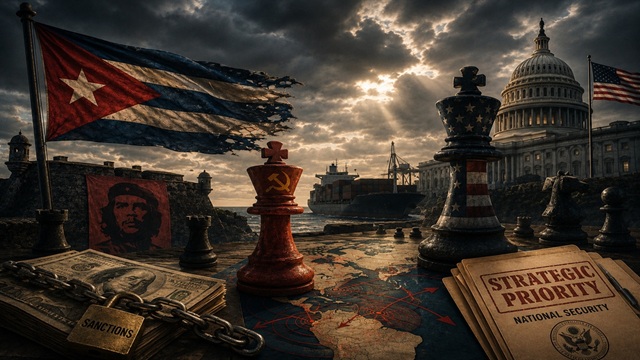
The CubanAmerican Voice, Julio M. Shiling, August 21, 2026 /The United States has correctly identified Castro-Communism as a persistent threat to its national security. The State Department’s July 20, 2026, report, Cuba: The Capital of 21st Century Communism, documents the regime’s decades-long campaign of subversion, ideological warfare, espionage, and support for radical movements both abroad and inside American territory. This assessment aligns with the broader strategic objectives set out in the November 2025 National Security Strategy, which prioritizes reclaiming influence in the Western Hemisphere and denying hostile external powers a foothold near U.S. shores. Overthrowing the Cuban communist system is therefore essential to those long-term goals. Cuban communism must end, and its comprehensive removal is both a moral good and a strategic necessity.
In service of that objective, the Trump administration has pursued a steady campaign of targeted sanctions. These measures have hit regime-owned state enterprises, Cuban Communist Party front organizations involved in domestic and international agitation, and individual members of the dictatorial elite and their families. The latest package, announced August 20 under the title “Imposing Sanctions on Cuban Regime Actors Associated with Marxist Subversive Networks and Corrupt Economic Dealings,” continues this calibrated pressure. Such sanctions are morally sustainable, ethically commendable, and tactically necessary. They deprive the regime of resources used to repress its own population, maintain an extensive surveillance apparatus, and project influence outward. They signal that the United States will no longer tolerate a hostile Marxist dictatorship ninety miles from its coast.
Yet sanctions alone will not cause the Castro-Communist dictatorship to fall. The regime has spent more than three decades refining methods to bypass American restrictions and the broader embargo. Through GAESA and lesser-known commercial entities, it has laundered proceeds from its operations via banks and intermediaries in Panama and other jurisdictions. Loyal Cuban communist émigrés have established ostensibly legitimate businesses abroad that maintain a symbiotic relationship with the dictatorship, enjoying privileges in exchange for services rendered. These soft-power assets, valued in the billions, form an external ecosystem that allows the regime to weather financial pressure. Targeting GAESA’s holdings in Panamanian banks and similar offshore networks would be a logical next step, but even expanded economic measures will not be decisive by themselves.
The regime’s indifference to the suffering of ordinary Cubans further limits the coercive power of sanctions. The dictatorship has never treated the welfare of the Cuban people as a constraint on its survival. A society pushed to the brink of famine would not compel the leadership to relinquish power. The dictatorial elite has repeatedly demonstrated that it prioritizes its privileges and ideological projects over the basic needs of the population it rules. Economic hardship is always absorbed by the people, never by the decision-makers in Havana.
Political timing also appears to shape the current approach. With midterm elections approaching, the Trump administration may be exercising caution. The American communist movement, operating today primarily under the banner of the Democratic Socialists of America, is engaged in a determined effort to capture the Democratic Party. This effort represents a contemporary expression of the “march through the institutions” long advocated by Gramscian Marxists. Given the documented historical and ongoing ties between Cuban communism and elements of the U.S. radical left, the continued existence of a Marxist regime in Cuba is not merely a foreign-policy problem. This is an American domestic issue as well. Restraint before the midterms may reflect an effort to avoid providing political ammunition to these forces.
After the midterm elections, however, the United States must adopt a more resolute posture. Economic warfare, however rigorously applied, is insufficient. The Castro regime retains external assets and networks capable of sustaining it through a single presidential term. If the objective is genuine freedom for the Cuban people and the elimination of a hostile danger to the American republic, policymakers must recognize that nothing short of concrete military action will achieve the necessary systemic change. A palace revolution that merely rearranges personnel while leaving the communist structures intact would be cosmetic. Any authentic transition to a democratic order would have to criminalize Castro-Communism from the outset and dismantle its institutional foundations.
Sanctions remain a justified and useful instrument. They are morally defensible and can weaken the regime’s capacity to repress and project power. But they cannot, by themselves, produce the decisive outcome required. The external ecosystem of front businesses, offshore finance, and ideological allies provides the dictatorship with resilience that pure economic pressure cannot overcome. Once the domestic political calendar permits, the United States should move beyond calibrated financial measures and prepare the concrete tools necessary to end Cuban communism. Only then will the strategic goals articulated in 2025 and the moral imperative recognized in the July 2026 report be fully realized.
The CubanAmerican Voice. All rights reserved.