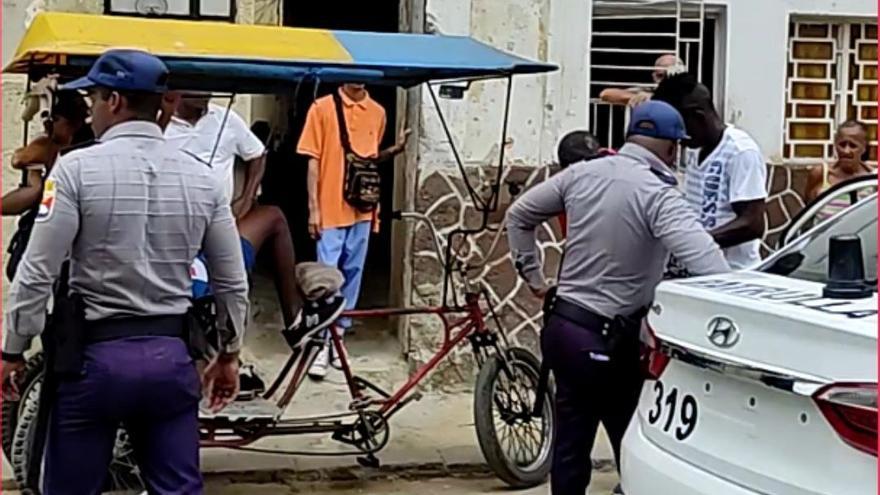
A group of 34 Cuban rafters detained on the high seas awaits a response to their request for asylum. (Semar)
14ymedio, Ángel Salinas, Mexico, 13 April 2023 — The crew of the Mexican Navy ship Comet notified the captain of Puerto Juárez last Tuesday about a “raft” drifting 90 miles north of Isla Mujeres, one of the illegal landing points for Cubans in recent years, a fisherman told 14ymedio.
According to a statement from the police, 34 Cubans were traveling on the home-made boat, including a woman and 33 men, who were trying to reach Mexico when they were intercepted by two coast guard boats.
The Cubans were treated by naval health personnel, who indicated that they were all in good health. They were transferred to the naval station of Puerto Juárez, where they were handed over to agents of the National Institute of Migration.
A municipal security officer identified as Horacio Márquez, confirmed that the Island’s nationals requested asylum. Migration picked up their identity cards and seven passports. “When applying for asylum, the law allows them to remain in Mexico until the case is resolved.” Article 7 of the Law on Refugees, Complementary Protection and Political Asylum emphasizes that “no sanction will be imposed” for illegal entry.
Márquez specified that this group of Cubans is the first known to arrive in Isla Mujeres this year. “The last week of October 2022, a similar group arrived. On that occasion, 30 rafters, who were linked to coyotes, were detained, but nothing was verified. Most continued on their way to the United States.” continue reading
The Migration Law establishes in article 69, paragraph V, the possibility of “regularizing their situation,” but several Cubans have denounced extortion, arbitrary detentions and imprisonment in Mexican immigration stations.
This arrest of 34 Cubans comes a week after journalist Fátima Vázquez said that at least 15 nationals of the Island had disembarked on San Miguelito beach, located near kilometer 13.5 of Kukulcán Boulevard, the main avenue that connects with the hotel zone of Cancun.
Municipal security officer Horacio Márquez said he did not know of any investigation by the Attorney General’s Office on the routes taken by migrants. “There is nothing out of the ordinary. We see it with this group, which was sighted by sailors on the ship Comet, but not through surveillance.”
Another rescue of rafters was recorded this Thursday. The Norwegian ship Bow Summer provided assistance to seven Cubans whose boat was adrift 100 miles from the Yucatan. “They were without food or drink, about to be swept even further offshore. We took them on board and provided them with dry clothes, food and drink,” said Captain Tor-Gisle Bjerknes.
The arrival of these 49 Cuban rafters in Mexico occurs just when the United States Coast Guard has reiterated that the borders are not open. The agency specified on its social networks that “a strong maritime presence is retained to detect and intercept anyone who tries to migrate illegally by sea.”
This Thursday another group of 28 people were returned to the Island aboard the ship Isaac Mayo. According to official figures, in the last six months the United States has returned more than 2,200 Cubans.
Translated by Regina Anavy
COLLABORATE WITH OUR WORK: The 14ymedio team is committed to practicing serious journalism that reflects Cuba’s reality in all its depth. Thank you for joining us on this long journey. We invite you to continue supporting us by becoming a member of 14ymedio now. Together we can continue transforming journalism in Cuba.
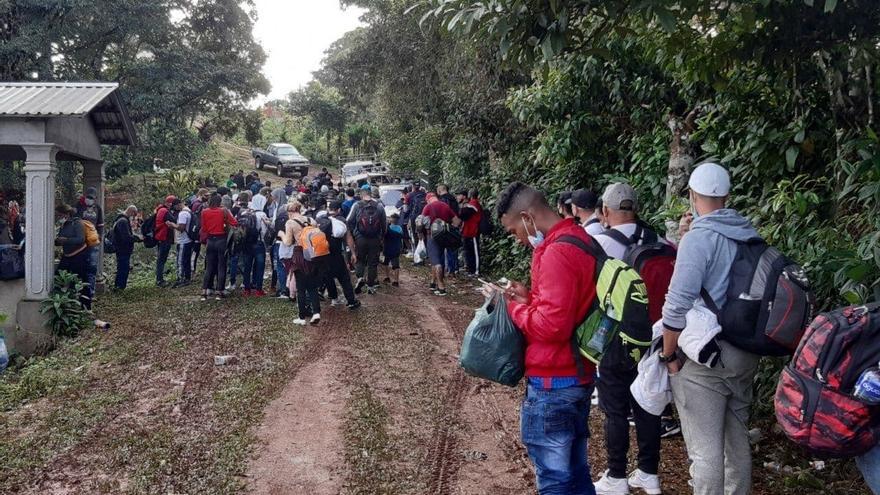
A group of Cuban migrants in northern Honduras on their journey to the United States (14ymedio)
EFE (via 14ymedio), Miami, 1 April 2023 — The Center for a Free Cuba, an organization of the Cuban exile in the United States, affirmed that the round of immigration talks between Cuba and the United States “will only encourage Havana to continue weaponizing migration to increase its influence on the Administration of President Joe Biden.”
“Cuba’s problem is not emigration, it’s the dictatorship,” the organization, based in Washington D.C., warned in a statement in response to a new round of immigration talks between the two countries.
This migratory round, which was held yesterday in Washington, D.C., was marked by a sharp increase in the arrivals of Cubans to the U.S. coasts.
The number of Cubans detained (6,202) when they tried to reach the United States by sea since last October 1, already exceeds that of the entire previous fiscal year (6,182), according to information from the U.S. Coast Guard.
The country’s serious economic crisis has intensified an unprecedented mass immigration exodus, especially to the United States, where authorities detained more than 313,000 Cubans on the southern border with Mexico, which represents about 3% of Cuba’s total population.
According to the statement of the Center for a Free Cuba, an organization whose objectives are to “promote a peaceful transition to a Cuba that respects human rights and political and economic freedoms,” Havana has used Cuban emigration “as a political weapon to repeatedly leverage negotiations with Washington.” continue reading
According to the organization, after the first round of talks on migration between the Biden Administration and Havana, in April 2022, “the State Department announced a series of unilateral concessions” that included “the expansion of authorized travel and educational exchanges.”
“The first benefit is to the Cuban Army through its conglomerate, the Grupo de Administración Empresarial S.A. (Gaesa), and its sub-entity Gaviota, which supervise and benefit from Cuban tourism,” the statement says.
The second, he adds, “benefits the Cuban intelligence service, which has used educational exchanges to recruit spies, insert intelligence officials into academic conferences and compromise visitors to the Island.”
He also affirms that all the migratory crises in Cuba “have occurred during administrations that sought to improve relations with Havana,” and cites among other crises the mass exoduses of Camarioca (1965), Mariel (1980) and the so-called “Crisis of the Rafters” of 1994, in addition to the current one.
“No negotiation with the Cuban dictatorship, manipulated by Havana and using migration as a weapon, can succeed for the Cuban people or the interests of the United States, while the Castro regime imposes an internal blockade on Cubans and more than a thousand Cubans are imprisoned for exercising their right to express their desire for a free Cuba,” said John Suárez, executive director of the organization.
The United States defended on Wednesday that the measures it has taken have allowed the reduction of irregular immigration from Cuba, but this country considers, on the contrary, that Washington is “stimulating” illegal immigration.
Translated by Regina Anavy
____________
COLLABORATE WITH OUR WORK: The 14ymedio team is committed to practicing serious journalism that reflects Cuba’s reality in all its depth. Thank you for joining us on this long journey. We invite you to continue supporting us by becoming a member of 14ymedio now. Together we can continue transforming journalism in Cuba.
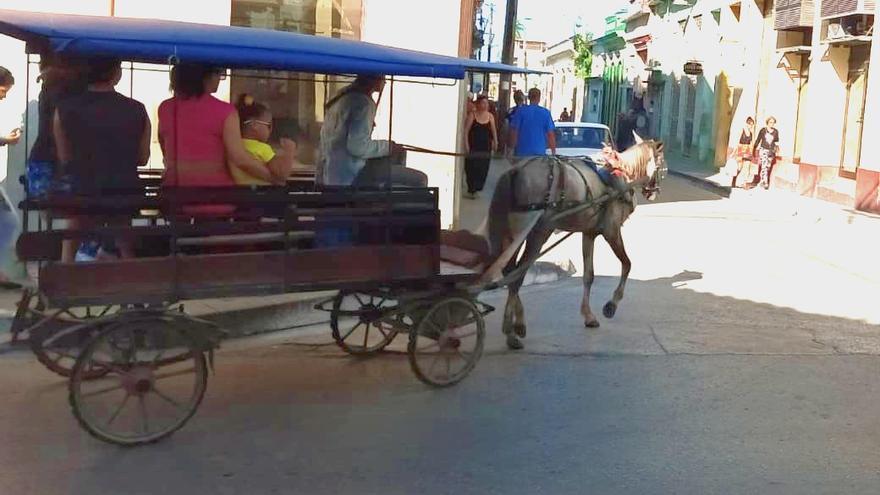
In such an isolated enclave, the horse-cart drivers maintain an indispensable link with the neighboring towns. (14ymedio)
14ymedio, Yankiel Gutiérrez Faife, Camajuaní, 9 April 2023 — Jinaguayabo is near the sea. To the north are the luxurious keys of Villa Clara; to the south, Remedios, at the end of a run-down road, where the horse carts circulate, at a slow pace and under the sun. It is a poor, rural town, with fewer than 700 inhabitants and from which everyone ends up leaving. In such an isolated enclave, the cart drivers maintain the indispensable link with the neighboring towns, but their routes, usually quiet, are now infested with assailants.
Gerónimo, who owns a passenger cart, leaves for work at seven in the morning. “At that time it’s easy,” he explains to 14ymedio. “It’s when the people of Jinaguayabo travel to Remedios, to study or to work. Then I have another route to bring them back, from three to seven at night, when they return to town.”
Several weeks ago, he says, he found three people waiting on the side of the road, and they asked him for a ride to Remedios. They got into the cart, two in the back seat and one next to him. “When we were coming to the bridge, the one behind me put a belt around my neck and forced me to park in a ditch,” says Gerónimo, who immediately obeyed his attacker.
The others were in charge of checking his pockets: they took his phone, some bluetooth headphones, his watch and the proceeds of the day, 2,500 pesos [$100]. “At least they left me the horse and the cart,” he says with some relief. “Now I have to see if I can buy what I lost again, because the police are not going to find the thieves.”
Despite the isolation and poverty, Jinaguayabo has always been close to the most tense events in Cuba. Located near the first settlement of the Spanish conquistadores in Villa Clara, besieged by corsairs and pirates and centuries later by insurgents, the town has not been oblivious to violence. However, its inhabitants complain that the atmosphere is electric, and they feel afraid being on any road at night. continue reading
“You can no longer go by bike to Remedios, as before,” complains Daivel, a 19-year-old whose parents have banned him from traveling at night the three miles that separate Jinaguayabo from the so-called “eighth village” of the Island. “I used to pedal there on weekends, but now they won’t let me go for fear that something will happen to me along the way. If I go to Remedios, I have to sleep with friends and come back in the morning,” he says.
The situation is repeated in other rural towns, such as Taguayabón — to the west, between Remedios and Camajuaní — where thieves prey on people during the November carnivals. At two in the morning, when everyone is drunk and their senses dulled in the dark, it is easy for bandits to take a wallet or watch, or to corner a clueless villager.
They also manage to force the doors to houses, which are less protected because, as Maria points out, “in the countryside everyone knows each other.” She and her husband returned from the festivities in the early morning and discovered a broken window in their home. Inside, she says, “everything was a disaster. They had taken a cell phone and cash, which I had hidden in the closet.”
Crime is so widespread that you can no longer trust even the workers you hire. Daniela, a housewife from Remedios, hired a bricklayer known by the family, 26-years-old, to change the tiles and the sink in the kitchen. “He came to work for a single day and didn’t finish. He told me that he had a fever and a cold,” she says. That same night she was robbed of a powerful LED light that she had in the yard. “My husband, who knew that the boy was in bad company, went to his house. He himself had stolen the lamp, taking advantage of the fact that he knew the house, and exhibited it very brazenly in his yard,” the woman says.
In the marginal areas of the cities or in the rural towns the situation is unacceptable, but it is even more serious in the homes of the farmers. Francisco, a guajiro whose farm is in the vicinity of Rosalía, near Taguayabón, had two oxen with which he worked on his plot.
After working and taking a bath, Francisco used to have lunch and take a nap, while the animals grazed near the house. “In short,” he says, “when I was sleeping very peacefully, the bandits had been ’paying attention’ to me for many days and knew my routine. They had studied me.” At nightfall, he saw that the oxen had disappeared.
A television program funded as propaganda by the Ministry of the Interior, “Behind the Footprint”, shows a police squad that quickly solves criminal cases. “But real life is not like that,” says Francisco, who didn’t wait for the authorities to take action on the matter.
Some neighbors helped him organize a search party, and they found a broken fence and tracks. Beyond, near the town of Palenque, they discovered a scrub where the drunken thieves were butchering the animals. The second ox, tied to the fence, tried in vain to free itself.
“We caught three thieves and the police took them,” says Francisco. “But they have already freed one of them. Usually they are released for lack of interest in the investigation, or the police don’t even bother to come.”
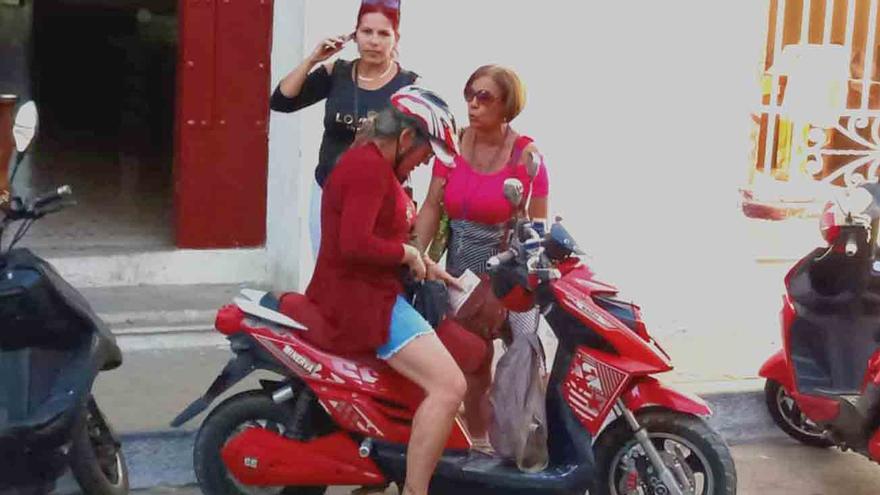
Woman talking on the phone in front of a motorcycle workshop that was robbed last month. (14ymedio)
No one is safe. Not even in the center of big cities like Santa Clara. Ernesto, owner of a motorcycle repair shop not far from Etecsa’s offices — just one block from Vidal Park — was robbed of one of the vehicles he had in the warehouse at nine at night, while his family was watching the telenovela.
The thief broke the fiber cement roof of the workshop and took a motorcycle with just two and a half years of use, which needed paint and a new battery. However, he did not realize that Ernesto had installed cameras and did not have his face covered. “It wasn’t difficult to identify him,” he says. “A week later, the police caught the thief and recovered the motorcycle. However, I know I was lucky.”
Translated by Regina Anavy
____________
COLLABORATE WITH OUR WORK: The 14ymedio team is committed to practicing serious journalism that reflects Cuba’s reality in all its depth. Thank you for joining us on this long journey. We invite you to continue supporting us by becoming a member of 14ymedio now. Together we can continue transforming journalism in Cuba.
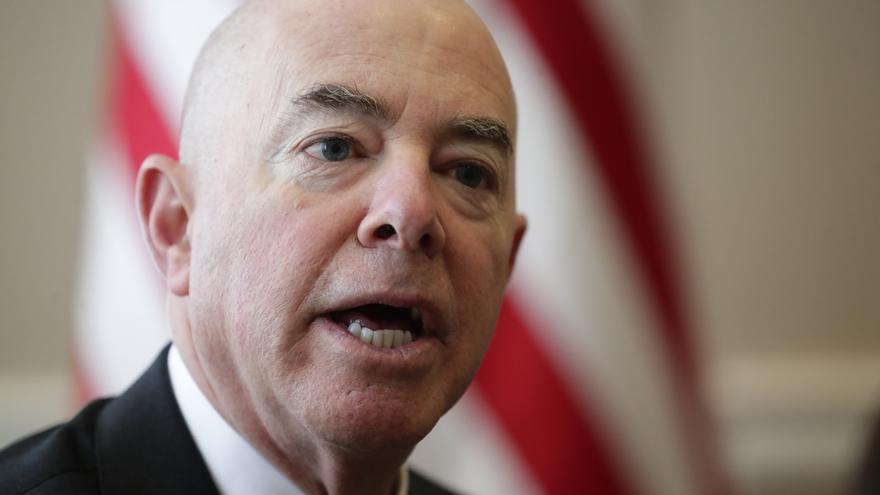
The mother of the Secretary of Homeland Security of the United States fled from Europe because of Nazism and, years later, from Cuba because of Castroism. (EFE)
EFE / Moncho Torres (via 14ymedio), Havana/Panama City, 12 April 2023 — Cuba and the United States will discuss “important and determining” issues in the round of immigration talks that take place this Wednesday in Washington, according to the Deputy General Director for the United States of the Cuban Ministry of Foreign Affairs (MINREX), Johana Tablada. She states that the delegation, lead by the Deputy Minister of MINREX, Carlos Fernández de Cossío, will have on its agenda matters “of concern for the Cuban government that are not resolved.”
Among those issues, Tablada referred to “incentives” that remain for irregular emigration, such as “the continuity of extreme, inhuman, siege measures, that directly influence the socioeconomic living conditions of the population of Cuba” and that make many Cubans seek to emigrate to the United States.
The Government of Cuba, Tablada added, blames the United States for “those high migratory flows and those extreme measures that have caused a direct threat to the well-being and livelihood of our population.”
“Regular migration will not be achieved, and this issue will not be resolved as long as there is that policy of asphyxiation against Cuba,” she said in statements reproduced by state media, although she acknowledged that last year there were “positive steps,” such as the resumption of the issuance of visas at the U.S. Embassy in Havana and the granting of the visas established in the migration agreements.
The Island’s delegation will also denounces “the admission of people who arrive irregularly in the United States,” which it considered “a stimulus for others to adopt that unsafe route,” and gave as an example the case of Rubén Martínez Machado, who stole a plane, fled to Miami and was granted political asylum, an “explicit violation of the migration agreements” and a “danger to the air safety of both countries,” she said. continue reading
Cuba will also reiterate its request for the re-establishment of non-immigrant visa programs so that the citizens of the Island can visit their relatives in the United States.
This round of talks will be marked by a sharp increase in the arrivals of Cubans to the U.S. coast, where the Coast Guard has intercepted some 5,000 Cuban rafters since last October.
Cuba’s grave economic crisis has intensified an unprecedented mass exodus, especially to the United States, where authorities detained more than 313,000 Cubans on the southern border with Mexico, a figure that represents about 3% of Cuba’s total population.
In this context, the Secretary of National Security of the United States, Alejandro Mayorkas, held a meeting in Panama with the foreign minister of that country and of Colombia and Mexico, to discuss migration through the dangerous Darién jungle. He insisted that migrants must use “legal means” or be “returned” to the other side of the border.
“There is a very important message to send in addition to the fact that we are building legal avenues so that people do not have to risk their lives in the Darién, and that is that we are enforcing our border laws,” the secretary remarked.
“It is so tragic to see people risk their lives, undertake the dangerous journey, suffer the trauma, put the savings of a lifetime in the hands of traffickers who only seek their own benefit, only to be returned,” said Mayorkas, who is of Cuban origin.
The Darién jungle is one of the most dangerous border crossings for migrants, who have to cross swollen rivers and risk the attacks of armed men who steal and rape. There is also a lack of drinking water, which is often contaminated by excrement and corpses.
Most migrants, when they have left the jungle and are exhausted and out of breath, say that they regret having taken that route, calling on their compatriots to choose another option, in vain.
This year alone, about 400,000 migrants are expected to cross the jungle, almost double the more than 248,000 who did so in 2022. In the first three months of 2023 alone, about 87,390 migrants crossed the Darién, seven times more than the same period in 2022.
“And those are the individuals, the human beings who survived to tell the trauma of the trip. We also think about the people who didn’t make it. That is exactly why we are generating legal avenues so that they can come to the United States in a safe and orderly way in search of a better life,” he explained.
Mayorkas highlighted as “the most powerful example of the success” of this legal path the creation of the program for nationals of Cuba, Haiti, Nicaragua and Venezuela, a measure that recently led to a 95% reduction in the arrests of individuals from these countries at the border.
“We have already received thousands and thousands of people in this way,” he said. The program can reach 30,000 humanitarian permits per month, “360,000 people per year.”
The U.S. official also warned that they are “expanding” the legal avenues. “We will be revealing in the coming weeks the additional avenues that people must take,” he announced.
The Secretary of Homeland Security also noted that migrants have at their disposal other ways to travel legally to U.S. territory, such as visas for seasonal workers, or for agricultural or non-agricultural workers for limited periods to “gain money lawfully and send remittances.”
In addition, next month the government of President Joe Biden will lift the controversial Title 42, a health measure imposed by the government of former President Donald Trump (2017-2021) that allows immediate expulsions of migrants at the border.
“We are concerned that there may be an increase in the level of migration” due to the lifting of that measure, Mayorkas acknowledged, recalling that the basis of the country’s immigration law, in Title 8, will remain fully in force.
In the meeting with EFE, Mayorkas was accompanied by Samantha Power, administrator of the U.S. Agency for International Development (USAID) and former U.S. ambassador to the United Nations. She highlighted the important role played by countries that were initially going to be only transit routes for migrants.
In Colombia, “more than two million Venezuelans” are settled, she said, and it is “a very important and laudable decision” that the Colombian authorities have offered them “a temporary protection status.”
“When that happened, USAID hurried to support the Colombian government to establish that system, the registration, the mechanism, but also to support the Venezuelans who entered to make sure that they did not overload the host communities,” said Power, who remarked that they are dedicating “more than 200 million dollars a year” to that mission and seek to increase it by 34 million.
The U.S. official insisted that it is the “responsibility” of the United States to support the countries south of the Darien — Colombia, Ecuador and Peru — “that are doing everything possible to absorb these migrant populations.”
For Mayorkas, the need to leave his country for political or economic reasons is not something foreign. A native of Cuba, he arrived with his parents and sister in the United States as “political refugees” when he was a child. “It was the second time, by the way, that my mother was a refugee,” having fled the Nazis in Europe.
“I understand very well the fragility of life, the vulnerability of people, the importance of humanitarian aid; and at the service of that fragility, at the service of that vulnerability, we generate legal avenues and urge people not to take such an costly risk. But it is also very important to remember that we are not alone in this. The migratory challenge that our region is experiencing is a challenge to which we must all respond together,” he said.
Translated by Regina Anavy
____________
COLLABORATE WITH OUR WORK: The 14ymedio team is committed to practicing serious journalism that reflects Cuba’s reality in all its depth. Thank you for joining us on this long journey. We invite you to continue supporting us by becoming a member of 14ymedio now. Together we can continue transforming journalism in Cuba.
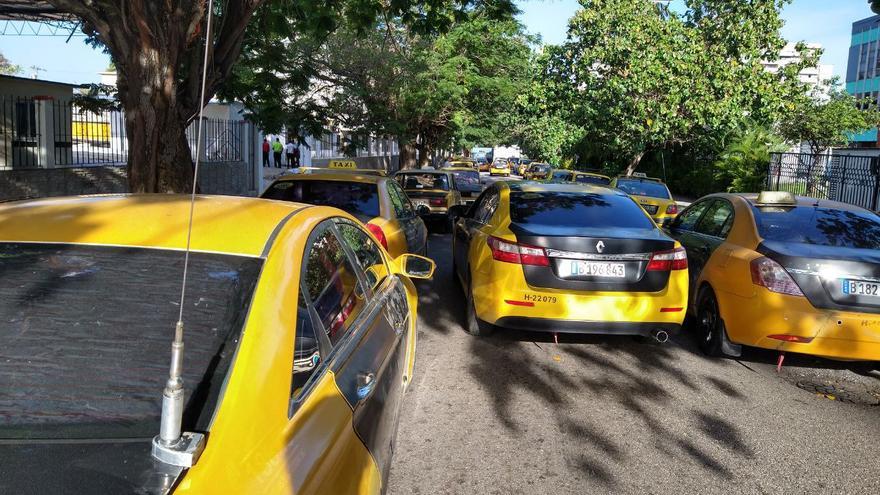
Traffic jam at Santa Ana and Boyeros of taxis waiting to get gasoline. (14ymedio)
14ymedio, Natalia López Moya, Havana, 10 April 2023 — Marta and Manuel, two Spaniards who arrived in Havana this Good Friday on the Air Europa flight, pass through the door of the José Martí international airport and come across a dark esplanade full of people holding signs with the name of a tourist. The taxi stand is empty. The lack of fuel has hit the strategic tourism sector, and the Madrid couple spends two hours waiting for a vehicle to take them to Old Havana.
“This is not how tourism can be recovered,” says the employee who manages the taxi stand. The man calls again and again on his mobile phone to the possible taxi drivers who relieve the long line that has been formed after the arrival of the European flight. But the answer he receives is almost the same: “I don’t have fuel.” After half an hour, a yellow Citröen arrives in front of the line of desperate travelers. “This is my last trip because what I have left of gasoline is not enough for another,” he says.
Several tourists hurry to get on the buses that will take them to Varadero and other resorts. “We are making the trips to leave the customers in the hotels but we have had to cut the excursions,” explains a driver who begins to read a list of British surnames to confirm the travelers he will take in his vehicle. “For almost a month we have only had fuel for transfers to and from the airport,” he emphasizes.
On the other side of the street, in the shadows, the drivers of several private vehicles load luggage into trunks and shout among themselves the coordinates to find fuel. “The Santa Catalina gas station has none; neither does Boyeros and Ayestarán although they told me that they saw a tank unloading an hour ago at the one on G and 25.” continue reading
The information, more valuable for filling the tank of the vehicle than the money itself, has created networks of solidarity among drivers who, in addition to spreading the word about where the supply has arrived, help each other in the lines in front of the gas station, which can last for days. “We are four taxi drivers and we take turns in line. The station that had fuel last week doesn’t have it anymore. We wouldn’t have a life if we had to be in line all the time,” explains a young man who rents a cab from the Taxi-Cuba Company.
“The tourists who arrive don’t know this, and some rent a car to go to the provinces; then they get stranded on the road because they can’t fill the tank,” the driver tells 14ymedio. “At first, passenger cars had priority, but if there is no gasoline, it doesn’t matter if you have priority. If there isn’t any there isn’t, and they can’t invent it.”
Marta and Manuel managed, after a long wait, to get into a vehicle on the way to a private rental house in the historic center of Havana. “Can we meet tomorrow for an excursion to the Zapata Swamp?” they inquired of the taxi driver. The payment proposal, an interesting amount of euros, would have been absolutely irresistible a few months ago, but the driver declines. “I can’t, this is the last gasoline I have left. Tomorrow I have to take care of getting more, and that will take me all day or all week.”
Rumors are circulating among taxi drivers that fuel problems will be solved on the 18th. In March, the British agency Reuters announced the shipment of oil from Venezuela that was going to be the largest in memory in a long time. The Nolan oil tanker, Panamanian-flagged and sanctioned by the United States, was in the Venezuelan port of San José loading 1.53 million barrels (400,000 barrels of oil and 1.13 of diesel), destined for Cuba.
Although the ship was supposed to arrive at the end of March, the shortage, visible at the Island’s gas stations, suggests that it arrived late or that the unloading has been slow. Radar positioned the Nolan for the last time off the coast of western Africa, but that was 111 days ago, and the sanctioned tankers travel with the transponder turned off to hide their location. The Venezuelan government opponent María Corina Machado said last week that the oil tanker was in the port of Antilla, in Holguín, according to a satellite application.
But the effects of the lack of fuel are not only noticed by tourists and Cubans who want to fill their tank. The blackouts are already back, and national television announced that a “complex” day is expected this Monday. Yesterday, Sunday, the deficit reached 368 megawatts (MW) at around 20:20, coinciding with peak time. Although the Unión Eléctrica de Cuba (UNE) assures that “this weekend it managed to meet the demand,” many Cubans have complained about more than three hours without power in different parts of the Island.
“Last night there was a blackout here from 10:27 pm until a little more than 1 am. I couldn’t rest well, and today we face the day to day to see how to survive,” lamented a woman from Cienfuegos. “I have just seen the list, and during the day there should be no problem, but in Remedios there is a deficit from 9 to 3 in the afternoon,” added another.
For today, UNE predicts a deficit of 200 MW, but 550 MW is expected to be missing at the peak. In its statement, the electricity monopoly speaks of a shortage in the distribution because of “failures and lack of maintenance,” correcting the information provided on television, which said that the lack of availability is due to “problems” in the distribution of fuel, which has not yet arrived.
“They don’t have oil because they don’t buy it, and they don’t pay for what they buy. Period.” says a user when reading the forecast for the day.
Meanwhile, the recovery work of the Antonio Guiteras de Matanzas thermoelectric plant continues after the accident that cost the lives of two people this Friday and injured two more when they were trapped by the collapse of a 23-foot high wall while cleaning the soot in the chimney of the plant. La Guiteras is the largest thermoelectric plant in the country, but last year it was out of service for more days than it produced energy.
Translated by Regina Anavy
____________
COLLABORATE WITH OUR WORK: The 14ymedio team is committed to practicing serious journalism that reflects Cuba’s reality in all its depth. Thank you for joining us on this long journey. We invite you to continue supporting us by becoming a member of 14ymedio now. Together we can continue transforming journalism in Cuba.
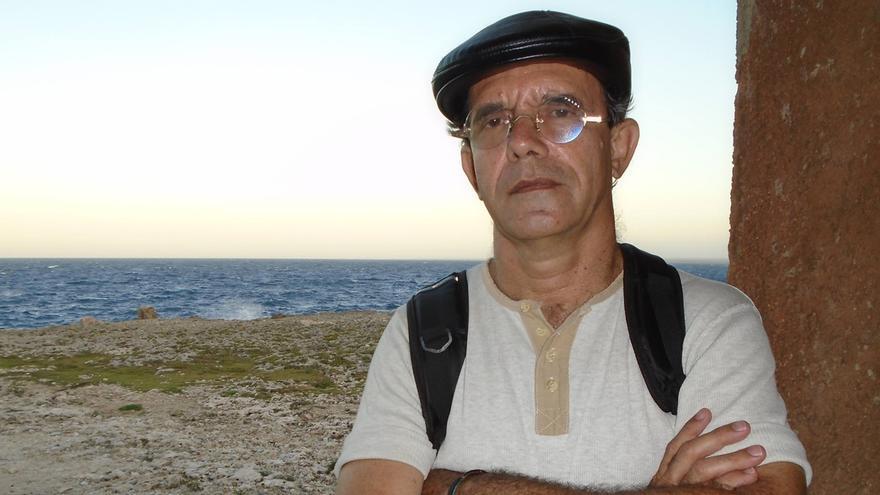
The journalist and writer Jorge Fernández Era. (Facebook)
14ymedio, Havana, 7 April 2023 — On Friday, the Cuban writer and journalist Jorge Fernández Era offered a detailed account of the arrest he suffered the day before, for six hours, at the hands of the political police in Havana. In a text published on his Facebook page, he said that the ambush by the agents unleashed a wave of solidarity throughout the country and exposed the clumsiness of State Security.
Fernández Era reported that the harassment had begun on Thursday morning, when a series of “wrong number” calls to his home was intended to locate him. The explanation of that “check,” he says, had to do with the publication of a recent “column-caricature” he wrote in La Joven Cuba, which ridiculed the nomination of octogenarian candidates to the Cuban Parliament, in addition to an interview he gave to the filmmaker Ian Padrón.
At noon, when he left his house to go to El Vedado, he was intercepted by several motorcycle officers in the vicinity of San Indalecio and Rabí streets. He was on his way with his wife and a friend, and they told him to “stop walking.”
The agents — one of them identified himself as the head of sector of the Tamarindo neighborhood — demanded his identification and, when returning the documents, informed the writer that he was “surrounded.” Arrested and taken aboard one of the motorcycles, Fernández Era was transferred to the Aguilera police unit.
After crossing a “perfectly caged” staircase to the basement, he was forced to stand for 45 minutes. Then they took him to a closed room, where an agent — who said he wrote poetry “for years” — was in charge of “taking care of him” until he was received by Eivesgney Vilarte, “badge 10034, first lieutenant and second head of Crime Prosecution,” says Fernández Era. continue reading
There they read him a complaint for the crimes of “failure to offer assistance and disobedience” and tried to impose the payment of a fine of 3,000 pesos for “not responding to the two summons that I received previously.” The writer argued that he did not have to pay the required amount until a claim that he had filed on January 30, successively, with the Provincial Prosecutor’s Office, the General Military Prosecutor’s Office of the Ministry of the Interior and Counterintelligence was resolved.
In addition, he criticized the irregularities of the document containing his accusation, which also contained — “in violation of the Criminal Procedure Law, the Law of National Symbols and the Law of Military Secrecy” — sensitive information about another detainee outside his case.
Faced with his refusal, Vilarte indicated that a “precautionary measure of provisional detention” would be imposed on him. He was held for an hour and a half without being offered food or water. When he demanded that he be allowed to call his wife on the phone, the officers replied: “It won’t be necessary. You’re leaving now.”
Vilarte informed him, he says, that they had decided to replace the provisional detention with another precautionary measure: the “prohibition of leaving the country while the Municipal Prosecutor’s Office has not pronounced,” which would define his legal status. In the vicinity of the station, his wife and several friends were waiting for him; they had “planted” themselves until Fernández Era was released.
The writer’s post concludes with an “epilogue” where he thanks Professor Alina Bárbara Hernández, who demanded his release in the Matanzas Freedom Park, where she was “cowardly harassed by three agents,” he said. In addition, he recognized the thousands of people who protested on social networks against his “run-in” with State Security.
Finally, Fernández Era informed his captors that “neither the ban on leaving the Island, nor the provisional detention, nor the house arrest, nor the cash bail, nor the obligation to appear, nor prison” were going to silence him.
Translated by Regina Anavy
____________
COLLABORATE WITH OUR WORK: The 14ymedio team is committed to practicing serious journalism that reflects Cuba’s reality in all its depth. Thank you for joining us on this long journey. We invite you to continue supporting us by becoming a member of 14ymedio now. Together we can continue transforming journalism in Cuba.
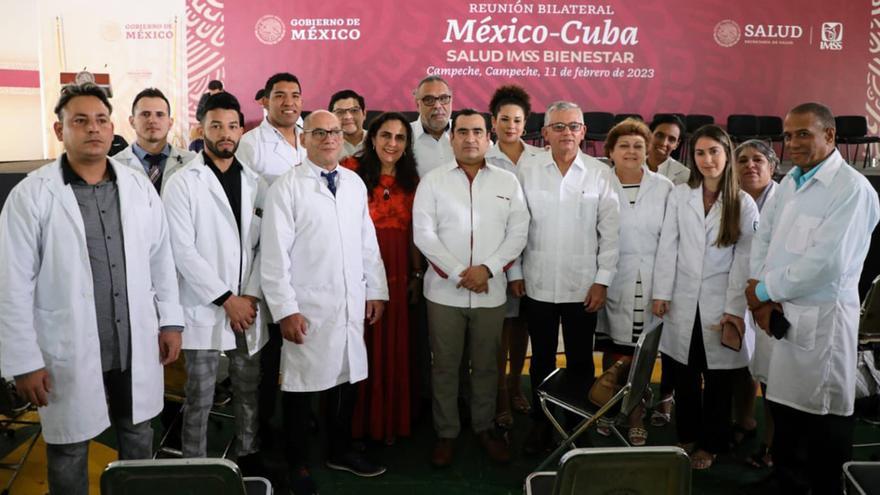
A group of the 610 Cuban doctors who were hired by Mexico to work in marginalized areas. (Twitter/@zoerobledo)
14ymedio, Ángel Salinas, Mexico, 11 April 2023 — The Cuban specialists who arrived last January in the Mexican state of Morelos and proclaimed their experience in Saudi Arabia, Venezuela, Guatemala and Pakistan, “are not in position” because they lack a professional identification card. According to the president of the Federated Colleges of Medicine A.C., María Reyna Bárcenas Hurtado, “about 20 health workers” have already been returned to Mexico City.
Bárcenas Hurtado told 14ymedio that during monitoring by the health centers of Axochiapan, Ocuituco, Tetecala and Temixco, it was found that the specialties of the Cuban doctors “do not correspond to what is needed in these hospitals, especially in the Temixco region.”
The last week of March, the leader of the Union of the Ministry of Health, Gil Magadán Salazar, said that the specialists “had no experience” and stressed that “the official Mexican regulation requires doctors to have a professional credential to practice, and they don’t meet the requirement because they don’t have the document from Cuba.”
Magadán Salazar spoke of three cases: “One said he was an anesthesiologist, but he didn’t want to work. We have a dermatologist who has never given a consultation, and the others seem to be gerontologists, areas that we do not require.” That’s why they were enrolled in a training program. continue reading
According to Bárcenas Hurtado, the specialists “were supposed to go to meetings but never showed up.” In addition, he says that it is up to the federal authorities to let them know what is going to happen to these doctors.
Despite the fact that there is a letter signed by the Union of the Ministry of Health of Morelos noting that “they should not be hired” due to a lack of certification, a source confirmed to this media that “no payment has been stopped” to the Comercializadora de Servicios Médicos Cubanos, S.A. For each specialist, the Cuban company, which is accused of human trafficking and forced labor, receives $2,042 per doctor each month.
The places that were left vacant, Bárcenas Hurtado explained, should be covered with specialists, but “we are waiting for the response to the letter presented to the state Ministry of Health.”
Meanwhile, in the state of San Luis Potosí, Governor Ricardo Gallardo Cardona confirmed last March, without specifying the number, the arrival of specialists from Cuba. On Monday, the state Ministry of Health and the Mexican Social Security Institute indicated that there are 113 places available, but it has not been defined how many will be filled by foreigners.
The College of the Medical Profession of the State of San Luis Potosí affirmed that Cuban health workers “are not prepared, and before being hired they must be certified by the Medical College.”
Translated by Regina Anavy
____________
COLLABORATE WITH OUR WORK: The 14ymedio team is committed to practicing serious journalism that reflects Cuba’s reality in all its depth. Thank you for joining us on this long journey. We invite you to continue supporting us by becoming a member of 14ymedio now. Together we can continue transforming journalism in Cuba.
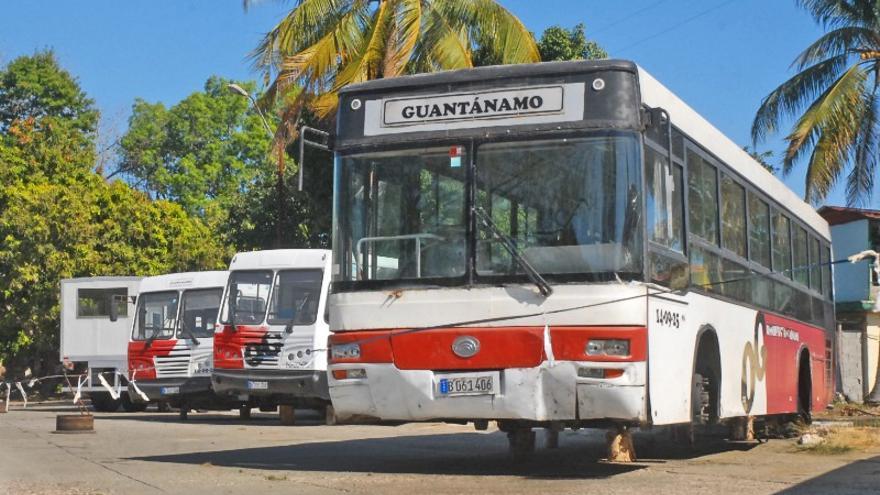
These buses are subject to the same difficulties experienced by the entire transport sector, such as the need to replace tires and lack of spare parts. (Venceremos)
14ymedio, Havana, 29 March 2023 — The leasing of 26 “underutilized” state vehicles, with which the Guantánamo Urban Bus unit planned to cover the transport deficit in the province, has been ineffective. The drivers often fail to comply with schedules and skip mandatory stops, and managers have threatened more than once to terminate their contracts, according to the local press.
Rubén Pico Judiones, director of this organization, lamented the origin of the problem: of the 74 buses that Guantánamo has, only 33 work. This forces the them to look for alternatives and to request the rental of “paralyzed” buses from several companies — under Resolution 207/2021, which facilitates the rental of vehicles — to cover several routes in the city and others that lead to the peripheral towns of Paraguay, Cecilia, Maqueicito, Maquey, La Jabilla, Boquerón, Cayamo and Hatibonico.
In addition, Pico details, four “private sector” vans were rented to connect some areas, and help was requested from various sectors to “support” the transportation of workers. “All that is still insufficient,” the manager admitted.
Pico indicates the conditions under which the drivers of leased vehicles operate. They must charge a fare of five pesos and make three trips in the morning and three in the afternoon. In addition, they have the duty to cover certain routes at a set time. “Once they comply, they have the freedom to perform other work to increase their income,” he says. continue reading
However, that kind of gap in their obligations allows them to treat the work schedule with “flexibility.” Ómnibus Urbanos began to take measures, such as inspections and “intermittent” controls, Pico says, aimed at surprising the drivers during their non-compliance. But even that hasn’t solved the problem. “They were warned about the possibility of losing their jobs if violations of the regulations persist, but we are certainly still dissatisfied with the results,” he says.
The scenes are comparable to the previous great crisis, which at least was baptized with one of the greatest euphemisms that Castroism ever came up with: “the special period in time of peace.” (14ymedio)
14ymedio, Juan Diego Rodríguez / Olea Gallardo, Havana, 30 March 2023 — The crisis that Cuba is experiencing is not only reflected in the official data, independent reports and the unstoppable exodus. In the streets, at every step, the poverty is evident. Ana María, a middle-aged neighbor of Central Havana, mentions an example: “A few days ago, on Infanta Street, a man in his 50s was going to pick up some croquettes from the floor, and when he saw that I saw him, he was embarrassed. The truth is that I was more ashamed than he was.”
These scenes are comparable to the previous great crisis, which was at least baptized with one of the greatest euphemisms that Castroism ever came up with: “the special period in time of peace.” It was common then, in the 90s, to see its imprint on the wrinkled and emaciated bodies of Cubans. Thousands of them suffered from diseases like neuropathy, which left them blind and was caused by malnutrition and the abuse of homemade alcohol.
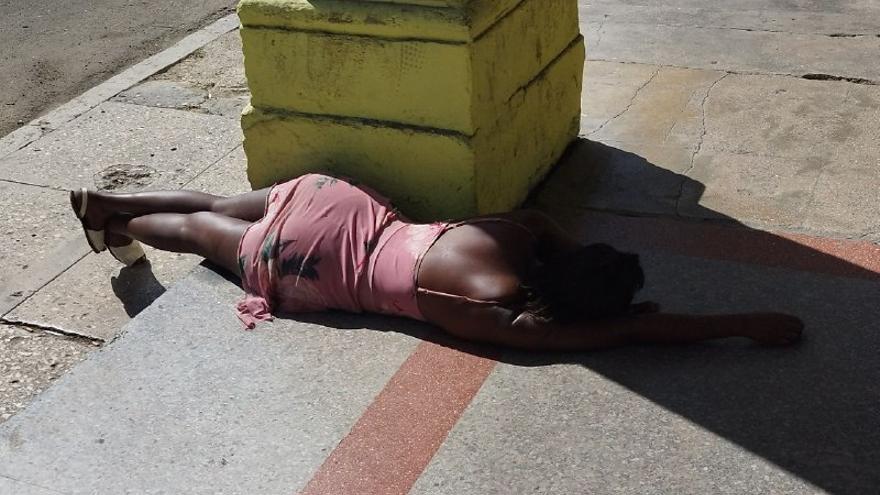
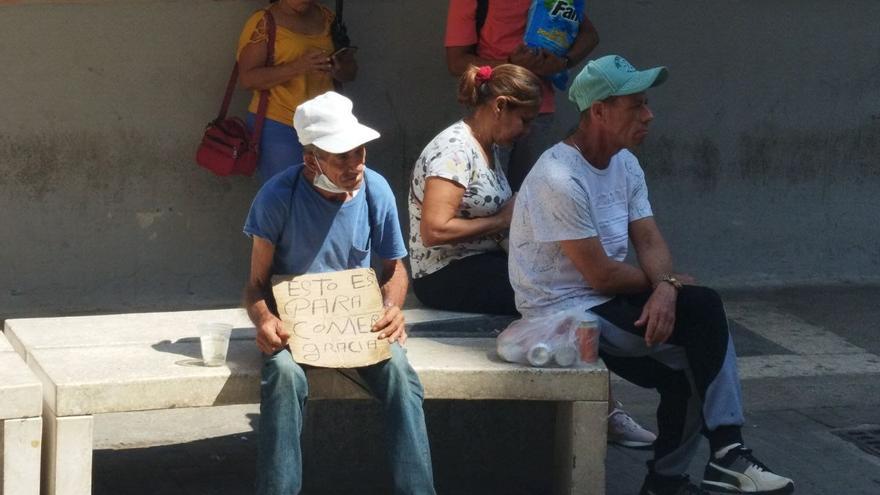
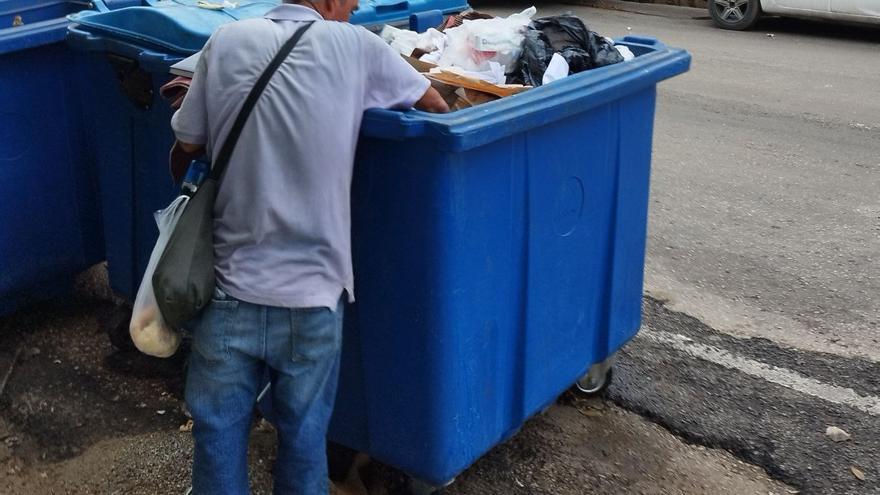
Today’s crisis has no name, but it does have the same face: the increasingly empty cities, especially of young people and those who fall down unconscious from drinking “train-spark” (homemade alcohol), and the elderly (and not so old) who rummage through containers or beg on the street.
And it doesn’t just happen in Havana. Jorge, from Holguín, says he encounters a similar situation every day. “It has increased a lot, but a lot, the number of people on the street who are rummaging through the trash and asking for money. Today I was having a pizza and soft drink in a private place and a 70-year-old man with crutches, who couldn’t even walk, came in begging, and I bought him the same thing I was eating. Yesterday a woman who saw me counting some money on the street approached and said: ’oh, give me something for the peas’. Right after, another woman asked me if I could buy her some cassava fries. I wanted to give her 100 pesos but she asked me to buy them for her: ’They scammed me,’ she told me crying. And what breaks my heart the most is the children who implore: ’could you give me five pesos?’” continue reading
Jorge attributes the scarcity mainly to inflation, which does not let up: “One pound of pork is 400 pesos ($16.70), and you buy four pounds and they are two of meat and two of bone and fat, which doesn’t work. A carton of eggs here is worth 1,500 pesos ($62.50), a liter (33.8 ounces) of cooking oil is 1,300 ($54). People make it to the end of the month almost without oil, without rice.”
To have something to put in their mouths, people even eat the impossible.. (14ymedio)
Caption – The scenes are comparable to the previous great crisis, which was at least baptized with one of the greatest euphemisms that Castroism ever came up with: “The special period in time of peace.” (14ymedio)
Thus, families are reducing the quantities. They eat rice with a little bit of vegetables, they eat only a banana, they get used to not having animal protein. “I have a neighbor who stops having lunch to give it to her son, who is in high school. Many times I see that they eat rice cooked in bean sauce with two tomato slices because they don’t have a main course,” Jorge explains.
Something similar is told by Lisandra, from Sancti Spíritus. “I recently brought a friend a picadillo that I cooked, after lunchtime, and I realized that her boy had been given rice with beans and she had not eaten anything.”
To have something to put in their mouths, people even eat the impossible. “My mother discarded a horrible picadillo that she had boiled in hot water because someone told her that it looked like ham and she wanted to give it to the neighbor’s dogs. The neighbor let it dry because she wanted it for herself.”
Sometimes, as happened to Ana María with the man who picked up the croquettes in Centro Habana, there is shame for both parties. “When I went to say hello to a friend from the university, at lunchtime, her children interrupted her all the time while we talked: ’Mom, I’m hungry’. And I realized that she didn’t want me to see what they were going to eat,” continues Lisandra, who says: “People don’t say it, but they are going hungry.”
From San Antonio de los Baños, Artemisa, the epicenter of the mass protests of July 11, 2021, Caridad recounts: “The famine is widespread. Soon we will not exist, because we’re going to starve, and we won’t have a doctor to help us.”
The woman, in her thirties with a young daughter, lashes out at the Government: “They can’t solve anything, and they want us to keep electing people we don’t even know. Last week the power didn’t go out because there were elections, and now that there are no elections? If only we could eat all the blackouts.”
Caridad’s list is long, from electricity (“without electricity you can’t live”), to water (“we haven’t had it for five days”), food (“milk is a forbidden product and soon we’ll be talking about beans at 200 pesos [$8])” to increasingly precarious health services (“there is no medical assistance because doctors have no medicines and they are not magicians.”) “I can’t really explain how we are still alive,” she concludes.
“It has increased a lot, but a lot, the number of people on the street who are rummaging through the trash and asking for money.” (14ymedio)
“My sister and I bought a yogurt that cost us more than 250 pesos [$10] for 1.5 liters [53 oz.], and we had to pay on the informal market. When a state truck comes, it’s a slaughter, with the cost of yogurt close to 100 pesos [$4], or 70, 80, 90 pesos. You don’t have any meat, a chicken thigh, or a piece of pork. There is no onion even if someone can pay for it,” she lets fly and continues with her litany of sorrows.
Rice, she says, is a “hot item.” “Here in this town they are selling a speckled rice, I don’t know where they get it, which contains transparent pebbles. It’s enough to make God weep. Not only do you have to spend two hours removing these particles, but on top of that they can break a tooth, and then where do you find a dentist? Everything is a stack of dominoes, and now the game is over.”
For Caridad, the moment that Cuba is experiencing could be called “minute zero,” because “we have no options at all.”
There is another widespread comment: what is most worrying are the children. “I suffer bitterly because I have a girl under the age of seven and I worry about the day to day. Even the schools don’t function now. The teachers don’t want to work because they are also hungry,” says Caridad.
For Ana María, the situation with the children is “a disaster,” and she recounts the torment of her grandchildren, who not only have to endure an insipid rice with peas every day but all kinds of propaganda in their classes. “My girl has to show something tomorrow, after a week sick with asthma,. One homework was about the tax system, nothing more and nothing less, and another about Fidel’s life as a child until he was a revolutionary leader,” the woman says. “And the boy had to talk about the Zanjón Pact and Martí’s attitude at that time and also about the elections. Tell me something I don’t know!”
Neither propaganda nor servility nor ordinary work frees Cubans from suffering. “A relative of mine, retired military and doctor, that is, with an above-average retirement, has just celebrated his 80th birthday, and between his brothers-in-law and nephews they collected something to celebrate, because he barely has any money,” says Ana María. She gives another example, her own sister, now retired from the state sector, who was “once pretty but now is skin and bones.”
Another neighbor of Ana María, a health worker, went to her house recently to implore her for something to eat, even if it was only chicken skins, because she couldn’t buy anything.”
As if that were not enough, it’s no consolation to have money to spend in stores in freely convertible currency (MLC): “Even those who have people abroad [who send them hard currency] can’t get food, because the stores are empty. Everything has to be paid to the people who steal it from state places, buy it in Havana or I don’t know where and sell it here so that people can live,” protests Caridad, the young woman from San Antonio de los Baños.
All in all, she, like Ana María, Jorge and Lisandra, are part of that 30% of Cuban families that differ from the rest because they receive help from abroad, the most paradoxical inequality created in 64 years of communism. The rest, most of them, have to settle only for what comes through the rationed market, which is not enough to last the month.
Ana María, who has no way to leave the Island, laments: “I’m now depressed when I go out on the street, the poverty, the grime, the miserable people, the starving animals. I want the aliens to take me, because it makes me want to cry.”
Translated by Regina Anavy
____________
COLLABORATE WITH OUR WORK: The 14ymedio team is committed to practicing serious journalism that reflects Cuba’s reality in all its depth. Thank you for joining us on this long journey. We invite you to continue supporting us by becoming a member of 14ymedio now. Together we can continue transforming journalism in Cuba.
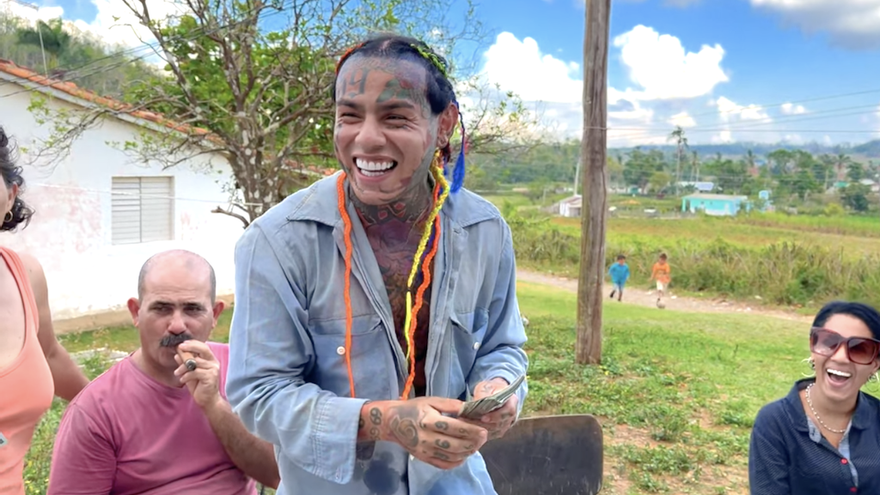
Rapper Tekashi 6ix9ine in a moment of his video recorded in Cuba. (Captura)
14ymedio, Madrid, 31 March 2023 — Ten days after being beaten in a Miami gym for which he was hospitalized, rapper Tekashi 6ix9ine has reappeared with a video clip recorded in Cuba. The song, which is titled Bori, has the collaboration of the Cuban singer Lenier Mesa, and just an hour after its premiere on YouTube, it already had about 200,000 views.
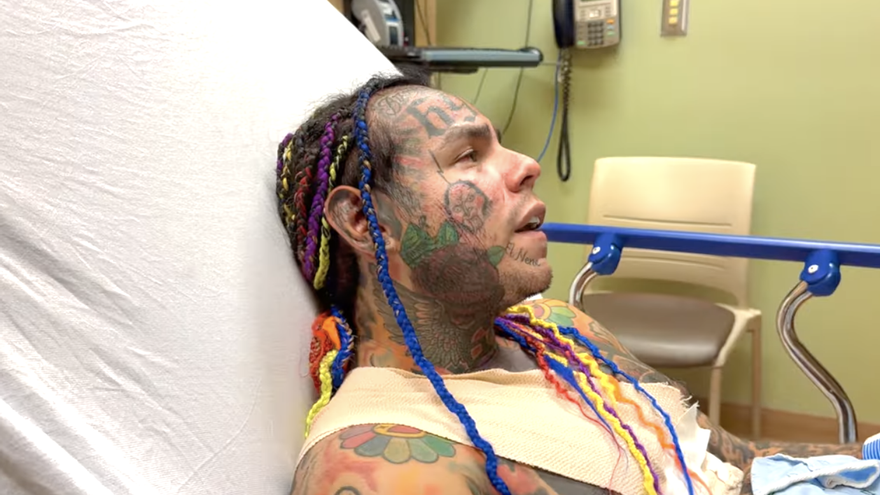
In the images, the musician is seen in a rural area of Pinar del Río, near the Viñales valley, with the results of the injuries he received visible on his face, especially in his right eye. At several times, he appears in a hospital center that looks like a Cuban clinic for foreigners.
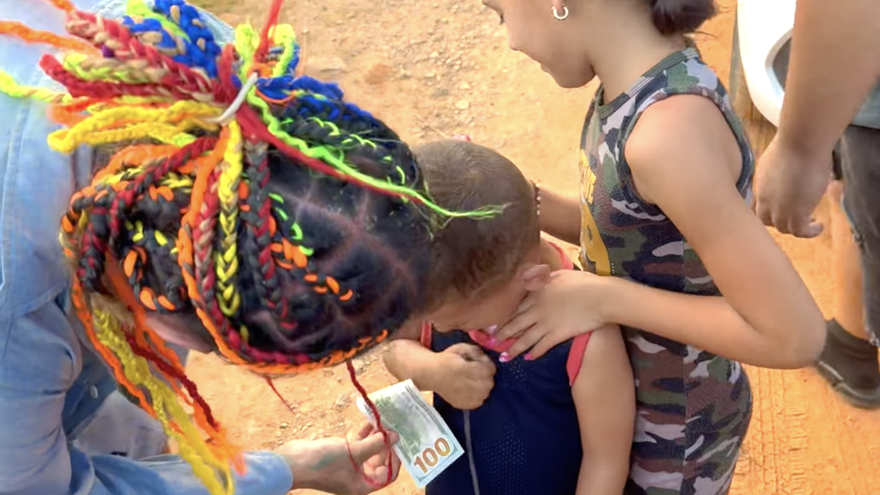
At another moment, the rapper is seen smiling, covered with a Cuban flag, surrounded by people and handing out $100 bills.
Giving away money in the streets has not been looked on well by the Cuban authorities when it is done by a national. Earlier this month, Cuban YouTuber Hilda Núñez Díaz, known as Hildina, broadcast a video on YouTube in which she claimed to have received the sum of 34,000 pesos — about 200 dollars — from a subscriber of her channel residing in Germany. With that money, she took to the streets to buy food and delivered it to several disadvantaged people in Santiago de Cuba.
Also, the Spanish agency EFE reported that the Police arrested three people in connection with the beating that Tekashi received on March 21 in Miami, where he had also been expelled from a game of the World Baseball Classic. continue reading
Local media reported this Friday the arrest of three individuals, identified thanks to the disclosure on social networks of a video in which it is observed how Daniel Hernández, the real name of the artist, is violently beaten on the ground.
The detainees, aged 23, 25 and 43 face charges of assault and robbery and are in a prison in Palm Beach County, in southeastern Florida.
Some media pointed out that the aggression may have been related to the artist’s alleged enmity with members of the gang Nine Trey Gangsta Bloods.
The rapper smiles while distributing money among the entire population of a Cuban town. (Screen capture)
The rapper’s lawyer, Lance Lazzaro, told TMZ that several men attacked his client while he was inside the gym facilities and that the artist could not defend himself.
The rapper, who was taken to a hospital by ambulance with cuts, a jaw injury and blows to his ribs and back, showed on social media how his face looked after the beating.
At various times on the video, Tekashi appears in a hospital center. (Captura)
This incident is in addition to another that occurred recently during the World Baseball Classic match between Mexico and Puerto Rico, when he was allegedly drunk and expelled for blocking the vision of other spectators, according to some media.
The son of a Mexican and a Puerto Rican, Tekashi was born in the United States and lives in New York. At the age of 26 he has achieved great popularity, especially on Instagram, where he has more than 21 million followers.
However, his personal life is very controversial. In 2019 he pleaded guilty to nine criminal charges, including conspiracy to commit murder, and agreed to a reduction in sentence that led him to be released from prison in 2020, after having served a good part under house arrest due to the pandemic.
Translated by Regina Anavy
____________
COLLABORATE WITH OUR WORK: The 14ymedio team is committed to practicing serious journalism that reflects Cuba’s reality in all its depth. Thank you for joining us on this long journey. We invite you to continue supporting us by becoming a member of 14ymedio now. Together we can continue transforming journalism in Cuba.
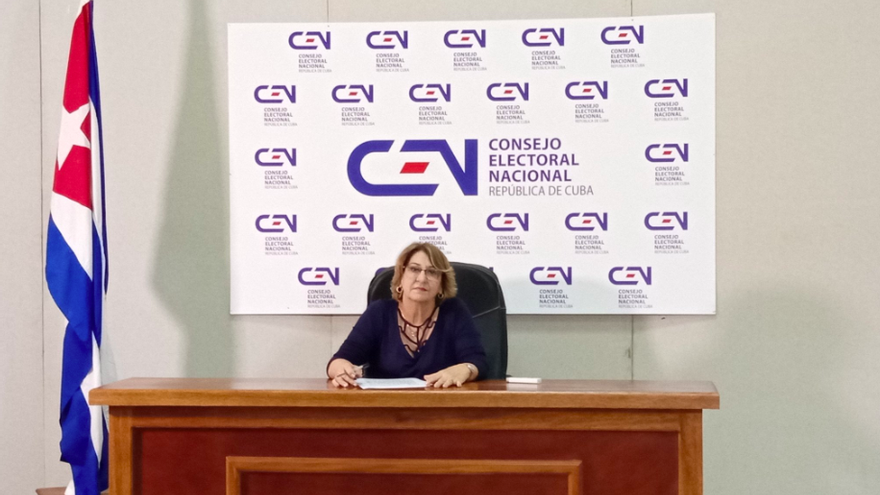
he president of the National Electoral Council (CEN), Alina Balseiro. (Twitter/Elecciones en Cuba)
14ymedio, Bueno Aires, 1 April 2023 –The president of the National Electoral Council (CEN), Alina Balseiro, held a press conference to give the final results of the elections for the National Assembly of People’s Power (ANPP) of Cuba held last Sunday, March 26. In it she reported that the electoral roll changed during the day of voting, something common in Cuba, increasing by about 9,000 voters due to the “compatibilization”of the lists of electors.
She pointed out that according to official data, the participation increased to 75.89% (6,167,605), and that “all deputies were elected with more than 61% of the valid votes cast as required by the electoral law, with free, equal, direct and secret voting.”
She reiterated on several occasions that the electoral process was transparent and even said that “for us it’s not a problem if they want audit us.”
Electoral Transparency took the floor and officially requested a comprehensive audit of the different phases of the electoral process. continue reading
Despite the statements of the head of the CEN, the Cuban elections are essentially autocratic — by clauses established in the Constitution: a single-party regime and the irrevocability of socialism — and technically opaque.
By their nature they are non-competitive elections, which only serve to seek to legitimize the candidates previously selected by the mass organizations subordinate to the Communist Party of Cuba (PCC). Procedurally they are inscrutable, because there are no cross-checks, independent audits or national and/or international electoral observation.
So Electoral Transparency proposes to carry out an audit that can respond to issues such as:
1. What are the criteria used by the National Candidacy Commission for the selection of the 470 candidates from a universe of more than 19,000 that had been initially announced?
2. What are the selection criteria for election officials?
3. What are the criteria for the selection of the vote counting authorities, what type of training did they receive and how were they evaluated?
4. What is the criterion for the selection of polling places? How is accessibility guaranteed?
5. What are the security measures for deploying the electoral material? Do the ballots have any identification? How do you make sure they are authentic? Which agency is in charge of reporting on the operation?
6. How is the electoral roll made up and how is it checked?
7. How do you ensure that a person does not vote in two or more polling centers? What is the procedure for crossing out those who have already voted? How is the consolidation carried out?
8. What are the protocols for the transfer of the ballot box once the election is over? How is the chain of custody of the material guaranteed in case a recount is necessary?
9. What are the reasons for reopening a ballot box?
10. How can observers appeal the count if they don’t agree with it, and for what reasons?
11. Where are the minutes for the count? Why aren’t they published and open to the public in digital format?
12. What is the system of transmission and consolidation of data? Who audits it?
These are just a few of the issues that could be analyzed in a comprehensive audit, which, although it would not reverse the anti-democratic mood of the election, could account for its technical solidity.
Electoral Transparency asked the National Electoral Council to open up to an independent audit after the 2022 municipal elections with the aim of making the aforementioned points clear before holding the March 26 elections. However, there was no opening on the part of the electoral body.
Given that on this occasion the head of the CEN, Alina Balseiro, publicly expresses that they are open to an audit, and considering that the results have generated justified doubts because there is no relationship between the percentage of participation announced and the number of voters in the voting centers, Electoral Transparency reiterates the request to audit the process. The technical team of the organization is available to travel to Havana and implement a comprehensive audit.
Unfortunately, the CEN website is not in operation at the time of publication of this statement, so Electoral Transparency communicates the proposal via Twitter.
Translated by Regina Anavy
____________
COLLABORATE WITH OUR WORK: The 14ymedio team is committed to practicing serious journalism that reflects Cuba’s reality in all its depth. Thank you for joining us on this long journey. We invite you to continue supporting us by becoming a member of 14ymedio now. Together we can continue transforming journalism in Cuba.
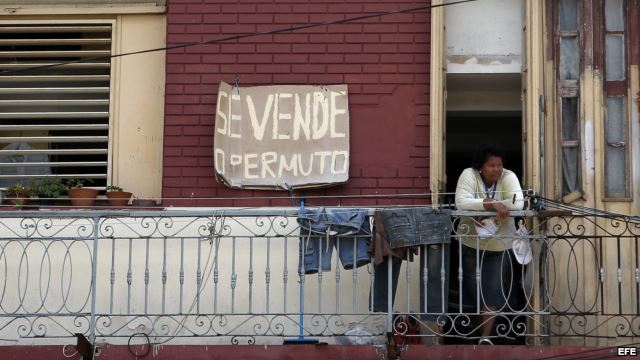
For Sale or Trade. With today’s massive migration, many Cubans find great difficulty in selling their homes. From martinoticias.com
14ymedio, Elías Amor Bravo, Economist, 3 April 2023 — The illegal occupation of homes and premises is a symptom that things are not going well in an economy. It is also a process that has been growing in Cuba in recent years, which has led communist leaders to get out of the collectivist and egalitarian script. Let’s see how. After the triumph of the so-called revolution, when the most devastating action against private property rights in the world was perpetrated by a country, the usurpation of homes became commonplace in Cuba, encouraged by revolutionary leaders. Families who fled the country, leaving all their assets behind by the confiscatory actions and the political persecution unleashed by Castro terror, contemplated from a distance how their homes and premises were occupied by other people who had nothing to do with their family or heirs.
The illegal occupation became legal due to the de facto acceptance of the new regime. In other cases, the new leaders were “giving away” the homes left by their former owners to people for the mere fact of being faithful to the new political leadership of the country. Without records, notaries, or anything like that, there was a real usurpation of the old housing property in Cuba, first by the state and then by people who were never its owners. The phenomenon reached such a dimension that for many years the regime played with the false image of the threat that a massive return of exiles could pose for the precarious occupants of the homes that were not theirs.
The chaos caused in revolutionary times was maintained until the approval of the communist constitution of 2019, in which article 42 recognized the right of people to the protection of the home, establishing the prohibition of the entry of others without the authorization of the person who inhabits it, unless such entry was made by express order of the competent authority and with the formalities of the law.
Subsequently, Criminal Code Law No. 151 of 2022 was published, which introduced the crime of usurpation, provided for in article 421, to address the increase in housing occupation by some individuals or groups, who, taking advantage of the temporary absence of the owners or cohabitants, committed the crime. A phenomenon that seems to have grown exponentially in recent years, as a result of housing shortages, the deterioration of existing homes and the low incomes of the population, especially among vulnerable groups. The alarm has reached the regime, observing that not only supposedly private homes are occupied, but also state premises where services for the community are provided, such as medical offices, social housing and warehouses, among other properties that have been abandoned by government neglect. continue reading
In this way, the regime wants to face the crime of usurpation with an approach commensurate with its interests. For example, before the entry into force of the current penal code, only those who entered other people’s homes or premises through violence or intimidation were prosecuted for said crime. Not those who didn’t do it in that way. The housing officials and the commissions to confront the illegalities managed their extraction from those places after declaring them illegal occupants, which was interpreted as a softer and more comprehensive treatment toward practices that they now want to eliminate.
And why this change? Well, basically because of the spectacular increase that has been occurring in these occupation practices and, with it, the harmfulness and aggressiveness of behaviors in any modality, which requires an intervention of criminal law in the solution of these conflicts aimed at protecting property as a legal asset. Yes, everything is very correct, but the protection of what property? Of the property previously usurped by the same regime that governs the destinies of Cubans? No. It’s not something to celebrate. It’s unbelievable that this type of approach emanates from an economic system in which private property, although recognized, continues to have a marginal role in the economy as a whole, where the collectivist mentality prevails overwhelmingly.
Thus, the authorities understand that ensuring and strengthening the inviolability of the home, recognized in the constitution of the Republic, is an objective that is related to the current socioeconomic conditions in which Cuba operates, where private ownership of housing is still limited to a maximum of two. It would be good if this measure were applied to all kinds of interference in homes, such as those that state security maintains in the form of repression against dissidents, for example.
But the regime seems to be clear about what it wants and that’s why it gets straight to the point. Only in this way can the publication by the Governing Council of the Supreme People’s Court be interpreted, through Opinion No. 471, of February 15, 2023 (published in the Official Gazette of the Republic of Cuba, no. 17, extraordinary edition, of March 2, 2023) of judicial practice in the processing and solution of these matters. An extensive document that is worth reading in detail.
When the illegal occupation or seizure of a house takes place in Cuba, the authority, once the complaint has been formalized, will immediately inform the administrative bodies responsible for the system of housing, territorial and urban planning, the community prevention bodies and the municipal administration councils, so that, together with the National Revolutionary Police, they adopt the measures to extract the illegal occupants, thus restoring, with identical immediacy, the broken legality.
We would have to ask ourselves at this point, what is the legality? The fiction created by Raúl Castro or the one before 1959 that continues to be documented in the historical property deeds of the Cuban economy? Remember that the law does not state which one, much less the law of property. The communists have gotten into a good mess, they alone. Will the historical owners of the homes be able to exercise this right of complaint or are they still excluded? Are the squatters the ones who were established without an acquisition or rental operation in the homes and premises confiscated by the revolution?
It is also stated that, against those who execute these illegal acts of seizure, the prosecutor’s office or the court will have one or more precautionary measures provided for in the law, which can be provisional imprisonment in cases where the property is not immediately abandoned, in order to avoid the continuity of the allegedly criminal conduct committed and the restitution of legality. The perpetrators of this crime can have penalties imposed that run from six months to two years, or a fine of 200 to 500 pesos, or both.
If the occupation is carried out with force, violence or intimidation, or the act was a consequence of gender or family violence, or for discriminatory reasons of any kind, the penalty increases from two to five years, or a fine of 500 to 1,000 in installments, or both. A similar procedure will apply when the occupation or empowerment takes place with premises belonging to state entities, and the administrative authorities, holders of these, are responsible for restoring legality, in conjunction with the other groups or institutions that are deemed relevant. What could happen when a holder of historical rights takes action against the state for the premises that have been confiscated and occupied since revolutionary times?
The rule states that criminal responsibility increases if the crime is committed against children under 18 years of age, people with a mental disorder or taking advantage of that situation, or the occurrence of a disaster, public calamity, or any other situation of that nature, or under the ingestion of alcoholic beverages, drugs or substances of similar effects.
When the occupant leaves the property voluntarily, without the need for the aforementioned administrative and preventive bodies to act, the court, at the time of adjusting the sanction, may assess the positive conduct of repentance and, consequently, apply a reduced penalty.
The court, in the execution phase of the sentence, if necessary, will be assisted by the administrative, preventive and police bodies, to extract the person who has illegally usurped a property, and will restore legality, returning it to its owner or legal possessor.
There is no doubt that the situation in Cuba must be very complicated for the regime, the authority, to try to face it with a procedure like this, which has nothing to envy compared to the one that is applied in privately owned market economies. The procedure described circumvents this legal right with ambiguous references to the inviolability of the home and uses dubious concepts, such as “owners or cohabitants.” There is no doubt that the owners of the property usurped by the regime can apply this procedure in defense of their rights. This is another issue that creates important gaps and inequalities in Cuban society. Some Cubans will be able to resort to the procedure in case of occupation or usurpation of their homes; others will continue without a recognition of their rights. In the Cuban communist regime, some things change, but, unfortunately, never in the right direction.
Translated by Regina Anavy
____________
COLLABORATE WITH OUR WORK: The 14ymedio team is committed to practicing serious journalism that reflects Cuba’s reality in all its depth. Thank you for joining us on this long journey. We invite you to continue supporting us by becoming a member of 14ymedio now. Together we can continue transforming journalism in Cuba.
The Matanzas professor Alina Bárbara López Hernández. (Facebook)
14ymedio, Madrid, 7 April 2023 — Professor Alina Bárbara López Hernández, who was detained for several hours after protesting the arrest of the writer Jorge Fernández Era, has announced that she plans to demonstrate peacefully on the 18th of each month in the Freedom Park of Matanzas, where she was approached by State Security yesterday.
She put a long post on Facebook, where she describes in detail what happened to her for exercising “a constitutional right in a country without political rights.”
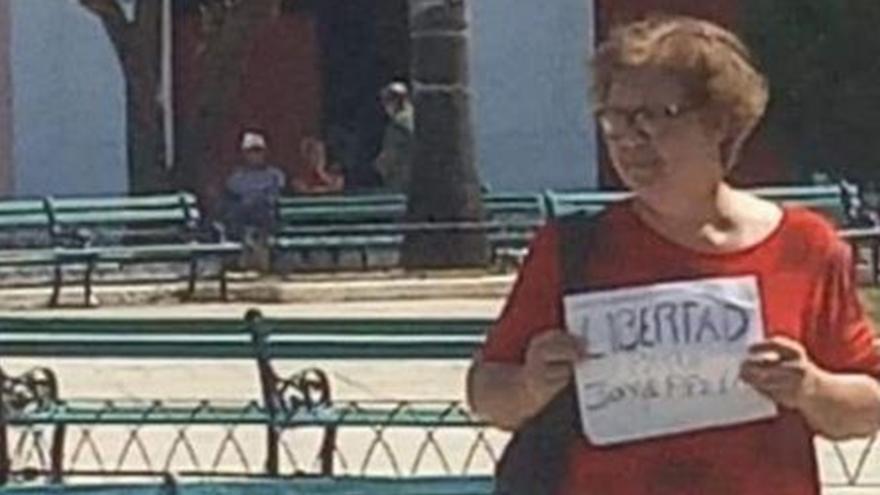
“I first sat down in the park, but I understood that I had to make the reason for my protest visible,” she says. “I wrote a very simple sign with my terrible hand writing and began to walk around the park.”
The historian says that several people came to read it and asked who Fernández Era was, and she explained it to them briefly. “Two ladies approached me and asked me kindly what I was doing, and when I told them, they introduced themselves as officials of the Provincial Government, which is in the area. They said that if I accompanied them to talk maybe they could call Havana and intercede. At that same moment, Osbel Sánchez, the provincial director of Culture, approached. He was obviously alerted because his headquarters is several blocks away,” her story continues. She accompanied the officials.
At the government office, she asked the dozen people there to introduce themselves. “Most were from the Provincial Bureau of the Party. One was the official in charge of the political-ideological sphere (very poorly prepared for that function, by the way); another was the official who deals with the issue of defense, plus another two from those areas; four were government officials and then the director of Culture, who went in and out constantly, supposedly finding out on the phone about Jorge’s situation, which was my main objective,” she explains.
The teacher realized then that the person she was talking to was “with three agents who were parked outside, who were evidently insisting that she convince me to give up.” Her answer was the same every time: “I will give up when you let Jorge go.”
López Hernández highlighted several anecdotes. When “a government lady, half annoyed, asked why if Jorge had been arrested in Havana I was demonstrating in Matanzas, I replied: ’As far as I know, no one ever objected to Fidel that Batista was in Havana when he decided to attack the barracks in Santiago de Cuba’.”
They asked her what what she was trying to do. “I’m exercising a constitutional right, that of peaceful demonstration,” was her response. continue reading
Similarly, she recounts that the officials wanted to know “about the financing” of the magazine La Joven Cuba (LJC), with which the professor had collaborated, but she clarified that she no longer worked there. “The problem with a magazine is not financial support, because everyone needs that to function, from Granma and Cubadebate to LJC. What should not happen, at least ethically, is a conflict of interest when receiving money from US government agencies with funds for regime change, but there were agencies that many times also financed projects of the Cuban Government, and there was not any conflict of interest, since alternative media are necessary, especially in the case of Cuba with its discriminatory political system.”
As usual in this type of case, “the exchange was respectful, sometimes even kind,” a deference that the three agents who were parked outside and who approached her when she left did not have.
This is how López Herndández tells it: “They were rude: ’Alina, come with us’. I categorically refused, I told them that I do not recognize the SE [State Security] as an interlocutor and that, according to the criminal procedure law itself, this was an illegal arrest. They insisted. ’You know you have to come with us’. I told them that they didn’t know me very well.”
Then they tried to take her to the car by force, and her daughter and son-in-law, who were nearby, defended her: “That was a demeaning moment: three trained men trying to force three peaceful people by violence. They used a neck-hold on my son-in-law to immobilize him; with my daughter Cecilia, who is a love of a person, they broke her umbrella and watch, but they did not manage to separate us. Even a dear friend who was there tried to mediate. I yelled for help and I think they were worried, because they stopped grabbing us. They didn’t hit me in the face or body, nor did they hit my daughter, but they pushed us, pulled us, threw us against a wall in the kidnapping attempt, which was what they were trying to do at the end of the day.”
By resisting, López Hernández managed not to be transferred and sat down to “talk” in the same office where she had previously met with the officials. The least aggressive of the police. She narrates: “He said that he had read my last book and noticed that I was even a little ’pro-Fidel’. I clarified that this was not the case, but that I have always recognized that, even founding and directing a system without political rights, Fidel gave great importance to sectors such as Health, Education and Social Assistance, currently abandoned, first by the Government of Raúl Castro and currently by that of DC [Díaz-Canel]. I suggested that he review the budget report to see the huge cuts.”
The teacher reproached them for the way they had treated her and said they violated the law they claimed to defend. The agent’s argument was that the demonstration “could bring problems.” “Well, they should have thought about that before approving a Constitution that grants such rights,” she replied, claiming that they had put this in “to give a certain image internationally,” while within the country “they frightened citizens who didn’t dare to exercise their rights,” which in her opinion was “perverse.”
It was at that moment that they informed López Hernández that Fernández Era was already free, but the teacher could not retire to her home as she wished, since they had sent a patrol of the National Revolutionary Police to take her to the Playa station, in the same city. “They told me that they heard on the radio that there was a public scandal in the park, and I said that indeed, I had resisted an illegal kidnapping and that the scandal had been provoked by three security agents.”
“I asked that they call me a lawyer if they were going to accuse me of something. I was told no, they would only give me a warning. I said that not only would I not sign it but I do not recognize myself ’warned’ because none of them, neither the aggressor agents, nor the President of the Republic, was above the Constitution,” she points out in her text. “Then we entered into an interesting exchange when he explained that the warning was not because I demonstrated, but because other people could try to join in. Answer: If they do, they would also be exercising their rights. He argued then that acts of violence could occur. Answer: That’s what the police would be for, to take care that peaceful protesters do not go overboard, although I clarified that I knew of violent incidents sometimes organized by undercover agents for situations like this.”
When she told the agent that on the 18th of each month she would continue to demonstrate, the conversation ended and they released her. “I didn’t even read the report.”
Once outside, her daughter was waiting for her and said that two agents asked her to convince her mother to give up the protest. The anecdote is revealing: “Not that the man was so friendly. He asked if my mother has ever given me medicine or ten pounds of rice. My daughter’s answer: Oh, so do you defend what you defend because you allow us a box of chicken? They hurried to say no and Ceci told them: Well, you must understand that not everything has a price, that my mother acts out of principles and convictions.”
The professor began to get attention from State Security at the same time as the young artists who took part in The Worst Generation, censored last October. López Hernández was going to write the preface to a book that would have the same title and which the regime also prevented from being published.
She herself denounced the harassment, asserting: “In Cuba, a perverse logic has been enthroned that establishes pressure on people whom there is no reason to prosecute and who are threatened and coerced for political reasons. I won’t lend myself to it. I think it’s necessary to put an end to it.”
López Hernández’s protest did not remain on social networks, because, after receiving several requests from the political police to be interrogated, she presented to the Provincial Prosecutor’s Office of Matanzas a “formal complaint and nullification action against the official summons.” She managed, with this, to have the summons canceled.
Three months later, inspired by her action, Jorge Fernández Era filed a similar claim for violation of the Criminal Procedure Law after receiving a summons from the political police, and he did not attend his hearing.
The collaborator of La Joven Cuba said at that time that the officer who addressed him expressly reminded him not to be inspired by the case of Alina Bárbara López Hernández, warning him that “Matanzas is not Havana.”
Translated by Regina Anavy
____________
COLLABORATE WITH OUR WORK: The 14ymedio team is committed to practicing serious journalism that reflects Cuba’s reality in all its depth. Thank you for joining us on this long journey. We invite you to continue supporting us by becoming a member of 14ymedio now. Together we can continue transforming journalism in Cuba.
Professor Alina Bárbara López Hernández during her protest in a park in Matanzas. (Screeen capture)
14ymedio, Havana, 6 April 2023 — The Cuban political police arrested journalist and writer Jorge Fernández Era on Thursday in Havana for about six hours, according to family and friends on social networks. After learning of Fernández Era’s arrest, Professor Alina Bárbara López Hernández went out to protest peacefully for his release in a park in Matanzas and was arrested shortly after. Currently her whereabouts are unknown, her daughter Lilian Borroto reported.
“I have just been informed that she was arrested along with my sister Cecilia Borroto López, after a physical assault by State Security. I don’t know their whereabouts and I hold State Security and the PNR (National Revolutionary Police) responsible for their physical integrity,” the young woman said in a message sent to 14ymedio.
For its part, La Joven Cuba, of which Jorge Fernández Era is a collaborator, reported on Facebook that, after several hours “since his arrest and a wave of solidarity on social networks, as well as peaceful demonstrations,” the writer was released.
“La Joven Cuba thanks all those who were aware of Jorge’s situation and who expressed their support. It also rejects the arbitrary detentions of the Cuban authorities and the violation of citizens’ freedoms and rights.”
After learning of the arrest of Fernández Era, Professor José Manuel González Rubines indicated that the arrest happened around 12:30 p.m. for “disobedience” in response to the recent “summons to an interview” from State Security. The intellectual was taken to the Aguilera Police Unit, at Calzada de Luyanó and Porvenir. continue reading
Laideliz Herrera Laza, wife of Fernández Era, let González Rubines know that the summons was appealed to the Prosecutor’s Office, but the writer did not receive a response from that body.
Faced with the arrest of the journalist, Alina Bárbara López Hernández wrote a post on Facebook saying that “if he is not immediately released” she would come out in public protest. “If other people join, I won’t be opposed. Stop repressing freedom of expression in Cuba,” she said.
She gave details about her demonstration on Facebook. “I went immediately to Matanzas Freedom Park. I will be there to protest until Jorge is released. I warn you that if they try to stop me I will resist, so bring reinforcements.”
The Cuban Observatory of Cultural Rights denounced the arrest of the writer and journalist while warning that last January he was summoned by State Security and threatened with criminal proceedings against him. His arrest is part of the repression exercised by the Cuban government for his work.
The Cuban Observatory for Human Rights warned about the growing criminal violence against Cuban artists and will continue to follow closely the current repression against Fernández Era.
Translated by Regina Anavy
____________
COLLABORATE WITH OUR WORK: The 14ymedio team is committed to practicing serious journalism that reflects Cuba’s reality in all its depth. Thank you for joining us on this long journey. We invite you to continue supporting us by becoming a member of 14ymedio now. Together we can continue transforming journalism in Cuba.
A total of 363 repressive actions of the regime were registered by the organization in March, of which 64 occurred during the voting. (14ymedio)
14ymedio, Havana, 5 April 2023 — The Cuban Conflict Observatory (OCC) recorded 372 demonstrations against the regime during the month of March. In its most recent report, the Miami-based organization also documented numerous cases of repression against activists and human rights defenders.
In its report, the Observatory highlighted the reappearance of graffiti with slogans offensive to the Government, such as “No to the Communist Party” or “Down with the dictatorship.” In addition, it detected an increase in protests by 60.3% compared to the 232 registered in March of the previous year.
However, taking into account the 711 demonstrations reported in February 2023, there has been a decrease that the OCC explains: the organization has decided not to include in its inventory, as they have been doing so far, the permanent campaigns of 200 activists.
The Observatory reported protests in 15 provinces of the Island, of which Havana, with 126 incidents, accumulated the majority. According to the report, of the demonstrations that took place in March, 189 were related to the claim of political and civil rights (50.8% of the total), while 183 were caused by demands for economic and social rights (49.2%).
During the month of March there were also several events related to the elections of deputies to Parliament, the ones with the lowest attendance since 1959. At least 8.1 million people were called to participate in the process, but 70.92% of the electoral roll attended, a figure that the Observatory finds unreliable. continue reading
The report also points out that the regime took advantage of the elections to repress several dissidents and independent journalists. In the middle of the electoral process, journalist Julio Aleaga Pesant was arrested and handcuffed for two hours inside a police car. Days later, a car with a military license plate rammed the car in which he was traveling through the capital. One of the collaborators of Diario de Cuba in Santiago de Cuba, Amado Robert Vera, was also harassed by State Security.
In addition, three CubaNet reporters — Enrique Díaz, Ángel Cuza and Osniel Carmona — were monitored in their homes and told to stay inside on election day. Finally, the organization stated that the regime prevented independent observers from monitoring the voting and observing the counting in the polling stations.
The Observatory stressed that crime and citizen insecurity intensified in Cuba in March. “What is most worrying are the violent crimes, especially by gangs of adolescents and children.” In the different provinces, in the first three months of the year, 10 murders took place in an attempt to steal a phone, a gold chain or an electric bike.
Femicides were also an alarming issue, the report said, with 19 murders between January and March (half of the total number of victims registered on the Island in 2022, which closed with 36).
In its report, the organization reiterates that insufficient wages and rampant inflation exacerbate social discontent, while mental illnesses increase, in a panorama of lack of medicines. “A one-off case revealed the apathy of people who witnessed the spectacle of an elderly woman with mental disorders who came out naked to protest. Those around her laughed or filmed her with their cell phones, but it took time before someone deigned to help her.”
The repression in the context of the parliamentary elections also occupied a central place in the report of another NGO, the Cuban Observatory of Human Rights (OCDH), based in Madrid. A total of 363 repressive actions of the regime were registered by the organization in March, of which 64 occurred during the voting.
Of these cases, 93 corresponded to arbitrary arrests and 270 to “other abuses.” There were 27 acts of harassment against political prisoners, and multiple police arrests were also reported, including that of Cuban YouTuber Hilda Núñez, alias Hildina.
Another notable case, the OCDH added, was that of activist Aniette González, arrested on March 23 and prosecuted for “outrage” to the Cuban flag in Camagüey. As for the political prisoners, they denounced the lack of medical attention to Maikel Puig and the violence of the jailers against Yuliesky Méndez, both in the Quivicán prison, in Mayabeque.
Translated by Regina Anavy
____________
COLLABORATE WITH OUR WORK: The 14ymedio team is committed to practicing serious journalism that reflects Cuba’s reality in all its depth. Thank you for joining us on this long journey. We invite you to continue supporting us by becoming a member of 14ymedio now. Together we can continue transforming journalism in Cuba.

 14ymedio, Ángel Salinas, Mexico, 13 April 2023 — The crew of the Mexican Navy ship Comet notified the captain of Puerto Juárez last Tuesday about a “raft” drifting 90 miles north of Isla Mujeres, one of the illegal landing points for Cubans in recent years, a fisherman told 14ymedio.