At the Summit Against Inflation, Diaz-Canel Offers Barter and a Thousand Cuban Doctors

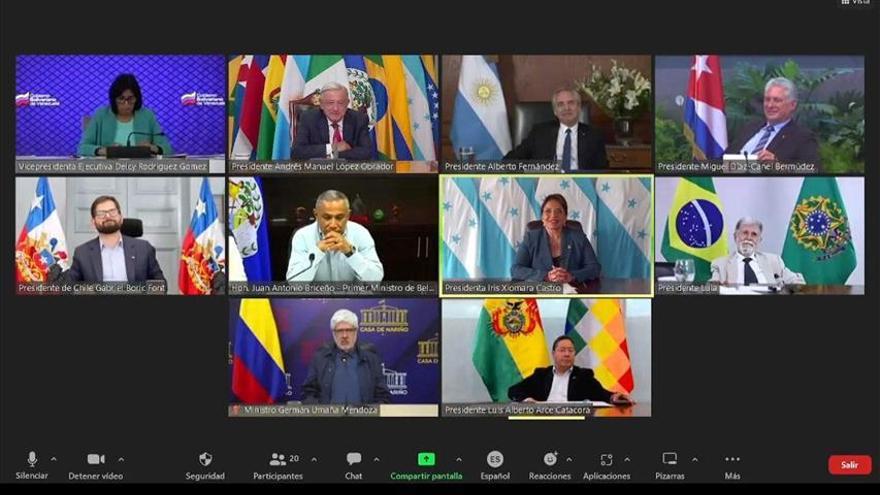
Cuban President Miguel Díaz-Canel during the virtual summit against inflation. (Prensa Latina)

14ymedio bigger14ymedio, Madrid, 6 April 2023 — Eleven countries of the Community of Latin American and Caribbean States, including Cuba, agreed on Wednesday to create an alliance to jointly confront inflation. In that virtual meeting convened by the Mexican president, Andrés Manuel López Obrador, the Cuban president, Miguel Díaz-Canel, made several proposals, which he described as “practical actions of great impact” and include resorting to barter and making a thousand doctors available to his partners.

In their final statement, the leaders of Mexico, Cuba, Argentina, Belize, Bolivia, Brazil, Chile, Colombia, Honduras, Venezuela and Saint Vincent and the Grenadines agreed, among other points, to “generate a principled circle of prosperity, economic growth and sustainable development for Latin America and the Caribbean.”

To do this, they commit to creating a “technical working group” composed of representatives of the Government of each country to establish an action plan with “logistical, financial and other measures” that allow “the exchange of basic basket products and intermediate goods” in “better conditions,” with the priority of “lowering prices” for the “poorer and most vulnerable” population.

The assembled countries consider that the rise in prices around the world is due, among other things, to “extra-regional military conflicts,” the slow economic recovery after the COVID-19 pandemic and “a large external debt that especially affects low- and middle-income countries.” The text also mentions among the causes of inflation “the application of unilateral coercive measures contrary to international law that affect some countries,” without specifically referring to the United States sanctions against the regimes of Cuba and Venezuela. continue reading

Thus, they highlight “the need to have a more just, democratic, inclusive and supportive international financial system that allows the countries of our region to access the necessary financial resources and improve the conditions of external indebtedness.”

Without forgetting “the current trade agreements that each country maintains” – for example, those of Mexico with Canada and the United States, Caricom or Mercosur – they commit to “finding alternatives that allow improving physical and economic access to products.”

Some of the leaders gathered virtually at the summit against inflation. (Prensa Latina)

Among their proposals are “improving the efficiency of the entry and exit of products through ports and borders,” the “exchange of intermediate inputs, machinery and technology for the benefit of agricultural productivity” and “facilitating access to credit at the international level.”

The joint statement includes a good part of the suggestions made by Miguel Díaz-Canel in his speech. The Cuban president suggested barter, or exchange. “This is an attractive modality for Cuba due to the severe restrictions imposed on us by the blockade and the arbitrary and unjustified inclusion in the list of countries that, according to the United States, sponsor terrorism, which severely limits the country’s financial relations,” he explained in his speech, picked up by the official press.

Díaz-Canel, the head of a country immersed in an unprecedented crisis, also urges them to “take advantage of the potential, capacity and political will to undertake, without delay, practical actions of great impact on the well-being of our peoples.”

As an example, he says: “In Cuba we have two plants with the capacity to produce fertilizers; however, we do not have the necessary raw materials for it. To produce fertilizer we need phosphorus, nitrogen and potassium. If some of the countries reach an agreement with Cuba to supply these inputs, we would be able to produce fertilizer and export it, and I think this is a scheme that can serve in other areas and in other countries.”

He also offers Cuba’s “extensive experience, particularly in the Health sector. We would be able to provide 1,000 comprehensive general practitioners to the populations that require it and also apply programs to confront chronic diseases such as diabetes and blindness,” reiterates the president, whose health missions deployed in dozens of countries are the country’s first source of income, ahead of remittances and tourism.

Díaz-Canel took the opportunity to thank the Mexican president, whom he refers to as “brother Andrés Manuel,” for organizing the summit.

López Obrador himself starred in one of the most controversial moments, declaring, with laughter and without an iota of irony: “I should go to Cuba and live there.”

The leaders called for an in-person meeting on May 6 and 7 in Cancun, Mexico.

Translated by Regina Anavy

COLLABORATE WITH OUR WORK: The 14ymedio team is committed to practicing serious journalism that reflects Cuba’s reality in all its depth. Thank you for joining us on this long journey. We invite you to continue supporting us by becoming a member of 14ymedio now. Together we can continue transforming journalism in Cuba.


US Court Rejects a Lawsuit by 12 Cuban Heirs Against Two French Banks

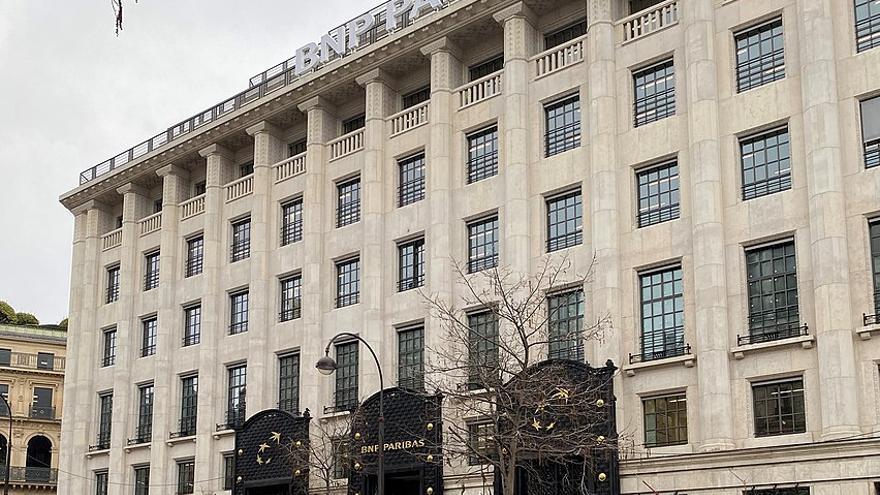
BNP headquarters in Paris, one of the banks sued by the heirs of Carlos Núñez. (CC/De Boubloub)

14ymedio bigger14ymedio, Madrid, April 3, 2023 — The lawsuit against two French banks, Société Générale and BNP Paribas, for alleged trafficking in goods confiscated by the Castro regime was dismissed last Thursday by a court in New York. The complaint, based on the United States’ Helms-Burton law, was made by a dozen heirs of the Cuban, Carlos Núñez, owner of Banco Núñez, seized in 1960 by the revolutionary government of the Island.

Société Générale and BNP Paribas were sued for doing business with the Central Bank of Cuba (BCC), owner of the former Banco Núñez after the nationalization, from which they would have obtained more than a billion dollars since 2000.

Judge Mary Kay Vyskocil has argued that Núñez’s heirs lack evidence to show that the Société Générale continued to handle BCC funds after the $ 1.34 billion fine that the entity agreed to pay in 2018 for evading U.S. sanctions against Cuba and other countries between 2004 and 2010.

As for BNP Paribas, the magistrate points out that the claims are too old and that it lacks jurisdiction to intervene. According to the plaintiffs, the entity routinely delivered cash to the BCC in Switzerland, in addition to making transactions with entities that work with it.

The news was released by the British agency Reuters, which tried to talk to the parties, without any of them – -neither the banks nor the heirs of Nuñez — willing to make statements. continue reading

The case began in 1996, when the approval of the Helms-Burton Act opened the way in the United States for this type of claim. However, the suspension of Titles III and IV prevented the litigation from advancing in those 23 years. The reactivation of both sections of the rule by Donald Trump, in 2019, re-opened the way.

In 2018, Société Générale agreed to the payment of a fine to avoid further sanctions from the U.S. Treasury, which accused it of having “intentionally and consciously violated U.S. economic sanctions related to Cuba, especially the Trading with the Enemy Act, preparing, carrying out and hiding U.S. dollar transactions using the U.S. financial system.”

The French bank made transactions worth $12 billion, of which approximately half were carried out from New York.

For its part, BNP Paribas paid a fine of $8.97 billion in 2014, imposed by the Treasury and Justice departments for having managed thousands of transactions with entities on the Island worth $1.7 billion.

“This fine, which is the largest imposed in history by the United States Government for violations of the blockade against Cuba and the sanctions in force against third countries, violates the norms of International Law and qualifies as an extraterritorial and illegal application of U.S. law against a foreign entity,” the Cuban Government denounced at the time.

Translated by Regina Anavy

____________

COLLABORATE WITH OUR WORKThe 14ymedio team is committed to practicing serious journalism that reflects Cuba’s reality in all its depth. Thank you for joining us on this long journey. We invite you to continue supporting us by becoming a member of 14ymedio now. Together we can continue transforming journalism in Cuba.

Updated Data From Hurricane Ian Indicate That It Reached the Maximum, Category 5

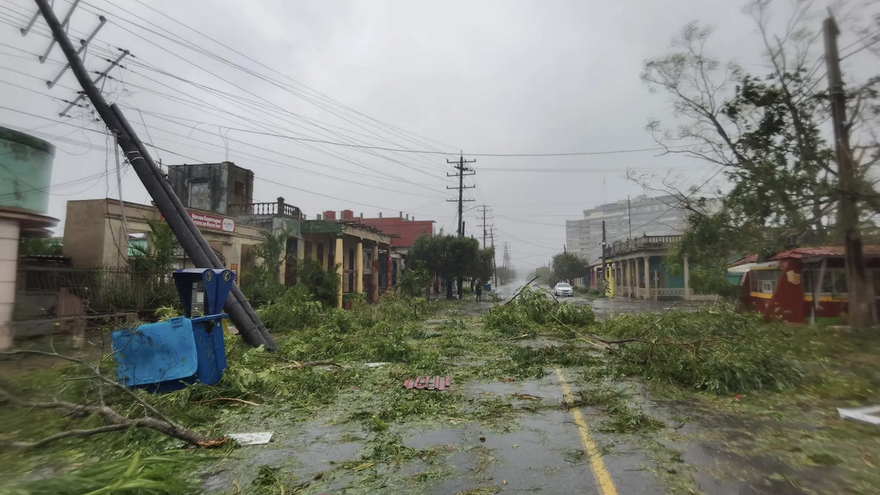
A street in Cuba with the damage left by the passage of Hurricane Ian, last September. (EFE/Yander Zamora/Archivo)

14ymedio biggerEFE (via 14ymedio), Miami, 3 April 2023 — Ian, the devastating hurricane of 2022, briefly reached category 5, the maximum, with winds of up to 160 mph near the west coast of Florida. It caused the death of 156 people and damage of more than 112 billion dollars in the United States alone, according to data updated on Monday.

A new report from the U.S. National Hurricane Center (NHC) indicates that Ian reached category 5 on the Saffir-Simpson scale in the Gulf of Mexico before making landfall in Florida last September as a category 4 hurricane.

Hurricanes of the highest category are rare in the Atlantic basin, but Ian’s maximum sustained winds reached 160 mph in the waters of the Gulf of Mexico, near where it made landfall in the Fort Myers area, on the southwest coast of Florida.

Ian thus became the 38th hurricane since 1924 that reached this maximum intensity of wind, even briefly, about seven hours before its impact on U.S. territory.

In addition to Ian, the four category 5 hurricanes computed in recent years were Lorenzo (2019), Dorian (2019), Michael (2018) and María (2017).

The NHC report also says this system left at least 156 direct or indirect deaths in the United States, making it one of the deadliest hurricanes to hit the country since 1980. continue reading

Also, the damage caused by Ian amounted to almost $113 billion, which places it as the third most expensive hurricane in the United States, only behind Katrina ($19 billion) and Harvey ($151billion), and the most expensive in Florida’s history.

Of the almost $113 billion in damages, most of it ($199 billion) occurred in Florida.

The fourth hurricane of 2022 in the Atlantic basin formed in the central Caribbean and passed through Jamaica, the Cayman Islands and Cuba before entering the Gulf of Mexico and making landfall in Fort Myers, on the west coast of Florida and, later, in South Carolina.

The system made landfall in southwest Florida as a Category 4 hurricane on September 28, crossed the state, entered Atlantic waters and, two days later, hit South Carolina as a Category 1 hurricane.

Of the 66 direct deaths attributed to Ian, all in Florida, 41 were due to the storm surge that occurred in the area where it made landfall.

In central Florida, 12 direct deaths were recorded from the floods, according to the NHC report, which blames the hurricane for another 90 indirect deaths in the United States, including 84 in Florida, five in North Carolina and one in Virginia.

The main cause of death in those cases was lack of access to timely medical care, hurricane-related accidents and heart problems.

Translated by Regina Anavy

____________

COLLABORATE WITH OUR WORK: The 14ymedio team is committed to practicing serious journalism that reflects Cuba’s reality in all its depth. Thank you for joining us on this long journey. We invite you to continue supporting us by becoming a member of 14ymedio now. Together we can continue transforming journalism in Cuba.

The First Effects of the London Trial’s Verdict on Cuba’s Debt

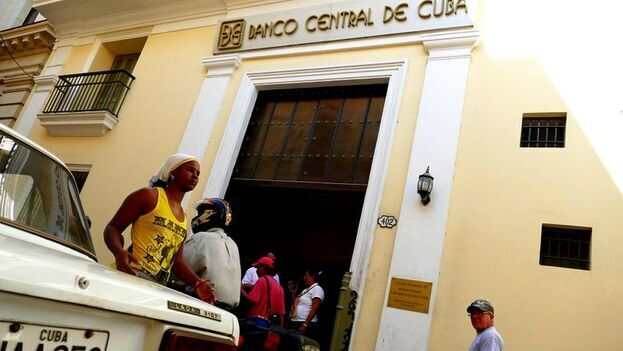
Headquarters of the Central Bank of Cuba. (Flickr/Maxence)

14ymedio bigger14ymedio, Elías Amor Bravo, Economist, 5 April 2023 — On January 23, a trial began in the British High Court of Justice for a debt claim of the CRF I Ltd. fund (plaintiff) against the National Bank of Cuba and the Republic of Cuba (defendants). A trial that, as expected, was not going to have a quick resolution, as finally happened on April 4, with the ruling of Judge Sara Cockerill, in charge of the trial. It took just over two months to arrive at a solid document of 94 pages, structured into 41 sections and some conclusions, and whose reading, loaded with legal technicalities as it could not be otherwise, comes to resolve, for the moment, the judicial matter related to a sovereign debt claim.

Rivers of ink have led to this conclusion of the trial, which is expected to become a precedent, and which is interpreted as a win by both parties.

For Cuba, because it will not have to face payment of the debt, at least for the moment. It is already established that CRF is not a creditor of the Cuban state but of the BNC, which means that the Republic of Cuba is out of the lawsuit. From now on, the trial will continue only against the BNC, which will have the right to establish the defense allowed by English law.

For CRF I, because it is not qualified as a “vulture fund,” and the court accepts its ownership of the debt and its status as a legitimate creditor, as well as the conditions under which the entire financial operation has been developed.

It could be assumed so far that everyone is happy and that Judge Cockerill’s decision is very Solomonic, but that’s not the case. Consulted legal experts, who are able to read the contents of the sentence with a much more professional look than an economist, can reach a series of conclusions that deserve attention. continue reading

The ruling, subject to appeal, leaves both parties without achieving their main objectives. CRF I finds it difficult to collect the claimed debt; hence, a director of the entity has already offered to begin negotiations with the regime. For Cuba, the sentence represents an international slap on the wrist for terrible public management of its debt policy and an anachronistic bureaucracy that transfers responsibility to employees to prevent the damage from reaching the top.

It is true that the judge does not investigate in depth the totalitarian roots of the communist regime, and this can make him lose perspective, but he did address economic and financial issues in a comprehensive way, even with that brief historical recourse to the background of the BNC in the times of Prío Socarrás [President of Cuba, 1948-1952].

No one should see in the ruling a document critical of the management of the regime prepared by the democratic opposition. It is a text of an independent judicial ruling that shows the complex mechanisms and bureaucratic tangle with which the Cuban communist regime attends to its financial affairs. First conclusion: it does not seem that the list of investors in Cuba is going to increase.

In addition to the breaches of the debt service, the algorithms of international analysts will be nourished by the information from this ruling, and the Havana regime, no matter how much its spokespeople say, is going to be demoted as a recipient of investments and loans.

The international image of terrible managers, corrupt practices and falsifying ownership of credit institutions to avoid lawsuits which derives from the ruling, should worry the regime, because it entails loss of credibility and trust and will make it even more difficult to access the international financial markets. The proximity to the closing off of credits is more than real. What will probably happen, since the parties have not achieved their objectives, is that they will appeal the ruling and prolong the trial.

In fact, a careful reading of the judgment guides the plaintiff (and many others) how to approach the claim to collect the debt, but the regime has some tranquility in the short term and is allowed to present the result as a triumph.

That is why I agree with my colleague Emilio Morales when he points out that in any judgment about the debt of the Cuban regime, the mechanism of transferring that debt from one entity to another has to be analyzed. That analysis is essential to “determine whether Havana’s assets are today in tax havens or in the hands of foreign entities that could be sued.” He adds, “the genesis of this conflict is to determine how they they were able to remove those assets from the BNC and transfer them to the BCC. There was an act of bad faith in the 90s when dividing the bank.” On these issues, Judge Cockerrill did not want to get involved.

And one last observation. The regime announced last January that the Superintendency of the Central Bank of Cuba, as a technical body with autonomy for the exercise of its functions assigned by the law related to the inspection, surveillance and control over the institutions that carry out financial and banking activity in the country, would be “in charge of reporting the results of the trial in a timely manner.” That has not happened. Instead, a Cuban television journalist has assumed that role.  Even in their statements they contradict each other. Our nerves are on edge.

Translation by Regina Anavy

____________

COLLABORATE WITH OUR WORKThe 14ymedio team is committed to practicing serious journalism that reflects Cuba’s reality in all its depth. Thank you for joining us on this long journey. We invite you to continue supporting us by becoming a member of 14ymedio now. Together we can continue transforming journalism in Cuba.

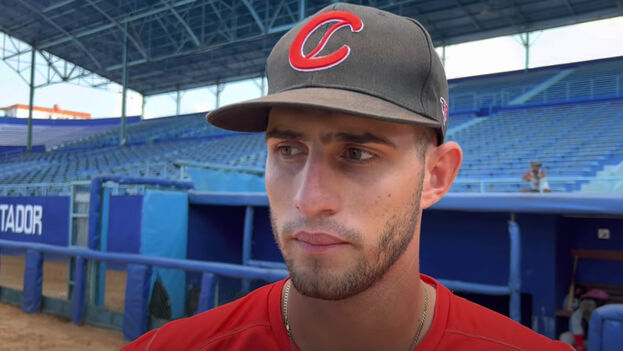
The Unattractive Salary Leads Cuban Baseball Player Yasiel Gonzalez To Resign

Since March, baseball player Yasiel González has not been on the Holguín team. (Screen capture)

14ymedio bigger14ymedio, Havana, 6 April 2023 — Yasiel González was one of the eight players who did not appear a month ago on the list presented at the Pernik Hotel by the Cachorros de Holguín team for the 62nd National Series of Cuba. A journalist based in the United States, Yasel Porto, reported on Wednesday that the 26-year-old athlete resigned from Cuban baseball “without confirming the reasons.”

González has been seen in the stands of the Calixto García stadium supporting his former teammates. According to the Facebook site “Colada Power,” the baseball player from Gibara wanted to leave the sport because of “the low salaries.”

Porto stressed on his social networks that behind the departures  of several players and the desertions are “the material conditions within a tournament that grows weaker every day” and where the players of the National Series receive an average of 3,500 Cuban pesos (145 dollars), “a very low figure, which is not enough for almost anything” in a country where the monthly minimum wage is 2,100 pesos (87 dollars).

The figures from 2020 for the players on the Island depend on their category. A member of the national pre-selection who participates in the National Series receives 3,525 Cuban pesos (156 dollars) monthly; while a player from the Reserve of the National Pre-selection and the National Series receives 2,400 pesos (100 dollars), according to Play-Off Magazine. continue reading

The tournament is “managed under the amateur concept,” a source told 14ymedio. “There are baseball players with professions, so what they do is ask for a sports license and the Government covers that amount.” To the money they receive are added the diets they are given and what they get from the products that are shared that they can “sell on the left [under the table],” an example of these being soft drinks.

Like Yasiel González, at the beginning of March, Rafael Viñales decided not to participate any longer with the Leñadores de Las Tunas. “The disappointment of not participating in the World Classic” and his current economic situation led him to leave baseball, according to journalist Gretel Yanet.

“Athletes begin to realize that their salary does not give them enough to support their families or they have housing and transportation problems, like everyone in the country. Then they begin to see other possibilities outside,” warned Juan Charles Díaz, the coach in the pre-selection of Vegueros, in February.

Díaz was clear: “Many athletes are leaving because there is no insurance and they do not have their problems solved.” Figures from journalist Francys Romero indicate that last year at least 120 Cuban players left the Island in various ways.

Iván Prieto decided not to return to the Island after his participation in Team Asere in the World Classic. (Facebook)

Others take advantage of the trips to not return. Cuban baseball player Iván Prieto, who decided not to return to Havana after his participation in the World Classic, signed his contract with the Mexican team of the Campeche Pirates last Tuesday. The agreement was announced by the Leona Sports agency, which represents the catcher, and according to the habanero Carlos Pérez, he has signed for the 2024 season.

A few days ago Prieto told Cuban Pelota that he decided to leave the Island because he saw that his “career was stagnant” with the current level of the National Series. “The decision was first because of sports issues, because I want to improve myself and prove myself in a higher level of baseball,” said the athlete.

This native of Holguín made the decision not to return to Cuba after being in the United States. “I thought about it, I analyzed it, I talked about it with my family and decided to make the decision,” in search of the dream that “everyone has, which is to play at the highest level in baseball.”

Prieto defended the teams of Holguín and Granma in seven National Series. Among his statistics, an offensive line stands out with an average of .287, with 36 doubles, a triple and 17 home runs.

He was the third catcher of the Cuban team in the West Palm Beach Pre-Olympics of 2022, and after his decision he became the first player to stay within the framework of a World Classic.

Translated by Regina Anavy

_______________

COLLABORATE WITH OUR WORKThe 14ymedio team is committed to practicing serious journalism that reflects Cuba’s reality in all its depth. Thank you for joining us on this long journey. We invite you to continue supporting us by becoming a member of 14ymedio now. Together we can continue transforming journalism in Cuba.

Faced With the Collapse of State Companies, Cuban Artists Ask for Less Bureaucracy and More Music

The artist Frank Delgado at the Cuban Art Factory (FAC). (14ymedio)

14ymedio bigger14ymedio, Madrid, 3 April 2023 — The idea is taking hold in Cuba that musicians could end up working in the private sector, although with limitations. The regime still does not give clear signs about it, but the second part of the report “Do music companies in Cuba represent their artists well?” mentions the possibility of “expanding and diversifying the music business system and offering the artist other alternatives in relation to the market,” although it is clear that the priority is to “strengthen the socialist state enterprise.”

The full report takes up the calamities from two weeks ago and specifies some of the government proposals to reverse the debacle of the sector, including the divorce of the business part from the political but without the second disappearing. Deputy Minister of Culture Fernando León Jacomino tells Cubadebate that some of the conclusions drawn lead them to propose several solutions aimed, above all, at making music companies profitable.

The most outstanding of the novelties is to give autonomy to the mechanism of accreditation of professionalism through the creation of the Registry of Professionals of Music and Musical Shows as “the only method of professional and legal accreditation of artists.” State companies must have profitability indicators, and artists must demonstrate that they can contribute to generating income, which will allow them to remain on the payroll. To do this, they have six months.

“Today, companies have to include in their catalogs all the artists who want to be professionals. If they operate under those conditions, they cannot be asked to be efficient, because they do not choose who they work with,” says the official. continue reading

On the other hand, Provincial Music Centers will be created, which will be in charge of enforcing the “cultural policy in private spaces and attending to subsidized artistic talent.”

From León Jacomino’s words it also follows that there is a plan to open the services related to the area to the private sector, and he gives as an example transport, which currently depends on the provincial companies of the State because there are no rules that allow others to hire a service that they cannot assume. The same applies to hosting, instruments and up to 14 “joined” activities, as the deputy minister refers to them.

“All the entrepreneurs we have are empirical,” adds Jacomino, who considers it essential to redesign the system of attention to subsidized artists, create a system of professional training in cultural management, present a strategy of export and promote attraction of foreign investment and new laws for the protection of artists.

The flexibility, in any case, will be very relative, since the companies will “link” to the provincial governments and must meet “the needs of the territory complying with the policy established by the ICM [Cultural Institute of Music] and the Ministry of Culture.”

Despite the numerous cases of corruption that have occurred in the sector, recognized in the previous report of Cubadebate and reported to 14ymedio also by a Cuban soloist, the section dedicated to this issue is smaller in this Monday’s text. The official newspaper talks about delays and non-payments but tiptoes over them.

“It takes several months before the payment of a performance is transferred to the company, as usually happens with Artex, famous for delinquency despite charging juicy percentages. This means that sometimes violations are incurred in the centers where the presentation is made in the face of the obvious need to guarantee the immediacy of the collection of fees,” confesses troubadour Ariel Díaz about a practice that is an open secret and that he defines as “the migration of musicians to the private sector where there are no papers or rules and they are paid, as is commonly said, ’by hand’ seconds after the end of the performance.”

The statements collected by Cubadebate, mostly anonymous, emphasize that the malfunction is systemic because there are many people who participate as intermediaries. However, they avoid directly accusing the authorities. “The blame is not on the companies but on all the fabric in the background,” reads the text, which dilutes the guilt between a faceless bureaucracy, officials supposedly far from reality and drivers or doormen who keep the money.

Laura Vilar Álvarez, director of the Center for Research and Development of Cuban Music, has participated in the proposal to reform the system and defends that music is profitable but balanced with the artistic side, since each style has a specific reality. However, it leaves the decision of what art is in the hands of the politicians of the Communist Party. “It is a company, but it is also a problem of the governor, of the provincial director of Culture. Music can’t be the last line. The function of the artist is not only to entertain. Art is the background and essence of spirituality of the Cuban nation,” she says.

“We need less paperwork and more music,” demands the artist Mauricio Figueiral. But for now it does not seem that the commitment to privatization is radical, since the control of what is put on a stage is at stake. In the words of Arnaldo Rodríguez, singer and music producer:

“The forms of non-state management can be used to boost this system, but we must not privatize the industry. The country must inject funding to the system to return to the hierarchy in the main public spaces, where today the immediacy and competence of private management prevail, which, to obtain positive economic results, are not promoting the best of our music and Cuban culture.”

Ofelia, the artist consulted by 14ymedio for the previous report, believes that the state system will end up collapsing alone. “Because if they open up now, they will see that everyone is going to leave those companies. There will be only the sacred cows of the Revolution, the devoted ones, and I don’t know to what extent, either, because companies have always been a control mechanism that artists hate,” she argues before ending with a plea for the liberalization of the sector.

“Music should flow freely, without state control and without mechanisms that hinder the creation, work and development of musicians, unless it is to support, not to hinder, which is what these companies do.”

Translated by Regina Anavy

____________

COLLABORATE WITH OUR WORKThe 14ymedio team is committed to practicing serious journalism that reflects Cuba’s reality in all its depth. Thank you for joining us on this long journey. We invite you to continue supporting us by becoming a member of 14ymedio now. Together we can continue transforming journalism in Cuba.

A School Without a Roof in San Juan and Martinez Where the Cuban Regime Profits From Tobacco

With a small enrollment that does not exceed one hundred students, classes are taught from preschool to sixth grade. (14ymedio)

14ymedio bigger14ymedio, Havana, 1 April 2023 — Between tobacco plantations and in a very beautiful natural setting, the residents of San Juan y Martínez in Pinar del Río continue to suffer the aftermath of Hurricane Ian, which last September destroyed much of the municipality’s infrastructure. To the meteoric winds is added the State’s lack of attention that has left the Modesto Gómez Rubio school without a roof for half a year.

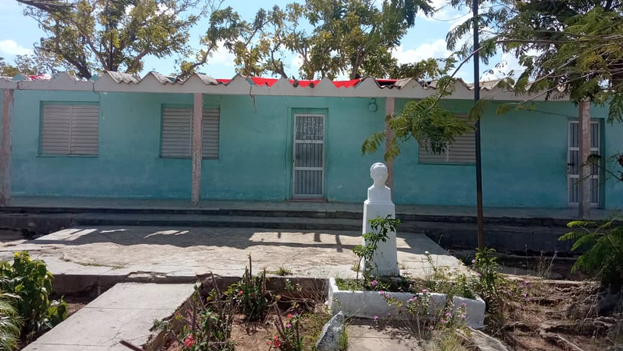
If you look at the educational center from the outside, located at kilometer 5 of the road to Punta de Cartas, it seems that the hurricane barely managed to damage it. But its blue walls hide from view the drama that is experienced inside its classrooms. Hurricane Ian tore off the roof and also damaged some columns that supported the asbestos cement tiles.

Nora Mesa García, mother of three children and a resident of San Juan y Martínez, no longer knows which door to knock on or which official to approach for a new roof to be installed in the primary school where her eight-year-old son is in the third grade. The woman explains to 14ymedio the sequence of winds, willfulness and inefficiency that has led them to the current situation.

After the passage of Hurricane Ian, former spy Gerardo Hernández, National Coordinator of the Committees for the Defense of the Revolution, arrived in San Juan y Martínez with an official delegation. “He said that the school year had to start although the parents warned him that the school did not meet the conditions,” Mesa recalls.

Despite the arguments for not restarting classes due to the condition of the building, Hernández ignored the approaches of the neighbors of San Juan y Martínez and said goodbye to the municipality with a triumphalist phrase: “The course will happen!” Six months later, classes continue, but risk and discomfort mark the day-to-day life of students and teachers. continue reading

“What was done was to collapse the parts that were in danger of falling and put two tarps on the roof, with the help of the people of the cooperative,” she adds. “We provided a third tarp so that at least the children could each be in their respective classroom and not have to all be squeezed into a small space.”

With a small enrollment that does not exceed one hundred students, classes are taught in the school from preschool to sixth grade. Mesa describes it as a place with “four small classrooms” of which only three were covered with the tarps, a momentary solution that has already continued for a half-year without a comprehensive repair of the property.

Before the “show” of the elections to ratify the deputies to the National Assembly began, Mesa verbally complained to several of the delegates of the People’s Power of San Juan y Martínez. “It seems unbelievable that you don’t have the courage to say that the priority here is to repair the school so that the children are safe,” she told them.

“Right now there is a lot of wind and the tarps move all the time. You have to enter those classrooms to feel the terror of the teachers and students. A few days ago when I went to pick up my son from school, one of the tarps had fallen, and a piece of debris almost hit him.”

“After that, my eight-year-old son won’t go to classes anymore because it’s a very dangerous situation. Here the little that has been done on the premises is because of the initiative of the parents, the cooperative and thanks to the courage of the teachers and the director of the school who are working despite the risk.”

“They told us that this was going to be temporary and that we had to wait because there were many houses destroyed and tobacco  sheds totally swept away by the winds. But they didn’t do anything about the little school. They only restored the other school that is at the entrance, in the Calderón neighborhood, next to the road, because it is the one you see when you arrive.”

Mesa has not stopped complaining and wrote to several institutions demanding that the property be repaired. She received a response from the national director of investments of the Ministry of Education of Cuba, Francisco Navarro. “He told me that yes, the school is in the investment plan, but that it is not the only one that is affected; in total there are 218. Many justifications but nothing concrete.”

“We feel like we are orphans everywhere. The rainy season is about to begin, and we will not be able to go inside the classrooms,” warns Mesa, who feels outraged because she considers that San Juan y Martínez is one of the municipalities that “contributes the most to the economy of the country” due to its tobacco production, which is sold at high prices in the international market.

“It bothers me because this is an area that provides the main contribution to the cigars, the leaf that is placed on the outside when they are rolled. It must be of very good quality and is not  produced in the rest of the country. What hurts me is that the authorities of the Ministry of Education have not even come to see our situation.

“They shouldn’t play with the parents’ feelings. They can’t tell us that it’s in an investment plan and nothing happens, because it’s our children under those tarps,” she says. “They have a cigar fair, they do auctions and everything under our noses without caring about anything that’s happening here,” she emphasizes. “It’s frustrating because we’ve run out of hope.”

Translated by Regina Anavy

____________

COLLABORATE WITH OUR WORKThe 14ymedio team is committed to practicing serious journalism that reflects Cuba’s reality in all its depth. Thank you for joining us on this long journey. We invite you to continue supporting us by becoming a member of 14ymedio now. Together we can continue transforming journalism in Cuba.

In Cuba, the Private Sector Creates Twice as Many Jobs as the State

Last year, the private sector created twice as many jobs as the public sector. (14ymedio)

14ymedio bigger14ymedio, Madrid, 5 April 2023 — The private sector created almost twice as many jobs in Cuba in 2022 as did the State. The number of new employees amounted to 226,704, of which 79,912 were government employees, compared to 146,792 in “other forms of management,” according to data offered in the annual review analyzed on Tuesday by Prime Minister Manuel Marrero, who asked for “a different look” taking into account “the challenges imposed by demographic dynamics.”

According to the report presented by the Ministry of Labor and Social Security, more than 4,653,000 workers are employed, although the figure will have to be confirmed pending an employment study announced this Monday that is intended to show “the magnitudes and structures of the economically active population.”

The document clarified that the percentage of employed women amounts to 39%, 34,000 more workers than in 2021. The largest number of female jobs were created in the sector of direct activities in the production and provision of services in the state and non-state sectors, “with a favorable impact of the jobs generated by the private sector.”

The data, however, reveal — as argued by Ariel Fonseca Quesada, National Director of Employment — a gender gap, since 34% of women do not have paid work, especially mothers who take care of children or the elderly, he added, without breaking down the data.

There are now 172,069 people who do not have any type of job, and Marrero indicated that many positions are vacant because of a lack of qualified personnel. He proposed to solve this problem through multi-employment.

The prime minister criticized some other issues that occur in the workplace, including unpaid employment of young people with the argument that they are being trained, and the low penetration of teleworking beyond the pandemic, and informal employment, against which, he insisted, it is necessary to fight. continue reading

“It is not a matter of going after them now, but of identifying them in order to protect the worker and demand that the employer assume his responsibilities,” he said.

At the opposite extreme is Alejandro Gil Fernández, Minister of Economy and Planning, who criticized “underemployment” as an evil that fundamentally plagues the sector that depends on the State budget and gives work to people who receive a salary without a specific task to do. Gil regretted that salaries do not serve to meet the needs of workers. Supposedly, as Minister, he could provide solutions.

At the meeting, other issues related to social assistance were addressed, such as the situation of women with children who cannot enter the labor market because they have no one to take care of their children. According to the prime minister, the expansion of child care through “little houses” has not been very successful, since their coverage is negligible.

In addition, the creation of “social work” as a university career was announced “on the basis of Cuban theory, which in no way resembles that of other countries, because it is part of our country’s model, in which social justice prevails,” an explanation that clarified little about the content and how it differs from the profession in other nations.

In this meeting, Cuban leaders addressed a problem of the first magnitude for the future of the country, which faces low birth rates, greater longevity and a massive emigration of people of working age, responsible for the maintenance of the State and pensions. But Cubans have the feeling that beyond words, what is systematically missing are changes.

“It continues the political discourse, the exhortations, but nothing is said about the fall in the purchasing power of the Cuban peso. Pensioners and many workers cannot cover the cost of the ’basic family basket’ [sold through the network of ration stores] with their income, and there is poverty. So what do we pensioners do who work for our Cuba, defend it, cut the cane and participate in agricultural and military mobilizations? Nothing has been done about these problems that we suffer; they are ignored, and there are no measures to solve them. We support the macroeconomic adjustment that has been mentioned, but its scope has not been made public,” a reader wrote in Cubadebate.

Translated by Regina Anavy

____________

COLLABORATE WITH OUR WORKThe 14ymedio team is committed to practicing serious journalism that reflects Cuba’s reality in all its depth. Thank you for joining us on this long journey. We invite you to continue supporting us by becoming a member of 14ymedio now. Together we can continue transforming journalism in Cuba.

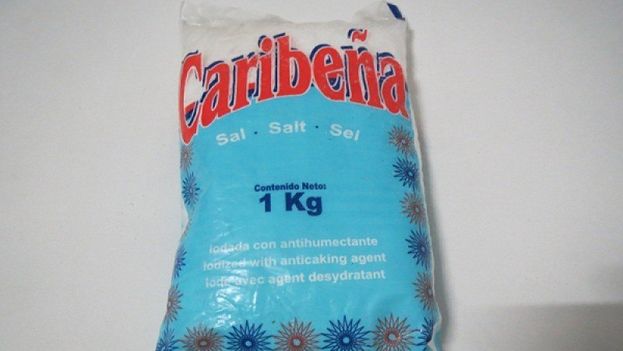
‘Don’t Forget To Bring Me Salt,’ the Plea of Cuban Mothers to Those Who Travel Abroad

How is it that a country surrounded by seawater lacks salt? This is the great question that Cubans ask themselves. (14ymedio)

14ymedio bigger14ymedio, Juan Diego Rodríguez, Havana, 5 April 2023 — The shortage of salt has been a serious issue on the streets of Cuba for a long time, but it was not until this Wednesday that the official press mentioned it. In a long article, Cubadebate echoed the complaints of its own readers and admitted that “for several months there has been instability in the marketing of salt in the country.”

The problem is not a lack of salt: more than 9,000 tons have been stored. The difficulty is with distribution, according to statements by the Minister of Energy and Mines, Vicente de la O Levy, speaking in February. “Problems with transportation have affected the delivery to consumers,” he said.

In what seems a justification for the big question — how is it that a country surrounded by seawater lacks salt? — the text devotes great space to arguing that most of the salt flats on the Island are in the eastern area. This, says the director of the Salt Company (Ensal), Jorge Luis Bell Álvarez, “is not due to whims or lack of investments, but to the fact that very specific weather conditions are required for their location”; that is, where “there is little rain and a lot of wind.” Two salt regions are located in Guantánamo, and the rest are in Las Tunas, Camagüey, Villa Clara and Matanzas.

“Guantánamo is the province that produces the most salt because it has a semi-arid climate, very dry and with little rain all year round,” says the official, while in Matanzas “salt can only be produced in the driest and windiest months, which are April, May, July and September. In the other months it rains a lot, and the water dissolves the salt that has formed.” continue reading

The salt flats of Matanzas present another problem, according to the president of the Geominero-Salinero Business Group, Fabio José Reimundo: “Every time a hurricane passes through, the entire installation is taken away, because there are dikes that separate the ponds and allow the salt to crystallize. When a strong swell happens, the water gets in and mixes with the salt. There are many hurricanes that pass through here, but not in Guantánamo.”

Despite everything, the director of Ensal assures that the state “has managed to maintain the production and (limited) distribution of salt throughout the national territory, despite the resource difficulties it faces.”

The same official explains a complex distribution process through the regulated ’family basket’ according to the number of household members. In the first month of the quarter, for example in March, 4,100 tons of salt are distributed, “and all households receive one bag of salt per household. But in April, 2,800 tons are distributed only to households that have more than four family members. “In the third and last month of the quarter, between 900 and 1,000 tons are distributed to the larger households and to those who still have a bag to fill.”

One can conclude that the figures in the Cubadebate article are not the same as on the street. Thus, the proposed price per kilogram of salt [2.2 pounds] in the warehouses, which the director of the company puts at 25 pesos [$1.04] can go up to 136 pesos [$5.67], as this newspaper was able to verify a few days ago in Luyanó, where it was sold only as a repackaged product.

“Already it must be gone, because any little bit doesn’t last long. As soon as they put it out, the resellers grab it. They repackage it and, as you know, sell it at an exorbitant price,” says a neighbor, who managed to buy a pound.

There is also inconsistency between paper and reality in the costs of salt “on the left” [on the black market]. Cubadebate says that a package costs 150 pesos [$6.25], but this same Wednesday in several markets in Havana, a package of a pound and a half was at 250 pesos [$10.42]. “They sell it to you as a kilogram [2.2 pounds], but you can see that it’s  less, and not always of a good quality. Sometimes it’s half wet, sometimes it’s very fat, and sometimes good, yes, but that depends,” complains a resident of Havana’s El Vedado district.

In San Antonio de los Baños, Ana María was able to buy just a small repackaged bag. “I don’t understand why salt is so scarce, a country surrounded by the sea!” says the woman, married and with a young daughter. “Salt wouldn’t have to be imported; it doesn’t have to come from any other country.”

Those who have a traveling relative have added salt to the list of orders to bring from abroad. “My mother sent me a message so I wouldn’t forget to bring her salt,” a habanero visiting Spain tells this newspaper. “But the last time I brought it was from Bogotá, and I almost missed the flight, because they made me open the suitcase to know what that ’dust’ was in my luggage. It was quite painful to explain to the Colombians that it was salt to take to an Island.”

In the face of all these vicissitudes, the response of the authorities via the official press is, as usual, proactive. “We are looking for alternatives to improve the transport of salt and change the modal matrix,” says Dolcey Castellanos, director of operations of Ensal. For example, “using additives that keep the salt from clumping” or “making an investment” in the salt flats of Santa Clara to “increase production capacity from four to ten tons per hour.” At the moment, nothing has been finalized.

Translated by Regina Anavy

____________

COLLABORATE WITH OUR WORKThe 14ymedio team is committed to practicing serious journalism that reflects Cuba’s reality in all its depth. Thank you for joining us on this long journey. We invite you to continue supporting us by becoming a member of 14ymedio now. Together we can continue transforming journalism in Cuba.

Closed Gas Stations and Empty Streets in Cuba Due to the Delay in the Delivery of Venezuelan Oil

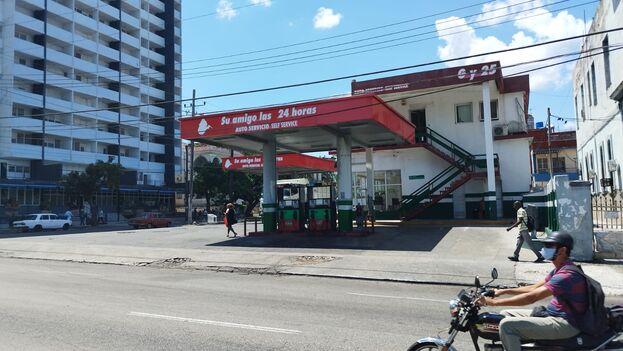
Gas station at G and 25, in El Vedado, Havana, on Monday. (14ymedio)

14ymedio bigger14ymedio, Juan Diego Rodríguez, Havana, 3 April 2023 — Havana faces restrictions due to fuel shortages for the umpteenth time. According to the website OnCuba from the State newspaper Granma — which this Monday again experienced “technical failures” and could only be partly accessed — the provincial government will establish new measures to face “a situation created by the lack of supply of fuel for private carriers and individuals with financial means in this sector.”

Thus, the official press says, “the fuel figures allocated to vital activities will be readjusted”; that is, a limit will be imposed on buying, and the sale of fuel will be offered in four service stations “located to the east, west, center and south of the city.”

The authorities do not offer the names of these gas stations but report that they will be open “in the early hours of the morning to provide services to the population.”

There will also be limits on the amount allowed according to the type of vehicle, although at the moment they have not specified the quota assigned to each one. continue reading

The lack of fuel is evident in Havana because there is insufficient   transportation and garbage collection. This Monday the streets looked emptier than ever, and even on avenues as central as 23rd, minutes went by without a car being seen.

Several gas stations, like the ones at G and 25th and L and 17th, where there are usually long lines of vehicles, were without service because there was neither gas nor diesel for sale. “They are both gone,” complained a driver to 14ymedio. “I’m paying for fuel at 50 and 60 pesos [$2-2.50] a liter [roughly a quarter of a gallon] on the street because I’m not there to wait in line.” The price in the official establishments is around 30 pesos [$1.25] per liter.

Other provinces have been suffering cuts for weeks. In Villa Clara, for example, fuel was rationed at the beginning of March, at a maximum of 30 liters [7.5 gallons] per car, 20 liters [5 gallons] for cargo and passenger bikes and 10 liters [2.5 gallons] for motorcycles.

In the middle of the month, just after a visit by Raúl Castro to Caracas, Reuters reported that Venezuela was preparing to send more than one and a half million barrels of oil to Cuba in a supertanker with the Panamanian flag. The cargo was composed, according to the report, of 400,000 barrels of Venezuelan oil and 1.13 million barrels of diesel.

The ship was supposed to arrive on the Island at the end of March, but there is no trace of that cargo on the streets.

Meanwhile, one group of workers especially outraged about the shortage of fuel are the taxi drivers. Sources in this newspaper say that they are fighting to be enabled by special services so that they don’t have to stand in the same lines as the rest, including the private ones. “So far we are having to gather together several taxi drivers to take turns standing in line, but we can’t continue that way,” says one of them.

Translated by Regina Anavy

____________

COLLABORATE WITH OUR WORKThe 14ymedio team is committed to practicing serious journalism that reflects Cuba’s reality in all its depth. Thank you for joining us on this long journey. We invite you to continue supporting us by becoming a member of 14ymedio now. Together we can continue transforming journalism in Cuba.

A Devastating Article in Cuba’s Official Press About the Mistakes in the Management of Tourism

The article laments that the recovery of tourism is so slow. (14ymedio/Archivo)

14ymedio bigger14ymedio, Madrid, 4 April 2023 — The provincial press once again proves to be the only one capable of separating itself from the official discourse of the Communist Party and sounding a wake-up call to the Government from within the system. The newspaper of Ciego de Ávila, Invasor, dared to do so this Monday with an opinion piece entitled “Cuban tourism: balances and imbalances,” in which it admits that the sector is not growing at the right pace, the goal for 2023 is “complicated” and, even more, the strategy is wrong.

The text highlights the failure of the recovery of Tourism, which in the first two months of the year was very far from the 2019 data, a fact that for the first time was mentioned aloud by Cuba’s Prime Minister, Manuel Marrero, last Tuesday in a meeting in which the “weaknesses and strengths” of the sector were analyzed.

Marrero, who was Minister of Tourism for 15 years, said that 1,014,087 foreigners visited the Island in 2022, 37.8% of the number in 2019. It was no secret, since the official data reflected it, and the independent press had been warning for months that the appropriate date for comparing tourism figures was not the previous year, but the last year before the impact of COVID-19. However, the state media had never put it in black and white.

Taking advantage of the circumstance, as well as the analysis of the current prime minister, Invasor took the data from the 2022 Tourism report to accurately emphasize that travelers spend most of their money on food and not on hotels. Yet, the Government insists on building them.

Cuba earned, always according to the official data, 19.2 billion pesos ($800 million with the rate of $24 to 1 peso) in income in the entities of international tourism, but “the highest income was not from accommodation but from gastronomic services, with about 44% of the total collection,” writes the author, Saily Sosa. continue reading

“This means that this is where we should put the money: in increasing the quantity and quality of gastronomic offers inside and outside the tourist hubs, generating value chains back and forth. Because to guarantee the cuisine destined for tourism we must import food and raw materials, and the business is far from great,” Sosa says bluntly.

The article recalls an extremely alarming fact: only 15% of hotel beds were occupied last year. In other words, out of every 10 hotel rooms on the Island, more than 8 were empty in 2022, an even more discouraging figure when compared to competing destinations, such as the Dominican Republic (70% occupied in Punta Cana), or the Mediterranean (75% occupied in the Balearic Islands).

For Sosa, the figure is a “poor indicator” that should lead to reflection, especially if one takes into account that “Tourism has benefited in the last decade with million-dollar investments, fundamentally in the expansion of hotel rooms.”

Invasor mentions “the lack of food, beverages and supplies; poor service; insufficient leisure and entertainment activities in the tourist resorts; lack of maintenance in the facilities and unstable internet service; in addition to the difficulty of finding fuel for planes, rental cars and tour buses.” One surprising data point that Marrero revealed was the decreasing number of workers in the Tourism sector. They were among the most benefited by the juicy trips they received, but the collapse of tourism also diminished the attractiveness of these jobs.

“Several economists have warned of the urgency of changing the pattern of investments in Cuba, drifting towards the production of meat, vegetables, fruits, grains and food amounts that improve the productive bases from the technological point of view, so that it can be spoken of in terms of competitive returns and supply markets, not just in terms of of tourism, by the way,” the article spits out.

While pointing out the “disadvantage” of the “blockade,” which does not allow the arrival of American tourists, the article immediately qualifies this with a devastating criticism of political leaders who have not made the necessary decisions to produce what is needed for tourism on the Island. By importing everything instead of producing in the country, “the income is equal to the costs; therefore, profits tend to zero.”

Translated by Regina Anavy

____________

COLLABORATE WITH OUR WORKThe 14ymedio team is committed to practicing serious journalism that reflects Cuba’s reality in all its depth. Thank you for joining us on this long journey. We invite you to continue supporting us by becoming a member of 14ymedio now. Together we can continue transforming journalism in Cuba.

‘It’s Not for Solidarity That Cuba Sells Its Expensive Teacher Program to Honduras’

Cuban teachers upon their arrival in Tegucigalpa, last December. (Government of Honduras)

14ymedio bigger14ymedio, Madrid, 29 March 2023 — The 123 Cuban teachers who will train teachers in Honduras will cost that country approximately 406 dollars a month, according to the Honduran newspaper El Heraldo on Wednesday in an article in which several analysts describe the investment on the part of one of the poorest countries on the continent as a mistake.

The newspaper claims to have acceded to the agreement, signed between Havana and Tegucigalpa on October 21, 2022, and points out that the amount allocated to each professional is 10,000 lempiras per month and a total of 14.7 million per year (just over half a million dollars). The total amount, for the three years initially agreed, is, as had already been announced, 40 million lempiras (1.6 million dollars).

“I understand the issue of solidarity, but in reality this is not cooperation because they are services that the Cuban regime sells very expensively, the same as with the doctors,” Julio Raudales, rector of the José Cecilio del Valle University (UJCV) told El Heraldo.

The newspaper has consulted with several experts who, among the flaws in the agreement, point out that the money could have been allocated to a national project to hire Honduran teachers and unemployed people. Specialists believe that it is an “initiative that arises from an erroneous and imposed ideology” and that it will “weaken” Honduras’s own educational system. continue reading

The implementation of the “Yo sí puedo” [“Yes I can”] program aims to help 700,000 people to become literate during the term of Xiomara Castro, who supports the Government of Havana. Although the program is very complete and works, specialists affirm that it has nothing new to offer and has not been proposed in Honduras.

“The document is well done, but it is not superior to a program that has been carried out by Hondurans. In comparison, the Nacho [a school book used in the country] is better elaborated than this methodology,” says Dennis Cáceres, director of Education of the Association for a More Just Society (ASJ).

The specialist mentions several projects that were implemented in Honduras for adult literacy in previous years and insists that there are no big differences. “In the end, literacy is based on learning words in a context, with the objective that people know how to read, add and subtract. Something that our programs already have,” he alleges.

The planned classes have a duration of two and a half hours and are spread over three days a week, and the exercises consist of the study of syllabic letters and combinations, but some experts warn that “if the roles are not agreed correctly” there could be indoctrination sneaking into the counseling.

Another of the specialists consulted, Johnny Varela, believes that it seeks to attract attention politically by launching a new proposal instead of seriously addressing a “true educational refoundation.”

The program has been the center of controversy since its announcement, when at the beginning of January the imminent arrival of ten technicians from the Island was announced to begin implementing the program, which has already been exported to about 43 countries. Then a promotional video of the Secretariat of Strategic Planning, one of the signatories of the agreement, which was advancing a new education system for Honduras, generated discomfort. “It will be universal, inclusive, participatory, secular and scientific. Just as it should be and not as the one that is being applied.”

The video continued to praise the Cuban education system, “which is one of the best in the world and will turn the exclusionary system into one that is inclusive, and we will begin to raise the cultural level of the population by delving into values such as solidarity and cooperation.”

In the images, an attractive young white woman explains in just under two minutes, smiling and with exaggerated gestures, the importance of the agreement. “The system prioritizes four aspects in education: literacy, universal access to education, the importance of teachers and education focused on social change,” she explains, referring to education in Cuba.

The opposition, led by the National Party of Honduras (PNH), also rejected the initiative, described as “Cuban interference,” and spoke of “dubious agreements.” “There are many questions from Latin American countries about Cuba’s political and ideological presence on the continent, which uses health and education as a pretext for its purposes,” a spokesman said.

Translated by Regina Anavy

____________

COLLABORATE WITH OUR WORKThe 14ymedio team is committed to practicing serious journalism that reflects Cuba’s reality in all its depth. Thank you for joining us on this long journey. We invite you to continue supporting us by becoming a member of 14ymedio now. Together we can continue transforming journalism in Cuba.

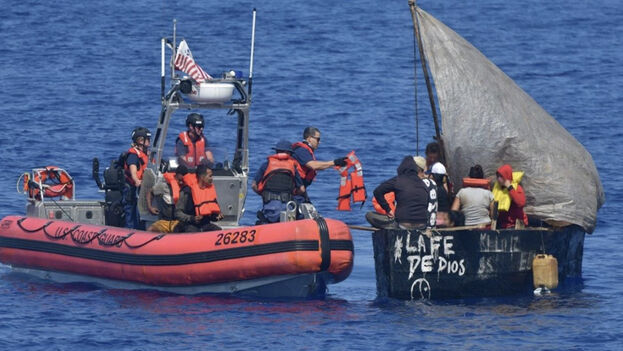
In Six Months, the US Coast Guard Thwarted 6,202 Cuban Rafters

The US Coast Guard thwarted the landing attempt of a group of Cubans who made the crossing on the raft ’The Faith of God’. (Twitter/@USCGSoutheast)

14ymedio bigger14ymedio, Havana, 3 April 2023 — In the last six months the United States Coast Guard has thwarted the attempt of 6,202 Cuban rafters to reach Florida. According to official data, this figure exceeds the total of the entire previous year, which was 6,182. Lieutenant John Beal of District Seven reiterated that “anyone who tries to enter the United States illegally by sea will be rescued and repatriated.”

Beal stressed that “those rafters who disembark will be arrested and prosecuted for expulsion.” This is the procedure faced by the 14 Cubans who managed to make landfall on Friday in the Florida Keys. The migrants arrived in two rafts, and one of the groups had a dog with him.

Although the landing of Cubans in Florida has decreased since last January, the Chief Officer of the Border Patrol, Walter Slosar, documented with images the arrival of 89 nationals of the Island in March. The largest group, 48 Cubans, was registered after their two rafts arrived at the Dry Tortugas National Park on March 4.

This national park in the Florida Keys had to close in January due to the arrival of at least 300 migrants in two days. These landings occurred just as Washington implemented the humanitarian parole program to receive 30,000 migrants from Cuba, Venezuela, Haiti, and Nicaragua on a monthly basis, in an attempt to stop the massive illegal arrival of people from those countries. continue reading

During the month of January, the US authorities granted the rafters who managed to land “an expedited deportation order,” the verdict issued by a judge for the expulsion of a person but which can be reversed with legal advice. Currently, they are being prosecuted and returned to their country of origin, noting that “they will not be eligible for the humanitarian parole program.”

This Sunday, the Coast Guard delivered 64 rafters to Cuba, and counting them there have been 2,998 irregular migrants returned to the Island this year. According to the Ministry of the Interior, the group was made up of 54 men and 10 women.

The migrants, mostly from Matanzas and Mayabeque, were handed over to the Cuban authorities in the port of Orozco in Artemisa province. Two of these people “were transferred to the investigative bodies, because before being involved in the illegal exits they were investigated as possible perpetrators of serious criminal acts,” the Ministry of the Interior said.

On the other hand, Mexican President Andrés Manuel López Obrador agreed to receive 30,000 migrants a month who are expelled by the United States, and this has generated an increase in arrests and confinement of foreigners in centers of the National Institute of Migration (INM), where abuses, extortion and human rights violations predominate.

In a temporary-stay area created by the Government, located on the Ciudad Juárez border, 38 migrants died as a result of a fire, out of the 700 who were held there. On Monday, the Secretariat of Security and Citizen Protection reported that the death toll had risen to 40.

“At the moment, 40 people have died and 27 are injured, of which 23 remain hospitalized,” the INM said in a statement. Among the victims are six Hondurans, seven Salvadorans, 18 Guatemalans, one Colombian and seven Venezuelans. The identity of the last deceased person is still unknown.

According to Mexican civil organizations, 2022 was the most tragic year for migrants in Mexico, since about 900 died in an attempt to cross into the United States without documents.

The region is experiencing a record migratory flow, with 2.76 million undocumented people detained at the U.S. border with Mexico since last October.

Translated by Regina Anavy

____________

COLLABORATE WITH OUR WORKThe 14ymedio team is committed to practicing serious journalism that reflects Cuba’s reality in all its depth. Thank you for joining us on this long journey. We invite you to continue supporting us by becoming a member of 14ymedio now. Together we can continue transforming journalism in Cuba.

What Can Happen With the Russian Economic Plans in Cuba?

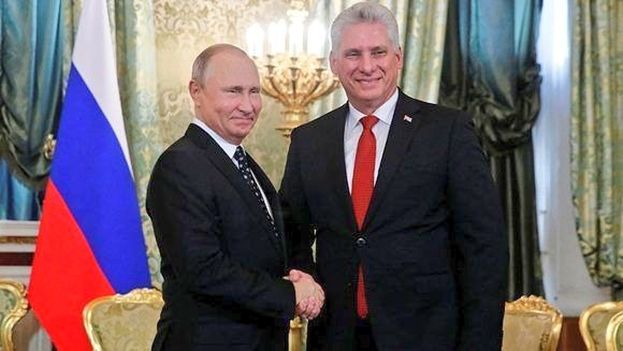
Miguel Díaz-Canel was received by Vladimir Putin on his visit to Russia. (@DiazCanelB)

14ymedio bigger14ymedio, Elías Amor Bravo, Economist, 4 April 2023 — The Russians are not going to be the salvation of the Cuban economy. Not by a long shot. No one should expect magical solutions in all this. Because they don’t care whether Cubans live better, nor have they received that order from Cuban President Díaz-Canel. Let no one have any illusions. Little is known about the Russian plans for the Cuban economy, but a conclusion can be reached. They will not straighten out the state shipwreck that is the inefficient and inoperative Cuban economy. The Russians propose to make changes but without touching anything. Let’s see how they do it.

However, the script of what has to be done to get the Cuban economy out of the Marxist hole is known and written, and in general, there is a lot of consensus around it. Therefore, it is advisable to distrust the Russian plan proposed by Putin’s adviser, Boris Titov, as president of the council of the Center for Russian-Cuban Economic Transformation that was born with the approval of Díaz-Canel during his trip to that country. This council acts on the instructions of Putin in the first place, and Díaz-Canel, secondly. From these two partners, from the good and the bad, you can expect anything, except rationality and economic wisdom. Any Spanish, Argentinian or American consultant could have done better.

The idea, in the first place, is to end the strict control that the regime exercises over the currency exchange. Correct. The creation of a foreign exchange market in Cuba for the peso, transparent and efficient, like the one that exists in other countries of the world with their respective currencies, is a proposal that the communist regime neither likes nor is interested in. Díaz-Canel had it at his fingertips in the Ordering Task,* and it barely lasted two months. He doesn’t  like it because a fixed exchange rate can’t be sustained with the level of reserves of the economy. And it doesn’t interest him, basically, because for Cuban communists the foreign exchange market is nothing more than a means of collecting foreign currency for the state coffers that is not going to leave just because. continue reading

All the exchange decisions that are taken in Cuba, including the fixed exchange rate of the ordering task, go through arbitrating mechanisms for the spin of currencies that enter the country for the benefit of the state. The discrepancies between the official and the informal exchange rate prevent any possible solution to the problem of the loss of value of a currency, the fundamentals of which are in serious crisis. The regime does not like the alternative of a foreign exchange market and, therefore, will block this proposal of the Russians, even if they recognize the consequences of the disastrous exchange rate policy.

Secondly, the Russian plan proposes to Havana to empower and promote small and medium-sized enterprises, which in Cuba are known as SMEs, and which have already been criticized from different positions. Are the Russians thinking that Castro’s SMEs serve their reforms? I doubt it. They have proposed an in-depth reform of fiscal policy to bring out activities from the underground economy. As a theoretical approach it could work, but first you have to throw something away. In the Cuban economy, taxes are only a small part of what prevents the SMEs from prospering.

The main problem lies in the absolute interference that the communist regime maintains in the SMEs, which in Cuba must be authorized by the Ministry of Economy and Planning and violates the right to free enterprise that exists in market economies. The Ministry offers monthly data from authorized SMEs, but nowhere is there information on those that go out of business, and it is known that this type of project usually presents a high mortality in its early years. Without this data, it is impossible to determine the scope of the reform of SMEs and their economic and social impact. Presumably, the Russians have asked for the data. Meanwhile, the Cuban state maintains its absolute control over all strategic areas of the economy and corners the SMEs by limiting their possibilities for growth.

The SME sector and other private actors cannot lead any economic change because it only represents 7% of GDP, 11% of budget income and offers employment to a quarter of the country’s workers (1,600,000 according to data from the Ministry of Labor, compared to more than 3 million, double, employed by the state and its companies). The figures do not allow comparison: the private sector in other countries represents more than 80% of employment and in terms of GDP management it far exceeds 70%. The distance from Cuba with these international parameters indicates the intensity and complexity of the reforms to be undertaken.

Thirdly, the Russian plan aims to eliminate other obstacles faced by companies in Cuba, such as the difficulty in accessing credit, high taxes, problems with the rate of return due to the prices of some goods, which are established in a directive way by the regime, or the price of other goods, limited by low wages in the public sector.

In short, return the axis of the functioning of the economy to the private market. Correcting the aforementioned factors is not easy, especially since, in this case, it would not be fair to apply corrective measures only to private companies, when the state companies, which are the “center of the economic system” for the regime, will not receive the same treatment.

Fourthly, the Russian plan believes that making the tax regime more flexible can help the private sector get out of the underground economy and the vicious circle in which it finds itself, and produce results in the increase of the production of food and commodities. The proposal is to move slowly, but surely, in terms of reforms, to avoid what happened in Russia, where structural transformations caused notable social injustices.

The question is how to reconcile reforms in the functioning of the economy with the maintenance of social quotas served by a budget that, necessarily, has to be reduced in size to free up resources for the private sector. It is not a matter of shock therapies or anything like that, but if the state is intended to reduce its weight in activity by placing itself at levels similar to other countries, and central planning is to be replaced by the laws of supply and demand in the setting of prices, the population cannot be deceived: sacrifices will have to be accepted.

And those sacrifices will be the greater the more the structural decisions are delayed and the more they try to sustain the state budget with the current superfluous spending commitments that currently exist. There is no possible alternative, and it should be explained to the people that the adjustments are necessary to build a prosperous economy, capable of generating employment and wealth for all, far from the Stalinist collapse of six decades.

Fifth, the definitive farewell to collectivism must be accompanied by transparent privatization processes with international observers, to ensure the legality of the actions. But as far as we know, the Russian plan doesn’t say much about this. The redistribution of economic power that is associated with these processes should not lead to the creation of mafia groups or companies of the regime, which in reality already exist, but to the birth of efficient, flexible and competitive private companies that help in the reconstruction of the nation. If the Russians are not able to offer this solution, it’s better that they don’t do anything.

In reality, the experience of Cuban SMEs in the last year has little to do with the free enterprise of which the Russians speak. Of course, it is much better that there are SMEs than that there are none. But the regime has absolutely controlled the process of creation and approval, and despite everything, it has not been able to consolidate productive structures in the field of food, where unattended needs are still very prominent. There has been a commitment to the manufacturing industry and services, which have been consolidated in the first sectoral position.

There have also been complaints that some SMEs have been oriented to develop businesses that are in the hands of family and friends of senior officials, as well as foreign entrepreneurs related to the regime. But the truth is that, so far, you can’t talk about an economic class with defined objectives and purposes. The state maintains absolute control of the process, and the SME as an alternative to communist power is weak.

Within the framework of the projects that the Russians want to implement in Cuba, there has also been talk of a joint commercial company, based on foreign investment to distribute food, chemicals and other items with the participation of the Cimex group, although no contract has yet been signed, and it is already known how these things end. Another investment project, also to be developed, is a hotel for the exclusive use of Russians, justified by the return of tourism from this country to the Island. The authorities have denied this information.

Okay, then. Russia’s relations with other countries, including Cuba, are usually structured on a framework of obscurity and little transparency that, at times like the present, with the war in Ukraine and the international embargo, multiplies significantly. Geopolitics also has a very important influence. Russians are not Cubans, nor are Cubans Russians. It will be difficult to know exactly what the Russian plans consist of, but there is no doubt that they may be compromised by what happens in Russia in the immediate future. Most likely, they will amount to nothing.

*The Ordering Task is a collection of measures that include eliminating the Cuban Convertible Peso (CUC), leaving the Cuban peso as the only national currency, raising prices, raising salaries (but not as much as prices), opening stores that take payment only in hard currency, which must be in the form of specially issued pre-paid debit cards, and a broad range of other measures targeted to different elements of the Cuban economy. 

Translated by Regina Anavy

____________

COLLABORATE WITH OUR WORKThe 14ymedio team is committed to practicing serious journalism that reflects Cuba’s reality in all its depth. Thank you for joining us on this long journey. We invite you to continue supporting us by becoming a member of 14ymedio now. Together we can continue transforming journalism in Cuba.

Cuba: Politics, Art and Sport

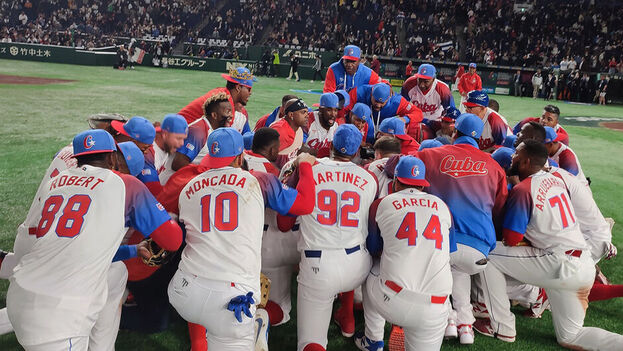
The Cuban baseball team said it felt under pressure in the Miami game, and, after its defeat, the regime blamed the audience and the opposition. (Jit)

14ymedio bigger14ymedio, Pedro Corzo, Miami, 1 April 1, 2023 — They are three independent activities, but when the arts and sports, like any discipline, are developed under a dictatorial, even worse, totalitarian management, such as the Cuban State, the management, individual or collective, is subject to the will of the government.

There will be those who do not understand the protests, which, in other words, are not against the athletes, but against the regime they represent, although as citizens, they also have rights and duties within their community.

I confess that I remember with bitterness those days of death sentences that were carried out in 24 hours, and that many prominent athletes and artists, receiving awards abroad, in their first statements to the press dedicated their awards to Fidel Castro or simply said that he was their inspiration.

The distinctions that athletes receive under the regime are a product of their own efforts, but the Government capitalizes on them for propaganda purposes, and this contributes to disinformation and to the athlete’s dependence on the State. Something similar happens with any scientific advance that occurs in Cuba. They make believe, they disseminate the results, as a genuine progress of the system, not of the nation; even less, of the individuals who with their talent and dedication achieve success. continue reading

The totalitarian regime takes credit for any award or recognition to a Cuban who represents the Island. But some do not feel a triumph as something national or as a success that belongs to everyone.

I have participated in protests against the dictatorship at sporting events. I confess that it’s not easy. I have felt like the character of the book The Two Halves of the Viscount, by Italo Calvino, which describes an aristocrat physically divided in half by a cannonball, which results in the contradictory behavior of his two halves.

The situation presented by Calvino in his short novel is complex, similar to that suffered by those of us who face totalitarian regimes that are capable of appropriating the values of a nation. It is true that there are those who do not have problems with their halves; they are whole, and they act as a battering ram without suffering the consequences.

In the early 1980s, a sports competition was celebrated in a stadium in Valencia, Venezuela, attended by Cuban boxers.

It was an intense day. Together with Kemel Jamis, a former political prisoner, and two other compatriots, we appeared on the grounds with a couple of large signs that said, “Welcome Cuban sports brothers” and another, “We condemn Castro-Communist tyranny.” Fortunately, for our safety from the Cuban and Venezuelan henchmen, the National Guard intervened and took us into custody and out of the stadium.

Protesting is a right, especially when people are not assaulted and public and private property are not damaged.

Totalitarianism introduces the citizen to a perennial debate. Consciousness, feelings, interests, politics and ideology face off against each other in a constant discussion, which acutely complicates reaching conciliation. The regime that prevails in Cuba is so absorbing and inclusive that, no matter how hard the individual tries, he cannot escape the influence of the system, unless he absolutely breaks with his roots and what he derives from them.

This perception to some extent is also based on the fact that totalitarianism, beyond the will and doing of each citizen, instilled for decades the certainty that the homeland and Fidel Castro were a single entity, an absolutism that led to the belief that any contrary individual decision would have a negative impact on the values and commitments of the nation.

All this generates an irreconcilable confrontation between the two supposed halves, not only in sports but in similar aspects. It affects everything, even the help you can give to a family member, because the reality is that totalitarianism is like a gigantic funnel that swallows everything.

But what to do? Totalitarianism is a dirty trap that corrodes us. On the Island everything is kidnapped, even our loved ones, and can there be a homeland without a family?

Translated by Regina Anavy

____________

COLLABORATE WITH OUR WORKThe 14ymedio team is committed to practicing serious journalism that reflects Cuba’s reality in all its depth. Thank you for joining us on this long journey. We invite you to continue supporting us by becoming a member of 14ymedio now. Together we can continue transforming journalism in Cuba.