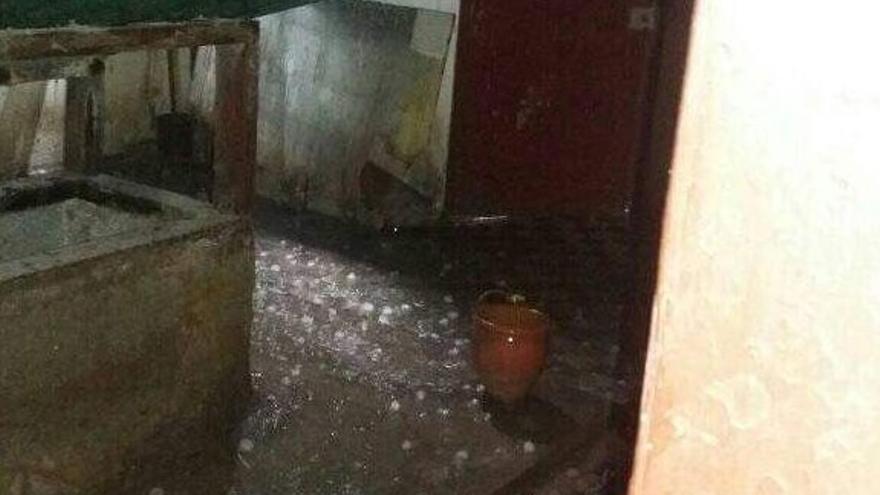
Hail in the courtyard of a house in Central Havana, this Thursday. (14ymedio)
14ymedio, Juan Diego Rodríguez, Havana, 10 April 2023 — A strong and atypical storm rained down hailstones on Havana in the early morning of this Thursday and caused flooding not only in several municipalities of the capital but also in the west of the Island.
For Lydia, who lives in Central Havana, the least of it was the large hailstones that woke her up and almost broke her windows. The water tanks on the roof of the building were directly above her bedroom, and they overflowed, taking away some precarious pipes that her neighbor had installed. All the water fell into her apartment, which was already in precarious condition.
“It was horrible. I opened the bathroom door to go in, and a waterfall landed on my head,” she tells this newspaper, while moving her electronic equipment to dry ground on the dining room table. She spent the night on a blanket on the floor.
It’s already noon, and the plumber the neighbor promised to send over is not at home because he’s working and still hasn’t arrived. “What am I going to do?” The woman is tearing her hair out. “I can’t go up there, I don’t know how to fix this mess.”
The worst, she fears, is that in the next storm, the walls, in which thick cracks are observed, may give way and the roof collapse. “This has no solution, it’s destroyed, it would have to be knocked down and rebuilt, but no matter how much we complain, the State does nothing.” continue reading
According to meteorologist Alejandro Adonis, an “isolated” storm cloud moved over Havana from the Straits of Florida “in an unusual trajectory from northwest to southeast” and “produced intense electrical activity, large hailstones and strong winds,” shortly before 5:30 in the morning.
The official press confirmed this assessment and said that the storm “produced the fall of abundant hail” of up to two inches in diameter in several municipalities, including Regla, Plaza de la Revolución, Centro Habana, San Miguel del Padrón and Old Havana.
In addition, there was strong lightning, and wind gusts of between 34 and 37 miles per hour were recorded at the Casablanca weather station. The early morning gusts caught many unprepared, as they didn’t wake up until the damage to windows and doors was evident. Some zinc tiles and water tank caps turned into veritable missiles in the dark.
In Sancti Spíritus, the Escambray newspaper published the case of the community of San Pedro, about 19 miles from Trinidad, where the storm caused the collapse of a dozen homes and an elementary school.
The authorities did not report injuries, but, the provincial newspaper says “talking with the neighbors we learned about the anguish experienced the day before in the face of strong winds and lightning.”
In addition, the newspaper warned that the amount of damage “may increase as reports from other nearby settlements come in.”
Translated by Regina Anavy
____________
COLLABORATE WITH OUR WORK: The 14ymedio team is committed to practicing serious journalism that reflects Cuba’s reality in all its depth. Thank you for joining us on this long journey. We invite you to continue supporting us by becoming a member of 14ymedio now. Together we can continue transforming journalism in Cuba.
Most of the buildings built under the concept of microbrigades were built in the years when the large Soviet subsidy allowed the Cuban state to pay for these projects. (Granma)
14ymedio, Havana, 20 April 2023 — The ninety-year-old Ramiro Valdés got angry during a meeting with leaders of Santiago de Cuba last week over the terrible state of housing in the province. The soldier, ratified this Wednesday as Deputy Prime Minister of the Island, “punched the table,” according to the local official newspaper, after unraveling the problems of the sector: overcrowding, building collapses, precarious buildings and illegal trafficking of materials.
“I can’t be everywhere,” complained Valdés, whose speeches and interventions do not usually appear in the official press, after calling on inspectors and managers to carry out greater vigilance of the situation.
The deputy prime minister took advantage of the meeting, of which only a summary was published in the official media this week, to blame those who sell construction materials at outrageous prices and also those who build “majestic houses.”
“It can’t be that a few build houses” and others neglect control of the market and then “nothing happens,” he said. Freeing the government from all responsibility, he pointed out that the State “creates” the housing plan, but that local management has not been up to the task. “If we don’t check and we allow the embezzlers to divert what little we have, the problem will continue,” he added.
The deputy prime minister said that they cannot be permissive with those who violate urban regulations either. The so-called llega y pon [“arrive and put down” makeshift housing] slums abound in the cities, towns and communities of Santiago de Cuba, triggering “new problems” that are “avoidable if the established way is done,” he added. continue reading
Santiago de Cuba is only a part of the extensive photography that shows the extremely precarious conditions of housing in Cuba: In the province there are 4,766 properties with dirt floors; 7,312 have been affected by climatic events; and the existence of 1,013 tenements has been confirmed.
Sierra Maestra describes the problem as the “’way of the cross’ of construction” and cites concrete examples of families who “take risks” to improve their housing conditions. Such is the case of Orlando, who since 2016 has been waiting for a state subsidy to get materials, or Mayté, who complains about her “mistreatment” by the authorities. The case of Sandy and Juan is also mentioned, two Cubans who have been trying for a decade to get a sack of cement in the informal market, which now costs 2,000 pesos [$83].
These “complaints” had bothered Valdés, who recalled that, in 1953, Fidel Castro promised to resolve the “housing tragedy.” Seventy years after those words, the official insists that housing conditions have been improved with the construction and delivery, since then, of 3,824,861 homes throughout the Island.
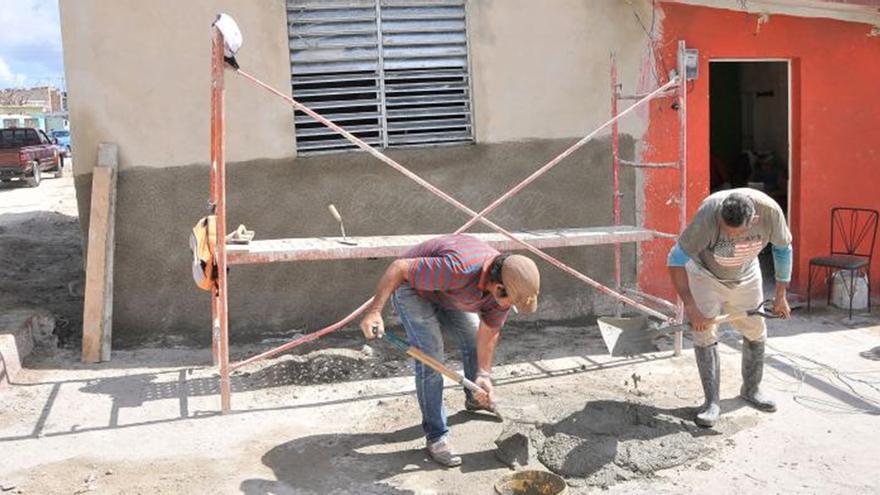
In addition, he insisted that it is time to resurrect the state microbrigade movement created by Castro in 1971, based on the idea of homeless workers building their own homes. The Government allocated land and supplied the materials, but eventually there were non-compliances and, as of 1990, the plan was scrapped.
Most of the buildings built under the concept of microbrigades were built in the years when the large Soviet subsidy allowed the Cuban state to pay for these projects. Many of the multi-family buildings of that period, with architectural models from Eastern Europe, have been harshly criticized for their ugly aesthetics and the little integration with the climate on the Island.
While the decisions remain on the table, thousands of Cuban families will take refuge this winter in makeshift houses or dark and poorly ventilated quarters. One of the problems that adds to the list is the shortage of cement, which stifles not only the housing sector but the entire economy, because it does not allow progress in the construction of key projects for the country’s industries.
Translated by Regina Anavy
____________
COLLABORATE WITH OUR WORK: The 14ymedio team is committed to practicing serious journalism that reflects Cuba’s reality in all its depth. Thank you for joining us on this long journey. We invite you to continue supporting us by becoming a member of 14ymedio now. Together we can continue transforming journalism in Cuba.
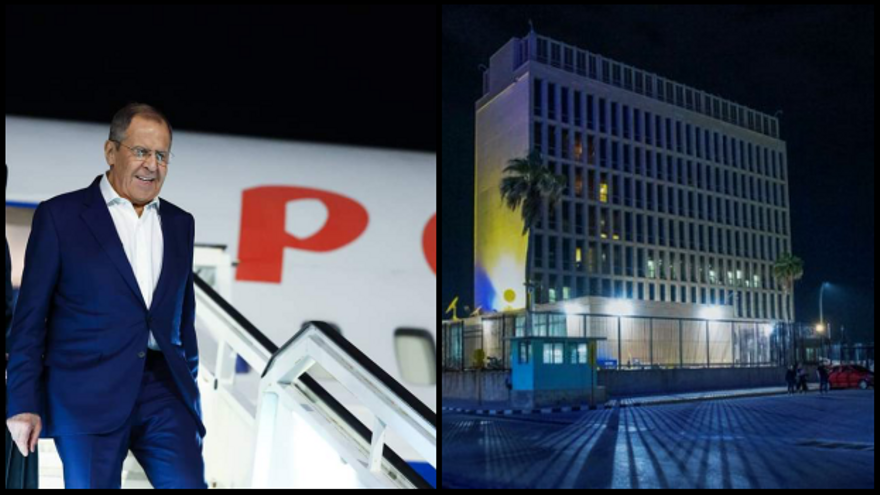
Russian Minister of Foreign Affairs Sergei Lavorov arrives in Havana the same night that President Díaz-Canel renews his mandate and the US embassy illuminates its facade with the colors of Ukraine. (Cubadebate/US)
14ymedio, Madrid, 20 April 2023 — The same night that Miguel Díaz-Canel again assumed the Cuban presidency, the Russian Minister of Foreign Affairs Sergei Lavrov landed in Havana and will be the first foreign leader to be received by Díaz-Canel in this legislature. This coincidence, perhaps forced, reflects the current situation of the Island’s international relations, with Russia as a priority partner.
It was also the same night chosen by the US embassy in Havana to reiterate its support for Ukraine with blue and yellow lights at the top of its facade, and this was not accidental. “Tonight, the US Embassy in Havana lights up again with the colors of Ukraine to demonstrate our unwavering support for the Ukrainian people. Russia continues its brutal and illegal war of aggression against Ukraine. We will continue to use the diplomatic and economic tools at our disposal to ensure that Russia’s malignant influence and brutal aggression are recognized everywhere,” the diplomatic headquarters said on its social networks.
Meanwhile, the Russian Foreign Ministry tweeted in Spanish: “In 1961, the people of Cuba heroically defended their sovereignty and independence, achieving a historic triumph by defeating American imperialism on the sands of Playa Girón*. We congratulate our Cuban friends on this significant date.”
The visit, according to the official press, will focus on promoting political, economic, educational and cultural cooperation. “The relations between Russia and Cuba are excellent. They have a high priority for both governments and are based on traditional bonds of friendship between peoples,” the newspaper Granma said, adding that the dialogue between the two nations “at the highest level has been valuable, friendly and aimed at promoting bilateral relations in all fields of interest and mutual benefit.”
Since Donald Trump, in 2017, put an end to the thaw with the United States and economic opportunities diminished for the Cuban regime, relations with Moscow have been closer. It was especially seen between 2018 and 2020, when in addition to travel — Russian tourism doubled — Moscow multiplied its investments on the Island, although many of them were canceled due to an attitude that Russia did not like. continue reading
In 2020 a railway collaboration was suspended due to “economic difficulties and quarantine restrictions on the Island,” according to Sergei Pávlov, director of the Russian state railway company, but the statements of other senior officials indicated that the mentality of the Cuban leaders was the great impediment for investments to come to fruition. Oleg Kucheriáviy, executive secretary of the Russian-Cuban Intergovernmental Trade Commission, told his country’s television that only 10 of 60 joint projects were being carried out and that the silence and procrastination of the island’s authorities had a lot to do with it.
The invasion of Ukraine has changed everything and has boosted relations. On this occasion, the interest of the Cuban side to have a powerful supplier of both energy and investments corresponds to the Russian interest of gaining influence in Latin America. With the premise of bringing together any potential enemy of the West and, in particular, the US, Moscow has once again turned on the flow of money.
The meetings of Boris Titov, president of the Cuba-Russia Business Council and a confidant of Vladimir Putin, with the Island’s authorities in recent months says it all.
Among the best-known results of those meetings are the creation of a joint venture of food, chemicals and other household items with the state-owned Cimex, the project of a hotel only for Russian customers, and the huge fuel increases from the Eurasian country to the Island, also the result of Díaz-Canel’s tour in December and his meeting with President Putin himself in Moscow.
Titov acknowledged in an interview with Sputnik last March that his team advises the Cuban authorities on an economic reform that involves giving more support to the private sector, and although he considered that there are problems in the regime’s mentality about profound changes (greater business flexibility and tax reductions, among others), many experts warn of the danger of following the steps that the USSR once took to become an oligarchy. In view of the SMEs that are multiplying on the Island, Moscow’s advice is being reflected, although it is suspected that many of those small and medium-sized entrepreneurs are friends of the regime and benefit from privileges.
Lavrov arrives in Havana after a meeting in Brazil with Luiz Inázio Lula da Silva, who has opted for a “Chinese” policy and proposed a peace plan to end the conflict in Ukraine. His position has been highly criticized by NATO, for standing aside in the face of the invasion of Russian imperialism and, despite this, it was the most critical of Moscow that Lavrov had to face. After leaving Brasilia, he finally arrived in the territory of unconditional friends. Venezuela, Nicaragua and Cuba, much more economically dependent than Brazil, have seamlessly supported Russia since the war began and not only by omission but by action, which is reflected in the United Nations votes on official pro-Russian propaganda.
In Nicaragua, Lavrov was satisfied with the support of Daniel Ortega, who has recently advocated for its incorporation as an observer country in the Community of Latin American and Caribbean States (Celac) and in the Central American Integration System (Sica).
“We addressed many areas of mutual interest, such as economic issues and also cooperation within the framework of the intergovernmental commission,” Lavrov added. Those issues range from healthcare to cars, fertilizers, food production and transport, but undoubtedly what really mattered to the Russian side was diplomacy.
“All this helps to create in Latin America a powerful center and a pillar in the new world that is being formed,” Lavrov said. According to him, the countries of the West, mainly the United States, “try to proliferate their hegemony and their influence in conflicts, such as in Ukraine or in the Asian-Pacific region.”
“We, with our Nicaraguan supporters, are going to fight against these trends and prevent these acts,” he said.
Russia’s petition to join Sica is in process, as is that of Egypt, the United Arab Emirates and Georgia, but a great division is expected, since countries such as Costa Rica and Guatemala oppose it.
*Translator’s note: Playa Girón is referred to as “The Bay of Pigs” by the United States.
Translated by Regina Anavy
____________
COLLABORATE WITH OUR WORK: The 14ymedio team is committed to practicing serious journalism that reflects Cuba’s reality in all its depth. Thank you for joining us on this long journey. We invite you to continue supporting us by becoming a member of 14ymedio now. Together we can continue transforming journalism in Cuba.
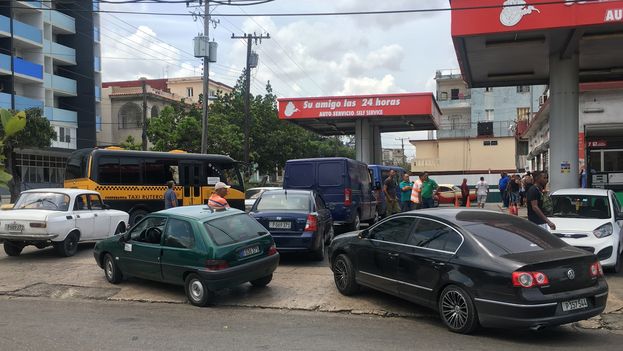
In Cuba, long lines of vehicles are waiting their turn in the service stations all over the country. (14ymedio)
14ymedio, Elías Amor Bravo, Economist, 19 April 2023 — An activity as simple in other countries as arriving in a vehicle to a gas station and filling the tank has become another headache for Cubans who have the privilege of access to cars or any other means of transport. It is no longer just the absence of food in the bodegas or the power outages that paralyze activity. Now it’s the scarcity of gasoline and diesel, and the situation has been going on for a long time.
The minister responsible for the chaos, who is the head of Energy and Mines, Vicente de la O Levy, blames the fuel suppliers who “have not been able to comply with the commitments they had with Cuba because of the economic and energy situation in the world. In addition, there are problems with the supplies needed to produce it.” And the truth is that neither of these excuses is true.
Cubans should know that the current economic situation worldwide is not causing deficiencies in fuel supplies in any country in the world. There is no global energy crisis now that the markets have normalized after Díaz-Canel’s friend invaded Ukraine, and this argument doesn’t make sense. Neither does the unreal image of a blockade of oil tankers that want to reach the Island.
All that is false and an insult to people’s intelligence. In reality, countries are intact and have even increased their oil reserves so as not to lack black gold and meet the growing needs of the post-pandemic. At the same time, there has been a notable acceleration of investments in renewable energies to reduce dependence on oil.
The lack of fuel and unstable supplies are a consequence of the Cuban regime’s behavior, especially its policy of not paying its debts. The 94-page judgment of Judge Cockerrill in London made it clear that Cuba doesn’t pay what it owes and that there will be consequences. One of them is the lack of fuel. To be able to buy oil in world markets at international prices, a country must to be up to date on its debt and have a normal payment schedule. Neither of these conditions is met by the Island. continue reading
International prices are unaffordable for the regime as a result of the shortage of foreign exchange caused by economic activities that do not generate the necessary currencies to formalize these purchases. Commercial credit is unfeasible, and even more so after the judgment of the London trial. Therefore, the regime resorts to donations or barter at subsidized prices, which are practices that, at the moment, cannot be assumed by the main producers, even by friends like Venezuela, which is positioned on world markets to take advantage of the favorable situation. Other producers, such as Algeria or Libya, look the other way.
In spite of all this, the Cuban communists have not been able to foresee a scenario that had been perceptible for months. All governments assume the preparation of a secure technical oil reserve, which could last between three and six months to face specific crises. The competent ministry is responsible for these actions. In the Cuban case, it is easier to blame others than to take responsibility. And that’s why the minister announces what the communists have practiced for more than six decades: the rationing of gasoline and diesel, with the now-known results of lines at gas stations, desperation and loss with downtime for workers. A disaster and chaos.
In addition, the minister assumes that an eventual improvement in supplies in the short term does not mean that the levels of the past will be recovered, but that we must prepare for the worst, because the fuel shortage will not be easily resolved. And the solution is to take out the little fuel that remains in a partially reduced way so as not to stay at zero, but with the known negative effects for the population in essential services like transport. As in the ‘Special Period’ in the 1990s after the collapse of the Soviet Union, “alternative” animal-powered vehicles may return to the streets, although some Cubans are pessimistic about this. There is also no food for the horses, so they lack energy.
So, while the minister of the branch and other leaders spend their time blaming the U.S. ‘blockade’ [i.e. the embargo] for the fuel crisis, someone has to think about what to do. The margins are reduced because the main supplier of oil to Cuba, Venezuela, already began in the second half of 2019 to reduce shipments to the Island, and that was decisive enough for the Cuban economy to experience a recession in the same period, starting its free fall in 2020 and then in 2021. Without oil those countries that still maintain a high dependence on non-renewable energy are not able to produce, and the 8.3 million tons of fossil fuel that Cuba consumes each year jeopardizes its growth, since only 39% is obtained from national production.
The regime announces restrictions and the rationing of fuel amid diminished capacity; it is not known how long it will last. Domestic fuel will also falter in supply since, as the minister pointed out, “there is not enough,” while some provinces “are left with one day of reserve, others have two and the eastern region ran out of fuel in the Cupet tanks of our bases.” Yet they remain calm. The lack of domestic fuel will join the blackouts that have already been occurring for some time, and a perfect storm is approaching, which may end with a collapse of the system, ending the patience of all Cubans.
The authorities say that they have done the impossible to alleviate the situation and at all times have kept the population informed, but this is not true. On the one hand, by not paying debts on time, they are having these problems now. No one will say it and much less recognize it, but debts that have been unpaid for decades act like a sword of Damocles at the present time. The information reaches the population too late, and nothing can be done, and the “sectoral and territorial priorities” established by the regime aggravate the people even more.
The scenario is not favorable. The weakened Cuban economy will be even more so with the lack of fuel, and the supply will be lower, which will increase prices and cause more inflation. The trickle of fuel, prioritizing certain activities and not others, can end up generating distortions in relative prices and even, in the extreme, in informal practices that can emerge if the situation continues over time, as all indicators confirm. It only occurs to the regime to increase surveillance, controls and repression by limiting the number of gas stations that will give “vital” services to the population and by limiting the amount of fuel to be marketed. It’s bad, and very difficult times are coming.
Translated by Regina Anavy
_______________
COLLABORATE WITH OUR WORK: The 14ymedio team is committed to practicing serious journalism that reflects Cuba’s reality in all its depth. Thank you for joining us on this long journey. We invite you to continue supporting us by becoming a member of 14ymedio now. Together we can continue transforming journalism in Cuba.
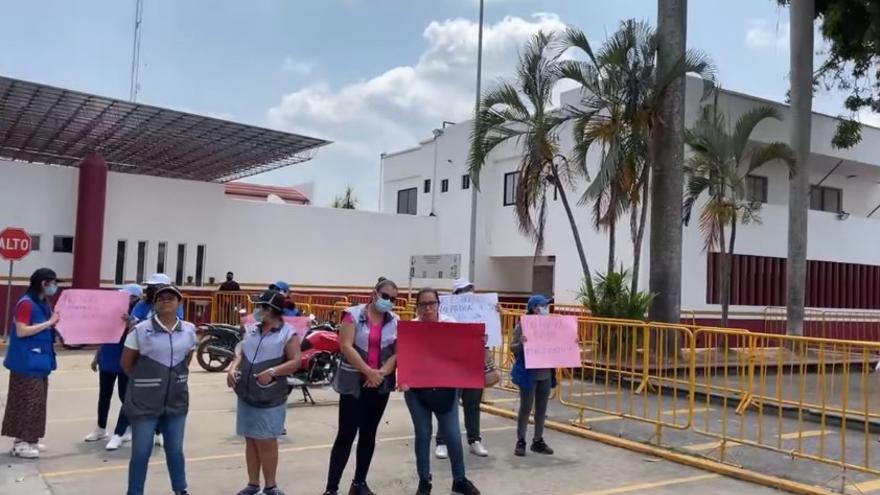
The National Human Rights Commission (CNDH) has registered more than 4,000 complaints of human rights violations of migrants in their transit through Mexico. (Captura)
14ymedio, Ángel Salinas, Mexico, 31 March 2023 — Yamilé, a Cuban woman, was illegally detained for five days at the Acayucan station of the National Institute of Migration (INM), in the Mexican state of Veracruz, and her husband José, for 12 days. “Once they admit you, they take away your papers and your cell phone. It’s hell. There is harassment by the agents, mistreatment, extortion. They sell you a sanitary pad for 25 pesos ($1), toilet paper for 35 pesos,” this habanera tells 14ymedio, adding that they transported the couple to the border with Guatemala.
“Human rights do not exist. A woman with asthma had her medicines withheld until she paid 500 pesos,” she said. They told Yamilé’s husband to continue to Tijuana to be processed by Customs and Border Patrol because the application process was overwhelmed. “Keep going, because if you go back to Tapachula they can put you in jail,” they warned him.
“Those who arrive to help you are coyotes, who tell you that they are lawyers. They asked us for $1,000 each to release us; a group of seven Colombians, $2,700; and a Venezuelan and her daughter, $1,300,” she says.
Yamilé says that the migrants in Acayucan are overcrowded because every day people arrive from Guatemala, Venezuela, some Cubans and Haitians. “There are people who have been there for 25 days and don’t know if they are going to be returned to their country. You are imprisoned like a criminal.” Before leaving the immigration station, they threatened to deport her if she came back. “I’m already registered.”
The editorial staff of 14ymedio has received complaints of Cubans who have been imprisoned in the immigration centers of Acayucan (Veracruz), Siglo XXI (Tapachula) and Las Agujas (Mexico City). Relatives of Luis Ángel Sánchez said that he spent several days in the capital. The agents accused him of having entered illegally, even when he had a safe-conduct pass and humanitarian parole from the United States. continue reading
A law firm contacted Sánchez’s relatives and offered to release him in exchange for $5,000. After several days, he was released and is now with his family in the United States. Migration stations have made extortion the bargaining chip so that Cubans can move forward on their journey through Mexico.
The human rights violations of migrants in transit through Mexico to the United States have been duly recorded in 4,424 complaints received by the CNDH against the INM between 2020 and 2022, but only 48 recommendations were issued.
“From 2018 to 2023, which corresponds to the Government of Andrés Manuel López Obrador, most of the National Security posts have been militarized, including the migration centers,” said migrant advocate Jose Luis Pérez Jiménez.
In the case of the 39 migrants who died in the fire at the provisional stay center in Ciudad Juárez, attorney Pérez Jiménez says: “Migration was fully responsible not only for the fires in the center, but also for the overcrowding, the systematic violation of the rights of those housed and the torture and mistreatment suffered by migrants at the hands of police officers and immigration agents.”
Migration has become dehumanized, said the migrant ombudsman, and this is because the Government of López Obrador has “militarized” the detention centers for foreigners who enter illegally.
The military is not prepared, and “their treatment of migrants is not the most ideal,” Pérez Jiménez explained. “We see it in Mexico City at the Las Agujas station, controlled by José Luis Valenzuela, a soldier with a bad reputation. Another case took place in Tapachula, which until recently was controlled by General Aristeo Taboada. The captain of the Navy, Jorge Alejandro Palau Hernández, is in Acayican. These are examples of only three migrartion centers, but obviously almost all of them have been militarized by López Obrador.”
Palau Hernández was removed from his position as director of the Siglo XXI immigration station, in Tapachula, after a video was released in which he could be seen beating a migrant. He was transferred to Las Agujas, where several Cubans have been detained, from whom they tried to extort money.
Importante que #INAMI aclare si es verdad esta información ??
Jorge Alejandro Palau Hernández, quien era director de la Estación Migratoria Siglo 21, de Tapachula, #Chiapas, y fue separado de su cargo tras la golpiza a un #migrante, ahora es jefe de la estación migratoria #CDMX. pic.twitter.com/QaCQFH830S
Important for #INAMI to clarify if this information is true
Jorge Alejandro Palau Hernández, who was director of the Siglo 21 Migration Station, in Tapachula, #Chiapas, and was removed from his position after the beating of a #migrant, is now head of the #CDMX immigration station. pic.twitter.com/QaCQFH830S — Eunice Rendón (@EuniceRendon) September 25, 2021
During his usual morning conference this Friday, López Obrador said: “I confess, the issue of the 39 deceased migrants has hurt me a lot, it has hurt me (…) it moved me, it broke my soul.” The Mexican president announced a reform within the INM and the formation of an external council so that the human rights of people in transit are not violated, for which he has the collaboration of Father Alejandro Solalinde.
More than a reform of the INM, Jose Luis Pérez Jiménez says that there is an urgent need for reform to the Migration Law, so that “the accommodation for a migrant is not understood by the INM as a pretrial detention. As long as this is not specified, there will continue to be abuses by migration agents.”
“It is also necessary to repeal Article 111 Part 5 of the Migration Law,” says the lawyer, because currently the agents use it to “pressure migrants to leave the shelters.” When they are released they give them “a resolution that, most of the time, is a permit for them to leave the country in 20 days, not so they can go to the border with the United States, and they don’t tell them that.”
Translated by Regina Anavy
____________
COLLABORATE WITH OUR WORK: The 14ymedio team is committed to practicing serious journalism that reflects Cuba’s reality in all its depth. Thank you for joining us on this long journey. We invite you to continue supporting us by becoming a member of 14ymedio now. Together we can continue transforming journalism in Cuba.
The line for passport and criminal record requests at the Camajuaní identity card offices. (Yankiel Gutiérrez Faife/14ymedio)
14ymedio, Yankiel Gutiérrez Faife, Camajuaní, 17 April 2023 — At the doors of the Camajuaní Collective Law Firm, located on Agramonte Street, between Maceo and General Naya, Janet, an elementary school teacher in Santa Clara, has just been given the run around after four months of waiting. “Yesterday was the last day we could get our documents stamped as legal. No more will be done until further notice,” one of the institution’s lawyers informed her.
After almost half a year of struggle with the institutions, Janet had managed to correct the errors in a document where her parents’ name was misspelled, and she was able to obtain three birth registrations and a marriage certificate. Having overcome the exhaustion of acquiring those papers, the law firm’s refusal portends more waiting in line.
Processing and legalizing documents is one of the most overwhelming processes faced by Cubans. After a “way of the cross” of bribes, going back and forth and long lines, nothing guarantees that a birth registration or a university degree will be ready in time to take a trip or enroll in a foreign university. From the purchase of a stamp to the signature of an official, there is only one constant: the desperation to get out of the bureaucratic labyrinth.
International Legal Consultancy on Colón Street, in Santa Clara. (Yankiel Gutiérrez Faife/14ymedio)
The situation is well known in the Ministry of Foreign Affairs, the institution that usually puts the decisive stamp on a document for it to be valid beyond Cuban borders. Unperturbed, the director of Consular Affairs, Ernesto Soberón, admitted the slowdown of all procedures and insisted that his office was taking “the necessary measures to respond to the increase in demand for service.” But, in reality, he didn’t promise anything. continue reading
The helplessness of Cubans lining up in front of law firms, civil registries and consultancies is the real drama. Aware — some more than others — of how bogged down the process has become, they look for alternatives and perfect several “tricks” to lighten the wait. But not everyone has the resources or the ability to overcome obstacles with good luck.
“In Santa Clara,” explains the lawyer of the Camajuaní Collective Law Firm, “there are also thousands of documents on the waiting list to be sent to the Foreign Ministry. Until we overcome this delay, we will not restart the service,” she affirmed. However, another of the lawyers had a recommendation: “Go early with your identity card to the Legal Consultancy of Santa Clara. Very early,” she insisted, “because turns in line are very limited, and if you don’t have an appointment before April 3, the doors will be closed until May.”
At five in the morning, Janet left her house, managed to catch a ride and went to the office on downtown Colón Street in Santa Clara. Her hopes were dashed as soon as it got light, when she saw that the line was already around the block, most people waiting to legalize documents. The lawyers started working at eight and, fortunately, Janet managed to get a turn.
“When I manage to deliver the papers and sign the contract to legalize my documents, I will feel relieved,” she says, knowing that she has only taken the first of many steps. “We have to live day by day so we don’t end up crazy.”
Once the document is deposited in the consultancy, the mechanism is put back in motion. The papers of the lucky ones who have signed their contracts will begin a rugged trip to Havana and, if everything is in order, the documents will be returned to the provinces months later. Even after suffering this delay, those who get their documents feel that the wait has had results.
Everything is very different when the lawyers themselves fail to comply with the clauses of the legalization contract, which theoretically obliges them not to delay the response to clients for more than 45 days. The actual waiting period, which reaches six months — often the documents have already expired after the wait — far exceeds what is stipulated.
A few weeks ago, the director of the Legal Consultancy went to the line herself and announced that it would no longer be possible to make an appointment in person. “At the end of April we will make the Ticket application available to users for all reservations,” she announced.
Several of the customers in line confronted the official with a barrage of additional questions: “Why don’t the collective law firms of the municipalities receive and legalize the documents? How can they change the process without official notice? Why do they want to concentrate all the work here if they don’t have the necessary conditions?”
As if it were an article of faith, the director of the Consultancy referred to Soberón’s announcement, which “suggested” that the rules of the game had changed due to the increase, by 16%, in the demand for procedures in the Embassy compared to 2022. “It’s not in our hands,” was the justification. “We don’t move the documents; we only contract for the services.”
The department headed by Soberón allegedly accepts about 1,000 documents a day, out of some 3,000 that they receive on average. The number of pending papers is overwhelming, explains one of the Consultancy workers, and the slow pace is aggravated because, in reality, the Ministry of Foreign Affairs continues to accept the same number as before, despite the official statements.
“Sometimes what takes the most time is the transfer of documents from the provinces to Havana, more difficult now due to the fuel crisis,” explains Fredy, a self-employed man from Santa Clara. “Customers themselves have recommended looking for ways to speed up the process, to ’decentralize’ to the eastern and central areas of the Island.”
The most viable solution so far is the one that seems least practical: traveling to Havana. Both Janet and Fredy have received the advice to rent a car and register on the waiting list of International Consultants and Lawyers, the International Legal Consulting or at Claim, a company dedicated to the protection of intellectual property that also legalizes procedures. You can also go to a Collective Law Firm in the capital or to Transconsul.
Civil Registry of Camajuaní. (Yankiel Gutiérrez Faife/ 14ymedio)
That’s what Claudia, a 24-year-old from Villa Clara, did, who was told to take her documents for legalization to the Embassy of Spain in Havana. “I sent them for legalization in January, and I’m still waiting. In order not to miss the appointment at the Embassy, I had to request proof of my parents’ marriage, get an appointment through a friend of my uncle’s and go to Havana to legalize the documents with Transconsul. It was a little faster there, 50 days or so,” she calculates.
In addition to the travel costs — in most of these institutions you have to go in person — each center has its own rules and peculiarities. Even in Havana there are long lines, the applications don’t work well and the phones are always busy.
“In reality, the law firms there are at the level of those in the province,” denounces Amelia, skeptical of the “technique” of traveling to the capital. “I had to get my daughter’s birth certificate. Every week I send my uncle who lives in the capital to ask about the procedure. They tell him that they will call when it’s ready and that he has to wait.”
One of the most frequent exits is the illegal way. Dubiel, a 23-year-old man from Santa Clara, who tried several times to solve his problem with an appointment at Claim, hired a “turn seller.” The price was 5,000 pesos [$208], to which was added the payment of the car trip, about 22,000 additional pesos [$917].
“My family in the United States sent me dollars. I sold them on the street, and that’s how I was able to pay for the trip. I was in a hurry and couldn’t afford to spend time with the law firms in Villa Clara,” he explains. The contact for the person who “facilitated” the appointment was found in a Facebook group.
Others offer, in private mail, the legalization of the document within 30 days, provided that 50 euros are paid for each procedure, in addition to a stamp of 500 pesos [$21]. “Apparently, it’s a business with the foreign officials themselves,” says Dubiel.
It is expected that digital processing, through state applications, will contribute to eliminating the “cluttering” of documents, but in reality it has complicated the picture. “Due to the lack of stamps, the customer can pay the tax on the document in cash or through an e-commerce platform. If the physical stamp is brought, we will send it along with the document. Otherwise, the amount can be paid digitally. There is no problem,” says another of the lawyers of the Santa Clara Consultancy.
With so many obstacles and in the face of a migratory exodus that has not ceased for months, the discomfort is growing. “After so much exhaustion standing in line at the civil registries, there are people who have documents from December and January that the lawyers won’t even look at. That’s why they have to pay, and it’s not cheap at all; it’s disrespectful,” says Maribel, a housewife from Santa Clara who is determined to get Spanish citizenship through the Law of Democratic Memory.
“If they really wanted to end this situation, they would open new branches for legalization services in the provinces,” she says, rejecting Soberón’s claims. “It’s no secret to anyone that people are now desperate.”
Translated by Regina Anavy
____________
COLLABORATE WITH OUR WORK: The 14ymedio team is committed to practicing serious journalism that reflects Cuba’s reality in all its depth. Thank you for joining us on this long journey. We invite you to continue supporting us by becoming a member of 14ymedio now. Together we can continue transforming journalism in Cuba.
‘Sadly we have high demand and very little availability of vehicles because of the lack of fuel.” (EFE)
14ymedio, Natalia López Moya, Havana, 17 April 2023 — The fuel crisis in Cuba is far from over and is reflected not only in the empty city streets but also in the unpayable prices of private transport.
“Unfortunately we have a high demand and little availability of vehicles due to lack of fuel,” said a highly respected agency representative in Havana this Sunday, excusing the cost. “We have only been able to locate one driver who can do the service but he charges 1,000 pesos [$42].
Maria, who lives in Nuevo Vedado, had called them. She had just been granted the United States visa for family reunification on behalf of her son and needed a ride early this Monday from her home to the Manuel Fajardo hospital, where she would collect the results of the medical check-up necessary for the consular interview at the embassy. A trip of less than two miles.
“I’ve been using them for months because a friend recommended them to me. They gave her a consular appointment a day after the passage of Hurricane Ian, when the city was full of branches and several blocked streets,” the woman explains to this newspaper to demonstrate the seriousness of the company.
This Sunday morning, she was informed that the service would cost 600 pesos [$25], which she accepted. “But the hours passed and they didn’t send me the make of the car and the name of the driver, as they always do,” María continues, “so I contacted them again in the afternoon.” It was then that they told her that the price would be a thousand pesos. “All that in the same municipality of Plaza de la Revolución; that is, that price for a very short stretch, because the rest of the road was going to be done on foot.” She had to say yes, although the price had almost doubled in a few hours, “because I couldn’t walk with my passport early in the morning given the lack of security.” continue reading
Another consequence of the gasoline shortage is being suffered by messaging platforms, such as Mandao. An employee of this company tells 14ymedio that at the moment only those who have a bicycle or an electric motorcycle are working on delivery. The young man, who has a bicycle, explains that his daily services have multiplied: “Before we were the least valued because at the pace of a pedal everything goes a little slower, and many businesses did not want us to take care of their deliveries. But now that there is no gasoline they have realized that our fuel is human, and we don’t have to buy it at gas stations.”
Of course, the law of supply and demand is not forgiving and, thus, the bicitaxis have also raised their costs. “All prices go up,” complained a customer who refused a service on Monday. “In that, the revolution is advancing.”
On Friday, President Miguel Díaz-Canel tried to offer explanations for the lack of fuel but, as on other occasions, he only pointed to scapegoats. “The countries that have certain commitments with us to supply us with gasoline from the agreements we have are also experiencing a complex energy situation,” he said in a meeting in Santa Clara with provincial leaders of the Party.
Translated by Regina Anavy
____________
COLLABORATE WITH OUR WORK: The 14ymedio team is committed to practicing serious journalism that reflects Cuba’s reality in all its depth. Thank you for joining us on this long journey. We invite you to continue supporting us by becoming a member of 14ymedio now. Together we can continue transforming journalism in Cuba.
The detained migrants were checked by Red Cross paramedics. (Facebook/Red Cross)
14ymedio, Mexico, 17 April 2023 — The Yucatan State Police arrested 241 migrants between Friday and Saturday, including a group of seven Cubans who were traveling along with 155 other people in two trucks. Among the nationals of the Island is “a family with a minor” who “asked not to be separated, but that now depends on the National Institute of Migration (INM),” an officer identified as Darío told 14ymedio.
The agency has received alerts about the flow of migrants since the middle of last month, said the uniformed man, who explained that this made it possible to locate two groups, one of 155 and one more with 86 undocumented persons who were detected “thanks to drones flying over a garbage dump.”
The Cubans are now in the INM facilities in Yucatan. “These people will not be deported,” Darío stressed, but they will be returned to the border with Guatemala “when Migration defines their situation.” According to him, the migrants “receive a 20-day residence permit to leave the country, but what they do is continue towards the United States border.”
The detention of the Cubans took place at a checkpoint located on the road from Mérida to Campeche. “At the time of the review, seven of the people traveling presented regular stay permits and were released; the rest were handed over to the INM. The drivers were arrested.” continue reading
The officer said that these migrants planned to reach Campeche and from there “cross Veracruz until they reach Tamaulipas. It’s what we know as the Gulf of Mexico route.” These arrests are not part of the routes being investigated by the Mexican Prosecutor’s Office, which so far has not offered results.
In addition to the seven Cubans arrested, there are 67 from Guatemala, 45 from India, nine from Brazil and the Dominican Republic, seven from Honduras, six from Vietnam and five from El Salvador.
A group of migrants were trying to reach Campeche when they were located and detained. (Facebook)
Of the 86 migrants arrested in the municipal garbage dump of Seyé, a town of 10,000 inhabitants that supports its local economy by leasing hostels and houses to tourists, the officer mentioned that “the coyotes who brought them abandoned them.”
A first group with 40 people from India, 15 from Guatemala and one from El Salvador “was helped by residents, who notified the authorities.” According to the data offered, “they paid between 300 and 600 pesos to be taken on an alternate route to Campeche, but on the way the coyotes abandoned them.”
The police used drones to locate the rest of the migrants who were scattered on the mountain. “There are seven children and a pregnant woman in the group. Everyone was given medical assistance, and after that they were handed over to Migration.”
According to data from the Ministry of the Interior, last year 444,439 migrants were arrested for illegal entry into Mexico, of whom 42,667 were Cubans. As of February, 17,023 Island nationals entered Mexico with documents.
Meanwhile, the Mexican Refugee Assistance Commission reported that 2,596 Cubans have applied for asylum.
Translated by Regina Anavy
____________
COLLABORATE WITH OUR WORK: The 14ymedio team is committed to practicing serious journalism that reflects Cuba’s reality in all its depth. Thank you for joining us on this long journey. We invite you to continue supporting us by becoming a member of 14ymedio now. Together we can continue transforming journalism in Cuba.
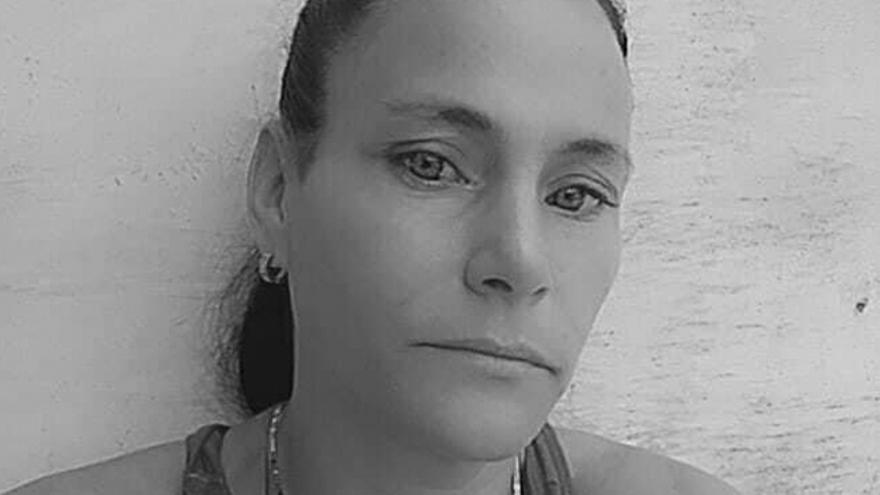
Ana Ivis Llanes, 42, was murdered by her ex-partner in the El Rastro neighborhood in Artemisa. (Facebook)
14ymedio, Feminicides, Sexist Violence, Alas Tensas, Artemisa, 15 April 2023 — Ana Ivis Llanes, 42, is the most recent victim of sexist violence in Cuba. Her death, which occurred this week in the neighborhood of El Rastro, in Artemisa, is attributed to her ex-partner, according to several relatives. With this, there are already 24 femicides so far this year, according to the Alas Tensas gender observatory.
Llanes’ family identified her aggressor on social networks as Yuliet Miranda, who allegedly fled after committing the murder. Gladisleidy Varde, the victim’s niece, published a photograph of the alleged aggressor asking for support to locate him.
Similarly, the Cuban Institute for Freedom of Expression and Press said last Thursday that, according to Llanes’ relatives, the aggressor had a history of the rape of a minor. As usual, neither the police nor the official press have confirmed the event.
The list of femicides in the first four months of the year almost triples the figure recorded on the same date in 2022, when nine were reported. In the first two weeks of April alone, there have been five violent deaths of women. continue reading
The most recent victim was Aliuska Jardines, 35 years old and a native of Guantánamo, who was murdered last Saturday by her partner in the Jesús María neighborhood, in Havana. According to feminist groups, her death is linked to a case of sex trafficking and internal migration.
Independent organizations have long demanded legislation that protects women and recognizes deaths motivated by hatred towards this segment of the population. In Cuba, there are also no official data on these events, a void pointed out by numerous feminist groups.
While cases of femicide continue to escalate, Cuban President Miguel Díaz-Canel acknowledged that there is sexist violence in Cuba and assured that there will be “zero tolerance.” In a meeting with 480 representatives from several provinces, held this Friday, the president promised a national debate, as well as “perfecting the statistics because they are insufficient” and may be “biased.”
“There are many manifestations of violence in our society that are not recognized, so we must do more in this regard,” he insisted.
Contrary to the speech of officials and the requests of feminists, the official newspaper Cubadebate published an article last Februar in which it admitted that they do not have “all the data” necessary to know “if indeed more women are dying” on the Island.
Translated by Regina Anavy
____________
COLLABORATE WITH OUR WORK: The 14ymedio team is committed to practicing serious journalism that reflects Cuba’s reality in all its depth. Thank you for joining us on this long journey. We invite you to continue supporting us by becoming a member of 14ymedio now. Together we can continue transforming journalism in Cuba.
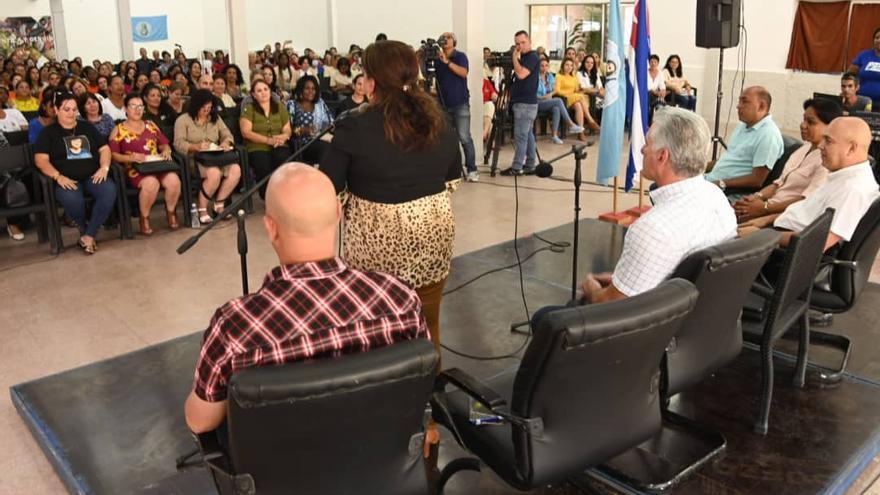
Cuban President Díaz-Canel met with 480 women from the provinces of Havana, Cienfuegos, Villa Clara, Sancti Spíritus and Ciego de Ávila. (Twitter/Presidency of Cuba)
EFE (via 14ymedio), Havana, 15 April 2023 — Cuban President Miguel Díaz-Canel said this Friday that there will be “zero tolerance” for sexist violence, which he described as “an unacceptable act” on the Island.
“This has to be a society with zero tolerance for violence and in particular for violence against women,” Díaz-Canel said in his first public pronouncement on this issue, which has gained much greater notoriety with the rise of reporting from independent feminist platforms and social networks.
The Cuban president met with 480 women from the provinces of Havana, Cienfuegos, Villa Clara, Sancti Spíritus and Ciego de Ávila in a meeting called Voices of Women for Gender Non-Violence, held this Friday in Santa Clara, as reported by the Presidency on Twitter.
“Violence against any woman is not only a blow to the feminist tradition of the Revolution, it is an unacceptable act for our socialist society,” Díaz-Canel stressed.
In Cuba there are no public statistics on femicides, and the official media do not usually report on it. continue reading
Díaz-Canel said that “because of the very strength of the social work of the Revolution, it is inadmissible for us that there are still manifestations of violence against women in our society,” during the meeting organized by the official Federation of Cuban Women.
Previously, he had announced on Twitter his participation in “this important meeting for a Cuba without violence against women.”
In a video released about his participation in the meeting, Díaz-Canel said that a national discussion will be held and a group of actions implemented to protect women who could be victims of gender violence.
The work of independent platforms against gender violence and their dissemination by some independent media has contributed to focusing on this issue, particularly the cases of sexist murders and disappearances of women. Feminist groups have confirmed so far this year 23 femicides on the Island and 141 since 2019.
The most recent case was reported last Monday. It was the murder of a young woman at the hands of her partner in Havana, the third documented in the last week. Yo Sí Te Creo [I Do Believe You] has insisted on a “Third Call” for the declaration of a “State of Emergency in Cuba for Gender Violence,” which was signed by 15 independent projects.
The call criticizes the lack of protocols and prevention mechanisms in Cuba, the persistence of problems in complying with restraining orders for potential victims and receiving complaints, and the lack of shelters and protection networks.
Independent activists insist on a specific comprehensive law against gender violence.
They consider that femicide should be expressly classified as a crime in the current Cuban Criminal Code, which only contemplates gender-based violence.
The most recent official statistics on this type of event appear in the 2016 National Gender Equality Survey in which 10,698 women participated. The survey showed that 26.7% of Cuban women between the ages of 15 and 74 claim to have suffered some type of violence in their relationship.
The state press does not usually collect these facts, which have become increasingly visible through social networks, but lately several media have reported on the issue and have recognized the need to have a comprehensive law that focuses on gender violence and provides “statistics that are public and timely.”
Translated by Regina Anavy
____________
COLLABORATE WITH OUR WORK: The 14ymedio team is committed to practicing serious journalism that reflects Cuba’s reality in all its depth. Thank you for joining us on this long journey. We invite you to continue supporting us by becoming a member of 14ymedio now. Together we can continue transforming journalism in Cuba.
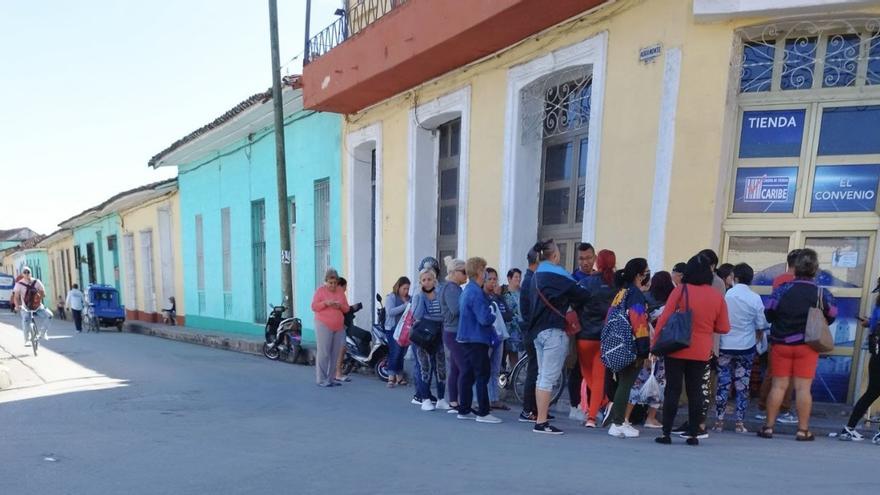
A state establishment in Sancti Spíritus that sells in pesos and belongs to the Caribbean Store Chain. (14ymedio)
14ymedio, Mercedes García, Sancti Spíritus, 15 April 2023 — “Between 11 in the morning and one in the afternoon you have to disconnect the central electricity and have zero consumption.” This is the information that state companies in the province of Sancti Spíritus are receiving. The measure, implemented a few days ago, aims to drastically reduce energy expenditure in search of a desperate palliative to the fuel deficit that Cuba is experiencing.
“Now the guidance, unlike other times when we were asked to turn off some lights and air conditioners, is that we must shut down the central power to avoid consumption between those hours,” explains an employee of a branch of the Cimex Corporation, managed by the Cuban military, which deals with part of the retail trade in the province.
“In our office, from 11 in the morning until one in the afternoon, the central electricity must be cut off, which complicates all our work that involves computers, printing invoices and other tasks that need electrical equipment,” laments the worker.
In a nearby office of the state telecommunications monopoly, Etecsa, the panorama is repeated. “When last year we were told that we had to turn off the lights and air conditioners, people looked for solutions,” says a young employee who prefers anonymity. “In order not to have to suffer from the heat, the workers brought their own fans.” continue reading
Instead of saving electricity in the two regulatory hours of blackout, in many of these premises consumption remained unchanged. “We went from using two air conditioners to having eight or nine fans connected. What was saved on the one hand was spent on the other,” acknowledges the man, who works in the area of attention to the population.
“We closed and did not accept more customers at that time, but we had to stay inside the office, which was hellish because of the heat, especially in the summer,” he says. “Apparently they realized that a lot of electricity was not being saved, and now the administrator will be in charge of turning off the central power. No one will be able to connect their fan or charge their cell phone.”
The measure joins others that have been taken in the province and throughout Cuba due to the fuel crisis that the Island is going through. “We have a very diminished fleet of merchandise delivery trucks; we have had to change the hours of supplying the stores, and now there are two hours a day when we will not be able to do anything,” says the employee, summarizing the situation in the provincial subsidiary of Cimex.
Sancti Spíritus, a territory that connects the flow of vehicles arriving from the west to the east of the Island and vice versa, has experienced a notable decrease in traffic. “Now you spend hours to get from the city of Sancti Spíritus to Trinidad because the drivers don’t have fuel,” says Mirna, age 59, whose family is divided between the provincial capital and the beautiful Valle de los Ingenios.
“Sometimes I go for days without seeing my daughter, as if we lived in different provinces. If you look at a map, her house is right there. With no cars or trucks, we are incommunicado within the province itself,” she adds.
Mirna does not seem very worried about the repercussions that the new energy-saving measure will have on the lives of workers in the state sector. “They don’t do much anyway,” she concludes. “Here it’s been a long time since you could do paperwork or budgets during those hours, so it’s more of the same.”
Next Monday, Mirna’s husband, who has an administrative position in a municipal office, will have to “turn off the electricity” at work. “He can’t do anything else. It’s what they’ve told him and what he has to do, but he already told me that during that time he’s not going to stay inside the premises, which is an oven. He says he’s going to sit in the park.”
Translated by Regina Anavy
____________
COLLABORATE WITH OUR WORK: The 14ymedio team is committed to practicing serious journalism that reflects Cuba’s reality in all its depth. Thank you for joining us on this long journey. We invite you to continue supporting us by becoming a member of 14ymedio now. Together we can continue transforming journalism in Cuba.
After recognizing that there was no clear and long-term strategy to address the problem, he suggested that it was best to be resigned to it. (ACN)
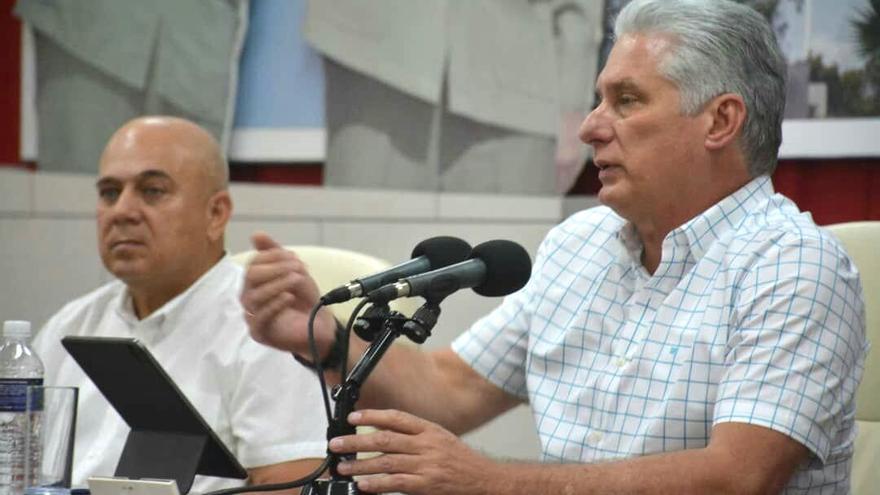
14ymedio, Havana, April 15, 2023 — Miguel Díaz-Canel found this Friday a new scapegoat this Friday to justify the fuel crisis in Cuba. “What happened to gasoline?” was the question that was asked in a confessional tone during a meeting with leaders of the Communist Party in Villa Clara. “The countries that have certain commitments to supply us with gasoline are also experiencing a complex energy situation,” he concluded.
The “non-compliances” of others — which seems to point, above all, to Venezuela — can be translated into figures: “From between 500 and 600 tons of gasoline per day that the country consumes, at the moment we have coverage of less than 400,” he calculated. In addition, the Government “is not very clear” about how it is going to “get out of the situation.”
After recognizing that there was no clear and long-term strategy to address the problem, he suggested that the best thing was to be resigned to it: “This does not have to do with inefficiencies of the country or with problems of our energy institutions, but with non-compliances that have also occurred for very objective reasons that the countries that supply us have,” he said, without going into details about the problems faced by Venezuela.
Regarding diesel, he assured that the cause of its deficit was “different,” and that it could be attributed to “temporary problems.” “The loading was guaranteed, but the ship broke down in Santiago de Cuba, and this prevented the unloading in time for it to continue to other ports. That has caused a delay in the way we have been able to distribute that fuel,” he explained, without specifying if he was talking about the oil tanker Nolan, which was loading 1.53 million barrels (400,000 barrels of fuel oil and 13.13 of diesel) destined for Cuba.
He also referred to the “strategy to avoid blackouts in the summer,” since most of the Island’s thermoelectric plants are “resolving breakdowns or under maintenance.” “We have had to depend more on distributed electricity generation, which usually consumes diesel,” he said. continue reading
The official press welcomed Díaz-Canel’s visit to Santa Clara, the city that nominated him for the new legislature of the Cuban Parliament and in which he carried out a sustained campaign during last March’s elections. Cubadebate admitted that the president arrived in the center of Cuba “in the midst of a complex energy situation, which has generated a lot of concern in the population,” and celebrated Díaz-Canel’s contrition in the face of the successive crises that “complicate the lives of Cubans.” In addition, it applauded his criticisms of “the deficiencies of the Party’s work in Villa Clara” and that he himself performed a “self-criticism.”
Despite Díaz-Canel’s “resignation,” the fuel crisis continues to worsen as the summer arrives. The imminence of the hottest months augurs a reoccurrence of the long blackouts that only gave Cubans a truce in December 2022, but that regained strength in January of this year.
So far, the most serious symptom is manifested in transport, since a large part of the Island’s vehicles are paralyzed or must face long lines in front of gas stations and are also required to have accreditation that they belong to an authorized ministry, company or to embassies.
However, data published by Reuters reveal that Cuba receives a constant supply of fuel. In March, Cuba received 980,000 barrels of oil from Russia, Panama and Uruguay, another sign of the increasing economic ties between the Kremlin and Havana.
The new rules of rationing at gas stations show that this supply rarely benefits Cuban drivers, and that despite the failures of the last harvest, Russia seems determined to reactivate sugar production on the Island and other agricultural activities by sending its oil to the country.
In addition to Moscow, Havana has its oil partner par excellence in Caracas. Several agreements, which a recent visit by Raúl Castro to the Venezuelan capital was in charge of reactivating, guarantee that the Island is the port of arrival for numerous oil tankers from Venezuela.
To this panorama is added the traffic of the patanas along the Cuban coast, the floating generators sent by Turkey to alleviate the energy deficit on the Island. The Erin Sultan left Havana on Tuesday for Santiago de Cuba and should arrive this Saturday to replace the IremSultan, which arrived in the capital of the East less than a month ago.
Meanwhile, other ships of the Karadeniz Powership company, the Suheyla Sultan and a small tugboat, are still anchored in the Bay of Havana. The most evident sign of Cuba’s energy instability is the blackouts that Cubans are already suffering, and that their duration is increasing.
Translated by Regina Anavy
____________
COLLABORATE WITH OUR WORK: The 14ymedio team is committed to practicing serious journalism that reflects Cuba’s reality in all its depth. Thank you for joining us on this long journey. We invite you to continue supporting us by becoming a member of 14ymedio now. Together we can continue transforming journalism in Cuba.
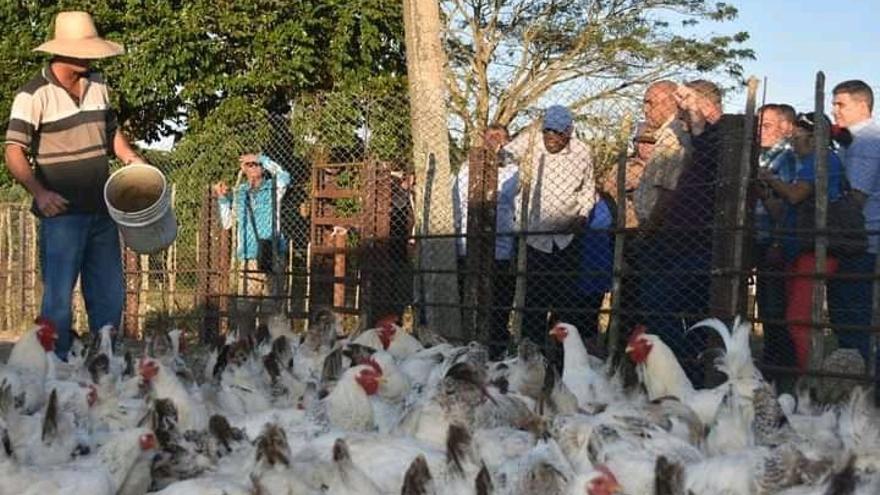
Cuba’s vice president, Salvador Mesa, wants to increase the production of free-range hens. (Archive/Granma)
14ymedio, Madrid, 14 April 2023 — Barely two days had passed after learning that the authorities had invested 12 times less in the agricultural sector than in business and real estate services, when the country’s top authorities urged farmers to look for “alternative solutions” due to the lack of “money to import all the resources required by the sector.”
The prime minister, Manuel Marrero, did not have the slightest embarrassment in accusing the workers of bad results, saying that the results of the measures put into practice “are poor, in a sector in which only 20% of production is in the hands of the state sector, and the other 80% is under non-state management.”
The reproach came to light in the annual review meeting of the Ministry of Agriculture this Thursday in Havana. The dismal results of the famous 63 measures to stimulate agricultural production were shown; although reluctant to recognize them, the leaders alleged, without any proof, that if the measures had not been approved “the situation would be worse.”
Among the star proposals of that package, announced in April 2021, was the possibility of charging excess production in foreign currency, a system that has never worked well due to arrears and non-payments, something recognized this Thursday at the meeting. continue reading
“The defaults to producers, at the end of December, reached 16,842,385 pesos [$701,766] showing a downward trend compared to previous periods,” reported the official newspaper of the Communist Party this Friday.
Given this lack of payment, which is what mainly motivates producers, it is understood that the results of 2022 were catastrophic. But the losses were not specified, and the authorities limited themselves to saying that “most productions did not reach the planned volumes.”
Among the products whose forecasts were met were corn, sorghum, beans and soy, but the same did not happen with complete groups of food, such as meat, vegetables, citrus fruits and fruit trees, in addition to the so-essential rice, basic in the daily diet of Cubans.
The detail of animal protein products is bleak, especially when a few days ago the Government mentioned its intention to maintain the goal of reaching a monthly consumption of 5 kilos [11 pounds] of these nutrients. Neither beef, nor pork, nor equine, nor eggs nor milk reached the planned projections. On the other hand, it was reached by a product that in recent times stands out, uniquely, for its lower price: mechanized tobacco.
However, the plans for agricultural tobacco, the twisted, black and blonde varieties and the total cigar were not fulfilled.
The excess of bureaucracy, which the leaders don’t consider their fault, also hindered the delivery of idle lands, which amount to 258,288 hectares [638,244 acres].
The State newspaper Granma completes the information with two other articles dedicated to the agricultural sector in its edition this Thursday, where the same authorities encourage exploiting “the potential” of the municipalities and self-sufficiency, something that in the conditions of absolute scarcity that the country is experiencing is less than a patch.
The third article calls attention to the tour of Salvador Valdés, vice president of the Republic, through the free-range hen farms, stating that they can help replace imports. The eggs have higher nutritional value and receive a high price in rich countries, compared to the eggs of caged hens, whose advantage is the massive production that a hungry country needs.
The president urged, as if that were not enough, “overcoming all limitations,” and he asked companies to “catch up” with their debts to producers. “It is not possible,” he said, “to stimulate production if money is owed to the producer.” However, he avoided any responsibility despite being the country’s second highest authority.
So much informative emphasis and urgency to produce more contrasts with the money invested and decisions made at the highest level. Although the Cuban economist living in Spain, Elías Amor, believes that concern exists despite appearances, no one wants to make the necessary decisions.
“There is more desperation with agricultural production than it seems. Behind inflation and closely related to this problem, Cubans complain about the lack of food and the prices of products. Agricultural production doesn’t succeed, and communist solutions don’t work. They have to think about taking a 180-degree turn and starting over. The longer it takes, the worse it will be,” he said in his blog, Cubaeconomía.
Translated by Regina Anavy
____________
COLLABORATE WITH OUR WORK: The 14ymedio team is committed to practicing serious journalism that reflects Cuba’s reality in all its depth. Thank you for joining us on this long journey. We invite you to continue supporting us by becoming a member of 14ymedio now. Together we can continue transforming journalism in Cuba.
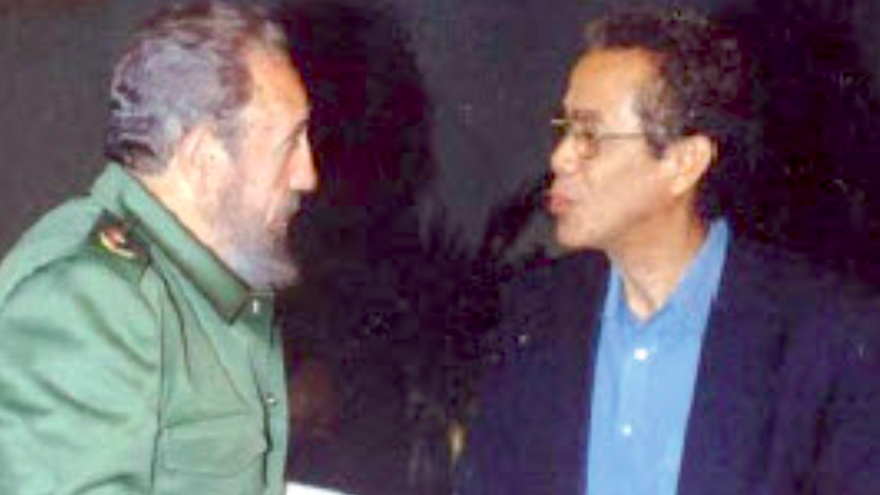
Heras’ definitive approach to Castro took place during the Special Period, as the head of one of the televised courses of the “University for All” project. (Trabajadores)
14ymedio, Havana, April 13, 2023 — Cuban writer, journalist and publisher Eduardo Heras León, National Prize for Literature in 2014, passed away this Thursday in Havana at the age of 82. Founder of the Onelio Jorge Cardoso Literary Training Center, he was one of the intellectuals “parameterized”* during the so-called Grey Quinquennium, the Five Grey Years defined by cultural censorship, despite which he always defended Fidel Castro’s cultural policy.
Heras, known from a young age as El Chino, was born in the Cuban capital in 1940 and had different jobs until 1958, when he entered the Normal School of Teachers in Havana, where he participated in different conspiracies against Fulgencio Batista organized by the 26 of July Movement.
In 1961 he joined the militias and fought as a volunteer gunner in the Bay of Pigs, about which he wrote the book La guerra tuvo seis nombres [The War had Six Names] (David Award, 1968). After the tension of the first years of the Revolution, Heras began to study journalism at the University of Havana and continued to write short stories, then collected in Los pasos en la hierba [Footsteps in the Grass] (Honorable Mention of Casa de las Américas, 1970), which received disapproval from the magazine El Caimán Barbudo [The Bearded Caiman], where he was accused of being “counterrevolutionary” in the article Otra mención a Los pasos [Another Mention of The Steps],” by Roberto Díaz.
After the example-setting arrest of the poet Heberto Padilla by State Security in 1971, the regime began a witch hunt against all the authors and works that departed from ideological orthodoxy and homosexuals involved in cultural positions. From the National Council of Culture, directed by Luis Pavón, the abrupt dismissal of numerous intellectuals was organized, including Heras himself, whose stories showed the “human” and unheroic side of the Castro guerrillas. continue reading
Decades later, in an interview in a confessional tone offered to the singer-songwriter Amaury Pérez, Heras tried to attenuate the story of his desperation during the Grey Quinquennium, when he was expelled from his journalism career and sent to work in a steel foundry.
A former colleague of Heras at the School of Journalism of Havana, evoking his expulsion, told 14ymedio that, during the summer of 1971, the secretary of the Union of Young Communists, Arsenio Rodríguez, went through the classrooms explaining that the writer “was no longer the school’s candidate for the elections of the University Student Federation (FEU), and that he had, in addition, been expelled for being a counterrevolutionary.” Faced with the disagreement of several students, Rodríguez explained that the announcement was merely “information and was not subject to discussion.”
In those years Heras began to think about suicide — using the revolver that Fidel Castro had given him after his time as a militiaman — and he encrypted his experience in the volume Acero [Steel], which was not published until 1977.
After a partial rehabilitation in 1976, Heras served as director of the narrative section of the newly founded publishing house LetrasCubanas [Cuban Letters] in addition to serving as director of the Casa de las Américas Editorial Fund and vice president of the Union of Writers and Artists of Cuba (UNEAC).
His definitive approach to Castro took place during the Special Period in the 1990s, at the head of one of the television courses of the University for All project. There, Heras led a course in narrative techniques that later led to the creation of the Onelio Jorge Cardoso Literary Training Center, in which numerous storytellers from the Island received advice.
In 2007 he was involved in another cultural controversy, during the so-called “little war of e-mails.**” During the convalescence of Fidel Castro, who had left the political arena the previous year, and in a climate of political tension, Televisión Cubana issued several interviews with the cultural commissioners in charge of the 1971 parameterization. The debate of hundreds of intellectuals and artists who had suffered the harassment of characters such as radio and television censor Jorge Serguera or Pavón himself set off the alarms of State Security and motivated the transfer of the controversy to a more “controlled” environment.
Heras, along with the critic and editor Desiderio Navarro, in addition to other “victims” of the Grey Quinquennium such as Fernando Martínez Heredia and Ambrosio Fornet – author of the expression – were appointed to bring the debate towards orthodoxy and absolve the regime, giving a conclusion to that period and freeing Fidel Castro from all responsibility.
The lectures at conferences offered during those days were gathered in the volume The Cultural Policy of the Revolutionary Period: Memory and Reflection (Theoretical-Cultural Criteria Center), which did not see its second volume edited. Heras said then that his whole life, including the episodes lived in the seventies, constituted the “testimony of a loyalty” to the Revolution and to Fidel Castro, of which he was proud.
In the last two decades of his life, Heras won numerous distinctions and medals awarded by the Cuban government, in addition to the National Publishing Prize in 2001 and the Literature Prize in 2014.
Translator’s notes:
*Fidel Castro’s “Words to the Intellectuals” in 1971: “Within the Revolution everything, against the Revolution nothing.” A year later came ’parameterization’ (enforcing rigid cultural parameters): “It is not permissible that through artistic quality homosexuals gain influence that affects the formation of our youth.” Outside these parameters, artists, intellectuals and homosexuals were considered “misfits” who must be parameterized, or “marginalized.”
**English translations of these emails can be found on Wikimedia Commons in Cuba: The Intellectual Debate, or The Little War of Emails, 2007. The original Spanish emails are on the Consenso website.
Translated by Regina Anavy
____________
COLLABORATE WITH OUR WORK: The 14ymedio team is committed to practicing serious journalism that reflects Cuba’s reality in all its depth. Thank you for joining us on this long journey. We invite you to continue supporting us by becoming a member of 14ymedio now. Together we can continue transforming journalism in Cuba.
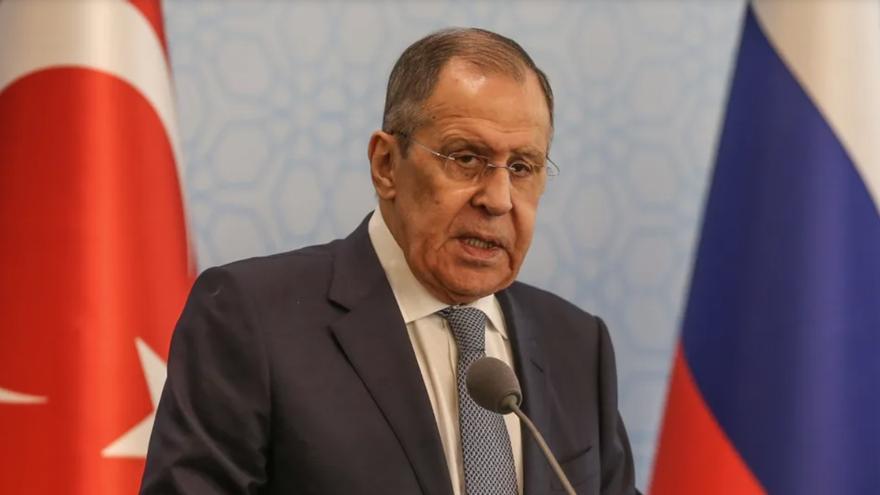
The Minister of Foreign Affairs of Russia, Sergey Lavrov, on April 7, 2023 in Ankara. (EFE/EPA/NECATI SAVAS)
EFE (via 14ymedio), Moscow, 13 April 2023 — The Russian Foreign Minister, Sergey Lavrov, announced on Thursday that he will carry out a Latin American tour in the second half of April that will take him to Brazil, Venezuela, Cuba and Nicaragua, the Kremlin’s main allies in the region.
“We advocate for strengthening Russian-Latin American cooperation on the basis of mutual support, solidarity and our interests,” Lavrov wrote in two articles published by the Brazilian newspaper Folha de Sao Paulo and the Mexican magazine Buzos de la Noticia.
In his articles, reproduced by the Russian Foreign Ministry on its website, he highlighted, in particular, the strategic relationship with Brasilia, Caracas, Havana and Managua.
“The rapidly changing geopolitical landscape opens up new possibilities for the development of mutually beneficial cooperation between Russia and Latin American countries. The latter play an increasingly prominent role in the multipolar world,” he stressed.
Lavrov insists that Moscow does not want Latin America and the Caribbean to become a source of discord between the powers, since it bases its foreign policy not on ideology, as was the case with the Soviet Union, but on pragmatism. continue reading
As an example, he highlighted that, despite sanctions and political pressures, Russian exports to the region increased by 3.8%, while wheat supplies increased by 48.8%.
Lavrov highlighted that at the moment 27 Latin American countries have signed visa-free agreements with Russia, in addition to the fact that the number of Latin American students studying in higher education centers in Russia has skyrocketed.
The Cuban president, Miguel Díaz-Canel, showed Putin his support in his confrontation with the West by visiting Russia in December 2022, and he also condemned the arrest warrant issued against the head of the Kremlin by the International Criminal Court.
Recently, the secretary of the Russian Security Council, Nikolai Patrushev, and the head of the largest Russian oil company, Igor Sechin, traveled to the Island.
At the beginning of the month, Russian President Vladimir Putin invited his Brazilian counterpart, Luiz Inácio Lula da Silva, to Moscow upon receiving a visit from the special adviser for International Affairs of the Brazilian Presidency, Celso Amorim.
Subsequently, Lula said that during his visit to Beijing he will propose to the Chinese leader, Xi Jinping, to promote dialogue to restore peace between Russia and Ukraine.
The president of Venezuela, Nicolás Madurdo, offered Putin “all my support” since the beginning of the Russian military campaign in Ukraine in February 2022.
On March 14, Russia and Venezuela celebrated the 78th anniversary of their diplomatic relations, ties that were strengthened with the arrival of the so-called Bolivarian revolution in 1999.
At the end of March, the Nicaraguan Foreign Minister, Denis Moncada, met with Lavrov and defended Moscow’s right to guarantee its “integrity and security.”
Lavrov also decorated Laureano Ortega Murillo, son of the Nicaraguan president, Daniel Ortega, with the Order of Friendship.
In the new Russian foreign policy, marked by the growing political, military and economic antagonism toward the West over Ukraine, Latin America is one of the priority regions.
In that sense, Lavrov’s tour is part of Lavrov’s recent trips to twenty countries in Asia, the Middle East and Africa, from the Maghreb to the Sahel and the south.
Translated by Regina Anavy
____________
COLLABORATE WITH OUR WORK: The 14ymedio team is committed to practicing serious journalism that reflects Cuba’s reality in all its depth. Thank you for joining us on this long journey. We invite you to continue supporting us by becoming a member of 14ymedio now. Together we can continue transforming journalism in Cuba.
 14ymedio, Juan Diego Rodríguez, Havana, 10 April 2023 — A strong and atypical storm rained down hailstones on Havana in the early morning of this Thursday and caused flooding not only in several municipalities of the capital but also in the west of the Island.