Artists on the General’s Farm / Camilo Ernesto Olivera

HAVANA, CUBA.  Each day we awaken, and the dinosaur is still here.  The delegates of the National Union of Cuban Writers and Artists (UNEAC) will meet with the master generals of the island-farm on the 11th, 12th and 13th of this month.

In the tedious lines that the UNEAC members stand in for the Internet, in the navigation room “LaJungla.com,” the commentary is acid.  The lack of respect for them and the dismissal of their opinions on the part of the institution’s leadership is evident.  The creators are losing their fear of saying what they feel and think:

“I am shocked to hear (Miguel) Barnet speaking of UNEAC as the spiritual vanguard of the country,” a young playwright said to this reporter, “in reality this is no more than a playpen where an aging, conformist and reactionary intellectual majority is huddled.  They are more afraid of losing perks than contributing to the Battle of Ideas in the last decade.”

“After seeing the way that the pre-Congress meetings were held, what I hope for is another act of revolutionary reaffirmation,” added the playwright, “the only agreement that is going to be reached here is summed up in this sentence:  ’Tell Raul Castro what he wants to hear, and maybe he will listen.’  On the general’s farm, intellectuals are like toilet paper, always disposable although politically correct.”

The younger members are refusing to accept the closed atmosphere that is breathed.  The taking of certain positions of power within the institution on the part of people with a prefabricated curriculum is also a striking fact.  Their labor is focusing on dividing and disrupting thought that is critical of the system.  They are the cultural police watching the members and reporting to their superiors:

“They are infiltrating their acolytes into disaffected groups in order to learn what is said and rewarding them under the table for the confidential information,” said a poet who requested anonymity.  “It is a watered down version, subtle, of the atmosphere that was breathed here in the ’70’s, which does not stop being worrying.”  They are playing old and gray cards, applying the Zhadanoviano method of the so-called black lists.  Manipulating the membership with floodgate mechanisms for access to or refusal of the rewards, incentives or other perks.”

The calamitous state in which the majority of cultural institutions find themselves, a situation that is worse in towns in the interior of the island, is a fact:  Theaters and culture centers falling down.  Influence peddling, money embezzled by programmers hiring Reagetton artists who, in their turn, pay a percentage “under the table.”  Radio and television censorship.  Salaries that do not go far…

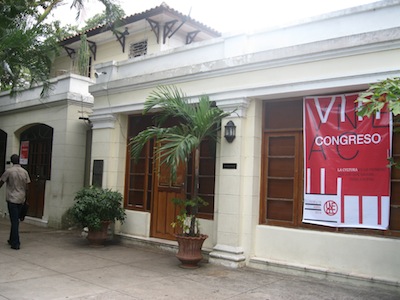
UNEAC-PEÑA-DE-POESIA-Copy1“You cannot promote culture on an empty stomach,” said a promoter from Bayamo.  “In my city they closed the visual arts school, and the art instructors’ buildings are full of leaks.”  I mentioned to her the promotional poster for the congress and the sentence by Fidel Castro that appears on it:  Culture is the first thing we must save, and she responded:  “The country’s culture is not saved with a putrid ideology, it is saved with a strong and well run economy.  And for there to be an economy, there must be free enterprise, opportunities to invest and prosper for those within and outside of the country.”

The future of UNEAC as a historic dam or fence to control the artistic herd is in doubt.  Another intellectuality is being born from the wreckage of fear, and it is approaching the vilified borders of political dissidence.  Although in this 8th Congress of UNEAC, the intellectuals are like toilet paper, always disposable.

Cubanet, April 3, 2014, Camilo Ernesto Olivera Peidro

Translated by mlk.

Our Potato Who Art in Heaven / Orlando Freire Santana

HAVANA, Cuba — Prices of agricultural products have increased between 15 and 25 percent in recent months. An unsustainable burden if we take into account the population’s salaries. The price increase coincides with new forms of marketing. It turns out that the mechanism for bringing producers and consumers closer and eliminating intermediaries set off prices.

It was obvious: An official research center decides to cast aside marketing analysis and concentrates on production.

Armando Nova Gonzalez, researcher for the Cuban Economic Studies Center, told the Tribuna de la Havana newspaper: The levels of production should have increased with the transfer of idle lands to lease-holders. But it has not been so because of how expensively the State sells tools and adequate inputs to the lease-holders in order to make the land produce, among other reasons. continue reading

Other forms of production — the Agricultural Production Cooperatives (CPA) and the Credit and Services Coooperatives (CSS) — also have seen their costs affected by the high prices that they pay for fuel, fertilizer, tires and parts for trucks and tractors.  All those provided by a single supplier — a certain state enterprise — which does not offer options to the producers.

Nova concludes that those costs will not diminish — nor the retail prices — as long as there exists no market for inputs, where the producer may select what he needs, with the only limit being his ability to buy, through credits or personal savings.

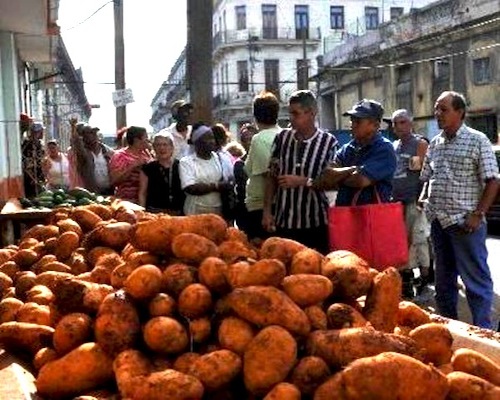
In order to verify the prices, we decided to visit three farmers markets in the capital, each one with a different way of marketing. The Egido Market, of the offer-demand mode, exhibited the following prices (all per pound of product): black beans at 10 pesos, red beans at 15, yams at 2, tomato salad at 5, cucumbers at 4, malanga at 5 and chunky bananasat 10 pesos a bunch.

A point of sale in Calzada de Monte, leased to the CCS Juan Bruno Zayas, offered these prices: black beans at 12, red beans at 13, yams at 2, tomato salad at 7, cucumbers at 4, malanga at 5 and chunky bananasat 10 pesos a bunch.

In Arroyo, a non-agricultural cooperative, the black beans were at 12, there were no red, yams at 2, tomato salad at 5, there were no cucumbers, malanga at 4, and there were no chunky bananaseither.  It is clear, there are no significant variations in the prices among the different forms of marketing. Nova is right, the elevated costs of production determine the high sale prices to the public. But, his suggestion of an inputs market for the growers could meet the same fate as the wholesale market for the self-employed workers. . .  And the price of the potato will continue toward the heavens.

Cubanet, March 24, 2014, 

Translated by mlk

Cuba Seeks Investors with an Old Publicity Strategy / Juan Juan Almeida

In 1989, Cuba concentrated 85 per cent of its trade relations on the USSR and the rest of the socialist camp.  Thus it assured the supply of components, raw materials, technology and satisfactory loans in terms of due date and interest. With the collapse of European socialism and the disintegration of the USSR, Cuba in short order found itself with substantially diminished purchasing capacity and economic-financial reality.

Havana was going close-hauled in a scene as uncertain as that of a refugee on the high seas.  It was then that Fidel, expert in navigating crises and very irresponsible about costs, laid out his directives for confronting the debacle as if it were a slip up. Internally he kept the nation entertained with the sadly famous “Special Period and War of All the People;” not abroad where he launched messages that assured of control and security, effective hooks for finding new trading partners and markets.

So there appeared on the island a nephew of Saddam Hussein who built the first plant for the canned soft drink “Tropicola;” and a known arms trafficker (sought on a worldwide level) interested in financing the national production of cane sugar and citrus fruits.

After such illustrious personages disguised as entrepreneurs, there arrived other such relatives of famed dictators, market opportunists, refined bandits, vulgar robbers, men of decorum, and Cuban exiles with suitcases full of hope.

As was expected, many entrepreneurs, those who the government rejected for various reasons, were on a long road of unbearable defaults; but others received, besides their temporary residence, the right to possess a “foreign firm” that today they trade on the island at low cost and high value.

This quasi-dishonesty where the foreign and national converge, unleashed a kind of euphoria; on one hand, many Cuban citizens trying to escape from economic suffocation managed to work for foreign businesses; on the other, relatives of and individuals close to high Cuban leaders, because of feeling they were not employed, left Cuba and founded companies with which they then bought another and another until hiding the original identity in order to then enroll in the commercial registry of the Chamber of Commerce for the Republic of Cuba and make it function.

Of course, not all the children of the elite wanted to become prosperous businessmen; the exalted Alejandro Castro Espin decided to reach high and under the pseudonym of Ariel was named chief of the section of the 4th department of State Security in charge of investigating, approving, recruiting and bribing all the businessmen, investors, entrepreneurs, foreign company workers, and Cuban stockholders in foreign businesses. Come on, it’s the same as printing money.

In such circumstances, in 1995 he approved the first legislation (No. 77) that regulates foreign investment and continues in force today.  At the end of 2000 there were 392 economic partnerships with foreign capital located for the most part in mining, prospecting–extraction of petroleum, tourism, light industry, metallurgy and construction; several of them, property of a few Cubans (relatives and people close to the high Cuban leadership) resident on the island.

The newspaper Granma reports that as provided, the State Council for the Republic of Cuba calls a special session of the National Assembly of Popular Power for Saturday, March 29 this year for the purpose of analyzing the proposed Law of Foreign Investment.

I see the answer clearly, there are political realities that cannot wait.  Alliances like ALBA and CARICOM smell redirection; Venezuela, for now, I do not believe loses Maduro as President but his regional leadership.  Cuba returns to old ways, approaches Brazil and the European Economic Community reaching for its old but effective publicity strategy to attract investors.

I would like to know if this new legal proposal will open new liberties for those Cuban exiles that currently can only carry out — from across the border — buying and selling activities; and if finally they will decide to legislate in favor of or against those Cuban entrepreneurs resident on the island who for a long time have invested in Cuba in and need to enjoy a protective legal framework.

I believe that if I ask any Cuban official, he will invoke a 5th Amendment that does not exist in our constitution.  For all the rest, we’ll have to wait.

Translated by mlk.

24 March 2014

Desertion by Doctor Ramona Matos Opens a Breach / Osmar Laffita Rojas / HemosOido

Dr. Ramon Matos shows her documents
Dr. Ramon Matos shows her documents in Brazil on seeking political asylum. Photo from Internet.

HAVANA, Cuba. — The manipulation by the official press has no limits. The report published in the Granma daily on March 17 by journalist Diana Ferreiro carries a grandiose headline: “White Scrubs for a Better World.”

In said article, it went so far as to say that the seventh delegation of Cuban doctors that left this week for Brazil “will lend international help.”

The concealment of what is really behind the presence of Cuban doctors in Brazil is grotesque. These doctors do not go “to lend international help.” They are simply health professionals hired by the Brazilian government in the “More Doctors” program through the Panamerican Health Organization (PHO).

After prior negotiation by the PHO, the Marketer of Cuban Medical Services S.A. will receive 4,300* dollars monthly for each of the 11,430 doctors who will work for a period of two years in the South American giant.

Ferreiro lies when she claims that of the 1,684 physicians of the seventh delegation, “a great part of them had finished their work in Venezuela and responded to the the new call.” Really what determined that they “step up” is that they know that, after March, they are going to earn 1,245* dollars a month in Brazil, and not the 3,000 Bolivares (the equivalent of 35 dollars monthly) that the Cuban government pays them on the Venezuelan “mission.”

The Cuban government keeps a third of the 4,200* dollars a month that the doctors who work now in Brazil receive as salary.

The official press has not said that the remaining 1,245* dollars will accrue entirely to the doctors. This was possible because of the pressure by the Brazilian authorities on the Cuban government which sees itself forced to put an end to the abusive and exploitative system of 1,000-dollar payments from which the doctors received 400 dollars a month and the remaining 600 dollars was deposited in an account which they could only access on return to Cuba after finishing their work in Brazil.  The change became possible because of the notorious scandal caused by the desertion of Doctor Ramona Matos and other Cuban doctors; something that, of course, Diana Ferreiro does not mention in her article.

To that extent it can be said — although the Cuban people do not know it — that it was Brazil and not Cuba where for the first time a real increase was produced in the salaries of doctors who mostly earn 20 dollars a month on the island.

The Cuban government has seen a goldmine of hard currency income with the exportation of professional services.

The payment of the 11,430 physicians who will work in various Brazilian states, added to the 35 thousand that are in Venezuela, will mean an annual income of over 6 billion dollars.

With the 46,430 Cuban doctors in Venezuela and Brazil, the Cuban population will only have 32,192 professionals at their disposal located in 57 general hospitals, four maternal-infant hospitals, 468 poly-clinics and 11,486 Family Doctor clinics.

The Cuban health system, already plagued by deficiencies, with so few professionals that will remain in Cuba, without a doubt will worsen in the coming months.

Cubanet, March 20, 2014 / Osmar Laffita Rojas

ramsetgandhi@yahoo.com

*Translator’s note: The dollar amounts reported in this text do not perfectly track, but it has been translated faithfully from the original.

Translated by mlk.

Fernando’s Eggs / Gladys Linares

Monte and Aguila. Photo Gladys Linares

HAVANA, Cuba. – Some “fighters” have done as Fernando, who when he decided to retire, began to think about how to increase his pension without courting trouble, because he was tired of “resolving” to feed his family.  One day, on passing through the farmer’s market at Diez de Octubre and General Lee, he saw that they were selling newly hatched chicks, and he bought 20 in order to begin his brood. He had found his little business. He knew that the government sells the unrationed feed for three pesos a pound. Also, rearing poultry was nothing new for him because in his childhood in Palmira, Cienfuegos, his parents kept hens in the backyard, and he and his siblings would sell the eggs in the city.

Fernando thought that this way he would have guaranteed eggs for his own consumption and even would be able to sell some in the street. He was sure he would have no problems with the police because he had bought the animals as well as the food from the State.

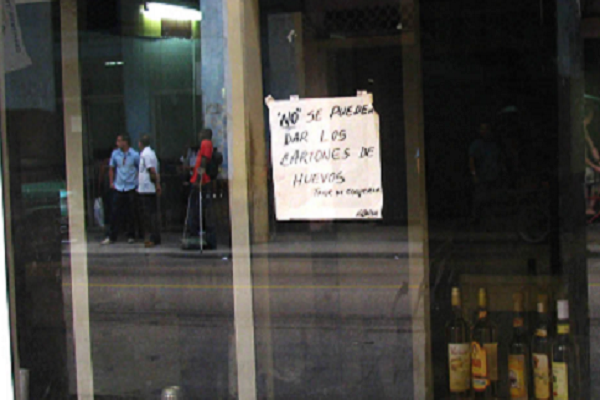
But, the poor man, he forgot that he was in Cuba: A few days ago he was walking the streets selling eggs when a police officer intercepted him. As much as the poor gentleman tried to explain that he was not a reseller, the officer took him to the station where they confiscated the merchandise and imposed a fine. They told him that individuals are prohibited from selling eggs, that only the State can do it.

Fernando already has forty hens and a production of 30 eggs daily. And after that day, he only sells hidden in his home.

Eight eggs per month per person in 1965.  Now the quota fell to five.

On January 2, 1965, in one of his long speeches, Fidel Castro said: “The great battle of the eggs has been won. From now on the people will be able to count on 60 million eggs each month.” With this affirmation he demonstrated his scorn for Cubans because given the then-population, that quantity in reality represented around eight eggs a month per person.

That same year, he would create the Animal Science Institute (ICA) whose main objective must have been the search for better alternatives for feeding cattle and poultry, an objective that the Institute still has not achieved 49 years after its creation.

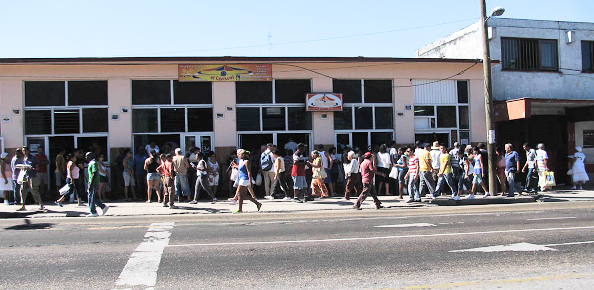
El Carrusel, Virgen del Camino, line for eggs – Photo Gladys Linares

In reality, in Cuba before 1959, more than 85% of the farms were dedicated to raising poultry and selling eggs. It was also a rare country family that did not have a small brood whose eggs constituted a product for quick sale. Also, in Havana, at Villas and Oriente, there were big poultry production centers so the sale of live animals and eggs was no problem for the population. It is after the arrival of the revolutionary government, with the intervention in farms dedicated to poultry, that the scarcity of this food begins.

Calle Monte market – Photo Gladys Linares

Also, with the objective of increasing the poultry production, the Institute of Poultry Investigations was created in 1976. By the way, according to reports it published, in Cuba there are 10 million egg layers, although we all ask ourselves where are the eggs. The government sells by ration book five eggs a month per person, so the five additional that cost 90 cents were excluded from regulated sale. After that point, eggs have practically disappeared, and when they are sold unrationed their price is 1.10 pesos national currency.

The scarcity of this protein causes long lines, in great demand among the population not only because of its nutritional value but because it is the cheapest sold in the country. And the old people are the most affected. In the opinion of many, it would be preferable to raise the price 20 cents instead of eliminating them from the ration book.

Cubanet, 24 March 2014, Gladys Linares

Translated by mlk

S.O.S.: They Continue Harassing Angel Santiesteban in Prison / Angel Santiesteban

My incarceration is not enough for the dictatorship

At dawn on last March 22, we prisoners, once again, were awakened by henchmen’s boots for another search procedure.  Several officers, directed again by Major Cobas, ousted us from the barracks with the intention of distancing us from our belongings. I objected and asked to remain present while they inspected my property which Cobas himself refused. I warned that I was not responsible for what they might find in my absence. The officer persisted in moving me away.

As has always happened, I was the only one of interest although they searched the rest. The majority gathered around my bed searching among books, reading each paper of the many that I posses, and setting aside those they found “interesting,” always news that brings me national and international reality and that generally is far away and different from that of government censors and authorized in their official media. They also read the back covers of the books in order to practice the look of the political police, and as on other occasions, to take them.

In the end, they only confiscated personal documents, printed news, two CDs, one with the images of the false “witness” that the Prosecution prepared against me in complicity with the police and the complainant when they came to demand 54 years in jail for me and later, thanks to those images, they had to desist.  They also took another CD with the sad documentary “Gusanos” which is about the fascist action of the government against State of Sats (Estado de Sats). I suppose that if those officers had the least bit of embarrassment and humanity, they would feel shame.

The alarming thing is that they showed me an instrument that looked like a screwdriver which can be used as a punch and which they claimed to have found within a dark suitcase that I possess. I assured that it did not belong to me, and the officer who said he found it blatantly lied and claimed it was true. A prisoner interrupted to claim that it was his property because he was trying it as a shoemaker’s needle, and he sewed work boots with it; then they left laughing with absolute cynicism.

It is no secret that they are searching desperately to implicate me even more and add some crime in order again, as on prior occasions, to erase the five year maximum sentence as stipulated by the Penal Code. Or a tangible vengeance for the “Second Open Letter to Raul Castro,” which I dedicated this past February 28 on completing a “Year of Unjust Incarceration.”

As always, they are plotting something, and also as always, they will not find in me even an iota of giving in to their constant torture for the “Crime” of thinking “DIFFERENTLY.”

Angle Santiesteban-Prats

Lawton prison settlement.  March 2014.

Follow the link to sign the petition for Amnesty International to declare Cuban dissident Angel Santiesteban a prisoner of conscience.

Translated by mlk.

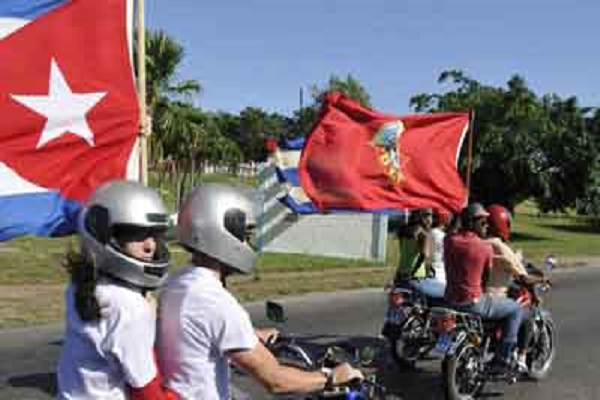
Political Police Parade on Motorcycles through Havana

Caravana.minint_AIN

A caravan, composed mainly of young officials, takes a tour through historical places of State Security

CUBANET – A caravan of motorcyclists from Cuban State Security (political police) toured the capital’s streets this past Saturday, taking a route around the places “where that institution, celebrating 55 years of existence next March 26, took root,” according to the dispatch by the official Agency of National Information (AIN).

The group of officials — says the note from the AIN — left on motorcycles from the Freedom School City, the location of the mansion where initially the leadership of this Interior Ministry force was established.

A floral wreath at the Jose Marti monument marked the passage through Revolution Plaza where the main buildings of the MININT are located, which previously hosted that forces’ department.

The caravan also passed through the Villa Marista center of operations and ended in the Forest of the Martyrs of the OSE (Organs of State Security). The press note says that the objective of State Security is “to protect the Cuban people from enemy aggression and safeguard the Revolutions’ conquests,” and that objective will continue to be the principal duty of the new generations of that organization’s combatants.

The reality, however, is different.  One of the main functions of State Security is to combat internal dissidence. The Havana parade takes place while in Venezuela too the government’s motorcycles become embroiled in a fierce battle against opponents in the streets.

Cubanet, March 17, 2014

Translated by mlk.

The Dirty Business Between Soldiers and Prisoners / Dania Virgen Garcia

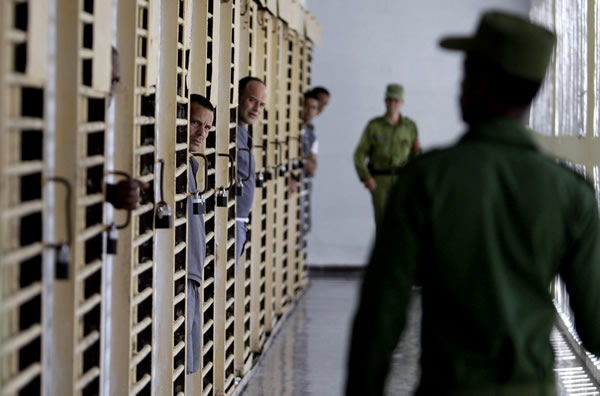
Prisons_Cuba_AFP. The image was taken in April 2013 when the foreign press was allowed to enter jails chosen by the state.

What about the wages of who officers who guard correctional facilities?  Do they traffic in narcotics and various benefits?

HAVANA, Cuba. – The ingestion of alcoholic beverages and psycho-pharmaceuticals is a very common vice in prisons, encampments and forced labor penitentiary settlements.  They provide, moreover, a business that is carried out day by day, in most cases, by prisoners with financial power.

Innumerable civilian workers and officials of the MININT (Ministry of the Interior) have been sanctioned in tribunals for the crimes of bribery and embezzlement.

Events like these often cause homicides.

There is a multitude of problems within the prisons and encampments: fights, bloodshed, theft, self-harm, escapes; these last are well paid-for to MININT’s civilian and military workers.

Life in the penitentiary settlements is incomparable to that of the jails.  They are workplaces or warehouses that belong to MININT. The quantity of prisoners that must inhabit them is reliably between 15 or 20, or those that bribe the re-educator of the prison or encampment.

Business is different in these places. The prisoners are privileged. Once they arrive they are free to do what they like. The supply of psycho-pharmaceuticals, alcohol, and the illicit businesses are not controlled. They may go outside the area when they want, ask permission to go to their homes and other benefits provided they bribe the guard and the officer.

The defenseless prisoners who report these outrages are exposed to reprisals, threats, severe beatings, shakedowns, punishments cells and prohibitions of their rights. They subject them to physical and psychological torture to make them shut up.

The inmates who do not allow themselves to break continue informing the independent press, which is their only means of defense.

When the punishments do not break them, they take away family visits and then transfer them to other prisons, some more than 200 kilometers from their families.

Another method that the guards use is to incite prisoners to physical attacks or accuse them of crimes not committed.

The heads of the Bureau of Prisons, Encampments and Forced Labor Settlements, within and outside of them, are not able to control this fully corrupt environment. Something is wrong when there is so much corruption.

Cubanet, March 18, 2014, Dania Virgen Garcia

Translated by mlk.

The Dictatorship’s Gift / Angel Santiesteban

February 28, 2013, the day that the Castro brothers’ totalitarian regime jailed me, was not a day chosen randomly by the political police.

That day, several events happened simultaneously, and it was significant for many reasons in my case.  Firstly, that day was the birthday of my partner, and they well knew it because they had interviewed her several times on television; it was also the culmination of the Book Fair in Havana and its continuation in the rest of the country’s provinces.

But not even those two dates indicate the bigger joke, the cynicism in the face of not only the dissidence but the world, principally the UN agency, because that day marked five years since the initial signing that the Chancellor Felipe Perez Roque — in 2008 — accepted the respect of human rights with the UN Covenants.  What they perhaps did not know and is most important for me is that that day celebrated the anniversary also of the birth of the great Cuban writer Cirilo Villaverde.

The Cuban government joined me on a date memorable to the island’s writers with a distinguished writer and fighter for Cuban liberty, a coincidence that makes me proud with the love of literature and the need for liberty. For his political ideas, he was jailed and sentenced to death, which he was able to circumvent thanks to the complicity of his jailer.

In homage to his sublime figure, I now in prison began a novel that takes place in 1808, on the eve of the anniversary of his birth, and my characters travel that Havana that he describes in his novella Cecilia Valdes or the Angel’s Hill; it has also inspired in me a script for a telenovela, which I am working on currently, writing the scenes for more than 100 episodes.

According to the writer, blogger and fighter for Human Rights, Luis Felipe Rojas, by taking advantage of my time in prison, it could appear to be a conspiracy between my readers and State Security.  The truth is that if that February 28 was intended to be a mockery of any of the “coincidences,” I have tried to reverse it and make it transcendent, at least for my future work Fear and Truth.  Such is the fear inoculated by the dictatorship since its birth, that later — as much as we exorcise it — it remains hidden, lurking in our guts.

Recognizing the fear in the Cuban citizens is simple and part of the idiosyncrasy of a people engulfed in dictatorship.  To demand rights, convinced by reason, is unacceptable for the majority when they infer the cost they would have to pay.  By telling the truth one is accused as a traitor, of pandering to our neighbor to the north.

In this year of incarceration, many have dared to send me their solidarity verbally, recognizing that to declare it publicly would be to pay a price that they are not ready to sacrifice.

But the most difficult thing has been to accept that that engendered fear also permeates the opposition as is demonstrated in several ways.  Some have given witness to having been threatened by State Security, which would not pardon them the defense of my case, to the point of intimidating them by prohibiting for them the possibility of travelling abroad, now that this has become the fashion.

That corroborates my fear that many of them gave their word to stay at my side, but once I was sent to prison, they distanced themselves, forgot their commitments, coming to allege that my “accusation” is hard to defend because of the international propaganda against “domestic violence.”  If that is not called striking a deal, I don’t know the word to define it.

Of course State Security searched for the most sensitive accusations in the public view in order to try to some extent to be defended; for example, running over a child in the road and fleeing, rape, attempted murder, among others — coincidentally all erroneous — for which I was formally accused.

In the first Prosecutor Petition I published on the internet, it sought 54 years incarceration, which was only truncated thanks to the hidden interview — recorded on video — that we did of a false witness that the prosecution, police and complainant prepared with the intention of corroborating their lies.

I will always ask myself what would have happened if the “witness” had not been caught telling the truth!  Today I would be sentenced to more than a decade of incarceration and with almost all the opposition to the government turning its back on me because they would see me as indefensible.  The fear speaks for itself.

As if that were not enough, the forensics specialists admitted that the “witness for the prosecution” was telling the truth, in terms of unmasking the ruse against me, because he thought that the person who interviewed him was part of the prosecution, as he was introduced, and was unaware that he was being filmed by a laptop camera that he had before him.  In that video the witness admits that he is uncertain that I was in the place where I was accused of being and for which I was sentenced to five years in prison, now finishing the first year behind bars.

Simply, when it comes to officials or opponents who accept or put in doubt my innocence, I do not rely on their transparency.

Angel Santiesteban-Prats

Lawton Prison Settlement. February 2014.

Lawton prison settlement.  February 2014.

To sign the petition for Amnesty International to declare Angel Santiesteban a prisoner of conscience, follow the link.

Translated by mlk and LW

27 February 2014

The Amazing Resistance of Reinaldo Arenas / Rafael Lemus

1.  March 12, 1965, an open letter by Ernesto Guevara to his friend Carlos Quijano is published in the Uruguayan weekly Marcha.  The text, “Socialism and the New Man in Cuba,” is perhaps Guevara’s most significant theoretical writing, and at the same time an emphatic declaration of the regime’s objectives emanating from the Cuban Revolution, then already declared Marxist and in the full process of converting the island to socialism.

Maybe nowhere else is the regime’s intention to intervene in all segments of Cuban society enunciated so clearly, to radically transform the mental and physical life of its citizens and to produce a new subject: the New Man.

That desire to regulate the existence of individuals and to act on the biological functions of life — even regardless of political action — is not, of course, exclusively of the Cuban regime and not even of socialist systems. As Michel Foucault discovered, it has to do with a fundamental characteristic of the power of modern western societies.

After the 18th century, as Foucault details in Security, Territory, Population, power “takes into consideration the fundamental biological fact that man constitutes a human species” and creates a series of disciplinary mechanisms and standardization — from hospitals and colleges to camps and prisons — that pursue “the eventual transformation of individuals.”

Then still leading the Cuban Ministry of Industry, Guevara writes in that letter:  “In order to construct communism, simultaneously with the material foundation, one must make the New Man.” The job, he warns, is not simple: “The defects of the past are transferred to the present in the individual conscience” and, in order to eradicate them, individuals “must be subjected to stimuli and pressures of a certain intensity.”   continue reading

Those stimuli and pressures may be of “moral character” or well managed, sometimes brutally, by the revolutionary institutions, that “harmonic collection of well oiled channels, steps, dams, devices” that guarantee “the natural selection of those destined to walk the vanguard.”

In that “dictatorship of the proletariat, exercising not only over the defeated class but also, individually, over the victorious class,” of special importance is the educational machinery of the State, now that it acts directly on the youth, “malleable clay with which it may construct the New Man without any of the previous defects.”

One of those youth is named Reinaldo Arenas, and he is not, in spite of his last name, “clay” and even less “malleable.”  Then, when “Socialism and the New Man in Cuba” is published, Arenas is 21 years old and is about to enter for the first time into conflict with the Revolutionary regime. That year the State creates the Military Units to Aid Production — rehabilitation and forced labor camps for “social misfits” — and stirs up its homophobia.

That same year Arena finishes his first novel, Singing From the Well, and tenders it to a national competition where he receives honorable mention — the beginning of his difficulties, acrimonious relations with the cultural bureaucracy of the island.

It is then–when the radicalization of the Castro repression and the emergence of Arenas as a public figure coincide–that the frictions begin between the writer and regime, frictions that soon evolve into a full and asymmetric confrontation, whether because Arenas is homosexual, whether because he publishes his works abroad, whether because he resists the disciplining processes sponsored by the State.

During the next 15 years Arenas will endure the harassment and punishment of the devices of state power: He will be forced to work on a sugarcane plantation, will be locked away in a prison, forced to sign a public retraction and will see his repeated efforts to leave the island frustrated, until 1980 during the Mariel exodus, he manages to leave for the United States.

It is there–at odds with the Miami Cuban exiles, first encouraged and then stunned by life in New York and finally sick with AIDS–where he finishes writing Before Night Falls, the memoirs that he began to write one day in 1973 in the culverts of Lenin Park while hiding from the regime’s security forces.

2.  “All dictatorship,” writes Arenas in a passage from Before Night Falls, “is cold and anti-life:  every manifestation of life is in itself an enemy of any dogmatic regime. It was logical for Fidel Castro to chase us, to not allow us to fornicate and to try to eliminate any public display of life.”

This image of the State that censors the “public display of life” and toils to control the physical existence of its citizens, is repeated time and again throughout the 343 pages of the book.

Whether the regime grants itself “the power to instruct how men should dress,” or proposes “to break ties of friendship” through organization, street by street, of the Defense of the Revolution Committees or penalizes homosexual relations, the image that emerges here is that of a power for which the life of its citizens does not represent the boundary of the political but precisely its center and objective.  In other words, a biopower, that, in order to continue being such, must intervene in and regulate all vital aspects of the population.

Not coincidentally Arenas lingers, in Before Night Falls, on the description of three of the disciplinary and standardization devices of the Cuban regime: education, forced work and prison. A member of the first generation of university students educated by the Revolutionary State, Arenas recreates those years not as a period of formation but rather of indoctrination in a college that, in agreement with his words, was a “monastery where new religious ideas prevailed and, therefore, new fanatical ideas” and where “it was not easy to survive all those purges that had a moral, religious and even physical character.”

Years later, in 1970, Arenas is sent to a sugarcane facility, the Manuel Sanguily Center in Pinar del Rio, in order to cut cane and write an elegy of the Ten Million Ton Harvest. There he comes across a new generation of youth, no longer indoctrinated in college but peons in a forced labor campaign: “those young men of sixteen, seventeen years, treated as beasts of burden, had no future to await nor a past to remember. Many gave themselves a machete blow to the leg, or cut off a finger, any barbarity so long as they did not have to go to that cane plantation.”

Instead of “ideologically guiding” that youth, Arenas is accused of perverting it. More specifically:  in the autumn of 1973, he is accused of having abused, together with another friend, two minors, charges that he denies.  In order to avoid being arrested, he hides for four months in the most unexpected places (behind a buoy in the sea, in the crown of a tree, under a bed, in the culverts of Lenin Park), in a series of misadventures almost worthy of Brother Servando Teresa de Mier that he had reclaimed and re-invented years before in the novel Hallucinations (1969).

When finally he is detained, in January 1974, he is locked away in the Morro prison and two months later is transferred to Villa Marista, headquarters of State Security, where he is forced to sign a retraction in which he “repents” equally his homosexuality and his literary works and promises “to rehabilitate himself.” Immediately he is returned to Morro and a little later taken to an “open” prison on the outskirts of Havana until the beginning of 1976 when he is finally “freed.”

These events, from when Arenas is accused until he is set “free,” occupy two and a half years of his life but almost a fourth of his autobiography.  It is in those pages where the most repressive edges of the Cuban state appear, as in this passage about the torture in Villa Marista:

“One day I began to sense in the next cell a strange kind of noise that was as if a piston were releasing steam; after an hour I began to hear piercing screams; the man had a Uruguayan accent and was screaming that he could stand no more, that he was going to die, to stop the steam. In that moment I understood what that tube next to the toilet of my cell–whose meaning I had ignored–consisted of; it was the conduit through which they supplied steam to the prisoners’ cell which, completely closed in, became a steam room. Supplying that steam became a kind of inquisitorial practice, like fire; that closed place full of steam made the person almost die of asphyxia.”

3.  Images like this are repeated throughout the central pages of Before Night Falls and make one think, often, of typical scenes of prison literature.  That is not, however, the most surprising thing in this autobiography:  not the sordid portrait of the Cuban regime Arenas paints but the way in which he himself confronts that power.

Said another way:  the most singular thing about Before Night Falls is not so much the denunciation of Castroist repression — present after all in the texts of many other writers and in the reports of various human rights agencies — as the characteristics of Arenas’ resistence, very different from the usual opposition of liberal societies and little akin to that liberal platform from which critics of the Castro regime usually shoot.  In a sentence:  Arenas’ resistance — alive, corporeal, erotic — shares not a few of the notions of the same biopower that he confronts, and thus could be characterized, if one wishes, as a biopolitical resistance.

Reading the first volume of the History of Sexuality by Foucault, Thomas Lemke notes that “the processes of power that seek to regulate and control life provoke forms of opposition that frame their claims and demand recognition in the name of the body and of life itself.”  That is to say, and Foucalt himself indicates:  “Against that power […] the forces that resist support themselves on the same thing that is at stake, that is to say, life and man as a living being.”

It no longer has to do with a resistance that happens exclusively in the public sphere, or that concentrates its action in the electoral processes, or that pursues a realignment of institutions or portion of the power at stake.  It has to do with a resistance that takes place everywhere all the time, that employs as a principal tool the bodies of those who resist and who oppose, fundamentally, the policies of normalization and discipline dictated by power.

It suffices to review once again the pages of Before Night Falls in order to notice that the resistance of Arenas is, without doubt, of that type. One must see: although decidedly opposed to the regime, Arenas does not try to defeat it through political means nor to suggest the possibility of organizing a political group against it. In the same way, he seems to disbelieve in the value of the dialog of ideas and even reproves those dissidents who declare themselves in favor of dialog with the Cuban authorities.

Maybe even more revealing is that there is not in all his autobiography a single moment of nostalgia for that political order in which life was the limit, the “other side,” the “outside,” of politics.

To the contrary:  that troubled partnership between life and politics provides the body and its eroticism an intensity that Arenas extracts in exile, now in New York, where homosexual relationships seem to happen routinely without transgressing any rule.

In the same way, Arenas does not seem interested in restoring autonomy — always relative — to the literary field or in distancing literature from political struggles. Neither does he seem to want to restore the old limits between the public and the private and still less to return sexuality to the side of the private sphere.

If he did desire it, he would do it: would reserve stories about his erotic life for himself and write literary works — dense, difficult, proud of his “autonomy” — distant from political circumstances.  It is clear that he does not do it: he writes, almost without exception, works that are bellicosely political and publicizes in them his homosexual experiences.  That is, in fact, his most effective political strategy: the repeated exhibition of himself.

The first image of the first chapter from Before Night Falls is that of a healthy and one would say almost new body: “I was two years old. I was nude, standing; I leaned over the ground and ran my tongue over the earth.” The last image is of a sick body, infected with AIDS and sapped by cancer, that contemplates the moon while awaiting death: “And now, suddenly, Moon, you explode into pieces before my bed. I am alone. It is night.”

Between one moment and another many other images of Arenas occur, of Arenas’ body, almost all textual but also, in the middle of the book, some photographic. In almost all of them Arenas’ zeal to present his body stripped of metaphors is evident, outside the categories with which states and ideologies usually dress bodies.

He exhibits his body to show the arbitrariness of all those labels — bird, dregs, proletariat, male, Cuban — to which they have wanted to reduce it. He exhibits it, also, as if dealing with a trophy: the proof that his body, in spite of repeated efforts to repress and standardize it, remains volatile and desirous.

So he remains today also, 23 years after the disappearance of that body, the ghost of Reinaldo Arenas: disobedient, incorrigible, amazing.

From El Universal, 14  December 2013

 Translated by mlk

The Workers Never Believed in “Their” 20th Congress / Orlando Freire Santana

Ulises Guilarte de Nacimiento, secretary general of the workers. Photo from
http://www.trabajadores.cu

HAVANA, Cuba.  The 20th Congress of the ruling Cuba Workers Central (CTC) has just concluded its sessions.  Even though authorities proclaimed that this had been a democratic meeting, what is true of every workplace discussion of the main documents is that very few workers expected anything good from the event.  I could verify the foregoing a day after the conclusion in conversations held with several people.

Alina is a worker in a dressmaking shop of the Ministry of Industries.  She told me that she did not bother to read newspapers or watch television news during the days that the Congress was in session.  Overall, it was not going to answer her demand and that of the rest of her companions: a salary increase.

Alina told me that in her workshop three systems of payment have been applied, and none of them has served any purpose. They have not been able to pay the wage stimulus because the company to which the workshop is subordinate has breached the indicators that they call macroeconomics, and no worker understands where they come from.

The day that they gave the pre-Congress meeting in her workshop, her companions suggested that, since they never paid the stimulus, at least they could increase the base salary. But the municipal CTC official said that was impossible until the country’s labor production and productivity increased. “And of course I wasn’t about to listen to the same story now in the 20th Congress,” concluded Alina.

Miguel Angel is a Bachelor in Economics. He does not much like that kind of slogan that the government brandishes in the context of modernizing the economic model, in the sense that planning prevails over the market. What he likes least is that the CTC is not original and merely repeats what the country’s rulers say.

Like many, he was not aware of what happened in the chief worker meeting. He did not need to be. Some days before, Mr. Ulises Guilarte de Nacimiento, who presided over the Organizing Commission for the 20th Congress, confirmed that the unions supported the economic strategy that planning put in the foreground. “Well,” says Miguel Angel, “I oppose planning in Cuba. The government planners here, besides being inefficient in their work, want to stick their noses into everything, even in what must be produced and sold in a simple farmer’s market.”

And on passing near one area where some months before everything was business due to the clothes that private workers were marketing and that today languishes in loneliness, I stumbled on Yoandri, a young man who had to turn in his license as a self-employed worker. He was one of the first to agree to belong to the unions sponsored by the CTC. Today, however, he assesses that decision as useless. “Bottom line, it was all for nothing. When they closed my clothing business, the union did nothing to defend me,” he confessed.

He also said that his case could serve as a lesson to many other self-employed workers who find themselves pressured by authorities to join the unions. “The government wants to unionize them in order to control them better, because here the union and the government are the same thing. The rest is baloney,” he concluded.

Ah, and the three knew beforehand that the fatso by the name of Brazilian — as they call Ulises Guilarte de Nacimiento — was going to be elected secretary general of the CTC. That was decided previously.

Cubanet, February 26, 2014,

Translated by mlk

The Last in History’s Line / Angel Santiesteban

Cuba has always been the last in line in terms of positive results compared to the rest of Latin America.  By a wide margin we were the last ones to abolish slavery, and also the last to achieve decolonization from Spain.

After a half century of trying out a prosperous and honest republic, we had a “revolution” that immediately stopped being such in order to turn into the iron dictatorship that we currently suffer, exceeding half a century of totalitarianism.

After Fidel Castro’s arrival to power in 1959 began the tumultuous period for Latin American countries in that failed effort to export the revolutionary model.  After the communist threat covered the rest of the continent like an ominous shadow, the answer, also negative, as a solution for moving away from Castro’s Carribean Stalinism was the establishment of more dictatorships that captured, tortured and assassinated anyone who opposed them.

After years of governing, those dictatorships were surrendering power because of social and international pressures.

We, as good Cubans, also will be the last to free ourselves of the “monarchical” regime of the Castro brothers.

Angel Santiesteban-Prats

Lawton prison settlement.  March 2014.

For Amnesty International to declare Cuban dissident Angel Santiesteban a prisoner of conscience, please sign the petition here.

Translated by mlk.

14 March 2014

A Brief Dictionary of Cuban Newspeak / Regina Coyula

Production — that is true production — this country does not produce, but in the matter of being creative with language, we are champions.  Psychologists are at the head of the invention of words, as if our language were sparing of synonyms.  The bureaucracy cannot be more creative with abbreviations, but the press, the press has specialized in euphemisms.  I invite you to add words to this incipient list.

Newspeak / real meaning

jinetera (jocky) = female prostitute

pinguero (penis provider) = male prostitute

to struggle = to steal

diversion of resources = embezzlement

missing = misappropriation

extractions = evictions

physical disappearance = important death

self-employed = private worker

factors = participants

internationalism = Cuban participation in other countries’ issues

interference  = foreign countries’ participation in other countries’ issues

temporary facilities = ¿housing?

semi-bus = truck used to carry passengers

modernization = leave me alone and go play somewhere else

Translated by mlk.

11 March 2014

If this country needs a “Revolution” it is not in industry but in Human Rights / Angel Santiesteban

The New Container Terminal at the Mariel Special Development Zone

There is no economy without liberty

The last visit by the Brazilian ex-president Luiz Inacio Lula da Silva to the Mariel Container Terminal, accompanied by the dictator Raul Castro — in order to learn of the advances of the large-scale work carried out thanks to a credit awarded by his country, and which began during his first term — was totally wrongheaded.

Raul Castro, Lula da Silva, Fidel Castro

Lula da Silva committed several errors; the first was, according to what he said to the press after the tour through the finished areas, that the terminal “represents for this country the possibility of an industrial revolution.”  We totally disagree given that this country, if it needs a “Revolution,” it is not in industry but in Human Rights, because of the deep and complex violations of the same, and in particular, against the political opposition.

One must recognize that the social achievements of the Castro brothers, in power for more than half a century, are not sustained or justified when the price for them has been the loss of freedom of association and free expression.  The magnitude of their punishments, prisons and deaths, has been and is immense.

Another blunder by Lula da Silva was to assert that — after the completion of construction of said container terminal — “now we just need to overturn the American blockade so that Cuba can full develop itself.”  Mr. Lula da Silva, no industry will be prosperous while a totalitarian regime commands it because wealth itself is in human beings, in those to whom it falls to stimulate that development, and we have spent exactly 55 years in frank decline because we Cubans are not happy.  One pretends to be happy because the cruel boot of the repressive machinery of the Castro brothers is ready to crush everyone who raises a voice against their omnipotent power.

It is no secret that the Castro brothers, for decades, bet on armed struggle in the world, advising and investing our economy in it, which is why today it is so badly battered and unhealthy.  But for the last 20 years, on learning that the times were changing, they began to sponsor leftist revolutions with which to bring future presidents to those countries, hence the appreciation of these on their arrival to power, a regional variant of the Cosa Nostra.

The greatest good that Cubans can wish for is that principled nations refuse to negotiate and use that marvelous terminal until they restore our rights and we Cubans determine, in free elections, who will be the leader to govern our nation’s destiny.

Meanwhile, not a thousand terminals like the Mariel will be able to wipe away the tears of the families and make the national economy prosper.

Sign the petiton to Amnesty International to declare Angel Santiesteban a political prisoner.

Translated by mlk.

5 March 2014

How to Survive a Collapse? / Frank Correa

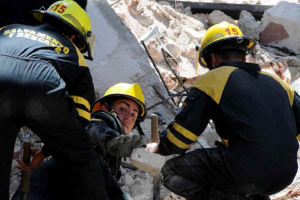
Rescuers extract the body of Isabel Maria Fernandez, age 50, victim of a collapse that occurred in Vibora, Havana, in September of 2013. Photo: www.cubadebate.cu

There is nothing written, except to be touched by luck.  “Suicides” that inhabit collapsed buildings talk about the time bomb.

HAVANA, Cuba.  An anonymous survivor of a collapse (he did not want his identity leaked), in a shelter with his family in a place in Playa township, told me the story of when part of the building where he used to live went down.

He occupied an apartment on the second floor of a four-story building.  It was night.  By luck, his wife was in the polyclinic with their son who had asthma, and another child was in the Latin-American Stadium, watching the game between the Industrials and Santiago with two neighbors, who were also saved.

He says that he was alone, seated in an armchair in the living room, watching the news, when suddenly the television and half the living room disappeared from his view with a roar, and he saw the two upper floors falling.

He will never forget the bulging eyes of his neighbor Leovigilda, washing the dishes in the kitchen, when she passed downward and asked him with signs what was happening. Then he saw the last floor pass by, crumbled, and some woman’s legs on a bed, and a cat that was jumping through the rubble. Later the roof passed in a jumble.

When he recovered from the shock, in the middle of a cloud of dust, he peeked out and observed a mountain of rubble. His armchair had remained at the edge of the abyss and he didn’t move from there until the rescue brigade arrived.

“We inhabitants of those buildings are suicides,” he says.  “They need to build many Alamar neighborhoods*, and get everyone out of those time bombs, which with each minute it brings death closer.”

Where do the “creatures” that make the night live?

The housing infrastructure of Old Havana, Central Havana, Cerro and 10th of October townships can be classified as “deplorable” because of the age of their buildings, lack of maintenance and violation of building standards on the part of their inhabitants who, for lack of dwellings, subdivide the spaces without order or control in order to accommodate new tenants.

In a building on Animas and Virtudes streets, which at the beginning was designed for 10 families, 45 are living there today. And in one on Marcaderes and Aramburen the stairway collapsed completely. The order by the Housing Authority to abandon the building was given, but the residents placed temporary steps and go up and down constantly putting their lives at risk.

On Cuba and Amargura streets there is a site that resembles a beehive.  No one can calculate exactly how many people it shelters. By day a certain number is counted, above all children who leave for school and old people running errands, but at nightfall a legion of characters comes out to make a living: transvestites, homosexuals, pimps, prostitutes, and criminals.

Given the extremely poor physical condition and lack of sense of belonging of their tenants, these old buildings ruined by time and governmental incompetence are a breeding ground for collapses which jeopardize the lives of the inhabitants.

*Translator’s note: Alamar is a “model community” built in east Havana in the early years of the Revolution. A video is here.

Cubanet, 6 March 2014 |

Translated by mlk