Cuba Continues To Occupy An Embarrassing Position In The Free Press Rankings

Freedom House, like every year, has published the report on the freedom of the press situation in the 197 countries that it monitors.

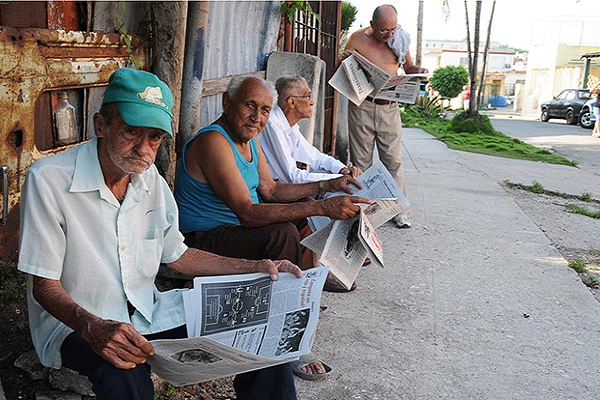
In the report released the first of May, covering 2013, Cuba continues to occupy one of the worst positions on the list. continue reading

On the global list, it occupies position 190 out of 197, shared with Equatorial Guinea and Iran.  On the list of countries of the Americas, it occupies 35 out of 35.

Nothing to add. . . everything said.

The Editor

Translated by mlk.

2 May 2014

Enjoying May 1st in the Dominican Republic / Juan Juan Almeida

While thousands of Cubans are “voluntarily” required to participate in the pantomime of May 1st, Mariela Castro, the sexologist and director of the Cuban Sex Education center, presented today in the Dominican Republic the book she authored, What Happens To Us in Puberty? continue reading

The truth is that today May 1st is the day of acting cool.  Who does not know that in puberty what we get is what I need: hair.

Mariela says, although I don’t believer her at all, that that work has had a very good reception in our country.  I asked until I was tired, no one was familiar with the book in question.  I think that she goes on as usual, strolling and doing the work of the first lady.  And so that we don’t fall short, the Dominican Minister of Culture, deputy Minou Tavarez Mirabal, and the respective ambassadors from Cuba and Venezuela attended the book’s presentation.  A very crowded launch.

Translated by mlk.
1 May 2014

Raul Castro, Think Again / Angel Santiesteban


The months keep passing, and Angel Santiesteban — the only “common prisoner” to whom the political police have offered “freedom” in exchange for his renouncing his political position, witnessed in a video — continues punished, victim of constant inspections and deprived of passes to which by law he has a right; nor do they permit him to go to the dentist or the barber. continue reading

Now, this “common prisoner” was chosen among the 100 Freedom of Information Heroes by Reporters Without Borders.  Those who took him to jail should be writhing in shame; also those who have been and are complicit with their silence.

Why does the Regime fear him so? Because if it considers him a common prisoner, nothing they undertook against him make sense, besides being illegal.

Angel remains incarcerated, and he considers it an honor; the Review of his trial remains ignored and his attorney disqualified. From whatever point you try to understand this unjust sentence, the one who loses is the dictator Castro, because being a “common prisoner” he treats him — for all purposes — as a political prisoner, by which we can imagine that he wants to aggravate his situation “converting him” now into an enemy of the Revolution and traitor to his country.

If they make this official, they will only admit that Angel is a political prisoner, and there will be in evidence — once again — the true nature of the Castro dictatorship. It is also true that the democratic governments that make deals with Cuba at the cost of the sacrifice, suffering and blood of Cubans, don’t care at all. These governments and the Castro dictatorship will pass, because everything passes.  But they will remain forever in history.

Raul Castro, think again; you can still correct this injustice–and all those that are committed against the more than one hundred political prisoners. Do not do it for Cuba or for your victims; you as well as your brother demonstrated amply that no one and nothing matters to you, that only power interests you; do it for your children and grandchildren, those who throughout life are condemned to carry your last name and your stigma. Because the moment will come in which everything will fall into place, although you and your brother perhaps will no longer be–regrettably–and will be saved from facing Justice.

It is not only incomprehensible that the dictatorship is the most tolerated of the world, but no one ever will be able to understand why a “Revolution” that never spared bullets and violence so fears the words and opinions of an intellectual, of peaceful opponents and of decent women who bear as a “weapon” a gladiolus.

The only certainty is that history will not absolve them.

The Editor

Follow the link to sign the petition for Amnesty International to declare Cuban dissident Angel Santiesteban a prisoner of conscience.

Translated by mlk.

1 May 2014

Burn Your Neighbor’s Beard / Angel Santiesteban

The hypocritical “conversation” that Nicolas Maduro held with the opposition indicates the political temperature of what is happening in Venezuela.

Against his will, the dictator sat down at the table of dialogue.  Although he does not want to recognize it, he did it at the demand of his Cuban advisors, and of Raul Castro himself, who in frequent phone calls from the Island, advises him not to give up, or show weakness or that he is desperate because of social pressure.

It is true that in Cuba Raul Castro is far from recognizing his political adversaries; further away still is the possibility of a dialogue between both sides.  Many more Cubans will have to die before — at some point — we throw ourselves into the streets in order to demand what belongs to us by right and that they have stolen from us for more than half a century.

Circumstances, dictators and tyrannies are different, but on perceiving that the process imposed by the deceased Hugo Chavez is extinguished, and in spite of the power and abuses they make a disillusioned people suffer, they have also make them pay for their rebellion with more than 40 lives.

In order to avoid guarimbas (street clashes) in Cuba, the Castros have maintained their iron command, which has cost many lives of those who have opposed them. Here, if one breathes at a different rhythm than that stipulated by the leadership, the political police open a file and begin their constant persecution, waiting for you to breathe deeply to “bring you” your shares of anguish.

No fire is needed in the archipelago; the smoke of a lit match barely suffices to sound the alarm.  Nevertheless, we keep dreaming of our guarimbas.

Angel Santiesteban-Prats

Lawton prison settlement.  April 2014.

To sign the petition for Amnesty International to declare dissident Cuban Angel Santesteban a prisoner of conscience, follow the link.

Translated by mlk.

25 April 2014

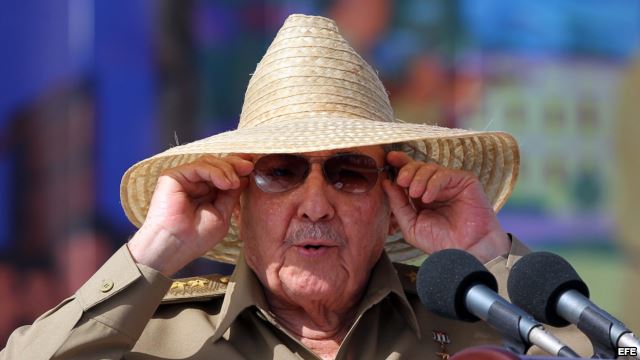
Raul Castro’s Black Glasses / Juan Juan Almeida

Although article 2.1 of the current Republic of Cuba Penal Code says, “Only acts expressly described as crimes in the law may be sanctioned…” doctrine inoculated for more than five decades managed to change in us the concept of Fatherland, Nation, State, Country and Revolution; this served as support for decreeing that whoever exercises the right to publicly criticize the ineffectiveness of the government will become, by conceptual association, an anti-patriotic activist who must be repressed.

Then, on establishing the word “Socialism” in the words of our Constitution, any different ideology or inclination was isolated to a dangerous anti-constitutional margin.

Cause and effect.  Today in Cuba, political prisoners are held incommunicado and sometimes, what’s more, deprived of the right to legal redress.  Such is the case with a young black Cuban, Juliet Michelena Diaz, who is in prison just for performing the innocuous work of independent citizen journalist, which permits us to observe reality and disturbs the clouded transparency of a governmental press; which although it may become strong with effort, will continue for some time to be rigid, controlled and censored.

The First Secretary of the Communist Party of Cuba lied supremely when at the closing of the 8th UNEAC (Cuban Artists and Writers Union) Meeting he said unabashedly and brazenly, “I am the absolute enemy of unanimity.”  Please, try that one on someone else.

Mister President forgets that his word may be command in the National Assembly, because it’s a political institution, but it should not be in trials or in courts. Nevertheless, based on honorable functions of watching over and protecting the citizenry, and sheltered behind the impudent excuse of maintaining the security of the people and public order, the Cuban authorities commit illegalities that allow them to prosecute, even using false accusations, not only people whom they wish to punish but also their relatives and friends.

Cuban shysters know well, they studied for this reason, that the guilt of a prisoner is personal and non-transferable and that under no circumstances should he be found guilty because of association, family relationship or heritage.  Even when dealing with an invented guilt as in the particular case of Lady in White Sonia Garro and her husband Ramon Alejandro Munoz, who have spent more than two years locked in prison with no one caring, and nothing happens.

Apparently, the General, like his brother Fidel, wears dark glasses in order to  protect himself from the sun and to keep blacks invisible.

I must clarify that with this writing I am not trying to be a judge or to promote a timely or opportunistic political crusade; I only want to make clear that while we move further from the majesty of the law, we will be permitting another “Don Juan de los Palotes” to keep distancing us from the road to democracy, respect and the real possibility of exercising of our full rights.

I apologize, I did not mention “Liberty” because even that is relative; and besides I am convinced that liberty will lose its value when it loses its obstacles.

Translated by mlk.

22 April 2014

The Drug Trafficking Country / Anddy Sierra Alvarez

Chapultepec Castle

Mexico City is one of the safest places for the families of the kingpins of the Mexican mafia. In spite of having a corrupt government, the politicians know the importance of protecting the capital. Even though drug trafficking is out at the doorstep.

Alejandro has awakened — silence does not exist — the sirens of patrol cars, ambulances or fire trucks are part of the vitality of the city. He can check his cellphone for today’s smog index in the area.

Walking towards an OXXO store his eyes water because of the pollution. Today most residents will not go out into the streets unless necessary. Some vehicles also are prohibited from circulating in order to reduce pollution.

The decision to go out into the street intimidates him a little because of the stories he has heard, the violence and disputes of the mafia in that country. In spite of the rumors,

Alejandro begins to adapt to the Mexican climate and society (very polite). The mafia stories begin to form a part of a myth (it exists), but he is confident. Another day begins, and Alejandro walking to the bread store observes a display of federal police, awaiting some supposed protest march.

The image of the police does not affect him but the tranquility of expecting to close the streets with railing close to four meters tall. They do not permit passage but nor do they refuse the right to protest or demand something. That is something called DEMOCRACY.

Translated by mlk.

14 April 2014

Cuba: The Clueless Official Press / Ivan Garcia

granma-620x330
There is an abysmal gap between daily reality and the information offered by a clueless official press.  Never in Granma, Juventud Rebelde (Rebel Youth) Trabajadores (Workers) or any of the 15 provincial press organs was there news of the Castro regime’s flagrant arms smuggling to North Korea in violation of the United Nations’ embargo of the Pyongyang dynasty.

The boring and disoriented national press, print, radio or television, to date, has not reported about the spaces open for dialogue by the Catholic Church. Or local news that has had resonance, like the protest by self-employed workers in Holguin or the unlikely walk by a nude woman in the city of Camaguey.

They also ignore less tense or contentious matters, like the visit to Cuba by Big League ball players Ken Griffey, Jr., and Barry Larkin or by famous people like Beyonce and her husband, rapper Jay Z.

Neither does it interest them for readers or viewers to find out that Cuban artists and musicians resident abroad visit the island and give performances, as in the cases of Isaac Delgado, Descemer Bueno and Tanya, among others.

They don’t even publish an article to analyze the insane prices for car sales or internet services.

On international topics, the old trick is to show only a part of the event.  For those who only read official media and do not have access to other sources of information, those who protest in Ukraine, Venezuela or Turkey are terrorists or fascists.

In Cuba it was never published that the dictator Kim Jong Un summarily executed his uncle.  Likewise, they kept silent about the atrocities that happen in the concentration camps of North Korea.  And about the degrading treatment of women in Iran.

Newsprint is usually occupied by cultural commentary and sports in an undertone, the television schedule, optimistic news about agricultural production or the good progress of economic reforms dictated by President Raul Castro and his advisors.

Apparently, they considered it inopportune to inform Cubans about the talks between the Cuban-American sugar millionaire Alfonso Fanjul and Chancellor Bruno Rodriguez.  Nor did they think it convenient for the common people to know that Antonio Castro, the son of Fidel, plays in golf tournaments.

Or that recently entrepreneurs with bulging wallets paid 234 thousand dollars for a handmade Montecristo tobacco humidor at the 16th Havana Festival where the most well known guest was the British singer Tom Jones.

Local reporting is directed by inflexible ideologies that presume that behind the vaunted freedom of the press is hidden a “military operation by the United States’ secret services.”

And they take it seriously. As if dealing with a matter of national security. That’s why the newspapers are soldiers of reporting.  Disciplined copyists.

For the Taliban of the Communist Party, the internet and social networks are a modern way of selling capitalism from a distance. The new times have caught them without many arguments. They assert they have the truth, but the fear the citizens testing it for themselves.

Reading of certain reports should be suggested by the magnanimous State.  They think, and they believe, that naive countrymen are not prepared or sufficiently inoculated for the propagandic venom of the world’s media.

Not even Raul Castro has managed to break the stubborn censorship and habitual torpor of the official press.  For years, Castro has spoken of turning the press into something believable, entertaining and attractive. But nothing has changed.

Destined for foreign consumption, official web pages and blogs have been opened. With their own voice they try to promote the illusion of an opening. The warriors of the word are for domestic consumption.

Ivan Garcia

Photo:  Taken from the Cuadernos de Cuba blog.

Translated by mlk.

26 March 2014

Studying Medicine and Desecrating Tombs in Cuba / Juan Juan Almeida

Since 1948, when the UN decided to adopt the Universal Declaration of Human Rights, many organizations and activists of the world have hoisted that dignified flag confronting the daily violations of liberty, justice and peace that many people suffer for the simple fact of their human condition.

Unfortunately, in several corners of this jungle that we call Earth, human rights entered a dark period due to the infinite apathy of many of its residents.  Barbarity is like our daily bread, and that makes it more or less normal.

In my country, for example, the topic is always a subject of controversy and debate; but today, I will not make reference to the rights of the living; I will speak of those who no longer exist, of our forebears, who are not the monkey, the Ardipithecus or the Australopithcus; but my mother and your grandfather.

Skulls, teeth, tibias, ribs, femurs, mandibles, vertebrae, pelvises; it is all found at the cemetery gate.  The desecration of graves has gone from being a horrible act of vandalism to an almost daily event.

But, “why is the toti always saddled with the blame for everything*”; uninformed metaphorics and made up know-it-alls, instead of finding out at the time of judging, they launch the accusing roar towards the many practitioners of Afro-Cuban religions who make up our folklore and form part of our cultural heritage.

In Santeria and witchcraft there are very but very isolated rites that require a human skeleton; there also exist artisans who buy bones in order to construct objects with them that they sell for the price of gold; but the absolutely responsible party for this atrocity against our dear ones is, as always, the State.

Ad nauseum the thought is drilled into us that since 1959, the development of medicine has been the principal priority of the revolutionary government, and in fact, Cuba boasts the highest physician-inhabitant ratio in the world.  Thousands of doctors are graduated each year on the island, and I tell you, each of these students, without regard to race, color, sex, language or religion (come on, like human rights), receives a bag with a skull and parts of human skeletal remains that if insufficient to study anatomy, then they get a card that they present at Cuban cemeteries in order to exhume from among the graves without owners the remains of those who in life were relatives of the unnamed, emigrated and exiled dead.

In order to have a slight idea of the desecrated graves, we would have to compare the number of bags delivered with the gross rate of Cuban mortality which, according to the reference published by the UN and sent by Havana, was 7.6 in 2012.  The same year in which — according to the extensive editorial by the website Cubadebate — the largest of the Antilles Islands trained more than 11,000 new doctors, 5,315 Cubans and 5,694 from 59 countries.  Scary.  I do not favor statistics when I write, nevertheless the exception deserves it.

Just a day like today, April 7, but in 1985, one of the most renowned Cuban visual artists, Rene Portocarrero, died.  His remains . . . I do not want to even think where they might be.

*Translator’s note: In “good Cuban” the expression is: “porqué la culpa de todo, siempre la carga el totí.”  It means several things: that someone small always ends up being accused of what others did, or that the blame always falls on the same notorious people regardless or whether or not they were actually involved, and also, that black people always get blamed for things. The totí (a.k.a. Cuban Blackbird) is a small black bird from the Cuban countryside that is notorious for eating crops and other human foods.

Translated by mlk.

10 April 2014

Cuba: Changes Come, Although the General May Not Want Them To / Juan Juan Almeida

For more than half a century, the Cuban Revolution developed exclusively inspired by the powerful and omnipresent archetype Fidel Castro.  An image that no longer exists or is hidden is the dressing rooms of the current political-economic-social theater. That is why when someone asks me if there exist in Cuba objective and subjective conditions for forging change, I always begin by saying: It depends on what we understand and want to assume by “Change.”

It is clear that the so extended process called the Cuban Revolution did not lead to a more just or prosperous or inclusive society, but to a strange and irrational collapse that still endures. The seizure of all powers, judicial and executive, did away with the legal protection of the citizen, and imposed apathy and fear; like that singular combination that exists between a cup of coffee with milk and a piece of bread with butter.

The old Asian theory that speaks of two elements is the basis of the idea that all phenomena of the universe are the result of the movement and mutation of various categories.  The good and the bad, the beautiful and the ugly, the yin and the yang.

The presence of the Ministry of Foreign Relations, the chief of the political department of the Central Committee of the Communist Party, and the misguided intervention of the President of the Republic of Cuba in the closing event of the recently held Eighth Congress of UNEAC was a terrible implementation of this old theory, and a disastrous strategy for showing the authority of the Government and the State, and at the same time it tried to reconquer the intelligentsia that as we all now know appears because of obstinacy, compromise, inertia or boredom, but that for some time, due to these same reasons, distanced itself from the Revolution.

The island’s government, upon the prompt and unstoppable disappearance if its leader-guide-priest and example, manages to entertain by talking of transformation while it intimidates us, leaving very clear the place of each in its chain of command.Many times we have seen dissident voices that issue from within the island repressed using mental patients with disorders like bi-polar and schizophrenia that without adequate medication exhibit extremely violent behaviors.  Outrageous.

I ask myself what the representatives of international organizations do, or what  those sensitive and passionate people who decided to defend vehemently and peevishly the Hippocratic oath say, on learning that the mentally ill are used as deadly weapons.

On April 14, 1912, the Titanic, at that time the safest boat in the world, crashed into an iceberg, and while it was sinking, the orchestra played.  In all ways, whether the general wants it or not, change is coming, although I have to admit that since 2008, the man has exerted himself in confusing us with an imaginary and mythological climate of national improvements and radical reforms; on one hand he shows several political prisoners, and on the other he hides political prisoners from us (here the order of the factors does alter the product).

According to the Marxist bible, the Communist Manifesto, a transformation of the structure of the classes demands a change in the social order and a political revolution.

La Habana decided to wind up its old and rusted clock because it had turned into quite the brake.

Translated by mlk.

14 April 2014

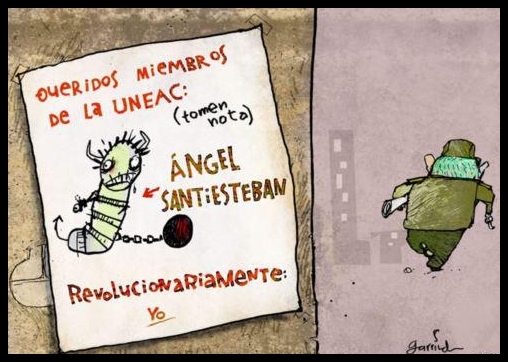
UNEAC Complicit In Its Silence / Angel Santiesteban

Previously I have said that in the circus exercise called court, which I attended with the sentence already dictated by State Security, as I was made to know long before by one of their henchmen, a fact that I made known publicly — and which the judges in the First Chamber of Crimes Against State Security executed, in their special headquarters for notorious crimes on Carmen and Juan Delgado, when it was supposed that my crime was common — officials of the Cuban Artists and Writers Union (UNEAC) attended, sent by their president Miguel Barnet to watch the show, like poet Alex Pausides, accompanied by the legal official, who said that to his understanding what the prosecution could present against me was smoke, like the report of that handwriting expert who said that the height and slant of my handwriting made me guilty.

At the exit, the poet and Communist Party member Alex Pausides as well as the legal official, said that I would be absolved given that what was presented, and according to what was exposed in the oral ceremony, I could not be judged, especially when I presented five witnesses who demolished those accusations.

caption
Dear members of UNEAC (take note). Angel Santiesteban, Revolutionarily, Me

Then, when they found me guilty, my lawyer went to UNEAC and left all the documents that corroborated my innocence and that they requested for presentation to Miguel Barnet, but we never received an answer, they kept silent.

Of course, I am not naive, I never expected a reaction from UNEAC, I always knew what they would do, but above all, what they would not do, and they have fulfilled my predictions.  I understood that they would take that posture because I believe in history like a religion, and I knew that history would yield that despicable stance. Their silence is their shamelessness.  And that shamelessness is now written in our history.

Angel Santiesteban-Prats

Lawton prison settlement.  April 2014.

To sign the petition for Amnesty International to declare Cuban dissident Angel Santiesteban a prisoner of conscience follow the link.

Translated by mlk.

“I Only Know That I Am Afraid” / Tania Diez Castro

HAVANA, Cuba — For almost the first three years of his regime, Fidel Castro was not interested in Cuban intellectuals. He did not forgive their passivity during the years of revolutionary insurrection. They had not put bombs in the street, nor did they engage in armed conflict with the previous dictator’s police. Even those who lived abroad did not do anything for the revolutionary triumph. He never forgave them. Neither he nor other political leaders considered them revolutionaries either before or after the Revolution.

Che Guevara had left it written forever in his little Marxist manual Socialism and Man in Cuba: “The guilt of many of our intellectuals and artists resides in their original sin: they are not authentically revolutionary. We can try to graft the elm tree so that it will produce pears, but at the same time we must plant pear trees.”

But the pears that Che mentioned had nothing to do with human beings because an intellectual, writer or artist is characterized by his sensitivity, his pride, his sincerity. In general, they are solitary and proud.

But also they are, and that is their misfortune, an easy nut to crack, above all for a dictator with good spurs.

During those almost first three years of the Revolution, the most convulsive of the Castro regime — the number of those shot increased and the few jails were stuffed with more than 10,000 political prisoners — surely writers did not fail to observe how Fidel Castro was cracking the free press when after December 27, 1959, he gave the order to introduce the first “post-scripts” at the bottom of articles adverse to his government, supposedly written by the graphics workers.

It was evident that Fidel Castro, who controlled the whole country, did not want to approach them to fill leadership positions of cultural institutions founded by the regime, like the Institute of Art and Cinematographic Industry, House of the Americas, the Latin News Press Agency and numerous newspapers, magazines, and radio and television stations that were nationalized.

For minister of education he preferred Armando Hart. For the House of the Americas, a woman very far from being an intellectual, Haydee Santamaria.  For the Cuban Institute of Radio and Television, Papito Serguera, and for the Naitonal Council of Culture, Vicentina Antuna and Edith Garcia Buchaca, two women unknown in cultural domain.

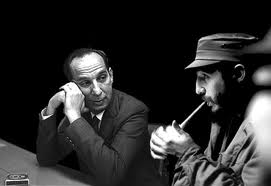
The first approach that Fidel Castro had with writers, June 16, 1961, in the National Library of Havana, could not have been worse. It was there where he exclaimed his famous remark, “Within the Revolution, everything; outside the Revolution, nothing,” and where he made clear that those who were dedicated to Art had to submit themselves to the will of the Revolution, something that is still in force.

The maximum leader left that closed-door meeting more than pleased on seeing the expressions of surprise and fear of many of those present, and above all by the words of Virgilio Pinera, one of the most important intellectuals of the 20th century when he said: “I just know that I am scared, very scared.” That precisely was what the new Cuban leader most needed to hear from the intellectual throng: Fear, to be able to govern at his whim.

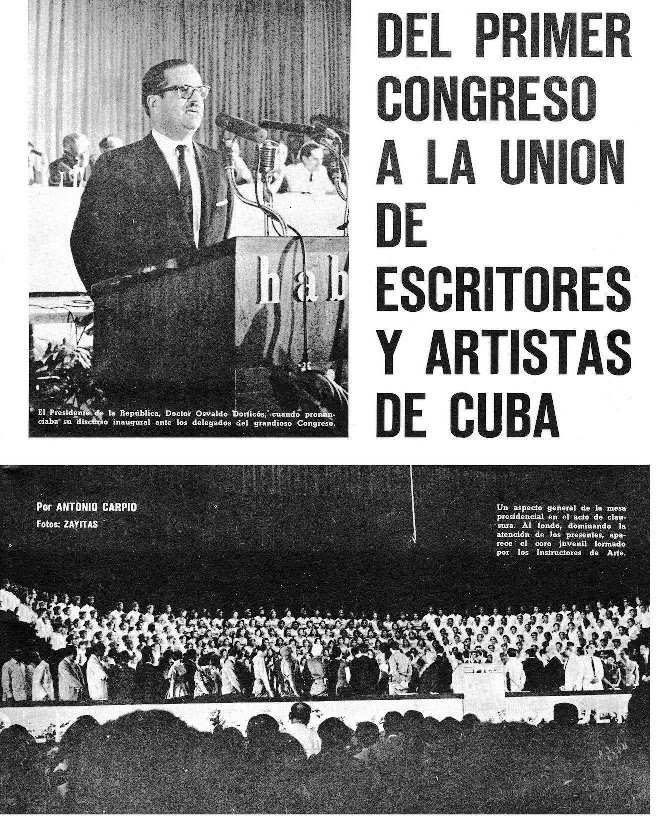
Two months later the Fist Congress of Cuban Writers and Artists was held, and UNEAC was founded.  The intellectuals had fallen into line.

If something was said about that palatial headquarters, property of a Cuban emigrant, it is that the Commandant was allergic to all who had their own judgment, and for that reason he would never visit it, as it happened.

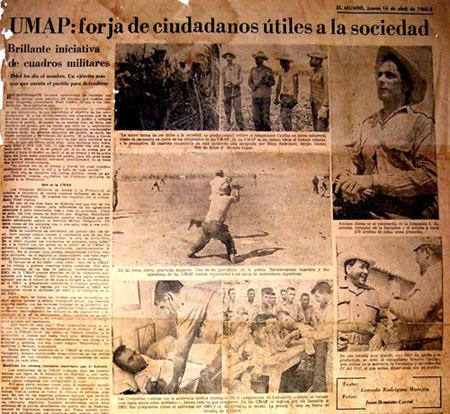
It is remembered still today that in a public speech on March 13, 1966, he attacked the homosexuals of UNEAC, threatening to send them to work agriculture in the concentration camps of Camaguey province. The “Enlightened One,” as today the president of UNEAC Miguel Barnet calls the Cuban dictator, kept his word. Numerous writers and graphic artists found themselves punished with forced labor in the unforgettable Military Units to Assist Production — UMAP.

These Nazi-style units were created in 1964 and closed four years later after persistent international complaints. If anyone knew and knows still the most hidden thoughts of the intellectuals, besides their sexual intimacy, it is the Enlightened One, thanks to his army of spies, members of the political police who work in the shadows of the mansion of 17th and H, in the Havana’s Vedado where UNEAC put down roots.

In 1977, one cannot forget the most cruel and abominable blow that the Enlightened One directed against the writers of UNEAC when his army of political police extracted from the drawers of the headquarters the files of more than 100 members — among them was mine as founder — so that they were definitively and without any explanation separated from the Literature Section of that institution.

Cubanet, April 11, 2014

Translated by mlk.

The Revolution’s Pensioners / Reinaldo Emilio Cosan Alen

HAVANA, Cuba.  Jose Manuel Rosado, 74 years of age, from Havana del Este, stands in line at four in the morning to be among the first to “fill up his checkbook.”

The bank opens at 8:30 for multiple transactions.  Many other people like Jose Manuel will wait patiently, on foot, whether in intense sun or cold and rain if it is winter, in order to cash their retirement.  Jose, his two-hundred forty pesos (ten dollars average), which will vanish in the first food purchases and payments for services.

Maria Victoria, 81 years old, stands in line in front of Branch 286 of the People’s Savings Bank — a state bank — in the San Miguel del Padron township:

“I retired at 65.  I was a cook in a business the last thirty.  I worked another eight years.  The money goes to deficient nutrition. I “resolved” my food at my work, do you understand, for my home.  Now I almost cannot walk because of my ulcerous legs, I am diabetic. I rent a pedicab to go get my cash. A dollar going, another returning. Fifty pesos spent, but it is dangerous to walk through broken, dark streets, exposed to robberies to go to the bank.”

She pays another fifty pesos monthly on installment for a bank loan for the purchase of her Chinese refrigerator. She has paid off five years, five are still left.

Build up for whatever official or individual management: mail, Currency Exchange, tax payment, liquidation sale and transfer of property and vehicles, fines, repayments, deposits, bonds, required seals–foreign and national currency–monthly payments for dwelling, loans retirement and pension payments. Craziness!

Pensioner Eloy Marante, 76 years old, pays triple the tax for his courier license. Day by day, he loads, transports and distributes gas cylinders to homes with his tricycle, in order to obtain a supplement for his lean pension.

“We run errands in the warehouse, attentive to if they are selling the piece of chicken allowed to those on a special “health diet.” We pay electricity, telephone, gas. We take the little kids to school and pick them up; take the snacks to the kids in high school, also we do favors for neighbors for a small tip. Jobs that the family throws to the old people. The worst: standing in unending lines to exchange bills for coins because business clerks and bus drivers say they don’t have change!  An fraud*,because the government does not demand responsibility. . .” says Jose Manuel.

Milagros Penalver, director of Budget Control for the Ministry of Labor and Social Security, says there are 672,568 retirees and pensioners out of 2,041,392 people over 70 years of age, according to the Population and Household Census of 2012.

Significant is the prediction by the Center for Population Studies and development of the National Office of Statistics: 33.9 percent of the population will be over six decades old in 2035.  The birthrate continues in permanent decline because of factors so adverse to procreation.

*Translator’s note: The fraud is refusing to give the customer coins and so the business or bus driver “keeps the change.”

cosanoalen@yahoo.com

Cubanet, April 11, 2014, Reinaldo Emilio Cosan Alen

Translated by mlk

Havana: The Poverty Behind the Glamour / Ivan Garcia

El-Fanguito-uno-de-los-barrios-marginales-de-La-Habana-620x330

View of El Fanguito, one of Havana’s slums

Just across from Cordoba park, in the Havana neighborhood of La Vibora, is nestled a luxury cafe called Villa Hernandez.  It is a stunning mansion built in the early 20th century and renovated in detail by its owner.

At the entrance, a friendly doorman shows clients the menu on a black leather-covered card.  A pina colada costs almost five dollars.  And a meal for three people not less than 70 cuc, the equivalent of four months’ salary for Zaida, employed by a dining room situated two blocks from the glamour of Villa Hernandez which attracts retired people, the elderly, and the poor from the area.

“It is not a dining room, it is a state restaurant for people of limited means. They call it ’Route 15,’ and the usual menu is white rice, an infamous pea porridge, and croquettes,” says Zaida.

Like the majority of the area’s residents, she has never sat on a stool in the Villa Hernandez bar to drink a mojito or to “nibble” tapas of Serrano ham.

A block from the dining room, on the corner of Acosta and Gelabert, in a house with high ceilings in danger of collapse, live 17 families crowded together.  The people have scrounged in order to transform the old rooms into dwellings.

The method for gaining space is to create lofts with wooden or concrete platforms between the walls. Each, on his own or according to his economic possibilities, has built bathrooms and kitchens without the assistance of an engineer or architect.

Even the old basement, where there once existed an animal stable, has been converted into a place that only with much imagination might be called a home.

The neighbors of the place see the Villa Hernandez restaurant as a foreign territory. “They have told me that they eat very well. I am ashamed to enter and ask about the menu. What for, if I have no money? At the end of the year they put up pretty decorations and a giant Santa Claus. I have told my children that this kind of restaurant is not within the reach of our pockets,” says Remigio.

Like small islets, in Havana there have emerged houses for rent, gymnasiums, tapas bars, cafes and private restaurants much like those that a poor Cuban only sees in foreign films.

There exists a nocturnal Havana with many lights, elegant designs and excess air conditioning which is usually the letter of introduction for the apparent success of the controversial economic reforms promoted by Raul Castro.

It is good that little private businesses emerge. The majority of the population approves cutting out by the roots dependence on the State, the main agent of the socialized misery that is lived in Cuba.

But old people, the retired, professionals, and state workers ask themselves when fair salary reforms will happen that will permit a worker to acquire a household appliance or drink a beer in a private bar.

“That’s what it’s about. Almost all we Cubans approve of people opening businesses. After all, in economic matters, the government has shown a lethal inefficiency. But there are two discussions: one is sold to potential foreign investors and another internal that keeps crushing the commitment to Marxism and to governing in order to favor the poorest,” says Amado, an engineer.

In the business field, the government has opened the door, but not completely.  In the promulgated economic guidelines, it is recognized that the small businesses are designed such that people do not accumulate great capital.

A large segment of party officials and the official press believes it sees in each private entrepreneur a future criminal.

At the moment, self-employment is surrounded with high taxes, the expansion of the opening of a wholesale market, and a legion of state inspectors who demand a multitude of parameters, as if it were anchored in Manhattan or Zurich and not in a nation that has short supplies of things from toothpaste and deodorant to even salt and eggs.

The regime takes advantage of the poor to sell the Cuban brand. “Marketing has been created that shows an island interspersed with images of tenements, mulattas dancing to reggaeton, happy young people drinking rum, US cars from the ’50’s, the National Hotel and luxury restaurants,” says Carlos, a sociologist.

Successful managers, like Enrique Nunez, owner of La Guarida, situated in the mostly black neighborhood of San Leopoldo in downtown Havana, also benefit from the environment in order to grow their businesses.

La Guarida was one of the locations in the film Strawberry and Chocolate by the deceased director Tomas Gutierrez Alea. There, among many others, have dined Queen Sofia of Spain, Diego Armando Maradona and US congressmen.

The dilapidated multifamily building where it is located, with sheets put out to dry on interior balconies and unemployed mulattos and blacks playing dominoes at the foot of the stairway, has become the particular stamp of La Guarida.

“Yes, it’s embarrassing. But to carry on culinary or hospitality businesses in ruinous neighborhoods replete with hustlers and prostitutes, is an added value that works.  Maybe that happens because Havana is still not a violent or dangerous city like Caracas. And the naive Europeans like that touch of modernity surrounded by African misery,” points out the owner of a bar in the old part of the capital.

While the governmental propaganda exaggerates the economic opening, Zaida asks if someday her salary in the State dining room will permit her to have a daiquiri in Villa Hernandez. For her, for now, it would be easier for it to snow in Cuba.

Ivan Garcia

Photo:  El Fanguito, old neighborhood of indigents in El Vedado, Havana, arose in 1935, at the mouth of the river Almendares, in the now-disappeared fishing village of Bongo and Gavilan. With Fidel Castro’s arrival in power, this and other Havana slums not only did not disappear but were growing. At any time, El Fanguito, La Timba, Los Pocitos, La Jata, Romerillo, El Canal, La Cuevita, Indalla, and La Corea, among others, are included in sightseeing tours through the capital, in order to be in tune with the fashion of mixing glamour with poverty, as occurs in Rio de Janeiro with the slums. The photo was taken from Cubanet (TQ).

Translated by mlk.

10 April 2014

Something That Goes Beyond the Law / Josue Rojas Marin, Cuban Law Association

Atty. Josue Rojas Marin

Some landlords from Santa Lucia beach in the Camaguey province find themselves confused before a measure imposed by officials from Immigration and Aliens. Since last year, they have made them sign a document obliging them to be responsible for the cars rented by tourist staying in their homes, in spite of the fact that they sign a rental contract with the agency.  As is logical, there is nothing in the law that imposes a responsibility for property that forms no part of the accommodation.

They also have to keep the home’s door wide open, as we say in good Cuban, in order not to obstruct a surprise inspection, abrogating to the inspectors the right to write or cross things out in the rental registry book, in spite of the fact that it is not they but the Municipal Housing Department that is responsible for controlling this document, so it is required that a responsible person not leave the dwelling unattended, even when there are no guests.

The landlords often suffer unexpected visits by police agents who also write in the registry books, conduct illegal searches, take the registry book without any legal process and return it whenever they want.

All that affects the rental activity and consequently their income.

Translated by mlk.
31 March 2014

Zunzuneo: Subversion or Breaking Censorship; / Odelin Alfonso Torna / HemosOido

HAVANA, Cuba — The Cuba-United States confrontation increased its pitch with the publication by the daily Granma of the article, Zunzuneo: The Noise of Subversion, commenting on a report by the AP news agency about ZunZuneo and Piramideo, two text message services (SMS) accused of having illegally complied a list of telephone numbers to which it sent unsolicited messages on innocent topics like sports and culture, but which later would become subversive messages to young people, considered “susceptible to political change.”

According to Granma, the cornerstone of the ZunZuneo plan — a network that emerged in February 2010 — was to access the “data and phone numbers of Cubacel users,” the branch with the most ETECSA users.  In the same paragraph, the Communist Party daily suggests: “It is not clear to the AP how the telephone numbers were obtained although it appears to indicate that it was done in an illicit manner.”

Maybe the AP does not know that the ETECSA database — guide of mobile and fixed (residential and commercial) telephone numbers — was leaked in early 2010 to laptop and desktop computers all over the Island.  And that, immediately, promotional texts began to appear issued by Cuban artistic groups or clubs and bulk messages — unsolicited — demanding freedom for the five Cuban spies.  I remember perfectly one that said:  “To love justice is to defend the five.  End injustice!  Freedom now!”

The official ETECSA database is updated every year. The latest version that circulates in the population accounts for 60 per cent of the mobile phones, some 200,000 users, not counting the residential sector. The weight of this application in megabytes is between 200 and 450 (by design) and can be copied in any digital format.

Is it possible that ZunZuneo got 25 thousand subscribers in less than six months without the need of a database as the AP well reflects?  Why not talk about the so popular data leakage by ETECSA and the proselytizing in its unsolicited text messages?

Thanks to a friend not tied to the internal oppositon or independent journalism, I subscribed to ZunZuneo in 2010.  It was all very simple, it just required sending an SMS to a phone number outside the border and you would receive news about sports, culture or science or technology.  Also, one could subscribe on the Internet, at a time when the number of connected Cubans was barely 2.9 percent of the population.

Often senior citizens receive in Cuba promotional messages about a reggaeton concert, also the “March of the Torches Parade in Havana — The Great Country” is convened through Cubacel, as happened January 27 this year.  Is this not, perhaps, the equivalent of infringing on “the laws of privacy” as Granma says of ZunZuneo?

Nothing is said about the database leak by Cubacel, software that has generated groups of clandestine users and even phantom prepaid top-ups within the informal Cuban market.

This Thursday, the US government responded to the AP’s accusations. White House spokesman Jay Carney confirmed that his government was involved in the program and that it even had been approved in Congress. But the spokesman for the State Department, Marie Harf, denied on Thursday that the social network was the product of a secret or undercover operation. “We were trying to expand the space for Cubans to express themselves,” said Harf.For his part, White House spokesman Jay Carney denied that ZunZuneo had an undercover nature although he clarified that the US president supports efforts to expand communications in Cuba.

AP and international media that have reproduced the “scandal” of ZunZuneo should know that the ZunZuneo application never was used for any “subversive” movement in Cuba. Instead, the Cuban government used the ETECSA database to send text messages advocating the liberation of the five spies or the attendance at pro-governmental political events.

About a year ago, the ZunZuneo messages stopped. Cubans still do not communicate freely.

Cubanet, April 8, 2014

Translated by mlk