The Dictatorship’s Annoying Writer / Lilianne Ruiz

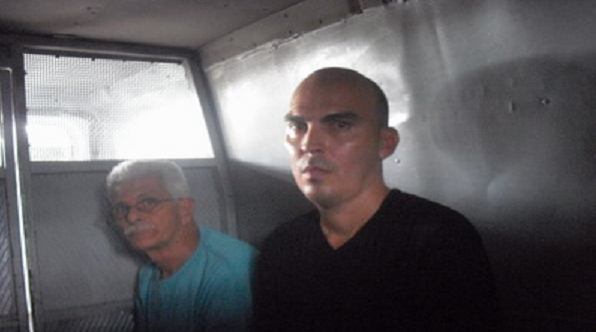
Writer Angel Santiesteban in prison -- photo Luz Escobar courtesy of Lilianne Ruiz
Writer Angel Santiesteban in prison — photo Luz Escobar courtesy of Lilianne Ruiz

HAVANA, Cuba.  This past February 28, Reporters without Borders issued a statement attaching the second Open Letter from Angel Santiesteban to General-President of Cuba, Raul Castro, on exactly the day that the writer finished a year in jail.  Santiesteban published the first letter, addressed to the same leader, on his blog a few days before being taken to jail for a crime of which he declares he is innocent.

The place where he is currently held is a military settlement in Lawton, Havana, with the appearance of a housing construction company.  It houses 19 prisoners. His companions have committed crimes of theft, drug trafficking and murder. They are required to stay in a regimen of forced labor. We went there to visit him, a group of friends and this reporter, who could obtain his statements.

Previously he was in La Lima, a prison establishment located in Guanabacoa, and afterwards in the prison known as the “1580,” situated in San Miguel del Padron.

The writer’s people skills guarantee respectful relationships with the inmates. While they are going to work at the ironworks or carpenter’s shop, he stays writing all day. But this he has gotten by force of protest.

Compared with the other jails where he has been, the place is less severe:

“The only explanation that I give you for the fact that they have brought me here is that I publish complaints.  Within the jails there are beatings constantly on the part of the authorities.  In the ’1580’ I made 70 complaints in four and half months,” explains the writer who receives us in the penal enclosure.

This is the second time he has been a prisoner. The first was when he was 17 years of age. He spent nine months awaiting trial in the La Cabana jail.  He had gone to the coast to say goodbye to a part of his family that was leaving Cuba clandestinely. They were caught, and all were taken to jail. From the memories of those nine months, which for him were interminable, came the book that won him the Casa de las Americas Prize in 2006: Blessed Are Those Who Mourn. continue reading

He has lost a lot of weight. He accepts no food except that supplied by his family. He came to have a diet as strict as milk with cookies at mid-day and a soup of dehydrated substances, made with boiling water, at the end of the afternoon.

Twice, in the “1580” prison during a hunger strike, he was shackled at his feet and hands. Then the jailers took him by the throat opening his mouth to make him swallow some foul liquid.

He is about to finish a novel:

“It will be an homage to Cirilo Villaverde, for his Cecilia Valdes,” he comments.  But he has another in the editing stage of the detective genre in order to entertain, which breaks with his usual style:

“I wanted to have fun,” he explains.

He has also written a book of stories about prison.

“I wanted to tell how riots occur. I condensed the stories that prisoners have told me.”

He was able to get the manuscripts out of jail, and now the texts are saved on a computer. In the “1580” he began writing at eight in the morning and only stopped when the guards turned off the light at ten at night.

“I wrote as if I were going to die. In spite of everything, this is going to be a time that I am going to miss for the rest of my life.”

The case against Santiesteban started weaving itself one afternoon in July 2009 when he was in the company of three people who can attest to his presence. On the other side of the city, his ex-wife, Kenia Diley Rodriguez, presented herself at the police station at the same time in order to accuse him of having forced entry into her home and attacked her. After three days, Rodriguez added the accusation of the crime of “theft; after almost two months following the supposed assault, added “rape” and “attempted murder.”

None of these accusations had the least physical evidence, as the accused himself has demonstrated.

The background is a soap opera, except that it ended in tragedy for the main character:

Santiesteban had abandoned his relationship with Diley Rodriguez. By then, he already had a romantic relationship with a well-known Cuban actress.

Meanwhile, there was someone else interested in damaging him: State Security.

Lilianne Ruiz and Angel Santiesteban, 2012

Little time passed between the publication of Santiesteban’s blog and the day and time of his trial.

Without guarantees in this country for respect for the presumption of innocence (the law is not dealt out equally, and courts are not independent), the ill will of the woman against her ex-spouse, an intellectual dissident, got him put in jail.

Recently, the Motion for Review of the judgment was received, which his lawyer presented to the Ministry of Justice last year. Now the Court needs to send the trial record to the Review Department. In the motion, it is expressed that the sanction against Angel Santiesteban is an enormous injustice because “he has been the victim of a vulgar hoax originated in the express lies of his ex-wife.” At the end of the document, the nullification of the judgment is requested; acquittal for the charged crimes.

The writer’s family managed to find out that the document was filed for a long time in the Ministry of Justice. They told them informally that the case was famous there and that all the authorities had met.

“It’s one thing for the Ministry of Justice to accept the review and another for them to be able to be honest,” says the writer.

The video in which the most important prosecution witness appears confessing to having lied in favor of Kenia Diley Rodriguez, because of the financial benefits she offered, was not received by the Court as proof of exoneration. But it served to erode the body of charges that was initially brought.

In spite of all logic, he was sentenced for “breaking into the residence” and “injuries.”

The person of good will who managed to turn on the camera at the right moment saved Santiesteban from the prosecutor’s request for 54 years in jail.

“The guy did not know that they were recording him. When he found out he went to the police unit with my son’s mother to accuse me of ’assault.’”

The video was analyzed by the Central Crime Laboratory which assessed it as perfect. The court simply dismissed the material “as not contributing elements of interest to the process.”

The question that his lawyer asks in the document is the following: If the authorities came to the conclusion that the greater part of the accusations of Kenia Diley Rodriguez against Santiesteban were false, what degree of credibility can be acknowledged in those that still stand?

Cubanet, March 8, 2014,

Translated by mlk.

The Hard Fate of Those Who Grow Old / Alberto Mendez Castello

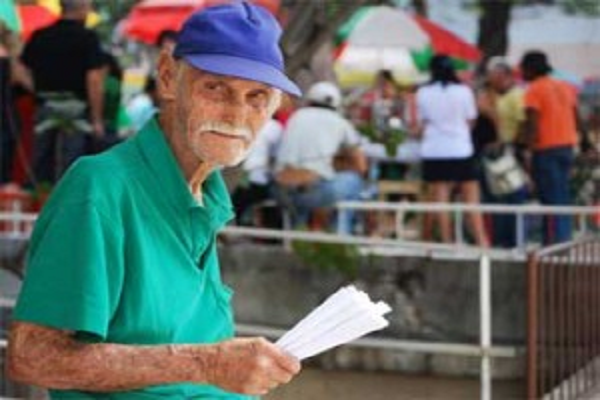
Cuba, old age, selling little cones of peanuts on the street.

PUERTO PADRE, Cuba — Old Raul was a worker for Communal Services, but an unyielding cervical disease at age 54 made the Medical Commission discharge him. Now he is 74 years old and has a pension of 242 pesos, “but I go over 40 just on my wife’s drugs,” he says.  Most of the time he stays seated on the sidewalk in front of a market that sells unrationed products, and sells spices and homemade bags to take on errands.

Raul gets around on a bicycle, but old Gilberto has to fight on foot, with short steps, in order to sell the occasional homemade cumin packet.  He was a truck driver.  He spent 41 years behind the steering wheel:  “I was driving throwing rods since I was 11 or 12 years old,” he says.

Skeletal illnesses took Gilbert from work.  Now a septuagenarian, he and his wife “live” with a pension of 242 pesos, and of those some seventy go for medicine. Those retired because of illness cannot get a license to work for themselves:  “The other day an inspector wanted to give me a fine of 700 pesos.  Take me to the police, to say there everything I have to say.  In the end he left me alone.”

Mariano had a better position than Raul and Gilberto, and unlike them, did not retire because of illness but because he finished his years of work.  At the time he retired, he held an administrative post in the municipal hospital.  After retirement, other institutions took advantage of him until his health took a bad turn.  Now Mariano is a paraplegic. Pedalling a tricycle with his hands, he tries to earn a living selling prú, a soft drink made of herbs and fermented roots.

Blanco also pedals a tricycle with his hands.  He is an ex-operator and driver of tow trucks, who was transformed into a babbling paraplegic by two thromboses.  Now he has to get by with a pension of 242 pesos for him and his aged mother:  “More than 40 pesos go for nothing more than medicines; if I don’t sell knives we die of hunger,” he told me at the same time he was lamenting the difficulty of finding knives to sell because Customs has limited their entry into the country.

In Puerto Padre there exists a Grandfather House where, for 25 pesos a month, old people receive breakfast, lunch, dinner and two snacks.  “Sometimes here we even have beef, today we have chicken,” said Jimenez, a retired bricklayer.  But this Grandfather House only has capacity for 40 old people, who have to go sleep in their homes.  So it is no more than a small remedy for this great wound that is old age, not only in Puerto Padre but in all of Cuba.

Hundreds of old people, almost all of them sick, almost always in precarious conditions and not a few on the edge of the law, have to pursue working in order to earn a living in this city.  False reasoning does not produce a good soup.  According to Law No. 117 of the State Budget for 2014, incomes for contribution to Social Security are 3,034.5 million pesos, but the expenses exceed 5,122.7 million pesos, therefore there is a deficit of 2,088.2 million pesos, to be covered by the central budget account.  That is okay if the numbers are real.  But they are not.

Cubanet, March 3, 2014,

Translated by mlk.

Collapse in Havana Leaves More Than 600 People on the Street / Agusto Cesar San Martin and Pablo Mendez

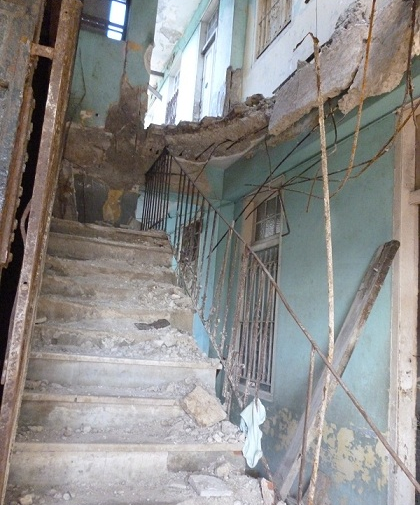
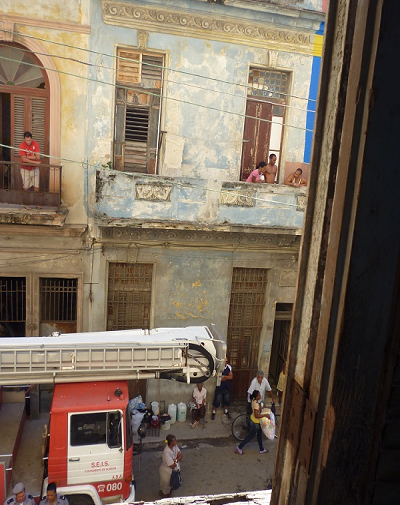
Building in danger of total collapse — photo Augusto Cesar San Martin

HAVANA, Cuba. — Since the afternoon of last Thursday the 27th, the residents of the building located at 308 Oquendo, between San Rafael and San Miguel, Centro Havana remain on the street.

The partial collapse of the upper floors put in danger the structure of the five story building of 120 apartments.

From the first concrete crashes, the more than 600 residents began to abandon the property, transferring their belongings to the street.  Facing the imminence of total collapse, the local authorities ordered an evacuation.

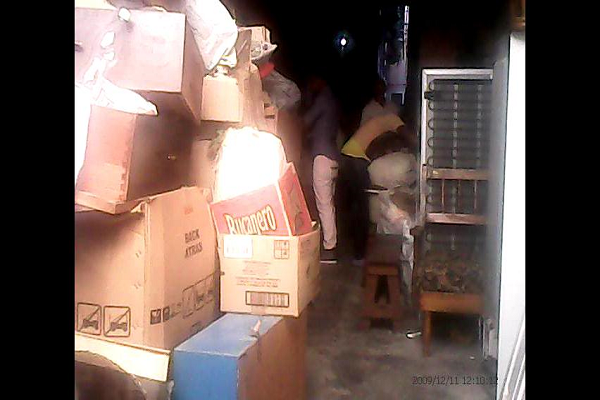
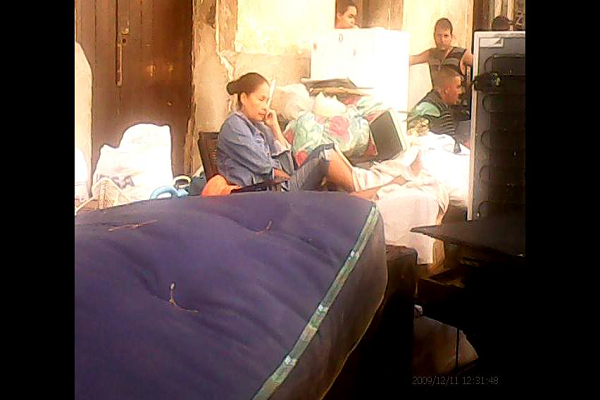
The residents keep doors, bathroom tiles, toilets, electric appliances, beds and all kinds of belongings on the street.  These people have not been evacuated.

At 7:00 pm on Saturday the police ordered the electricity cut off and prohibited entry into the building until Sunday morning.  The order caused a disruption for the residents who have not finished gathering their belongings.

On Friday, local government officials met with some of those affected.  According to one of the victims, they made assurances that they would evacuate everyone gradually.

One of the building’s residents who did not want to be identified told the independent press said:

“We don’t know where to go.  Yesterday nine buses came by here in order to take us to shelters, and they were empty. . .  We want homes, not shelter.”

It is also known that some affected families were installed in apartments of buidlings located in Santa Fe, Playa township.  The provision of dwellings is prioritized by the composition of nuclear families with children.

The building constructed in 1928 was declared in danger of collapse in 1988.  All the victims consulted agree on the reiteration of the government alerts about the deterioration of the building.

Photo gallery of collapse in Centro Havana, sent by Augusto Cesar San Martin and Pablo Mendez

1 El-derrube-en-los-pisos-superiores-puso-en-peligro-la-edificacion-420x5052 Edificio-desalojado.-2.3-53 Edificio-desalojado.-2.3-1 4 Derrumbe-1-feb-2014-5-400x505Cubanet, March 3, 2014, Augusto Cesar San Martin and Pablo Mendez

Translated by mlk.
Transition to Dictatorship Rhythm / Jorge Olivera Castillo

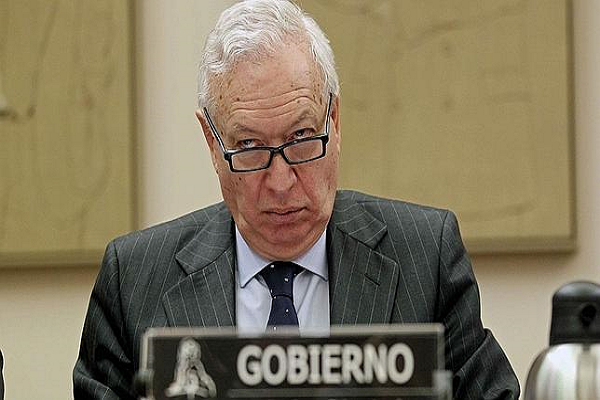
Jose Manuel Garcia-Margallo, Spanish Foreign Minister, believes that the European Common Position towards Cuba is correct, but can be more flexible

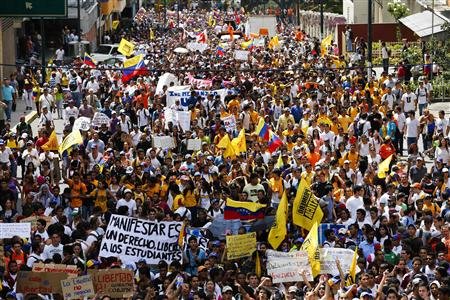
HAVANA, Cuba, March — Latin America and now the European Union approach the Cuban dictatorship without great demands. Respect for fundamental rights, as a requisite for closer relations with Havana passes to a more distant plane than previously.

The priority is to guarantee the survival of the regime as an assurance of political stability within the Island, and maybe to manage a soft landing towards some form of less authoritarian government. It is risky, at the very least, to say that the end point of this journey that is barely beginning is democracy with all its attributes.

Single-party socialism is not going to disappear from Cuba because of a civilian-military revolution. Neither does it appear that its end is associated with a negotiating table formed by people of the current regime, the Catholic Church and the opposition groups. If history grants the possibility of such a scenario, it would settle for when the heirs of the gerontocracy assume control at a time impossible to determine.

Whoever says to the contrary is, as they say, lost in the weeds. The weakness of the opposition, in a social climate where anarchy stopped being exceptional some time ago, is a reality that counts when the time comes to define policies. Of course they are not the only motivations, but there is no doubt that they have contributed to things flowing in favor of conservative pragmatism. continue reading

To this one would have to add the little importance of our country in the geopolitical order. Without great economic attractions or strategic relevance for the centers of world power, the topic of Cuba dissolves between indifference and the castlings of very specific interest. Nothing of commitments with respect to a political evolution that overcomes single party rule and the impossibility of exercising fundamental rights without conditions. That would come associated with the development of economic openness.

The only government that maintains a policy of confrontation is the United States, although of little benefit for advancing the pro-democracy agenda. The embargo increasingly loses effectiveness following a moderating trend that includes important sectors linked to the politics and economy of this nation.

At times it seems that the incidents of abuse perpetrated by the regime fall on deaf ears. Except for a few non-governmental organizations, the majority of governments remain impassive in the face of statistics about arbitrary arrests, acts of repudiation and prison sentences for political reasons.

Resignation would not be a good option facing the sequence of irrefutable facts, but also one has to be careful about romantic visions.

A deep reflection about the circumstances is necessary. The opposition and the members of alternative civil society that do not do it will fall by the wayside. One must insist on efforts to be more creative and to eliminate the recurrence of old errors that continue burdening the pro-democratic plans.

Cubanet, March 3, 2014, Jorge Olivera Castillo

oliverajorge75@yahoo.com

Translated by mlk

Cuba’s History Told by Beans / Alberto Mendez Castello

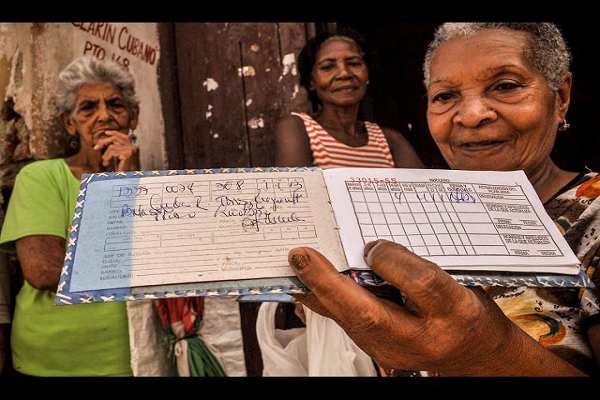
Cuban ration booklet — AFP

PUERTO PADRE, Cuba.  Within the systematic scarcity and increasing cost of daily life, the last week was marked by gaps in supplies.  And although cement, steel and deodorants are missing, groceries are particularly missed.

More than the bread of the ration books that has gone missing some day or another, stomachs cry out for the “midnight,” for the one peso bun that could be acquired unrationed, along with the rationed bread, but that now is not produced for lack of flour.

For many without purchasing power, it mattered little during the several days that chicken was lacking in the “Hard Currency Collection Stores” (as the State itself named them).  But it did matter, and quite a lot, when this week, after standing in long lines at the butcher shops, the ration of “chicken for fish” was not enough, nevertheless and being a rationed product, people had to content themselves with getting on a list for when a second round is produced, that no one knows for sure when it will be produced.  “This is more of the same, ’when it’s not Juana, it’s her sister’,” grumbled one of those who did not get his quota of “chicken for fish.”

As is known, although Cuba is surrounded by the sea, on this island fish is a scarce product and is expensive, so that when it’s time to supply it through the ration book, the government substitutes some few ounces of imported chicken, which on many occasions, because of factors of corruption or bad administration, does not reach all the consumers of certain localities, adding to the discontent of the population because of … “shortages.” continue reading

Depending on the person from whom you acquire it, the time of year, the place, the quality of the product, and the species in question, in Puerto Padre a pound of fish or other marine product can cost between fifteen and forty pesos.

But if the meat products are scarce and expensive here, nevertheless and now being well into the third five-year period of the twenty-first century, nothing less happens with vegetables, which as early as the ’50s decade of the last century, in the case of rice, provided 24% of the Cuban diet, while beans made up 23%, according to data from the time by the National Institute of Economic Reform.

“I forget the last time that I ate red beans”

In one survey by the Catholic University Association, carried out among the rural Cuban population in 1957, it was found that only 4% of those interviewed mentioned meat as an integral part of their customary portion, 11.22% milk, only 1% admitted consuming fish and only 2.12% of those surveyed acknowledged eating eggs.  The investigators asked themselves: “How does the farmer subsist with such deficient contributions of meat, milk, eggs and fish?”

The same surveyors from the Catholic University Association revealed the mystery in their report:  “There exists a providential and saving fact: the bean, basic element of the farmer’s diet, is exceptionally a vegetable very rich in protein. In other countries where corn takes the place of beans in Cuba, deficiency diseases are very frequent. We can assure, without fear of error, that the Cuban farmer does not suffer more deficiency diseases thanks to beans.”

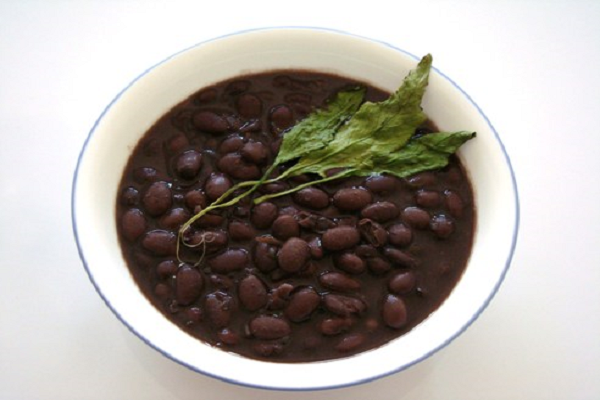
Black beans — picture from the internet

“Beans providential and saving? That would be in that period, when beans were eaten by the poor in Cuba!” exclaimed a doctor who on condition of anonymity explained to this correspondent how the local population, although not in all cases precisely underfed, mostly is malnourished by a diet in some cases insufficient and in others unbalanced.

In the bowl of the hands is more than enough space to fit the beans that, through the ration book, the consumer may buy for a whole month that, perhaps, suffice for one, two or three pots of rice and beans; the rest, for people who worked all their lives and got a very diminished retirement under socialist planning, must be bought at market price. “I forgot the last time that I ate a stew of red beans,” confessed a retired electrician.

Today, in Puerto Padre, a pound of red beans costs fifteen pesos; also white beans and garbanzos cost fifteen, and between ten and twelve for black beans; a pound of rice is five pesos, a small head of garlic costs a peso, a little more than a peso for a medium onion, five pesos for a bowl of peppers and between three and seven pesos a pound for tomatoes. Pork meat costs twenty-five pesos a pound.

The humble rice and beans that freed our poorest farmers from deficiency diseases today costs some forty pesos if seated at the table are two old people, two children and the man and woman of the house, something like the family of today; six mouths although with more old people and fewer children, the same number as the rural family from the fifties.

Maybe that is the reason for underweight and small children, why so frequently the consultation and waiting rooms of clinics and hospitals remain crowded. And they are not scarcities more or less of recent weeks, but from the last half century, where by decree, in Cuba meat came to be the chosen food, while the poor stopped eating beans because of socio-political circumstances, making Cubans more destitute, maybe worse fed than our ancestors, the aborigines.

Cubanet, February 26, 2014,  

Translated by mlk.
Sacristan Arrested for Protecting Ladies in White / Calixto R. Martinez Arias

Sacristan Pupo — photo Calixto Ramon

HAVANA, Cuba. — Roberto Pupo Tejeda, sacristan of the Catholic Church, was arrested and mistreated by officials of the State Security Department (DSE).

“I was in the Church participating in the Sunday Mass, and I went out to observe the walk of the Ladies (in White),” said Pupo Tejeda, referring to the customary walk that they hold on leaving mass, down Fifth Avenue, the women’s movement that demands from the government freedom for political prisoners and respect for human rights.

The religious man, was who taken in a PNR (National Revolutionary Police) paddy wagon  along with six opposition activists to a police station, told this reporter after being freed in the afternoon that he was a victim of taunts and physical and psychological mistreatment on the part of officers of the DSE.

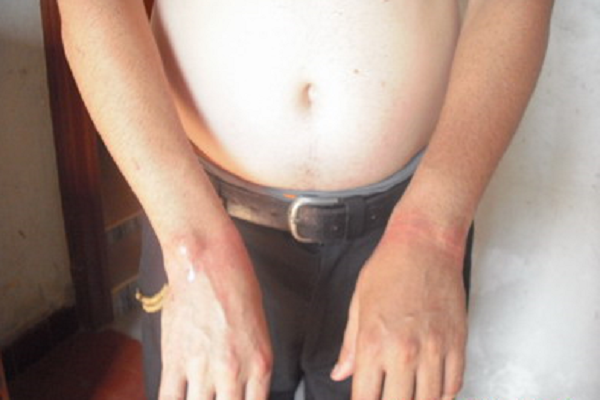
“They put the handcuffs on me too tight, and in order to take them off, a Security officer who identified himself as Camilo used a knife, and as if to intimidate me said that I should be calm because the knife had a quite sharp blade, and he might slip and cut me,” indicated the sacristan while showing the lacerations caused by the shackles.

According Pupo Tejeda, who was threatened by his oppressors with being deported to his native Holguin, 700 kilometers to the east of Havana, when he showed his card that identified him as a member of the Church, the DSE officers told him that that gave him no right to protect the Ladies in White. continue reading

“When I saw that they (DSE officers) rushed violently to arrest the Ladies, I put myself in the middle to protect them.  That was all that provoked their ire with me,” he emphasized.

Berta Soler, leader and spokesman of the Ladies in White, confirmed to this reporter the arrest of the sacristan and reported that a total of one hundred activists from her movement were arrested on leaving the Santa Rita Church, as well as some ten opponents who had gone to offer their support.

She also emphasized that the number of women detained this Sunday is around 200 because there were arrests in all the provinces in which the Movement has headquarters.

Sacristan Pupo shows marks of mistreatment — photo Calixto Ramon

The National Revolutionary Police’s (PNR) and DSE’s way of working in the arrest of the layman and more than a hundred opponents exposes the falsity of the words of the Catholic hierarchy and of the General President.

The wave of arrests took place in the morning hours this Sunday, February 23, when both repressive bodies carried out a raid against dissidents and opponents in the vicinity of the Santa Rita de Casia church located in the neighborhood of Miramar in Havana where the Ladies in White attend mass each Sunday.

Cubanet, February 24, 2014,

Translated by mlk.

The Tax Man and his Aladdin’s Lamp / Gladys Linares

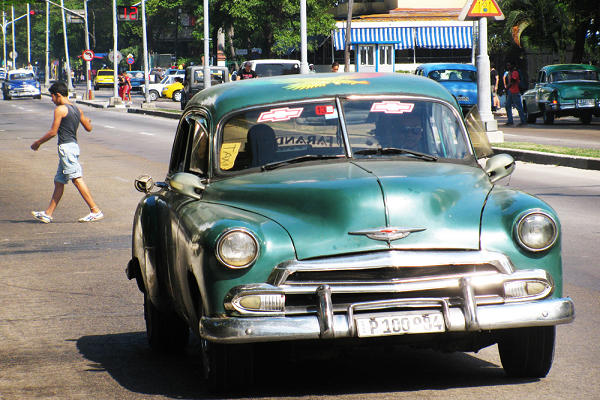
Private taxi — photo Gladys Linares

HAVANA, Cuba. — In 2010, Elvira was dismissed from her workplace. She had no option other than to get a license and open a snack-bar in her home in order to support her mother and son. She started selling coffee, soft drinks and sandwiches. She remarks that working for herself was more convenient, and she believed that she owed nothing to anyone because every month she duly paid her taxes.

Nevertheless, when she heard talk for the first time about the sworn statement about personal income as part of the “perfection” of the Cuban economic model, she never imagined what would happen to her: one fine day, they notified her that she owed nine thousand pesos national currency in debt to the tax authorities, and 500 in fines for fraud in her sworn statement, a total of 380 CUC [around $400 USD, close to two year’s average income in Cuba], hard currency and unattainable.

On inquiring at the Office of National Tax Administration (ONAT), the responses she received left her bewildered.  According to the official, in order to monitor the sworn statement, they consider the work hours, quantity of products sold and their prices, as well as the place where the snack-bar is located. continue reading

Private taxi -- photo Gladys Linares
Private taxi — photo Gladys Linares

Elvira asked how they could know all that, and the worker replied that the evaluation might be direct or indirect.  “You may know that we observe you, but equally we have the option of evaluating you without your knowing.”  And she added that if she did not agree, she could complain.  Elvira, getting to her feet, told her: “I see now that you all get information from Aladdin’s Lamp.” Today she is thinking of turning in her license and working under the table, but first she must devise a way to pay the debt.

A carrier who did not want to reveal his name said that he turned in his license more than three months ago because “the streets are in a very bad state, and I barely earned enough to buy tires and fix the car.”  In spite of that, a short while ago they notified him of a tax debt of 30 thousand pesos national currency, some 1,200 CUC.

One of the topics that lately has caused a commotion among the people is the great quantity of money the self-employed have to pay by way of taxes and fines.

Julio, an honest and enterprising neighbor, closed his private restaurant and turned in his license some time ago. He says that when the matter of the sworn statement about personal income began at the end of the year, he did not understand why, if all those months he paid 10% of his income, he had to pay again at year’s end.

“Marino Murillo said,” complains Julio, “that the payment to the tax system is to diminish the inequalities among the citizens. And I say what must be done for that is to take away privileges from the leaders, officials and their families, who are the ones who live well in this country, at the expense of Cubans.”

Cubanet, February 27, 2014, 

Translated by mlk.
Venezuela is not Angola / Camilo Ernesto Olivera Peidro

Cuban special troops

Cuba is not the same as 40 years ago, but its leaders are the same

HAVANA, Cuba, February — Cuba intervened militarily in Angola on the side of the MPLA in August of 1975.  In 1977 Revolutionary Armed Forces (FAR) supported the government of Agostino Neto in order to suppress by blood and fire an internal rebellion.

After that moment, the Cuban government took in its hands, in a less surreptitious manner, control of Angola. Within the MPLA there were divergent opinions about the role the Cubans were playing in the country’s political situation. On the death of President Neto in 1979, they pulled strings for the appointment of Jose Eduardo DosSantos to the post.

“In 1978, Fidel Castro knew that he could not count on the USSR unconditionally,” says an ex-official connected to the Cuban embassy in Angola at that time, “and his plan B consisted of strengthening political and military control over Angola.  The Russians involved themselves in the matter when they saw the possibility of trafficking arms in exchange for gold and precious stones. This the high Cuban officialdom did from the moment they gained control of the Angolan governmental entities and the main access roads into the country. The political and military caste that came into power in Russia post-1991, did it, too, with the money earned there and in other low intensity military conflicts.”

Now, in the case of Venezuela, the strategy is different but seeking the same objective. “Venezuela is not Angola, and Cuba is not the same as it was 40 years ago,” explains my interlocutor, “but the individuals in control are the same. They have sent civil collaborators like a screen to try to cloak their strong presence within the structures of all levels of that country. Chavez handed the house keys to the Cuban DGI (State Intelligence Directorate), and Maduro is a bad version of Jose Eduardo DosSantos.” continue reading

If the political situation in Venezuela goes completely out of control, the first victims would be the Cuban civil collaborators. “And in the same way as happened in 1977 when Nito Alves confronted Agostino Neto, it cannot be ruled out that FAR will intervene in Venezuela citing the protection of the collaborators.”

The question of how they will do it is more of form than of substance.  But Angola was a country recently released from colonial domination, in contrast with Venezuela which possesses a democratic tradition that has shown itself to be persistent.  “Nevertheless the silence or complicity of the Latin-American countries with the abuses of the Burro from Miraflores is a bad sign.”

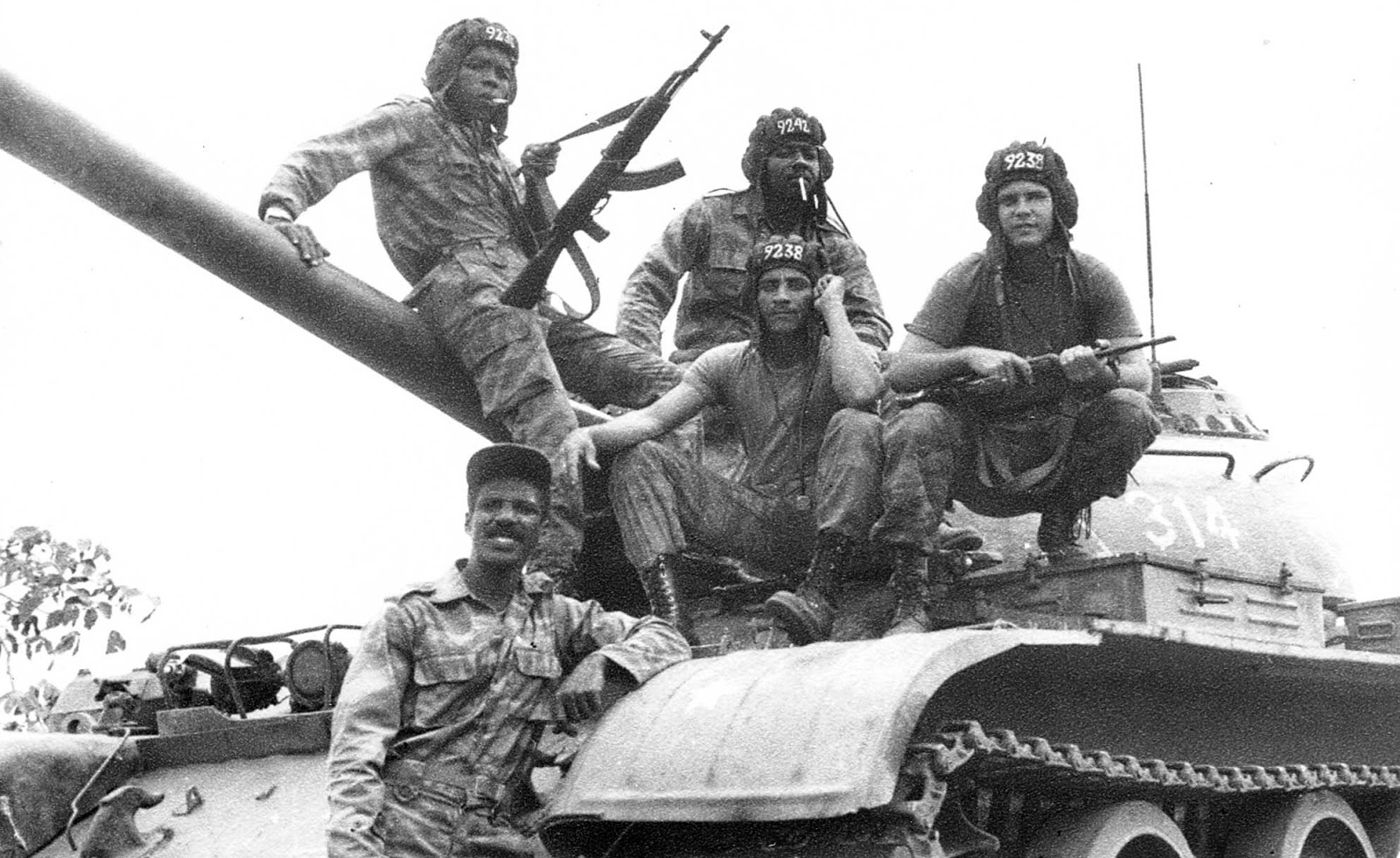
Cuban soldiers in Angola

On the other hand, the government of Raul Castro is facing a difficult choice: “If the military intervention by Cuban troops generates a spiral of such violence that it involves massive deaths among the civilian Venezuelan population and Cubans, the political cost for Raul Castro would be very high within and outside of Cuba. The US government would hold all the cards in its favor to declare it a hemispheric plague. The Latin-American governments would have to take a clear position in the matter or public opinion would hold them to account.” And a possible dialog with the CEE would grind to a halt.

Towards the interior of Cuban, just look at the sad destiny that the African veterans suffer. My interlocutor said: “It is unlikely that a lightning political campaign of Raulism will gain the support of the island’s people for military intervention in Venezuela. At first, he will send elite troops trained in confronting disturbances in urban zones.”

In 1992 Fidel Castro declared that the era of Cuban military missions abroad had ended.  Two decades later, the drums of another fratricidal war may be about to beat on the doors of the Cuban family. The worst scenario possible is not impossible.

Cubanet, February 28, 2014 /

Translated by mlk

Shelves of Misery / Victor Ariel Gonzalez

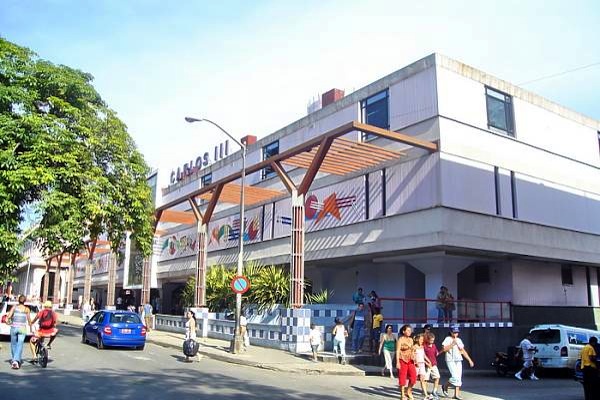
The old Carlos III market was transformed into a “mall.”  At the beginning, Havanans found a wide selection of merchandise (in CUC — hard currency); today the showcases are empty.

The shelves where the most common ingredients should be found often appear empty or offer only one product of its type without options of quality or size.  Those foods that Cubans eat the most are exhausted rapidly, sometimes missing from the shelves for weeks.  On the other hand, the most expensive foods stay for sale for so long that many wind up expiring.

Carlos III market, inaugurated in 1957 as Plaza de Mercado

Not to mention the toiletry section. This week there was only one kind of soap for sale, a small bar for 0.25 CUC.  The counter where there used to appear dozens of offers for varying budgets now presents a desolate emptiness. continue reading

Another features of the supermarket is the disorganization. It is no surprise that at midday the aisles are full of boxes, piled one on top of the other. “Don’t touch” has been scrawled on them by the establishment’s clerks, who also work as stockers and have neither time nor intention for assisting customers. The boxes that have been empty for hours still wait for someone to retrieve them.

That same disorder is expressed in that the supermarket’s departments have been inconveniently separated: on one side, the meat and dairy where the rotten odor is unbearable, and there are only two types of cheese. There a Cuban resident of Spain visiting the Island comments to this reporter that she has brought all her food from abroad for her stay, and that she is in the place just to buy something for a friend. “I don’t like the quality here,” she confesses is the motive. On the other side is the preserves department as in other stores where packets of coffee or cookies can be obtained. The products may repeat from one department to another.

The lack of sanitation is also seen in the dust on the bottles of wine in the liquor section, one of the most Cuban products offered. The main current suppliers for the shelves of Plaza Carlos III are the Spanish brands Gourmet or Spar, food of national production has almost disappeared.

In this atmosphere, when a humble and fortunate customer in the end has found what he needs, he must confront a long line to pay because one of the two cash registers never works. The difficult mission of obtaining food ends when, at the exit, a character sometimes not in uniform and with a very bad look on his face treats the clients like criminals, being able to search bags shamelessly.

This process is not applied to foreigner who visit the store. This is done to remind Cubans that, as miserable as the shelves of the supermarket are, also miserable is the spirit that the regime has developed.

Cubanet, February 25, 2014 / Victor Ariel Gonzalez

Translated by mlk.
Communique from the Venezuelan Resistance / Orlando Luis Pardo Lazo

Sunday, February 23, 2014

OFFICIAL COMMUNIQUE NUMBER 1 FROM THE VENEZUELAN NATIONAL RESISTANCE

Resolution concerning the position of Venezuelan citizens who continue street protests against the Castro-Communist regime that operates illegally in Venezuela.

WHEREAS:

The noble people of Venezuela, sick of the treason by the militaristic cabal and Castro-Communism agents who control power, went out February 2, 2014 in the state of Tachira to protest against insecurity, inflation, scarcity and plundering of Venezuelan resources and were repressed and attacked by the repressive forces of the regime, causing dozens of injuries and several detentions.

WHEREAS:

The national discontent, in the face of the oppressive economic crisis unleashed by the Castro-Communist Agent Nicolas Maduro Moros, after the devaluation of the currency, permitting the monthly plundering of a billion dollars in order to maintain and reconstruct the economy of the island of Cuba, attacking and destroying Venezuelan enterprises, subjecting the people to outrageous shortages that keep them demoralized and frustrated in long lines in order to obtain basic products, caused the rest of the country and some 50 cities to join a national protest today converted into a RESISTANCE. continue reading

WHEREAS:

The military, Diosdado Cabello, which occupies the presidency of the National Assembly and the engineer Rafael Ramirez, in the presidency of the PDVSA, are co-authors of the nation’s economic damage, after being the executive arms of each measure that directly benefits them and their corrupt groups embedded in the exchange control authorities.

WHEREAS

The protests that have had a peaceful character and that have been attacked cruelly by armed groups of mercenaries and assassins in the pay of the regime, gathered in the so-called social collectives, identified as Tupamaros, La Piedrita, Carapaicas, and another 92 groups with an average of 100 to 120 members each, have caused hundreds of injuries, damage to private property and residences throughout the country, student deaths, which demonstrates a Terrorist and Assassin State with the purpose of generating fear and chaos in the civil population that today heroically RESISTS in the streets the crimes against humanity to which they have been subjected.

WHEREAS:

Already ten Venezuelan citizens, students, have been assassinated in the streets of Venezuela in the middle of civil and peaceful protests.  Crimes committed by the regime’s mercenaries, calling themselves “collectives” or the Bolivarian National Guard, bodies that act together and are what sustain the criminal and traitorous cabal clinging to power.

WHEREAS:

There are hundreds of complaints of unlawful arrests, outside the legal order, warrantless searches, torture of detainees, students subjected to reporting regimes, the illegal incarceration of the citizen Leopoldo Lopez, national leader of the Popular Will party, attacks on political parties and persecution.

WHEREAS:

Amid the regime’s desperation it has sought to develop with the political agents of the opposition, gathered in the Board of Democratic Unity, who call for deposing the civil street protests, offering A DIALOGUE as the only exit from the massive social, economic and political crisis that Venezuela is living through and that said political agents have failed in those efforts.

WHEREAS:

The regime has implemented a ferocious censorship and media manipulation in order to prevent Venezuelan citizens from being up to date on the reality of events, subjecting dailies to newsprint shortages, purchasing through intermediaries audio-visual means of communication, radio and written, using Conatel as a censor entity and repressor of radio broadcasts in almost the whole country in order to try to hide from the world the crimes they are committing.

RESOLVED:

FIRST:

We decide to maintain, intensify and redouble the efforts of the protest action, now become NATIONAL RESISTANCE, until the following objectives are reached:

a) We demand that the members of the armed collectives and those loyal to Castro-Communism be disarmed, investigated and incarcerated and that the para-military action of these groups, which has cost lives, be stopped.

b) We demand that citizens Jose Gregoiro Vielma Mora and Francisco Ameliach, both governors from the states of Tachira and Carabobo, respectively, be subject to immediate investigation for being the masterminds and around whom revolve the action orders of the collective mercenaries who kill students in cold blood.

c) The RESISTANCE in the streets will continue in protest, the petition for SURRENDER AND JAIL for the citizens mentioned in point (b) of the First Resolution.

d) We demand at stop to the regime’s attack on all the productive enterprises established in the country, in all areas. The primary sector, manufacturing and commerce, so that the lines of production may be re-established and to avoid the famine that Venezuela has entered.

e) We demand the criminal and independent investigation of citizen Diosdado Cabello who has been at the front of the military operations of the Bolivarian National Guard against the noble people of Venezuela, committing crimes against humanity, registered and documented, carried out by officials of said repressive body.

f) We demand the removal of all the high command of the Bolivarian National Guard, chiefs of the various detachments, to submit them all to investigation as being suspected of committing war crimes against the people of Venezuela.

g) We demand the removal and criminal investigation of citizen Rafael Ramirez, president of PDVSA, primarily responsible for the economic debacle that lives on in the country, who is at the head of the regime’s economic decisions by being the vice-president of the economic area of the PSUV, singled out as promoting and being part of the corruption in Cadivi, the shipment of oil tankers without any record to criminal regimes like that of Syria, producing inflation and poverty in Venezuela.

h) We demand the irrefutable and non-negotiable surrender of citizen Nicolas Maduro Moros from position as president of the Republic, who must submit himself to investigation and first of all demonstrate his authentic Venezuelan nationality, clarifying to the country with reliable proofs all the events related to the physical disappearance of Lt. Col. Hugo Chavez who held the presidency in order to clear the legality of his ascendance to power being Vice President in the administration of the deceased President.  To be investigated in relation to Cuba and the rest of the Latin countries that receive oil perks from Venezuela in order to buy political consciousness and votes in the Organization of American States (OAS). To be investigated for his participation in orders centered on the mercenary collectives to massacre Venezuelan citizens.

i) We demand the FULL LIBERTY of all fellow students and civilians detained in the protests and the investigation of each case of torture, raid or persecution and to establish responsibility and criminal punishments for each soldier implicated.

j) We demand full freedom for all citizens considered political prisoners for years, including the leader of the Popular Will and the end of the persecution of the rest of the leaders of that party.

k) We demand the dismissal of the entire board of directors of Conatel and their prosecution for violating Human Rights in accessing the information of every citizen, after the repressive censorship that it has imposed on the people in the last two weeks.

l) We demand the mass surrender of the High Military Command, generals traitorous to the people of Venezuela, repressors and assassins, suspected of being narco-traffickers, submitted by the foreign military and civil forces of occupation from Cuba.

m) We demand the immediate expulsion from Venezuela of all the Cuban Castro-Communist agents present in the operations against civil, political and economic liberties of Venezuela.

SECOND:

We demand the creation of an Independent National Commission for Criminal Investigation, legally binding, with protection so that it may carry out the investigations that they manage to take before national and international justice according to each case of those responsible for the destruction of Venezuela and the crimes against humanity.

THIRD:

We declare that the Democratic Unity Board (MUD) is not representative of the NATIONAL RESISTANCE, we hold political support in that instance, nevertheless all the protest and resistance operations do not depend on any policy of MUD, by which none is authorized by the demonstrations in the streets to establish dialogues or negotiations with the regime in the name of the RESISTANCE. Any kind of decision that MUD wants to express before the regime must be framed with these points:  a through m of the Number One Resolution of this communique.

FOURTH:

We reaffirm that the RESISTANCE will not cede before any kind of negotiation that involves the traitorous members of the country maintaining their positions in power and establishing negotiating tables to investigate and establish penalties. The people of Venezuela remember that this tactic was applied in the 2002-2003 crisis, manipulated by José Vicente Rangel, when he established the Negotiating Table, not allowing the so-called “truth commission” to investigate the events of April 2002, rather they used it to unjustly imprison scapegoats, political prisoners today.

FIFTH:

We urge all civilians, doctors, teachers, professors, public employees, workers, employees, independent civilian, grassroots residents, middle class and wealthy to  maintain RESISTANCE IN THE STREETS WITH PEACEFUL PROTEST METHODS AND THAT ARE THAT ARE PART OF THE OPERATIONS THAT HAVE BEEN DEVELOPED TO RESIST THE CRIMINAL SCHEME OF THE CASTRO-COMMUNIST REGIME WHOSE FACE IN VENEZUELA IS NICOLAS MADURO MOROS.

In the streets of Venezuela, on the 23rd of February 2014

 Translated by mlk

24 February 2014

Bureaucratic Absurdities / Fernando Damaso

Photo: Rebeca

Government bureaucrats like to complicate things and, in turn, the lives of citizens. From their privileged positions of power, they do and undo at whim.

With the matter of cooperatives, the form of work preferred by the State for the self-employed, they have formed a terrible entanglement: they began with the so-called agricultural cooperatives of different types, and when they decided to leave the rural framework, they found no better name for the new ones than non-agricultural cooperatives.  They even now have their abbreviation: CNoA. Why not call them simply cooperatives?

Another spawn is the first denominated Wholesale Market of Agricultural Supply Products the Wheat Field, located somewhat distant from the center of the city, with the inconveniences that that entails. In reality it is no more than a simple Hub Market since its structure lacks the adequate spatial arrangement for buying and selling, besides which supply and demand do not work there: you pay the same per pound if you buy 20 or if you buy 200.

Before the Chinese merchants sold cheaper than the Spanish and Cuban grocers, because they formed a group and bought in bulk at lower prices, which permitted them to give discounts to their clients. The advantage of a wholesale market is precisely that of offering a variety of products at lower prices than in the retail market, depending on the volume of the purchase.

This is what permits the retail merchants, after deducting their expenses, from not having to raise their prices for the consumer in order to earn profits.  A question: Why not equip the old central Mercado Unico on Cristina Street, today in a state of abandon, as the Wholesale Market?

Another: Why in the state businesses, given beneficially to individuals, is all the attention of the supervisors from the Integral Management Oversight (DIS) centered in each territory? When they were state-run, in spite of their poor functionality, they were never controlled with regards to comfort, the presence of workers, hygiene, quality of services and their offers, as well as other aspects.

Now, like inquisitors, they fall on the individuals, handing out fines right and left, with fees of 1200, 700 and 200 pesos, and, if they think there is a recurrence, withdrawing the license. No one suggests that they not control and ensure compliance with established regulations, although these are exaggerated and sometimes even absurd, but it has to be the same for everyone, both individual as well as state businesses. Or is it that the state businesses enjoy carte blanche?

If you want the updating, although slow and limited, to introduce some small improvement in the difficult lives of the citizens, you have to, at least, eliminate the bureaucratic absurdities.

Translated by mlk.

22 February 2014

Opposition Protests in Venezuela Worry Not A Few Ordinary Cubans / Ivan Garcia

Source: uknews.yahoo.com
Protests in Venezuela.Source: uknews.yahoo.com

One way or another, the street protests taking place recently in Venezuela are being noticed in Cuba.  The most nervous are the olive green autocrats.

According to a low-ranking party official, since the death of Hugo Chavez, the regime has had several contingency plans in its drawer, in case the situation in Venezuela were not favorable to the interests of the Island.

“If Maduro falls there exists a plan B.  In the corridors, at least at the level where I work, it was assumed that Maduro might be a president with a fleeting career. Although the PSUV (United Socialist Party of Venezuela) has controlled a large number of the threads of power, there are divergent opinions among the Chavez followers themselves about the relationship of their country with Cuba.  This kind of socialism, with democratic streaks, is not reliable.  Maduro might lose power either by a recall referendum or within six years.  In meetings of our nucleus it is commented that Maduro’s term in office only serves to buy time,” the official notes.

The earthquake of marches, barricades and opposition protests shocks different regions of Venezuela, but the epicenter shakes the corridors of power in Cuba.

The Castro brothers risk a lot in Caracas.  Just in case, Raul Castro opened a window to Brazil in the new Mariel Port and Special Development Zone with a different jurisdiction.

And he almost begs the United States, his number one enemy, to sit down and negotiate.  Meanwhile, the Castro diplomacy travels Florida, trying to seduce the wealthiest businessmen of Cuban origin.  Although sensible businessmen would keep thinking.  When they look at the recent past, they only see shady dealings and a cryptic partner who at the first exchange transforms the rules of the game. Therefore, the Caribbean autocracy is going to have to fight dog-faced and with gritted teeth its strategic position in Venezuela.

The key, you know, is oil.  100 thousand barrels daily acquired at a bargain price so that Cubans do not suffer outages 12 hours a day.  When the paratrooper of Barinas (Hugo Chavez) arrived at Miraflores in 1998, Fidel Castro understood that after nine years of crossing through the desert, with finances in the red and exotic illnesses devastating the country, the hour of his resurrection had arrived.

Cuba entered the light phase of the Special Period.  After the fall of the Berlin Wall, the country continued in a fixed economic crisis, but the loyal Bolivarian shared his strongbox.  And it was an important piece of the anti-imperialist project that so excited the commander.

The death of Chavez was the beginning of the end of the honeymoon.  Maduro is loyal and is allowed to drive.  But he does not have charisma.  And after 14 years of foolish economics in pursuit of gaining followers among the most disadvantaged, the debts, violence and inflation have exploded in the face of the PSUV.

Maduro, stubborn and awkward, instead of releasing the uncomfortable and parasitic ballast of Cuba, to govern for all and look more to Lula and Dilma than to the Castros, moved his pieces incorrectly.

He tried to continue the Joropo and the booze party of comrade Chavez.  He designed a simple strategy: he shouldered his comrade’s coffin and tries to govern in his name.

And it is failing. In Cuba, because of selfishness or a short term mentality, the ordinary people, tired from 55 years of disasters, cross their fingers and hope that the Venezuelan crisis does not close the oil spigot opened by PDVSA (Venezuela’s state-owned oil and gas company).

In a park in the Havana neighborhood of Vibora, several retired people opine about the situation in Venezuela.  “If that is screwed, what happens to us is going to be huge.  The blackouts will return, industry will be paralyzed again and we will return to a phase the same as or worse than the beginning of the Special Period in 1990,” says a man of about 70 years of age.

Others are less pessimistic. “It’s true, it will be hard. Since the revolution triuimphed we have been accustomed to living at the expense of foreign sweat. Before it was the USSR, now Venezuela.  If the worst happens there, here reforms will accelerate.  Although this is already capitalism, but with low salaries,” points out a woman who identifies herself as a housewife.

A university student adds to the conversation. “Seeing the marches or strikes on television is something that I envy. That freedom of protesting in front of the governmental institutions, as in Ukraine or Venezuela, we need it in Cuba.” And he adds that “in the meetings of the FEU (Federated University Students), the situation in Venezuela is a top priority topic, but I have heard rumors that in some Party cores the alarm is greater.”

In this warm February, in spite of the news that arrives from Caracas, the ordinary people continue on their own. Standing in long lines to buy potatoes that have disappeared. Going to farmer’s markets in search of other tubers, vegetables and fruits. Or sitting down at the neighborhood corner to talk about movies, fashion, soccer or baseball.

And so it is that for many on the Island, Venezuela is not on their agenda.

Diario de Cuba, 23 February 2014, Ivan Garcia, Havana

Translated by mlk.
The Self-Employed: Unemployed or Illegal / Odelin Alfonso Torna

HAVANA, Cuba — January offers to close its curtains with 100 empty stands in the country’s markets, self-employed who hope for job relocation, government fines  shielded in absurd justifications and the promise of a wholesale market that does not arrive.

While the print and television press emphasize new regulations for the private sector in 2014, the so-called “small businessmen” line up in municipal offices of the Tax Administration (ONAT) in order to turn in their licenses.

Rosa Maria, resident of Washington Street and Bejucal in the Havana township of Arroyo Naranjo, is one of those who delivered her license recently.  As a seller of ice cream and slushes, Rosa received innumerable visits from inspectors:

“The last fines were 50 and 500 pesos (2 and 20 dollars at current exchange), both from Public Health.  The 50 was because of my long nails and the 500 because there was dust on the counter of the cafeteria; now I’m tired!” she exclaimed.

La Cuevita Market before its closure

According to the Ministry of Work and Social Security, at the close of February 2013, 450,000 individuals worked for themselves.  An official economist, Ariel Terrero Font, said on television that judging by growth in the first months, it would not be possible to reach “half a million self-employed workers” by the close of that same year.

Nevertheless, after the prohibition on the sale of imported clothes and hardware items bought on the retail market, the body of licenses awarded by the ONAT for private work, say food vendors, cabbies (we call them “boatmen”), clothing and hardware sellers, decreased sharply.

The tsunami that passed through Havana

Hundreds of tarps lie empty in the capital’s markets.  It is said unofficially that at a national level, a mid-range of 62,000 individuals have frozen or turned in their licenses.

In the Electrico neighborhood market, located at Camilo Cienfuegos and Calzada de Managua, Arroyo Naranjo township, 17 stands have closed since the beginning of January and only two operate with the sale of pirated CDs and handicrafts.  The market located on Porvenir Avenue, between San Gregorio and Georgia, in the same township, closed totally: more than 70 stands offered clothes and imported shoes, including four cafeterias that used to serve the self-employed.

Self-employed market after closure by authorities

In one of the best attended markets of Arroyo Naranjo, sandwiched between Atlanta and Diez de Octubre, 43 stands have remained empty since January 6. The occupied stands, a total of 32, offer tailored clothes, handmade shoes, and costume jewelry.  In Central Havana, another of the leading markets in supply and demand, located at Angeles and Reina, barely keeps 3 or 4 stands active out of approximately 60 mini-kiosks.

Nevertheless, while in the main the extermination of taxpayers is visible, others give the impression of recovery. That is the case at the Virgen del Camino Market, situated on San Miguel and B Street, San Miguel del Padron township. This market, which reopened at the beginning of January, has 55 abandoned sales stands and 63 in service, above all with the sale of shoes and leather items.  This township is characterized for being the greatest producer of handmade shoes.

For Natividad Jimenez, a specialist in physical planning for the National Tax Administration Office (ONAT) in the capital township of Arroyo Naranjo, the taxpayers who used to sell imported clothes were never unemployed because some have accepted relocation and others have not.

“No place has been closed. They (the sellers) were alerted since last year, nothing has been done outside of the law. Many of the sellers from La Cuevita (Havana’s most prolific market) were illegal, that’s why they haven’t done anything, they haven’t complained and they have remained quiet,” Natividad pointed out.

Unemployment:  A secret tax?

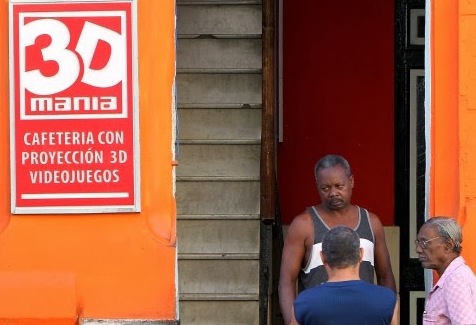
Three-D theaters were the first required to close

At the close of 2011, the Office of National Statistics (ONE) published its last report about the numbers of taxpayers enrolled at the ONAT, a total of 391 thousand self-employed workers.  Nevertheless, statistics published in the official press reflect, until that date, a mid-range of 444,109 individuals registered with the ONAT.

Given the growing number of taxpayers cancelled in the ONAT, the municipal and provincial offices close ranks when it comes time to offer information.

The black market as a solution

Maybe the ONAT, charged with receiving the liquidation of taxes for private workers who seek cancellation, does not register in its data base the number of licenses turned in?

Judging by the official statistics, since December 2011 to date, only 54,000 Cubans have sought a license in the offices of ONAT. This tells us that the private sector remains at the bottom of the sewer, in spite of the grandiloquent displays of “transparency and timely information.”

Cubanet, January 30, 2014, 

Translated by mlk.

Raul Castro in Search of Money or of Moneyed Men / Juan Juan Almeida

It was only some years ago, when the visible financial crisis infected sectors of the national economy, and Cuban industry verged on the almost invisible boundary that marks the action and the omission that hastens the death of a hopeless patient; General Raul Castro, with that impressive way of showing his pathetic talent, sold us the fraudulent idea that the Armed Forces had been converted into an example for “The Change.”

In papers, because delving into the demonstrated earnings, the island’s military enterprise system worked much more than the lawyer of singer Justin Bieber works these days; of course, being propelled by slave labor (to be more exact, recruits), there was no way of measuring the calculable cost of a product or its labor efficiency.

Absurd, yes, but through repetition, it managed to attract the attention of those who move opinion, and many began to believe in that rigged sequence of decisions that today make up what appears the destiny of Cuba and what some still call “Raul’s reforms.”

That group of measures, or non-structural opinions, which pay no attention to productivity or change the nature of the system at all and are basically aimed at legalizing or facilitating what until yesterday was tolerated, prohibited or complicated; and bring symptoms of anemia to the practically defunct capacity of monetary investments of that labor force that biting a biased and naive scheme, believed the story of “we are all an enterprising population,” and jumped from the state sector to the private, and today, earning more, counts on less.

Evidently, not all state workers took the streets convinced and believing in Tía Tata*; but at this point in the story, “modernizing the economic model” is simply a gross verbal diarrhea that served to disguise a perpetrated crime that should be judged, obviously respecting the due process that every accused must have, because only a defrauded person can be induced to believe that after 20 years working in an office, a person, by magic, without supporting aptitudes, will be transformed into a shoemaker, locksmith, farmer, barber, drummer, trash man or watch maker.

The strategy of General Raul Castro and his penitent entourage has only served to simulate changes and forge flexibility; to increase poverty; to abandon the retired people in an aging population; to invest less state money in services like health and education and above all to try to play down the stay in power of a single and inefficient governing pack of hounds.

It is not accidental, it is all well planned and coldly calculated.  It was at the end of the ’90’s when Raul, after his recurrent hormonal disorder, made fashionable the sentence, “Let’s exchange cannons for beans.”  By then, few could understand that he was not referring to the food, but to the need of, without renouncing the least power, his new strategy consisted of going in search of money or men with money who with their presence in Havana would help demonstrate that security that only solvency offers, or to count on solvent friends.

*Translator’s note: Tía Tata’s Stories was a radio program and later a TV program with puppets.

Translated by mlk.

13 February 2014

CELAC Summit Passed Like a Storm / Martha Beatriz Roque Cabello

Informers on guard at the corner of my home — Martha Beatriz Roque

HAVANA, Cuba — There is not a single time that the phone rings for good news; these days every conversation is based on arrests, beatings and demonstrations, an eloquent way to carry out the Summit of CELAC (Community of Latin-American and Caribbean States) which turned into a parody of the famous novel “Wuthering Heights” by Englishwoman Emily Bronte.

But although the meeting was held in Havana, the capital was not the only place where these situations were produced.  In other sites as distant as the eastern provinces also there were moments of tension because of the repressive work of the political police.

In Manzanillo, Granma province, on January 28, some members of the Cuban Community Communicators Network could not leave their homes, as, for example, Xiomara Moncada Almaguer who wanted to visit her ill six-year old grandson; when she came out of her house, six women armed with parasols attacked her in front of State Security officer Camilo Mandiel (alias The Joker), who permitted them to hit the peaceful woman.

Leonardo Cancio Santana Ponce tried to leave his house — on the same day — on bicycle and was impeded by Captain Napoles, Sector Chief, whom he found in the company of four State Security officers, among them Alexis Guerra and the older Able Guevara. Cancio explained that they lifted him and threw him inside his house, together with the bicycle. A drunk neighbor, by the name of Pedro, defended him, yelling “abusers,” and they arrested him.

Also, the house of Tania de la Torre Montesinos, in Manzanillo, was under surveillance by political police, and they did not allow her daughter Ariuska Marquez to go out to the street, in spite of the fact that she is not a dissident activist.

In Holguin province, at two in the afternoon, a demonstration against Doctor Ramon Zamora Rodriguez began at his house on Avenue of the Americas 66 between Comandante Fajardo and Playa Giron in the Ramon Quintana Division; it lasted until 9 at night.  The cheerleaders broke the fence of the house, the windows and the door by stoning and body slams; but what is most regretful is that they hit his 13-year-old son. When they withdrew, those in the dwelling tried to fix some of the damage, but they had to put furniture behind the door in order to be able to sleep with some security.  The next day, several dissidents went to try to repair all the breakage done by the mob.

In the basement of my home

On the 29th — like one more Wednesday — no one was permitted to enter my home, and I was under house arrest. A mob of some 10 or 12 people on the stairs, some of them neighbors who were paid in the morning to dedicate themselves to those functions, did not let anyone up. Our collaborator Arnaldo Ramos Lauzurique asked them to identify themselves in order to learn with what authority they were doing this, and one of the repressors, by the name of Juan Carlos, (a well-built man of about 35 years of age), who in April 2013 beat me inside my house, went up to Arnoldo, and the State Security officer there had to intervene so that he would not hit him, because he surely had orders to do so if something occurred. You have to remember that Arnoldo is a man of 73 years of age who suffered 8 years in prison.

From this unclean practice the following community communicators were arrested: Evelyn Pineda Concepción, Laudelina Alcalde, Maritza Concepción Sarmientos, Blanca Hernández Moya, Arnaldo Ramos Lauzurique, José Antonio Sieres Ramallo, Juliet Michelena Díaz, Billy Joe Landa Linares, Julia Estrella Aramburu Taboas (seized two times because they jumped on her when she returned), Juan Carlos Díaz Fonseca and Judit Muñiz Peraza.

The first three women in this regard were transferred in a patrol car — the same as everyone — but with the special feature that they left them in the township Melena del Sur in the Mayabeque Province. When they arrived at that place, a clearing, they told the police that they were not going to get out there, and they said they were complying with orders, that if they did not get out of the car, they would get them out by force.*

Also, Julia Estrella Aramburo Taboas, in her second effort to enter her home, was arrested and taken by patrol car past the town of Santiago de las Vegas.  She resides in Central Havana township and found herself alone.

If the protagonist of Wuthering Heights saw the specter of a woman, in the Cuban parody we are in front of a ghost that has turned into a nightmare for the opposition, but unfortunately no president of the democratic countries of Latin America, who have just visited Havana, have seen it.

*Translator’s note: A popular tactic now is for State Security or the police to simply pick up dissidents and drive them to ’the middle of nowhere’ and abandon them, never recording any arrest or detention.

Cubanet, January 30, 2014, Martha Beatriz Roque Cabello

Translated by mlk.

31 January 2014