The first Cuban doctors, of the 1,000 requested by the government of Rafael Correa, will arrive in Ecuado in December, according to a report from Cuba’s Foreign Ministry, reported by AFP.
The decision is supported in a series of agreements signed in Quito during a recent visit by the Cuban Health Minister, Roberto Morales, according to a brief statement published on the official site cubaminrex.cu.
“The new agreements cover the level of primary, epidemiological and physical medicine anticipated, starting this coming December, when the Cuban specialists who will start to arrive in the country will contribute to strengthening the capacity of Ecuador’s Ministry of Health in this area,” said the Foreign Minister.
The request for the doctors was made to Raul Castro by Correa during his visit to Havana on September 21.
The announcement raised concerns in the Ecuadorian medical associations, which was expressed publicly.
“The Cubans coming will cost 30 million dollars, when, for this price, we could hire Ecuadorian doctors and train them in comprehensive care and family medicine,” Alberto Navraez, president of the Ecuador Medical Federation told the local paper Expreso, in September.
In addition to the tens of thousands of doctors and health personnel that Havana maintains in Venezuela, this year 4,000 doctors will be sent to Brazil for the first time.
Although it continues to maintain free medical collaborations with some of the poor countries like Haiti, Raul Castro’s government has medical services in some 60 countries as one of his main sources of hard currency.
The professionals sent to serve the “missions,” receive a fraction of the money charged by Havana.
The export of services, mainly doctors, is the principal activity of the Cuban economy, with some 8 billion dollars annually, second to tourism, with 2.5 billion.
HAVANA, Cuba, November 18, 2013, Augusto César San Martín Albistur / www.cubanet.org.- Ramon Alejandro Muñoz González, husband of Sonia Garro remained without food for three days in the punishment cell of the Combinado del Este prison.
On the telephone call this morning, from prison, Ramon explained that he was confined to the punishment cell for 10 days.
“They took away the food… Forced me not to eat… The guards told me they had to wait for orders from above to give me food,” the political prisoner said.
According to him, he doesn’t accept the prison food. For three days he was deprived of the food his family brings: biscuits and powdered drinks.
Ramón Alejandro explained that when he was incommunicado in the punishment cell he was ill.
“I had a bad flu with a fever over 102. My blood pressure was 180/100 and I had a kidney infection. These papers (medical certificates) I have because, being in the cell, they had to take me to the hospital emergency room,” he said.
The husband of Sonia Garro, also a political prisoner, blames the political prisoner and the prison authorities for the deterioration of his health and the future consequences.
“I am mainly accusing the political police, and the Combinado del Este Prison authorities, led by Rogelio Osorio, Major Miguel, chief of building number 3, captain Emilio, deputy chief of the unit, and René, chief of re-education, and the chief of Internal Order, known as ’Captain Boxing’.”
Ramón Alejandro announced that he intends to send letters of complaint to the United Nations, the vice president of the U.S., the European Union embassies in Havana, so that they will know the risks run by the political prisoners run.
The measurement of confinement in the punishment cell was taken after he read, in the visiting area, in front of other prisoners, an anti-government communication.
Ramon Alejandro Muñoz González was arrested along with his wife the, Lady in White Sonia Garro. Both have been awaiting trial for a year and 8 months, accused, among other crimes, of public disorder and attempted murder.
Ramón Alejandro was demonstrating, from the roof of his house, with proclamations addressed to the government. An assault brigade violently carried out the capture of both. Sonia Garro was hit by rubber bullets and still suffers the effects in prison.
A few days ago, it was announced that there would be a trail, but then suddenly it was cancelled.
Beginning improvements in the Ministry of Foreign Affairs: The approved proposals were aimed at shaping a modern revolutionary Foreign Ministry to ensure more efficient performance of the organization and the concentration of the resources and efforts in the priorities of Cuban foreign policy.”
Commentary:
Under the slogan of “Combating the blockade as our principal mission” in the diplomatic sphere, lies perhaps in the modification of the existing legal mechanisms, which allow Cubans (especially the most powerful Cubans, who are those of the Government of Havana) to interact with foreigners (governments or companies) interested in the new direction that Cuban political economy seems to be taking.
Should this be the case, then the Ministry of Foreign Affairs (MINREX) would be undergoing a transformation similar to that of other State agencies and entities: to accommodate the game at the convenience of the ruling class, who want to economically restructure the country while still having absolute power over it.
All this can also be related to the winks that come from the leadership of the country to the prosperous Cuban community in the US. They have made declarations (onthe part of Antonio Castro, son of Fidel Castro and the true “owner” of the Cuban baseball team) that it would be good if the Cuban ballplayers in the U.S. major leagues returned to play under their flag: which was denied to them the day they “deserted” and were called “traitors.”
Certainly, with the changes within the country there will also come changes toward the exterior. MINREX will not be the exception.
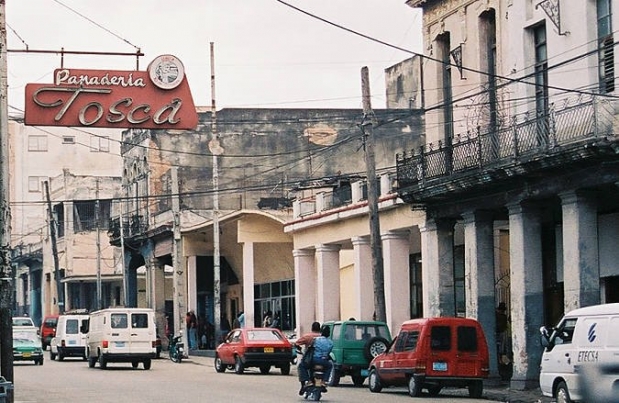
The Calzada de Jesús del Monte (Jesus of the Mountain Roadway), now known as the Calzada de Diez de Octubre (Tenth of October Roadway), begins at Esquina de Tejas (Texas Corner) as an extension of Calzada de Infanta (Princess Roadway). It extends to Entroque de La Palma (La Palma Link), where it splits into Calzada de Managua and Calzada de Bejucal, crossing, connecting or bordering in its path the neighborhoods or districts of Cerro, Santos Suárez, La Víbora, Luyanó, Lawton, Sevillano, Santa Amalia, Apolo, Víbora Park and Barrio Azul.
Immortalized by the poet Eliseo Diego, it is still one of the most extensive roadways in the city. In the 1950s numerous bus routes ran along it and it saw a great deal of vehicular traffic, though by then the streetcars were already gone as were their tracks and overhead electrical lines.
It was adorned with movie theaters, stores of all kind, bakeries, pastry shops, bookstores, pubs, restaurants, coffee houses, pharmacies, jewelry stores, a major hospital (Purísima Concepción, more commonly known as Quinta de Dependientes), police stations and the constant hustle and bustle through its doorways and over its sidewalks of students from numerous schools located nearby, who visited its bookstores in search of school supplies and classical textbooks published by Editorial Thor, which were offered for sale at low prices.
The cinemas Florida, Moderno (side-by-side with Police Station no. 11), Apolo, Tosca, Gran Cinema and Marta (which faced Station no. 14) satisfied the needs of several generations of movie-goers.
The Toyo bakery and pastry shop, as well as a pub with the same name — located on the lower floors of the Civil Registry building — became synonymous with one of the busiest and noisiest street corners in Havana. It served as the crossroad for those buses that changed course, heading in the direction of Calzada de Luyanó, and those that continued, one way or another, along Calzada de Jesús del Monte.
The ever-present aroma of freshly baked bread left its distinctive imprint on the site, as did the desserts and pastries from from shop next door and the magnificent sandwiches from the pub. At the entryway there was a newsstand. Hidden behind the authorized newspapers and magazines, as though they were winking, one could see portions of the covers of small notebooks and erotic or pornographic photos, which were printed on low-quality paper by unidentified publishers. This is also where the shoeshine stand was located.
Several blocks away, near calle Tamarindo (Tamarind Street), the characteristic aroma from the coffee roaster permeated the surrounding area, reaching as far away as the pharmacy, as well as the small shoe store and its workshop across the street, beyond calle Municipal (Municipal Street).
Further along, from left to right, there was a series of stores until you got to Loma de la Luz, which everyone associated with the roadway of the same name. After that there was the parish church Jesús del Monte (Jesus of the Mountain) and the high, thick wall that still obscures it, leading to the multiple commerce established in the space between the Loma de Chaple (Hillock of Chaple), at the end of the Lacret Street and beginning of the Avenida de Dolores (Avenue of Pains). Hundreds of meters away, the Avenue de Santa Catalian has taverns, coffee shops and a bakery. In between other types of bread served at the bakery, they offer a Galician bread known as “bonete”, as well as cookies, breadsticks, pork crackling and pastries of cheese, ham, or meat.
On the opposite side of the street was the Tosca movie theater, where we children over twelve years old would go, motivated by the French and Italian movies, which showed light nudity, something unusual in the United States at the time.
Then appeared the residences of the middle-class, more rich and progressive, that had large portals with columns and were always uphill. The “Paradero de La Vibora”was where the tramcars ended their travels and entered the maintenance area in order to start their routes again.
Then, with the disappearance of tramcars,the maintenance area became the modern bus stop, which were called “nurses” due to their white and blue color. This place was suitable for trade since it was the beginning of Route 38 that led to Batabano. Batabano and had a conglomerate of restaurants, inns, cafes, french fry stands and shops. It also had a beautiful house with the figure of a “black boy with the lantern”, dressed with blue pants and a red shirt, in the large front garden. Opposite the house was the Tropicream, the house of one of the first settlers in the city, and the square of the Church of the Passionists.
Next to this this was the street that led to the Institutes of the La Vibora and Edison.
Beyond this there was a train station, which was home to the legendary Cafe Colon and across the street was the Cheesemonger Santa Beatriz, a modern milk pasteurization plant. Then there were scattered homes, some with patios, fruit trees and gardens, which marked the end of the cramped city with the houses up against each other and the beginning of the country environment, which extended to the “La Palma” Crossroads, which had a famous ice factory, and continued to Bejucal and Managua Roadways. At that time, after the Avenida de Acosta, the paved road was narrow with large flowerbeds and trees on both sides.
Today, unfortunately, all the cinemas have disappeared with the exception of the “Marta”, renamed Joy and turned into a party room, as have the bread shops, bakeries, restaurants, taverns, inns, bookstores, shops, stands, shoeshine chairs, and many other shops. They converted these premises into housing, with horrendous architectural adaptations or low cost. They also transformed the former “Calzada de Jesus del Monte” into a sad Museum of buildings in decline, totally damaged or collapsed by cave-ins.
One could offer many reasons to try to explain the inexplicable, even dip into the broken argument of the U.S. “blockade” or embargo, but the only real cause of what happened is the incompetence of the authorities and the tax system, both with regards to protecting what was created by previous generations of Cubans, and creating something new and valuable.
The street “Calzada de Jesus del Monte” or “Tenth of October”, as it is called, has had the same terrible fate of other roads, avenues, and streets of the city of Havana.
But in recent months, with the increase in self-employment, some of its sections are home to small private businesses. They even used local buildings, which were previously establishments that became precarious dwellings. Even still, the vast majority of major facilities are in the hands of the unproductive State-owned enterprises, with demonstrated inability to offer quality services to the citizens.
Perhaps these facilities, if they are privately rented or sold, will serve as a real spur for the rapid revival of the once important road, which will never be achieved with the stunted measures adopted so far. For instance, the government only authorised to revive these facilities with a few services where there are fewer than five employees. This means, ultimately, they continue betting on the “bonsai” or “pinching” commercial activity, which actually solves very little.
Anyway, the “Calzada de Jesus del Monte”, due to its importance as a means of communication towards the southeast of the city, should truly liberate the productive forces and the Cuban people can develop their initiative, returning to be what it was was, and then become modernized and in keeping with the time.
“Cuba is not the place of origin, transit or destination of human trafficking”. This was declared by Isabel Moya Richard, the director of ’Editorial de la Mujer’ (A Cuban Women’s Federation publisher) on November 1. However, later in the article it is stated that in 2012 fourteen people were convicted of trafficking. So, the phenomenon does exist.
The aforementioned director recognises that it is important to prevent these practices through an orientation towards healthy sexuality, implementing “sexual education in all levels of education”.
She adds that “another key matter is the work of the Ministry of Tourism to avoid campaigns that could associate Cuba with ’sexual tourism’”. The matter “is not easy” given the advertising image of a paradisaical beach (main natural resource for Cuban tourism) upon which usually walks a woman whose figure indirectly offers to the visitor the possibility of finding sexual pleasure. This aesthetic concept implies a distortion of the female image and its association with a product that sells. Paradoxically, this phenomenon, equally common in western market economies, has been criticised by the Cuban government, that for reasons of “avoiding turning women into merchandise” has gone so far as to prohibit the possession of pornography.
In various civil independent society publications, foreign as well as Cuban, accounts appear that bear witness to the sexual exploitation of Cuban adolescent victims. They speak of families that agree to “offer” their daughters to a foreigner who promises to take them with him to give them a better life and in this way the girl is able to help those who she leaves behind.
Prostitution is a hidden subject in Cuba. The critical economic situation has contributed to the growth of this phenomenon in recent years to never before seen levels.
In respect to human trafficking we can also include those who are victims of irregular migratory trafficking. Although it is not necessarily related to prostitution, conditions in Cuba also give rise to a high number of illegal immigrants, those who pay exorbitant prices to arrive to the U.S.A. by sea or via third countries such as Mexico. The price of a “ticket” is above 8,000 CUC.
Santa Clara, Cuba November 13, 2013. Officers of the Ministry of Education (MINED), Central Region, at a government meeting on Monday the 11th, suspended the Schools in the Countryside program for November and December, because of the complicated epidemiological situation in the province.
Guilfredo Martin Betancourt, a MINED official, said the province is experiencing cases of cholera and dengue fever, without giving specifics with regards to numbers, given the environmental and social indiscipline problems.
Captain Robert Rodriguez said, during a meeting with families of the students at the school, that since the beginning of the summer rains and despite the efforts of workers in the provincial health system, foci of the vector (mosquitoes) have accumulated in the capital city and other municipalities.
Yudmila de la Caridad Vázquez, a teacher of the institution, told this publication that the curriculum of the Cuban school is planned such that students from eighth grade upward, spend 30 days of work in the fields, thereby strengthening the Marti principle of Work Study, but that this time the suspension is the right thing to do, because they can not endanger the health of students.
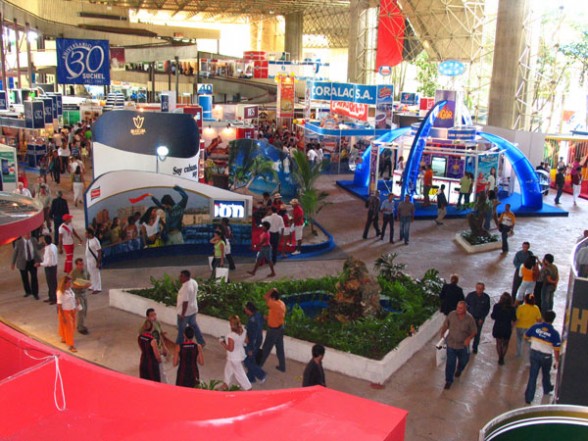
Havana, Cuba, November 2013 – www.cubanet.org.- Mr Rodrigo Malmierca, minister for external trade and foreign investment, said that in the 31st Havana International Fair (HIF), held from November 3 to 9, the participation of various foreign delegations shows that “our country is not alone and there is no economic blockade of worldwide power that is capable of changing our course”.
Does this mean that the Castro regime will stop requesting the end to the blockade or commercial, economic and financial embargo imposed on Cuba by the United States?
The embargo was imposed in October 1960 when Fidel Castro illegally occupied properties owned by North American citizens and companies. In 1992 the embargo became law when Castro refused to take steps towards democratization or to show respect to the Universal Charter of Human Rights.
More than twenty years later, the Cuban military dictatorship continues to violate the world’s most respected citizen rights and further impoverishes the country.
On the streets many ask what purpose 31 fairs that look for countries to trade with Cuba have served if Cubans continue to live in poverty, subsisting on incomes much less than a dollar a day, the same as those who live in sub-Saharan Africa.
it isn’t understood why numerous Cuban companies received prizes and mentions for many of their products exhibited at the 2013 HIF while in Granma, the official newspaper of the Central Committee of the Cuban Communist Party, the poor quality of the country’s products and services are criticised almost daily.
If the 2013 HIF welcomed Russian millionaire businessman — there are more than 20 in the country including one woman, Mrs Yelena Baturina, wife of the mayor of Moscow — why isn’t anything known of the commercial agreements that were reached with them?
How can we forget February 22 of this year when Russian president Dimitri A. Medvedev, visiting the island, signed an agreement about the “adjustment of Cuban debt to the Russian Federation, for credit granted during the period of the defunct USSR?
How can we forget that days afterward on May 22, the president of the Russian Federation Council, Ms Valentina Matvienko, expressed to Granma “We are pleased to have found a solution for the readjustment of debt”.
It is said that it refers to thirty billion dollars, an impressive figure.
How then will the insolvent and inefficient Cuban dictatorship be able to pay? Why haven’t the technical aspects of the signed agreement signed by Ms Matvienko and the Cuban National Assembly “for a prompt ratification of debt and approval in the Russian parliament” been explained to the people?
Nothing is known. Only that the Russian business advisor in Cuba, Vadim Tiemnikov, visibly moved on television, thanked the Cuban authorities celebrating the 96th anniversary of the Great October Socialist Revolution, despite having dismantled socialism some twenty two years ago.
Despite the Havana International Fair of 2013, Cuba will continue to be a country weighed downed by marginalization, by the shortage of basic food products, with miserable salaries and fields infested with the invasive marabou weed, without a fishing industry or merchant navy, the livestock industry on its knees, the sugar industry in its worst state in history, an obsolete ration book system (Lenin’s idea) and a military dictatorship that asks the people to change their mentality although the people still doesn’t know how the hell they should change their mind.
HAVANA, Cuba, November-www.cubanet.org — “La Libertad Extrapenal” — similar to parole — is a punitive category in which the offender does not live in prison, but has their civil rights suspended, and may even go back to prison if the authorities so decide. Jorge Olivera Castillo finds himself in this condition, along with another 13 or 14 other victims of the diabolical 2003 crackdown known as the Black Spring, who decided to stay in Cuba. To them, the government will not let them go overseas on a visit.
Recently, I asked Olivera (presiding over the Cuban Writers Club) why they haven’t coordinated jointly a legal challenge to get rid of this vexatious status. His answer was:
“Many friends have encouraged me to hire a lawyer and file a complaint in court, claiming our arguments, because it is a paradox that other human rights activists, independent journalists and bloggers who have done the same things we did and for which we were sentenced, are allowed to travel.” Maybe next year action will be taken against this anachronistic remnant of Fidel Castro.”
Technically, Olivera’s penalty is set to expire in 2021, and so he remains in the list of political prisoners. When asked if all those compatriots who are under the same injunction receive the same restrictive treatment, he told me, “At least everyone who has gone to inquire at the immigration offices has been told that for the moment we do not have permission to leave the country, that is, we are in the same black list,” and he points out, “If instead of asking for permission for we asked for it for final departure I believe they would give us authorization.”
The government certainly will justify that every ex-convict has legitimately invalidated his naturalrights; however, in this case it is poisonous to dismiss these 13 or 14 Cubans who were sent to prison for defending something intrinsic in every civilized society: the defense of human rights. Specifically, they apprehended him when he was the director of Havana Press, a pioneering Press Agency of independent journalism.
The 75 prisoners of the repressive wave would be released for real or supposed health reasons, and also because of the huge pressure from the international community. And in your case (I inquired), in addition to these two reasons, don’t you think the was the added “blessed” concern that the inmates with whom you coexisted, and your guards, could only be wondering who the fuck gave the order to imprison such a noble and decent man?
“Well,” said Olivera, smiling, “the prisoners there didn’t believe that I got 18 years just for writing, that my crime had to be something big. The truth is they gave us parole because of a confluence of political factors, and because of arrogance (of the Castro brothers) not to give an inch before the whole world, and to grant us a pardon or an amnesty. Also, the severity with which they treated us accelerated the process of declining health in most of our cases.”
So, our conversation turned to the Cuban Writers Club, a new project funded in 2007. Today there are around 40 members: novelists, short story writers, poets, from almost all the provinces. They have plans to create a contest that includes all genres.
Oliver is a full member of the Pen Club of Cuba in the exile, and has received a fellowship from Harvard, as a writers, thanks to a proposal from the Pen Club of England.
Finally, I ask him for an opinion: Those of us here who oppose the regime, and we know our authorities well and the laws they hide behind, could we claim that we all live on parole?
And smiling, he confessed, “To a certain extent, yes.”
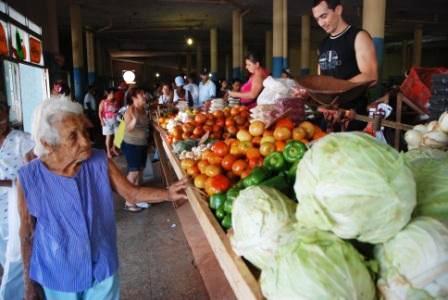
HAVANA, Cuba, November 2013, www.cubanet.org – The ban was issued by the Director of Farmers Markets just a month ago, because the vendors were making excessive use of chemicals (fordimed and carbide) to advance the ripening process in fruits, which in turn brought several complaints by customers who claimed that the uncontrolled use of these chemical altered the taste and texture of the fruits and was bad for one’s health.
Although the intention is to “protect the population,” it’s contradictory that this measure has only been applied to farmers markets, when the practice is a common one among most vendors operating in almost all points of sale, whether its one belonging to the Ministry of Agriculture, or a roving vendor.
The prohibition on the sale of bananas and papayas in the farmers markets in the capital, has only been strictly maintained in the market at 160th and 51st in La Lisa.
Julio Castillo Martínez, a vendor at one of the stands at the La Lisa market, and the source of this information, offered ripe bananas and papaya there, and said, “I was selling around 2,200 pounds of papaya a week and the same amount of bananas, and never had any customer complaints,” and he added, “the use of flordimed in small quantities diluted in water has been used for years by all the papaya producers at the time the fruit is picked and sold. In the case of bananas, I don’t use the chemical because they ripen quickly. This ban has affected my income.”
A truck driver who refused to identify himself, transports these fruits from the rural village of San Antonio in Mayabeque Province, to 114th Street in Marianao, where almost all the vendors of agricultural products get their supplies, said, “The fruits can’t be transported ripe because they get crushed and the measured or exact use of flordimed is not harmful, it facilitates the sale and has always been used.”
At the markets at 19th and B in Vedado and at Elgido in Old Havana, they’ve stopped selling papayas and bananas for more than 15 days, but they’ve started to offer them again in the last few days. One of the vendors at the market at 19th and D said, “Now we have to have papers that support the phytosanitary control of bananas and papayas in order to have them at our stands, although my products have always been high quality and no one has ever complained.”
The truth is that the absence of these products in the markets can’t be justified by the inefficiency of phytosanitary controls which the State itself should guarantee, or at least create conditions for others to guarantee it. And that must necessarily start from the same field the fruits come from.
Beyond this, the problem lies in the lack of reviews of some irresponsible sellers who, eager to sell, sprayed the precious products with chemicals. This nebulous situation is annoying both the serious sellers, as is the case of Castillo, who have nothing to do with this, and who are now unable to sell their most popular products — papayas and bananas — as well as consumers who like these precious fruits and have to look for them in far off places.
For some, the measure taken by the director of the farmers markets, and so far maintained at the establishment at 160th and 51stin La Lisa, is not appropriate. A solution other than prohibition — so abundant on the island — should be demanded. Especially when we know that papayas and bananas are the only fruits Cubans can count on year-round. Don’t even talk about canistel, cherimoya, soursop, cashews, mandarins, star apples, and much less about good quality oranges.
HAVANA, Cuba, November www.cubanet.org- Today no one doubts that much of the knowledge (still rare) that people in Cuba have about the people and projects of civil society, opposed to the political system, has been possible thanks to the dissemination of alternative materials in all formats, but especially in video. Thousands of discs, flash memories and other digital media have circulated from hand to hand in recent years, spontaneously creating the largest truly citizen network covering every corner of the island.
That’s why today we proudly present to Claudio, someone who has long been in the shadows, working tirelessly in the editing of the majority of the programs such as Estado de SATS, Citizens’ Reasons and many other initiatives.
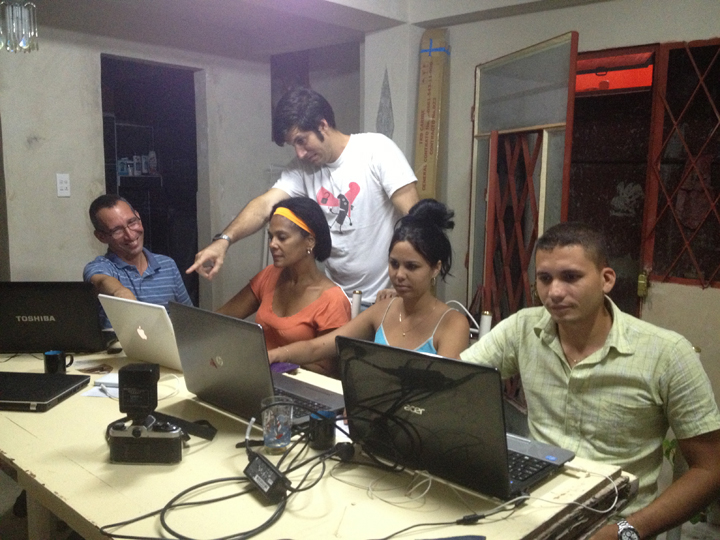
Until yesterday Claudio had to be divided into little pieces, often using the wee hours of the morning to dedicate to us some time for each one us who lined up looking for his help to conceive, film and edit some material. This noble and intelligent young man deserves a gold medal for patiently enduring the demands of ao many friends who tried to be “Directors” of videos.
But he does not want to be irreplaceable, on the contrary, he is promoting a project that will give voice to more people and raise the quality of what is generated within the heart of a society that takes on, from the independent side, the tasks that State media should be developing to sustain us and instead deceive us.
His project is to provide digital editing workshops in several provinces. So far 11 students have passed the course in Havana and Santa Clara; in a few days four more will be ready.
“I’m doing nothing more than making a small contribution to democratize access to audiovisual media, technologically empowering citizens to develop their civic activism or sometimes, simply, so they can make a living without depending on the State, which always asks for something in return … says the Prof.
In my experience, I can say that in learning to edit I have learned to observe, to decipher and therefore to understand the intentionality of what we Cubans are shown daily and what I see now on Telesur, the Venezuelan TV station that is now broadcast in Cuba.
In the case of Cuba, I can now affirm that the Revolution has not been well done, but it has been excellently edited.
Havana, Cuba, November, www.cubanet.org — With regards to the absurd and prudish limitations imposed on some students by the Communications Faculty, Elaine Diaz recently wrote on her blog: “. . . the policymakers are scandalized by things from the students as if the Revolution were going to fall apart next week. They should ask themselves what kind of Revolution falls apart for so little.”
The answer is simple: a revolution like that of Fidel Castro, which long ago stopped being one in order to become a racketeering and mean dictatorship, which, if it has managed to continue in power for 54 years, it is precisely because it fears everything different, it is closed tight and does not waver in repressing a fractious student who thinks with his head like the Ladies in White, who, for the henchmen of State Security are all the same: dangerous enemies of a revolution so fragile that it cannot tolerate anything that differs one iota from official decrees.
Besides, in their aberrant paranoia, they fear books, songs, visual arts, blogs, Facebook and the Internet in general. And also 3D films. The private mini-theaters whose projections have been prohibited without it mattering that the people lose money that they have invested or that they will be left without work. They alleged that these theaters had never been officially authorized, so they did not even give them time to close.
There the fools who thought that prohibitions had been left behind for ideological reasons!
Some think that behind the prohibition on 3D cinemas, as in the case of clothing imported from Ecuador or Miami and sold by individuals, is the desire of the State to eliminate competition by those individuals. But let’s not fool ourselves: the reasons are more ideological than merely commercial. As ideological as when in the ’60’s they prohibited North American music and by extension British also, The Beatles included, no less.
The prohibition on mini-theaters was seen coming. Several days ago, a long article (3,260 words) in Rebel Youth, the newspaper of the Communist Youth, showed the official preoccupation with it. It cited Fernando Rojas, vice minister of Culture, who accused these cinemas of showing video to promote “frivolity, mediocrity, pseudo-culture and banality.” In spite of the vice minister declaring himself in favor of regulation before prohibition, finally the regime decided on the latter.
So, once more, a handful of meek and submissive eggheads, on behalf of their obsolete, uneducated bosses without a drop of class, who have Haitianized and what is worse, barbarized, the country, claim the right to be the arbiters of cultural quality and good taste.
It is not that the cultural commissars are wrong when they say that banal and low quality products prevailed in these cinemas. But those products are not very different from the films and pirated series that pass for Cuban TV or that are shown in the few and deteriorated State theaters that remain. Because the high brow cinema (ay, Huxley) that some foreign correspondents say is seen in Havana is quite scarce. Only arthouse and films of a certain quality are seen on some television programs, in a few film festivals to which very few go and in the Festivals of the New Latin-American Theater, which keeps getting worse and which now, without Alfredo Guevara, it remains to be seen what will happen.
The commissars’ interest in cultivating our taste (always within the moral and ideological coordinates of the system) in order to make us “the most cultured people on the planet,” for lack of organicity and coherence, but above all sincerity, has failed down the whole line. From the punks who slide down the shell of the University for All, the ballet, the symphony and chamber music, jazz and arthouse theater. They prefer reggueton, Manga comics and films about vampires and Jackie Chang. And if they have the money, “to put on the spectacles” they prefer to see Avatar and Ice Age in 3D.
The prohibitions are not going to manage to tidy up Cubans or cultivate their taste. They will only make their lives more boring and miserable. Particularly those of the young. Maybe the bosses think that they will be easier to control so. To hell with their ideas!
HAVANA, Cuba, November 11, 2013, León Padrón Azcuy/ www.cubanet.org.- The home of opposition activist Sandra Ace Rramos in the town of San Juan y Maritnez was the scene this Saturday morning of a seige by pro-government “Rapid Response Brigades” and paramilitary forces, organized by provincial State Security officials in Pinar del Rio Province. The government-organized mobs were mobilized to disrupt a meeting of provincial opposition leaders scheduled for that day.
According to a report by phone by local activist Maiker Alexander Hernández of the Cuban Patriotic Union (UNPACU), who attempted to participate in the dissident meeting, the mobs began surrounding the home in the early morning hours, and were organized by State Security officers José Manuel Crespo and Captain Orestes Ayala. The furious mob shouted obscenities and threats against the opposition activists gathering inside, with the intention of intimidating them into not proceeding with the event. “It as a classically fascist tactic, something never seen in this town before”, said Hernández.
Despite the intense repression and physical aggression, thirteen of the eighteen planned participants were able to enter the house located at 145 Leopoldo Pérez Street, in the town of San Juan Y Martinez. The structure is the site of the independent library Amor Paz y Libertad, run by Ace Ramos.
Five of the activists attempting to participate in the meeting were arrested and taken to the local station of the National Revolutionary Police and released later in the day, around 5pm.
Among the participants in the opposition gathering were Raúl Risco, President of the Pinareña Democratic Alliance, and Eduardo Díaz Freitas, former political prisoner belonging to the famous “Group of 75” (from the Black Spring of 2003) recently released from prison for health reasons. Mr. Díaz declared by phone link: “We organized this gathering because we have resolved to bring together all of the opposition groups in Pinar del Rio Province, something we’ve been wanting to do for some years now”.
Independent librarian Sandra Ace, who hosted the gathering, stated: “We’re really moved, because despite the intense repression and aggression that surrounded us all day, many neighbors helped the participants make it into the house”.
The fascist-style event this Saturday in the town of San Juan y Martinez against peaceful opposition activists is not an isolated event. Pinar del Rio has seen a wave of repressive activity this year against dissidents, similar to that seen in all other parts of the country — a level of repression which is expected to only get worse with time.
It’s no secret that the disproportionate repression on the part of the government of Raul Castro reflects a fear of loss of control. According to the Cuban Reconciliation and Human Rights Commission (CCDHRN), led by Dr. Elizardo Sánchez, in the month of October alone there were 909 politically motivated detentions in the country, one of the highest rates for a single month in over 20 years. This is in addition to incidents of violence by police and para-police units (Rapid Response Brigades), as well as acts of physical aggression against opposition activists.
At the time this report was release, the opposition activists who had gathered for this meeting expressed their gratefulness to media outlets abroad that attempt to generate international awareness of the true state of affairs inside Cuba.
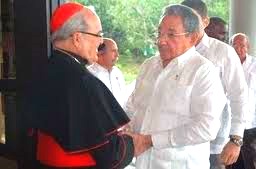
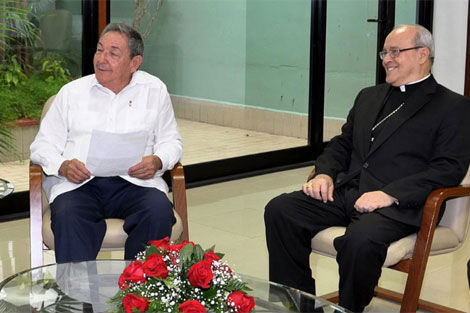
Havana, November 2013 — Cardinal Jaime Ortega turned 77 on October 18 of this year. Canon law sets the retirement age for cardinals at 75. Pope Benedict XVI asked Cardinal Ortega to postpone his retirement but Benedict is no longer in charge at the Vatican. Time has passed and the Cardinal is looking exhausted. Finding his replacement can no longer be put off.
Numerous questions arise. Who will be his successor? What might his relationship with a dictatorial government be? Will he retain Ortega’s policies? Will he maintain a middle-of-the-road position or will he shift in favor the opposition?
Applauded by many and criticized by others, Cardinal Ortega is a saint to some while others criticize him for a lack of energy, for caving in to government pressure and for remaining silent in the face of acts of repudiation against peaceful dissidents, most notably the Ladies in White.
The Catholic Church has made several announcements of prisoner releases. On February 11, 2011 it announced “the impending release of opposition figure Elías Biscet, one of Cuba’s most prominent political prisoners. Biscet, who was serving a twenty-five-year sentence for crimes against the independence and territorial integrity of the state, is one of several opposition figures who have rejected exile as a condition for release from prison.”
Cardinal Ortega was a spokesman for those pardoned and served as the inmates’ “mediator”, or more precisely a “facilitator,” arranging the release and expatriation of nearly two hundred political prisoners.
During that time the church and the government developed close ties after half a century of conflict and political strife. This seems to have been the main reason that Benedict XVI did not accept the cardinal’s retirement as proscribed by canon law.
Ramona Muñiz Hernández — the 84 year old director of a Catholic congregation, the Daughters of Mary, and resident of Tarará in Eastern Havana — told us, “You have to acknowledge the cardinal’s patience. The ’beasts’ have been tamed. There was no other way to confront the government.
“This is a government that, when I worked as a hair dresser in a state-run hair salon, docked 70 pesos from my 280 peso paycheck for being Catholic, for going to mass and for not hiding my beliefs. I could not live without God.
“When Jaime Ortega, who is now Cardinal Ortega, and Troadio Hernández, the current pastor in Bejucal, were seminarians studying for the priesthood, the government took them and others out of school and forced them into obligatory military service. They spent three years interned in camps on the Isle of Pines. It was almost like being banished.”
“The Church put up a tremendous fight, and Jaime and Troadio were able to return to the seminary and finish their studies. Ortega is from Matanzas, the only child of Catholic parents. He has always fought against the ’beasts’ with kindness and love for God. How many relatives of political and common prisoners have been been able to survive because the Church quietly gave them two hundred pesos a month? It is always engaged in works of charity. Many people never find out about this. The cardinal does good, and triumphs! He is a saint.”
Ortega was archbishop of Havana when he was named a cardinal in 1981. He paved over differences between the church and the communist government to gain authorization for visits to Cuba by John Paul II and Benedict XVI.
Ortega was the architect of the lavish celebration of the 500th anniversary of the appearance in the northeastern Bay of Nipe of Our Lady of Charity of El Cobre, the patroness of Cuba. The pilgrimage of the virgin’s statue across the island — beginning in Cobre, where she is venerated, and ending in Santiago de Cuba — served to significantly revive the Christian faith of the Cuban people after half a century of state-imposed Marxist doctrine.
Because of the cardinal’s involvement, Cayo de la Virgen and Playa Morales — two sites on the virgin’s trek after her appearance in the Bay of Nipe — were recently declared national monuments. Other locations were designated “sites of historic interest.”
December 25, Christmas day — long eliminated from the official calendar — was reinstated as a holiday after Pope John Paul II petitioned Fidel Castro to do so during his pastoral visit to Cuba, asking that “Cuba open itself to the world.” Will they retain the day of rest?
The archdiocese regained possession of the splendid church in Tarará, which had been confiscated and turned into a warehouse and later into a mundane nightclub. It was a move that had the hallmarks of efforts by the cardinal, who will soon leave behind a controversial legacy bathed in light and shadow. Ultimately, Pope Francis and time will have the last word on Cardinal Ortega and who his successor will be.
Laura is a Cuban woman who has lived in Spain for more than twenty years. She speaks like a Spaniard. She looks like a Spaniard. Her husband, children and grandchildren are Spaniards. But in spite of the passage of time and the distance separating us, she still considers me her best friend. Or so she tells me.
She is a little older than me, though we are both elderly. Nevertheless, we began planning a trip to Havana.
“Like old times,” she told me.
“Like old times,” I said.
Because those times remain in our memory and form part of our experience. The adventure of visiting Havana — that beloved city of ours that continues to struggle for survival in spite of the neglect and apathy brought on by half a century of socialism — is something I just have to tell you about.
We got into an almendrón, a taxi fashioned out of one of those old 1950s American cars, in Séptima de Santa Fe, a coastal town outside of Havana. We asked the driver to drop us off at Galiano and Zanja streets, located in the very heart of the Cuban capital.
What we saw would impress anyone. At the intersection of these two streets is El Curita Park, named in honor of Sergio González, who today is considered a pillar of the “July 26th Movement.” In March 1958 he was shot to death by Batista’s police for having committed numerous terrorist acts.
Though it was during working hours, we counted several hundred young people of both sexes in the park and its surroundings. They were standing or sitting on its low walls, or leaning on cars, engaging in an odd way of wasting time, or worse. They were fishing for pesos. The commotion spoke all too clearly about the lack of employment opportunites from which our society suffers.
“What do they sell?” I asked an old vagabond who extended his hand to us, asking us for monetary help.
“Anything, ladies,” he said to us: sex, drugs, jewelry. Whatever you need. But be careful. If you deal with one of them, you will be lost in a heartbeat before the eyes of whoever, through the mysterious stairs of this neighborhood.
We entered an old family restaurant that in previous years I had visited on Aguila and Dragones, inside a small dwelling, without natural light or air, but where they served, for only 30 Cuban pesos, a little more than a dollar, a magnificent creole meal composed of black beans, well roasted pork meat, white rice and a typical dessert.
My friend Laura seemed horrified by the place and we left.
“Let’s enjoy a good Spanish meal,” she said.
And a bike-cab took us through the famous Prado, while its driver told us that in the back of all those wide gates, which seemed in good shape, there were as many uninhabitable tenements as in any slum neighborhood of the city and that the water was in such short supply that many bathed in the dirty waters of the Malecon, in spite of the danger that this represented.
On the Malecon, between Genio and Crespo, the driver stopped and we entered the restaurant of the Castropol Asturian Society, founded in Cuba in 1929.
My old friend was right. A good meal is better enjoyed in a comfortable and agreeable place. There we enjoyed some delicious chickpea fritters which I recommend to my Cubanet readers.
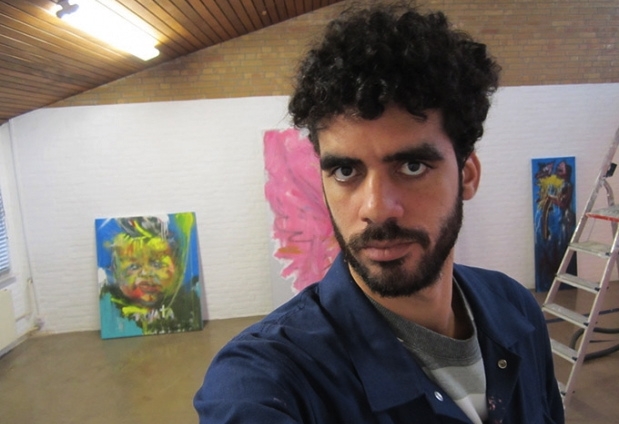
The sixth WHAT? People wondered when his graffiti started appearing around the city. And then it was more than a signature. But the irreverence is unforgiven. State Security is not about to understand this punk aesthetic, much less the art of graffiti. The forces of order are too serious.
For them, Danilo Maldonado, alias “El Sexto” (the Sixth), is a criminal who dirties (even more) the city, A coarse guy who makes everything into a joke and has no fear. So of course, there must be war. He can’t spray graffiti, much less exhibit in a gallery. This would be to accept him as an artist. And he isn’t one. He is a citizen non grata who although abroad, continues to suffer some consequences.
In this interview he talks about the most recent censorship of his work and announces his return to the Island after completing his Shelter City: the Hague fellowship, awarded by Justitia et Pax.
For El Sexto, what are the boundaries between art and social and political activism?
For me the boundaries between art and social and political activism sound like restrictions, and restrictions, to me, sound like a lack of freedom to create, and what’s more, they sound like communism.
I like the idea of breaking boundaries: and this fits with my beliefs, with what seems solid to me. I’m constantly at war with myself trying to better myself. I tell myself I have gotten this far, why not go further. If I do graffiti at night, why not do it in the day. If this is who I am, why hide. So I want to defend those who share my art, no matter what, why not do it.
I don’t understand why people put themselves in cages. For me, art is in everything. A can do a lot, even cross the lines of politics which I also believe in an art although it is practiced with lack of sincerity in my country.
People love to set boundaries, but art and politics are a game in which we ourselves impose the boundaries, not those who would limit us. So breaking them is good, because it’s the first step to finding the interior freedom that we’re lacking.
I hear you’ve set aside graffiti and started to conceive of your work in galleries. When will we see your exhibition at the Christ the Savior Gallery?
Yes, I’ve set it aside because I work all the time, so I get to experiment with canvas, cardboard. Recently I had the chance to put together at least sixteen canvases of 6 feel by eight feet, several cardboards, photographs and sculptures, for an exposition in Christ the Savior Gallery.
But as you know, my work makes the galleries panic, even the independent ones, so I’ve only exhibited at La Paja Records, and at Estado de SATS; later in the Christ the Savior Gallery, in a Graffiti Festival where I will have the chance to do a two-person exhibit with the graffiti artist and fine artist José Ernesto Rodríguez,
son of Silvio Rodriguez.
At that time, like always, it was under pressure. And they lost–only–the photos of my pieces take by the photographer Marcel.
However, when I’d put together this much work, Otari Oliva was very excited to see that finally it was possible for me to have a personal exhibition. And excited because Christ the Savior Gallery would be the first independent gallery — not associated with “activists” or “politics” — according to him — to show my work. So I left them in his house with everything arranged for September.
During that time, Otari sent me emails asking to postpone the expo until October because he was still arranging travel and such… but the same month, on 21 September, there was an exhibition held in Christ the Savior, of Ernesto Oroza.
Needless to say that made me sad. I did not understand why, if this date was planned for my first exhibition, someone would have a show before me. But fine, we went back to setting a date for October, in the first five days.
And again, emails from Otari saying that he was getting too much pressure, and that State Security wanted to see my works. What he told me was that he refused and preferred to remain silence and not to talk to the media because he’s afraid that what happened to Estado de SATS would happen to the gallery. And he also said that Chris the Savior was cultural, not political. But above all, that I should wait for everything to calm down without saying a word about my situation.
That reminded me of the attitude taken every day by the Cuban government and its repressive philosophy, “the place and time.” So I was left frustrated that couldn’t see my work and deserved an explanation. Once again, I’ve been censored by State Security and the fear some people have of keeping their word and not fighting tooth and nail for what is worthy and what they love, art.
Does that mean censorship in Cuba gains space, because who can confront them, make them give up? Do you think art and independent spaces could make a difference?
Of course. Those who have managed to snatch a scrap of earth for freedom are the independent spaces and if they give in… They [State Security] already have the formula: “I scare you a little and you give in and now everything’s fine.” But I think if someone has managed to create an independent space and proclaim it as such, then they acquire certain responsibilities, and one of them is not to be an extension of State censorship.
To what extent can you limit this negative? Have you thought about changing strategy? This could be a good turning point for how visual arts are perceived on the island, but that, I think, must be done from within.
Sometimes I feel pessimistic, especially when I see how some people behave. People do not understand that the struggle has to be waged from within Cuba. I do my work without forgetting my family. My language and my reality are there.
Then on your return how do you see Danilo as an artist? Do you go back to the streets, or maintain this change of perspectives?
The streets would love to see the last of me, but that’s beyond me, it’s my therapy. From the first graffiti I couldn’t turn away from the street. Here in the Netherlands I’ve also gotten in trouble, don’t think it’s just in Cuba.
However, sometimes I take a rest or change tools. I play with video, performance, painting, photography… I love being tested with other materials, it’s also another space outside the official, it’s simply to grow as an artist, as a human, to find other languages to express an idea. I’m just telling you there will be surprises, for the Cuban streets and for the galleries as well, why not?