At Havana’s State Bodegas: Plenty of Slogans, No Products

The dilemma Cubans face every day is that whatever they can afford doesn’t exist, and whatever does exist they can’t afford.

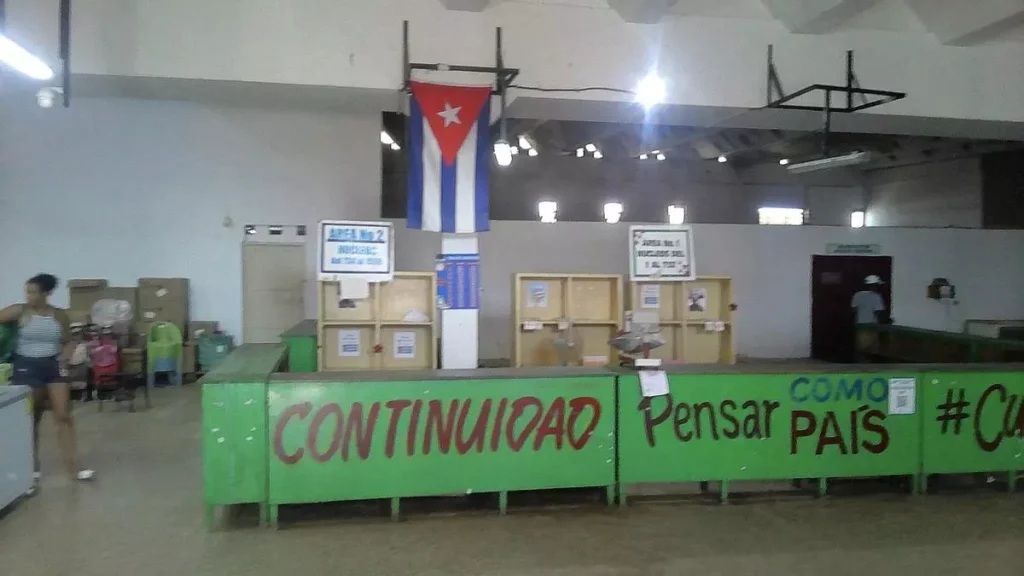
Empty of products, but not of slogans, was the ration store this Tuesday.

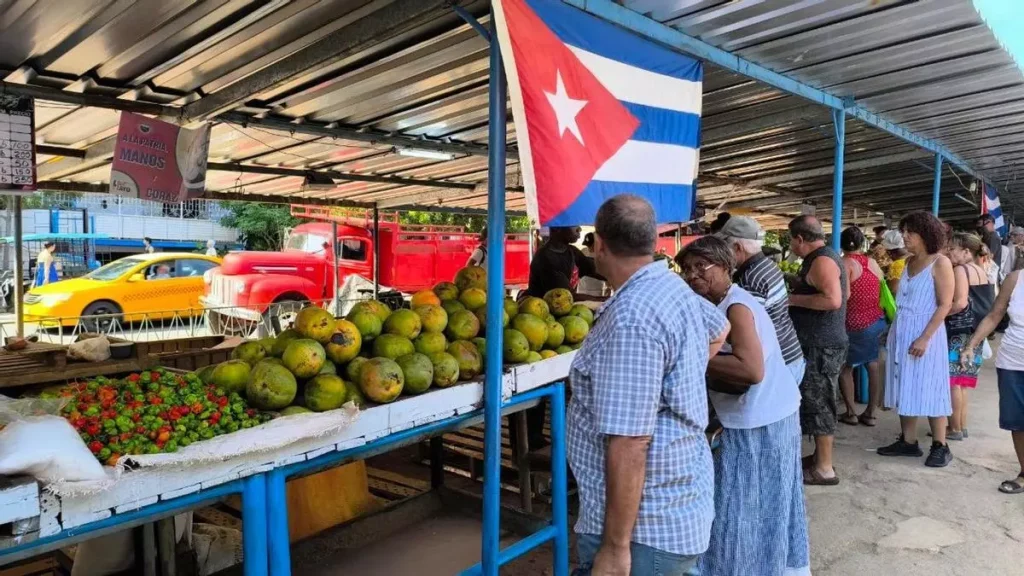
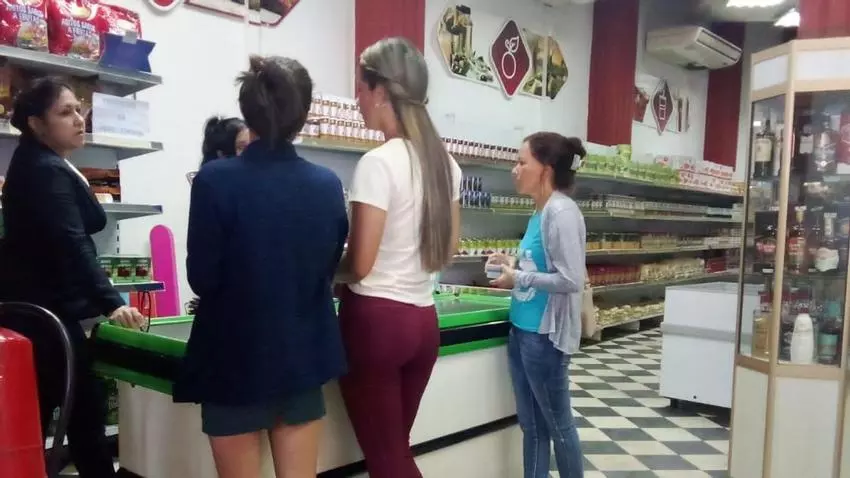
14ymedio bigger14ymedio, Havana, Juan Diego Rodríguez, May 13, 2026 – The old state-run bodega next to the market at 19 and B, in Havana’s Vedado district, has never really been able to compete with the bustling produce market. Well stocked with every kind of fruit and vegetable, the market stands in stark contrast to the shop reserved for ration-book purchases, which has increasingly become the very symbol of the country’s shortages.

When, at the end of December 2023, the private home-delivery business Zona K’liente set up shop in half of the premises, the contrasts became even sharper. But never to the extent seen now, as the crisis has worsened due to the fuel shortage and the ration-market stores have been left completely empty.

Meanwhile, not only is the small private business Zona K’liente thriving, but so are the stalls in the adjacent market.

This Tuesday — the first day of the week when the market at 19 and B reopens after the Sunday and Monday break — the shelves contained only a tiny quantity of fruit purée, intended for children up to two years old in each household. Empty of products, but not of slogans. “We Are Continuity,” “Thinking as a Country,” are some of the phrases written in capital letters across the front of the green-painted counter, as if big, strident lettering were enough to feed people.

Meanwhile, not only is the small private business Zona K’liente thriving, but so are the stalls in the neighboring market. Prices*, however, are another matter. Imported mandarins at 1,500 pesos a pound, soursop at 1,000, red cabbage at 2,000, pork leg at 950, a single mamey fruit at 400 pesos…

Both places lay bare the dilemma ordinary Cubans face every day just to survive: whatever they can afford doesn’t exist, and whatever does exist they cannot afford.

*Translator’s note: The monthly retirement benefit in Cuba is roughly about 3,000 to 4,000 pesos a month.

Translated by GH

______________________

COLLABORATE WITH OUR WORK: The 14ymedio team is committed to practicing serious journalism that reflects Cuba’s reality in all its depth. Thank you for joining us on this long journey. We invite you to continue supporting us by becoming a member of 14ymedio now. Together we can continue transforming journalism in Cuba.

Born to Cuban Parents, Pere Villacorta is a Defender in FC Barcelona’s Youth Academy

The left-footed player, born in 2010, can also play as a left back and defensive midfielder

Pere Villacorta joined Barça’s youth ranks in 2024 from RCD Espanyol / Instagram La Masia Promises

14ymedio bigger14ymedio, Andy Lans, Matanzas, May 13, 2026 — FC Barcelona’s youth academy has adorned Spanish football with great defenders. Names such as Gerard Piqué and Carles Puyol were written in the past in golden letters. Other current players like Pau Cubarsí and Gerard Martín inspire confidence for the present and the future. Meanwhile, another center-back of Cuban descent is being polished at La Masía: Pere Villacorta García.

As 14ymedio was able to confirm, the player born in Barcelona in 2010 has Cuban ancestry. His father is from Cienfuegos, and his mother from Havana. In addition to playing center-back, the left-footed player can also perform as a left back and defensive midfielder. On the field, he stands out for his personality, exquisite technique, and tactical maturity.

In his emerging career, he has passed through three prestigious football institutions in Catalonia

Pere Villacorta arrived at Barça’s youth academy in 2024 from RCD Espanyol, which had signed him in 2022 from CF Damm. As can be seen, in his emerging career he has already passed through three prestigious football institutions in Catalonia.

This season, Villacorta has been one of the key figures in Barcelona Under-16’s title in the Catalan Honor Division, with two matchdays still remaining before the championship concludes. Wearing his usual number 4 shirt and the captain’s armband, Pere has played 21 matches so far in the tournament, with the same number of starts and a pair of goals. Due to his strong performances, he has been rewarded with four call-ups and two appearances in the National Youth League with Barcelona Under-19 B.

Could Pere Villacorta join a Cuban national team? In theory, he is eligible through his parents’ birthplace, but he would need to obtain a Cuban passport and be recruited by the Cuban Football Association.

Translated by Regina Anavy

______________________

COLLABORATE WITH OUR WORK: The 14ymedio team is committed to practicing serious journalism that reflects Cuba’s reality in all its depth. Thank you for joining us on this long journey. We invite you to continue supporting us by becoming a member of 14ymedio now. Together we can continue transforming journalism in Cuba.

Concern Grows Among Spanish Companies in Cuba Over Helms-Burton

Donald Trump’s poor relationship with Pedro Sánchez increases exposure to reprisals, especially for the hotel chain Meliá, which has 34 establishments on the Island.

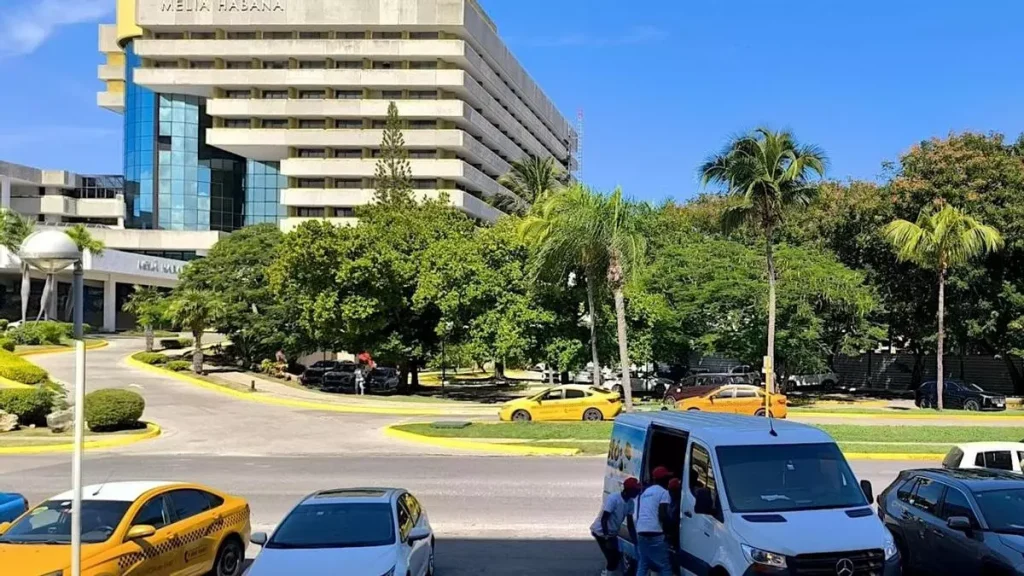
Meliá owns nearly 14,000 rooms in Cuba, but according to its latest report, it is keeping just over 700 open. / 14ymedio

14ymedio bigger

14ymedio, Madrid, May 13, 2026 — Nearly a week after the Canadian mining company Sherritt International withdrew from Cuba over the possibility of U.S. sanctions tied to its operations on the Island, attention has now turned to Meliá. The Spanish hotel chain, which manages 34 properties owned by the Cuban State, has been forced to reduce its available rooms by approximately 50%, and although it has not expressed any intention of ending its business there, warnings are coming from various quarters.

This happened last Saturday, when the U.S.-Cuba Economic and Trade Council (U.S.-Cuba Trade) published an article asking whether the Mallorca-based company would be the next to end its collaboration with the military conglomerate Gaesa due to pressure from Title IV of the Helms-Burton Act, already activated during Trump’s first term, and a possible inclusion on the SDN (Specially Designated Nationals) list of the Office of Foreign Assets Control (OFAC) of the U.S. Treasury Department. This directory includes sanctioned individuals, companies, or vessels, implying a financial blockade and a prohibition on Americans doing business with them.

Although theoretically any company could be exposed to such measures, U.S.-Cuba Trade believes there could be an additional political motivation for acting against Meliá: the stance of Spanish Prime Minister Pedro Sánchez, who prohibited the U.S. from using Spanish military bases for operations against Iran. In fact, the organization believes that Sherritt’s withdrawal may have stemmed from a similar situation involving Canadian Prime Minister Mark Carney, who has also been confrontational toward the American president. continue reading

The organization believes Sherritt’s departure may have resulted from a similar situation involving Mark Carney, Canada’s prime minister and likewise confrontational toward the American president

Meliá also has a precedent. Its CEO, Gabriel Escarrer Jaume, son of Escarrer Juliá, founder of the hotel chain and closely linked to Fidel Castro, was already sanctioned by OFAC in February 2020. Exactly six years ago, during a visit to Cuba for the Tourism Fair, the businessman said he was indifferent to the sanctions and stated that his intention was to remain on the Island for at least another three decades. “We do not tremble in the face of outside pressures we may suffer,” he insisted.

At that time, the hotel chain had already begun receiving claims under Title III of the Helms-Burton Act, although none have succeeded. Meliá relied on the European regulation known as the Blocking Statute, which prevents European Union companies from complying with extraterritorial measures. Companies based in the EU are strictly prohibited from applying legislation or court rulings from other countries listed in an annex that expressly includes the Cuban Liberty and Democratic Solidarity Act of 1996.

But now, U.S.-Cuba Trade points out, there is the possibility of being placed on the SDN list, which would mean, in addition to losing the two hotels it owns in the United States, the INNSiDE in New York and the Meliá Orlando Celebration in Florida, the possibility that banks could sever relations for fear of being affected themselves.

The Spanish newspaper ABC consulted a lawyer specializing in these matters for an article published Tuesday. “From a legal standpoint, this is a major change, because the United States is giving itself a weapon it can use however it wants. For companies operating in Cuba, their existence in the country is going to become more complicated. There will be much greater scrutiny from banks, insurers, and partners when doing business, and many companies will reconsider whether it is worth continuing,” said José María Viñals, a partner at the international law firm Squire Patton Boggs. In his view, financial institutions will have to conduct “a very exhaustive analysis and review their credit history with the Island,” and the measures discourage investment in Cuba.

ABC also spoke with Ignacio Aparicio, from Andersen Lawyers and head of Cuban affairs, who said several companies have consulted about “the validity and continuity of their contracts with entities linked to Gaesa, the personal risk to their executives regarding entry visas to the United States, and the position of their banks and insurers regarding ongoing operations.” The expert does not believe there will be a total withdrawal of Spanish companies, but he warned: “This is neither a hypothetical nor a distant nor a legally simple risk.”

Among the most visible companies potentially affected, the Madrid daily notes, are also the hotel chains Barceló and Iberostar, Banco Sabadell, and Alto Cedro, the latter linked to Banco Santander, which has a strong presence in the United States.

“Europe will have to decide whether it protects European companies and confronts the United States”

Viñals, in any case, raises an even broader issue in the conflict. “Europe will have to decide whether it protects European companies and confronts the United States,” he said. The Blocking Statute mainly functions as a tool capable of nullifying the legal effects of U.S. court decisions on European soil, but it can do little against an OFAC designation, which would exert coercive pressure on other businesses. However, the EU still has a weapon it has never used, known as the trade bazooka: the Anti-Coercion Instrument (ACI).

Created in 2023 by the European Commission, this mechanism activates direct trade reprisals if authorities determine that there is a policy attempting to influence the policies of the EU or its member states. Measures can range from tariffs to service restrictions or suspension of U.S. patents in Europe. The first time the bloc of 27 countries considered invoking it was last January, when Donald Trump threatened to take over Greenland, but given the potential for open conflict implied by its use, it was never even formally considered.

Just a week ago, French President Emmanuel Macron again brought the ACI into the spotlight when Trump threatened new tariffs on the EU. Sánchez joined the initiative, supporting its use to block measures against judges of the International Criminal Court. However, even if the EU wanted to use its “last golden bullet” against the United States, activating the measure would take months to move through Europe’s high-level institutions, compared to the immediacy of OFAC measures.

Translated by Regina Anavy

______________________

COLLABORATE WITH OUR WORK: The 14ymedio team is committed to practicing serious journalism that reflects Cuba’s reality in all its depth. Thank you for joining us on this long journey. We invite you to continue supporting us by becoming a member of 14ymedio now. Together we can continue transforming journalism in Cuba.

The Cuban Government Is Privatizing Fuel Sales, but Will Continue To Control Prices.

This is about circumventing the US measure that only authorizes small private businesses to import petroleum products

A gas station known as the Shell Roundabout in Havana, rented from a micro, small, or medium-sized enterprise (MSME), where state vehicles are served. / 14ymedio

14ymedio bigger14ymedio, Havana, May 12, 2026 / Starting at midnight on Friday, May 15, the fixed price for gasoline purchases will be eliminated. The Cuban regime announced this Tuesday through its media, stating that “the sale prices of fuels in foreign currency will be updated, either upward or downward, according to the actual costs of each specific transaction.”

“The gradual process of social and economic transformations that Cuba, in its legitimate and sovereign right, has been carrying out has allowed multiple actors to import and sell fuel in foreign currency,” states the press release published in official media. The statement does not specify what has “allowed multiple actors” to import and sell fuel; that is, not only the Cuban government’s willingness—which since February has facilitated the purchase of fuel by any company with the means to do so—but also the permit issued by the U.S. Office of Foreign Assets Control (OFAC) for Cuban private entities to import fuel from the United States, provided that regime institutions are excluded.

“Different retail fuel prices will coexist, reflecting the actual import costs for each economic actor.”

Without mentioning any of this, the official statement reports that from now on “different retail fuel prices will coexist at service stations, reflecting the actual import cost for each economic actor; this will be influenced by the supplier, freight costs, supply route, insurance, risks and international market fluctuations.”

Until now, it explains, “a fixed price for the sale of fuels was maintained as a policy of protection against the changes and instabilities inherent in a turbulent market, which cannot be economically sustained under the current conditions.”

However, the mere fact that the government issued a statement dictating a price policy supports the hypothesis that Havana is, in reality, circumventing the US regulation by de facto intervening in the newly privatized market. This newspaper has documented continue reading

how Cupet not only leases state-owned gas stations to micro, small, and medium-sized enterprises (MSMEs), but also serves vehicles belonging to state-owned companies at these stations , which is expressly prohibited by the OFAC order.

“Cuba demands its inalienable right to import fuels to guarantee the country’s economic and social development and the well-being of its people.”

Far from apologizing, the regime asserts: “Cuba demands its inalienable right to import fuels to guarantee the country’s economic and social development and the well-being of its people.”

US oil sales to Cuba surged in March, reaching $8,788,501 in a single month. According to the latest figures from the US-Cuba Trade Council, the total value of gasoline, fuel oil, diesel, and lubricants in the first quarter of the year reached $11,624,773, indicating significant growth in March compared to the previous month.

In February, US-Cuba Trade already reported a quantitative jump in the figures, with almost 2.44 million dollars – 2.2 in fuel oil and 162,100 in gasoline, which is more complex to transport in isotanks (tank containers of just over 20,000 liters).

Broken down by product, this March, light fuel oil was one of the most purchased items, totaling $3,066,920, although petroleum oils were the star performer, reaching nearly four million dollars. Additionally, $490,223 was spent on gasoline, three times more than the previous month. All shipments originated from Florida, New Orleans, and Houston.

______________________

COLLABORATE WITH OUR WORK: The 14ymedio team is committed to practicing serious journalism that reflects Cuba’s reality in all its depth. Thank you for joining us on this long journey. We invite you to continue supporting us by becoming a member of 14ymedio now. Together we can continue transforming journalism in Cuba.

Havana Chronicles: Sleeping Is Also a Privilege in Havana

While hundreds stand in line to leave the country after sleepless nights, a class emerges capable of shielding themselves from blackouts and sleeping soundly.

Tejas Corner, in Havana, this Tuesday. / 14ymedio

14ymedio bigger14ymedio, Yoani Sánchez, Havana, 12 May 2026 / Everyone on the street is talking about the same thing. “I couldn’t sleep even an hour last night,” a young woman tells an elderly woman she passes as she walks along Calzada del Cerro. I follow behind, with the clumsy gait of someone who spent the night awake, barely blinked the night before, and managed, if anything, a couple of hours of sleep. The constant sleeplessness imposed by the combination of blackouts and heat weighs heavily on all of us in this city.

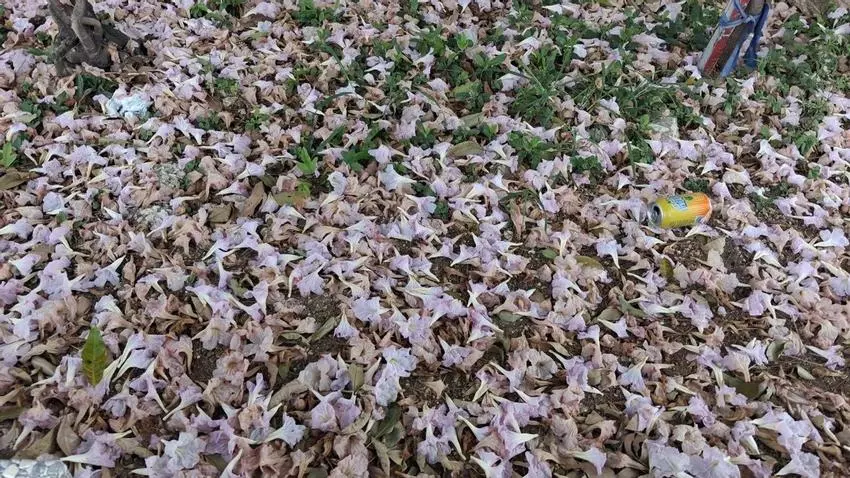
Before five o’clock in the morning this Tuesday, I’d already had a couple of cups of coffee. By seven, my eyes were wide open, and I headed out, but I made a mistake turning right at Rancho Boyeros instead of going straight, and I ended up at the Ciénaga train workshops. I crossed the avenue and decided to walk to Esquina de Tejas. The oak trees were in bloom all over the city, so with every step I stumbled upon a tapestry of petals on the ground. A soft carpet that got me yawning. All I could think about were pillows, blankets, and a cool room where I could snore for hours on end.

The owner of the most powerful Ecoflow, the longest-lasting battery, and the generator with the most fuel is now the neighborhood ‘big shot’.

Several blocks before reaching the Immigration and Foreigners Directorate office, I see the crowd. There are dozens, most likely hundreds, of people who have spent the night there to apply for a passport. The exodus continues unabated. A woman boasts to others that she spent the night at a friend’s house who has a generator and that she slept “like a log with the air conditioning on.” The looks she gets from those who hear her bravado are like poisoned arrows.

The new class emerging is the one that can isolate itself from blackouts and enter the deep sleep stage, essential for physical recovery. People with resources are no longer identified so much by the designer clothes, the car they drive, or the drinks they toast with. Now, the deepest social divide is between those who can count on an energy supply that allows them to rest during the early morning hours, and those who experience that time of day amidst mosquito bites, sweat, and sudden awakenings.

Our status is written all over our faces. That woman with dark circles under her eyes; she probably doesn’t even have a rechargeable fan to keep cool in the dark. That young man with puffy bags under his eyes; he probably lives in a windowless tenement and has a small child he must fan all night. And those cheeks without a dark spot on their upper part; there we have the nouveau riche. The owner of the most powerful Ecoflow, the longest-lasting battery, and the generator with the most fuel is now the neighborhood dandy.

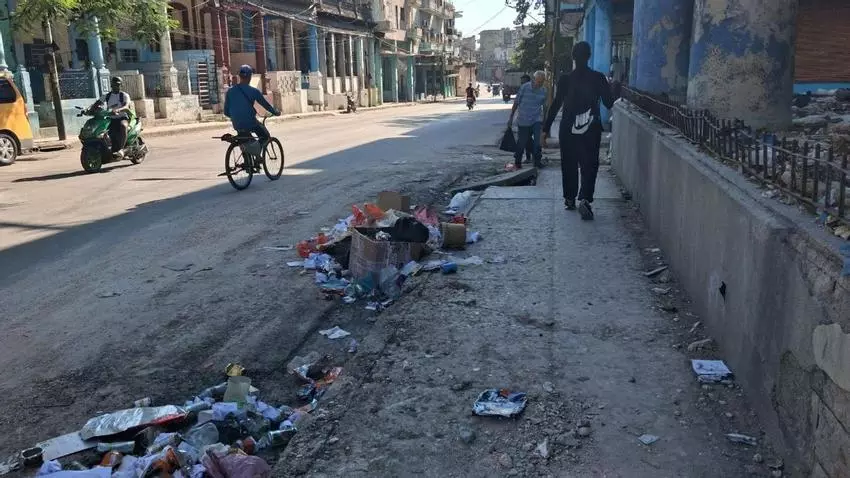
When the sun starts to beat down, they take refuge in their offices with a certain air of duty fulfilled, while outside, mountains of garbage continue to dominate the landscape. / 14ymedio

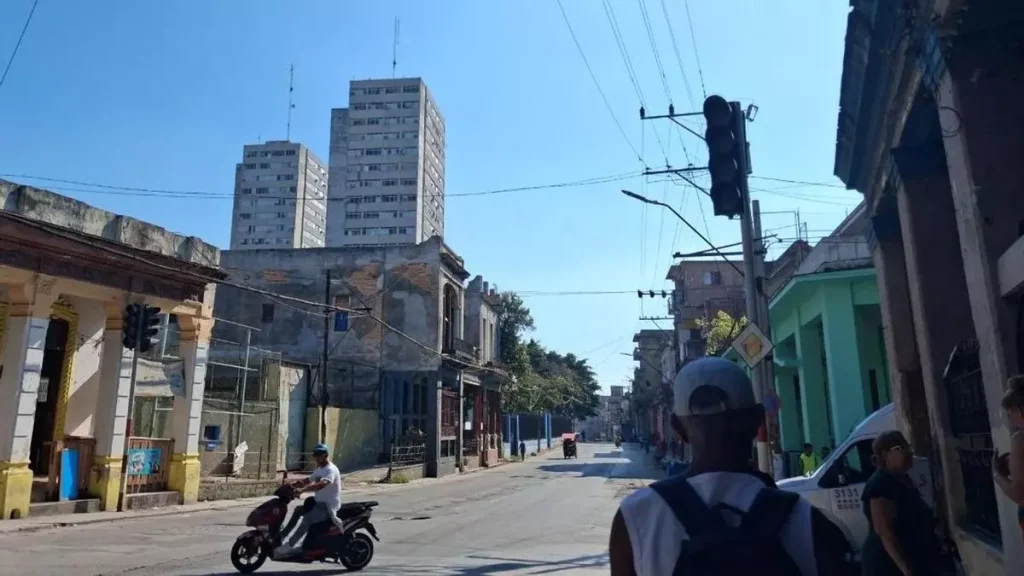
I arrive at the Esquina de Tejas. The park benches at the base of the two 20-story buildings are full of families. Some children sleep stretched out on the granite, while their mothers wave cardboard boxes close to their bodies. These towers, which I can see from my apartment, spend a good part of the night in darkness. When I feel that my building’s electricity is being mistreated more than the others, I only have to look toward the horizon at the windows of these darkened buildings to remind me that in this city there’s always someone who might be worse off, much worse off.

I turn onto Infanta Street. Several government offices have been ordered to clean up the mess in front of their buildings. So, several employees, brooms and dustpans in hand, are sweeping up a piece of paper here, some cardboard there, in the middle of an avenue overflowing with filth. As the sun begins to beat down, they retreat to their offices with a sense of accomplishment, while outside, mountains of garbage continue to dominate the landscape. One of the enthusiastic cleaners has forgotten the bin of accumulated waste, which a cart driver accidentally knocks over, and it all spills back onto the street.

The flowers have continued to fall, and her shoulders, skirt, and bag are covered in those fragile petals that are ruined as soon as they fall. / 14ymedio

She bought some coffee from a street vendor. She never drinks it after eight in the morning to avoid sleep problems later, but who cares about a little more caffeine in a city where you can’t sleep anyway? The small dose came with sugar, but she didn’t care; she just wanted to wake up and get to her destination. She reached Parque de la Normal.

In one corner, a woman has fallen asleep leaning against a tree trunk. It’s an oak. The blossoms have continued to fall, and her shoulders, skirt, and bag are covered in those fragile petals that wither as soon as they fall.

Previous Havana Chronicles:

A Desperate Plea in the Middle of the Dark Havana Night: ‘Light!’

The Refuse of Disenchantment

Under a Picture-Postcard Blue Sky, the Country is Crumbling

Fatigue Barely Allows One to Enjoy the ‘Lights On’ in Havana

Dollars, the Classic Card, and a Havana Without Tourists

A Journey Through the Lost Names of Havana

The Shipwreck of a Ship Called “Cuba”

Havana Seen From ‘The Control Tower’

In Havana, the Only Ones Who Move Are the Mosquitoes

Reina, the Stately Street Where Garbage is Sold

Searching for Light Through the Deserted Streets of Havana

The Death Throes of ‘Granma’, the Mouthpiece of a Regime Cornered by Crisis

The Anxiety of the Disconnected Cuban

One Mella, Three Mellas, Life in Cuba Is Measured in Thousands of Pesos

It Is Forbidden To Leave Home in Cuba Today Because It Is a “Counter-Revolutionary Day”

Vedado, the Heart of Havana’s Nightlife, Is Now Converted Into a Desert

Havana, in Critical Condition
______________________

COLLABORATE WITH OUR WORK: The 14ymedio team is committed to practicing serious journalism that reflects Cuba’s reality in all its depth. Thank you for joining us on this long journey. We invite you to continue supporting us by becoming a member of 14ymedio now. Together we can continue transforming journalism in Cuba.

While Attending a Mass for Leo XIV, the Regime Orders the Encirclement of Activists and Independent Journalists

Police arrest Yoan de la Cruz, the young man who broadcast the start of the 11J protests from San Antonio de los Baños

Beyond the ceremonial language and official photographs, the day was marked by reports of surveillance, police cordons, and repression. / Granma

14ymedio bigger 14ymedio, Havana, May 9, 2026 / An unknown man intercepted journalist Reinaldo Escobar at his front door on Friday and asked if he planned to go out. When told no, the man warned him that neither he nor Yoani Sánchez could leave because there was a special mass for the Pope that day. “And what does that have to do with us, if we’re not even Catholic?” Escobar asked. “That’s what I told you,” the unknown man responded, in a phrase that betrayed the existence of orders from above. The man concluded: “Well, you know, stay upstairs and don’t go out.”

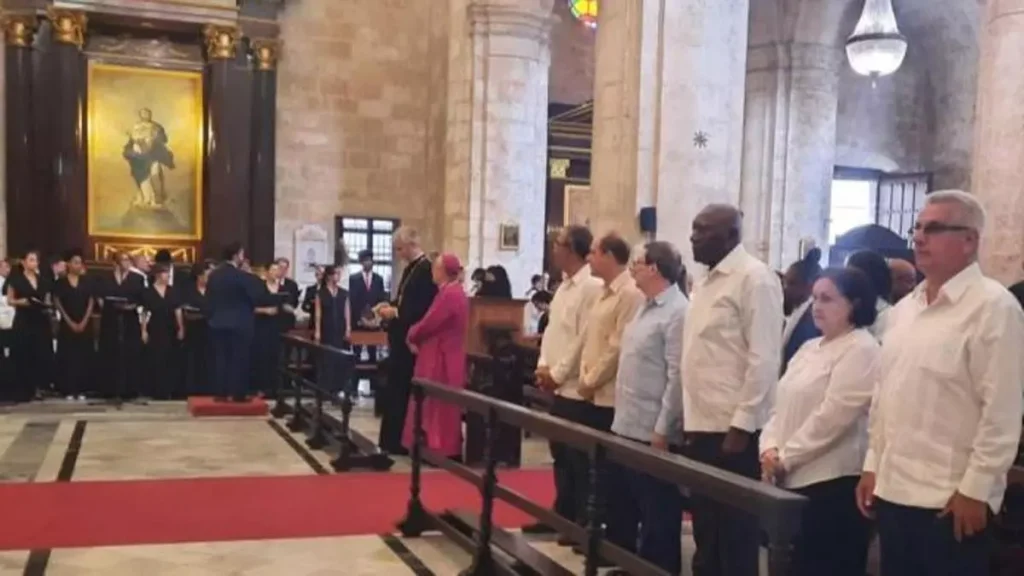
In effect, the Cuban regime once again presented its best diplomatic face to the Catholic Church this Friday. In Havana’s cathedral, Cardinal Juan de la Caridad García, Archbishop of Havana, and the president of the Episcopal Conference, Arturo González Amador, celebrated a Mass of Thanksgiving for the first anniversary of the pontificate of Leo XIV. In the front row were Cuba’s Foreign Minister Bruno Rodríguez and Vice President Salvador Valdés Mesa, both members of the Political Bureau of the Communist Party.

However, outside of the ceremonial language and official photographs, the day was marked by reports of surveillance, police cordons, and pressure against independent journalists and activists.

The Apostolic Nuncio, Antoine Camilleri, focused his message on the Pope’s approachability, simplicity, and spirit of service. He also referred to the more than 90 years of diplomatic relations between the Holy See and Cuba, which he described as a “constant channel of dialogue, respect, and cooperation.” The official newspaper Granma presented the ceremony as a new episode of “respectful and constructive dialogue” between Havana and the Vatican.

While the government speaks of dialogue before the Church and diplomats, its repressive forces keep under control those who could offer a different image of the country.

Several reports of harassment and police blockades circulated on social media in the hours leading up to and following the mass. Opposition members and independent reporters asserted that State Security agents were stationed around their homes to prevent them from leaving. Among those surrounded were journalist Camila Acosta, opposition member Ángel Moya, and Berta Soler, leader of the Ladies in White movement. According to independent journalist José Raúl Gallego, Moya and Soler were detained.

While the government speaks of dialogue before the Church and diplomats, its repressive forces keep under control those who continue reading

could offer another image of the country: that of political prisoners, those released from prison under surveillance, the mothers of “11J” and the journalists who document the crisis outside the state press.

Adding to this climate was the report about Yoan de la Cruz, the recently released political prisoner who live-streamed the first protests on 11 July 2021, in San Antonio de los Baños. A Facebook post circulated this Saturday alerted the public that the police had arrested him and confiscated money, perfumes, and other items during the operation. “Under what pretext? I don’t know, this is robbery to me,” the post stated, adding that De la Cruz was working and complying with the regulations imposed since his release.

“They seized several items from him, including perfumes, money, a phone, and a computer.”

A source close to the family, consulted by 14ymedio, later confirmed some of the information circulating on social media. “According to neighbors, they confiscated several items from him: perfumes, money, a phone, a computer, and so on. I don’t yet know the reason for his arrest,” the source explained. As of now, it is unknown what charges he was arrested under or whether the authorities have formally informed the family about his situation.

Yoan de la Cruz was first arrested on July 23, 2021, after broadcasting from San Antonio de los Baños the images that sparked the 11J protests across the island. In March 2022, he was sentenced to six years in prison, and in May of that same year, he was released after his sentence was reduced to five years without incarceration.

This system, presented by the authorities as an alternative to prison, functions in practice as supervised release. The offender is obligated to comply with restrictions, subject to police monitoring, and vulnerable to any alleged violation being used as grounds for returning to prison.

The coincidence of the official mass, the reported blockades, and the operation against De la Cruz paints a picture difficult to reconcile with the discourse of openness the regime projects to the Holy See. In the cathedral, officials spoke of respect and cooperation. In the homes of activists and former political prisoners, the police reminded them of the true limitations of that dialogue.

______________________

COLLABORATE WITH OUR WORK: The 14ymedio team is committed to practicing serious journalism that reflects Cuba’s reality in all its depth. Thank you for joining us on this long journey. We invite you to continue supporting us by becoming a member of 14ymedio now. Together we can continue transforming journalism in Cuba.

Opposition Is Growing Among Republican Senators Against a U.S. Military Action Against the Cuban Regime

Several lawmakers believe all efforts should be focused on Iran and that economic sanctions should be enough to force change on the Island

Republican U.S. senators trust that economic pressure will be enough to reach an agreement. / 14ymedio

14ymedio bigger14ymedio, Madrid, May 12, 2026 — U.S. President Donald Trump posted a message on his social network, Truth, in which he claimed that Cuba is asking for help and that he will respond through dialogue. The post makes a veiled reference to an article published Tuesday by the newspaper The Hill, which quoted several Republican senators rejecting military intervention on the Island and urging priority be given to the war with Iran.

“No Republican has ever talked to me about Cuba, a failed country that is only going in one direction: downward! Cuba is asking for help, and we are going to talk! Meanwhile, I’m going to China!” Trump exclaimed, just hours before his trip to Beijing, which begins this Wednesday and will last through Friday the 15th.

The Hill spoke with several senators from the president’s party who warned of the mistake it would be to attack Cuba while problems with Iran continue, and who called for continued economic pressure so that the Cuban regime collapses on its own.

The lawmakers are apparently concerned about the political repercussions that presidential decisions could have ahead of the midterm elections in November, when all signs point to a Democratic victory. The war against the regime of the ayatollahs is worsening the already negative polling numbers forecast for Republicans, and senators are asking for the issue to be resolved as soon as possible.

The lawmakers are apparently concerned about the political repercussions that presidential decisions could have ahead of the midterm elections in November.

“I think right now we are focused on what we should be, which is trying to open the Strait of Hormuz,” said Senate Majority Leader John Thune, who considers the matter a national priority. “I’d love to see regime change in Cuba, like everyone else,” he added, but said continue reading

that this may come through the force of events. “I think the things happening in the world are putting more pressure on many of these dictatorial-type governments. Maybe something there will happen naturally.”

James Lankford, Republican senator from Oklahoma and vice chair of the Senate Republican Conference, called for increased sanctions to try to force change, but when asked whether he would support a military operation against the Island, he was blunt: “No, I would not. There is a lot of economic pressure that can be put on Cuba that makes a huge difference by itself.”

Another firm “no” came from Susan Collins, representative from Maine and chair of the Senate Appropriations Committee. Steve Daines argued that although Cuba is “in our backyard,” he prefers “less conflict rather than more, given what’s happening in the world.”

“I trust,” he added, “the instincts of the president and Secretary Rubio. They are much closer to that situation, frankly, than I am,” highlighting the role of Secretary of State Marco Rubio.

Senator Rand Paul of Kentucky said a military operation in Cuba would be a mistake and suggested that the Cuban regime is open to reforms in exchange for investment. “I want less war, not more. I am not in favor of a war with Cuba, which right now is suffering economically from the embargo, although I think they were suffering even before that because of socialism,” he stated.

“From what I have discussed with their ambassador, I think they are open to negotiations, they are open to better relations. They have told me they are open to U.S. investment. That is really the way societies are transformed,” he argued.

Shelley Moore Capito, senator from West Virginia and chair of the Senate Republican Policy Committee, downplayed the likelihood of military action and insisted that Iran is the priority. “It’s very far down the list, even if it’s on a list. I think we have to focus on what’s happening in Iran,” she told The Hill.

“It’s very far down the list, even if it’s on a list. I think we have to focus on what’s happening in Iran,” she said.

By contrast, Axios sees more signs that Trump may be preparing military action in Cuba, in an article published Monday titled “Trump and Rubio’s escalating rhetoric shows a Cuba invasion could be imminent.” While the outlet does not provide strong indications from government sources pointing toward military intervention — they cite a White House official saying that Cuba “will soon fall, and we will be there to help them” — it does include a relevant opinion in that direction.

That opinion comes from Sebastián Arcos, interim director of the Cuban Research Institute at Florida International University, who told Axios that intervention is more plausible now that “the war with Iran is in a kind of limbo.” “I sense a reorientation toward Cuba, not only in the surveillance flights, but also in the president’s statements to Marco Rubio and the newly announced sanctions,” the specialist declared.

He does not believe the U.S. president will deploy troops on the Island, but rather “undertake a remote military action, similar to what occurred in Iran, that would shock the regime, weaken the ruling leadership, and perhaps create an opportunity for the emergence of new leadership.”

Translated by Regina Anavy

______________________

COLLABORATE WITH OUR WORK: The 14ymedio team is committed to practicing serious journalism that reflects Cuba’s reality in all its depth. Thank you for joining us on this long journey. We invite you to continue supporting us by becoming a member of 14ymedio now. Together we can continue transforming journalism in Cuba.

The Cuban Regime Wants To Charge Yoan de la Cruz With Financing an Alleged Sabotage Plot

The young man who broadcast the first images of the historic July 11 protests was transferred to the prison known as Técnico de Guanajay

One of the relatives assured this newspaper that Yoan de la Cruz was working and complying with the regulations imposed since his release from prison. / Facebook

14ymedio bigger14ymedio, Madrid, May 12, 2026 – Yoan de la Cruz, who livestreamed the first protests of 11 July 2021 in San Antonio de los Baños and was detained last Saturday following a police operation at his home, has been transferred to the prison known as Técnico de Guanajay (Artemisa). A relative confirmed this to 14ymedio, requesting anonymity, and explained that the authorities want to accuse the young man of having “financially helped some prisoners who were going to carry out sabotage.”

According to the same source, however, “they have not been able to link him to what they are alleging, they have not been able to tie him to anything,” so “there is a possibility they will release him soon.” During the search of his home, his relatives said, authorities not only “took his cellphone and his computer,” but also the electronic devices belonging to his mother (a cellphone and a computer) and his grandmother’s cellphone. “Punishing the whole family,” another relative remarked.

“They feel completely free to do whatever they want with Yoan,” the first source lamented. “They can take him, interrogate him, detain him whenever they want, because he is a July 11 prisoner, and his sentence continue reading

does not end until December of this year, and that’s just how it is.”

“They can take him, interrogate him, detain him whenever they want, because he is a July 11 prisoner and his sentence does not end until December”

The family, the legal organization Cubalex denounced on Monday, suffered “a severe emotional crisis,” especially his mother and his 87-year-old grandmother, “who was recently hospitalized.” The NGO stated on its social media that the young man “was returned to prison,” which demonstrates “the fragility of freedom in Cuba and the permanent risk of revocation against those persecuted for political reasons.”

On Saturday, the day of the police operation, one of the relatives told this newspaper that De la Cruz was working and complying with the regulations imposed since his release from prison. The young man was first detained on July 23, 2021, after authorities located him for broadcasting from San Antonio de los Baños the images that sparked the July 11 protests throughout the Island. In March 2022 he was sentenced to six years in prison, and just over a month later he was released after his sentence was modified to five years of imprisonment without confinement.

Presented by the authorities as an alternative to prison, the measure works in practice as supervised release. The convicted person is required to comply with restrictions, subjected to police monitoring and exposed to any alleged violation being used as grounds to send them back to prison.

Translated by Regina Anavy

______________________

COLLABORATE WITH OUR WORK: The 14ymedio team is committed to practicing serious journalism that reflects Cuba’s reality in all its depth. Thank you for joining us on this long journey. We invite you to continue supporting us by becoming a member of 14ymedio now. Together we can continue transforming journalism in Cuba.

A Worker at Santiago de Cuba Provincial Hospital Sentenced to 12 Years for Stealing Fuel

The State Security Crimes Chamber sentenced him for sabotage after he stole more than 5,700 liters of diesel

The diesel was stolen from the hospital’s generator units. / Facebook/Hospital Saturnino Lora

14ymedio bigger14ymedio, Madrid, May 12, 2026 — A worker at the Saturnino Lora Provincial Hospital in Santiago de Cuba was sentenced to 12 years in prison for “embezzlement” and “sabotage.” The man was prosecuted for stealing more than 5,700 liters of diesel intended for the health center’s generator units and contaminating the reserve fuel with water, which left the generators unusable during a blackout.

According to an official statement from the Santiago de Cuba Provincial People’s Court regarding the trial, held in the State Security Crimes Chamber, the accused worked as a “Specialist B” in energy saving and rational energy use, and was the only person responsible for controlling the fuel stored to power the hospital’s generator units. Taking advantage of that responsibility, he extracted a total of 5,742 liters of diesel from the storage tanks, which he later sold on the black market.

To conceal the shortage, according to the ruling, the employee temporarily refilled the generators with reserve fuel. However, anticipating an inspection by the Energy Generation Base Business Unit, he poured a similar amount of water into the reserve tank, thereby contaminating the diesel.

The failure caused the interruption of treatment for five patients connected to mechanical ventilators in intensive care

The manipulation became evident, the official account continues, after a shutdown of the national electrical system and the hospital’s generator units failed to start operating. According to the statement, the failure affected medical services at both Saturnino Lora Hospital and the Santiago de Cuba Cardiology Center, and caused the interruption of treatment for five patients connected to mechanical ventilators in intensive care. The fuel contamination also damaged protective filters and settling devices in the generator units.

The court considered the accused guilty of the crimes of embezzlement and sabotage, established in Articles 424 and 125 of the Cuban Penal Code, and imposed a combined sentence of 12 years’ imprisonment, in addition to a ban on leaving the country and the loss of public rights. He must also assume “civil liability arising from the damages.” continue reading

The sentence comes amid a penal crackdown promoted by the Cuban Government against any disruption related to the national electrical system. In April of this year, Cuba’s prime minister, Manuel Marrero Cruz, demanded a “heavy hand” against these crimes and an increase in efforts to combat the theft of fuel and dielectric oil from transformers.

Depending on the seriousness of the act and its consequences, penalties can reach up to 30 years in prison, life imprisonment, or even the death penalty

In that context, the official press recalled that sabotage against the national electric power system is classified in the Cuban Penal Code with penalties that can reach, depending on the seriousness of the act and its consequences, up to 30 years’ imprisonment, life imprisonment, or even the death penalty.

Recently, the courts have increased the so-called “exemplary trials” for fuel thefts and crimes associated with energy infrastructure, in a way that appears intended to shift responsibility for the structural deterioration of the national electrical system onto these specific crimes. Last March, two men in Ciego de Ávila were sentenced to nine and seven years in prison for stealing bolts intended for a photovoltaic park, also under sabotage charges.

Scarcity, necessity, and the opportunities of a black market that pays what the State cannot guarantee have multiplied this year’s thefts of fuel and dielectric oil. These acts directly affect the population but also put the perpetrators themselves at risk, as some have been injured or killed during the thefts.

Translated by Regina Anavy

______________________

COLLABORATE WITH OUR WORK: The 14ymedio team is committed to practicing serious journalism that reflects Cuba’s reality in all its depth. Thank you for joining us on this long journey. We invite you to continue supporting us by becoming a member of 14ymedio now. Together we can continue

Cuba’s Foreign Minister Struggles To Defend the Regime in English

In an interview on ABC News, Foreign Minister Bruno Rodriguez hesitates in his answers about free elections and political prisoners.

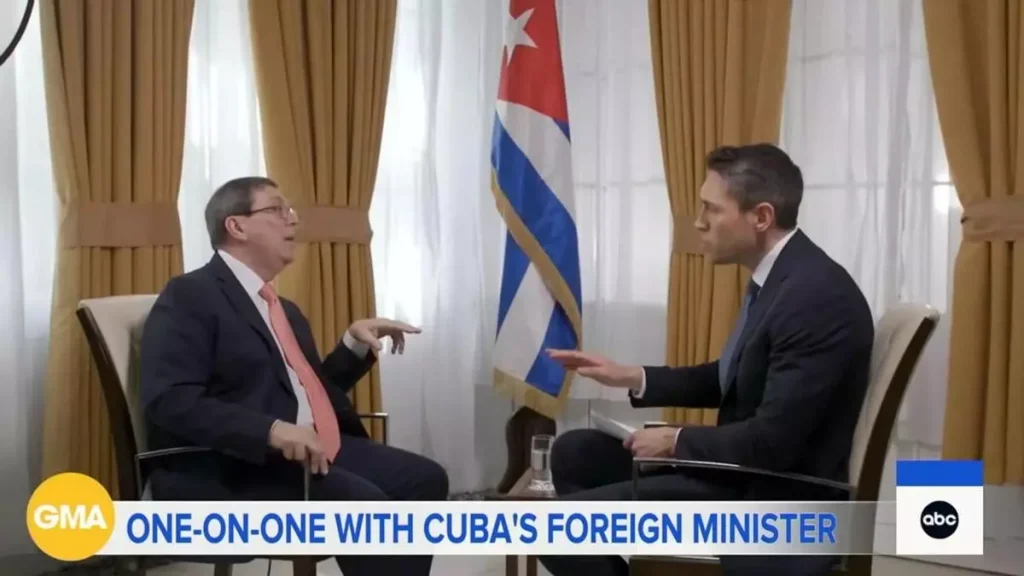
Cuban Foreign Minister Bruno Rodríguez during an interview with Whit Johnson in Havana. / ABC News

14ymedio bigger14ymedio, Madrid, May 11, 2026/ Cuban Foreign Minister Bruno Rodríguez experienced awkward moments in front of ABC News cameras while trying to answer questions about free elections in Cuba, political prisoners, and reforms demanded by Washington.

Rodríguez gave the interview last Thursday in Havana to reporter Whit Johnson, but this Sunday the program Good Morning America highlighted the answers that the foreign minister gave in broken English, when the journalist asked him what changes the Cuban government would be willing to make in the face of pressure from Washington.

The Foreign Secretary, stammering and visibly struggling with the language, managed to reply, “I reject those accusations,” referring to the issues of political prisoners, human rights, and free elections in Cuba. Johnson pressed on: “What do you reject about free elections? It is a single socialist party—essentially, a single family—that has practically ruled Cuba for almost seven decades.”

“Cuba is a democracy, a different kind of democracy.”

Notably nervous, Rodríguez responded that he would return to that topic at another time, maintaining that Cuba “is a country with its own history and its own particularities, and we are a free and independent nation […] but Cuba is a democracy, a different kind of democracy.” Johnson was quick to point out that it cannot be called a “democracy” when there is only one party and a single candidate for whom the population can vote, and asked directly: “What are you worried might happen if there were free elections in Cuba?”

The chancellor hesitated and managed to say: “You are presenting a prejudice.”

Johnson pointed out to viewers that Rodríguez never answered this direct question, which was repeated several times. However, he did answer a question about political prisoners, stating that they “didn’t exist” in Cuba.

In response to Rodríguez’s refusal, the ABC journalist countered by mentioning reports from international organizations and independent monitoring groups that document hundreds of people imprisoned continue reading

for political reasons, including protesters from 11 July 2021: to this day, Prisoners Defenders reports 1,258 prisoners of conscience on the Island.

Bruno Rodríguez asserted that “there has been no progress” in recent talks with the US, and that Washington’s threats would provoke a “bloodbath in Cuba.”

Good Morning America ‘s Cuban-American host, Gio Benitez, noted how “shocking” it was to see a foreign minister responding to those questions in this way. Johnson added that in Cuba he saw the population surviving this desperate crisis on their own and that the citizens he spoke with do want change.

In other fragments from the interview that had been published last Friday, Bruno Rodríguez had asserted that “there has been no progress” in recent talks with the US, and that Washington’s threats were going to provoke a “bloodbath in Cuba.”

The conversation took place amid a new escalation of tensions between Washington and Havana, after the Trump Administration announced new sanctions against the Business Administration Group (Gaesa), the military business conglomerate that controls much of the Cuban economy.

From the outset of the report, ABC described a country exhausted and on the verge of economic collapse: “There is a growing sense of despair and exhaustion here in Cuba, and the government remains defiant.”

______________________

COLLABORATE WITH OUR WORK: The 14ymedio team is committed to practicing serious journalism that reflects Cuba’s reality in all its depth. Thank you for joining us on this long journey. We invite you to continue supporting us by becoming a member of 14ymedio now. Together we can continue transforming journalism in Cuba.

Mexico and Honduras in the Spotlight

Claudia Sheinbaum resists handing over her corrupt officials to the U.S.; in Central America, critics point to the complicity of Nasry Asfura’s new government with Washington’s interventionism

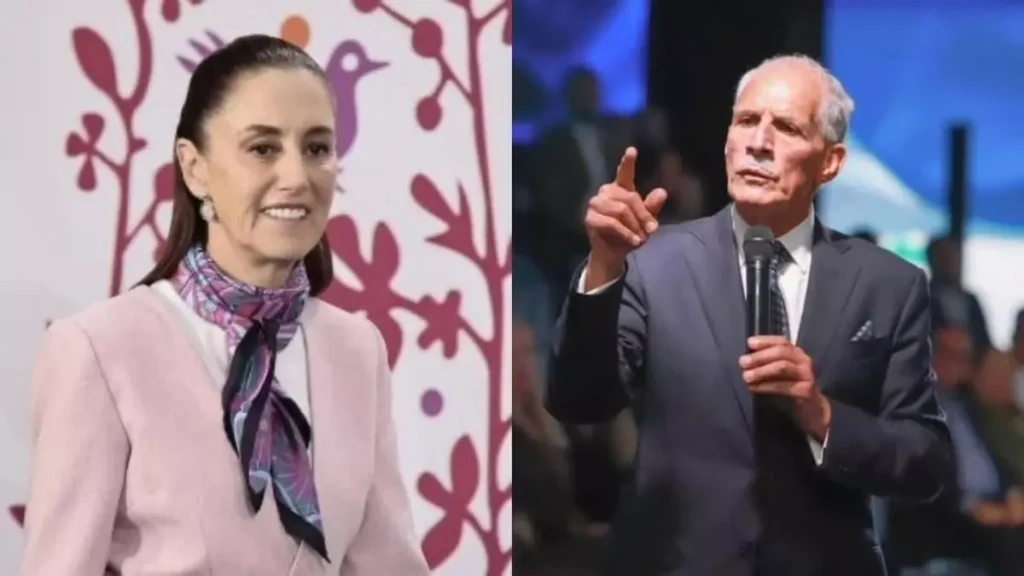
Sheinbaum and Asfura are at the center of the continent’s attention, for different reasons. / Collage

14ymedio bigger14ymedio, San Salvador, Federico Hernández Aguilar, May 11, 2026 — Two enormous scandals are currently shaking Hispanic America: the so-called Hondurasgate, in the country located at the very center of the continent, and the formal request by the United States to Mexico to extradite a group of senior officials from the ruling party, Morena, in the state of Sinaloa. Both cases are of enormous importance and could demonstrate the existence of extensive criminal networks and political clientelism in the region.

Perhaps because the media outlets that have reported Hondurasgate are clearly ideological in the way they handle the news — something I allow myself to point out with the same ease with which those same outlets label opposing media as “conservative” or “far-right” — the revelation of compromising audio recordings involving former president Juan Orlando Hernández and current Honduran president Asfura, along with other public figures in that country, has not had in Central America the impact it should have had. And that is a shame.

A media outlet’s political subjectivity is not sufficient reason to ignore everything it says, especially when it presents evidence. Nor should we be naive and think that large media conglomerates tend toward objectivity by definition. What is regrettable is that ideological tug-of-war intervenes so deeply in journalism that colleagues accuse each other of “pushing agendas,” each forgetting that free expression protects their work and that people themselves, according to their own conscience and education, will reward each outlet with their attention and preference.

A media outlet’s political subjectivity is not sufficient reason to ignore everything it says, especially when it presents evidence

In the case of Hondurasgate, for example, the recordings can be freely heard on the very platform that published them. And it is very difficult to deny the credibility of these 37 leaks. The voices of those involved are there, clear, with their unmistakable tones and inflections. In those exchanges, Hernández and Asfura appear willing to facilitate the installation of a network of U.S. and Israeli interventionism in Honduras, something that would explain why Donald Trump pardoned the former and supported the latter in the most recent presidential election.

Certainly, the shameless way in which the President of the United States supported Asfura at the end of last year’s campaign, almost at the same time continue reading

he released Hernández — sentenced to nearly half a century in prison for drug trafficking crimes — would have a real underlying reason: turning Honduras into a regional hub for systematic interventionism, including electronic surveillance, lucrative investments, political interference, and citizen control.

The matter goes much further and would prove several hypotheses. Former president Xiomara Castro, of course, would like us to buy the thesis that fraud was committed against her party, but the truth is that Libre candidate Rixi Moncada never gained traction in the polls and barely managed a distant third place, with less than 20% of the vote. No. What these conversations reveal is that the old Honduran two-party system, made up of the National Party (of Hernández and Asfura) and the Liberal Party (now in opposition), is susceptible to corruption at the highest level, involving electoral authorities, legislators, businessmen, and even gangs of drug traffickers and hitmen.

From this entire plot there would also emerge a supposed warning to Mexico, because the broader plan allegedly includes the creation of digital structures for attacks and smear campaigns against the “progressive” governments of Claudia Sheinbaum in Mexico and Gustavo Petro in Colombia. There is no doubt that Trump does not sympathize with Sheinbaum, but let us be frank: he does not need any sophisticated machinery to undermine her government. She herself seems willing to do that work without her adversaries even asking. To illustrate this, let us look at the clumsy way the president is handling her own domestic scandal.

In force since 1980, the United States and Mexico have an extradition treaty that stipulates the procedures through which criminals will be exchanged between the two nations. Using this historic bilateral agreement, a formal 34-page indictment issued by a Grand Jury in the Southern District of New York and therefore not subject to manipulation by the White House is now asking Mexico for the arrest and extradition of about ten public officials from the state of Sinaloa.

In force since 1980, the United States and Mexico have an extradition treaty that stipulates the procedures through which criminals will be exchanged between the two nations.

Just as in 2025 other alleged perpetrators of crimes related to drug trafficking, bribery, and organized crime — Ismael ‘El Mayo’ Zambada, the Treviño brothers, or Abigael González, to mention a few — were sent through the same process, today the Mexican Attorney General’s Office should proceed with the arrests of those accused without demanding any additional evidence beyond the indictment itself, because the legal cycle of accusation does not require any further element, since the evidence will naturally be presented during the corresponding trials.

But now Claudia Sheinbaum, instead of taking advantage of the opportunity to rid herself of so many discredited figures, has chosen to wrap herself in the Mexican flag, claiming sovereignty, and with a speed worthy of a better cause has backed the Attorney General’s Office over which she does have influence in demanding proof from its northern neighbor against the officials from her party who are implicated. The scandal threatens to grow and become the Watergate of Mexico’s ruling establishment.

As things appear to be unfolding, simple moral principles may end up being more decisive than stale ideologies. “Left” and “right” are merely labels, wrappers, shells… The old misery of human nature prevails.

Translated by Regina Anavy

______________________

COLLABORATE WITH OUR WORK: The 14ymedio team is committed to practicing serious journalism that reflects Cuba’s reality in all its depth. Thank you for joining us on this long journey. We invite you to continue supporting us by becoming a member of 14ymedio now. Together we can continue transforming journalism in Cuba.

Families of Political Prisoners Pay Tribute to Opposition Figure Who Died in Venezuelan State Custody

The Venezuelan Church demands that responsibilities be determined and joins the recognitions of Víctor Quero’s mother, who searched for him for months.

Families of Political Prisoners Pay Tribute to Opposition Figure Who Died in Venezuelan State Custody

14ymedio biggerEFE (via 14ymedio), Caracas, May 11, 2026 – Families of political prisoners in Venezuela paid tribute this Sunday to Víctor Quero Navas — whose death last year while in state custody was acknowledged this week by the Government after months of searching by his mother — with an activity outside the prison where, according to authorities, he was held.

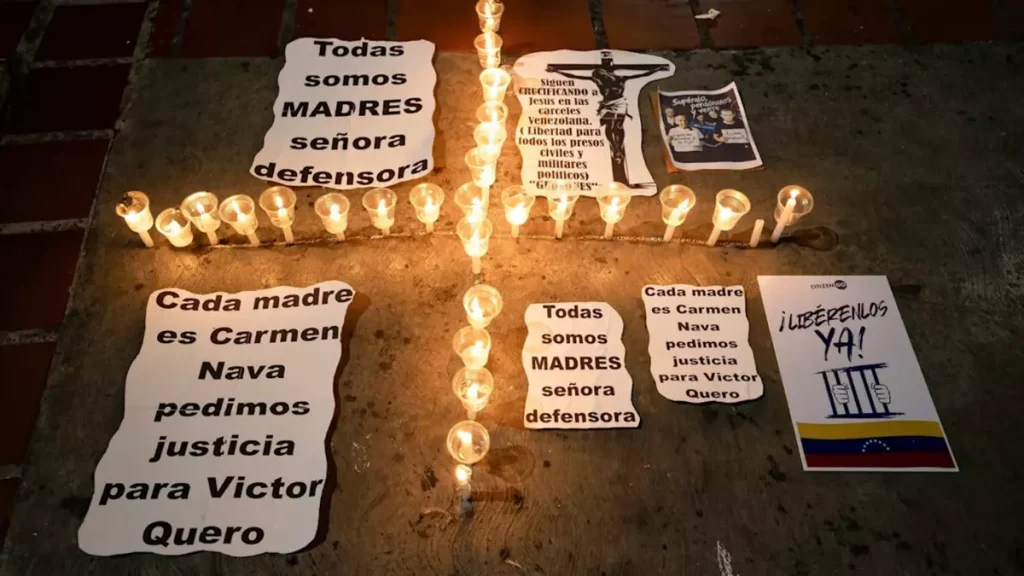
In the vicinity of the El Rodeo I penitentiary center, near Caracas, relatives and activists placed a sign in his memory highlighting that his death occurred “after remaining in forced disappearance since January” of that year.

“His mother searched for him in Rodeo I, but the authorities denied his detention, concealed his death, and destroyed evidence,” the text adds.

Around the sign were small banners with messages such as “Let no one else die in custody,” “Truth for Víctor, freedom for all,” and “No death in custody can go unpunished.”

There were small banners with messages such as “Let no one else die in custody,” “Truth for Víctor, freedom for all,” and “No death in custody can go unpunished”

On the ground they placed a couple of floral arrangements and candles in the shape of a cross, while on another part of the street asphalt they wrote in chalk “Víctor Hugo Quero present,” according to photographs published on X by the NGO Committee for the Freedom of Political Prisoners (CLIPP).

“This May 10, Mother’s Day in Venezuela, the memorial placed in the vicinity of El Rodeo I prison recalls the death in custody and demands justice,” the organization wrote on the social network.

Opposition leader and Nobel Peace Prize laureate María Corina Machado expressed that all Venezuelan women are “one in señora Carmen,” among others who “represent what it means to raise and fight for a child and demonstrate that a mother’s love never surrenders.” “Soon we will all embrace each other, with our families, in freedom,” she said. continue reading

The main opposition bloc, the Democratic Unitary Platform (PUD), greeted all the women who, with “love, strength, and sacrifice, sustain their families and keep alive the hope of a better country,” and made special mention of the mothers of political prisoners, who “face the pain of injustice and separation, but continue giving an example of dignity, fortitude, and struggle for freedom.”

“Special recognition also to the mothers who live with the distance caused by migration, persecution, or the absence of their children, without ever giving up hope,” it added.

The Primero Justicia party demanded “justice for all the mothers who, because of persecution, the search for a better future, or prison, today cannot embrace their children and grandchildren.”

The organization Encuentro Ciudadano asserted that, in Venezuela, being a mother “has also meant resisting, resisting the separation from children who emigrated, hunger, blackouts, uncertainty, and the pain of seeing a broken country.”

In Venezuela, being a mother “has also meant resisting, resisting the separation from children who emigrated, hunger, blackouts, uncertainty, and the pain of seeing a broken country”

“But today, especially, we think of the mothers of political prisoners. Of those women who cannot embrace their children, who travel through courts and prisons seeking justice, who live between anguish and hope. To them, our respect and solidarity,” it wrote on X.

The party asked that this day “not be only a celebration but also a reminder of the debt Venezuela has with so many mothers who suffer in silence.”

For its part, the NGO Venezuelan Prison Observatory (OVP) stated that hundreds of women spend their day “standing in lines outside a prison, while others wake up far from their children, locked in a cell, watching childhood pass behind a visit, a phone call, or a photograph.”

“There are mothers who travel kilometers carrying food and medicine for their imprisoned children, mothers who grow old amid searches, transfers, and institutional silence, mothers like Carmen Teresa Navas who spend months desperately searching for their children while the regime disappears, tortures, or kills them,” it said.

In that sense, it warned that the prison crisis “not only punishes those deprived of liberty; it also breaks bonds, separates families, and condemns thousands of mothers to live amid pain, uncertainty, and absence.”

The CLIPP demanded, on this “Mother’s Day, freedom for their children.” “That is the gift awaited by the mothers who continue outside the prisons. They do not ask for privileges: they demand justice, truth, and a return home,” it added.

The Venezuelan Episcopal Conference (CEV) expressed in a statement its “deep consternation and pain” over Quero’s death and demanded that criminal and administrative responsibilities be determined.

“It is imperative to determine the criminal and administrative responsibilities of those officials who, by action or omission, allowed a young Venezuelan to die in oblivion, without access to his family and deprived of due process,” it stated, and asked the Public Ministry and the Ombudsman’s Office to act “with true autonomy and independence.”

The CEV expressed solidarity with the mother, Carmen Navas, and said that she “personifies the ordeal of so many Venezuelan families.” “Her tireless search, marked by harassment and uncertainty, is a cry that reaches heaven. The Church stands in solidarity with the pain of those who seek the truth amid institutional opacity,” it said.

The CEV expressed solidarity with the mother, Carmen Navas, and said that she “personifies the ordeal of so many Venezuelan families”

In addition, the conference recalled that the State “has the inalienable moral and legal duty to guarantee the life and physical integrity of those deprived of liberty.”

On the other hand, it pointed out as “signs of a lack of transparency and probity” by the authorities that the political prisoner “died in July 2025 while the State provided contradictory information to his family.”

“The fact that his whereabouts were denied in facilities such as El Rodeo I, while he had already died, constitutes an extremely serious breach of public ethics. This deliberate concealment constitutes elements of forced disappearance, a crime that justice cannot and must not ignore,” it asserted.

Regarding the exhumation carried out on Friday, the CEV called for international experts to “validate the findings in order to clarify the truth, determine criminal responsibilities for the forced disappearance, and stop the institutional cruelty that revictimizes” the mother.

With Quero Navas, there are now 27 people detained for political reasons who have died in state custody since 2014, according to the NGOs Justice, Encounter and Forgiveness (JEP) and Provea.

According to an official statement released last Thursday, Quero died almost ten days later from “acute respiratory failure secondary to pulmonary thromboembolism.” The same day, the Ombudsman’s Office requested an exhaustive and independent investigation and the Prosecutor’s Office announced the start of inquiries.

Translated by Regina Anavy

______________________

COLLABORATE WITH OUR WORK: The 14ymedio team is committed to practicing serious journalism that reflects Cuba’s reality in all its depth. Thank you for joining us on this long journey. We invite you to continue supporting us by becoming a member of 14ymedio now. Together we can continue transforming journalism in Cuba.

Spain Allocates Half a Million Euros to Buy Food for the Cuban Population

This money comes from the 375 million euro investment fund created in exchange for forgiving Havana part of its public debt to Madrid.

Cubans shopping at a market stall at 17 and K. / 14ymedio

14ymedio bigger14ymedio, Madrid, May 11, 2026 — The debt conversion program signed between Spain and Cuba ten years ago is being used to donate food to the Island, according to the newspaper El País this Monday. The bilateral committee managing the program authorized last February a 500,000 euro project to purchase food as urgent aid for the population, following the model of an earlier initiative in which agricultural cooperatives in the eastern region supplied schools with food.

The fund — a mechanism in which debt is forgiven in exchange for investment in projects of common interest — has a value of 375 million euros and was signed in 2016, although it was not until last year that an agreement was reached on how to channel the money. In July 2025, the Economy Ministers of both countries signed an agreement stating that the money would be used to finance sustainable development projects in sectors such as energy, water, and food security.

Technically, according to sources from the Secretariat of State for Trade speaking to El País, that money could not be used for current expenses, as this case would be considered. However, the committee decided to authorize it because of the Cuban crisis, aggravated at that time by the recent publication of the executive order through which the U.S. prevents oil shipments to the Island under threat of sanctions.

Cuba’s public debt to Spain amounts to nearly 2 billion euros, most of it originating from the former Development Aid Fund

Cuba’s public debt to Spain amounts to nearly 2 billion euros, most of it originating from the former Development Aid Fund during the 1980s and 1990s, which the European country considers impossible to recover. continue reading

In an effort to resolve the situation, different governments have signed three agreements with the Island, two during the second term of Mariano Rajoy(2015 and 2016) and a third during the first government of Pedro Sánchez (2021).

The first agreement, part of a broader pact with the Paris Club, was signed in November 2015 and consisted of a short-term debt restructuring agreement worth 201 million euros, of which 110.8 million were forgiven. Another 40 million were used to create a counterpart fund that provides grants to Spanish companies investing in Cuba for their local currency expenses. In March 2024, Spain reported that the fund had almost been fully used.

In 2016, the second agreement was signed, valued at 2.242 billion euros in medium- and long-term debt. Of that amount, 1.492 billion euros were forgiven, and another counterpart fund of 375 million euros was organized: the one now being used to donate food. The last agreement, signed in 2021, involved a reorganization of payments without debt forgiveness.

Although the decision to activate this first 500,000 euro project was made last February, El País notes that this mechanism could continue to be used, becoming an option for donating aid to the Island. On April 19, Prime Minister Pedro Sánchez, Brazilian President Luiz Inácio Lula da Silva, and Mexican President Claudia Sheinbaum signed a statement at the summit held in Barcelona calling for ways to cooperate in resolving the crisis in Cuba.

“We express our enormous concern over the grave humanitarian crisis facing the Cuban people and call for the adoption of the necessary measures to alleviate this situation and avoid actions that worsen the living conditions of the population or are contrary to international law,” the text stated.

However, private companies owed money by Cuba are not pleased, according to the newspaper. The amount of debt was estimated at around 350 million euros owed to 300 companies, according to the Catalan organization Fomento del Trabajo Nacional, although El País speaks of 316 million euros claimed by about 200 companies grouped in the Platform of Those Affected by Non-Payment by the Cuban Government.

‘El País’ speaks of 316 million euros claimed by about 200 companies grouped in the Platform of Those Affected by Non-Payment by the Cuban Government

This group, made up of 50% companies from Catalonia and 20% from the Basque Country, has criticized the move while also considering that there has been inactivity when it comes to demanding payment of the private debt from the Cuban Government. On May 5, the Senate debated a motion urging the Executive Branch to implement measures “that help Spanish companies working or trading with Cuba to collect outstanding amounts owed by the Cuban Government and Cuban state companies.”

The initiative received support from the People’s Party, a center-right opposition party with a majority in that chamber, and Catalan and Basque nationalist parties (Junts and PNV, allies of the Government), while all others abstained. During that session, the spokesperson for the Socialist Party argued that the Government pressures the Cuban state to pay but cannot use public funds to cover private defaults.

“The Secretariat of State for Trade constantly monitors the situation through the debt survey prepared by the commercial office and has made numerous claims before Cuban authorities on behalf of those companies,” he explained. “The commitment to ending non-payment by the Cuban Government is total. What we cannot support is the payment of compensation by the Spanish state as a consequence of commercial operations between private companies and the Government of Cuba. Public spending cannot be allocated to items not authorized by law.”

As a result of that session, the motion was approved, urging the Government to quantify the private debt, develop a plan to defend the interests of companies, study liquidity support instruments for affected businesses, and bring the situation before the competent bodies of the European Union in order to adopt a joint position demanding from “the Cuban Government legal certainty, respect for contracts, verifiable payment mechanisms for European companies, and real progress in freedoms, human rights, and the rule of law.”

Translated by Regina Anavy

______________________

COLLABORATE WITH OUR WORK: The 14ymedio team is committed to practicing serious journalism that reflects Cuba’s reality in all its depth. Thank you for joining us on this long journey. We invite you to continue supporting us by becoming a member of 14ymedio now. Together we can continue transforming journalism in Cuba.

A Mother’s Day Without Flowers or Gifts

“This year, the only thing I can buy for the mothers in my family is a bar of bath soap for each of them,” Dianet admits with a mixture of shame and resignation.

Mother’s Day seems to have become more of an exercise in economic survival than a celebration. / 14ymedio

14ymedio bigger14ymedio, Julio César Contreras, San José de las Lajas (Mayabeque), May 9, 2026 / Gone are the days of making the bed with the best sheets available and placing gifts for Mom on it every second Sunday of May: perfume, a housecoat, new slippers, or a box of chocolates that remained untouched until after the family lunch. In San José de las Lajas, just days before the second Sunday of May, Mother’s Day seems to have become more of an exercise in economic survival than a celebration.

“This is what we have left of the little money my son sent from abroad,” says 74-year-old Georgina, clutching a debit card with barely nine dollars remaining. In front of her, the shelves of the La Época store display the same familiar scene: packages of detergent, bottles of shampoo, napkins, spaghetti, and a few imported soaps with prices that seem out of this world. The retiree scans the shelves again and again as if, by persisting, a miraculous sale might appear. But no. “It’s vanished like smoke, and we’ve barely bought anything, and there’s a holiday coming up that we should be celebrating.”

Inside the store, the air conditioning is only partially working, offering little resistance to the humid heat that seeps in from the street. Leaning against the cash registers, the clerks chat about the power outages, the price of rice, and the latest blackout in Jamaica, the outlying neighborhood where many have built makeshift homes of concrete and asbestos cement. No one mentions Mother’s Day promotions. There are no plastic flowers, no pink ribbons, not even a hastily written sign with a marker saying “Happy Mother’s Day.” Everything feels as cold as a government office.

“All the stores have the same old things, with the same exorbitant prices.”

“All the stores have the same old things, with the same exorbitant prices,” Georgina complains. She does mental calculations as she looks at a product priced at $2.50. If she buys that for a granddaughter who just gave birth, then her daughter and niece will be left with nothing. “Pensions are around five or six dollars a month, and here any little thing costs half of that,” she laments. continue reading

Inflation has blurred the lines between necessity and sentimentality. / 14ymedio

Among the customers is Dianet, recently arrived from Palma Soriano and now living in a llega y pon [‘shanty town’] on the outskirts of town. She walks with a small child in tow and an impossible list running through her head: soap, deodorant, something for her mother in Oriente, and, if she can afford it, a little something for her cousins ​​and sisters who live nearby. “This year, the only thing I can buy for the mothers in my family is a bar of soap each,” she admits with a mixture of shame and resignation.

As she speaks, an elderly woman examines packages of toilet paper as if appraising fine jewelry. In another corner, two young women argue about whether it’s worth spending seven dollars on shampoo or buying better cooking oil. Inflation has blurred the lines between necessity and sentimentality. A bottle of cologne can cost several days’ worth of food; a simple postcard, if it were to appear, would be almost a luxury.

“A one-way ticket costs 5,000 pesos. Instead of celebrating Mother’s Day, we’re living in times of hardship.”

For Dianet, going into a dollar store is reminiscent of the story of Martina the Cockroach: choosing between too many necessities with barely a few coins in her purse. “Before Friday, I plan to send my mom a money order for 200 or 300 pesos,” she explains. A trip to the East is out of the question. “A one-way ticket costs 5,000 pesos. Instead of celebrating Mother’s Day, we’re living in times of hardship.”

In the private shops downtown, the scene isn’t much different. The shop windows display bottles of rum, packets of coffee, a few imported sweets, and small perfumes that look like relics. The prices, however, are shocking. Twelve dollars for a modest fragrance, almost ten for a body cream, more than 1,000 pesos for a mug decorated with artificial flowers.

Aimé, a worker at the Banco Popular de Ahorro and a new grandmother, has spent days visiting state-run stores and micro-enterprises without making a decision. “I can’t spend $12 on perfume for my daughter, and besides, giving her spaghetti or condensed milk seems tacky for this occasion,” she says. She’s looking for something “that she’ll like and that will be useful,” a combination that has become almost impossible in today’s Cuba.

“A picture postcard accompanied by another item would be a decent gift,” she adds, while looking at some patterned napkins that she might end up buying for lack of alternatives. “But there aren’t even any postcards. Sometimes it’s better not to go into these places, because you leave empty-handed and disappointed.”

Outside, in the central park, a few artisans are trying to salvage the season by selling crocheted flowers, inexpensive jewelry, and varnished wooden frames. Several women stop, ask prices, and continue walking. Most are silently calculating their cash.

______________________

COLLABORATE WITH OUR WORK: The 14ymedio team is committed to practicing serious journalism that reflects Cuba’s reality in all its depth. Thank you for joining us on this long journey. We invite you to continue supporting us by becoming a member of 14ymedio now. Together we can continue transforming journalism in Cuba.

The US Is Openly Increasing Its Military Flights Near Cuba, as a Warning

CNN documents at least 25 missions since February in the vicinity of the island in a pattern similar to that observed before the intervention in Venezuela

MQ 4C Triton, one of the surveillance drones detected in the vicinity of Cuba. / CC

14ymedio bigger14ymedio, Madrid, May 10, 2026 / At least 25 US military flights have been detected near Cuba since February 4, according to a CNN investigation based on open air tracking data and publicly available flight records. The network maintains that the pattern of operations appears to have been deliberately made visible in the context of increased tension between Washington and Havana.

The investigation documents military and intelligence flights around the island, most concentrated in the vicinity of Havana and Santiago de Cuba, some less than 64 kilometers from the coast. In comparison, the US conducted “only a few intelligence flights” of this nature near the island in 2025.

All the routes were identified using open platforms such as Flightradar24 and ADS-B Exchange , commonly used to track civil and military air traffic. “This occurs even though the aircraft involved have the ability—if they so choose—to conceal their presence by turning off their location beacons,” CNN notes.

CNN reports that “similar patterns, in which increased rhetoric from the Trump administration coincided with an increase in publicly visible surveillance flights, occurred before US military operations in both Venezuela and continue reading

Iran.”

The aircraft involved have the capability – if they so choose – to conceal their presence by turning off their location beacons.

The public exposure raises the question of whether the US is deliberately sending a signal about the presence of these aircraft to its adversaries. Regardless of whether this signal is intentional or not on the part of the US military or government, the message has triggered nervousness among Cuban officials and the public.

On social media, Cuban users are sharing reports of US surveillance flights and fueling growing concerns about a military intervention, like the one that took place on January 3 in Venezuela.

Most of the operations involved P-8A Poseidon aircraft, used by the US for maritime surveillance and reconnaissance missions. An RC-135V Rivet Joint, an aircraft dedicated to electronic intelligence gathering and interception, was also detected, as well as several MQ-4C Triton drones, used for high-altitude aerial observation.

These surveillance flights coincide with a context of growing verbal and political confrontation between Washington and Havana. Recently, the Trump administration has tightened sanctions against the regime and even hinted at intervention scenarios , although sources cited by The Associated Press (AP) have denied that the White House is planning a military operation in Cuba.

Independent of whether that signal was intentional or not on the part of the US Army or Government, the message has triggered nervousness among Cuban officials.

For its part, the Cuban regime has intensified its rhetoric of defending the “homeland”—or, what amounts to the same thing for them, the political system in place on the island—”to the death,” through the so-called “war of the whole people” strategy. However, despite the intense state campaign to demonstrate supposed popular support, public opinion—reflected in the results of the recent independent poll conducted by El Toque —does not appear to back the government.

CNN adds that the operations have been constant since February 4, the date on which Cuban Deputy Foreign Minister Carlos Fernández de Cossío gave an interview to the network in which he stated that Havana was willing to talk with Washington, but ruled out any discussion about a change of political system.

______________________

COLLABORATE WITH OUR WORK: The 14ymedio team is committed to practicing serious journalism that reflects Cuba’s reality in all its depth. Thank you for joining us on this long journey. We invite you to continue supporting us by becoming a member of 14ymedio now. Together we can continue transforming journalism in Cuba.