
After the Castros, What Will Happen in Cuba?

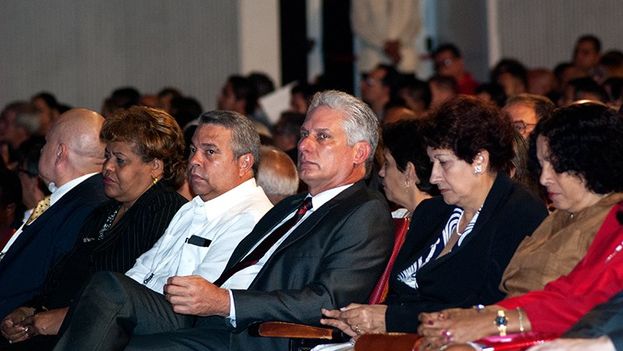
Miguel Diaz-Canel, 57 years old, is an electronics engineer by profession and comes to the presidency on the recommendation of José Ramón Machado Ventura. (@ Universided2018)

14ymedio bigger14ymedio, Carlos Alberto Montaner, 1 April 2018 — Raúl Castro leaves the presidency of the State Council to Miguel Díaz-Canel on Thursday April 19.

Officially, Cuba has a government appointed by the Parliament. Actually, the government is a family dictatorship, but the president is legally elected by a small leadership group (the State Council), seemingly segregated by the National Assembly of People’s Power (the Parliament), in which everything – supposedly – is carefully prearranged. Some opposition groups tried to nominate a few candidates, but it was impossible. Not even one was allowed. You do not play with tyranny.

Díaz-Canel (D-C) is a 57-year old electronics engineer and becomes president thanks to the recommendations of José Ramón Machado Ventura, a doctor who for many years oversaw the Communist Party and enjoys Raúl Castro’s total confidence. In that far from artificial division between fidelistas (Fidel Castro’s followers) and raulistas (Raúl Castro’s followers), D-C is a raulista, selected, in the first place, by his characteristics: he is a discreet pragmatic apparatchik who does not like innovations, a trait well regarded by inquisitors of all times. continue reading

A few months ago, Cuban State Security circulated a supposedly leaked video, in which D-C recited a very conservative collectivist catechism, conceived for three purposes – to engage the heir with those reactionary positions, to reassure the small group of Stalinists around Raúl, and to downgrade Cuban society’s multiple expectations of reform, so that no one is excited about the change. The Leopard’s formula maintains its validity in Cuba – if we want things to stay as they are, things will have to change.

What does Raúl Castro intend to do with this non-change? He intends to make possible the inevitable arrival to power of a new generation, born after the triumph of the Revolution (D-C is a 57-year old “kid”), but with the condition that they don’t make substantial changes to the regime created by his brother Fidel and a handful of henchmen. Like all dictators, Raúl would like time to stop in the moment in which he and his brother won a place in history. Simultaneously, he tries to assure his family and his friends that fate will be benevolent with them when he is not there to guarantee it. After all, he will be 87 years old very soon.

Is all that possible? Of course not.

All the conditions are in place for a change of regime to occur. First, the feeling of failure is widespread. The system’s lack of productivity is overwhelming. None of the parameters of a minimum quality of life resists the slightest analysis: housing, electricity, transportation, food, drinking water, clothing. Cuba has regressed in almost all aspects of existence. Adding to those problems are the constant fear, the absence of rights and the unpleasant need to lie, a need all Cubans have in order to survive in a totalitarian society. Living in Cuba is not pleasant neither materially nor emotionally. That’s why young people dream of leaving the country.

When will the regime change begin? The first step is when D-C becomes president. Although he repeatedly swears that he will be loyal to the Castros’ legacy, and even if he believes he will, the administrative environment of the country and society as a whole would like a radical transformation as soon as possible. What does this transformation consist of? Essentially, it would free the nation’s productive forces, unleashing the hands of entrepreneurs so they are able to create and accumulate wealth, invest and be powerful, even if the superstition of egalitarianism ends up impoverished.

The idea of a central economic nucleus, managed by the state and administered by the military, with around 2,500 companies that generates foreign currency, lacks spontaneity, flexibility and is a sure path to the disaster that lies in the accounting records, as audits have demonstrated. The model of Castro’s “guidelines” does not work. The idea of a private self-employed sector dedicated to serving the state as a taxpayer and as an employer of supernumerary workers that pay taxes is foolish.

After 60 years of nonsense Cubans know that there is no substitute for the market, economic freedom and private property. They also know that, despite its imperfections, the only system which can guarantee the organized transmission of authority, and that can be purged and transformed without violence, is the state under the rule of law that emerged from the Enlightenment, either as a republic or as a parliamentary monarchy. That’s the only way, even if D-C is against it. That’s the way of history.

Note: Translation is from the Latin American Herald

______________________________

The 14ymedio team is committed to serious journalism that reflects the reality of deep Cuba. Thank you for joining us on this long road. We invite you to continue supporting us, but this time by becoming a member of 14ymedio. Together we can continue to transform journalism in Cuba.
“I Knew That Killing Fidel Castro In A Play Was My Social Suicide”

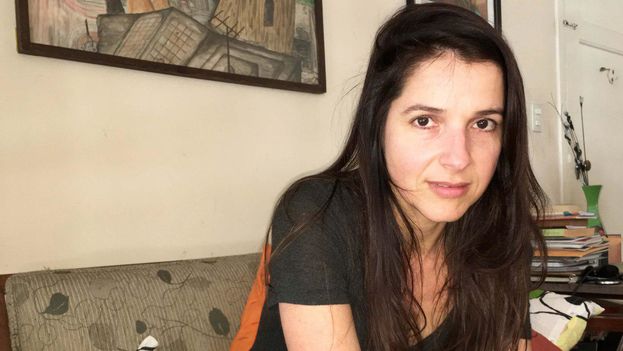
Lynn Cruz says she was recently denied access to a workshop at the San Antonio de los Baños International Film School and the Actuar agency stopped representing her. (14ymedio)

14ymedio bigger14ymedio, Luz Escobar, Havana, 10 April 2018 – She was a “vanguard Little Pioneer” in her childhood, later earned a degree in Geography, and now Lynn Cruz has ended up an independent and censored actress. Born in Havana, in 1977, but raised in Matanzas, the actress is convinced that State Security is determined to end her artistic career.

Cruz says she was recently denied access to a workshop at the San Antonio de los Baños International Film School and the agency Actuar has stopped representing her, without explaining a single reason for the rebuff. All this comes after the artist participated in several creative projects that disgusted the cultural authorities.

“After everything that has happened to me, I feel more free,” says the artist. Last November, harassment by State Security blocked almost the entire audience from attending the staging of her work The Enemies of the People in an alternative space, an event that was preceded by her participation in the exhibition of the documentary Nadie, inspired in the officially damned poet Rafael Alcides. continue reading

Long before arriving at her current situation, Cruz worked for television in detective shows and her face is known to moviegoers through films such as Larga Distancia and La Pared. A few months ago, when she had not yet become a radioactive actress, she finished filming Eres tu papá, a film yet to be released.

Lynn Cruz recently responded to a few questions from 14ymedio.

Luz Escobar. How has your professional life changed since you are under the eyes of the authorities?

Lynn Cruz. Now I am in a limbo. They are erasing me little by little to make me into a non-person, which is a way of using me to teach a lesson to others. State Security goes around to all the places to let them know that they are deleting the files and now, if a director requests my work through an agency, they can tell him that I am not in the country or they can say directly that I am a ‘mercenary’ [in the pay of the “empire”, i.e. the United States].

Escobar. What were the first signs that something like this was coming?

Cruz. Since I made The Enemies of the People I knew all this could happen, but it is not the same to imagine the outrage as to be outraged. I can’t live worrying about the consequences of my actions, I simply take action because at that moment I am convinced. I did that work because since I started researching the sinking of the 13 de Marzo tugboat (1994) and I heard the testimony of María Victoria García Suárez, who lost her 10-year-old son, I felt the duty to do something with that.

For the actor it is possible to evade censorship because she is interpreting what someone else wrote and the censors are always searching for the author. However, in this piece I also became an author, which implies a greater responsibility. I came to writing because most of the time I am an unemployed actress and that is the way to release the things that happen to me.

Escobar. Have you received any signs of solidarity since the censorship?

Cruz. Most of the actors did not know what was happening and many people of my generation have gone to live outside of Cuba. I can’t say that I felt either antipathy or sympathy because it was as if it had not happened. When I talked about it, some people looked surprised because they could not believe that I had killed Fidel Castro in a play.

I knew that by doing so I was performing my own social suicide.

Escobar. Does your acting career end here and now?

Cruz. I’m working with Lía Villares and Luis Trápaga on the work Patriotismo 3677, a work I wrote a while ago where I take a tour of prisoners of conscience of these 60 years. It has testimonies from Sonia Garro, Maria Elena Cruz Valera, Nestor Diaz de Villegas and other writers of the diaspora. It is the way I have found to maintain hope and to be able to continue living in Cuba even in the midst of these situations that I am facing.

__________________________

The 14ymedio team is committed to serious journalism that reflects the reality of deep Cuba. Thank you for joining us on this long road. We invite you to continue supporting us, but this time by becoming a member of 14ymedio. Together we can continue to transform journalism in Cuba.
Vietnamese Leader Calls on Cuba to Develop Its Market Economy

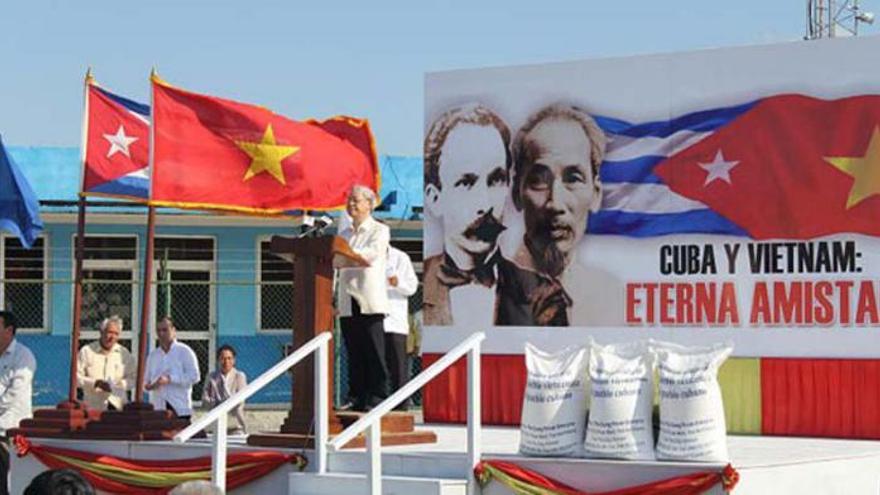
Leader of the Vietnamese Communist Party, Nguyen Phu Trong (Twitter).

14ymedio bigger14ymedio (with contributions from other news outlets), 28 March 2018 — The leader of the Communist Party of Vietnam (PCV) urged Cuba to follow the path of reform in order to develop its economy and “maintain socialism.” On a visit to the island, Nguyen Phu Trong explained during a lecture in the main auditorium of the University of Havana that, thanks to the implementation of the market economy in 2001, more than thirty million Vietnamese have emerged from poverty.

“In and of itself, the market economy itself cannot destroy socialism. But to successfully build socialism, it is necessary to develop the market economy properly and correctly,” said the top leader of the PCV.

Attending the conference was the first vice-president of Cuba, Miguel Díaz-Canel, considered by many analysts as the political heir of Raúl Castro, who is expected to resign from power on April 19. continue reading

Since 2008 Castro has launched a series of structural reforms, referred to officially as “guidelines”, whose purpose is to advance the planned and centralized Soviet-style economic system. However, changes have slowed in recent years and in 2007 the government announced a freeze on new buisness licenses for more than twenty designated fields of self-employment.

The person in charge of the reforms, Marino Murillo, has said that undertaking these changes has generated more mistakes than benefits.

“We are aware that the market economy is the result of human sensitivity and that it can coexist and adapt to differences in social constructs,” said the Vietnamese leader, who will meet later with Raúl Castro.

On Thursday, Havana handed over administrative control of the Mariel Special Development Zone (ZEDM) to the Vietnamese company ViMariel S.A., the first time it has done so to an entirely foreign-owned and funded company. The Asian company will develop infrastructure for the Mariel project.

The agreement will remain in force for fifty years and, starting in 2019, the company will develop a 160-hectare industrial park. ViMariel will provide communication services and facilities as well as power and hydraulic networks to investors.

ZEDM is a project developed by the Brazilian company Odebrecht thanks to a loan of more than 900 million dollars extended under the presidency of Luiz Inácio Lula da Silva. The industrial zone is intended to generate opportunities for growth and foreign investment in Cuba, but several economists lament the low indicators for the company. Of the thirty-four projects approved to operate in the area in the last five years, only ten are in operation.

ViMariel, a subsidiary of the Vietnamese Viglacera S.A., can recruit and propose new clients for the Special Zone, according to the zone’s project director, Ana Teresa Igarza.

Igarza signed the cooperation agreement along with the director of Viglacera, Nguyen Anh Tuan, at the Cuba-Vietnam business forum. Also present was Cuba’s minister for foreign trade, Rodrigo Malmierca, and his Vietnamese counterpart, Tran Tuan Anh.

The Cuban official, who expressed the island’s desire to attract investors in the fields of logistics, biotechnology, pharmaceuticals, electronics and manufacturing, said that the country is working on similar agreements with other companies to accelerate the development of ZEDM’s infrastructure.

On Monday a factory financed with Vietnamese capital was opened in Mariel. It will produce sanitary pads and disposable diapers.

After China, Vietnam is Cuba’s second largest trading partner in Asia. Trade between the two countries reached $220 million last year and is estimated to reach $500 million by 2020.

_______________________________

The 14ymedio team is committed to serious journalism that reflects the reality of deep Cuba. Thank you for joining us on this long road. We invite you to continue supporting us, but this time by becoming a member of 14ymedio. Together we can continue to transform journalism in Cuba.
Concerning When We Ate Cats in Cuba / Iván García

Iván García, 7 April 2018 — “I was born during the Special Period, in 1990. Twenty years later, my parents told me the truth: my birth brought them to tears,” says Ricardo, today a university graduate.

I can understand that. In my house, too, we went through difficult times when my sister gave birth during the height of the “Special Period in Times of Peace.” As ostentatious as that was the official name given to one of the blackest intervals suffered in 59 years by the Cuban people–and that is saying a lot.

An old proverb says that a child comes into this world with a loaf of bread under his arm. But in the 90s, to have a child in Cuba meant the opposite: to lose an arm, if not both, just to get a piece of bread. continue reading

The story of this war-without-cannon-blasts could fill multiple tomes. In 2018 the mere mention of the Special Period to a Cuban is enough to send shivers down his spine.

The first time I had any notion of the “Special Period” was in the summer of 1989. Upon inaugurating an AKM rifle manufacturing plant in Camagüey, Fidel Castro made mention of what we would be facing. Later, during a function at the Karl Marx theater in Miramar, he half-jokingly told the women in attendance, “Take good care of your wardrobes–you’ll need them in the coming years.”

The people on the Island never lived abundantly. There was always a shortage of something. Besides holding back individual liberties (about which those of us born after the Revolution had no concept), Father State guaranteed to each of his citizens a poor life, but a dignified one. Thanks to the petroleum pipe from Moscow.

Prior to that silent war, we could buy two pairs of pants a year, three shirts and one pair of shoes, with a ration book for “industrial products.” These were paid for in Cuban pesos, the national currency.

The ration book for groceries back then was more generous. Nothing to write home about, but less emaciated than in later years. There were foodstuffs for sale in unregulated venues. At the dairy stores, boxes with bottles of fresh milk, yogurt containers, and cheeses would be delivered at dawn, and nobody even entertained the thought of stealing them.

That was in the 70s or 80s. Back then we could not imagine the “surprise” that the olive-green* socialism had in store for us. It was terrible. People dropped weight as if they were going to a sauna every day. We were always hungry. Lines would form for half a day to buy pizza topped with boiled potato instead of cheese.

Starving and toothless old people would jam into the little cafés just to down a kind of infusion made with orange or grapefruit rind. As for animal products, you can only imagine. Culinary monstrosities appeared. The state laboratories hastily churned out soy hash, “meat” mass, oca pasta, and fricandel [a kind of “mystery-meat” hot dog], among other horrible inventions.

The dollar was prohibited, and what few valuable items there were, people would sell to afford food. When in July 1993 the dollar was decriminalized, my mother sold her record collection of Brazilian music for $39.

Others sold their furniture or exchanged it for a pig, which they would hide in the bathtub. It became fashionable to breed chickens on balconies and roofs. Many cats ended up in pots, in place of rabbits.

Exotic diseases appeared, such as polyneuritis, optical neuritis, and beriberi. On the streets, more than one person dropped like a fly from locomotive deficiencies. Public transportation disappeared and in its place emerged horse-drawn wagons, which are still functioning in rural towns. Tractors were replaced by ox-pulled plows.

The bicycle became the official vehicle of the people. The top brass, of course, continued getting around by car. There was serious talk about Option Zero, a plan to have army troops go though neighborhoods giving out food.

What prevented people from starting to die off in massive numbers from hunger, and Cuba becoming the North Korea of the Caribbean, were the measures adopted by Fidel Castro. Venturing far from socialist philosophy, and taking a liberal and market economy approach, the government allowed small business start-ups. The possession of hard currency was legalized.

All of this proved effective. Hundreds of citizens were able to progress, and the government stashed millions of dollars into its coffers.  But in 2009, a real crisis emerged that affected the entire planet. Facing a worldwide drop in oil prices, coupled with internal instability and squandering, Hugo Chávez–the new ally–whispered a message to the Castros: “I am running out of cash.” The Brothers from Birán** took the hint. And they started proclaiming the same decades-old speech they have sold to the Cuban people: Savings must be made. The belt must be tightened. One more time.

And so we go. In the midst of a storm. Without umbrellas. With an economy that is taking on water. And with foreign partners who view the regime with distrust for the absurdity of its investment laws and the dishonesty of its dealings. With thousands of Cubans leaving the country or trying to leave, to go anywhere, tired as they are of the aged government, and never forgetting the crude reality of the Special Period when in Cuba we ate cats.

Translator’s Notes:

*A reference to the color of the combat fatigues worn for years by Cuba’s top echelon of leaders. This epithet is often used by dissident Cuban writers when alluding to the Cuban government, its socio-political system, and its bureaucrats.

**A reference to the town in eastern Cuba that is the birthplace of Raúl and Fidel Castro.

Translated by: Alicia Barraqué Ellison

Cuban Government Disembarks in Lima "With Everything"

Cuba’s official delegation represents, according to the official press, the true civil society of Cuba. (Granma)

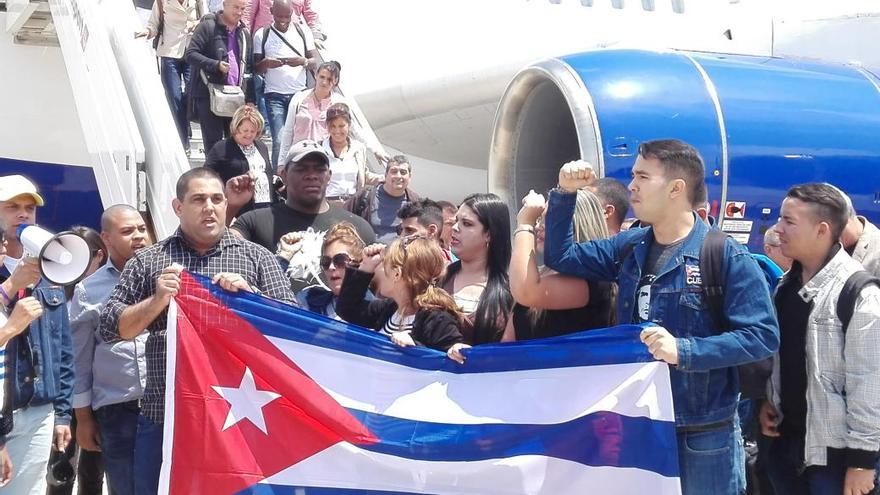
14ymedio bigger14ymedio, Havana, 9 April 2018 — The official Cuban delegation that landed this Sunday in Lima, Peru, to participate in the events parallel to the VIII Summit of the Americas, is composed of almost a hundred individuals who will carry out an intense public agenda. In contrast to this pro-government group, independent activists on the Island have been prohibited from traveling.

Under the slogan “Don’t Mess With Cuba,” representatives of several organizations that include the National Union of Cuban Jurists (UNJC), the Hermanos Saíz Association and the Federation of University Students (FEU) departed from Havana’s José Martí International Airport this weekend.

Their arrival on Peruvian soil was widely covered by the Island’s official media, which stresses that these groups make up the “true civil society” and they “will not accept provocations” by “mercenaries” or figures with “terrorist links” that “try to usurp” the name of Cuba. continue reading

Travel bans against activists, dissidents and independent journalists have been increasingly applied in recent days, although the national press has not offered any information about this. All those affected have received a single response from immigration without further explanation: they are “regulated.”

On Saturday, the activists Juan Antonio Madrazo Luna and Marthadela Tamayo González, both members of the Citizens Committee for Racial Integration (CIR), were denied the freedom to leave the country, even though they had been invited to participate in the Universal Periodic Review session in Geneva, Switzerland, a United Nations effort that reviews the status of human rights in all member countries.

The independent journalists Ileana Álvarez and Pedro Manuel González, as well as the musician Gorki Águila and the playwright Adonis Milán, were also faced with a similar situation a few days ago. None of them was given any explanation for their being forced to remain in Cuba, but everyone suspects that the authorities feared they were intending travel to participate in the events in Peru.

The strategy to prevent independent civil society from participating in the meetings in Peru differs on this occasion from that used in the previous Summit of the Americas, held in Panama in 2015. On that occasion a representation of activists was able to arrive at the event, but once in Panama was subect to several acts of repudiation — ranging from physical attacks to being shouted down and prevented from speaking — carried out by the government’s official “independent groups.”

This April, the Plaza of the Revolution seems to have opted to reduce to a minimum the presence in Peru of any dissidents currently living on the Island, while simultaneously launching an intense media campaign against the exile groups that are planning to participate in the civil society forums that will take place between April 10 and 12.

The national media have not confirmed whether Raúl Castro will travel to Lima to be part of the Summit, the second to which the Cuban government has been invited. The event is being held just one week before the announced transfer of power in Cuba, with a new president scheduled to be appointed on 19 April.

In the pro-government delegation, some faces stand out, such as Iroel Sánchez, a hard-line political commissar who runs the blog La Pupila Insomne (The Insomniac Pupil)He was president of the Cuban Book Institute and coordinator of EcuRed, an official version of a Wikipedia-like site for Cuba that can be consulted online and made available in the Island’s Young Computer Clubs.

Sánchez is known for his positions against political “centrism” and his criticism of the independent press. In his opinion, Peru is a battlefield in which “two visions are going to face off.” On one side are the “integrationist processes such as CELAC” and on the other is “the hegemonic vision of the United States” over the region.

Another one of the prominent names is the one of Yamila González Ferrer, vice-president of the National Union of Cuban Jurists. The lawyer first gained visibility during the Hemispheric Dialogue held in Havana in March, when she said that “Cuban civil society will not share any space with mercenary elements and organizations.”

At the Summit of the Americas in Panama, which was attended by Raúl Castro, the then adviser to the president of the Councils of State and of Ministers, Abel Prieto, who led several of the shock groups that insulted the representatives of independent groups, stood out. A short time later he was appointed Minister of Culture, a position he had held previously.

Something similar happened with the psychologist Susely Morfa who starred in several altercations against dissidents and issued fiery statements before the microphones of the international press convened in Panama. After her performance she was promoted to the general secretariat of the Young Communists Union (UJC) and became deputy to the National Assembly of People’s Power and a member of the Council of State.

 ____________________

The 14ymedio team is committed to serious journalism that reflects the reality of deep Cuba. Thank you for joining us on this long road. We invite you to continue supporting us, but this time by becoming a member of 14ymedio. Together we can continue to transform journalism in Cuba.
Cuban Young Filmmakers Exhibition Gives Award to Director Criticized by Government

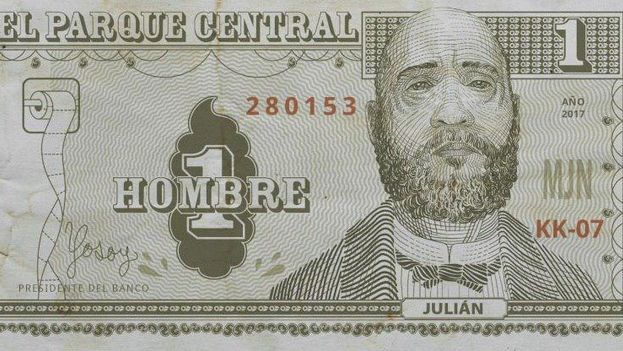
Poster for the short film ‘Eternal Glory’.

14ymedio bigger14ymedio, Luz Escobar, 9 April 2018 — After the controversy arising from the exclusion of Yimit Ramirez’s film I Want To Make A Movie from the Young Filmmakers Exhibition, on Sunday Ramirez won the prize for the best fictional film for his short Eternal Glory, a work that reflects on the historical myths in a totalitarian society.

The short, starring the actors Lynn Cruz and Mario Guerra (who play the characters Haydée and Julián), addresses the sanctification of heroes, which is the same subject that led the censorship of Ramirez’s feature film, which the authorities considered “disrespectful of José Martí.”

Yimit Ramirez’s work has been at the center of the debates and comments in this year’s Young Filmmakers Exhibition, an event focused on promoting film creation among young people under the age of 35. In recent years the event has been marked by several scandalous episodes of censorship and exclusion. continue reading

The Exhibition awarded the prize for Best Documentary to two films “on equal terms”: The Dogs of Amundsen, by Rafael Ramírez, which also won for Best Director and the Best Original Music, and Music of the Spheres, by director Marcel Beltrán.

The mentions in that category were awarded to the directors Daniela Muñoz for What Remedy? The Parranda, and Adriana Castellanos for Two Islands.

The Special Jury Prize went to Alejandro Alonso for his documentary work The Project, which is a nod to “cinema within cinema.” The peculiar script, through pure photography and without a single word of dialogue, narrates a story that mixes fiction and reality and begins when the young director tries to film inside high schools and boarding schools in the countryside but the authorities deny him access.

With the thread of the prohibitions and obstacles that appear in the way of any film project, Alonso manages to convey the states of uneasiness, doubt and commitment that the filmmaker goes through in order to complete his dream.

With that same work, Lisandra López won for best script, while the Best Animation award recognized the work Mamiya CR7, by Danny de León and Eisman Sánchez.

Parallel to the exhibition, the Cuban Association of Cinematographic Press award went to The Dominant Species, by Carolina Fernández-Vega. The National Center for Sexual Education and the Oscar Arnulfo Romero Reflection and Solidarity Center awarded the work I Love Papuchi, by Rosa María Rodríguez; the International Film and Television School of San Antonio de los Baños awarded its prize to Cosplayer, by Orlando Mora Cabrera; and the Faculty of Art of the Audiovisual Media chose The Project.

The documentary Two Islands, by Adriana F. Castellanos, also won an award from the Antonio Núñez Jiménez Foundation of Nature and Man, while the Sara GómezNetwork of Cuban Performers and Televisión Serrana awarded What Remedy? The Parranda. The Audience Award went to Human Thirst, by Danilo C. París and Gabriel Alemán, a film that also won the award for Best Photography.

____________________________

The 14ymedio team is committed to serious journalism that reflects the reality of deep Cuba. Thank you for joining us on this long road. We invite you to continue supporting us, but this time by becoming a member of 14ymedio. Together we can continue to transform journalism in Cuba.

Cuba’s First Black Bishop is a "Street" Priest

Father Silvano Pedroso (L) with Bishop Alfredo Víctor Petit Vergel in the Priests’ House of Havana. (Catholic Holguin)

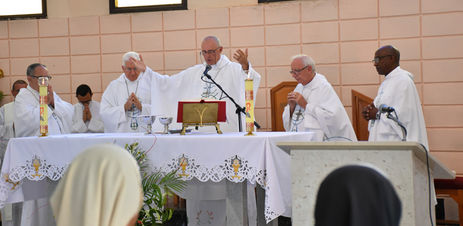
14ymedio bigger14ymedio, Mario Penton, 7 April 2018 — “I’m surprised, I never would have imagined it.” The grave voice at the other end of the telephone line is that of Silvano Pedroso Montalvo, who seems not to have gotten over his astonishment a week after Pope Francis appointed him bishop of the diocese of Guantanamo-Baracoa.

About to turn 65, Pedroso Montalvo is the first black bishop of the Catholic Church in Cuba in its entire history. “In the Church, we are all brothers and equal, I have never felt superior or inferior to anyone because of the color of my skin, but I understand that many people may like having a black bishop because the Church is universal,” says the priest. He works in two of the most humble and ethnically mixed neighborhoods in the Cuban capital: El Cerro and Jesús María. continue reading

“Silvano is authentic, austere, close to the people, consistent, accurate, and a simple man. Perhaps, using the words of Pope Francis, he is a ‘stray’ who can be a ‘game changer’ for the community of believers in Cuba,” says a priest who is an expert in the history of the Cuban Church and who prefers to remain anonymous.

Father Silvano, as the parishioners know him, has worked as a spiritual advisor to young men who want to be priests. He has also been a parish priest in rural areas. It is common to see him walking through the streets of Jesús María and El Cerro, as well as helping organizations such as Caritas in solidarity with the needy.

According to an expert consulted by 14ymedio, the Pope is trying to renew the face, style and language of the Cuban Church “with pastors such as the Bishop of Havana Juan de la Caridad, Father Silvano and Manolo de Céspedes, among others.”

Having accepted the resignation of Havana’s Cardinal Jaime Ortega, the Cuban Bishops’ Conference is in a process of transition that some experts believe involves distancing the Church from power and bringing it closer to the people.

“This appointment seeks to emphasize that the Catholic Church on the island is not only white, although most of the faithful are,” he adds.

Pedroso (far right) concelebrating Mass in Guantanamo

Pedroso was born in Cárdenas, Matanzas, on 25 April 1953 and was baptized in 1961, during a time when there was a rupture between the Cuban Church, which initially supported Fidel Castro, and the Revolution, after it turned to the Soviet Union. He graduated in Geography from the University of Havana and practiced his profession from 1979 to 1982 at the Physical Planning Institute of Las Tunas.

Dagoberto Valdés, a lay Catholic from Pinar del Río, believes that Pedroso’s work experience can help him better understand the contemporary Cuban Church. On the island it is estimated that 60% of Cubans are baptized as Catholics, but no more than 10% attend Sunday Mass.

“The incorporation into the episcopate of men who grew up, were educated, worked and became priests at the time of the institutionalization of the socialist process is a wonderful experience for the pastors of the Church,” says Valdés. “Silvano is a man close to the people, a missionary in solidarity with them,” he added.

For Lenier González, former editor of one of the most important Catholic publications on the island, Espacio Laical (Lay Space), and current coordinator of Cuba Posible magazine, the appointment of Silvano is good news because “he addresses many challenges at once, almost all of them related to the links and historical actions of Catholicism with the Cuban black population.”

There is as yet no date for his episcopal consecration, which will be in Havana, but Silvano Pedroso is already very familiar with the work that is done in the diocese that has been assigned to him. “In Guantanamo, the Church has done a very nice job in terms of helping the most needy, especially after the hurricane,” he says.

After Hurricane Matthew, young Catholics organized weeks of help to rebuild the homes of the victims. Caritas distributed more than 60,000 pounds of aid from churches from neighboring countries, such as the United States.

The diocese of Guantánamo-Baracoa was created by John Paul II in 1998. Although the city of Guantánamo is home to the cathedral of Santa Catalina de Ricci, Baracoa (the first town founded in Cuba after the arrival of the Spaniards) is home to the co-cathedral church where the Cruz de la Parra (Cross of the Vine), brought by Columbus to the New World, is preserved.

The seat of the diocese has been vacant since 6 December 2016, when the previous bishop, Wilfredo Pino Estévez, was appointed to head the diocese of Camagüey.

Pedroso’s pastoral plan will be to follow the line of solidarity and human advancement that was underway in the diocese. “I try to accompany people in their reality, which is sometimes very hard,” he says.

Pedroso remembers that he was shocked the day a humble family in a Guantánamo town welcomed him into their home, giving him the best they had to eat and offering him rest. “Many times simple people are the ones who open themselves most to God and his message,” he explains.

 __________________________

The 14ymedio team is committed to serious journalism that reflects the reality of deep Cuba. Thank you for joining us on this long road. We invite you to continue supporting us, but this time by becoming a member of 14ymedio. Together we can continue to transform journalism in Cuba.
Opinion: Lula’s Final Hour

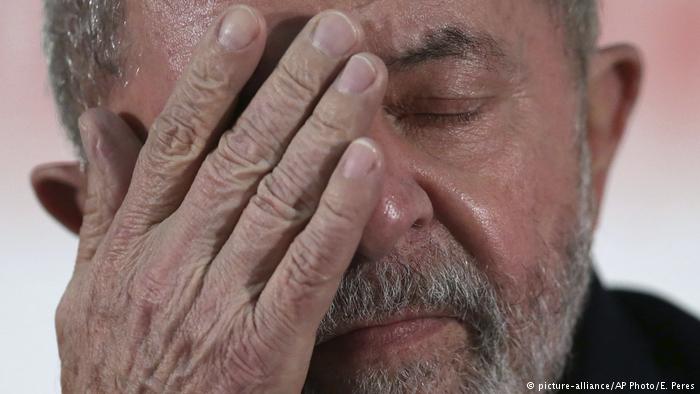
Luiz Inácio Lula da Silva, former president of Brazil. (Picture-alliance/AP Photo/E. Perezs

Deutsche Welle, Yoani Sanchez, 6 April 2018 — A few years ago, the socialism of the 21st century, that populist imitation that deftly disguised itself with a discourse of social justice and opportunities for all, seemed to be in full force in Latin America. The region was dotted with leaders who resembled something more than the ideology they embraced: they loved to hear themselves speak in public, they suffered from a chronic intolerance of political opposition and they believed they embodied the feeling of an entire nation.

That motley explosion of charismatic and authoritarian leaders ranged from the vociferous Hugo Chávez, to the arrogant Rafael Correa, the coca grower Evo Morales, and the popular Luiz Inácio Lula da Silva. The latter was described as having emerged from the most humble strata of Brazilian society and, once in Planalto Palace, to have promoted changes to lifting more than 30 million people up from poverty. With these credentials, it was difficult not to applaud him and many international organizations fell at the feet of the steelworker become president. continue reading

However, behind the image of an austere man and implacable enemy of political corruption, Lula was creating his own networks of favors and support to which he responded with privileges and perks. The Workers’ Party became a more powerful force every day, one that harassed its political opponents, supported untenable regimes like that of Cuba and was constantly accused of diverting funds and mismanagement. However, Lula maintained his impressive popularity in Brazil and almost unanimous support beyond its borders.

Now, the former trade unionist seems to be coming to the end of his road. Last year he was convicted of corruption and money laundering and this month the Supreme Court rejected the last legal recourse to stop his imprisonment. Although the seasoned populist still draws crowds and leads the polls for the October elections, on his last tour of Brazil eggs were thrown and taunts shouted.

Cornered, the former president has chosen to to keep running forward. He has redoubled his discourse to the popular classes and has presented the whole judicial process in which he is immersed as an attempt to silence him politically or as a revenge of the elites and his old ideological adversaries. Others, however, accuse him of running for president to elude justice. Despite this attack from the podiums and from the media, it has not managed to prevent the myth from suffering major cracks.

With the conviction of Lula, part of the illusion that he fueled also falls, that of a leader who rises from below, who understands the poor, who will never steal from them. His fall from grace is also a blow to the left’s populist forces in the region, many of them tarnished by corruption scandals linked to the extensive maneuvers of Brazilian giant Odebrecht.

The socialism of the 21st century was not only killed by its own inefficiency in finding solutions to the serious problems of the continent, but by its dirty financial management. Their most distinguished representatives encouraged networks of loyalties and bribes that ended up taking their toll. The coup de grace was not “the empire” so much reviled, nor the “bourgeoisie,” but their own ambition.

To Be "Rich" in Cuba / Ivan Garcia

In Cuba it is considered “rich” to have a private or successful restaurant, such as Porto Habana, on Calle E No. 158 between Calzada and 9a, Vedado, visited by celebrities passing through Havana. Taken from TripAdvisor.

Ivan Garcia, 4 April 2018 — From the twentieth floor of a building near the Havana Malecon the blue waters of the Atlantic Ocean look like you could touch them with your hands. From that height you can’t see the disastrous infrastructure of Havana. Or its broken streets, water leaks or the buildings torn apart by bad state management.

When Victor, owner of a micro-lodging business, feels frustrated, he spends an hour on the balcony with a cup of coffee watching the panoramic view offered by his apartment in the central neighborhood of Vedado. Before venting his worries about the rumored new government measures that will curb private work, he runs a a pocket comb over his gray and sparse hair. continue reading

“Do you know why Cuba is not flooded with fruit, food and quality services?” he asks, and before answering pauses to savor his coffee. “Well, it’s the government’s fault. If the State did not harass private individuals and, instead, empowered them, agricultural, dairy, livestock production and housing shortages would not be as dramatic as they are now.

“It is the government that has to answer for those deficiencies. Every time there are timid openings the creativity of the private sector is on display. If there were a legal framework, impartial courts and wholesale markets, business owners would not be forced to violate the laws, to try to find ways to avoid taxes and to practice double accounting.”

The Havana entrepreneur rents his apartment for the equivalent of 50 dollars a day, which would be 1,500 dollars a month. “Discounting taxes, I clear 1,100 dollars. Enough for the expenses of my wife and I who live in another apartment in the same building. My children are in Miami. With what I save, in any other kind of society, I could expand my business buying homes in poor condition or outsourcing those services to people who want to rent their homes, but do not have the resources. It’s the business cycle. Save money, then invest and earn more. I do not see any kind of crime in that intention. I do not know why the government wants us to always live in poverty.”

In the third section of the Economic Guidelines approved in 2010, a kind of road map instituted by the regime of Raúl Castro, it is stated that concentrations of wealth and capital will not be allowed for Cubans on the island. Eight years later, a segment of private entrepreneurs has accumulated a quantity of money, whether legally, with subtle subterfuges or under the table.

Onel, an economist, believes that “between 10 thousand and 20 thousand small business owners have been able to hoard between 10 thousand and 250 thousand dollars, some may even have amassed more than a million dollars. But, given that this is Cuba, gaining capital is a crime and you mark yourself as a suspicious person or presumed criminal, so those people invest in buying houses from relatives, or works of art or take the money out of the country, because they have relatives abroad,” he says and adds:

“Among them there are repatriated Cubans, who because they have more capital at the time of starting their business and knowledge of marketing, they have generated profits faster. There are also Cubans who live in the United States, who live off the income of their businesses on the island or share the profits with their families,” says the economist.

To have a fortune in Cuba is to travel through a minefield. When self-employment was forbidden by the autocracy of the Castro brothers, clandestine managers of businesses, warehouses and restaurants made money by stealing from the State. Most Cubans do not believe that the means of production are owned by all, as Marxist theory says. And at the first chance, they defraud the state in order to survive in the harsh conditions of Island socialism.

Carlos, who lives in Florida, recalls that “the first time I raised half a million pesos, the exchange rate of the time artificially equated the peso with the dollar, and I threw the money on the mattress of my room and slept on the bundles of notes,” he says with a smile from a restaurant in Miami.

“I was a supplies manager in a luxury hotel. I sold whatever I could under the table. Then, the money I earned was exchanged for dollars one-by-one with the hotel’s accounting manager. A negotiation. My plan was to fill my pockets and get out of that shit. I have friends who thought they could be millionaires in Cuba and ended up in jail. Like Roberto, the former manager of the World Ice Cream Parlor, on Santa Catalina Avenue,” says Carlos.

As he tells it, “Roberto came to grief because of the typical envy of the top leaders. He had a better Lada than the higher-ups. One morning, passing through Avenida Boyeros, Ramiro Valdés, who was then Minister of the Interior, observed that a bodyguard greeted Roberto as he passed by. He asked who that guy was and the bodyguard told him he was a compañero of State Security. Ramiro found out and discovered that he was a simple corrupt administrator and broke his balls. It is a very envious breed, if you presume to have more than them, they make your life impossible. Only they can be rich.”

Nobody in Cuba knows the limit of what you can and cannot have. The amount of money that sets off the alarms in the police apparatus of the regime is not known. “In the statutes, the determined amount of money that violates the laws is not specified. For example, Silvio Rodriguez [the singer], Alicia Alonso [the dancer] or the ballplayer Alfredo Despaigne, who plays in a professional league in Japan and has a millionaire’s salary, have six zero incomes and no one challenges them for economic crimes. The reason is ideological. If those who make money are inside the apparatus or comply with government rules, they are allowed. If they earn money through their own efforts, they will always be suspects,” says Beatriz, a lawyer.

On the island, acquiring certain material goods can pigeonhole a citizen as being suspected of ‘illicit enrichment’. “I used to sell toiletries and clothes. I was able to raise enough money to build my own business. I had two air conditioners, three plasma televisions, several appliances besides repairing my house. They opened a file on me for violating the laws, that is to say selling without the required license, they confiscated all my merchandise and electrical appliances, alleging that they had been acquired with dirty money. Ultimately, I was sentenced to three years in prison,” says Luis Alberto, a resident of the municipality of Diez de Octubre.

Those who accumulate a significant amount of capital try to fly below the radar. They don’t buy sumptuous mansions in Miramar or Siboney. Nor the latest cars or a yacht. It is exposing oneself too much to the public magnifying glass in a command and control socieity.

In Cuba, members of the club of the rich often dress in olive-green.


Building Collapses and Shelters in Cuba

Street in Havana blocked by the collapse of a building. (14ymedio)

14ymedio bigger14ymedio, Mario Blanco. Montreal, 5 April 2018 — Within a month of assuming my position as mayor of the Plaza of the Revolution municipality in the City of Havana, in 1986, there was a partial collapse in one of the old buildings of the famous neighborhood of El Vedado. Several people were injured, although luckily no one lost their life.

We went to the site to talk to those affected and to try to convince them to go to one of our shelters in the city. In the municipality we had four, but all were full and so we wanted to assign people to space in another municipality. The unanimous answer was NO. For various reasons. continue reading

People knew that those who went to shelters were stranded there and lost their connection with the neighborhood in which many of them had lived all their lives, as well as the whole family’s work, transport and schools.

The next day I took on the task of touring our shelters, and the feeling of helplessness in the face of one of the most pressing problems of the country, housing, entered my soul like a major cancer. When I arrived at the first shelter, the people who were there approached me asking what were the chances, at the beginning of the newly inaugurated Government, for them to obtain a house with a minimum of amenities, either through a microbrigade (the work centers organized brigades to build houses with the objective of satisfying the demand of their own workers), or some other method. They were willing to repair housing by their own means.

One of the first people in a shelter who approached me told me that his house had collapsed and that for 19 years he had been in that shelter waiting for a solution. He asked me: What can you tell me about this? That question has been one of the most difficult I have ever heard, including  during my studies at the University.

Unfortunately at that time not all work centers were able to raise a microbrigade. The reasons were several, sometimes it was simply due to the lack of construction materials and often the plans for the construction of new homes, implemented by the Government, for one reason or another were not met.

At the same time, the demand for housing was growing. The quality of life in the shelters was terrible, sometimes the cubicles were divided only by a sheet, some were for men and others for women with children, which implied the division of the family home with disastrous results. There were others in which one part or wing was for men and one for women, and there was no family life there either. To that was added the difficulty of having common bathrooms and kitchens.

The saddest thing about this story which I had to experience personally and which happened during the triennium 1986 – 1989, is that this problem still has not been solved. Far from it, it has worsened, even though demand has decreased, as a result of the emigration of Cubans, even though over two million individuals, that is, one fifth of Cuba’s total population, has left the country.

Every year fewer houses are built and, until only a couple of years ago, if the family emigrated, they lost the housing that the government supposedly had to grant to other people in need. However, this housing was not always delivered to the most needy people, but many times its allocation was determined by corruption, cronyism, or “political security,” which involved the so-called “frozen zones,” where only those who are not considered political dissidents are allowed to live.

Housing is and has been to this day, one of the greatest difficulties that the Cuban people have faced. After 60 years this government does not seem to have found any solution to this problem.

 _______________________________

Editor’s Note: this text was originally published in Viceversa Magazine and is reproduced here with the authorization of the author. Mario Blanco was born in Santiago de Cuba in 1949, although as of 1997 he has lived in Montreal, Canada. He is a naval engineer and between 1986 and 1989 he held the position of President of the People’s Power of the Plaza of the Revolution municipality, in Havana.

The 14ymedio team is committed to serious journalism that reflects the reality of deep Cuba. Thank you for joining us on this long road. We invite you to continue supporting us, but this time by becoming a member of 14ymedio. Together we can continue to transform journalism in Cuba.
Latin American Youth Network Calls Out Cuban Intelligence’s Interference at the Summit of the Americas

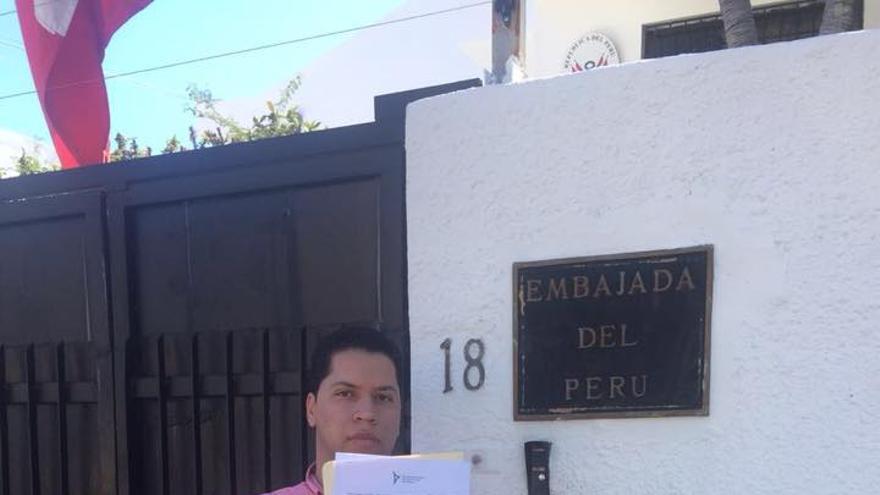
Members of the Network delivered the letter to several institutions, such as the embassy of Peru. (Facebook)

14ymedio biggerEFE, via 14ymedio, Miami, 4 April 2018 — The Latin American Youth Network for Democracy sent a letter to Foreign Minister Néstor Francisco Popolizio and other Peruvian high officials, warning of the “grave danger” that they believe “interference from agents of the Cuban dictatorship” represents for the 8th Summit of the Americas.

The letter, which Efe had access to, is addressed to Popolizio, Antonio García Revilla, national coordinator for the Summit Process, and Marcio M. Bendezú Echevarría, regional prefect of Metropolitan Lima, and will also be delivered to the embassies of the countries participating in the Summit, which will take place in the capital of Peru on April 13 and 14. continue reading

The Network, made up of young people from 20 countries, reiterates that its members will participate in the Social Summit that will take place as a complement to the presidents’ meeting, and expresses its hope that “the Peruvian authorities will be able to guarantee the security” of its members and delegates from Cuban and Venezuelan civil society.

The president of the Network, Rosa María Payá, and the coordinator, Jatzel Roman González, urge the Peruvian authorities not to “tolerate” what they say happened at the previous Summit in Panama, in 2015, “the ‘neighborhood bully’ attitude of the Castro delegation.”

The letter emphasizes that in Panama “shock troops of the Castro regime, led at that time by the current Minister of Culture of the dictatorship, Abel Prieto, attacked with blows and shouts formally accredited members of civil society of the Americas.”

“Three years later, the goal of the Cuban regime remains the same: to prevent the Civil Society Summit from being held because a dictatorship cannot tolerate sharing space with those who peacefully oppose their repressive actions and dare to express it,” the letter adds.

The Latin American Youth Network and the delegation of independent Cuban civil society at the Social Summit are already suffering “aggressions by the Cuban regime,” they point out.

The letter mentions an episode with the Cuban ambassador at the Hemispheric Dialogue in Lima, who “lashed out against Jorge Vallejo, the Peruvian representative who served as spokesman for Coalition 26 and director of our Network.”

The letter also refers to a message on the official Twitter account of the Cuban Foreign Ministry in which it warns that “Cuba will not allow offenses, disrespect or provocation” from the Latin American Youth Network during the Summit.

“Given all the threats and aggressions launched from the institutions and the Castro media, we are obliged to hold the Government in Cuba and the Peruvian authorities responsible for the physical integrity of all of our members,” the signatories of the letter write.

Payá and González also warn of the “dangerous error and incoherence of extending an invitation [to the Summit] to the representatives of the Cuban dictatorship,” after praising the exclusion of representatives of the “Venezuelan dictatorship.”

At the end of the letter, the Network’s directors state: “Our young people are not controlled by fear, we will continue peacefully fighting dictatorships from one end of our region to the other.”

_______________________

The 14ymedio team is committed to serious journalism that reflects the reality of deep Cuba. Thank you for joining us on this long road. We invite you to continue supporting us, but this time by becoming a member of 14ymedio. Together we can continue to transform journalism in Cuba.

Photo of the Day: Homemade Entertainment

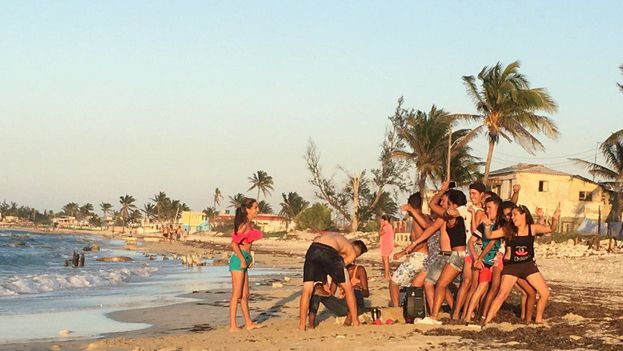
Endlessly laughing and screaming, spreading their contagious joy at being young, teenagers revel in a day of joy on the beaches of eastern Havana. (14ymedio)

14ymedio bigger14ymedio, Havana, 5 April 2018 — Oblivious to any programs oriented toward recreation or culture conceived by official institutions, these young Cubans born at the beginning of the 21st century chose the beaches of eastern Havana’s coastline to make their own fun. As shown in this image, they danced for hours to the rhythm of reggaeton, laughing and shouting, their rejoicing at being teenagers completely contagious.

Their hips radiated a defiant sensuality, as if to say, “What’s it to me?!” It showed in the rhythmic shrug of their shoulders, in the desire with which they seemed to want to devour the present, and in the absolute certainty with which their thoughts of the future did not extend beyond the next minute. Their gestures and smiles aroused envy in more than one quiet swimmer.

In their midst, as an accomplice to their enormous joy, a portable speaker blasted the catchiest songs, and those with the jubilantly nastiest words, from this moment in time of that well-known urban music genre.

___________________

The 14ymedio team is committed to serious journalism that reflects the reality of deep Cuba. Thank you for joining us on this long road. We invite you to continue supporting us, but this time by becoming a member of 14ymedio. Together we can continue to transform journalism in Cuba.

Which One Is The Criminal?

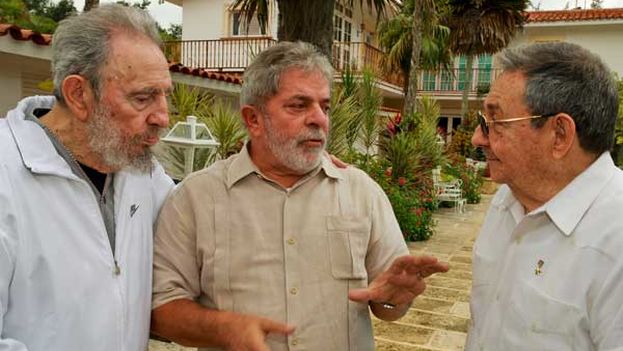
The brothers Raul and Fidel Castro together with Lula (center) in 2010, when the former Brazilian president visited the island at the time of the death of Orlando Zapata Tamayo. (Juventud Rebelde)

14ymedio bigger14ymedio, Yoani Sanchez, Havana, 6 April 2018 — In 2010, then Brazilian president Luiz Inácio Lula da Silva provoked a bitter controversy when he compared Cuban dissidents to common criminals. Those words, said a week after the death of the opponent Orlando Zapata Tamayo, take on a new meaning today, a few hours before the Brazilian leader goes to prison.

“I think hunger strikes cannot be used as a human rights pretext to free people,” said the former steelworker, eight years ago in March. “Imagine what would happen if all the bandits who are imprisoned in Sao Paulo went on hunger strike and asked for their freedom,” he remarked cheerfully. continue reading

For Lula, the dissident who agonized in his cell until he died was nothing more than a criminal who refused to eat for 86 days to pressure the authorities to release him from prison. Despite publicly lamenting his death, Brazil’s president believed the official version of Zapata’s death and insisted the Cuban bricklayer, born in Banes, was not a political prisoner.

Now it is the popular trade unionist who has been tried in the courts of justice and public opinion. He came to this point not because he protested police repression in the streets, as Zapata did, but because of corruption and money laundering. As president of his country he betrayed the voters’ trust by exchanging favors, receiving bribes and handing out contracts.

Under the image of a humble man who ascended to the highest position in an imposing nation like Brazil, Lula was in fact a “political animal” accustomed to prioritizing ideology and his old ‘comrades in the struggle’ over the welfare of his people. As soon as he settled into Planalto Palace he began to create his own robust network of perks and fidelities that ultimately blew up in his face.

In this network of favors were not only some of his old comrades from Brazil’s Workers Party, but also those from outdated regimes like Havana’s. Lula solicitously served the Castro brothers the entire time he was in office, an attitude inherited by Dilma Rousseff when she succeeded him in office.

For the Cuban Government the years during which the Workers Party led Brazil served as a panacea. Lula and Rousseff closed ranks to support the Plaza of the Revolution in international forums, kept their shock troops at the ready to attack any critics of the Castros, and financed the Port of Mariel Special Development Zone project, which involved the corrupt Brazilian transnational Odebrecht.

In the name of those old favors, on Thursday the Havana regime released a statement signed by the Ministry of Foreign Affairs in defense of the former president, calling his sentence an “unfair campaign against Lula, against the Workers Party and against the leftist and progressive forces in Brazil.” Some corruption is repaid with apartments, some with bribes, and much of the rest with political statements.

Lulu’s 12 year prison sentence could well be extended much longer, should the magistrates find him guilty in other pending cases. His time behind bars could be long, enough time to allow him to reflect on everything he has said and done.

Perhaps in the long days that await him looking through the thick bars, the former president can imagine what Zapata’s last days might have been like for the young black bricklayer born in a small town in the east of the island who refused to eat or drink water to demand his freedom. That man, unlike Lula, was innocent.

_________________________

The 14ymedio team is committed to serious journalism that reflects the reality of deep Cuba. Thank you for joining us on this long road. We invite you to continue supporting us, but this time by becoming a member of 14ymedio. Together we can continue to transform journalism in Cuba.
Twelve Cuban Rafters Arrive in Florida Keys, a First for 2018

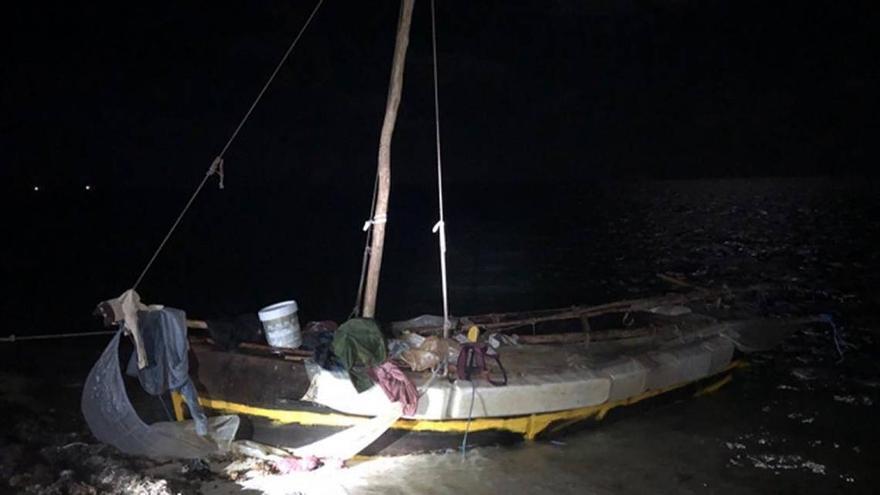
The makeshift raft in which 12 Cubans recently sailed from Punta Alegre to the Florida Keys. (US Border Patrol)

14ymedio bigger14ymedio, Havana, 3 April 2018 —  Twelve Cuban rafters from Punta Alegre arrived at Florida’s Lower Matacumbe Key on Tuesday, becoming the first migrants to arrive in the Keys from the island so far this year, according to the digital media site FlKeysNews. 

The ten men and two women who traveled in a makeshift boat made land at around 1:00 am local time, according to Adam Hoffner, an agent of the US border patrol.

The spokesman for the Monroe County Police Department added that the twelve people on board were “in good health.” continue reading

The coastal town from which the rafters left about seven days ago, located in the north of the island, is the same place where last March another group of 16 rafters reported to 14ymedio that their raft had been purposely sunk by Cuban border guards as they attempted to navigate to the United States.

Cubans arriving in the United States by raft has not been completely ended, despite then president Barack Obama’s decision, in January of 2017, to put an end to the wet foot/dry foot policy, which allowed Cubans who reache US soil to stay in the country and become legal immigrants after one year.

Some 58 Cuban immigrants have tried to enter the US illegally by sea since October 1, which contrasts with the same period last year when 1,934 Cubans were detained by the US authorities while doing the same thing.

 ________________________

The 14ymedio team is committed to serious journalism that reflects the reality of deep Cuba. Thank you for joining us on this long road. We invite you to continue supporting us, but this time by becoming a member of 14ymedio. Together we can continue to transform journalism in Cuba.
Despite the Government and Censorship, Cubans ’Resolve’ the Internet

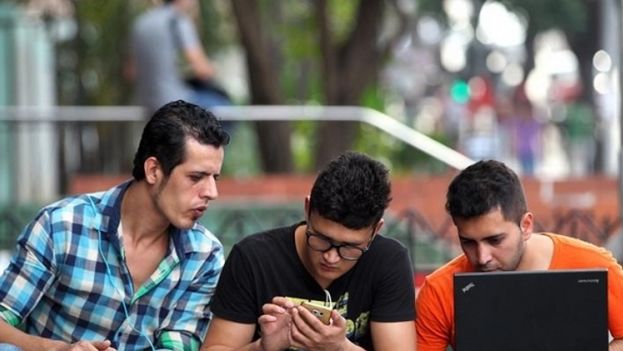
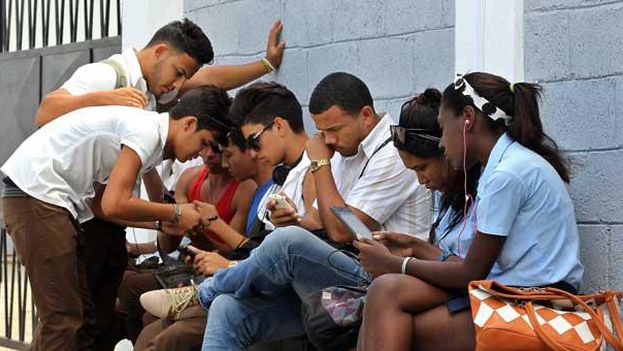
Young people have a hard time getting a computer or a mobile phone in a country with a totally distorted economy, where the monthly salary barely exceeds the equivalent of $30. (EFE)

14ymedio bigger14ymedio, Havana, 1 April 2018 —  ‘FactorUV’ does not like his name spoken and prefers the pseudonym for which he is known in Cuban digital networks. He is 21 and has been glued to a computer screen since he was a child, although he lives in a country with one of the lowest Internet connectivity rates on the planet.

FactorUV’s generation are digital natives, but they face many difficulties in getting a computer or a cellphone in a country with a completely distorted economy, where the average monthly salary barely exceeds 30 dollars. continue reading

“Fortunately as a child I liked putting things together and taking them apart, so I assembled my first computer,” he recalls now. “At the beginning it was harder to get the pieces, but right now buying a hard drive, a memory, a processor or a cellphone is easier than buying a sofa,” he says ironically.

At the end of 2017 there were 4.5 million mobile lines in Cuba, a country with a little over 11 million inhabitants. Although the island continues to be at the bottom of the list in terms of cellphone access, the progress has been significant in recent years and has had a clear impact on daily life.

Internet access has been one of the demands most repeated in recent years by activists, opponents and citizens in general. Despite the limited advances in information and communication technologies, Cubans today are increasingly informed and aware of what is happening inside and outside their borders.

However, this slow transformation coexists with censorship, high prices and a lack of transparency on the part of state institutions.

In FactorUV’s family, the digital divide is evident. His grandmother, a retired woman who worked for decades in a ministry and still belongs to the Communist Party of Cuba (PCC), refuses to even touch a cellphone. “She does not understand everything that can be done with these devices,” says the young computer expert.

FactorUV’s parents spent some years in China on an official mission and “that’s where they realized that you have to use technology,” explains the young man, who also says it makes their lives easier. The family has also allowed him access to devices that many Cubans of his age can only dream of.

Despite the material limitations, barter, exchanges and loans between friends are helping the digital experience reach many others. “When I’m going to connect in some Wi-Fi zone, we almost always go in a group and the one that doesn’t have money to buy a recharge uses a bit of someone else’s time.”

In 2015, the Telecommunications Company of Cuba (Etecsa), a state monopoly, installed the first Wi-Fi connection zones, a few dozen throughout the Island. There are currently a little more, half with wireless connection.

The rates, very high at the beginning, have been reduced little by little. An hour costs 1 CUC (1 dollar) but it is still expensive for those who live only on their salary. These limitations have strengthened an informal market where accounts or browsing time are shared.

Etecsa offers a speed of 1 Mbps (megabits per second), but in practice it remains, at most, around 125 KB/s (kilobytes of data per second) or even less when there is congestion in wireless zones, something that happens very often.

For gamers like Ramón Gómez, who is called Pocholo, the speed of connection to the web is often “frustrating.” Games “are blocked or do not run well and playing online is a headache,” he explains.

Through tools such as Connectify, which allow sharing the same connection, digital entrepreneurs who have appeared in plazas and parks sell browsing hours at half the Etecsa price. (EFE)

Through tools such as Connectify, which allow sharing the same connection, digital entrepreneurs who have appeared in plazas and parks sell browsing hours at half the Etecsa price, an offer closer to the pockets of many Cubans.

Despite all its failures, ranging from power outages to the difficulties of opening the user portal, the wireless connection has become an indispensable tool for the emerging private sector, which consists of only half a million people.

From rental houses advertised on tourist websites to popular classified sites like revolico.com, digital businesses have boosted creativity and expanded economic opportunities for many Cubans.

Young graduates of the University of Computer Science (UCI), who sell their services as programmers of mobile applications, or prostitutes who offer their favors to tourists through Tinder, all of them use the internet to promote their services.

The most visited sites continue to be social networks, chatrooms and dating sites. The information sites about visas and scholarships are also among the priorities for domestic Internet users.

“In the wifi zones, sitting on the ground in a park or on the sidewalk at the edge of the street while the cars pass and make noise or it starts to rain, you can’t have a complete experience as an Internet user,” laments Pocholo. “You also have to be careful with the technology because the thieves know that in the wifi areas, especially at night, it is easy to snatch a tablet or a phone.”

His dream is to be able to connect from his own home, but he must wait to fulfill it because the Havana municipality where he lives is not yet included among the first areas where this service has started, so common in the rest of the world.

Nauta Hogar (Home): step by step

In the first months of 2017 the first tests began on installing domestic internet service in 17 districts of the municipality of Old Havana, in the historic center of the capital. The initiative has been extended very slowly to other provinces and is intended exclusively for residents who have a fixed telephone line.

Etecsa modified the initial rate and connection speed. Initially, the user paid 15 CUC (15 dollars) for browsing with a bandwidth of 256 Kbps; now that same rate buys 1 Mbps. The prices are still well above the economic reach of the average wage earner, which explains why only 11,000 people have contracted for Nauta Hogar.

An annual index of world development in information and communication technologies places the Island in 166th place out of 176 countries in terms of access to the web. Cuba continues to be one of the countries with the lowest internet penetration rates in the world and until last year connection from the home was a privilege enjoyed only by high officials, and professionals such as doctors, lawyers and journalists.

However, official figures say that Cuba registered more than 4.5 million Internet users in 2016, which means 403 connected users per 1,000 inhabitants. Most of them connected from the Wi-Fi zones installed starting in 2015 or from the internet rooms managed by Etecsa with terminals belonging to the company.

These figures are questioned by experts, who say Raúl Castro’s government includes in these data users who connect to intranet services, national email and other sites hosted on local servers, such as the Infomed medical information site, available for workers in the sector without having to access the web.

Connected yes, but not free

Amnesty International’s most recent report, referring to 2017, says that in Cuba there are “undue restrictions” on access to the internet and cites at least 41 blocked websites, all critical of the Government of Havana. Among them are the digital newspaper 14ymedio and other websites such as Cubanet, Martinoticias and, recently, El Estornudo.

Censorship also refers to the filtering of words that circulate through national email (Nauta) and text-only messages (SMS).

report published in 14ymedio reveals that messages containing words like “democracy” and “dictatorship,” or the names of the main opposition leaders of the island never reach their destination, despite the fact that the state communications monopoly charges the fee as if they had been delivered.

Censorship also refers to the filtering of words that circulate through national email (Nauta) and text-only messages (SMS). (14ymedio)

Self-censorship also affects how Cubans use the networks. For example, in the wireless networks of games or forums that have become very popular in the neighborhoods since the arrival of devices such as the NanoStation or Mikrotik (sold on the black market), virtual communities such as SNet have emerged, which has more than 50,000 users in Havana and extends to other provinces of the country.

These communities prohibit political, religious and pornography issues so as not to endanger a network that, without being expressly allowed, at least passes under the radar of the toughest censorship.

The blogs written from within the Island, which emerged starting in 2006, were mainly managed by citizens independent of institutions, activists and opponents. Over time, as has happened with social networks such as Twitter and Facebook, the government has placed its own bloggers in these spaces to defend the official discourse and, also, to denigrate and defame its opponents.

Currently, several of the founders of the “alternative” blogosphere have become media managers or political activists. Also, many of them have been exiled due to pressure and repression.

________________

Editor’s Note: Venecuba is a space created by journalist Andrés Cañizalez to share information and analysis on the presence and influence of Cuba in Venezuela.

The alliance of Venecuba with 14ymedio and the Venezuelan newspaper El Nacional has supported the writing of this report.