Cuba’s Ladies in White Win 2018 Milton Friedman Prize for Advancing Liberty

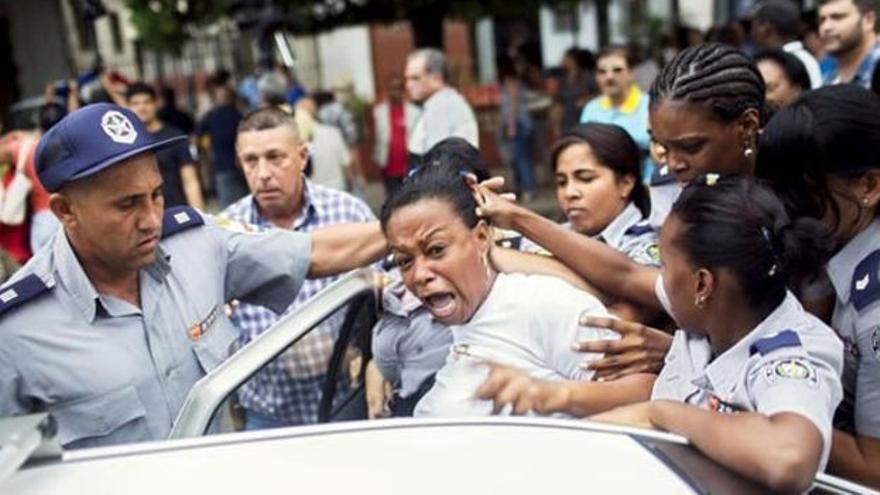
A Lady in White is arrested in Havana. (File EFE)

14ymedio bigger14ymedio, Havana, 16 April 2018 — The Ladies in White have been awarded the 2018 Milton Friedman Prize for Advancing Liberty, given every two years by the Cato Institute to an individual who has made a significant contribution to the advancement of human freedom, according to a press release published on the website of the American institute.

The award, which comes with 250,000 dollars, has been bestowed on the women of this human rights movement that was born as a result of the arrests of the 2003 Black Spring. Over the last 15 years “the authorities have constantly harassed them and organized mob violence against them,” says the press release. continue reading

The Cato Institute declares that, although “they are not a political party and do not have an overtly political program, they seek freedom of expression for all and the release of prisoners of conscience in Cuba.”

The document adds that these activists “have faced increasing police harassment and arrest in recent years, as the Cuban government tries to hide-but not correct-its habit of quashing dissent.”

The prize will be formally awarded on May 17 at the Gala Dinner of the Milton Friedman Prize for Advancing Liberty to be held in New York.

Established in 2002, previous editions of the Milton Friedman Prize has been awarded to well-known academics, activists and political leaders. Outstanding among them are the Venezuelan student leader Yon Goicoechea Lara (2008), the Chinese activist Mao Yushi and the Iranian journalist Akbar Ganji, among others.

This year’s international selection committee was made up of Lescek Balcerowicz (former deputy prime minister and former finance minister of Poland), Janice Rogers Brown (former judge of the U.S. Court of Appeals for the District of Columbia Circuit), Vicente Fox (former president of Mexico), Sloane Frost (president of the Board of Directors for Students for Liberty), Peter N. Goetler (president and CEO of the Cato Institute), Herman Mashaba (Executive Mayor of Johannesburg), Harvey Silverglate (Co-founder Foundation for Individual Rights in Education), Donald G. Smith (President of Donald Smith & Company Inc.) and Linda Whetstone (Chair of Atlas Network).

The Ladies in White were awarded the Sakharov Prize for Freedom of Thought in 2005, granted by the European Parliament, but the Cuban government barred them at that time from attending the award ceremony in Strasbourg, France.

 __________________________

The 14ymedio team is committed to serious journalism that reflects the reality of deep Cuba. Thank you for joining us on this long road. We invite you to continue supporting us, but this time by becoming a member of 14ymedio. Together we can continue to transform journalism in Cuba.

Havana, Year Zero

The majority of Cubans are tied to a daily cycle of survival (14ymedio)

14ymedio bigger14ymedio, Generation Y, Yoani Sanchez, 17 April 2018 — My mother was born under the Castro regime, I was born under the Castro regime and my son was born under the Castro regime. At least three generations of Cubans have lived only under the leadership of two men with the same surname. That uniformity is about to be broken on April 19 when the name of the new president will be publicly announced. Whether he maintains the status quo or looks to reform it, his arrival to power marks a historical fact: the end of the Castro era on this Island.

Despite the closeness of this day, without precedent in the last half century, in the streets of Havana expectations are extremely low. In a country on the cusp of experiencing a transcendental change in its Nomenklatura that could begin in couple of days. continue reading

At least three reasons feed this indifference. The first is the regrettable economic situation that keeps the majority of people tied to a daily cycle of survival, one in which political speculations or predictions of a different tomorrow are tasks relegated to other emergencies, like putting food on the table, traveling to and from work, or planning to escape to other latitudes.

The second reasons for so much apathy has to do with the pessimism that springs from a belief that nothing will change with a new face in the official photos, because the current gerontocracy will remain in control through a docile and well-controlled puppet. Meanwhile, the third force engendering so much ennui is knowing no other scenario, of having no references that allow on to imagine that there is life after the so-called Historic Generation.

This feeling of fatality, that everything will continue as it is now, is the direct result of six decades of, first, Fidel Castro, and later Raul Castro, controlling the Island with no other person to cast shadows or question their authority at the highest rung of the government. By remaining at the helm of the national ship, by their force in crushing the opposition and eliminating other charismatic leaders, both brothers have shown themselves, throughout this entire time, to be an indispensable and permanent part of our national history.

More than 70% of Cubans were born after that January in 1959 when a group of barbudos – bearded men – entered Havana, armed and smiling. Shortly after that moment, school textbooks, all the media of the press and government propaganda presented the “revolutionaries” dressed in olive green as the fathers of the nation, the messiahs who had saved the country and redeemed the people. They spread the idea that Cuba is identified with the Communist Party, the official ideology of a man named Castro.

Now, biology is about to put an end to that chapter of our history. The Cuban calendar could have, in this, its year zero, a new beginning, However, instead of people waving flags in the plazas, of enthusiastic young people shouting slogans, or epic photos, the feeling one perceives everywhere is that of exhaustion. The stealthy attitude of millions of people whose enthusiasm has atrophied after a very long wait.

________________

This text was  originally published by Deustche Welle’s Latin America page.

The 14ymedio team is committed to serious journalism that reflects the reality of deep Cuba. Thank you for joining us on this long road. We invite you to continue supporting us, but this time by becoming a member of 14ymedio. Together we can continue to transform journalism in Cuba.

An Embarrassment

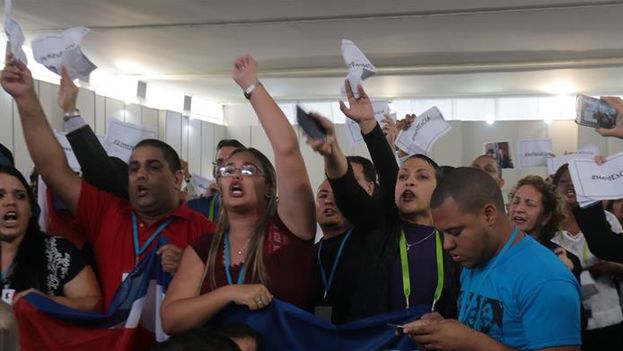
More than fifty Cuban pro-government and a dozen Venezuelans screamed “mercenaries” as they hijacked the start of the meeting between representatives of governments and members of civil society. (EFE / Alberto Valderrama)

14ymedio bigger14ymedio, Generation Y, Yoani Sanchez, 16 April 2018 — The echoes of the recently concluded Summit of the Americas are beginning to fade. The event that summoned most of the presidents of the region and served as a framework for various social forums is a thing of the past. However, the images of the deplorable performance of the official Cuba delegation remain fresh in our memory.

The ‘civil society’ that Raul Castro sent to Peru provokes, at the very least, at sense of embarrassment over the actions of others. Their contemptuous faces and their intolerant screams spread the idea that the inhabitants of this Island have no talent for debate, we lack the necessary respect for differences and respond to arguments with shouts. continue reading

They, with their calculated bullying and their picket line behavior, have seriously affected the image of the nation. Under the slogan “Don’t mess with Cuba,” they ended up damaging this country’s reputation in the region even more, a prestige already greatly undermined by our having tolerated, as a people, more than half a century of an authoritarian system.

Why did these shock troops insist on their performance knowing the backlash they engendered? Because the message to be transmitted was precisely that of a horde of automatons without nuance or humanity. Their bosses in Havana trained them to present that sad spectacle, exposed them to ridicule, and used them to make it clear that nothing has changed.

Over time, as has happened so often, some of the protagonists of these escraches will ascend to positions of greater responsibility as a reward for the decibels they achieved with their cries. Others will emigrate, using the opportunity of some official trip to escape from the country, and try to forget making such fools of themselves. But they will never apologize to the victims of their aggressiveness.

The new stain on the image of the nation will last longer than the false intransigence of these soldiers disguised as citizens. They will move on, but the shame will remain.

___________________

The 14ymedio team is committed to serious journalism that reflects the reality of deep Cuba. Thank you for joining us on this long road. We invite you to continue supporting us, but this time by becoming a member of 14ymedio. Together we can continue to transform journalism in Cuba.

Cuba Imposes More Travel Bans on Dissidents

The passport check windows that Cubans must pass through to fly out of Cuba from Jose Marti International Airport. (CC)

14ymedio bigger14ymedio, Havana, 12 April 2018 — The Cuban government has taken another step in its policy of restricting travel, by preventing the departure of Dora Leonor Mesa from the Cuban Association for Early Childhood Education, and Marthadela Tamayo and Juan Antonio Madrazo from the Committee for Racial Integration. The three were invited, as presenters, to the Universal Periodic Review (UPR) of Cuba, which takes place this Friday in Geneva before the United Nations Human Rights Council. However, Cuban authorities prohibited them from leaving the island, according to the organization Archivo de Cuba.

This decision places Cuba in a tiny and inauspicious group, the few nations that have blocked their citizens from participating in the UPR, which currently, in addition to Cuba, consists of Bahrain, Sudan and South Sudan. continue reading

The UPR sessions are preliminary meetings to assess the human rights situation in different countries and, from them, recommendations are offered. Member countries of the UN are subject to this scrutiny every five years.

Maria Werlau, director of the Cuba Archives project based in Flordia, will speak at the review to “expose violations of the right to life contained in the report prepared by her organization in October 2017” and developed jointly with Cubalex and Human Rights Foundation, as the organization said in a press release.

The meeting will also hear from Alejandro González Raga, from the Cuban Observatory of Human Rights, and José Fornaris Ramos, from the Pro Free Press Association (APLP). In addition, several NGOs presented reports to the working group to address the situation of rights and freedoms on the island, including: Apretaste, Buró de Derechos Humanos, Cadal, Civicus, Cuban Commission for Human Rights and National Reconciliation, Cubalex, Democratic Directorate Cuban, Foundation for Human Rights in Cuba, Patmos Institute and Race & Equality.

Juan Antonio Madrazo explained to 14ymedio that before going through the ticket office of the Directorate of Immigration and Emigration (DIE) at José Martí International Airport in Havana, he was informed that there was an exit ban against him. “I do not understand why. Before traveling, I went to the Immigration Citizenship Office and was told that my ‘regulation’ had been in force for only 21 days and that it had already expired.”

Madrazo denounces that after that incident he approached Marthadela Tamayo to give the activist his computer and some documents. At that moment an immigration official took Tamayo’s passport out of her hands and after “a show of rudeness and provocations” told her that she could not travel either.

Another similar case is that of Dora Leonor Mesa, director of the Cuban Association for the Teaching of Early Childhood Education, who was told that she also was barred from traveling, while lawyer José Ernesto Estrada, a resident of Pinar del Río, was prevented by State Security from leaving his province to travel to the airport. “This act prevents our seven-minute exposure in front of the UN,” denounced Madrazo.

Last February, four members of the Free Press Association were interrogated by State Security after sending a report on press freedom in Cuba to the United Nations Human Rights Council.

José Antonio Fornaris, president of the independent organization, believes these pressures to be “an attack on the press” in the midst of a national context in which “aggressions against journalists” have increased in recent months.

A month later, Acelia Carvajal, member of the Inclusive Culture Network, was not able to visit the Swiss headquarters of the United Nations, because she was also “regulated.” The activist was going to participate in a presentation on the situation of people with disabilities on the Island.

Although Migratory Reform was enacted in January 2013 and significantly eased the procedures to travel outside the Island — among other measures by eliminating the previous “exit permit” — over the years Raúl Castro’s government has been adding to the list of opponents that can not leave the country.

In the beginning, to prevent them from traveling, State Security used the arbitrary arrests of dissidents, hours before their planes took off or intercepted the vehicles in which they were traveling to the airport and held then until the flights had left. In the last year, however, it has become more common to wait to inform people that they are “regulated” until they arrive at the immigration window in the airport.

 ________________________

The 14ymedio team is committed to serious journalism that reflects the reality of deep Cuba. Thank you for joining us on this long road. We invite you to continue supporting us, but this time by becoming a member of 14ymedio. Together we can continue to transform journalism in Cuba.

Residents of Sarra Building to Return Home Six Years After Staircase Collapse

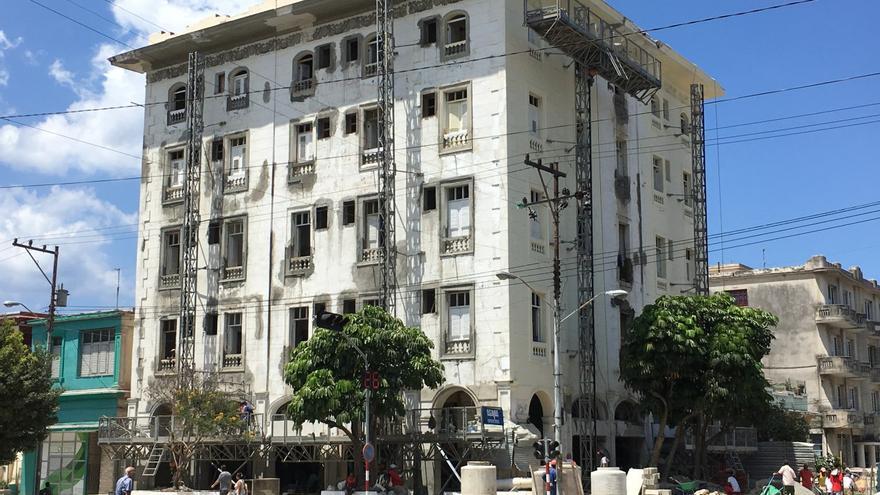
The authorities hope to reopen the building on the 57th anniversary of Fidel’s Castro declaration of the socialist character of the Revolution, delivered in a speech from the same corner. (14ymedio)

14ymedio bigger14ymedio, Havana, 13 April 2018 — The residents apartment building located at the central corner of 23rd and 12th in Havana’s Vedado district, are counting the days until they will return to their homes, six years after being evacuated, in March 2012, because of the collapse of the staircase. After a prolonged repair, the residents of the emblematic building will return to their homes on 16 April.

The iconic structure known as the Sarrá Building, built in 1925, is the currently a hive of activity swarming with builders and officials. The authorities hope to reopen the five-story block on the date commemorating the 57th anniversary of Fidel Castro’s declaration of the socialist character of the Cuban Revolution, during a speech delivered from the same corner. continue reading

The 36 families that inhabited the building six years ago will be able to return to their homes, which have been returned to “optimal living conditions,” according to statements to the press from Michel Milán Reyes, vice president of the Provincial Administration Council in Havana.

“The brigade is rushing to deliver the work on 16 April,” one of the builders engaged in the restoration told 14ymedio, who did not want to reveal his name. The worker says that in the last weeks they have had to “put the pedal to the metal, because the bosses want it ready on that date.”

“All the apartments have been worked on because, although it was the staircase that initially collapsed, over the years the entire building was damaged and much deeper repairs had to be made,” the worker says. “The roofs, beams and slab were very affected by humidity,” he says.

After the staircase collapsed six years ago, the residents loaded their belongings, appliances and other valuables and moved to the nearby Charles Chaplin cinema from where they were relocated to state shelters and houses scattered throughout the municipalities Cerro, 10 de Octubre, Guanabacoa and Habana del Este.

This April, the art gallery that was traditionally located in the basement of the building will reopen its doors, but “on this occasion, dedicated to the Undefeated Commander Fidel (Castro),” said Milan Reyes in a statement. The official also announced that on the ground floor of the premises there will be other services to mark the “500th anniversary of the city.”

Since the first residents were evacuated and the building was left in total neglect, the commemorative sign that marks the place where Castro made his historic speech was covered with a metal plate to protect it from deterioration and vandalism.

The plaque shows a bronze bas-relief with the figure of the former Cuban president, one of the few sculptures of his person that exist on the island, where in 2016 a decree was passed prohibiting the use of Castro’s name or image in public spaces or monuments

During the prolonged work of repairing the building, the complaints of the residents, who feared the total collapse of the building, were constant. In 2013, several of them sent a letter to the official newspaper Juventud Rebelde in which they lamented that, although in December 2012 the budget for the reconstruction was approved, almost a year later the work had not yet begun.

The signers deplored the “lack of will” and of “coordination among the agencies in charge of the repair.” In the letter they insisted that they could not allow the “the lack of responsibility, the indolence and negligence” to continue, and they requested that the facts be investigated and the responsibilities for the delay determined.

Nereida and Manolo, a couple who resided in the building, reported that during the first years when the building was uninhabited after the collapse of the staircase “the scourge of water and mold” considerably damaged the apartments, which were also plundered by vandals, who stole flooring, tiles and elements of the electrical installation.

“This place became a dumpster and they even took the hinges off the doors,” says Mario, a resident on 12th Street a few yards from the well-known corner. “Now they have had to invest in replacing everything that was stolen,” says the neighbor.

The residents, who spent years evacuated in state shelters, wrote to the president of Parliament, Esteban Lazo Hernández, a number of high officials of the Communist Party and the Provincial Prosecutor’s Office to press for the repairs to be done, but the budget was not approved until 2014 and the first work started two years later, a total of four years after the evacuation.

“This has been an ordeal, there were people who died without being able to see the finished work, couples who divorced, children who have grown up in a shelter without any privacy and even families who ended up leaving the country,” Mario explains. “To many this return is bitter because they have already spent six years of their lives without a roof of their own.”

“The fear that the neighbors had is that, given the location and the importance of this building, they would repair it to give it to some institution or use the land to build a hotel, but from the first moment they wrote letters and demands to everyone, so they could not do that.”

In Havana some 33,889 families (132,699 people) need a roof and most of them have spent decades in “temporary” shelters for victims of building collapses or hurricanes.

In 2012, the Population and Housing Census showed that 60% of the 3.9 million homes that exist on the Island are in poor condition.

 _____________________

The 14ymedio team is committed to serious journalism that reflects the reality of deep Cuba. Thank you for joining us on this long road. We invite you to continue supporting us, but this time by becoming a member of 14ymedio. Together we can continue to transform journalism in Cuba.

Venezuelan and Cuban Officialdom Join Forces to Hijack Civil Society Meeting in Lima

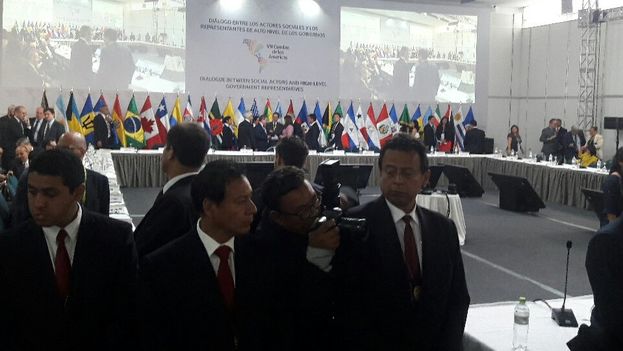
Security forces had to stand between the protestors and the main table of Summit participants. (ALBA)

14ymedio bigger14ymedio (with information from agencies), Lima/Miami, 13 April 2018 — As they had warned days ago that they would, representatives of the Cuban government tried yesterday to prevent a meeting between representatives of other governments of the Americas and members of civil society from many nations. The meeting, held in the framework of the activities of the Summit of the Americas in Lima, was preceded by a monumental uproar in which Cuban pro-government activists, joined by a dozen Venezuelans, shouted “mercenaries” and “get them out” at the opponents of their governments. To the denunciations calling the event an “antidemocratic format” the pro-government group joined their voices in singing the Cuban anthem.

The protest over the presence of government opponents began when Luis Almagro, secretary general of the Organization of American States (OAS), took the floor to start the meeting.

“I have no problem talking to background music, as I did, and worse things have been done in my life to try to silence me,” Almagro told EFE during a pause.

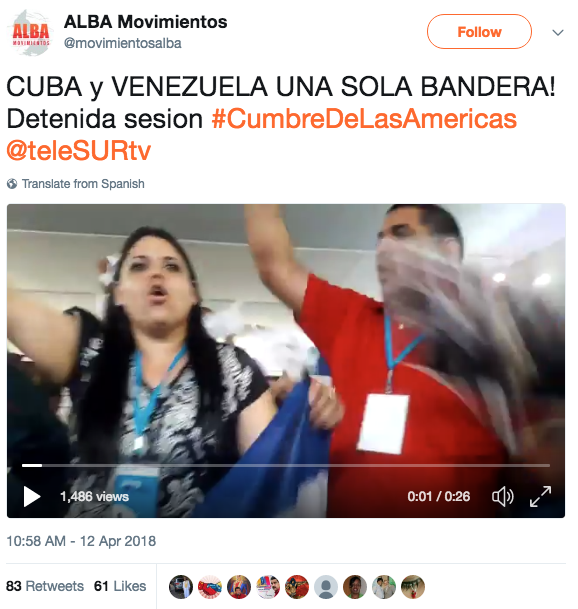
CUBA and VENEZUELA ONLY ONE FlLAG. Session stopped. – ALBA Movements (@movimientosalba) April 12, 2018 [CLICK ON IMAGE FOR VIDEO OF PROTEST]
continue reading

“I think we all have to learn from this, there are countries that still have strategies that are at odds with democracy,” he added, describing “the spectacle that is taking place” as “regrettable” and “embarrassing.”

Almagro also told EFE that he has expected the protest to take place: “We had been told before we arrived that 40 gorillas had installed themselves in the front rows and had a disruptive intention.”

Cuba’s ambassador in Austria, Juan Antonio Fernández, said that he did not intend to “dialogue with mercenaries and terrorists and with that whole party that has arrived from Miami. Cuba’s civil society is the one that is expressing itself here,” Fernandez said in reference the pro-government protestors.

The US ambassador to the OAS, Carlos Trujillo, said he was “pleased that Cuban society has the opportunity to participate in a true democracy,” that is the one in Peru, and that representatives of the ruling party had “absolutely no respect… I respectfully ask these organizations to leave the room,” he added.

The representative of the Government of Mexico tried to mediate and asked everyone to listen, something that the Bolivian representative supported, although he mentioned the absence of Venezuela at the Summit. “You have to listen to all voices, but a voice is missing here,” he said.

The events occurred at the same time that the acting Secretary of State of the United States, John Sullivan, met with a small group of Cuban and Venezuelan opponents. At the meeting, the diplomat expressed his disagreement with the “undemocratic transition” that will take place next week in Cuba, when President Raul Castro leaves office.

Among those attending the meetings were Guillermo Fariñas and Antonio Rodiles, as well as Danilo Maldonado, the artist known as El Sexto.

“The Acting Secretary of State applauded the work done by these independent activists and thinkers to promote a more open, free and prosperous future for their country,” and expressed his “support for the Cuban people in the face of the continued repression of their government,” said the US State Department spokesperson, Heather Nauert.

The acting secretary “condemned the harassment and intimidation” that “activists routinely face” at the meeting, and that the non-government activists denounced that some of their “friends and colleagues” could not travel to Lima because “the Cuban government prevented it,” Nauert added.

In this context, the Inter-American Press Association (IAPA) noted that the governments of the Americas have the “historic obligation” to take measures that lead to “a rapid and unwavering democratic transition” in Cuba and Venezuela.

IAPA, based in Miami, stressed that in both countries “the essential principles of the Inter-American Democratic Charter” are not respected, and said that the Charter “can not remain as a decorative statement, but should be a call to action.”

The IAPA noted that at the Panama Summit in 2015 it had stated that “the governments of the Americas had ‘a historic opportunity’ to reaffirm to both totalitarian regimes that they should show respect for those essential freedoms.”

“Today we believe that they already have ‘a historical obligation’ to take concrete measures that, described in that Charter, lead to a rapid and unwavering democratic transition,” the proclamation adds.

The Association, dedicated to freedom of the press, acknowledged that in recent years the international community has been aware of the “deteriorated socio-political climate in Venezuela and that many nations have refused to recognized Venezuela’s Constituent Assembly or to recognize any leader that emerges from fraudulent elections.”

Therefore, the IAPA urges that this consensus be used to “promote more drastic measures to prevent the regime from trying to perpetuate itself in power while turning its back on the progress of its citizens.”

Although no government in the region is exempt from occurrences of abuse, corruption and censorship, those with “democratic systems with separation of powers, independent judges, transparency mechanisms and a free press, have the necessary counterweights,” the Association added.

“The authoritarian regimes of Cuba and Venezuela are the antithesis of these values,” says the IAPA, which believes that the Lima Summit’s agenda, “Democratic governance against corruption,” will allow presidents and heads of state to feel an obligation to work for the citizens of Venezuela and Cuba.

__________________________

The 14ymedio team is committed to serious journalism that reflects the reality of deep Cuba. Thank you for joining us on this long road. We invite you to continue supporting us, but this time by becoming a member of 14ymedio. Together we can continue to transform journalism in Cuba.

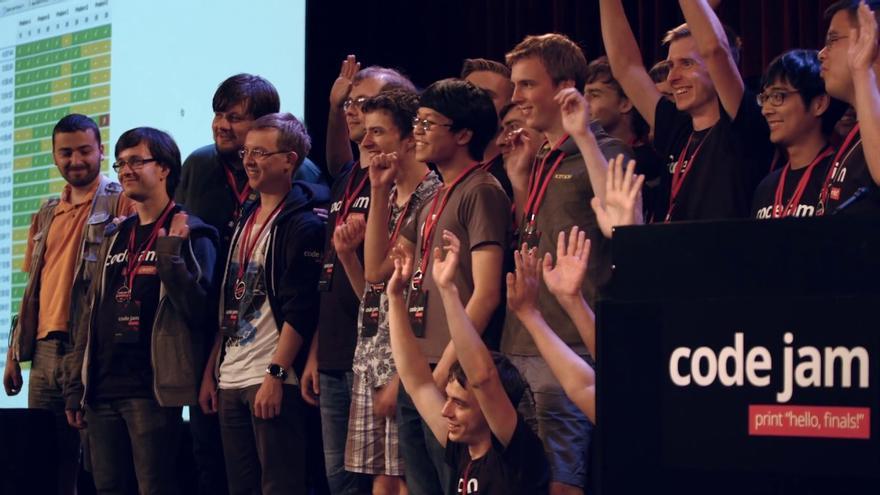
Cubans Compete for the First Time in the Google Programmers Contest

Until now, Cuba was not included in Google’s registration categories for competitions and certifications. (Screen capture)

14ymedio bigger14ymedio, Havana, 6 April 2018 — Cubans have until this Friday to register for the worldwide Code Jam programmers contest organized by Google. This year, for the first time, the contest has included coders on the Island among its contestants. The contest final will be held in August in Canada.

Brett Perlmutter, Google’s director of Strategy and Operations for Cuba, made the announcement through his Twitter account and said it was “a pleasure” that Code Jam was finally “open to Cuban contestants.” continue reading

Perlmutter expressed his enthusiasm that “for the first time, the world will be able to see the capabilities of Cuban scientists and programmers,” a possibility that did not exist until now, because the Island was not included in Google’s registration categories for competitions and certifications.

The registration period closes this Friday, April 6, when the qualification rounds will be held. To compete in the contest, the contestants must be connected from their respective countries, a challenge for Cubans who live in one of the nations with the lowest rate of internet connectivity.

Among the biggest stimuli of the contest promoted by Google is the unique prize of $15,000, and the chance to travel to Canada for the final.

In Cuba there is a vibrant community of application developers and in February 2017 the Android Developer’s Club was launched, sponsored by the government Cuban Informatics Union (UIC).

However, most of those who devote themselves to developing these utilities on the island prefer to work independently and seek contracts directly with foreign companies, which offer computer engineers and programmers better salaries than they can receive from state employment.

The vast majority of national applications are dedicated to promoting new business in the private sector and providing information about traveling within the Island.

Tools such as Alamesa, KeHayPaHoy, 100 Logos of Cuba, HabanaTrans, Qvacall or La Chopi are the best known. Many of them have been developed to work without an internet connection, a way to avoid the high prices of the connection to the web that remain at 1 CUC per hour (roughly $1 US in a country where salaries top out for most state workers at about $30 a month).

 __________________________

The 14ymedio team is committed to serious journalism that reflects the reality of deep Cuba. Thank you for joining us on this long road. We invite you to continue supporting us, but this time by becoming a member of 14ymedio. Together we can continue to transform journalism in Cuba.

An Island with a Salt Shortage

A bag of salt from Trinidad and Tobago. Cubans who travel abroad bring home packages of this condiment because it is unavailable in the national markets. (14ymedio)

14ymedio bigger14ymedio, Marcelo Hernández, Havana, 5 April 2018 — The official had a concerned look on his face upon seeing the two bags of salt that Laura Acuña was carrying in her suitcase on a flight from Bogota to Havana. “It was hard to explain to him why I was transporting two kilos of salt to an island,” recalls Acuña, a Cuban woman now living in Colombia, who was bringing it home to her mother.

Since late last year it has been difficult to buy salt with Cuban pesos both in stores selling rationed goods as well those where products are not rationed. It is still available in hard currency stores but at a much higher price. continue reading

The black market is still an option but even informal retail networks have begun to see shortages. The situation has gotten worse with each passing week as shipments to government warehouses, where most of the merchandise is diverted to the illegal trade, fail to arrive.

Salt production has fallen in recent years according to the Statistical Annual of Cuba, published by the National Bureau of Statistics. Extraction of unrefined salt fell from a little more than 280,000 tons in 2011 to 248,000 in 2016. The official reasons for the decline have been weather-related problems and “technical obsolescence” within the industry.

The production of refined granulated salt, the kind used by consumers, has also fallen, from 93,700 tons in 2012 to 76,100 tons in 2016, according to the annual report.

Even with this fall in production, the industry should theoretically still be able to supply salt to the entire population. According to authorities, Cubans consume an average of ten grams of salt per day (twice the amount recommended by the World Health Organization), which translates into 40,800 tons per year. However, this 35,300-ton surplus somehow does not make it into stores.

“Every day people ask if I have salt but none has come into this store since January,” says Leandra, an employee of a small market on Havana’s Monte Street that distributes basic items. “We still have a little left but it’s quite damp. Other than that, it’s all gone.”

Of the island’s six salt processing plants, five are in operation and all are located in the central and eastern region of the country. Last September, Hurricane Irma seriously affected at least three of them, paralyzing production and leading to countless tons of lost production.

The director of Geominsal Business Group, Fabio Raimundo Paz, explained to the official press that the production areas that suffered the greatest damages were those of Puerto Padre in Las Tunas province, Santa Lucia in Camagüey and Bidos, located in the municipality of Martí in Matanzas.

All the salt that was still in drying beds and in so-called crystallizers was lost, while 5% of the product in storage and ready for distribution was damaged, according to the official. Weeks passed before the impact of these losses were felt on consumers’ dining tables.

Despite the fact that competent authorities have for months made assurances  that “product availability” has been returned to normal levels and that the one-kilo bags “guaranteed” by the rationing system are being distributed, supplies of the condiment have become scarce.

Recently the local press Sancti Spíritus sounded the alarm, noting that since October, deliveries of salt to private sector stores — about fifty tons per month according to the weekly newpaper El Escambray — had been interrupted. Now “only those orders intended for basic rationing and certain of areas of public consumption have been delivered,” it added.

“Normally we don’t see much turnover of this product here,” an employee at a store in Plaza de Carlos III, the city’s main hard currency shopping center, explains to 14ymedio. “The people who buy this product here are almost always foreigners who are visiting the city or owners of privately owned restaurants,” he adds.

The employee has noticed a rise in demand for bags of salt, which go for 1.50 convertible pesos (twenty-five times more than the subsidized price of rationed salt). “They started buying it in large quantities and now we’re out of it,” he says. “Until recently the problem was toilet paper; now it’s salt’s turn.”

The response on the Ministry of Domestic Commerce’s hotline are terse. “We are waiting for additional supplies to arrive,” without any indication when that might be. In the manufacturing plants themselves complaints focus on a lack of organization and difficulties in getting the merchandise to the point of sale.

We are not tackling any number of problems, especially the issue of rail transport,” says an employee at El Real, a salt producer in Camagüey, who prefers to remain anonymous. The plant, which opened in 1919, has an annual production target of 20,000 tons. “Although the salt beds are well stocked, we lost part of the roof of the storage facility in the hurricane,” he adds.

“We are now in a race against time because, when the rainy season begins, which is normally in May, we have to halt almost all production,” adds the employee “When there is a lot of rain, the brine becomes contaminated with fresh water and dust,” he points out.

In the hotel and tourism sectors, the problem also creates a greater demand for food supplies, which creates additional stresses for some employees. “Until recently we were giving customers tiny doses of domestically produced salt,” says one of the waiters at the Hotel England, which faces Central Park.

“When we put out salt shakers, we had to keep an eye on them because people would empty them. We also have to add grains of rice to the shakers because it’s very humid,” he adds. “Before, we had to be careful that customers did not take the silverware or the glasses, but now we also have to watch out for the salt.”

_______________________

The 14ymedio team is committed to serious journalism that reflects the reality of deep Cuba. Thank you for joining us on this long road. We invite you to continue supporting us, but this time by becoming a member of 14ymedio. Together we can continue to transform journalism in Cuba.

Cuba Reaches 5 Million Mobile Lines, But Still Lags Behind Latin America

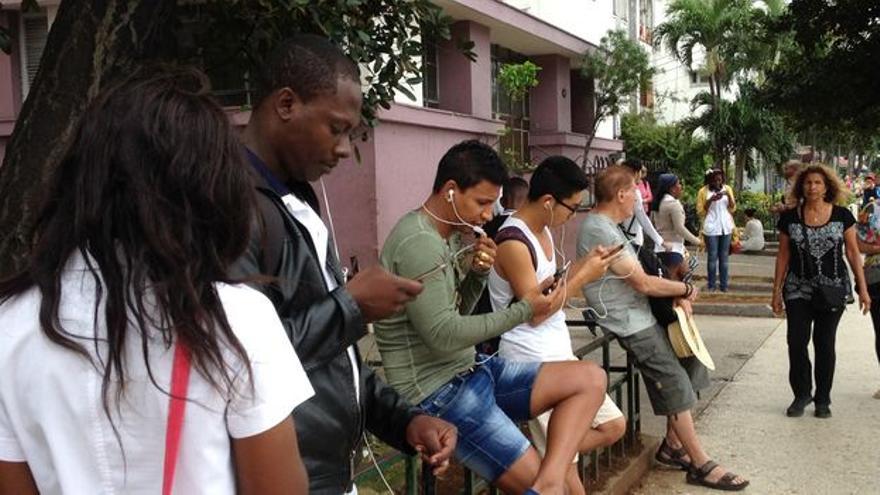
Young people using their cell phones to connect to Wi-Fi in an enabled zone in a public park in Havana, where fees for the service are very high. (14ymedio)

14ymedio bigger14ymedio, Havana, 12 April 2018 — The Telecommunications Company of Cuba (ETECSA) reported Wednesday that it has reached five million active mobile telephone lines throughout the country, serving 43% of the inhabitants, a figure that has the island still lagging behind Latin America, with 65% mobile phone penetration.

The state telecommunications monopoly detailed the growth in mobile service in the last year and a half, which went from 4 million, 16 months ago, to the current figure of 5 million. In its statement, ETECSA did not specify what percentage of the customers are occasional tourists (who contract for cellphone service while visiting Cuba because their own phones do not work here) and which are permanent users of the service. continue reading

In fifteen years cellphone lines went from about 43,000, in 2003, to the current 5,000,000, a growth that has a direct impact on communications, private businesses and the professional life of the country.

“2018 will be another year to continue the process of computerization of Cuban society and thereby contribute more services to the population, contribute to the economy and the development of the country,” said ETECSA.

Recently the company announced that this year it will begin to offer Internet service from mobile phones. “We are prepared to start selling Internet-on-mobile next year, we are working to reach this type of access,” said the president of this entity, Mayra Arevich, on the government website CubaHoy.

However, the company has not yet begun to market the service or announced when it will be operational.

In 2015, in Latin America, mobile technologies and services generated 5% of GDP and around two million jobs, according to data from the GSMA organization that covers mobile operators and related companies around the world.

 ____________________________

The 14ymedio team is committed to serious journalism that reflects the reality of deep Cuba. Thank you for joining us on this long road. We invite you to continue supporting us, but this time by becoming a member of 14ymedio. Together we can continue to transform journalism in Cuba.

Cuban Government Says Rosa Maria Paya is in Lima Due to "Secret Machinations"

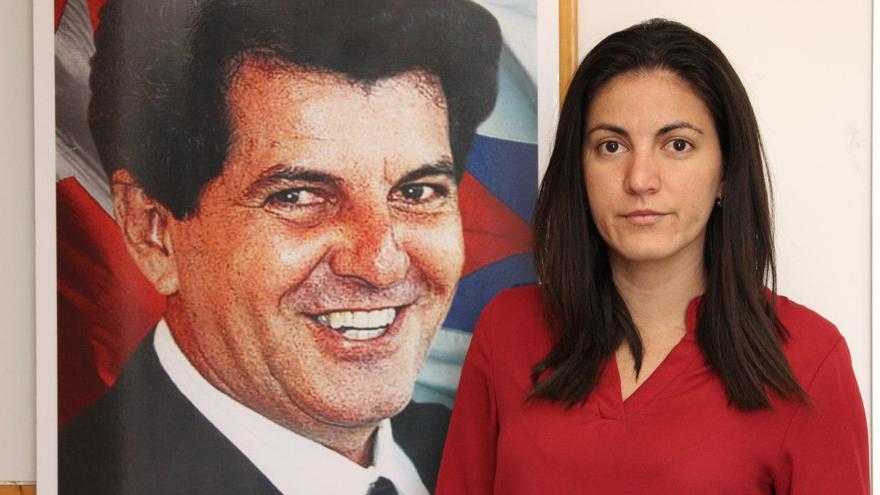
Rosa María Payá with a painting of her father, Oswaldo Payá. (14ymedio)

14ymedio bigger14ymedio, Mario Penton, Miami, 11 April 2018 — Rosa María Payá is one of the few Cuban activists who have managed to reach the Summit of the Americas being held in Lima this week. While the majority of the opponents who reside on the island have been stopped by the police from leaving their homes, or picked up by State Security on the way to the airport or stopped by immigration authorities at the exit gates to prevent them from reaching Peru, Paya, who divides her time between Havana and Miami, was able to circumvent the siege.

At 28, Rosa María Payá has become one of the most visible faces of the Cuban opposition. Her international presence has raised the tone of the attacks on her launched by Plaza of the Revolution in the official media, particularly in recent weeks.

Her ancestry (she is the daughter of the late dissident Oswaldo Payá) and her good relations with US Senator Marco Rubio and the Secretary General of the Organization of American States (OAS), Luis Almagro, have been enough for officialdom to attack her. continue reading

The most recent attacks occurred on Tuesday, coinciding with her arrival in Peru to participate in the civil society forums that are being held at the same time as the Summit between the hemisphere’s leaders.

The official newspaper Cubadebate has published an attack titled Secret machinations against Venezuela and Cuba at the Lima Summit, which is based on a supposed letter claimed to be from the opposition to Luis Almagro that was originally published in the blog Discovering Truths. Payá flatly denied being the author of the letter and charged that the ruling party had used a photograph of her signature in a faked montage.

Propagandists of the Castro dictatorship asked to interview me.  Interview with  #CubaDecide by government media: @ACN_Cuba y @VideosCubaHoy en #VIIICumbredelasAmericas

– Rosa María Payá A. (@RosaMariaPaya) April 11, 2018

In June of 2017, Cuban television presented a report trying to discredit Payá because of her links with some exile groups in Miami, “the international right” and a presumed relationship with the Central Intelligence Agency (CIA). Payá requested five minutes on national television to defend herself against such accusations but never received a response from the authorities.

This Tuesday, however, she was interviewed by Cuba’s official media. The Cuban News Agency (ACN) spoke with the activist about the alleged letter published in Cubadebate, and Payá took the opportunity to ask the journalist to ask State Security “who is it who defames and lies about the defenders of human rights in Cuba.”

“[In Cuba we have lived] for 60 years without rights, without the ability to prosper on the wages of our own work and the only party responsible for that is a totalitarian regime,” she answered when asked about her knowledge of the country, due to the short periods of time she has spent on the island since her father’s death in 2012.

In addition, she took advantage of the moment to talk about her initiative, Cuba Decides, intended to achieve democracy on the island through a binding referendum, in a model similar to the consultation that ended the Pinochet regime in Chile. “What I want is for Cubans to be able to represent themselves, that nobody else speaks for all Cubans, we are going to ask them in a plebiscite,” she told the official agency yesterday.

“We are at a point where the regime, the group of generals in power, is in an increasingly vulnerable position. Even though they seem immovable, they are not. There is no other general who has come down from the Sierra to take power in April. Cubans are increasingly unhappy,” the opposition leader told 14ymedio in a recent conversation.

“We do not have to convince Cubans of what is wrong in Cuba, everyone knows, we can not live better for an intrinsically political reason. We live in a system of terror, in a culture of fear,” Payá told 14ymedio.

“Cuba Decide does not want to influence the regime, but rather the Cuban citizenry. We know that we want to force the group that is in power to do what they do not want to do, so we seek to generate the conditions of external and internal pressure so that the changes occur in an orderly, peaceful way, but definitively,” she argues.

Payá believes that the situation in Cuba is not supportive of large groups of people marching in the streets, so she is committed to getting the minimum agreements with other opposition groups to allow them to join forces with her movement. “We are trying to simplify the message to reach more people. We look for points we agree on: Cuba needs a change and with that as a starting point we invite people to join the forces of the nation,” she says.

So far the Patriotic Union of Cuba, the Pedro Luis Boitel party, the independent trade unions, Opponents for a New Republic and several movements of independent churches have accepted the call of Cuba Decides, according to its promoter.

Rosa María Payá thanked the journalist for giving her the opportunity to speak to Cuban media yesterday. “I hope the Cuban government press accomplishes its mission of transmitting the truth instead of serving the oppressors in power and that it publishes our proposals to the countries attending the secretariat of the Summit of the Americas.”

A short distance away, representatives of Cuban officialdom lamented their alleged exclusion, which they described as “malicious,” from the Youth Forum that brings together representatives of civil society with high-level representatives of the governments.

“When we went to the San Isidro Business Center, where the accreditation process for the event took place, we got involved in the dialogue with the representatives of the States and they told us that we had not been selected. The meeting is expected to involve 50 young people, of the 150 that the organizers accepted for the 5th Youth Forum, and ‘coincidentally’ they did not choose any Cubans,” said Ronald Hidalgo Rivera.

In addition, the group publicly denounced the “intrusion of three elements [individuals] of the Cuban counterrevolution” as representatives of the island’s youth at the meeting. And they announced that they will not allow “the forum to be held with these three little people in the room, because we are not willing to dialogue with elements financed by counterrevolutionary and terrorist organizations.” The war is on.

 _________________

The 14ymedio team is committed to serious journalism that reflects the reality of deep Cuba. Thank you for joining us on this long road. We invite you to continue supporting us, but this time by becoming a member of 14ymedio. Together we can continue to transform journalism in Cuba.

Corruption, the End of Impunity and the Latin American Political Street Gangs

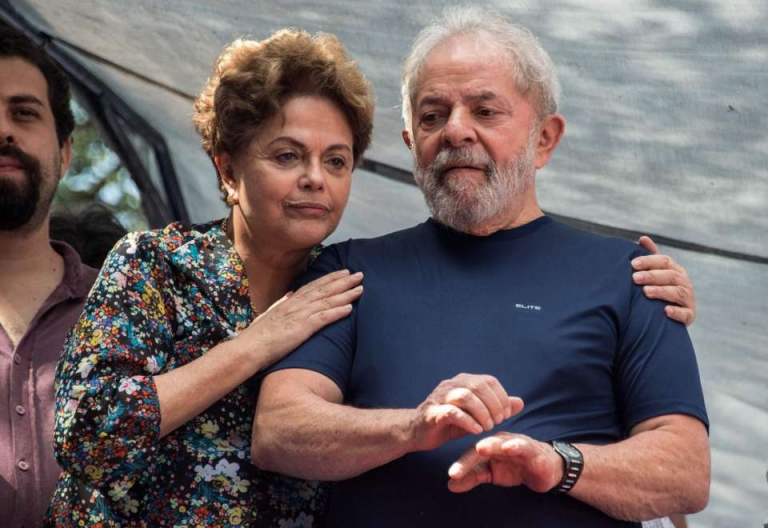
Lula and ex-president Dilma Rousseff (AFP)

Cubanet, Miriam Celaya, Havana, 10 April 2018 — With the recent imprisonment of former Brazilian President Luiz Inácio Lula da Silva, the regional left has just received another hard setback. In fact, it could almost be said that Lula’s fall from grace has been the most serious blow suffered by Latin American progressives in the midst of the relentless bashing that its leaders have been weathering in recent times.

Lula is, without a doubt, one of the few heads of state of the left under whose government (2003-2011) extraordinary economic and social improvement was seen, reflected in a high rate of GDP growth, increases in exports, anticipated liquidation of external debts, strengthening of the national markets, significant decreases in unemployment, increases in salaries and the creation and diversification of microcredits, among other important reforms. continue reading

If Brazil reached a relevant position in the world economy in just eight years, and if ever the developing countries looked with hope at what was known at the time as “the Brazilian miracle,” it is largely due to the political talent and the economic reforms promoted by Lula, which explains his enormous popularity in his country and the considerable political capital which he still has, even in the midst of the judicial process – a corruption plot not yet concluded – that has landed him in jail.

But, along with all of Lula’s merits listed above is that other essential component of the best exponents of political populism: a mixture of charisma and histrionics that the former President, now a defendant, has deployed astutely, in the purest style of the television soap operas produced by his country, to manipulate the exalted spirits of his followers in his favor. Staying in the political game, despite everything, is one of the most common tricks of populist leaders, regardless of their ideological alignment.

The hoax reached its climax precisely at the end of the 48 hours of the weekend in which he remained resistant – self imprisoned, it could be said – in the face of the order to surrender to the authorities to begin to serve a 12-year prison sentence, when, surrounded by militants of his own party (Partido de los Trabajadores, PT) and other allied parties – among which the everlasting scarlet shadow of the Communists could not be absent – Lula used popular sentimentality to invoke the memory of his late wife on the first anniversary of her death, with a Catholic mass that served to close a chapter in what promises to be an extensive and complicated saga.

Afterwards, before surrendering to the authorities, the beginning of messianism and megalomania surfaced in one who, now purified by his punishment, assumes himself as metamorphosed into the Illuminati of the poor, to harangue his enlightened discourse, with a mystical touch: “I will not stop because I am no longer a human being, I am an idea (…) mixed with your ideas.” And “in this town there are many Lulas.” Apotheosis of the peoples. The crowd cheered deliriously, tears flowed and hugs for the martyr abounded. Curtain down.

It is not personal. It is known that the defense of those who are condemned must be allowed, even from the guillotine, and that those who are hanged also kick about. However, as far as it has transpired, Luiz Inácio Lula da Silva was prosecuted with the corresponding guarantees under the Brazilian judicial system rules, and he is being convicted of corruption, not because of his political ideas.

Ergo, even though Lula’s downfall benefits his political adversaries, it was Lula himself who, in committing the crime, deeply harmed the PT and dirtied the “cause” of his followers. It is not, then, a “political trial,” as his regional leftist allies want others to believe, and some of them are beginning to fear they could also be splashed by this great mess of putrefaction.

Beyond all that Lula did well, no one is above the Law. After all, whoever is corrupt should be prosecuted and imprisoned, especially those who hold political office. It is true that, in good faith – and judging by the corruption scandals that are being uncovered in recent years among the political classes of any alignment – it would be said that, in order to imprison the dishonest public servants, prison capacities would have to be expanded rapidly, especially in Latin America.

In fact, the history of our region is so lavish in examples of political and administrative decay at all levels that this last uncorking, which continues to expose long chains of corruption and to implicate numerous high level politicians, should not surprise anyone. The novelty – and this, only to a certain extent – is that they are being judged, condemned and imprisoned.

We must not forget the case of the former Brazilian president Fernando Collor de Mello (who governed between March 1990 and October 1992) as the young politician who assumed the first presidency of a democratic Brazil. He won the elections in the second round – precisely against Lula da Silva – for the right-wing National Reconstruction Party, with the promise of ending the illicit enrichment of public officials.

Paradoxically, just over two years later, Collor de Mello was forced to resign because of investigations of corruption – acceptance of bribes in exchange for political favors – and influence peddling, followed by a Congress that officially requested his dismissal. A technicality in the court process prevented his being found guilty of political corruption, and that saved him from prison. However, Congress did consider him guilty and condemned him to eight years of suppression of his political rights. So far, Collor de Mello has not succeeded in his political career, although he has again attempted to venture into it.

Now, Collor de Mello’s asking his supporters back then to publicly demonstrate against what he called a “coup d’état”, seems to be part of a desperate recourse followed by presidents fallen into disgrace, beyond their political color. Years later, Dilma Rousseff took that same stance when facing her own destitution.

And these are only Brazilian references. We can also mention recent cases of fallen angels in other countries of the region, such as the left-wing Argentine president, Cristina Fernández – also said to be “persecuted politically,” the poor thing – or the right-wing Peruvian president, Pedro Pablo Kuczynski. It has been said that corruption is not an ideological disease, but a moral one.

And while the spiral of corruption continues to expand, dragging more and more prominent figures of regional politics in its dizzying cone, Latin Americans who are followers of one leader or another – or one party or trend or another – continue to show civic immaturity and the proverbial political infantilism.

So, instead of taking on the challenge of the moment and embracing the end of impunity as an essential principle that, without distinction or privileges, will reign over all public servants, they prefer to project themselves as if this were all a brawl between street gangs, where what really matters is not to prove one’s innocence but to accentuate the guilt of the adversary. It isn’t so much that “mine” is corrupt, but that “yours” is more so. And so it seems that we will continue to the end of time.

To paraphrase a well-known Cuban poet: It’s Latin America, don’t be surprised at anything.

Translated by Norma Whiting
“Friends Of Cuba” in Peru Destroy Billboard That Supports Human Rights

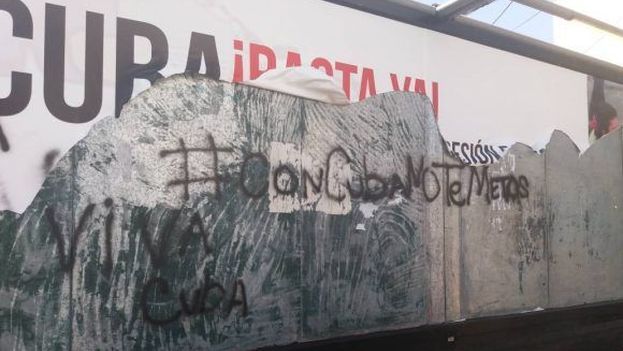
What the billboard in Peru looked like after it was defaced. Spray-painted text: “Don’t mess with Cuba” (Cubadebate)

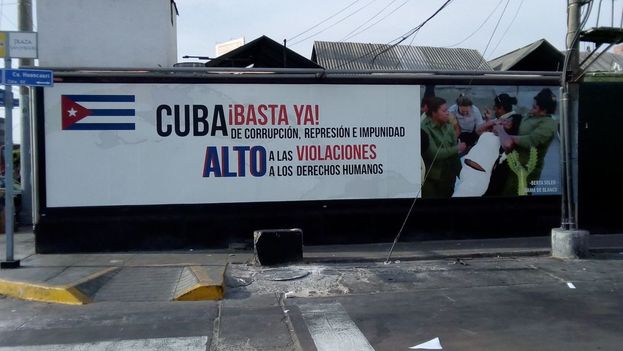
14ymedio bigger14ymedio, Miami, 11 April 2018 — A billboard calling for the end of repression, corruption and impunity in Cuba was vandalized on Tuesday in Lima, Peru, where the forums parallel to the VIII Summit of the Americas are being held. The billboard, placed near airport and addressed to those who are participating in the hemispheric meeting, unleashed the wrath of the “friends of Cuba in Peru.”

The activists allied with the Cuban government not only tore up the poster mounted on the billboard, but also wrote below what little remained of it: “Don’t mess with Cuba,” a piece of bravado from the Cuban ambassador in Lima, Juan Antonio Fernández, which was aired on national television in an edited and manipulated video which incorporated cheering and applause that never happened. continue reading

Cuban diplomat Juan Antonio Fernández Palacios makes a fool of himself in a meeting prior to the 2018 Summit of the Americas and the official press INTRODUCES APPLAUSE by creating a fake video. Do not miss the video, before and after the manipulation. There are no words… [The faked video can be seen here, along with the original video from another angle showing that rather than speaking in front of a large cheering crowd, the remarks were delivered to a meeting of mostly silent participants.]
– ObservatorioCubanoDH (@observacuba) March 23, 2018

Billboard in Lima before it was torn down and defaced by allies of the Cuban Government. Text: Cuba, Enough Already! Of corruption, repression and impunity, ignoring violations, ignoring human rights.

The official newspaper Cubadebate said that with the destruction of the billboard, “the friends of Cuba” showed that “there is no provocation from the mercenary counterrevolution that remains unanswered.”

In recent days, parallel forums have been developed for the hemispheric summit to which the Cuban government has sent a large delegation to represent “the true Cuban youth.” Havana has more than 20 activists from independent movements in the country boarding flights at Havana’s José Martí International Airport, to prevent them from attending the summit and has promised that it will not tolerate dissidents or critical voices sitting at the same tables of dialogue and discussion as their delegation.

In Cuba, social organizations function as transmission mechanisms to enforce orders from the Government and the Communist Party. After the death of Fidel Castro in 2016, a graffiti with the phrase “He left” outside the Habana Libre hotel cost activist Danilo Maldonado 55 days in jail.
________________

The 14ymedio team is committed to serious journalism that reflects the reality of deep Cuba. Thank you for joining us on this long road. We invite you to continue supporting us, but this time by becoming a member of 14ymedio. Together we can continue to transform journalism in Cuba.

Crash in Villa Clara Leaves Two Dead and Four Injured

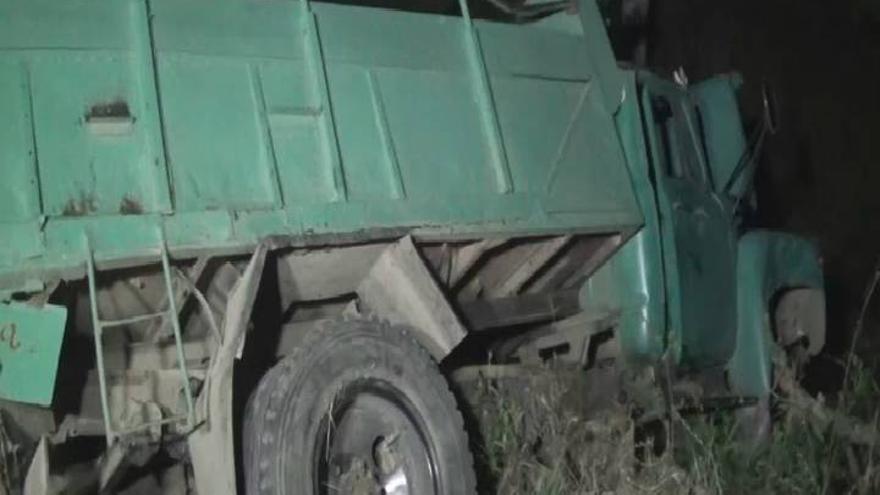
Massive traffic accidents involving trucks are very common on the island. (Telepinar / Archive)

14ymedio bigger14ymedio, Havana, 9 April 2018 — A traffic crash took the lives of two people on Sunday afternoon and left four others injured, including two children, on the road from Ranchuelo to Cienfuegos in Villa Clara province. The incident involved a Moskovich car trying to overtake another vehicle, according to a note in the official press.

The deceased were Jorge Lantigua García, 52 years old, who was the driver of the Moskovich, and Yasmani Bárbaro León Cordero, 28 years old, both residents of the Villa Clara municipality of Ranchuelo. The latter received “serious injuries resulting from the accident, and died shortly afterwards,” the note said. continue reading

Among the four injured are two children, ages 4 and 5, residents of the municipality of Santo Domingo, who are stable and under observation at the Pediatric Hospital José Luis Miranda, Santa Clara

The two adults who were also injured, ages 23 and 24, were taken to the Arnaldo Milián Castro Provincial Hospital in Santa Clara; one of them has serious injuries.

In recent weeks the official press has been filled with news of crashes, several of them massive and involving trucks equipped for the transport of passengers, something very common on the island given the chronic problems of providing transportation as a public service.

At the beginning of this year a wave of fatal crashes led the official newspaper Granma to publish an article in which it demanded greater urgency in the repair of roads and, especially, the section of the highway between Villa Clara and Sancti Spíritus, which the official press called “an asphalt cemetery.”

Recently, faced with the high number of fatal crashes on Cuban roads, the authorities turned to a road safety education program organized and financed by the United Nations Children’s Fund (UNICEF) and the Canadian company Sherritt.

Traffic crashes are the fifth cause of death in Cuba, with a daily average of 31 crashes. According to the latest available data, in the first half of 2017 there were 1,070 crashes, resulting in 314 deaths* and 3,478 injuries.

*Translator’s note: Transportation fatality rates are generally compared country-to-country based on deaths per number of inhabitants, per number of registered vehicles, and per miles/kilometers traveled. On measure of deaths per inhabitant, Cuba had the lowest rate in 2013 among 10 Latin American countries, with a rate almost exactly equal to that of the European Union.  However, per registered vehicle, Cuba’s death rate was second only to Ecuador’s, and roughly ten times that of the European Union, making clear that the lower number per inhabitant is a reflection of the very low rates of travel in Cuba relative to other Latin American countries. Death rates based on distance traveled, generally the best comparison, were not available because few Latin American countries collect this data.

________________________

The 14ymedio team is committed to serious journalism that reflects the reality of deep Cuba. Thank you for joining us on this long road. We invite you to continue supporting us, but this time by becoming a member of 14ymedio. Together we can continue to transform journalism in Cuba.

Cuba’s Opposition Leaders Ask Latin America to Ignore Succession in Cuba

A group of Cuban opposition leaders during a press conference in Miami after the announcement of the change of policy towards the island. (14ymedio)

14ymedio biggerEFE, via 14ymedio, 9 April 2018 — A group of 16 leaders of the internal opposition in Cuba urged the governments of the region, on Monday, to “ignore the Castro dictatorship” when Raúl Castro hands over power on 19 April, and asked the Organization of American States (OAS) “for concrete and firm actions to support the Cuban people.”

In an open letter addressed to the OAS and its member states, obtained by EFE, the opponents, among them Berta Soler, Guillermo Fariñas, Antonio Rodiles and Jorge Luis García “Antúnez,” ask the region to pay attention to the imminent departure of Castro from the Government. continue reading

The opponents warn that Castro’s successor will be “a finger-pointing puppet” and that his “relatives, henchmen and associates will redistribute economic positions and control to guarantee the dynasty indefinitely.”

With this in mind, they urge governments to take a “positive step, ignoring the Castro dictatorship and its dynastic succession and demanding the release of political prisoners.”

They also ask the region to “accept” the Cuban opposition as a legitimate political actor and to form a bloc of countries “that exert pressure through economic and political sanctions against the regime.”

Although the signatories highlight the work of OAS Secretary General, Luis Almagro, they point out that this organization must undertake “concrete and firm actions to support the Cuban people in their struggle for freedom and democracy.”

They say that Almagro’s work “has taken a favorable turn in comparison with previous periods, but the actions are weak even in the face of such a challenging scenario.”

“Convictions and actions with greater impact are needed,” the signatories wrote.

According to the opposition leaders, the fact that “the Castroist presence has exported its repressive technology to Venezuela” is scandalous and “the permissive positioning of the region is inexplicable.”

They stressed that “only” the government of US President Donald Trump, “has been consistent in its behavior to put an end to the regime’s absurd agenda of legitimization, promoted by former President (Barack) Obama (2009-2017).”

They stressed that Trump “has in his sights sanctions against the military power on the island and the companies that gravitate around the Castro family.”

On the other hand, they described as “inexplicable” the silence of Latin America about the interference of the “Cuban dictatorship” in the “democratic rupture” of Venezuela.

The letter is also signed by the opponents Antonio Ángel Moya, Félix Navarro, Eduardo Díaz Fleitas, Ailer González, Gorki Águila, María Cristina Labrada, Ángel Santiesteban, Raúl Borges, Juan Alberto de la Nuez, Benito Fojaco, Claudio Fuentes and Juan González Febles.

________________________

The 14ymedio team is committed to serious journalism that reflects the reality of deep Cuba. Thank you for joining us on this long road. We invite you to continue supporting us, but this time by becoming a member of 14ymedio. Together we can continue to transform journalism in Cuba.

Cuban Children and Childish Journalism

Students from a primary school in Havana say goodbye to the 2016-2017 academic year. (14ymedio)

14ymedio bigger14ymedio, Miriam Celaya, Havana, 9 April 2018 — On Friday, April 6th, The National Newscast on Cuban Television (NTV) devoted a few minutes of its midday and evening editions to broadcast a critical report by journalist Maray Suárez about parents’ lack of attention to their children. In her own words, this situation, which is becoming worrisome in current Cuban society, negatively affects the education and the formation of children’s values.

It is refreshing to see that someone finally cares about this issue despite the slow reaction of the government press when it comes to addressing the multiple and pressing problems of society. continue reading

The report is based on Suarez’s two particular personal experiences. The first took place 4 o’clock in the morning, when the reporter was on her way to work and she encountered a group of teenagers, between 12 and 15 years old, gathered on a corner of Havana’s Vedado district. The second, when she attended a choreographed performance by a large group of children from the primary school Quince de Abril, in the Havana municipality of Diez de Octubre, on the occasion of the celebration of the 57th anniversary of the Organization of Pioneers of Cuba. The reporter showed the video recording of that performance in conjunction with the report.

It’s heartening that someone finally cares about this matter, despite slow reaction by the government press when it comes to addressing the problems of society

In the first case, Suárez stopped to talk with the night-owl boys, asked them their ages and reflected on the families’ lack of supervision that allows these children to stay up late at night in the street, with all its implied risks.

In the second case, the video presented on NTV shows a group of children at the Pioneer celebration, dressed in their school uniforms, dancing provocatively to the sound of reggae music, sensually swaying their hips, glutes and waists. Suárez believes that the celebration should have included the sort of music which is more appropriate to a children’s audience than that which led to a vulgar, erotic display that played out on the school’s stage.

“Are these the spectacles we want from our children?” the worried reporter of the official press asks rhetorically. The journalist insists on the importance of “the interaction of the child with the family,” underlining that the development of minors is an obligation “that the whole society should be concerned with.” All of which is (or should at least be) true.

However, perhaps driven by her passionate interest in the education and care of children, Maray Suárez forgot to inform us if – as one would expect – she consulted or asked the families of those children for their authorization before exposing them publicly performing their obscene dance in a video broadcast by the Cuban TV news media, which did not take the trouble to have anyone pixelate their innocent faces.

Could it be that this media professional not know that exposing images of children publicly constitutes a crime in any moderately civilized society in the world?

Could it be that this press professional did not know that exposing images of children publicly constitutes a crime in any moderately civilized society in the world? Where, then, are her own ethical values as a journalist? Does she find it very educational to act with such flagrant disrespect to minors and their families?

Unfortunately, since Cuba is not a State of Laws, the parents and children thus vexed are defenseless: they cannot sue the colossal official press apparatus or the reporter in question.

Although the reporter addresses the issue of family supervision, it would not hurt to introduce reflections on the role that the teachers and the primary school management played in this case. Ultimately, it was they who allowed – and perhaps even promoted – these children’s vulgar dance display at school.

For the problem to be really corrected, the official press should put aside all the hypocritical puritanism that mediates each article of information and take on the challenge of describing and exposing the dark and dirty cracks lacerating the current Cuban society.

The official press should put aside all the hypocritical puritanism that mediates each article of information and take on the challenge of describing and exposing the dark and dirty cracks lacerating current Cuban society 

The task is particularly impossible if we take into account that to find a solution to sensitive issues such as the one we are dealing with, it is necessary to stop beating about the bush. Instead of flirting with the effects, you must first identify the causes of the malady.

But faced with a deep problem in education, it will not be the communicators of the government press who air the dirty laundry.

Because, at the end of the day, the official journalists are also a bit like children: to publish each and every one of their lines or tidbits they need the consent of the principal responsible for the disaster: the Government. And the journalists of the Castro regime are, Yessir, respectful and obedient children.

Translated by Norma Whiting

_________________________

The 14ymedio team is committed to serious journalism that reflects the reality of deep Cuba. Thank you for joining us on this long road. We invite you to continue supporting us, but this time by becoming a member of 14ymedio. Together we can continue to transform journalism in Cuba.