Blacklisted in 21st Century Cuba / Lynn Cruz

Havana Times, Lynn Cruz, 28 April 2018 — I have been witness to the most absurd experience in my life as an actress. I only had testimonies of actors such as Pancho Garcia, Rolen Hernandez and Mirian Munoz as a reference from the well-known “Five Grey Years” (a period of witch hunts, persecuting intellectuals, artists, homosexuals, religious people and followers in the ‘70s). I always saw these things as events in the past, but reality surpasses the imagination.

As I explained in previous posts, I was recently expelled from the state-led agency Actuar for arbitrary reasonsThe agency’s director, Jorge Luis Frias, carried out the measure without taking into account the fact that he was violating the clauses of my artistic representation contract, which I have had with this company for over 10 years, by blindly obeying his superiors. continue reading

Taking the Labor Ministry’s advice, I filed a written complaint. People at the Human Resources department, where Actuar’s Labor Justice Committee (OJL) resides, were very nice to me. Everyone was surprised about my situation and couldn’t understand why Frias wouldn’t tell me the reasons for my expulsion. I was also dumbfounded.  Even when I suspected what the reasons were, I refuse to take part in this nonsense.

I left them with a copy of the letter which explained what had happened. Frias has committed two violations. First of all, he canceled my contract without waiting the established 30-day period to tell the worker why this company has decided to revoke the contract. Secondly, he went behind my back and colluded with the International Film School of San Antonio del Los Banos’ management, who knew about the measure before I was told anything and it prevented me from attending a workshop that I have worked at for the past six years as an actress.

Last week, I received a call from the OJL secretary to tell me that Friday April 20th, they would meet with me to answer my complaint. I arrived at the agreed time, however, I had to wait because the OJL boss was running late. He arrived wearing shorts and flip flops. The assembly began ten minutes later. Approximately 15 people attended.

Frias coldly admitted that he had violated my contract and the solution he offered was to reopen the contract for 30 days and then decide to revoke it again. A completely insane idea. Basically, the procedure they were using with me was the most similar to the labor trials that took place in theaters in the ‘70s.

I saw myself wearing a scarf on my head, or like Mirtha Ibarra in Hasta Cierto Punto, a Tomas Gutierrez Alea movie. I had to keep myself from smiling in the face of so much nerve and absurdity. I wouldn’t call it a lack of respect as that would be taking it too seriously.

Everyone who had treated me nicely before fell into the situation. Most people were offended because Frias, like a programmed robot, said: “She has been expelled for her protests online against the people who govern this country.”

I looked over all my assessment papers as an actress, my work contracts and it didn’t say that an artist had to be a hypocrite and dishonest anywhere. It doesn’t say in writing that an artist has to stop being free to say what to think. Everyone who was gathered there to judge my case abused and ignored the fact that their wages depend on artists work and the funds generated.

It’s even more twisted when it comes from a company that has apparently been “representing” me all this time yet hasn’t sought out a single job for me. These offices have become just another part of our bureaucracy, which has nothing to do with the reality of actors living in Cuba. Actors’ work depends on the rules of the market. Every co-production that is processed via these companies give large sums of hard currency to the country and they take a 7% cut out of our personal wages. This is what really sustains the bureaucrats who were incriminating me.

I was attending a blacklisting assembly in the middle of such an ambiguous reality. A system which doesn’t have its values defined. A veiled market economy, without a truly structural change which at least articulates a coherent discourse. More than making me sad, it made me feel like I was inside a madhouse. But, it’s better to watch the video for yourselves.


Note: Translation from Havana Times

The "Man With the Flag" Hunger Strikes for the Release of His Son

The brutal arrest of Daniel Llorente was captured on camera by dozens of foreign correspondents. (EFE)

14ymedio bigger14ymedio, Havana, 30 April 2018 — On the eve of the first anniversary of his arrest during last year’s May Day parade in Havana’s Plaza of the Revolution, Daniel Llorente is refusing to eat until his son, Eliezer Llorente, who was arrested on Sunday in San Antonio de los Baños, in the province of Artemis, is released.

“He was arrested when he was with independent journalist Vladimir Turro,” his mother Judiza Pérez told 14ymedio. “They went together, but at twelve he returned to pick up his father’s lunch to go for Sunday’s visit,” at the Mazorra Psychiatric Hospital where the elder Llorente remains interned* as a result of his activism. continue reading

After several unsuccessful attempts to communicate with her son, Perez received a missed call from the police station in San Antonio de los Baños. At first the officers of the station denied that Eliezer Llorente was detained there, but at her insistence one of them confirmed the detention of her son.

“It was six o’clock in the evening and I immediately headed there [San Antonio de los Baños is 40 kilometers from Havana], and I had to take four transports and a pedicab because it is very far away,” said Perez.

After a sleepless night in that town, the deputy head of the Police Station told her Monday that her son was arrested because he was in possession of “meat” brought by the journalist who was with him.

In Cuba the private sale and distribution of meat is prohibited.

“All that is a lie,” says Pérez, who says that the real cause of the arrest of her son is because the authorities fear that he will engage in some protest action like his father’s, during tomorrow’s May Day parade.

“My son is not an opponent or a criminal,” she said sorrowfully.

According to Pérez, the officer with whom she spoke told her that her son is refusing to eat and that he has declared himself “on strike” until they release him. They also told her that the young man is “under investigation” and that they plan to release him after the parade on May 1.

“I’m going to go there to be with my son and I will not move from the Police Station and if they put me out I will sit in the park until they release him because I’m not leaving this town without my son,” she added.

This morning Perez took her son a toothbrush, toothpaste and soap but he was not allowed to bring him food.

From the Comandante Doctor Eduardo Bernabé Ordaz Ducungede Psychiatric Hospital in Havana, popularly known as Mazorra, Daniel Llorente told this newspaper that he was fasting “until the situation [with his son] is resolved.”

“The doctor told me to be calm but I’m very calm, this is just another adversity, a total arbitrariness,” he added by phone. He also joined his son in fasting until they release him.

“If they think their doing this will soften me, on the contrary, my position remains the same as always,” said the activist.

Eliezer Llorente has faithfully visited his father in the hospital twice a week all year long and is informing the independent media and the international press about his father’s situation. This would explain, according to his mother, why her son is targeted by State Security.

Daniel Llorente Miranda has stood out for the activism he displayed on his own after the diplomatic thaw between Cuba and the United States. His image traveled through social networks and the covers of many international newspapers when he hoisted the US flag during the 2017 May Day parade in Havana’s Plaza of the Revolution.

Seven security agents pounced on him and took him down him by force. Since then he has been detained. Although during the first month the authorities kept him in the Operations Directorate of the State Security (Villa Marista), he was later transferred* to Mazorra.

*Translator’s note: Holding political protestors in mental hospitals is intended to keep international organizations from classifying them as political prisoners.

 ___________________________

The 14ymedio team is committed to serious journalism that reflects the reality of deep Cuba. Thank you for joining us on this long road. We invite you to continue supporting us, but this time by becoming a member of 14ymedio. Together we can continue to transform journalism in Cuba.

The Monosyllabic Rebel

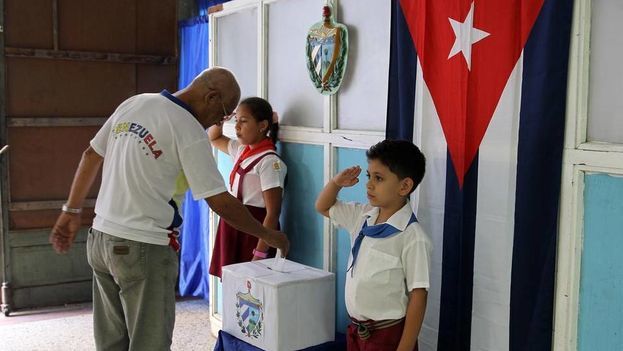
A man exercises his right to vote in the elections to the People’s Power in Havana. (File EFE)

14ymedio bigger14ymedio, Reinaldo Escobar, Havana, 30 April 2018 — Rarely in the last half century has Cuba’s citizenry had a chance to show its displeasure. Government control and lack of a unified opposition platform have spoiled those moments, but a constitutional referendum could be the golden occasion to change the course of events or, at least, to demonstrate differences with the government.

By mid-2021, if the deadlines announced by former President Raul Castro are met, voters will face a ballot where they can mark “”Yes” or “No” for a new constitution. A vote that will have the value of a plebiscite on the socialist character of the Cuban system and the role of the Communist Party as “the superior force of society and the State.” continue reading

Unlike the so-called constitutional mummification, which in June 2002 made socialism “irrevocable,” with more than eight million signatures collected at the neighborhood level and in full public view, without any options presented to reject the proposal, it appears that on this opportunity the procedure established in the Electoral Law will be followed, with a secret vote and space to say “No.”

The process begins this year when the National Assembly appoints a commission of deputies to draft and present the new Constitution. It will then be discussed by the members of the Assembly, subjected to “popular consultation” and the final text will have to be submitted to a referendum, as detailed by Raul Castro, some years ago, in his first speech as president.

Right now, the view is that the initiation of constitutional reform will be constrained within a rigid corset. “We do not intend to modify the irrevocable socialist character of our political and social system, nor the role of the Cuban Communist Party (PCC),” the General warned, to avoid triggering expectations about a change of course.

Castro went further and also detailed that in the preparation of the new legislation he will defend the ratification of the PCC’s authority “remaining in the same place: Article Five.” A detail that does away with any illusion that the constitutional reform will promote, and accompany, a democratic transformation on the island.

With these preconditions, the rewriting of the fundamental law is nothing more than a mere exercise of updating the superfluous and keeping the totalitarian core intact. In the face of such evidence, only two positions remain. Approve, with a “Yes” vote, the attempt to perpetuate Castroism, or concentrate, in the “No” vote, all the nuances of rebellion.

The supporters of the regime, as well as those who feel some hope with the slightest aperture in the new Constitution, will go to the polls gathered around the obedient monosyllable. Among them will be those who will consider the inclusion of a few winks toward the market incorporated in the text to be sufficient. Without a doubt, they will be millions.

On the other hand, opponents of the system will have plenty of reasons not to go to the polls to vote on the referendum, or to leave the ballot blank or to scribble whatever is the motto of their opposition initiative on the sheet they deposit at the polls. A diversity of proposals that becomes counterproductive in this particular case and allows the authorities to diffuse dissent.

Although there are still months, perhaps years, before the vote will be called, proposals are circulating among the island’s civil society about the most effective positions to take in the process.

Those arguing the case not to go to the polling stations at all say that their presence at the polls “only serves to validate the dictatorship,” while the promoters of going to the polls but not marking either option believe that this position is more viable in the face of the population’s widespread fear. Others will campaign to write the slogan of their organization on the ballot or they will insist on denouncing at the international level the lack of legitimacy of the referendum.

For once it would be worth joining forces and, shoulder to shoulder, marking an X in the “No” box, but this also involves a challenge. Those who do so need to know that they will be included in the elevated percentages that the officialdom will report as backing for the referendum process itself, and also run the risk of massive fraud in the counting of ballots. But, if they manage to be the multitude, they will send a devastating message.

With a consonant and a vowel, Cubans who refuse to validate a coerced constitution will be making it clear that they do not want to remain part of an unsuccessful experiment. They are the electors who with a simple stroke of a pencil will ratify their displeasure before the imposition, by law, of a small political fraction on the plural and diverse spectrum of the nation.

The plebiscite meticulously calculated to not allow any loophole of political freedom would turn against its organizers, as happened once in Chile to the astonishment of the international community and to the country’s own dictator, Augusto Pinochet.

From now on, it is worth noting that the “No,” that rebellious monosyllable, can thus become the visible and forceful expression of the citizen unrest in Cuba, sunk today in the swamps of faking it.

______________________

The 14ymedio team is committed to serious journalism that reflects the reality of deep Cuba. Thank you for joining us on this long road. We invite you to continue supporting us, but this time by becoming a member of 14ymedio. Together we can continue to transform journalism in Cuba.

Diaz-Canel’s Arrival Generates Much Skepticism and a Bit of Hope in Miami

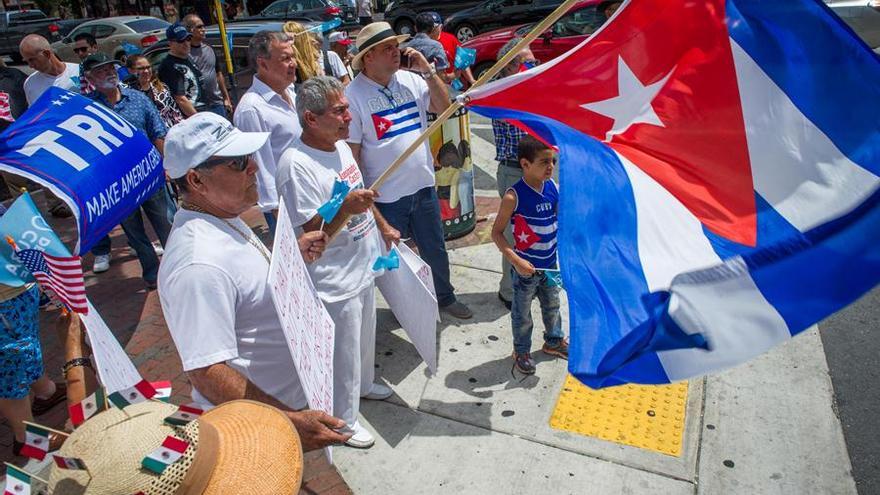
Dozens of people demonstrate with posters and Cuban flags, in the heart of Little Havana, in the city of Miami. (EFE)

14ymedio bigger14ymedio, Mario J. Pentón, 19 April 2018 — In the city with the largest Cuban population after Havana, the appointment last Thursday of Miguel Díaz-Canel as president of Cuba took no one by surprise. As the only candidate for president just the day before, the 58-year-old electrical engineer is hardly unknown in Miami.

“I don’t care who rules Cuba. The place is a total mess. That’s why I left,” says Elaine García, a 35-year-old Cuban woman who works as a salesperson at a bakery on Okeechobee Road in Hialeah. She arrived from Cuba five years ago and, though she says she maintains her ties to her family on the island, she prefers not to get involved in “politics.” continue reading

Díaz-Canel took office without generating large public demonstrations in southern Florida, though there has been a wave of criticism from politicians, activists and non-governmental organizations.

One such organization is Raíces de Esperanza (Roots of Hope), which sponsors programs to support young people on the island. It issued a statement saying it is “hopeful” about the change of leadership in Cuba.

“We believe that today’s transfer of power represents an opportunity for a new generation of Cuban leaders to take concrete measures to promote significant economic prosperity and political reforms on the island,” it says, asking the country’s new chief executive to listen to “Cuba’s youth, from its businesspeople and civil society leaders to artists and students.”

For Ramón Saúl Sánchez, president of Movimiento Democracia, what happened last week in Havana “is an undemocratic handover that should not be recognized by the international community.”

Sánchez told 14ymedio that he called upon Cuban exiles to demonstrate in front of the legendary Versailles restaurant in the heart of Miami’s Little Havana to “condemn the illegitimate transfer of power.”

“I listened to Díaz-Canel’s speach. I would have liked hear a reformist but that was not the case. It was a speech by yet another establishment figure who will not help Cubans obtain their freedom,” he said. He does, however, hold out hope that the situation could change after “the inevitable biological event.”

Activist Rosa María Payá — leader of Cuba Decides, a campaign to hold a binding referendum on a democratic transition in Cuba — accused the government of “disguising its despotism by designating heirs.”

“An heir acting as a front-man for the Castros is not change. Change comes when Cubans can participate and change the system through referendum,” tweeted Payá, who has been the target of a smear campaign by the official press for her recent participation in the Summit of the Americas in Peru.

“The percentages are a sign of totalitarian conformity and the complete absence of democratic engagement in the National Assembly. With a ridiculous 99.83% of the votes going to Raúl Castro’s man, he is now the designated president,” she added.

Cuban-American congresswoman Ileana Ros-Lehtinen also used the social network to say that it does not matter who governs the island because “Cubans continue to suffer and their basic human rights are denied under a totalitarian communist system.”

“The sham transition of power in Cuba does not change the reality of the island’s people or bring them any closer to freedom. Power remains in the hands of Castro’s murderous communist regime,” she said in another Spanish-language tweet.

The prominent anti-Castro congresswoman will retire from the US House of Representatives after a political career spanning thirty-eight years. Ros-Lehtinen has historically been one of the most vocal critics of the Castro government.

Archivo Cuba, an NGO which compiles personal accounts and statistics related to violations of human rights on the island, issued a statement saying that the new government “is a transfer of power in name only, a nominal change within a totalitarian system that continues to carry out serious abuses against Cuban citizens and to ignore their fundamental rights.”

Senator Marco Rubio said in an interview with El Nuevo Herald that he hopes that the community  of Latin American countries does not recognize the “fraudulent” succession which has taken place on the island.

“We will see if an organization that was created to defend democracy is ready or not to criticize something that is not democratic. I hope there is a vote on this as soon as possible,” said Rubio in a reference to the Organization of American States.

For his part, the Cuban-American congressman Mario Díaz-Balart recalled Osvaldo Dorticós Torrado, president from 1959 until 1976, the year current socialist constitution was adopted and the office of president was eliminated. During his tenure as head of the government, he had to deal with the constant presence of Fidel Castro as prime minister. Dorticós committed suicide in 1983.

“Just as Fidel Castro made Osvaldo Dorticós president until 1976, Raúl Castro has made Miguel Díaz-Canel president of the Council of Ministers and Council of State. Another Castro puppet,” says Díaz-Balart.

___________________________

The 14ymedio team is committed to serious journalism that reflects the reality of deep Cuba. Thank you for joining us on this long road. We invite you to continue supporting us, but this time by becoming a member of 14ymedio. Together we can continue to transform journalism in Cuba.

Millionaire Guerrillas and Angelic Drug Traffickers / Miriam Celaya

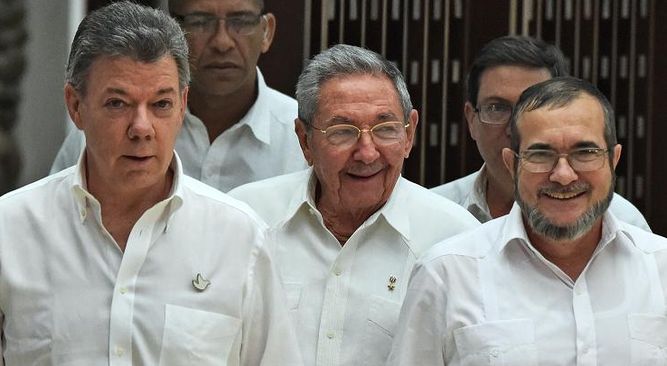
(Front, l to r) Juan Manuel Santos, Raúl Castro and Rodrigo “Timochenko” Londoño (prensa.com)

Cubanet, Miriam Celaya, Havana, 27 April 2018 — Long before what the most skeptical anticipated, the failure of the new “Peace Accords” between the Colombian government and the former Revolutionary Armed Forces of Colombia (FARC) – today metamorphosed into a political party today – is a real possibility on the horizon of that South American nation.

The pacts were negotiated in Havana for four years before being signed in Colombia, with much fanfare, on September 26, 2016. A plebiscite held on October 2 of the same year received a resounding NO, but after making several modifications to the initial version, the pact was finally signed at the Colón theater in Bogotá. From the moment of its first steps, the pact has been on shaky ground, and it is now on the verge of tumbling. continue reading

The recent imprisonment of former FARC guerrilla leader Jesús Santrich, accused of having links to drug trafficking, and his possible extradition to the United States – a situation that, as the high commissioner for the Peace of Colombia has declared, should be clarified judicially and not through debates between the government and political actors – deepens the doubts about the seriousness and veracity of the commitment of the leaders of the now called Common Alternative Revolutionary Force (FARC) to leave behind a past of violence and war that marked half a century of national Colombian life.

However, this episode is just another nail in the coffin of a handful of Agreements that evidently lacked the broad popular support that was attributed to them from the beginning, as demonstrated by the results of the October 2016 plebiscite, and more recently, with the popular rejection that the FARC leader received in his political campaign tour related to the presidential elections, from which he chose to withdraw.

On the other hand, public opinion is not greatly surprised by the arrest and incarceration of Mr. Santrich. It was an open secret that, after losing the financial and logistical support of the former Soviet Union, the Marxist fighters of the Colombian jungles, once champions of the cause of the poor, had rapidly evolved into narco-guerrillas.

The trafficking of cocaine and the extraction of gold which, it is claimed, were always part of the fighters’ “self-financing”, thus became essential sources for the economic and material support of the war and, at its core, for the enrichment of the members of its power elite.

It is not surprising, then, that after the signing of the Havana Peace Accords, the FARC leaders – far from looking like the leaders of an army made up of peasants, workers and other poor and “oppressed” sectors of society – in truth were transformed into administrators of goods and assets of about $345 million, according to an estimate from a list delivered to the Government of Juan Manuel Santos by the UN Mission in Colombia in August of 2017.

However, it is baffling (at the very least) that instead of the gang of the needy one would expect from those who, in theory, have suffered the privations of war and jungle, the harshness of fighting and the persecution of the army, the cream of the crop of the former guerrilla force are in a position to fulfill the obligation to have gold, money, land, livestock, means of transportation and other assets to pay to the fund for reparations to the victims of the armed conflict, as settled in the Agreements.

In this way, due to these difficult paradoxes of reality, the fruits of systematic crime, kidnapping, extortion and terror which was planted in Colombian society for decades, is today part of the safe-conduct for impunity that, though not necessarily forced or required, leaves a bitter taste on the mouths of the victims.

That is why it is even the more brazen that the cynicism with which the FARC – and here I refer to the “political party” – pretends to pose as a victim of political persecution, when one of the members of its clique has been caught in flagrante delicto of drug trafficking, according to the Colombian authorities, breaking with what was agreed in the Peace negotiations.

These days, his colleagues in arms and misdeeds affirm that poor Santrich is in his 15th day of a hunger strike, which “has begun to wreak havoc on his health” and one we hope he is determined to continue to its ultimate consequences.

Since the accused does not have the one act-farce style, so often used by the regional left when defeat circles its wagons, this angelic image that’s being offered of a poor, unjustly incarcerated blind man (and two other companions (cronies?) locked up in the same prison), who is willing to sacrifice his life to prove his innocence, denied the assistance of his own doctors by the authorities, is almost tender. It would seem that those kidnapped and murdered until recently by FARC guerrillas had received a lot better treatment and considerations.

But perhaps such a plaintive stance only tries to mask, as far as possible, the ramifications that drug trafficking reaches among that dark amalgam of Marxist-drug-traffickers-guerrillas-politicians, for whom perhaps the failed Peace Accords – not coincidentally negotiated in Havana’s Palace of the Revolution by their historical allies, the Castros – are too much like a capitulation of their olive-green glory days, when they camped at will, kidnapping, extorting, trafficking and murdering in the jungles and towns of Colombia.

Translated by Norma Whiting

Menstruation Without Resources / Irela Casanas

Photo: Mar Lazcano

Alas Tensas/Tremenda Nota, Irela Casañas, 2 April 2018 — Every month something happens that causes me anguish, stress, fear… when my body warns that something is coming, I start looking through all the cabinets and drawers.

I head out to the informal markets, I go see my friends, I ask my mother if she can help me. I don’t bother to look in the shops because it doesn’t work for me: what I need is very expensive and comes in very small packages. On those critical days a tiny little package like that wouldn’t be worth much. continue reading

In short, even though I’m in my thirties, every month when I menstruate I feel as disoriented as a young girl on her first time. Why? Because this year the pharmacies haven’t even sold pads – we Cuban women call them ‘intimates’ – also known as ‘Brazilians,’ or ‘absorbents.’

And why don’t they sell what we need in Cuban pesos? Because the factory broke, because there are no raw materials, because there was an eclipse… In any event, something that should be routine and solvable is an anguish for Cuban women.

When they see me at home cutting up old pillowcases, worn out sheets, holey T-shirts… it is not to improvise a rope to escape through the window… no! It is to make my own pads and to be able to get through my day, go to work, and do the housework, keep going with my bloated belly and a wad of old cloth between my legs. My God! I should take a bath, have I already stained my jeans?!

I know that my monthly problem is multiplied by millions. And I know that if someone added it all up it would be alarming to see how much my country’s economy loses because of menstruation without supplies. Because sometimes it can’t be solved with old rags, and also because sometimes there is no aspirin to ease the pain.

What is lost in the personal economy we already know, and we all know it too well. The question is, will it always be like this? Does a natural event in our bodies have to be like a hurricane, an earthquake, a blizzard? Oh my great-grandmothers, when you were young at the beginning of the last century you had no idea!

Well I would not have suspected it either, when, as a teenager in a boarding school I tried to salvage my privacy during my period and I encouraged myself by thinking, “When I am an adult and I am working this will not be a problem.”

Woman Watchmaker, Yes, Why Not / Ileana Álvarez

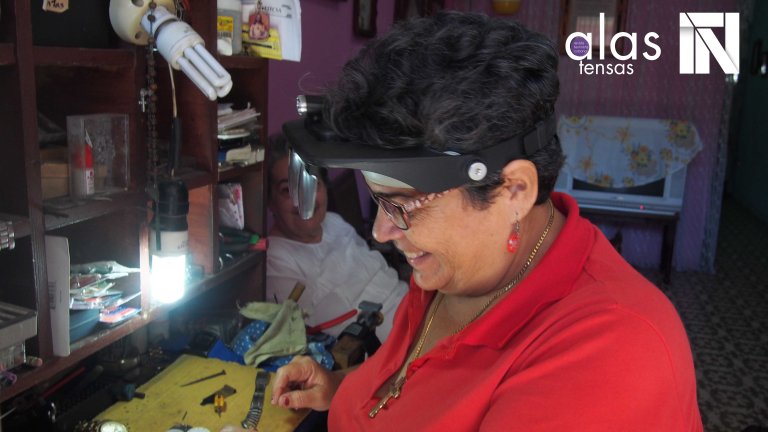
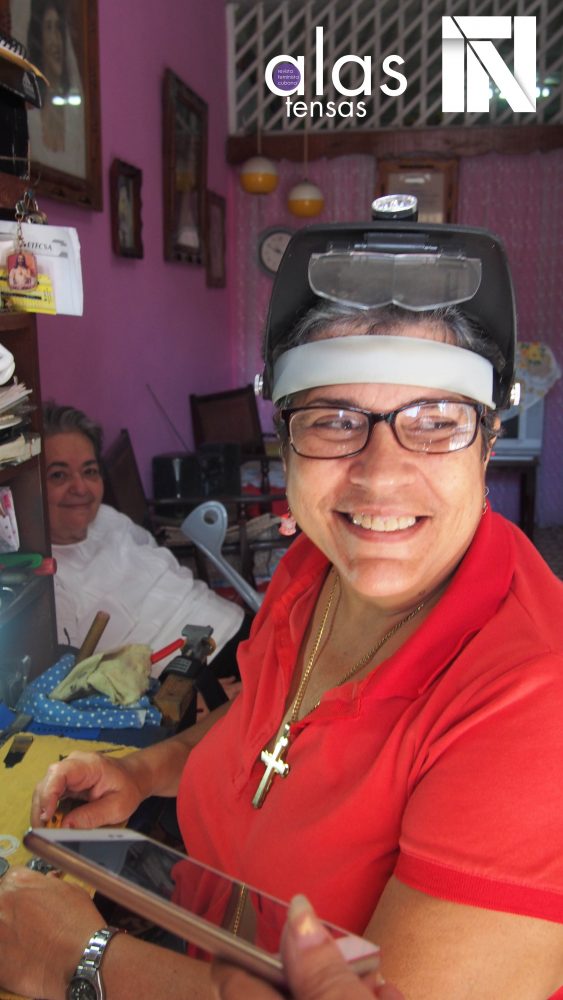
Maria del Carmen, a woman watchmaker. Photography by Yaudel Estenoz

Alas Tensas/Tremenda Notas, Ileana Alvarez, 6 April 2018 — Fixing something in Cuba is difficult. You know you can’t throw anything away because tomorrow you may need it. As the days pass you are filling your room or drawers with these castoffs. Until the moment comes when need impels you to try to fix what is broken, even if it takes you all day.

Libertad Street is one of the main roads in the city of Ciego de Ávila, and there is a sign: “Watchmaker,” with the word in the feminine form. Yes, relojera, ending in “A” not relojero ending in “O,” as the people you ask for directions will tell you. continue reading

Six women are waiting in line: most of the customers are women. Maria del Carmen, the owner of the watch repair business, is the one who fixes the watches, the eyeglasses, the shoes… and perhaps it is also that men don’t trust women very much when they perform trades traditionally seen as men’s.

Maria del Carmen has a deep voice and large hands. While she works classical music plays in the background. She is one of the more than 150,000 self-employed women in Cuba. According to the Federation of Cuban Women (FMC), one out of three self-employed people in Cuba are women, although it is estimated, in the absence of official data, that few are the owners of the businesses they run.

Maria del Carmen, now past 50, has been a watchmaker for less than three years, since her cousin Idalia taught her the business. She entered this world with her cousin and liked it so much that she believes she has far exceeded her teacher: “My teacher was Idalia, and I already have more customers than she does.”

It is not common to be a female watchmaker. It is not a tradition. Many people here tell you that it is strange, that they always ask her when the watchmaker will arrive. María del Carmen loves her job: “I’m passionate.” She gets enough to survive day-to-day, not much, but enough for her daily needs.

The problem is the lack of certainty, the scarcity of the raw materials is a great hindrance. She has to look for the parts, find a supplier, someone who travels and brings back what she needs, because in Cuba there is often no place to buy these things. This is a major inconvenience and costs her a lot of time.

Although, given the quality of service she provides, it seems that, at least until now, there is no shortage of customers. She works until 1:00 in the afternoon and says, “Sometimes when it’s quitting time I have to tell those waiting to come back tomorrow because I have to close.”

She is not teaching any other women. So far there isn’t anyone. “My descendants were my niece, and she left the country, like so many others. I would love to teach other women.”

And the taxes? “I am in the simplified regime, that is, the one where you do not have to pay ten percent.” She does not pay social security because she also works with the State as a consultant to ANEC [National Association of Economists and Accountants of Cuba], where she has a salary and provides services in economic consulting. She has a degree in Accounting and Finance, and also one in Chemistry. She learned the watchmaking trade separately.

There is a cheerful atmosphere at the watchmakers. (Yaudel Estenoz)

She would like to see more women performing jobs dominated by men. “Of course! Why not! To defend our gender, they already criticize us so much, and so they see that we capable of doing anything.”

Supposedly there is no discrimination, but indeed there is, and what there is, “I have suffered first hand.” To think that a woman can’t be a good watchmaker is also discrimination, in fact a great discrimination, because there are good female watchmakers, including some who are better than many men.

Maria has been told that she is one of these. You can see how women practice this profession with great care. Women’s ability to do the work with great patience, and to put so much love into it, is a great help in performing as watchmakers.

“We pay attention to details. We think long term. Look at these two watches that are ready now, but this on here isn’t fixed, it got damp and the whole mechanism is rusted. In any event, we don’t throw it away. You know, we can’t throw anything away. Also, it is very beautiful and perhaps we can fix it with the workings of another watch that isn’t as beautiful.”

"Children of the Revolution" Strip Naked Cuba’s "Military Capitalism" in a Book

“There is no social equality in the dictatorship,” said the book’s editor, Marlene Azor. (Screen capture)

14ymedio biggerEFE, via 14ymedio, Madrid, 9 April 2018 — “The children of the revolution stripped naked Cuban military authoritarian capitalism,” said Armando Chaguaceda, a professor at the University of Guanajuato (Mexico), on Monday, in his presentation of the book Human Rights: Realities and Challenges in Cuba.

Together with the editor of the volume, Marlene Azor, a professor at the Autonomous Metropolitan University of Mexico, Chaguaceda explained that the authors who contributed their articles “are born and live” on the island and their “academic inquiry intersects with activism.” continue reading

He emphasized, however, the academic rigor of the analysis of the situation of social, economic and cultural rights in Cuba from different perspectives.

According to his words, the authors “live in the so-called gray area, and are children of the revolution. This is not a research effort carried out from exile.”

At the event at the headquarters of the Atlantic Institute of Government, launched by José María Aznar in 2014, editor Marlene Azor denied the reality of the proclaimed achievements of the Castro revolution in the fields of health, education, access to water, culture and housing.

She criticized the Government of Cuba for ending the publication of poverty rates more than 20 years ago and recalled that, since the collapse of the Soviet Union and the end of its “subsidies,” things that had been considered social rights have ceased to be so.

“There is no social equality in the dictatorship,” she said, calling into question the existence of revolutionary successes and added that “there is no such success.”

Azor affirmed that there was a “national famine” in the early nineties and its existence has been denied by the Cuban government.

According to her data, the only improvements that the island’s economy has experienced since then is a slight increase in consumption and a reduction in power cuts, but she pointed out that “the level of precariousness is very important.”

She dismissed the official unemployment figure of 3.5% and reported that unemployment among the working age population of the Island reaches 28%, while incomes, she explained, are barely sufficient to cover anything other than food.

She also highlighted the absence of the right to freedom of association and collective bargaining in the country, and added that the country also lacks “freedom of employment.”

“All professionals are captives of state companies,” and do not even have the right to strike, said Azor, consistent with the fact that professionals are forbidden to practice independently, outside the state.

In her opinion, Cuba is “worse than any country with marginal capitalism” and cited as an example Haiti “where workers can strike.”

The housing deficit is another of the social deficiencies denounced by the book’s editor, who argued that at least 1.2 million homes are needed to meet the Island’s demand.

According to the data managed by Azor, only 5.7% of the population has running water 24 hours a day while for a large part of the population water is delivered via tanker trucks, which in common parlance are called “pipes.”

“It is a lie the size of the Eiffel Tower that no one is homeless in Cuba,” she said when referring to the state budget cuts, which she said have also affected social rights.

“Yes there are the rich and the very poor” in Cuba, said Azor.

Chaguaceda and Azor agreed in emphasizing the limitations of the expected political reforms which, they pointed out, could restart the initiatives begun with the support for cooperatives in 2011, which were paralyzed in 2017.

For Chaguaceda there will be “evolution, not transition” with the disappearance of the Castro brothers’ political scenario and he indicated that “everything points to (Miguel) Diaz-Canel,” the current vice president as the country’s next strongman.

 __________________

The 14ymedio team is committed to serious journalism that reflects the reality of deep Cuba. Thank you for joining us on this long road. We invite you to continue supporting us, but this time by becoming a member of 14ymedio. Together we can continue to transform journalism in Cuba.

From a Leader to a Director, From a Director to a Functionary / Regina Coyula

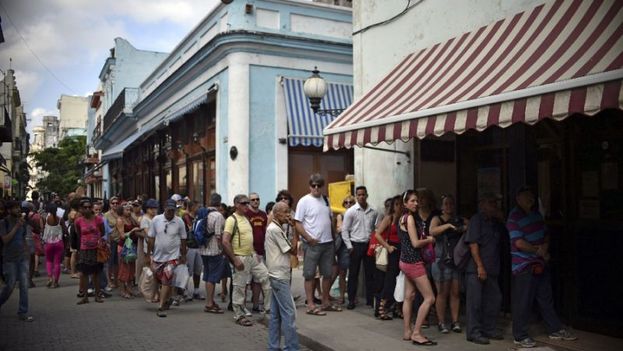
A long line of customers stretches outside a Western Union office in Havana. (14ymedio)

Regina Coyula, 20 April 2018 — The new president takes office with the backing of Raul Castro, but the advanced ages of the so-called “historical leaders” make that support very volatile and Diaz-Canel must create his own alliances beyond those he inherited, in order to govern a country filled with problems.

In spite of yesterday’s speeches, and in spite of Diaz-Canel, of Raul Castro and of the rest of the 603 deputies, the economy must be put ahead of the ideological cart now that there is nothing left of the “Maximum Leader” except his ashes.

And since they proclaim themselves so irreversibly socialist, they should study, review and analyze what Marx wrote on the issue. And if all this is tedious and old, get in line: at a market, a pharmacy, a bus stop — opportunities abound — and pay attention.

Cuban General Rabeiro Garcia Dies, Led Repression Against the Opposition

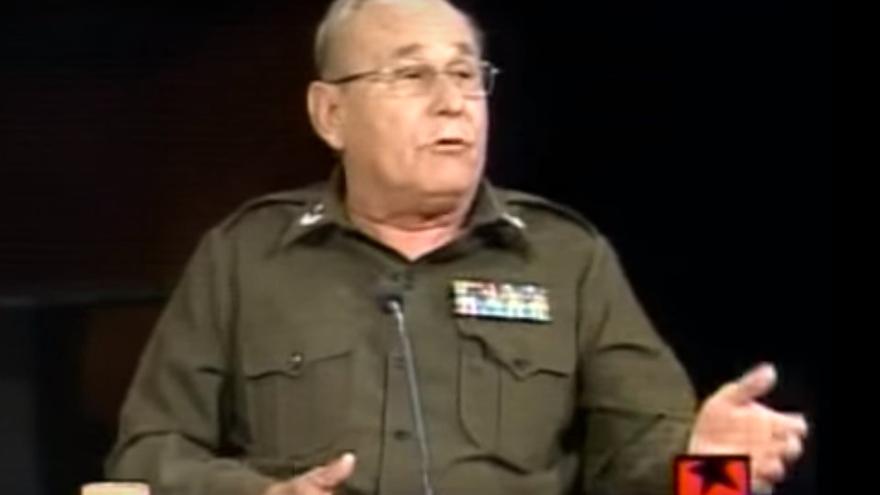
Brigadier General, Adalberto Rabeiro García, speaking on the Roundtable program on Cuban TV. (Screenshot)

14ymedio bigger14ymedio, Havana, 27 April 2018 — The head of the Directorate General of Investigations and Operations of the Ministry of the Interior, Adalberto Rabeiro García, died Thursday in Havana at the age of 73, according to the island’s official press.

Rabeiro García, who had the rank of Brigadier General, has been described as a repressor by several independent organizations that monitor respect for human rights in Cuba. His name is linked to the 100 and Aldabó Prison, in Havana, which he led in the 1990s, where many dissidents have spent long periods of confinement and cruel interrogations.

The soldier worked in the counterintelligence department in Villa Marista, headquarters of the State Security. Some independent media reports link him to several attempts to infiltrate agents in the exile movements in Miami, New York, Boston, Los Angeles and Houston.

The brigadier general was also linked to the investigations of a group of Cubans who in 1994 tried to divert a tugboat serving the Havana-Guanabacoa route to the United States. Those responsible for the action were sentenced to long prison terms.

Rabeiro García was also linked to the case of Panamanian businessman Alejandro Abood, 50, who was accused in 2001 of spying for the Central Intelligence Agency of the United States. The businessman, to whom Cuba owed millions, was released from prison in 2003 due to health complications.

___________________________

The 14ymedio team is committed to serious journalism that reflects the reality of deep Cuba. Thank you for joining us on this long road. We invite you to continue supporting us, but this time by becoming a member of 14ymedio. Together we can continue to transform journalism in Cuba.

Bodeguita del Medio, a Gold Mine That Lives Off the Past

Despite its international fame, La Bodeguita, as it is popularly known, has been losing importance among Cubans and lacks a domestic clientele. (14ymedio)

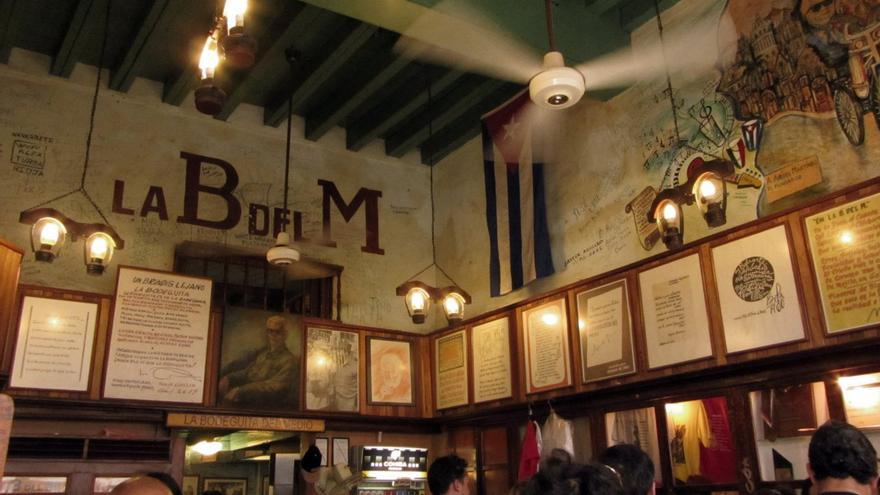
14ymedio bigger14ymedio, Zunlida Mata, Havana, 27 April 2018 — Tourists landing in Havana have, at a minimum, two goals: tour the city in an old convertible and have a mojito at La Bodeguita del Medio. The emblematic restaurant, which has just turned 68, owes its fame to the bohemian intellectuals who frequented it for more than two decades.

On 26 April 1950, No. 307 Calle Empedrado was inaugurated, between Cuba and San Ignacio, which would eventually become a symbolic site in the Cuban capital. Poems, songs, innumerable paintings and photographs have been inspired by this place specializing in traditional food, and its walls contain more than two million autographs.

Despite its international fame, La Bodeguita, as it is popularly known, has been losing prominence among Cubans and lacks a domestic clientele. Only the memory remains of that meeting place of painters, poets and journalists from the middle of the last century. A memory that travel agencies exploit and travel guides exaggerate. continue reading

The brand of La Bodeguita del Medio is registered by the Ministry of Tourism of Cuba and has at least eleven franchises in countries that include Mexico, Macedonia, Australia, Ukraine, the Czech Republic and Lebanon.

Houses that have rooms or the whole house to rent to foreigners, private galleries and even state institutions describe their location according to how many yards separate them from the restaurant-bar. “I rent two rooms on the corner of La Bodeguita del Medio,” Susana, a self-employed entrepreneur in Old Havana has printed on her business card.

“Dance classes five minutes walk from La Bodeguita del Medio,” reads an advertisement stuck on a nearby electric pole. “This is the golden mile of the old town,” says Omar, a young man who acts as a city guide for tourists who speak English or French. “No one who has a house here sells it,” he emphasizes.

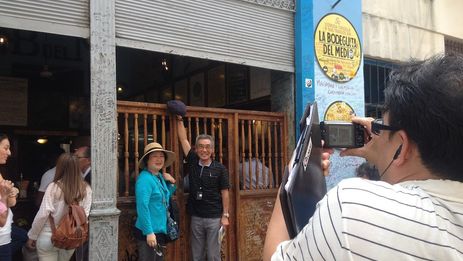
Tourists having their pictures taken in front of La Bodeguita del Medio.

However, beyond foreign visitors’ fascination for the small place with its striking sign with a yellow background and its doors in the style of the bodegas that sell food, the interior of the restaurant is becoming more and more like a postcard retouched for the eyes of tourists.

Last Tuesday, two Austrian tourists waited in the inner courtyard to be served sitting on the typical stools. In the place, crowded with diners, the waiters cleaned, set and served the tables automatically. Most of the chairs were occupied by Canadians, along with some Russians and Europeans who asked for the typical local dishes: roast pork, rice and beans.

“People here eat what you put on the plate, whatever it is, because they do not come for food but for the place,” a kitchen worker tells 14ymedio. “Most customers do not even know the difference between frijoles negros dormidos or reheated,” he says. “So the real business is that they pay luxury prices and consume an average product.”

Yanelis, who manages a small Spanish language academy, ate at the place the other day with three French students. “It’s a beautiful place, but sometimes I think I’m in a McDonald’s because everything is done very fast, the groups come and go and you can not see those gatherings that people like Ernest Hemingway held here.”

“The pork is tasteless and they don’t even make it with a mojo sauce. My rice dish looked like it contained portions from different times and the beans are mixed with flour and have a white cream on top,” she complains. “There are paladares (private restaurants) in this neighborhood that charge much less and offer a better meal, but La Bodeguita lives off its name.”

“Before the artists came and stayed for hours, my mother told me that it was common to find the poet Nicolás Guillén here and other known faces of the Cuban artistic avant-garde, but now you only see that kind of people in the photos that are in the walls,” she laments. “When my parents celebrated their tenth anniversary they came here and it was still a place for Cubans.”

One of the party with Yanelis asked for ropa vieja (literally ’old clothes’, a dish of shredded beef) one of the traditional dishes of Creole cuisine. The smal size of the portion, almost half of what they serve in a private restaurant, did not seem to matter much to the tourist. “My girlfriend asked me to take several pictures for her,” says the tourist.

“When I come with my students I warn them not to order the shrimp or the Cuban sandwich because they are a scam,” says the Spanish teacher. “But there are people who order that because they don’t come here to be filled up, but to say that they ate at La Bodeguita del Medio or to take a selfie and post it on Facebook.”

Roberto worked almost five years at the bar. “That is a place where people would kill to be, and you can line your pockets there,” he says. “Most of the mojitos sold are made with rum that is not what the label says or that the employees themselves buy from the outside,” he says.

“Everyone who works at La Bodeguita wants to open it every day and keep it full, so you often have to buy your own mint, rum and even ice because they do not arrive on time from the state, but that’s no problem because the investment is worth it with the profits you get,” he says.

“In the time I worked there, I started out buying a motorbike, then I was able to exchange my house for a bigger one and I paid for my two children to leave the country,” he says. After five years he lost his job because “they hired another bartender who paid more, because to be behind that bar you have to hand out a lot of money and there are many eyes on that square.”

Outside the restaurant-bar, a lady with a huge cigar in her mouth charges one convertible peso (roughly $1 US) for each photo taken. The tourists approach and smile believing she is a resident dressed in typical clothes but her sitting there is a job that she has done, religiously and for almost two decades, for more than eight hours each day and the cigar never seems to be lit.

“Every so often they come to film some program or a movie,” says Osniel, a resident of a dilapidated tenement who has a business selling small oil paintings of the façade of La Bodeguita. “It’s been more than two years since the American actor Don Cheadle recorded an episode of the House of Lies series,” he recalls and shows a photo that was taken nearby.

Osniel, however, does not remember any Cuban artist who has been there recently. “Famous Cubans? No, the Cubans do not come here.”

 __________________________

The 14ymedio team is committed to serious journalism that reflects the reality of deep Cuba. Thank you for joining us on this long road. We invite you to continue supporting us, but this time by becoming a member of 14ymedio. Together we can continue to transform journalism in Cuba.

Cubans Air Their Views on Miguel Diaz-Canel / Ivan Garcia

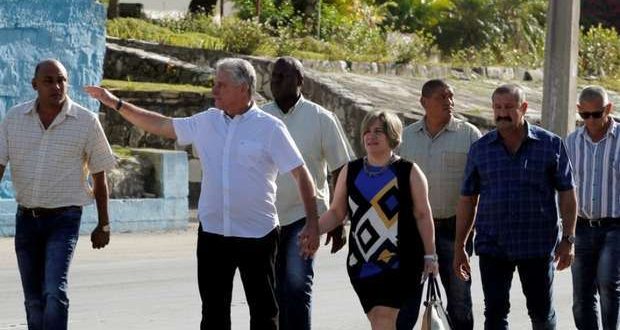
Miguel Díaz-Canel (white shirt and raised arm) and his wife Lis Cuesta, surrounded by State Security agents, go to vote at their electoral college in Santa Clara, on Sunday, March 11, 2018. Taken from USA Weekly.

Ivan Garcia, 20 April 2018 — Summer 1993. When night fell in Falcón, a little place next to the Central Highway, crossed by the Sagua la Chica and Jagüeyes rivers, people were sitting by their front doors, telling stories, and drinking home-made rum distilled with cow-shit.

Those were the difficult years of the “Special Period“, and in Falcón, like in the rest of the country, with officially-decreed twelve-hour-long power cuts which turned Cuba into a dark and silent island, people killed time like that, trying to make the summer heat more bearable. continue reading

Miguel Mario Díaz-Canel Bermúdez, the great-grandson of an Asturian, Ramón Díaz-Canel, who emigrated to Cuba in the mid-nineteenth century looking for a better life, was born in Falcón, in Placetas, Villa Clara, some 320 km east of Havana.

Falcón is an idyllic spot, where you can hear the cocks crowing in the distance. Most of its 6,000 inhabitants raise cattle, pick tobacco, and grow fruit, root plants and vegetables. The main celebrations are the parades, which go through the Sagüeros y Jagüeyeros river neighbourhoods. The Falconers, including Díaz-Canel, still remember the floods of 18th and 19th August, 2008, when many people had to run for a nearby hill, because of the fierce rains of the tropical storm Fay. There were no fatalities or injuries, but important material possessions were lost.

Antonio, who is retired and a native of the area, tells us that “some years back, Díaz-Canel was slim, wore his hair long and liked American music. His family and he were, and are, good citizens. Before he was elected First Secretary of the Party — a kind of mayor — in Villa Clara, he held an important post in the Communist Youth Union. But the man came home in the blackout and played guitar for his CDR bodyguard or talked about sports, to anyone.

He was well thought of in the nine years he administered Villa Clara, a province with 13 councils and just over 8,000 inhabitants. Elpidio, a resident in La Esperanza, Ranchuelo, Villa Clara, remembers that, “The fellow went about all over the city on his Chinese bicycle, and, in spite of the shortages, he was always worrying about the people there. A programme started on the local radio called High Tension and listeners could phone in and report their complaints. He was the first Cuban politician to authorise a night centre with performances for homosexuals and transvestites”.

In 2003, he was promoted to First Party Secretary in Holguín province, 800 km northeast of Havana. Daniel, a Holguinero, now living in the capital, recalls that “In Holguín, Díaz-Canel was not as spontaneous as he was in Villa Clara. He stopped smiling, and put on weight, like the other party leaders and government functionaries. He talked in bureaucratic jargon”.

In Holguín he met his present wife, Lis Cuesta Peraza. He did something not all that common in the macho behaviour of the Communist bureaucrats: instead of having her as a lover, he divorced the mother of his two children and married Cuesta, a professor in the Instituto Superior Pedagógico José de la Luz y Caballero. “Hopefully she will become the First Lady. That would give her prestige, because presidents don’t look so good if they are alone, like single people or widowers. Better to be accompanied by a lady, especially if she is well-prepared, like her”,  says Mercedes, a retired teacher.

In 2009, Díaz-Canel was appointed Minister of Higher Education, a post he held until 2012. At that time he used to wear a typical white guayabera the uniform of the Chinese creoles [there has been a substantial Chinese population in Cuba since the mid 19th century]. “In those three years as a Minister, I don’t recall Díaz-Canel doing anything out of the ordinary. On the contrary, he continued plodding along on the same old socialist treadmill, quoting stuff from Fidel, and repeating the refrain that the University is Only for the Revolutionaries”, says Sergio, an engineer.

The olive green autocracy, an insane system of personality cult, never showed any sign of providing good quality politicians. Fidel governed. The rest of them applauded and followed orders. In July 2006, Fidel had a gastrointestinal perforation and, in a historial arbitrary act, appointed as his successor his brother Raul, a natural-born conspirator with dictatorial obsession, but who, out of habit, worked on a team and listened to other points of view.

According to the gossip merchants, Castro II likes people who are like him. Whether it was because of his appearance, or his CV, what we do know is that, when he took over from his brother, he had already looked carefully at Díaz-Canel, a guy who had some forty-year-old women sighing over him.

In 2012, when he appointed him as Vice President of the Consejo de Estado, Raúl put him on the ladder to the presidency. Six years have passed, but Díaz-Canel still looks a bit nervous in public.

“He behaves as if he is still living in Falcón”, says Antonio, a retired chap. “Sometimes he looks ill-at-ease, or acts like a fool”, says Yadira, a university student. “His behaviour is contradictory. I remember he was the first leader to show up with a tablet at a party meeting”, adds Victor, another student. In the opinion of Rogelio, a private taxi driver, “One day Canel talks like a liberal, and the next day like a dictator”.

One good thing people in Havana do know is that, thanks to Díaz-Canel, ICRT transmits live the games between Real Madrid and Barcelona. “The man is a Barcelonista to his dying breath. People like that get high blood pressure when Barcelona loses. I think that when he finds his feet as President, they will put out live transmissions of the NBA and the Big Leagues. He loves sportS”, says a state TV producer.

The Puerto Rican journalist, Benjamin Morales, from El Nuevo Dia, wrote last April 17th: “Guaracabulla, in Placetas, has a ceiba tree there marking what is said to be the centre of the island, and, from this week, it could also be said to mark the centre of Cuban leadership, when Miguel Díaz Canel, its most famous son, becomes the first president not called Castro Ruz and who also was not a guerilla”.

After seeking opinions on the street — which did not include those of Antúnez, a well-known opposition figure in Placetas — Morales continued: “The people are  overcome with enthusiasm, but don’t let themselves get too carried away, because they understand that change is good, but only when it doesn’t affect people’s well-being”.

For most people in Havana, who spend all their time trying to put food on the table for their families and to survive the shortages of Caribbean socialism, the much-proclaimed presidential succession has not fulfilled their expectations.

“It’s more of the same. Seems like more Castroism, by another name, setting us up with “Canelism”. I don’t expect much from him. If he manages to sort out the disaster that Cuba has become, they’ll have to put up a statue to him”, says Diana, a bank employee.

Miguel Díaz-Canel could just as easily turn into an Adolfo Suárez (Spain’s first democratically elected prime minister after the Franco dictatorship) as become another Nicholas Maduro (current president of Venezuela). We’ll have to wait and see.


Translated by GH

Peace is Not Built on Lies

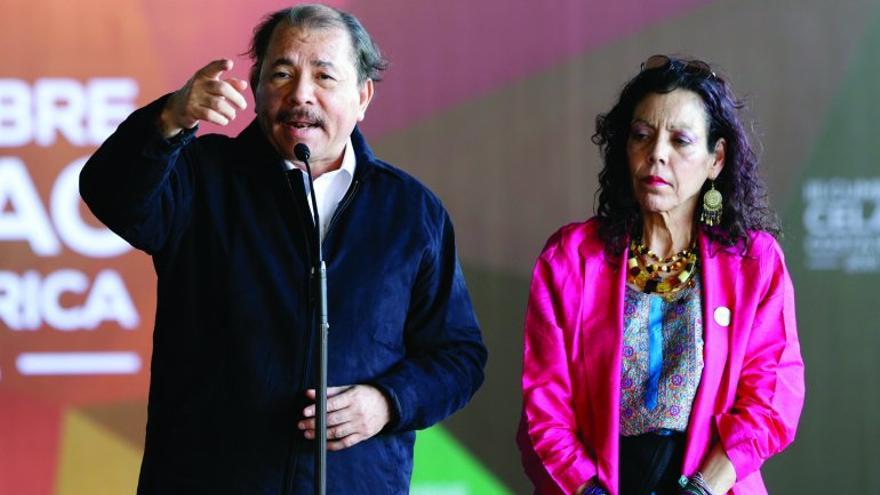
The president of Nicaragua, Daniel Ortega and his wife, Rosario Murillo, vice president of the country. (EFE)

14ymedio bigger14ymedio, Onofre Guevara López, Managua, 25 April 2018 — In two television appearances, Daniel Ortega repeated insults against the dead and lies about the student demonstrations, calling them gang members and insisting that they themselves caused the deaths. Unprecedented cynicism in a ruler. The only ones who have arms are his supporters, and everyone here knows that they used them against unarmed students. And it is worth noting that the origin of the conflict is not the protests against the reforms, but the repression against the right to make them public.

Once again his cliche-discourse stuck in time, and revealing a huge ignorance of the reality of the country he is so determined to lead against the popular will. The bubble in which he lives and the other mobile bubble protected by dozens of police have caused him to lose contact with the national reality and become insensitive to human pain. continue reading

On Saturday he spoke of the rupture of a reconciliation and dialogue that never existed, but were rather arrangements between the elite of economic and political power. And on Sunday he suspended the decree regarding the reforms to the Social Security System (INSS), to satisfy the foreigners of the “swallow companies” (named for their migratory habits) of the free zones, but without ending the repression. He spoke of a consensus and a tripartite dialogue with business partners and union leaders who do not represent all the trade unions, much less all the workers.

He spoke of reforms to the Constitution, without saying for what personal purposes he made them; in short, he offended the intelligence of the students again, by accusing them of being the “bases” of the parties on the right. He concealed that this conflict is the result of his bad habit of illegality that characterizes all his government measures, from the reforms to the Political Constitution to guarantee his continuity in power, until the latest of Tuesday aimed at raising the values of the Social Security contributions.

Typical forms of action of this Government, very similar to that of the neoliberal governments of other countries: impositions without consultation and repression. In our country, both measures are practiced with the hypocrisy of pseudo revolutionaries, while the Police simultaneously acts with the shock forces of the so-called “Sandinista youth,” which has nothing to do with Sandinistas and much of lumpen, whose victims they blame on the students.

Ortega believes that we forget that the protests are not only because of the inconsistency of the decree, but also because of all the abuses accumulated over ten years. And against the factors and interests that cause corruption in the administration of the INSS, beginning with the privatization of medical services in favor of the so-called previsional private companies, actually initiated by the governments of the right, but followed by his government, together with other concessions to private capital. But now business is doing it the other way around, that is, they buy private hospitals that previously favored the privatization of medical services, without giving information about who operates them under the name of Sermesa, who buys them.

This business began with the purchase of the Cruz Azul hospital, from the late commander Tomas Borge, who acquired it with a loan from the INSS. On the base of Cruz Azul, they founded the Policlínica Bolonia and it was enlarged with the purchase of the private hospital Sédédico, and before that they had bought the Central Hospital Managua, also private.

With regards to the sale of Sumédico, an investigation by the journalist Ismael López, revealed that the real value of this hospital was 10 million dollars, but the INSS paid 15 million dollars, although an ex-officio lawyer of the hospital declared that it was worth 20 million dollars. The INSS business also revealed another fact: that in 2015 alone, Súmedico profited to the tune of 227.4 million córdobas ($7.2 million US) from the INSS for the care of the insured; on the other hand, its earnings for the care of private clients was only 16.2 million córdobas ($516,000 US).

Very recently, national media echoed the “suggestions” that the International Monetary Fund made to the Ortega-Murillo government to “save” Social Security from bankruptcy. Among these are increasing contributions, eliminating benefits to pensioners and raising the retirement age to 65 years, as well as increasing the number of contributions that must be made to be entitled to retire. Now that violence is hitting the country, these media have “forgotten” that the IMF is the intellectual author of the social crime that constitutes the reforms of the Ortega-Murillo government.

The citizenship’s unanimous rejection of the reforms — outside the political parties — has varied origins and reasons, as multiple interests are represented by each of the sectors affected. However, the government accuses “the right” (Somoza accused “Sandino-communism” for all just popular protest), which not only is a lie, but also gives credit to the right that it cannot earn for itself. We all know that none of the opposition parties — on the right or the left — is able to call the people to action in the way that is being manifested throughout the country.

We are looking at a political phenomenon that comes as a surprise to the government and to many Nicaraguans. For the government, because it trusted in its propaganda and in the popularity of Ortega-Murillo reported in surveys paid for by themselves; for the rest of adult citizens, because the majority of them believed that the passivity of their generation before the abuses of the power was shared by the youth. We were all wrong, in thinking that the process of struggle had stagnated, rather than paused.

Now we are not only lamenting the dozens of young victims of Ortega’s repression, after the initial spontaneity of the protests; we are also morally and patriotically obliged to support the students’ demands, since it would be criminal to leave them on their own after they paid with the sacrifice of their lives for the revocation of the decree against the interests of their grandparents and parents, and of themselves as future contributors to Social Security. Their just struggle defeated the decree, although it has not defeated the repression, and we expect the rulers, who have not legitimized themselves as such, to at least respect their right to life.

Ortega-Murillo called for dialogue with employers, but the students do not recognize them as representatives, and demand that their prisoners be freed and the culprits guilty of the murders of so many of their classmates be punished. In addition, as a matter of ethics and morality, they should not continue to offend the memory of the dead or slander the living.

On the other hand, if it is true that the Cosep (Superior Council of Private Enterprise) and Amcham (American Chamber of Commerce of  Nicaragua) reject the decree, saying that the increase in the employer’s contribution threatens investment, with negative consequence for the economic development of the country, we remember also that these bosses did not speak out against the suggestions of the IMF, which were accepted by Ortega-Murillo, with the exception of raising the retirement age to 65. For the rulers, however, this rescue was not final, because it  is only temporary while assessing social reactions, and it is certain that if they had not known the reactions, they would have ended up setting 65 as the retirement age.

So far, everything is sad and condemnable: dozens of deaths and students who have lost their eyes; countless wounded, imprisoned and kidnapped; beatings of older adults; beatings of journalists and thefts of their cameras and cellphones filming the demonstrators; shootings, throwing stones and destruction of university campuses; tear gas bombs affecting students, passers-by and residents; Ortega’s mobs “taking” public places to restrict the right to demonstrate; several television channels censored and Channel 63 (100% News) closed as of today; and the looting of shops. And, as a symbol of fascism, scholarship students were taken from a residence and forced to sleep in the open, and violent intrusions interfered with the funerals of the dead.

That and more, rained down from a government of those who still want to pass as revolutionaries, without ceasing to be usurpers of the power the Nicaraguan people conquered with their blood forty years ago, which later they betrayed.

Editor’s note: This text was initially published in the Confidencial newspaper. We reproduce it with the authorization of its author.

___________________________

The 14ymedio team is committed to serious journalism that reflects the reality of deep Cuba. Thank you for joining us on this long road. We invite you to continue supporting us, but this time by becoming a member of 14ymedio. Together we can continue to transform journalism in Cuba.

"Almost All the Young People Want to Leave Here"

The lack of unemployment insurance helps to hide the real data. (Screen capture)

14ymedio bigger14ymedio, Luz Escobar, 26 April 2018 — At 25, Yimmi Buchillón García has tried almost everything to make a living: he was a fisherman, carpenter and repairer of carnival floats, but in Punta Alegre, Ciego de Ávila, “it is very difficult to find a job,” he tells 14ymedio in despair. On March 25 he sailed for the United States but failed to reach his destination and was repatriated to the village from where “almost all the young people want to leave.”

Buchillón departed from the north coast of the center of the island, one of the areas most affected by Hurricane Irma last September. Many residents dream of emigrating to escape the crisis, but the end of US wet foot/dry foot policy means most of their attempts end in deportation back to Cuba. continue reading

In Punta Alegre, in the Chambas municipality, winds and coastal floods toppled 645 homes while another 1,054 partially collapsed. Although the government turned to repairing the area’s infrastructure and credits were granted to rebuild the houses, the economic life of the town has not recovered.

“The situation has gotten worse, I would like to stay with my family, with my wife and have a steady job here, but nothing comes up,” explains Buchillon just a few hours after arriving home after spending a month away from the island, a part of that time at sea and the rest in a prison in the Bahamas, from where he was repatriated.

According to data from the National Bureau of Statistics for 2016, 17.3% of young people in the country of working age do not study or work, although more than a third of these unemployed (37%) say they are not looking for work either, figure that totals 78,778 young people throughout the country.

In rural areas the problem is more serious and a good part of the young people only find informal and illegal tasks through which to make a living. ( Screen capture)

The numbers could be higher since many do not report their situation, in the absence of unemployment insurance that would allow them to collect a minimum amount while looking for a job. In rural areas the problem is more serious and a good part of the young people only find informal and illegal tasks to support themselves.

“Before the hurricane I had messenger work in a cafe, but it was illegal, without a contract,” says Yoandy Rojas, another young resident of Punta Alegre who has tried to leave the country illegally three times. “Since September, this town has been taken over by the police so even a fly can’t move outside the law,” he explains.

The area, with little agriculture, depends mainly on the sea and the visits of tourists who go to the keys, north of Ciego de Ávila. “There are towns where people live mostly off the tourism business, but foreigners don’t come here much and also in recent months tourism has dropped,” he says.

“Here tourism is the center of everything,” explains Dielsy Hechevarría, who works as an informal guide and rents out two rooms with her mother. “If there are no foreigners there is no work,” says the young woman who is now hoping to move to Havana in search of other opportunities. “This town has no future,” he concludes.

The area, with little agriculture, depends mainly on the sea. (Franco)

In Punta Alegre, Buchillón made a living as a fisherman and illegally sold his products to residents and businesses in the area. The National Revolutionary Police (PNR) killed that opportunity with an increase in operations on the coast. “They harass fishermen and do not let them live,” says his mother, María de Los Ángeles García León.

Last summer, Buchillón was hired to repair the floats of the popular festivities. “They paid me 150 Cuban pesos, about 7 Convertible pesos, for all the work and it was only enough to buy shoes for my daughter who started school,” he recalls. Since then, he has not returned to work with the State or in any private business.

García León has said goodbye to her son four times, at every attempt to leave the country. The last time was barely a month ago, when he left with 12 other friends to try to reach the coast of the United States. “There is a lot of misery here, and the young people have no life because they have a rope around their necks,” the woman says.

The rafters built a craft with a sail but without a motor, known popularly as a chapín, and launched themselves on the water. “We spent five days in the sea and there were a lot of waves,” recalled Buchillon, still suffering from a throat infection and the tousled hair of the shipwrecked.

On March 30, the US Coast Guard intercepted the raft and moved its occupants to a migrant detention center in the coastal town of Flipper in the Bahamas. After being prosecuted, the 13 rafters were taken to Nassau where they were imprisoned for 22 days until their return to Cuba.

Buchillón says that 34 Cubans from different groups came together and received degrading treatment, a situation that led them to start a hunger strike. A few hours after the fasting began, the ambassador of Cuba in the Bahamas, Ismara Mercedes Vargas Walter, visited to urge them to end the protest.

This Monday, finally, they set foot on Cuban soil and two days later Buchillón was back in Punta Alegre. “For now, I’m not thinking about trying to leave again,” he reflects, but he knows that he has a difficult task ahead of him, as difficult as evading the coastguard or surviving the waves: finding a job.

 _____________________

The 14ymedio team is committed to serious journalism that reflects the reality of deep Cuba. Thank you for joining us on this long road. We invite you to continue supporting us, but this time by becoming a member of 14ymedio. Together we can continue to transform journalism in Cuba.

A Brave Song for Nicaragua

In the streets of Nicaragua there is also discontent with an executive who turns his back on the population. (EFE / Jorge Torres)

14ymedio bigger14ymedio, Reinaldo Escobar, Havana, 26 April 2018 — “Where is Fidel?” Daniel Ortega shouted in Havana’s Plaza of the Revolution during the official ceremony on the death of the former Cuban president at the end of 2016. That question was prophetic. Less than two years later, the Nicaraguan people have taken to the streets and the old mentor is not there to help his disciple.

The Sandinistas’ coming to power in 1979 was taken in Cuba as a sign that Latin America would travel along the path of the Revolution, social justice and left-wing governments. It was another spark in the bonfire that was going to devastate the continent and that had its origin in this Caribbean Island.

The Cuban poets sang praises to the Nicaraguan commanders and the Nueva Trova turned Urgent song for Nicaragua into an anthem. The Central American country became the realized dream of having an ally in the region that eased the diplomatic solitude in which Cuba had remained after the radicalization of the political process. continue reading

Nicaragua became a second opportunity for the Castro brothers, who not only offered their territory for the military training of the Sandinista National Liberation Front (FSLN), but also offered the nascent government advice on literacy, medical care and agrarian reform.

Part of the initial Sandinista program was taken from the Marxist-Leninist system implanted in Cuba. Those guidelines, copies of a bad copy, generated an enthusiasm that faded as they clashed with the complexity of a country whose social composition is different from that of this Island.

The Sandinista Revolution was breastfed by Havana, but the “milk” came from the Soviet stepmother eager to expand her influence in the region. The followers of Sandinismo did not imagine that with their dedication and passion they were helping to build another family dynasty.

Daniel Ortega, then a young man, became a regular visitor to the circles of the Cuban elite circles and in July 1980, a year after the Sandinista Popular Revolution triumphed, he greeted Fidel Castro at the Managua airport. That close relationship lasted until the last day of the Cuban leader’s life.

However, along the way, the Sandinistas departed on several occasions from the path traced in Havana. The most costly of these deviations was in 1990 when the Sandinista National Liberation Front (FSLN) lost the elections to the National Opposition Union (UNO) and Violeta Chamorro assumed the presidency.

In 2007, after promising to respect private property and expand its relations with the international community, Ortega won 37.99% of the valid votes in the polls to reach the highest office in the country. Unlike Castro, the disciple had proven himself in an election, and could say he was an elected president.

After that victory, the ex-guerrilla found a balance that guaranteed his continuity in power: political control and a certain economic laxity. His agreements with the Nicaragua Superior Council of Private Enterprise helped spread the idea that, beyond the ideological antics of the president, he imposed in the country the pragmatism of business.

During the last 11 years, Ortega controlled the nation with a strong presence in the army and the police, substantial aid from Venezuela and personal whims that became decrees as fast as he could blink an eye. Each day he became less presentable as a leader and more like the caricature of a satrap.

During this time Havana kept a certain distance. The official media of the island stopped speaking up for Sandinismo, the poets parked their verses about the Nicaraguan revolution and the eccentricities of Ortega and his wife Rosario Murillo were hardly reported, while Murillo filled the streets of the capital with immense “Trees of Life.”

This last week, several of those immense sculptures have been demolished by protesters against Ortega opposing reforms of the social security and pension system. The protests, which have claimed thirty lives, are being followed with caution by newspapers controlled by the Cuban Communist Party.

The breaking point came in the guise of that neoliberal measure that has turned out to be the last straw. In the streets there is also discontent with an executive who turns his back on the population, squanders the nation’s resources and builds houses of cards like the apparently hypothetical ocean-to-ocean canal.

Cuba’s Ministry of Foreign Affairs has not yet published a statement of support for its Central American ally and the Nicaraguan president has not even been able to follow in the footsteps of Nicolás Maduro and Evo Morales, the first leaders from the region to visit the new Cuban president, Miguel Díaz-Canel.

The Cuban intelligentsia is also silent or looks away from the repression that the Nicaraguan government unleashes in the streets and against young people at the Polytechnic University. The bards who in the past sang to the FSLN today lack the civic courage and moral integrity to criticize it.

If the arrival of Sandinismo to power, almost four decades ago, was read as a foretaste of the red flare that would spread across the continent, its crisis significantly affects an entire ideological current in this part of the world. An Ortega cornered in the face of the popular impulse represents the resounding failure of a system.

__________________________

The 14ymedio team is committed to serious journalism that reflects the reality of deep Cuba. Thank you for joining us on this long road. We invite you to continue supporting us, but this time by becoming a member of 14ymedio. Together we can continue to transform journalism in Cuba.