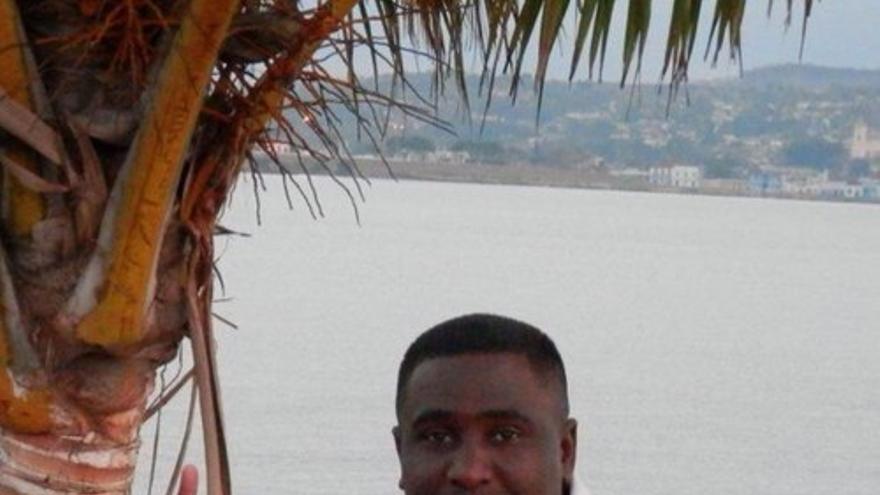
Rudy Cabrera’s work creating audiovisuals has been particularly outstanding, according to Cubanet. (Cubanet)
14ymedio, Havana, 4 April 2018 — Independent reporter Rudy Cabrera, a contributor to Cubanet, was released on Tuesday afternoon after a 48-hour arrest. “They told me that this arrest was just the ‘kiss of the tiger’,” the journalist told 14ymedio. He also said that he was subject to “different levels of threats” during his imprisonment.
Cabrera’s arrest came after a search of his home, last Sunday, by State Security and the National Revolutionary Police (PNR). They seized several external hard drives, a laptop, a desktop computer, a printer and other personal items. continue reading
That morning, two “patrol cars, four motorcycles and a civilian car,” arrived at Cabrera’s house to conduct the search, along with a photographer, five State Security agents and several police officers. “They had a search warrant to look for computer equipment and story boards,” he told this newspaper.
About three hours after the search of the house began, the reporter was taken to the police station in the municipality of Cerro. “The first day I did not eat anything because I did not have an appetite,” he says.
Cabrera was questioned several times at the station and State Security officials repeatedly threatened to send him to jail but also alluded to his professional training with phrases such as: “You are an educated person.”
An agent of the political police, who identified himself as Camilo, insists that the search of the house and the detention were only “the kiss of the tiger.” The officer suggested that they had found “something very irregular” in the house that could be legally “complicating” for Cabrera.
Another member of State Security warned the reporter that he should not cross the “red line” and told him that his work as a journalist had placed him “under the spotlight” of the authorities’ attention, threats that Cabrera believes are intended to intimidate him and to stop him from continuing with his work.
Rudy Cabrera work has been especially outstanding in the preparation of audiovisual reports for Cubanet, with on the street interviews and reports about the use of technology, housing problems and the work of groups opposed to the Government.
“I was allowed to leave the station after my mother paid the 3,000 Cuban peso fine they levied on me,” he explains. “According to the document, the fine was for illegal economic activity and now I have to consult with a lawyer, because everything has been very arbitrary,” he says.
Before leaving the police station, the reporter signed the official record with the list of the belongings seized in the search, which have not yet been returned.
The Cuban penal code sets a penalty of deprivation of liberty for from three months to one year, or a fine of 100 to 300 CUP, for the criminal offense of “without the corresponding license or despite the existence of an express legal or regulatory prohibition, working, for profit, to produce, transform or sell merchandise, or provide any service.”
Pressures against independent journalists have intensified in recent months and, along with arbitrary arrests, State Security has increased the number of searches in their homes and the confiscation of their tools of the trade.
At the beginning of this year the Freedom House organization gave Cuba a very low score of 14 points on a scale of 0 to 100 in rating freedom on the island. The report, which analyzes the situation of political rights and civil freedoms in the world, cataloged the country as “not free” with regards to freedom of the press and the internet.
____________________
The 14ymedio team is committed to serious journalism that reflects the reality of deep Cuba. Thank you for joining us on this long road. We invite you to continue supporting us, but this time by becoming a member of 14ymedio. Together we can continue to transform journalism in Cuba.
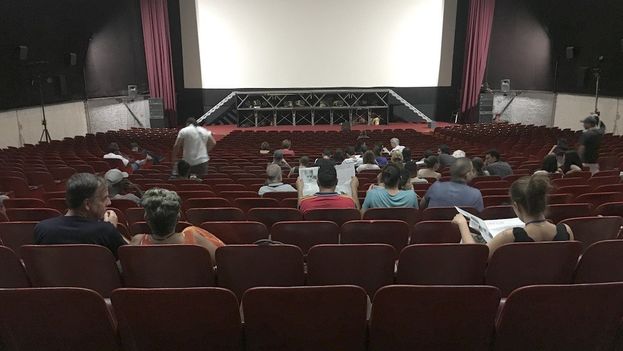
The first hours of the 17th edition of the Young Filmmakers Exhibition took place this Tuesday in an almost empty theater at the Chaplin cinema, in Havana. (14ymedio)
14ymedio, Luz Escobar, Havana, 4 April 2018 — The first hours of the 17th edition of the Young Filmmakers Exhibition took place this Tuesday in an almost empty theater of the Chaplin cinema, in Havana. The event began in the midst of the scandal over the the exclusion of the film I Want to Make a Movie, from director Yimit Ramírez, an incident that continues to generate conflicting opinions among officials and filmmakers.
The Exhibition was inaugurated with the screening of The Two Princes, a short film inspired by the homonymous poem by José Martí. The choice of the film was interpreted by the audience as a response to Ramírez’s film, which the Cuban Institute of Cinematographic Art and Industry (ICAIC) criticized for including “disrespectful” dialogue about the national hero. continue reading
The afternoon and evening session on this first day was enlivened a little more with the welcome offered by the organizing committee to the young filmmakers at their new headquarters on 23rd Street. Two exhibitions, Hair of the Wolf, by the artist collective Chambelon Network, and Vero de perro, by Manuel Almenares, completed the day’s program.
Also presented on the opening day was the feature film not part of the competition, The Wolves of the East, filmed in Japan and directed by Carlos Machado Quintela, known for his film The Work of the Century (2015)about the failed Cienfuegos Nuclear City project.
However, the main protagonists of the day were the absentee I Want to Make a Movie and its director, who were at the focus of the conversations among exhibition attendees, especially because, hours earlier, the Presidency of the Union of Writers and Artists of Cuba (UNEAC) issued a harsh statement against the film.
UNEAC’s statement adds to an avalanche of articles and comments published in the official press and on the websites of institutions that criticized the words of a character in the film, who refers to José Martí with the terms “mojón” and “maricón” (turd and faggot). UNEAC believes that the exclusion of the film from the program is an incident that has been “magnified” by the “anti-Cuban press.”
“We share the indignation of youth who follow Martí in the face of this attempt to tarnish the memory of the Apostle,” said the Presidency of the pro-government association. The statement, however, did not mention the public solidarity shown by much of the film industry with Ramírez.
“To those who seek to undermine the founding values of the Cuban nation, we say: Don’t involve José Martí!” UNEAC said in its statement, in a tone that many filmmakers and film critics have considered threatening.
On Tuesday night, the Exhibition continued with the screening of the documentary short films Movies and Memory by Jorge Luis Sánchez and Notes on the Shore by Luis Alejandro Yero. In addition, the fiction short film Rocaman, by Marcos Díaz, and the animated Decomposition, by Jarol Cuellar, were screened.
Like last year, the Exhibition suffers from a shortage of works in the animation section, with just three this year. In addition to the films in the competition, the event also includes a Bonus section for non-competition pieces, known as the Moving Ideas space, along with the usual conferences and the pitching of movie themes in the Making Cinema section.
Among the most anticipated is the screening of Alejandro Alonso Estrella’s documentary, The Project, which presents the concept: “A filmmaker is forbidden to film an old school converted into housing. Years later, he decides to remake the Project.”
Also in the documentary category, the filmmaker Marcel Beltrán competed with the work The Music of the Spheres, inspired by a family history.
Despite the censorship applied to his latest film, Yimit Ramírez is represented with a short film from 2017, Eternal Glory, which tells the story of Julián, an “outstanding worker” worthy of an award he has always wanted, but “at the moment he is nominated, his mind is filled with great conflicts.”
______________________
The 14ymedio team is committed to serious journalism that reflects the reality of deep Cuba. Thank you for joining us on this long road. We invite you to continue supporting us, but this time by becoming a member of 14ymedio. Together we can continue to transform journalism in Cuba.
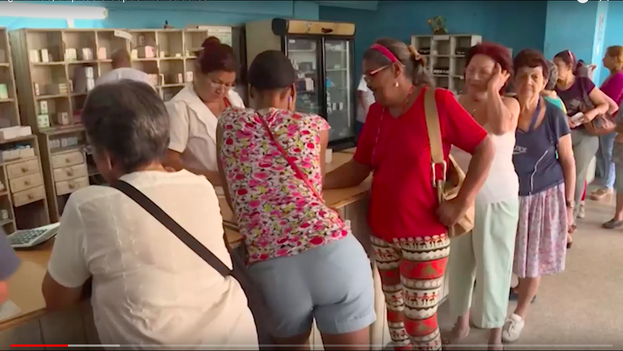
Women line up at a pharmacy in Cuba for menstrual supplies. (Video Screen Capture)
14ymedio, Havana, 29 March 2018 — The production of sanitary pads is paralyzed due to lack of raw materials and will only be resumed in May, according to Emma Hernández Ibarra, general director of the National Hygienic-Sanitary Materials Company, Mathisa, speaking to Cuba’s official press.
“The company suffered a delay in the arrival of the raw material that is used for the production of sanitary pads, and the purchase of cellulose, and for this reason production is paralyzed,” explained the official on the newscast on Wednesday. continue reading
“At this moment, this raw material is already on its way [to Cuba] and we have an estimated date of arrival of April 30 and in May we will began our production with a strategy of gradual recovery,” added Hernández.
According to the official, the aim is to “increase the production schedule” so that the monthly supply received by women of childbearing age can be met through the rationed market at the country’s pharmacies.
“It may be that during the month they will receive some pads and another part of their ration as cotton depending on the availability of that product in the logistics chain,” she said.
According to statements made by Hernández herself to the official press in 2017, this problem affected the production of pads in the three factories devoted to them at that time.
“Of the ten raw materials needed for sanitary pads (popularly known as ‘intimates’), eight are imported from countries such as Spain, Italy and China, and only the packaging material is obtained in the domestic market,” said the official.
In a report published in this newspaper in March, women’s opinions about this product were surveyed. Many complain about the poor quality of the product and that the 10 pads allowed for each monthly menstrual cycle are not enough, in addition to frequent shortages of even that number.
Outside the gynecological and obstetric hospital Gonzalez Coro a doctor explained to 14ymedio that “on average a woman uses three to four sanitary pads” on a day of menstruation, and a menstrual cycle lasts between five and seven days.
Given the shortage of the product, consumers shop in the hard currency markets for pads, and look for friends to bring tampons into the country, along with the lesser known silicone cup.
___________________
The 14ymedio team is committed to serious journalism that reflects the reality of deep Cuba. Thank you for joining us on this long road. We invite you to continue supporting us, but this time by becoming a member of 14ymedio. Together we can continue to transform journalism in Cuba.
The document highlights the case of the former Prisoner of the Black Spring, Ivan Hernandez Carrillo, who claimed to have been “brutally assaulted” and fined by the police when he tried to prevent the arrest of his mother last month. (Twitter / @ivanlibre)
14ymedio, Havana, 3 April 2018 — During the month of March in Cuba, there were 319 arbitrary arrests against activists, a figure “slightly lower than the one recorded” in February, which was 347, according to the Cuban Commission for Human Rights and National Reconciliation (CCDHRN). The Cuban Observatory of Human Rights (OCDH), on the other hand, reported a higher figure for March, 340, with 202 women and 138 men.
The CCDHRN also denounced 33 cases of harassment and “outrages” against dissidents, in addition to nine physical aggressions “executed or instigated by the powerful secret political police or their agents,” according to a report published on Monday. continue reading
The document highlights the case of the former Prisoner of the Black Spring, Ivan Hernandez Carrillo, who claimed to have been “brutally assaulted” and fined by the police when he tried to prevent the arrest of his mother, the activist and Lady in White Asunción Carrillo, on 25 March.
Throughout the month, “systematic weekly arrests continued” against the women who make up this human rights movement and the arrests were carried out “under inhumane and degrading conditions.”
The CCDHRN also reported on the “arbitrary ban on travel abroad by opponents who tried to respond to invitations from various international NGOs,” a repressive practice that has become common over the last year against members of independent civil society groups.
“The number of political prisoners remains above a hundred,” says the Commission, which will soon publish the Partial List of Prisoners for Political Reasons in Cuba, as it does every year.
“The new political prisoners, imprisoned during the month of March were: Aracelis Fernández, Martha Sánchez, Freddy Martín Fraga and Edel Peralta Rus,” reports the CCDHRN.
During 2017, the Government of Raúl Castro carried out at least 5,155 “politically motivated arrests,” according to the year-end report drafted by the organization.
That figure was the lowest since 2011, when the CCDHRN reported 4,123 arrests for political reasons, and also falls far short of the reports of 2016, a year in which 9,940 arrests were recorded.
According to the Cuban Observatory of Human Rights, the Ladies in White continue to be the center of the attacks by the Government, which every week “represses them when they try to participate in Sunday Mass and in other activities.”
The organization, based in Madrid, also denounced the travel restrictions suffered by opponents from within the island but especially highlighted the prohibitions on entry against foreigners, giving as an example what happened during the ceremony held to deliver the Oswaldo Payá Freedom and Life Award.
On that occasion, at the beginning of March, the authorities refused to allow the entry into Cuba of the former presidents of Bolivia and Colombia, Jorge Fernando Quiroga Ramírez and Andrés Pastrana Arango, and the Chilean deputy Jaime Bellolio. Miguel Calisto, a Chilean parliamentarian, was allowed to enter the island but was arrested and deported once he arrived at his hotel.
These actions show, according to the entity, “the intolerance of the Government in relation to the free exercise of universal rights.”
In addition, the Observatory foresees a similar climate in the coming days, coinciding with the transfer of power from Raúl Castro to his successor, Miguel Díaz-Canel.
____________________
The 14ymedio team is committed to serious journalism that reflects the reality of deep Cuba. Thank you for joining us on this long road. We invite you to continue supporting us, but this time by becoming a member of 14ymedio. Together we can continue to transform journalism in Cuba.
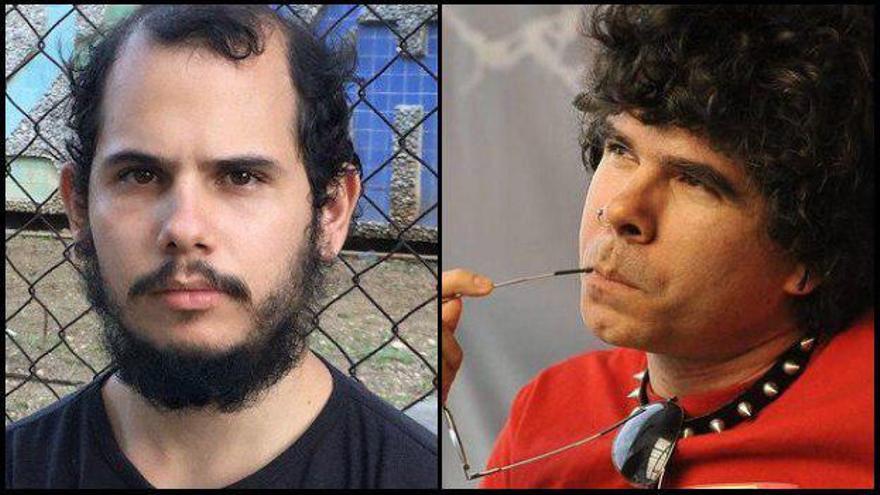
14ymedio, Luz Escobar, Havana, 4 April 2018 — Two more activists were victims of restrictive measures that prevented them from leaving Cuba on Wednesday. They are the playwright Adonis Milan and the musician Gorki Águila, both of whom have been invited to attend the Forum of Civil Society and Social Actors that will be held in Lima, Peru, on the 10th and 11th of this month, an event parallel to the 8th Summit of the Americas also being held in Peru.
Milan, a member of Cuba Decides, was not allowed to not board the plane that would have taken him to Argentina. The immigration authorities cancelled his boarding pass and acknowledged that he was “regulated” by Cuban State Security Counterintelligence, he told 14ymedio. continue reading
The playwright, who has recently been expelled from the Hermanos Saíz Association and who suffers the permanent harassment from the political police, was intending to travel to Buenos Aires as a guest of the “cultural exchange of the Center for the Opening and Development of Latin America (CADAL).”
At the conclusion of that meeting, the activist had planned to travel from Argentina to Peru, without going through Havana, to attend this month’s events parallel to the 8th Summit of the Americas, as a guest of CADAL and the Center for Journalism and Technology Networks of Peru.
This morning, musician Gorki Águila, a member and leader of the punk rock band Porno para Ricardo, was also prevented from traveling, in his case to Miami. Once in the American city he also intended to travel to Peru to attend the Summit.
Theindependent civil society activists suspect that it is a strategy of the Government to prevent the arrival of the opponents in Lima.
“The government wants to avoid the meeting up of forces that occurred in Panama [in 2015] and therefore will not let any of the guests traveling to the Lima Summit leave the country,” the musician said, referring to the attacks against independent activists by of members of the official delegation that occurred that year.
In recent days, the vice president of the National Union of Jurists of Cuba, Yamila González Ferrer, said she would not share any space “with mercenary elements and organizations,” in reference to dissidents who have been accused of responding to the interests of “the empire.”
In the last year, State Security has increased the pressure against activists and dissidents, preventing them from traveling abroad. In most cases the refusal of the right to travel is not permanent, but arbitrary and circumstantial, which makes it difficult to report to international organizations. This strategy is in addition to the arrests, confiscations of personal belongings, the raids of homes and the imposition of legal charges.
In January 2013, Migration and Travel Reforms came into effect that eliminated the “exit permit” previously required for travel abroad. In the first ten months after the approval of the new measures, Cubans made more than 250,000 trips abroad, a record number compared with previous years.
______________________
The 14ymedio team is committed to serious journalism that reflects the reality of deep Cuba. Thank you for joining us on this long road. We invite you to continue supporting us, but this time by becoming a member of 14ymedio. Together we can continue to transform journalism in Cuba.
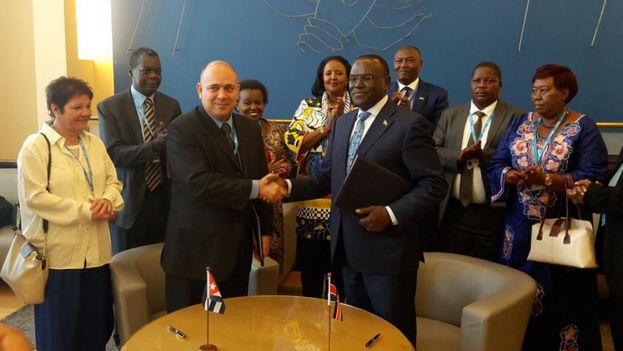
Signing of the Healthcare Agreement between Cuba and Kenya last year in Geneva with Minister Roberto Morales Ojeda on the Cuban side. (Minrex)
14ymedio, Mario Pentón, Miami, 4 April 2018 — The decision of the Government of Kenya to accelerate the hiring of 100 Cuban doctors has been badly received by the local Healthcare sector union, in a statement that denounces the situation of some 1,200 unemployed Kenyan doctors.
“This is not fair. [The government needs] to take advantage of these resources to update our medical skills, offer better working conditions, pay better salaries and then adjust the law that guides the provision of services [doctors]. [If this were done] we would not need imported doctors,” read a comment posted on the official Facebook page of Kenyan President Uhuru Kenyatta. continue reading
The Union of Physicians, Pharmacists and Dentists of Kenya (KMPDU), which brings together public employees in these sectors, made clear its disagreement with the measure. “Kenya has trained doctors who are now unemployed and have been waiting for their deployment since May 2017,” the organization tweeted, in response to the official announcement about the hiring of Cuban healthcare workers.
Since then, the KMPDU has promoted a campaign to give jobs to Kenyan doctors and posted a survey on Twitter what garnered 2,364 votes, with 78% supporting the solution of recruiting Kenyan doctors before turning to Cubans.
Samuel Oroko, president of the KMPDU, told local media that his country has more than 1,200 unemployed doctors and that there are only 4,300 doctors working in the public health system serving a population of more than 49 million Kenyans. According to statistics from the World Health Organization there is one doctor for every 5,000 inhabitants, considered very inadequate despite being Kenya’s being one of the best-equipped countries in sub-Saharan Africa. Oroko, however, believes that Cuban doctors are not the solution to the crisis in the healthcare system.
“There are no medicines and the laboratories do not work, so if they (Cubans) come, they will not be able to work,” said Oroko, who also asks where the money will come from to pay foreign doctors. According to official data, almost a quarter of Kenya’s healthcare expenses are paid by international organizations and private donors.
“Our advice is, and always has been, that Kenya improve its infrastructure and working conditions. Only then will we be able to attract and retain enough local specialists,” the head of the KMPDU told 14ymedio.
14ymedio was able to verify that the first doctors Cuba plans to send to Kenya are already receiving training in Havana. “The doctors who will provide their collaboration in Kenya are being trained at the Central Medical Cooperation Unit,” said a Cuban official on condition of anonymity. The doctors receive classes in English, local culture and the Kenyan public health system. The Cuban doctors still do not know what their salaries will be.
The first time that the Kenyan Government negotiated with Havana to send a group of doctors, it faced a one-hundred-day strike in its national health sector. Some 5,000 doctors stopped working because the Government failed to follow through on salary increases ranging from 150% to 200%, as it had previously agreed to do.
The strike ended with doctors receiving between 560 and 700 dollars a month in premiums, retroactive to January 2017. Cuban doctors were scheduled to travel to Kenya in October but at the last minute Nairobi suspended the contract due to pressure from the national healthcare sector, which opposed the bringing in of professionals from Cuba.
The monthly salary of a doctor in Kenya is at least a thousand dollars and can reach up to $5,000 in the private sector. In contrast, the average salary of Cuban doctors is about $60 US per month.
The president of Kenya made an official trip to Cuba last March where he was received by President Raúl Castro. The State visit focused on relaunching bilateral relations and negotiating the sending of doctors, sports technicians and biotechnological products.
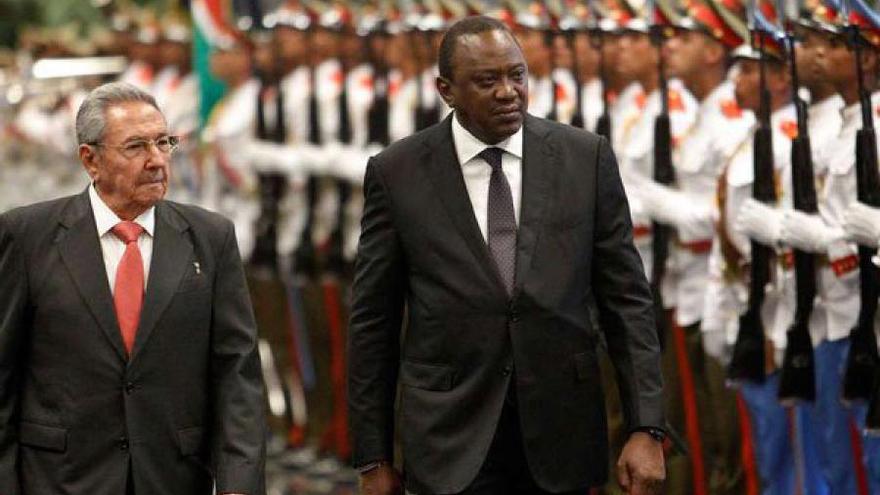
Raúl Castro and the Kenyan President during his official visit to Cuba in March. (Minrex)
“I think I could summarize [the visit to Cuba] this way: I have seen the future and it works,” Kangumu County Governor Anyang ’Nyong’o, who accompanied the Kenyan president on his trip to the island, told African media.
“They have very good primary health care, they have excellent referral facilities, and I think that for us, who want to implement universal health care coverage, this is the place we should go and learn from,” he added.
The governor explained that the agreement seeks to bring two Cuban specialists to each of the counties of the African nation. The Kenyan Health Minister, Sicily Kariuki, said the agreement would last two years and asked that the discussion about bringing in Cuban doctors “not be politicized.”
14ymedio tried to communicate with Kenya’s Ministry of Health to learn the details of the contract for Cuban doctors (as of now unpublished) but did not get a response from the authorities.
Cuba promised the Kenyans vaccines against cattle ticks and technical support in the training of that nation’s boxing team. The cooperation planned with the Island is a part of the Big Four initiative with which President Kenyatta seeks “food security, affordable housing, industry and healthcare accessible to all.”
Havana bases a large part of its economy on the export of services, mainly health services, which provide the country an annual income of 11.5 billion dollars, according to official data not confirmed by independent means. The Cuban Government keeps more than half of the payment made for each doctor hired by foreign States or institutions.
________________________
The 14ymedio team is committed to serious journalism that reflects the reality of deep Cuba. Thank you for joining us on this long road. We invite you to continue supporting us, but this time by becoming a member of 14ymedio. Together we can continue to transform journalism in Cuba.
A woman in Havana showing Cuban convertible pesos and Cuban pesos. (Cubanet)
EFE via 14ymedio, Havana, 30 March 2018 — Cuba’s Central Bank, on Thursday, tried to calm the “false” rumors that one of the two currencies circulating in the country will be immediately withdrawn in the process of monetary reunification, which has led to a rush on banks and currency exchanges.
“This event is based on the false information that in the next few days the Cuban convertible peso (CUC) will be removed from circulation as part of the monetary unification process,” said a statement from the Central Bank, read tonight on the government channel’s primetime evening news.
Monetary unification is one of the primary pending reforms in Cuba, where two currencies currently circulate: the Cuban peso (CUP), in which state salaries are paid, and the Cuban convertible peso (CUC), the hard currency, with its value tied one-to-one with the US dollar and equivalent to 24 CUP, according to official exchange rates. continue reading
The persistent rumors about the imminent unification of the two currencies, reflecting the Cuban government’s plan to eliminate the CUC which it began working on in 2013, has caused hundreds of Cubans to go to banks and currency exchanges in recent weeks to get rid of Cuban convertible pesos and exchange them for Cuban pesos (also known as “national money”), dollars or euros.
The official statement insists that “the CUC will continue in circulation until such time as its withdrawal is decided on as a part of the monetary unification process, an event that will be officially announced.”
“The date for the beginning of the process of monetary unification has not been set,” stresses the agency, which also insists on the permanence of the current rate of exchange.
Finally, the Central Bank noted that during the 7th Congress of the Communist Party of Cuba there was “once again, the decision to guarantee deposits in bank accounts in foreign currencies, CUC and CUP, as well as the cash held by the population.”
Last December, during his most recent speech before the National Assembly, President Raúl Castro urged that the unification process be completed and described the elimination of the double currency as “the most important process” that needed to happen to advance his reforms.
“No one can calculate the high cost that the persistence of duality has meant for the state sector, which favors the unfair inverted pyramid: where there is greater responsibility, there is lower remuneration,” Castro said in his remarks.
He also warned that the situation promotes the migration of skilled workers to the non-state sector, which pays higher salaries and pays them in CUC.
Although the CUC is officially quoted at a value of 24 CUP, several official exchange rates coexist in the accounts of State enterprises in Cuba, which, according to some analysts, generates strong distortions that make it impossible to caculate the real state of the Centralized Cuban economy.
________________________
The 14ymedio team is committed to serious journalism that reflects the reality of deep Cuba. Thank you for joining us on this long road. We invite you to continue supporting us, but this time by becoming a member of 14ymedio. Together we can continue to transform journalism in Cuba.
Havana Times, Lynn Cruz, 3 April 2018 — After being expelled from the San Antonio de los Banos School of Film and TV (EICTV), the Actuar Agency has decided to not represent me anymore.
Actuar doesn’t find me work but it stops me from being able to invoice my work as an actress if somebody else hires me in Cuba.
There are two companies which represent actors who work in film and TV, Actuar and Caricato, both of which are owned by the State. The fact that they are denying me representation means that my legal assessment documents from here on out as an actress in order to get paid, won’t be valid, as the company won’t validate them. This decision is an attempt to destroy and put the brakes on my professional life here in Cuba. continue reading
But, something strange has happened, it seems that Actuar and the EICTV, didn’t reach an agreement. The EICTV is blaming Actuar for refusing to represent me, but I received word of Actuar’s order after I was banned from taking part in the Norma Angeleri workshop at EICTV.
Jorge Luis Frias, Actuar’s director, bit his tongue when I asked what the reasons behind this decision were. As I caught him off guard and the script he was supposed to repeat hadn’t been written yet, he didn’t know what to answer, so he promised to write down the reasons for my expulsion in a week’s time because the real people who executed the order don’t reside within this agency.
Has this decision come from the Ministry of Culture or Villa Marista, Cuban State Security’s military base?
In face of such an obvious sham, I told him that they had also done something illegal, because before undoing my contract, both parties have a thirty-day period to repeal the decision if need be, if I haven’t worked for longer than six months or because of absences, and if both parties don’t reach an agreement, a legal process could be opened.
So, I am still legally a member of Actuar, however, my last wages from EICTV were brought to my house in cash, when Actuar should have issued me a cheque. Frias, like any good executing soldier, didn’t care about going off his bureaucratic script because the “good director” has clearly been assured that he wouldn’t suffer any consequences, even if I made a claim.
Now then, it doesn’t say anywhere in this joke of a contract that representation must be withdrawn because the artist doesn’t accept being gagged and stopped from saying what she thinks, which is the real reason behind these schemes and manipulations.
I can’t explain how bad I felt while I tried to explain what had happened to Angeleri, who had practically been deceived by every board member at the EICTV.
Nobody who lives outside of Cuba is ready to understand that this is a sick society where everyone wears a mask and that the line between the truth and a lie, between what’s real and pretend, has been lost.
But, they haven’t punished me because luckily enough, I’ve never lived off of this salary, I have always gone to the EICTV because I love film and that’s why I offer my services as an actress to the students and professors there. I feel I have a duty to work there, to give back all of the knowledge that my own teachers have given me, in this marvellous exchange that making a movie entails.
The only thing they’ve managed to do with these decisions is to destroy the school’s image, which is far from being the place that Fernando Birri described during its founding:
“So that the place of utopias which is nowhere by definition, can be found somewhere.”
This is another of the Revolution’s failed dreams, in the hands of irresponsible, unprincipled persons who are blinded by power.
In my case, the measure only reaffirms what I’ve always been, an independent actress and the students that I’ve worked with at the EICTV who want to call me, I’d like to tell them that I was indoctrinated at socialist schools, where I was taught that the most important thing in life was to be good at whatever I chose to do and, for a long time, my History teachers made me believe that money would cease to exist in 2000 in Cuba.
Starting over is a real challenge for any artist. If they want me, I’ll work for free. Artists don’t believe in bureaucracy.
The video below is not translated into English but it is subtitled in Spanish:
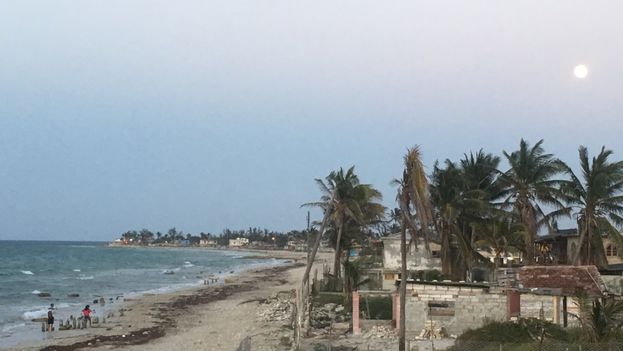
The resident on the first line of Guanabo beach see how the sea is getting closer to their homes. (14ymedio)
14ymedio, Havana, 2 April 2018 — The perimeter wall has a concrete reinforcement every two yards. “Even with this we can’t stop the sea,” says Elsa, a retiree who lives 50 yards from the coast, in La Conchita, east of Havana. “Here the fight is hard, either the waves destroy us or [Samuel] Rodiles destroys us,” she laments, referring to the president of the Institute of Physical Planning (IPF).
The town of Guanabo is the scene of a silent war being fought between three sides: the sea, the government and residents. At night, waves splash the windows of the buildings on the beachfront. At dawn a trail of debris represents the structures that failed to resist. continue reading
Every day that a front gate doesn’t end up under water or receive a demolition order is a victory for the residents of this tourist area, who fear both the advance of the tide and the IPF, led by General Samuel Rodiles Planas, a man of the old guard to whom Raúl Castro has entrusted the task of bringing order to the country’s urban and housing chaos.
Since Rodiles took office in 2012, he has waged a tough battle against homes located very close to the sea under the slogan of “restoring legality in the coastal zone.” On the beaches of eastern Havana new constructions, extensions or the remodeling of houses that are less than 200 feet from the edge of the sea are forbidden.
The denunciations and the inspectors have become a nightmare for those who live in that strip of coastline, with white sands, which begins in El Mégano, passing through the more elitist Santa María del Mar, the familiar Boca Ciega or the deteriorated Guanabo, until you reach the farthest Jibacoa.
The restrictions imposed by Rodiles seriously affect those residing in the area who make a living from renting rooms to domestic and international tourists. “They give us loans to buy construction materials, but then they do not give us permission to improve our homes,” explains Jorge Marrero, who holds a “self-employment” license allowing him to rent two rooms.
“What many residents are doing is remodeling in secret, little by little and without much notice, so the inspectors won’t show up,” he says. The landlord maintains that “there is an interest in moving all Cubans who live close to the water, to put those areas under state ownership,” he says.
In some ruins, like this state building, the damages caused by the proximity of the waters, join forces with neglect and vandalism. (14ymedio)
Cuba could lose over a thousand square miles of land and several thousand homes by the year 2050 due to the rise in sea level, which is expected to total over 10 inches by that time, according to statements to the official press by the director of the National Agency of Environment, Tomás Escobar.
This situation “will increase the vulnerability of coastal settlements, reduce forest and crop areas, and the quality and availability of water,” the specialist points out. Among the most affected areas are the north coast areas of the provinces of Matanzas, Havana, Mayabeque and Artemisa.
In Guanabo, east of the capital, Elsa has hired a team of masons who on Tuesday will reinforce the wall that separates her house from the sand, where the sargasso is piling up. “There are days that I’ve woken up with people sleeping in the doorway because they think this is a public part of the beach,” she says.
In 2017 the Council of Ministers approved a State Plan to confront climate change. The Minister of Science, Technology and Environment, Elba Rosa Pérez Montoya, warned that climate change “will aggravate environmental problems, becoming a determining factor in sustainable development.” But the package of official measures also has a dark side.
“They show up and tear down everything that is close to the coastline, it doesn’t matter if it is contained within a property,” Elsa says, complaining about the performance of the IPF. “When I was born the beach was much farther away and it is not our fault that now it’s in the patio,” she reflects. But every year, the waters have continued to enter the settlement at a speed difficult to ignore.
The IPF relocates people to other areas, but the task is complex because it is estimated that in the country there are more than 35,000 people in vulnerable conditions and more than 11,000 homes affected by the rise of the water.
In La Conchita, several residents who live with their doorways right on the beach have been pressured to move “inland,” a vendor of guava cakes in the area, who preferred anonymity, tells this newspaper. “They want to put us in buildings that look like matchboxes, but we were born and grew up with the sea in front of us.”
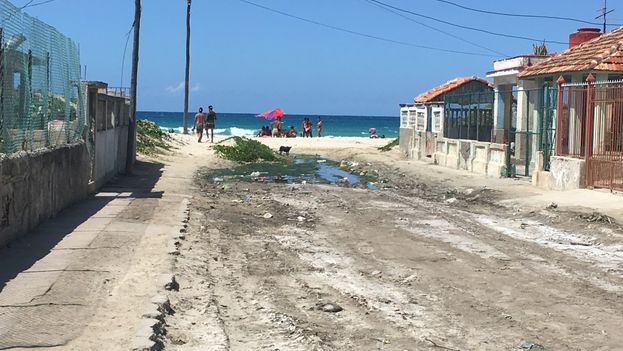
The areas of the streets closest to the sea are almost entirely covered with sand. (14ymedio)
The home of the small merchant shows serious effects on “the foundations and the walls closest to the water, but nobody in my family wants to move,” he says. “We are going to stay to pressure them and make them offer us something better, also near the sea.”
According to scientific studies, the climate of the island is warmer every year. In the last 17 years the country has suffered nine intense hurricanes and it is estimated that the sea level has risen rapidly. It doesn’t take a scientist to realize: “The water is coming into the living room of the house,” explains Rogelio, owner of a house that he rents tourists in the area of Boca Ciega.
“Years ago we lost the wooden bridge that joined Boca Ciega with Santa María because the sea destroyed it, but no state work brigade has come to repair it,” he complains. Rogelio believes that “the great disinterest in fixing the place is because they want to get us out and make all this the property of the State.” He believes that “they are going to give this to foreign firms to build hotels, as they did in Varadero.”
For many residents in the lower areas of this coast, there is “a coincidence between what the Government wants and what the sea wants: to get us out of here,” says Rogelio, who sees in the official neglect when it comes to repairing infrastructure like streets and sewers, a way to “push people to leave.”
The avenues of Guanabo are full of gaps at the corners, where there once was a sewer system, but the streets that run into the sea have been lost under the sand and the supply of brackish water is unstable.
The options for neighbors who choose to relocate are uncertain. “There are people who had mansions near the sea and now they’re suggesting that they live inland in buildings without many amenities,” says the retiree.
Some prefer to stay and resist. “Nothing can be made with iron because the saltpeter causes it to fail and damage everything around it,” says Geondys, a 28-year-old bricklayer who works on several of the houses in the area. “This, more than masonry is just makeup, because these houses have to be refurbished every month to be maintained.”
Some of the remains of houses or sidewalks have been integrated into the landscape of Guanabo, which the vacationers take advantage of to sunbathe or put their belongings safely above the water. (14ymedio)
Geondys’ specialties are the perimeter walls, the external showers for customers to clean the san off before entering the house and the installation of moderately hermetic windows that stop mosquitoes, saltpeter and the invasion of strangers that in the summer months become more reckless with the houses that are closer to the sea.
“I make a living from this, so what for many is a problem for me is a way to support my family,” says Geondys. “The sea puts food on our table.”
Others, like the owners of the restaurant Le Mare try to take advantage of the waves that get closer and closer. “Customers like to eat on our deck because it’s like they’re on a pier over the sea,” an employee told 14ymedio, from the premises with several tables facing the immense blue. “Hold onto your napkins,” he warns each diner to prevent them being blown away by an onslaught of the sea breeze.
A small fence separates Le Mare from the sand where three catamarans offer trips in the area to those who want to mix a lobster with maritime pastimes, or a beer with some adrenaline on the tide. The boats are private and charge around 5 CUC for a short ride. “The proximity of the water to the houses benefits us, because this way the clients are closer,” says one of the pilots.
The man, who defines himself as “catamaran champion and expert on the Havana coastline,” recalls a time when the terrace of Le Mare was not an arm’s length away. “There was a time when we were out of this, now we live surrounded by water.”
_________________________
The 14ymedio team is committed to serious journalism that reflects the reality of deep Cuba. Thank you for joining us on this long road. We invite you to continue supporting us, but this time by becoming a member of 14ymedio. Together we can continue to transform journalism in Cuba.
The customer must go pick up their products in the store within 48 hours after the ‘online’ purchase ‘online.’ (Facebook)
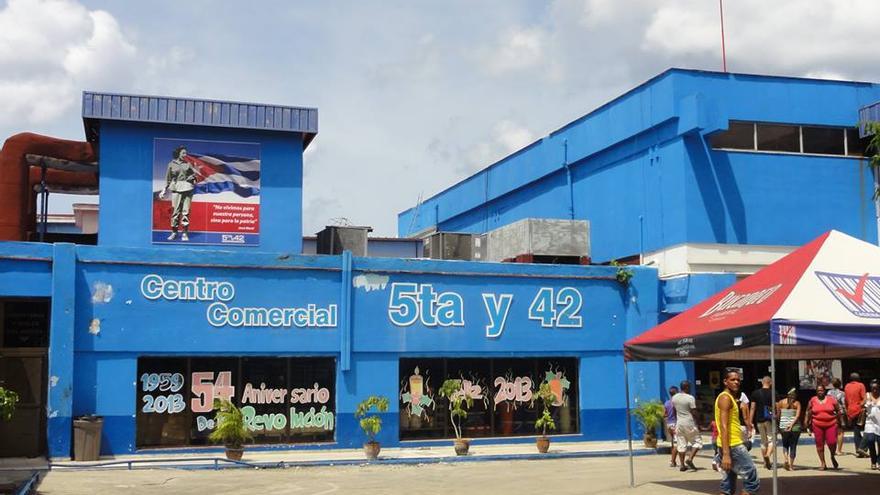
14ymedio, Havana, 3 April 2018 — Thirty years behind the rest of the world, online shopping will arrive in Cuba this summer. The service will be available only to customers with magnetic cards in national currency, also known as Cuban pesos (CUP), and products must be picked-up in person, according to a note in the official press on Monday.
“In the first phase, it will only be available at the 5th and 42nd Shopping Center in Havana,” the note says, which also details that the new service is a part of the “computerization process of the country” in order to “make some things more accessible and fast for people.” Predictably, the service will be extended later to “at least one store in each province.” continue reading
For years Cubans have dreamed of being able to use e-commerce platforms such as Amazon, Ebay or Alibaba, but all this has been delayed by the lack of internet connectivity in the country, the problems associated with obtaining a debit or credit card of any kind linked to a bank account, and the very poor quality of the postal service which preclude its involvement in package delivery.
The first operations of this kind in the country will be carried out by the Caribbean Chain of Stores, formerly called Hard Currency Collection Stores (TRD), which are managed by the Armed Forces and have retail locations throughout the Island.
The payment gateway through which the products will be purchased is managed by the state-owned Defense Information Technologies Company (Xedit).
“Some time ago we had been working with Xedit in the development of the payment gateway, which currently only works internally while we are evaluating its performance, but which as of the summer should be available for the use of the population. When you have connectivity, you can make your purchases at any time from your home, workplace or other places,” explained Martha Mulet Fernandez, sales specialist for the sales department of Caribbean Chain Stores.
The website to make purchases is already available at http://5tay42.xetid.cu according to the organizers, but a test carried out by 14ymedio showed a privacy error message and the site’s homepage was never displayed.
The online store will start working for the purchase of products this summer, but the official press release did not specify the date.
New users must register, choose the products they want to buy, enter their card data into the payment gateway and confirm the purchase. The invoice and proof of the transaction are sent via email.
Initially the store will only offer food, beverages and liquors, but “depending on the demand the remainder of the chain’s 14 families of products will gradually be added,” says Mulet Fernandez.
The customer must pick-up their products in the store within 48 hours after the onlinepurchase, although the official does not rule out that “in the second phase we do want to deliver the purchases to each person at home, and in this way provide a more complete and higher quality service.”
In 1984, the world’s first electronic commerce operation was carried out. It was made by Jane Snowball, 72, who from her home in Gateshead, United Kingdom, ordered through the remote control of her TV, enabled as a computer terminal, a list of groceries from a nearby market.
In the middle of last year Cuban authorities launched Transfermóvil, an application for smartphoneswith the Android operating system to make payments from mobile phones, especially for electricity and telephone bills. The tool has been criticized for its slowness in registering new users due to organizational problems between the Telecommunications Company of Cuba (Etecsa) and state banking entities.
_________________________________
The 14ymedio team is committed to serious journalism that reflects the reality of deep Cuba. Thank you for joining us on this long road. We invite you to continue supporting us, but this time by becoming a member of 14ymedio. Together we can continue to transform journalism in Cuba.
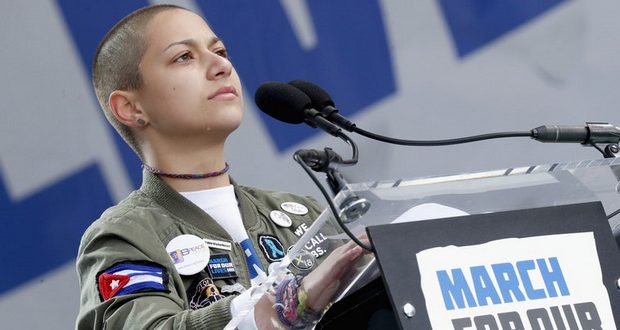
Emma Gonzalez at the March for Our Lives in Washington DC on 24 March 2018. Source: Teen Vogue.
Ivan Garcia, 2 April 2018 — On Friday, 23 March, with a temperature of 50 degrees and a warm sun melting the snow on the streets of Washington DC, a crowd of teenagers began to settle in, wearing T-shirts and caps stamped with the phrase that is now in vogue in the United States: #NeverAgain.
Flights arriving from cities all over America to the local Ronald Reagan Airport, were packed with young people with banners, many accompanied by their parents and teachers.
In a cafe, relatively close to the White House, children, teachers and family members waited for their boxes of pizzas and bottles of Coca Cola while listening to music on their smartphones. continue reading
“I’ve never seen such a big line so early in the morning. It looks like Saturday the 24th is going to be big,” said a clerk originally from Mexico.
The beautiful capital of the United States of America, is the best example of a variant of neoclassicism that arose in the United States between 1780 and 1820, defined as Federal style. The Capitol, the National Library and the Lincoln Memorial, among others, preserve the grandeur of ancient Greek temples.
The city has a European touch and it seems drawn with a brush. The buildings do not block out the sky and the people, despite the unusual spring cold, walk on the sidewalks. It is a pedestrian city with an efficient public transport, very different from Miami, where on any given day you lose two or three hours sitting behind the wheel of a car.
The National Museum of History, located in an area where museums abound, is usually full of schoolchildren who are attentive and respectful as they pass through the rooms that show important moments in the history of their nation.
In the five days I was in Washington DC, in hotels, Starbucks cafes or on the subway, the student revolution and a new law regarding guns was a matter of debate.
“Something we have to do. You have to stop these killings. It is not compatible with a society that promotes work and creativity. This country, unlike Trump or the gentlemen of the NRA, is multi-ethnic and people from all over the world come here to change their fate. It’s crazy that a young man, who can not buy alcohol in a liquor store, can buy an automatic rifle designed for war. It is a contradiction in a country that claims to be a standard bearer of the values of democracy and integrtation. With my two children I will go to the march (March for Our Lives),” said Irma, a Dominican-born maid who works at the State Plaza Hotel.
According to the authorities, on Saturday, 24 March, 800,000 people marched to express their discontent in front of the White House gates. A figure even higher than the protests against the Vietnam War in 1969.
The youth movement that emerged as a result of the shooting at Marjory Stoneman Douglas High School in Parkland, Florida, a shooting that on 14 February left 17 dead and 15 injured, has not gone unnoticed in Cuba.
It is true that the Castro regime takes advantage of any school slaughter, revolt or the murder of a black American to fire up its propaganda machine against ’Yankee imperialism.’
But this time it has been different. The image of Emma González, 18, with her shaved heat and a military-cut jacket with a Cuban flag on her right sleeve, has generated sympathy in different strata of Cuban society.
In Havana’s Diez de Octubre municipality, very close to the Red Square of La Víbora, while waiting for customers, two transvestites seated on a staircase at the entrance of an art gallery, spoke about Emma.
“That girl rules! In an interview I read on the internet, she declared that she was Cuban and bisexual. Over there you do not have to be hiding your sexual orientation. She dresses like she talks. Not Obama. Her mother is American and her father, José González, arrived in New York [from Cuba] in 1968. I hope that in the future, if things change here, that little girl will run for president of Cuba,” says one of the transvestites. “I would vote for her,” says the other, wearing a leather skirt and high-heeled shoes.
On Tuesday, 27 March, Cuba’s National Television News, aired in its entirety Emma’s speech at the March for Our Lives in Washington and her overwhelming six minute and twenty second silence: the time it took the murderer to riddle students and teachers with the bullets from his AR -15 rifle.
Dianely, the mother of three children and professor of biology, confesses that in addition to “being moved by the speech, I was struck by the the capacity of high school students to deliver such high-level oratory. In the national press I read that an major share of American students don’t know where Cuba is on the map and that their education was deficient. But those Florida kids are very well prepared. Emma has earned respect in many countries. In Cuba, it couldn’t have earned less. She has our roots.”
In a global and interconnected world, the good or bad that happens on the planet, diffuses in a few minutes. The women’s movement against sexual harassment and the student revolution to stop the sale of automatic weapons in the United States have been echoed on the island. In the case of Emma González, Cuban pride has shined.
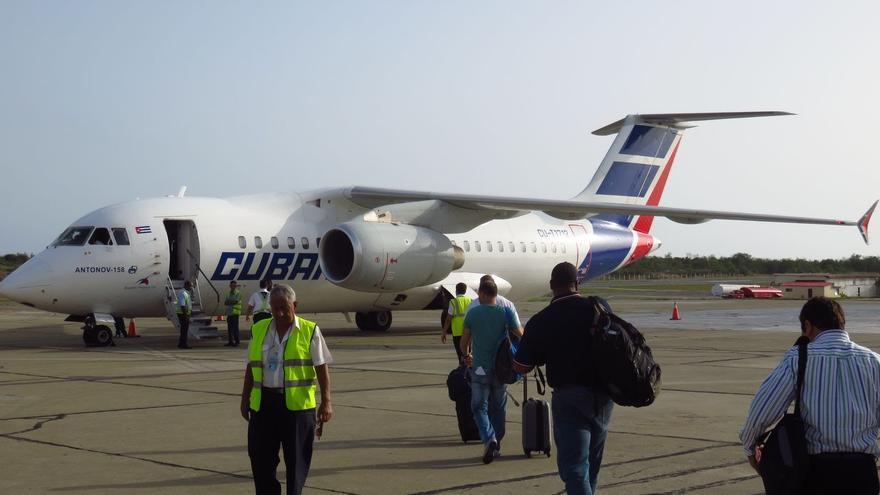
The six Antonov-158 aircraft that were purchased in 2012 are all on the ground due to lack of spare parts. (Screen capture)
14ymedio, Havana, March 29, 2018 — The Cuban airline Cubana de Aviación has suspended domestic flights “until further notice” due to lack of aircraft to cover its scheduled flights, as an information employee at Havana Airport’s Terminal 1 confirmed to 14ymedio on Wednesday.
“There are no planes,” said the worker, citing the reason for the suspension of all flights by the island’s main airline. Seats on the canceled flights were purchased by local residents using the national currency although “other airlines, such as Cubatur, are still providing service to tourists.” continue reading
Tickets purchased using the national currency are subsidized by the state with the requirement that a ticket be purchased up to three months in advance at the offices of the company located in the provincial capitals or in the main domestic destinations. Tickets on Cubatur can be purchased in Cuban pesos (CUP) when that airline has available seats.
The cancellations, which have not yet been reported in the national media or on the company’s website, is causing uncertainty among travelers who had tickets to fly on Cubana de Aviación in the coming weeks.
“The phones are ringing constantly because a lot of people found out through the internet and we are getting a lot of complaints. But we guarantee we are doing everything possible so that no customer is stranded,” says the company employee.
Authorities from the state-run company have devised a solution for transporting passengers that apparently involves “a bus, train or available space on another airline’s plane,” added the airport worker.
“I have a ticket for April 8 and, so far, I have not received any notice from Cubana de Aviación about a change in transport that I will have to use,” explains Ángel Collazo, a passenger who frequently makes the trip between Camagüey and Havana.
Although the airline does not often cancel all its domestic flights, partial cancellations are routine. “The last time I made this trip, I had to wait 12 hours at the airport until they transferred us to a bus,” Collazo recalls. “In all that time, they only gave us a small sandwich and a soda,” he says.
For several months, complaints have been growing about Cubana de Aviación operations due to ongoing delays and canceled flights. In 2016, more than 50% of the flights between Holguín and Havana were delayed according to reports from the Holguín press.
Company directors have stated that “technical problems with the aircraft” are the main causes of delays and suspended flights. When flights are cancelled, passengers are rerouted to buses and other means of transport.
In 2012 Cuba bought six Russian/Ukrainian-made Antonov-158 aircraft to modernize its national fleet. But a company employee who has requested anonymity told 14ymedio that the aircraft have presented successive “difficulties and problems in acquiring the spare parts.”
“The first problems occurred because the An-158 was purchased from Ukraine but the agreement for spare parts was signed with Russia. Shortly thereafter, the problem between the two countries began and that’s where we stand,” the source added. “Now everything is on hold.”
In 2017 a lease contract with the South African company Solenta Aviation was signed, adding two ATR 72-500 aircraft to the fleet. The aircraft were incorporated into domestic routes such as Baracoa, Holguín and Varadero, but tickets can only be purchased in hard currency.
______________________
The 14ymedio team is committed to serious journalism that reflects the reality of deep Cuba. Thank you for joining us on this long road. We invite you to continue supporting us, but this time by becoming a member of 14ymedio. Together we can continue to transform journalism in Cuba.
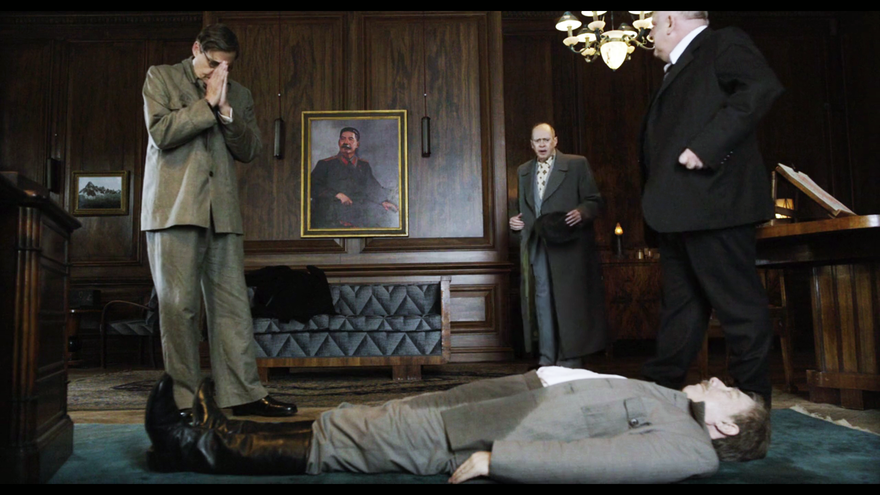
The screening of ‘The death of Stalin’ was initially suspended in Russia. (Still)
14ymedio, Daniel Delisau, Las Palmas de Gran Canaria, 31 March 2018 — “I never thought it would be you,” says Svetlana’s character to the actor Steve Buscemi, who plays Nikita Khrushchev in The Death of Stalin. At the end of the film, the daughter of the late dictator realizes that, after the struggle for power unleashed by the death of the man who ruled the Soviet Union between 1924 and 1953, Khrushchev had won.
Eight years after the premiere of In the Loop, until now his only feature film, the director and screenwriter Armando Iannucci has returned to the big screen with a film that remains true to his characteristic humor, as he satirizes the intricacies and intrigues of the political game. continue reading
In approaching such a dark historical period, both in the history of Russia and for all of humanity, it is almost instinctive to want to find a moral lesson in The Death of Stalin, beyond the humor. But Iannucci’s objective seems to be the same as that captured in his debut: to convey that in the intricacies of politics, which sometimes border on the absurd, winners and losers always emerge among its participants.
In spite of the obvious and well-documented events, there is little reliable information about Stalin’s death and how the principal and decisive political decisions were made in the days following his passing. Luckily the secrecy inherent in political life in the Soviet Union lends itself to artistic creativity, since it cannot be said that the film is based on real events, but on hypothetical facts that have freed it from the straitjacket of historical rigor.
At other moments, on the other hand, the film needs only to sip from reality to unwind the absurd. In the face of a need to find doctors to treat the apparent stroke that ended up killing Stalin, the film shows his main collaborators wondering which doctors they might call, given than 37 of the best had recently been imprisoned precisely because they were accused of wanting to poison the dictator.
In real life, the sinister Lavrenti Beria, one of Stalin’s closest collaborators and head of the NKVD (the body responsible for political repression and the murder of thousands of people), began to put an end to the well-known Doctors’ Plot and other repressive labors just one day after Stalin’s death. Overnight the Soviet Union’s primary torturer became its first reformer and liberator in an attempt to launder his image.
This dichotomy is captured in the film and finally ends up making us realize that the work of Iannucci could well have been called The Death of Beria, because while Khrushchev ends up victorious in the struggle for power, the head of the NKVD ends up being condemned to death by his closest Party comrades, who were not much better than him but who feared and hated him in equal measure.
“This is how people die when their stories don’t add up,” Khrushchev lectures Stalin’s daughter in front of Beria’s cremated remains. Unlike Stalin and other dictators before and after him, who in real life knew how to play their role as tyrants until the end, Beria wanted to change his role in the script of life when it was too late.
Khrushchev emerges victorious from the struggle for power, and the NKVD’s chief, Lavrenti Beria, ends up condemned to death by his closest comrades in the Party. (Still)
The sarcasm inherent in British humor, one of the main characteristics of which is the most subtle personal undermining, flows very well in political comedies such as In the Loop or The Death of Stalin, where the suspicion, paranoia and hatreds of the main characters — almost all of them politicians — form the central nucleus through which the action takes place.
“Coco Chanel messed with your head?” an annoyed Marshal Zhukov asks Georgi Malenkov, who is presented as a weak character with a ridiculous hairstyle, and who became Stalin’s successor for nearly two years after the dictator’s death, until he was deposed by Khrushchev.
There is, however, an ambiguity in this comedy around the use of Anglo-Saxon black humor. As a screenwriter, Iannucci is aware that humor has no limits, but its use in The Death of Stalin raises doubts about its intentionality.
Despite being a comedy, there are plenty of unpleasant scenes for the viewer, including executions, arbitrary arrests and torture carried out against the Soviet population for political reasons. Listening to the ingenious dialogues of several characters in the basement of the Lubyanka building — the headquarters of the NKVD — while in the background the gunshots of summary executions are heard, it is difficult to discern whether Iannucci’s goal is simply to exploit black humor as much as possible or to create feelings of disappointment in the audience, who know they are laughing at some macabre and fictional scenes but who also know that in an underlying sense what they are seeing and hearing is shockingly real.
Coincidentally, leaving humor aside, the projection of The Death of Stalin in Russia last January has managed to say more about the country’s current political situation than it does of the period led by the long-dead Soviet dictator. Fruit of an authoritarian tic, the Ministry of Culture at first suspended the projection of the film for being an insult to the history of the USSR and to Soviet citizens, but it was finally exhibited, at least in one Moscow cinema and to packed audiences, possibly because Russian law prevented its prohibition.
“Do not worry, nobody is going to be killed tonight, I promise,” says the director of Radio Moscow to the bewildered audience at a concert that had only been broadcast live, but that by order of Stalin had to be repeated so that it could be recorded and a copy sent to him.
Nobody comes to a bad end in that scene. Nor has the Russian authorities’ objection to the public screening of the film gone beyond the anecdotal. But reality and fiction are here to show us a country whose society is not yet able to demonstrate its patriotism — questionable but legitimate — if it is not centered on an authoritarian leader.
In the past it was Stalin and the rest of the Soviet leaders; today it is Vladimir Putin, who has been ruling for 18 years and can now remain in power for another six years, after his victory in the recent elections. It remains to be seen if the struggles between his successors that will take place after his departure may be the source for the script of another movie.
__________________________
The 14ymedio team is committed to serious journalism that reflects the reality of deep Cuba. Thank you for joining us on this long road. We invite you to continue supporting us, but this time by becoming a member of 14ymedio. Together we can continue to transform journalism in Cuba.
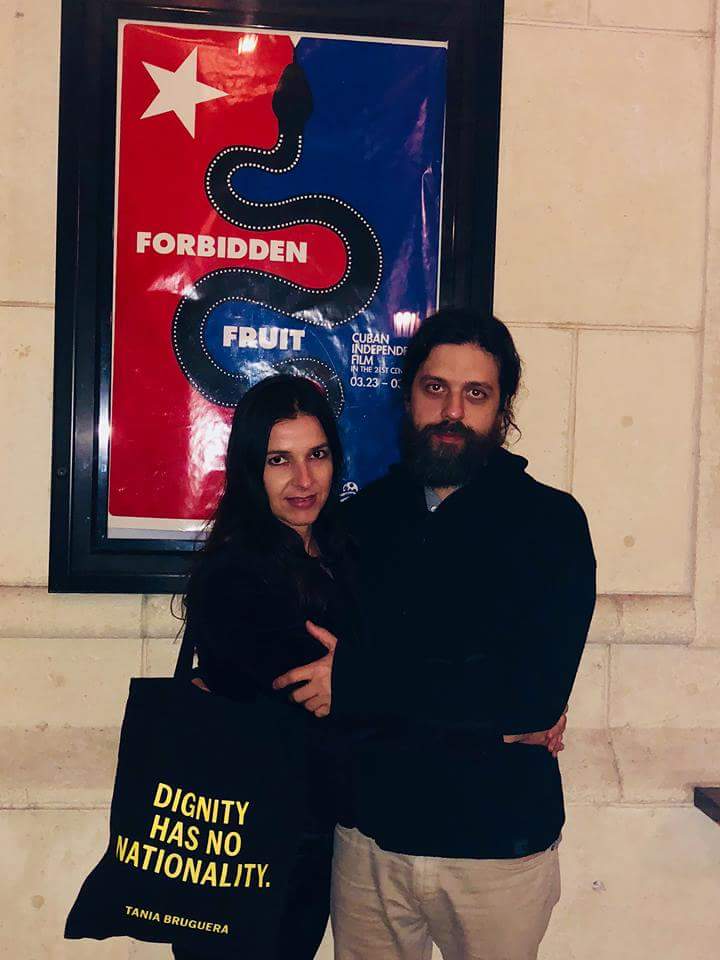
Havana Times, Lynn Cruz, 31 March 2018 — The first Independent Cuban Film Festival organized outside of Cuba coincided with my ban from entering the International Film School of San Antonio del Los Banos. With Cubans from the country of “Miami” taking the lead, the event had as its forerunner another that had been organized by the Hannah Arendt International Institute for Artivism, led by Tania Bruguera, which took place in New York’s Museum of Modern Art at the beginning of this month.
Cubans in Miami have won themselves a piece of land in the US. Terrified of Castrismo, they fell like expatriates into the exile boat and contrary to popular belief, thought and art are buzzing here in this city, in spite of its arid landscape and Anglo-Saxon toughness. continue reading
In addition to meeting friends who stood in solidarity with me after I lost my place in Argentinian director Norma Angeleri’s workshop at the Film School, my first surprise when I stepped foot on Cuban-American soil was to meet Nat Chediak, the founder of the Miami Film Festival, in a Chinese restaurant called No Name, which he had deliberately chosen to pay homage to the belittlement that Rafael Alcides embodies in our movie Nadie.
We met Javier Chavez, who was with Chediak, a young, introverted Cuban-American who is slow and deliberate with a really sharp way of looking at things, who collaborated in the festival showing movies and assisting Chediak. Chediak has never returned to Cuba, but he says he never left. He lives it through film. He has been scheduling movie screenings for nearly half a century.
On the other hand, Chavez confesses that he doesn’t feel Cuban at all; he is 27 years old and the curious thing is that most of his generation who live in Cuba, don’t identify with their own country either. Identity is something that is yet to come. You aren’t born with it. A sick land spoils its fruits. It will never be a reason for compatibility.
The Forbidden Fruit Festival at the Coral Gables Art Cinema concluded on March 29th. It included a varied program with 25 movies, bringing together most of the movies that are left in the dark in Cuba. If they don’t deal with subjects banned by the government, some of them find their way into the Weekly Packet, also know as the Cuban Netflix.
Every week, those who are lucky enough to own a computer can purchase this Packet for 2 Convertible Pesos and receive 1 Tb of information, movies, series, TV programs made in Miami, the most-watched videos on YouTube, as well as independent Cuban movies.
The most daring, which can’t be found in the Weekly Packet, are in the Paquetico (Little Packet), which has a more limited, but bold selection.
Today, Cuba could be analyzed via “illegality,” a term that was invented to describe something that survives in a legal limbo. Thus, independent movies and media and a large sector of our national economic activity, both public and private, suffer under this irregular status.
There is currently a movement that has been created by new technologies and access to new media, which has sparked the evolution of filmmaking to making movies with low budgets, most of which come from crowdfunding campaigns and the self-management of young filmmakers, who are determined to defend a platform that gives them a voice.
However, many of these movies don’t then find their way into a place to be shown, in or outside the island, if they make Cuban politicians uncomfortable because of its daring content, which aren’t subject to self-censorship which most Cubans movies are.
Bruguera and Chediak have come together accidentally and they are raising their voices in the name of a Cuban community that suffers the pain of having their land kidnapped from them. Thus, the subjects dealt with in these movies revolve around deceit, a lack of freedom, fear which borders on paranoia, neglect, apathy, poverty, movies which live in the Post-Fidel world.
The thing I liked the most about Forbidden Fruit was the willingness to move past the hard feelings and disappointments that Cuban people have, who can only come together through art, especially film. There is an English saying that goes: “The boss sets the tone.” Chediak has promoted a dialogue between viewers and filmmakers which, at least in my case, has led to the most special experience I’ve ever had as an actress.
I could see Nadie in a movie theater for the first time, in high definition, and confirm, alongside its director Miguel Coyula, that its audience are Cubans wherever they live, as Rafael Alcides, the dissident poet and lead character in the documentary, manages to express his truth which is the same truth for anyone who has suffered indifference at the hands of a system after crushing anyone who has judged it outrightly and been in power for nearly 60 years.
We were invited to Channel 41, to the program A Fondo, which is hosted by Pedro Sevsec and accompanied by critic, journalist and one of the festival’s curators, Alejandro Rios, a program which goes beyond the local and deals with more universal issues.
Meeting up with Juan Carlos Cremata, Eliecer Jimenez and Humberto Padron, three Cuban filmmakers who also took part in the festival with their movies, was a gratifying and also sad experience at the same time. Trapped by a black and white policy, just like we are, which hasn’t done anything but divide the Cuban people from its exile community. We were free of all labels and manipulation for a few days. The Forbidden Fruit Festival appeared as a real alternative project for independent works created outside of Cuban institutions and the government.
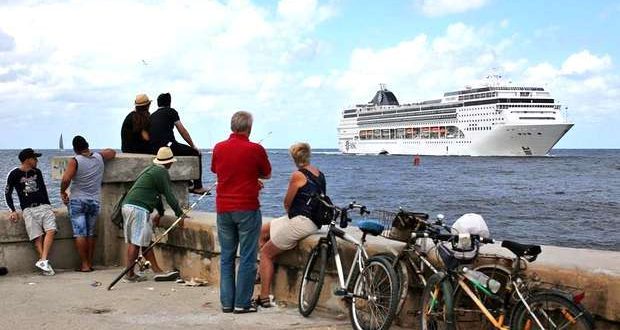
Cruise ship entering Havana. From El Nuevo Diario.
Iván García, 29 March 2018 — As the cruise ship sits docked at port, two ragged old men lie drunk on top of the seawall. An almost motionless gray-haired man tries to catch fish in the fetid waters of the bay. Around him, several stray dogs fight for the leftovers of a fried chicken that a passerby has thrown on the sidewalk.
Curious onlookers take snapshots of the imposing ship with their phones. A squadron of police is there to keep the peace and to prevent the populace and the local rabble from harassing the ship’s passengers as they disembark in Havana. continue reading
After an expedited passport check, a bland complimentary mojito and a brief performance by some mulatto women with make-up running down their faces and visibly tired from dancing to Compay Segundo’s “Chan Chan” in the cheesy reception that the official tourist agencies often put on, the travelers exit the terminal.
A young man speaking in a low voice and in rudimentary English offers “girls, boys, cigars, Cuban music DVDs” to a somewhat startled British tourist walking along the cobbled street of the Lonja del Comercio.
The official guides — they are dressed in green, yellow or white shirts, the colors corresponding to the hotel group to which they belong — welcome them and describe a wonderful night under the stars at the Tropicana nightclub.
Freelance guides, who speak German, Russian and fluent English, also have tourist attractions to offer: “Señor, a tour of Havana in an old convertible, a visit to the Museum of Fine Arts, dinner at the private restaurant where the Obama’s ate and, to cap off the evening, salsa at Casa de la Música in Miramar, all for a hundred dollars.”
Outside the terminal swarm all manner of people, including hookers, male prostitutes and professional con artists. They have interesting cultural attractions to offer the newcomers.
From a distance girls in skimpy shorts — some overweight, with visible cellulitis — watch for tourists travelling alone, then approach them and offer them sex. Retirees selling peanuts or the dreary national newspaper Granma take advantage of the new crop of tourists, shouting, “Roasted peanuts for twenty-five American cents; Granma for thirty cents.”
The police try to scare off and intimidate the hustlers. But since these people know how the police operate, they wait for the phalanx of tourists to filter out through the old city streets before making their proposals, far from police radar.
A few noisy Europeans arrive at the Two Brothers bar and within a few minutes the placed is packed with others like them. In the area’s guesthouses, cafes and restaurants, half a liter of mineral water goes for three dollars and a beer for five.
Joel, a bartender at a guesthouse on the Alameda de Paula says, “Every time a cruise ship comes in, sales triple and prices take off. That’s why I stock extra bottles of rum, mineral water and beer. On a busy day, I can go home with 150 to 200 bucks.”
Private restaurants use assistants, with menus in hand, to invite strangers wandering nearby to come in. “For every American I bring in, the owner pays me a commission of three CUC. There have been days when I have brought in an entire busload of tourists,” says a gentleman who describes himself as a “private tourism manager.”
Most government-employed guides and drivers in the tourism industry have an under-the-table verbal agreement with the owners of private bars and restaurants. They charge fees of 5 CUC for single tourists and 100 CUC or more for a group of twenty or thirty. “Additionally, anything they eat or drink is on the house,” says the bartender of a private restaurant a stone’s throw from the former presidential palace.
Of course, the choices offered by the self-employed are more novel and attractive. Armando, the owner of a fully restored Chevrolet convertible, charges 70 CUC for a two-hour tour of picture-postcard Havana, including the restored colonial area, El Vedado and Miramar.
“If tourists are going to spend a bit more time in the capital, I suggest they visit Viñales, in Pinar del Rio province, which is the best example of a town with a range of high-quality private businesses. There are some foreigners with less money than others and then there are those who are quite stingy. The Japanese, Russians and Americans are the most generous. They give good tips and will invite you to lunch or to have a beer. Spaniards are despicable and foul-mouthed. I will only accept them as customers if there are no tourists from other countries available,” confesses Armando.
A recent development in the private tourism sector are those options described as “an experience in Cuba.” Usually, these are tours led by professionals with broad technical knowlege who introduce visitors to Havana’s rich architectural heritage. Others give casino dance lessons or teach people how to play the tumbadora. Former athletes offer physical training courses or provide instruction in the rudiments of boxing. But perhaps one of the most original options is offered by Olga Lidia, a former English teacher who invites tourists to live like Cubans for a week.
According to a smiling Lidia Olga, “Europeans — especially the Swiss and Scandinavians — and Americans love the idea. They sleep in a bedroom with an electric fan but no air conditioning. I give them a ration book to buy bread and chicken at the butcher shop. In the morning I put them on a city bus and take them to visit San Miguel or Arroyo Naranjo, where I have relatives. They can go online once, at a wifi hotspot in a public park. And they may have only a single meal on two out of seven days, like many Cubans. Some of them can’t take it and complain.”
While state-run establishments try to milk tourists, with prices comparable to those of New York but at much lower levels of service, private entrepreneurs are more creative and even offer discounts to visiting foreigners.
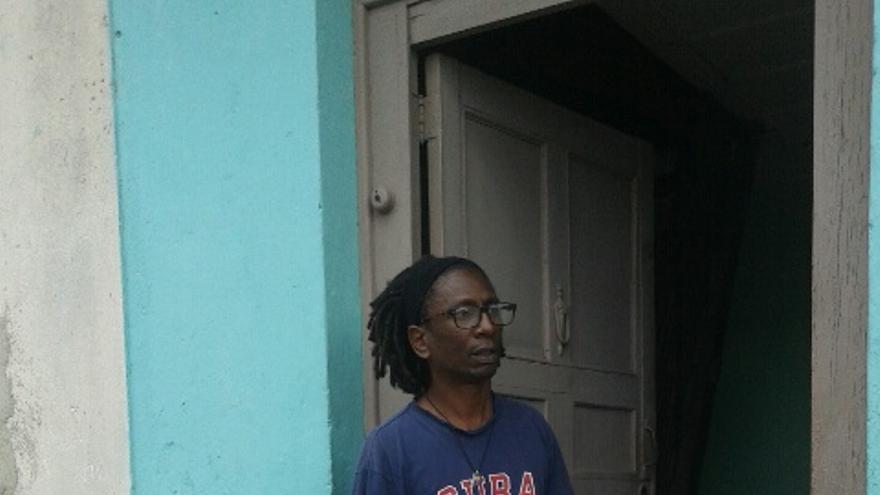
 14ymedio, Havana, 4 April 2018 — Independent reporter Rudy Cabrera, a contributor to Cubanet, was released on Tuesday afternoon after a 48-hour arrest. “They told me that this arrest was just the ‘kiss of the tiger’,” the journalist told 14ymedio. He also said that he was subject to “different levels of threats” during his imprisonment.